THE LIGHTHOUSE (2019)

by Miguel E. Rodriguez

Director: Robert Eggers
Cast: Robert Pattinson, Willem Dafoe
My Rating: 8/10
Rotten Tomatometer: 90% Certified Fresh

PLOT: Two lighthouse keepers try to maintain their sanity while isolated on a remote New England island in the 1890s.


tone poem
NOUN, a piece of orchestral music typically in one movement, on a descriptive or rhapsodic theme


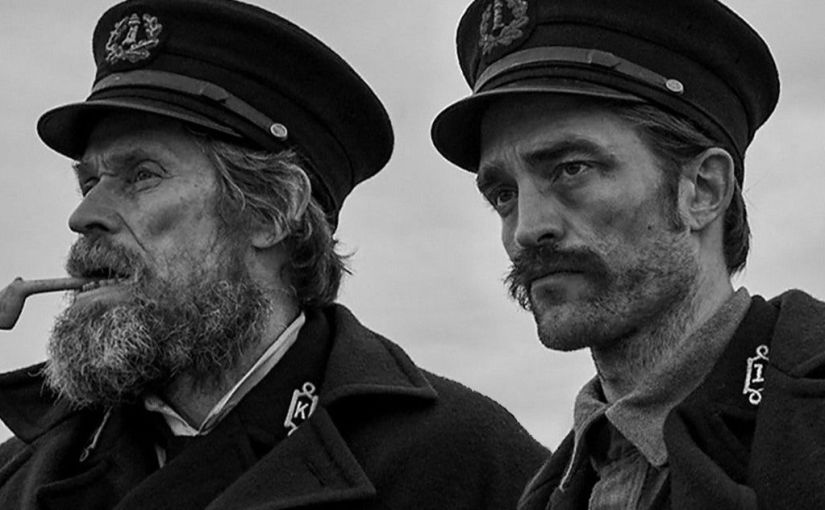
As I watched Robert Eggers’ The Lighthouse, that term “tone poem” kept leaping to my mind.  It’s not told in a standard or familiar fashion.  There are scenes where we’re not sure, until they’re over, whether they’re real or not.  The Willem Dafoe character, Thomas Wake, makes references to behavior in the past by the Robert Pattinson character, Ephraim Winslow, that Winslow never committed…or did he?  We are certain that Wake is the character who is going mad, if he’s not there already.  But what if it’s the other way around?  Or are they both going mad?

The mood or tone of the piece seems to be insanity and how one might get there given the right circumstances.  In many ways, it has quite a bit in common with another sensational tone poem of madness, Stanley Kubrick’s The Shining (1980).

Two men, Wake and Winslow, are lighthouse keepers in the late 19th century.  They are brought to a remote island in the stormy waters off the New England coast and left to fend for themselves for four weeks until the next tender brings supplies.  Wake (Dafoe) is a crusty old veteran lighthouse keeper whose speech and mannerisms appear to be based on Long John Silver, right down to the gimpy leg.  Winslow (Pattinson) is a much younger and, let us be honest, handsomer gentleman who keeps to himself whenever possible.  He tends to his duties, sometimes grudgingly but mostly not, but wonders why Wake flatly refuses to share the duty of tending the actual light source at the top of the lighthouse.  That mystery lies at the heart of the film, but don’t expect all your questions to be answered by the time the credits roll.  Fair warning.

A key decision by director Eggers was to shoot in black-and-white and in a very old screen format, 1:19, so the picture area is a virtually square space in the center of the screen, with black bars on either side.  (The Coen brothers did something similar with their brilliant adaptation of The Tragedy of Macbeth [2021].)  This visual language creates a uniquely claustrophobic atmosphere, especially in scenes taking place in Wake’s and Winslow’s quarters.  The walls are closer together, the ceiling feels lower, and the actors’ faces seem much closer to the screen than normal.  Even exterior shots seem more constricted and confining.  Wide open sky doesn’t look as inviting as it might to someone essentially imprisoned on a storm-lashed island for four weeks.
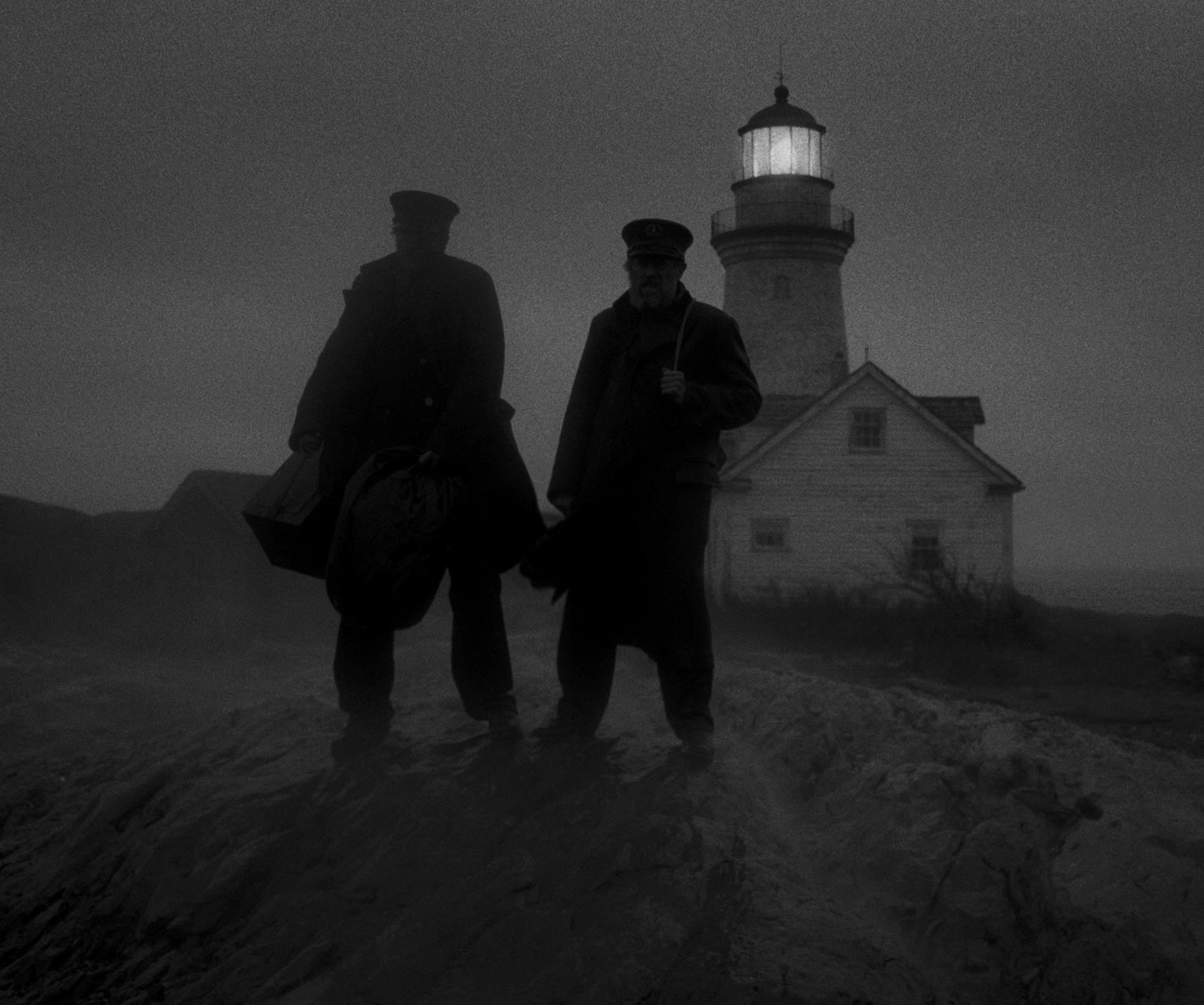

Like all the best films, The Lighthouse begins its descent into madness slowly and gains momentum as time passes.  Winslow discovers a mermaid figurine stashed inside his mattress.  That night he dreams about a mermaid in the surf.  Or was it a dream?  We glimpse Wake standing naked at the top of the lighthouse, almost as if he’s worshiping the light itself.  When Winslow tries to get a closer look at what Wake is doing up there, he glimpses something…supernatural.  Or does he?  The film is brilliant at not only portraying mounting madness on the screen, but also at conveying the tone of madness in the cinematography and editing.  If we’re not quite sure what is happening, even when we see it happening, that’s on purpose.  The audience is meant to be kept off balance throughout the movie to put us in the heads of the two main characters.

Another factor that I found riveting was the acting workshop on display from both Pattinson and Dafoe.  We’ve seen this kind of thing from Dafoe before.  He chews the scenery with Nicolas Cage-like gusto, spittle flying, prosthetic teeth flashing in manic sneers, and that crazy piratical accent.  If it had been revealed during the film that his character’s last name was Osborne, and that he was a distant relative of Norman Osborne from Spider-Man (2002), I would not have been the least surprised.

But equally impressive is Robert Pattinson’s performance, which must be seen to be believed.  Here is an actor who is set for life after being a part of two of the most profitable film franchises in history (Twilight and Harry Potter) and who has just rebooted a third (The Batman [2022]).  But in this film, he easily keeps pace with Dafoe’s quirkiness, which is not easy.  As his character descends into madness (or does he?), Pattinson dances a jig while singing a sea shanty that devolves into complete gibberish.  He laughs like a loon.  He, ah, takes some time for himself while fondling that mermaid figurine from earlier.  It’s the kind of performance that might be described as “courageous.”  He swings for the fences with abandon.  In so doing, he helps to make The Lighthouse one of the most unique movies I’m ever likely to see.

But what is really going on at the top of that lighthouse?  Why do seagulls pester Winslow so often, seemingly unafraid of him in any way?  Why does he continue to dream about mermaids?  IS he dreaming them?  Is Wake actually a merman?  Did real foghorns sound like that?  Why is one seagull missing an eye?

Well, come on, I’m not actually going to ANSWER those questions, but those are questions that occurred to me.  The movie does answer quite a few of them, but not all.  The point of the movie, like The Shining, isn’t about solving the mystery.  It’s about conveying the mystery, creating a mood of dread, and wallowing in it for a good 110 minutes.  It’s not the happiest movie I’ve ever seen, but it’s definitely one of the most original films of the last ten years or so.

COLOR OUT OF SPACE (2019)

by Miguel E. Rodriguez

Director: Richard Stanley
Cast: Nicolas Cage, Joely Richardson, Madeleine Arthur, Tommy Chong
My Rating: 9/10
Rotten Tomatometer: 86% Certified Fresh

PLOT: A secluded farm is struck by a strange meteorite which has apocalyptic consequences for the family living there and possibly the world.


Some backstory…

Once upon a time, there was a film director named Richard Stanley.  He made a few unremarkable films in the early 1990s, toiling in relative obscurity, until he hit the big time in 1996 when he got the opportunity to direct his dream project: a remake of The Island of Dr. Moreau starring none other than Marlon Brando.  The story of that film’s troubled production inspired a documentary all by itself (Lost Soul: The Doomed Journey of Richard Stanley’s Island of Dr. Moreau [2014]).  Stanley himself was fired after only four days of shooting and replaced by John Frankenheimer.  Rumor has it that Stanley secretly convinced the makeup crew to turn him into one of the background mutants so he could keep tabs on his dream project.  After Moreau bombed, Stanley’s career imploded, and he never directed another feature film.

…until over twenty years later when an enterprising film production company expressed interest in allowing him to direct another dream project: an adaptation of an H.P. Lovecraft story from 1927 called The Colour Out of Space.  To say that Stanley redeemed himself with this film would be an understatement.  This is one of the scariest movies I’ve ever seen.  It was supposed to be the first part of a Lovecraftian trilogy, but alas, Stanley was accused of domestic abuse in March of 2021 and the trilogy was scrapped.  One hopes that someone like Guillermo del Toro or Jordan Peele might pick up the promising threads here.  [insert good mojo dance here]

Anyway, the movie.

Color Out of Space is, at first glance, an amalgam of previous horror films.  One can easily spot elements of The Thing (1982), Annihilation (2018), and David Cronenberg’s The Fly (1986).  But when you consider the screenplay has been adapted from a 95-year-old short story, the movie takes on a prescient nature.  Here are all the elements of a solid contemporary horror film, in a story that was published the same year sound was introduced to motion pictures for the first time.  Remarkable.

The Gardner family lives on a secluded farm in the forests of New England, where the nearest township, Arkham, is an hour’s drive away.  (No, Arkham isn’t a Batman reference, it’s Lovecraftian…which might explain why the very name “Arkham Asylum” has always felt a little creepy all by itself.)  One night, a meteorite lands with a crash in their front yard.  This is no ordinary meteorite.  It glows with an unearthly magenta light, and by the following morning it has disappeared.  Shortly thereafter, the youngest son, Jack, starts hearing strange noises outside.  Mrs. Gardner (Joely Richardson), who is recuperating from cancer surgery, keeps getting disconnected from her business calls.  Nathan Gardner (Nicolas Cage) takes a shower one day and discovers what looks like a cake of soap covering the shower drain.  He picks it up…and experiences something NO ONE wants to experience after picking up a cake of soap.

Things get stranger.  A local hydrologist takes some water samples and urges the Gardner family and their squatter, Ezra (Tommy Chong), who lives in a shack on the Gardner’s vast property, not to drink the water until he gets some test results.  Meanwhile, Jack, the youngest son, takes a peek down their well and watches as an alien-looking egg hatches and releases a magenta-colored praying mantis.  Mrs. Gardner gets distracted by…something…and has a kitchen accident with a knife.  Their daughter, Lavinia (Madeleine Arthur), who dabbles in Wiccan rituals, hears a noise that makes her sick to her stomach.  Time passes in fits and starts.

And the whole time, new vegetation has sprouted up around the well.  All the same magenta color…

Experienced moviegoers might be able to plot the film’s course from A to B to the climax, and they might be right on.  But Color Out of Space has one or two surprises up its sleeve that elevates it into the same level as other modern horror classics like Hereditary (2018) or The Babadook (2014).

There are scenes involving a small herd of alpacas – oh yeah, they raise alpacas – that are as unsettling as anything from John Carpenter.  At one point, mother and son are caught in the “grip” of the alien color/light.  What happens to them sets up one of the biggest jump scares I’ve ever had in my life.  I yelled so loud and long that my girlfriend ran to the back of the house wondering what was happening.

Color Out of Space is one of the most effective horror movies I’ve seen in a long time.  Naysayers may refuse to watch it because of Nicolas Cage’s presence, but I can assure you, his “hammy” talents are put to good use and are always in service of the story.  It’s not for everyone.  It’s not for the squeamish.  But for those who dare…Color Out of Space is a horror-film lover’s dream.

SAINT MAUD (2019, United Kingdom)

by Miguel E. Rodriguez

Director: Rose Glass
Cast: Morfydd Clark, Jennifer Ehle, Lily Frazer
My Rating: 8/10
Rotten Tomatometer: 93% Certified Fresh

PLOT: A pious nurse becomes dangerously obsessed with saving the soul of her dying patient.


This is a review where the less I say about the plot, the better, so this will be a short one.

What happens when a horror movie that’s 84 minutes long is virtually all build-up to a shocking payoff in the last 10 minutes?  You divide audiences and critics, that’s what happens.  The handy-dandy Rotten Tomatoes website gives Saint Maud a hefty 93% critics score…but manages a substandard 65% from audiences.

I get it.  This film is an exercise in tone and mood.  In a word, it’s unsettling.  Look at it in hindsight and not much happens.  But this is one of those films where the destination isn’t really the point…it’s the journey.

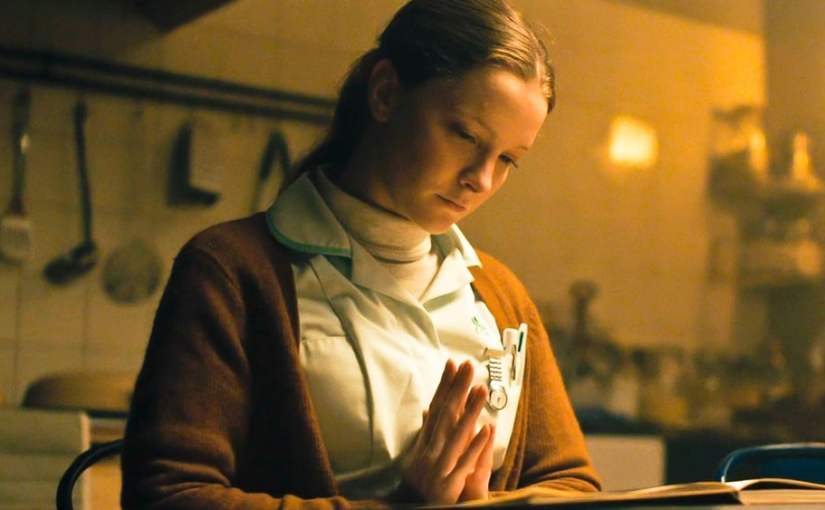
Maud (Morfydd Clark) is a private nurse to a terminal cancer victim, Amanda (Jennifer Ehle), who used to be a famous choreographer until she fell ill in her prime.  Maud seems timid and competent, but she is a recent convert to Catholicism and has taken its teachings perhaps a little too much to heart.  For example, when she prays in front of her makeshift altar at home to pray, she sprinkles unpopped popcorn kernels in front of her before she kneels.  This is based on fact: there is an outdated practice called Corporal Mortification where devout Christians would inflict self-harm while praying.  The sight of her knees settling on those kernels made me wince.  And I won’t even mention what she does to the insoles of her shoes.  She also experiences sporadic moments of religious ecstasy (what the filmmakers refer to as “Godgasms”, though that term is never mentioned in the film).  These mini-epiphanies have a disturbing tendency to end just as Maud’s face seems to stretch beyond any human capability.  Creepy.

(A brief prologue also insinuates that something horrific may have happened in Maud’s previous posting, but it’s left mostly in the background.  Mostly.)

Maud is taken with Amanda, perhaps physically, but mostly with the idea that she can help save Amanda’s soul.  Staring death in the face, Amanda has little time for religion, but she humors Maud’s prayers before meals and even seems to experience a tiny bit of religious ecstasy along with Maud.  But beneath everything is this undercurrent of dread or foreboding.  Director Rose Glass is an expert at framing simple scenes in a way that conveys much more than what is visible to the eye.  Lights flicker.  There are subtle focus racks reminiscent of Vertigo.  Occasional voiceovers give a glimpse into Maud’s mind about her faith in God and her doubts.

I could say more about the plot, but I think that would detract from the experience of watching the film.  The tension and suspense leading up to the film’s climactic outburst are expertly sustained.  …and that one single cockroach is creeeepy…

No doubt some viewers will walk away from Saint Maud feeling the same way the Rotten Tomatoes voters felt.  I can’t think of anything that might change your mind if that’s the case.  This movie is a master class in generating a suspenseful atmosphere on a budget.  There are some obvious visual effects, but they are used sparingly and effectively.  There are stretches where we are led to believe, due to years of conditioning from previous films, that something super scary is about to happen…and then it doesn’t.  This happens a lot.  But I don’t think that’s a bad thing.  When done right, suspense in a film is a welcome experience.  To have a film where the entire movie is constructed out of suspense is a minor miracle.

Watch this one with the lights out and the doors unlocked.  I double-dog dare you.

THE BIRDS

By Marc S. Sanders

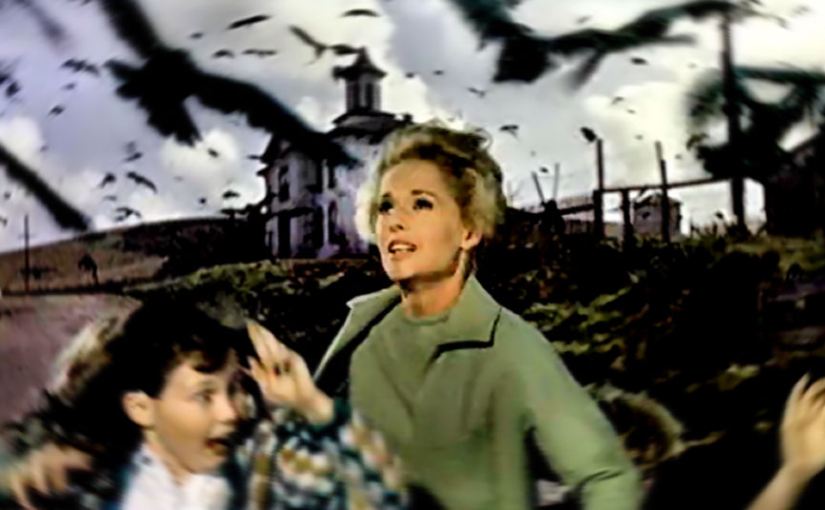
Alfred Hitchcock’s monster movie is The Birds from 1963.  There’s really not much to the piece as far as a story goes.  Characters are just given a purpose to be with one another so that they can be tormented together.  In this case, the film offers up a near hour introduction of newspaper heiress Tippi Hedren playing meet-cute with attorney Rod Taylor.  How ironic that they begin a flirtation in a bird shop of all places only to reconnect at Taylor’s harbor island home in Bodega Bay, located on the outskirts of San Francisco.  Still, as only Hitchcock can demonstrate there’s an ominous feeling sprinkled throughout before the real terror takes flight in the movie’s second half.

While I don’t rush for repeat viewings of The Birds, there’s no doubt as to its influence.  Each time there’s a shot of a bird soaring in the sky, your eyes open wider.  Something will eventually take effect.  At the beginning of the film, Hedren looks out into the San Francisco sky to see large flocks of birds soaring overhead.  Later, while taking a boat in Bodega Bay towards Taylor’s home that he shares with his mother and sister (Jessica Tandy, Veronica Cartwright), she’s attacked by a random gull.  It’ll raise the hair on your arms for sure. 

I’ve noted before how Alfred Hitchcock builds suspense.  The audience knows there’s a bomb under the table.  The characters in the film don’t. So, the audience is nervous as to when the bomb is going to go off or if the characters are even going to discover the explosive.  An outstanding sequence in The Birds includes Tippi Hedren sitting on a park bench near the jungle gym, outside of a school house.  The children are singing along inside.  One crow lands upon the jungle gym.  Then Hitch returns to a shot of Hedren calmly lighting a cigarette.  Then back to the jungle gym and there are four more birds perched just behind her.  Then back to Hedren, unaware.  Then back to the jungle gym for Hedren to turn around and there are suddenly hundreds of crows congregated together.  Effectively, other than the innocent harmonies of the children nearby, Hitchcock opts not to use any music to shock his audience as the scene develops.  The visuals lend to the fear.  The danger that threatens Hedren and the children heard off screen is at the forefront of the viewer’s mind.  No more is needed.  It’s scary, and you want to be as quiet and unalarming as Hedren so as not to instigate the monsters right next to you.

A later scene has Hedren ascend a dark staircase to open a bedroom door.  The roof has been torn open and suddenly the blackness comes alive with flapping wings from every direction.  That’ll make you shift in your seat.

Hitchcock offers plenty of set pieces for bird attacks, but another effective device is to show dissention among the ranks.  From a character perspective, the picture takes a sideways route to imply an oedipal complex between Rod Taylor and Jessica Tandy, who plays his mother.    Therefore, the script suggests Hedren as a threat to their relationship.  Before the film is over, they are likely going to have to develop a united front or it could be their undoing.  (Maybe it’s a nod to Hitchcock’s popularity with Psycho. A cute wink and nod.)

There’s also Suzanne Pleshette as the school teacher that we learn had a tryst with Rod Taylor’s character at one point.  That doesn’t spell out too well for Hedren, either.  As this bizarre epidemic becomes clearer, a scene in the town diner goes so far as to suggest that these random bird attacks didn’t start until Hedren arrived the day before.  Yes!!!!  It’s all her fault!!!! 

None of this will eventually matter though.

Other disaster films and monster movies later relied on exchanges like these, from Jaws to The Towering Inferno.  Hitchcock was wise enough to build tension.  Not a single bird in the scene, but still the fear and doubt among each other bares the strain.  There’s even an advocate for the birds with a strange elderly woman proudly debating her ornithological expertise, while a drunkard at the end of the bar declares the world is coming to an end.  All of these characters could have come from different movies, only to be pasted on to this canvas thereby lending to the frenzy.  Chaos must ensue among the masses.

Often, I get frustrated when there’s no explanation for a film’s central story.  I gave up on the TV show The Walking Dead many years ago because there never was a cause revealed for the zombie epidemic.  It became a smut of soap opera cliché accompanied with ridiculous gore.   Forgive the SPOILER ALERT, but I commend Hitchcock’s film for not providing a wrap up to The Birds.  The film ends with an uneasy final caption.  Nearly every inch of space on the screen is occupied with birds as the cast makes their way to the car to slowly drive out of town, careful not to disrupt the now dominant species of this universe.  Hitchcock provides a picture where the laws of nature declared a winner.  As intelligent as humans are considered to be, they have not won out.  They have had to surrender.  Why the birds attacked, we’ll never know.  Odd phenomena can happen.

There’s nothing thought provoking about The Birds.  It’s simply a film based on heightening your discomfort.  Often, I find the material and dialogue laughable.  The townsfolk notice a man lighting a cigarette right over a stream of gasoline and urge him to put out the flame.  Wouldn’t the dumb guy smell the diesel?????  However, then we wouldn’t get a fantastic fire ball to observe up close as well as from Hitchcock’s “God shot” in the sky with the birds looming into frame over the town below. 

The visual effects look outdated of course, but they still hold because of how Hitchcock demands they are used.  I noticed that his reliable composer Bernard Hermann is credited, but as a “sound consultant” this time.  The shrieking of the birds is what sends the chills down your spine.  Also, there’s the fact that Hitchcock offers up birds flying right at the screen or the windows.  A great sequence includes the front door of a house being gradually shredded apart by the bird masses.  The wood proceeds to splinter.  You don’t see the monsters but you know they’re right there on the other side.  Once that door breaks open or those windows shatter, then it’s likely all over for our heroes.  George A Romero exercised bits like this in Night Of The Living Dead.  Very, very effective.

The Birds is just okay for me, honestly.  The fright material is what keeps its legacy.  Yet, there’s a lot of soapy material among the cast of characters that’s not all that interesting.  Again, a purpose has to be served for these people to occupy the story.  Just offering a movie where birds hover and peck at people wouldn’t be enough.  So, we have to follow Rod Taylor and Tippi Hedren’s trajectory.  It’s fun to see screaming kids run from these animals turned menace, though.  I found it hilarious to watch a birthday party run amok.  I also yelp when I see a flock storm into Jessica Tandy’s house from the chimney turning the living room into a contained disaster area.  An especially gruesome discovery by Tandy later in the film is absolutely eye opening (pardon the pun, if you know what I mean), and clearly an inspiration to a well-remembered scream out loud moment in Jaws.

The Birds is fun, but it’s not the artistic merit you’ll find in other Hitchcock classics like Rear Window, Vertigo, Suspicion, or even Psycho. What I can promise is that once you get through the plodding character connection build up, you’re allowed to forget about any of their value to the picture and simply relish in the mayhem. 

PSYCHO

By Marc S. Sanders

To watch Alfred Hitchcock’s Psycho today is a blessing and a curse.  You can’t take your eyes off the craftsmanship of the film.  Yet, you know all the surprises and plot twists.  There’s only so much blood you can draw from the stone. 

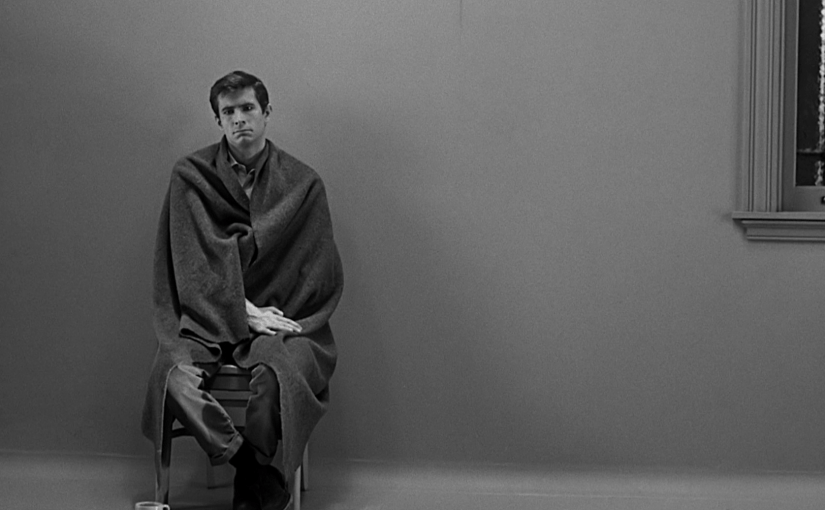
Recently, I told my fourteen-year-old daughter, who doesn’t like scary movies, that she needs to watch the film.  If only because she knows absolutely nothing about Psycho.  She has no idea what’s to come of Marion Crane (Janet Leigh). She’s never heard of the shower scene.  She doesn’t know about the true relationship between Norman Bates (Anthony Perkins) and his chastising mother.  Imagine, assuming you have seen the movie and/or know all its secrets already, watching the movie with someone who is seeing it for the first time with a completely blank canvas to go on.  Oh, the reactions you’ll get to see!!!

Hitchcock’s film, with a screenplay from Joseph Stefano, works under a lot of different dimensions.  It’s classified as the first “slasher movie.”  That may be true.  However, it’s much more intelligent than a typical Jason or Freddy Krueger fright fest.  Psycho begins as one story with a central character, seemingly innocent, carrying out a crime.  Later, it turns on itself and becomes something else altogether.

Marion Crane makes off with $40,000 in cash from a chauvinistic, obnoxious client of her real estate boss.  She hits the road, heading towards her lover’s home in nearby California.  Her impending doom is never implied.  Stefano and Hitchcock focus only on Marion’s scruples with the crime she’s committed.  She gets haunted by a curious police officer.  She certainly wonders what her boss must think when he’ll discover that she never deposited the money in the bank.  Is the used car salesman going to follow up on her after she urgently trades in her car for a new one with new plates?

Soon though, none of that will matter when she has no choice but to pull off the road for the evening to stay at the Bates Motel, currently with twelve cabins and twelve vacancies.

For the one or two readers who have never heard of Psycho, I’ll stop there with the narrative.  However, what I appreciate about the second half of the film is that the new central character, now young, quirky, altogether strange Norman Bates, seems to respond with avoidance when a private investigator named Arbogast (Martin Balsam), and then later Marion’s lover Sam (John Gavin) and her sister Lila (Vera Miles) start questioning him about Marion’s whereabouts.  Arbogast is on the trail of a thief who went off with $40,000.  Sam and Lila are also curious about the theft that seems unheard for Marion to commit.  Yet, there’s something else leaving them curious.  Norman, on the other hand, knows nothing as to what Marion was up to.  In his eyes, the only odd thing about her is that she checks into the motel under a different name.  All of these characters are coming in conflict with one another, but not for the reasons they think they are.  The fun part is that we are the only ones who know the hands that each player is holding.  Even more fun is when we uncover a secret that Norman has been hiding from the audience all along.

Hitchcock tricks his audiences with Psycho.  With its first story, we are in suspense of one criminal.  Will she get away with the theft? Rather, how and when will she get caught?  With its second story, we are unnerved by someone far worse and frighteningly mysterious.  Following the infamous shower scene, it’s a little nerve wracking to watch as Norman tries to hide the evidence in the trunk of a car that he pushes into the nearby swamp.  Any storyteller would just have the car simply sink.  Hitchcock brings in shadowed close ups (with his wise idea of black and white photography) of Norman chewing gum, and then becoming completely still when the car actually stops sinking midway through its descent.  As a viewer, your jaw drops.  What is Norman going to do if the car doesn’t fully submerge?

Later, it’s a wonder how Norman is going to circumvent around the unexpected visits form Arbogast, Sam and Lila.  Then, we are in suspense of their safety.  They’re just looking for the missing money while tracking where Marion went off to.  Unbeknownst to them, they have can’t even fathom her demise.

I was talking with one of my Cinephile brothers about Psycho, explaining how it follows a similar dynamic that the second half of Vertigo moves upon.  In Vertigo, the main characters, Scottie and Madeliene, are both in love with one another.  Yet, it’s for different reasons that they can’t explain to each other.  In Psycho, the characters are all under suspicion and even paranoid of each other, yet for all different reasons.  Norman never knew of Marion’s crime.  Though the other characters suspect that he does.  In both pictures, only we, the audience, know almost everything at play.  According to various documentaries I’ve watched, Hitchcock wholeheartedly trusted his screen writers to flesh out the stories.  He concerned himself more with constructing the film with a faithfulness to the script.  What’s commendable about the films Alfred Hitchcock chose to make is that he sought out these conundrums where his chess pieces are left bewildered or unaware of why they are sharing the stage with the other players.  The director had a way of channeling into deceiving his characters against one another, allowing the viewers to relish in their trickery.  Going a step further though, Hitchcock reveals other twists never suggested in the film to turn the audience on their ear in shock.

You can’t take your eyes off Psycho, even with knowing all the goodies that Hitchcock provides. 

Anthony Perkins especially is a tense and unnerving menace.  He has a boyhood innocence to him that should not appear threatening to Janet Leigh’s Marion Crane.  It’s in his relaxation with the role that it feels all the more terrifying to the viewer.  Simply look at the way Arbogast pulls up to the motel and Perkins is sitting calmly on the porch eating his bag of candy.  Watch how he casually shares with Marion how he relishes in stuffing the birds he has mounted on the parlor walls, or even how he casually offers cabin number one for Marion to occupy so that she can be close to everything.  Norman Bates hides himself very well in his virtue.  A wolf in sheep’s clothing.

The Bates Motel and the large house poised behind it on the hill were set up on a Universal back lot.  It remains one of the most famous settings in film history.  When you see the silhouette of Norman’s mother in the window from afar or young, slender Norman standing in front of the house, the images of the chilling locale stay with you whether it is on a dark and stormy night or even during a sunny afternoon.  Hitchcock opted to shoot the film in black and white to taper the goriness of the piece.  Outside of the gore elements though, the black and white lends a foreboding feeling to this destination.  Even before we realize that Marion is in danger, we feel uneasy with just arriving at this place.

The shower scene of course is one for the ages.  I’m not here to discuss all of the mechanics of film’s centerpiece.  The assembly of the scene’s elements are masterful though.  Can you imagine the scene without Bernard Hermann’s shrieking score?  Hermann was to Hitchcock like John Williams is to Steven Spielberg.  The aftermath is brutally shocking as well.  The camera does a zoom out on Janet Leigh’s eye as the soaking head of her corpse lays down on the bathroom floor.  I notice the eye does just the slightest twitch.  For me, that’s all the more disturbing than just a very still open eye.  It implies the last bits of life leaving her body and consciousness.  Later, when Norman cleans up the bathroom, Hitchcock shows his process with a mop and neatly wrapping Marion in the torn shower curtain and disposing of anything belonging to her, including a newspaper that isn’t just a newspaper.  Norman is methodical.  Perhaps this strange man has done something like this before.

I do have one grievance with Psycho.  The air is kind of sucked out of the film in its last few minutes before that delicious last close up on Norman.  Stefano’s script offers up a psychological explanation for what Norman Bates seems to suffer from.  It’s as if we are given a scientific description for what ails him. This is all painfully boring.  I dunno.  Maybe in 1960, when Psycho was a pioneering kind of horror film, and moviegoers were not as familiar with the genre that seemed far scarier than Boris Karloff, and vampires and mummies, they needed a summation like this.  Sixty years later, naturally this is not necessary.  We know all to well that there are disturbed people who live among us.  We know, sometimes, to be cautious of folks like these.  For someone as reputed as Hitchcock was, being identified as the “Master of Suspense,” this long monologue, spoon fed diagnosis from the psychiatrist kills all of the horror we’ve bared witness to over the last two hours. 

Psycho was the first slasher movie.  It was the first movie to feature a toilet and have it flush on film. It has one of the most famous characters in all of film history.  It has one of the most famous scenes of all time.  It was directed by one of the greatest directors of all time.  Yet, it also has one of the worst conclusions of all time.  If ever a scene should have been cut from a finished product, it is the second to last scene of Psycho.

Now, go find someone who has never heard of Psycho, knows nothing at all about Psycho, and watch them watch Psycho.  Of course, as the famous marketing campaign for the film insisted, by all means do not start the movie or walk in the middle, and never reveal any of its secrets.

ALIEN

By Marc S. Sanders

To be lost and alone is my absolute greatest fear.  I don’t know what to do when I find myself in situations like that.  I feel palpitations and terrible anxiety.  The only argument my wife and I had on our honeymoon was when we got lost in the Louvre in Paris.  She was relaxed.  I definitely was not.  I didn’t know in which direction to walk through the massive museum, located in a country that I’m not at all familiar with, inhabited by a majority of people who speak a language that I’m terribly limited at using for conversation.

When a person is completely, physically isolated, the only thing to depend on is his/her own wits and sensibilities.  That’s step one in constructing a scene of terror.  Step two is to lock that person away with an entity that is unpredictable, unrecognizable, smart and grotesquely frightening.  In a film, each time that entity comes into the play, the scene should not look like the last time the protagonist or the audience encountered this creature.  Whatever I learned a few minutes ago is not going to offer much help the next time around. 

I’ve just described the spine of the story that makes a horror film like Ridley Scott’s Alien so successful.

Science Fiction always works best when it can be convincing enough to lend authenticity to the fiction of its, well, science.  With Alien, a variation of biology and evolution lends to the terror of the picture and you don’t even realize it until the movie is half over. The title character is introduced in different characterizations with every scene it is called for.  First, it’s an egg, then a tentacled creature wrapped around the face of an unfortunate victim.  Later, at dinner time, it reveals itself in an unforgiving and memorable scene as a phallic shaped organism with a snake like tail and steel teeth.  Lastly, you just can’t even describe what it is except to say it is huge and its even worse than the monsters you imagined as a kid hiding in your closet or under your bed.  Credit has to go to the creature designs from H.R. Giger.  Every limb or shape of the monster seems to serve a purpose.  If that’s not enough, the animal bleeds acid that’ll burn through the hull of an enormous spaceship.  The alien in this 1979 film, later deemed a “xenomorph,” is one of the scariest and most unforgettable monsters in movie history.

A crew of seven are piloting a large ship back to the planet Earth.  Their cargo is carrying mineral ore (whatever that is).  This crew is not military of any kind.  There’s a science officer, but by and large, I’d characterize these people as truckers in outer space working on behalf of a company, by hauling a load across the galaxy.  During the long journey, they rest in a cryo-like sleep.  As the film opens, they are awakened by their transmission computer, known as “Mother,” to respond to a distress call.  Their ship has been diverted from Earth to investigate an unexplored planet.  As the piece continues, the crew brings back a plus one. They have no idea what to expect or how to handle its presence, and then they are hunted across the maze of the large ship, dispatched one by one.

The byline for Alien is marketing brilliance.  In Space, No One Can Hear You Scream.  It only scratches the surface of the terror you encounter when watching this terrifying film.  Ridley Scott uses art direction set up with long, dark hallways and warehouse size rooms that make the cast appear infantile.  His labyrinth of a spaceship offers up practically any place for a killer creature to hide and strike at an opportune time. 

It’s important to point out that Alien lends to the argument for the value of 4K resolution.  This latest print to honor the film’s 40th anniversary offers much clarity within the dark settings of the picture.  Having seen Alien countless times, I still examine each frame carefully because Giger’s designs allow the monster to blend in properly with engineering architecture of long and large pipes and cables, and immense darkness.  Chains hang from the ceilings and water drips down for no reason to be explained.  It’s just how the spaceship lives, apparently.  The atmosphere rattles you, however, when you realize there’s a dangerous bug crawling around somewhere.  Did I just catch a glimpse of the alien’s head there????  Was that his tail????  Is that a limb, like an arm or a hand????  I know all of the highlights of the picture by now, but to this day I still look for when and where the silent terror is looming, thinking I missed it from the last time I watched.  Would you believe on this last viewing, I found a caption of the alien I don’t recall ever seeing before?

Once the monster is established and we see our heroes within inescapable danger, then paranoia and mistrust can lend to their erratic nature.  The screenplay from Alien co-creator Dan O’Bannon establishes how the “grunts” of the seven (Yaphet Kotto, Harry Dean Stanton) debate what is and isn’t their responsibility and what monies they truly are entitled to on this mission.  Early on, before the threat is even considered, a divide exists within the band.  They are not always going to get along.  Later, the debate on whether to quarantine the crew members who investigated the distress signal on the strange, unknown planet comes into play.  It would be easy to simply make Alien all about blood, guts and sci fi laser pistols in a post Star Wars/Star Trek era, but it is even more effective to create disagreements and seeds of unreliability among the group.  One or two of them could end up operating in a different and unexpected direction that won’t help their cause.  Maybe it’s not just the alien we should be afraid of.

The seven members (5 men, 2 women) all have different personalities.  They like one another well enough, but they all have uncommon values and motives.  Sigourney Weaver portrays Ripley, the third in command, behind two men.  However, in outer space, does it really matter where she falls in the line?  The science officer, Ash (Ian Holm), seems to drift into his own way of thinking, separate from the rest.  Captain Dallas (Tom Skerritt) moves along the straight and narrow, only doing what’s assigned simply to move on and get things over with.  The other woman Lambert (Veronica Cartwright) does not have much dialogue to work with, but her expressions seem to be questioning why she even took this job.  Was this woman desperate for work and this is the best she could find?  She’s definitely the most unrelaxed and fearful of the crew.

Like Steven Spielberg’s Jaws, Alien does not operate on the movie monster alone.  There are other factors at play.  A popular Hollywood story is that Spielberg didn’t show the shark for a long period of time simply because the thing would not work, mechanically speaking.  Ridley Scott, however, demonstrates that he can present the animal one way and then show it in a completely different form later.  When it has reached what we can only believe is full evolution, we still don’t get a clear physical picture of the creature’s design from head to toe.  Scott will show us teeth, or maybe a shoulder blade or a tail that whips or moves at a slow and cautious pace.  The alien functions with a combination of real-life predators’ behaviors.  It hatches.  It sheds its skin.  It bites.  It runs.  It hunts a prey.  It grows and evolves…and seemingly very quickly.

Alien has been duplicated many times following its release, including a few shameless sequels.  Mind you, some of the franchise follow ups remain exceptional in their own right.  What misgivings Ridley Scott’s movie have later inspired cannot be helped.  Mr. Scott should consider it an honor, at best, that various craftspeople have attempted to top what he accomplished, I guess.  Those copycats don’t follow the recipe of Alien though.  There’s either too much of an ingredient included like blood and guts or there’s a lacking in its script, such as the eerie haunts of a dangerous setting or the overeager intelligence of its characters.  Whatever the case may be, the achievements in horror work so well in Alien, because it moves with dread, uncertainty, helplessness, a lack of knowledge, and then with only a few touches of gore and violence that are mostly left to our worst imaginations. 

Alien is not only one of the best science fiction films ever made.  It is also one of the best horror films ever made.

THE THING (1982)

By Marc S. Sanders

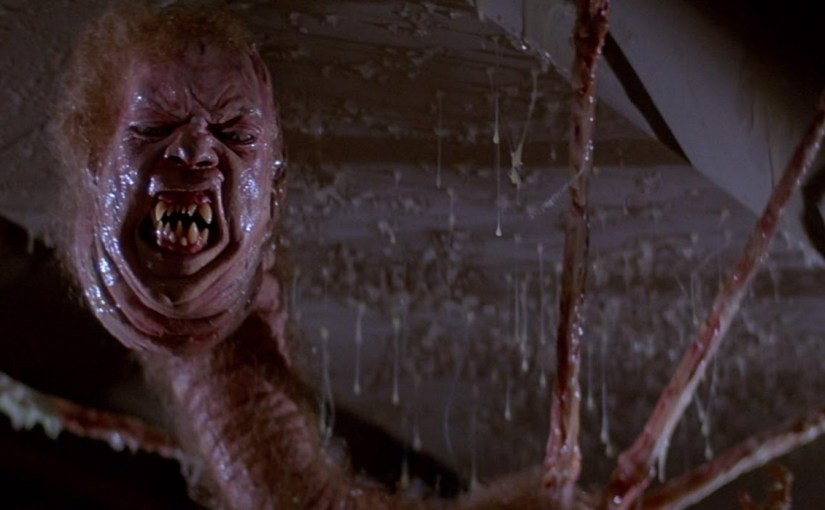
Often, a great beginning to a film offers an intriguing question. So as I finally watched John Carpenter’s 1982 interpretation of The Thing, I was especially curious as to why a sniper aboard a fast moving helicopter was targeting a dog running across the open plains of Antarctica with a pulse pounding beat from legendary film composer Ennio Morricone. The film has me hooked and none of the gory horror to come, compliments of creature effects wizard Rob Bottin, has even presented itself yet.

Gore never did anything for me in horror, and horror has never been my most favorite genre of film. Rather, suspense always held my attention and kept me thinking long after the movie was over. Carpenter’s film is full of Bottin’s imaginative gore but the paranoia and mistrust among a crew of science operatives is the real centerpiece here. Whether it’s the innocence of a dog or the star power of Kurt Russell, I never trusted the narrative of The Thing and that’s the point.

An exceptional scene on the same level as the dinner scene in Ridley Scott’s Alien occurs following a crew man suffering a heart attack. The defibrillator is brought out, “CLEAR” is shouted and the man is zapped. Then something else happens. I won’t spoil the moment. Yet, this is where imagination was put to work; where effects and storytelling work cohesively. Thankfully, moments like these become a running theme throughout The Thing. You never know what to expect from an unmeasurable and incomprehensible enemy. The fact that resources are scarce and escape is impossible traps our characters and the viewer as well.

Convenient, fast learning knowledge only tells you that this entity can duplicate anything it comes in contact with. So, you might just be sidling up to the thing itself and you won’t even know it until it’s too late.

Isolation, lack of trust, fear, paranoia – all of these elements work towards the advantage of superb imagination and storytelling in Carpenter’s piece.

The Thing was always a movie that eluded me. I’m now so grateful to have witnessed it. It makes me yearn for better storytelling in today’s films beyond remakes and superhero exhaustion.

John Carpenter’s The Thing is an absolute must see motion picture. Watch it with friends and watch it with the lights turned off.

THE SHINING

By Marc S. Sanders

Stanley Kubrick’s The Shining has become a legendary film that set the standard for haunted house films. It’s a spooky story with a musical soundtrack never destined to be played at weddings or bar mitzvahs.

The whole movie is unsettling, beginning with a long winding road drive through the Colorado mountains as the title and credits unconventionally roll up the screen, one at a time. Kubrick was never typical. Here he was frighteningly weird.

The film, based of Stephen King’s bestseller, consists of four characters. Three of them are novelist Jack Torrance (Jack Nicholson), his wife Wendy (Shelley Duvall) and their son Danny. He’s one effed up kid with a mop top haircut. I think I’d be disturbed if I uncovered what Danny grew up to be hereafter.

The fourth character is the main attraction, the isolated Overlook Hotel; left empty during the harsh winter months to take advantage on reviving its morbid history of harsh violence by means of ghosts, bleeding elevators and hacked up innocent looking, pig-tailed, young girls. Don’t ask me to explain the guy with the gold lion mask about to go down on a happy partygoer. No. I also can’t explain what exactly happened in Room 237. Perhaps King’s book covers all of this. Kubrick opts not to and focuses on the naivety of Wendy while Danny and his imaginary friend Tony talk to the consciousness of the hotel only to understand it is gleefully influencing Jack into an obsession of murderous incentive, eventually leading him to charge his ax through some doors.

I once visited the Louvre in Paris. I couldn’t fully enjoy or appreciate it. It was too big and too overwhelming. I didn’t know where to start or where to end. I had a panic attack, but I didn’t know it at the time, and I was eager to leave. Kubrick works on that anxiety during the long exposition of the film. Effectively disturbing tracking shots are provided that shoot deep hallways, vast ballrooms, large furniture pieces, and loud colors of reds, browns, yellows and whites along with emerald, green in the bathroom of room 237. The pastel blues of the young girl’s dresses and pigtail ribbons are also deliberately garish. Colors are normally cheerful for me. Here, they are unwelcome and intrusive and when I say loud, I mean to say the colors scream at you,

You just want to get away with Danny on his Big Wheel that he pedals around the property, softly on the carpet and thunderously loud on the tile and wood.

The character of the setting continues its disturbing details by means of a maze. Kubrick offers a great transition when Wendy and Danny enter the maze while Jack overlooks (pun intended) on a small-scale model. The hotel’s haunts have its prey in sight by means of its possession of Jack. Kubrick clearly shows that with his camera work. There are wide shots both overhead and facing Jack, and narrow, trapped captions of Danny and Wendy lost in the labyrinth.

I won’t say The Shining is a favorite of mine. I think this is only the second time I’ve seen it. I’ll watch horror movies, but they often bother me; leaving me distraught and stressed, unrelaxed. Occasionally, while Kubrick is vague with his imagery, Nicholson is blatantly obvious in his urge to terrify; maybe a little too blatant. He is in direct competition with John Belushi in the facial expression department. He’s disturbing even before the hotel’s influence is available to take hold, and so I didn’t necessarily get a good character arc from him. Same with Duvall or the boy. This family is downright weird all on their own from the moment you meet them until the film’s cold, wintery end arrives. Kubrick gets you curious about what this hotel is capable of. Then he shows you. Then the end literally tires the story out.

The Shining is best when you have an urge for fear and frights. A house of horrors tale where a cat or bird will not suddenly fly into focus for a cheap jump-scare. Rather your vision and hearing will still feel shocked, leaving butterflies in the stomach, and shortness of breath. Repeat viewings will leave you awake at bedtime, and worried and agitated. There’s so much to explore, but do we really want to know what’s in that room, or down that hall or around that corner, or even how that photograph of a July 4 celebration from the 1920s ever came to be?

THE BABADOOK

By Marc S. Sanders

The Australian psychological horror film, The Babadook is a very unsettling piece, and I hate my colleague, Miguel E Rodriguez for subjecting me to a viewing. It’s so unnerving simply because it is so good.

Jennifer Kent writes and directs an eerie film about a troubled mother and her young son (Essie Davis, Noah Wiseman) named Amelia and Samuel Vanek. Samuel’s father passed away in an accident while taking Amelia to the hospital when she was in labor. Seven years later, Amelia endures much sorrow and loneliness while Samuel has social issues in school and resorts to crafting barbaric weapons out of wood. I just played with action figures. This kid puts sharp knives on a sling. Other mothers and children keep their distance from them. Samuel’s school is concerned of his presence with other first graders, and Amelia opts to not even celebrate the boy’s birthday on the actual day, also known as her husband’s date of death.

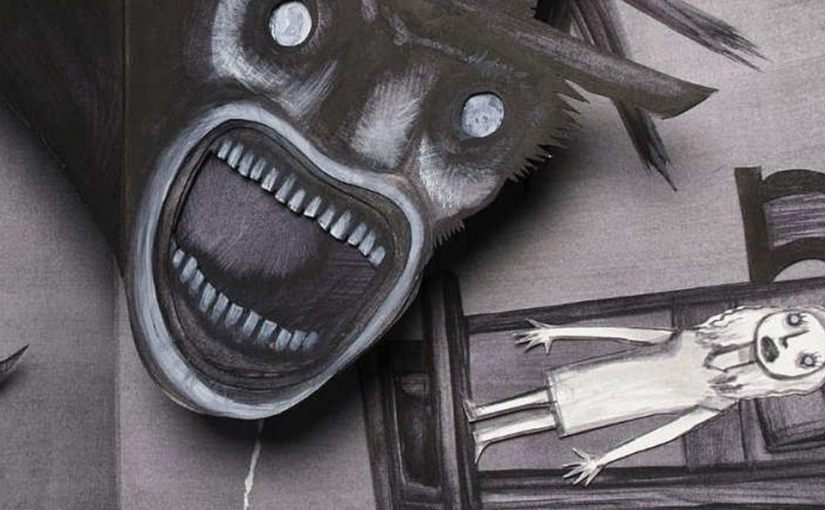
One evening, Samuel pulls a book known as “Mister Babadook” off the shelf for bedtime reading. Opening the book is their first and most regrettable mistake. Haunting images of a dark shadow are shown in “pop up book” form with promises of death and so on in a cute, yet sinister, Dr. Seuss like rhyme. This is the evil “Cat In The Hat.”

Like most creepy horror films, there’s pounding on doors and floors, open doorways to find nothing there, disturbing phone calls, shadows, surprising sound editing and so on. That’s nothing new. What makes Kent’s debut film so special though are the performances from Davis and Wiseman.

As I watched the film with Miguel, I told him after about a third of the way through that I hate that annoying little kid. I think that’s the point though. Noah Wiseman plays his part with great hyperactivity who can never be satisfied or calmed with any variation of attention. Essie Davis plays Amelia as strung out and exhausted. You can’t help but feel for her inescapable circumstance of being trapped in a home with no other family and no friends who seem willing to help, much less tolerate her crazed son.

Later, long after the disturbing children’s book is read, Jennifer Kent’s script turns on a different perspective. It’s not so much that the character’s have changed. More so, the aftermath of reading “Mister Babadook” has altered the mother and son’s behaviors. What caught me by surprise was that my own perspective gradually changed on the two players.

You will need to watch the film to truly uncover the mystery of the book’s power. However, it’s a very frightening exploration. Kent is very good with the sensory overload; which really is a necessary tool in horror, particularly in what you hear and what you see. Kent mixes up what sense is alarmed first though, with each passing sequence. It makes it hard to relax as a viewer, while it’s also hard for the mother and son to sleep at night. That’s what keeps the hairs on your body standing up and believe me, mine were standing at full attention.

Kent covers much psychologically. Insomnia, depression, aggression, night terrors and trauma are all given attention as they manifest into this disturbing unrecognizable character know as The Babadook.

I also observed an interesting aspect in use of color. Namely that Amelia is dressed primarily in faded pink and yellow while Samuel is adorned in dark grey or charcoal like the two story home they live in. The contrast in colors left me guessing who was the real source of fright in this film because at times the contrast seems to flip. I risk sounding vague here, but I’d prefer not to spoil what’s presented.

Again, The Babadook left me feeling shaken like the best of Stephen King’s adapted films including Stanley Kubrick’s The Shining and especially the latter half of Brian DePalma’s Carrie. I’ll even go on record and say this film is better or more effective than those two films. It’s sharper and more mysterious.

I’m not sure I was entertained with The Babadook because I was always feeling disturbed and unsettled. Good horror films do that to me. Forgive me. I can’t help that.

On the other hand, Miguel was quite entertained at me cursing him out and loudly expressing my seething hatred towards him as I watched. What can I say? Mig had it coming for introducing me to The Babadook.

A QUIET PLACE

By Marc S. Sanders

M Night Shamylan is kicking himself right now for not thinking of this story.  All it took for director/co-writer John Krasinski was very, very minimal dialogue, some well skilled young actors and his brilliantly, talented wife Emily Blunt to pull off one of the best pictures of 2018.

Another desolate, post-apocalyptic future has occurred and thankfully this story does not feature tired zombies or vampires.  Krasinski uses old fashioned techniques to hide or mistakenly reveal his characters to the boogie men with no other agenda except to shut out all of the noise. A silo, a basement, a waterfall, fire, a nail, a hearing-impaired character, bare feet, a toy space shuttle, sand, lights and fireworks. I accepted every plot device used in the film, and each element is a miniature story in and of itself.  As well, when there are moments that allow the four main characters to actually talk, there stands to be good reason for it and I bought all of it.

Emily Blunt is an incredible actress full of hard concentration and Krasinski does not let up on long running close ups to heighten her tension of isolation surrounded by the most terrifying threats, all while enduring a physical emergency.  She stares without a blink.  She effortlessly shakes with paranoia, and she evokes pain of the worst kind; all without uttering a sound or saying a word.  This is the same actress who played a snobby diva in The Devil Wears Prada, and later went on to portray the most popular nanny of all time, Mary Poppins.  This performance should not be overlooked.  It’s incredible.  You don’t need monsters in your face to be afraid.  All you need is Emily Blunt to carry you along.  

Krasinski springboards his terror off the best horror films from Jaws to The Shining to Alien to The Blair Witch Project and the original Paranormal Activity.  Yet, he does manage to pioneer his craft with A Quiet Place.  This is not something you have seen before. Hiding in silent fear has been done to death.  The girl always hides in the closet from the killer.  Here, you can hide, but staying out of sight won’t necessarily save you or do you any favors.  These creatures just might be prepared for that.  So, now you have something new to wrestle with.  Can you keep quiet?  This script does not make that easy. If ever a movie was to justify the need for Oscar categories like Sound and Sound Effects Editing, then this is the film to turn to.  These tools give reason for the storyline more overtly than any other that I can imagine.  You do not take the sound for granted, and you do not take the lack of sound for granted either.

Miguel Rodriguez and I originally saw this picture in a Dolby theatre.  It’s a telling film that gives reason for a Dolby theatre in the first place.  A film like this is worthy of the upgraded ticket price. (By the way, Mig, you still owe me $11.00.)

Put John Krasinski up as a top-notch director.  I believe this film was granted a very small budget, but like the best directors to come before him, he has managed to put up big screams and the best in dramatic storytelling with little expense. He even manages to tug at your heartstrings if you allow it. The ending was a huge pay off for me personally.  John Krasinski gives you a horror film, but he’ll make sure you have something to think about while you’re watching it, and long after you have left the theatre.