KILLING THEM SOFTLY

By Marc S. Sanders

What did I just watch? A mob movie, or a 2008 Presidential debate where the candidates are no shows, and their respective commercials are aired in their place? Andrew Dominik directs Killing Them Softly, with Brad Pitt who also produces.

Reader, I don’t get the appeal. Maybe it’s the outstanding cast which includes Pitt, as well as James Gandolfini, Ben Mehndelson, Richard Jenkins, Scoot McNairy and Ray Liotta. Sadly, these guys are given next to nothing do of any consequence.

After it is revealed that Liotta’s character, Marky, ripped off his own mob poker game a few years back, an idea is presented to two street addicts played McNairy & Mendehelson to do the same thing because, heck, they’d never be suspected and logic dictates that Liotta must have done it again. So, he’ll be the one to blame and get whacked. The game is robbed and now Brad Pitt’s hitman character is on the job. Simple enough story, almost like a Guy Ritchie picture.

Killing Them Softly is an adaptation of a 1974 novel by George V Higgins. I never read the book, but I’m curious if it contains any kind of relation to Andrew Dominik’s idea of editing recurring speeches and ads, compliments of Obama, McCain and Bush 45. Truly, what was the point of this recurring theme? A two-sentence piece of dialogue finally acknowledges this in the final minute of the film, but I’m still lost on the significance. Somehow Dominik made a dirty, cold, rain-soaked picture that has an omnipotent viewpoint from our most prominent politicians, and I don’t know what one thing has to do with another.

As well, Gandolfini arrives in the story and I never could gather what was his purpose. I think he is a hitman who is washed up, never getting his ass up to carry out the job and just monologues about nothing like the hooker he pays off; topics that Quentin Tarantino might’ve thrown in the editing trash bin.

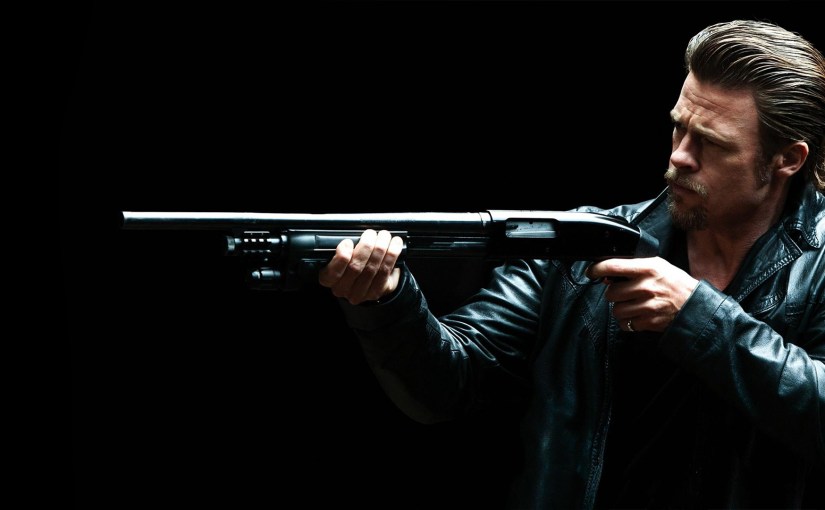
Mendelsohn looks incredibly convincing as an addict living off the streets, yet his storyline has no end. He’s arrested. Then what happens? What does that mean for everyone else? Liotta has a long drawn out sequence of getting the shit kicked out of him by two mob foot soldiers. The scene goes on and on and on. His face cracks and bleeds, and bleeds some more. Brad Pitt? Well, he’s the hitman who just looks cool. Yeah, the black leather jacket he wears looks very cool on him. That’s about it.

There’s no development to Killing Them Softly. No surprise or twist. The guys you expect to get killed, get killed, and there’s no good dialogue.

This film is just an empty void of poorly, uninteresting violence.

NIGHT FALLS ON MANHATTAN

By Marc S. Sanders

Sidney Lumet is the director known for shining a light on police corruption. His films were not crime dramas or legal thrillers really. They were an examination in what turns righteous professions within the confines of law and order into something tainted in violations of morality. Night Falls On Manhattan showed what can happen when the politics of New York City could be stained by the policemen who lost their sense of distinguishing right and wrong.

Andy Garcia plays Sean Casey, a newly deputized, very green district attorney and former street cop. His image looks perfect to prosecute a big time drug dealer who wounded his own policeman father, Liam (Ian Holm), and killed two other cops. Richard Dreyfuss does an inspired Alan Dershowitz personality portraying the defense attorney for the dealer, by angling a theory that police corruption is unfairly working against his client. It seems like a very open and shut case for Sean, which occupies the first half of the film.

Afterwards, Sean appears to have a white hot image in the public eye and he is quickly nominated and wins an election as Head District Attorney for the city, following a heart attack from the incumbent and his boss played by Ron Leibman. Conflicts arise though when it is uncovered that perhaps Liam, along with his partner Joey (James Gandolfini), have been taking money under the table as part of a group of dirty cops spread among three precincts.

Sidney Lumet’s films always present topical and complicated real life problems with no expected solutions. These issues of transgressions exceed any kind of quick fixes. He’s shown this time and again with films 12 Angry Men, Serpico, and The Verdict. With his original script here, Lumet gets a little personal. What can you do when a city relies on your image of ethical practice, but your own loving father may be a traitor to the laws he’s vowed to uphold? How can Sean work ethically for his constituents while his father and his longtime partner are possibly betraying sworn policy?

I was always engaged in Night Falls On Manhattan. What is Sean going to do? The dilemma is never patched up with a band aid. It actually feels like it gets worse and worse because it is next to unsolvable. Cops are heroes in this film and a cold blooded killer seems to have been rightfully sentenced? So how can Sean, Liam, Joe and the rest of the cast live with themselves when the end results they wanted all arrive, but came about in all the wrong ways?

This is a terrific assembly of talent. Most especially, credit has to go Ron Liebman as the head DA whose overbearing loud mouth is necessary for the city that never sleeps and the endless amount of police troops and city prosecutors he has to answer for. If New York City had an actual voice that emanates and speaks the endless noise of the Big Apple , it is Ron Liebman. He should have been Oscar nominated. He comes carved out of the concrete of the city landscape.

This is really an unsung picture of Lumet’s that should be seen, much like Find Me Guilty with Vin Diesel. My one issue is the preachy monologue that Sean delivers at the end of the picture. It comes off like a concluding statement and left me with the impression that the conflict of the story painted these characters into an inescapable corner. So, tack on a speech to bring on the credits. The monologue just didn’t work for me though. It didn’t give me that bookended impact I was hoping for.

Other than that, however, Night Falls On Manhattan is another fine piece of filmmaking rooted in a metropolitan setting that becomes a character all its own. Lumet was a genius about acknowledging his settings. This is another perfect example.

THE FIRM

By Marc S. Sanders

Sydney Pollack was the first director to take a crack at adapting one of John Grisham’s best-selling books, namely the still most popular novel, The Firm. Wisely, and with a measure of risk, Pollack took the script from David Rabe, Robert Towne and David Rayfiel and maintained a true adaptation for the first hour of the film while inventing a new kind of second half that I think improves upon Grisham’s story.

Mitchell McDeere (a well cast Tom Cruise) is the most sought after Harvard law graduate in the country. A small Tennessee firm makes an offer to him that outbids any of the big leaguers. Considering that Mitch comes from a poor broken home with a brother (David Strathairn) currently in jail for manslaughter, the offer and treatment given to Mitch and his school teacher wife Abby (Jeanne Tripplehorn) could not be more enticing. A house, a car, school loan payoffs, and a near six figure salary in the first year is not something anyone would walk away from.

Once the happy, young couple are comfortable though, a curious FBI man (Ed Harris, an MVP of this stellar cast) inquires if Mitch finds it odd that this firm has four of its lawyers dead within the last ten years. The two most recent casualties perished in a boat accident.

The sharp minded Avery Tolar (another welcome performance from Gene Hackman) is assigned to make sure Mitch follows the path the firm expects of him. Avery also has his sights set on Abby. For a guy who has never been regarded as good looking, Hackman plays a pretty effective flirt.

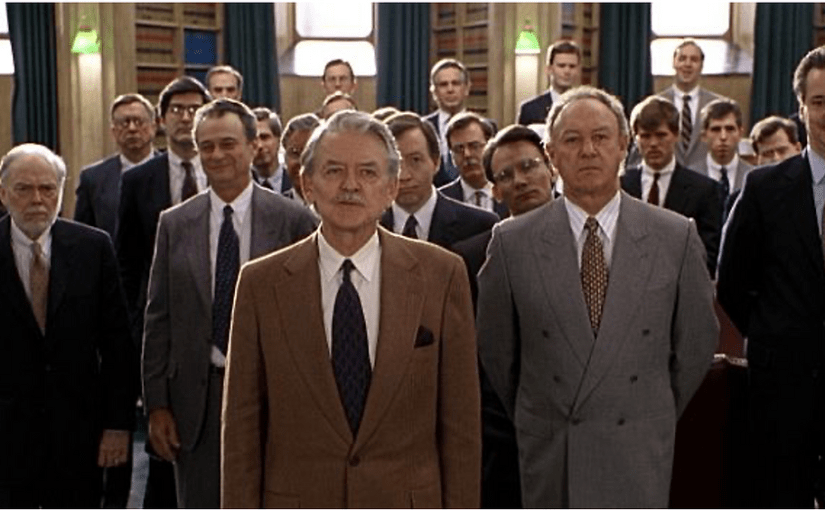
The firm, led by a seasoned Hal Holbrook with a charming Mark Twain like bow tie, and a perfect henchman villain played by Wilford Brimley (definitely on my top list of best bad guys) are involved with the Mafia and their shady dealings of money laundering, racketeering, murder and embezzlement. Now Mitch is stuck.

The FBI want to use him to uncover the firm’s activities but that risks blowing his career and maybe his and Abby’s life. If he doesn’t cooperate, then the Feds will run him in with the rest of the gang.

A second hour focuses on a complicated way for Mitch to get out of this ordeal. It means a lot of white collar work and contrived timing in the script. Fortunately though, Pollack builds suspense with foot chases and some allies on Mitch’s side, including Holly Hunter as an hourglass figured, bombshell secretary to a private investigator (Gary Busey) that Mitch went to see. His plan involves traveling to and from the Cayman Islands, and making copies of legal documents to build evidence of mail fraud against the firm.

Mail fraud???? That’s right mail fraud. It’s not a sexy crime, but the script with Pollack’s direction and a hard pounding piano soundtrack from Dave Grusin manage to keep the suspense up and alert.

Pollack directs Cruise to sprint across downtown Nashville for some great sights and hideouts in broad daylight. Your adrenaline moves with the film even if you can’t connect all the dots of Mitch’s complex plan.

In fact, it’s best to just give up on following every little step Mitch and his team take to stay ahead of the firm. What works best is the seemingly no win scenario for Mitch and Abby. Pollack follows a Hitchcock trajectory. He leaves the bomb on the table but doesn’t detonate it right away. Thus the suspense holds steady.

So, the best kind of counsel I can give is to just enjoy The Firm as it runs through its paces. It’s a solid white-collar thriller.

TRUE ROMANCE

By Marc S. Sanders

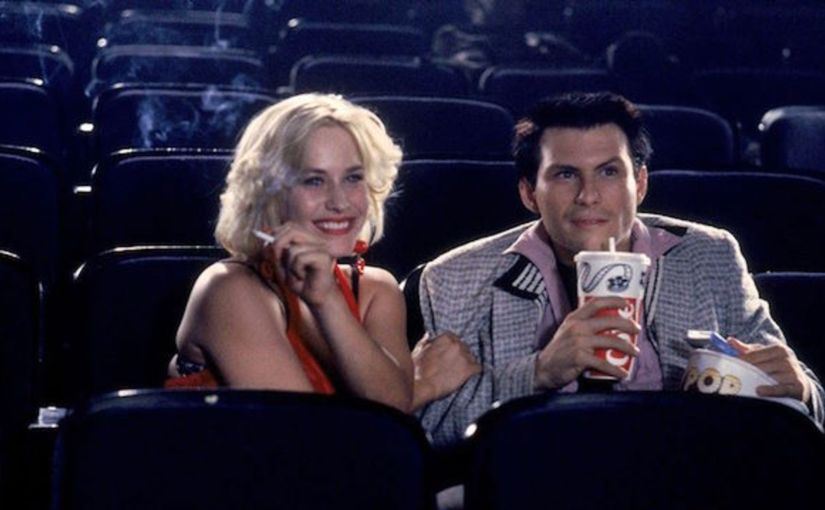
The structure built into the script for True Romance by Quentin Tarantino, directed by Tony Scott, is like the trunk of a solid oak tree with strong, sturdy branches representing its collection of seedy characters in off color scenes. Tarantino sets it up – an Elvis infatuated boy meets a rookie call girl (Christian Slater, Patricia Arquette). Boy marries girl, and then boy & girl find a suitcase filled with a fortune in uncut cocaine. A simple storyline that now allows a bunch of fun, short vignettes to be played out, all leading to one moment after the other within this universe of outlandish, lurid debauchery.

What works so well in True Romance is that literally from beginning to end, you are always meeting a new and incredibly interesting character. Each scene welcomes someone else into the fold. For that, you need an all-star cast. Gary Oldman, Samuel L. Jackson, Christopher Walken, Val Kilmer, Conchata Farrell, Dennis Hopper, James Gandolfini, Brad Pitt, Bronson Pinchot, Saul Rubinek, Michael Rapaport, Tom Sizemore, Chris Penn, Ed Lauter, Elvis & martial arts master Sonny Chiba. The list goes on and on. It should be noted that some of this cast were hardly bankable stars before this film, which flopped at the box office in 1993. Before the movie became a cult B movie obsession on home video and cable, it was blazing the trail of well-established careers for much of its talent.

Nearly every character can have a story of their own written about them. Take Gary Oldman in one of his best roles as the vicious looking pimp named Drexel, a white guy adopting a Jamaican gangsta accent with dreadlocks, gold caps on his teeth, a blind eye and wickedly curved scar down the side of his face. His appearance alone makes me beg to know this guy’s background in a whole other movie. Drexel’s introduction comes early when he pumps a shotgun into two hoods. Shortly thereafter he’s conversing with Clarence Worley (Slater), and we know who’s in charge of this scene. Oldman is only given about 10 minutes of screen time, but it’s hardly forgettable.

The same goes for Walken, as a well-dressed mafia don interrogating Clarence’s father (Hopper). This scene has become legendary for film lovers, and it carries into a stratosphere of intelligence and timing in performance duality. It remains one of the best scenes Tarantino ever wrote as we learn a probable origin of Sicilians from a doomed Dennis Hopper. This is an acting class at its finest.

Jeffrey L Kimball filmed the piece showing contrasts of a wintery cold and dirty Detroit versus a sun-soaked Los Angeles. It’s sharp photography of gorgeous colors schemes.

Hans Zimmer scored the soundtrack, deliberately saluting Terrance Malick’s Badlands where we followed a similarly young criminal couple played by Martin Sheen and Sissy Spacek. Zimmer’s fun, melodic tones to celebrate Arquette and Slater’s adventures is perfectly in tune with the two-dimensional charm of their new and happy relationship. Most of Tarantino’s script is not taken seriously. Zimmer was the right device for that.

A few spare moments are played with dread, though. Slater and Arquette are truly in love. So, Tarantino & Scott threaten what the film treasures. Arquette as a call girl named Alabama Worley is incredible throughout the film. She’s a silly, adorably cute Southern belle dressed in secondhand store accessories, such as a cow spotted patterned skirt with neon blue sunglasses, and red cowgirl boots. This is not someone you’d hire to manage your accounting firm or run a library. However, Arquette’s emotional range really comes through during a brutal beating scene with Gandolfini. It pains a viewer to watch the moment, but it comes long after we’ve grown to love her.

Later, towards the end, our favorite couple is again endangered during a three way Mexican standoff. It’s hilarious, and way off kilter, but then it also gets downright scary.

That’s the beauty of True Romance. It’s a well-organized mess of emotions from comedy to drama to violence and silliness. Tarantino has great set pieces put together in a connect the dots rhythm.

It’s an endlessly quotable film. It’s a visual film. It’s a literal roller coaster of dangerously amusing storytelling told with affection and gratuity. It’s also quite sweet.

True Romance remains one of my favorite films of all time.

WITNESS

By Marc S. Sanders

Recently, I viewed The Last Emperor and one issue I had was that it was challenging to comprehend the in-depth culture of the people it depicted. I really wanted to learn and pass the final exam with flying colors. Sadly, this was an AP class that I just wasn’t qualified for.

Now that I have watched Witness for the first time in many moons, I can honestly say there is an approach where you can get absorbed in a thrilling crime drama while also appreciating the core values of the community the film focuses on, namely the Amish who reside in the state of Pennsylvania. It’s a much easier film to learn from. That’s for sure.

Peter Weir directed Harrison Ford to his only Oscar nomination to date. Ford plays police officer John Book, opposite Kelly McGillis as Rachel Lapp, a widowed Amish mother traveling by train from home to visit family. At a layover stop in Philadelphia, her young son Samuel (Lukas Haas, in one of the best child performances I’ve ever seen, so bright, observant and wide eyed) witnesses a murder committed by a decorated narcotics police officer (Danny Glover). When Book gets wind of who the cop is, all three of their lives are in danger and they are forced to flee and hide back at the Lapps’ home among the Amish community. Book, however, has taken a gun shot wound following an attempt on his life. The Amish see no choice but to heal him, especially at Rachel’s insistence.

Weir, with a marvelous script by Earl & Pamela Wallace and William Kelley, shows the intersection of two extremely different ways of life where an “Englishman’s” belief in aggressive tactics conflicts with the peaceful nature of people looking to never get involved with any other culture. A romance may seem inevitable between the two leads but it’s a difficult one to embrace. It’s truly forbidden, not simply by the elder Amish and their respective code, but both Book and Rachel know it can’t happen either.

Because we are aware of this forbidden romance that seems to break through anyway, there’s a terrific dance scene at night lit only by headlights within the barn. Ford and McGillis really shine through in this scene as it is the first escape from the fear they have for their lives and the code they honor and are reluctant to violate. It’s the best scene in the whole film. It presents possibilities for different people to interact despite the barriers that prevent such feelings and actions. They laugh and swing naturally. It’s a different kind of moment for Harrison Ford, unconventional when compared to a large majority of the action film roles he’s widely recognized for.

With a biting soundtrack of suspense from Maurice Jarre, Peter Weir also focuses on the theme of intrusion. When the climactic and certainly expected shootout sequence on the farm is to begin, it’s frightening and disturbing to actually see men in suits holding shotguns amid an unarmed society. There’s a masterful shot at dawn of the three men marching down the hill quickly approaching the farm. These aren’t cops being covert. These are cops storming a palace of peace and tranquility. It’s hard to watch because of the stain it leaves.

Josef Sommer is the lead dirty cop and he plays a great villain, truly an uncelebrated bad guy character, as the years have gone on. He’s a decorated officer who comes off with an intent that looks like it’s noble, until nobility will no longer work and intimidation has to set in. Weir shoots Sommer at a lower angle to give him an imposing height.

Ford is terrific. You see some of the Han Solo vibe in the character. He’s a tough cop after all, but then he transitions into an awakened man healed by the more primitive methods of the Amish and their drive to simply build and nurture. Another good moment occurs when Book contributes to building a barn with the other men. He shares lemonade with them. Assists with lifting the framework and hammering along. Two communities are no longer clashing. They are now blending.

McGillis is also very good in her role. She is determined to honor her background, but questions if she is capable of sin and defends her position later.

Witness gives an in depth look into the daily life of the Amish, literally how they farm, build and dress. Book wakes up with them before sunrise to milk the cow and he experiences what they endure from pesky tourists looking for photo ops. It makes for some funny moments as well as an opportunity to cheer for the stand he eventually takes.

Another funny moment is when Ford dons the Amish attire for the first time; it doesn’t exactly compliment him well at first. Book’s adaptability to his new community is awkward to grasp.

Witness presents a bird’s eye view into a very private way of living, and I saw a very large picture.

Beyond that, it’s also a crackling, good thriller.

THE KILLERS (1964)

by Miguel E. Rodriguez

Director: Don Siegel
Cast: Lee Marvin, Angie Dickinson, John Cassavetes, Clu Gulager, and in his final acting role, Ronald Reagan
My Rating: 5/10
Rotten Tomatometer: 80%

PLOT: A hit man and his sadistic partner try to find out why their latest victim, a former race-car driver, did not try to escape.


…well, THAT was disappointing.

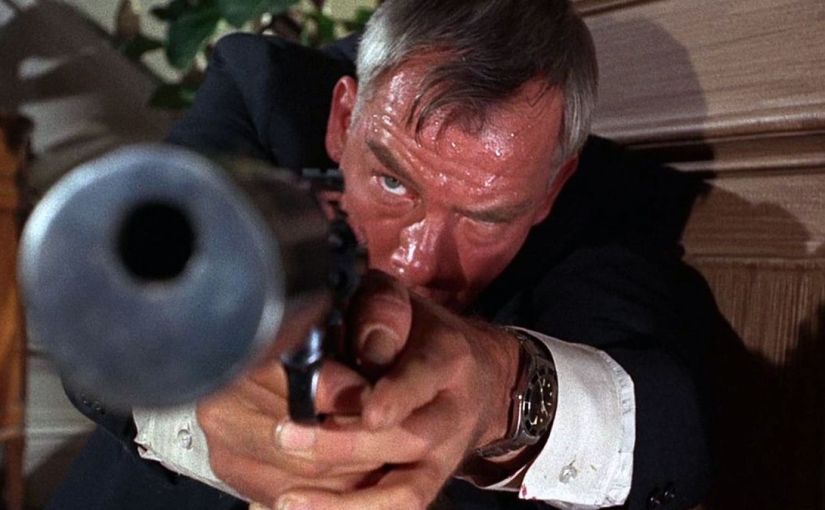
Fresh off watching the original The Killers from 1946, I dove into the 1964 remake.  Originally intended for television – indeed, this was supposed to have been the very first made-for-TV movie – it contained so much casual violence and sexual content that no network would touch it, not even the network that commissioned it, NBC.  It was imported to movie screens, pillarbox framing and all, where it cemented Lee Marvin’s status as one of the all-time great Hollywood tough guys.  (How tough?  He reportedly shot a scene while he was literally falling-down drunk.  That’s the take that’s in the film; you’ll know which scene it is when you see it.)

But while Lee Marvin is indeed tough, and even though his partner (Clu Gulager) plays a sociopathic killer who brings tension to every scene he’s in, I couldn’t get as worked up over this remake as I did over the original version.  Those two performances aside, this movie felt cliched and a little boring to me.

The story is the same as the original, with a couple of minor changes.  Two hitmen stroll into a school for the blind (!) and gun down Johnny North (John Cassavetes) in broad daylight.  Afterwards, Charlie, the veteran hitman (Lee Marvin) latches on to something he can’t figure out: why didn’t the target try to escape?  He does his own digging which leads him to a motley assortment of thugs and one duplicitous dame, Sheila (Angie Dickinson), who isn’t just a gold-digger, she’s a gold-strip-miner.  Turns out North was part of a million-dollar heist along with Sheila and some other thugs, including Jack Browning (Ronald Reagan).  The heist was successful, but after a series of double-crosses, no one seems to know where the money is.  With his seriously psycho partner, Lee (Gulager), Charlie tracks down the witnesses, and we get the same flashback structure as the original.  And the more he digs, the less he likes what he finds…

One major factor that didn’t score many points with me was the production’s obvious roots in television.  As you can well imagine, lighting on a movie set is very different from lighting for television.  And this movie looks like a TV movie through and through.  At the time, because of the relatively smaller screens of most televisions, it was believed that a movie shot FOR television needed bright lights and especially colors, so the pictures would be clearly visible on the tiny screens.  Well, in this remake, everything is so brightly lit and colorful it looks an episode of Star Trek or any other TV series of that era.  The very brightness of the surroundings drains a lot of the tension out of scenes that are meant to be disturbing or violent.  Blood doesn’t look like blood; it looks like Sherwin Williams.  I’m aware of the technical limitations of the time, but the shortcomings are just so obvious that it left me cold.

(By comparison, the original 1946 version is steeped in darkness and shadows and pools of light; it’s not only more beautiful, but it also just works better for the story.)

I also had problems with the casting of some of the big character roles, but my momma always said, if you can’t say nothin’ nice, don’t say nothin’ at all.  So that’s all I’ll say about that.

The editing was also a little distracting.  Again, this might be a factor of the period when it was made, as well as the fact that it was intended for TV, not the movies.  But one scene annoyed the heck out of me.  I don’t normally nit-pick bad editing, but here goes.

There’s a scene where someone has to drive a car down the length of a winding dirt road within two minutes, if not faster.  Zoom, off he goes.  And as we cut back and forth to various shots showing the car’s progress, instead of cutting directly to a different vantage point or camera angle, it’s cut with fades, which are normally used to indicate a passage of time.  But when the fades are used in what is basically a race against time, it has the effect of making the scene feel longer than two minutes, even though only 30-40 seconds of real time have elapsed.  It made the whole scene feel “off”, even amateurish.  Director Siegel had already directed 15 or 16 films by this time.  I think he should have known better.  Or his editor should have.

By the time we get to the end of the film, we’ve seen someone get dangled out of a hotel window from seven stories up, six or seven people get shot dead (one by a sniper rifle), more double-crosses than a Luftwaffe squadron, and a future hardline conservative President of the United States play…a villain.  But it all felt like an exercise in futility.  Sure, you get Lee Marvin playing a tough guy, but in three short years he’d get to play a really tough guy in Point Blank.  THAT’S the movie you wanna see. Or go find Dirty Harry, or even Escape from Alcatraz, both directed by Don Siegel, both superior films.

This one?  This one I only got because it came packaged with the 1946 version on the Criterion Blu-ray.  Do with that information what you will.

THE KILLERS (1946)

by Miguel E. Rodriguez

Director: Robert Siodmak
Cast: Burt Lancaster, Ava Gardner, Edmond O’Brien (and William Conrad in a small role…and yes, he was a big fella even then)
My Rating: 8/10
Rotten Tomatometer: 100%

PLOT: An insurance investigator tries to get to the bottom of a strange case involving a man who waited calmly for two men to find him and kill him.


Over the last several months, I’ve been digging a little more into the film noir genre, specifically going back to the ‘40s and ‘50s, and I’ve discovered some gems.  Pickup on South Street (1953), for example, featuring one of the most violent fight scenes to be found outside of a Tarantino film.  Or The Killing (1956), an early Stanley Kubrick film depicting the kind of ruthless behavior that I didn’t think was permitted at the time.  I’m discovering that, for the adventurous moviegoers back then, there were films available to see that might have made their parents or grandparents gasp in horror.

Take the movie I watched today, The Killers (1946), the film noir that introduced Burt Lancaster to the world.  It’s based on a short story by Ernest Hemingway that was also adapted into a film in 1964, starring Lee Marvin, Angie Dickinson, and, in his last film role, Ronald Reagan.  [Watch this space for a review of that film, coming soon.]  At the beginning of this movie, we’re introduced to two thugs who walk into a small town, cloaked in the kinds of shadows and light that only film noir can get away with.  After terrorizing the patrons of a small diner, they walk to a nearby boarding house and up the stairs to a room occupied by Ole Anderson, aka “The Swede” (Lancaster), who has been alerted to their arrival but makes no effort to escape or call the cops.  He simply awaits his fate.

And what a fate.  The two thugs burst into the room and obliterate the Swede in a hail of gunfire that goes on for quite a long time, even by today’s standards.  (Later, the coroner describes the Swede’s body as being nearly “cut in half” by the barrage…yikes.)  This being 1946, we don’t see any of the actual carnage, but the implication is there.

The movie proceeds in a series of flashbacks.  An insurance investigator named Jim (Edmond O’Brien) tries to find out two things: why the Swede named a kindly hotel maid as beneficiary of his life insurance policy, and what happened to the $250,000 payroll that the Swede helped steal from a hat factory.  Now that I think about it, The Killers is almost like a thick-necked, brass-knuckles, gun-toting variation on Citizen Kane.  We never see anything about the Swede that wasn’t directly observed by someone Jim tracks down, and as Jim continues to dig, things just get mysteriouser and mysteriouser.

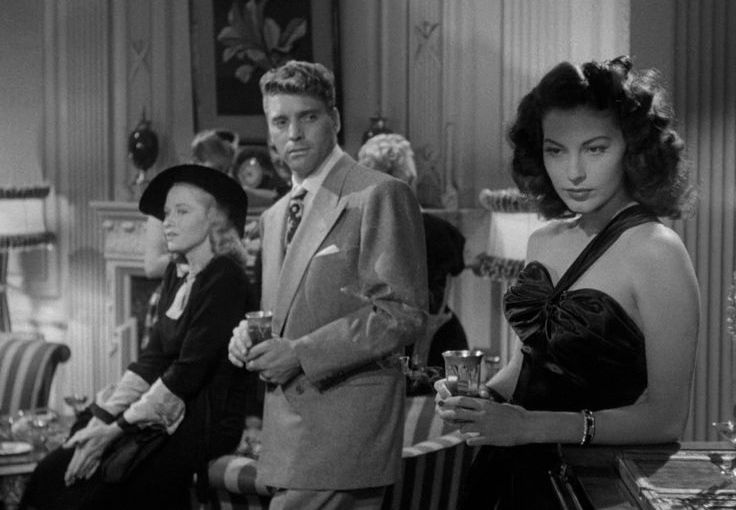
Figuring prominently in the Swede’s backstory is Kitty Collins, played by the ravishing Ava Gardner.  This was not her first film, but The Killers is the movie that put her on the map for good.  We first see Kitty when the Swede goes to a fancy party with his girlfriend, Lilly.  Alas, Lilly is no match for the sultry Kitty, who is wearing the kind of stunning black gown that inspires poetry when it isn’t simply driving men crazy.  How crazy?  At one point, when Kitty is caught by a cop wearing shoplifted jewelry, the Swede claims responsibility, slugs the cop, and winds up doing three years in jail for her.  Talk about being Kitty-whipped.

Naturally, as Jim, the insurance guy, meets more people, the Swede’s story comes more sharply into focus, but there’s still the mystery of what happened to all that money.  The robbery was indeed pulled off by the Swede with three other guys, but none of them have the money, and the Swede doesn’t have the money, so where is it?  As it turns out, the hat factory they stole from is insured by the same company that provided the Swede’s life insurance policy, so it’s in Jim’s best interest to get to the bottom of everything and recover the money, even if it means getting involved with the same kinds of thugs who killed the Swede in the first place.  That’s okay, though.  Jim is prepared.  He carries his own piece, and he comes up with a cool plan to get the guilty parties to confess as much as possible before they wind up dead…or he does.

The Killers is an example of a film that helped define, or at least refine, the relatively new film noir genre.  Similar films centering on crime, criminals, and punishment had been around since the ‘30s, but the real granddaddy of them all, The Maltese Falcon, had only been released five years earlier in 1941.  Since then, World War II came and went, and as dark as noir had been, it got even darker and more violent than Bogey was when he slapped Peter Lorre around.  With this film, director Robert Siodmak turned everything up to eleven.  The shadows aren’t just dark, they’re black, which of course makes the periodic pools of light that much more striking.

And the characters mean business, too.  Among the bad guys, there’s one named Colfax who doesn’t look like much – sort of like a moderately well-built school principal.  But when a genuine thug threatens to fight him, he doesn’t posture like a bully.  He just sits back in his chair and calmly tells the thug: “You’ve got quite a reputation yourself.  You’re supposed to be a troublemaker.  Okay.  Make some.”  And you just know that if the thug so much as lifts a finger, he’ll get it broken for his trouble.  It’s an interesting scene that reminded me of Goodfellas: “Paulie may have moved slow, but it was only because Paulie didn’t have to move for anybody.”

(I should also mention the flashback involving the payroll robbery.  In today’s films, when we marvel at long takes involving complicated camera moves, it’s good to be reminded that, three-quarters of a century ago, The Killers gave us a heist sequence that starts at ground level, follows the robbers up a staircase, shows the actual robbery, follows them back down into their getaway cars, and even provides a small-scale shootout as they drive away – all in one uncut take, using a camera about the size and weight of a SmartCar.)

While I thoroughly enjoyed The Killers, I wouldn’t quite put it in the same weight class as, say, Out of the Past or The Big Sleep, but it’s got all the right ingredients, it tells a good story well, it gives us Ava Gardner in that gown, and it provided a great springboard for the films that came after.  Good film noir is fine; GREAT film noir is better.  This is one of the great ones.

[P.S.  The scene near the beginning of the film where the two thugs terrorize the people at the diner reminded me strongly of the scene in No Country for Old Men when Anton Chigurh quietly tells the store clerk to “call it.”  They were just as calm and serene and tightly coiled as Chigurh.  Pretty creepy.]

IN THE HEAT OF THE NIGHT

By Marc S. Sanders

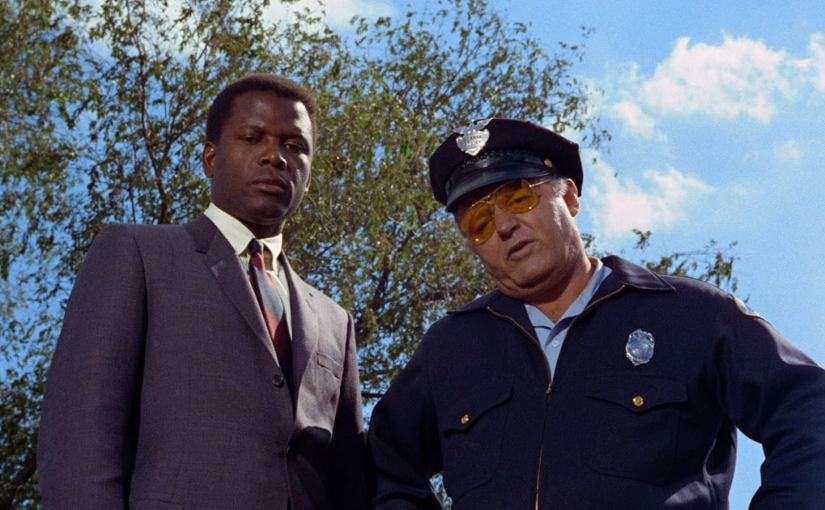
In 1967, just before the assassination of Dr. Martin Luther King Jr, Norman Jewison’s film In The Heat Of The Night won five Academy Awards including Best Picture, Best Actor for Rod Steiger and Best Adapted Screenplay by Sterling Silliphant.  While it is easy to classify the movie as a crime drama/murder mystery/detective story, the setting and themes of racial prejudice overshadow who the killer is or the motive.  As the film progressed, I grew less curious of who bludgeoned white businessman Philip Colbert to death and why.  It was much more important to understand exactly why Steiger’s Mississippi Police Chief Gillespie is so quick to believe that a well dressed and cooperative black man who was simply apprehended for waiting at a train station would be the culprit.  The black man is Virgil Tibbs (Sidney Poitier), a Philadelphia police detective.

After Tibbs has an opportunity to identify himself, Gillespie shamelessly requests his services in solving the crime.  Murder doesn’t happen often in Sparta, Mississippi.  Tibbs’ supervisor speaks highly of his officer’s capabilities.  Tibbs knows how to look for signs of rigor mortis on the deceased.  He knows how to identify that the killer was right-handed and he knows that when another suspect is quickly brought in, that he can’t be the killer either.  Still, many of the heated conversations between Gillespie and Tibbs are the same.  Their back and forths even become redundant at times.  Gillespie, nor the deputies and other residents of Sparta, are apt to listen to a “colored” person.  At one point, Tibbs is put in a cell for not agreeing with Gillespie’s conclusions.  He’s also ordered on two or three occasions to get out of town.  Tibbs is not so willing to surrender though, even if he’s regarded with racial disdain.  The impression is that this murder will not be so challenging for Tibbs to solve, if only he had a little more time and cooperation.  So, the riddle of the crime is not the overall conflict of In The Heat Of The Night.  More so, it is the racial hatred that a deep south Mississippi town has for an educated and skillful black man from up north.  

I read that the film was shot primarily in Sparta, Illinois.  Poitier made that request for his own safety while a tense period within America was occurring against the backdrop of the civil rights movement.  Jewison’s film is quite brave.  In the face of racial divide within the United States, this film still got made.  Yet, it had to be produced with an abundance of caution. 

A telling scene happens in the middle of the picture.  Tibbs requests Gillespie escort him to a wealthy cotton plantation owner’s home.  As they drive up to the home, they pass by the black cotton pickers collecting the crops under the hot sun.  They meet in the estate green house with a Mr. Endicott, who comes off very cordial to Tibbs at first.  However, when a slight accusatory question comes from Tibbs, Endicott slaps him across the face.  Tibbs responds with a slap right back at him.  In Mississippi, a black man better know his place, even if the prime suspect of a murder is a wealthy white man, or more simply just white.  It’s a classic moment in film history.  However, it remains an important scene and maybe its significance should be all the more heightened in modern day 2022 with the Black Lives Matter mentality at the forefront; where police/African American race relations are being tested. 

Three white men were recently sentenced to life in prison without parole for the hate crime killing of a black jogger named Ahmaud Marquez Arbery in the state of Georgia.  All that Mr. Arbery was doing was jogging through a neighborhood.  He didn’t have a weapon.  He hadn’t come in contact with anyone to even slightly suspect a threat.  He was noticed by these three criminals, and because he didn’t belong in that area, he was brutally murdered for the color of his skin.  Evidence would reveal where these men stood with regards to black people as a history of various texts that were clearly racial in nature were later uncovered.  If it wasn’t going to be Mr. Arbery who was murdered, it was eventually going to be another black person who would fall victim to these men. 

Though Dr. King was murdered shortly after the release of In The Heat Of The Night, I’m cautiously optimistic that racial hatred has lessened and the generations that followed learned from the misgivings of their ancestors.  Still, the term “hate crime” is often used in news reports today.  The debate of the Confederate flag and its argument for keeping it flying still has to be pondered.  Fifty years later, I cannot understand why, though. 

I will never forget a vacation I took with my family to Stone Mountain in Georgia back in 2005.  It was fourth of July and we were picnicking on the lawn next to a couple of teenagers while waiting for the fireworks.  I struck up a conversation with a local teenage girl and the flag and the confederacy along with the carving of Confederate leaders (Stonewall Jackson, Robert E. Lee and Jefferson Davis) on the rock sight were brought up.  Her defense of these topics was “It’s history.  Not hate.”  I became much wiser in that moment.  I was just a naïve Jewish guy who was raised in New Jersey.  I was not aware enough.  Much still hadn’t been learned and a whole lot needed to be unlearned.  History is not a reason to celebrate.  History is not meant to honored.  History is meant to be remembered for our rights, and especially our wrongs.  Much of history should not be repeated, and yet that’s what happens all too often.

In The Heat Of The Night is another example of the power of films.  So much is debated about what is taught in our schools.  A proposal of law for “Don’t Say Gay” is likely to be passed in Florida where it’s deemed impermissible to discuss homosexuality in elementary schools.  Books are continuing to be restricted from availability in libraries.  So, if our institutions of learning are being censored, then we have to rely on other mediums.  Movies like Schindler’s List or In The Heat Of The Night or Do The Right Thing offer those opportunities.  Films open a window to view love and hate as well as tolerance and prejudice.  We can never afford to look at our world with rose colored glasses.

ELEVATOR TO THE GALLOWS (1958, France)

by Miguel E. Rodriguez

Director: Louis Malle
Cast: Jeanne Moreau, Maurice Ronet, Georges Poujouly
My Rating: 10/10
Rotten Tomatometer: 93% Certified Fresh

PLOT: A married woman and her lover hatch an apparently foolproof plan to kill her husband (his boss), but a split-second decision at a crucial moment sends everything into a tailspin.


We plan, God laughs. – old Yiddish proverb

Let me get this out of the way right at the top: Elevator to the Gallows is one of the best crime drama/thrillers I’ve ever seen.  It holds its own against anything by Hitchcock or Clouzot.  With admirable focus and restraint, first-time director Louis Malle (My Dinner with Andre, Vanya on 42nd Street) crafts a gripping illustration of how the best laid plans can fall apart because of one minor miscue.

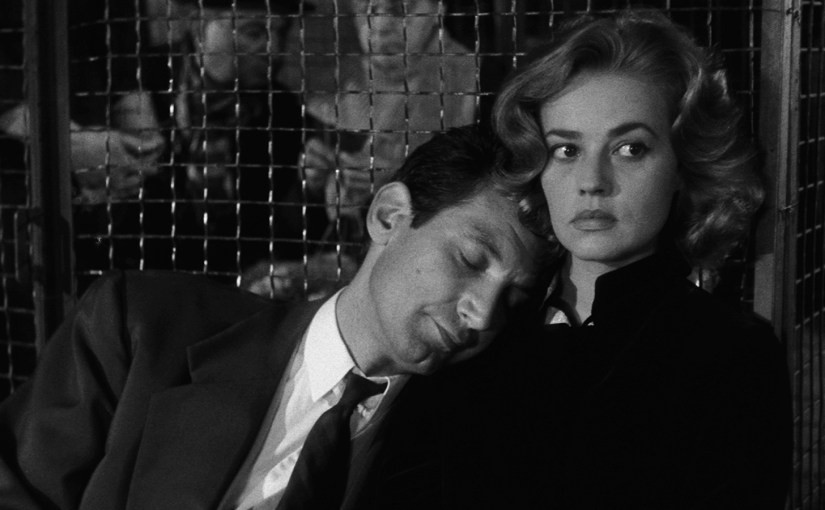
The film cuts right to the chase at the opening scene, showing a phone conversation between Florence Carala (Jeanne Moreau) and her lover, Julien Tavernier.  They discuss their plans for Julien to kill her husband in his office on a Saturday evening, after which he’ll pick her up at a café where she’ll be waiting, and that will be that.  Everyone will assume her husband is in Geneva on business, and no one will discover the murder, which Julien will arrange to look like a suicide, until Monday morning, giving Florence and Julien plenty of time to make their escape.

(I liked how we never got any flashbacks of the relationship between Florence and Julien.  All we need to know is, they’re lovers, they’re desperate enough to commit murder, and that’s it.  Very concise.  I love it.)

Julien’s plan involves using a grappling hook to avoid using the office elevator to get to his boss’s office one floor above his.  He proceeds with the plan, nearly getting caught in the process, but he’s able to commit the crime and leave the building with several witnesses as an alibi, witnesses who will say they never saw him enter his boss’s office before he left.  So far so good.

Julien gets to the street, takes the top down from his convertible, takes one last look back at the building…and realizes he left a vital clue in full view of any pedestrian or street cop.  Leaving his car running, he decides to run back into the office building and retrieve the evidence before the night guard shuts off the power for the night.

Unnoticed by Julien, a florist and her bad-boy boyfriend have been having an argument at the shop next to his car.  The boyfriend sees this rich man leave his convertible on the street…with the engine running…

Thus begins a Hitchcockian odyssey that leaves Julien stranded in an elevator, his car and his identity stolen, and his mistress stranded on the streets wondering where the hell her lover is.  At one point, Florence sees Julien’s car drive by the café where she’s waiting…she can’t quite make out the driver, but who is that girl in the car with him?!  Has she been betrayed at the last minute?

The film follows the younger couple, Louis and Véronique, as they tool around in Julien’s car, eventually winding up at a roadside motel, and unwittingly making friends with two German tourists.  They even share drinks with the Germans and take some candid photos using a little spy camera in Julien’s raincoat.  (We learn that Julien was in the Foreign Legion and was well-trained as a soldier – maybe even in spycraft.)  I found myself wondering why we were wasting time with this larcenous couple…until they decide to check into the motel as Mr. and Mrs. Tavernier to cover their own tracks.

The screenplay ingeniously heaps one hasty decision on top of another so that, just when it seems Julien might be in the clear, something else happens that makes it seem impossible he won’t be discovered or at the very least blamed for something he didn’t do.  Meanwhile, Julien is desperately trying to escape the elevator, using a penknife as a screwdriver, getting excruciatingly close to tripping a vital switch that’s just out of his reach.  He eventually tries to get out using the old climbing-the-cable trick…which is of course exactly when a night watchman is making his rounds.

This story is so good, I can’t believe there hasn’t been an American remake.  And it’s not like there aren’t other great films out there that cut right to the chase and never look back for flashbacks or additional material.  I’m not sure what makes Elevator to the Gallows so good, to be honest.  Maybe I was rooting for Florence and Julien when they are clearly not the good guys.  Maybe it’s the economy of the storytelling, or the screw-turning twists that lead the police to believe Julien has committed more than one murder.  At one point, Louis and Véronique make a startling decision that had me yelling at the screen.

Words fail me on this one.  I can’t describe it any better than by saying this is one of the best films I’ve ever seen, certainly one of the best film-noirs I’ve ever seen, and a movie that I’ll bet Hitchcock watched while thinking to himself, “Damnation…I wish I’d thought of that.”

BRUTE FORCE (1947)

by Miguel E. Rodriguez

Director: Jules Dassin
Cast: Burt Lancaster, Hume Cronyn, Charles Bickford, Ann Blyth
My Rating: 9/10
Rotten Tomatometer: 94%

PLOT: A convicted felon tries to organize a prison break under the nose of a sadistic chief guard who is on the verge of becoming the new warden.


In Brute Force, released seventy-five years ago, we are witness to: a man getting crushed by a metal press, a suicide, a brutal interrogation with the help of a length of metal pipe, a prisoner machine-gunning dead cops out of sheer frustration (okay, you got me, that part is off camera), and the kind of nihilistic ending that you typically only see in old French films.  Wages of Fear, for example.  I mean, this movie is violent by TODAY’S standards, let alone just a couple of years after World War II ended.

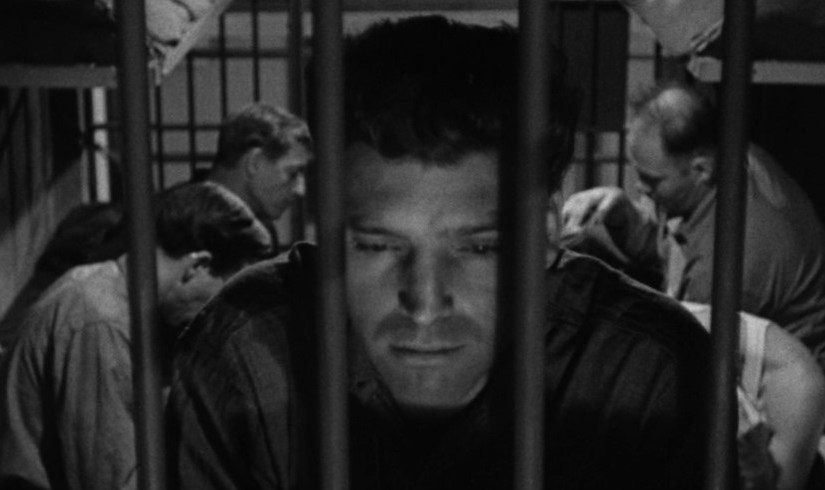
Joe Collins (Burt Lancaster in only his second film) is just getting out of solitary confinement at Westgate Penitentiary when he sees one of his cellmates being driven out of prison…in a hearse.  This only solidifies his resolve to escape with the help of his remaining cellmates.  Meanwhile, we get glimpses of life elsewhere in the prison.  The current warden is a trembling coward who addresses the prisoners only through a P.A. system in his office.  The prison physician, Dr. Walters, sees injustice and top-down barbarism on a daily basis and has his own method of escape: whiskey.  Inmate informants and stool pigeons are dealt with promptly and carefully.

Looming above everyone, despite his relatively small stature, is Captain Munsey (Hume Cronyn).  He has the real power at Westgate.  He rarely raises his voice and even stops his lieutenant from beating a prisoner unnecessarily.  But he unflinchingly doles out punishments and even strong-arms other convicts into ratting out their buddies.  Of course, the stoolies are usually found out and wind up dead.  Shame about that.

The crux of the story is the escape plan, an ambitious endeavor involving capturing the yard tower which controls the gate and lowers the drawbridge – an actual drawbridge! – to the mainland.  Between making these plans and various other intrigues involving the warden and an imperious visiting government official, we are also treated to flashbacks showing how some of Joe’s cellmates wound up in prison to begin with.  Here the film gets a little overly melodramatic, a typical trait of many dramas of the ‘40s, but director Jules Dassin wisely doesn’t dwell on them for too long.  The scenes do just enough to create more audience empathy for these “bad men” without bathing in soap.

I put “bad men” in quotes because these guys are, in fact, criminals, but they’re also our protagonists.  When it comes to Joe himself, it seems clear by his demeanor and his flashback that he wasn’t just a criminal, he was a leader of criminals, head of his own little gang.  This is not a very nice man.  The only convict sharing a cell with Joe who might conceivably be considered a “good guy” is Tom, a man who embezzled money from the company he worked for to buy his frustrated wife a fur coat.  Everyone else looks capable of perpetrating real violence.

Why do we root for these men?  Partly because it’s in our nature to support anyone who is out to give authority figures the finger.  From Cool Hand Luke all the way to Hannibal Lecter and beyond, we are instinctively drawn to men and women who are bucking the system.  But it’s especially prominent in this movie where we see these men at the mercy of a broken system that eventually revokes all their privileges, even visiting hours, in the name of restoring discipline.  Armed guards watch the prisoners everywhere, even in the chapel.  There is no longer any attempt at actual rehabilitation.  In the prison’s auto garage, a prisoner is asked what he’s learned while working there.  His answer: “I’ve learned that, when I get out, I don’t wanna be a mechanic.”  He hasn’t learned anything.  He’s just learned that it’s better to not get caught.  For this we pay our taxes?

So, yes, there is a strong message in Brute Force.  It’s not especially subtle, especially during the liberal Dr. Walters’ various monologues about the corrupting nature of power and the futility of expecting lasting behavioral changes through punitive measures.

But what stood out to me was the unexpected level of violence in the story.  Sure, some of it is discreetly left off screen, but what is left to the imagination can be infinitely worse than what the screen shows us.  Case in point: Se7en, where we are always shown murder scenes, never the murders themselves.  Or the infamous ear scene in Reservoir Dogs, where we never actually see the deed being done, yet it’s remembered as one of the most violent scenes in film history.

In Brute Force, during an interrogation, we see Captain Munsey winding up to deliver several blows with a lead pipe to the head of a handcuffed prisoner.  We push past the prisoner, so we only see Munsey, and down comes the first blow.  We hear the impact, then cut to just outside Munsey’s office where other officers are killing time playing cards or writing reports.  And through the doorway we hear more impacts, one after the other after the other.  Some officers look uncomfortably toward the office but make no move to stop what’s happening in there.  One officer is so disturbed he throws down his cards and stalks away.  Right away, we’re thinking, jeez, if HE’S that upset, something terrible is going on in that office.

This is not the kind of “realness” I was expecting from a 1947 film.  And it doesn’t end there.  There are other little vignettes of violence during the climactic escape attempt that made me gasp, including a hand-to-hand fight where one guy appears to be getting hit in the head and neck with a belt of machine gun bullets…for real.  At least twice.  Looked convincing to me, anyway.

Jules Dassin (1911-2008) is known for directing some of the best loved film noirs of all time, including The Naked City [1948], Night and the City [1950], and Rififi [1955], which won him the Best Director award at Cannes that year.  His best films are steeped in atmosphere and a fatalistic sense of…well, fate, an idea that no matter how hard we kick and scream at the walls of our existence, any attempts to escape will be met with massive resistance and will most likely end in failure, or at best only a partial victory.  Not a particularly uplifting outlook, but who says all movies must have a happy ending?  Sometimes you get the bear, sometimes the bear gets you.  By the end of Brute Force, Dassin ingeniously combines those two outcomes.  Tricky.