SEVEN

By Marc S. Sanders

There’s an interesting dynamic to David Fincher’s Seven that is not touched upon often enough.  Beyond the clever and grisly murders set to a theme of the Seven Deadly Sins, the two police detective protagonists are carved from completely different molds.  The spine of Fincher’s film, written by Andrew Kevin Walker, focuses on how these men approach the craft of the killer’s accomplishments.  One man wants to cut to the chase, find the criminal and cuff him.  The other wants to study the nature of this mystery man, and only then will it lead to the suspect’s true identity.

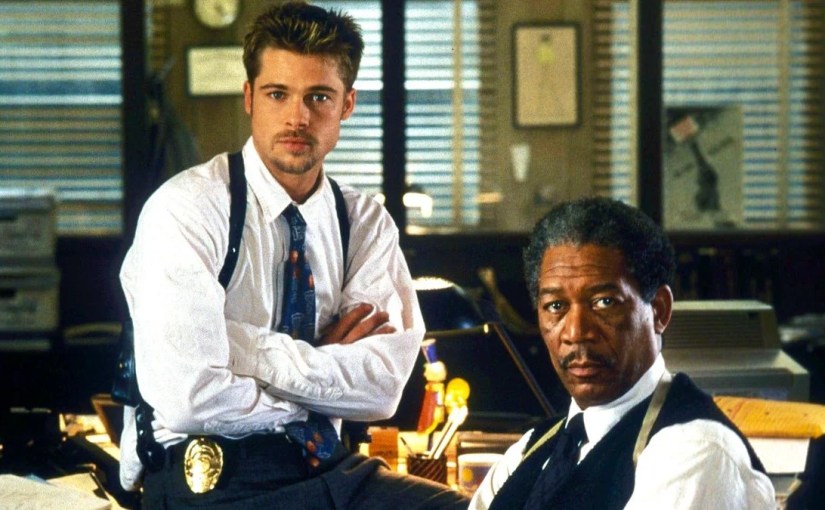
Detective William Somerset (Morgan Freeman) stems from a time gone by for the cinematic detective.  He’s the trench coat wearing investigator who examines and connects dots, never resorting to fists or police intimidation with a gun.  Newly assigned Detective David Mills (Brad Pitt) dons the leather jacket with the cute goatee and boy blond haircut.  He’s more apt to making fun of the sick weirdo they are chasing, hardly lending any valuable insight or observations.  Somerset will approach with respect for the killer and his work.  Mills, with nowhere near the experience of his new partner, will disguise his loss of where to begin with this case by resorting to cheap shots at the killer’s expense, calling him Yoda and surmising this guy must be pleasuring himself in peanut butter, perhaps.

Fincher is widely recognized for the dark photography of his films, like the cherry wood hallways of Harvard in The Social Network or the lurid neighborhoods in movies like Zodiac and Gone Girl.  In Seven, the setting is very much a character in and of itself, but other than the fact that it is a California (thanks to a throw away piece of dialogue) metropolitan area, we never know the name of this city.  It is a dreary, ongoing rain-soaked environment that hinders the police officers and keeps everyone contained in the film, especially David’s wife Tracy (Gwyneth Paltrow), unsettled.  The city has no name or identity.  Therefore, the police officers who occupy it are not the stereotypical cops designed for this place.  One works as a tired, wise and experienced Colombo figure, minus the sarcasm.  The other is an aggressive hot shot who is over trying to prove himself to peers and superiors.  Now he wants to be in charge.  They both follow the footsteps of the mystery together.  Yet, they are reading different roadmaps.

With seven days left before retirement, Somerset meets newly arrived Mills.  They are quickly dispatched to a filthy apartment for an ugly murder scene of an odd nature.  It is a scene labeled as Gluttony by the killer.  Greed follows shortly thereafter, and Somerset knows none of this random.  Whoever has orchestrated these two executions is methodical and resourceful, with a point to prove.  The artistic measure and inspiration are too creative, far from the sloppiness of a standard stabbing or gunshot to the head.  Somerset already knows five more murders will likely turn up and doesn’t want to get involved.  He’s seen enough.  Mills has the cavalier attitude.  Find the freak, and maybe take him out in a blazing shootout.  It’s reckless. 

Could Seven be an answer to how cop movies performed at one time and how they act now?  Seven may be the closest outline of pairing Humphrey Bogart’s Sam Spade with Mel Gibson’s Martin Riggs.  Sure, the murder scenes are hard to look away from, as deliberately repulsive as they are.  Even after multiple views of the film, I still get curious with how the killer planned all of this out to the absolute most minute detail.  However, ninety percent of the dialogue is exchanged only between Freeman and Pitt. Paltrow has a couple of scenes that help paint the sad picture of life in this city, but ultimately the film belongs exclusively to the two cop characters.  Seven has one action scene, but it primarily covers how the two men respond to the nature of what they come upon.  Mills will crack jokes that maybe his college pals would snicker at.  Somerset asks the young man to just be quiet while he explores the scene.  Mills gets grossed out by a bucket of vomit.  Procedurally, Somerset will ask Mills if there was any blood in it.  Mills will resort to Cliff’s Notes on the Seven Deadly Sins.  Somerset will spend his evening in the library, digging through the original source.  Mills will kick down a door without authority.  Somerset will protest against that action without following the standards of procedure.  It’s a dichotomy of impatience versus patience.

The two men actually don’t come to a common platform until the third act of the picture, when the rain has subsided, the sun comes out, and the killer opts to surrender himself.  Still, the mystery of his purpose remains and there’s an unknown element of what to expect next.  So, while the partners may agree that there’s more to come, they still respond to the killer, in person, differently.  Mills can only yell at the deranged suspect and call him names.  Somerset interviews the gruesome and imaginative architect with questions. 

Seven is a sensational crime drama.  It’s eerie, creepy and appreciatively sickening in its crimes.    The outline of some of the killer’s actions might seem conveniently questionable or far-fetched.  Some of the crime scenes were planned over a year’s time. Others were not meant to be revealed until a certain point within these particular seven days.  So, the writing might be a little too overly precise.  However, that should not be dwelled upon.  Rather, one kind of cinematic cop is not the standard in Hollywood films anymore.  Another kind of cop has filled that void in its stead. 

Andrew Kevin Walker’s script follows a very structured outline.  It’s not until the story’s infamous end does the film divert itself, as it is almost unfathomable that it could have actually happened. 

It is fortunate that David Fincher was allowed vast liberties with the production of only his second film, following the abysmal Alien 3 which famously took away any of the personal oversight he depended on as a rookie filmmaker.  With Seven, Walker and Fincher draw out four characters quite well – Somerset, Mills, the city with Tracy as its spokesperson, and the killer’s actions.  Blend these elements together and see if they make for a good product.  Fact is they couldn’t be any more disagreeable, but the chemistry works perfectly. 

Seven is a sensational movie and will likely always remain as one of David Fincher’s best films.

THE NAKED CITY (1948)

by Miguel E. Rodriguez

Director: Jules Dassin
Cast: Barry Fitzgerald, Howard Duff, Dorothy Hart, Don Taylor
My Rating: 7/10
Rotten Tomatometer: 85%

PLOT: In almost documentary-like fashion, New York City cops investigate the brutal murder of a young woman.


It’s that narration.

If The Naked City hadn’t included that cockamamie narration, I might have given it a “9” instead of a “7.”  Here is a police procedural ahead of its time, a pre-television-era herald of popular entertainments from Dragnet to Law and Order to CSI.  The story is absorbing and engaging from beginning to end, even if some of the acting is not especially Oscar-worthy.  There are enough twists and turns in the search for a cold-blooded killer – or killers – to keep your attention all the way through.  And over it all, intruding where it’s not wanted, is a Disney-esque narration from the film’s producer, Mark Hellinger, who also produced a superior prison film a year earlier, Brute Force (1947), also directed by Jules Dassin.

Imagine a scene where foot-weary detectives are pounding the streets, making inquiries at jewelry stores, hairdressers, pawnshops, looking for leads.  As we watch the scene progress, we hear the narrator: “Are your feet tired, detective?  Not to worry, only 400 more jewelry shops to go.”

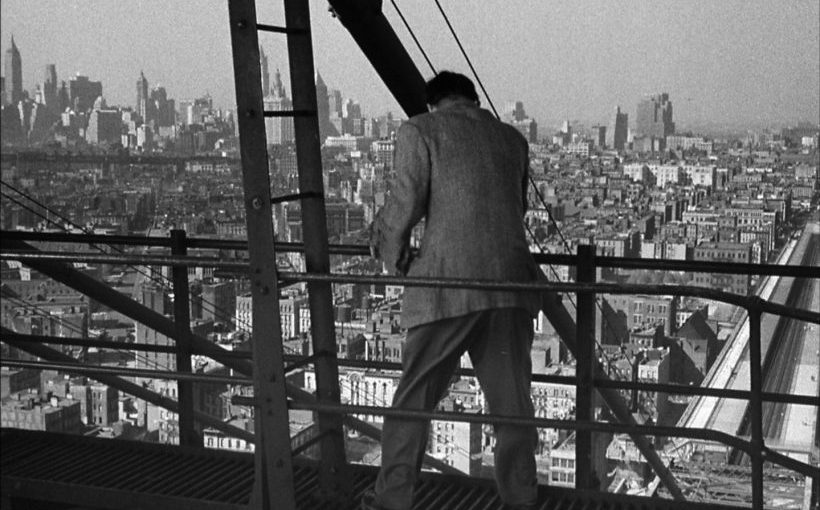
Or another scene where a detective looks wearily through a window at the city laid out below, pondering where to go for the next clue.  Cue the narrator: “There’s your city, Halloran.  Take a good look.  Jean Dexter is dead, and the answer must be somewhere down there…”

I hated the narration in this movie.  It reduced what I was watching to the level of one of those Disney animated shorts where Goofy is playing some kind of sport and the narrator describes the action while Goofy screws it up spectacularly.  Another example, as morning comes to the city: “The city is quiet now, but soon it will be pounding with activity.  This time yesterday, Jean Dexter was just another pretty girl, but now she’s the marmalade on 10,000 pieces of toast.”  Give me a break.  I fully understand how future TV shows made use of this kind of narration, but not to this degree.  It made a crime story sound like an industrial video.

So let us stipulate that I hated the narration.  The rest of this review will discuss the film as if the narration didn’t exist.  It’s best for you, it’s best for me…it’s best for us.

The Naked City opens with the murder of a young woman, Jean Dexter.  The rest of the movie details the police investigation and search for her killer.  In broad strokes, that’s pretty much it.  In its own way, it reminded me a little bit of All the President’s Men (1976) in that we’re focused exclusively on the process of investigation with very little cutting away to other participants.  The lead figures are a very Oyrish Lieutenant Muldoon (Barry Fitzgerald) and the dependable Halloran (Don Taylor).  The chief suspect is Frank Niles (an impossibly young Howard Duff, whom you may recall as Ted Kramer’s attorney in Kramer vs. Kramer [1979]).  Niles raises so many red flags that I started to think he was an obvious red herring.  Under questioning, he lies and lies and lies again, even “forgetting” to tell the police he’s engaged to the dead woman’s best friend.  Can this guy be for real?  We have seen so many criminals in so many TV shows and movies who are so much better at lying to the police…but he’s so bad at it that he must be innocent by default, right?

The investigation continues.  Clues and leads are chased down.  Another murder occurs.  False confessions are heard and dismissed.  The dead girl’s parents come down to the mortuary to identify the body.  (That particular scene was notable for being filmed at an actual New York City mortuary, a first for its time.  In fact, the vast majority of The Naked City was filmed on location in the Big Apple, one of the first major Hollywood productions to do so.  It’s hard to conceive of now, but this caused a minor sensation upon the movie’s release.)

While the mystery of the murder is the real meat of the story, I got the impression that the goal of the film was to bring these mundane police procedures to the masses, to show audiences that, while you work and eat and play and raise your families and go to baseball games, the good guys are on the case whenever something goes wrong.  And this is what they do for just one murder case.  In a city like New York, who knows how many murder cases are being worked on at once?  As the closing narration famously says, “There are eight million stories in the naked city.  This has been one of them.”  (Okay, that’s the one bright spot in the narration, let us never speak of it again.)

I can even draw a direct line between The Naked City and The Silence of the Lambs (1991).  In The Naked City, Halloran uncovers a possible connection between the second murder victim and the prime suspect in the first murder.  (It’s complicated.)  He gets permission from Muldoon to chase it down, despite how unpromising it is.  As he’s following his nose, Muldoon chases down a lead of his own, getting closer to the true mastermind behind this case.  In this way, there is a direct parallel in The Silence of the Lambs where Crawford takes a task force to a suspect’s house while Clarice follows a nearly invisible trail to Jame Gumb’s doorstep.

Everything comes to a head with a foot chase that leads to the Williamsburg Bridge, scenes that must have been a little mind-blowing for 1948 audiences as the camera seemingly defies gravity, climbing higher and higher into the scaffolding with the fleeing suspect.  (It should also be noted that the film perhaps romanticizes inner city life to a degree…as the suspect flees across the bridge, he breaks up a group of children skipping rope on the footpath.  Not the kind of thing I’d expect to see today, for sure.)

The Naked City is about as good as crime dramas in the ‘40s could get without resorting to the darkness and shadows of film noir.  This is, after all, a film about the good guys, not the bad.  Watching cops interrogate witnesses and compare notes about stolen jewelry isn’t quite as “sexy” as watching Bogie draw down on some hoodlums, but hey, that’s the kind of thing that really happens in the big bad city.

CASINO

By Marc S. Sanders

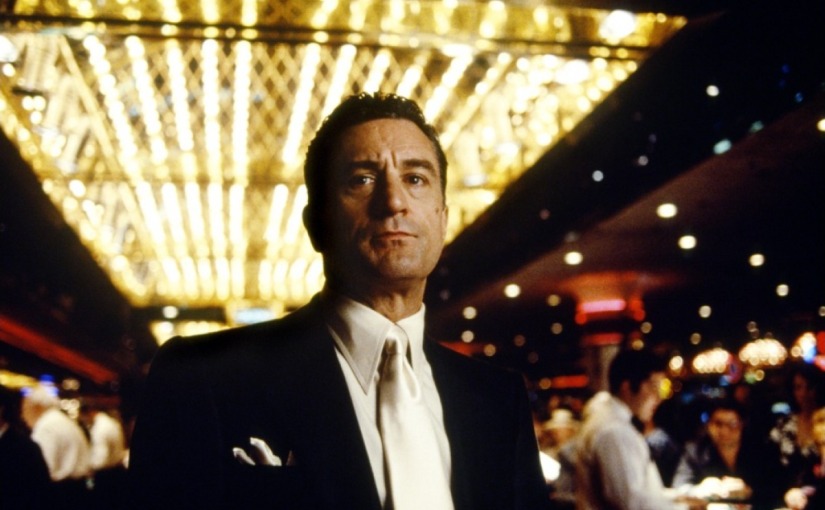
When a movie is set in Las Vegas, doesn’t it feel like it should be overly exaggerated, maybe a little loud, and quite bombastic?  That’s how I feel about Martin Scorsese’s three-hour opus, Casino.  The film opens with a car bomb exploding our primary narrator, Sam “Ace” Rothstein into the skies where he then makes his descent into the expansive signs that light up sin city in the desert.

Ace (Robert DeNiro) runs The Tangiers Casino.  He was especially picked by the mid-west Mafia back home (St. Louis, Mo.) to oversee everything that happens at the casino.  He’s looking for cheaters.  He’s making sure blueberry muffins live up to their name.  He’s dodging the FBI and their hidden bugs.  Most importantly, he’s making sure hefty suitcases are walked out of the casino and delivered on a monthly basis to the wise guys he has to answer to, and those deliveries better not come up light.  These guys treasure Ace because he never loses a bet.  Not one.  He can predict the outcome of any sports contest.  He can beat the odds on any table.  Ace is the best at his job because he also works eighteen hours out of every day, and he makes a lot of money for his superiors.

Everything should go smoothly.  However, the mob has also allowed Ace’s childhood friend, Nicky Santoro (Joe Pesci) to move out to Vegas.  Nicky is a heavy.  It’s not wise to upset or anger Nicky, because it’ll likely be the last time you ever do.  He’ll kick you when you’re down on the ground, but he’ll also stab you with a pen an endless number of times.  Don’t get your head caught in a vice when you are around Nicky.  This bull might have been sent out as a toughie to protect Ace and his work, but he’s not subtle about his methods.  When law enforcement gets involved, it only causes interference for Nicky and his crew to get back in the casinos or even in to Vegas.  Because Nicky won’t settle for that, it’s only going to make things harder, and especially challenging for Ace.

Ace’s other problem focuses on the one bet he did lose in life, and that was marrying Ginger (Sharon Stone in an Oscar nominated performance).  She’s a high-class hooker that Ace quickly becomes infatuated with, and the worst mistake he could have ever made was that he trusted her.  He trusted Ginger way too much.  Ginger may have quickly had a child and married Ace, but she never gave up on her loyalty to her scuzzy pimp, Lester (James Woods), and just wait until she starts carelessly confiding in Nicky.  Early on, everyone in the room, like even those in the comfort of their own homes, scream out loud why Ace would entrust a safe deposit box containing millions in cash with only Ginger’s name.  Ace can’t even get into the box if he wanted to.  He arranged it so that only Ginger could have access.  Keep the cash out of his name and the Feds can’t make a case.  As well, is Ace hiding his own interests from his own people?  Yet, that’s what he did.  He trusted his hooker wife way too much, way too often.

I’ve seen Casino a few times and I always leave it with the exact same problem.  I don’t think the film lives up to its title enough.  The first half of the film, while a similar blueprint to Goodfellas and later The Wolf Of Wall Street, is incredibly sweeping with Scorsese’s signature steady cams and voiceover work from DeNiro and Pesci.  You can travel from one end of the gambling hall, and then through clandestine back rooms and into secure areas all within sixty seconds.  Scorsese with a script from Nicholas Pileggi gives you a very fast education on how Ace operates a tight ship and keeps his mob superiors invested. 

Later, however, the film loses its way with an abundance of material on the Ginger character and how she is undoing Ace.  Stone gives an incredible performance as a constant drug and alcohol fueled spoiled brat of a trophy wife/former hooker.  She has wild outbursts that continuously threaten Ace and who he works for and with.  Minutes later, the film cuts to where the drugs have worn off and she comes back to her husband with her chinchilla coat draped over her shoulders.  The energy that Stone puts into this role must have exhausted her.  As a viewer, I get wiped out just watching her.  Yet, as engrossed the actress is in the part, what does it really have to do with life in a mob run casino? 

It’s not crazy to say that Las Vegas is city of at least 8 million stories.  It’s not called sin city for nothing.  In three hours’ time, much attention is given to how Ace’s casino funnels out monies to the mob.  Focus is also given to how they deceive the gaming commission and how Ace dodges the need to have a gaming license if he is to work at the casino.  There’s a great scene where he demonstrates what happens to cheaters who rip off the joint.  He also has to contend with the governing good ol’ boys who staked their claim in Nevada long before it became the gaming capital of the world.  If a dumb nephew is fired for not properly handling the slot machines, Ace is going to have to answer to someone with a big shot title.  Pileggi’s script is best in scenarios like this.  So, I can’t understand why he diverts his story into a domestic squabble of screaming and shoving between a husband and wife. 

The Ace/Ginger storyline populates over one third of the movie and then not much is talked about with the casino.  There are broken glasses and screaming and crying and drug fueled rages and opportunities to beat up Lester and now the film has become a personal picture, rather than Las Vegas mob cycle we were invited to observe.

Ironically, what I always hoped to gain from Casino is only a tease at the end, when Ace narrates how Las Vegas segued from mob rule and sold out to corporate America, even comparing it to Disney Land.  A wise shot is provided showing the senior citizens entering the doors of the casinos en masse, dressed in their sweat pants and polyester outfits ready to take a chance on the slots, not the more sophisticated gaming tables where the fat cats would lay down ten grand a hand.  Why couldn’t Nicholas Pileggi and Martin Scorsese devote time to this transition?  This seems like the bigger bet that Ace wouldn’t win out on.  Tons of married couples lose out and get married for the wrong reasons.  We’ve seen that kind of material before.  The real undoing of Ace Rothstein was likely the blue-chip organizations who pounced on what the mafia pioneered.  Hardly any of that is shown, only left to be implied.  I’m sorry, but Casino concludes on a missed opportunity.

AT CLOSE RANGE

By Marc S. Sanders

Sean Penn has been a gifted actor from the very beginning of his career.  Whoever thought the kid who played surfer dude Jeff Spicoli in Fast Times At Ridgemont High would go on to evoke such intensity in future roles afterwards?  Other actors who did that kind of sophomoric material went on to be in Police Academy movies.  Penn would never shake that surfer image, but he would at least equally receive accolades for his dramatic turns. In James Foley’s At Close Range the high stakes drama could not be more apparent. 

Penn portrays Brad Whitefore, Jr. in this film based on a true story taking place in a small, rural Pennsylvania town in 1978.  Brad Jr.  is going nowhere and that’s fine with him.  He’d rather be an intimidating, fearless kid who will defy his step father so he and his brother (Chris Penn, Sean’s real-life sibling) can get drunk and high.  When Brad opts to go live at his father’s, Brad Sr., house, he hopes that he will learn the ropes of becoming a career criminal like his dad.  Brad Sr. (Christopher Walken) specializes in ripping off tractors, farm equipment, cars, wealthy property owners, and safes carrying large amounts of cash.  He happily welcomes his son into his home with his misfit gang and his new young wife.  Dad will also express love to his son by giving him a car and support, while also welcoming in Jr’s new girlfriend Terry (Mary Stuart Masterson). 

There is a code among these criminals however, and it stretches to flesh and blood as well.  No one is to talk about what they do or how they do it.  Shortly after dad allows his son join in on a job, Brad Jr. learns of the consequences if anyone talks about their handiwork, especially if you are seen chatting with local law enforcement.

At Close Range came out in 1986.  Even by then, I don’t think it would be challenging to forecast where the story is heading.  What’s most interesting about the film are the cast performances from Penn, Walken, and Masterson.  James Foley sets up good scenes where loving trust works at one point, but when that is shattered, what is the detritus left over afterwards?  Christopher Walken plays a guy with no limits to upholding his code, and as I reflect on that motivation, I can’t help but think how relevant Madonna’s eerie ballad Live To Tell (from her True Blue album) is so very important to the picture.  The song should have received an Oscar nomination based on its significance alone.  I’ve only now just seen the movie for the first time.  Yet, I’ve been familiar with the song for nearly forty years.  It carries much more meaning now.

James Foley’s film could’ve been better, however.  The first hour is incredibly slow moving and doesn’t seem to offer much direction or exposition for what the film is truly going to be about.  At some points it is a boy meets girl storyline with Penn and Masterson.  They have good scenes together, but were they all necessary?  Couldn’t some of this material ended up on the cutting room floor?  Then in other areas it is a father/son coming of age piece where pals from both of their respective backgrounds get drunk together on any given night.  Brad Sr. is emulated for his leadership, the gun he carries, the money he flashes and the high-end muscle cars he steals, even gifting one to his son.  Brad Jr. is looked upon as the cool rebel (maybe a more aggressive modern James Dean) for not surrendering to intimidation from anybody. 

The movie also ends kind of abruptly.  It’s clearly understood what’s going to come of the father and son’s relationship.  Sean Penn and Christopher Walken stage a nail biting, very intense showdown in the kitchen.  However, what happens to them individually?  The final scene actually ends right in the middle of what could have been some good dramatic work, but it all goes to black.  Had I been in a movie theatre, I might have thought the projector broke down.  Business must have interfered behind the scenes.  A producer must have stepped in and pulled the plug.  It’s the best excuse I can think of, because the end credits intruded way too soon.  If the film was being edited for length, then there was much material to chop out of the first hour.  The filmmakers basically cut off the wrong leg.

At Close Range is not a steady trajectory of a movie.  It moves in too many sideways directions to stay focused on what it wants to be considered.  Is it a more genuine Rebel Without A Cause?  Is it a rural, backwoods interpretation with inspiration from Mean Streets?  Thankfully, what saved me from turning it off or falling asleep are the assembled cast performances.  At the very least, it got me interested to read up on the real story the film is based on.

SECRET IN THEIR EYES (2015)

By Marc S. Sanders

So here is a movie I thought I had figured out; the twist, I mean. Yet it’s ending didn’t turn out to be that way at all.

So, what did I get from Secret In Their Eyes? Well, I guess the confidence that I am probably a better writer than the ones who doctored this crap.

This is another mystery thriller, where everybody working in the same law enforcement department must remain divided and have animosity towards each other because if they didn’t have conflict they’d only get along and solve a very basic murder case.

See, it has to be this way.

The main character played by Chiwetel Ejiofor must play the obsessive (13 years obsessed!!!) FBI investigator prone to making dumb and impulsive mistakes because if he didn’t there’d be no movie.

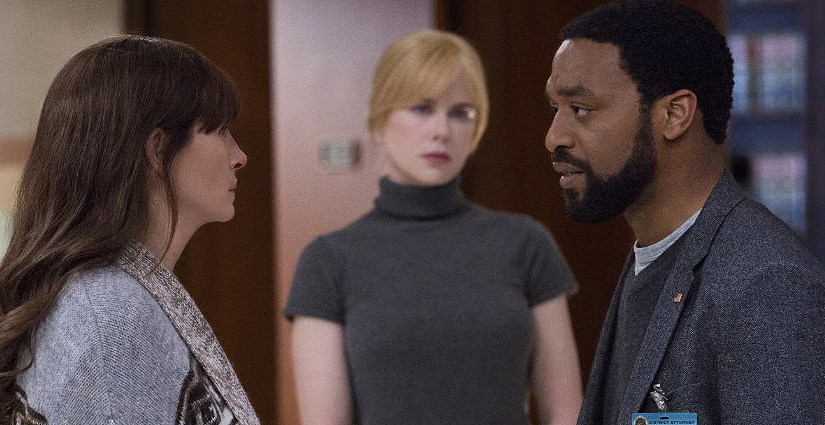
Julia Roberts, effectively departing her glamour roles, as the cop/mother of a murdered daughter will only conveniently appear to make things awkward for Ejiofor and DA Nicole Kidman who is unnecessarily, overtly sexy to drive a subplot for more awkwardness. Oh, hi Julia. Didn’t expect you to step on to the elevator. Well, look who showed up at the office just as I get into town; things like that.

Nothing that these characters do seem very wise or necessary but we are supposed to believe these are some of LA’s best legal minds; break in and steal evidence without a warrant, solve a murder by looking at a picture from company picnic, beat a confession out of a suspect, and presume you found the killer again because a guy made parole 13 years later and the ages match up. He might have had a nose job, but that’s gotta be the guy. Ejiofor says it is. So it must be true. Stop arguing with me. Ejiofor says he’s right and you’re wrong. Case closed. Shouldn’t these great legal minds look a little deeper before they make their conclusions? There’s more concrete evidence in a game of Clue than anything I found in Secret In Their Eyes.

I guess now that I’ve watched the film and see that my predicted ending never turned up, maybe I’ll keep it to myself, jot it down on paper and sell my own screenplay. If this crap could attract a Hollywood budget with top talents to fill the roles, how bad could I do?

TO LIVE AND DIE IN L.A.

By Marc S. Sanders

William Friedkin is the director of one of the greatest automobile chases ever put on film with the 1971 Best Picture The French Connection. In 1985, he tried to up his game with the counterfeit caper called To Live And Die In L.A. He just about tops himself.

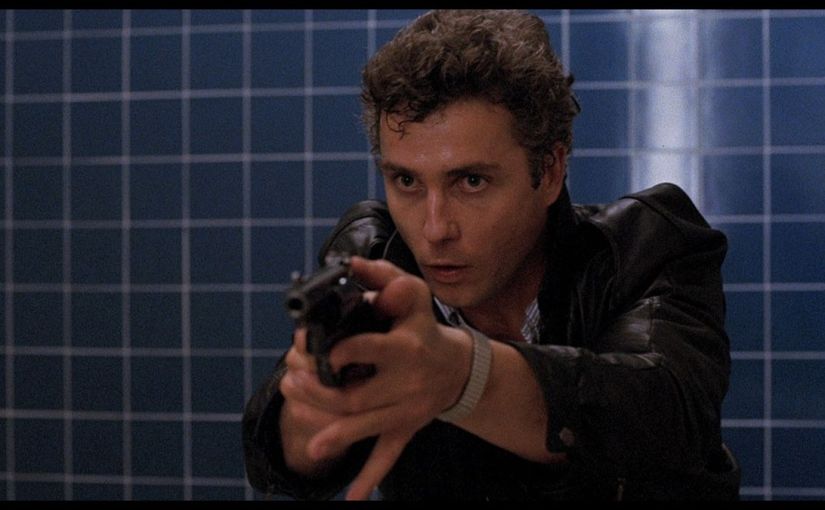
It is a dated flick with a Wang Chung soundtrack, popped up shirt collars, black leather jackets, and skinny ties. Friedkin goes Miami Vice and it more or less works but his lead player, William Peterson, is no Don Johnson. He’s more like a contestant on the dating show Love Connection.

Peterson plays a Secret Service agent with the last name of Chance; Richard Chance to be more precise. Kind of apprapo as he seems to always test his fate like bungee jumping off bridges (long before bungee jumping was ever a thing) and taking his tactics over lines that should not be crossed.

Chance is on the trail of nabbing counterfeiter, Rick Masters (Willem Dafoe), who killed Chance’s partner with only three days left until retirement. The cop who gets killed early on always seems to have three days left until retirement. To get at Masters will require Chance to…well…take some chances. He’ll blackmail a prostitute informant. He’ll also pressure his new partner (John Pankow) into circumventing policy. As well, like any movie cop or agent, he’ll go against the instructions of his supervisor. Chance might even rip off a diamond dealing exchange.

The acting is nothing special here. Peterson looks more athletic than fierce or driven. He’d never be Gene Hackman. Dafoe’s weirdly youthful appearance with his Benneton ‘80s outfits look…just that…well…weird! He’s an artist (like with actual paintings) while also printing fake money.

Friedkin’s film carries on its longevity through the years with an effective car chase; one of the best on film. From what I can tell he mounted a camera on the hood of the car. The camera can pivot 360 degrees. So we can see Peterson driving the car and then the camera can swoosh and turn to give a point of view as to where the car is driving. So now the viewer can see where the cars are careening and turning and speeding towards. It gets especially hairy when the car goes the wrong way up the freeway exit ramp into rush hour traffic. No CGI work here. This is in your face material.

To Live And Die In L.A. is worth the watch. A surprise moment towards the end also gets your attention by going against the typical cops and robbers formula film. The shoestring budget is apparent here with quite dull, very dull, cinematography and no big stars at the time (Peterson, Dafoe, Pankow, John Turturro, Dean Stockwell). However, William Friedkin does his best to make every moment worth it, and I can’t deny it, this 80s raised kid thinks the Wang Chung soundtrack is so friggin’ cool.

OUT OF SIGHT

By Marc S. Sanders

In 1998, Elmore Leonard’s best-selling novel, Out Of Sight, was adapted by director Steven Soderbergh, where Federal Marshall Karen Sisco (Jennifer Lopez) falls in lust with Bank Robber Jack Foley (George Clooney), which leads to ridiculous, albeit logical set ups as a high stakes diamond heist is planned along the way.

I know years after Steven Soderbergh’s film was released an ABC tv series based on the Sisco character was produced. That was a misfire. Simply because the beautiful, sexy and most importantly under appreciated and intuitive portrayal that Lopez mastered was a role that could have led to another great film franchise of sequels to come. Carla Gugino played author Leonard’s heroine in the tv show. If you are saying “Carla who?” then ‘Nuff said. Sisco belongs to Jennifer Lopez.

Lopez and Clooney have great chemistry amid gorgeous cinematography on location in sun filled Miami and snow blanketed Detroit. Soderbergh shoots a great scene midway through where the two characters, on opposite sides of the law, throw caution out the door as they seduce each other in front of a hotel window view boasting beautiful midnight blue sprinkled with falling snow. It is one cool and very hot scene.

Sisco is always a step ahead of Foley. Her problem arises when after being held hostage by him in the trunk of her car following his escape from prison…well, she just can’t resist him.

My apologies. Out Of Sight is a far better film than I could describe here thanks also to a boastful cast featuring Dennis Farina, Ving Rhames, Don Cheadle (how many films has he done with Clooney?), Steve Zahn, Albert Brooks (simply great as a hairpiece wearing white collar criminal), Michael Keaton (two Batmans in a film for the price of one) and finally a master of cameos reserved for a smirk inducing final scene. Make an educated guess of who I could be talking about.

Lopez and Clooney should have done more films together over the years. They are as classic a couple as Tracey & Hepburn, Beatty & Dunaway, Hanks & Ryan or Gere & Roberts.

This was a gem of a movie I mistakenly found boring when I saw it in theatres. What was I thinking? On a second viewing, 20 years later, I laughed, smiled and just couldn’t take my eyes off it. It’s just great fun.

Without Out Of Sight, Soderbergh, Clooney and Company would probably never have made an Ocean’s 11. Check out what became before their more successful collaborations to come.

KILLING THEM SOFTLY

By Marc S. Sanders

What did I just watch? A mob movie, or a 2008 Presidential debate where the candidates are no shows, and their respective commercials are aired in their place? Andrew Dominik directs Killing Them Softly, with Brad Pitt who also produces.

Reader, I don’t get the appeal. Maybe it’s the outstanding cast which includes Pitt, as well as James Gandolfini, Ben Mehndelson, Richard Jenkins, Scoot McNairy and Ray Liotta. Sadly, these guys are given next to nothing do of any consequence.

After it is revealed that Liotta’s character, Marky, ripped off his own mob poker game a few years back, an idea is presented to two street addicts played McNairy & Mendehelson to do the same thing because, heck, they’d never be suspected and logic dictates that Liotta must have done it again. So, he’ll be the one to blame and get whacked. The game is robbed and now Brad Pitt’s hitman character is on the job. Simple enough story, almost like a Guy Ritchie picture.

Killing Them Softly is an adaptation of a 1974 novel by George V Higgins. I never read the book, but I’m curious if it contains any kind of relation to Andrew Dominik’s idea of editing recurring speeches and ads, compliments of Obama, McCain and Bush 45. Truly, what was the point of this recurring theme? A two-sentence piece of dialogue finally acknowledges this in the final minute of the film, but I’m still lost on the significance. Somehow Dominik made a dirty, cold, rain-soaked picture that has an omnipotent viewpoint from our most prominent politicians, and I don’t know what one thing has to do with another.

As well, Gandolfini arrives in the story and I never could gather what was his purpose. I think he is a hitman who is washed up, never getting his ass up to carry out the job and just monologues about nothing like the hooker he pays off; topics that Quentin Tarantino might’ve thrown in the editing trash bin.

Mendelsohn looks incredibly convincing as an addict living off the streets, yet his storyline has no end. He’s arrested. Then what happens? What does that mean for everyone else? Liotta has a long drawn out sequence of getting the shit kicked out of him by two mob foot soldiers. The scene goes on and on and on. His face cracks and bleeds, and bleeds some more. Brad Pitt? Well, he’s the hitman who just looks cool. Yeah, the black leather jacket he wears looks very cool on him. That’s about it.

There’s no development to Killing Them Softly. No surprise or twist. The guys you expect to get killed, get killed, and there’s no good dialogue.

This film is just an empty void of poorly, uninteresting violence.

NIGHT FALLS ON MANHATTAN

By Marc S. Sanders

Sidney Lumet is the director known for shining a light on police corruption. His films were not crime dramas or legal thrillers really. They were an examination in what turns righteous professions within the confines of law and order into something tainted in violations of morality. Night Falls On Manhattan showed what can happen when the politics of New York City could be stained by the policemen who lost their sense of distinguishing right and wrong.

Andy Garcia plays Sean Casey, a newly deputized, very green district attorney and former street cop. His image looks perfect to prosecute a big time drug dealer who wounded his own policeman father, Liam (Ian Holm), and killed two other cops. Richard Dreyfuss does an inspired Alan Dershowitz personality portraying the defense attorney for the dealer, by angling a theory that police corruption is unfairly working against his client. It seems like a very open and shut case for Sean, which occupies the first half of the film.

Afterwards, Sean appears to have a white hot image in the public eye and he is quickly nominated and wins an election as Head District Attorney for the city, following a heart attack from the incumbent and his boss played by Ron Leibman. Conflicts arise though when it is uncovered that perhaps Liam, along with his partner Joey (James Gandolfini), have been taking money under the table as part of a group of dirty cops spread among three precincts.

Sidney Lumet’s films always present topical and complicated real life problems with no expected solutions. These issues of transgressions exceed any kind of quick fixes. He’s shown this time and again with films 12 Angry Men, Serpico, and The Verdict. With his original script here, Lumet gets a little personal. What can you do when a city relies on your image of ethical practice, but your own loving father may be a traitor to the laws he’s vowed to uphold? How can Sean work ethically for his constituents while his father and his longtime partner are possibly betraying sworn policy?

I was always engaged in Night Falls On Manhattan. What is Sean going to do? The dilemma is never patched up with a band aid. It actually feels like it gets worse and worse because it is next to unsolvable. Cops are heroes in this film and a cold blooded killer seems to have been rightfully sentenced? So how can Sean, Liam, Joe and the rest of the cast live with themselves when the end results they wanted all arrive, but came about in all the wrong ways?

This is a terrific assembly of talent. Most especially, credit has to go Ron Liebman as the head DA whose overbearing loud mouth is necessary for the city that never sleeps and the endless amount of police troops and city prosecutors he has to answer for. If New York City had an actual voice that emanates and speaks the endless noise of the Big Apple , it is Ron Liebman. He should have been Oscar nominated. He comes carved out of the concrete of the city landscape.

This is really an unsung picture of Lumet’s that should be seen, much like Find Me Guilty with Vin Diesel. My one issue is the preachy monologue that Sean delivers at the end of the picture. It comes off like a concluding statement and left me with the impression that the conflict of the story painted these characters into an inescapable corner. So, tack on a speech to bring on the credits. The monologue just didn’t work for me though. It didn’t give me that bookended impact I was hoping for.

Other than that, however, Night Falls On Manhattan is another fine piece of filmmaking rooted in a metropolitan setting that becomes a character all its own. Lumet was a genius about acknowledging his settings. This is another perfect example.

THE FIRM

By Marc S. Sanders

Sydney Pollack was the first director to take a crack at adapting one of John Grisham’s best-selling books, namely the still most popular novel, The Firm. Wisely, and with a measure of risk, Pollack took the script from David Rabe, Robert Towne and David Rayfiel and maintained a true adaptation for the first hour of the film while inventing a new kind of second half that I think improves upon Grisham’s story.

Mitchell McDeere (a well cast Tom Cruise) is the most sought after Harvard law graduate in the country. A small Tennessee firm makes an offer to him that outbids any of the big leaguers. Considering that Mitch comes from a poor broken home with a brother (David Strathairn) currently in jail for manslaughter, the offer and treatment given to Mitch and his school teacher wife Abby (Jeanne Tripplehorn) could not be more enticing. A house, a car, school loan payoffs, and a near six figure salary in the first year is not something anyone would walk away from.

Once the happy, young couple are comfortable though, a curious FBI man (Ed Harris, an MVP of this stellar cast) inquires if Mitch finds it odd that this firm has four of its lawyers dead within the last ten years. The two most recent casualties perished in a boat accident.

The sharp minded Avery Tolar (another welcome performance from Gene Hackman) is assigned to make sure Mitch follows the path the firm expects of him. Avery also has his sights set on Abby. For a guy who has never been regarded as good looking, Hackman plays a pretty effective flirt.

The firm, led by a seasoned Hal Holbrook with a charming Mark Twain like bow tie, and a perfect henchman villain played by Wilford Brimley (definitely on my top list of best bad guys) are involved with the Mafia and their shady dealings of money laundering, racketeering, murder and embezzlement. Now Mitch is stuck.

The FBI want to use him to uncover the firm’s activities but that risks blowing his career and maybe his and Abby’s life. If he doesn’t cooperate, then the Feds will run him in with the rest of the gang.

A second hour focuses on a complicated way for Mitch to get out of this ordeal. It means a lot of white collar work and contrived timing in the script. Fortunately though, Pollack builds suspense with foot chases and some allies on Mitch’s side, including Holly Hunter as an hourglass figured, bombshell secretary to a private investigator (Gary Busey) that Mitch went to see. His plan involves traveling to and from the Cayman Islands, and making copies of legal documents to build evidence of mail fraud against the firm.

Mail fraud???? That’s right mail fraud. It’s not a sexy crime, but the script with Pollack’s direction and a hard pounding piano soundtrack from Dave Grusin manage to keep the suspense up and alert.

Pollack directs Cruise to sprint across downtown Nashville for some great sights and hideouts in broad daylight. Your adrenaline moves with the film even if you can’t connect all the dots of Mitch’s complex plan.

In fact, it’s best to just give up on following every little step Mitch and his team take to stay ahead of the firm. What works best is the seemingly no win scenario for Mitch and Abby. Pollack follows a Hitchcock trajectory. He leaves the bomb on the table but doesn’t detonate it right away. Thus the suspense holds steady.

So, the best kind of counsel I can give is to just enjoy The Firm as it runs through its paces. It’s a solid white-collar thriller.