SUDDEN IMPACT

By Marc S. Sanders

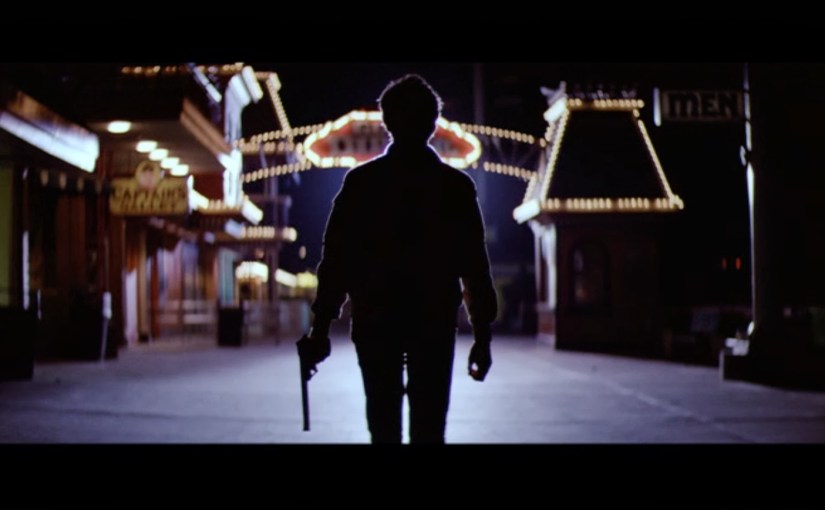
The very first R rated picture I ever saw in theaters was the fourth installment of Clint Eastwood’s Dirty Harry franchise, entitled Sudden Impact.  I was eleven years old and I loved it.  My brother Brian took me with his best friend Nick.  Age 11 and I’m in a crowded theater on a Saturday night watching a brutally violent and sometimes funny crime drama with the cop who carries the .44 Magnum.  Looking back, it felt like a rite of passage.  It felt rebellious.  I’d now be the coolest kid in school as I recount for them everything I was allowed to see that their parents refused to even consider.

Brian introduced me to many of what remain my favorites this very day.  He introduced me to Jackie Gleason in The Honeymooners,and then at age 8 or 9 I must have watched the first of Eastwood’s series, Dirty Harry, on video tape.  At that age, you just want to get to the next shootout where Harry allows his bloodletting revolver do the talking while he finishes his hot dog.  I watched those first three films (Dirty Harry, Magnum Force and The Enforcer) over and over again.  As an adult, I more so appreciate the themes of the San Francisco cop, Harry Callahan.  He always had a low tolerance for the bureaucratic BS of court procedure and legal precedent.  He was always smart enough to know who the real bad guys were and that was enough to bring them in. If they didn’t cooperate, well then there were other means. 

The first two films in the series question Harry’s procedures and philosophies.  The third film, although entertaining to a degree, deviated from that.  The fourth film returns to test Harry’s beliefs in police enforcement and justice.  Only this time, it’s actually from the perspective of a gang rape victim, played by Sondra Locke.

Much of the first hour of Sudden Impact is episodic.  Scene after scene shows Harry’s encounters with various hoods that he has a connection too.  Harry disrupts a wedding to undo a vicious mobster.  Later, those guys try to take him down.  Some punk kids get off on a technicality in court.  They’ll have something to say to Harry as well, and just in case you need a little more action, there is that very memorable coffee shop robbery where Harry tempts all of us to “Go ahead.  Make my day.”  There’s also good laughs as Harry is gifted a bulldog he calls Meathead. 

Weaved within these various moments is a separate story focusing on a beautiful painter who has a knack for killing men with one bullet to the genitals and another to the head.  She has revenge on her mind following a gang rape of her and her sister ten years prior.  Eventually, Harry is assigned to investigate and he is on his way to a fictional neighborhood known as San Paulo (filmed in Santa Cruz).  Harry has to navigate around a difficult police captain (Pat Hingle) as the killings continue to happen out here.

I’ve always been fascinated with the Dirty Harry series.  Surprisingly, when I do internet searches on the films and character, I don’t find much that explores the measure of rights and law.  Yet, beyond the sometimes-comic book violence of the pictures there’s much to question and think about.  Is Harry right with his chosen actions?  After all, the films make clear that the bad guys are the bad guys.  The writing however, makes it a challenge when legality interferes and the rights of men and women are tested.  Sudden Impact does the same thing.  With Eastwood directing, he makes the viewers witnesses to what the Locke character is subjected too.  That should be enough, right?  Real life is not that clean cut though.  However, in an age of internet surfing and headline breezing, people are endlessly tried in the court of public opinion and not a court of law.

The first film in the series had Harry declare that the law is crazy.  The second film tested the protagonist when he uncovers that people supposedly on his own team were carrying out vigilante murders against the worst mobsters and pimps in the city, as a means to clean up the streets.  Now, another and more personal vigilante appears.  What makes Harry right and these others wrong?  I don’t think any of the five films in the series ever give a clear-cut answer.  That’s okay.  I’d be frightened if there were a direct response, because it remains a complex issue.  When the courts fail us, what is there left to do?

Do not mistake me.  I am not calling for violence.  I’m just questioning a system that is sometimes broken.    

Recently, a local trial wrapped up where a retired police officer shot a man in a movie theatre who became argumentative and belligerent when he wouldn’t turn off his cell phone.  Popcorn was thrown, a gun was drawn and a man was instantly killed.  The retired police officer was found not guilty by a jury of his peers.  The court of public opinion by and large have been outraged with this verdict.  The grieving widow felt as if justice was not served.  Followers of the story didn’t either.  Another story focused on a beloved teacher who was hit by a car in a school parking lot.  I actually got into a public Facebook debate with someone who said the driver should be punished to the full extent of the law.  I questioned if the driver is truly guilty of murder or manslaughter.  It could have just been an accident.  We are humans to a fault.  How do we know the teacher didn’t just step in front of the car without looking?  The opposing view insisted the driver had to be speeding.  Maybe.  Yet, at the time neither of us knew that.  A car going at 5 mph can just as easily crush a human to death as a car going at 30 mph.  I insisted to the person I was sparring with that she was riding a slippery slope of presumption without all of the facts disclosed.  A police report has yet to be publicly disclosed.  Circumstances always come into play.

I know I’m digressing.  With a Dirty Harry picture like Sudden Impact, it’s laid all out for you.  Harry will request that four robbers put down their guns before introducing his friends Smith & Wesson.  He’ll also consider the circumstances after a woman’s life has been permanently scarred with no one to side with her.  A police officer should not be judge and jury.  Yet, it’s reassuring those films like Sudden Impact or Dirty Harry will allow a comeuppance for the wrongdoers in the world. During the closing minutes of the film, Sondra Locke delivers a monologue that at least is worth consideration even if it’s not agreeable.  I don’t believe our society should turn into a wild west circus where you can get gunned down in a movie theater over thrown popcorn.  I do believe however, that evidence must be taken more seriously in many circumstances.  Suspicion must be valued more often. 

Sudden Impact might have a right-wing attraction to it.  It glorifies gun violence, for the sake of action entertainment.  Harry doesn’t just have a .44 Magnum.  Now, he also has a .44 Magnum Auto Mag!!!!  (Whatever that is!)  Ironically, this picture is primarily told from a woman’s point of view where she wants to be believed and she wants justice, much like many of the messages of the Me-Too movement that gained major traction in 2019.  It’s insisted that when a victim says they have been raped or assaulted, no matter how far back the incident occurred, it should be believed.  The argument is where’s the proof?  Like Harry Callahan though, proof is not always the end all be all.  Instinct and common sense sometimes have to prevail.  Again, it’s a slippery slope, but it’s also always worth questioning.  Harry Callahan is always worth questioning.

DOG DAY AFTERNOON

By Marc S. Sanders

Sidney Lumet uses his best strengths in this ridiculous Brooklyn bank robbery that is actually based on fact.

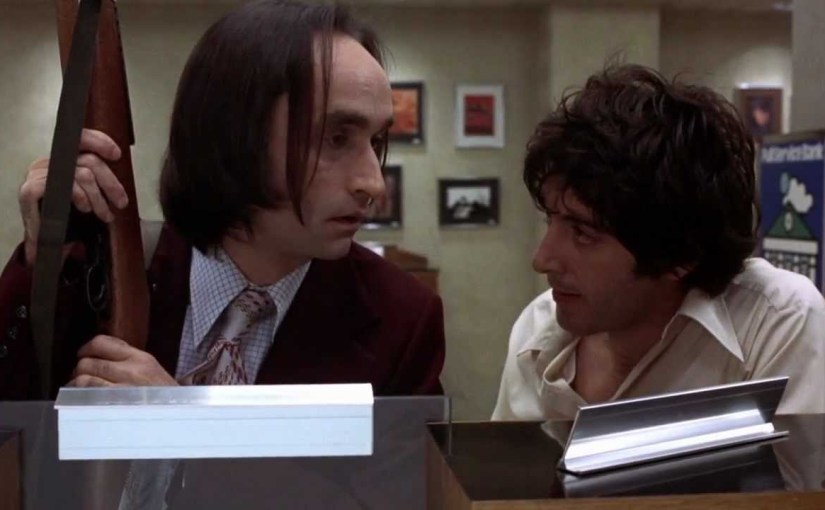
Here, Al Pacino and his cohort, John Cazale, play inadvertent stupidity without compromise. If two of the three stooges went on to do drama, this would be the material they’d use.

A simple bank robbery with little to no planning spirals out of control and into sheer pandemonium. Nothing goes right even when Pacino’s dimwit character, Sonny, is deluded enough to believe all is going in his favor. He immediately earns the support of the encroaching Brooklyn community only to lose them when he shows his true homosexual nature. Then he’s blindsided as to what happened. Layered in drenching sweat, Lumet wisely takes advantage of Pacino’s best up close facial expressions. Utter delirium!!!!!

Once again, Lumet’s camera moves while his best actors remain naturally in place. Al Pacino does his thing and trusts his director will find his shots. As the cop initially in charge, Charles Durning does as well. Pacino and Durning especially have great scenes together in the middle of a heavily populated New York Street as the robber shines off the cop, and the cop does his best to obtain some measure of control. It’s a scream fest for the ages. “Attica! Attica!” Pacino and Durning’s best career performances were always the ones where it looked like neither of them were ever acting. Dog Day Afternoon is one those better examples.

Frank Pierson’s jagged script of wild turns makes every person whose an extra like the pizza delivery man, for instance, caught up in the hysteria. The pizza kid shouts out to the crowd “I’m a star!!!” It’s great reason to applaud Sidney Lumet’s control over a crew and the entire company of extras he’s employed. This film is a rare example where all of the extras (seemingly the entire Brooklyn population) are as integral as the leads. The setting is the main antagonist from the media all the way to the observers who can’t look away and can only cheer, yet mock as well. Brooklyn, New York is a great character here.

Most fascinating about Dog Day Afternoon is that it is all based on fact from the media circus to dumb bank robbers with a need to steal in order to fund a lover’s sex change operation. It’s ridiculous. It’s funny. It’s frighteningly stressful and it’s all true.

This was released following the first two Godfather films and confirms the enormous range Al Pacino possesses with his performance talents. Hyperactive and dumb here as gay bank robber, Sonny; quietly contained, evil as Michael Corleone. His range was through the roof in the 70s before absorbing his loud, crackling, smokers voice. It was when the script outshined Pacino and before the current age of writing being catered to its bankable star.

Lumet also allows great moments for the hostages who become undone to the point of regretfully using foul language, to actually befriending their captors. He’s a director who efficiently leaves no stone untouched.

Chris Sarandon as Leon, Sonny’s male gay spouse is great here too. He’s full of melodrama, panic, worry, and a New York maternal despair. Another great scene is a phone exchange between Pacino and Sarandon. It might appear funny at first, especially in the 70s when homosexuality was lampooned often with the other F-word, but anyone who appreciates the filmmaking of Lumet will quickly contain their snickering when they realize a gay man is equal flesh, bone and feelings like anyone else.

Dog Day Afternoon is very telling of an out of the closet social media future. The story will always get grabbed regardless of danger or sensitivity. People will get swept up in the hoopla (a teller hostage quickly boasts her brief fame on television “Girls, I was on TV!”), police will overextend their privilege, helicopters will swarm, the criminals will demand their moment in the spotlight, and the public will serve as jury per the majority.

It’s a vicious cycle but considering it is a 1975 masterpiece, it’s all disturbingly valid and sensationally true.

TRAINING DAY

By Marc S. Sanders

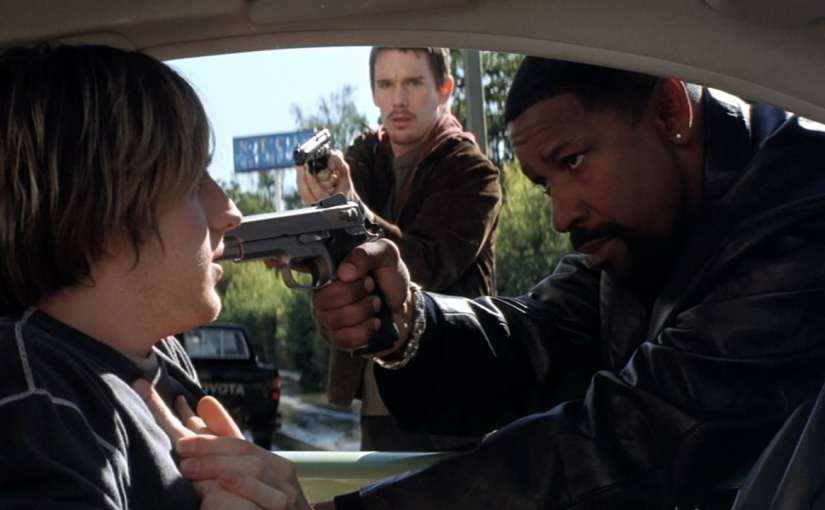
When I first saw Antoine Fuqua’s Training Day in theaters, I found it difficult to watch. The violence or the induced police brutality is very strong. There’s no humor and there’s no thrill. Just an in your face pull over excuse for a cop to exercise his strong arm with his two strapped nickel played Barettas.

Jump to the present and it’s even harder to look at because what the film perpetuates is quite parallel to how many parties view law enforcement and people of color today. Training Day isn’t pretty, nor is it assuring. It’s more or less glamorized evil with a good-looking Denzel Washington driving a gorgeous looking pimped out black Chevy Monte Carlo.

Washington gives an Oscar winning turn (though I’ve seen him in more deserving and nuanced roles; Hello? Malcolm X, anyone?) as narcotics detective Alonzo Harris. He begins his day taking on a new partner named Jake Hoyt (Oscar nominee Ethan Hawke), a boy scout looking cop fresh out of his uniform and into street clothes eager to advance his career and eventually get the kind of big house that other high salary detectives reside in.

Alonzo knows the streets of Los Angeles so well that he can literally stop his car in the middle of an intersection and every other driver will circumvent around him with no protest. Alonzo is here to show Hoyt how to learn the streets for himself and earn the respect of the various gangs and pushers that will lead to the big busts. Only thing is that Alonzo Harris is not a good man. This is a cop who uses his badge as a way of power and intimidation. In this one day, with each passing moment, Hoyt questions his own training and considers if crossing line after line is how you get ahead. Does Alonzo truly know what it means to be a cop making a difference? Does Alonzo care? Does Hoyt care, or does he only concern himself with his career aspirations?

There’s no question that Fuqua’s film is very well made. His dirty, criminally ridden Los Angeles is very convincing and the command that Washington has with his corrupt cop role is all the more intimidating. However, I didn’t feel good with the film after it ended. I didn’t learn anything about race or social classes in America. I didn’t learn that a cop can be a hero. After all, Jake Hoyt doesn’t exactly take the noble approach to surviving his first day in the new job.

There’s a lot of preaching monologues from Alonzo Harris, who is a pretty frightening guy. He’ll his gun at his apprentice’s head, as a means to convince him to smoke some street PCP, because it’s a first step in knowing these streets. Hoyt gives in to the pressure. Still, none of this tells me anything.

Harris goes from one questionable incident to another and Hoyt gives merely dubious expressions but not much else. Eventually, as things boil over between the two men, Hoyt takes the law into his own hands rather than following procedures.

Training Day dictates who is the good guy and who is the bad guy. In the film, however, the good guy more or less becomes the bad guy by the end. That simply didn’t sit right with me. All the necessary ingredients are here for a good cop/bad cop thriller, but I didn’t feel quite good about myself when the film closed out. There really is no one who comes up triumphant. There’s nothing to question about my own view of the world we live in, and there’s too much edge to allow for any kind of suspense. Alonzo Harris is just a bad, bad guy and John Hoyt is never really a good guy. He’s a wimp succumbing to an evil brainwash.

So, then what’s left is to wonder exactly what is there to truly appreciate in Training Day, and the answer is practically nothing except the construction of the film and Washington’s performance. Otherwise, the film is a harsh fiction never concerned with conveying a message within a real problem area of the United States. I would’ve appreciated a response to a harsh reality.

MEAN STREETS

By Marc S. Sanders

I must not be that much of an intuitive movie watcher because I can not comprehend what is so fascinating about Martin Scorsese’s Mean Streets.

Robert DeNiro was hardly known at the time but he is certainly a scene stealer here as Johnny Boy. He’s the wild one with no concept of the danger he puts himself and his best friend in. Charlie is the much more respectable and well-dressed hoodlum. Charlie is played by a young strait-laced Harvey Keitel. Keitel & DeNiro are the strengths of the film.

Beyond the headline cast, the structure of Mean Streets is a very loose patchwork of random events that circulate around Little Italy, NYC. The soundtrack comes from side street buglers, transistor radios, and jukeboxes consisting of The Rolling Stones, The Sherrills, The Ronettes, and samplings of Italian opera. It lends to the setting as another character. For a Scorsese film, that’s all part of the plan. The setting talks back to you, or it’ll take your hand and lead you on. Martin Scorsese is a prophet of New York. He uses the grime and steam of the streets to his advantage (even if some of this film was actually shot in Los Angeles).

Still, I just don’t get this picture. It moves slow at times. Random meet ups occur and I found myself asking if we have met this character and that character already.

I give Scorsese credit, in one respect. He testifies that although the film is fiction, it is a direct representation of what he experienced during his own upbringing. I believe all of that. Again though, why couldn’t it all be pieced together a little more tightly? Had it been, I’d probably have taken more of an interest in the setting and the dangerous exploits of Charlie & Johnny Boy.

It’s okay though. I’m glad I watched it, nonetheless. I had seen it many years ago and I was excessively bored then as much as I am right now. Scorsese was destined for better things. MUCH BETTER THINGS.

HEAT (1995)

By Marc S. Sanders

My all time favorite crime drama, as well another one of my most favorite films, is Michael Mann’s Heat which is widely recognized for the much-anticipated moment where Al Pacino and Robert DeNiro finally share the screen together for the first time. The Godfather Part II never counted as their characters performed in different time periods. Still, Heat has so much more going for it, beyond just its headliners.

Michael Mann wrote the screenplay he directed. It deeply involves both the thief, Neil McCauly (DeNiro), and the homicide detective who pursues him, Vincent Hanna (Pacino), with inspiration from two real life characters. Therefore, this film drives with more authenticity than a standard Lethal Weapon picture. Much more is at stake than a standard kill shot, arrest or the score to take down. The women and children and partners these guys become associated with carry a weight and sense of value. Even the hoods who betray them hold significance. How they matter and are part of the story is just as pertinent.

The story focuses on DeNiro, with Val Kilmer and Tom Sizemore taking down high stakes scores, not petty liquor store hold ups. An early armored truck hold up goes well until a new partner executes the three security guards in broad daylight on the street, at point blank range. Pacino takes the case along with his brilliant squad of detectives that includes great supporting performances from Mykelti Williamson, Ted Levine and Wes Studi. Then it becomes a cat and mouse tale where two equals match one another in wits, skill, and experience. To believe the equal match up though required casting Pacino and DeNiro. The film would not work with any other pair. Through their respective careers, their various performances came off different than one another. Yet, it has been often easy to imagine either one of them playing their classic roles instead. I could envision DeNiro as Michael Corleone or Serpico. I can also envision Pacino as Rupert Pupkin or Travis Bickle. The range of these actors is unlimited.

Diane Venora and Ashley Judd are two actresses not used enough in films. As the wife to Pacino’s round the clock detective, Mann provides time for Venora to show the pain of a woman in love with a man who can hardly ever be home because he’s always on the prowl of DeNiro’s professional thief and his crew. Venora is a likable woman in the role, only the circumstances of her marriage and the difficulties of dealing with a troubled pre teen (a fantastic Natalie Portman who will break your heart with just three scenes) are gradually making her cold. She has a great monologue midway through the film that is terribly dark, as she surmises Pacino’s cunning detective.

Ashley Judd is a different kind of cold as the wife of Val Kilmer’s gambling addicted sharpshooter. She’s a beautiful housewife and mother to a toddler that is trying to maintain a happy home. However, the balance of living with a career criminal is near impossible to maintain.

Michael Mann put so much thought into characters like this. Other directors and writers would keep the story on the streets and in the hideouts and city precincts. Mann goes not just for the low level criminal hoods who provide information in a night club at 2 AM. Mann allows his crime drama to spill over into the home.

He even allows a side story to occur with an ex con (Dennis Haysbert) out on parole trying to get his life back in order. What does this guy with his loving girlfriend have to do with anything else? Eventually, the bridge is connected, and it comes down to an emotional and heartbreaking conclusion.

Heat deliberately takes its time to flesh out a lot of great characters. The large cast are all given moments to stand apart from the rest. It is primarily a quiet, talking picture of careful planning and investigation. However, when the legwork is complete, Mann arrives at two scenes right in the middle of the film. The first is the now famous coffee shop sit down confrontation between Neil and Vincent. Mann did a masterful job of capturing the two actors doing some of their finest work with nothing tangible to aid them; no props or grand music or effects. Just a table in the middle of a crowded coffee shop. The professionals allow their history to show only so much but the cop and thief know this is not going to be easy from here on out. Mann did numerous takes, but with at least two cameras showing at each go round. So, if Pacino is talking, we see DeNiro’s facial reactions and vice versa. Pacino’s take #11 is also DeNiro’s take #11. It is one of the all-time great scenes in film history. Beautifully written. Beautifully constructed. Beautifully performed.

The next centerpiece is the bank robbery that occurs at midday in downtown Los Angeles. Neil and crew are almost scott free when Vincent and squad intercept them in the middle of the street. What sets this massive shootout (based on a real incident) above all others is that I actually get choked up and emotional over the moment. Characters that I have become acquainted with for the last 90 minutes are swept up in huge risks and danger of massive gunfire and ambushes. I even become terrified for the extras that Mann includes in this scene. I’ve watched this scene a hundred times and I can’t help but actually get tearful over it. Mann has the power to make me have an affection for these characters. As well, how will the spouses, who become aware of this matter, be going forward? That accounts for much of the latter half of the film.

Neil holds true to a philosophy he learned while doing time. If you spot the heat around the corner, allow nothing to interfere that you cannot walk away from immediately to avoid getting apprehended. He is put to the test of that motto when he falls in love with an introverted graphic designer played with quiet reserve by Amy Brenneman. This storyline will sum up the ending. Again, Mann shows the characters on the outside of these guys with their guns, working in an underworld environment. How do the risks of these guys play out on others?

Technically, Heat succeeds as well with brilliant blues, blacks and whites in cinematography. Major accolades for Dante Spinotti. Everything from the well-lit coffee shop to Neil’s unfurnished, ocean view apartment and even a blue Camaro that Neil drives away in through an underground tunnel are brilliant. Spinotti paid careful attention to the evolution of the characters. As Neil drives into that tunnel, the car turns white hot. He is on his way to escape with an unsure Brenneman by his side. Often in moments like this, the film tells more than any piece of dialogue could ever sum up.

Heat is a must watch film for genuine portraits of characters few of us will ever cross paths with. We should understand, though, they have more than just a drive to steal or to get an arrest. These guys exist for more than just the score. Few crime dramas ever approach that angle, and that is why Heat is such a special film.

NO COUNTRY FOR OLD MEN

By Marc S. Sanders

Joel and Ethan Coen have an odd collection of films under their belt. No Country For Old Men, an adaptation of Cormac McCarthy’s novel is no exception. You’re likely to meet the oddest hit man you’ve experienced in a film. (Reader, I’m going under the presumption you’ve never encountered a normal or odd hit man in real life. If you survived long enough to read this passage, you are truly blessed.)

Anton Chigrh follows a discipline that likely no one ever taught him. His code is to continue until he finds what he’s looking for and dispose of any lead in his ongoing quest. His weapon of choice-an air gun hose connected to an oxygen tank. It’s instant in serving its purpose. Its sound is quick and jarring.

Javier Bradem delivers an Oscar winning performance as Chigrh in search of $2 million when Llewelyn Moss (Josh Brolin) takes possession of it after coming upon the sight of a drug deal gone bad.

Tommy Lee Jones is perhaps one of the old men in the title. A Texas sheriff not surprised by the carnage he comes upon, but not of much use either. I think he regrets that he can never do more or better and simply can only surmise what’s already been done. I gathered that especially from a scene depicted in a hotel room during the third act of the film. His approach on the scene and his need to sit down translate that for me. His periodic anecdotes during the course of the film seem to say so as well. This sheriff has likely never rescued anyone from harm despite how intuitive he may be.

The Coen Brothers are never shy with blood. A lot of directors are not, really. Yet with the Coens, it seems the bloodshed is disturbingly honest. The instant splatter and flow following another act by Chigrh couldn’t be more truthful. They tell this tale very well, never concerning themselves with how unsettling they can be. Sun filled deserts are not comfortable. Evenings are sleepless. Blood is dark, thick, sticky, messy.

Moss is a hunter who has no idea what he’s up against. Brolin plays him with quiet reservation. He could not resist the urge to take the bag of money, but he also knows he’ll pay for it as well. When he realizes there’s no way to escape, by even crossing the border, he can only try to kill the devil incarnate. He’s likely aware of how this will all play out though.

Among this trio of fine actors (with Woody Harrelson also briefly in the fold), the film is nevertheless celebrated for Bardem. Whenever the story returns to Chigrh, you sit up in your chair a little more alert. He’s got disturbing dialogue exchanges with those he encounters and Bardem’s method makes you wish you never have to decide your fate with a coin toss.

No Country For Old Men is not an action film. The pace takes its time, invested in three men with respective histories who cannot change what their meant for. No incident will change their lifestyles. They are meant to be an assassin, a washed-up lawman, and a poor country hunter. Until they die, no moment in time will alter their caricatures. That’s what I took from the Coens’ Best Picture winner.

I appreciate its honesty.

THE UNTOUCHABLES

By Marc S. Sanders

Brian DePalma directed the very loose cinematic adaptation of Eliot Ness’ squad of treasury agents during the 1930s prohibition era. The movie is The Untouchables, based on the famed TV show starring Robert Stack. It’s a gorgeous picture with incredible set designs, props, and Georgio Armani costume wear. It’s also bloody as hell.

Kevin Costner solidified his leading man status as the righteous Eliot Ness who swears by the law he promises to uphold, while making efforts to topple Al Capone’s (a convincing looking Robert DeNiro) massive Chicago empire that thrives on the buy and sell of illegal alcohol. Capone controls the city on all levels, from government officials down to the police force. His power is unlimited, but he has not filed his tax returns in four years. It’s crazy, but that just might bring him down.

Ness teams up with veteran beat cop Jimmy Malone played by Sean Connery, in one of the most celebrated and winning roles the Academy Awards ever bestowed. Malone knows where the underground liquor operations are located. He knows who accepts the bribes and kickbacks too. The question is how involved does he want to get. He’s the grizzled Irish mentor for Ness, and his timing is perfect for David Mamet’s script.

Memorable additions to the team also include a young and tough Andy Garcia and nerdy Charles Martin Smith as the IRS agent happy to pick up a shotgun for the cause.

DePalma’s film carries the epic look. There’s much splendor in the art direction of the film. It’s a glamorous piece of film, but it’s also just a movie.

Mamet’s script takes lots of liberties against the actual occurrences that came through historically. I do not recall hearing that The Untouchables ever took down a deal while riding horseback alongside the Canadian Mounties, for example. A villainous henchman for Capone is Frank Nitti (a happily slimy Billy Drago), always dressed in bad guy white and putting on the bad guy charm. His demise in the film never happened and most certainly not so adventurous or violently, but DePalma and Mamet clearly don’t care. This is lean entertainment for action sequences set in a gorgeous gangster period. The Untouchables is a slick looking gangster flick and nothing more.

A real star of the film is the Oscar nominated score of the film from The Maestro, himself, Ennio Morricone. His opening piece of drum beats with quick piano keys during the credits will get your pulse going. He also has great horn sections that capture the four heroes in tight shots of shining cinematography from Stephen H Burum. For me personally, this is my favorite soundtrack of Morricone’s massive career.

Costner is well cast. He has the handsome hero look to him. Garcia became a well-known and sharp looking tough guy. Smith did not move on to more celebrated material beyond this. He was remembered comedically here, just as he was in American Graffiti. He also directed since this film. As a team though, Costner, Garcia, Smith and Connery have wonderful chemistry together.

DeNiro actually took a step back from the spotlight here. His Al Capone is not so much a character as he is an every so often antagonizing appearance with a couple of well paced lines from Mamet’s famed dialogue. He’s got a memorable moment with a baseball monologue that convinces you of Capone’s strong arm, but his villain does not get too personal with the hero.

The Untouchables holds a special place in my heart. It was the last film I saw before my life changing move from New Jersey to Florida in 1987. Because the move was hard on me from a teenager’s perspective, I found great escape with this film as I memorized the lines of the enormously colorful characters along with getting absorbed by the violence and emotional variety of tones in the score. Having watched the movie many times since it was released, it’s become a kind of therapeutic experience for me. I take in the gorgeous craftsmanship of the film, the humor and the surprise moments many of the beloved characters face.

The Untouchables is not a perfect film I thought it was at age fourteen. It’s almost proud of its admitted inaccuracies, but it remains a favorite and very personal piece for me. I still love the film, all these years later.

THE DEPARTED

By Marc S. Sanders

Martin Scorsese finally won his Best Director Oscar with the 2006 Best Picture The Departed, from a script written by William Monahan. The film is a remake of a Hong Kong crime drama called Infernal Affairs.

Also known as the one film in Scorsese’s library with a linear plot, The Departed depicts the stories of two guys who grew up in the south end of Boston and joined the police academy to serve. Only difference is one is recruited to go undercover within the Irish mob, while the other is recruited by the same mob to become a highly respected police officer and supply an unlimited wealth of information to his criminal boss.

Leonardo DiCaprio is the undercover cop Billy Costigan. Matt Damon is the criminal cop Colin Sullivan. Jack Nicholson is the Irish mob boss in the middle, Frank Costello.

The Departed works because Scorsese and Monahan allow the audience in on every deceit playing against the characters. Pleasantly surprising is that there are even twists to this layered story, and cellular flip phones assist all the players with trying to remain in hiding or hoping to one up and trap the other. However, because everyone is getting tipped from their own respective sources, people are either not ending up dead, or arrested or caught red handed. As Costigan builds his case against Costello, Sullivan is worming his way to protecting his cover in the police force while also tipping off his true boss.

Performances from DiCaprio, Damon and Nicholson are what you’d expect. Nicholson is chewing the scenery again appearing like the devil incarnate while hamming up the facial expressions. Damon is great at playing it like the Boy Scout cop in well-tailored suits, clean shaven and flirtatious within his department and earning respect among his peers, that is until it all seems to unravel. DiCaprio is wired as the cop who needs to show he’s a dangerous hood to be trusted among the mob cohorts. However, he’s getting more paranoid and unwound at the risk of being made.

Thelma Schoonmaker (one of my favorites) does a balanced approach edit to showing a parallel among the cops. She will insert a happening of Costigan for a snippet and then segue to Sullivan appearing to do honest police work, or reaching out to Costello with a warning of what’s coming for him.

Great support also comes from Ray Winstone as Costello’s right hand man, and Alec Baldwin, Anthony Anderson and Martin Sheen, all within the police department.

Ironically, the one Oscar nominated performance was bestowed upon Mark Wahlberg and I grew tired of his presence quickly as the cop who berates Costigan endlessly with yelling and fast one liners that involve someone’s mother. Could we just move on from this please?

I also found Vera Farmiga as a police psychologist to be mostly unnecessary until a contrived ending point needed to arrive. Her character naturally has affairs with both Damon and DiCaprio, who also attend her office for sessions. Of course they do! Whenever the film sidetracks to one of them with Farmiga, The Departed stalls for a moment. Her character carries no stake in the plot line and offers no further dimension to DiCaprio and Damon’s characters.

The film works best as the complications compound on each other. A great moment occurs between the cops when one of them picks up a bloody cell phone to dial back the most recent call. Silence on both ends of the line, and the moment just plays out until someone speaks or hangs up.

Moments like that is suspense similar to when a man is intruding in a dark house. However, this is suspense delivered by Martin Scorsese, and Martin Scorsese will film suspense that is anything but typical. Martin Scorsese’s suspense leaves you breathless.

UNDER SUSPICION

By Marc S. Sanders

I’ve noted before how sometimes you can’t decide if you like a movie until it reaches the final, climatic five minutes that remains.  That’s the experience I had with a below the radar picture called Under Suspicion, which features two of the best headlining actors ever – Morgan Freeman and Gene Hackman.  Well, I didn’t care for the last five minutes of the film.  So, I didn’t care for Under Suspicion.

Gene Hackman plays Henry Hearst, a wealthy, hot shot tax attorney who resides and practices on the island of Puerto Rico.  When the film opens, he’s already dressed in his tuxedo and his gorgeous, much younger wife, Chantal, played by Monica Bellucci, is zipping up her black evening gown.  They are on their way to a benefit dinner to honor him for his charitable fundraising for underprivileged children.  Henry has to take a quick detour to the police station however to answer a few questions that Captain Victor Benezet (Freeman) has regarding the recent strangulations of two young girls. Victor plays good cop, while his underling, Felix Owens (Thomas Jane), does the bad cop routine on Henry. 

Since this is Gene Hackman playing a likely suspect, it’s no surprise that he’s cool as can be with Victor’s inquiries into some inconsistencies that have been uncovered.  Flashbacks to recent moments of where Henry has been jogging or visiting his sister-in-law cut in, and director Stephen Hopkins puts a present-day Victor within the scene of Henry’s recollections.

The theme of Under Suspicion is all about the gradual breakdown of a powerful guy.  Victor and Felix chip away at Henry’s alibis.  While Henry starts out virtually bulletproof to the cops’ questions, soon he’s reduced to being stuck without explanations, and even physically humiliated.  Let’s just say that more than just his tuxedo gets torn.  Eventually, the officers bring Chantal into the fold and the story diverts into a checkered relationship that Henry has with Chantal’s sister and her family, but what does that really have to do with the murders of two girls?  I hoped I’d see some relevance by the time the conclusion arrived.  I didn’t, and that’s the problem with this picture. 

What did I gain from the prior two hours that I was watching?  The main question at hand is did Henry murder these two girls?  Only if he did commit the acts is what the picture will have you believe is pertinent.  The script from John Wainwright (based on his book Brainwash), and Claude Miller & Jean Herman (based on their 1981 screenplay Garde à vue) never really scratches the surface for a motive.  Implications that Henry could be a child sex pervert come up, but I didn’t think it was explored deep enough to then bridge it to murder.  All that Victor and Felix seem concerned with is whether Henry killed the girls.  That’s too simple.  The movie isn’t thinking hard enough for us.  What makes this self-assured guy, with the familiar cockiness of Gene Hackman’s many other film personas, tick?

When the veil is finally lifted on who committed the murders, I felt emptyhanded like I’d been dealt a bait and switch.  The reveal comes out of nowhere and then the credits roll.  Under Suspicion practically promises a plot twist that never materializes.  A shame really, because there are winning moments between these two acting giants on screen.  Not an ounce of dialogue is memorable, however.  Yet, to see the pair together longer than the screen time they shared in Clint Eastwood’s award-winning film Unforgiven, bears my attention and curiosity.  Ultimately, Hopkins’ film is further proof that a script must come first before the talent is recruited.  It doesn’t matter if you have contracted the likes of Hackman and Freeman for your film.  If you don’t give them anything interesting to say, then there’s nothing interesting to see them do.

THE GODFATHER PART III

By Marc S. Sanders

Francis Ford Coppola and Mario Puzo finished out their Corleone trilogy in 1990 with The Godfather Part III. Not so much a sequel, this third film feels more like an epilogue jumping towards Michael Corleone’s (Al Pacino) elder years as the Don of the most powerful Mafia family in the late 70s/early 80s.

Michael seems exhausted with his rule as he suffers from diabetes as well as remorse for his past sins; especially feeling the guilt of ordering the execution of his brother Fredo.

Still, he is drawn to crime, but on a more sophisticated and righteous nature by taking advantage of the Roman Catholic Church. Michael intends to purchase the powerful bank associated with the church but that’ll have to fall in line with the Pontiff’s agreement. It doesn’t help that the Pope is in failing health. The setup of all this lends to another grand opening where Michael earns a prestigious award from the church in the same tradition of an austere celebration of many guests that lend to character set ups for the film. A Godfather movie is not a Godfather movie without a grand reception to open the film.

The most interesting character is Michael’s nephew, Vincent (Andy Garcia), a fierce hot head like his father Sonny. He wants to work for Michael desperately while fending off a street hood boss (Joe Mantegna). An older don also comes into play by the great character actor, Eli Wallach. Diane Keaton as ex-wife Kay is also here but more or less to quietly bicker with Michael. Sister Connie is here, too, with Talia Shire. The Connie character always changes from each movie. Here she’s a deadly black widow. There’s also Michael’s daughter Mary (Sofia Coppola, contrary to popular opinion, I insist she’s very good in the role). Is Mary a legitimate cover for the family as the spokesperson for a fundraising effort? Is the possibility of Vincent and Mary (as cousins) getting intimate a terrible risk?

I like this film and hold it in high regard. Namely because Coppola and Puzo took an approach straight out of the news when there was an embezzlement scheme occurring within the Vatican bank. The problem for many I believe was that the plot of this grand scheme was not flashy or bloody enough, even if a participant is revealed to be hanging from a London bridge with fraudulent receipts falling out of his pockets…which actually happened in real life.

The film allows many opportunities for Michael to allow his anguish in guilt to flow. Fans grew used to a fierce Michael Corleone from the first two films. The elder Michael here would rather not get involved. Hence the introduction of Garcia’s character. He’s very good in the role. Yet there’s not much dimension to Vincent. He’s a scary violent guy, and a contradiction to what Michael seeks. Yet, thats about all there is. I would have wanted more dimension to this role; the guy destined to carry on the reign.

Sofia Coppola is fine in her part and undeserving of the lashing she received upon the film’s release. She’s Michael’s young daughter; a young adult dangerously close to the fray. The one innocent constant within the family. For me, I found a dramatic stake in her character.

The ending is very powerful. Slowly methodical as the family assembles in Sicily to see Michael’s son’s stage opera debut. There are elements that are consistent with the other films’ endings, but this violent conclusion comes with quite a shocking result. I was really moved by it.

Coppola didn’t measure up to the first two films with this effort. I agree with that. Still, The Godfather Part III is worthy of holding its place in the saga. It carries the traditions of the prior films in set up and music and operatic narrative. Be patient with its slow pace because I think the ending will grab you.