By Marc S. Sanders
The Princess Bride, Rob Reiner’s whimsical storybook fantasy come to life by means of a grandfather (Peter Falk) reading to his bedridden grandson (Fred Savage), has taken on an everlasting life of its own. Though it’s not my favorite movie, it’s way up there for my wife, adjacent to Grease 2. I find it to be cute, but lacking a pulse on occasion. Sorry, but for me a lot of the characters and moments are simply sleepy. Maybe it’s literally too much of a bedtime story. Still, I do not frown on its pop culture touchstones since its release forty years ago.
Famed screenwriter William Goldman adapts his book that includes heroics and romance, along with swordplay and fire swamps haunted with R.O.U.S’s.
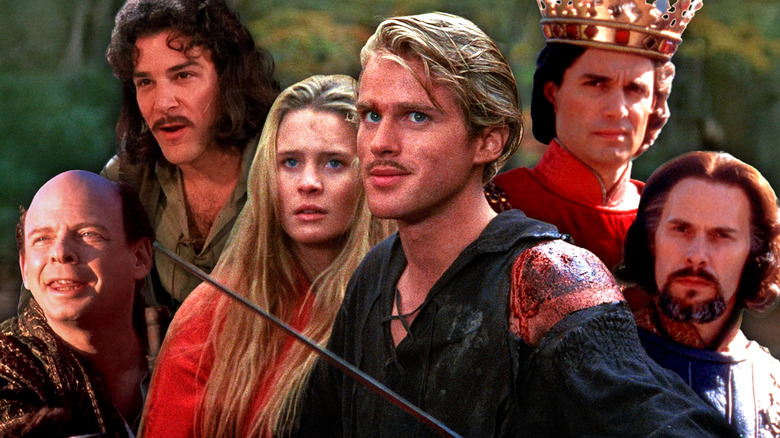
A beautiful girl called Buttercup (Robin Wright, in her debut role) falls in love with a farm boy named Westley (Cary Elwes) who tends to any of her demands by responding with the simple catchphrase “As you wish.” Though, just as the pair confess their affections for each other, Westley is thought to be killed by pirates.
Five years pass and Prince Humperdinck (Chris Sarandon) has declared that Buttercup is to be his bride. The lady has no say in the matter and stands fast that she will never love again as long as Westley is gone.
Buttercup is taken captive by three strangers. Vizinni, proud of his brilliant mind, Inigo Montoya an expert swordsman bent on avenging the six fingered man who killed his father, and Fezzick, the lovable giant. (Respectively portrayed by Wallace Shawn, Mandy Patinkin, and Andre The Giant).
But wait!!!! A masked man dressed in black takes up pursuit to rescue the kidnapped girl.
Everything looks familiar in The Princess Bride. What has made the film so special is the attempts for comedy based on one liners and puns. Billy Crystal is Miracle Max, the old healer, but with his Jewish New Yorker schtick for a personality. Carol Kane compliments him well as the nagging wife. Prince Humperdinck has people to kill and frame and a kingdom to overthrow, all while planning to marry Buttercup. He’s swamped! I love the sermon focused on “MAAWIDGE” delivered by the kingdom’s clergyman (my introduction to Peter Cook). These moments of dry comedy make up for some unexciting leading characters.
Try as I might I have trouble understanding what Andre and Patinkin are saying beneath their dialects. That’s an issue that takes me out of the movie. Patinkin moves gracefully with action, but his personality is sleep inducing. Even with a Spaniard’s accent, he comes off very flat. Christopher Guest is also here as Humperdinck’s right-hand man. With This Is Spinal Tap! and his own mockumentaries, especially Waiting For Guffman, Guest’s appearance here is a bit of a letdown. The guy is a perfect comic but he’s so dry and unexciting here.
Cary Elwes is dashingly handsome with his blond locks and a wry grin. The sword fight with Patinkin is one for the ages, despite the blah music behind it and the artificial looking rock like set.
The soundtrack plays like a kid’s electric keyboard and the sets, while decorated impressively, still look like they are residing in a soundstage warehouse. The beauty of fantasy is the escape. The imagery must look convincingly like another world entirely. Here I could never get past the fact that nearly everything from the fire swamp to the pit of despair and the castle looks like something from my fourth-grade play. The costumes work. The environments look too crafted out of spray-painted cardboard and paper mache, though.
Robin Wright is the princess. She’s beautiful, but there’s not much demanded of her from Goldman’s script except for a graceful English accent.
My favorite is Vezinni. Wallace Shawn is simply doing Wallace Shawn and that’s absolutely fine by me. The bratty Jewish guy with the lisp who operates with the most energy in the cast next to Crystal and Cook. The best scene of the whole movie doesn’t include the screaming eels or a sword fight. It’s actually when Shawn shares a moment with Elwes in a battle of wits. Goldman writes his best dialogue here as Vizinni explains layers upon layers of logic because anything that Westley can think of can only be “INCONCEIVABLE!” This scene plays like the best of Saturday Night Live or The Daily Show. Truly one of my favorite comedy moments ever.
I like The Princess Bride. I just don’t love it like so many ardent fans. My hang ups just keep me out of the picture, and I think about what I want for dinner rather than where my full attention should be – the rescue of Buttercup.
Nevertheless, I love Rob Reiner for making such a film. Too often the standard princess in the castle formula is reserved for Disney blueprints. Goldman and Reiner colored outside the lines to lend comedic self-depreciation to the regular tropes. I only wish they heightened their efforts a little more.
I miss Rob Reiner. It’s a terrible loss and the tragic fate he shared with his wife is not only unfair to them but to the world of moviegoers and beyond. He delivered bi-partisan opinions on politics, always looking to improve his country. The height of his career might have been in the 1980s & 90s (This Is Spinal Tap, Stand By Me, The Princess Bride, A Few Good Men, Misery, The American President, When Harry Met Sally…) but he always remained a treasured filmmaker and occasional actor in surprising roles (The Wolf Of Wall Street, Sleepless In Seattle). He’ll also always be “Meathead.” Sadly, when I return to these special and often groundbreaking movies, there’s now a tragic mark on the experience. How can I not think about what Reiner would still have contributed to the world had his life and ongoing legacy not been ripped away so brutally and unnaturally?
It’s truly inconceivable.