PRINCE OF THE CITY

By Marc S. Sanders

Sidney Lumet made an outstanding career of bringing attention to corruption within the halls of police precincts, amid the offices of politics and the inside the hallows of cherrywood courtrooms with manipulating lawyers and unsympathetic judges. His films are spellbinding with difficult conundrums for his protagonists to overcome and survive.  Prince Of The City is a perfect example.

A handsomely young Treat Williams stars as Danny Ciello.  He’s a famed cop working for the New York City Special Investigative Unit.  He’s part of a squad of partners who are also his best friends.  Jerry Orbach is the standout among the gang.  They make a huge difference in the big busts they accomplish.  In fact, some of them were part of the famed French Connection cocaine takedown.  Their celebrated careers lend to their monikers.  Danny is an especially accomplished “prince of the city.”  Proudly, they march into a crowded courtroom with a packed audience to announce another huge indictment with the criminals handcuffed together in a line.  However, these officers are also immoral in their daily practice. 

A bust of illegal immigrant drug dealers is made early in the film where over ninety-two thousand dollars is uncovered, and the team agree to share half among themselves.  A little later, Danny gets a desperate call in the middle of the night from one of his informants and to appease him he rips some heroin off another street user to give to the other one.  It’s a necessary evil to ensure progress as an accomplished detective.  The snatching of the monies? Well, as his brother frustratingly points out, that’s so he and his partners can live comfortably in furnished homes with nice clothes and jewelry. Yet perhaps all of this is no longer sitting right with Danny.

None of this is unusual for Danny but considering that an internal investigator (Norman Parker) has approached him about going undercover to reveal corruption that’s rampant throughout the police force, his conscience is weighing on him.  Danny agrees to go to work on this assignment.  However, he lays out one important condition. He’ll never give up his partners, including wearing a wire in their presence.  He lives with his wife, but he loves his partners.

Prince Of The City is a long film, but its running time is necessary because there are so many facets to Williams’ character.  Also, the residual effects of Danny’s work branch off in so many directions.  More than once, Danny is warned not to perjure himself.  Legal authorities find it hard to believe that Danny only broke his ethical code just three times in eleven years.  However, Danny insists that’s all there is.  He’s warned over and over it better be.  Otherwise, those that are working with him will later work against him.

Lumet is very good at showing realistic settings.  An abandoned post office is designated as a secret locale to store evidence and wiretap records that Danny collects.  In the beginning, the joint is empty, but over a progression of five years’ time, the shelves fill up quickly and a large staff is assembled, equipped with computers, typewriters and stuffed file cabinets.

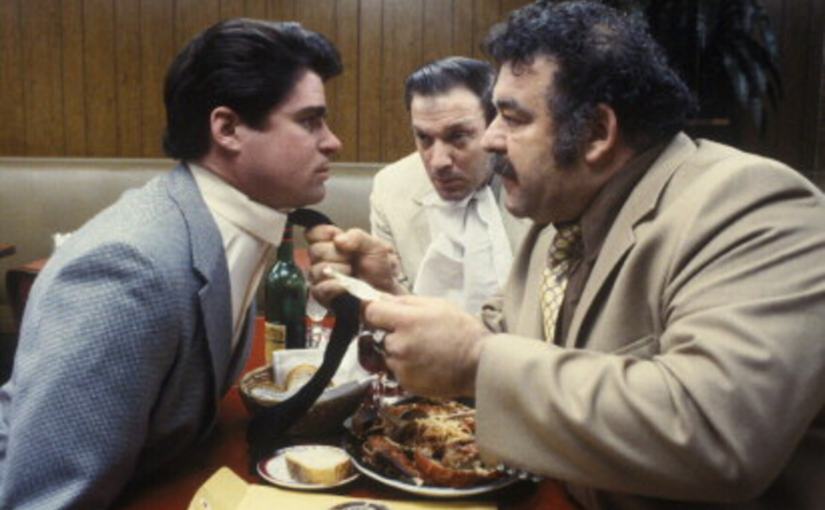
Danny catches cops on the take.  He gets a crooked lawyer on tape.  He’s also taking big risks that amplify his stress.  Lumet showed the increasing agony of a cop against a police department in Serpico with Al Pacino.  I thought the actor was a little overdone in that film.  Here, Treat Williams could not be more authentic, and the transition from cocky detective to paranoid informant, working against his colleagues, comes through much more subtly as the film carries on.  Danny gets caught in a diner sting wearing his wire.  His quick instincts save him, but only after his shirt is torn open showing the wire, and a gun comes out of nowhere.  The sloppy struggle that ensues with a broken glass door and overturned tables loaded with food and dishes is frighteningly realistic.  Lumet shoots the moment with a documentary kind of feel.  Deliberately, there’s no special effect to the camera work here.  It’s all in Williams’ performance and the actors he shares the scene with.

Treat Williams performance is so wired that I am very surprised it did not lead to more recognizable and stand out roles later in his career.  Williams was unknown at the time of this film’s release in 1981, but his lead in this picture is as welcome as Ray Liotta in Goodfellas.

Danny Ciello is a fictional character based on the real-life narcotics detective known as Robert Leuci.  Leuci had a checkered background dating back to when he became an undercover cop informant.  Neither Danny or Robert wears the white hats of pure honor and loyalty.  That is what makes these men so challenging.  Because they are somewhat impure, there is a tipping scale to how they should be regarded. 

A marvelous part occurs in the last act of the film.  Danny’s transgressions as well as what he’s accomplished have all been laid out.  The costs of his partners’ careers have been considered.  The risks and dangers that Danny and his family with two young children have encountered are given their due attention.  Now, as the film is concluding, Lumet along with his co-writer Jay Presson Allen, assemble close to twenty prosecutors and district attorneys in a dark, slightly sunlit office to debate whether Danny Ciello should be charged for violations of perjury.  One prosecutor threatens to resign if Danny is prosecuted.  Another one cannot see how a police officer can be granted pardons for violating the very laws he’s been sworn to uphold. No one is right or wrong in this argument. The collection of actors in this scene is amazing. 

The Oscar nominated script from Lumet and Allen do not provide a straight answer as to whether Danny is a hero or a criminal.  Prince Of The City is never spoon fed to its audience.  Different perspectives and receptions have likely been generated from the picture.  I’d love to hear other people’s viewpoints.

Once again, I commend the running time of Lumet’s film.  Danny Ciello is a complicated man who sacrifices so much that the cost of everything needs to be acknowledged.  The rampant corruption that is uncovered among his colleagues is so extensive that the turnaround response must be depicted.  Some men committed suicide for their crimes.  Some swear they’ll never give themselves up or even Danny.  Danny is expected to do the same in return.  Danny lost friendships and trust over the assignments he accepted. His children and his wife (an excellent Lindsay Crouse) were undeservedly forced to live in fear for their lives, and upend their household, ironically feeling obligated to accommodate those assigned to protect them.  At one time, Danny is relying on men who are heading the investigation, promising to abide by his conditions and guarantee his safety.  Later, these men accept promotions that pull them away to other departments, leaving Danny to deal with people he cannot count on going forward, and who may work against him or refuse to honor original promises.

It’s quite unfair for Danny as he continues to make headway.  An uncaring portrayal by Bob Balaban (really good in everything he does) as a federal prosecutor forces Danny into uncompromising positions where he’s squeezed into offering up everything with little to no options.  Because Danny is no longer the conceited prince that he once considered himself to be, these authorities keep him beholden to his commitments, no matter the cost of his career, his partnerships or how it affects the lifestyle of himself and his family.

Prince Of The City is a very heavy film with much to address.  If this were to be remade, without the guidance of Lumet’s expertise, it could only work as a miniseries.  Though I doubt it would ever compare to Treat Williams’ performance or Sidney Lumet’s specialty in covering the complexities that organically stem from police corruption.  This is a fascinating film that I’m looking forward to watching again.  Because the weight of the material is so thick, I’m certain I’ll discover something new in a repeat viewing.  This is one of Sidney Lumet’s best films.

AMERICAN SNIPER (2014)

by Miguel E. Rodriguez

DIRECTOR: Clint Eastwood
CAST: Bradley Cooper, Sienna Miller, Luke Grimes, Jake McDorman
MY RATING: 9/10
ROTTEN TOMATOMETER: 72% Certified Fresh

PLOT: Real-life Navy S.E.A.L. sniper Chris Kyle becomes the most lethal sniper in American history during four tours of duty in Iraq, but he finds it difficult to leave the war behind when he finally returns home.


I once called Katherine Bigelow’s award-winning The Hurt Locker the Deer Hunter for the Iraq War generation.  Having just seen Clint Eastwood’s masterful American Sniper for the first time, I must now amend my statement.  American Sniper presents its story concisely, almost tersely, states the facts of the matter, and leaves the audience to draw its own conclusions when the credits roll.  For myself, I was once again struck by the sacrifices of those men and women who have ever made, and will ever make, the choice to serve their country, for whatever reasons.

Chris Kyle’s reasons are made clear at the outset.  30-year-old Kyle (Bradley Cooper) is a skilled cowboy and rodeo rider when he decides to enlist in the military after seeing footage of the embassy bombings in 1998.  In a marvelously edited prologue (resembling a Scorsese film), we see Kyle’s father impress upon a school-age Kyle how people are either sheep, wolves, or sheepdogs.  Wolves attack the sheep, and the sheepdogs protect the sheep.  Kyle has lived his entire life with a sheepdog mentality and badly wants to do his part to protect his country against what he feels are the forces of evil.

Kyle enlists in the Navy S.E.A.L.s and, after a brutal training process, becomes a skilled sniper.  Shortly after graduation, he meets and falls in love with Taya (Sienna Miller).  The abbreviated exposition of their courtship and marriage contains little details that give a ring of authenticity that even The Deer Hunter lacks at times.  (After their first meeting in a bar, for example, Taya has to run outside and throw up after doing one too many shots.  Kyle follows and discreetly holds her hair back, as every gentleman should.  It’s the kind of scene you would normally see in a mid-level rom-com, but it feels as real as an autobiography.)

Kyle’s and Taya’s relationship at home is an important factor in the film, but the bulk of the story shows us Kyle putting his unique skills to use in Iraq, where he is sent shortly after the 9/11 attacks.  These scenes belong in some kind of war movie Hall of Fame.  Kyle’s first kills occur when he has to make a command decision whether or not to shoot a young Iraqi boy holding a grenade and running towards a US convoy.  The scene takes on an even more horrific dimension when the mother tries to pick up where her young son failed.  This horror is echoed in triplicate in a later scene when an even younger boy approaches an abandoned rocket launcher and appears ready to fire it at American troops.

Kyle goes on to much more “conventional” warfare later on (including a virtual duel between himself and another similarly skilled enemy sniper), but it’s scenes like the ones I mention above that elevate American Sniper into a masterpiece.  Watching them, I could not help but remember that this movie is based on a real person who went to real war zones during his lifetime.  I have no idea whether Kyle really did make those choices in real life, but the idea remains: whether Kyle did or not, it’s a foregone conclusion that someone had to make similar decisions at one time or another, not just in the Iraq War, but in other wars, many wars, ALL wars.  (I was perversely reminded of another superior war film, also based on fact, Jarhead, where the main character is also a sniper, except he never gets to fire his weapon in combat.  My respect for that character is no less profound.)

Speaking for myself, I don’t know if I have it in me to make that kind of call.  I have nothing but admiration and respect for those people who are making those calls every day in wartime, who are asked to put their lives and mental health on the line and do their duty no matter what.

Kyle’s compulsion to be a protector leads to his decision to become part of the teams “clearing” houses on the ground, as opposed to being the “overwatch” who protects them from the rooftops.  He sees too many squads being cut down by enemy soldiers inside the houses where he can’t see them from above.  “If I can’t see them, I can’t shoot them.”  One of his comrades disagrees with this decision.

“All these guys?  They know your name, and they feel invincible with you up there.”
“They’re not.”
“They are if they think they are.”

His decision puts him in even greater danger than before, but he can’t help himself.  Every death that he feels he could have prevented haunts him.  In another echo of another shattering war film, I was reminded of Oskar Schindler’s last scene in Schindler’s List when he breaks down thinking of how many more Jews he could have saved, instead of focusing on the ones he did save.  It’s impossible to say exactly how many lives Chris Kyle may have saved with his actions in Iraq, but in his mind, he was just doing the right thing, not the heroic thing, so he never felt comfortable accepting the title bestowed upon him by his grateful comrades: “The Legend.”

American Sniper is also very careful to depict the cost Kyle faced as the result of his job.  For one, the Iraqi insurgents put a $180,000 bounty on his head, making his job even more dangerous than it already was.  For another, he witnesses some things firsthand that would give Quentin Tarantino nightmares.  At one point, he tracks down an Iraqi enforcer nicknamed “The Butcher” who uses a drill to punish anyone who collaborates with American soldiers.  When Kyle raids his compound, he finds a freezer full of the Butcher’s “souvenirs.”  This is all on top of the various times he sees his teammates cut down by enemy fire, sometimes right in front of him.

The other cost comes during the brief periods at home between tours.  He loves his wife and children, but he finds it impossible to share the details of what happened to him in Iraq.  This reticence threatens his marriage to the point where Taya tells him flat out: “If you leave again [for another tour of duty], I don’t think we’ll be here when you get back.”  This kind of plot point is hardly new, but again, there is a ring of truth to it in this movie that makes it much more poignant than it normally is.  Kyle’s internal code can’t allow him to let someone else go to a war zone and do a job that he is eminently more qualified than anyone else to do.  “I have to serve my country.”  And that’s that.

(The film does have one drawback that compels me to score it as a “9” instead of a “10.”  There are scenes later in the film depicting more of Kyle’s troubles at home and as he speaks to a psychiatrist who recommends he go down to the VA and meet with disabled veterans as a way of “saving” soldiers without being in combat.  While these scenes are invaluable in terms of shedding even more light on Kyle’s character, even this late in the film, I did feel like there could have been a little more time spent with Kyle and those veterans so we could flesh that issue out just a little more.  There’s much more to it than could possibly be explored in just the last fifteen minutes of a movie.  I’m not saying it should have become Coming Home, but…that’s my opinion.)

In the event you don’t know Chris Kyle’s ultimate fate, I won’t spoil it here.  I had forgotten about it, and when the movie sprung it on me, it was as surprising as any other plot twist I can think of.  American Sniper proved to me, as if it needed proving again, that the people in our armed forces, especially those in combat zones, face unthinkable decisions, sometimes on a daily basis.  The morality of those decisions can, and will, be debated from now until such time (God willing) that armed forces are no longer necessary in this world.  This movie doesn’t pass that kind of judgement.  It merely says, “Here is what happened.  What do you think about it?”  How you answer that question is what the movie was really about.

MISSION: IMPOSSIBLE DEAD RECKONING PART 1

By Marc S. Sanders

The object of the Mission: Impossible films is not to wow its audience with thought provoking questions of politics or Cold War intrigue or even daring and uncompromisingly evil villains (apart from Phillip Seymour Hoffman).  The elements of espionage coursing through the TV series are non-existent in the film adaptations.  I’m not watching a film based on a John LeCarre spy novel.  By the time the seventh installment has arrived, titled Dead Reckoning Part 1, the goal of the film series is to sketch out the set ups for one action piece after another.  Only they must be bigger, bolder, and seemingly that much more impossible to overcome for their hero, Tom Cruise (playing a guy named Ethan Hunt).  The action is once again top notch.  The glues that bind these displays of bravado together, you know where the characters have to talk and give us a semblance of a plot, is as nil as the scotch tape that assembles a stretch of film reel into a running time length of nearly two hours and forty-five minutes.

The locales are as grand as any travel getaway. We go through a labyrinthine airport.  A techno night club works as a meeting place for a bunch of characters. There are journeys to the Arabian Desert, Rome, Venice, and a beautiful ride along the famed Orient Express.  Shot on digital, this movie is a gorgeous travelogue.

Let’s get the problems out of the way, though.  The MacGuffin that Ethan Hunt and his trusty pals Benjy and Luther (Simon Pegg, Ving Rhames) have been assigned to recover is two parts of a specially designed key.  One part is supposedly with the disavowed MI6 agent Ilsa Faust (Rebecca Ferguson).  The other half is questionable as to who possesses it, but a thief known only as Grace (Hayley Atwell) may be significant in finding it.  Put the two halves of the key together and it will unlock something that no one seems to know of, or where it is located.  Here’s my first issue.  The audience does know what the key unlocks because it is shown in the first three minutes of the film.  So, while the cast of characters act dumbfounded, we know all along.  So, there goes any curious interest I may have for wanting to follow through with this. 

The other problem is that the same conversation happens over and over and over again.  Lines like (and I’m paraphrasing here, or maybe I’m not) “If this key gets into the wrong hands…” and “Whatever this does unlock, Ethan, could spell the end of the world…” or “It’s important that both halves of the key are not put together…”  or “Whatever this does unlock…”  (See?  Even I just repeated myself in this write up.) Except, we know what it unlocks!!!!!  The same exchange of dialogue occurs over and over.  The redundancy exhausts itself.  It occurs so much in fact that it’s writer/director, Christopher McQuarrie, relied upon the repetitive dialogue to stretch this next M:I chapter into two films instead of one (Part 2 is scheduled to be released in 2024).  I don’t recall the context of any of Ving Rhames’ lines going further than what I have presented here, for example.

The film is also a little too character heavy.  I never understood why two agents (Shea Wigham, Greg Tarzan Davis) are constantly pursuing Ethan.  Just was not clear for me. Heightened suspense?  That’s the best excuse I can think of.  The White Widow from the prior film (Vanessa Kirby) also appears.  Not much purpose to her.  Cary Elwes is the deputy director, there at the beginning and later towards the end, but again I was not entirely certain of his contribution to the story.  Even Ilsa Faust does not seem to have much value, except to work as a step in Ethan’s ongoing trajectory for the key.  I think Rebecca Ferguson had no more than five lines in the whole picture.

Finally, Ethan Hunt seems to be up against an omnipotent enemy, an AI program known as The Entity.  The humans doing the bidding of this phantom program consist of a goatee wearing Esai Morales and his henchwoman, played by Pom Klementieff.  She looks straight out of a James Bond picture and makes for a good car chase through the stone cobbled streets of Rome in a tank like Hummer.  Morales is as boring as most of the other the M:I villains.

What works for the film is what Tom Cruise really wants to impress you with though.  Riding a speeding motorcycle off a mountain and parachuting his way down.  That’s actually a near sixty-year-old Tom Cruise performing that feat.  Very impressive.  The car chase with a handcuffed Cruise and Atwell in a puny yellow Fiat versus an unbeatable Hummer and an army of Italian police vehicles is fun on the level of Roger Moore’s Bond films.  Most impressive for me is the final act where the famed Orient Express train tumbles off a bridge with a gap in the middle, car by car with all the furnishings, piano included, pouring out while Ethan and Grace hold on for dear life. 

It’s the high stakes stunts that work.  Whatever smidge of a story there is fails though.  The script by McQuarrie and Erik Jendresen lacks so much that the cliffhanger the film ends on doesn’t leave me yearning for more because it only hearkens back to the beginning.  The characters catch up to what the audience has known for the last three hours.  So, I’m not losing sleep wondering with what happens next.

Of course, I’ll go see the Part 2 installment.  Tom Cruise won’t let me down in whatever daredevil achievements he’s dreaming of doing next.  However, am I going to these movies to watch Mission: Impossible, or to watch an aggressively updated version of Circus Of The Stars?

MISSION: IMPOSSIBLE ROGUE NATION

By Marc S. Sanders

Mission: Impossible Rogue Nation is as stunt filled as its predecessor. Perhaps even more.  The difference for me though, is that it is better than Ghost Protocol.  The stunts and action are at least equal in both films, but Rogue Nation also plays with its characters while not stopping at certain points to explain what must happen next.  Sure, the movie talks, but it speaks with developments and surprise, rather than starting the story all over again from square one (a shortcoming for me with the prior film).  Much of that is thanks to a new character, a disavowed British Intelligence Agent named Ilsa Faust played with perfect unsurety and mistrust by Rebecca Ferguson.  She’s the actress keeping me interested beyond the magnificent action scenes because I want to uncover what her game really is all about. 

Rogue Nation opens soon after Ghost Protocol ended.  A hearkening back to the original TV series has finally introduced the nefarious and clandestine organization known only as The Syndicate.  No one has been identified as heading this mysterious group.  A face or name has yet to be linked.  None of the major governments, including America, even believe they exist.  Tom Cruise as Super Spy Ethan Hunt is the only one certain that this Syndicate is responsible for a series of terrorists’ attacks and government overthrows occurring throughout the world.  By the way, I always call him Super Spy, because nothing gets past Ethan Hunt.  Not only can he run fast enough to hop onto a cargo plane taking off a runway, but he even has a talent for drawing as well as reading lips in various languages. Amazing!!!!  Incredible!!! Astounding!!!! ETHAN HUNT – SUPER SPY!!!!!

Don’t ask how we get there, but Ethan recruits his trusty pal and computer hacker Benjy (Simon Pegg) to attend an opera in Vienna where the leader of this shadowy Syndicate may be.  Complications and fistfights, along with sniper rifle assassination attempts ensue backstage during a performance, and now Ethan has convinced Benjy that his hunches must be true.  Ilsa is also there, but is she trying to kill Ethan or just fend him off, or is she working alongside of him?  Ferguson plays the role with a perfect poker face, and it helps keep the movie running along while wanting to find out more information.

Every Mission: Impossible film has that one especially heightened action set piece.  This time, Ethan has three minutes of inhaled oxygen while he enters an underwater vault to hack into a “safe deposit box.”  Benjy gleefully sees the simplicity in this.  “Well you can do that!”  As an extra bonus, we are treated to a kinetic motorcycle chase through Morocco.  The sound editing alone with revving engines and cars screeching, machine gun fire, and horns blasting is impressive enough.  Accompany it with well placed camerawork (nothing is blurry or shaky like in many other action films) and you have a set piece that’ll keep you alert.  Who needs dumb Fast/Furious junk when this stuff tops it?  Kudos to writer/director Christopher McQuarrie.

There are some standard motifs to Rogue Nation.  Once again, there’s a government official or two who does not trust Ethan Hunt’s intentions and thus he’s number one on the Most Wanted list.  How many times has this guy saved the world, already?  Give him a break! Also like before, most recently in the last installment, the IMF team has been shut down.  That does nothing for me anymore.  I wouldn’t expect anything less.  No IMF team, but Ethan and Benjy still get a hold of the most inventive gadgets and tricked out cars they can find.  So what’s the big deal if the IMF is on the chopping block?  Still, I like how this picture wraps its storyline up and defeats the villain.  It’s different and a welcome surprise.  Ilsa Faust’s character arc tidies itself up nicely as well.

Amazing stuff happening in this fifth chapter of the film franchise.  As long as Tom Cruise and company get more daring and aggressive with the impossible missions that need to be overcome, the staying power of these films holds.  Mission: Impossible Rogue Nation is a fantastic piece of filmmaking.

MISSION: IMPOSSIBLE GHOST PROTOCOL

By Marc S. Sanders

When JJ Abrams took the reins of IMF adventures with Mission: Impossible III, he brought his penchant for meet cute romance between Tom Cruise’s super spy and his love interest Michelle Monaghan. It worked well as a new dynamic in the high-octane series. In the follow up film, noted Pixar director Brad Bird takes over with his own touch of tongue in cheek wry humor courtesy of Simon Pegg, as well as a little bit from Cruise and some side characters.

This is a great installment opening with a fun prison break moment accompanied by some Frank Sinatra in the background to earn your appreciative grin. An energetic credit theme sequence featuring Lalo Schifrin’s adventurous theme song follows with a spark on a fuse. I get so wired when I hear the Mission: Impossible Theme.  From there, Bird offers up challenges like putting a spin on the now familiar ID retina scan by any typical spy computer.  There are shootouts, of course. More running – lots of running courtesy of Tom Cruise – a sandstorm, a Kremlin covert operation and a climactic chase for a briefcase within a weird multilevel movable parking garage filled with cars to crash, bash, and drive off high level platforms.

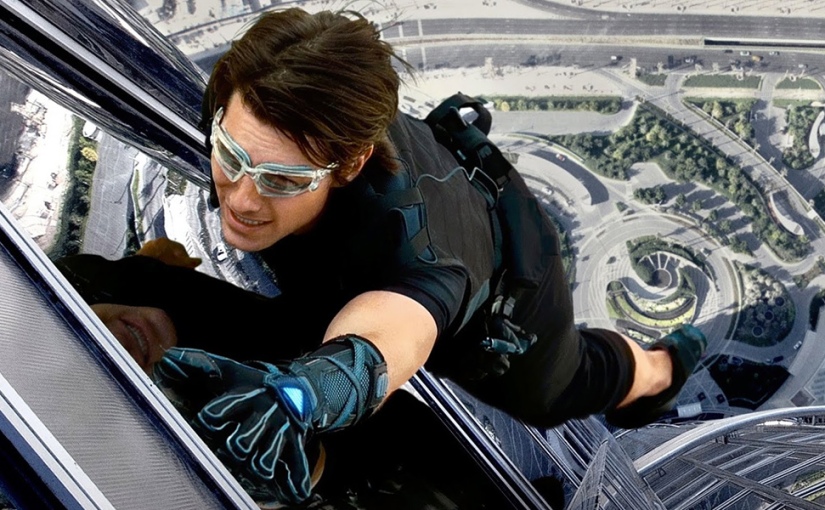
The main centerpiece reaches for the sky however with the world’s tallest (I think) building, the Burj Khalifa in Dubai. I love this scene. Not just because Cruise is doing the stunt of climbing the glass tower himself, but it screams of hilarious moments that belong in Bird’s other great accomplishment, his Incredibles films.  The photography is unbelievable in this sequence even when watching it on a 4K flat screen at home.  This one scene can be taken out of the context of the film and treated like a short story adventure.  The goal that Ethan Hunt is trying to accomplish is to quickly hack into the building computer.  Seems so trivial for the enormous lengths he goes through, but then we wouldn’t get the scene!!!!  So, scale that glass Ethan and let’s see how you get yourself out of this one.  A highlight of not only the film series, but Tom Cruise’s amazing career.

Simon Pegg is hilarious against the reluctance of Cruise’s straight man along with an out of touch Jeremy Renner. There’s a sticky glove that won’t work for Cruise as he scales the outside of the building, but Bird milks the joke while also using Renner, who is of no help but invites nervous glee and desperation.

Especially with Ghost Protocol, the film seems to begin, conclude, and then begin again.  Over and over, the players are explaining what must happen or needs to be done, or what the next step in the mission is.  So, there’s a lot of stops and starts with exposition through the course of the film.  What does it all spell out?  I hardly care.  All I know is the heights of danger are that much bigger, because all IMF agents, including Ethan Hunt and team, are now disavowed following an attack on the Kremlin in Russia. 

I don’t try too hard to piece everything together in the M:I films. Other than Phillip Seymour Hoffman in Abrams’ film, the villains have not been altogether memorable. The breathtaking action is much more fun than the stories. Though this film talks a little too much, something is always happening. This occurs in nearly every installment of the franchise, save for John Woo’s short-changed Mission: Impossible II.

This is a franchise that hasn’t self-destructed.  Cruise and company choose to up the ante with each new installment.  I hope the films continue on that course.

TERMINATOR 2: JUDGMENT DAY SPECIAL EDITION

By Marc S. Sanders

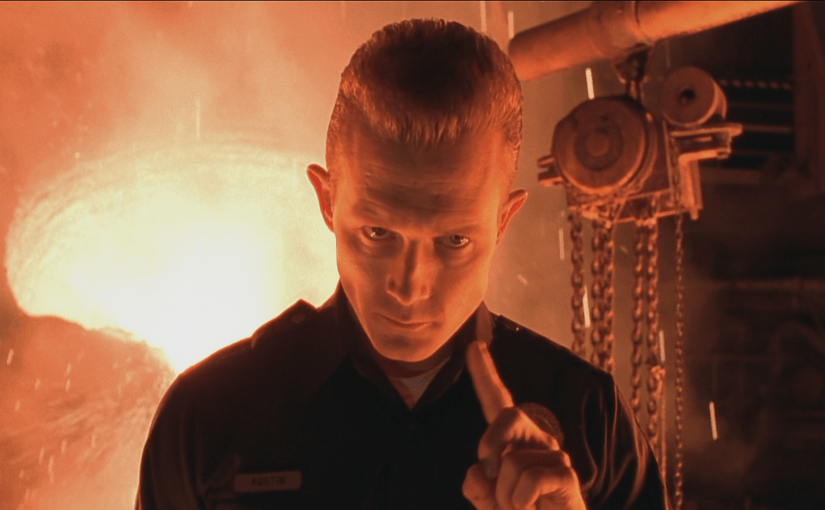
Hailed as one of the greatest sequels ever made, James Cameron’s sci-fi extravaganza Terminator 2: Judgment Day remains revolutionary in its achievements in special effects that still hold up over thirty years later.  This was a major film in Arnold Schwarzenegger’s career, but Robert Patrick became a known character actor for his stoic expressions as a sinister android with the ability to shape shift out of a substance of liquid metal that consumes his entire body.  Neither of these actors have much dialogue and yet the hero versus villain element is so well defined with Cameron’s imagination and drive for effects enhancements. 

It’s ironic.  The first Terminator was a scrapy film with an interesting plotline of time travel to serve outstanding shoot out and car chase mayhem for an hour and forty minutes.  Stan Winston’s make up work was effective. Visual effects of the metal exoskeleton look like the work of Ray Harryhausen from his days working on the Sinbad movies.  Impressive, but they looked outdated.  It’s forgivable though because the storyline and the action were masterfully orchestrated.  Cameron’s sequel makes up for these shortcomings.  It was a box office smash.  The image of Schwarzenegger mounting a Harley Davidson with sunglasses and a black leather motorcycle outfit (shotgun in hand) became as iconic as his standard promise of “I’ll be back,” and just about everything in the film raised the bar that much higher for all vision effects to be produced thereafter.  Some of the imagery in this film remains absolutely astonishing.

In this 1991 installment, two Terminators from the year 2029 are sent back in time to protect a pre-teen John Connor (Edward Furlong in a wonderful and spirited debut performance), the leader of the human resistance in a futuristic war between man and machine.  There is Schwarzenegger as a new T-800 (a steel skeleton with living tissue and skin on top) designed with good intentions to keep John alive.  The T-1000 is the much more advanced liquid metal monster who can form sharp objects like knives and stabbing weapons.  It can also take the shape of any human it encounters.  So, it has the capability of deceit.  This thing is truly unstoppable. 

John’s mother, Sarah (Linda Hamilton), who was being hunted in the first film is now a bulked-up warrior imprisoned in a psychiatric hospital for her violent tendencies, making outrageous stories that predict a doomed future, and for the crime of blowing up a computer factory.  Hamilton makes a major departure from her hokey damsel in distress in the first picture.

James Cameron is a director with high standards.  With each film he has made in his storied career (Titanic, Avatar), he seems to be both the teacher and student of advanced filmmaking.  Every new film shows a new discovery on his part.  The dazzling special effects of Terminator 2 work because they serve the robotic characters.  The effects are the threats and superpowers meshed within the plotline.  The technology used, along with Stan Winston’s artistic make up imagery, serves the story.  The liquid T-1000 will get frozen in liquid nitrogen.  Cameron will show Robert Patrick breaking apart like chipped ice.  Schwarzenegger will shoot the frozen statue, breaking it into a thousand pieces.  Is the monster dead though?  Cameron applies another cool effect for a fast resurrection, and you see how it all functions and morphs into something new.  The T-800 will shoot a grenade into the head of the T-1000, and you’ll see it break apart and what it does next in response.  It’s groundbreaking.  More importantly, it is eye opening.  Absolutely marvelous work.

There’s a handful of cheesy dialogue in Terminator 2: Judgment Day.  That’s to be expected in many of James Cameron’s scripts.  I can’t help but roll my eyes when I hear Michael Biehn or Linda Hamilton deliver a line like “On your feet, soldier!”  I dunno.  It just doesn’t come off authentic to me in the same way a drill sergeant would demand.  Hamilton’s voiceovers never did it for me either and I think it’s a combination of the dialogue and the vocal performance from the actor.  The melodrama is a little too thick in these areas. I’ve often regarded faults like those of Cameron.  That doesn’t make his films any less watchable.  I’m looking at some of the greatest visuals ever to grace a screen.  I do wish that he would take his screenplays to a script doctor, though.

Terminator 2 is never boring.  I opt to watch the Special Edition found in a DVD set.  It’s a recut of the film with lots of extra footage that flesh out the functionality of these sci fi futuristic figures and lend to more character depth.  A dream sequence is included.  Sarah sees the return of Kyle Reece (Michael Biehn), John’s father, to push Sarah on her campaign to change the future and ensure the technology that soon develops in a future 1997 never comes to be, while also continuing to protect their son.  My favorite new addition comes in the final act when we see the T-1000 suffer from the cumulative damage done by the heroes.  That welcomes some new visuals not seen in the original theatrical cut.

No matter which edit you watch though, the set pieces are spectacular with lots of shoot ‘em up mayhem, truck and motorcycle chases, and bullets blazing all over the place, including bouncing off of Arnold Schwarzenegger, while being “absorbed” by Robert Patrick.  A helicopter collides with a SWAT team van.  An entire building explodes into a huge blaze. Cameron offers frequent nightmares for Sarah that depict a truly frightening end to nearly all of humanity with scorching white heat, fire and ash.  A playground never looked so scary.

I digress with a mild spoiler alert.  This most recent watch of the film was fun because I showed it to my fifteen-year-old daughter.  She had a different impression than most movie going audiences who saw the film in 1991.  Promotions at that time clearly demonstrated that Schwarzenegger was a good Terminator this time, while Patrick was the threatening bad guy.  My daughter had no idea.  So, a well edited suspense scene that builds in a shopping mall left her quite surprised when both Terminators meet face to face for the first time, with their guns drawn and John perched right between them.  Who was the protector and who was the killer?  See?  It pays not to watch the commercials and previews.

Terminator 2: Judgment Day is one of many outstanding achievements for James Cameron.  It enhanced a new visual effect introduced in an earlier film of his, the “water worm” in The Abyss, and made it a major story element.  He might not be the best dialogue writer, but Cameron repeatedly showcases the art of writing a solid storyline around the technology he toys with as he brings it all to perfection. 

INDIANA JONES AND THE DIAL OF DESTINY

By Marc S. Sanders

When a film director, the writers, and producers are trying to make a fifth installment of a franchise that spans over forty years, centered around one of the most iconic characters in history, it is important to consider every factor involved in the process.  My colleague, Miguel, commented that Indiana Jones And The Dial Of Destiny had four writers attached to the project.  Normally, I call that a shortcoming.  When you’re stumped for imagination, turn to yet another writer.  In this case, however, I believe it served to ensure they were providing a fitting send off to the famed archeologist in search of rare antiquities.  Dr. Jones’ final silver screen adventure hits all the right notes thanks to storytellers focused on imagination and sensitivity for the celebrated character.

James Mangold, a director who I don’t think gets enough credit for his accomplishments (Walk The Line, Logan, Ford Vs Ferrari, 3:10 To Yuma) takes over for a busy Steven Spielberg who occupies the producer’s chair this time.  The Dial Of Destiny has a modern Mangold gloss to the cinematography, compared to the distressed, washed out films of Indy’s earlier adventures.  However, it remains a very well-constructed film that should be recognized especially for some outstanding editing.  At the center of the film is a swashbuckling chase through Tangiers on three-wheel scooters and cars. It is as breathless as any of Mangold’s prior work or Spielberg’s pieces.  In fact, all the fined tuned action sequences function so beautifully.   Give the editors an Oscar nomination now!  The DC superhero films need to take a lesson from this esteemed house of Spielberg.

The film has a wonderful prologue worthy of being in the same fraternity with the other films in the series as Indy (a de-aged Harrison Ford) and his colleague (Toby Jones) come face to face with Nazis as Hitler’s reign is quickly collapsing.  The set up of the titled MacGuffin is introduced aboard a high-speed locomotive through German territory.  Flash forward to 1969 in New York City, and it is the eve of Dr. Jones’ retirement being overshadowed by America’s parade celebration of the moon landing.  Circumstances that our hero was never looking for occur and before you know it, Indiana Jones is riding horseback through a subway tunnel after being set up by his long-lost goddaughter, Helena Shaw (Phoebe Waller-Bridge).  Clandestine antagonists are hot on their trail, particularly a professor who goes by the name of Schmidt (Mads Mikkelsen). Then it is on to Morocco, followed by a diving expedition among a school of threatening eels. Sicily is next, and I dare not even reveal where the final destination takes place, but it’s a welcome and very appropriate surprise.  Bravo to the promotion machinists for not even hinting where this new film eventually escorts Indy and his pals.

When George Lucas invented the famed archeologist with the fedora hat, crackling whip, and leather jacket, I believe he was simply looking to arrange with Steven Spielberg to offer an update of the Saturday cliffhanging serials they watched as adolescents.  Indiana Jones was not a character in Raiders Of The Lost Ark.  He was a carving.  Harrison Ford occupied the well-worn image. Spielberg’s silhouettes of the man kept him thankfully recognizable.  Later films gave the world traveler more depth with back stories pertaining to his father (a timelessly memorable Sean Connery) and his one true love Marion (Karen Allen; isn’t she great?).  Indiana Jones is an archeologist by trade. Yet, in an age of advancing technology with television sets in every home during the 1980s and video games being updated quicker than people pay for them, the character is cinema’s greatest historian and one its most adoring adventurers.  The greatest achievement that The Dial Of Destiny offers is an absolutely perfect send-off to the character that movie goers have gotten to know since he first appeared in 1981, when he was the best alternative to James Bond.

Unlike the British secret agent, though, I truly believe only one actor can play Indiana Jones.  All five films demonstrate that Harrison Ford is irreplaceable.  Unlike Bond, who is written to adapt to the respective modern age in which every new film is produced, Ford has aged in line with Jones.  Indiana Jones is a traveler through the history of the twentieth century, researching and uncovering evidence of centuries past.  In his youth he’s fallible, and his improvisation to get out of a tight squeeze remains thematically the same during his elder years.  Time passes and evolves over the twentieth century, but Dr. Jones’ profession and vast intelligence lives in a past before evolution and technological advancement.  

This film features snippets of 60s rock music and references the moon landing.  Jones clearly is grumpily dismissive of these new discoveries.  They are not appropriate in his world. His best skills in the field to fend off what interferes with him are a weapon of ancient times (his whip), some hard-hitting punches and a six-shooter pistol.  Other than his researched knowledge, he doesn’t advance further than that.  So, the character ages physically and out of modern date, just as the man who portrays him does as well.  Ford goes shirtless in one scene.  The wrinkles, grey hair, pot belly and love handles show.

The cast is very welcoming in this latest movie.  Phoebe Waller-Bridge is especially fun and spunky in the same vein as Karen Allen.  She’s smart and instinctual.  Daringly adventuresome too.  I know she’s a newly celebrated screenwriter, but I’d love to see more of her in front of the camera as well.  Toby Jones is that character actor who always looks fitting for a period piece.  Mads Mikkelsen is who casting agents dial up for the quiet, yet scary, villain that the best heroes in film need to face off against.  He’s not doing anything we haven’t seen him do before, but he works well as a smart Nazi stooge.  Antonio Banderas is here, not doing much really.  A kid actor named Ethann Isidore joins the party, reminiscent of the Short Round character, and John Rhys-Davies as Indy’s trusty pal Sallah returns for a few scenes to welcome applause.

The cast is dynamic, and all have their shining moments, but the film belongs to Harrison Ford. I regard his latest performance with a warm smile as a salute to his distinguished career of playing those everyman roles without the bulked-up muscles or tough guy bravado.  He never had the skillful soldier like ease of getting out of any dangerous situation like a Stallone or Schwarzenegger.  Ford steers his characters to those pictures where none of them, including Indiana Jones, ever expect to get caught up in grand adventures.  Yet, when it happens his performances leave you yearning for him to triumph and win out in the end.  The best example is Indiana Jones, of course.  He carries his audiences with the smarts of the character and the pursuit of the unknown and what we can learn more about.  The Indiana Jones series is one of the greatest inventions to ever grace a movie theater.  Because they are born out of history, they will always remain timeless and priceless with each passing generation that discovers these wonderful films.

It’s good to have Indiana Jones back in theaters.  I can’t wait to see this movie again.

ASTEROID CITY (2023)

by Miguel E. Rodriguez

DIRECTOR: Wes Anderson
CAST: More Actors Than You Can Shake a Stick At
MY RATING: 5/10
ROTTEN TOMATOMETER: 76% Certified Fresh

PLOT: In the mid-1950s, a roadside motel in a fictional mid-Western flyspeck plays host to a junior stargazing event that unexpectedly escalates, changing everyone’s world view forever.  …sort of.


Asteroid City, Wes Anderson’s latest film, feels like a collector’s edition box of Cracker Jack with no prize inside.  Or a cake that has prize-winning decorations, but it’s hollow inside.  It looks phenomenal; one of my fellow cinephiles, Anthony, predicts it will be nominated for cinematography and production design, and I agree with him.  But where the heart of the film should be is simply a crater like the one around which the fictional town of Asteroid City was built.  This is yet another star-studded cast for Wes Anderson, but Anderson has given them very little to do other than wear colorful costumes, look solemnly into the camera, and speak in very precise phrases.

This strategy has served him very well…no…EXTREMELY well in the past.  Moonrise Kingdom (2012) and Grand Budapest Hotel (2014) spring immediately to mind.  But some crucial piece of machinery is missing from Asteroid City.  The characters are colorful and quirky, but at the end of the day, I simply didn’t care about what they did or said.  (Well…except when actress Midge Campbell [Scarlett Johansson] decides to rehearse her nude scene for her next-door neighbor…I did care about that.)

The film opens with a pillarboxed segment in black-and-white.  Our host (Bryan Cranston) explains that we’re about to watch a staged presentation of the newest play from author Conrad Earp (Edward Norton), who proceeds to lay out the “set” for us.  “Upstage right is the crater…upstage left are the motel cabins”, etc.  Then the screen expands to full letterbox and we are treated to eye-popping Kodachrome desert landscapes as we follow a 165-car freight train as it passes by Asteroid City.  Well, “City” should be in quotes…the population is officially listed at eighty-seven.

This is some wacky city.  It’s as if Wes Anderson watched every Coen Brothers film set in the Midwest, from Raising Arizona to No Country for Old Men, and filtered them through a Looney Tunes cartoon written by Charlie Kaufman.  Vending machines on the porch of the rental office sell everything from snacks and drinks to martinis and parcels of local real estate.  (Cost for the real estate parcels: forty quarters…they’re not big parcels.)  An abandoned highway overpass lurks on the outskirts.  Periodically, a police chase roars down the otherwise empty highway, guns firing and sirens blaring.  The residents say nothing about this phenomenon.  And every now and then, the town shakes from nuclear testing being done hundreds of miles away, but close enough that the mushroom clouds are visible.

Man, I love this kind of thing.  The stage is set for one of the all-time great satires, or maybe just a flat-out fairy tale.  We meet the cast of characters who have congregated here to honor young geniuses who have invented everything from rocket packs to particle guns to a projector strong enough to project an image on the moon.  A full rundown of all these characters would wind up being a novella, but if you’re acquainted with Anderson’s work, they will all be familiar to you in one way or another.  (Not least because many of them have worked on Anderson’s other films.)  They have also gathered to witness a rare astronomical event: a solar ellipse.  Not an eclipse.  An ellipse.  The mechanism required to view an ellipse without damaging your retinas looks like something out of Brazil.

Again, I normally love this kind of stuff, really, I do.  But…okay, look, first of all, the film intermittently takes a break from the movie itself to yank us out of the story and show us an event in the playwright’s life that led to the casting of Augie Steenbeck.  Or to show us a rehearsal where an acting coach (Willem Dafoe) encourages the actors – that we’ve already been watching perform in the movie/play – to improvise what it’s like to wake up by first falling asleep.  There’s even a moment where the host shows up where he really shouldn’t be.  And when one of the actors has a moment of existential crisis concerning the character he’s playing, he simply walks off the set, goes backstage and asks the director (Adrien Brody) why he’s doing what he’s doing.

…I mean…what IS this?  Conceptually, I get it, even if it’s a little heavy-handed.  (“What’s my motivation?”  “You’ll have to figure it out as you go along.”  “That’s too hard!”  “Well, that’s life.”)  But…why is it here?  Anderson worked with non-linear structure before in Grand Budapest Hotel, and it worked marvelously.  Here, it feels indulgent.  In fact, many of the scenes in the movie feel that way.  There’s a moment where an army general (Jeffrey Wright) announces he’s going to deliver a speech he’s prepared for the occasion of the “ellipse.”  But this is no ordinary speech.  It’s practically beat poetry, delivered with the kind of conviction that only Jeffrey Wright’s magnificent voice can provide, but…but…why is it here?  Even in this weird, cotton-candy, retro-fever-dream of a movie, this “speech” felt out of place and just plain goofy.  In fact, quite a lot of the scenes between characters felt less like story and more like the kind of dialogues you find in source books for actors.  (101 Scenes for Two and Three Actors…that kind of thing.)

I will provide full disclosure and say the movie did deliver some decent laughs and chuckles.  There is an event that occurs during the ellipse (I’ll have to tread carefully here) that may not be entirely unexpected, but it’s executed and timed so well that I laughed pretty much through the whole scene.  It’s the kind of thing I imagine Buster Keaton and Charlie Chaplin would have thoroughly enjoyed, if I may be so bold.  There is also the problem of the disposition of a Tupperware container holding a valuable, ah, keepsake.  Oh, and that roadrunner was awesome.

But by the time Asteroid City rolled credits, I didn’t feel like I had seen one of Wes Anderson’s best films.  (The Royal Tenenbaums remains his best film, in my opinion.)  This almost felt like a movie made on a whim, kinda like, “Hell, I don’t know if this’ll work, but if I get enough star power behind it, this may turn out to be something.”  Alas, it did not.

HOBSON’S CHOICE (Great Britain, 1954)

by Miguel E. Rodriguez

Director: David Lean
Cast: Charles Laughton, John Mills, Brenda de Banzie
My Rating: 7/10
Rotten Tomatometer: 92% Fresh

PLOT: A widowed bootmaker in 1880s England with three unmarried daughters is thrown when his eldest daughter announces her intentions to marry his best cobbler and start her own business.


From Wikipedia: “A Hobson’s choice is a free choice in which only one thing is actually offered. … The most well-known Hobson’s choice is ‘I’ll give you a choice: take it or leave it’, wherein ‘leaving it’ is strongly undesirable.”

Ask ten cinephiles about their favorite David Lean films, and I’ll bet dollars to doughnuts not more than two of them will even know Hobson’s Choice exists.  It’s one of only two comedies Lean ever directed (the other being Blithe Spirit in 1945), and it’s one of the last smaller-scale movies he would direct before 1957’s The Bridge on the River Kwai made his name synonymous with big-budget cinematic spectacles.  Hobson’s Choice oozes charm from every frame, has many well-earned laughs, and features a brilliant performance from the great Charles Laughton.  I just wish it had a better ending.  I’ll try not to spoil it for you, but…dang.

Henry Hobson (Laughton) is a widowed bootmaker in late 19th-century England with three unmarried daughters.  The eldest daughter, Maggie (Brenda de Banzie), keeps house, manages the books, and essentially runs the business, leaving Henry free to drink himself silly at the local pub every night and come home drunk as a skunk.  Being of an undesirable age – 30 years old – Maggie is also considered unmarriable.  But she’s no dummy.  See, one of Henry’s employees is a cobbler named William (John Mills, a legendary, prolific British actor), and Maggie notices when a rich patron praises William’s boots as the best she’s ever owned.  So, Maggie hatches a plan that will accomplish three things: get herself married, steal her father’s prize employee, and start her own business with the best bootmaker in town.  Hobson, of course, will have none of it, for various reasons…one of which is that, as the father, he is expected to pay a handsome dowry to the bridegroom, and he’ll be damned if he’ll give hundreds of pounds to a lowly cobbler, nor will he allow his “uppity” daughter to get the best of him.  Comedy ensues.

There is a lot to like in Hobson’s Choice.  First, there is the clever skewering of the class system, both socio-economically and along gender lines.  Hobson is reluctant to pay anything to William other than his barely-livable wages.  When circumstances force him to treat William as if he were a member of the same middle class as he, Hobson, is, he becomes enraged because…he simply has no choice.  The idea of all men being created equal is alien to him.  This same principle applies to his treatment and perception of his daughters.  He may genuinely love them in his heart of hearts, but all we ever hear from Hobson is how bothersome and loud and “uppish” they are.  To him, their sole purpose is to keep things neat and tidy and have dinner ready when he demands it.  It never once occurs to him that Maggie, the eldest, would be capable of putting her plan together, let alone actually pulling it off.

I also enjoyed how a good chunk of the story parallels Shaw’s Pygmalion, at least in broad strokes.  Will, Hobson’s prize cobbler, is as low-class as you can get, and has been treated as such his entire life.  Part of Maggie’s plan is to get Will to behave and dress more genteelly, and her method is nothing short of brilliant.  Rather than follow Henry Higgins’s approach – bullying with a heavy hand – Maggie very gently points Will in the right direction, stepping in with a firm hand only when necessary, as when it becomes necessary to deal with Will’s landlady, one of the funniest bits in the movie.  At first, Will is taken aback by Maggie’s directness, but it’s fun watching how gradually he gets turned around.  He may not be the spitting image of a member of the royal family after all is said and done, but his transformation is unmistakable.

Another great factor is the blustery performance by Charles Laughton in a role that, in my opinion, deserves more attention from film fans.  He’s most commonly associated with Quasimodo or Captain Bligh or the barrister in Billy Wilder’s Witness for the Prosecution (1957), but in Hobson’s Choice, he convincingly plays a man who is painfully aware he’s being driven towards a specific decision he does not want to make.  He’s been lord of the “manor” his entire life, and the idea that he might be forced to bow to his daughter’s whims is unbearable.  He is the most fun person to watch in the film…although John Mills is a close second.  I love his borderline incomprehension as Maggie patiently explains her plans and orders him about.

As I said, there is a lot to like in Hobson’s Choice.  But, man, did that ending let me down.  I was reminded oddly of David Cronenberg’s most recent film, Crimes of the Future (2022), which rolls the closing credits at the EXACT moment it becomes the most interesting.  I have no theatrical knowledge of the play on which Hobson’s Choice is based (other than the fact it ran for over 130 performances), but if the play ends the way the movie does, and I had been a member of the audience at a performance of that play, I would have rolled up my program and chucked it at the curtain.  I don’t want to give too much away, but its abruptness is breathtaking.  In my mind, it leaves far too much unresolved, unless there’s something I missed in that final scene/conversation.  I kept waiting for Hobson to make his eponymous choice, and for a second it LOOKED like he did, but it also looked like he had a devious plan of his own, and then…credits.

Oh, well, no matter.  There is more charm in a single frame of Hobson’s Choice than there is in any two Will Ferrell rom-coms.  I found it thoroughly enjoyable, even if it did let me down at the end.  Since Lean directed my favorite movie of all time, I’m inclined to forgive it.  I’ve seen most of Lean’s other films, and none of them committed this same blunder, so…c’est la vieHobson’s Choice is still worth seeking out.

THE LOST WEEKEND (1945)

by Miguel E. Rodriguez

DIRECTOR: Billy Wilder
CAST: Ray Milland, Jane Wyman, Phillip Terry, Howard Da Silva
MY RATING: 8/10
ROTTEN TOMATOMETER: 97% Certified Fresh

PLOT: The desperate life of a chronic alcoholic is followed through a four-day drinking bout.


I don’t drink.  Like, at all.  I’ve never taken drugs, and I’ve never smoked a cigarette.  Luckily, I have never been gripped in the throes of a crippling addiction, unless collecting movies counts as an addiction, in which case I plead the fifth.  I say this, not to brag, but because a lot of my first impressions of Billy Wilder’s The Lost Weekend are tinted by the fact that I don’t know the first thing about being drunk or what it means to suffer from an addiction so crippling that it would force me to hang a liquor bottle outside my window to hide it from my brother.

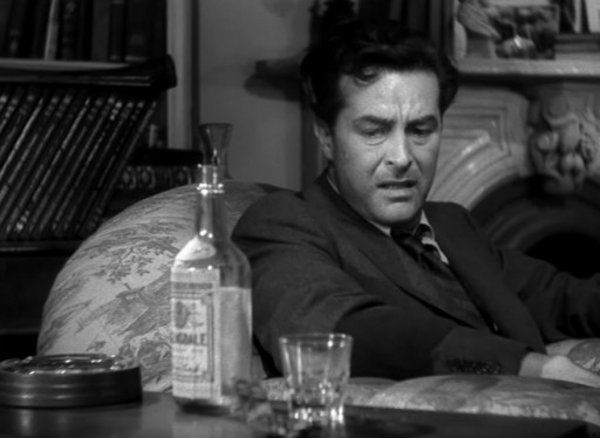
As it happens, Don Birnam (Ray Milland) DOES suffer from this kind of mid-to-late-stage alcoholism.  We first meet Don as he and his brother, Wick (Phillip Terry), are packing for a long weekend to get away from everything and everyone, including alcohol.  Don is a would-be author who needs a break from…something.  (Whatever he went through is never specified, only hinted at: “It’ll be good for you, Don, after what you’ve been through.”)  Don’s plan to surreptitiously pack the hidden bottle of liquor falls through after the arrival of his almost unbelievably good-hearted girlfriend, Helen (Jane Wyman).  No matter.  He still has a plan, which he confides to the long-suffering but increasingly annoyed bartender, Nat (Howard Da Silva).  He’s bought two bottles of rye.  He’ll hide one badly in his own suitcase and another in his brother’s suitcase.  When Wick discovers the badly hidden bottle in Don’s suitcase, he’ll chew Don out, Don will act suitably contrite, and Wick won’t think about searching his OWN suitcase for a second bottle.  What could go wrong?

During these first few scenes, when Don lies and lies and drinks shot after shot in a bar and winds up missing the train for his getaway weekend, I found it difficult to sympathize with him.  Oh, he’s clever and loquacious when he’s either about to drink or while he’s drinking.  He has enough knowledge to quote Shakespeare at the right times and wittily proposes to Nat the bartender: “I wish I could take you along, Nat.  You and all that goes with you.”  Under the right circumstances, Don is a fun guy, always good for a laugh…until his seventh or eight or ninth shot of bourbon.  Then the other Don shows up, Don the drunk, Don the liar, the Don who gets so desperate for cash that he’ll walk 70 or 80 New York City blocks trying to find an open pawn shop so he can hock his typewriter for drinking money.

For some reason, it was harder for me to empathize with Don Birnam than it was to empathize with any of the main characters in Darren Aronofsky’s Requiem for a Dream (2000).  In that film, not a single leading character escapes the ravages of addiction, and yet even as they made their mistakes, I empathized with them and grieved when their bad decisions made things worse and worse.  With Don Birnam, however, every bad decision he made just made me like him less and less.  I remember thinking at one point, “He’s brought this all on himself, he deserves what he gets.”  Not a very Christian attitude, but I’m not gonna lie about it: that’s what I felt.

And his girlfriend, Helen…wow.  It’s almost like she needs as much of an intervention as he does.  She loves Don so unconditionally it’s almost unbelievable.  What’s the attraction?  Perhaps it’s symptomatic of the era in which The Lost Weekend was made.  She discovers Don’s alcoholism late in their 3-year dating relationship.  (What did people think in 1945 of someone who dates a man for 3 years?)  Instead of breaking up with him or giving him ultimatums, she devotes herself to “fixing” Don.  Not precisely the course of action I would recommend myself in today’s world, but there you have it.

Director Billy Wilder presents this first half of the movie in a very uninflected tone with little-to-no comic relief.  This flat tone becomes very effective at simply presenting the information without directly commenting on it one way or the other.  There are moments up to this point where the movie seems to side with Don (his struggle to find a bottle whose hiding place he’s forgotten is particularly pathetic), but it’s still not really passing judgment or giving him a pass.

And then…the turning point.  Don accidentally falls down a flight of stairs and knocks himself out after finagling some drinking money out of a young lady he flirts with at his favorite dive.  When he wakes up, he’s lying in a bed in the Alcoholic Ward of the local hospital, face to face with one of the strangest characters I’ve ever met in a Billy Wilder movie, and that’s saying something.  He’s a nurse.  “Name of Nolan.  They call me Bim.  You…can call me Bim.”  The closest I can get to describing Bim’s weirdness is to imagine an evil Waylon Smithers from The Simpsons as a male nurse.  On quaaludes.  To Don’s slowly increasing discomfort, Bim lovingly describes what Don is in for during his stay on the Alcoholic Ward, giving the inside scoop on the various repeat offenders and what to expect during his D.T.’s: “You know that stuff about pink elephants?  That’s the bunk.  It’s little animals.  Little tiny turkeys in straw hats.  Midget monkeys coming through the keyholes.”  This Bim…he has NO bedside manner, man.  “Prohibition…that’s what started most of these guys off.  Whoopee!”  (Nice little social commentary there…classic Wilder.)

Don manages to find his way home once again, having not had a drink for almost a day-and-a-half, if my memory is correct.  And it’s at this point that the movie, Billy Wilder, and Ray Milland finally got me in Don Birnam’s corner.

SPOILER ALERT, SPOILERS COMING.

Don finally has a bout of the D.T.’s.  It’s not turkeys or monkeys or elephants, though…it’s a rat.  A single rat chewing its way out of the wall in front of him.  Then, out of nowhere…a bat finds its way into the apartment and flutters around the room.  Don is understandably distressed.  But then the capper: the bat swoops down to where the mouse’s head is poking through the hole, there is a terrible squealing sound, the bat sort of trembles and scuffles…and a stream of thick blood starts to dribble out of the hole where the bat is presumably chewing the rat’s head off or something.

To say I was surprised is an understatement.  Don starts screaming his head off…and at long last I finally empathized with Don’s situation, and I no longer wanted him to wind up penniless and/or alone and/or dead.  I wanted the movie to find a way to fix him, like Helen tries desperately to do through the entire picture.  From then on, I was on his side, or Helen’s side, or whoever’s side, it didn’t matter, as long as he figured out a way to get out from under the disease that was slowly killing him.

I would not dream of revealing exactly how the movie ends.  It might go the way of Leaving Las Vegas (1996).  Or it might go the way of the vastly underseen Duane Hopwood (2005), featuring David Schwimmer as an alcoholic father on a path of self-destruction, but who manages to turn things around.  (Sorry if I spoiled that for you, but I’m betting it’s not a movie most people will want to seek out.)  I will say that it’s the ending of The Lost Weekend that really showcases the era in which it was made more than anything else.  But it could just as easily have gone the other way and still been just as successful.

The Lost Weekend cleaned up at the 1945 Oscars, winning awards for Best Picture, Best Director, Best Actor, and Best Adapted Screenplay (it was based on a novel).  At the time, it was the most unglamorous movie ever made about alcoholism.  Up to that point, drinking in movies rarely if ever led to hangovers and the D.T.’s and spending the night in the Alcoholic Ward.  It certainly belongs to be mentioned with Wilder’s greatest films.  But you’re gonna wanna watch something a little lighter afterwards.  Stalag 17, maybe.  Or Some Like It Hot.  A laughter chaser.