A TIME FOR SUNSET

By Marc S. Sanders

Tom Calloway’s A Time For Sunset is a well-crafted film with shadowy, haunting cinematography and some decent edits.  Unfortunately, it travels towards its conclusion on a repetitive Groundhog Day trajectory.  Regrettably, the deliberate slow burn does not work.

A cell phone rings.  It’s answered.  A few lines are exchanged and then there is the hang up.  Five seconds later, the phone rings again and the same routine occurs, between the same two people. This pattern occupies the ninety-minute running time of this film. Sometimes the same questions are asked. The conversations seem similar to what I’ve already encountered, and I asked myself if we’ve covered this already. Out of nowhere someone gets shot right between the eyes, but I am so numb to this lethargic routine that I can’t even become alert to see what could happen next.  After all, the phone is going to ring again for a couple of lines to be said before the next hang up, followed by another call.

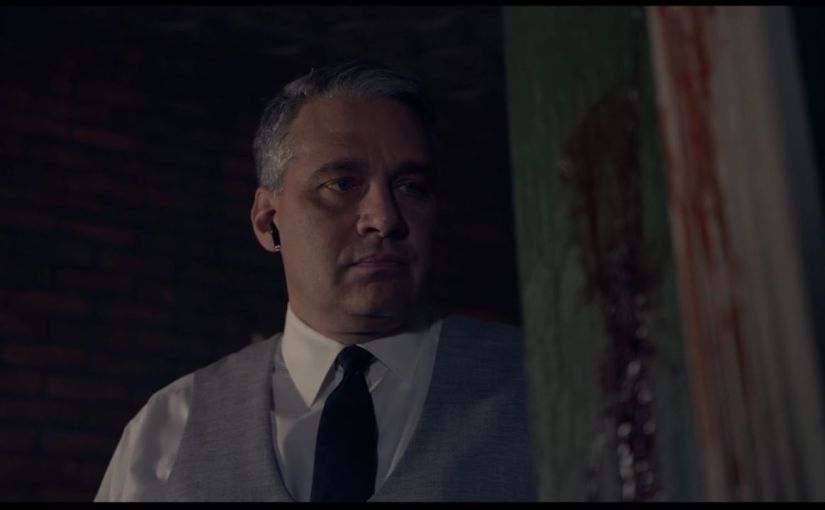
Don Worley is John, a seasoned assassin, who checks into a downtown hotel room with a set of golf clubs.  He calls his wife and daughter to say hello while he begins to assemble his sniper rifle.  Just after he disconnects with them, “No Caller ID” (Nicholaus Weindel) rings and John realizes that while he awaits his assigned target to appear on the street below, John has also become a target.  Each time this caller phones, he seems to share more information about John’s current circumstance thereby putting him in danger along with his wife and daughter.  Now it’s one assassin against another, but John is clearly at a disadvantage because he is unable to pinpoint from where this caller is watching him.

With Thomas L Callaway directing, A Time For Sunset monopolizes its camera work on actor Don Worley who is up for the one-man challenge.  Intermittently, other figures on the hotel floor disrupt the phone conversation to lend to John’s contained paranoia such as a bellhop, a couple of rowdy kids, a manager and an angry mother.  One person arrives to up the stakes with a cleverly rigged bomb and my mind immediately went to the third act of Jan DeBont’s Speed.  These all feel like brief episodes though with not enough oomph to break the monotony.

The pace of the film moves very slowly because it focuses too often on a guy talking into his cell phone or the accompanying earpiece. So, the thrill of this thriller is mostly absent.  Don Worley might be portraying this expert assassin with a measure of calm and cool sensibility during a high-pressure circumstance.  However, his tone hardly changes as the stakes are getting higher.  I never saw the desperation unfold, even as the film was wrapping up.  John hardly breaks a sweat.  Joel Schumacher’s Phone Booth was another picture that came to mind.  Colin Farrell’s everyday man seemed to respond to the fear that is sorely lacking in Callaway’s film.

I liked the idea of this bottled up storyline.  It has the potential to be compelling. A lot can be generated when someone must work against an unknown entity within a small setting.  The original Saw, for example.  Yet, even with a ticking time bomb front and center, plus the intrusion of a red pointer beam from a sniper scope, the direction does not build any suspense here. 

Despite what the introductory scene appears to spell out for John’s fate, I really didn’t care what would become of the poor fellow.

THE EXORCIST (1973)

By Marc S. Sanders

Perhaps it is my Jewish upbringing or the fact that I’m not a spiritual person anymore, but what many consider to be the scariest movie of all time really does not alarm me that much.  William Friedkin’s The Exorcist is a superb demonstration in horror though.  Disturbing? Yes.  Unsettling? That’s an understatement.  Scary? A little bit. 

It’s not so much the threat of a random demon or the possibility of Satan on earth that chills me.  It’s this poor, sweet girl who has been unfairly taken advantage of that makes me shudder. 

William Peter Blatty adapted his best-selling novel into his Oscar winning screenplay and it succeeds so well because amidst all of the terror, there’s an education to be had.  Do any of us truly know or have witnessed someone who has been demonically possessed by an entity of pure evil?  I’ll be the first to come clean and say no.  Therefore, I’m intrigued as Friedkin’s film proceeds to observe how the decision to exorcise a demon from the shell of a pre-teen girl arrives.  Nevertheless, to me it is all fantasy.  I might just hold more faith in the Jedi practice of the Force than I do in the ideas of holy water, devilish idols or even what can befall you by flippantly using the name of Christ in vain.

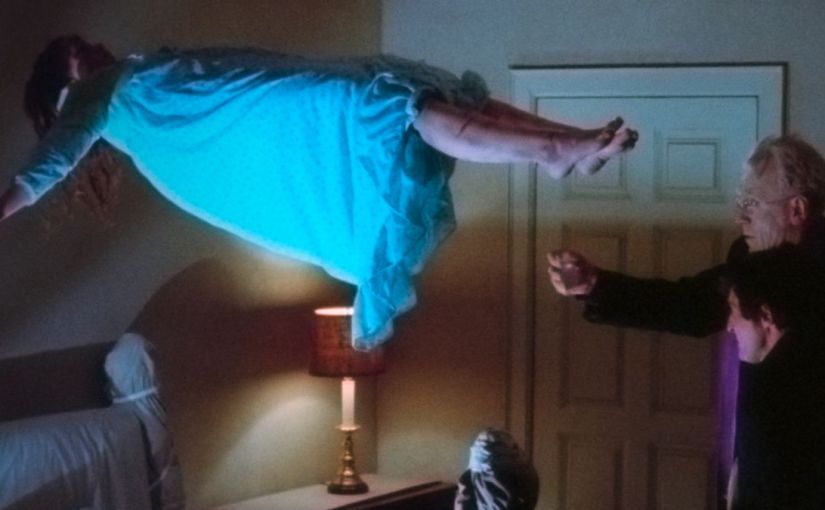
Famous film star Chris MacNeil (Ellen Burstyn) is on location in Georgetown shooting her latest picture.  She resides in a furnished home with her twelve-year-old daughter Regan (Linda Blair), along with an assistant and a butler servant.  Regan is a fun-loving kid and adored by her mom.  Strange behaviors begin happening and all too quickly, the daughter is beyond control with patterns of activity that are anything but recognizable.  I can’t even describe most of the imagery.  I could never do it justice.

Doctors are quick to attribute Regan’s afflictions to a lesion resting on the cerebellum of her brain.  Yet, extreme procedures and x-rays show no medical disruption or disturbances.  I recall Friedkin’s director cut from 2000 inserted the questionable practice of dosing the girl with Prozac.  Before the supernatural is ever considered, the merits of science and medicine must be explored.  

Nevertheless, it is unbelievably bold how this personification puppeteers young Regan with vile actions of vomiting, uttering the ugliest vocabulary and committing terrible bodily harm and atrocities with a crucifix.  Blatty could have drawn the line with the slaps and punches Regan delivers to the doctors and her own mother.  The point would have been clear.  Yet only something that has to be tangibly real with no question of a joke or side humor, has to go this far.  It’s often sickening and demoralizing to the worst degree, but reality never compromises.  The drivers of this fiction wish to move this as far away from what’s not valid. It’s evident how convincing all the footage is within the film.

Following the mysterious death of Chris’ film director, along with an unheard-of recommendation from a physician, the idea of committing an exorcism to release whatever’s possessing the girl is suggested.  The problem is there is no expert on the subject of exorcism.  It seems absurd, and the Catholic Church is never quick to endorse the procession.  

During the first hour of the picture, a second story covers the personal conflict of Father Karras (Jason Miller).  One of his first scenes shows him arriving home to his ailing mother and removing his collar.  It’s a visual sign that the minister is questioning his own faith as he undoes his garb.  Karras may be a priest, but he also specializes in the study of psychology for his parishioners.  As he encounters Regan in her bedroom, he’s gradually assured that he is speaking with the demon who knows too much about himself.

A third story, which actually opens Friedkin’s film, occurs in Iraq where Father Merrin (Max von Sydow) is excavating through an archeological dig.  He doesn’t have much to say but his stoic expression tells us that his discovery of a medallion buried in the rubble, along with particular statue, spell dread.  It’s no accident that Friedkin places this scene often against the backdrop of a sun sparked, blood red sky.  

Eventually, all three stories intersect within the coven of Regan’s upstairs bedroom, where this demon taunts, cackles, teases and defies the power of the Bible and the Catholic faith.  This third act is impossible to take your eyes off.  Every second of imagery builds upon the power of the supernatural from moving furniture that charges forward like monsters on the attack, to ceilings and doors that split open.  The bed rumbles.  Demonic imagery appears out of the cold darkness.  It’s such a well-crafted sequence of events that is completely atmospheric.  

On what I believe is only my second viewing of the film, there are few things I noticed.  Chris is not a religious character.  So, when she evokes frustration, first at her ex-husband over the phone, and then at doctors and priests who lack explanations, she’s apt to shout “For Christ’s sake,” or “Jesus Christ.”  Variations of the word fuck is also adjacent to this dialogue.  Chris’ language could be a close second to the abhorrent verbiage coming from her monstrous daughter.  Blatty and Friedkin seem to imply how the son of God and the potential of Satan are so easily taken for granted.  Chris may be corrupted, but it is the innocent, young Regan who is trifled with.  There is nary a thing more disturbing in film than watching a child in peril.

Friedkin’s direction with Father Karras is consistently interesting as well.  Often, he positions his camera on a ground floor or at least pointed up to a level above to witness Karras’ ascents.  His faith is clearly shaken.  So, all he can do is rise and rise again, closer to a heaven that may still be welcoming.  Karras climbs flights of stairs or walks up sidewalk hills, to approach a vile intruder seeking to disrupt the purity of angelic youth.  

Only after I watched the film did I read that Linda Blair’s unforgettable performance was not the only contributing factor to Regan’s demonic possession.  Oscar winner Mercedes McCambridge who originally was not credited, supplied the scratchy, tormented and taunting voice of the demon.  It’s an unbelievable embodiment of a powerful villain.  Linda Blair was Oscar nominated for this role, but because she did not entirely own the performance, she likely lost to another child actor, Tatum O’Neil (Paper Moon).  The craft of Blair’s makeup all the way to her changes in eyes is a gut punch to the psyche.  Regardless, this is one of the most uncompromising and effective child performances I’ve ever seen in a film.

Max von Sydow donned aging makeup on his youthful forty-four-year-old complexion, and he looks straight out of another famous role from later in his career (Minority Report).  Richard Pryor and Saturday Night Live did a hilarious spoof on The Exorcist and for this nonbeliever I related to Pryor’s antics.  Yet, Max von Sydow takes what could have looked like utter silliness and convinces me that the ritual of exorcism is incredibly trying and exhaustively repetitive accompanied with the robes he dons to the holy scripture he reads from.  Merrin specifically instructs Karras not to directly respond to the demon.  Don’t even talk to it.  Merrin sticks to that practice.  Karras, the younger and less experienced sidekick, is drawn into the monster’s personal jibes.

Despite my position on religion and faith, I do not frown on what others value.  People find solace in their perceptions of God, the biblical stories, and the figures who teach. Religion often bestows a fulfilling life cycle.  Religion offers comforts through pain, loss, love and hope.  That’s okay. Everyone must follow their own path towards salvation. I tend to turn towards my personal psyche which I speak to daily.  

I watched The Exorcist off of a 4K streaming print found on HBO MAX, and the picture is positively striking.  Aside from dated fashions and cars of the early 1970s, the picture looks incredibly modern.  The themes of the film remain strong.  Hardly anything has ever matched the horror of The Exorcist.

I value everything in The Exorcist that Father Karras and Father Merrin heed to.  I believe in this story wholeheartedly.  Friedkin and Blatty, plus the cast enhance the authentication of demonic possession and how it operates.  This work of fiction, which Blatty claims to have been inspired by from an account of possession of a young boy during the 1940s, is a thousand percent genuine.  Within the moment and inside the confines of this picture this demon lives by overtaking young Regan.

How much did I believe it? Before bed last night, I made sure my little night light was on and I never walked into a dark room.   Every single light in the whole house was practically turned on.  

It’s not about the fear of God or the Devil.  It’s the fear I had for young Regan.

THE MIST

By Marc S. Sanders

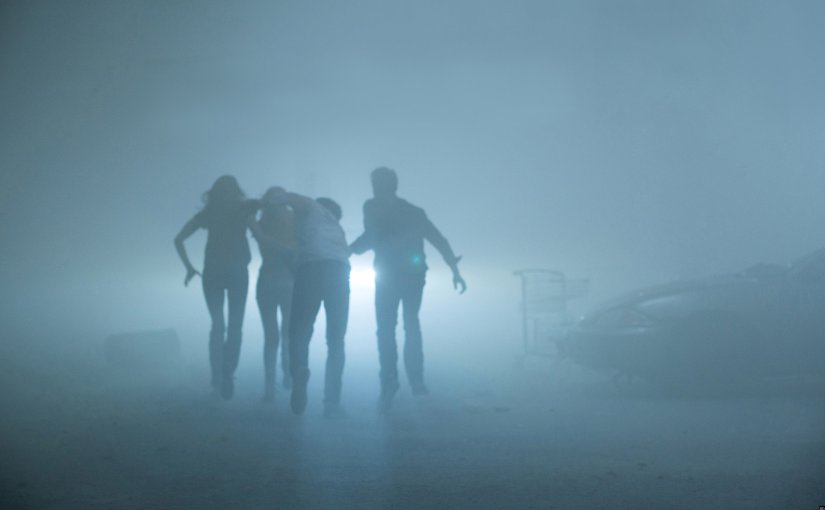
I’m tough to satisfy when it comes to monster movies.  Too often they all look the same, or they behave with similar instincts and motives.  There’s a new dinosaur movie coming out this year where they apparently stalk a military unit.  So!  I’ve seen seven Jurassic Parks.  About the only monster that still gets under my skin are the acid pumping, knives for teeth xenomorphs of the Alien franchise.  Everything else is been there, done that, and this includes the insect like pests found within the mist of Steven King’s The Mist, directed by Frank Darabont.  Fortunately, there’s a better and much more engaging attraction to this eat ‘em up blood fest.

Within another small fictional town in Stephen King’s version of Maine, a dark and stormy night kills the power within the area.  The next morning large fallen trees appear to have damaged the homes of David Drayton and Brent Norton (Thomas Jane, Andre Braugher).  Phones and power remain out, but a curious cloud of mist grows over the lakeside area.  

The gentlemen decide to go into town for supplies with David’s son Billy (Nathan Gamble) in tow.  The checkout line of the supermarket is crowded with tourists and residents when a similar mist envelopes the building and clouds up the expansive front window of the shop.  An elderly man runs through the parking with a bloody nose and urges the shoppers to lock the doors because there are things within this unwelcome mist that are terrifying and bloodthirsty.  I’ll spoil this for you. The old coot is right.  The creepy crawlies are thirsty for blood and hungry for flesh.

You’ve seen much of what Darabont’s screenplay adapts from King’s novella in similar iterations of horror.  The wheel is not reinvented here and though an explanation of this mist and the organisms it conceals is spelled out, nothing is jaw dropping.  Seems similar to how King’s The Stand opened.  The cast of this B movie is what needs to be talked about.

Sure, there are doubters of things terrorizing the community just before the blood is spilled.  Some characters make hard decisions despite the urging of others not to leave the store.  Yet, when these flesh eaters become evident, then the end of days gospel of Mrs. Carmody (Marcia Gay Harden) permeates through the populace of the supermarket.  That’s when The Mist grows a brain to demonstrate the power of fear, threat, and especially influence.  The disturbing Mrs. Carmody exaggerates the purpose of this phenomenon with select biblical scripture both documented and I believe conjured on the fly by her.  Now I am reminiscing back to tenth grade English when I studied Lord Of The Flies.  A tribe forced to live together will ultimately divide.

Darabont so wisely reads a collection of different walks of life forced to either work together or work against each other, both sides with desperate means to survive.  William Sadler is a dimwit mechanic who goes through three different modes of purpose during the film.  He starts with a tough guy mentality, then on to timid fear and regret, and lastly, he’s reawakened to echo the call of Marcia Gay Harden’s religious zealot.   Truly insightful because I often wonder how any person can so easily succumb to the influential beliefs of someone else.  I mean you would have to be dense to allow that to alter your mindset, right? Well Stephen King and Frank Darabont remind me that there’s more dense people on this planet than wise.  A dread of cabin fever only exacerbates to succumb to what someone will tell you. Therefore, let’s observe how the morons respond to the dominant personality.

The action for the sake of jump scares and expected horror does not disappoint too much.  There’s screaming. There’s lots of blood. There’s lots of running too, and monsters and webs and teeth and claws.  A sneak away trip to the pharmacy next door is neat centerpiece, but you’ve seen stuff like this so many times before. Frances Sternhagen gets the opportunity to use a makeshift, bug zapping, flame thrower that made me laugh and cheer.  

The jump scares are not very effective, though.  One bug thuds against the window pane. Otherwise, there’s monster stuff to absorb like tentacles, claws, teeth and webbing. I don’t go for slasher flicks and endless bloodletting gore like most movie makers of this genre attempt to achieve.  Too much blood is boring and a sign of a lack of story.

I was invested in uncovering why this all started.  I was taken with how a small group of people quickly engages in a mob mentality because their individual desperations refuse to satisfy. What instincts will undo people when hope dwindles and your companions turn on you?  Darabont presents some effective moments for these questions. However, once the exposition was out of the way, I didn’t care who lived or died.  My concern was knowing how whoever survives gets out of this dilemma.

The answers come and there is an unexpected ending tacked on by Darabont that is not recounted in King’s work.  Trust me when I say I’ll never forget the conclusion of The Mist.  Same as I’ll never forget the ending to The Sopranos.  That’s not necessarily a compliment though because I think Frank Darabont was only adding unnecessary insult to injury. He resorts to using a terrible psychological epidemic for one last twist of his gleeful, mischievous knife in my back.  I am not spoiling anything for you dear reader, but James Cameron went this route during a sequence in Aliens and it made much more sense, while offering convincing justification.

While you might like the chills and thrills of The Mist, be warned that it’s the ending that’ll leave you angered for days and nights thereafter. I had a furious urge to throw my popcorn at the screen.  

Popcorn can be found on aisle 5 by the way.  Bug spray on aisle 9.

MISERY

By Marc S. Sanders

The worst thing that could have happened to Paul Sheldon is that Annie Wilkes saved his life.

Rob Reiner breaks away from innocent romantic comedy to deliver a violently cruel kind of intimacy. He directs his second Stephen King adaptation, Misery.  (His first was based off King’s novella The Body, which became Stand By Me.)  With next to no prior record with horror or disturbing psychosis, Reiner achieves greatness with this film.  Much like Martin Scorsese, he focuses quite a bit on props that offer no dialogue but say so much.  A cigarette, a match, a champagne flute, a bottle, a beat-up briefcase, a clunky Ford Mustang, along with a gun, a two by four block of wood, a portable grill, a knife, a syringe, a sledgehammer, and a porcelain penguin.  Barry Sonnenfeld is the cinematographer offering brilliant clarities of color for mundane and endless discomfort.

Before leaving his mountainous Colorado cabin, Paul has smoked his cigarette and savored his glass of 1982 Dom Perignon.  He has just completed a new manuscript; a big departure from his best-selling series of novels focusing on his beloved heroine Misery Chastain.  Lady Misery is not how Paul wants to be entirely defined as an author.  

Unfortunately, on his way back down the snowy mountain, he veers off the road and lands upside down in his Mustang, buried within a blizzard.  A hulking figure carries him back to a peaceful, isolated cabin in the woods.  When he awakens two days later, he meets Annie who has already begun to nurse him back to health following two very damaged legs and a popped shoulder blade.  By his grogginess, he might have had a concussion too.  Lucky for Paul because apparently, he cannot reach a hospital or get a call out to his family or literary agent (Lauren Bacall) due to the harsh weather conditions.

It’s also convenient that Annie is quite the fan of Paul’s work, particularly his series of Misery novels.  She has a maternal bedside manner, but oddly enough she becomes irascible at any given moment.  After honoring Annie’s request to read his untitled manuscript, Paul realizes that might have been a mistake.  Annie can easily get unhinged to say the least, and that temper…

Paul Sheldon is portrayed by James Caan, and he was one name on a long list of leading actors considered for the role including Warren Beatty, Robert Redford, Harrison Ford, Robert DeNiro, and Jack Nicholson.  Any one of these guys could have done the part.  However, I can now only see James Caan.  He beautifully plays stationary vulnerability as he’s anchored to a bed for most of the film.  Ironically, for a writing master of words, Caan’s dialogue is not even half of the script that belongs to his counterpart.

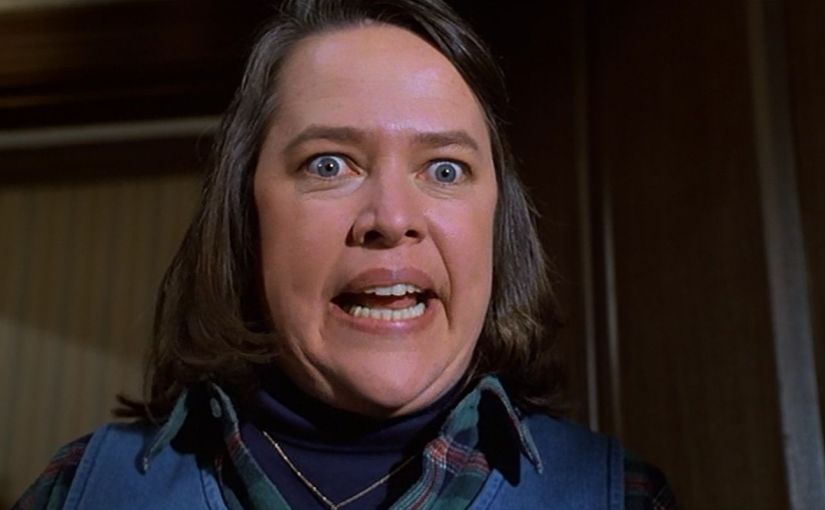
Kathy Bates was deservedly awarded the Oscar and a slew of accolades for her role as Annie Wilkes.  This role put Bates on the map.  Her portrayal is timed so authentically with changes in tempo from childlike enthusiasm to demented rage that she only makes Stephen King seem like that much better of an author than he already was at the time.  Actually, I’d argue that before Misery hit theaters, the Stephen King factory of film adaptations was churning out subpar products like Cujo, Firestarter, Christine, and his own film that he directed Maximum OverdriveMisery elevated the author’s brand back to when it was celebrated with Brian DePalma’s Carrie and Stanley Kubrick’s unforgettable interpretation of The Shining.

I believe what helps is that of all the varieties of horror the author was delivering, Misery did not hinge on the supernatural.  Annie Wilkes is a very real embodiment of capable terror and disturbing psychological handicap.  Kathy Bates effectively demonstrates byproducts of schizophrenia and obsessive, compulsive disorders.  Living alone in the woods with the subconsciousness of an author speaking to her through the pages of his fictional hardcover novels only feeds the beast that she’s become. 

I’m not a big fan of Stephen King’s works.  Often, I find his material of gore stretches too hard for shock value, and hardly ever achieving insightful originality.  To the best of my recollection, I’ve only read Misery, The Stand and It.  That’s enough for me.  I read that as he was writing Misery, he was emoting his alcoholic demons that left him obsessively challenged.  Annie Wilkes developed into that tangible, physical fiend.  This story takes a far step away from the macabre world that built his literary empire.

Rob Reiner does not go for any kind of novel inventions with his film.  He’s simply telling a story with the tools provided by celebrated screenwriter William Goldman (The Princess Bride, Butch Cassidy & The Sundance Kid, All The President’s Men) and his wise adjustments from King’s piece.  Goldman and Reiner wisely cut out a lot of King’s gory schlock.  (That foot scene, for example.  Either way?  YEESH!!!) Smart move, because Annie Wilkes is such force of power personified by the hulking physicality (by choice of Reiner’s lens) and range of Annie Wilkes.  Even though Kathy Bates is short, she is a hulking menace here. Kathy Bates is doing stage work in front of a camera.  I’d argue her performance inspired the idea of eventually converting Misery into a Broadway play that featured Laurie Metcalf and Bruce Willis in the roles.  I wish I could have seen that. 

Goldman wisely allows the picture to move on with another perspective in the form of two characters that were not part of King’s story.  A perfect casting of Richard Farnsworth and Frances Sternhagen as the local sheriff and wife advance the curiosity of Paul’s absence from the world.  They speak for the surrounding areas that don’t reveal what is beneath the blankets of snow where few clues remain, and not even a missing 1965 Ford Mustang can show itself.  They’re funny, quirky, and unusual, almost like a combination of Jessica Fletcher or Miss Marple seeking to resolve the mystery.

Props like a gun and a knife along with visuals like uncontrollable fires and fight scenes are nothing new.  However, it’s when these scenarios are paired with Kathy Bates to victimize a small, weakened James Caan that these items become well filmed properties of Rob Reiner.  So again, I focus on the inanimate objects of Misery because Reiner lends a lot of footage to all of these working pieces.  This revolver suddenly has dialogue of its own through one of Annie’s personalities.  The knife works like a guard dog for Paul.  The aluminum can of lighter fluid sadistically squirts itself to tickle or tease an extreme point for Annie.

The cigarette and champagne flute emote those small, cheating, harmless vice escapes from commitment that awards Paul. 

The sledgehammer puts its foot down.

The match plays both sides of the duality during different points of the film.

Misery is that film that works with a small cast, but with a wide population of environment, in a snug, confined space.  I describe the picture this way because like Annie Wilkes, this exploration in psychological terror operates without fair balance.  When an animal cannot control and subdue its instincts, there’s no telling what to expect, and an unpredictable Annie Wilkes might be one of the scariest personifications any one of us could ever encounter.

BLOW OUT

By Marc S. Sanders

Brian DePalma’s Blow Out is an inventive approach to the political conspiracy thriller.  In 1981, following a mask of innocence the United States lost with the assassination of President Kennedy, later his brother Bobby, plus the drunken, liable carelessness of their brother Ted, and then finally the Watergate scandal, DePalma capitalized on newsworthy incidents to make a paranoid thriller of present day while incorporating what he likely knows much about which is sound effects editing.  Despite the cheesy music soundtrack that is highly intrusive and poorly composed, Blow Out is a good blend of hysteria and suspense.

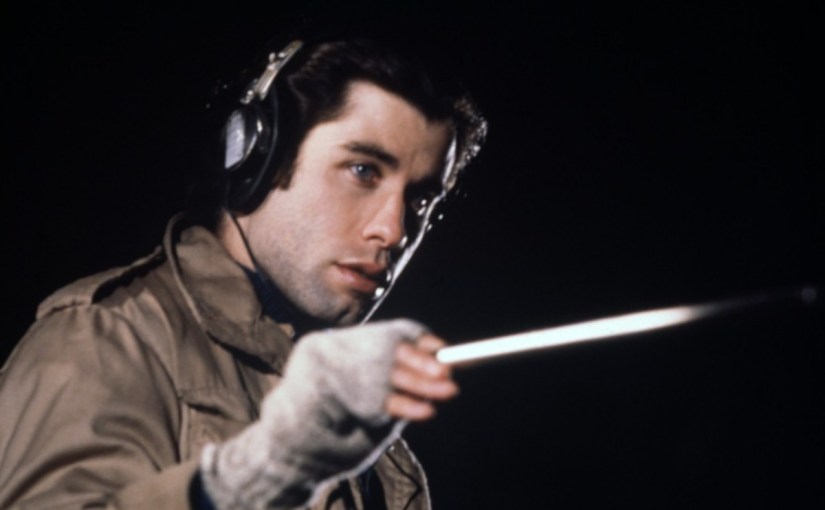
John Travolta plays Jack Terry, a Philadelphia sound effects recording artist for b-grade schlock horror movies.  One night, while out in a park trying to pick up sounds of outdoor nature, he witnesses a car suffer a blown-out tire and crash into a nearby river.  Jack is able to rescue a woman named Sally (Nancy Allen) but cannot save the Pennsylvania governor who was driving the car.

As he is about to leave the hospital, he is specifically instructed to never speak to Sally nor acknowledge to anyone about any of his own involvement in this incident.  However, Jack cannot help but recount the sequence of events in his head and as new details come to light, he knows that there is a cover up at play.

Blow Up operates like a how-to kind of picture.  The expertise of a sound effects recording artist is demonstrated as Jack replays every sound that his equipment picked up. Later he’s able to manufacture his own film by assembling a series of published photographs that also captured the crash.  Sync up the sounds with the sights and a new theory surfaces.  Other mysteries change the course of the riddle through dialogue.  This character has to work by himself using the skills he’s acquired to learn the truth.  He hardly has anyone to commiserate with.

John Travolta is convincing within this occupation that’s not as common as a cop or a private eye.  I like how I can pick up how he uses his recording equipment and even the minute details like labeling what he has preserved within his inventory.

It took a little bit of patience to get used to Nancy Allen’s damsel in distress who plays it up like Judy Holliday or Jean Hagen with the squeaky, dingbat voice.  When we first meet her, she is in an intoxicated stupor that goes on a little too long. Nevertheless, I came around because the tension of the film builds quite well.

John Lithgow is the sadistic adversary – a serial killer and assassin rolled into one.  He’s got the weird, unwelcome appearance like any bad guy in a Hitchcock film.

DePalma is known for his split screen cuts that he offered in Carrie and later in Mission: Impossible.  More well known is his reliance on bringing a character in zoom close up, while in the same frame, another object will be zoomed out at a distance.   During an outdoor evening in the park, an owl hoots and stares us down while John Travolta is far in the background standing on a bridge. Within this same moment, DePalma does it again with a toad ribbiting up close with the actor again positioned out. It’s a disorienting approach that works well at maintaining the perplexity of his story.

I think the final act of Blow Out falls apart a bit.  Travolta is on the heels of rescuing Sally by rampaging his jeep through a crowded parade.  The scene is shot so aggressively that it was hard for me to believe he would survive much less not run down a cop, spectator, or the entire marching band.  DePalma could have tightened this up a bit.

Blow Out ends on a bleak irony that’s quite surprising and definitely against formula.  There’s a running gag for Jack and a film director as they edit a silly problematic issue for a new slasher flick.  I guessed early on how this was going to resolve itself.  Though I was right, I didn’t expect how the conclusion arrived at my predication.  

As well, there are some notable questions left unanswered.  I had to roll back and see if I missed something.  I didn’t.  DePalma’s script neglects some key points with unfinished resolutions. So, I was not entirely satisfied. Still, the how-to procedures along with the pursuit of the truth, while also evading demise, are very engaging.

When I conduct workshops on playwriting, I always recommend keeping up with the news.  An unending wealth of ideas are there to be discovered.  As a sincere compliment to Brian DePalma, it could not be more apparent where his creativity took off with this film.  As a skilled and educated filmmaker, he also writes what he knows.  

Blow Out is very close to being a smart nail biter that echoes the sad truths of political rule breaking by means of savage crime. I wish modern films would be as risky today.  There are so few of these kinds of thrillers being made anymore.

THE 39 STEPS

By Marc S. Sanders

I propose you try an experiment.  Watch one of Alfred Hitchcock’s earliest, British produced films, The 39 Steps, and then have a look at Andrew Davis’ The Fugitive with Harrison Ford and Tommy Lee Jones.  You’re likely to recognize how inspiring Hitchcock’s film is towards modern thrillers almost sixty years later.  In particular, Hitch explored the thrill of the chase.  All he needed was the simplest of reasons for the pursuit to begin.  Then, he had the framework for his entire motion picture.

The 39 Steps is a loose adaptation of John Buchan’s novel.  Hitchcock’s film invented so much more than the book offered.  When the film was previewed for Buchan, midway through, the author reportedly told the filmmaker how he was wondering how it was going to end.  I took a film studies course in college and one of my assignments was to read the book and then document how it compares with the movie.  The nationality of the hero is different, a potential love interest appears in the film that is nonexistent in the novel, and even the actual 39 steps is entirely something else in the film.  Some books are challenging to deliver on a visual medium.  Alfred Hitchcock knew what needed to be altered to make for an adventuresome thriller.

The film opens in a European theater where one of the most astonishing people has taken the stage.  He is Mr. Memory (Wylie Watson) and he claims that his mind contains an infinite number of facts.  So much so, that any reasonable question pertaining to math, science, geography, sports or history can be answered by him instantly.  He won’t be able to tell a lady where her husband is spending his nights, and while he knows how old Mae West is, because he’s a gentleman, he will never reveal a woman’s age.

A Canadian gentleman named Hannay (Robert Donat) is in the audience and after a riot breaks out within the crowd and some gunshots go off, he’s escorting a mysterious woman back to his flat.  She hides from the windows, away from the light and is fearing for her life because of what she knows about The 39 Steps.  She also accurately points out two men down below on the street who have been following them. When she awakens Hannay in the middle of the night with a knife in her back, he is suddenly on the run, trying to make it to Scotland with what few clues she has shared with him.  However, he’s also become a prime suspect in her murder.  The police are after him. These two men are following him and who knows who else is on his tail relation to the 39 steps. This foreigner is now up against an entire country that offers no friends and only suspicions. Alfred Hitchcock relishes in drowning his characters within whatever can be sinister.

Though I have not seen the picture in decades, I’ve never forgotten the secret of The 39 Steps. This recent viewing (on a superb Criterion print) offers moments that are near copies of films that had yet to come.  

Ian Fleming declared that without the invention of the suave, well dressed and sarcastic Mr. Hannay there would be no James Bond.  A woman’s scream upon discovering a murder victim is reminiscent of a scene transition from Spielberg’s The Lost World: Jurassic Park.  Black Widow and Captain America evade secret agents the same way Hannay does with a woman named Pamela (Madeleine Carroll) who he inadvertently encounters on a train.  How many times have you seen two characters handcuffed together while on the run? Plenty, right?  (The Defiant Ones and I’m sure there’s an episode or two from Moonlighting or Starsky & Hutch). Here’s where the idea of such an inconvenience first took place.  Of course, there’s Davis’ thriller with so many near identical scenarios like a foot chase through a chilly countryside to blending within the crowd of a town’s marching parade.  The one-armed man from The Fugitive franchise of TV and film is seen here as a character with a deformity on one of his fingers. Both films even boast nail biting train scenarios, and pursuits that take to the air while the escapee flees down below on the ground.

Alfred Hitchcock tricks his viewer time and again.  He will make you believe that the focus of his pictures carries an overwhelming weight.  Often, they do.  However, it’s of no consequence to reveal what must remain secret or concealed.  Instead, his themes are to make sure his protagonists survive and evade.  The 39 Steps is one of his first efforts he thematically became known for about an ordinary man getting entangled in undeserving threats of danger.  

I directed a stage adaptation of The 39 Steps and the script, published in 2005, pays deliberate tributes to some of the most famous films from Hitchcock such as North By Northwest, Rear Window and The Man Who Knew Too Much.  (Liberally, I incorporated my crew into the play and called them The Backstage Psychos.) The play is notable for its broad spoof treatments and the fact that only four actors are intended to play every character, and some props and pieces, within the story.  It may teeter on satire, but it’s also a salute to Hitchcock’s career.  Before any of his most famous films were conceived, The 39 Steps created some of the director’s most well-known set ups.  While Hitch is a direct, or indirect, inspiration to modern filmmakers, he was also laying groundwork for what audiences would accept as shocking and eye-opening beginning with something as simple as a knife in someone’s back.  

I was also impressed with the director’s use of the camera.  The audience’s questions for Mr. Memory come at him fast, and Hitchcock moves his camera from row to row in a zig zag trajectory with a new extra ready with a demanding query as soon as the camera arrives on every face.  You’d think this was Steadicam work, but this is nearly fifty years before that option was available.  Alfred Hitchcock was daring enough to work beyond simplicity.  

Wide shots of a small Hannay silhouette stumbling across the mountainous Scottish terrain allow for the pursuit to appear overbearing.   The police close in, while a flying machine above is ready to bear down on the hero.  Close ups during a dinner sequence at a farmer’s home are provided with alarming looks and eyes widening to spell doom and fear. Hannay’s need for caution while containing his paranoia uphold the suspence. 

The 39 Steps is a picture that any film enthusiast should watch.  When you see a Marvel movie or an Indiana Jones adventure or even an episode of Murder, She Wrote, you are apt to uncover staples and tropes you have become all too familiar with.  Yet, what about when these ideas were fresh and new? 

The 39 Steps is nail biting entertainment from the early twentieth century, ninety years ago.  Despite its grainy black and white footage, its pursuit moves at a brisk pace with new encounters to overcome while a man tries to hide in plain sight. Again, it seems of utmost importance to discover the answers to a conspiracy wrapped in murder and secrecy.  Actually, it’s the struggle to stay ahead and alive that hold you until the end.

You have watched movies like this before, but have you watched one of the first of this kind?

ARLINGTON ROAD

By Marc S. Sanders

Arlington Road is a disturbing and all too real glimpse into how domestic terrorism in the United States operates.  The film from director Mark Pellington becomes more intriguing with repetitive views. Evening news shows and commentators’ programs airing nightly on outlets like FOX, CNN and MSNBC will delve ad nauseam into the hows, whys, and whos of a startling attack upon a populated area within the country.  Theories are pronounced, explored, and fault is found with someone, somewhere.  The protagonist of the film suggests that a name and face must be declared to ensure the country is at peace once again and punishment is rightfully delivered.

What surprises me about Pellington’s film is that it was released in 1999, two years before 9/11.  The worst, modern tragedy at that time was the Oklahoma City bombing.  School shootings were not even as prominent; practically unheard of.  We were only on the brink of Columbine High School’s terrible massacre.  At this precursor moment in time, I have to believe it was especially complex and required meticulous strategizing to bomb a government building.  

When I watched Arlington Road for the first time in theaters, I went with a last resort option for a ritual Sunday movie outing with dad.  We had seen everything else that was playing.  Title is lousy.  (Really lousy – Arlington Road??? That’s the best name they could come up with???) The marquee actors are meh to my twenty-seven-year-old psyche.  (Where’s Harrison Ford or Tom Cruise or Schwarzenegger???). Who’s the director????  Well, for dad and I this film was a huge surprise because of its taut, compelling screenplay and magnificent performances from Jeff Bridges, Tim Robbins and Joan Cusack.  The acting is what stands out the most while you forgive all of the conveniences that intersect to keep the story on its tracks.  

However, when I watch the picture on repeat viewing every couple of years, I realize that other than a random encounter in a parking garage for two characters, everything had been well planned ahead by the villains.  Roger Ebert and even the other unpaid critic, Miguel, took issue with minor happenstances that occur at just the right time.  Well, sorry to disappoint them but Arlington Road has an explanation for nearly every detail that seems contrived when in fact it was all part of a villains’ orchestrated construction.  The bad guys are especially smart in this movie.

Jeff Bridges plays Michael Faraday, a college professor who teaches a history class about domestic terrorism in relation to bombings, shootings, and assassinations.  He lectures his students about the faults and responsibilities of the FBI and other law enforcement departments.  He also provides insight into the people responsible for these heinous acts and often questions if these nefarious figures were lone wolves capable of such madness or were they scapegoats or were there others involved to help carry out these acts.  

Michael is a widower and a father to a ten year old son named Grant (Spencer Treat Clark).  After his FBI wife is killed in the line of duty, Michael has not fully come to grips with the loss.  He is dating Brooke, a former graduate student (Hope Davis), but he is clearly obsessed with what went wrong on that fateful day when his wife perished.

Oliver and Cheryl Lang (Tim Robbins, Joan Cusack) are the happy neighbors who recently moved in across the street.  Michael becomes acquainted with them when he saves their son’s life following a fireworks accident.  The Langs quickly become enmeshed within Michael’s space with child sleepovers, barbecues and evening dinners.  However, the friendlier the Langs seem the more suspicious Michael feels about them.  

Oliver’s backstory seems inconsistent with what Michael observes.  Soon, the professor’s hysteria becomes increasingly amplified.  As wholesome as Oliver and Cheryl are with big, toothy grins and neighborly charm, could they actually be plotting for an act of violence to occur?  As Michael becomes more skeptical around them, Grant, Brooke, plus his wife’s former FBI partner, seem all the more dismissive.  Whatever Michael is beginning to believe is nowhere near as apparent as his own expressive paranoia with big outbursts and unkempt appearances.  Jeff Bridges delivers a manic performance that leaves you breathless and uncomfortable.  He’s so focused on how unhinged this guy is even when he’s just trying to move on with a new normal as a surviving spouse and parent.

One of the many strengths of Arlington Road is reliant upon its ongoing build.  More is learned with each passing scene.  When you feel like you’ve grasped everything, new material presents itself and the actual truths may be more disturbing than what’s already been revealed.  

Joan Cusack is freaky frightening.  She performs to the camera with wool over the viewers’ eyes and she says so much by doing so little.  Before you die, the last thing you want to see is a Joan Cusack with a crooked, unwelcome grin. I salute the simple costuming of Tim Robbins character.  He dresses like Mr. Rogers with a lanky, thin build covered by earth tone sweaters and khakis.  He’s so plain and corny that its terribly awkward. These friendly neighbors hide in plain sight.  

On a first view, Arlington Road may feel like a paint by numbers formula with a few jump scares as the hero sneaks around for clues along with a high stakes chase through Washington DC.  However, I encourage anyone to watch Mark Pellington’s thriller more than once.  The first time you are focused on Bridges, Robbins and Cusack.  The second time you are likely to find what explains the conveniences of the characters and the story.  Then you realize that Pellington and screenwriter Ehren Krueger have done thorough research into what realistically upholds the actions of these characters and situations.

Arlington Road only suffers from a terrible and misleading title.  It’s simply unattractive.  However, the film is compelling and authentically conceived long before a dark trend of American terrorism and mass violence dominated social media and evening newscasts.  It’s a mixed compliment to suggest that the cast and filmmakers got so much right with a topical story that was not yet so commonplace.  

This is an absolutely engaging thriller that I only wish was more fictional and exaggerated than it actually is.

KLUTE

By Marc S. Sanders

Perhaps Klute, directed by Alan J Pakula, was one of the earliest erotic thrillers to hit the cinema.  In 1971, with Jane Fonda portraying a call girl who briefly goes topless on screen, the daringness of the picture likely garnered a lot of attention.  I bet it was perceived as controversial and elevated the common murder mystery to a grittier more forthright and sleazier height.  Even John Klute, the investigator, played by Donald Sutherland, did not possess the theatrical disposition of a Sam Spade like Bogart or even a Jake Gittes that was just a few years away.  The case at hand in Klute felt real and disturbing.  The actions of the characters were unmentionable and unfathomable.

A highly respected married man named Tom Grunerman turns up missing.  The most unusual clue into his disappearance are letters found in his desk that were written to a New York City prostitute named Bree Daniels (Jane Fonda).  According to his wife and the CEO of his company, the letters seem out of character for a man like Tom.  Six months go by and there is still no sign of the man.  So, John Klute voluntarily goes to New York to investigate for himself while becoming acquainted with Bree.  

Bree is a very high-priced call girl who estimates she does between five hundred and six hundred calls each year.  She’s trying her best to step away from this lifestyle and work as a professional actress and model.  Yet, to uphold her means of living and to make up for the various rejects at auditions, she can’t help but return to what she’s best at.  Occasional visits to a therapist help her justify why she maintains this seedy occupation.  Various recordings of Bree’s observations and conversations with her Johns are about her regard for the profession. She claims that she is capable of catering to any particular vice a man might have. Most impressive is that she does not get turned on by the trysts she shares with these men. She also does not cast much judgment on whatever niche her various clients are into.  She’s positively cold to the demands of her job. Tom does not sound familiar to her, but he might have been the guy who beat her up a year earlier.  

I like the slow burn wait of this story.  A picture like Sea Of Love with Al Pacino works this way.  That’s a better movie though.

Donald Sutherland has significantly less dialogue than Jane Fonda.  He’s got a disturbing expression with large eyes and closed lips, not to mention a tall stature, that allows him to seem alert as an observer and a listener, particularly to Fonda’s character who is protective of herself even if she has much to say.  So, while the two get to know one another with Bree offering some possible leads for Klute to follow, there is an eerie and deliberately meandering pace to the story.  I knew I had to keep up my patience with Klute because an unexpected payoff would eventually arrive.

What bothered me though is that the twist of the mystery is revealed midway through the movie.  You brought me my steak before I had time to finish my salad.  Now, for the rest of the story I’m smarter than the characters and I’m only watching everything unfold. That left me feeling unchallenged through the whole second half of the film. Klute became boring and less inviting.

In 1971, this was a bold kind of picture though, not a common 1990’s erotic thriller like Basic Instinct or Color of Night.  It was seedy, unheard of and therefore fascinating.  At the time, the intrigue for a picture like this must have been off the charts.  Pakula even shows off how novel a tiny tape recorder was in 1971. Imagine what this recorder is capable of!

Had Klute been released today, I’m certain many would take issue with its final edit of story development.  I would also argue that a young Jane Fonda would never be accepted in a role like this.  Frankly, twelve years after this film, Jamie Lee Curtis was more convincing to me as a call girl in Trading Places.  Fonda’s inflection and voice of maturity just did not work for me in this role.  I did not find her alluring in the part, and I think she was too organized and educated to be Bree the call girl.  I was surprised to read afterwards that Jane Fonda won the Oscar for Best Actress for this film because I considered her miscast. Fonda’s voice always sounded overly patronizing to me.  I read later that the actress’s moments with the therapist were primarily improvised by Fonda, shot after the bulk of the picture was completed. Pakula honored her wish to shoot the therapist scenes later because Fonda wanted to have more of a grasp on this call girl character. The therapist scenes definitely look unpolished, particularly for the woman portraying Bree’s counselor. I could detect the improv going on before I knew that it was so. I was watching Jane Fonda, the actress, making a case for the research she collected to prepare for this role.  I wasn’t convinced Jane Fonda was playing the role, though.

The film provides moments where Bree is catering to a couple of clients.  Pakula is honest with his staging.  One client breathes heavily with nervousness about the trouble he’s about to indulge in and then there is the awkward business agreement between Bree and the man followed by the necessary construction of turning the hotel sofa into a bed. It’s weird and unromantic. All this business interrupting this guy’s ultimate fantasy. Very good direction by Alan J Pakula.

Another client hires Bree to pose like a woman from a pre-World War I era where she simply narrates a scenic moment from his past. He does not touch her. He does not undress. This old man from the city’s fabric district simply takes it all in, allowing Bree to do the heavy lifting while he remains stoic in his chair surrounded by the darkness provided by famed cinematographer Gordon Willis (The Godfather).  Still, Fonda seems out of place in these episodes.  Even her fear of a possible killer on her trail left me unsatisfied.  This woman always looks like she has it altogether. She arrives on John Klute’s doorstep in the middle of the night because she’s apparently haunted by what he’s pursuing and also, she’s getting prank calls at odd hours. Nevertheless, I’m still not convinced that Jane Fonda as Bree the call girl is truly shaken by any of this. Jane Fonda is just too put together and hardly evokes any convincing weakness.  

It is ironic the film is named after Sutherland’s character, Klute.  The story begins with his perspective.  I liked his detective.  Almost like the guy could’ve branched off into other stories, like Sherlock Holmes or Sam Spade or Mike Hammer.  The fact that the picture is called Klute leaves me wondering if a series of mysteries would have been paved for this character.  To my knowledge, I do not believe that ever came to be.  I’m sorry the trajectory of the movie veers off into Fonda’s character primarily when she enters the story.  Little is revealed about John Klute.  I only know his experience as a detective is limited, and he’s actually never visited New York City before.  Some interesting challenges for this guy, but none of this hardly becomes obstacles or factors for the rest of the film.  Much is learned about Bree Daniels, but hardly anything is absorbed about the title character, John Klute.

Klute starts off with a lot of promise.  I was excited to tag along with a new kind of brooding investigator who is impervious to influence and looks like he could not get easily overwhelmed. The mystery to uncover why a man went missing but not murdered is very intriguing.  My curiosity was there from the start.  Unfortunately, my interest dwindled as the picture carried on.  Jane Fonda talks a lot with not much to say and when the real culprit is unmasked at the midway point, my attention span is no longer demanded by the film.

Klute was likely a risky, pioneering kind of picture at the time of its release.  A sexy thriller.  Nowadays, it’s like any Saturday night midnight kill thrill of the week where the tempos are foreseen several minutes before they come to life.  Klute just loses its lust–ahem–sorry luster.

NOTORIOUS

By Marc S. Sanders

In 1946, Alicia Huberman (Ingrid Bergman) is numbing the shame of her father being convicted for treason by drinking herself silly at a party she’s hosting.  We see the back of the head of a nameless guest, eventually revealed to be a man named Devlin (Cary Grant).  Once Alicia is sobered up, she awakens to the handsome image of this man entering her room with her point of view turning like a clock in a hundred- and eighty-degree direction.  This mysterious fellow is about to escort her into a dizzying labyrinth that will test the limits of her loyalty to him and the patriotism she has for her country.

Devlin is an American agent who has been assigned to recruit Alicia as an insider to an associate of her father’s.  His name is Alexander Sebastian (Claude Rains) and he’s likely a Nazi stooge with a deadly plot ready to set in motion.  Alicia is tasked with reacquainting herself with Alex and uncovering who he is working with and what they all have in mind.  Devlin will check in with her on occasion.

Complications ensue however because just before Alicia begins her mission in Rio De Janerio, she has fallen in love with Mr. Devlin.  Normally, I would not be able to buy into the quick whirlwind romance of Alicia and Devlin.  I never liked it when Sydney Pollack would wedge a love story into his thrillers (Absence Of Malice, Three Days Of The Condor).  However, this is Ingrid Bergman and Cary Grant we are talking about here, and they are being directed by Alfred Hitchcock in the classic film, Notorious.  The famous three-minute kiss in the picture seals the argument.  

Standard film practice of the time would not permit a kiss lasting longer than three seconds.  The actors though expand on this romantic moment with inserted dialogue, none of which is altogether memorable, and focus on a prepared chicken dinner to have on the balcony overlooking the coastline.  This scene occurs early in the film just after the exposition of Alicia and Devlin’s assignment is established.  I still don’t know either of character very well.  So why do I care about them?  Well, it’s how Hitchcock films the script by Ben Hecht.  There’s disturbing shadows and ominous mystery to the world that Alicia is seduced into entering after her drunken binge has ended.  As well, Devlin is warned that he will have to keep his distance from her so as not to alarm Alex or any of his Nazi associates.  Now, I’m genuinely nervous for Alicia’s safety.

Once Alicia is ingrained in Alex’ world, a new romance arrives, and she willingly marries the German aristocrat to uphold her ruse while making efforts to uncover the Nazis’ plot.  Devlin enters and exits her life to collect whatever information and access Alicia can supply.

As Notorious played out for me, sadly the first thing that came to mind was that Tom Cruise’s second Mission: Impossible film is nearly a scene for scene remake of Hitchcock’s classic, minus the over-the-top stunts and rock climbing.  Yet even before that thought popped into my head, I thought this is a film that could be remade into a wonderful modern update, but only in the hands of select filmmakers like Martin Scorsese or Christopher Nolan.  Keep the guns and blood and car chases out of it though.  Notorious succeeds without a single punch, gunshot, curse word, or ball of fire.  It’s the characters and Hitchcock’s use of brooding light, mood and shadows that maintain the suspense.  Select props and costume wear are scarier than Godzilla or The Birds.

Nearly twenty years before he made Psycho, the director was terrifying audiences with a maternal element already.  Madam Sebastian (Leopoldine Konstantin) is such an intimidating force within the castle like estate she shares with her son Alex, who easily falls in love with the beautiful Alicia.  The Madam is upholds a watchful eye on all activity. Bergman’s fear of this foreboding mother is just one of the dynamics she brings to her portrayal.  

Suspense is what Hitch relies on.  Sometimes I felt like I could not trust Mr. Devlin.  The name Devlin bears a sinister reminder of a beast within its spelling. Cary Grant is at first aloof with how Devlin regards Alicia’s potential for self-harm.  Hitchcock eerily introduces Cary Grant in the picture.  First, by only shooting him behind his head, not revealing his face. A little later, I felt reluctant to trust his upside-down appearance as Alicia awakens from her drunken stupor.  Thereafter, he will take a measured risk with Alicia riding horseback and never attempt to rescue her.  He leaves it to someone else to save her. He’s a tricky sort of fellow.

Conversely, Claude Rains as Alex, the supposed Nazi, is utterly charming and attentive towards Alicia.  Despite what he might be involved with, he’s ready to begin a newly loving and glamorous life with her.  I trust Alex.  He maintains a genuine affection for Alicia and it’s hard to presume he is anything else, especially of the sinister sort.

Ingrid Bergman is captivating as soon as she appears on screen, exiting her father’s courtroom sentence.  In fact, she resembles her most famous portrayal as Elsa from Casablanca that easily can be part of this cinematic universe.  With Claude Rains on screen with her again, could this have been a sequel of sorts?  I have much more experience with Meryl Streep’s career and therefore Bergman gives me a lot to reminisce about Streep both when she’s a strong and confident person or a fearful subject.  Either way, the bravery of the character upholds.

There are eye opening camera tactics of Hitchcock working here.  I’m amazed at a zoom in that lowers its focus from a great height at Alex’ mansion down to the grand foyer below where Alicia stands with a vital prop key hidden in her fist.  Amidst all of the traffic of an evening party, this tiny key is what’s most important.  A teacup is given greater scale to enhance a monstrous threat of what’s inside the drink.  A wine bottle suddenly becomes a mystery.  Some elderly, petite men dressed in perfectly tailored tuxedos spell a likely outcome of doom.  The darkness of rooms shot in black and white feels inescapable.  The absolute final shot of the picture is unforgettable.

For years, the adventurers of North By Northwest with Cary Grant in his beautifully fitted blue suit held the crown as my favorite Alfred Hitchcock picture.  That title has now been surrendered to Notorious.  It is signature Hitchcock with twists in character, reasons for mistrust, a MacGuffin (that item that drives the story, yet bears hardly any importance), motherly instincts of fear, obscure camera angles, shadows and dim light which is particularly chilling when shot in black and white.  All of these elements add up to the director’s expert craft at suspense.  

Notorious is a hundred percent perfect example of why Alfred Hitchcock remains celebrated as one of the best directors to ever film a motion picture.  

NOTE:  I am surprised that neither IMDb trivia, nor Roger Ebert in his Great Movie review, ever acknowledged that the story of Notorious begins on April 20, also known as Adolf Hitler’s birthday. A curious date for a spy thriller centered around Nazi espionage.

NOTE: I want to also draw attention to a move that Cary Grant does in the film.  Following Alicia’s drunken party, several guests are passed out on the sofa.  Devlin finishes a drink and rests the glass on the upper torso of a passed-out woman where it balances perfectly.  We may be going after dangerous Nazis, but Grant and Hitchcock still found opportunities to make audiences smirk at their mischief.

JAWS 2

By Marc S. Sanders

The last movie, the masterpiece of masterpieces, told us that a great white shark is rare for the kinds of waters that surround the New England area of Amity Island.  Well, Jaws 2 disproves that fictional theory as Chief Martin Brody (Roy Scheider) ascertains that another man eater has arrived with a large appetite for chomping on swimmers, scuba divers and water skiers.  It’s ridiculous but it’s an entertaining sequel with a supporting cast of young actors ready to effectively tremble and scream while trying to survive the clutches of a hungry great white.  

Things appear tranquil yet prosperous for Amity.  A developer has completed a large Holiday Inn hotel that will magnify tourism profitability.  To Martin’s chagrin, his wife Ellen (Lorraine Gary) works for this guy.  Mayor Vaughn (Murray Hamilton) somehow got reelected following that terrifying Fourth of July weekend from a few years ago.  (Well…his kids were on that beach too.) Chief Brody’s biggest concern though is his oldest son Michael’s penchant to laze around sailing with his friends for the summer when he should be getting a job.  Michael just wants to score with the new girl in town.

All is well until an abandoned boat is discovered off shore with an underwater camera dropped on the ocean floor, near Captain Quint’s shipwrecked Orca.  Thereafter, is an explosive water skiing accident.  The most hideous eyesore must be the beached, partly devoured corpse of a humongous killer whale.  The bite sizes are enormous.  Chief Brody is getting terribly suspicious, but once again his intuition is being disregarded until the truth reveals its blood in the waters. 

Jaws 2 is effective suspense.  The teens are straight out of familiar slasher movies, but this film actually released ahead of Halloween and Friday The 13th fare.  Director Jeannot Szwarc captures good close ups of the whole cast and magnificent pace with a speeding fin that slices through the ocean surface.  These kids are mostly nameless but the director gives them good moments to put their greatest fears on.  When the sailboats capsize and the kids topple into the water, there’s a nervous tension all the way to the end of the picture.

It’s no secret that Scheider hated making this movie.  Universal contractually beheld him to it after he dropped out of Michael Cimino’s The Deer Hunter.  Nonetheless, I like the direction the character takes with returning script writer Carl Gottlieb.  Brody’s job is in jeopardy and maybe his marriage, along with the paternal strife he gets in the way of his eldest boy.  Roy Scheider does fine with the material.  Perhaps his personal frustrations lent to the performance.

What doesn’t work is Bruce II – the shark.  To this day I’m still stricken with fear of the shark from Spielberg’s film, even after we finally get to see it.  It truly is a scary monster.  In Jaws 2 however, the animal looks like something you buy at a beach novelty store for your grandson to play with in a kiddie pool.  The texture of the shark never feels authentic particularly after it survives a fire.  I am not fond of how it swims or raises its head above water.  Even when a helicopter gets in its crosshairs, the shark looks small and literally mechanical, never seeming strong or powerful enough to kill, maim and destroy. The magic trick just appears entirely too transparent.  Fortunately, I bought into how this town’s worst fears eventually come true again.  The perception of Brody and the kids is the mightiest strength of the film.

A brief mention is given to Matt Hooper (famously played by Richard Dreyfus in the first picture).  That always left me curious with why Universal did not pursue a sequel based on his character instead of Brody.  It’s hard to swallow that another monster shark is terrorizing Amity again.  Wouldn’t it have more plausibility for the actual shark specialist to pursue another brutally unforgiving Carcharodon Carcharias elsewhere in the world?  I think a story moving in this direction could have opened a lot fresher possibility.

Regardless, Jaws 2 is a fun summertime escape with one of the most familiar taglines in cinematic history: “Just when thought it was safe to go back in the water.”

Only watch Jaws 3 & The Revenge when you’re ready to get your itch for a Mystery Science Theater 3000 kick to commiserate with some friends on a Saturday night.  Save Jaws 2 for when you want more shark chum after having watched the classic original for the five thousandth time.