MARATHON MAN

By Marc S. Sanders

John Schlesinger contributed to the long line of political paranoid thrillers that came out in the 1970s with Marathon Man, with a screenplay by William Goldman based upon his own novel.  Most films are not constructed this way any longer.  Here is a picture that, albeit may have large plot holes, leaves you curious as to what it all means while you are watching it for the first time.  Don’t belabor yourself with watching it again as a way to piece it altogether with logic and sense.  You’ll only be keeping yourself up at night.

Marathon Man begins with several different incidents occurring at different parts of globe.  A man is tirelessly running through Central Park.  In Manhattan, two elderly men get into a heated road rage argument that leaves them dead in a massive explosion.  A box of band aids is taken out of a safe deposit box and later smuggled beneath a box of chocolates.  In Paris, an explosion occurs after a sharp dressed man gets into a car.  A little later, that man is violently attacked in his hotel room, leaving a very bloody mess.  A couple is mugged, only the hoodlums are dressed in business suits.  Another man is found with his throat slashed in the balcony of an opera house.  A white haired man hiding out in South America starts to shave his head.  What does it all mean?  How are all of these occurrences connected?

As long as vague moments like these don’t carry on too long, I’m likely to be hooked because I consider myself a curious fellow.  Thankfully, Goldman’s script pieces the characters together with a few hair raising twists that I didn’t see coming.

Without giving too much away, Dustin Hoffman plays a marathon runner/Columbia University history major with a bleak family background.  Beyond his comprehension, he is connected or will find himself connected to each one of these early moments in the film.  Once a person very close to him turns up dead in his apartment, the hysteria sets in.  Hoffman plays this quite well as he is always trying to catch his breath while soaked in sweat and remaining the lightest of sleepers.  Schlesinger creates a terrifying moment with a bathroom door that Hoffman is trying to hide behind.  It reminded me of Kubrick’s use of an axe with a bathroom door that would come out four years after this picture, with The Shining.

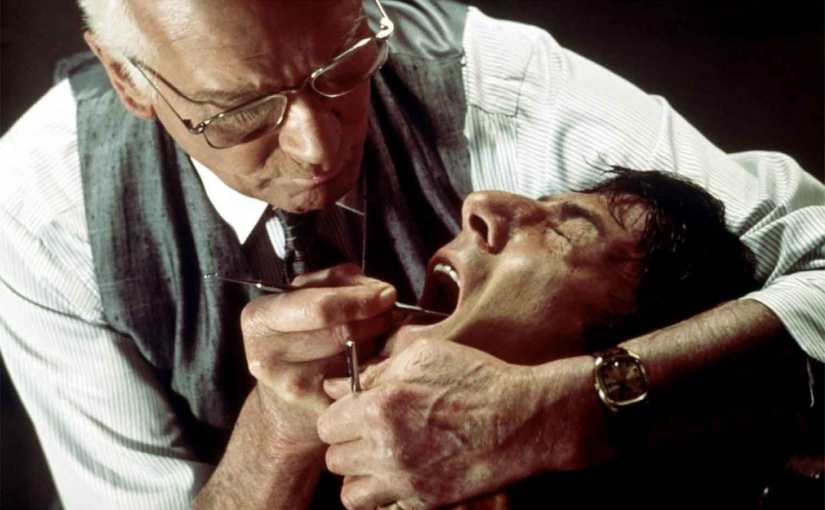
Laurence Olivier is a mysterious elderly man who has arrived in New York, eventually coming face to face with Hoffman. Thus, leading to one of the most uncomfortable torture scenes in film history.  Cancel any upcoming dental appointments that are scheduled soon after watching Marathon Man.  You’ll thank me for it.

The set up and players are eventually explained, albeit at breakneck speed when the tension is very high.  Put it this way. It’s a challenge to sum up exposition when it’s being dictated in a high-speed car chase.  So, on the first viewing, you might miss a few details here and there.  Nevertheless, I knew who the good guys were, I knew who the bad guys were and simply hearing the word “Nazi” in any given line of dialogue is enough for me to know how sinister this all is.

I can’t deny the ending feels a little hokey as it takes place in a Central Park reservoir system with platform stairwells and waterfalls all around.  Yet the tension remains as a young Dustin Hoffman (a hot commodity of 1970s actors) pairs up with the legendary performer, Laurence Olivier.  As I came to understand, Olivier was suffering from a terrible cancer diagnosis while making this picture.  Unbelievably, he never shows his illness, as his performance is electric with a well-deserved Oscar nomination.  Hoffman was striving for method by exhausting himself personally.  I know about the legendary story where Olivier suggested he simply “try acting.”  Hoffman later clarified that conversation and explained it had more to do with a personal divorce he was going through and late night drinking at Studio 54.  Whatever!!!  The ailments these great actors were experiencing at the time lends perfectly to the paranoia. 

I try to avoid movie trailers these days.  They give away much too much.  I had not seen one trailer or commercial for Marathon Man, prior to experiencing it for myself.  All I was aware of was the infamous dental torture scene with the famous line “Is it safe?”  Out of context, I found it to give me goosebumps.  Within the framework of the film, it’s utterly disturbing and it only heightens the suspense that Schlesinger and Goldman were striving for. 

MAD MAX

By Marc S. Sanders

What is the fascination with George Miller’s original 1979 film, Mad Max?  I don’t get it.  I know this film shot in the Australian outback was made a on budget less valuable than even a shoestring.  The fast-paced camera shots of cars careening down long stretches of highway are high octane (pun, most certainly intended) and the crashes are completely in your face.  Yet, I need more than this. 

When the film pauses for albeit very brief moments of storytelling such as a motorcycle gang apparently out for revenge against dystopian future cop Max (Mel Gibson’s breakout role), how is this ever even learned among the characters?  When Max opts to resign from the police force and take his wife and young son on holiday, how does this motorcycle gang led by a savage named The Toecutter (great name) catch up with them, and then after a narrow escape, how do they catch up yet again with one another, while making a sudden appearance on the back of these noisy motorcycles?  Miller’s film never goes from A to B to C.  Rather it goes from W to S to Q and then Z.  It’s a mixed up mess.

I’m all for throwing logic out the window when watching a thrilling action piece…if it’s thrilling.  When it’s not, well then, I’m asking for the logic.  Miller’s film feels like a bunch of want ads cut out of old newspapers, and then scotch taped together into a film reel.  I’d be curious to see an original script.  I can only imagine it being no more than three pages long. 

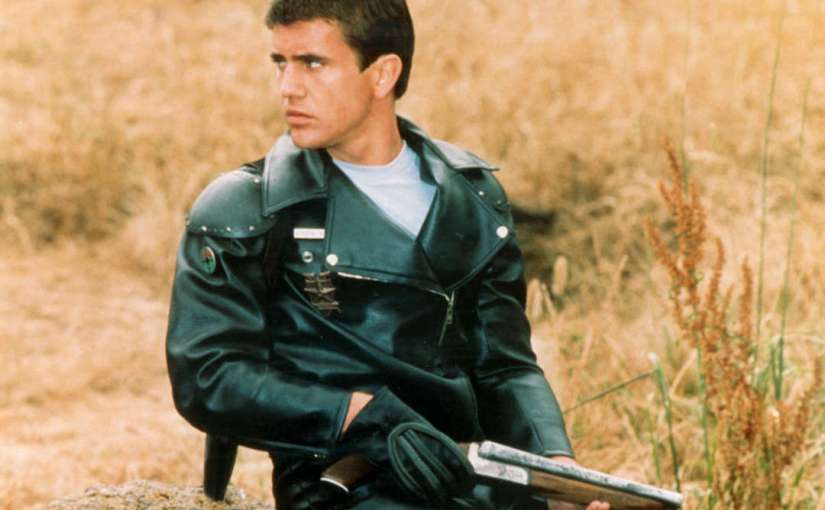
The appeal in 1979 and the years thereafter when the Max character blossomed into a franchise must have come from Gibson on film.  Yes, the stunts in this film with quick edit action pieces are daring.  I still think so forty years later.  This wasn’t CGI after all.  This was all the crunched up metal, rubber tires and flames that Miller could muster.  Still, the one artistic achievement had to be Mel Gibson’s image.  He wears the costume well.  A blue t-shirt enhancing his blue eyes under all black leather with a sawed off shotgun in his right hand while driving a souped up black Pursuit Special automobile with the engine sticking out of the hood.  Just writing that out reminds me of how iconic that image is, and this is before the similar looking Terminator that came along a few years later. Still, that’s where George Miller’s inventiveness stops. 

There is nary a character to consider.  The villains are nothing more than leather clad with bleached hair and dark mascara under the eyes riding Kawasaki bikes.  I know this was made with next to no money.  These guys don’t have to look like Darth Vader, but could they at least offer up something interesting to say?  Max has a couple of partners in the police squad.  They have no camaraderie.  One of them gets burned to a crisp.  Max takes a look at him in the hospital.  Why should I care though?  It’s not like I saw these guys share a Coke together.  Max is married.  They lie side by side each other in bed and their toddler sits on the floor nearby.  So?  Anything else?  Could one of them start a pillow fight or kiss or something, please?  A shoestring budget can still allow relationships to happen.  Miller doesn’t care about that though.  John Woo may show a nonstop bloodbath in any of his films with next to no story.  His films can work however, because he won’t get sidetracked with showing two people in their bedroom doing nothing.  He’ll remain focused on the mayhem.  Miller is not doing that here.  He shows a house with a bedroom.  Yet he doesn’t show the story in that bedroom that’s in that house.  That’s the difference.

I know the subsequent films in the franchise vastly improve upon the original Mad Max.  I’m just amazed they ever saw the light of day.  I’m more amazed that this became one of the most profitable films in worldwide history.  How did 1979’s Mad Max have the legs…no…the wheels…to maintain this ongoing velocity of interest?  What do I know?  I guess I’m a Debbie Downer for wanting people to talk to one another before handcuffing them to a gas guzzling fiery wreckage.  Is it too much to ask for a little sensitivity?