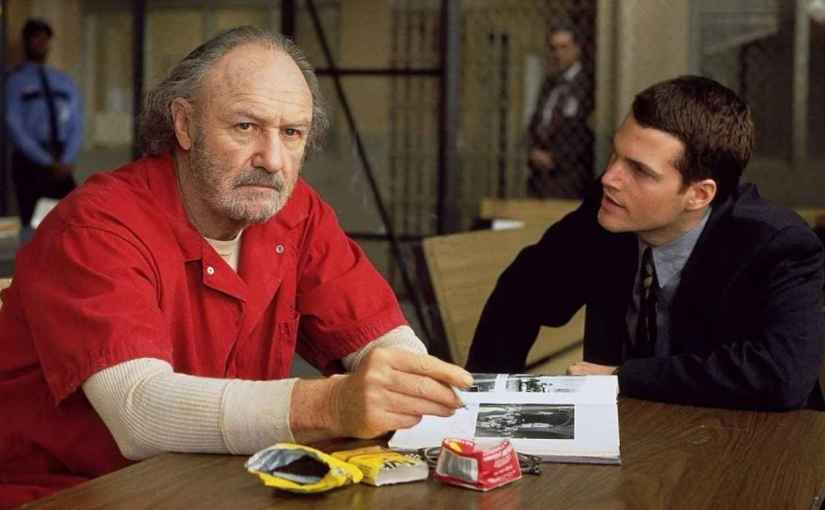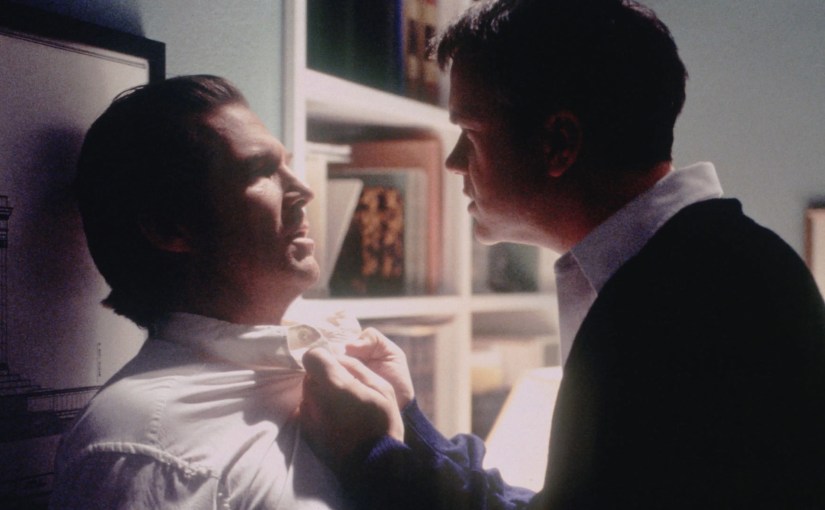
WALL STREET

By Marc S. Sanders

Oliver Stone is a very good director at providing the evidence of cynicism within the worlds he films.  JFK covered a clandestine, conspiring environment oozing out of the columns of government.  Platoon not only depicted the horrors of war, but also the cancer that poisons the mentality of soldiers expected to protect one another.  Wall Street explores the temptations to cheat the stock market for grand prizes in wealth.  Gordon Gekko is the 1980s tycoon who never knows the meaning of enough.

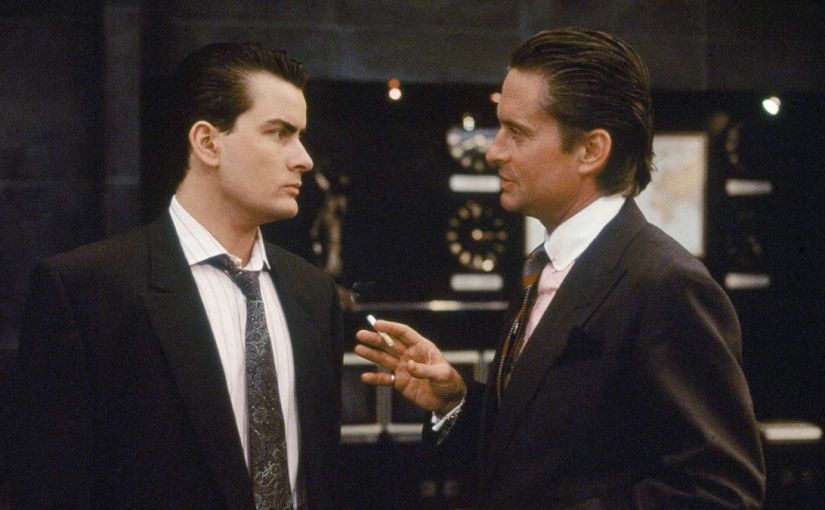
The well-dressed yuppie lizard, Gordon Gekko, is memorably played by Michael Douglas in his only Oscar winning role; regarded as one of the most villainous characters of the last fifty years.  It’s not a modest part, and Douglas’ performance is therefore electrifying.  With slicked back hair, the signature crackle of a voice inherited by his father Kirk, and the newest 80s innovation, a brick size cellular phone, the power to earn money and crush corporate enemies is done with ease.  Gekko relies on obtaining inside information (a federal crime) to find the next chest of treasures.  It might be an illegal practice but the best of the best at making mountains of money do it, and if you keep your process on the down low, nobody will catch wind of what you’re up to.  Gordon Gekko is an absolute genius, and he’s awarded a script of fast talking, slick monologues that justify his sins.

Bud Fox (Charlie Sheen) is the kid on the ground, way below Gordon’s high-rise office, desperately trying to get five minutes with the guy.  A whole day’s wait in the lobby and a birthday gift of Cuban cigars does the trick.  Now the lizard has the fox ensnared in his money-making schemes of deception and pursuits for unlimited greed.

Oliver Stone writes Sheen’s character as virginal when it comes to stock trading.  The kid is dying to get laid with the big boys while getting away from the cold calling hang ups of promising uncertain futures in stocks and bonds.  A subtle and effective angle is to give Bud a mentor.  Hal Holbrook enters the screen from left or right on many occasions to put his hand on Bud’s shoulder and give him his own twist of Confucius philosophy.  Then he exits out of frame towards the opposite direction he enters, leaving Bud to follow the questionable paths that Gordon paves.  Holbrook’s contribution to Wall Street has never been celebrated enough over the years.

Michael Douglas and Charlie Sheen are an outstanding pair of devilish mentorship against innocence lost.  Gekko preaches his passion for wealth on top of more wealth and why nothing should stand in his way, especially the law or the cost of others’ livelihoods.  Bud Fox emulates him as a master of the universe.  Charlie Sheen is great at being the biggest fan in Michael Douglas’ concerts of monologues. Watch how Sheen listens when Douglas has the floor. 

Martin Sheen extends his paternal role to Charlie within Stone’s film.  As Gordon sets designs on taking stock ownership of the small airline company that the father works for, the father/son relationship is tested, and Bud becomes blurred between what is right and wrong.  The Sheens have good debates and heightened dramatic moments.  I wish they were given more to do together though.  Perhaps even showing the wedge of the mother role within this family.

Additionally, Oliver Stone writes dynamics for Bud in a worker relationship with a fellow trader colleague (John C McGinley). There’s a former college pal/now lawyer (James Spader) that Bud tries to squeeze at the behest of Gordon’s demands.  Bud is also covered doing his own tricks of the trade such as dressing as a janitor to dig for what’s forbidden.

Why bring up all of these storylines?  Well, there’s a wealth of great material in Wall Street that’s relevant to the practice of insider trading and corporate overhaul.  Somehow though, Oliver Stone is responsible for writing one of the most unnecessary characters in film history.

Daryl Hannah just had to be cast as the buxom blond love interest for Bud Fox.  She’s never believable as a New York City interior designer and the chemistry between Hannah and Sheen is as thin as water.  Her name is Darien (a 1980s name) and one scene between Michael Douglas and her bustling the streets of Manhattan goes nowhere.  Wall Street is simply not the superb film it could have been because of the amount of time devoted to Daryl Hannah’s character.  Every moment she occupies is cutting room floor material.  When Darien exits the picture she’s never mentioned again.  The history she has with Gordon is never revealed to Bud.  Regrettably, it’s all meaningless.

What’s frustrating with Wall Street is its promise is never fully committed.  The roles awarded to Spader, McGinley, Holbrook and even Saul Rubinek in an early role as Gordon’s nerdy lawyer could have been even more fleshed out in lieu of what is covered with Daryl Hannah’s part.  More moments with Martin and Charlie Sheen would have better served the film.  A competitor tycoon played by Terence Stamp is very interesting and worthy of a larger presence.  Sadly, I imagine a studio producer or even Stone insisted on having a love interest that serves no purpose here except to put a glamorous actress above the title in the credits.  

Nonetheless, Oliver Stone built an authenticity to the hysteria of stock trading and corporate underhandedness.  When he shoots the scenes occupied by Bud and Gordon, he does handheld shaky camera work to emulate that nothing feels sturdy and balanced.  In moments that Bud’s father is at the center, the director shoots with a locked in position, bearing the character’s assured apprehension to trust his son or this prophet of greed.

I especially like the scene where Michael Douglas delivers his famous “Greed…is good!” speech at a shareholders’ annual meeting.  Stone glosses over all the company vice presidents and officers as well as the fat cat suits who carry stakes in the company.  Yet, the filmmaker also takes the time to show that little old lady with the pocketbook who finds her entitled seat to see how the value of her small ownership share is being treated.  Remember, if you own stock like Disney or IBM, you get that invitation in the mail to attend these meetings, and you have just as much a right to attend as all the Gordon Gekkos of the world.

Wall Street serves an important reflection of 1980s capitalism, while taking place in 1985, two years ahead of the infamous market crash of 1987 (the year the film was released).  Guys like Bud Fox had the Charlie Sheen image. Boyish men who got rich quick with little imagination to create and build.  They stood next to tall wealth and learned, but they never gained the knowledge to prepare for quick falls and disheartening sacrifice.  Most importantly, they took their own sense of morale for granted.  These are the best parts of Wall Street.

F1

By Marc S. Sanders

Miguel and I are the two unpaid movie critics who find ways to entertain ourselves beyond the IMAX picture on the screen.  By now, I know when Nicole Kidman is arriving and I start her off by saying out loud “We come to this place…”. Mig turns his head down in sarcastic annoyance.  We applaud at the return of Jaws in theaters this August.  There’s a rhythm we chemically thrive on.

Thirty minutes after a series of trailers plus an unwanted Allstate commercial (Thanks a lot AMC), the film begins, and the personal hand gestures begin.  Excuse me a moment.  I must pause for a moment.  (a-hem!) 

GET YOUR MINDS OUT OF THE GUTTERS!!!  

Now, where were we?  

Oh yes…

During the running time of Brad Pitt’s racing movie, F1, there were animated fist pumps (“Yeah!  Alright!!”).  There was rhythmic poking in and out of my right index finger jamming into my left thumb and forefinger (“Brad is about to get it on with Kate, the staple romantic interest, played by Kerrie Condon”).  A palm up facing twirl of the wrist (“Of course.” “Naturally!”). There’s the muted gasp pat on Miguel’s arm (“Is it?” “Could it be?” “Don’t tell me!” “Brad is fully recovered and walking through the steam cloud to pilot his race car?” “Again?”  “For one last time?”).  F1 covers all the expected beats.  

Frankly, I am not aware of too many racing films.  Days Of Thunder with Tom Cruise, of course.  Ron Howard did an engaging piece called Rush.  Ford Vs Ferrari works better as a bio than just a racing movie.  Pixar has its series of cute films. Still, just like the new Jurassic World picture, and I’m sure the latest Superman iteration arriving later this week, F1 is all too familiar like any kind of sports movie or Top Gun on the track Jerry Bruckheimer pic.

Tom Cruise—I mean Brad Pitt—is legendary stock car racer Sonny Hayes, a middle aged, washed up and broke recovering gambler desperately invited by his friend and former teammate Gabriel (Javier Bardem) to rescue his racing team from going belly up and leaving him hundreds of millions of dollars in debt.  Gabriel already has a cocky, promising driver named Joshua enlisted. He is performed very well with a lot of appeal by Damson Idris.  However, the young man does not have focus yet and lives for his social media likes and attention.  It’s up to Sonny to make the Formula One racing squad look like a contender while reigning in Joshua who can’t let go of personal conceit and a jealous animosity.

Kerry Condon is the engineering designer of Sonny and Joshua’s racing vehicles.  With each race, Kate trouble shoots what needs improvement and what can advance the drivers’ rankings.  Too bad she can’t fully invest her expertise as F1 demands she flirts with Sonny.  (Cue my right index finger while Miguel is ready to brush it away.)

The most impressive moments from Joseph Kosinski’s (Top Gun: Maverick) film are the racing scenes.  You are seeing both Pitt and Idris tucked within the snug cockpits of these low to the ground speedster machines.  The editing is superbly matched with the roaring sound and a pulsing soundtrack from another Hans Zimmer masterpiece.  

My one issue is the final cuts of the various races lacked overhead shots.  I would have liked to have seen moments from above where I could follow when the race cars pull in and out of a pit stop for example and stay on pace with unnamed competitors.  Kosinski gives an overabundance of close-up shots of the actors in the cars but not as much outside of the vehicles.  It’s all very exciting though, and when a film opens with revving engines playing in tandem with Led Zeppelin’s Whole Lotta Love, well you have me hooked.

F1 is like another exciting amusement park ride that you’ve experienced a hundred times before.  In between the races, while there are well drawn characters played by good actors, there’s ho hum filling material that keeps this speedy ride going about a half hour to forty-five minutes too long.  The guys have to argue.  They have to lose the race.  They each have to crash their cars.  They have to be tricked into getting along.  There also has to be a traitor among the ranks.  There has to be sequences of music overplaying a series of different races and the voiceover commentators chiming in with standard fare like “…and here comes Sonny Hayes from behind…” As well, Pitt and Condon have to get it on.  She has to tell him she doesn’t get romantically involved with racers before they hump each other’s brains out (Cue the index finger!).  

Sonny also has to be told he’s finished, before emerging from that humid, sunlit steam cloud where Joshua and the pit crew slowly raise their sunglasses and drop their jaws, upon his return. (Cue the muted gasp, followed by my twentieth fist pump.)

Look, F1 is entertaining.  It’s well made.  It’s got great action with impressive direction and an enthusiastic cast.  Still, I’m tired of this more of the same.  I alluded to my same feelings yesterday with Jurassic World: Rebirth.  It’s all the same flavor and these iterations are not daring enough to take big risks or surprises with what they offer.  Consider Avengers: Infinity War and Endgame.  Those films were expected to play by the same beats and yet there were some shocks to come through.  Look at what happened with The Empire Strikes Back.  Anyone see those surprises when first encountered?  The stakes were always surprisingly high, and the heroes were getting personally affected, not just episodically, but permanently.  

Blockbusters need not be so cookie cutter all of the time, but that’s exactly what is happening.  I already know the outcome of the upcoming Fantastic Four movie.  It could not be more apparent and unimaginative.  

I watched Companion which just hit HBO MAX earlier this month and in ninety minutes, that bloody delicious film diverts in so many different directions with a bare minimum setting and a small cast.  It’s as bloody as most thriller movies we’ve seen but an applied script turns on its axis over and over again.

On an IMAX screen, F1 especially delivers. Yet, while I’m absorbing well staged cuts of movie made racing footage, my mind is turning into comatose mush and the only thing that keeps it electrified is to acknowledge the standard beats.  

Declaring “Gentlemen, START YOUR ENGINES!” will not hold my attention for 200 laps.

Do it with me now:

Fist pump!

Finger fuck!

Muted gasp!

The Of Course!

Now you know the drill! Hit the gas!!! Turn up the volume and let Robert Plant remind you that You need coolin’/Baby I’m not foolin’

A PLACE IN THE SUN (1951)

by Miguel E. Rodriguez

DIRECTOR: George Stevens
CAST: Montgomery Clift, Elizabeth Taylor, Shelley Winters, Raymond Burr
MY RATING: 9/10
ROTTEN TOMATOMETER: 82% Fresh

PLOT: A struggling young man gets a job working for his rich uncle and ends up falling in love with two women, one rich and one poor.


I first saw A Place in the Sun many moons ago at a friend’s house.  I remember enjoying it but thinking it was too soapy for my taste.  Years went by.  I finally got around to watching Woody Allen’s Match Point and was stunned at how much Allen’s film borrowed from George Stevens’ celebrated melodrama.  Having just re-watched A Place in the Sun, my opinion of it has warmed considerably, without diminishing my admiration for Match Point, which remains one of my favorite films of all time.

A Place in the Sun tells the story of young George Eastman, played by Montgomery Clift at or near the height of his powers.  He’s a bit of a layabout who wrangles a job at his rich uncle’s swimsuit factory.  When George meets his rich relatives, I was reminded of a George Gobel quip: “Did you ever get the feeling that the world was a tuxedo and you were a pair of brown shoes?”  That’s George Eastman to a T, a ne’er-do-well in a sea of the well-to-do.

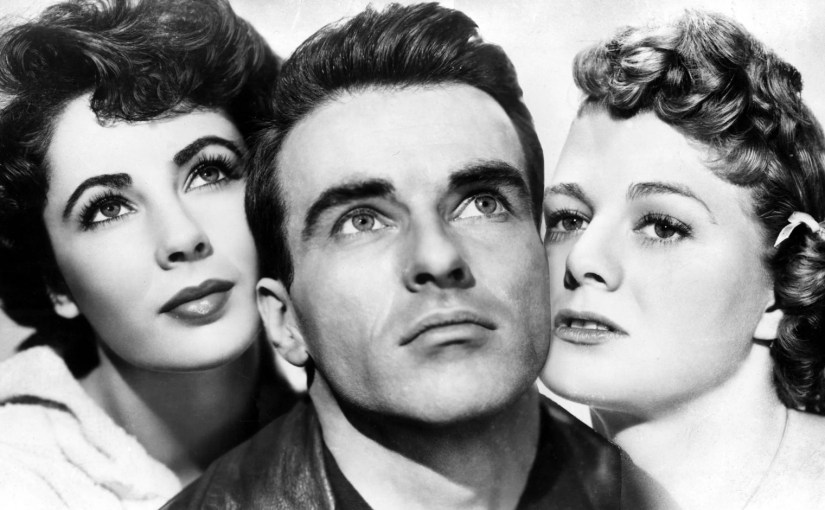
Against company policy, George falls in love (or at least in lust) with a rather plain girl, Alice, played by Shelley Winters in a de-glamorized role that went completely against type at that point in her career, winning her a Best Actress nomination.  Alice and George flirt and hold hands and occasionally neck (mildly scandalous for a 1951 film), but George can’t help but stare at another girl who pops up occasionally: Angela Vickers.  Angela is played by a ravishing Elizabeth Taylor, who was only 17 at the time of filming and empirically one of the most beautiful women in Hollywood, if not the world.  It’s not too hard to imagine any man, let alone poor George Eastman, falling in love with her instantly.

But George is still connected to Alice, especially because he’s already slept with her.  When George learns Alice is pregnant, he despairs because he had been planning to end things with Alice to pursue Angela.  Alice even visits a doctor who might possibly provide an abortion.  Of course, this being 1951, “abortion” is never mentioned out loud, nor is the word “pregnant.”  But Alice’s visit to the doctor is handled with incredible intelligence and brilliant screenwriting that manages to say everything it needs to say without ever uttering those forbidden words.

The rest of the film examines what George may or may not be willing to do for the sake of his love for Angela, who loves him back, it turns out…but she doesn’t know about Alice.  Since this is based on a then-famous novel called An American Tragedy (by Theodore Dreiser), it may not be too hard to divine what is in store for George before the final credits roll, but getting there is the fun part.  By casting heartthrobs as the hero/anti-hero and the rich girl he loves, the film cleverly gets us to root for them a little bit, even when George is considering murder.

While Elizabeth Taylor dominates every scene she’s in just by standing there, the Academy made sure Shelley Winters was recognized for her incredibly difficult performance as Alice.  There are some movies where, if a character is an emotional yo-yo, it can be frustrating.  With Alice, Winters never crossed a line into unlikability, even when she calls George at a fancy dinner party demanding he marry her tomorrow, “or else.”  It’s clear she has no options left to her if she wants to have any semblance of a life in polite society (by 1950s standards, anyway).  I felt bad for her.  But I also felt bad for George – to a degree – when he demonstrates how sincerely he has fallen head over heels for Angela.  Not just because she’s stunningly beautiful, but also because she really seems to have fallen for him, too.

Lately, my movie-watching itinerary of classic films has involved a fair share of outstanding melodramas (Leave Her to Heaven, 1945; The Heiress, 1949; Dodsworth, 1936).  A Place in the Sun fits right into that mold.  It doesn’t quite achieve the perfection of The Heiress, but it is a fantastic example of its genre, good enough for Woody Allen to “reimagine” its basic story for Match Point, so it’s definitely worth a look if you’re into that kind of thing.

SILKWOOD

By Marc S. Sanders

As the 1980s were setting its stride, Silkwood might have been one of the earliest in a line of films to focus on the union worker who fights back at the billion-dollar corporation.  Some might unfairly regard the movie as The China Syndrome, Part II. Other well-known pictures of this mold are even more familiar to me like Michael Mann’s The Insider.  However, director Mike Nichols, working with a first screenwriting effort from Nora Ephron who partnered with Alice Arlen, showcases the aggravation on not just Karen Silkwood, the real life potential whistleblower, but also her friends and co-workers in a one factory town just outside of Oklahoma City.

Karen (Meryl Streep) lives with her boyfriend Drew (Kurt Russell) and her best friend Dolly (Cher) in a run-down house in the middle of nowhere.  They ride to work together at the local plutonium manufacturing plant where they dress in scrubs and gloves. Punch in, punch out kind of days, and often they are expected to work double shifts and weekends.  Karen works an assembly line where she places her hands in rubber gloves and assembles dangerous combinations of chemicals in an enclosed box.  It’s also routine that before you leave your station you wave your hands over a sensor to ensure you have not been exposed to radiation.  There’s even sensors you walk through as you enter and leave the plant.  When those sensors go off, a calm kind of film seemingly turns into a horror movie.  The last thing anyone could ever want is to get “cooked.”

Karen does not live a perfect life.  Her three kids reside with their uncompromising father in Texas.  Money is not ideal.  Dolly is a slob and has also invited her girlfriend to live with them.  Karen can manage with all of this, but when she observes some unconventional activities around the factory she gets up the nerve to head the union for better protection and working conditions.  However, the further she goes looking at files and photos, jotting down notes of what people say and do, plus taking trips to Washington DC, and getting phone calls from attorneys at night, she becomes more and more isolated from Dolly and Drew, along with the rest of her close-knit workers.  Karen is not just risking her job, but everyone else’s jobs and worse her own life.

The attorneys lay it out to the townsfolk and the union of the horrifying statistics that go along with radiation exposure.  The tiniest fraction of a miniscule of exposure to the smallest crumb of chemicals could increase a human’s bearable limit towards radiation and cancer.  The sad irony is that the more that is learned, the more the people of this area smoke and smoke some more.  Granted, this story takes place in the early 1970s, though.    

The company is primarily represented by an intimidating Bruce McGill.  He’s great in everything he does and is worthy of an Oscar nomination somewhere.  M Emmet Walsh has no lines but his presence is enough to shake you; the slimy guy you easily recognize from every other movie you have seen.  While the company’s overbearing intrusion is shown plenty, the script for Silkwood focuses more on how these working people get by.  They are treated unfairly and in dangerous working conditions, but they also know this is the only place that offers steady income in the area.  Without this factory, the whole town would be left in dire straits.  Karen is repeatedly told or implied to leave well enough alone.

Meryl Streep notches another harrowing performance on her resume and bears such a departure from more sophisticated characters found in Sophie’s Choice and Kramer Vs Kramer.  Karen Silkwood is not educated and she bears an unmistakable white trash dialect but she’s also not stupid and the more progress she makes at exposing the plant’s shortcomings the more unfairly she is treated with department transfers and workplace shake ups that she is indirectly blamed for.  Potential threats on her life begin to build, but she only upholds a bravery.  You really observe the strength of Meryl Streep.  She’s at the top of an elite class of actresses at this time that also included Sally Field, Jessica Lange and Glenn Close.

Cher plays Dolly in her first on screen role.  The variety act performer probably subjected herself to a bigger departure than Streep.  She was not a professionally trained actress at the time.  Mike Nichols insisted on no makeup along with her hair unkept and flat, while dressed in green chino pants and baggy sweatshirts.  The new actress carries herself so well without the usual glitz that accompanies her.  Her scenes with Streep are workshops in acting technique. 

Kurt Russell delivers another understated performance.  One of the best actors out there who has never been enough of a critical darling.  Drew is likable and Kurt Russell plays him as a settled in match for Streep’s portrayal of Karen.  Watch how they tangle up in each other’s arms in bed or when he snaps at her as she carries on her crusade while he’d rather things be left alone.  His timing is perfect for the script.

Mike Nichols keeps his film calm, except when the go by the numbers narrative must be disturbed.  A radiation cleanse with high pressure hoses will make you wince.  The factory alarms will terrify you.  Meryl Streep accepts the physical taxations necessary for this setting.  Nichols gets in close with his camera to show how cleansers dressed in scrubs and masks rub Streep down until her skin is a burning red.  I distinctly remember how her right ear appears in this scene, getting flushed by something just short of a fire hose, and the aftermath of her sitting in a chair is so discomforting while a company doctor assures her that there’s not much to worry about as long she brings in her urine samples daily.  In fact, soon all of the employees are tasked with delivering their urine samples.  What kind of place is this?

While Silkwood is based on a true story with a burning question left behind, I do not want to reveal too much.  Many have seen Silkwood since it was released over forty years ago, but as the third act begins, the fallout only becomes more disturbing and Mike Nichols directs a horrifying sequence built primarily on the pealing of old wallpaper.  That’s all I want to suggest. 

Karen Silkwood was a very unlikely crusader.  She probably never envisioned what she would become and what she would fight for.  Yet, she uncovered horrible truths that should not have been occurring under the eye of billion-dollar corporate America.  After watching Silkwood, I can only imagine what else was there to turn over.

NOTE: Another good reason to watch Silkwood is to discover early performances from some amazing character actors who were either just starting their careers or continuing to hide in the crowd. 

Scavenger hunt for Anthony Heald, James Rebhorn, David Strathairn, Ron Silver, Fred Ward, Diana Scarwid, Bill Cobbs, M Emmet Walsh, Craig T Nelson, Tess Harper, Will Patton, Richard Hamilton and Josef Sommer.

LETTERS FROM IWO JIMA

By Marc S. Sanders

The companion piece to Clint Eastwood’s World War II film, Flags Of Our Fathers, and shot back-to-back, is Letters From Iwo Jima.  It’s not so much a war film as it’s a perspective of a losing battle during the height of the war, shown through the eyes of Japanese soldiers bearing little ammunition, food, and supplies while being plagued with dysentery and starvation. 

Right from the start, what I found interesting is how similar the Japanese mentality is to that of American soldier characters I’m all too familiar within other cinematic retellings. Paul Haggis recruited Iris Yamashita to write the screenplay, entirely in English, and then translated into Japanese.  The subtitles seem to read with a familiar English vernacular that my limited knowledge of Japanese culture would never expect.  I also find it interesting that rankings are the same from General to Lieutenant for example, and the salute to officers is precisely identical.  All of these similarities, and still the world powers find reason to fight one another.

The running theme of the picture reminded me of the television show M*A*S*H.  An assortment of characters take the time to write home about their experiences and fears along with the hardships they are enduring with unpure water, sweltering heat, infectious bugs and exhaustion.  One soldier’s letters are told will get censored if they ever reach the mother land.  These men are bakers and scholars, forced to serve a power that controls them.  They are not spies or regular army men.  They had no choice but to be here digging and preparing to kill.

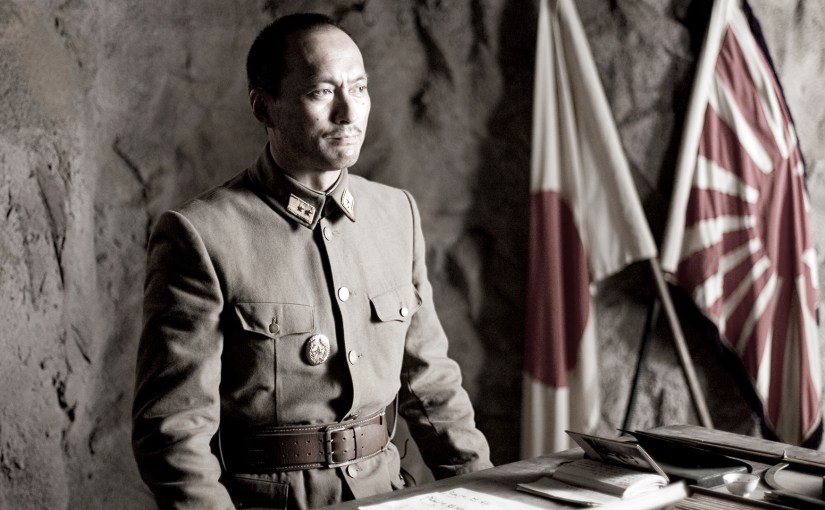
Ken Watanabe portrays General Kuribayashi.  In the beginning of the film, he is writing a letter to his wife as he is landing on the island days ahead of the battle to come.  One of his biggest concerns is that he did not finish installing the kitchen floor in his home before leaving. Kuribayashi is a celebrated strategist and hero, who actually studied and worked abroad in the United States.  He even broke bread with famed American military leaders and carries a valuable gift from them in his holster.  Yet, he is committed to his country’s Imperial Army and he knows he will not return home from this island.  He also knows that he will have to kill the very same men that he shared a meal with just a few years earlier. That kitchen floor is what is on his mind. 

A young infantryman named Saigô (Kazunari Ninomiya) was forced to enlist while his loving wife is carrying their child.  I’ve seen character situations like these before.  It’s much more revealing to see what cinematic history has described as the enemy to my John Wayne and Clint Eastwood heroes, though.  Recently, I listened to The Cine-Philes podcast recap of the film Crimson Tide, and they focus heavily on the midway dinner scene among the officers.  Denzel Washington’s character concludes that “…the true enemy of war is…war itself.”  Letters From Iwo Jima delivers on that argument.

Ahead of the well-known battle, there’s a quiet tranquility among the Japanese troops.  They debate about digging trenches and even fighting on the island which is devoid of any stronghold or power.  It’s also an unwinnable battle as the Japanese have realized that they are getting no air or naval support because much of their military cavalries have already been decimated.  The ultimate purpose for these men is to hold off the Americans, who are ten times more powerful, for as long as possible.  No man serving the Imperials is to surrender.  They will fight until they are as good as dead.  General Kuribayashi’s best idea to hold out is to dig caves within the mountainsides, thus making it challenging for the American soldiers to locate Japanese within the darkness of the caverns.  It worked longer than it should have as the engagement that was expected to only last five days went as long as thirty-six days instead.

Disturbing moments within the film do not compromise.  A small unit’s unified shout of “BANZAI!” will live with you forever when you see what they jointly commit within the cave they occupy.  Eastwood convincingly shows you the carnage.  Another character recollects how he was enlisted for five days in the military before he was forced to serve at this miserable place for disobeying a direct order. His humanity undid him.  Letters From Iwo Jima tells the stories before the occurrences that left gravesites (estimated to be ten thousand Japanese men lost) on its black sand beaches.

In a way it makes me proud that Clint Eastwood chose to direct Letters From Iwo Jima.  While his war pictures (Where Eagles Dare, Kelly’s Heroes), and even his Dirty Harry films which lean on prejudice for the truth found in humor, are endlessly memorable, he opts to take a sensitive position to the other side of the coin.  Eastwood does not lose sight of the fact that his heroes celebrated during the first half of his career were heroically killing and taking out fellow humans.  Letters From Iwo Jima recognizes the loss of humanity amidst the rocket fires and artillery of violence.  Six Japanese men will take to killing a captured American by beating and stabbing him into lifelessness.  Later, faceless Americans concealed by the director’s familiar shadows of photography will point blank kill a pair of unarmed Japanese men. 

Flags Of Our Fathers points a critical eye at the celebrations of victory.  Letters From Iwo Jima acknowledges victory is beyond reach but the enemy of all of us, war, is never done with any of us.

BOBBY (2006)

By Marc S. Sanders

There’s the distinguished doorman who is retired now but returns each day to play chess with a colleague in the hotel lobby.  There’s the open-minded girl who is inspired to prevent a young man from getting drafted into the Vietnam War by marrying him.  Her hairdresser is married to the hotel manager, who happens to be having an affair with the beautiful switchboard operator.  As well, the dining manager is a bigot who will deny his Mexican employees enough time to leave work and exercise their right to vote.  A busboy will have no choice but to miss what will likely be Don Drysdale record breaking sixth shut out game in a row.  A drunken night club performer can hardly stand up straight while she is completely dismissive of her caring husband.  A wealthy man is ready to introduce his trophy wife to an eventful evening in modern politics.  Two young campaign workers sneak away to drop acid for the first time.  A black man is at a loss following the recent assassination of Dr. King. Though he has hope that at least Bobby Kennedy will uphold his faith for a promising future in America for African Americans to carry equal rights. 

So, what does any of this have to do with Robert F Kennedy?  Not much I’m afraid.  Writer/Director and star Emilio Estevez tells us that all of these stories occur in the Ambassador Hotel on the fateful night when the Senator was assassinated in the hotel kitchen by Sirhan Sirhan.  In Bobby, the only character that is not a character is Bobby Kennedy and that is unfortunate.  More to the point, all of these short stories and other characters are precisely boring.

Estevez committed himself to grinding out stories that occur in the Ambassador that would lead up to Kennedy’s tragic death.  He’s admitted that they are all fictional. Based on his research and photographs, these characters are very loosely inspired by those that were there that night.  Before gathering in the ballroom to hear Kennedy’s victory speech after winning the California primary, these people were going through own personal ordeals.  If Emilio Estevez was not so personally inspired and researched in Robert Kennedy’s purpose to American history and politics, then perhaps Arthur Hailey (Hotel, Airport) would have pieced together this script of anecdotes and vignettes.

I commend Estevez’ efforts here.  The film looks great and even though the Ambassador was being demolished at literally the same time as this film was being shot, the scenic designs are very authentic.  The cast is even more impressive as the director reunites with many co-stars that he’s worked with before including Demi Moore, Anthony Hopkins, Christian Slater and his real-life father Martin Sheen, a lifelong loyalist to the Kennedy family.  The “importance” of this movie seems to sell itself.  Yet, everything is incredibly mundane and of little interest.  When your cast and your characters are just items on a grocery list to check off, there’s not much that’s interesting beyond the coupons.

The juicy gossip that surrounds the real-life actors is more captivating. Estevez cast Ashton Kutcher (Demi Moore’s real-life husband at the time) to play the drug dealer who provides acid to the campaign workers (Shia LeBeouf, Brian Geraghty).  Moore is also Estevez’ ex-girlfriend.  Yet, to watch Kutcher, LeBeouf and Geraghty experience an acid trip with weird visions they see when they open a bedroom closet is unfunny and not captivating.  Emilio Estevez is not living up to the Coen Brothers (The Big Lebowski).

A tryst with the boss (William H Macy) and his young, attractive and naïve switchboard operator (Heather Graham) is nauseatingly hokey.  The aged wife who works in the hotel salon (Sharon Stone) turns it all into squeamish soap opera tripe.

Bobby has an alarming opening.  A false alarm fire call is wrapping up at the Ambassador Hotel and you may feel like you are entering the middle of a panic storm, but things quickly calm down and the film resorts to cookie cutter editing to introduce its all-star cast.  None of what they say matters.  This is a game of who you can recognize.  Joshua Jackson, Nick Cannon, Harry Belafonte, and eventually the guy with the most significant role, Laurence Fishburne, is given his moment, the best scene of the whole film.  Fishburne is the kitchen chef who allegorically uses his creations in cuisine to compare the black man’s experience to the brown man’s, or Mexican. 

Having finished a trip to Martha’s Vineyard, I wanted to show my wife the under-the-radar and captivating film, Chappaquiddick, which covers Ted Kennedy’s personal story of controversy.  (My review of that film is on this site.) To continue on the Kennedy parade, we were motivated to follow up with Bobby.  Yet, this picture offers very little to the significance of Senator Robert F Kennedy.  There are samples of news reports complete with Cronkite.  Plus, the Senator’s own words ring through the epilogue of the picture.  Yet, I felt cheated of learning nothing new about the historical figure. 

Reader, you may tell me to kick dirt and go find another movie or read a book.  Fair!  However, this is film is called Bobby, and if I’m not going to learn about Bobby Kennedy from the man himself, then allow me to get to know the man through the eyes of these individuals.  Who hates him?  Who loves him? Who has a crush on him?  Who is inspired by him?  Who wants him dead and why? 

Estevez’ script does not allow enough material to describe what Kennedy meant to these campaign workers or hotel workers or guests.  They are primarily self-absorbed in their own personal battles to think enough about the fact that Bobby Kennedy is expected to make an appearance later this evening.  Again, their personal concerns for each other is very dull.  I don’t want to be around a drunk and obnoxious Demi Moore.  I don’t want to drop acid with some guys who hide behind a façade for caring about the candidate they are supposed to be serving.  I feel sorry for the busboy who will miss that big game, but that’s not enough to get me engaged in the entirety of the picture.

Bobby lends very little to the confusing times of the late sixties when an unwinnable war was persisting and championed leaders were being killed for others’ agendas.  Any of these stories could have been yanked from this script and slotted into a disaster flick like The Poseidon Adventure or The Towering Inferno

Bobby only picks up momentum when it arrives at its end that many of us learned about in school or witnessed firsthand in documentaries or directly from that very sad and unfortunate evening, June 4, 1968.  This day in history is so much more important than a Helen Hunt character trying to convince her Martin Sheen husband to let her buy a new pair of black shoes.  Bobby Kennedy deserves more recognition than what Emilio Estevez offered.

THE SUGARLAND EXPRESS (1974)

by Miguel E. Rodriguez

DIRECTOR: Steven Spielberg
CAST: Goldie Hawn, Ben Johnson, Michael Sacks, William Atherton
MY RATING: 6/10
ROTTEN TOMATOMETER: 87% Certified Fresh

PLOT: A young wife breaks her husband out of prison in 1969 Texas so he can help reclaim their infant from a foster family.  The ensuing media circus takes everyone by surprise.


Watching Steven Spielberg’s The Sugarland Express is like looking at one of those historical medieval tapestries of fierce battles, created by artists who didn’t yet know how to depict perspective.  There is plenty of action on display, but everything looks and feels flat.  The film took an award at Cannes that year for Best Screenplay, probably (at least partly) in recognition of how it shies away from a traditional Hollywood resolution, but even its downbeat ending is reminiscent of earlier, more resonant films like Bonnie and Clyde [1967] or Butch Cassidy and the Sundance Kid [1969].  As a stepping stone in the career of an eventual legend, it’s worth a view.  As a stand-alone film, it never quite achieves liftoff.

Based on real events, The Sugarland Express tells the story of Lou Jean Poplin (Goldie Hawn at her irrepressible, bubbly best), the young wife of prison inmate Clovis Poplin (William Atherton).  During a conjugal visit, just four months before Clovis is to be released, Lou Jean boldly busts him out because she needs his help to reclaim their infant, Langston, from a foster home.  Lou Jean herself has just finished serving time at a women’s prison, and the state, probably very wisely, determined Langston was better off with a foster family.  But they need to hurry because “I bet those Methodists are gettin’ ready to move out of state.”  Lou Jean’s delivery of “Methodists” tells you all you need to know about her feelings on the matter.

After Lou Jean breaks him out, a comedy of errors ends up in a situation where she and Clovis have hijacked a police cruiser and are holding a police officer at gunpoint.  They demand to be left alone while they drive to Sugarland, Texas, and retrieve their son, at which point they’ll release their hostage.

Now, this has all the makings of a smart, character-driven “road” movie, instigated by desperate people with no real plans for their end-game.  But for reasons I can’t put a finger on, nothing ever happens in the film that got me on the edge of my seat, figuratively speaking.  I fully comprehended the situation intellectually, but the film never got to me at an emotional level.

Could it be because we never really learn a lot about Lou Jean and Clovis in order to make them more empathetic?  No, I don’t think so, because over the course of the film, we’ll hear all about their past histories and previous brushes with the law.  The very fact they’re executing this plan to essentially kidnap Langston is proof of how unfit they are as parents.

I think part of the problem with the movie is…

…I’ve been sitting here for the last fifteen minutes trying to finish that sentence.  I can report that the film didn’t get to me emotionally, but I am struggling to explain why.  Could it be as simple as I think they’re not such great people, but the film seems to be siding with them as the movie progresses?  I mean, the movie HAS to side with them at least partially in order to make their journey mean anything.  Look at Butch Cassidy and the Sundance Kid.  Bank robbers, lawbreakers, but clearly the good guys because, duh, Paul Newman and Robert Redford are playing them.

So, maybe it has to do with the casting?  The Sugarland Express had one of America’s sweethearts as a woman willing to resort to kidnapping just to commit another kidnapping in the name of maternal love.  So, we’ve gotta root for her, right?  But then we see her behaving in the most inane, brainless way for so much of the movie.  I found it difficult to side with her when I just wanted to, forgive the expression, slap some sense into her.

What about Clovis?  I could side with him.  He appears to have misgivings throughout the entire film, right up to the point of no return.  But the way he willingly goes along with the scheme because, dammit, it’s his wife…something about that also turned me off on him.  There are moments I felt sorry for him, for them both, because I could see where this movie was headed early on.  But that empathy wasn’t enough to make me feel a catharsis of tragic energy at the film’s finale.  There’s just something about Clovis and Lou Jean that wouldn’t allow me to get too worked up over their fate.

I guess I identified most with the kidnapped police officer, Slide (Michael Sacks).  Maybe too much.  From the beginning, Slide is begging them to drop their weapons and turn themselves over to the police.  At first, he looks like he’s just following his training.  But then the movie progresses, and doggone it, he starts to like these two loonies, even though Clovis handcuffs him and even shoots at him a couple of times in the heat of the moment.  He can see where this road ends, and he pleads with them not to do exactly what the Texas state troopers expect them to do, because he doesn’t want to see them dead.  Because Slide never stops imploring the Poplins to see sense and do the smart thing, I guess he’s who I sided with for the entire movie.  (Well, him and his superior, Captain Tanner [Ben Johnson], who also doesn’t want to see them die.)

But…isn’t that the wrong way to approach this movie?  I shouldn’t be siding with the cops, for cryin’ out loud, should I?  At least, not in this movie.  Discuss.

From a technical standpoint, it is pretty cool to see how Spielberg, in only his second film, was able to marshal vast resources to create some arresting imagery.  The sight of what looks like literally hundreds of cop cars following the Poplins is a deceptively difficult feat, logistically speaking.  There’s a tense shootout in a used car lot that would have been right at home in The French Connection.  And everywhere, there’s bits of humor that made me smile.  From the elderly couple abandoned on the road (long story) to the solution of how to get Lou Jean to a toilet while in the middle of an extended police chase, Spielberg constantly pokes us in the ribs.  If this had gotten to the hands of someone like John Landis, it’s easy to see how this could have been turned into an out-and-out comedy with thriller elements, instead of the other way around.

One other aspect I did like was the media circus that blew up around the Poplins’ plight.  I’m sure it is yet another link to previous anti-heroic films, but while I was watching it, I was reminded of only one film: Oliver Stone’s Natural Born Killers [1994].  The outpouring of affection from the general public for these two, let’s face it, outlaws was both funny and sobering at the same time.  It would have been interesting to see a scene or two at the end of the film as an epilogue, so we could get a reading on what the public thought about how the police should have handled the situation.

If comparing The Sugarland Express to most of Spielberg’s later films, it certainly comes up lacking, no question.  As a lifelong Spielberg fan, I am compelled to say it SHOULDN’T be compared to his later films because it was made before he’d had a chance to hone his skills and become the populist/mainstream film icon he is today.  Look carefully at the two-dimensional storytelling and you can see the outlines of what was coming around the bend for this modern-day master.

SHANE (1953)

by Miguel E. Rodriguez

DIRECTOR: George Stevens
CAST: Alan Ladd, Jean Arthur, Van Heflin, Brandon De Wilde, Jack Palance
MY RATING: 8/10
ROTTEN TOMATOMETER: 97% Fresh

PLOT: A drifter (who may or may not be a retired gunfighter) comes to the assistance of a homestead family terrorized by a wealthy cattleman and his hired gun.


Shane affords me the opportunity to use a word I never get to use in daily conversation: archetypal.  John Ford’s Stagecoach [1939] may be the granddaddy of the modern Western, but Shane taps into something even more primal.

Alan Ladd as Shane is the archetype of the mysterious stranger riding out of the mountains, either coming to the aid of a community who has lost hope (Pale Rider, 1985) or wreaking havoc as an avenging angel (High Plains Drifter, 1973), and then disappearing into the sunset or riding back into the distant mountains.  This formula was probably already old when Shane was made, and the film does little to dress it up or add any kind of pretentious spin to the story.  But by sticking to the formula and really nailing it home, director George Stevens achieved a weird kind of clarity that elevates Shane into a mythical realm.  If it’s not terribly realistic, well…who wants realism mixed in with their magic?  Not me.

Shane is set in the high plains of Wyoming in 1889.  (I don’t remember the exact year being mentioned in the film – I pulled it off IMDb – but we can tell it’s after the war because a running gag involves a harmonica player who always starts playing a Union song whenever a homesteader called Stonewall, who fought for the South, walks into a meeting.  It’s a mark of faith in the intelligence of the average viewer that the screenplay never comes out and explains that’s what’s happening; we just see it and have to put two and two together.  Nice.)

ANYWAY…it’s 1889, and a land baron named Rufus Ryker is trying to run homesteaders off some land that they rightfully own, but which is preventing Ryker from expanding his cattle ranch.  Among these homesteaders is Joe Starrett (Van Heflin); his wife, Marian (Jean Arthur); and his little boy, Joey (Brandon De Wilde, who earned an Oscar nomination for Best Supporting Actor, but don’t ask my opinion of his performance…just don’t).

One day, true to mythical form, a lone figure rides out of the mountains and up to Starrett’s patch of land.  He is improbably good looking, wears a fringed buckskin jacket, two ivory-handled revolvers, and identifies himself only as Shane.  After earning Starrett’s trust, he agrees to stay on as a hired hand and possibly help with the struggle against Ryker…

…and if you’ve been watching movies as long as I have, you could practically write your own screenplay for the rest of the film, because you’ve seen it before, many times.  The stranger proves his worth, defends his new friends, makes friends with the wife (but not TOO friendly), gets hero-worshipped by the little boy, and eventually runs them cattle barons plumb out of business.  But I’ve never seen it done quite like Shane.

For example, there’s a bar fight that ought to be in the Bar Fight Hall of Fame.  Shane, in what HAS to be a deliberate move to goad the bad guys into action, walks into a saloon filled with Ryker’s men to return a soda-pop bottle for the deposit.  A fight predictably breaks out, first one-on-one, then 1-on-2, then 3, then 4.  (Who does this guy think he is?  John Wick?)  The fight gets to a point when it’s winding down…then it picks right up again.  Then they get Shane on the ropes and start waling on him…until Starrett sees what’s happening, grabs an axe handle, and cracks it over someone’s head.  That may not sound like much in writing, but it’s pretty impressive visually, especially from a 1953 Western that feels at times like a Disney product.

(It almost feels like what Tarantino did with the fight between the Bride and the Crazy 88 in Kill Bill, Vol. 1 (2003).  George Stevens said, “Okay, these people want a bar fight?  I’ll give you a damn bar fight.”)

But while I was watching it, I started to analyze it a little bit.  Bar fights…seen one, seen a thousand.  But Shane felt to me like it was embracing the cliché, making friends with a trope, and in so doing the fight became a myth of a bar fight, a fever dream of itself.  It’s not just a bar fight.  It’s THE bar fight.

A lot of Shane works that way.  Shane isn’t just a mysterious stranger, he’s THE mysterious stranger.  An argument could be made for Eastwood’s “Man with No Name” as the archetype of this character, at least in the Western genre, but it’s clear that Eastwood took a lot of cues from Shane when writing and directing his own films.  I’m not suggesting that Eastwood plagiarized Shane.  I’m suggesting that Eastwood’s creations are infused with Shane’s DNA in all the best ways.  (I wouldn’t presume to speculate how much of Shane is in Sergio Leone’s spaghetti westerns starring Eastwood, though I would say those have more of Kurosawa in them than George Stevens.)

There are just two items that bugged me while watching Shane.  One, the editing was occasionally erratic, using a lot of fades or cuts to virtually empty frames in the middle of the action.  I don’t normally pick that kind of thing apart in a review, but it was glaringly apparent in a lot of places.

Two…the tragic waste of talent by casting Jean Arthur as Mrs. Starrett.  Jean Arthur is the fast-talking, quick-thinking actress who appeared in such classics as Mr. Deeds Goes to Town [1936], Mr. Smith Goes to Washington, and Only Angels Have Wings [both 1939].  She goes (or OUGHT to go) on the list of intelligent female actors like Katharine Hepburn and Rosalind Russell.  By 1953, she was semi-retired and only appeared in Shane as a favor to her friend, director George Stevens.  When I saw her name in the credits, I had visions of her delivering fiery speeches, shaming and out-thinking the menfolk, declaring her admiration for Shane without exactly laying out her TRUE feelings for him, and so on.  Instead, she is reduced to spending the majority of her screen time fretting over her husband’s safety, casting loaded glances at Shane while her husband isn’t around, baking pies, and reading bedtime stories to Joey.  I know I just got done writing about how the movie embraces clichés and becomes mythological, and there’s nothing more clichéd than the “little woman” supporting her husband, etc., but something about her role just rubbed me the wrong way.  After this film, Arthur retired from film completely, and although Shane was a massive popular and critical hit, I can’t help but wish she had been given more to do in her last film.

By the time Shane reaches its famous finale (“Shaaane!  Come baaack!”), justice has been meted out and the little guys have won…all is right with the world.  Echoes of Shane still linger today, because who doesn’t like a good old-fashioned bad-guy beatdown, administered by the archetypal mysterious stranger?  This may not be my favorite Western of all time, but from now on, whenever I do watch my favorite Westerns, I’ll keep an eye out for Shane’s shadow, looming large over all who came after it.

TO CATCH A THIEF (1955)

by Miguel E. Rodriguez

DIRECTOR: Alfred Hitchcock
CAST: Cary Grant, Grace Kelly, Jessie Royce Landis, John Williams [no, not THAT John Williams]
MY RATING: 7/10
ROTTEN TOMATOMETER: 93% Certified Fresh

PLOT: A retired jewel thief in the French Riviera sets out to prove his innocence after being suspected of returning to his former occupation.


Alfred Hitchcock’s To Catch a Thief is somewhat of a paradox.  It contains all the hallmarks of the master’s touch during what was arguably his most fruitful decade of work: exotic location shoots, a breathless romance, sly comedy, daring innuendo, and, of course, a vivacious blonde.  But there is little to no suspense.  There’s an intriguing mystery that admittedly left me guessing until almost the very end, but I never felt invested in the hero’s predicament.  I cared way more about L.B. Jefferies [Rear Window] or Roger O. Thornhill [North by Northwest] or even “Scottie” Ferguson [Vertigo] than I did for John Robie.

The story opens right away with a typical Hitchcock wink-and-nod.  The camera pushes in to an inviting travel brochure for the south of France, then there’s an immediate smash cut to a woman screaming.  Is she being murdered?!  This is a Hitchcock movie, after all!  No, she’s distraught because someone has stolen her precious jewelry.  There has been a rash of burglaries, in fact, perpetrated by a shadowy, unseen figure whom French authorities believe is none other than the infamous John Robie (Cary Grant), aka “The Cat.”  But Robie has retired comfortably to a stunning villa and claims he’s innocent of this new string of daring crimes.  To clear his name, he must do what the police can’t: identify and capture the burglar himself.

There’s a subplot about how Robie was involved in the French Resistance during the war, but his former comrades, who now all work at the same restaurant (!), are distrustful of him.  I was never quite clear on why.  Something about how the law could catch up to them if Robie was ever arrested?  But if they were Resistance, why would they be considered criminals?  Did they help him with his previous string of burglaries?  The screenplay is not 100% clear on this, unless my attention wandered at some point.

Anyway, in the course of Robie’s investigation, he meets (by chance?) the stunning Frances Stevens, played by the inimitable Grace Kelly in one of her three films for Hitchcock.  At first, she is aloof towards Robie, but when he escorts her to her hotel room after rebuffing him all night, she boldly plants a firm kiss on his lips before closing the door on him.  Not only that, she reveals the next day she knows exactly who Robie is and practically dares him to steal the fabulous diamond necklace she’s wearing.

While Frances is certainly no shrinking violet, her attitude and character felt…forced.  The screenplay explains (in a roundabout way) that she is a bit of a thrill-seeker, so she’s getting her kicks by tweaking a known criminal.  Okay, fair enough, I guess, but later in the film, she abruptly declares she’s in love with Robie, almost out of the blue.  This and other incidents, too numerous to mention, had me thinking that the new burglar was actually…Frances herself?  Watch the movie and tell me I’m wrong for thinking that way.  She throws herself at him in a male-fantasy kind of way because, duh, it’s a Hitchcock movie, but this aspect kept me locked in to my theory of her as the burglar, because what other motive could she possibly have?

Without giving TOO much away, let it be said that the mystery of the new burglar’s identity is cleverly hidden until the final scenes which demonstrate Roger Ebert’s Law of Economy of Characters.  This law posits that a character introduced with no clear role will turn out to be important to the plot.  In hindsight, it’s an obvious choice, but I must admit, it did keep me guessing.

But, again, while there was mystery, there was no genuine suspense.  The whole film is so light-hearted and airy that to introduce real danger might have ruined the atmosphere.  It’s not just comic, it’s downright slapstick, exemplified in a scene where Robie runs from the police only to fall into a bunch of flowers at a market and the elderly flower-seller starts beating him with a bunch of lilies.  In an earlier scene set in a hotel casino, Robie drops a 10,000-franc chip down the cleavage of a female guest as part of a ruse.  These and other instances almost make me want to classify this film as a romantic comedy rather than a suspense thriller.

Which brings up another point.  To Catch a Thief might be the most unwittingly prophetic film in Hitchcock’s filmography.  Consider:

  1. There is an early scene when Robie gets on a bus and sits next to a woman who is holding small birdcage.  Shades of The Birds, released eight years after To Catch a Thief.
  2. One scene features Robie in a motorboat, running from the police who are chasing him in…an airplane.  Four years later, Cary Grant would be running from another airplane in North by Northwest.
  3. A late scene features a key character dangling from a rooftop, which immediately reminded me of Vertigo, released five years later.
  4. The scene at the flower market takes place at an outdoor market that looks uncannily like the same one Cary Grant visits while looking for some rare stamps in Stanley Donen’s Charade, released TEN years later.  (Not a Hitchcock movie, but one featuring a very similar romantic relationship, this time with Audrey Hepburn.)

Having said all of that, I still must confess that this movie did not exactly stir up my emotions the way many other Hitchcock films do, even after repeated viewings.  To Catch a Thief is beautiful to look at, not least because of its sensational location photography and, of course, Grace Kelly.  The mystery at the center of the plot is sound, and I appreciate Hitchcock’s sense of humor, which occupies front and center as opposed to his other films where it lurks at the edges of the danger.  But I was never on the edge of my seat.  I know, I know, this isn’t Psycho or The Birds, but…there you have it.

LEAVE HER TO HEAVEN (1945)

DIRECTOR: John M. Stahl
CAST: Gene Tierney, Cornel Wilde, Jeanne Crain, Vincent Price
MY RATING: 9/10
ROTTEN TOMATOMETER: 85% Certified Fresh

PLOT: A writer falls in love with a young socialite, and they quickly marry, but her obsessive love for him threatens to be the undoing of them both as well as everyone around them.


Leave Her to Heaven is one of the earliest examples in my movie collection of what I call a “head-fake” movie.  There is a tiny bit of foreshadowing in its opening moments, but after that, it appears to fall into the traditional pattern of an old-fashioned, melodramatic potboiler, with a spurned fiancé, lovers in a whirlwind romance, and glorious three-strip Technicolor production design and cinematography that makes everything feel like a Douglas Sirk soap opera.  When it makes its left turn into unanticipated territory, I was on tenterhooks.

Author Richard Harland (Cornel Wilde) has a classic, almost clichéd meet-cute with the ravishing Ellen Berent (Gene Tierney, who has never looked more beautiful) during a train trip to New Mexico.  He’s visiting friends, she’s there for a funeral, and their circles of friends unexpectedly mesh.  He winds up staying with her family at their ranch house.  She and her family remark how much Richard resembles Ellen’s late father.  He notices her engagement ring, but a few days later he also notices its absence along with her declaration that she’s removed it “forever.”  (I’m REALLY condensing here to get to the point…)

Her fiancé, Russell Quinton (a very young Vincent Price), arrives upon hearing she’s broken off their engagement.  He leaves after a brief conversation, and a few minutes later she literally proposes to Richard.  They marry and enjoy a few scenes of wedded bliss (in separate beds, of course, this is the ‘40s), during which Ellen makes some red-flag-raising statements to the effect of, “I’ll never let you go” and “I want you all to myself.”

During all of this, the filmmakers exhibit terrific restraint.  In some high-tension scenes, there is a notable lack of background score, which is a bit unusual for these kinds of pictures.  You usually get ominous for tension, or pastoral for outdoor scenes, etc.  But Stahl seems determined not to cue the audience for what they’re supposed to feel at any given moment, with one or two exceptions.  This method contributes greatly to not giving away what’s coming.  Ellen’s own words do that all by themselves.

There are other plot developments I could mention: Richard’s brother, Danny, who is disabled and comes to live with them for a while…Ellen’s fixation on how much time Richard spends with her sister, Ruth…Ellen’s attempt to get Danny’s doctor to prescribe more bedrest…these and other signal markers start to twist this apparent soap opera into something else entirely.  It reminded me of the great head-fakery in Woody Allen’s ingenious Match Point [2005], which also started out in soap opera territory and wound up somewhere altogether more sinister.

Much is made of the film’s Oscar-winning cinematography, and rightly so.  In an era when color films were an extravagance for a movie studio, they made the right choice here.  Cinematographer Leon Shamroy and production designer/art director Lyle R. Wheeler create picture-postcard images of a bygone era, lending an air of “vintageness” to the rooms, wardrobe, and makeup of the actors.  Look at Gene Tierney’s marvelous red lips, or the gaudy red of her swimsuit, worn at a time in the film when she probably shouldn’t have been so extravagant.

But I particularly love the music choices, or rather the choices to NOT use music during key sequences.  One in particular stands out.  If you’ve never seen Leave Her to Heaven, I won’t spoil it for you.  It’s the scene with a rowboat and one character’s attempt to swim across a lake.  In many other films of the time, there would almost certainly have been tense strings, low cellos and brass in the background.  For some reason, my mind goes to Miklós Rózsa’s magnificent score for Double Indemnity [1944].  That’s the kind of music normally heard in scenes like this.  But the filmmakers made the canny decision to let us merely listen to the actors and watch as Ellen makes a crucial decision.  That dread silence fairly SCREAMS as the scene progresses.

It’s tempting to look at this movie as a kind of Fatal Attraction [1987] prototype, but that’s not giving either movie its due.  Fatal Attraction is a straight up thriller, and it’s about an unfaithful husband getting what he deserves.  Leave Her to Heaven is also a cautionary tale, but not because the husband did anything wrong, aside from choosing to ignore a lot of red flags in Ellen’s behavior until it was far too late.  It might also be possible to interpret the film as a warning to men against women who think for themselves too much, who are too “take charge”, or would be considered such in the 1940s.  But I would disagree with that interpretation, too.

Look at Leave Her to Heaven as a whole, and I think it most closely resembles Lawrence Kasdan’s Body Heat [1981], or vice versa.  Both feature femme fatales who are not shy about doing what’s necessary to get their way.  The film’s ending even seems about to resemble Body Heat’s ending, but it veers away at the last second from the later film’s bleakness, providing an ending that seems just a little too pat.  I have a sneaking suspicion the filmmakers had a different ending in mind, but were forced to make changes to please the censors.  If there’s anyone out there who knows how the book on which the film is based ends, sing out.

Leave Her to Heaven is a singular experience.  I even knew about the famous boat scene, and I was still on the edge of my seat.  I simply couldn’t believe she was going to go through with it.  That’s the sign of a great film: you know what’s coming, it’s inevitable, but instead of feeling predestined, there is real suspense, a desire to know why this is happening, and what’s going to happen next.