PIG (2021)

by Miguel E. Rodriguez

Director: Michael Sarnoski
Cast: Nicolas Cage, Alex Wolff, Adam Arkin
My Rating: 9/10
Rotten Tomatometer: 97% Certified Fresh

PLOT: A truffle hunter who lives alone in the Oregon wilderness must venture to urban Portland in search of his beloved foraging pig after she is, I guess, pig-napped.


Gotta tell you, that plot summary is one of the most bizarre summaries I’ve ever typed out.  To me, it’s on par with, “A file clerk working on the 7th-and-a-half floor of an office building discovers a portal that transports you into the brain of John Malkovich for 15 minutes before spitting you onto the side of the Jersey Turnpike.”

Who read the elevator pitch for Pig and thought it was worth filming?  Nicolas Cage himself is credited as one of the producers, so that’s a partial explanation, I guess.  The film has twenty other credited producers and executive producers, so it’s clear the financial burden was spread around.  But still…a movie about a guy looking for his stolen pig?  Is this a movie you should run out and rent/stream/buy?

Yes.  Yes, you should.  Oh, but let me tell you why.

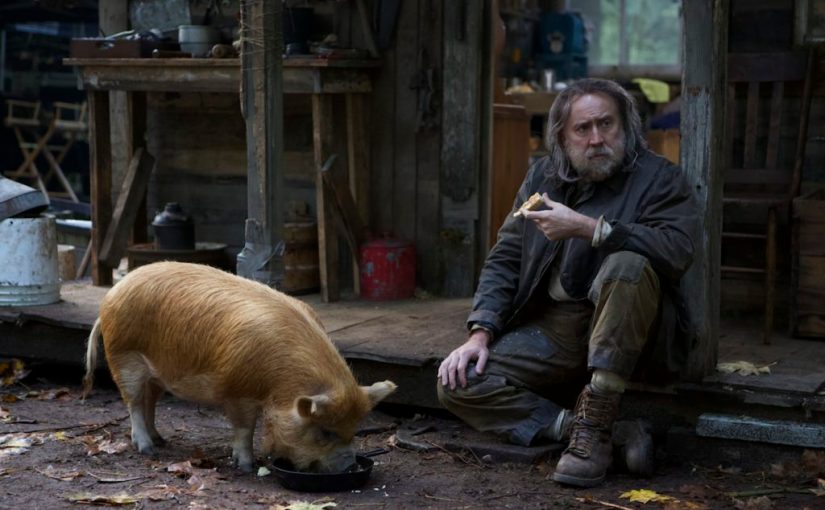
Cage plays a scraggly fellow named Rob who lives in the aforementioned cabin with his pig, whose name is never spoken throughout the movie.  (Although when it was over, I had one or two guesses of my own, each as unlikely as the other.)  This pig excels at finding valuable truffles hidden in the shallow forest soil.  How valuable?  Well, the ones we see in the movie are black, and the current market price for winter black truffles runs from $300 – $1,300 per kilo, depending on the variant.  So…yeah, pretty valuable.  Rob apparently funds his meager existence by selling his truffles to a high-end buyer named Amir (Alex Wolff, Hereditary [2018]), a slick customer who drives a banana-yellow late-model Camaro.  I’m not sure how many Portland restaurateurs can afford Camaros, but it didn’t bother me until this precise moment, so I’ll let it slide.

One night, unknown parties break into Rob’s cabin, beat him up, and steal his pig.  At this point, I was reminded unavoidably of the opening scenes of John Wick (2014), and I thought we were in for another kill-crazy-rampage film like Mandy (2018).  But I was very pleasantly surprised.

It turns out Pig isn’t a revenge movie, or a weird Spike-Jonze-esque journey into absurdity, or a mind-numbing Bergman-esque examination of the human condition.  Ultimately, it’s about food.  Yeah.  Or the transformative properties of food.  Or maybe it’s just about cooking food.  It feels like the kind of movie Anthony Bourdain would have loved, if that’s not being too presumptuous.

Once he gets a line on who the thieves might be, Rob convinces Amir to help him track them down by driving him into the city.  First stop is a sketchy-looking guy who rebuffs Rob’s request for information and asks Amir, “Do you even know his real name?”  That leads to a hidden restaurant under another restaurant where we learn Rob’s full name…a name that brings shock and awe to the eyes and faces of everyone who hears it.  Who is this guy?

One thing I noticed during this film was the great economy of the storytelling.  Scenes that might involve pages of dialogue in other movies are handled in seconds with either terse dialogue or sometimes none at all.  For example, there’s a scene in Amir’s apartment.  Rob wakes up on the couch to the sound of a fire alarm.  The camera tilts up and we see Amir standing on the counter trying to fan smoke away from the alarm.  Cut immediately to a kitchen table, Amir slides a plate in front of Rob, and he says sheepishly, “I don’t cook a lot.”  I can easily imagine that scene in some other movie involving a setup showing Amir trying to cook, burning something, trying to put the fire out, all very comic and probably well-done…but ultimately unnecessary.  Asking the viewer to do the occasional heavy lifting is not the worst thing in the world.  Pig is full of moments like this.  It’s a welcome change when it’s done right.

The screenplay is brilliant in other ways.  It convincingly leads you down one path where you think you can guess what’s about to happen, and then it throws a curveball or neatly sidesteps your expectations.  At least, it did mine.  Rob visits the house where he used to live, where he has a conversation with a small boy.  Where are the parents?  Who knows?  Doesn’t matter.  Amir talks about his family life, about his very successful father who doesn’t believe Amir can cut it in this business.  Later, there’s a scene where Rob and Amir cook a fancy meal for Amir’s father, and the dinner service for that food has a huge emotional payoff I did not expect, and which is worth the price of admission all by itself.

Is Pig a good movie just because it’s unique?  No.  But unique it is, and it is VERY good.  Cage gives one of his most understated performances in forever, so if you have been avoiding this one because you didn’t think you could take more Cage-ian histrionics, you don’t have to worry.  He’s very low-key.  There are a couple of moments where you can see the anger boiling deep within Rob, or when you might expect him to overturn a table or throw a glass of wine in someone’s face.  But it doesn’t happen, and that works for this unexpectedly touching film.

JUDAS AND THE BLACK MESSIAH (2021)

by Miguel E. Rodriguez

Director: Shaka King
Cast: Daniel Kaluuya, LaKeith Stanfield, Jesse Plemons, Martin Sheen
My Rating: 9/10
Rotten Tomatometer: 97% Certified Fresh

PLOT: In the late ‘60s, William O’Neal, offered a plea deal by the FBI, infiltrates the Illinois chapter of the Black Panthers to gather intelligence on party Chairman Fred Hampton.


By the time it was over, Judas and the Black Messiah made me think of that scene in Psycho (1960) where Norman is cleaning up after his mother and the car starts to sink in the swamp and then stops…and Norman gets nervous.  At that moment, I started rooting for Norman, getting in his headspace: “C’mon, car, sink.”  I was empathizing with the bad guy.  Neat trick.

That’s how I felt during Judas and the Black Messiah.  Instinctively, I know I’m supposed to be rooting for one character, but the movie empathizes with the “villain” character so well that I found myself rooting for him, too.

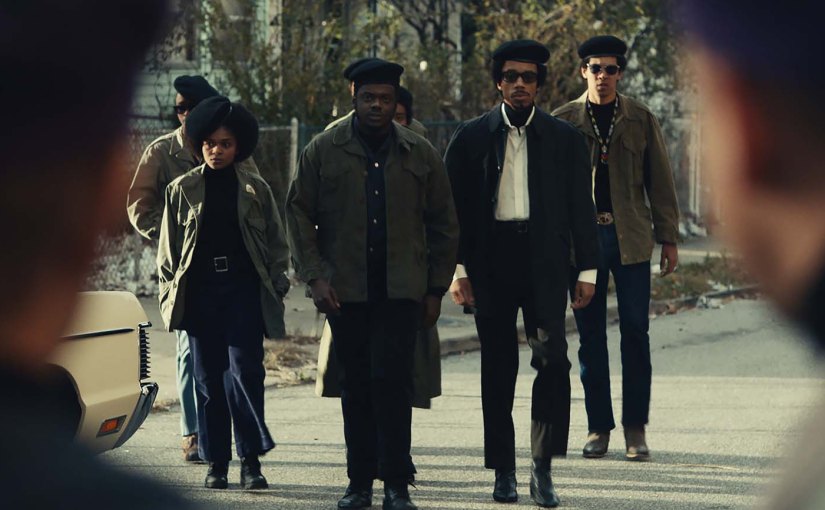
In the late 1960s, Fred Hampton’s star was on the rise in the black community.  As portrayed in a sensational performance by Daniel Kaluuya, Hampton is a fiery, charismatic, passionate public speaker who publicly advocates armed patrols of Black Panthers in black neighborhoods to keep an eye out for harassment from white cops.  When he is made Chairman of the Illinois chapter of the Black Panthers, the FBI takes an interest.  Well…Hoover takes an interest, which pretty much means the FBI followed suit regardless.

Meanwhile, a petty thief named Bill O’Neal (LaKeith Stanfield) is arrested by the FBI, who gives him a choice: serve a 5-year stretch for impersonating an FBI officer, or…go undercover into Fred Hampton’s Black Panther chapter and bring out good intel that will help them arrest Hampton.  O’Neal agrees, and what follows is an exercise in classic cinematic storytelling and misdirection, done up with glossy modern cinematography that looks like the best movie Oliver Stone never made.

(…actually, “misdirection” is not the right word.  I’m not sure what the right word is.  I’ll explain.)

Fred Hampton is clearly meant to be the hero of the film.  Hoover even refers to Hampton as a “messiah” of the black movement.  This all takes place a few years after both Dr. King and Malcolm X had been assassinated.  (If things had turned out differently, Fred Hampton’s name would be synonymous with King and Malcolm X, but it’s not, and based on this movie, that seems distinctly unfortunate and unfair.)  He boldly walks into a local meeting of white supremacists and, incredibly, turns them around to his way of thinking, using a brilliant metaphor of America as a house on fire.  If that moment is not based on fact, it should be.

So, if Hampton is the hero, then O’Neal is clearly meant to be the villain.  Hampton is the messiah of the title, so O’Neal is Judas, the traitor, the informer.  As a direct result of his intel [SPOILER ALERT], the FBI makes several arrests, including Hampton himself, and eventually initiates a raid during which Hampton is killed in his bed with his pregnant wife in the next room.  (This is all a matter of public record, though it’s interesting that it took this movie to really make me aware of it.)

But it’s easy to make a movie with a two-dimensional villain.  Judas and the Black Messiah does something much more difficult.  It asks us to empathize with both Hampton AND O’Neal.  We see the conflict in O’Neal’s face when Hampton promotes him to chief of security for their chapter.  We see O’Neal’s fear when he is recognized by a member of a local gang.  We see how few choices he really has in his various meetings with his FBI handler (Jesse Plemons), who constantly reminds him that, if he runs, they will find him and put him in jail.  Hampton says numerous times in the film that if he were to die for the cause, it would be a life well spent.  O’Neal has no such ideals.  I’d go as far to say that, if that were me in O’Neal’s shoes, I might do the same thing to stay out of jail.  I know my limits.

So, the entire film, I was pulled back and forth between admiration for Hampton and his cause and feeling anger towards O’Neal; and feeling terribly sad for O’Neal and what he’s essentially being forced to do by the FBI.  In other films depicting the Jesus story, I felt no such sympathy for the Judas character.  Director Shaka King accomplishes what so many other films do not: total alignment with one viewpoint while also demonstrating that not everything is so – forgive me – black and white.

Frankly, for me, the movie is worth watching just for the closing epilogue alone.  We get a glimpse of the real Bill O’Neal being interviewed for a real PBS documentary in 1989, and he is asked what he might tell his son about his role in the events surrounding Fred Hampton’s death.  His answer feels like something he’s rehearsed and said all his life.  And then there’s a closing subtitle…and it’s devastating.

I feel like there is more I could say, but it would involve getting into much more detail about several plot points, and I would prefer to leave them for the viewer to discover on their own.  Judas and the Black Messiah is worthy enough to stand with Spike Lee’s Malcolm X (1992), Ava DuVernay’s Selma (2014), and Steve McQueen’s 12 Years a Slave (2013) as one of the best films ever made about the black experience in America.

A MOST VIOLENT YEAR

By Marc S. Sanders

If Michael Corleone had kept his promise to Kay to go strictly legitimate, he’d probably have become Abel Morales, the protagonist of A Most Violent Year, played exceedingly well by underrated Oscar Isaac.

Writer/Director J.C. Chandor sets his story in winter 1981, on record statistically recognized as what the film’s title literary suggests.  Therefore, it is a challenge for Morales to successfully bring his heating oil enterprise to a capital success when his competitors don’t play by the rules and hijack his product while threatening his able staff of truckers and salespeople. Then there is the stigma Morales must endure by being married to a reputed mob boss’ daughter, searingly played by Jessica Chastain, ready at a moment’s notice to call on her own family for help or to just pull a trigger herself.  Morales tried his hardest to keep her in check.  Furthermore, the industry he’s chosen is riddled with suspicion of fraud, embezzlement, racketeering, and underhanded tricks. All this warrants the DA to bring an endless array of indictments against Morales and his business, despite all the cooperation and legal activities that have been accomplished so far.

So why go through with this at all?  A lifetime has been invested.  Time of money and work to fight for an opportunity.  Abel knows this more than anything, and he will not surrender to deals from the DA or the mob.  He will not compromise despite the challenges.

Chandor’s film is well done.  It had been on my radar to watch since its release and yet it was not what I expected.  I was waiting for Abel’s widely seen beautiful camel overcoat to end up soaked in blood.  It never came to be.  That observation only suggests that A Most Violent Year does not promise on its descriptiveness.  On the contrary, it offers the setting so that we understand Abel’s conflict.  

A good story piles on one problem after another to keep a viewer compelled. Maybe one primary problem is wrapped up a little too neatly here, but no matter.  I also would have preferred better camera positioning from Chandor on occasion. Some characters who are being introduced for the first time are heard speaking off camera only to then be shown a close up of them with no more to say.  Happened more than twice and I can’t understand why.  I’m sure Chandor artistically intended it to be that way.  Yet, I didn’t like it.

Oscar Isaac and Jessica Chastain are great.  These are two actors rarely seen in the gossip rags.  So, they are more well known for selecting smart roles and stretching their flexibility for the parts they agree to take.  It’s refreshing. It’s why A Most Violent Year can be capably made with a great script (better than the film) amid all of the tentpole blockbuster sequels.  

It’s worth it to check out.

MOLLY’S GAME

By Marc S. Sanders

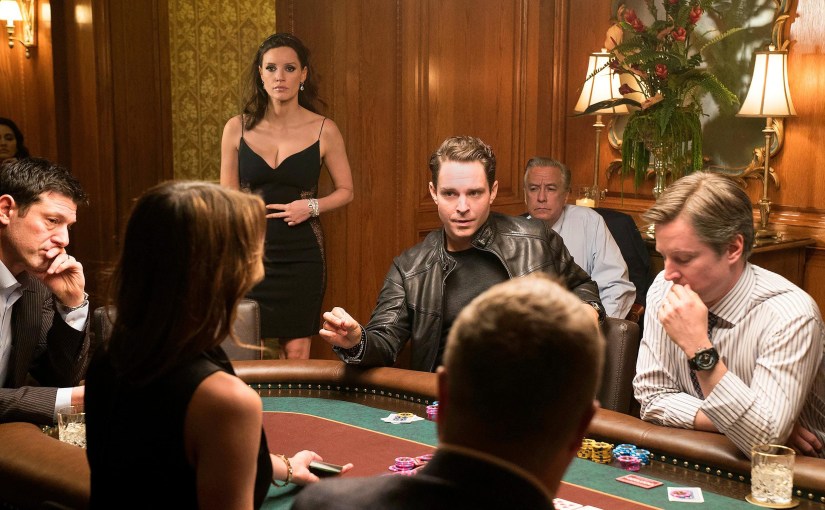
Despite being a little distracted by a drunk patron sitting next to me, I thought Molly’s Game was very good. It doesn’t measure up to The Social Network, and I feel justified in comparing the two because the sharp, fast dialogue follows what appears to be an intentionally similar narrative from writer, and here director, Aaron Sorkin.

Sorkin in his directorial debut uses great techniques for film editing to match the beats of his dialogue.  His opening voiceover of Jessica Chastain as Molly describing the ultimate worst sports experience will get your heartbeat racing.  It draws you into the film right away.

Chastain is good, but maybe a little over the top.  I needed a little more convincing that she was actually this brilliant, inventive and resourceful woman who was also considered one of the world’s greatest skiers.  Can’t put my finger on it but something was missing with her playing the Molly Bloom role.  Was she really holding her own against these high stakes guys who take big risks in her personally constructed poker ring?  I’m just not sure.

Felt the same about Kevin Costner in the role of her father.  He’s supposed to be an incredibly brilliant psychologist and an intimidating patriarch.  Yet Costner doesn’t fit that mold for me here.  Couldn’t feel the pressure from Dad on his daughter.  Someone else might have been stronger.

Michael Cera too.  I think he is playing a combination variation of Tobey Maguire & Leonardo DiCaprio, two of the most famous celebs that participated in the real Molly Bloom’s underground poker games, but Michael Cera?  Really?  He doesn’t carry the weight or looks of guys like that.  There just was not enough power or presence from him.

None of these actors were the worst options for this cast, I just think the film could have used more appropriate performers. There was more appropriate talent out there, I’m sure.

Idris Elba is great, however.  He’s blessed with an awesome Sorkin monologue in the 3rd act of the film, and he hits every note.

A great script.  A great story worthy of being a big screen film and it’s got me interested to learn more about the real Molly Bloom, including reading her novel.

MANCHESTER BY THE SEA

By Marc S. Sanders

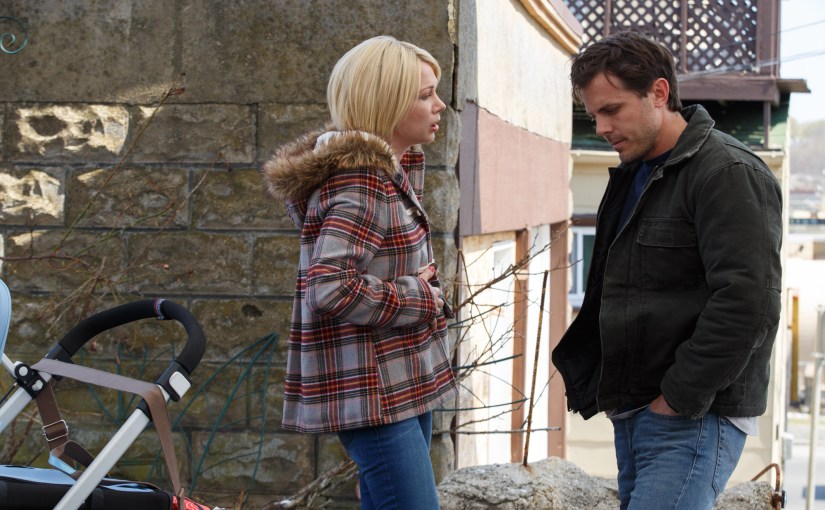
Whether it is Gone Baby Gone, or The Assassination Of Jesse James By The Coward Robert Ford, or even Good Will Hunting, Casey Affleck is an actor who never compromises for glamour or grandeur in his roles. He will look ugly, dress down or be the most unlikable of characters to preserve the authenticity of a movie’s script. I imagine good directors just let him loose and film him with whatever he comes up with on the spot. It would be a tribute to his talent to do so. Here, in this Best Picture nominee, he is incredibly moving and quietly unhinged. He’s excellent.

Manchester By The Sea is a heavy, dramatic script held together by a simple story. Affleck plays Lee Chandler who will probably be destined to endure one unspeakable tragedy after another for the rest of his life; hammered away until it seems there’s no way to ever recover from inner demons of guilt and sadness.

At best, his recently departed brother (the always reliable Kyle Chandler) blesses him with an opportunity by making Lee the guardian to his 16 year old son, Patrick, played by Lucas Heges in one of the best screen debuts I can remember. He’s an eerie doppelgänger for a young Matt Damon.

Patrick needs Lee, and Lee, who doesn’t know it yet needs Patrick.

Manchester By The Sea takes its time to set up story and character, and maybe that is its downfall. People get in their cars, they shovel snow, they get out of their cars, they shovel more snow. All this set up for a 2 hour and 15-minute film might handicap the pacing, but I can’t think of a better way to improve upon its heart wrenchingly real narrative. The tragedy at the center of Lee’s turmoil is difficult to accept.

Michelle Williams as Lee’s wife is proves once again that she is an amazing actor finding her own unique method for a penultimate crying scene. She is underused. I would have liked to see more of her in this film.

Manchester By The Sea was nominated for Best Picture, Actor, Director, Screenplay and Supporting Actress. All well-deserved but maybe not worthy of the awards. (Affleck won the award, actually, and so did Kenneth Lonergan for his screenplay.) I think there were a few better nominees in each of these categories. Still, had it not been for the Oscar nods I probably wouldn’t have watched it. All I can say is, I’m glad I did.

NOMADLAND (2020)

by Miguel E. Rodriguez

Director: Chloé Zhao
Cast: Frances McDormand, David Strathairn, and a cast of non-professionals/actual “nomads”
My Rating: 8/10
Rotten Tomatometer: 93% Certified Fresh

PLOT: A woman in her sixties, after losing everything in the Great Recession, embarks on a journey through the American West, living as a van-dwelling modern-day nomad.


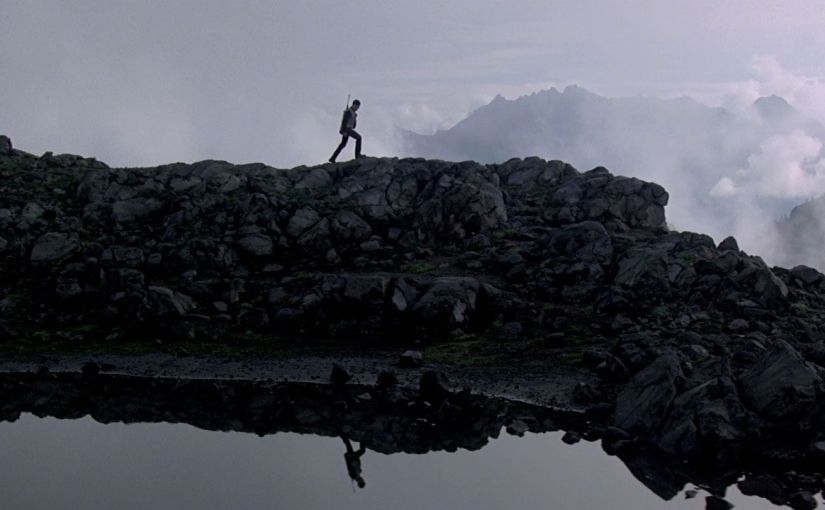
Nomadland is one of the most visually beautiful films I’ve seen recently.  It mostly reminded me of Brokeback Mountain (2005) with its sprawling vistas of distant mountains, lonely country roads against a looming sky, and desert badlands illuminated by that elusive light that appears only during the “magic hour” so coveted by cinematographers and photographers alike.  It’s beautiful and well-made.  As a message film that won the Academy Award for Best Picture of 2020…I mean…it’s good and admirable, but it didn’t quite get to me like it was clearly trying to.

As a piece of propaganda (intentional or not), I can see Nomadland being effective for anyone who has been disillusioned of the American Dream by financial troubles.  Set in 2011, the film follows Fern (McDormand) as she hits the road in a van after the gypsum mining company her deceased husband worked for folded, displacing an entire town, Empire.  Even the town’s zip code was discontinued.  Fern literally lives out of her van, which doubles as living quarters, bedroom, dining room, and (revealed in a shot that I was stunned to learn was real) bathroom.  She works seasonal jobs throughout the American West at various parks, restaurants, and even an Amazon warehouse during the holidays.

On her travels, she encounters a large community of fellow nomads.  Periodically (I think annually), they gather at a location in the middle of the desert to trade goods, share stories and nomadic tips, and basically support each other for a week or a month or whatever…it’s not made clear exactly how long everyone stays before they go their separate ways once more.  On this occasion, she meets a fellow traveler named Dave (Strathairn) who trades her for a can opener.  Over the course of the film, Fern’s and Dave’s paths will intersect again and again.  I thought we were getting the kernel of a corny love story, but not quite.  The purpose of their relationship is pragmatic, not romantic.

Another traveler Fern meets is Swankie, a lively woman in her seventies who hangs a skull-and-crossbones flag from her van when she wants no visitors.  Honestly, it made me wish I had a similar flag to hang from my neck to communicate the same thing in public.  Anyway, Swankie reinforces Fern’s commitment to this way of living by describing trips to Alaska, a visit to a large community of swallows nesting on a cliff while on a canoe trip, and by revealing one of the real reasons Swankie has adopted this lifestyle in the first place.  All with no bills to pay, other than gas, food, and vehicular upkeep.

The movie follows Fern from one place to another over the course of a little over a year.  We see her working, driving, talking with people she meets, cooking on her tiny gas stove inside her van, dealing with the cold in the winter, reminiscing over old photos and slides.  There are two interesting side trips when she can’t avoid reaching out to…well, I guess “civilization” is the right word.  One occurs because her beloved van breaks down and she has to get to her sister’s to ask her for repair money.  Another occurs when she takes Dave up on an offer to…no, won’t spoil it.

At times, I found myself comparing Nomadland to Cast Away, Robert Zemeckis’ 2000 film where Chuck Noland (Tom Hanks) finds himself stranded on a desert island after a plane crash.  In both situations, the heroes find themselves isolated from civilization.  They must both learn to deal with an alternate way of life, and there is no alternative.  Adapt or die.  (When Swankie learns Fern doesn’t even know how to change a tire, she reprimands her.  “You can die out here.  You’re out in the wilderness, far away from anybody.  You can die out here.  Don’t you understand that?  You have to take it seriously.  You have to have a way to get help.  You have to be able to change your own tire!”  It’s a sobering reminder that, even though she has a cell phone (how she pays the bill is a mystery to me), Fern must be self-sufficient in order to survive.)

Furthering the similarities to Cast Away, there’s even a moment where Fern has an opportunity to sleep in a real bed.  We see her crawl underneath the covers…but in the middle of the night, she creeps back out to her faithful van to get a real night’s sleep, just like Chuck Noland sleeping on the floor of his hotel room.

But what does it all mean?  What is Nomadland trying to say?  I couldn’t shake the idea that Zhao’s film, based on a book of the same name, was an attempt, like Into the Wild (2007), to romanticize the concept of shedding our material needs, stripping ourselves down to the necessities, and getting back in touch with nature.  I have no doubt this notion appeals to many people.  Well, that much is clear because nearly everyone in the film besides McDormand and Strathairn are non-actors who are playing themselves, and they’re all nomads, too.  But is the movie simply showing me how and why a person makes this decision?  Or is it trying to convince me that I should do the same thing?  Is this one of Ebert’s “empathy machines” that allows me to live in someone else’s shoes for 107 minutes and experience life through their eyes, or, like Into the Wild, is it making the case that folks who haven’t made this decision themselves are slaves to a corporate system?

At one point, a gentleman named Bob, who is a real person and is one of the main coordinators of the community that meets once a year in the desert, makes a speech to the nomads who have gathered:

I think of an analogy as a work horse. The work horse that is willing to work itself to death, and then be put out to pasture. And that’s what happens to so many of us. If society was throwing us away and sending us as the work horse out to the pasture, we work horses have to gather together and take care of each other. And that’s what this is all about. The way I see it is that the Titanic is sinking, and economic times are changing. And so my goal is to get the lifeboats out and get as many people into the lifeboats as I can.

I’d be lying if I said his notion wasn’t appealing.  Who wouldn’t want to live a life of seeing the country, parts of which many of us may never see in our lifetimes?  Never being tied down to a job, to familial obligations, bills, taxes, the eternal quest for the almighty Dollar?  I get it.  But…if I didn’t have a job, didn’t earn a living, didn’t pay my bills, and have enough left over to buy a home entertainment system including the Blu-ray of Nomadland…I would never have seen this lovely film in the first place.

So, no, the concept of living as a nomad is not something I would seriously embrace…yet.  Life is good.  I have a job.  I have family.  I have friends who are as good as family.  I have the woman I love beside me.  I’ve seen Alaska, England, Greece, New York, Miami, and Key West.  Nomadland argues that, if any of that would ever change, there is an alternative to depression and slaving away and eking out a living in my retirement years in a 1-bedroom apartment.  Perhaps, on that day, I might re-evaluate my opinion of nomadic living.

But that day is not today.

Tomorrow is not looking good, either.

THE NAKED CITY (1948)

by Miguel E. Rodriguez

Director: Jules Dassin
Cast: Barry Fitzgerald, Howard Duff, Dorothy Hart, Don Taylor
My Rating: 7/10
Rotten Tomatometer: 85%

PLOT: In almost documentary-like fashion, New York City cops investigate the brutal murder of a young woman.


It’s that narration.

If The Naked City hadn’t included that cockamamie narration, I might have given it a “9” instead of a “7.”  Here is a police procedural ahead of its time, a pre-television-era herald of popular entertainments from Dragnet to Law and Order to CSI.  The story is absorbing and engaging from beginning to end, even if some of the acting is not especially Oscar-worthy.  There are enough twists and turns in the search for a cold-blooded killer – or killers – to keep your attention all the way through.  And over it all, intruding where it’s not wanted, is a Disney-esque narration from the film’s producer, Mark Hellinger, who also produced a superior prison film a year earlier, Brute Force (1947), also directed by Jules Dassin.

Imagine a scene where foot-weary detectives are pounding the streets, making inquiries at jewelry stores, hairdressers, pawnshops, looking for leads.  As we watch the scene progress, we hear the narrator: “Are your feet tired, detective?  Not to worry, only 400 more jewelry shops to go.”

Or another scene where a detective looks wearily through a window at the city laid out below, pondering where to go for the next clue.  Cue the narrator: “There’s your city, Halloran.  Take a good look.  Jean Dexter is dead, and the answer must be somewhere down there…”

I hated the narration in this movie.  It reduced what I was watching to the level of one of those Disney animated shorts where Goofy is playing some kind of sport and the narrator describes the action while Goofy screws it up spectacularly.  Another example, as morning comes to the city: “The city is quiet now, but soon it will be pounding with activity.  This time yesterday, Jean Dexter was just another pretty girl, but now she’s the marmalade on 10,000 pieces of toast.”  Give me a break.  I fully understand how future TV shows made use of this kind of narration, but not to this degree.  It made a crime story sound like an industrial video.

So let us stipulate that I hated the narration.  The rest of this review will discuss the film as if the narration didn’t exist.  It’s best for you, it’s best for me…it’s best for us.

The Naked City opens with the murder of a young woman, Jean Dexter.  The rest of the movie details the police investigation and search for her killer.  In broad strokes, that’s pretty much it.  In its own way, it reminded me a little bit of All the President’s Men (1976) in that we’re focused exclusively on the process of investigation with very little cutting away to other participants.  The lead figures are a very Oyrish Lieutenant Muldoon (Barry Fitzgerald) and the dependable Halloran (Don Taylor).  The chief suspect is Frank Niles (an impossibly young Howard Duff, whom you may recall as Ted Kramer’s attorney in Kramer vs. Kramer [1979]).  Niles raises so many red flags that I started to think he was an obvious red herring.  Under questioning, he lies and lies and lies again, even “forgetting” to tell the police he’s engaged to the dead woman’s best friend.  Can this guy be for real?  We have seen so many criminals in so many TV shows and movies who are so much better at lying to the police…but he’s so bad at it that he must be innocent by default, right?

The investigation continues.  Clues and leads are chased down.  Another murder occurs.  False confessions are heard and dismissed.  The dead girl’s parents come down to the mortuary to identify the body.  (That particular scene was notable for being filmed at an actual New York City mortuary, a first for its time.  In fact, the vast majority of The Naked City was filmed on location in the Big Apple, one of the first major Hollywood productions to do so.  It’s hard to conceive of now, but this caused a minor sensation upon the movie’s release.)

While the mystery of the murder is the real meat of the story, I got the impression that the goal of the film was to bring these mundane police procedures to the masses, to show audiences that, while you work and eat and play and raise your families and go to baseball games, the good guys are on the case whenever something goes wrong.  And this is what they do for just one murder case.  In a city like New York, who knows how many murder cases are being worked on at once?  As the closing narration famously says, “There are eight million stories in the naked city.  This has been one of them.”  (Okay, that’s the one bright spot in the narration, let us never speak of it again.)

I can even draw a direct line between The Naked City and The Silence of the Lambs (1991).  In The Naked City, Halloran uncovers a possible connection between the second murder victim and the prime suspect in the first murder.  (It’s complicated.)  He gets permission from Muldoon to chase it down, despite how unpromising it is.  As he’s following his nose, Muldoon chases down a lead of his own, getting closer to the true mastermind behind this case.  In this way, there is a direct parallel in The Silence of the Lambs where Crawford takes a task force to a suspect’s house while Clarice follows a nearly invisible trail to Jame Gumb’s doorstep.

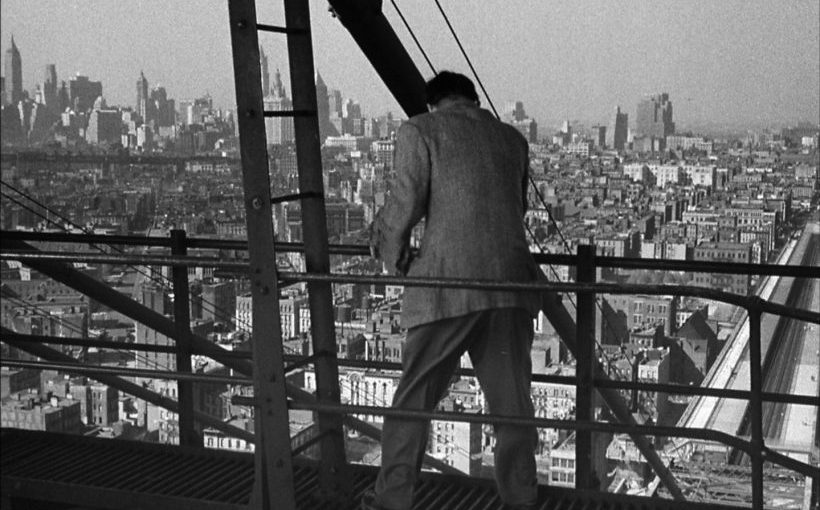
Everything comes to a head with a foot chase that leads to the Williamsburg Bridge, scenes that must have been a little mind-blowing for 1948 audiences as the camera seemingly defies gravity, climbing higher and higher into the scaffolding with the fleeing suspect.  (It should also be noted that the film perhaps romanticizes inner city life to a degree…as the suspect flees across the bridge, he breaks up a group of children skipping rope on the footpath.  Not the kind of thing I’d expect to see today, for sure.)

The Naked City is about as good as crime dramas in the ‘40s could get without resorting to the darkness and shadows of film noir.  This is, after all, a film about the good guys, not the bad.  Watching cops interrogate witnesses and compare notes about stolen jewelry isn’t quite as “sexy” as watching Bogie draw down on some hoodlums, but hey, that’s the kind of thing that really happens in the big bad city.

LA STRADA (1954, Italy)

by Miguel E. Rodriguez

Director: Federico Fellini
Cast: Anthony Quinn, Giulietta Masina, Richard Basehart
My Rating: 8/10
Rotten Tomatometer: 98% Certified Fresh

PLOT: A child-like woman is sold to a traveling entertainer, consequently enduring physical and emotional pain along the way.


Fellini’s La strada, the very first film to win the Academy Award for Best Foreign Film, is widely considered to be one of the greatest movies of all time, a touchstone of the Italian neo-realist movement that grew out of Bicycle Thieves (1948) and Umberto D. (1952).  Ask anyone who knows me, and they’ll tell you that, while I appreciate these kinds of films, they are not exactly my bread and butter.  There are some Italian movies that I will probably never watch, and I am quite sure I won’t miss them.  However, I am happy I finally sat and watched La strada.

But why?  La strada is not a happy movie by any stretch of the imagination.  It tells the story of a vaudevillian strongman, Zampanò (Anthony Quinn), who entertains street crowds by stretching a chain across his chest muscles until it breaks.  When the movie opens, he is paying the mother of a large family 10,000 lire for Gelsomina (Giulietta Masina), a child-like woman with a hugely expressive face.  For that princely sum, she will leave her family forever and learn a trade as Zampanò’s assistant.

They hit the road.  Zampanò is not a very nice man.  He teaches Gelsomina the basics but refuses to let her learn any more than is necessary.  When they eat dinner at a restaurant, he picks up a local floozy and ditches Gelsomina for the night.  When she tries to run away, he runs after her and beats her.  When they take up with a traveling circus, he refuses to let her perform with anyone else but him.  Gelsomina despairs of her existence, but she has convinced herself she can’t leave because she can’t think of anywhere else to go.

In a traveling circus, Gelsomina meets a carefree acrobat/clown known only as The Fool (Richard Basehart).  The Fool lives up to his name: performing dangerous high-wire acts and recklessly teasing Zampanò for no apparent reason, even heckling Zampanò during his act.  This is not a smart man, but he manages to steal a quiet moment with Gelsomina where, in his own way, he tries to let her know that her life has a purpose because EVERYTHING has a purpose, even a pebble he picks up off the ground.  “I don’t know what this pebble’s purpose is, but it must have one, because if this pebble has no purpose, then everything is pointless.  Even the stars!”

Examine that statement closely enough and it’s not quite as life-affirming as it seems, but it lights a spark in Gelsomina’s otherwise bleak existence.  From then on, she holds fast to that conversation, referring back to it when new hardships or doubts arise.  Meanwhile, Zampanò remains as cold and ruthless as ever, even trying to steal from a convent.

And then something unexpected happens that seems as if it will finally break Zampanò’s hold on Gelsomina, but no.  Gelsomina clings to the belief that her purpose is to be with Zampanò, no matter what happens or how miserable she might become.

…so, yeah, this isn’t exactly a happy film.  This is not the kind of movie I would normally seek out.  But in its bleakness, it achieves a kind of aching beauty, like Atonement (2007) or The Remains of the Day (1993).

A lot of that beauty is achieved through the must-see performance by Giulietta Masina as Gelsomina.  It’s clear that Gelsomina is stuck in a woman’s body but with the emotional maturity of a child.  Is she developmentally disabled?  The movie never makes it clear.  Perhaps she simply chose to retain her innocence while the rest of the world moved on around her.  In that way, she becomes almost like a character in a fairy tale.  I found myself wondering if the movie would have played the same had Gelsomina been a child rather than a grown woman.  It might have played a lot like the sequence in Pinocchio (1940) when he is captured by Stromboli and forced to perform for street crowds.

Masina’s performance as Gelsomina would be the single best reason I can think of to recommend this movie to anyone who might not otherwise watch it.  Her face and eyes light up like candles on a birthday cake when she smiles.  When she frowns, she puts clown makeup to shame.  And when she dons clown makeup herself and dances and plays the trombone, you can’t help but grin a little.  When she weeps because she can’t see The Fool anymore, she sounds like a little girl who’s lost a pet.  It’s one of the greatest performances I’ve ever seen.

That performance is key to the movie.  Zampanò’s cruelty and dismissive nature masks his own fear of Gelsomina’s innocence.  He keeps her down because he doesn’t dare allow himself to believe he might be in the wrong.  Watching the movie, we allow ourselves to hope that perhaps Zampanò will reach a turning point where he throws himself at Gelsomina’s feet, begging forgiveness for his terrible behavior and past misdeeds.  But will it happen in time to make a difference?

On the Criterion Blu-ray of La strada, director Martin Scorsese states in an interview that, if you’ve never seen a Fellini film in your life, you could watch La strada and 8 ½ (1963) and you’d know all there is to know about Fellini and his films.  I’m certainly no Fellini expert, but that sounds accurate to me.  La strada contains all the seeds – the score, the performances, the circus theme – that come to fruition in 8 ½.  But La strada is the more accessible of those two films, in my opinion.  If you’re going to start somewhere, start here.

MISS SLOANE

By Marc S. Sanders

Jessica Chastain is an aggressive actress. The talent is on par with Meryl Streep or Katherine Hepburn for sure, and the Oscar trophy she won earlier this year is evident of that. Actually, she’s worthy of more than just one. My question, though, is if she is too aggressive. Films like Zero Dark Thirty, Molly’s Game, and Miss Sloane, put her in characters that never stop to react and smell the roses. That wears me out. Could you just slow down Jessica, so I can take this all in, please? You’re talking faster than I can think.

In Miss Sloane, Chastain portrays an impenetrable lobbyist. Nothing gets past this woman and despite her shortcomings, nothing will harm her either. Elizabeth Sloane will always be one step ahead of the game. This is a fierce chess player in the political arena. She’s omnipotent and admits to hardly ever sleeping. Maybe the pill popping helps with that. Like the Faye Dunaway character from Network, she also has no time for personal relationships or sensitive sex. So, she’s a high paying client for a male escort who will wait for her to come home to satisfy her fix.

Elizabeth is first employed with a wealthy private law firm who wants her to head up a bill in favor of the gun lobby. She declines, walks out the door with one long speech, a way over the top laugh (this is where there’s too much Jessica in my morning coffee) and over half her staff. She goes to the other side of the aisle to lobby aggressively against the gun bill.

From there it’s one aggressive maneuver after another and Elizabeth more than proves that she’s got the balls for this game. Only thing is, as Elizabeth proceeds to countermeasure and attack from her side, is she losing sight of the subject at play? Will her soul swim to the surface showing any sense of morality?

The film begins where Elizabeth is being questioned at a hearing headed by a state Senator (John Lithgow, always a pleasure to see). Then it moves on to show us how Elizabeth finds herself at that hearing.

Miss Sloane has no limits to what she’ll do to protect the integrity of a client’s argument for the bill even if it means embarrassing a traitorous teammate, putting another teammate in an unwelcome limelight of political journalism or maybe even employing a cockroach of the sort to use as a listening device. Miss Sloane won’t hesitate to take risks for the lobby she’s been hired to pursue, even if it risks someone’s life or their reputation.

A twist presents itself at the end and yeah, it could work assuming you believe Elizabeth Sloane, the brilliant lobbyist, can telegraph about fifty different actions that could take place amounting to that one moment. The math adds up, but were the numbers fudged to allow the arithmetic to work? That’s why a film like Miss Sloane is hard for me to swallow.

Does this woman have ESP? The final card she plays would require not only her own personal endurance, but that of a colleague as well. A lot of factors all have to be in sync to make this story work out the way it does. So my suspension of disbelief was really tested with this film.

I go back to Jessica Chastain. Zero Dark Thirty remains my favorite of hers. She was a great underdog against a male oriented governing body in the pursuit of Bin Laden. After that, Miss Sloane released a few years later and Chastain got bit by the Aaron Sorkin bug, I think. Endless talking works as an intellect that’s hard to challenge. Problem is, I’m the viewer and I’m wondering for the first thirty minutes what in the hell you’re talking about. Miss Sloane isn’t an Aaron Sorkin film, but Jessica Chastain will have you convinced she wants it to be.

Fortunately, writer Jonathan Perera with director John Madden ease up on the brakes allowing much more realistic and human characters to invade the film including Lithgow, Alison Pill and an especially riveting performance from Gugu Mbatha-Raw (recently seen by me with a subpar script called The Whole Truth) who becomes Elizabeth’s trusted sidekick both behind and in front of the cameras for political jockeying. This is an actress ready for some lead roles.

I described Miss Sloane as omnipotent earlier and that’s a problem for the first act of the film. This character never shuts up early on. There’s next to no impact on anyone around her. She just talks and talks and talks and she convinces me that she’s the smartest one in the room, but she also makes me want to turn the movie off. The film saves itself with the able supporting cast eventually.

To watch Miss Sloane is not to take any position on gun lobbying especially seriously. I’m not sure the filmmakers have a stance to play. I’m not sure the filmmakers know whether to even regard the titled character as a hero or villain. Actually, I just think the purpose of the film is to show corner cutting and how aggressive a made-up lobbyist can actually be, devoid of any determining factors. We are privileged to see how far a woman with stiletto heels, a cinched up red head ponytail and a tight business suit will go to win at any cost. It’s intriguing, but I guess I just felt unfulfilled by the end. It was all there. It just seemed to work itself all out too conveniently by the end. 

AT CLOSE RANGE

By Marc S. Sanders

Sean Penn has been a gifted actor from the very beginning of his career.  Whoever thought the kid who played surfer dude Jeff Spicoli in Fast Times At Ridgemont High would go on to evoke such intensity in future roles afterwards?  Other actors who did that kind of sophomoric material went on to be in Police Academy movies.  Penn would never shake that surfer image, but he would at least equally receive accolades for his dramatic turns. In James Foley’s At Close Range the high stakes drama could not be more apparent. 

Penn portrays Brad Whitefore, Jr. in this film based on a true story taking place in a small, rural Pennsylvania town in 1978.  Brad Jr.  is going nowhere and that’s fine with him.  He’d rather be an intimidating, fearless kid who will defy his step father so he and his brother (Chris Penn, Sean’s real-life sibling) can get drunk and high.  When Brad opts to go live at his father’s, Brad Sr., house, he hopes that he will learn the ropes of becoming a career criminal like his dad.  Brad Sr. (Christopher Walken) specializes in ripping off tractors, farm equipment, cars, wealthy property owners, and safes carrying large amounts of cash.  He happily welcomes his son into his home with his misfit gang and his new young wife.  Dad will also express love to his son by giving him a car and support, while also welcoming in Jr’s new girlfriend Terry (Mary Stuart Masterson). 

There is a code among these criminals however, and it stretches to flesh and blood as well.  No one is to talk about what they do or how they do it.  Shortly after dad allows his son join in on a job, Brad Jr. learns of the consequences if anyone talks about their handiwork, especially if you are seen chatting with local law enforcement.

At Close Range came out in 1986.  Even by then, I don’t think it would be challenging to forecast where the story is heading.  What’s most interesting about the film are the cast performances from Penn, Walken, and Masterson.  James Foley sets up good scenes where loving trust works at one point, but when that is shattered, what is the detritus left over afterwards?  Christopher Walken plays a guy with no limits to upholding his code, and as I reflect on that motivation, I can’t help but think how relevant Madonna’s eerie ballad Live To Tell (from her True Blue album) is so very important to the picture.  The song should have received an Oscar nomination based on its significance alone.  I’ve only now just seen the movie for the first time.  Yet, I’ve been familiar with the song for nearly forty years.  It carries much more meaning now.

James Foley’s film could’ve been better, however.  The first hour is incredibly slow moving and doesn’t seem to offer much direction or exposition for what the film is truly going to be about.  At some points it is a boy meets girl storyline with Penn and Masterson.  They have good scenes together, but were they all necessary?  Couldn’t some of this material ended up on the cutting room floor?  Then in other areas it is a father/son coming of age piece where pals from both of their respective backgrounds get drunk together on any given night.  Brad Sr. is emulated for his leadership, the gun he carries, the money he flashes and the high-end muscle cars he steals, even gifting one to his son.  Brad Jr. is looked upon as the cool rebel (maybe a more aggressive modern James Dean) for not surrendering to intimidation from anybody. 

The movie also ends kind of abruptly.  It’s clearly understood what’s going to come of the father and son’s relationship.  Sean Penn and Christopher Walken stage a nail biting, very intense showdown in the kitchen.  However, what happens to them individually?  The final scene actually ends right in the middle of what could have been some good dramatic work, but it all goes to black.  Had I been in a movie theatre, I might have thought the projector broke down.  Business must have interfered behind the scenes.  A producer must have stepped in and pulled the plug.  It’s the best excuse I can think of, because the end credits intruded way too soon.  If the film was being edited for length, then there was much material to chop out of the first hour.  The filmmakers basically cut off the wrong leg.

At Close Range is not a steady trajectory of a movie.  It moves in too many sideways directions to stay focused on what it wants to be considered.  Is it a more genuine Rebel Without A Cause?  Is it a rural, backwoods interpretation with inspiration from Mean Streets?  Thankfully, what saved me from turning it off or falling asleep are the assembled cast performances.  At the very least, it got me interested to read up on the real story the film is based on.