SCHINDLER’S LIST

By Marc S. Sanders

Oskar Schindler was a handsome, well dressed man. A man of wealth, power, and influence. A successful businessman. He was a womanizer. And Oskar Schindler was a Nazi who saved 1100 Jews from the atrocities of the Holocaust.

On a filmmaking measure alone, Schindler’s List is one of the best pictures to ever be made. Steven Spielberg’s production value is incomparable. Nothing I can recall appears as grand (not sure that’s the appropriate word here???) and authentic as Schindler’s List. How did Spielberg pull off this feat? How did he direct hundreds, thousands maybe, of extras to reenact the vilest human suffering that a generation of people could ever encounter? I’m astounded. Positively astounded.

This evening was only my second time seeing the film. I always put off watching it over the last 30 years; reluctant maybe to see a horrifying truth. The first time I saw the film was on Christmas Day, 1993 at the Hyde Park cinemas in Tampa, Florida with my father. I didn’t realize it at the time, but I was in the beginning stages of the flu with a high fever. Midway through the film, I had to leave the theatre as my illness caught up with me. I mustered the strength to return to watching the remainder of the movie, as I recall I could not go without finishing this masterpiece. I was horrified and yet amazed; amazed that this moment in world history could have ever occurred.

To see a man like Amon Goth (brutally and uncompromisingly played by Ralph Fiennes), a high ranking Nazi, excuse himself from his nude mistress’ bed and perch himself on his balcony to sniper random Jewish prisoners as a means of sport was sickening and twisted to me. Twenty five years later, it is this moment that has always stayed with me, as much of the story and scenes left my memory from so long ago. This moment as well as Spielberg’s choice to highlight a young girl in a red coat amidst a most somber black and white picture have stayed with me all these years. The glimpse of red serves as a truth to Schindler’s naivety. Spielberg is a thinking director. He never follows the manual. He chooses to think outside the box. A glimpse of a child dressed in red in a sea of black and white where mutilated corpses and possessions are aimlessly strewn about. It’s a marvelously telling moment.

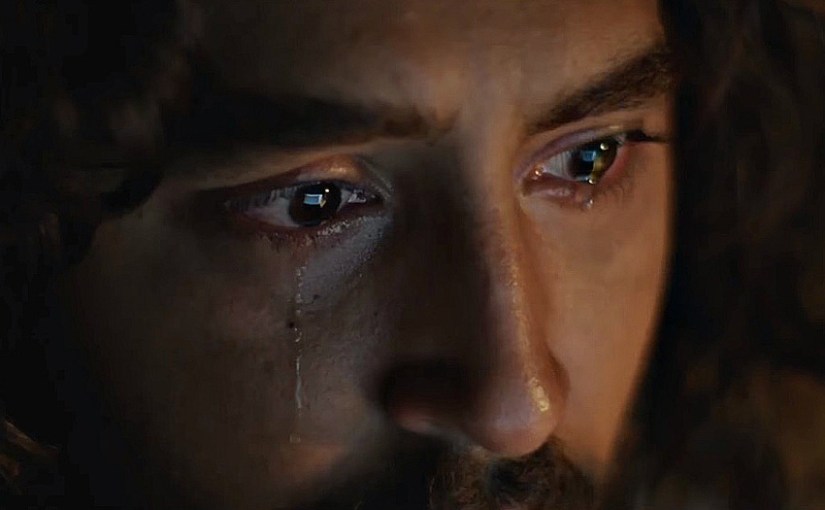
Liam Neeson plays Schindler. It will likely be the greatest role of his career. Schindler is a man who even fools the audience until the very end when he reveals that the war has ended and his salvation has rescued these 1100 souls. Finally, his humanity no longer hides and he weeps to his accountant and accomplice, Itzhak Stern (played subtly and beautifully by Ben Kingsley). Schindler weeps for he could have saved more. Neeson is superb in this moment. His commanding stature crumbles, his materialism and wealth have disappeared. Neeson translates all of that clearly, and finally my tears arrive. Prior to this moment, I was numb to the Nazi tactics of gas chambers, careless bloodshed and apathetic separation of families and friends; perhaps because I’ve extensively studied it during my years in Yeshiva. Before Schindler’s List, much of the history on the Holocaust seemed like textbook fare to me. Spielberg made its terrifying and tragic reality real.

Ben Kingsley’s performance is so important as well. The architect behind the list, his portrayal of Stern is countered with contained fear and leveled sensibilities amid the senseless intentions of a dominant force of evil. His instincts kept him alive so that only he could help keep his comrades alive.

Schindler’s List won the Best Picture Oscar for 1993, only 50-52 years following the events of the Holocaust. Many survivors thankfully remained to see Spielberg’s epic premiere. People who I share this planet with experienced the most insane and heinous evil ever encountered. They were well to do people living normally until they were violently pulled from their homes, stripped of their possessions, separated from their families, suffered at the threat of murder, witnesses to other murders and hate crimes, humiliated, beaten, forced into slave labor in tightly contained ghettos and eventually thrust into concentration camps. Yet, these few survivors lived to carry on with their lives and deliver new generations, beyond this morally ugly and evil historic episode.

I’m being redundant as I’ve said it many times before, but isn’t that the point? The Holocaust and the Nazi regime only occurred around 85 years ago. This happened before. This can happen again.

Thank you, Steven Spielberg for Schindler’s List.

I don’t consider myself to be very religious anymore. Because of moments like the Holocaust, I question how a God could ever be possible. Still, for the survivors and those that perished, I can only say Baruch Hashem, and L’Chaim. 

Peace.  Progress.  Love.

EMPIRE OF THE SUN

By Marc S. Sanders

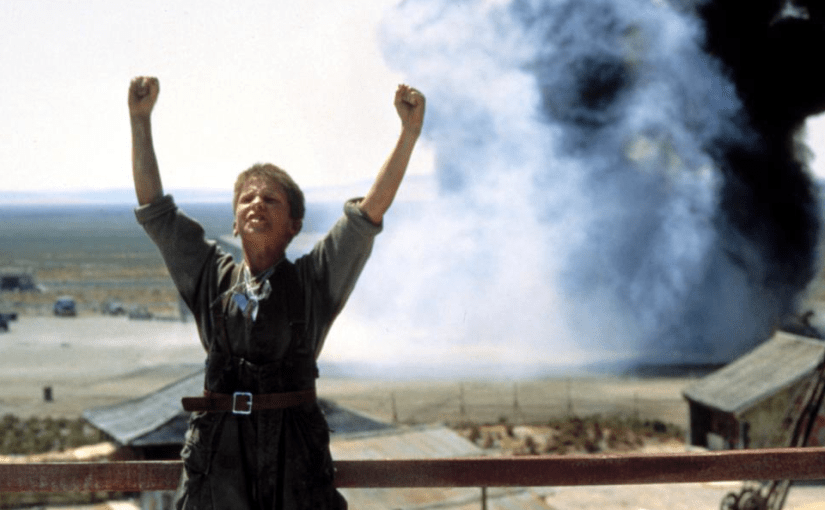
Empire Of The Sun is a marvelous film.  Finally, I got to see it, and now I consider it to be Steven Spielberg’s transition film within his storied career. It’s also one of his best cinematic achievements.

Other than The Color Purple, the majority of his directorial work up to this point in 1987, consisted of adventure and escapism found in cliffhangers and children with the innocent curiosities to uncover what is underneath.  Empire Of The Sun contains all of these elements, but as the film progresses, it matures and grows up right before your eyes. 

Christian Bale makes his introductory role a performance to remember as young Jamey Graham.  He is a British child of unlimited privilege living in Shanghai with his parents, naïve and sheltered from the gradual Japanese occupation taking place in 1941 when China and Japan were in conflict with each other.  Jamey happily plays and gets into adventures with his model airplanes and his imagination of heroics.  One day, while at a costume party, he discovers a crashed war plane and then envisions his fantastical heroism.  Shortly thereafter, the fantasy becomes real when he comes upon a Japanese battalion, just yards away.  With his parents, they make a desperate escape from the city they and their ancestors have called home.  However, Jamey becomes separated from them amid the chaos within the surmounting crowds.  Now, this young child with no sense of self reliance has no choice but to become resourceful if he is to survive and reunite with his mom and dad.

Eventually, Jamey meets up with two Americans named Basie (an outstanding John Malkovich) and his sidekick Frank (Joe Pantoliano).  The three are sent to a Japanese Internment Camp forced to live and survive on bare necessities as the second World War rages on with the Americans joining the fight.

Spielberg treats his protagonist the same as he did with the Elliot character in E.T. The Extra-Terrestrial.  Jamey happily lives in his own imagination until it is disrupted by an intrusion.  For films like Close Encounters Of The Third Kind and E.T., an alien of fantasy interrupts the protagonist’s lifestyle.  For Jamey, however, the reality of war harshly takes over.  It fascinated me how Empire Of The Sun, with a screenplay adaptation by Tom Stoppard of J.G. Ballard’s biographical account, seems to follow a familiar formula to Spielberg’s other pictures, and yet it reinvents itself with reality as opposed to fantasy.

Furthermore, Steven Spielberg does not abandon one of my favorite tropes of his as he makes the unseen the antagonist of the film.  When the veil is lifted, you can’t help but gasp.  Everyone knows he followed this approach in Jaws.  I also like to think he did this effectively with the German tank in Saving Private Ryan.  Here, he caught me completely off guard.  Young Jamey is dressed like Sinbad for Christmas jubilation at a costume party.  He’s happily tossing around one of his model planes and then when it flies out of sight over a grassy ridge, he runs over to the edge and finds something shocking beyond his treasured toy.  It’s a moment that happens early in the film and immediately tells me that this story will be bigger and more frighteningly real than meeting a cute, strange friend from another planet willing to eat my Halloween candy.

Spielberg’s production value is eye opening with thousands of extras within the scenes of mass exodus from Shanghai or within the internment camp.  Especially impressive is how he directs his extras to seem so overwhelming against young Christian Bale.  The child actor really followed direction, but more importantly it’s easy to see how method Bale might have been even at this young age.  He gets pushed and pulled and tugged on like I can only imagine an unforgiving circumstance of war would present itself.  Cinematics often praise Whoopi Goldberg’s debut in The Color Purple as one of the greatest introductions ever.  I have to put Bale’s performance up there as well.  The character arc that young Jamey experiences is well drawn out within Stoppard’s script, but Bale really performs the gradual change of a spoiled brat forced to become resourceful for not only himself but his comrades within the camp.  A director can tell a child actor where to walk or to sit or to stand.  A director can discuss the motivations of a particular scene.  With Christian Bale though, his performance throughout the film seems to remember where his character left off earlier in the story, where it has currently arrived and where it hopes to end up.  This young actor is so in tune with his character’s story. 

You may say John Malkovich serves as the staple mentor that every child protagonist has in so many other stories.  Basie is not that simple though.  A child will be quick to trust anyone he comes in contact with.  Spielberg and Stoppard know it’s not that easy though.  Malkovich is that dynamic actor who never seems forthright with his portrayals.  There’s something he always seems to hide from the audience.  Is he a snake ready to strike?  Is he a gentle pup ready for an embrace?  I never trusted how Basie would end up with Jamey by the film’s conclusion.  Malkovich delivers unpredictability so well.

Miranda Richardson is credited as a once wealthy friend to Jamey’s parents.  She’s not given much dialogue or scene work, but with the times she appears on screen Spielberg gradually breaks her down.  At first, she is well dressed in her finest linens insisting that her husband explain who they are to the Japanese forces.  Later and later in the film, the strength of her proud stature slowly crumbles.  It’s nice work and it’s crushing to watch.

Notable “tough guy” Joe Pantoliano goes through a similar transition.  A capture of him with Spielberg’s camera eventually focuses on a weeping and weak man.  Like much of the film, it is so unexpected.

There are epic overhead shots of panic and riots within the streets of Shanghai.  There are amazing moments where aerial attacks coming from nowhere with Jamey depicted running in a parallel line along the trajectory of a bi-plane.  It’s such a sweeping, personal story but the visual effects and camera work are so impressive as well.  The photography is striking in bright sunlight amid fireball missile strikes.  It is dazzling to watch.

As I noted earlier, Empire Of The Sun is Steven Spielberg’s transitional film.  Once again, he focuses on the innocent, young and unaware hero who is forced to become wise and most especially sensitive to a change in setting and circumstance.  With Empire Of The Sun, Steven Spielberg demonstrated that he could mature himself away from fantasy and embrace reality. 

I think Empire Of The Sun is an absolute masterpiece.

LION (2016, Australia)

by Miguel E. Rodriguez

LION (2016)
Director: Garth Davis
Cast: Sunny Pawar, David Wenham, Nicole Kidman, Dev Patel, Rooney Mara
My Rating: 9/10
Rotten Tomatometer: 84% Certified Fresh

PLOT: A five-year-old Indian boy is adopted by an Australian couple after getting lost hundreds of kilometers from home. 25 years later, he sets out to find his lost family.


It’s as if Charles Dickens came back to life and concocted the plot of Lion.

In 1986, in Central India, a young boy named Saroo, lives with his family, hovering on the knife edge between poverty and desperation.  He and his older brother, Guddu, steal coal and redeem it for two bags of milk.  Their mother asks where they got it, but they do not answer, and she tactfully does not press the question.  One day, Saroo begs Guddu to take him on a week-long job.  At the train station, Guddu leaves Saroo on a bench while he goes to make sure the job is still waiting.  Saroo dozes off, and when he awakes, the station is empty…and Guddu is nowhere to be found.  Saroo wanders onto a decommissioned train and curls up for another nap.  But when he wakes this time, the train has left the station far behind.  He winds up in Calcutta, 1,600 kilometers from his village, with no way to get home or contact his family.  (The end credits inform us that 80,000 children vanish in India every year.)

Plot-wise, there’s not much to distinguish Lion from any number of similar films.  The dreaded words “soap opera” came to mind as the movie progressed.  We get a nice little wrinkle when, after several months of wandering Calcutta and winding up in a government orphanage-slash-prison, Saroo is adopted by a loving Australian family, John and Sue Brierly (David Wenham and Nicole Kidman), who also adopt another Indian boy, Mantosh, two years after adopting Saroo.  Then we jump to 2008, Saroo is now a strapping young man (Dev Patel) who leaves home to go to university in Melbourne, but the unforgettable smell of a specific Indian pastry brings back memories of his childhood, and he decides to find the family he lost.

So, yeah, just another movie-of-the-week on your basic third-tier cable channel, right?  Not exactly.  What distinguishes Lion is its storytelling.  Just like in comedy, it’s all in the delivery.  This was director Garth Davis’s first feature film, but you wouldn’t know it.  The whole movie feels slick and polished.  The establishing or transitional shots between scenes are intentionally reminiscent of the new online research tool that was all the rage at the time: Google Earth.  It’s very subtle, but it’s there, like it was designed to not be noticed until the movie is almost over.

The performances from the adult cast are all great, but what stood out to me was the boy playing young Saroo.  His name is Sunny Pawar.  He was 8 years old during filming, but he is so small he looks 5 or 6.  His story, from introduction until he grows up into Dev Patel, occupies nearly half of the film’s running time, and during that time he must make us feel sorry for him, empathize with him, and root for him every step of the way.  In the hands of an experienced child actor, we might have viewed his performance as just that: a performance.  But Sunny was a non-actor when he was selected for this part, and that makes all the difference.  The look on his face when he finds himself lost is indescribably real.  There’s a scene where he is trying to make himself understood to a ticket agent (he speaks Hindi, but in Calcutta everyone speaks Bengali).  The adults try to move him out of the line, but for a brief instant, he gets furious and shoves the adult hands and bodies away from him.  The rage in that tiny face and in his body language was utterly convincing.  I think it was that moment when I felt I was watching something a little more elevated than a cable melodrama.


Although the story is a bit trite as far as movies go, there’s something to be said about the universality of its message.  There isn’t a soul who can watch Lion without completely understanding Saroo’s desire to find his real family, along with his desire to keep his adopted mother in the dark about his obsession.  I’m not a parent, but I know some close friends who went the adoption route, and I found myself thinking of them and their children, and how they might feel if they found out their kids were actively searching for their real parents.  Lion addresses this heartbreaking scenario in a marvelous scene between the adult Saroo and his mother, Sue, in which she reveals the real reason she decided to adopt.

Saroo’s girlfriend, Lucy, brings up a terrible, but probable, scenario: what if Saroo completes his search, finds his village, and travels to India…only to find his family isn’t there?  It’s been over 20 years.  He believes his mother and brother searched for him, but he can’t really know that for sure.  Maybe they moved away.  Maybe they’re dead.  Saroo doesn’t care.  For him, that chapter of his life must be closed one way or the other or he will feel lost and adrift for the rest of his life.  Closure is everything.

This is another one of those movies where, as an audience member, we’re put through the wringer for about 100 or so minutes so we can experience the full emotional impact of the film’s climax.  At some point, we can surmise that, yes, Saroo is eventually going to travel to India.  What he finds there, I would not DREAM of revealing.  I think it’s safe to say that many people I know would be reduced to tears by the time the final credits roll.  The finale justifies the overall melodramatic tone of the film, especially because of how well the damn thing was made.

Lion is one of the few true-blue melodramas that I would wholeheartedly recommend, even and especially to anyone who doesn’t think they like soap operas.  Dickens would have approved.

A CIVIL ACTION

By Marc S. Sanders

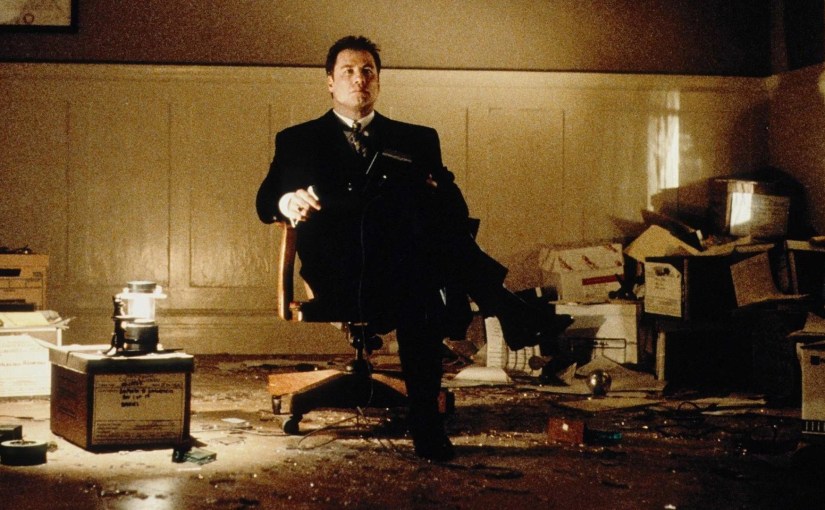
In A Civil Action, writer/director Steve Zaillian allows John Travolta to demonstrate the workings of a remorseless ambulance chasing lawyer with a pride for the finest in men’s wear and the title of one of the most eligible bachelors in Boston, Massachusetts.  Then, all of that crumbles apart when a self-effacing acknowledgment breaks through. 

Travolta portrays real-life attorney Jan Schlictmann, who heads a small personal injury law practice with three partners (Tony Shalhoub, William H Macy and Zeljko Ivanec).  They go after the cases that promise large settlements from hospitals, insurance companies and multi-million-dollar corporations.  The best cases are where the mid-30’s breadwinning male of the household has suffered irreparable damages.  The victim is not deceased, but permanently handicapped, unable to work and provide for his family.  A dead victim is not as theatrically attractive.   Better to put the poor soul in the wheelchair on stage for the winning cash settlement. 

When Jan is boxed into a corner to meet with the residents of a small New England town, he dismisses their case as an unwinnable nuisance.  The townsfolk believe that their children have taken ill, with some not surviving, due to locally contaminated drinking water.  Kathleen Quinlan is one mother who wants an apology and explanation from whoever is responsible.  An apology holds no tangible value for Jan though, until he observes who the primary suspects are likely to be; two large corporations that own well known brands like Peter Pan Peanut Butter, Tropicana Orange Juice, and Samonsite Luggage.  Now the pockets to collect from could go on forever, and Jan does not realize until it’s too late how much of a personal gamble he is undertaking with himself and his partners in tow.

A Civil Action has always left me thinking on so many different levels since I first saw it in theaters.  The value of a life, especially a child’s life, is not very significant when corporate America profits on dollar bills.  The priority of environmental protection and its most precious resource, water, is just as minimal, maybe more.  Zaillian uncovered a fantastic character arc from a very frighteningly sad and true story.   Jan Schlictmann proudly dons an appearance of false care for victims of botched surgeries and car accidents to advance his ego and materialistic nature.  However, then he found a conscience, as he realized that money doesn’t win cases for his clients.  Instead, the acceptance of responsibility triumphs.  That surrendering admittance, though, is not expected to come from these companies.  Not when the burden of proof only comes from a measly platoon of four small town attorneys, who could never bear the expenses of proving such gross negligence and wrong doing.  This is a David & Goliath confrontation. 

Beyond a cast of recognizable faces, there are scenes in this film that just stay with you.  Most especially for me is the unforgiving nature of Quinlan’s suffering maternal character.  She no longer has any care in the world for whatever sacrifices are made by the lawyers to reveal the truth of what happened.  I didn’t think that was fair of her, frankly.  Zaillian demonstrates what these four guys endure as the case prolongs itself.  However, people are unfair.  Sometimes they are unreasonable because they have been pushed down to a bottom they’ll never climb up from.  This movie and the circumstances at play are not here to please me and make me feel good with a tidy ending wrapped in a bow, however.  The script is brutally honest in its characterizations.

What’s also disturbing about this case is simply water.  Countless times, Steve Zaillian gets close up shots of glasses and pitchers of clear, crisp water.  Children are drinking water.  Water is spilled on tables.  Jan’s enemies in trial will indulge in a refreshing gulp from a glass as they finish a scene with him.  The movie reminds you time and again that water is the silent killer.

Robert Duvall is the shining talent on the other side of the aisle from Travolta as an attorney in a fifty-dollar suit with a beat up fifty-dollar briefcase representing one of the large companies that is being sued.  Duvall makes his shark of an attorney appear effortless.  He falls asleep in court.  He tucks away in a corner to listen to the Red Sox play on his transistor radio.  Yet, he’s wise enough to know how to derail an opposing counsel’s case with just his quiet, unspoken presence at the table.  He isn’t even so much a villain or an antagonist as he allows the hero of the film ample opportunity to settle rather than charge on.  His urgencies don’t work however because Jan has changed.  Where he once saw money, he now sees something much more valuable that is beyond any variance of negotiation.  The scenes shared between the handsome, fit and well-dressed John Travolta against the older, short, hunched yet astute Robert Duvall play beautifully here.  There is top notch stage performance work happening here.

It amazes me that A Civil Action is not available on Blu Ray or 4K.  Look at this cast and its direction.  It’s magnificent.  Zaillian’s film moves with a fast pace of easy-to-follow courtroom theatrics.  Additional performances from Sydney Pollack, James Gandolfini, Dan Hedaya, and John Lithgow are so engrossing.  William H Macy is very good too, as the desperate man trying to keep Jan’s cause afloat.  Why is this film not being granted the accessibility it deserves?  I actually had to pay for a streaming rental watch.  No matter, it was worth it.  For like Jan Schlictmann, money is not the most important commodity known to man.  Morality and decency will stretch further than money that’s been spent, never to be replenished.  A noble and most human thing you can do is to experience Steve Zaillian’s film, A Civil Action. Then you will understand what an unjust world any one of us could fall victim to.  Then maybe you will understand the loss a loving mother endures far outweighs any financial liability from a grocery food company.

I, DANIEL BLAKE (2016, Great Britain)

by Miguel E. Rodriguez

Director: Ken Loach
Cast: Dave Johns, Hayley Squires, Briana Shann
My Rating: 10/10
Rotten Tomatometer: 92% Certified Fresh

PLOT: After surviving a heart attack, a 59-year-old carpenter fights bureaucratic rules and regulations to receive Employment and Support Allowance from the British government.


I, Daniel Blake made me mad.  Not because it’s a bad film – it’s a SENSATIONAL film, as a matter of fact.  Not because I didn’t like the characters or the story or the direction…everything is top-notch.  What made me mad was the gross injustices on display from an uncaring, monolithic government agency whose sole aim appears to be to discourage the very people it’s supposed to be helping from applying for help in the first place.

Daniel Blake (Dave Johns) is a middle-aged carpenter who has suffered a heart attack and been told by his doctors that he should not go back to work.  For a while, he receives the Employment and Support Allowance from the British government, but after one of his physicals, the Employment office deems him fit for work, directly contradicting his doctor’s orders.  So now, with no other means of financial support, Daniel must prove that he’s looking for work, even though he can’t go back to work, to satisfy the Employment agency’s requirements.

The amount of bureaucratic run-around on display in this movie is stunningly awful, even more so because it has the ring of authenticity.  The end credits of the film send a special thanks to workers within the appropriate governmental departments who provided “invaluable information, but who must remain anonymous.”  It is literally illegal for employees or even ex-employees to speak publicly about employment assistance.  Really?!

For Daniel, the internet is a foreign country, a foreign planet.  Faced with a mouse for the first time in his life, he holds it up to the computer screen to move the cursor.  But these agencies are converting to “digital by default.”  So, learn he must.  On one of his many trips to a local job center, an employee takes pity on him and starts walking him through the online registration process.  She doesn’t get very far before her supervisor calls her into an office to reprimand her for providing extra help to applicants.  (“You don’t want to set a precedent for these people…”)  Despicable.

The horror-story nature of his predicament is tempered by his encounter with a single mother of two, Katie (Hayley Squires), who is going through a horror story of her own.  Late to a meeting because of getting on the wrong bus in an unfamiliar city, she is informed her employment assistance cannot be extended without an appeal.  Katie is in dire straits, but she is a master at keeping her stress hidden from her children.  Daniel and Katie’s friendship provides much-needed moments of warmth during this otherwise chilling cautionary tale.

Ken Loach directs I, Daniel Blake with a calmness that belies the anger at its core.  It feels like a documentary, much like the Paul Greengrass films Bloody Sunday and United 93, but with fewer stylistic fireworks.  There are no “shaky-cam” shots following the main characters, no camera zooms, no gimmickry of any kind.  There is some movement, but it’s kept to a minimum.  The focus is always on the story.  That simplicity is a big part of what makes this film immensely more powerful than many other similar films that rail against corporate bureaucracies.  (I’d name examples, but you get the idea, I think.)

When the film ended, I wanted to throw something.  I had flashbacks to those first early months of the Covid shutdown in 2020.  I was indefinitely “furloughed” from my job and was forced to go online and navigate the notorious Florida Unemployment website.  I once had to make a call to the main line.  I stayed on hold for three – count them – three hours…only to hear a recorded message tell me they were unable to speak to me and to call again later.

At one point, Daniel receives a notice in the mail that his support is being cut off.  He makes a call so he can file an appeal.  After waiting on hold for 90 minutes, the person on the other end tells Daniel he should have gotten a call from the “decision maker.”  Daniel received no such call.  “Well, you should have gotten the call before you got the letter.”  Daniel asks if he can speak to the decision maker anyway.  “Sorry, I can’t transfer you until he’s called you about the letter.”  But he’s already GOTTEN the letter!  I empathized with poor Daniel to such a degree that it was almost painful to watch.

I seem to be simply rehashing the plot.  The effect I, Daniel Blake had on me is hard to put into words.  It’s so well-made, so well-written, so sharply observant of human behavior and the coldness of a government bureaucracy more intent on process than on actual assistance.  I really felt as if Daniel and Katie were real people.  I smiled when Daniel slyly gives Katie £20 to help pay for the electric.  I shook my head in sorrow when Katie gives in to desperation and shoplifts.  I smiled again when Daniel takes a can of black spray paint to the walls of the Employment Office.  And when the end of the film rolled around…well.  I was right there with them, emotionally, when it happened.  You can’t ask for better filmmaking than that.

THE HUNT FOR RED OCTOBER

By Marc S. Sanders

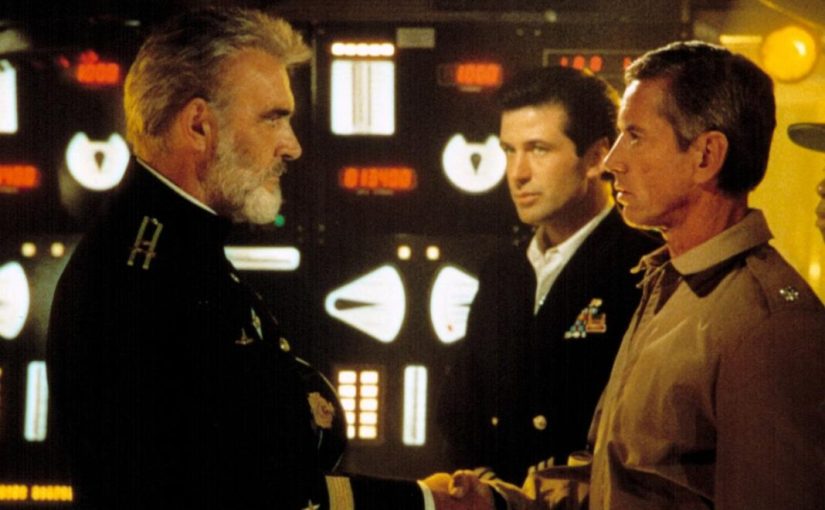
John McTiernan’s adaptation of Tom Clancy’s first bestselling novel, The Hunt For Red October, might seem dated but it’s still a crackling good thriller. It’s one of those films where you truly feel like you’re walking through the secretive hallways of DC government buildings with their elevators accessed only by an Admiral’s key. Soon you’re in a dark, underground boardroom. You’re also there on the various naval crafts and submarines with alarming lights, shiny steel and glowing monitors. The biggest treat is being in the command center of the titled sub, Russia’s Red October, commanded by their captain, Marko Ramius (Sean Connery). All in all, Terence Marsh built a convincing production design.

Clancy’s story takes a different approach than most thrillers involving Cold War politics. Ramius might have been a James Bond villain in another film as he hijacks Red October, but there’s more to him actually. Rather, Ramius wants to defect to the United States. Most of his command crew is in agreement as well. America doesn’t necessarily see it that way; a Russian, missile equipped submarine quickly approaching the eastern seaboard with other subs following him?!?!?!? Let’s not polish the tea set so quickly.

Fortunately, one man had the pleasure of meeting Ramius once and doing extensive research on the General’s background; Jack Ryan (appropriately cast with a young Alec Baldwin). Ryan is given three days to catch up to Ramius and guide him safely to the United States while avoiding getting the famed submarine shot down by either power nation.

I must point out my favorite scene and it actually takes place in that secret boardroom where it dawns on Ryan of Ramius’ true plan. Baldwin is great here. The young guy who is green when it comes to military and political protocol. McTiernan gets his company of generals and high ranking officials into a large quarrel over what to do and then he zooms in on Baldwin thinking for the close up before he calls Ramius a SON OF A BITCH. It’s at this moment, that the movie going consensus and fans of Clancy overall determined that Alec Baldwin was the best of the cinematic Jack Ryans. (No slight to Harrison Ford, who was too middle aged for the role when he took the part).

Connery at least has the commanding appearance of Ramius’ stellar reputation. He is not very exciting or charismatic. Then again, I don’t think Clancy built the character that way. Connery plays the role as silent, yet wise and experienced as implied by his well groomed, white beard and hairpiece plus his square stature. If this man is standing in your presence, you better give him an update. You shouldn’t have to ask if he wants one.

Good moments are made available to Scott Glenn, James Earl Jones, Sam Neill and Stellan Skaarsgard as well. It is the talking scenes among all these fabulous actors that really build tension. The underwater scenes…not so much. The subs look like long, black blobs weaving their way through depths and avoiding missiles coming their way. It’s forgivable because McTiernan always keeps the characters at play. This isn’t a film that relies on the dog fights depicted in Top Gun or Star Wars. McTiernan keeps his audience away from drowning in the underwater murkiness.

The makers of this yarn really are a great combination of imagination. We got Tom Clancy and John McTiernan to thank for a gripping tale from 1990 that still holds up today. The Hunt For Red October is definitely a film worth revisiting.

DIRTY DANCING

By Marc S. Sanders

Dirty Dancing was a major surprise at the box office. For me, it is such an eye opener because of how good it actually is, and how well it still holds up. It’s energetic and fun and a different kind of escape from the endless supply of action films and gross out comedies.

Here’s a film with a no name director, Emile Ardolino (I’m sorry, who????) and produced by…excuse me…Vestron Video???? It did not carry a cast with box office clout either, the tallest guy from The Outsiders and the older, bratty sister from Ferris Bueller’s Day Off. Yet, the film wins out in the end.

“Baby” Houseman (Jennifer Grey) arrives with her family to a Catskills like vacation resort during the summer of 1963. Usually costumed in whites, Baby is as virginal as her moniker suggests. Eventually, she gets taken with the entertainment staff who spend their off hours dancing in, shall we say, a non-conservative manner. Particularly, she falls for the gorgeous head dance instructor, Johnny Castle (macho name, dressed in macho cool blacks with macho cool shades) played by Patrick Swayze.

Every development of their relationship is telescopic. Yes! We know they’re gonna fall in love despite coming from two different worlds. They’re gonna sleep with each other. Then they’re gonna argue. Then they’re gonna make up and then they’re gonna have the big dance to close out the film with one huge extravaganza. However, it’s the material within that grabs me, and much of that is thanks to the chemistry of Swayze and Grey.

The leads dance beautifully together, and when a music montage comes up, it is adoring to see the frustration of the dance instructor with his giggling student. It’s also charming to see them work it out as well. Reader, I’ve seen this stereotypical “chick flick” many times and I still get caught up in it. The movie comes alive in their puppy love with music and dance. Hey, I got a sensitive side to me. What can I say?

The subplots of the film are lacking though. An abortion storyline really is not necessary to assemble all these characters together. Jewish high income guests meet rebellious, but mostly kind hearted, staff members. There are a couple of distracting jerks too. Something more substantial could have been here. Perhaps, a more meaningful acknowledgment where the two parties favor or do not favor each other, and why. Abortion is a heavy subject matter that does not blend well with the rest of this film, though. The fact that the script never even utters the word “abortion” tells me that the film isn’t even sure of itself with this side story.

As well, when one dancer friend (Cynthia Rhodes) needs emergency medical help, couldn’t Baby’s doctor father (Jerry Orbach) just stop to listen for the explanation? Guess not. He just chooses to stop speaking to his daughter. Thus, making it hard for Baby to hang with Johnny. This could all be resolved with a quick sentence of dialogue. As my colleague Miguel suggests however, then there’d be no movie!!! It’s called the idiot plot, I guess.

A third sub plot involves a pick pocket thief and the reveal comes ridiculously out of nowhere. It’s here to give reason for Johnny’s reputation to be threatened one more time, while Baby defends him. Now this storyline has next to no purpose of existing. Johnny’s reputation in the boss’ eyes was tarnished enough already. This is cutting room floor material.

Dirty Dancing is a film that is merited in its special talents, but not necessarily its whole story. The consistently good soundtrack of oldies mixed with some anachronistic 80s tunes work so well. The setting is completely absorbing with its mountainous camp getaway cabins and intermittent calls for entertainment activities like with its social director (played deliberately corny by comedian Wayne Knight). It feels authentic and escapist. Therefore, I look past those silly plot developments that scotch tape one enthralling moment of dance, sex appeal and music for another.

This most recent time of watching the film was especially fun as I got to witness my twelve-year-old daughter seeing it for the first time. Nothing shows how special a movie, any movie, can be than to see your daughter slap her face when Baby chickens out from doing “the lift” with Johnny during a dance performance. Later, when she finally accomplishes that feat, my daughter sat up with a huge smile on her face. If you ever ask me why movies are so special, I might just have to reiterate this experience when I watched Dirty Dancing with my Julia.

SEARCHING FOR BOBBY FISCHER

By Marc S. Sanders

In a game of chess, if your queen is taken, it might mean a permanent loss of what was thought to be a god given talent. Seven year old Joshua Waitzkin does not realize that, and thus it allowed him to become the greatest chess champion in the country.

Josh (Max Pomeranc) is not a chess player. Josh is a boy who plays chess, as well as baseball. He also builds Legos, plays Clue and does just about anything else including fishing with his dad. He knows this about himself. The problem is the adults in his life only see chess, and nothing else. Writer/Director Steve Zaillian assembles a film that turns the world’s most historic board game into a means of recognizing self-worth and the limits of talent with its correlation to identity.

Josh gains influence from a cutthroat formal chess instructor named Bruce (Ben Kingsley) who doesn’t just teach chess but also offers guidance in manners of contempt and dislike for your opponent. It helps that he recognizes Josh’s talent but is Bruce coaching with the best intentions?

Contrary to Bruce is a city park speed player named Vinnie (Laurence Fishburne) who reminds Josh to always play on offense. Play the board, not the opponent. Josh’s father (Joe Mantegna) only sees victory through beautiful trophies. When Josh loses interest in champion accomplishment, his father only sees nothing but failure. His mother (Joan Allen) sees the boy losing his boyhood.

These are all good people and necessary for Josh. The conflict lies in the clash of their different ideals. I love that. There isn’t a villain here. There’s a debate.

Zaillain devotes time to footage of renowned champion Bobby Fischer who eventually went into seclusion probably due to the lack of any worthy challenger beyond himself. The worry of the film lies in whether Josh will end up with the same sad fate of Fischer. Everyone is on the hunt for the next Bobby Fischer. Does everyone want to be the cruel, cold and isolated Bobby Fischer, though; a man with talent yet also hates his talent?

Zallian films very effectively in a majority of close ups, hardly showing the surroundings of the settings. He wants his camera to maintain a tunnel vision to only allow Josh, and those that discover and observe him, per se, to see what’s directly in front of him. Nothing else. Nothing but the chess pieces on a board and how many moves until check mate arrives are all that matters.

The film edits beautifully in sound as the speed play pounds the chess pieces in an aggressive music accompaniment. Pieces are KNOCKED onto the board, and when a queen is taken it is SLAMMED on to the table. A person has ultimately been disabled and weakened. When check mate eventually comes, the king piece weakly drops over.

Josh is not proud of his ability to conquer. He’s proud of his ability to play.

NIGHT FALLS ON MANHATTAN

By Marc S. Sanders

Sidney Lumet is the director known for shining a light on police corruption. His films were not crime dramas or legal thrillers really. They were an examination in what turns righteous professions within the confines of law and order into something tainted in violations of morality. Night Falls On Manhattan showed what can happen when the politics of New York City could be stained by the policemen who lost their sense of distinguishing right and wrong.

Andy Garcia plays Sean Casey, a newly deputized, very green district attorney and former street cop. His image looks perfect to prosecute a big time drug dealer who wounded his own policeman father, Liam (Ian Holm), and killed two other cops. Richard Dreyfuss does an inspired Alan Dershowitz personality portraying the defense attorney for the dealer, by angling a theory that police corruption is unfairly working against his client. It seems like a very open and shut case for Sean, which occupies the first half of the film.

Afterwards, Sean appears to have a white hot image in the public eye and he is quickly nominated and wins an election as Head District Attorney for the city, following a heart attack from the incumbent and his boss played by Ron Leibman. Conflicts arise though when it is uncovered that perhaps Liam, along with his partner Joey (James Gandolfini), have been taking money under the table as part of a group of dirty cops spread among three precincts.

Sidney Lumet’s films always present topical and complicated real life problems with no expected solutions. These issues of transgressions exceed any kind of quick fixes. He’s shown this time and again with films 12 Angry Men, Serpico, and The Verdict. With his original script here, Lumet gets a little personal. What can you do when a city relies on your image of ethical practice, but your own loving father may be a traitor to the laws he’s vowed to uphold? How can Sean work ethically for his constituents while his father and his longtime partner are possibly betraying sworn policy?

I was always engaged in Night Falls On Manhattan. What is Sean going to do? The dilemma is never patched up with a band aid. It actually feels like it gets worse and worse because it is next to unsolvable. Cops are heroes in this film and a cold blooded killer seems to have been rightfully sentenced? So how can Sean, Liam, Joe and the rest of the cast live with themselves when the end results they wanted all arrive, but came about in all the wrong ways?

This is a terrific assembly of talent. Most especially, credit has to go Ron Liebman as the head DA whose overbearing loud mouth is necessary for the city that never sleeps and the endless amount of police troops and city prosecutors he has to answer for. If New York City had an actual voice that emanates and speaks the endless noise of the Big Apple , it is Ron Liebman. He should have been Oscar nominated. He comes carved out of the concrete of the city landscape.

This is really an unsung picture of Lumet’s that should be seen, much like Find Me Guilty with Vin Diesel. My one issue is the preachy monologue that Sean delivers at the end of the picture. It comes off like a concluding statement and left me with the impression that the conflict of the story painted these characters into an inescapable corner. So, tack on a speech to bring on the credits. The monologue just didn’t work for me though. It didn’t give me that bookended impact I was hoping for.

Other than that, however, Night Falls On Manhattan is another fine piece of filmmaking rooted in a metropolitan setting that becomes a character all its own. Lumet was a genius about acknowledging his settings. This is another perfect example.

GRAN TORINO

By Marc S. Sanders

I had a few reasons to watch this movie. One, a good friend, Greg Spiegel, had given this film his full endorsement on a number of occasions. Two, as some of you know, I’ve been a huge admirer of Clint Eastwood for as long as I can remember, since age 8 or 9 I imagine, when I saw his Dirty Harry films and even Fido Beddow in Every Which Way But Loose (and its sequel; those films are much better than maybe they are given credit for actually).

Eastwood matured as a filmmaker during the mid 80s and on into the present. He transitioned into films that delivered messages that sometimes even contradicted his past films as the gunslinger who never asks questions and always knew where to shoot. Films like Unforgiven and A Perfect World really showcase the tragedies of violence perfectly, and I think Gran Torino is worthy of being added to that list.

Eastwood plays Walt Kowalski, a racist Korean War veteran, who never left the war he used to fight in. The war comes home with him 50 years later to his Michigan neighborhood where he seems to be the only Caucasian American to live among a melting pot of other races; highlighted especially here are his Hmong neighbors who look past Walt’s prejudices to befriend him following his unintended gesture of protection from an intrusive gang. From there, Walt makes a bond with young Tao, a boy with no male influence in his life, and Tao’s sister.

Eastwood is probably the best director to direct himself. He knows how to position his camera and lighting, or lack thereof, to carve out the lines on his face and hide himself in haunting shadows to show a riddled history to Walt. He also adheres to similar themes that worked well in other films. A defiance to religion represented by a young minister looking to help Walt is reminiscent to the sarcastic approach Eastwood’s character used in Million Dollar Baby. The neglect of a protagonist’s family, and most especially, the connection of the pessimistic old man with the young child, barely adult, as well echos the Clint Eastwood/Hilary Swank pairing in that film. I don’t mind if it’s a repeat actually. Relationships like these are hardly shown in films these days, and I think they are important. Films like Harold & Maude and The Karate Kid show that gaps in generations are not an excuse to separate ourselves. (Heck, I even attempted it when I wrote my play, Arnie & The Itch.)

Eastwood has great, uncompromising racial affection (yes, those two words work nicely here) with his two Asian co-stars Bee Vang and Ahney Her, who are well cast in their own right.

Name calling is a method of maintaining a relationship in a film like this. The PC bandwagon is tossed out so the actors, especially the minority Asians, find something more wholesome to a prejudiced old coot.

The language is strong in Gran Torino, but I say it’s an important film to show to many kids to learn of a neighbor’s tolerance; of what goes on behind a closed door or even if that neighbor sits quietly on his porch with a dog by his side and a beer in his hand. We learn of the roads they have crossed, the battles they have fought, and the accomplishments they’ve made. Learn from these people. Learn from the humanity they carry; the honest humanity that may look offensive on the outside yet is present due to a tormented history inside.

I could say “these whipper snappers with their phones” but it’s honest frustration. It’s hard to learn what a person really is by means of a handheld device. To learn about a person, you have to eat with them, work with them, speak to them and even appreciate their 1972 restored Ford Gran Torino, automobile.

This was a great effort in performance and production from Clint Eastwood. I’m glad I watched it finally.