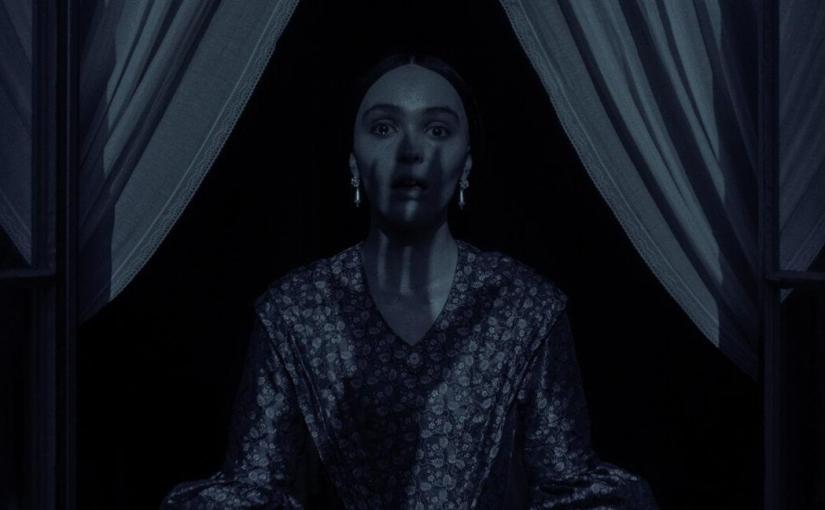
X (2022)

by Miguel E. Rodriguez

DIRECTOR: Ti West
CAST: Mia Goth, Jenna Ortega, Brittany Snow, Kid Cudi
MY RATING: 10/10
ROTTEN TOMATOMETER: 94% Certified Fresh

PLOT: In 1979, a group of young filmmakers set out to make an adult film on a rural Texas farm, but when their elderly hosts catch them in the act, the crew find themselves fighting for their lives.


I like great horror, but I have never enjoyed slasher films, with the clear exceptions of Halloween [1978] and Psycho [1960].  They tend to fall too easily into the formulas lampooned in Scream [1996] and The Cabin in the Woods [2011] and lose all suspense when the stories cave in to ancient tropes and traditions.  You’ve seen one bloodthirsty masked strangler/slasher/axe-murderer jump from behind a tree at night, you’ve seen them all.

So, how do I explain my delight and gushing praise for X, the indie horror phenomenon that turned Mia Goth and director Ti West into industry darlings?  I can only report that, despite following timeworn traditions of the genre, this film somehow found a way to ratchet up the tension to almost unbearable levels.  I’m not exaggerating.  The night I finished watching it, I found it impossible to fall asleep right away.  My mind was racing and rehashing what I had just seen.  It is the creepiest, scariest horror film I’ve seen since Hereditary [2018], and I freaking LOVE Hereditary.

The plot is right out of Slasher Films 101.  The year is 1979.  An aspiring group of wannabe porn stars pile into a van and head to a rural Texas farm where the crusty owner has agreed to rent out his barn and guesthouse, ignorant of this motley crew’s true motives.  The composition of the group reads like the beginning of a dirty joke: a cowboy, a film school graduate, his mousy girlfriend, two strippers, and a black guy (Kid Cudi…yes, that Kid Cudi).

Upon their arrival on the farm, ominous music and occasional breathy noises on the soundtrack tip us off that something just ain’t right…not to mention the blood-soaked prologue.  The elderly farmer, Howard, has an elderly wife, Pearl, but we don’t see much of her at first.  There’s a magnificently tense scene when one of the strippers, Maxine (Mia Goth), skinny dips in the lake behind the farm, unaware of the gator eyeing her from the opposite bank.  It slithers into the lake just as Maxine starts to swim back to the dock.  An overhead shot shows Maxine swimming leisurely, and the gator getting closer and closer, and…I mean, I’ve seen scores, if not hundreds of movies with similar scenes, and very few of them evoked the kind of terror I felt as that gator closed in on Maxine.

Why?  This isn’t even a monster movie about a killer gator, it’s a – let’s be honest – formulaic movie with creepy old people and a slew of young people just waiting to be dispatched in hopefully creative ways.  But something about how Ti West directed this film got right under my skin, in a good way.  Even in the gloriously retro scenes when the ersatz film crew is shooting a sex scene, there is still an undercurrent of unease over the whole enterprise.  (And by the way, if I were to make a list of things I didn’t think I’d ever see in a movie, a topless Brittany Snow in a brief-but-raunchy sex scene would be really close to the top.)

It’s hard for me to describe the intensely creepy atmosphere in writing, especially because I want to preserve the film’s surprises for anyone who hasn’t seen it yet…and boy, I wish I could be there to watch it with you.  There’s the scene in the farmhouse between Maxine and the farmer’s elderly wife, Pearl, where you have absolutely every reason to believe it’s about to turn all Texas-Chainsaw, and then the scene abruptly pivots.  Pearl looks like your stereotypical crazy old lady; that’s the best way I can put it.  I seem to remember a few characters who looked like her in the background of Shutter Island [2010].  We learn a little bit about Pearl’s past, and we can see that she’s sharper than she looks…or maybe she’s just crazy.  I’m not sayin’.

When things heat up around the halfway mark, the tension factor skyrockets.  I learned a phrase a while ago that captures it perfectly: the film becomes a stress sandwich.  Situations arise that we’ve all seen before, but in this movie I was on the edge of my seat waiting to see what would happen next.  When Jackson (Cudi) searches the lake at night and makes a creepy discovery right out of Hitchcock.  When “Don’t Fear the Reaper” plays at a critical moment.  When Lorraine (Jenna Ortega…yes, that Jenna Ortega) goes to the cellar looking for a flashlight.  When a soundly sleeping Maxine gets some unwanted physical contact from a nocturnal visitor.  (That sound you just heard is me shuddering.)

I could write more about the plot, but I would give something away, I’m sure.  To call the film’s finale satisfying is a vast understatement, right down to the very last line that, in my book, is as perfect as “Nobody’s perfect!” or “Tomorrow is another day!”  Ti West has created a slasher movie for people who hate slasher movies, and it’s one of the best modern examples of the genre that has ever been made.

(P.S.  Don’t spoil this for yourself by Googling it or anything if you don’t already know, but make sure you watch the closing credits.  When I saw the name of the performer who plays “Pearl”, my jaw dropped.)

FORCE OF EVIL (1948)

by Miguel E. Rodriguez

DIRECTOR: Abraham Polonsky
CAST: John Garfield, Beatrice Pearson, Thomas Gomez, Marie Windsor
MY RATING: 8/10
ROTTEN TOMATOMETER: 100% Fresh

PLOT: A crooked lawyer working for a numbers-running “combine” nevertheless tries to get his older brother to quit the racket himself when an even bigger combine tries to move in.


On the surface, Force of Evil looks and feels like a B-movie: low production values, populated by talented bit players elevated into larger roles [John Garfield being the exception, naturally], and looking like it was shot on the fly by a television crew.  Of course, reading that sentence back to myself, I realize I could also be describing Hitchcock’s Psycho [1960], but Force of Evil feels even more low rent than that.  There are shadows present in brightly lit rooms that could only be caused by stage lights behind the camera.  Oddly timed edits draw attention to themselves and threaten to take the viewer out of the movie.  The female roles are literal representations of the so-called “Madonna-Whore” complex, limited to expressions of fluttering tension or full-on seduction.  The dialogue, at least near the beginning, is filled with legal and financial jargon that had me rewinding a couple of scenes to try to digest what the characters were saying.

And yet, Force of Evil exudes a strange power through its unique use of language and the borderline-Shakespearean nature of its tragic story, involving a crooked lawyer (John Garfield) who works for a numbers racket, but nevertheless tries to convince his older brother to quit the business when a larger “combine” threatens to take over.

John Garfield, God love him, was no Brando or Bogart, but in this movie, the screenplay provides him and everyone else with dialogue that feels lifted out of a stage play that was translated into English from some foreign language.  Here’s a line from Leo Morse (Thomas Gomez) to his younger brother, Joe (Garfield):

“Do you know what that is, Joe?  Blackmail!  That’s what it is!  Blackmail!  You’re crazy!  You’re absolutely crazy mad!”

Another example:

“All right.  I am sensible.  I am calm.  I’ll give you my answer calmly and sensibly.  My final answer.  My final answer is finally NO.  The answer is no – absolutely and finally no, finally and positively no!  No, no, no!  N – O!”

To call that kind of language “stylized” is an understatement.  The repetitive words, the broken-up clauses…tilt your head and it could almost read as poetry.  In fact, in Martin Scorsese’s introduction on the Force of Evil Blu-ray, he relates a story where a critic watching a screening of the film exclaimed, “My god, it’s written in free verse!”

While I acknowledge the screenplay’s poetic form, I found an even more contemporary comparison: David Mamet.  I semi-recently watched his film Homicide [1991] and wrote in my review that “…Mamet’s signature word choices…suggest an almost Shakespearean construction, as if the words are being shoehorned into a buried structure or pattern that operates subconsciously…trying to create a mood reminiscent of Greek tragedy…”  Those words apply equally well to Force of Evil’s screenplay by director Abraham Polonsky and Ira Wolfert.  I got a distinctly Mamet-esque vibe from the dialogue in this 1948 film, with just a dash of Aaron Sorkin, perhaps.

(Ebert once said that Pulp Fiction [1994] is a movie that he could watch with the picture turned off, just so he could listen to the crackling dialogue.  Force of Evil could just as well fit that mold, in my opinion.)

There’s even a Mamet vibe to Garfield’s acting style, as he rarely cracks a smile or any other expression for the entire film; we only sense changes in tone by the volume of his voice, not by the expression on his face…much like the lead actors in Mamet’s House of Games [1987].  That stylization sets Force of Evil apart from many of its film-noir counterparts.  To be sure, other noirs have their share of stylized dialogue and characters, but this movie sets some kind of stylization bar that must be heard to be believed.

The story can be summarized easily (see the top of this review), but it is powerful in its simplicity, at least when it comes to the interplay between Joe and his older brother.  As for the female characters, they are sadly stuck in placeholder roles that are there either as eye candy (Marie Windsor, a film-noir regular in her first major role) or as the young woman, Doris (Beatrice Pearson), helpless before the wiles of a wicked smooth-talking man like Joe Morse.  No Ida Lupones or Barbara Stanwycks or Lauren Bacalls here.  However, there is an interesting conversation between Joe and Doris that gives us an interesting insight into Joe’s character, as well as hiding a discussion of moral relativism in plain sight.

Joe is doing the ‘40s film equivalent of “putting the moves” on Doris, telling her baldly that she WANTS him to be wicked to her, “because you’re wicked, really wicked…you’re squirming for me to do something wicked to you – make a pass for you, bowl you over, sweep you up, take the childishness out of you, and give you money and sin.  That’s real wickedness.”  In so many words, he’s telling her that she’s ASKING for it.  This is not a nice man.  He goes further.  He tells her:

“If I put my hand in my pocket and gave you a ruby, a million-dollar ruby for nothing, because you’re beautiful and a child with advantages and because I wanted to give it to you without taking anything for myself – would that be wicked?”

In Joe’s mind, charity isn’t just for suckers, it’s downright evil.  Doris mounts a good defense, telling Joe how she hasn’t been fooled by magicians or smooth-talking men since she was a little girl.  Joe keeps following his path of logic, but an interesting thing happens.  He incriminates himself, and at the end of the scene he seems to realize it:

“To go to great expense for something you want, that’s natural.  To reach out to take it, that’s human, that’s natural.  But to get your pleasure from not taking, from cheating yourself deliberately like my brother did today, from not getting, from not taking…don’t you see what a black thing that is for a man to do?  How it is to hate yourself and your brother, make him feel that he’s guilty, that…that I’m guilty?”

There’s that free verse in action again, with those repetitive phrases.  His own amoral code trips him up, and the camera lingers on Joe’s haunted face for a moment before we fade into the next scene.  I mention this exchange because it’s so atypical of even some of the greatest noirs, which are usually full of hard-boiled dialogue about heaters and button men and glamorous dames.  In Force of Evil, we’re invited to turn inwards with our anti-hero and compare our definition of evil with his, as Doris does later in the film.

The film ends with several scenes of shocking violence, including a murder that looks inspired by Battleship Potemkin [1925] and a three-way shootout in a darkened office.  There is a remarkably evocative shot as Joe hurries down a staircase, and it appears as if he is making his own descent into hell.  Force of Evil has recently been critically re-evaluated; after years of being dismissed as nothing more than an assembly-line noir thriller, it was recently restored by UCLA and the Film Foundation and was also selected to the National Film Registry.  It’s not the greatest film noir I’ve ever seen, but if you’re a fan of the genre, you owe it to yourself to hunt down a copy and give it a look…or more appropriately, a listen.

A COMPLETE UNKNOWN (2024)

by Miguel E. Rodriguez

DIRECTOR: James Mangold
CAST: Timothée Chalamet, Edward Norton, Elle Fanning, Monica Barbaro, Boyd Holbrook
MY RATING: 9/10
ROTTEN TOMATOMETER: 79% Certified Fresh

PLOT: In 1961, Bob Dylan arrives in NYC for the first time.  Four years later, his groundbreaking performance in Newport changed the music world forever.


The 1994 documentary Hoop Dreams began as a small-scale, 30-minute project concentrating on two inner-city boys who dreamed of making it to the NBA.  It was supposed to cover only a few months in their lives, but as their stories progressed, the filmmakers just continued filming, and the sprawling documentary eventually covered five years and became an absorbing three-hour odyssey.

In a weird way, that’s how I felt about James Mangold’s Dylan biopic A Complete Unknown.  The movie opens with no backstory, no flashbacks, just a disheveled young Bobby Dylan (Timothée Chalamet) arriving in 1961 New York City with his guitar, determined to meet his idol, legendary folk singer Woody Guthrie, hospitalized at the time with Huntington’s disease and no longer able to sing or speak.  In Guthrie’s hospital room, Dylan also meets another folk legend, Pete Seeger (Edward Norton), in what must count as one of the greatest musical summit conferences of all time.

The way this scene is shot, it almost feels like, after it’s over, it could be the end of a marvelous short film about three legends bumping into each other.  But, like Hoop Dreams, this biopic remains focused on the unknown Bobby Dylan, with his nasal whine and preternatural gift for lyrics, for five years.  He eventually gets more and more exposure and cuts his first album.  Along the way, he meets two women who will be his emotional touchstones during the film: the celebrated Joan Baez (Monica Barbaro), whom Dylan accuses of being and singing “too pretty,” and Sylvie Russo (Elle Fanning), who becomes his girlfriend despite his flirtations with Ms. Baez.

But throughout the film – and this is one of the reasons I enjoyed it more than I thought I would – we remain focused almost exclusively on Dylan, the man and his music.  We are treated to countless scenes of Dylan performing live, Dylan recording in a studio, Dylan scratching out a new song note for note and word for word.  If a soundtrack album were ever compiled of the full-length versions of all the songs we hear in A Complete Unknown, I have to believe it would be between two to three hours long, if not more.

Why did I react so favorably to this kind of treatment?  My two favorite musical biopics of all time are Ray [2004] and Amadeus [1984].  Amadeus certainly contains a LOT of music, much like A Complete Unknown, but we are given a lot of background information into Mozart’s life, his relationship with his father, his childhood years, and so on, whereas the Dylan film presents him as a blank slate without a single flashback to his younger years.  Ray is much more in the vein of your “traditional” musical biopics like Walk the Line [2005, also directed by Mangold] or Bohemian Rhapsody [2018], containing the standard story beats of struggles in their personal lives, a haunting past, liberal-to-moderate use of flashbacks, you get the idea.

I suppose part of my enjoyment of A Complete Unknown stems from the fact that, even though I’m not a Dylan fan, or Fan with a capital F, I appreciate the songs themselves, with their intricate lyrics and folksy rhythms, so I thoroughly enjoyed the myriad musical breaks.  I also liked the way the movie did not spoon-feed me chunks of information it felt I needed to know.  Instead of the movie telling me how I should feel about a scene or a moment with clunky dialogue or exposition, it simply presents a situation and kind of stands back from it, allowing me to form my own emotional reactions to the material.  That’s a tricky storytelling method; one false step and you’re left with a story with no heart, no meat in the middle.  But A Complete Unknown pulls it off extremely well.  I’m sure there’s a way to explain how they did it, but I’m not the one to try.  I just know that it works, and that’s enough for me.

Any discussion of this movie must necessarily include Timothée Chalamet’s magnetic performance as Bob Dylan.  It is destined for an Oscar nomination.  I am reliably informed that Chalamet did all the singing himself (as did Norton and Barbaro as Seeger and Baez, and Boyd Holbrook as Johnny Cash), and he went to great lengths to mimic Dylan’s trademark sound.  Combined with the pitch-perfect hair and makeup, it really feels like the real Dylan onscreen, especially when the movie jumps forward to the Newport Music Festivals of ‘64 and ‘65.  Of course, I wasn’t alive back then, but I have seen pictures and documentary footage of the man himself, and Chalamet is utterly convincing.  Even if you’re not a Dylan fan, this movie is worth watching just to see Chalamet’s performance…he’s that good.

My colleague, Marc Sanders, mentions in his review how the production design of the film went to great lengths to recreate early-1960s New York City, and I second that statement.  It’s as utterly convincing as Chalamet himself, especially when it comes to the various “underground” music clubs Dylan performs in, clubs where the folk music revolution was born.  I get the feeling that anyone who watches this movie, who was also alive at the time, will be easily transported back to that era when Kennedy’s Camelot was in full swing, as was the hippie movement, the folk movement, the civil rights movement, the Cold War, the Beatles.  There are aspects of this film that I may never fully appreciate since I was born in the early ‘70s, but I get the gist.

I feel compelled to rebut a specific argument from my girlfriend, who did not like the movie because it did not give us any real background information about who Bob Dylan really is.  (We only get a single tantalizing glimpse when someone leafs through one of his old scrapbooks that had been delivered to a “Mr. Zimmerman.”)  All the movie does, so her argument goes, is present us with a performer singing his music, culminating in a pivotal big concert, of which the same could be said of many other biopics that came before.  A Complete Unknown could just as well have been about Richie Havens, or Jerry Lee Lewis, or Janis Joplin, or anyone else.  There is no real personal conflict presented in the film.

To which I have to say…that’s not quite true.  I acknowledge the absence of background story and flashbacks, but for me, as I said, that’s a strength, not a weakness.  It follows the theme set up by the film’s title, after all.  Also, there is a real conflict in the story, as Dylan, after becoming the figurehead for the folk music movement in America, takes the unprecedented step of recording an album and performing live songs that are (gasp!) non-acoustic.  He complains that his fans want him to sing “Blowin’ in the Wind” for the rest of his life. This generates shockwaves throughout the folk community, and at one of his concerts where he performs an electric set, the crowd jeers, throws trash at him, and even calls him “Judas.”  That pretty much counts as “conflict,” in my opinion.

A Complete Unknown goes down as one of the best films of 2024 that I’ve seen.  For Dylan fans, it is an absolute must-see.  For fans of great acting, it’s also a must-see.  If you’re not a Dylan fan at all, well, it’s not likely to change your mind, but do yourself a favor and give it a chance.  Not many musical biopics, or films of ANY kind, are made this well and with as much loving care as A Complete Unknown.

RED ONE (2024)

by Miguel E. Rodriguez

DIRECTOR: Jake Kasdan
CAST: Dwayne Johnson, Chris Evans, Lucy Liu, J.K. Simmons
MY RATING: 8/10
ROTTEN TOMATOMETER: 30%

PLOT: After Santa Claus is kidnapped, the North Pole’s Head of Security must team up with a notorious hacker in a globe-trotting mission to (all together now) save Christmas.


Jake Kasdan’s Red One is by no means perfect, but it is not nearly as bad as the plethora of negative reviews would have you believe.  The Rotten Tomatoes website lists such jabs as:

  • “…forgettable as a first dusting of snow.”
  • “…offers big-budget visuals but lacks soul…”
  • And my favorite: “An ugly, under-lit, joyless slog, devoid of any holiday charm or sense of fun.”

Let me first address that “under-lit” comment.  I first attempted to watch this movie at our local AMC cineplex, and I noticed that the ads and previews were so dim that parts of the screen looked almost black.  I petitioned the manager to adjust the projector settings twice, but to no avail.  (“That projector has been giving us problems for two weeks.”)  When the movie started and it was just as dark as the previews, I gave it up as a lost cause, left and got a refund, and streamed it on Prime instead, and on our big-screen HD TV, presto, no more under-lit areas.  Everything was perfectly visible, clear, and bright.  So, it’s entirely possible that that reviewer’s issue with the screen being “under-lit” could have been a projector issue, and NOT a problem with the film itself.  Just wanted to throw that in there.

As far as those other negative comments go, well, I don’t know what kind of mindset those folks were in as they watched Red One, but it’s difficult for me to comprehend how anyone could call it “joyless.”  I found it charming and funny myself.  But then, when it comes to holiday movies, I have always been partial to the ones that attempt to provide logical solutions to the massive logistical problems involved in getting one man to travel the entire globe in a single night, delivering presents to every household that’s waiting for them.

For example, in The Polar Express, we are treated to a semi-industrial North Pole that runs like clockwork and (thanks to convenient time dilation) can get everything into Santa’s sleigh so he can dash away just before midnight. Red One ups that ante right from the get-go.

After he has taken a brief holiday in the city – masquerading as, of course, a mall Santa – the real Santa Claus, call sign “Red One” (J.K. Simmons), is driven to the nearest military airbase in an armored limo with a motorcade escort.  Accompanying him is his Chief of Security, Callum Drift (Dwayne Johnson)…because of course the real Santa would have a bodyguard.  It just makes sense.  Then, at the airbase, under blacked-out radar coverage, Santa’s state-of-the-art sleigh, powered by eight gigantic reindeer and carefully monitored by NORAD, takes off for the North Pole with a fighter jet escort.

I dunno, man, I just ate this stuff up with a spoon.  The imagination and attention to detail that went into creating this version of the Santa mythology brought a smile to my face for pretty much the entire movie.  Another example: I mentioned to my girlfriend that this version of Santa Claus is not very fat, which is usually a given.  But then there’s a scene where Santa lifts weights in a gym as Drift spots him, and I thought, okay, I can buy that.  Santa needed to drop a few pounds. It sounds absurd writing it out like that, but I’m telling you, for me it all made sense.

So, like I said, right away I was on board with the logistics of the story.  Then the real plot kicks in when Santa is kidnapped under everyone’s noses by a gang of bad guys who manage to infiltrate the North Pole’s highly sophisticated defensive measures.  The only way Drift and his colleagues will have a chance of retrieving Santa before Christmas Eve is with the help of Jack O’Malley (Chris Evans), a talented but amoral tech genius who claims he can track down anyone, anywhere, anytime.

There’s the usual backstory of Jack’s son who lives with his mother and her husband, and Jack was never father material to begin with, but the son is going to play in a concert on Christmas Eve, and so on.  I’m not saying this material is irrelevant, but for me it was secondary to my enjoyment of how the filmmakers were treating all the mythological/fantasy/sci-fi material.  We get talking polar bears [not the Golden Compass kind, the Zootopia kind], murderous snowmen who are seemingly invincible, tech gadgets that turn Matchbox cars into full-size vehicles [I want one!], a whole new use for Rock ‘Em Sock ‘Em Robots, and we even get to meet Santa’s brother.  Yep…his brother.

I mention all these details because they are what I responded to mostly during the film.  The plot?  The plot is, let’s face it, standard thriller fare, with a reasonably interesting big-bad and hidden connections and a few surprises, but because the filmmakers went to such great lengths to provide a fascinating backstory for all the mythological characters and how the North Pole is organized logistically, I didn’t particularly care if the story was perhaps shallow and mildly predictable to anyone who has seen more than 10 movies in their lives.  I’m not ashamed to admit it.

But because of how the filmmakers were telling the story this time around, I just ate it up.  Dwayne Johnson and Chris Evans are a decent screen pairing.  Bonnie Hunt as Mrs. Claus was a treat.  Lucy Liu was perhaps the most wasted of the entire cast, although she does get one very brief kicking-ass scene.  The motive behind Santa’s kidnapping was credible.  There was nothing in the movie that broke its own set of rules, which is more than I can say of quite a few would-be thrillers out there.

Heck, I’m just gonna say it: Red One is the Galaxy Quest of Christmas movies.  You either buy into the preposterous, but logically sound, premise and laugh for a while, or you don’t.  As for me, I’ll be watching this one again next Christmas.  Or maybe sooner.

BLACK ORPHEUS (France, 1959)

by Miguel E. Rodriguez

DIRECTOR: Marcel Camus
CAST: Breno Mello, Marpessa Dawn, Lourdes de Oliveira
MY RATING: 8/10
ROTTEN TOMATOMETER: 88% Certified Fresh

PLOT: The Greek myth of Orpheus and Euridice is translated into a modern-day story (with an all-black cast) set in during Carnaval in Rio de Janeiro.


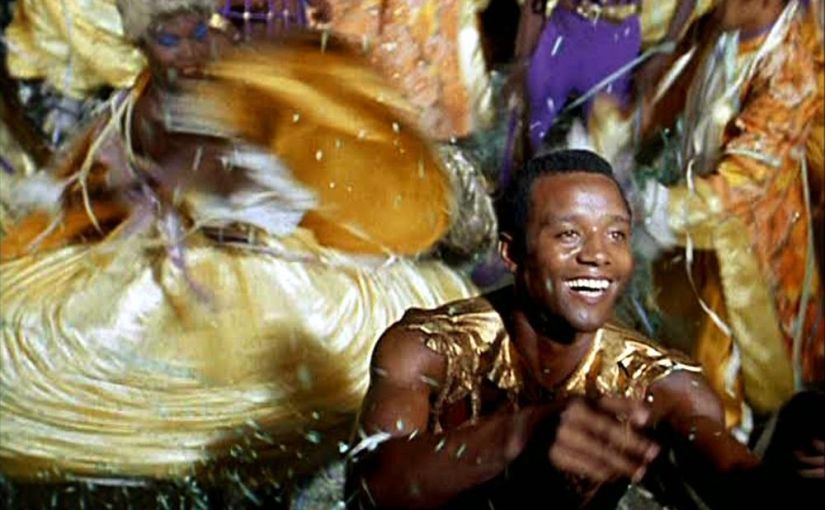
In the first two-thirds of Black Orpheus, there are scarcely more than 2 minutes strung together at a time without some kind of music or sound effects thumping away in the background.  This gives the film a subtle real-world backdrop, which is good, because Black Orpheus is a fantasy through and through.  Critics, now and at the time of its release, complained that French director Marcel Camus ignored the reality of the Brazilian favelas, or slums, in favor of depicting Rio as a non-stop party.  This is a valid point.  However, I believe that, in this movie, reality has no place.  This is a love story, a myth, a tragedy, and a travelogue all rolled into one.  Reality must take a back seat in movies like this.

(And, heck, somebody must have liked it because it won both the Palme d’Or at Cannes AND the Best Foreign Film Oscar that year, a rare feat.  True, there were extenuating circumstances [numerous French critics had problems with the emerging French New Wave], but let’s not turn this into a classroom, shall we?)

If you’re familiar with Greek mythology, then the plot of Black Orpheus is nothing new.  Orfeu (Breno Mello, a non-professional actor) is a streetcar conductor engaged to the sexy, vivacious Mira, but he is not exactly thrilled about it.  Meanwhile, Eurydice (Marpessa Dawn, who actually hailed from Pittsburgh, not Brazil) gets lost in the city on the way to visit her cousin, Serafina, who lives in a ramshackle favela neighborhood.  She asks Orfeu and his boss, Hermes, for directions, and for Orfeu it’s love at first sight.  The rest of the movie will involve Orfeu wooing Eurydice, who worries about a strange man who might be following her, while trying to ditch Mira, with Serafina’s help.  Also assisting Orfeu, while acting as a Greek chorus in miniature, are two street urchins, Benedito and Zeca, who envy Orfeu’s lovely guitar playing, which Orfeu claims is what makes the sun rise every morning.

Apart from the story itself, the things I noticed at the outset were the presence of riotous colors in the costumes and the Brazilian countryside, and the music.  Lots and LOTS of music, but not a great deal of songs.  Black Orpheus is billed as a musical, but I’d have to say it’s a quasi-musical.  In a standard musical, characters break out into song, and no one notices because otherwise we’d be watching a play.  In Black Orpheus, every song is diegetic…someone asks Orfeu to play a song on his guitar, for example, or the Carnaval participants sing a rousing song while on parade or at a huge dance.  And I want to mention again that, while Orfeu is singing a quiet song to Eurydice, the constant percussion of the Carnaval pulses behind it, completely at odds with his song.  You would think it would become a cacophony, but it doesn’t.  It makes his quiet song much quieter, which may sound counterintuitive, but it works.

The mythic tone of the story keeps the film from flying off into ridiculous territory amid all the revelry.  Without mythology, Black Orpheus would be a soap opera.  A pivotal scene occurs during a massive dance contest, as Eurydice has disguised herself as her cousin, Serafina, so Mira doesn’t recognize her.  But Mira sees through the disguise and threatens to kill Eurydice.  Mira chases her, and unseen by anyone else except Eurydice, a man dressed all in black wearing a skull mask follows them both.  This is Death.  Earlier he had nearly chased Eurydice off a cliff, but Orfeu had saved her.  “I am not in a hurry,” he said, “we shall meet soon.”  With that in mind, his presence during this second chase is tinged with suspense.  It’s a very Hitchcockian element, the threat of danger juxtaposed with a dance or a party.  Good stuff.

So, it’s fair to say I enjoyed this movie a little more than I expected to.  But the bonus features on the Blu-ray brought up an interesting point.  Detractors of the film pointed out that, despite taking place mostly in a slum, the actual reality of those slums (both then and now) is anything but festive, no matter how much bossa nova music you play or how many songs you sing.  It’s highly unlikely these people would have had the wherewithal to create such stylized, colorful costumes while having to deal with the reality of poverty, all while looking down the mountainside at the distant concrete high rises of the higher classes.

Does Black Orpheus ignore reality?  Well…yes, it does.  Myths, by definition, have little to do with reality in the first place.  Would it have been possible to tell this mythical story, retaining its coincidences and absurdities and supernatural elements [especially towards the end], while also keeping its feet firmly on the ground and making a socially conscious statement about the horrible living conditions in Brazil?

I don’t think so.  Or, if you did, it wouldn’t be held together very well.  Black Orpheus is simply re-telling a very, VERY old story and re-imagining it as if the Greek gods had lived atop Sugarloaf Mountain instead of Olympus.  When you start with that kind of premise, reality goes out the window.  You have to focus on the story’s emotional beats, the pleasant assault on the senses and, occasionally, logic.

This opens a whole separate argument: is it a film’s responsibility to BE authentic, or just to FEEL authentic?  For example, Titanic [1997] feels authentic to me, a layman, but I’m sure historians and other experts could point to any number of things that were simply not true in the film.  Fair enough, but that doesn’t affect my enjoyment of the film as it was presented to me.  It FELT authentic, and that’s enough for me.  The only way to make a movie like that 100% authentic would be to turn it into a documentary.

Black Orpheus FEELS emotionally authentic to me, a layman, who is not a social anthropologist.  I look at the colors and vibrancy on display, visually and in the story itself, and while a small part of me acknowledges, “This isn’t real life”, another part of me says, “Well, if I wanted real life, I wouldn’t be watching a movie, would I?”

CARMEN JONES (1954)

by Miguel E. Rodriguez

DIRECTOR: Otto Preminger
CAST: Harry Belafonte, Dorothy Dandridge, Pearl Bailey, Brock Peters, Diahann Carroll
MY RATING: 8/10
ROTTEN TOMATOMETER: 75% Fresh

PLOT: The Bizet opera Carmen is translated into a modern-day story (with an all-black cast) of a sultry parachute factory worker and a GI who is about to go to flying school during World War II.


Otto Preminger’s Carmen Jones will be (or OUGHT to be) remembered for many things, but the thing I will remember it for the most is the dynamic presence of the sexy, sultry Dorothy Dandridge in the titular role.  She may not have done her own singing – nearly all the major characters’ singing voices were dubbed by opera singers – but, by God, she knew how to own a role.  In the first five minutes, she steals the movie lock, stock, and barrel when she performs that first aria in the mess hall.  It’s like watching a Marilyn Monroe film: everything around her pales in comparison to her sheer magnetism, although with Dandridge (at least with the character of Carmen), you can see an intelligence behind the sexiness.  Dandridge thoroughly deserved her Oscar nomination.  A quick Google check shows she had some stiff competition that year: Grace Kelly, Judy Garland, Audrey Hepburn, and Jane Wyman…although how Kelly pulled out a win over Dandridge AND Garland will forever remain a mystery to me.

ANYWAY.

In this modern retelling, Carmen Jones is a factory worker during World War II, making parachutes for the war effort.  During the opening aria, she sets her sights on Joe (Harry Belafonte), a naïve GI in love with a country girl, Cindy Lou, from his hometown.  If I’m being completely honest, nothing in the film matches the simmering sexual energy of this opening number.  Carmen slinks from table to table in the mess hall, modestly dressed, but with complete knowledge of exactly how to work with what’s available.  She flirts shamelessly with Joe, right in front of Cindy Lou.

Later, Carmen gets in a knock-down, drag-out catfight with Frankie (Pearl Bailey, the only principal actor whose singing voice WASN’T overdubbed) and is arrested by the MPs.  Joe, who was just about to elope with Cindy Lou, is ordered to drive Carmen to a town some 50 miles away, since the Army can’t put civilians in jail.  This sets up another opportunity for Carmen to flirt with Joe, as she does everything but unbutton his pants during their drive.  The more he resists, the more she wants him.

…but I don’t want to simply summarize the plot, which was a mystery to me since I have never seen a production of Carmen.  (The ending is mildly pre-ordained, because, hello, it’s an opera.)  I want to express my admiration of this film, particularly for its ambition.  I’m no film scholar, but I’m prepared to bet that in 1954, there weren’t an awful lot of big studio films being directed by A-list directors featuring an all-black cast.  The fact this film exists at all is, I think, a minor miracle.  I won’t attempt to put words in the mouth of anyone in the black community, but at that time in cinematic and American history, I have to believe this was seen as a giant leap forward, AND a giant risk.  (There is probably MUCH more to this story, but I do not want to turn this article into a research paper.)

Otto Preminger’s directing style in Carmen Jones also deserves recognition.  A factoid on IMDb trivia states: “This film contains just 169 shots in 103 minutes of action. This equates to an average shot length of about 36 seconds, which is very high, given the 8-10 seconds standard of most Hollywood films made during the 1950s.”  This is important because those longer shots create, in many places, an illusion of watching a stage performance.  For instance, if I remember correctly, that opening aria that I keep going on about – Dandridge is SMOKING – runs for about 4-5 minutes and has only three total shots.  Towards the middle of the film, there’s an astonishingly long take that travels from a bar across the room to a table, following a group of five people, all singing simultaneously at multiple points.  The shot lasts just under five minutes, but it feels much longer.  It’s a brilliant piece of work.

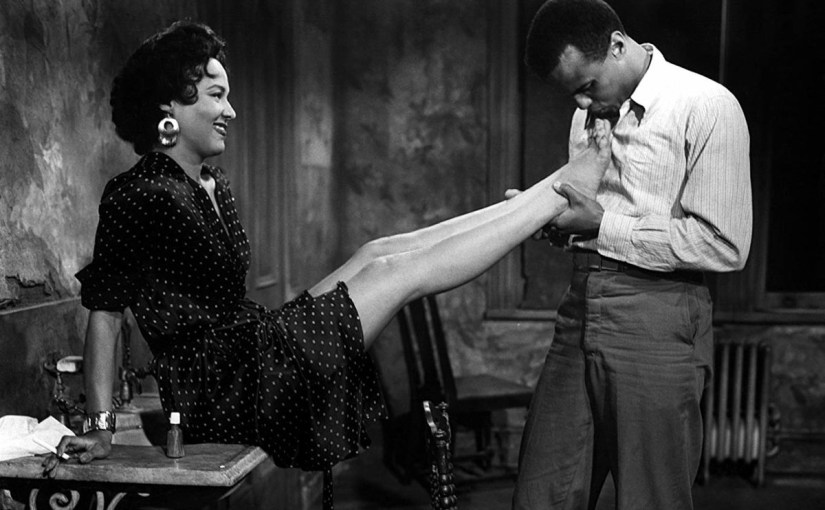
The tragic arc of Carmen Jones may seem inevitable, as I said before, but it remains an entertaining watch.  You can see the dominos falling, and you bemoan the choices Joe makes as he falls under Carmen’s spell, but I mean, LOOK at her.  There’s a scene that I’m sure would bear the Tarantino stamp of approval as Carmen paints her toenails and coyly asks Joe to blow on them for her so they can dry faster.  Dayum.  Show me a straight man who wouldn’t fall for that kind of treatment from a woman who looks like Dorothy Dandridge and I’ll show you a dead man.

If I wanted, I could get nitpicky about Carmen Jones.  Has it aged well?  Not exactly.  Does it feature great acting aside from Dandridge?  Not exactly.  Does it look natural to hear an operatic tenor burst forth from Harry Belafonte’s mouth?  Not exactly.  But Carmen Jones is a landmark of black cinema in an era when schools and government buildings still had segregated water fountains and restrooms.  Based on that fact alone, I consider Carmen Jones to be a vital step in Hollywood’s painfully slow racial evolution. (It is also a painful reminder of a career that might have been; Dandridge died 11 years later at only 42.)

MONTE WALSH (1970)

by Miguel E. Rodriguez

DIRECTOR: William A. Fraker
CAST: Lee Marvin, Jeanne Moreau, Jack Palance, Mitchell Ryan
MY RATING: 7/10
ROTTEN TOMATOMETER: 89% Fresh

PLOT: An aging cowboy realizes that the West he knew and loved will soon be no more – and that there will be no room for him, either.


Based on this film, Monte Walsh, and the other two films he directed, A Reflection of Fear [1972] and The Legend of the Lone Ranger [1981], I think it would be charitable to say that William A. Fraker’s best films are the ones where he served instead as director of photography, such as Bullitt [1968], WarGames [1983], and Tombstone [1993], among many other notable movies.  Am I saying Monte Walsh is a bad film?  No, but it’s certainly not as bad as Gene Siskel’s 1-star rating, nor is it as stellar as Roger Ebert’s 4-star rating.  I give it a 7-out-of-10 on my scale because of the way the second half of the film builds and builds so that the outbursts of violence feel earned and motivated instead of cliched.

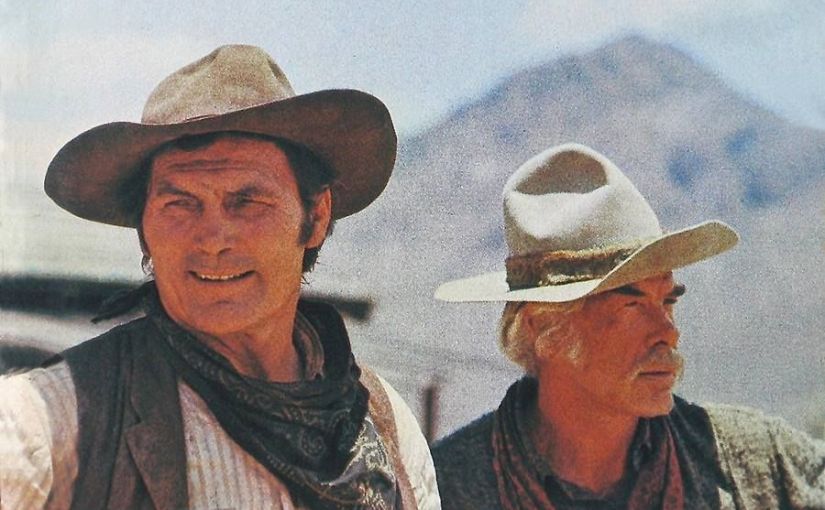
Monte Walsh (Lee Marvin, grizzled as ever, even with a handlebar moustache) and his friend and partner, Chet (Jack Palance in a rare non-villainous role), come down off a mountainside after a rough winter keeping watch on Mr. Brennan’s herd of cattle, only to get news that Brennan’s ranch has been purchased by a corporate entity, Consolidated Cattle.  Brennan offers them a steady job, which they reluctantly take, but deep inside they know this means their prairie-roaming way of life is coming to an end.  Chet is prepared to accept this, but Monte chafes at the idea.  “I ain’t doing nothing I can’t do from a horse,” he warns Brennan.

We get entertaining glimpses of the ranch hand life, complete with the saloon fights and the stinky cook.  Monte dallies with a French madame, Martine (played by the exotic Jeanne Moreau).  At one point, Monte and Chet ride out and meet a weathered old ranch hand who is “riding fence,” or inspecting every foot of fence around the ranch for repairs…the only work he’s cut out for anymore.  “Looks like his life is over with,” they say, and you can tell they’re looking into their own future.

The thrust of the film is one I’ve seen in many other westerns before this one: “The old West is changing, and there’s no place in it for people like us anymore, so we’d better evolve or die.”  This theme is present in Once Upon a Time in the West [1968], Butch Cassidy and the Sundance Kid [1969], and especially The Wild Bunch [also 1969]…seemed to be a trend for westerns at the turn of the decade, for some reason.  Monte Walsh handles it in an episodic format, kind of like another Lee Marvin film, The Big Red One [1980].  It doesn’t quite tell a straightforward plot with a pre-determined story arc.  It skips around a little bit, painting a picture without telling a conventional story.

There can be a sense of freedom in this kind of storytelling.  Unshackled by traditional story beats – at least for the first half – the movie is laid back, asking the viewer for a little patience as it slowly lays down building blocks for the finale.  However, I must report that I found this section of the movie a little slow.  I grew impatient.  I felt I was being set up for something, but pretty soon I just wanted the movie to get on with it.  Butch Cassidy sort of works that way, but you had two of the most photogenic stars who ever lived as the two leads.  I struggled to care the same way for Jack Palance as I did for Paul Newman.

But then an unexpected scene of violence occurs, setting into motion a series of events that culminate in a tragic series of deaths that, I must admit, had me glued to the screen as they unfolded.  Because of the gangbusters nature of this section, I am inclined to forgive the film’s shortcomings in its first half.  Here, we see, yes, Monte must evolve or die, and even if it’s never in any real doubt what he will choose, it’s entertaining to watch him make that choice.

If not for the second half of the picture, I might not even be writing about Monte Walsh.  I didn’t care for the opening song (even if it WAS sung by Mama Cass), some of the movie felt ripped off from several other westerns, and I was borderline bored for the first half.  But if you stick with Monte Walsh until the end, I think you’ll agree it’s worth a look.

UMBERTO D. (Italy, 1952)

by Miguel E. Rodriguez

DIRECTOR: Vittorio De Sica
CAST: Carlo Battisti, Maria Pia Casilio, Lina Gennari
MY RATING: 8/10
ROTTEN TOMATOMETER: 98% Certified Fresh

PLOT: An elderly man and his beloved pet dog struggle to survive on his government pension in Rome.


The greatness of Vittorio De Sica’s Umberto D. is something I was only able to appreciate after it was over.  As the film plays out, I was waiting for something more to happen, something to add to the paper-thin plot of an elderly man struggling to make ends meet in a city whose government has forsaken him and thousands or millions like him.  When the screen faded to black at the end, my first thought was, “That’s it???  Well, what happens next?”  The fact that the film prompted me, not only to ask the question, but to attempt to come up with an answer, is probably one of the reasons why this film is widely regarded as a classic.  Not many films can claim to keep the story running forward in your head after it’s over.

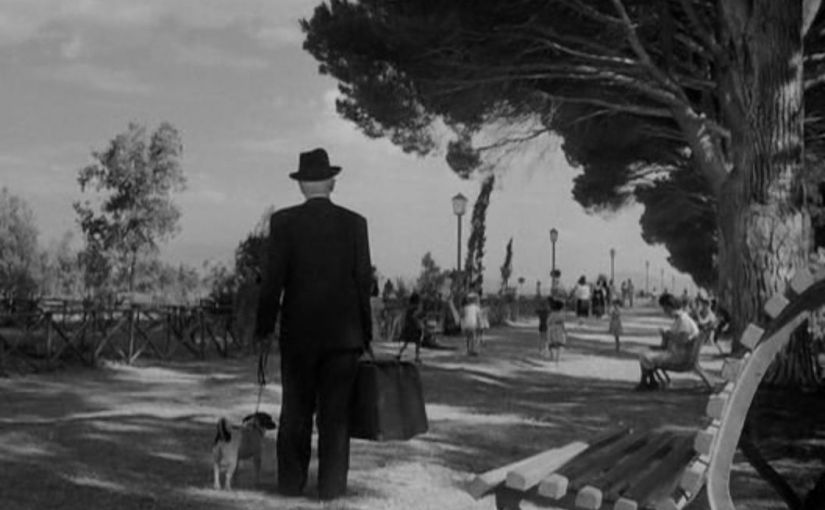
Umberto Domenico Ferrari is an elderly man living in post-war Rome.  The film opens with him joining a crowd protesting the city government’s policy of cutting their pensions.  Umberto is in dire straits.  He’s behind on his rent, low on cash, his landlady threatens eviction, and he must somehow still feed his beloved dog, Flike (rhymes with “like”).  The film will follow Umberto’s tribulations over the course of several days as he berates his landlady, tries to get some cash by selling some of his books and other possessions, dines at a soup kitchen while furtively feeding scraps to Flike, and befriends the young maid in his building who has problems of her own.

Umberto D. is as good an example as any, and better than most, of Italian post-war neo-realism, a cinematic movement in which Italian film directors aimed to paint the silver screen with portraits of everyday life in their country, which was wracked with poverty and unemployment at the time.  Rather than provide an escape from such hardships, these directors felt it was their civic duty to bring the everyman (or everywoman) into the spotlight, to remind the audience that movies could be more than escapist entertainment.  They felt obliged to say, “There are more stories of despair and hardship ten feet out your front door than can be imagined by any Hollywood screenwriter.”

There are pros and cons to this approach, at least in my opinion.  On one hand, the neo-realist movement created such immortal classics as La strada [1954], Bicycle Thieves [1948, also directed by De Sica], and a little later, Rocco and His Brothers [1960]; these are films that have stood the test of time and will continue to do so for decades to come.

On the other hand, a quote from Roger Ebert comes to mind: “A man goes to the movies; the critic must admit that he is this man.”  In other words, learn to say exactly what you think about a film as opposed to what you think you should think.  And when it comes to Italian neo-realism, I’ll say this: give me a choice between a De Sica retrospective and a Christopher Nolan marathon, and it’s the Nolan marathon seven days a week and twice on Sunday.  Yes, I am aware of the place that neo-realism films have in cinematic history, and I can appreciate their greatness on a cerebral level.  However, on a gut level, I can usually only watch them once or twice, with very few exceptions.  La strada, for example, is heart-wrenching, but in such a way that I want to revisit it just to relive those emotional gut-punches at the end.

Umberto D. didn’t quite deliver those gut-punches, at least not during its running time.  …okay, there IS a moment when Flike runs away, and the possibility arises that he may or may not have been put down by the local pound.  There is a cringe-inducing scene when we watch hardened men roll a cage full of stray dogs into a large box where the dogs will be gassed; we are spared the sight of the actual procedure, but we see enough of it to get the picture.  Umberto watches the box with fear in his eyes.  Another man wants to retrieve his captured pet, but he falters when he lacks the money to pay for his return.  The look on his face as he repeatedly asks, “So, if I don’t take him, you’ll kill him?”  THAT is a scene where my emotional juices where stirred up.

(Okay, there is ONE other scene that got me a little riled up emotionally, but it happens near the film’s climax, so I can’t describe it without spoiling something.)

Aside from those very rare moments of heightened emotion, the film is mostly pedestrian, giving us more details of Umberto’s daily life as he tries and tries to find a way to get enough cash to pay his rent.  In one pathetic scene, he debates whether he should resort to panhandling like so many other men he sees on the streets.  At first, he tries it himself, practicing holding out his hand on a street corner, but when someone actually turns to give him some money, Umberto pretends he was just stretching – he just can’t bring himself to accept handouts from a stranger.  He tries to enlist Flike instead, getting him to hold his hat while sitting on his hind legs, but that doesn’t work out either.  He reaches out to former friends, to no avail.

As I’ve said before, DURING the film, these scenes, and others like them, didn’t stir me up the way I felt the director was shooting for.  It was only afterwards that I found myself pondering those scenes and Umberto’s actions.  I used to own a dog, a very long time ago.  If my dog were my only remaining connection, with no family or friends to reach out to in times of need, how would I feel if I learned he might have been captured and put down?  If I suddenly had no means of income, no way to pay the rent/mortgage/whatever, and nowhere to go if I got kicked out of my apartment/house/whatever, how would I manage?  Would I manage?  Late in the film, Umberto makes a couple of hard choices.  Would I make the same choices in his position?

As FINE appears on the screen, Umberto D. invites us to wonder about Umberto’s fate.  The last scene is, on the surface, a happy one, but somber music plays over it, and the scene does not address or solve Umberto’s situation.  This is in the neo-realist tradition.  If De Sica were asked, “But what happened to him at the end?”, I can imagine him saying, “The same thing that happens to all such men.”  If he was told, “But I don’t know what happens to such men,” De Sica might say, “Well, now you have something to think about.”  Q.E.D.

[Trivia: The lead actor, Carlo Battisti, was not a professional actor, but a professor of linguistics. Umberto D. would be his only film, and not many people can claim that kind of legacy with just one film.]

GLADIATOR II (2024)

by Miguel E. Rodriguez

DIRECTOR: Ridley Scott
CAST: Paul Mescal, Denzel Washington, Pedro Pascal, Connie Nielsen
MY RATING: 6/10
ROTTEN TOMATOMETER: 72% Certified Fresh

PLOT: After his home is conquered by the tyrannical emperors who now lead Rome, a rebel soldier becomes a gladiator and must look to his past to find the strength to return the glory of Rome to its people.


[SPOILER ALERT: There is a key plot point that I must divulge in my review, but it is not something I knew before watching the film, despite the fact it was supposedly spoiled in one of the trailers.  You have been warned.]

While I was being underwhelmed by Ridley Scott’s latest film, Gladiator II, I was reminded of his previous lapses in judgement.  Although he is the deservedly acclaimed director of masterpieces like Alien, Black Hawk Down, Kingdom of Heaven, and Thelma & Louise, he also helmed such misfires as 1492: Conquest of Paradise, House of Gucci, and the regrettable Robin Hood [2010].  My point is that Gladiator II is a reminder that Mr. Scott is human like anyone else and occasionally makes mistakes.

I’m not saying that Gladiator II is a terrible film, though.  It is not aggressively bad like some other films I could mention (*cough, The Counselor, cough*).  It has some amazing sights, like the rhino battle in the Colosseum, and it boasts a triumphantly over-the-top performance from Denzel Washington as Macrinus, a flamboyant trainer of gladiators with designs of his own for the city of Rome.  On those merits alone, Gladiator II is maybe worth a watch.

But…but…

While the story is interesting from a standpoint of pure plotting, and while we get the requisite nostalgia bombs of seeing Connie Nielsen back again along with periodic flashbacks to the first Gladiator [2000], I felt curiously distant from the film itself.  I have theories about this phenomenon, but nothing conclusive.

First, the lead actor, Paul Mescal, as [SPOILER ALERT] Lucius.  He looks the part, I grant you that, at least from a physical standpoint.  He’s built, he appears to do most of the physical stunts himself, and he delivers his lines with the appropriate gravitas.  But I never got behind him as the hero of the piece.  Maybe it’s because he’s a complete unknown to me?  Maybe because we barely got to know him before he was suddenly thrust into the main story arc?  (By contrast, in the first Gladiator, we got to know Maximus inside and out before he became a gladiator.)

My sympathies went entirely towards Pedro Pascal as General Acacius, the military mastermind behind Rome’s greatest victories.  He is the new husband of Lucilla (played by the returning Connie Nielsen), whose son, you’ll remember, was last seen following Maximus’s body out of the Colosseum, sixteen years before Gladiator II begins.  Acacius is dutiful almost to a fault, deferring all glory on the battlefield to the empire of Rome, even if it’s currently being run by a couple of brothers (Emperors Geta and Caracalla) who are entitled, bloodthirsty tyrants.  He is weary of the constant bloodshed and wonders if there isn’t a better way to restore Rome to glory.

And Denzel Washington…well, I’ll get to him in a minute.

So, the story, while it must have been compelling on paper, seems to be a healthy echo of the first film.  Another defeated soldier becomes a gladiator.  Another successful Roman general wants to restore Rome.  More spectacular, bloody battles inside and outside the Colosseum.  More political intrigue regarding power-hungry senators and double-dealing merchants.  Forgive me, but I’ve been there, and I’ve done that.  (And adding massive sharks to a Colosseum battle does not intrinsically make it better than anything from the first film.  However, some basic research does show that the Colosseum WAS occasionally flooded with about 5 feet of water to stage mock naval battles…so there you go.)

The undeniable highlights of the film are any scenes involving Denzel Washington.  Not since Training Day has he chewed the scenery with this much gusto (although his recent turn as Macbeth comes pretty close).  I’m guessing he still has traces of Gladiator II set pieces stuck between his teeth.  He can command a scene by his presence alone, but he adds these marvelous gestures of adjusting his robes and tossing in one of his dazzling smiles when you might least expect it.  He makes one of the greatest uses of a dramatic pause that I’ve ever heard.  (“I own…[beat, beat, beat, beat, beat]…your house.”)  In another scene, he uses an exceedingly gory prop as a punctuation mark during a speech; if he gets nominated for an Oscar for this role, that’s the scene they SHOULD use for a clip, but they probably won’t.  Shame.  The whole performance is a classic example of taking a smaller role, owning it, and turning it into a thing of beauty.  In hindsight, it’s probably a good thing that he doesn’t have much screen time, because he simply outguns his scene partners at every turn.  You can’t take your eyes off this guy.

The drawback to Washington’s masterful performance is that I found myself marking time between his scenes, instead of falling into the world of the story.  I followed along, was able to keep track of which senator was doing what and why Lucilla was so distraught and so on.  But to the degree that I was able to follow along, I just didn’t care.  I was reminded of Troy, another sword-and-sandals epic, also told on a grand scale with innumerable extras and some world-class battle scenes, but which also left me apathetic for much of its running time.

Gladiator II improves on the first film only in terms of the complexity of its visual effects and the addition of Denzel Washington.  Aside from that, I’m afraid it does very little to make me care about its heroes, its plot twists, its unexpected deaths, and the glory of Rome.

(And I had to exercise superhuman restraint, at the final shots of the film, to keep myself from yelling out loud, “Talk to me, Goose!”)

MEPHISTO (Hungary, 1981)

by Miguel E. Rodriguez

DIRECTOR: István Szabó
CAST: Klaus Maria Brandauer, Rolf Hoppe, György Cserhalmi, Karin Boyd
MY RATING: 9/10
ROTTEN TOMATOMETER: 80% Fresh

PLOT: In early-1930s Germany, a passionate, prominent stage actor must choose between an alliance with the emerging Nazi party or a life of obscurity in exile.

[Author’s note: this is another in a series of movies I’ve watched lately whose subject matters have intimidated me.  There are topics at play in Mephisto that are beyond my ability to analyze in coherent prose.  I must advise you, this is a BRILLIANT film, even if my review below does not convey that fact…]


Watching Mephisto reminded me of the early days of Covid-19.  As the infection spread and restaurants and other businesses voluntarily closed their doors, I was still naively hopeful that it would all just go away.  A friend asked me, “When will you take this seriously?”  I blithely said, “When all the McDonald’s restaurants close, that’s when I’ll know there’s a problem.”  Not long afterwards, that’s exactly what happened.  Then I was indefinitely “furloughed” from my job, and soon after that, the government shutdown occurred.  In hindsight, I was foolish.  The signs were all there.  Had I paid more attention, I might have been better prepared for the stressful days that followed.

This situation is echoed in director István Szabó’s Mephisto, the first Hungarian film to win the Academy Award for Best Foreign Film.  Mephisto tells the story of a popular actor in 1930s Germany, shortly before and after Hitler rose to power.  Hendrik Höfgen (Klaus Maria Brandauer) is a hot-headed, passionate stage actor who throws himself into his performances with abandon.  We watch him evolve from an actor/director to the leading force behind a “revolutionary” theater company that exhorts its audience to acknowledge the plight of the everyman in their society.  He marries (for money more than anything else), but keeps a mistress on the side, a black German woman named Juliette Martens (Karin Boyd) who doubles as his private dance instructor.  He rails at his wife for riding horses before breakfast – the ultimate in bourgeois behavior – but engages in frantic frolicking with his mistress between dance lessons.

Brandauer plays Hendrik as a man who only feels like himself when he’s pretending to be someone else.  Onstage or when directing his cast, he’s filled with boundless energy, dancing with the chorus line or leaping across the stage with abandon.  Offstage, he is quiet and self-effacing, unless he’s socializing with other cast members.  Mention is made several times of his “limp” handshake, a direct contradiction to the strong characters he portrays, especially his most famous role: Mephistopheles in Faust, a role that brings him even more fame and prominence within the theater community.  The imagery of Hendrik is striking: He covers his face in white makeup like a kabuki player with sharply angled black eyebrows and red lips, the ultimate in being able to disappear inside a character.

But something is happening in the background that Hendrik is reluctant to acknowledge.  A fellow cast member almost gets into a fistfight with him when he criticizes another actress because of her associations with a member of the Nazi party.  His wife warns him about the dangers presented by this man who was just elected Chancellor.  [Interestingly, the name of Adolf Hitler is never once mentioned onscreen.]  She tells Hendrik that many of his friends are leaving Germany, fearing for their livelihoods, if not their lives.  But Hendrik refuses to panic:

“There is still the opposition, no?  They’ll make sure he doesn’t get too big for his boots.  And even if the Nazis stay in power, why should it concern me? … On top of that, I’m an actor, no?  I go to the theater, play my parts, then go back home.  That’s all. … I’m an actor.  You can design sets anywhere or buy antiques.  But I need the German language!  I need the motherland, don’t you see?”

Hendrik is so wrapped up in his profession that he simply cannot accept the fact that his freedoms are about to come crashing down around him.  He would rather formulate a far-fetched scenario based on nothing but hope so he can just stay where he is and keep performing.

(I have to be honest: when we took our first steps out of the Covid lockdown, I felt the same way.  Local theaters announced auditions for shows again, and I assured myself and my girlfriend that I would take the utmost precautions and wear masks at rehearsals and disinfect and wash my hands and I wouldn’t get sick.  And, of course, I eventually got sick.  I recovered, but you can probably imagine my disbelief when I tested positive that first time.  “ME?  But I was so careful!”)

Hendrik stays in Germany.  His wife moves to Paris.  Fellow actors either disappear outright or are arrested by the Gestapo in full view.  Hendrik accepts an offer to direct the official state theater, despite his past affiliations with liberal/Bolshevik causes, because of his prestige in the theater world.  A character known only as the General (probably intended to be Hermann Göring) gives him his marching orders as theater director.  He witnesses several Nazis beating a man on the street and walks in the other direction…best not to get involved.

So, what we have here is an actor willing to trade away his soul and his conscience in exchange for the opportunity to remain in the limelight, performing as Mephisto or Hamlet.  The metaphor is not exactly subtle, but director Szabó manages to land the message in such a way that it never feels like preaching.  It’s a masterpiece of storytelling that lands somewhere between satire and Kafka.

An especially telling scene has Hendrik explaining to an attentive crowd of Nazi journalists that his production of Hamlet will portray the lead character as “a hard man…an energetic, resolute hero”, rather than as a neurotic, “pathetic” revolutionary.  Hendrik tells them exactly what they want to hear so he can stay in the limelight.  He’s made his own deal with the devil.  I will not reveal whether Hendrik’s bill comes due during the film, but I will say the finale evokes the landmark documentaries of Leni Riefenstahl.  I’ll leave it at that.

As I said, watching the film reminded me of the Covid lockdown…but it also made me think about all those many, many times in the past that actors and other celebrities have been criticized for voicing their political opinions in public.  “Shut up and play/act!” is the usual cry.  Many people would prefer their favorite actors to behave more like Hendrik: just keep your head down and let everything blow over, don’t make waves, it’s not your place, etcetera, etcetera.  Mephisto argues that keeping silent in the face of injustice or tyranny is not an option, especially not for people in the spotlight.  Those who do so risk suffering Faust’s fate.  Or Hendrik’s, whose last words in the film are brilliantly contradictory.