By Marc S. Sanders
I’m a sucker for courtroom theatrics and Otto Preminger’s Anatomy Of A Murder is no exception. Though it is sorely out of date when most of today’s viewing audiences have at least one Law & Order episode under their belt. Preminger’s film, adapted from the novel by Robert Traver and inspired by a real-life upstate Michigan homicide, hinged on taboo language and heinous motives enabled by revenge. Even the father of leading man, James Stewart, found this film to be entirely offensive and campaigned for audiences to avoid seeing it.
Army Lieutenant Frederick Manion (Ben Gazarra) is on trial for the murder of an innkeeper he believed raped and abused his promiscuous wife, Laura (Lee Remick). Good ol’ boy lawyer Paul Biegler is the former prosecuting attorney of this small Michigan town who opts to represent the defendant. This will be Paul’s first trial on the other side of the courtroom, and he recruits his best friend and colleague to help him, a washed-up lawyer and lovable drunk named Parnell (Arthur O’Connell). Paul’s strategy is to defend his client with a plea of not guilty by reason of insanity because Manion is adamant he has no recollection of killing the victim with five gunshot wounds.
Anatomy Of A Murder is easy to follow because it does not have a wealth of variables to twist the narrative in different directions. The interest works on Stewart’s Capra-influenced likability. George Bailey becomes a lawyer. The actor is older by this point in his career, and this performance would be his last Oscar nomination. He’s sharp in the role and quick on his feet with objections and standard trial ligations. He’s also adorably charming as he crafts fishhooks at the table while a witness is being questioned by opposing counsel. That was a first for me to observe.
The prosecution has its small-time attorney, Mitch Lodwick, played with mustache-adorned, nerdy conservatism by Brooks West. However, a big metropolitan lawyer sits next to him. George C Scott might be early in his career here, with black slicked hair and dark suits as the imminent Claude Dancer, who notoriously arrives from Lansing, Michigan. He’s reputably intimidating and altogether sly. He hardly says a word during the first third of his performance and his silence is impossible to ignore. However, when he takes lead counsel later in the story, Scott demonstrates that he’s the standout element of the picture.
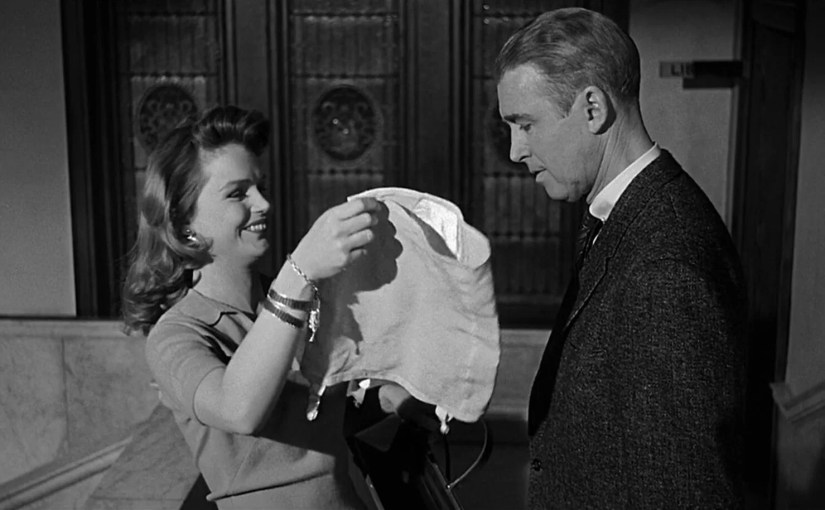
Anatomy Of A Murder relies on the taboo nature of the crime on trial. A rape of his wife motivates a suspect to kill. In any circumstance, that is going to necessitate a discussion on the subject of ladies’ undergarments. With a sidebar committee consisting of Stewart, West and Scott with the sleepy, elderly Judge Weaver (Joseph N Welch, famously part of the McCarthy hearings), the script includes time to debate how best to describe Laura Manion’s panties by going so far as to ask if there’s a more suitable word for “panties.” The men are stumped and the Judge draws a line in the sand by declaring to the courtroom that any sort of chortling will not be tolerated.
In 1959, it’s unheard of to tarnish a person’s ears with vocabulary that includes “sperm,” “intercourse,” “penetration,” “climax,” “rape,” “panties,” “girdle,” and “bitch.” Yikes! My friend Anthony and I watched the Criterion Blu Ray of Preminger’s film, nominated for Best Picture, Screenplay and a trio of actors (Stewart, Scott and O’Connell) and we did our best to put our perspective in the past, before our time when Father Knows Best occupied television sets. Yes. It was likely shocking with a lot of gall to pull away the veil of sexual deviancy. An intoxicated Lee Remick is no Donna Reed as she struts around in tight pants and low-cut blouses with a pair of sporty sunglasses. On the stand, she describes her panties as either being white or pink with lace down the side and ripped off during her alleged assault. Later, Jimmy Stewart is holding the evidence in clear view. It couldn’t be anything but shocking. Turn on any program today, and you’re apt to find any of this conjecture within an episode of Friends or Modern Family. Still, ‘the fella who spoke to Harvey the rabbit is fondling women’s underpants in a courtroom for everyone to see? For shame.
Laura Manion is also tested on the witness stand by Mr. Dancer when she declares she swore on a set of rosary beads. The attorney questions her faith with the Catholic church and if she is worthy of identifying herself as a Catholic any longer. Another person reveals being born out of wedlock. Something that no one should ever know. Religious conservatism tests the merits of its witnesses. In 1959, to say you swore on a set of rosary beads is not taken lightly. To be known as a bastard child is a social crime. Today, it’s just a phrase as common as saying “I swear on my children…” or you are just raised in a single parent home. The servitude of Anatomy Of A Murder has changed over decades of different generations when many are not so protective their personal sensibilities. The age of internet browsing allows everyone to be much more revealing in beliefs or lack thereof, and what constitutes as sexual appeal or how you originated.
Beyond the coarse language and subject matter of Anatomy Of A Murder, there’s not much here that feels fresh or pioneering any longer. Today’s audiences are far too sophisticated for what Preminger was brash enough to originally show on screen. Anthony and I were certain that Laura’s adorable shaggy dog and a gold cigarette lighter that resurfaces a few times would lynchpin inevitable twists in the case. Alas, it was just a dog, and alas it was just a lighter. Yet, the attention to these items seemed like apparent invitations to significant developments.
Actually, the one surprise that comes from the film is regrettably revealed too soon. A material witness is disclosed midway through the picture. However, when George C Scott questions this individual on the stand towards the end of movie, his character is the only one in the room who doesn’t know anything about this person. With the audience already in on it, what is left to learn except to watch Scott’s character stand apart from everyone else? Had Anatomy Of A Murder been made today, the big reveal would have occurred in the courtroom for all to be surprised and intrigued. Sidney Lumet’s The Verdict did that. Unfortunately, this is a terribly unfortunate misstep in execution. It even takes away from Scott’s sensationally devious performance while sucking out potential dramatic heights.
As Paul waits for the jury to return with its verdict, Parnell ponders the dynamics of twelve strangers coming together to determine the fate of an accused. It’s as if no one ever heard of a jury before this film was released. Surely audiences, on the cusp of Perry Mason with Agatha Christie at the local library, were somewhat familiar with juries and judicial proceedings. Anatomy Of A Murder is so simplified that it’s hard to embrace how heinous its evidence and testimonials should be.
However, Jimmy Stewart performs like Andy Griffith’s famous characters, from Mayberry and Matlock. The fella loves to fish and sit with his friend Parnell as they joyously read law books well into the night. If a trial comes along, he might take it if he’s up for it. This guy is just so relaxed with himself and his practice which amonts to hardly any business and income as his faithful secretary, Maida (Eve Arden) reminds him for the run along relatable humor of the piece. Oh Maida, there you go again. Ribbing Paul all along!
Anatomy Of A Murder serves as a lookback to when movies were shedding their innocent, whitewashed skin. It anticipates that audiences will accept heinous crime and sexual deviancy. Otto Preminger trusts America’s favorite actor, Jimmy Stewart, to deliver. Lee Remick stands as an influence for those overly sexualized roles that Sharon Stone and Demi Moore would occupy thirty years later.
Preminger’s film has a widely recognized reputation with a bestowed ten Oscar nominations (though not including Otto Preminger). AFI ranks it as one of the top ten courtroom dramas, in the company 12 Angry Men and Judgment At Nuremberg. Criterion has a print edition within its library. Yet, seventy years after its introduction the temperature of the film is lukewarm, and the subjects are not so jaw dropping. As well, at nearly three hours running time, it could stand to have edited out so much irrelevant material that slows down the story and lends nothing to its characters.
Anatomy Of A Murder is upheld by its formula which I’d argue has been significantly more enhanced and leaner in movies to come, which drew from its inspiration. This is an anatomy of a courtroom crime drama, in its most basic form, when unmentionables might have been mentioned for the first time. I’m glad I didn’t die of embarrassment in front of Anthony. I mean I’ve heard of intercourse and I’ve seen women in girdles in a Glamour magazine (like George Costanza) before, and at the very least I’ve seen women’s panties on sale at Macy’s. If you have as well, then you are likely ready for Anatomy Of A Murder.