PROMETHEUS

By Marc S. Sanders

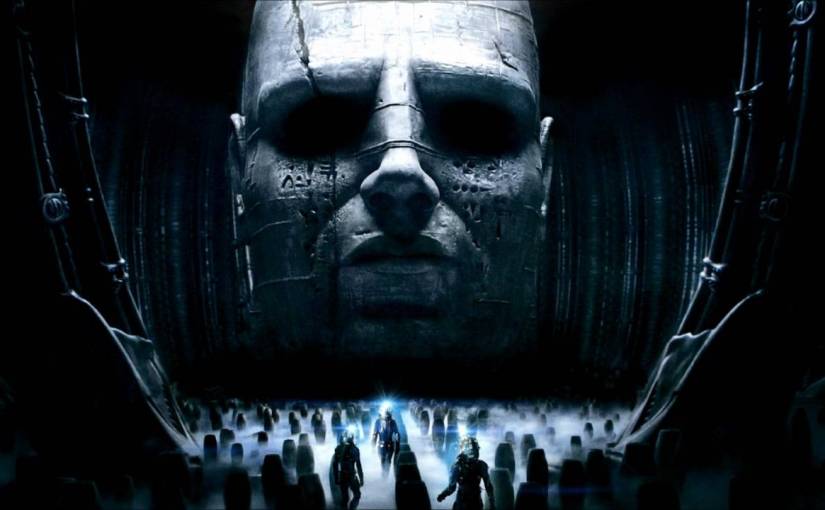
In 2012, Ridley Scott was well established as an elite film director that I’d argue could pick and choose what projects he would want to work on.  So, the question is was it worth the opportunity to return to the Alien franchise that had been established back in 1979?  Following its just as magnificent sequel, Aliens helmed by James Cameron, none of the other subsequent installments (including the Predator mish mash stuff) lived up to the first two films. Not even close.  So, was it worth another go at exploring the world of Alien under Ridley Scott’s leadership?  Yes.  I believe it was worth every effort exhausted into making the prequel/side story picture known as Prometheus.

The movie begins with an odd prologue where an unusual looking strong man consumes a black liquid while standing at the precipice of a wild waterfall, while an unidentifiable shadow looms above, darkening a blue sky.  Shortly after his drink, the man seems to violently implode, and a graphic of his DNA strand explodes apart while what is left of him descends into the bottom of the falls.  The natural waters are now contaminated.

Afterwards, in the year 2089, an exploration crew of scientists uncover a hieroglyphic on the wall of a cave in Scotland, and then the film follows Prometheus, a large technologically advanced spaceship (a very cool looking spaceship I might add), on a trajectory into deep space four years later.  An elderly man named Weyland (Guy Pearce) is uploaded on a video and describes the mission to the ship’s crew.  He explains that he is now dead and that the lead scientists, Shaw and Holloway (Noomi Rapace, Logan Marshall-Green), have discovered a link between what they found in Scotland to similar hieroglyphics uncovered in other parts of Earth.  Coordinates lead to this particular planet where Prometheus will make its landing.  Their goal is to research what made them–the human race in other words.

Prometheus works like a sci-fi/monster fest of course, like the other Alien films.  However, I admire the intelligent questions it asks even if it is all based on fiction.  For example, I look at the film as continuously testing whether technology can overcome man, or religion, or even the theory of Darwinism.  A significant character in the piece is an android known as David (Michael Fassbender, doing an uncompromisingly sterile performance).  As the ship embarks on its four-year journey, with the crew resting in cryo-sleep, David continues to collect data including studying the film Lawrence Of Arabia and looking over visuals of Dr. Shaw’s dreams.  Both sources seem to offer a tolerance to live (“The trick…is not minding that it hurts.”) and die.  The latter option depicts a pre-adolescent Shaw inquiring of her father about the death of her mother.  David is a mechanical creation that never stops pursuing advancement even beyond what the science of humanity allows.

Upon arrival on the mysterious planet, the crew enthusiastically approaches a structure to explore.  Finally, they will receive answers to life’s greatest mysteries.  It’s not hard to realize that things will not go as planned, however.  It’s also not worth detailing everything that happens within the confines of this column.  I’ll let you absorb the imaginative visual feast of horrors and effects for yourself.  Most interestingly is that Dr. Shaw shares with her lover/scientist partner that the strong men, which they identify as “Engineers,” possess the same DNA as humans.  That’s an interesting observation.  Is it disappointing though?  Should it be grander for this long hike into outer space?

In many films like Prometheus or Alien, not everything cooperates as the characters expect.  None of that is surprising but it is welcome for the entertainment of suspense and thrills.  However, what I took away from the picture is where technology duals against religion and biology.  A pertinent blink and miss moment occurs following a traumatic event for Shaw.  David the android removes the cross around her neck.  Is there sound reason any longer to believe in God or the biblical teachings she was raised on if Shaw found the origin of herself and fellow humans?  Is her faith now a moot point?

On a scientific level, we learn Shaw is incapable of bearing children.  Yet, through a set of circumstances David informs her that she is suddenly three months pregnant.  The high-tech invention of David may have had a hand in this development by the way, and this is not some normal kind of pregnancy either.  Technology lends to a horrifyingly memorable scene where Shaw “delivers” her offspring. 

I’m sure we all question our beginnings.  Did it begin in six days by God, with Adam and Eve, as initial products?  Was there a big bang that just started it all?  I’d argue these questions will likely never be answered in our lifetimes.  Thus, the debates rage on because we have nothing better to do with our lives.  Cynical, right?  Well movies like Prometheus try to offer suppositions on possibilities.  In fact, there’s one pessimistic crew member on the ship who questions Shaw and Holloway’s goals of undoing a century of Darwinism on some distant planet, billions of miles away from Earth.

As the film reaches its climax, I found it even more interesting that Shaw puts on her cross necklace again, and David asks her if its even necessary at this point. 

The visuals of Ridley Scott’s film are impressive, though the planet surface and space travel doesn’t look any more creative than other science fiction films.  Frankly, it doesn’t need to reinvent the wheel.  The cast is quite diverse in personalities from a space pilot captain portrayed by Idris Elba, to a nothing but business professional played by Charlize Theron.  Other cast members are there for the casualty line up.

How Prometheus relates to the universe of Alien is fun, but the film still stands on its own. This movie does not require knowledge of the other films to follow this storyline.  Yet, if you’ve seen the other pictures, it is fun to uncover a few wink and nods here and there.

Jon Spaihts and Damon Lindelof (writer of the TV series Lost) deserve more credit for the construction of Prometheus because of the subtle debates ingrained in the monster movie themes of the picture.  Would an emergency C-section be considered a natural way of giving birth?  Would a belief in an “Engineer” supersede someone’s faith in a higher God-like power?  Should technological advancement overcome what’s destined for humanity?

As I close this article, you know what?  I’m going to say yes to all those questions.  Whatever put people on the planet Earth to live and occupy, granted us the capabilities to find alternatives to biological functionality.  Alternatives of religion preach a variety of different content that all humans choose to believe (yes even atheism, because if it’s got a name then it is some form of belief).  The science and engineering capability of technology did not arrive and develop without tests and experimentation, and it will forever proceed that way.  Dr. Frankenstein toyed with invention that did not go as expected.  Ridley Scott’s film suggests that the characters of Prometheus had a similar experience.  The point is we never advance unless we try and unless we fail before we hopefully succeed.

THE ROAD WARRIOR

By Marc S. Sanders

An Australian post-apocalyptic desert wasteland is the setting of George Miller’s B movie classic The Road Warrior.  It’s a film deliberately short on depth, but big on mash ‘em up, bash ‘em up high-speed hot rods, muscle cars, motorcycles and one big rig truck.

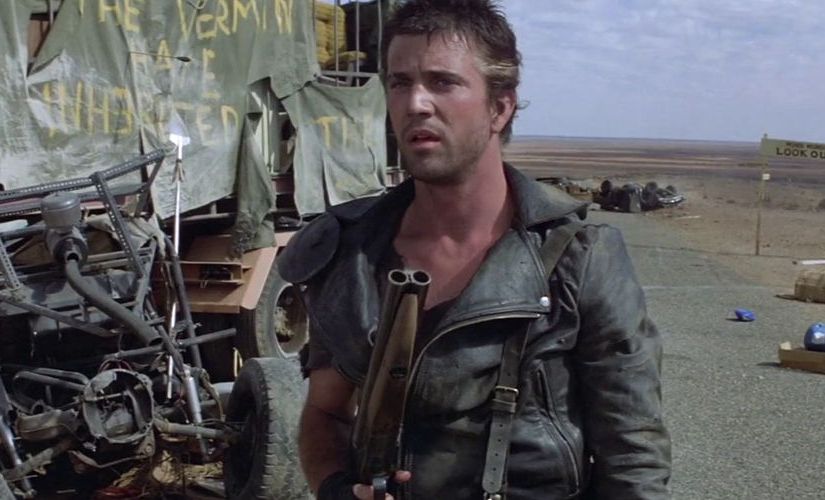
Mel Gibson returns as Mad Max, the leather wearing drifter driver who patrols the endless roads.  A brief narrative at the beginning recaps some of the events of Miller’s first film in this series, Mad Max, explaining that the governments worked against one another, riots ensued, and a nuclear holocaust left little of the population to survive with a shortage on the most precious commodity, fuel.  Max was a policeman whose wife and child were slaughtered by the way, but that’s not relevant here.

The center of the film focuses on a small community of people dwelling in maybe the last known functioning oil refinery.  However, barbarians led by The Humungous (Kjell Nillson) who wears a hockey mask and S & M straps over his bare body are intent on taking over the precious area.  The Humungous’ second in command is a red mohawked freak named Wez (Vernon Wells).  Everyone else in the gang is dressed in the same thematic sex play costume wear with their ass cheeks on display. 

Following some episodes of havoc, Max, along with his dog named Dog, form a contract with the oil refinery dwellers to get the big rig, fuel it up and attach it to a tanker for a journey across the wasteland towards a paradise of ocean blue oasis.

Max has sixteen lines in the whole film.  I’ve expounded on this movie more than he ever could.  In fact, Dog has more dialogue. George Miller knew he wasn’t writing anything of multi dimension or fleshed out characterizations.  You can hardly understand anything that The Humongous has to say or bellow.  It doesn’t matter.

What’s important is the demolition derby footage contained in The Road Warrior.  It’s thrilling.  Bodies get bashed by metal and caught in barbed wire.  Explosions go off in huge fireballs against a scorching sun.  Max fires his sawed-off shotgun at these gonzo gangsters.  They fire crossbow arrows in return.  Some of them use inventive gladiator kinds of weapons with sharp blades and spikes. 

Miller’s frames per second accelerate the various chases.  Multiple collisions end up in a sand dune or turning someone’s ugly sunburned face into hamburger.  The editing of these scenes is magnificent.  Every crash is pieced together cohesively.  Zoom in close ups are spectacularly orchestrated and the cinematography holds up for welcome daylight action where you can easily make out who is who and what is where. 

The inventions of these junk machine jalopies are quite fun too.  Syd from Toy Story must have taken inspiration from this movie when he assembled his freakazoid toys that tormented poor Woody.  Other than Max’s black muscle car and some motorbikes, everything else looks drilled and fused together for relentless mayhem.  Sedans, SUVs, and station wagons would never survive.

George Miller’s world may seem a little prophetic these days.  It’s not that there’s such a rarity of gas, but the need among the masses to hoard fuel is there considering the inevitable price hikes spread around the globe.  Oil will always be a precious dependent.  Environmentalists, I feel for your crusade but be damned. Oil powers so much in and out of this planet.  Electric cars and the few power-up stations are not the dominant alternative yet and won’t be for a while.  Their longevity has not been proven.  Even the disposal of their expired parts has not yet been considered.  So don’t hate me Elon Musk.  I’ll happily eat my words one day, though, I’m sure.

As thin as the storyline may be, George Miller created this dystopian era for Mad Max to drift through and I commend the imagination of the MacGuffin.  Oil is what we rely on, and the setting of The Road Warrior may not be so far-fetched if it ever came to be that we were short on it.  However, I’m not running out to get my masochistic leather body armor just yet.

Wez, The Humungous and their bandit barbarian warlords may be fearless nut jobs, but I get their motivation.  You never know when rush hour may rear its ugly head in a post-apocalyptic age.  So, you better fuel up your Harley, BMW and Toyota because the boss is still gonna want you sitting at your desk by nine.

TERMINATOR 2: JUDGMENT DAY SPECIAL EDITION

By Marc S. Sanders

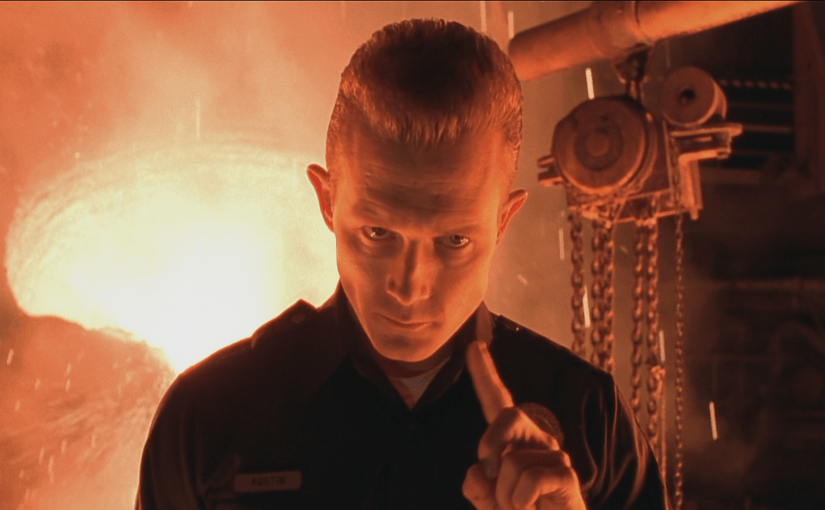
Hailed as one of the greatest sequels ever made, James Cameron’s sci-fi extravaganza Terminator 2: Judgment Day remains revolutionary in its achievements in special effects that still hold up over thirty years later.  This was a major film in Arnold Schwarzenegger’s career, but Robert Patrick became a known character actor for his stoic expressions as a sinister android with the ability to shape shift out of a substance of liquid metal that consumes his entire body.  Neither of these actors have much dialogue and yet the hero versus villain element is so well defined with Cameron’s imagination and drive for effects enhancements. 

It’s ironic.  The first Terminator was a scrapy film with an interesting plotline of time travel to serve outstanding shoot out and car chase mayhem for an hour and forty minutes.  Stan Winston’s make up work was effective. Visual effects of the metal exoskeleton look like the work of Ray Harryhausen from his days working on the Sinbad movies.  Impressive, but they looked outdated.  It’s forgivable though because the storyline and the action were masterfully orchestrated.  Cameron’s sequel makes up for these shortcomings.  It was a box office smash.  The image of Schwarzenegger mounting a Harley Davidson with sunglasses and a black leather motorcycle outfit (shotgun in hand) became as iconic as his standard promise of “I’ll be back,” and just about everything in the film raised the bar that much higher for all vision effects to be produced thereafter.  Some of the imagery in this film remains absolutely astonishing.

In this 1991 installment, two Terminators from the year 2029 are sent back in time to protect a pre-teen John Connor (Edward Furlong in a wonderful and spirited debut performance), the leader of the human resistance in a futuristic war between man and machine.  There is Schwarzenegger as a new T-800 (a steel skeleton with living tissue and skin on top) designed with good intentions to keep John alive.  The T-1000 is the much more advanced liquid metal monster who can form sharp objects like knives and stabbing weapons.  It can also take the shape of any human it encounters.  So, it has the capability of deceit.  This thing is truly unstoppable. 

John’s mother, Sarah (Linda Hamilton), who was being hunted in the first film is now a bulked-up warrior imprisoned in a psychiatric hospital for her violent tendencies, making outrageous stories that predict a doomed future, and for the crime of blowing up a computer factory.  Hamilton makes a major departure from her hokey damsel in distress in the first picture.

James Cameron is a director with high standards.  With each film he has made in his storied career (Titanic, Avatar), he seems to be both the teacher and student of advanced filmmaking.  Every new film shows a new discovery on his part.  The dazzling special effects of Terminator 2 work because they serve the robotic characters.  The effects are the threats and superpowers meshed within the plotline.  The technology used, along with Stan Winston’s artistic make up imagery, serves the story.  The liquid T-1000 will get frozen in liquid nitrogen.  Cameron will show Robert Patrick breaking apart like chipped ice.  Schwarzenegger will shoot the frozen statue, breaking it into a thousand pieces.  Is the monster dead though?  Cameron applies another cool effect for a fast resurrection, and you see how it all functions and morphs into something new.  The T-800 will shoot a grenade into the head of the T-1000, and you’ll see it break apart and what it does next in response.  It’s groundbreaking.  More importantly, it is eye opening.  Absolutely marvelous work.

There’s a handful of cheesy dialogue in Terminator 2: Judgment Day.  That’s to be expected in many of James Cameron’s scripts.  I can’t help but roll my eyes when I hear Michael Biehn or Linda Hamilton deliver a line like “On your feet, soldier!”  I dunno.  It just doesn’t come off authentic to me in the same way a drill sergeant would demand.  Hamilton’s voiceovers never did it for me either and I think it’s a combination of the dialogue and the vocal performance from the actor.  The melodrama is a little too thick in these areas. I’ve often regarded faults like those of Cameron.  That doesn’t make his films any less watchable.  I’m looking at some of the greatest visuals ever to grace a screen.  I do wish that he would take his screenplays to a script doctor, though.

Terminator 2 is never boring.  I opt to watch the Special Edition found in a DVD set.  It’s a recut of the film with lots of extra footage that flesh out the functionality of these sci fi futuristic figures and lend to more character depth.  A dream sequence is included.  Sarah sees the return of Kyle Reece (Michael Biehn), John’s father, to push Sarah on her campaign to change the future and ensure the technology that soon develops in a future 1997 never comes to be, while also continuing to protect their son.  My favorite new addition comes in the final act when we see the T-1000 suffer from the cumulative damage done by the heroes.  That welcomes some new visuals not seen in the original theatrical cut.

No matter which edit you watch though, the set pieces are spectacular with lots of shoot ‘em up mayhem, truck and motorcycle chases, and bullets blazing all over the place, including bouncing off of Arnold Schwarzenegger, while being “absorbed” by Robert Patrick.  A helicopter collides with a SWAT team van.  An entire building explodes into a huge blaze. Cameron offers frequent nightmares for Sarah that depict a truly frightening end to nearly all of humanity with scorching white heat, fire and ash.  A playground never looked so scary.

I digress with a mild spoiler alert.  This most recent watch of the film was fun because I showed it to my fifteen-year-old daughter.  She had a different impression than most movie going audiences who saw the film in 1991.  Promotions at that time clearly demonstrated that Schwarzenegger was a good Terminator this time, while Patrick was the threatening bad guy.  My daughter had no idea.  So, a well edited suspense scene that builds in a shopping mall left her quite surprised when both Terminators meet face to face for the first time, with their guns drawn and John perched right between them.  Who was the protector and who was the killer?  See?  It pays not to watch the commercials and previews.

Terminator 2: Judgment Day is one of many outstanding achievements for James Cameron.  It enhanced a new visual effect introduced in an earlier film of his, the “water worm” in The Abyss, and made it a major story element.  He might not be the best dialogue writer, but Cameron repeatedly showcases the art of writing a solid storyline around the technology he toys with as he brings it all to perfection. 

DEMOLITION MAN

By Marc S. Sanders

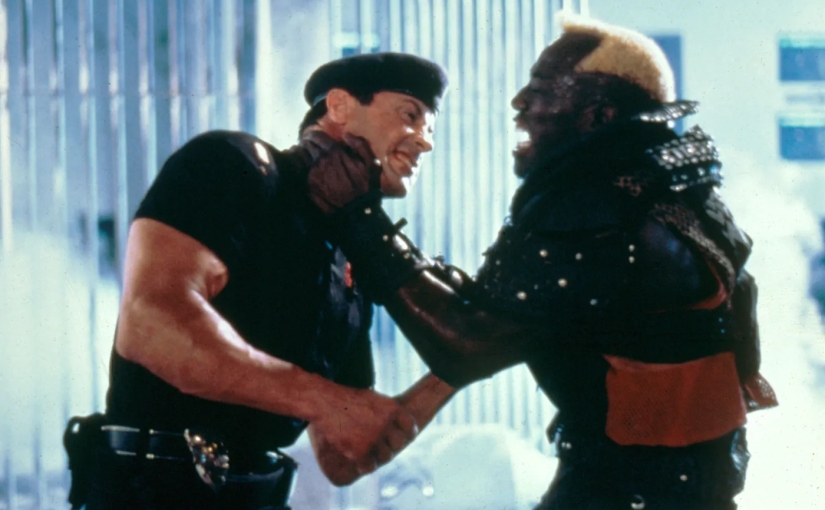
In the years since the Sylvester Stallone/Wesley Snipes futuristic action picture Demolition Man came out in 1993, bloggers have been giddy to post about how brilliant the satire is, especially since much of its fictional future set in a totalitarian San Angeles (formerly Los) in the year 2032 ended up becoming real to some degree.  Okay, fine.  I’ll go with what they say.  However, Reader, this is not on the same level as Paddy Chayefsky’s prophetical film, Network, and the legacy it has bestowed.  Demolition Man remains just as stupid as it was when it first came out.

In a mid-1990s prologue of fire, gunfire, and flames, a vicious killer named Simon Phoenix (Snipes), with a happy go lucky habit of giggling through the mayhem he unleashes, is apprehended by decorated cop John Spartan (Stallone).  However, both men are sentenced to decades of cryo-freeze imprisonment because the hostages that Phoenix held had perished and Spartan was found neglectful.

The film jumps to 36 years later. Phoenix has been released and immediately returns to his old habits.  The problem is the law enforcement of this period is not equipped to contain the crazed criminal.  So, Spartan is defrosted as well to go up against Phoenix.  This future is occupied by the cute smiles and charms of Sandra Bullock, Benjamin Bratt and Rob Schneider as the cops who happily sing the melodies made famous by radio and television ads.  Guns are entirely outlawed along with drugs, alcohol, spicy food, and obscene language.  Say a curse word and a machine is nearby, quick to charge you with the offense.  Touching and the exchange of bodily fluids are forbidden as well.  A high five with no contact was an uncanny precursor and is now reminiscent of the early days of the Covid crisis when it was strongly urged that people not even shake hands.  About the only favorable improvement of this future is that toilet paper is no longer used, and people resort to solving their hygiene problems with three seashells.  Regrettably, the technique is never demonstrated.

This film invests a lot of time in its satire, and I appreciate the attempt to find its humor.  The problem is the humor is delivered by Sylvester Stallone and he’s not Bill Murray or Aaron Eckhardt (check out Thank You For Smoking).  Satire is not a wheelhouse for Stallone to reside in.  Sandra Bullock on the other hand is cute in her response.  A memorable scene could have been so much better had Bullock had a more appropriate scene partner.  Lovemaking takes on a whole new method in this 2032 future.  Head devices are used to stimulate the mind.  Oddly enough, you could say that’s the direction that virtual reality has taken.  I appreciate the intuitiveness, but Stallone’s performance doesn’t.  What was intended to be a foreign experience for sexual gratification, comes off very clunky with Stallone.  Imagine what Ben Stiller or Paul Rudd could have done here.  Bruce Willis would have been marvelous in a scene like this.

Wesley Snipes is just as good an action star as Stallone or Willis or Schwarzenegger.  Unfortunately, his Simon Phoenix is so one note as a villain.  He’s a got a bleach blonde crew cut and a giggle and nothing else.  Stallone’s character describes Phoenix as a dirt bag, and the dastardly bad guy shoots guns and does quick kicks.  There’s nothing to know or learn about this guy.  He’s just a target for Sylvester Stallone to do his typical Sylvester Stallone with a shotgun and a handgun and his signature rahhhhhhh bellow that he’s provided in Rambo and Cliffhanger and Cobra and most of the rest of his career.  (Don’t get me wrong though.  Stallone does have a good repertoire of movies.  This one in particular is what doesn’t work.)

Denis Leary lends to the thin plot for a time.  Back in ’93, Leary was known for a few MTV ads where he did his infamous ranting monologue while popping a cigarette.  Because the script for Demolition Man is so nil, the angry comedian is granted opportunity to do his schtick here…twice!  It didn’t amuse me in ’93.  Now it’s just terribly outdated.

Back to the satire, I question the response of the players.  This film takes place only 36 years after a time of violent crime and cursing and smoking and drinking and all the debauchery that we were tolerated.  When Rob Schneider and the police look shocked and terrified at Simon Phoenix’ measure of violence, they are completely oblivious to what’s occurring.  I dunno.  Should they be that gullible?  This guy is only from a time that’s just over thirty years ago.  It hasn’t been that long.  Bullock even has a poster of Lethal Weapon 3 hanging in her office.  The response was hard for me to swallow, and that’s what killed the satirical attempts.  You can’t be that dumbfounded or naïve, can you?

There was a good idea here, but any kind of semblance of thought went out the window once that was jotted down.  The right player was not inserted into the main slot.  Stallone is miscast.  That’s the biggest problem.  Demolition Man hinges on the ho hum gunplay of any Sylvester Stallone actioner and stands on a sliver of irony with how dynamics have played out since the film’s release.  That’s not enough to consider it a fun kind of popcorn flick, though.  Demolition Man needs to remain frozen in time.

THE HUNGER GAMES

By Marc S. Sanders

Some of the worst atrocities in history have often spawned some of the greatest stories.  I’d expect it would at least leave us feeling melancholy, but I hope it shapes a future that learns from humanity’s worst offenses.  That’s what came to mind as I watched the film adaptation of Suzanne Collins’ dystopian best-selling novel The Hunger Games.

In what was once a supposed North America, the continent is now called Panem and it is divided into twelve districts, with each specializing in some means of living.  Districts 1 and 2 are the upper-class wealthy.  Districts 11 and 12 are the starving destitute.  To maintain a semblance of order, President Snow (a chillingly older Donald Sutherland) oversees the nation’s Annual Hunger Games where a boy and a girl from each district is selected to compete in a dangerous competition of being the last one to outlive their competitors.  May The Odds Be Ever In Your Favor!  In the 74th edition, expert hunting archer Katniss Everdeen (Jennifer Lawrence in her most celebrated role) volunteers herself from District 12 to spare her younger sister from danger and selection.  She is paired up with the District 12 boy, Peeta Malark (Josh Hutcherson). 

Like any sporting competition, Collins’ story takes time to hype up the event.  The youths are fashioned up in the most glamourous adornments and interviewed for television by Caesar Flickerman portrayed by a delicious, yet unsung Stanley Tucci in bright blue hair and sparkly suits, doing his best Griffin, Carson, Letterman, Leno, and O’Brien.  With every white molar revealed in Tucci’s broad smile, he appears even more sinister in the purpose he serves for the Games, Panem, and President Snow.

Jennifer Lawrence gives a faithful portrayal to the Katniss character found in the pages of Collins’ series of young adult novels.  A new hero has been conceived – the rebel who stands along other well knowns like Luke Skywalker, Robin Hood and Harry Potter.  Katniss is not looking to be a savior but with influence from a prior Hunger Games champion (Woody Harrelson, doing his drunken best) and a calm, but humble fashion designer (Lenny Kravitz) she finds herself elevated towards a promising future.  Katniss Everdeen inherits the moniker known as “The Girl On Fire” with a three finger salute and a somber three note battle cry harmony.

I’ve likened the setting of The Hunger Games to the Holocaust and the early twentieth century European Nazi occupation.  (It seems more apparent in the next film, Catching Fire.)  If I had to compare the real-life period to this fictional one, then they are not anywhere close.  Yet, Suzanne Collins and director Gary Ross’ film depict hardship and oppression from a ruling upper class gleefully using their young for savage sport entertainment, while being forced to dwell in concentration camps with no permission to escape or run free, lest they suffer terrible punishments for themselves or those they care most about.

The Hunger Games values the themes of sacrifice while some characters inadvertently become heroes for a people against a domineering force.  It’s fantasy.  It’s adventurous.  It’s sprinkled with romanticism for Katniss and the triangle she’s pitted within for her care of Peeta but also her loving affections for another District 12 resident named Gale (Liam Hemsworth).   Frankly, the romance angle is a little weak in the films and books.  Ultimately though, it is harsh for the young characters in the story, which is why my wife refuses to invest her time.  I empathize with her position.  However, I find the story inspiring.  It’s also a hell of a thriller.

As a film, Gary Ross assembled a strong and alive production of gaudy, bright colors within the capital against morose grays found in District 12.  The clash of the two settings is no more apparent than when squeaky Effie Trinkett in her garishly loud facial makeup and wardrobes arrives in District 12 to host the Reaping, also known as the selection of the child contestants.  So many actors in this cast are memorable.  An unrecognizable Elizabeth Banks is no exception.  As Effie, her personality that publicly represents a hesitant Katniss and Peeta is deliberately inappropriate and further demonstrates how demonically twisted the mentality of The Hunger Games truly is. 

When it is time to finally arrive at the manufactured arena where the contestants will do battle to the death, Gary Ross effectively incorporates the inventive surprises offered by Collins’ source material.  Some competitors are brutal in their combative skills, but environmentally speaking the forest like jungle is dangerous as well.  Especially notable is a hive of stinging tracker jackers that’ll leave the viewers shaken. 

Suzanne Collins’ first installment of her series persists in leaving its ending completely questionable.  Will all these children, some of them who are noble and good, actually die?  Could a good soul like Katniss follow through with what the Games demand of her like killing Peeta for example?  I appreciate the imagination that went into the ending, leaving a subsequent tale to be told beyond this film.  

My one complaint is common in action films.  Gary Ross does really well with the edits and filming of his movie.  However, one of the last scenes develops into a hand-to-hand combat moment taking place in darkness with very shaky camera work and uneven grunts, punches, and kicks.  I abhor when filmmakers go this route.  It’s lazy work.  I can’t tell who is hitting who or where.  I’m just supposed to accept the final struggle that the hero is having with the bad guy and feel a sense of urgency and suspense as they supposedly cast a harsh blow to their enemy and fall over. I might as well close my eyes during moments like this because it’s all just blurry streaks in midnight blackness with sound editing filtered into the sequence.  This tiring approach happens so often in movies, and it becomes a let down for me time and again.   I love a well-made, thought-provoking thriller but the filmmaker hacks it all up near the end and it looks like he’s got to meet a deadline for the final print to get out to the theaters.

There’s much to discuss and think about in The Hunger Games.  Suzanne Collins’ idea stemmed from how television viewers soaked up the drama found in reality tv shows like Survivor and Big Brother.  It’s not so much the fate of the contestants that we care about, but how do they serve the producer’s crafted storylines.  Even American Idol steers the drama of the kids who get their shot at Hollywood fame.  The Super Bowl will position a star player like Tom Brady as a focus with questions of whether this is his final season, and how the championship games affect his marriage and family.  Does he get along with his coach?  None of this has anything to do with the points on the board.  Is all of this about the games, or is it about those tasked with playing the games, and for whose benefit of control, wealth, and power?  In this fantasy film, do the people of Panem cry at the drama spurned from the horrifying death of a child they got to know from Caesar’s colorful interviews, or are they in despair at the loss of another young life?  Whether it is real or fictional, is the drama of these gladiator games and competitions focused in the right direction?

The cast and production team under Gary Ross have put together an effective dystopian and bleak future reliant upon what the world focuses on more than anything beyond who they truly love or what they stand for.  The Hunger Games might seem inconceivable, but it is frighteningly relatable. 

THE MITCHELLS VS THE MACHINES (2021)

by Miguel E. Rodriguez

DIRECTORS: Michael Rianda, Jeff Rowe
CAST: Abbi Jacobson, Danny McBride, Maya Rudolph, Eric André, Olivia Colman
MY RATING: 9/10
ROTTEN TOMATOMETER: 97% Certified Fresh

PLOT: A quirky, dysfunctional family’s road trip is upended when they find themselves in the middle of the robot apocalypse and suddenly become humanity’s unlikeliest last hope.


Discovering The Mitchells vs the Machines feels like finding a discarded lottery ticket that someone threw away.  Intended for theatrical release in 2021, it was instead sold to Netflix when that became unfeasible due to Covid.  I have no way of knowing how many people may have streamed it, but it didn’t exactly take the world by storm.  I happened to find a discounted copy on sale at Target some time ago and have only just now gotten around to watching it.  Written and directed by the writers/creators of the acclaimed animated series Gravity Falls and produced by the minds behind the Jump Street reboots, the two Lego Movies, and Spider-Man: Into the Spider-Verse, this movie is a home run that feels like it has been all but forgotten by the general public.  If you’re a member of that section of the public, and you like great animated films, do yourself a favor and carve out some Netflix viewing time.  You won’t regret it.

The Mitchells are a mildly dysfunctional family with their hearts in the right places, but their quirkiness gets the best of them sometimes.  Aspiring filmmaker Katie Mitchell (voice of Abbi Jacobson) has been accepted into a film school in California, but instead of flying, her father, Rick (Danny McBride), decides to make one last effort at connecting with his daughter by taking the whole family on a road trip in a mid-90s station wagon whose model name is sensible.  As in, that’s the name of the model, the mid-90s Sensible.

The mom, Linda (Maya Rudolph) tries to act as a buffer between Katie and Rick, when she’s not trying to get her family to act more “normal” like their all-too-perfect next-door neighbors (voiced by John Legend and Chrissy Tiegen).  Katie’s younger brother, Aaron, is so obsessed with dinosaurs he calls random people from the phone book: “Hi, would you like to talk to me about dinosaurs?  No?  Okay, thank you.”  They have a pug dog named Monchi that apparently has the IQ of a carrot and looks like he was bred in a bakery.  (“Bred” in a bakery…get it?  Don’t worry, you will.)  Put them all in close quarters and you’d be lucky to get them to survive into the next county, let alone halfway across the country.  And don’t forget that robot apocalypse mistakenly engineered by a tech genius (Eric André) who took the concept of obsolescence one step too far.

What follows is a Pixar-esque journey into self-discovery, industry and pop culture in-jokes, and genuine emotional moments.  Any quibbles I have with the movie have to do with certain physical logistics.  I know I shouldn’t bring the concept of real-world physics into an animated film that includes killer microwave ovens and ominous toasters, but there were a couple of moments that defied logic when everything else was doing so well.  I won’t spoil them, but they’re there.

But that’s a minor, minor quibble.  TMvTM is so delightful and fun, it doesn’t matter.

I loved the visual style of this movie, recalling the eye-catching pyrotechnics in Spider-Man: Into the Spider-Verse.  To emphasize certain moments during the film, the filmmakers added little “flair” on the edges of the screen, or emitting from certain characters like in a comic book, but instead of feeling “comic-book-y”, it felt like a little glimpse into the mind of Katie, the main character, whose mind is constantly in “making-a-movie” mode.

I loved the “big-bad” in the movie because it’s based on the world’s ever-increasing reliance on portable electronic devices.  At one point, the villain shuts down the wi-fi on a global scale.  Humanity predictably loses its mind within seconds.  (My favorite example of this meltdown showed a woman pleading with someone to take a picture of her food.)  Do I advocate for a complete erasure of our devices?  Absolutely not.  But I am on the dad’s side when he insists on no devices at the dinner table.  Everything in moderation, folks.

Underneath the flashy style and effective villains, though, there is a real human story about the father’s desperate need to reconnect with his daughter before she leaves for college.  (Indeed, the film’s original title was Connected.)  The filmmakers took a lesson from Pixar’s playbook and made very sure to include some tender moments and heartfelt speeches that never once felt contrived or schmaltzy.  I don’t have kids, but if I did, I could easily imagine myself shedding a tear when the dad watched old home movies of himself and Katie when she was a toddler.  And I loved the story behind the wooden moose.  The story is diligent about giving everyone a solid, believable back story that fills in the blanks without resorting to lengthy flashbacks.  Not an easy task.

As hidden animated treasures go, this goes on the list with Boy and the World and A Town Called Panic.  It’s streaming on Netflix, so chances are you have access to it right now, so…what are you waiting for?

TIME AFTER TIME (1979)

by Miguel E. Rodriguez

DIRECTOR: Nicholas Meyer
CAST: Malcolm McDowell, David Warner, Mary Steenburgen
MY RATING: 6/10
ROTTEN TOMATOMETER: 87%

PLOT: Before he wrote any of his famous novels, H.G. Wells pursues Jack the Ripper to the 20th Century when the serial murderer uses the future writer’s time machine to escape his time period.


There are two scenes in Time After Time that are genuinely shocking from a story perspective.  One involves a newspaper headline.  The other involves a bloody crime scene.  The first I should have seen coming, but the second I never would have guessed in a million years, and I literally yelled at the TV when it happened.  That’s good plotting.

Those two scenes are the only things that prevent me from giving Time After Time a lower score.  That, and the fantastical, thought-provoking nature of the story itself.  Too bad both those scenes and the plot are buried under layers and layers of hackneyed dialogue and the kind of forced situational comedy that would be more at home in Three’s Company than in a sci-fi adventure.

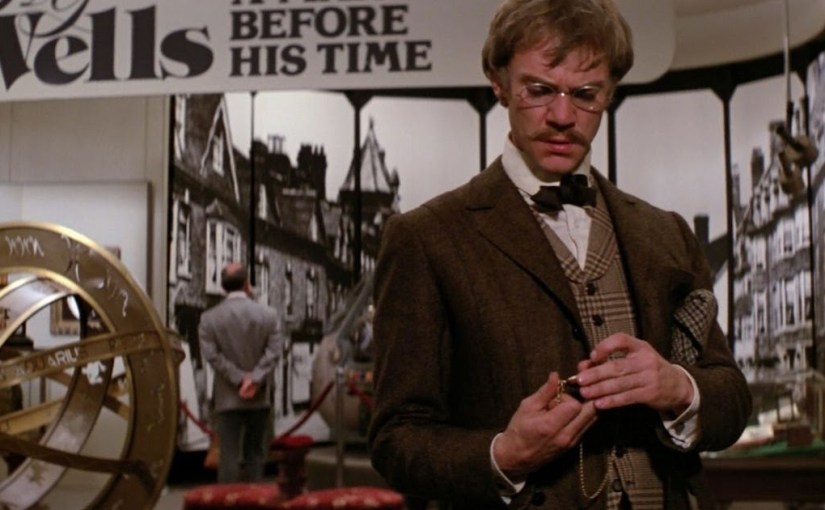
First, the good stuff.  After a credits sequence that looks inspired by countless grade-Z movies before it, the story starts back in London, 1893, two years before H.G. Wells would write his first novel, The Time Machine.  A prostitute is murdered in a dark alley, victim of the infamous Jack the Ripper.  Later that night, Wells hosts a dinner party at his house for some friends and shows them something he’s been building in his basement: a fully functional time machine.  It doesn’t quite resemble the famous machine from the 1960 classic The Time Machine – it looks more like a ride vehicle from an amusement park than a chair with attachments – but the Victorian details are all there.  There’s some talk about a vital key needed to return to their present and a VERY important device that is discussed without being precisely explained, at least not to my satisfaction.  When it makes a reappearance late in the film, I was still mystified as to its actual purpose other than a convenient deus ex machina.

Suddenly, Scotland Yard appears.  Turns out they tracked Jack the Ripper to Wells’ doorstep.  Tricky Jack awaits his chance and uses the time machine to escape…though, without that handy key mentioned earlier, the machine returns to its point of origin on its own, leaving Jack stranded in a world 86 years in the future.  Wells feels duty-bound to bring Jack to justice, so he follows Jack, setting up the meat of the next few reels: a man from 1893 London struggling to adjust to daily life in 1979 San Francisco.

(It must be noted that the bulk of this film’s budget was clearly NOT devoted to the visual effects department.  The effects on display as Wells travels through time are cheesy at best.  I’d try to describe them here, but my words cannot possibly do them justice.  I couldn’t even find a decent still shot to embed here that would accurately convey just how low-rent they are.  I recently watched 1974’s execrable Zardoz, and I’m here to tell you, from a VFX perspective, Time After Time makes Zardoz look like Interstellar.)

H.G. Wells chasing Jack the Ripper through time?  This is a great plot from a sci-fi perspective, a thrilling “what-if” tale.  I had heard about this film for years but was never able to find a copy until recently.  The scores on IMDb and Rotten Tomatoes are decent.  Not stellar, but decent enough that I was pretty sure I would enjoy it.  The movie was directed and co-written by Nicholas Meyer, the mind behind The Day After, Star Trek II: The Wrath of Khan, and Star Trek VI: The Undiscovered Country.  That’s not a bad track record.

But, man oh man…for most of the film’s middle section after Wells arrives in 1979, the movie’s brain goes on sabbatical.  Example: he walks into a McDonald’s, takes careful note of how the customer in front of him orders a meal, then does his best to literally impersonate the customer.  He doesn’t just order what he orders…he gives an impersonation of the customer’s voice and accent.  Why?  He doesn’t do that at a pawn shop or a bank.  No, it’s just there because someone thought it would be a laugh to see Malcolm McDowell do a broad American accent.

I can’t deny that the potential is there for real humor.  I couldn’t find it.  I thought these scenes were completely at odds with the tone of the first third of the film.  Wells meets a bank teller, Amy, (a very young Mary Steenburgen) who inexplicably falls in love with him at first sight.  She’s so taken with him she impulsively asks him to lunch, an act that, in 1979, was directly at odds with 99.99% of all other screen romances, so kudos to that, I guess.  But why?  I’m not saying Malcolm McDowell is an affront to the concept of human beauty, but…really?  As Wells, he’s the 19th-century version of a science nerd.  Amy is not a character so much as a cardboard placeholder to be moved and manipulated according to the whims of the plot.

The dialogue is clunky, to say the least.  There is a foot-chase between Wells and Jack that is devoid of suspense.  The score by Hollywood legend Miklós Rózsa feels utterly out of place, as if someone simply lifted Rózsa’s score from some other film and plugged it in where necessary.  There is simply no romantic chemistry between McDowell and Steenburgen, as evidenced in a painfully unfunny scene when they sit on a couch and she declares: “Herbert, if you don’t take me into your arms, I’m going to scream.”

Another actual line of dialogue: “My mother was rather an atrocious woman in her own way, but her many failings did not include raising mentally deficient sons.”  That’s not a real person talking, that’s a writer trying to imitate George Bernard Shaw.

No doubt someone out there will tell me I missed the boat with this movie somehow.  Perhaps Rózsa’s score is intentionally “retro” to make the whole movie feel as temporally displaced as its characters.  Perhaps the intention was the same with the hopelessly amateurish visual effects.  Who knows.  It’s possible.  Maybe there’s a better movie here somewhere and I’m not equipped to find it.  I doubt it, but it’s a possibility.  In the meantime, I’m going to keep this movie in my collection as an example of how a great story can be derailed by poor execution.

And maybe I’ll bring it out if my fellow Cinemaniacs are in the mood for a “So-Bad-It’s-Good” movie day.

[P.S. Keep your eyes open for the screen debut of an 8-year-old Corey Feldman.]

12 MONKEYS

By Marc S. Sanders

Bruce Willis is a time traveler from an ugly dystopian future in 12 Monkeys.  His name is James Cole and his mission is to uncover why all but one percent of the world’s human population perished from a mysterious virus in the year 1996. 

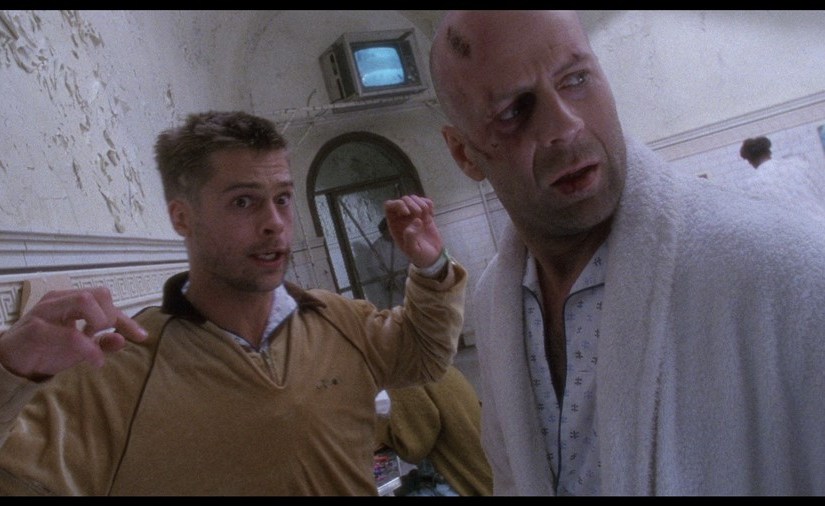
Director Terry Gilliam specializes in disorienting his films.  No shot or closeup is well defined.  He’ll position his camera on a slant or he’ll turn it on an uneven axis so that nothing appears completely clear.  In 12 Monkeys, the viewer is as confused as the protagonist, James Cole, along with a psychiatrist he periodically encounters named Kathryn Railly (Madeleine Stowe).  Beyond the camera trickery, the script of the film offers up oddball characters in both Cole’s present time period (the “future”) and in his past.  Jeffrey Goines (Brad Pitt, in his first Oscar nominated role) is one particular weirdo, residing in a mental institution that Cole is entered into when he time traveled back to Baltimore, Maryland in the year 1990.  During his stay in the loony bin, Cole is talking gibberish to Dr. Railly and her team.  Jeffrey has his own language of nonsense.

Cole’s dreams of himself as a child are intermittently weaved into the final edit of the film.  There’s a woman running after a man, a rapid beep, beep, beep and a gunshot.  Later returns to this dream will provide more clues fleshing out its significance.

It would be easy to have a five-minute conversation and spell out what occurs in 12 Monkeys, but that would be defeating the cleverness of the film.  The achievement of its story relies on the sum of its parts.  Terry Gilliam strategically lays out breadcrumbs with fractional pieces of dialogue, words and pictures that quickly flash in front of you.  It may even hinge on a news story or memorable pieces of music playing on a radio. Still, he also unnerves the characters and the viewer with uncomfortable and sometimes grotesque imagery. 

The first time you watch the film your attention may turn to the long stream of bloody drool hanging from Bruce Willis’ mouth when he shares his first scene with Madeleine Stowe.  Repeat viewings, which I believe only enhance the picture, will have you focus on the nonsensical dialogue that James Cole is continuously uttering.  Other characters are seemingly disruptive to your concentration, particularly the herky jerky behavior of Brad Pitt’s character, but their purpose is essential to a mystery that has left the world of the future in a tailspin where the last of the human race lives underground while animal wildlife roam the cities above.  Furthermore, who or what can explain the enigma behind a team of people perhaps known as The Army Of The 12 Monkeys?

12 Monkeys is a very weird and very unusual kind of science fiction film and that is its crowning achievement.  I have spoken before of how sometimes a movie can not be determined as a success until it reaches its climax, say the last five minutes of its running time.  Terry Gilliam’s picture is one such example.  Gilliam has a keen sense of foreshadowing with tactical layering of complexity.  He is wise with how everything neatly unravels at just the right moment. The answers to the mysteries that James Cole pursues eventually rise to the surface, reminding us that everything was right under our nose the whole time. 

I recall the elation I had the first time I saw the film in theaters.  On repeat viewings, I grin at how the movie is assembled.  Quick references that seem like blink and you miss it moments add up to a satisfying conclusion in Terry Gilliam’s film.  My colleague, Miguel, and I both agree on the time travel motif in 12 Monkeys.  It is one of those rare occasions where the science built within the story’s fiction seems to make sense.  Too often time travel movies paint themselves into a corner and can’t escape the gaping plot holes they leave behind.  Yet the different time settings of 12 Monkeys cooperate with themselves.  Because the film doesn’t color outside of its lines, its worth applauding how ingenious the picture truly is from beginning to end.

12 Monkeys may require your patience the first time you watch it.  It’s not a comfortable journey.  However, you’ll be glad you stayed with it as the story answers its own questions.

ANT-MAN AND THE WASP: QUANTUMANIA

By Marc S. Sanders

Ant-Man And The Wasp: Quantumania is a fun frolic through the Quantum Realm, another dimension that was uncovered in previous chapters within the Ant-Man series of films.  I’m not watching a potential Best Picture nominee for 2023.  I’m watching a glorious kaleidoscope of colors and visual effects with likable characters, and the setup of a new big bad villain for upcoming installments for the Marvel Cinematic Universe.  It’s not a perfect movie.  It’s corny and hokey at times, but I was with the picture the whole way.

I do believe these sci fi superhero franchise films are getting way too diluted.  I think there are more Marvel films now, all working within a shared universe, then there are episodes of single seasons of television shows.  A lot of these films do not stand apart any longer and hinge on events or hanging threads that occur in prior installments.  It makes for a lot of homework and time spent on the consumer to keep track of everything, and where everyone was last left off.  With Disney + adding in multiple Marvel streaming series to watch as well, I’m sorry but my days feel like they need to be extended beyond the standard 24 hours.  The economic term known as “The Law Of Diminishing Marginal Utility” hearkens back to me at this point, all these years later after we first met Robert Downey Jr. as Iron Man in 2008.  Are viewers getting tired of the superhero phenomenon?  Superhero movies rule the box office these days.  Westerns did it four or five generations ago.  How many new westerns do you now see each year?

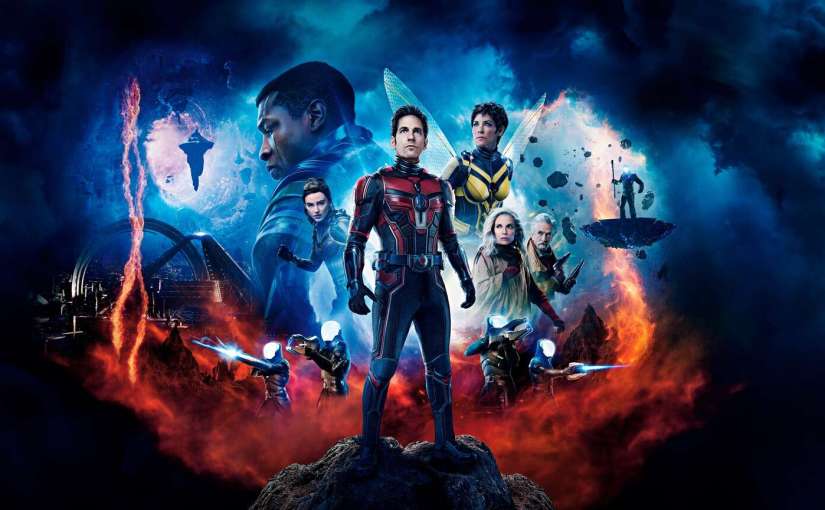
The blessing of Quantumania is that it does not rely abundantly on other material in the Marvel Cinematic Universe.  Scott Lang (Paul Rudd) reintroduces himself in a very adoring Paul Rudd-like way with a voiceover and thereafter, he is unexpectedly sucked into the Quantum Realm, along with his daughter Cassie (Kathryn Newton), his current partner Hope Van Dyne (Evangeline Lilly), aka The Wasp, and his mentors Hank Pym and Janet Van Dyne (Michael Douglas, Michelle Pfeiffer).  The gang must primarily depend on Janet to navigate them through this world of inconsistency and oddball inhabitants where no two characters seem to look alike.  Janet was marooned in the Quantum Realm for thirty years before finally being rescued.  What concerns her the most is one who is first referred to as “The Conqueror,” and later identified as the frightening superman known as Kang (Jonathan Majors), who was mysteriously exiled to this place.  As Janet describes, Kang has made the prison of the Quantum Realm his empire and now he wants to use the technology that our heroes possess to break free of this dimension and cause all kinds of chaos in the real world and other parallel universes.

The best assets to the film are the scenes between Jonathan Majors and Michelle Pfeiffer.  Granted, their dialogue could apply to any other kind of movie.  A lot of ping pong arguments between the villain and hero, which if I remember correctly go something like “You don’t understand.” and “I’ll never let that happen.”  This verbiage could also be suitable in a Meryl Streep tearjerker or a courtroom drama.  It’s pretty standard.  We’ve seen discussions like this a million times before.  Fortunately, my state of mind was not demanding of thought-provoking conversation.  The magnetism of their acting in front of the expansive CGI environment kept me hooked.   Jonathan Majors simply looks like a very frightening threat.  He’s calm at one point and later raging like a lunatic.  The man has levels.  If he were reciting the ingredients of chocolate chip cookies, I’d be on pins and needles. 

I do not think Quantumania is going to wow most audiences.  In fact, it’ll be a divisive film.  It’ll go half and half.  Though I really do not like to rank films any longer because it feels so pointless, I got into a debate with my wife and daughter about which one was better.  Quantumania or Wakanda Forever.  Both films have their merits, but I left the latest Black Panther film feeling a little depressed and exhausted.  That was a long time to feel morose for a superhero film.  The ladies, however, appreciated the story of that film over this one.  (I wanted to see the Black Panther suit a lot sooner.  I wanted a handful of people to be cut from the film, and I thought the Namor character was very boring.  Look for my review on this site.)

With Quantumania, audiences are either going to like the weirdness that is splashed all over the screen.  Splashed is not a strong enough word.  Try SPLATTERED!!!! Everywhere you look there is something abnormal to see from one corner to the next.  On the other hand, viewers will think the Quantum Realm and its inhabitants are just too bizarre, and the Marvel filmmakers are scraping the bottom of the barrel in imagination.  Sorry, but I got a kick out of the tall stilt guy with a spot light lamp for a head.  I thought the pink goo guy was cute.  I also giggled at the fat head henchman, with scrawny arms and legs, known as M.O.D.O.K. (with Corey Stall, making an MCU return).  The functionality of this character is deliberately lacking and comes off like Looney Tunes cutting room material, but that’s also why he is here.  If there was anything looking remotely normal in the Quantum Realm, well then it isn’t the Quantum Realm, I guess.  Bill Murray even shows up, but if you need a bathroom break, this is when you should go.  All of this looks way too stupid, yes!  Then again, stupid can be entertaining and stupid is often taken with subjectivity. So, I’m just one guy’s opinion. 

Quantumania is maybe the most unsophisticated of all the Marvel films.  More so than the Guardians movies, or the most recent Thor installment.  With a happy go lucky Paul Rudd, an army of ants and some of the most bizarre CGI extras found anywhere it proudly stands tall on that pedestal of ultra, ultra, ULTRA weird.  I think director Peyton Reed accomplished what he set out to do with this film.  The question is will the film win majority of approval within the nerd land of keyboard warriors like myself, who share their perspectives on the internet.  Well, the movie gets my vote at least.

CRIMES OF THE FUTURE (Canada, 2022)

by Miguel E. Rodriguez

DIRECTOR: David Cronenberg
CAST: Viggo Mortensen, Léa Seydoux, Scott Speedman, Kristen Stewart
MY RATING: 5/10
ROTTEN TOMATOMETER: 80% Certified Fresh

PLOT: In a dystopian near-future, the human pain threshold has suddenly disappeared, giving rise to bizarre performance artists who publicly showcase bodily mutations and self-mutilations.


Somewhere at the core of David Cronenberg’s Crimes of the Future is a crackling good thriller waiting to happen.  I was still waiting for it when the end credits rolled.  I couldn’t predict what was going to happen next, which is normally a big plus for me, but the problem was, I didn’t care what was going to happen next.  Just when the movie seemed about to kick into a new gear story-wise, boom, credits.  Shame.

In the near future, human bodies worldwide have started undergoing bizarre mutations involving the development of new internal organs and the disappearance of a pain threshold.  This leads to the proliferation of underground performance artists who are either publicly mutilated or mutilated themselves.  Why?  Because Cronenberg.  We get close ups of the lead character, Saul Tenser (Mortensen), lying in a special chamber while knife-wielding robotic arms controlled by his partner, Caprice (Seydoux), slice, probe, and excavate his thorax in search of unwanted new organs.  Another performer lies in a chair while a surgeon literally cuts grooves into her face.  Yet another performer has grown dozens of additional ears all over his body, and has his eyes and ears sewn shut while he dances to modern music as a voice intones, “NOW is the TIME to LISTEN.”


This is all typical stuff from Cronenberg, who was and is a virtuoso of so-called “body horror,” going all the way back to Scanners, Videodrome, and the remake of The Fly.  It’s so typical, in fact, that the sight of various bodily injuries and mutilations didn’t really faze me as much as I thought it would.  Or should.  Maybe this says more about me than about Cronenberg, but the most off-putting sight was that one dancer with the extra ears.  Everything else, while graphic, didn’t feel “real.”  It all felt like effects.  Instead of recoiling, I found myself thinking, “Wow, how’d they do that?”  (By contrast, the dancer with the ears may yet give me nightmares.)

The storyline of the movie remains maddeningly vague for the first half.  In a weird prologue, we watch as a mother performs an unthinkable act after seeing her son eat a plastic trash can as if it were made of gingerbread.  Saul Tenser seems to encourage the growth of these new organs in his own body, even though they could become harmful over time.  His assistant, Caprice, gets turned on by seeing him getting carved up in his chamber; he seems to enjoy it as well.  They call it “the new sex.”  There is a subplot about a new police division, New Vice (not terribly original), trying to crack down on people who perform these public acts of mutilation.  We watch as an unknown gentleman stalks Saul and Caprice while he eats what looks like a purple chocolate bar.  At a bar, another stranger inexplicably grabs the purple bar and takes a bite out of it himself, and immediately experiences something that makes him wish he hadn’t.

This is all interesting, cerebral stuff, I must admit.  The makings of a dystopian thriller a la Blade Runner or Gattaca (with more blood) are all there.  But the mood and lethargic pacing of the movie literally put me to sleep.  I had to rewind it several times during the first half to catch what I missed.

But then the second half kicks in.  Saul is contacted and asked to perform a public autopsy on a child who may have inherited a surgical self-mutilation from his father, a medical first which might be the signal of a true next step in human evolution, but one which was engineered by man and not by nature.  New Vice reaches out to a deep-cover agent (whose identity I wouldn’t dream of revealing) who is assisting the search for cells of bio-terrorists who are trying to alter the course of human evolution.  Meanwhile, Saul, who has been battling some kind of respiratory affliction for the entire film, is tempted with one of those purple bars.  Caprice undergoes a self-transformation of her own…

And then, when a crucial discovery is made that might change the course of the entire movie…it’s over.

How to describe my disappointment?  I was a huge fan of Cronenberg’s two entries in the genuine, “traditional” crime thriller genre, A History of Violence and Eastern Promises, both starring Mortensen.  Both films are much more conventional than Crimes of the Future, but both are light years ahead in terms of holding my attention.  I naively thought this film (with the word “crimes” right in the title!) would be along the same lines.  Am I critiquing the film I wanted it to be instead of critiquing the film it is?  Maybe I am, because the first half of the movie was so bland and stultifying that I can’t think of anything else to say about it except to compare it to something that I wish it had been.

Crimes of the Future, Cronenberg’s first feature film after an 8-year hiatus, sees him returning to a horror sub-genre that he virtually created, or at least perfected, nearly 40 years ago, and he does have something meaningful to say about what mankind is doing to itself and the planet without regard to future generations.  I just wish he had found a way to say it without boring me for the first fifty-four minutes, then leaving me hanging at the end.