THREE BILLBOARDS OUTSIDE EBBING, MISSOURI

By Marc S. Sanders

From February 2017:

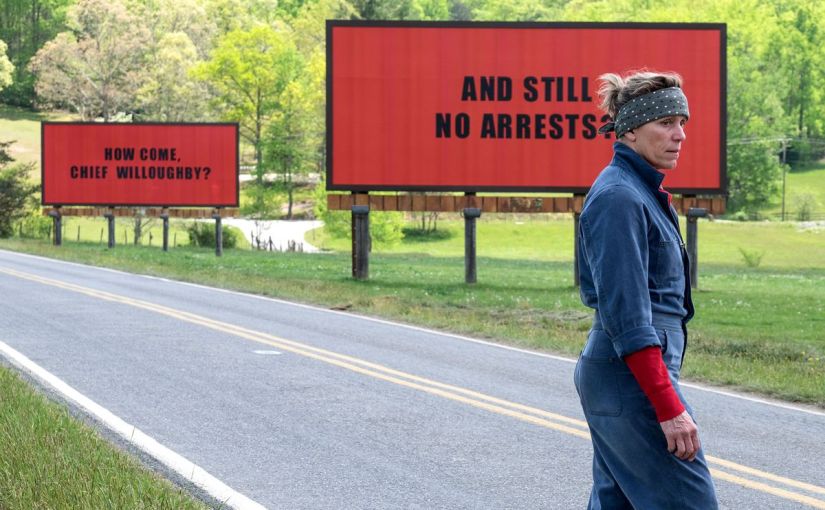
A number of years ago I read Roger Ebert’s review of a Kevin Spacey film called The Life Of David Gale, only after seeing the film myself. Reading his viewpoint assured me that perhaps I do recognize good and bad filmmaking with the absence of influence. Like me, he hated the film because of its contrivances and the complete 180 on Spacey’s character. He said it angered him so much that he wanted to throw his popcorn at the screen. Years later, I feel the same way, for nearly identical reasons after seeing this 2017 Best Picture nominee. I hate Three Billboards Outside Ebbing, Missouri.

I HATED THIS MOVIE. Hated it so much that I’m pissed over how much I hated it. This film is worthy of Best Picture, Actors and Screenplay nominations???? There was nothing better than this dreck???? Not Baby Driver, or Wonder Woman? Not All The Money In The World? Blade Runner 2049?

This film contains great talent trying way too hard to elevate the stupidity of the unjustified actions of their characters so much that suspension of disbelief isn’t just thrown out the window (like one hapless character who earns no justice), it’s burned, beaten, raped, shot, burned again, thrown off a building and drowned.

Consider midway thru the film, Sam Rockwell’s nominated performance as a vile, heinously racist backwoods lawman. He reads a letter and is magically transformed into a do gooder Boy Scout. There’s no way in hell I’d ever believe this. No one should. This guy is the entire KKK in one embodiment. By the time this bastard gets to this “epiphany” he had already committed the most sickening and atrociously violent actions fathomed, and in great detail. Yet magically a letter from a friend and an arson scene that burns him suddenly transform him. Just like that. Uh uh. Too convenient. Too manufactured. Too insulting to a movie going audience.

This film is full of other ridiculous contrivances that are simply too long and spoilery to describe here. (I’d love to spoil the film to salvage anyone from seeing this crap.)

Frances McDormand’s character is also despicably written. Here’s a character entitled to the anger she has after losing a daughter to rape and murder, worthy of attention due to the stubborn intellect she conveys during the act one exposition, yet as the film progresses, she becomes incredibly stupid and downright unlikable. What a thoughtless jerk she is. Nothing to cheer for. Nothing to love to hate. Nothing to laugh at. Nothing to cry over. Nothing. She’s just an asshole who conveniently gets away with her actions, yet everyone knows she’s the culprit.

In a film like this the bad cops are uncaring racists. The good ones are the clueless keystone cops who conveniently can’t see the forest through the trees. I don’t like it, and more importantly I don’t believe it. Unacceptable!!!

What a stupidly shitty movie that has been executed here in exchange for arguably the most interesting idea of all the 9 Best Picture nominees. I salute the idea of the film. It’s the execution that’s deplorable.

The only redemption that can come from this garbage now is if this film does not win one single Oscar. Sadly, I think I’ll be wrong. Congratulations Sam Rockwell, you stole a trophy from three much more entitled actors (Christopher Plummer, Richard Jenkins and I hear Willem Defoe.) Woody Harrelson’s performance in this pic is also up for grabs….for what? He coughs up blood quite well. I have no clue, otherwise.

Don’t believe the hype. Three Billboards… only has a great title, a great concept on paper and a great cast list. Beneath all that is carbon monoxide. Don’t breathe it in. You’ll only feel sick after watching it.

This will likely remain as one of the ten most despised movies I’ve ever seen.

THE GODFATHER PART III

By Marc S. Sanders

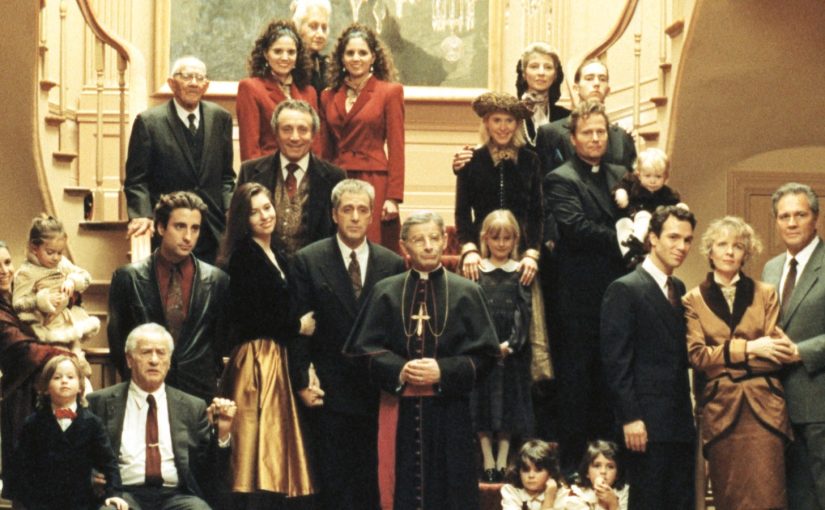
Francis Ford Coppola and Mario Puzo finished out their Corleone trilogy in 1990 with The Godfather Part III. Not so much a sequel, this third film feels more like an epilogue jumping towards Michael Corleone’s (Al Pacino) elder years as the Don of the most powerful Mafia family in the late 70s/early 80s.

Michael seems exhausted with his rule as he suffers from diabetes as well as remorse for his past sins; especially feeling the guilt of ordering the execution of his brother Fredo.

Still, he is drawn to crime, but on a more sophisticated and righteous nature by taking advantage of the Roman Catholic Church. Michael intends to purchase the powerful bank associated with the church but that’ll have to fall in line with the Pontiff’s agreement. It doesn’t help that the Pope is in failing health. The setup of all this lends to another grand opening where Michael earns a prestigious award from the church in the same tradition of an austere celebration of many guests that lend to character set ups for the film. A Godfather movie is not a Godfather movie without a grand reception to open the film.

The most interesting character is Michael’s nephew, Vincent (Andy Garcia), a fierce hot head like his father Sonny. He wants to work for Michael desperately while fending off a street hood boss (Joe Mantegna). An older don also comes into play by the great character actor, Eli Wallach. Diane Keaton as ex-wife Kay is also here but more or less to quietly bicker with Michael. Sister Connie is here, too, with Talia Shire. The Connie character always changes from each movie. Here she’s a deadly black widow. There’s also Michael’s daughter Mary (Sofia Coppola, contrary to popular opinion, I insist she’s very good in the role). Is Mary a legitimate cover for the family as the spokesperson for a fundraising effort? Is the possibility of Vincent and Mary (as cousins) getting intimate a terrible risk?

I like this film and hold it in high regard. Namely because Coppola and Puzo took an approach straight out of the news when there was an embezzlement scheme occurring within the Vatican bank. The problem for many I believe was that the plot of this grand scheme was not flashy or bloody enough, even if a participant is revealed to be hanging from a London bridge with fraudulent receipts falling out of his pockets…which actually happened in real life.

The film allows many opportunities for Michael to allow his anguish in guilt to flow. Fans grew used to a fierce Michael Corleone from the first two films. The elder Michael here would rather not get involved. Hence the introduction of Garcia’s character. He’s very good in the role. Yet there’s not much dimension to Vincent. He’s a scary violent guy, and a contradiction to what Michael seeks. Yet, thats about all there is. I would have wanted more dimension to this role; the guy destined to carry on the reign.

Sofia Coppola is fine in her part and undeserving of the lashing she received upon the film’s release. She’s Michael’s young daughter; a young adult dangerously close to the fray. The one innocent constant within the family. For me, I found a dramatic stake in her character.

The ending is very powerful. Slowly methodical as the family assembles in Sicily to see Michael’s son’s stage opera debut. There are elements that are consistent with the other films’ endings, but this violent conclusion comes with quite a shocking result. I was really moved by it.

Coppola didn’t measure up to the first two films with this effort. I agree with that. Still, The Godfather Part III is worthy of holding its place in the saga. It carries the traditions of the prior films in set up and music and operatic narrative. Be patient with its slow pace because I think the ending will grab you.

THE GODFATHER PART II

By Marc S. Sanders

The first film to use the number 2 (or Roman numeral II, in this case), in its title and the first sequel to win Best Picture is Francis Ford Coppola’s continuous adaptation of Mario Puzo’s Corleone family legacy in The Godfather Part II. It is worthy of all of the accolades it collected as an individual film. Yet, it does not best the first film.

Unlike the 1972 classic, Part II does not provide much character arc for anyone. We’ve already seen Michael (Al Pacino, silently ferocious here) change from good college boy and war hero to the evil puppet master Mafioso he eventually became. This film shows him exercising his threateningly murderous deeds as he works in conjunction with a sly Nevada Senator, a Jewish Miami mob boss (an excellent performance from Lee Strasberg) from the time of his father’s reign, and another mob guy from New York (Michael V Gazzo). We get a whiff of all these guys early on during a commencement celebration for Michael’s son. Coppola keeps this a running theme of grand openings in all three films. It’s a great method of introductions each time.

Following the party, an assassination attempt is brought against Michael. But who did it? Problem is this is where the foundation of the film is not so strong. It’s never really made clear who betrayed Michael. That’s a little bothersome.

Coppola depicts another storyline altogether with the early 20th century origin of Vito Corleone flawlessly played by Robert DeNiro who hardly speaks any English while communicating in a Sicilian variant of Italian. Young Vito immigrates to America following an escape from the Sicilian Don that murdered his family. In New York we witness his rise to power. Famed Cinematographer Gordon Willis washes out these flashback images to enhance a pictorial history accompanied by Angelo P. Graham’s art direction of early brick and mortar architecture and the muddy streets of early Little Italy, New York. It’s a time travel back to a historical age. It’s magnificent.

Back in the 1950s, Puzo and Coppola bring authentic fiction to real life history as Michael considers a go at a business enterprise in Cuba. However, will the rebellion uprising interfere with his plans, and what will it cost him? As well, there’s a great sequence where he has to testify before a congressional hearing in response to suspicion of criminal activities. Coppola used the infamous McCarthy hearing footage as inspiration for this predecessor to what C-Span would eventually look like.

Yet, there’s another story to become involved with as Michael must contend with his dim witted older brother Fredo. John Cazale is superb as the guy who wanted more but was limited by the influence of competing factions and his loyalty to his brother. Pacino and Cazale always had great chemistry together. A great conversation moment occurs in the third act following a terribly surprising twist. One of the best scenes in the film occurs on the porch of the Corleone compound.

More story elements come into play as Michael attempts to balance his married life with Kay (Diane Keaton). She’s pregnant again. Yet, what will that mean for the future of the family?

The sequel to The Godfather assembles another stellar cast. So good, that the film garnered three Oscar nominations in the Supporting Actor category alone (DeNiro, Gazzo, Strasberg) as well as a nomination for Pacino as Best Actor and Talia Shire (Supporting Actress) as Connie, Michael’s sister. That nom left me a little dubious only because there’s not much material for Shire to play with here.

Coppola’s detail is at the top of his game again. The film, like the first, feels like a true life biography.

Puzo offers heartbreaking moments, most especially in the film’s shocking end which leads to a flashback assembly of characters from the first film. That scene alone plays as a great reminder of what Michael once was before becoming the hideous monster that closes the story. Puzo’s whole Godfather franchise hinges on well defined, crushing tragedy.

The Godfather Part II is nothing short of mesmerizing and wholly engaging. You can watch it over and over again. It’s layered in rich storytelling and narratives that provide endless amounts of material for a family meant to be mired in secrets, deliberately hidden in the dimly lit rooms that Willis photographed.

It’s a treat to be the fly on the wall wherever Michael and his family move to next.

THE GODFATHER

By Marc S. Sanders

Probably the greatest character story arc in all of film is of Al Pacino’s portrayal of Michael Corleone in Francis Ford Coppola’s The Godfather based upon Mario Puzo’s best-selling novel. (The film is a thousand times better than the book.)

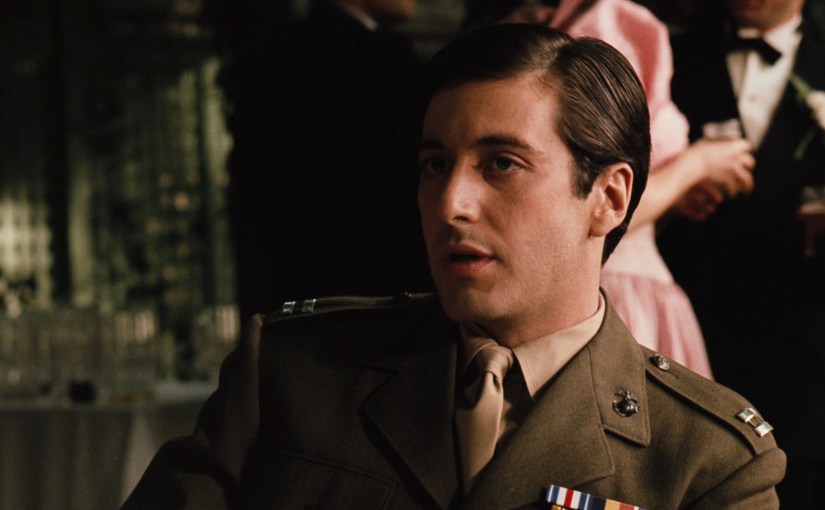
Michael is the youngest of three sons intended for a legitimate life separate from his Mafia family. The masterful opening sequence of his sister’s lavish wedding show him courting his eventual wife, Kay (Diane Keaton), and never feeling proud of the actions of his notorious father, Vito (Marlon Brando), nor his brother Sonny (James Caan) or their consigliere, Tom (Robert Duvall). He’s an innocent war hero in uniform with an open mind of an untarnished future. It is only when bad blood circumstances are tested that he feels forced to strike with the same intent that the Corleone family is infamous for.

Coppola presents quiet, subtle moments of expression in Pacino on camera. You see the change in Michael sneak up on you and you see a character develop into something else entirely. What starts as a false impression to appear as if he’s carrying a gun in his pocket, soon after leads to murder, by means of nothing personal but “strictly business.” From there, he retreats and hides until he is blessed with carrying on an evil legacy.

Yes, the first chapter in the operatic trilogy of crime, is mostly known for a grandstanding performance by Marlon Brando but the story relies on Pacino as Michael. Michael Corleone at least must be one of Al Pacino’s greatest roles. He arguably has one of the most impressive resumes in all of film. Here is where it jump started.

The direction by Coppola is a film student’s required studying. With Puzo’s script, the best idea was to open the film with a wedding. As the film offers so many characters and much back story among all of the guests, the interaction and workings of the family are efficiently condensed into this 25 minute opening sequence. Don Vito meets with people needing favors while outside the home, the crew is dancing, doing their jobs and minding who is watching. By the end of this opening you have a full grasp of the family tree and who works for who and what their characters are like. Sonny is the hot head. Michael is the innocent. Fredo (the middle son played by John Cazale) is not doing much but being a cut up, Momma Corleone is the valued matriarch and Tom is the well managed advisor. You even get a glimpse of some “very scary guys,” some competing hoods, who’s cheating on who, and some people who need help with citizenship and film casting.

Art direction from Alex & Dean Tavoularis is magnificent, depicting a post WWII New York, and a historical Sicily stagnant in open plains, romance and murderous pasts.

The cinematography is better today than it was originally. Gordon Willis returned decades later to (for lack of better word) lighten up the picture. The interiors remain dark in secret and comfort, but the characters are more illuminated. The Blu Ray restoration is a fantastic return to the classic film and its two sequels.

The Godfather is endlessly quotable and never dull no matter how many times you watch it. Puzo’s screenplay plays like the biography of a real person and family, much like his adaptation for the screen of 1978’s Superman: The Movie. It is an American classic rich in a history we believe has been told and carrying on the tradition over the course of a 10-12 year period.

I return to praise Pacino to remind you how his appearance even changes as he gradually builds his strength and accepts his title of Don. I feel like I’m looking at two physically different people from the beginning in his Marine uniform with boyish looks, to his independent walkabout way during his Sicily retreat, to a more broad shouldered, slicked back hair, dark suit tailored appearance during the film’s third act. It’s an uncanny transformation that is built on performance and expert direction and writing from Coppola and Puzo. I still get chills as Michael in his college boy sports jacket volunteers himself to satisfy a family vengeance. Coppola zooms in on him slowly as he sits in a leather arm chair, arms at his side, legs folded. We are seeing a new man in charge for the first time. It’s chilling.

The Godfather is one of the greatest pictures that will ever be made. It’s a perfect chemistry of technical achievement, attentive storytelling and sensitive, yet powerful performances from probably the best cast ever assembled.

I’m amazed that I know of some friends who still have yet to see it.

The Godfather is the film that everyone should see before they die.

PHILADELPHIA

By Marc S. Sanders

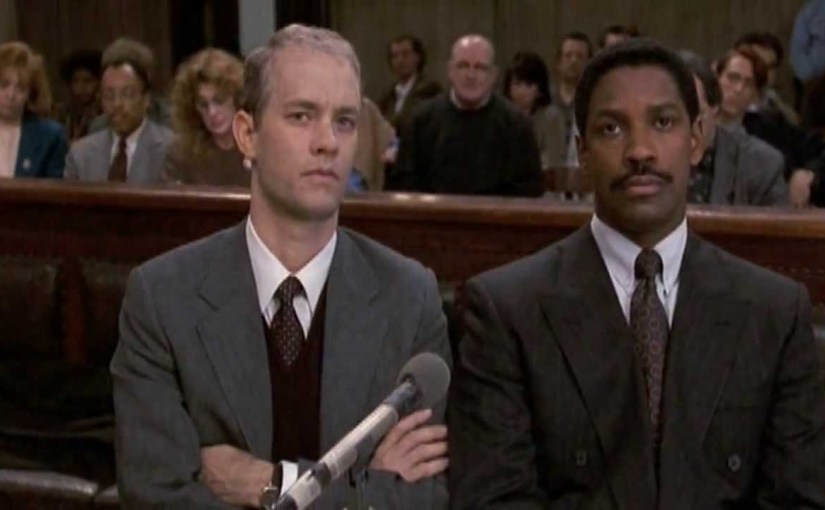
Tom Hanks most certainly deserved the first of his two Oscars for his portrayal of Andrew Beckett, one of the first protagonists to be an AIDS victim on screen in Jonathan Demme’s 1993 film, Philadelphia. Its a good film but not a great film.

I recall seeing Philadelphia when it was originally released. Seeing it today, my opinion hasn’t changed. I don’t believe the film takes enough risks and the script from Ron Nyswaner is too cookie cutter and simple. Beckett hires Joe Miller (Denzel Washington) to represent him when he proceeds to sue the law firm who wrongfully fired him for having AIDS, and most likely being gay as well. The argument hinges on proving that having AIDS is a handicap that never interfered with Andrew’s work performance. Andrew is clearly made out to be the firm’s best of the young attorneys when he’s assigned their biggest client. Nine days later he’s sabotaged, and soon after he’s fired for an attitude problem and carelessness. Eventually, Andrew and Joe assemble, despite Joe’s prejudices against homosexuals.

The trial, Andrew’s struggle of living with AIDS, and Joe’s own inner debate with associating and defending a homosexual, AIDS victim are the three main storylines.

The first storyline is the best. Demme does a masterful job of showing the evolution of the disease. Andrew could be looking at papers on a desk and when he turns his head, a lesion appears on his neck. Makeup artists Carl Fullerton and Alan D’Angerio deservedly were Oscar nominated as Hanks’ appearance seems to change from one scene to another and another. He’s thinner in one moment with very fine ash gray hair. In another scene, he’s got a full head of hair with an energetic way about him. I cried for Andrew’s deterioration. Hanks and Demme carry that aspect very, very well. The actor does great work of changing his voice when he’s fighting a cold with a terrible cough or evoking massive weakness. As the film progresses and Andrew gets sicker, he’s incredibly pale with a droopy eye. The makeup artists tell the story with Hanks’ performance and Demme’s direction.

The 2nd and 3rd storylines don’t offer much of a challenge. The law firm primarily represented by head partner Jason Robards is too easily “evil.” There’s no subtlety here. Robards gets right in the face of the film – “Andrew brought AIDS into our office.” A better script would wait for the bad guys’ momentous third act Freudian Slip. This case was unchallenging really. It was too easy to win. Especially true considering this great and powerful law firm hires Mary Steenburgen as defense counsel. Steenburgen plays her part very mousy and unaggressive though. This case is too lopsided and uneven and I just couldn’t get past that.

Joe’s own reservations are too apparent as well. He’s meant to represent those that simply never understood the mentality of gay love, nor the scientific evidence of the AIDS virus. He rushes to his doctor following an initial meeting with Andrew. Demme does an extreme close up of this doctor to teach the audience the basics of AIDS. This guy is right in your face with his dialogue. I didn’t care for moments like this. Too patronizing.

A side story attempts to show the intimate relationship of Andrew with his boyfriend Miguel (Antonio Banderas). I still feel the same about this part. The script holds back. Hanks and Banderas give each other “bro hugs” and kisses are done on the bottom cheek. Back in’93, filmmakers were not prepared to go all the way with depicting the true nature of homosexuality. I found it insulting. You finally want to make a film that shows AIDS and homosexuals at the forefront but you stop short at the finish line.

Ironically, Joe has a repetitive line “Explain this to me like I’m a 4 year old…” Demme adopts that method throughout the film with major “in your face” close ups to glaringly make the beliefs of what any character values or has to say as obvious as possible. I felt as an audience member that Demme didn’t have to take it this far. I get it. You don’t have to be THAT FORTHRIGHT.

Washington is a great actor as always. He’s likable even if he’s tripped by the fault of misunderstanding. His “TV GUY” ambulance chasing lawyer is comic relief at times within a film of very heavy subject matter.

Demme’s filmmaking does make some wise choices despite some of my issues. The opening credits offers a lot of footage of the city with people carrying on their daily lives while waving to the camera, selling fish at the market, street dancing, etc, all accompanied by Bruce Springsteen’s sweet, yet haunting theme “Streets Of Philadelphia.” I like this opening as it shows what we see on the surface of the people we live with does not necessarily reveal the struggle any one of us might be enduring. This is a moment where the script is not so easy to grasp. There’s a challenge to accepting Demme’s footage blended with Springsteen’s overture.

Jonathan Demme is a good director, who is sadly no longer with us. I appreciate Philadelphia for showing the illness but not much else. It’s a film that should be seen. I’d argue most would embrace more of the movie than I did. I just felt the envelope could have been, actually should’ve been, pushed further. It was too careful with its subject matter.

A great observation though was recognizing the many faces that appear in the film from Demme’s other film, The Silence Of The Lambs. As well as naming Joe’s baby daughter “Clarice.” I also recognized an identical tracking shot that Demme offers. When Joe goes to visit Andrew in the hospital, it is a shot for shot remake of the tracking movement when Clarice goes to visit Jack Crawford in his office, at the beginning of Lambs. This might not be original, but I had fun recognizing it, nonetheless.

QUIZ SHOW

By Marc S. Sanders

Robert Redford’s 1994 masterpiece deserves much more recognition than it ever got.

Here, he produced and directed a stellar cast that showed how America was always in it for the competition and for the glory and for the fame and naturally for the money.

Redford opens his film with a car salesman describing the regal elegance and perfection of a 1957 Chrysler convertible. It’s a gorgeous car. Then the potential buyer turns on the radio. The car isn’t so fascinating anymore as a news announcement reveals that Russia beat the United States into space with its launch of Sputnik. All America has now is just a car.

Opening credits roll and the next American sensation is presented, “21,” the most popular show displayed on the greatest invention, a home television set. However, the show is all a lie, and yet by the end it’ll survive along with its network, NBC, and its wealthy sponsors.

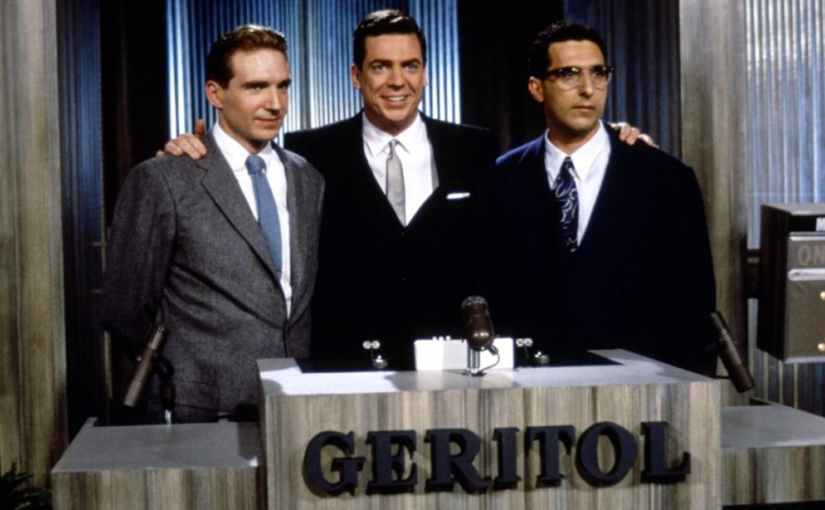
Quiz Show foreshadows the cost of fame and attention. It’s a wonderful sensation until it’s stripped away in personal disgrace. John Turturro (how did he not get an Oscar nomination?) is Herb Stemple, the champion, nerdy schlub who is growing tiresome among producers and audiences. He is forced to take a dive and be replaced by the handsome Charles Van Doren played Ralph Fiennes, a member of one of the country’s most intellectually gifted families. The difference in appearance is obvious. So is the desire for a change in programming. What’s obvious is how the two men are exploited as pawns for gain in corporate America. Cheat, but if you call it television, what harm is there really?

The harm falls in public perception. Disgrace comes to these men, and worse, to their families. It mirrors modern stories like Harvey Weinstein, Joe Paterno, Bill Cosby, Kevin Spacey and Matt Lauer.

It’s a very calm film that debates the ethics of these men and necessities to uncover the truths and reveal the falsehoods.

Redford only gets aggressive in his period settings and I’m thankful for it. Nothing looks out of place, including the large enthusiastic grins of a 1950s American viewing audience dressed elegantly and innocent. Even nuns and pajama clad children are invested in “21.” This clean cut appearance will soon fade , however, after the quiz show scandal dies down.

Ugly lies and denials were committed against Redford’s beautiful backdrops. Therein lies the necessary conflict of another fascinating story.

Was this country ever innocent?

her

By Marc S. Sanders

Director/Screenwriter Spike Jones is a master at adding multiple dimensions to what we always know exists. It’s been evident in his prior films, Adaptation, Where The Wild Things Are, (which I did not care for personally), and most especially in Being John Malkovich. He plants the seeds of fantasy in what we can normally touch, hear and see. Then his elements of fantasy receive a supportive crutch from what his viewers have always been familiar with.

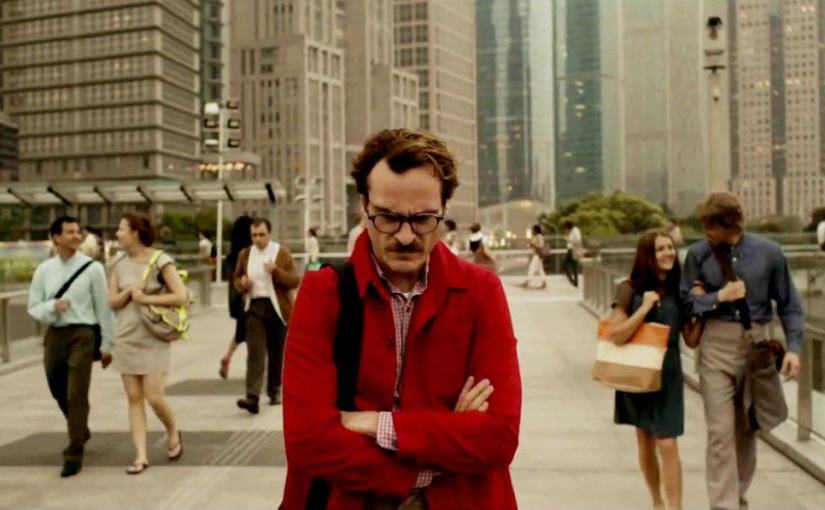
her is another masterwork; a film that takes place in the not too distant future that expounds on our current digital age. If we can already talk to “Siri” or “Alexa” and trick–umm, excuse me, “her” (I mean “Siri”) into making sophomoric dirty jokes, then of course we are bound to approach the stage where we can literally, truly fall in love with her and then she can reciprocate.

With her raspy yet silky vocals, Scarlett Johansson is inspired casting as the voice of “Samantha.” Had she actually had a physical presence in the film I would have totally fallen for her affections. The film hinges on the performance of Joaquin Phoenix as Theodore. If we can’t believe that he loves “Samantha” more than he loves himself (a surefire test of true love as far I’m concerned) then “her” falls apart. Phoenix passes abundantly. He deserved his Oscar nomination.

From the start, you become very accustomed to the banter between Theodore and his electronic device voiced by “Samantha.” Both have personal feelings. Both have personal longings (more especially “Samantha” the computer, of all things!!!).

Spike Jonze explores all the diameters and dimensions of a loving relationship. The ups, downs, and in betweens. What’s different is how all of these layers of a relationship are received in this currently fictional (bound to come true, one day) dynamic of a relationship. Theodore and “Samantha” are affectionate. They argue, they laugh, they even make love. Watch the movie to understand that last point. It happens, and it is perfectly executed with the residual effects of their lovemaking bringing the film into its next act brilliantly.

Jones won the Oscar for original screenplay simply for how innovative this picture is. I’m not sure it’s the most exciting two hours of film, however. Personally, I think other films in this category back in 2013 had sharper and more interesting scripts. her is practically all talk and when it ended, I was ready for it to be over, and it concluded as I expected.

Still, Jones is fortunate that his cast (Johannsson, Phoenix, Amy Adams and Rooney Mara and Chris Pratt) trusts him. If they hadn’t, this movie would have lost its magic by probably how absurd this script must have originally been perceived on paper. Well done work by all involved but credit has to begin with Jones, the screenwriter.

BLACKKKLANSMAN

By Marc S. Sanders

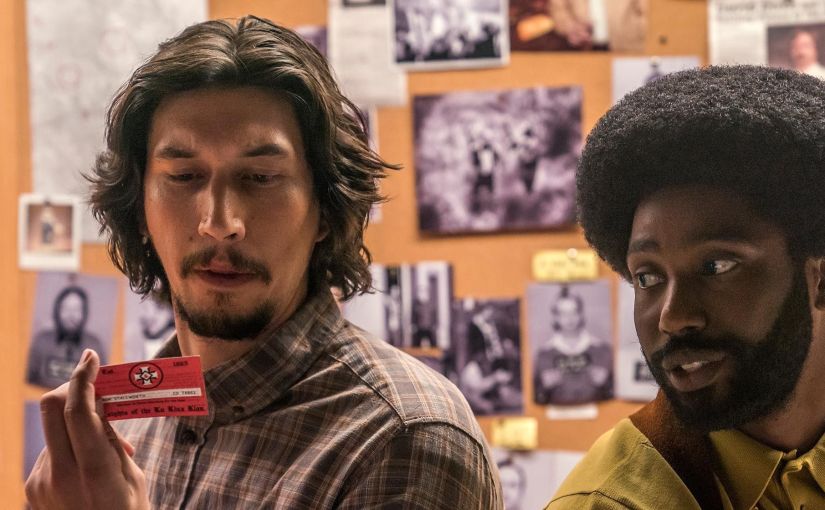
Spike Lee has finally received a Best Director Oscar nomination for his film BlacKkKlansman. It is based on the book by Ron Stallworth. In the 1970s, Stallworth was the only black police officer in the Colorado Springs police department. He was always ready to face the backlash and criticism for his afro and skin color. He also orchestrated an infiltration of the Ku Klux Klan while developing a trust with their Grand Wizard and eventual Presidential candidate David Duke.

John David Washington (son of Denzel) portrays Stallworth with high intelligence, instinct and even tolerance to stay focused on the end goal of incriminating Klan members out to do more than just march. Stallworth partners up with Flipp Zimmerman, a Jewish cop who will make his presence as Stallworth among the ranks of the Klan. Call it a Cyrano set up. Stallworth does the talking over the phone. Flipp stands in their presence.

I’ve usually been hot and cold on Spike Lee. Forgive me but when a “Spike Lee Joint” debuts in theatres, my subconscious immediately expects a very biased and unfair viewpoint of racial tensions in America. I don’t care for Lee’s outspoken statements in the media at times and I shake my head at some of his misguided actions. That’s another conversation that I welcome to have with anyone at another time. However, Lee takes a very aware and balanced approach here. The film opens with Alec Baldwin as an evil messenger of hate attempting to record a sermon for his disciples. Lee films Baldwin very disturbingly among different color hues and jittery close ups and wide angles. It’s nauseating and it should be.

Then Stallworth’s story begins and he is assigned to go undercover at a former Black Panther member’s (played by Corey Hawkins, who I loved in the revival of 24) speaking event on a college campus. The police expect this will be an orchestration of violence among the black community but Stallworth sees it is anything but that. Lee commits a beautiful filmmaking effort as he shows the faces of black people listening to the speech in spotlights as Hawkins continues on. These are college students simply looking for a way to never succumb to anyone who considers them inferior. The speaker does hold the white man accountable, yes, and I don’t care for that as I’m a white man with no instinct of superiority. Therefore, don’t lump me in with a small sect of misguided people, please. Still, the scene is effective and relatable. America has its ugly histories and America is not settling for insensible and uncaring treatment of its people either.

From here, the film takes on a more linear story as Stallworth and Zimmerman build their case.

Lee offers good debates among his cast of characters. Stallworth becomes attracted to an activist named Patrice, played very well by Laura Harrier. Here’s hoping to a long, successful career for her. Patrice believes the police are the enemy and even questions if Stallworth will remain a police officer following this case. Stallworth takes pride in being a cop. Black Life vs Law Enforcement.

Stallworth and Zimmerman bear witness to the mentality of the Klan. Over and over the Klan members suspect Zimmerman of his Judaism. He denies it and goes to great lengths to disprove his heritage and yet the Klan continues to question him, despite some high level members truly believing his guise of white supreme devotion. White Supremicists vs. Judaica & Black Life.

Lee has offered a powerful film that left my wife and I up until two in the morning discussing its dynamics; discussing how many things have changed for the good since the 50s; discussing how many have gotten better, have gotten worse and how some things have sadly resurfaced in recent years.

BlacKkKlansman reminds me that Lee is truly an accomplished filmmaker. Beyond his messages and viewpoints, Lee knows how to edit a scene and offer inventive camera angles and direction. He’s a prize student of film, now a teacher. This latest effort is a reminder of how Lee’s production of Malcolm X in 1991 was robbed of recognition at the Academy Awards, a true injustice.

BlacKkKlansman is Spike Lee’s best film since Malcolm X and one of the best films of 2018.

STAND AND DELIVER

By Marc S. Sanders

One of the most inspiring classroom setting films is Stand And Deliver directed by Ramon Menéndez and written by him with producer Tom Musca. This pair took great pains to protect the integrity of their script.

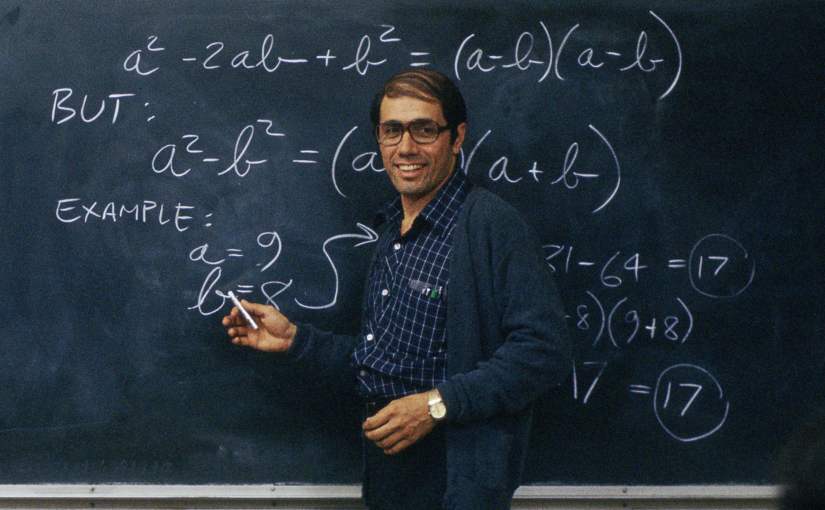
The film tells the story of math teacher Jaime Escalante’s (Edward James Olmos) uncompromising drive to bring 18 students at Garfield High School to passing the state’s AP Calculus exam. These students come from working class Hispanic families who hardly offer their own children any bright future beyond fixing cars, waitressing in the family restaurant or remaining as a gang member in a life of crime. Their parents laugh and shake their heads at their dreams of becoming doctors or engineers. Their parents never had a teacher like Jaime Escalante.

Escalante motivates them to find a ticket out, and become the first members of their families to graduate high school and go to college. The first two acts of the film focus on Escalante’s drive and brief encounters with some members of his classroom. He shows how he’s not intimidated by gang member Angel (Lou Diamond Phillips) and how he convinces a restauranteur to allow his daughter to return to class. Another student is overcome with stress. Escalante listens but doesn’t allow the student to give up. I like these scenes a lot and my descriptions do not give these moments enough credit.

The film does not rely on classroom speechifying or inspiring rock music to cut in with sequences of kids reading books. Instead, it drives home the fact that Jaime Escalante never loses sight of the nowhere potential these students live with. The students learn to respect the one man who never underestimates them, regarding him as “Kemosabe.” He never allows them to lose their “ganas;” a desire for something better.

Even after they pass the exam, the students’ own environment will not allow them to celebrate their success. It’s too hard to accept the result. It’s easier to accuse them of cheating as it’s presumed that this sect of Hispanic/Mexican people could never have accomplished what their scores indicate. No other explanation could merit what’s occurred. Escalante is angered by this racism, but his confidence in his students pushes them to retake the exam. Blatant racism will not prevent a future without poverty.

The students consist of mostly unknown actors. Following this film from 1988, I’d catch one of them guest starring on a TV show here or there. Collectively speaking though, they really come through by convincingly displaying their lower class lives. It’s easy to see a lack of potential for these kids early on in the film. It’s also comfortably easy to see how Escalante takes command of their lives with a sense of unity and motivation. No one ever told these kids they could solve some of the hardest mathematical equations ever conceived. No one ever told these kids they could amount to something. It took someone from their own environment to help them defy a stereotype and demonstrate that intelligence is a gift that any human being is blessed with. They just have to have the “ganas.”

Edward James Olmos was nominated for a Best Actor Oscar. I’d say it was one of the most under the radar performances to ever be considered frankly. Stand And Deliver was made on a small budget. It’s easy to see that. Still, that is also what is so special about the film. This film stood on its performances and the genuine inspiring story it’s based on. It had all the ingredients it needed to be a winning film. This film eventually reached the exclusive annals of the prestigious National Film Registry of the Library of Congress. Stand And Deliver will tell you to never surrender. 

THE KARATE KID (1984)

By Marc S. Sanders

Though it may feel like an After School Special at times, there’s always been a charming quality about The Karate Kid, and that stems from the relationship between Daniel LaRouso (Ralph Macchio) and his elderly Asian mentor from Okinawa, Mr. Miyagi (Oscar nominee Pat Morita).

John G. Avildsen, director of Rocky, is harsh in the expository bullying that Daniel endures when he moves from Newark, NJ to California. The Kobra Kai kids led by William Zabka (your go to bully for 1980s films) are brutal in their fighting skills as they use Daniel as a means to exercise their Sensei’s philosophy of “No Mercy!” The Sensei is played very frighteningly by Martin Kove.

What’s hard for me to digest with The Karate Kid is that Macchio is not very good in the role. He kind of comes off as a kid I’d never want to hang out with. He tries too hard to be cool, but he doesn’t look cool. His sense of humor is really never funny. It’s too hokey really when he puts the charms on his crush Alli (Elisabeth Shue). While Shue is fine her in her sweetness, Macchio is really why I never found any chemistry between the two actors. He comes off like Shue’s little brother more than a high school crush. He’s a twerp. What saves me from giving up on Daniel, or Macchio in the role, is the maintenance man who steps in to rescue Daniel from another beating.

Pat Morita is excellent as Mr. Miyagi and has truly created one of the most pop culturally significant characters in film from the last forty years. There’s an authenticity to his role. Most importantly, he’s a veteran of World War II who suffered loss. A great scene occurs mid way through the film where Daniel finds a drunken Miyagi commemorating the death of his wife and newborn both lost due to complications in childbirth while he was away in service. Screenwriter Robert Mark Kamen brought a depth to the Miyagi role. Along with Morita’s performance, he allowed a likability in Daniel that eventually catches my interest. Daniel eventually appreciates the elderly man beyond his devotion of karate. When Macchio is responding to Morita, I like him. When he’s responding to any other character in the film, I don’t like him.

The centerpiece of the film is the mundane training that Daniel endures. “Wax on. Wax off,” and so on. It’s hardly forgettable but it’s also a little slow moving. Still, I like the lesson. Miyagi demonstrates that the best way to learn karate is ironically when you have no inkling that you’re learning karate. Use the fundamentals of any skill and apply it to the art of karate. Karate doesn’t stem from an urge of violence. It comes from something more intrinsic. Karen’s script with Avildsen’s direction never forgets that.

The payoff moment is when it dawns upon the very naive Daniel of what Miyagi was teaching him all along. Daniel might be painting the house and sanding the floor and waxing the cars on Miyagi’s property, but is that all he’s doing? Soon we discover the significance of this drawn out sequence. Morita opens your eyes when he throws punches and kicks at a frustrated Daniel, and it dawns on the kid that he suddenly knows how to defend himself. Avlidsen films a hair raising scene at this moment. Its like when the frail Yoda uses the Force to lift Luke’s X-Wing fighter out of the swamp. It’s another layer revealed in the Miyagi character.

So, without Mr. Miyagi The Karate Kid plays like a cheesy home room, early 80s lesson film. When a scene includes Morita, the wow factor is front and center. Often I talk about the best characters are the multi dimensional ones. Mr. Miyagi is the perfect example. We see him as the quiet maintenance man, then he’s the master fighter, then he’s the guy with a healing skill, then he’s the guy who’s got the secret crane technique for delivering a kick, and then he’s the guy with a sorrowful past and finally he’s the mentor and most importantly, he’s the friend. All of this crammed into one little old man from Okinawa. Pat Morita is the reason to watch The Karate Kid.