THE TRAGEDY OF MACBETH (2021)

by Miguel E. Rodriguez

Director: Joel Coen
Cast: Denzel Washington, Frances McDormand, Alex Hassell, Brendan Gleeson, Corey Hawkins, Stephen Root
My Rating: 8/10
Rotten Tomatometer: 93% Certified Fresh

PLOT: William Shakespeare’s tragic tale of murder and guilt gets a stylistic re-telling with moody direction from Joel Coen and powerhouse performances from its two leads.


I am of two minds when thinking about Joel Coen’s take on William Shakespeare’s Macbeth.

First, I must admit I am no Shakespeare scholar. I can count on one hand (maybe two) the number of filmed Shakespeare adaptations I have seen, and I can count on one finger how many theatrical productions I’ve seen. I’ve only read two of the Bard’s plays beginning to end: Othello and Julius Caesar. I have acted in a production of the popular Shakespeare parody The Compleat Workes of William Shakespeare (Abridged), but I doubt anyone would find that an acceptable credential.

So I must be honest and say that, when it comes to the nitty gritty specifics of the dialogue in The Tragedy of Macbeth, I was lost for, oh, 50-60% of the time. Like, “out to sea” lost. I am moderately familiar with the story, so in those times I was lost, I was able to glean what was going on or what was being said in context. I know who Banquo and Macduff and poor Duncan are, and so was able to follow their various comings and goings as revealed in the frequent chunks of expositional dialogue.

[Full disclosure: If the name of the Ross character is ever actually mentioned in the film, I must have missed it…for the duration, I wondered what his name was, and he is a vital character in certain scenes.]

But I have to say, whatever I missed in the dialogue was more than compensated for by the sensational visual language of the film, and by the stunning performances from the two leads.

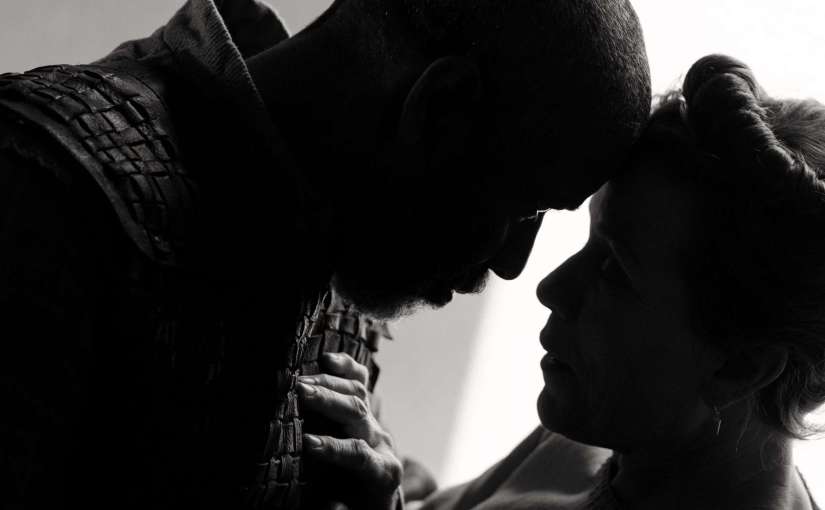
First, it was shot in glorious black-and-white, and it was all shot on soundstages, giving the director (Joel Coen, working for the first time without his brother Ethan) and cinematographer (Bruno Delbonnel [Amélie, Across the Universe]) absolute control over the lighting and shadows. The resulting visuals look like something out of the early silent films of Fritz Lang and, especially, F.W. Murnau, with compositions that must have taken hours and hours to set up, with high-contrast shadows creating elaborate framing devices on walls and floors. When Macbeth famously sees a dagger before him, it’s accomplished by shining a reflective light on a highly polished door handle. In the few shots that take place outside the castle, more often than not shadows are moving slightly in the frame, as if the sun or the clouds were in constant motion. Those shadows always seem to be sliding down over the characters, perhaps mirroring Macbeth and his lady’s constant downward spiral towards their fate.

Another factor in the visual look of the film was the decision to frame it in the standard 1:33 ratio, sometimes known as the “Academy” ratio. Basically, instead of watching the film on a rectangle-shaped viewing area, you’re watching it on a square set in the middle of the screen. One might think that doing so would limit the possibilities of visual expression, but not so. For me, it had the effect of making everything a little more claustrophobic, which I think is important in cementing the state of mind of our two main characters. As the guilt over their evil deeds threatens to overwhelm them both, the smaller screen is a constant, subtle reminder that their options are limited, and becoming fewer as time goes on.

All in all, a visual feast, in a nutshell.

But what makes The Tragedy of Macbeth even more delightful to watch are the performances. To be sure, everyone involved acquits themselves incredibly well. (Keep your eyes open for a young man named Harry Melling, aka “Dudley Vernon” from the Harry Potter film franchise.) But the two that shine brightest are Denzel Washington as Macbeth and Frances McDormand as Lady Macbeth.

Lady Macbeth is as quietly vicious and malicious as they come, and it helps that her attitudes are quite at odds with McDormand’s kind, open features. It is a little startling to see the face of good-hearted Marge Gunderson fiercely exhorting Macbeth to commit regicide in sharp, clipped tones, her whispers piercing the air between them like poison darts. Her despair at her husband’s inability to calmly deal with the guilt is clearly evident; when he reveals he went above and beyond what was originally planned, her shocked “are-you-kidding-me” looks are worth pages and pages of dialogue. And, of course, in the late stages of the story, when madness finally overtakes her, when no amount of washing will wipe the blood from her hands, her animalistic howls of anguish are almost worth the price of admission.

But the highlight of the whole venture (for me, anyway) was watching Denzel Washington demolish the screen as Macbeth himself. Words fail me. I haven’t seen a performance this amazing and praiseworthy since Daniel Day Lewis in There Will Be Blood. I may not be a Shakespeare scholar, but I know enough to understand that making it flow as easily as normal speech takes a great deal of research and rehearsal and collaboration. What I would not GIVE to see him reprise this role on stage somewhere! He navigates the twists and turns of Shakespeare’s tortured syntax as easily as if he was telling a story about his day at work. As with any great performance, there are peaks and valleys, and his teeth-clenching, fist-pumping outbursts are used as periodic punctuation marks, not entire sentences. There is a brief scene where he angrily berates a messenger, and his seventeenth-century taunts and name-callings are as surgical and cutting as anything from Mamet. It’s a miraculous performance, and I would not be surprised in the least if he gets another Oscar nomination. (The same goes for Frances McDormand…what a duo!)

(I would be remiss if I did not also mention the performance by a little-known actress, Kathryn Hunter, as the famous Witches. Her voice and face open the film, and if there’s any justice, it will go down as one of the great opening sequences of the movies. There are portions of her performance that must have taken great courage and trust in director Coen, to make sure she did not come off as simply a kook. She does not. She is one of the most ineffably creepy individuals in a movie in quite some time. I dare not say more without ruining the effect. But she was breathtakingly successful.)

When I walked out of The Tragedy of Macbeth, I can clearly remember thinking, “Well, great movie, but one that I wouldn’t purchase for my home video library, because how can it possibly equal the experience of seeing these precise visuals married to these insane performances, on a big screen?” But the more I think about it, the more I think I will pick up a copy when it becomes available, for a couple of reasons. First, a little extra culture never hurt anyone, and second, it will be worth the purchase price just to see Washington and McDormand tear up the screen as the Macbeths again, not to mention those stunning visuals, AND those creepy witches. This movie is really growing on me.

ROCKY

By Marc S. Sanders

Rocky is a story about a bunch of losers.  It really is. It’s actually a film that does not represent or follow the standard ho hum formula that so many other well-recognized sports films that are so familiar, since it premiered on screens in 1976. 

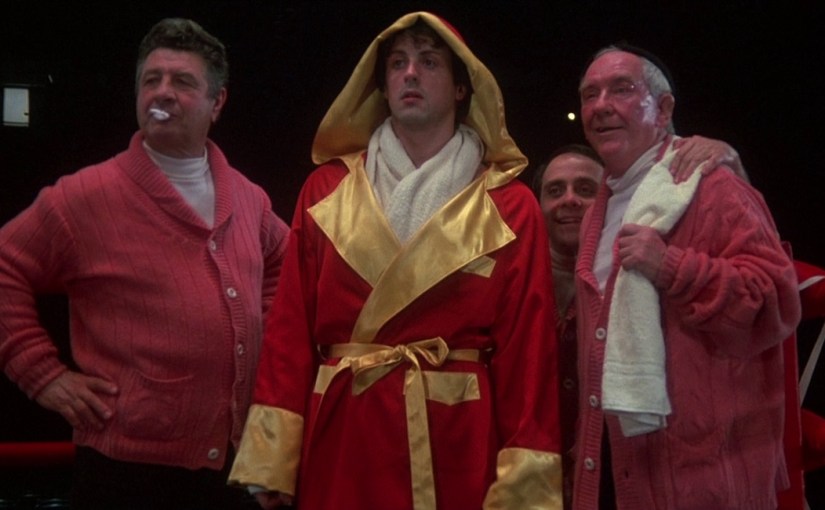
If you examine Rocky, what you’ll find is a story about a boxer by the name of Rocky Balboa (Sylvester Stallone in a role that broke through everything for him), who is not shown doing much boxing or even training.  Instead, the southpaw boxer known as The Italian Stallion, is displayed as a heavy collector for a loan shark in and around the south side of a dirty Philadelphia.  Early on in the film, Rocky delivers monies to the loan shark and his driver asks Rocky “Did ya get the license plate?”  Rocky asks for what, and the driver snaps back with “For the truck that ran over your face.”  It’s delivered with a little humor but it’s also sad.  Is there anyone to uplift poor Rocky’s spirits?  His one-time trainer, Mickey (Burgess Meredith), kicks him out of the gym because he’s tired of Rocky at age 30 wasting his life with the scum of the streets.  Rocky lives in a filthy apartment barely making scratch from underground fights.  About the only redeeming quality Rocky seems to show is his tender loving care for his two turtles, Cuff and Link.  So, it is surprisingly charming when he sweet talks a mousy, petite woman named Adrian (Talia Shire, truly in an underrated performance) for a date. 

Adrian is also a loser, or at least she’s treated like one by her brother, Paulie (Burt Young).  He’s constantly putting her down for her looks and lack of men in her life and any other opportune moment he can find.  It’s the only way that Paulie can build confidence in himself; by putting his sister down.  Beyond that, all he has going for him is his job in the meat locker.  His one dream is for Rocky to give him a job working for the loan shark.  Such aspirations.

By luck, Rocky is called upon by the Heavyweight Champion of the World, Apollo Creed (Carl Weathers), to fight him in the ring.  Anyone else would jump at this chance.  For Rocky, it’s just a way to earn a fast $150,000 and use his face as a punching bag for Creed on live television.

All of these characters within this circle come out of their shells once Rocky is given the opportunity of a lifetime.  The first win for Rocky is when he wins over Adrian on an adoring, near penniless date when he takes her ice skating on Thanksgiving night.  They’re only given ten minutes to skate together.  The transition thereafter is quite revealing.  Director John G. Avildsen transforms Adrian’s appearance by removing her ugly glasses and hat.  Rocky is pleasantly surprised by the red winter coat she wears later in the picture.  Adrian becomes more talkative and expressive.  Initially, she couldn’t even look Rocky in the eye.  When Rocky gives her a shout out at a press conference on TV, Adrian laughs and cuddles up next to Rocky.  Someone has finally treasured her and she adores it so appreciatingly.  Shire really demonstrates a nice character arc, where she comes out from under the strong arm of her brother to find her independence and make choices for herself.  An amazing scene occurs near the end between Shire and Young.  The pent-up frustration the siblings have for one another finally boils over.  This scene is what won both of these actors their Oscar nominations.  It’s a moment in all of the Rocky films that doesn’t get enough recognition.

Mickey is the one who gives tough love to Rocky.  He shares with Rocky his own battles in the ring during the first half of his near 50 years in boxing.  All of the blood and sweat didn’t amount to much beyond the gym he has for the local fighters.  What he earned as a fighter was a cauliflower ear and no family except the poor kids who go in and out of his southside gym.  Now he has a chance at the big time and he has to win over Rocky’s affections so that he can train him properly for the fight that’s coming up.

The biggest loser of course is the title character.  Credit must first go to Stallone for an outstanding insightful script that looks much deeper than any of the numerous sequels that followed this film.  The original Rocky is not about punches.  The script eventually transitions into determination with Rocky giving a sorrowful monologue to Adrian acknowledging he’s a loser with no chance at beating Creed.  At the very least, all he wants to do is settle for going the full 15 rounds with the champion and never falling down on the mat for a count of 10.  Only then can Rocky triumph with a personal victory.

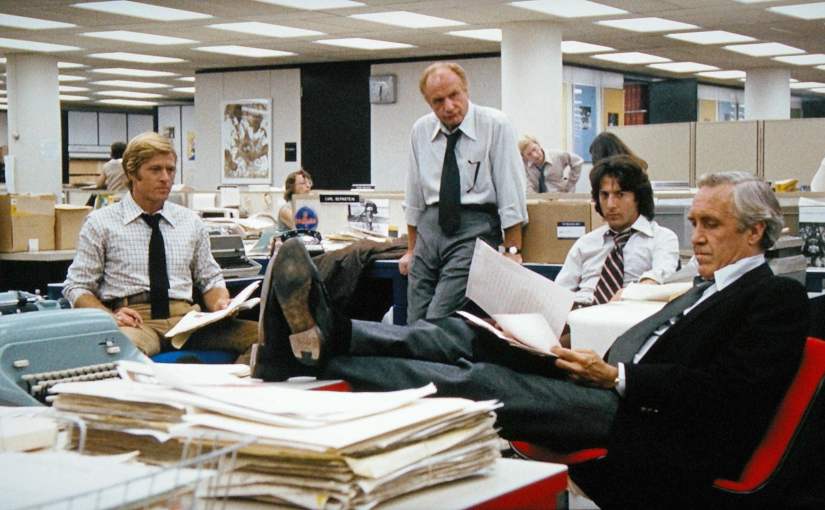
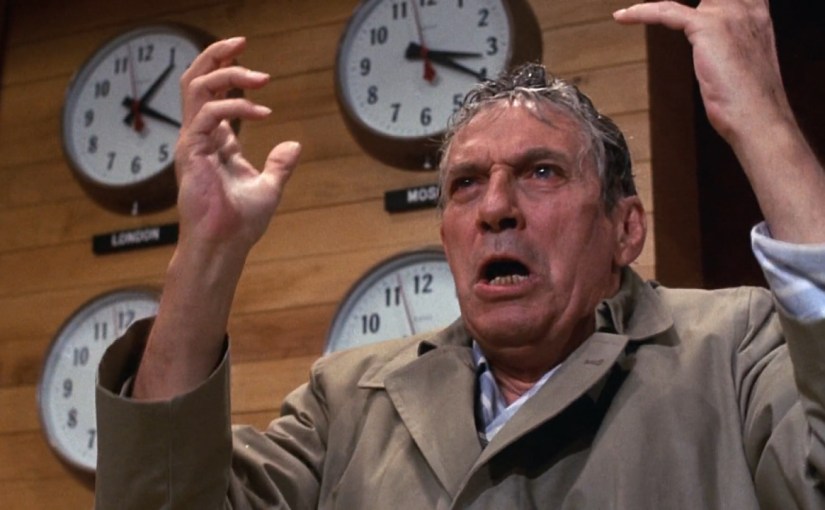
Rocky won the Oscar for Best Picture and Avildsen won Best Director in 1976, beating out incredible films like Network, Taxi Driver and All The President’s Men.  I’ve thought about this endlessly over the years.  Why did it win?  I mean look at the competition it had.  The script for Network is one of the most admired and amazing scripts in Hollywood history; now it’s regarded for how prophetic it has become.  The other two films gave brutally honest, yet cynical portraits of the lack of innocence in the United States.  These other films rightfully question if America is the greatest and most thriving country in the world.  Just writing this, I think I answered my own question, though I will endlessly ponder anyway.  Rocky is the one positive entry of nominated films that year.  Rocky Balboa put aside the differences he had with others and overcame the adversity of those that would antagonize and guide him down the wrong paths. 

It’s totally cliché now to say this but Avildsen’s film, Rocky, is an awe-inspiring triumph.  It’s still okay to identify the picture as such, because it was the first to do what only so many imitations thereafter tried to duplicate.  The outcome of the fight within the film was not about winning the belt and the fortunes of money.  It was a breakthrough from a wasted life – the life of a loser; the lives Rocky, Adrian, Paulie and Mickey were all sadly living before the chance opportunity of supporting one another came to pass.  As Bill Conti’s unforgettable soundtrack closes out the picture, you are not just crying for Rocky and Adrian as they profess their love for one another in the middle of a crowded boxing ring.  You are crying because you realize you can believe in changing your life with will, stamina, endurance, personal strength, confidence and then…finally…love.

BOUND FOR GLORY

By Marc S. Sanders

David Carradine plays Woody Guthrie in Bound For Glory, directed by Hal Ashby.  It’s a magnificent performance in a well-constructed film especially by the standards available in 1976, and still today in 2022.  Yet, am I capable of showering the film with additional accolades?

My first viewing of the Oscar nominated picture occurred with my Cinephile pals (Thomas Pahl, Anthony Jason and Miguel Rodriguez).  More or less, we all had the same reaction.  The film is as slow moving as much as the slow-moving trek that Guthrie embarks on from his dustbowl home town of Pampa, Texas all the way to California.  Guthrie is a musician, especially when he’s strumming a guitar and he’s altogether attractive to anyone within earshot as he seemingly makes up the lyrics to his Depression-era Americana songs on the fly.  Anyone reading this has certainly heard of “This Land Is Your Land.”

Woody is married to Mary (Melinda Dillon) with two children, and as the film opens in 1936, his hometown is flat broke.  There are no jobs anywhere.  Families are abandoning their homes that they can’t afford to maintain.  Literally, no one has two nickels to rub together.  It also doesn’t help that the town and outlying areas are plagued with monstrous dust storms.  Ashby with legendary cinematographer Haskell Wexler offer up a caption of one such storm towering over the town like a terrible tsunami.  Even on Blu Ray, this is eye opening.  It’s a magnificent visual effect that took me completely by surprise. 

Shortly thereafter, Woody ups and leaves his family with just a note saying he’ll send for them once he settles down in California.  I can only guess he’s looking for a better life, and I can only presume California is the promised land of wealth and well…glory!  I don’t recall a prior conversation that praises the state as the land of milk and honey.

Wexler spoils the viewer with countless moments of scenic design as the film moves on.  We follow Guthrie as he walks the endless roads towards the west with nothing to hold in his hands.  He hops on cars that pass by.  He also hitches rides upon locomotives heading in the western direction.  Ashby reminds us that the sojourn is not easy. Seems like everyone has the same idea in mind as Woody; looking for a better way of life. Fights for sitting space on train cars break out.  Authorities try to shoot stowaways off the trains, and the best place to hide is maybe on the roof of the train, or simply hanging on to a ladder with your elbow painfully folded over, as the train moves on.

Whenever I watch a film, I try to make a habit not to look at the time.  If I do, I feel like I’ve broken the wall of the environment I should be immersed in.  I kept to my rule on this film, but Guthrie’s journey takes so long, that I truly thought once he reached California, that would be the end of the picture.  Not so.  There was at least another hour to go.  Wow, did this thing move at a snail’s pace.  Woody arrives and gets into episodes of infidelity, and more importantly he bonds with another strummer named Ozark Blue (Ronny Cox), who travels the state singing in support of a union for the poor and destitute working odd jobs on farms and railroads earning only pennies by the day.  Woody eagerly takes up the cause even as he is becoming a pop sensation on the radio.  The fight for the rights of the poor becomes so passionate for him that he butts heads with the radio big wigs who insist on knowing what he’s going to sing about on air, to ensure the wealthy sponsors remain happy. 

I read briefly afterwards that much of what is depicted in Bound For Glory is actually not true to Woody Guthrie’s story.  My buddies felt a little betrayed knowing that.  I still don’t know what is and isn’t accurate.  I dismissed all of that, though.  What fascinated me was the technical work of the film.  When David Carradine is leaping on to a moving train or jumping off of it, that’s really him.  We also uncovered that along with Rocky, also released in 1976, Ashby’s picture was one of the first to use a Steadicam and the output is marvelous.  Ashby with Wexell’s lens is unbelievably impressive.  They capture Carradine walk through an ocean of extras while strumming the guitar and singing in the moment; his voice never cracking and all happening in one take.  Carradine is seen standing in between train cars and lying on top of them with the rising or dawning sun in the foreground.  The film delivers a literal moving picture to Woody Guthrie’s most famous song “This Land Is Your Land.”  For a film made in the mid-1970s I certainly believed what was captured was genuine to the mid-1930s. 

Ashby also seemed to be inspired by the The Grapes Of Wrath.  Numerous cars of the time are disproportionally stacked with furniture like dressers, kitchen chairs and tables, along with knapsacks and sleeping bags, while the raggedly clothed children hang out the window or sit on top.  A nipple bottle top is attached to a glass Coke bottle for a baby to drink from.  If you are looking for reference material of what it was like to live in the times of the Depression, look no further than Bound For Glory.

I can’t say I will rush back to watch this film again.  The story never grasped me.  I was waiting for that special turnaround moment to come that would perk up my interest.  It just never arrived.  There’s no question, however, that the merits of the piece stem from the set design and camera work at play.  It is absolutely jaw dropping.  Woody Guthrie’s story, though, not so much.  He had faults. We learn he is not a devoted family man (something we’ve seen many times over in countless stories), and his drive to fight for the rights of the working man doesn’t appear to stretch very far.  After nearly 2 hours and twenty minutes, Guthrie up and decides to resume his countrywide walkabout on trains to sing in devotion for the working class across the country, but beyond a favorite camp fire song, what else did he truly accomplish?  There’s never a time when he sways the authority to see it his way, and there’s never an announcement that a union is established in direct response to Woody’s movement.  At best, we are offered Randy Quaid in a small role as a one of the poor family men who reminds Woody to keep doing what he’s doing.  However, that’s a staple of any biography film really, and in pictures like Malcolm X or The Last Emperor, it seemed that much more effective. 

Maybe there was more to Woody Guthrie.  I just didn’t feel that Bound For Glory illustrated much beyond the song we all know and love.  So, was that enough? 

AWAKENINGS

By Marc S. Sanders

The title of Penny Marshall’s film Awakenings has at least two meanings.  The most obvious focuses on Robert DeNiro’s character, Leonard Lowe, who comes out of a near thirty-year catatonic state one day.  As well, Robin Williams plays Dr. Malcolm Sayer, the doctor who uncovers the experimental drug that awakens Leonard, along with other patients who reside in the caretaker ward located in the Bronx.  Many of the patients share the same abnormality as Leonard, due to all suffering from a wave of encephalitis that swept through the area in the 1920s. 

DeNiro and Williams are a top of their game pair together.  Both of them go against type that many audiences were accustomed to by the time this film released in 1990; DeNiro – the tough, short tempered, unhinged guy; Williams – the manic, fast talking, quick on his feet comic.  Both actors bring it down many notches to bring this story to light that was inspired by the documented experiences of Dr. Oliver Sacks.

Still, Penny Marshall has a way a bringing gentleness with touches of comedy to this film just like she did with Big and A League Of Their Own.  Okay, maybe those films were more energetic at first and then quieted down, thereafter.  Awakenings performs in the opposite direction, but Marshall’s recipe of drama mixed with humor is so appreciated.

Dr. Sayer is a shy individual with limited social skills.  He relates more to plant life than actual humans.  When he’s recruited by the hospital administration, led by the intentionally obnoxious and objectionable John Heard, to oversee the patients at the ward, he does so without any intent to make a difference.  The hospital staff is just fine with that.  Soon though, Dr. Sayer is recognizing a behavior in some of the patients.  They seem to be staring into space, open mouthed with no emotion or change in expression, but they respond to a variety of unusual stimuli.  A woman will walk across the social hall on the black squares of a checkered floor.  Leonard, and a few other patients, will catch and toss a tennis ball around.  Yet, they won’t blink or wince or smile.  Through further research, Dr. Sayer takes a pharmaceutical risk and increases the dosage of an untested prescription over time.  One night, his patient zero, Leonard, is sitting up in bed and awake.  Shortly thereafter, he’s speaking, walking, and functioning like a regular forty something man.  Thereafter, the drug is administered to the other patients who demonstrate the same outcome. 

The challenge comes first from the hospital, though.  They are not prepared to take Dr. Sayer’s methods or assessments seriously and they are stubborn to recognize some exceptional progress.  Like any standard drama, this leads to conflicted debate.  The debates Dr. Sayer has with the hospital board never took me out of the picture, but I do question if the antagonism needed to be so close minded.  After all, should such unexpected and miraculous development be so dismissed?  The challenge seems so forced at times that a scene is offered where the doctor’s support from nursing and janitorial staff gladly gives up their hard-earned paychecks to help alleviate the expense of the experimental drugs.  It puts a lump in your throat for sure, but would this really happen? 

A hint at a romantic angle presents itself when the lovely Penelope Ann Miller arrives at the ward to tend to her ill father.  Leonard becomes smitten with her.  He is not free to go about as he pleases.  Miller’s character can.  Eventually, Leonard becomes rebellious of his “incarceration” within the ward while the hospital exercises its mandated caution.  While this is occurring, Leonard’s condition is deteriorating. 

Robert DeNiro received an Oscar nomination for this role and its easy to see why.  His physical performance comes so naturally, at first in the catatonic state, later as a man witnessing daily life in the hippie of age of the 1960s and then again as his body dwindles into uncontrollable spasms, when the drugs’ positive effective doesn’t hold.  His enunciation falters, his body violently twitches and he can’t even grasp anything.  It’s a sorrowful and marvelous performance to see.

Awakenings is a picture that performs with real heart and tenderness.  Marshall’s film offers a glimpse into a short period of time when adults who hadn’t gotten the opportunity to live active lives were suddenly offered an opening.  Leonard gets to see a jet liner fly overhead and take a walk in the ocean.  He can taste ice cream for the first time in years and get a glimpse of young hippie’s derriere.  The other patients get a chance to go to dance at a swing club.  As well, Dr. Sayer’s guarded exterior gradually sheds as he persists to act beyond the administrators’ objections and also consider a little romance for himself with a nursing assistant.  (Point of fact: Oliver Sacks was actually gay in real life.  So, some liberties are taken with the film.)

It’s important to point out a forgotten performance from Ruth Nelson as Leonard’s elderly mother.  She visits Leonard every day by reading to him, dressing him, and changing his diapers like any loving mother would.  Yet, as Leonard gets more independent, Nelson is terrific as the kindly elderly woman who has to become a different kind of mother to her son.  She is an quickly awakened from being the mother of a helpless child to the elderly mother who is not as capable of controlling her son’s choices.  Mrs. Lowe is rightly uncomfortable with Leonard’s affection for Miller’s character.  She’s just not used to this dynamic that’s come about so quickly.  What an amazing character arc and Nelson pulls off the portrayal beautifully.

Tear jerking films work best when they operate like Awakenings.  You’re given many opportunities to laugh and enjoy the pleasures and quirkiness of the characters.  Later, it becomes a welcome and satisfactory cry fest when what was once celebrated is at a risk of loss.  Penny Marshall worked best with this formula on these kinds of pictures.  It’s why a simple, seemingly silly story like Big worked.  It’s also why a female baseball movie worked as well beyond the diamond.  There was more dimension than just the basic summary.  Marshall always delved deeper and she allowed her actors to go that far as well.

Awakenings is a terrific film, blessed with a gamut of emotions.

THREE BILLBOARDS OUTSIDE EBBING, MISSOURI

By Marc S. Sanders

From February 2017:

A number of years ago I read Roger Ebert’s review of a Kevin Spacey film called The Life Of David Gale, only after seeing the film myself. Reading his viewpoint assured me that perhaps I do recognize good and bad filmmaking with the absence of influence. Like me, he hated the film because of its contrivances and the complete 180 on Spacey’s character. He said it angered him so much that he wanted to throw his popcorn at the screen. Years later, I feel the same way, for nearly identical reasons after seeing this 2017 Best Picture nominee. I hate Three Billboards Outside Ebbing, Missouri.

I HATED THIS MOVIE. Hated it so much that I’m pissed over how much I hated it. This film is worthy of Best Picture, Actors and Screenplay nominations???? There was nothing better than this dreck???? Not Baby Driver, or Wonder Woman? Not All The Money In The World? Blade Runner 2049?

This film contains great talent trying way too hard to elevate the stupidity of the unjustified actions of their characters so much that suspension of disbelief isn’t just thrown out the window (like one hapless character who earns no justice), it’s burned, beaten, raped, shot, burned again, thrown off a building and drowned.

Consider midway thru the film, Sam Rockwell’s nominated performance as a vile, heinously racist backwoods lawman. He reads a letter and is magically transformed into a do gooder Boy Scout. There’s no way in hell I’d ever believe this. No one should. This guy is the entire KKK in one embodiment. By the time this bastard gets to this “epiphany” he had already committed the most sickening and atrociously violent actions fathomed, and in great detail. Yet magically a letter from a friend and an arson scene that burns him suddenly transform him. Just like that. Uh uh. Too convenient. Too manufactured. Too insulting to a movie going audience.

This film is full of other ridiculous contrivances that are simply too long and spoilery to describe here. (I’d love to spoil the film to salvage anyone from seeing this crap.)

Frances McDormand’s character is also despicably written. Here’s a character entitled to the anger she has after losing a daughter to rape and murder, worthy of attention due to the stubborn intellect she conveys during the act one exposition, yet as the film progresses, she becomes incredibly stupid and downright unlikable. What a thoughtless jerk she is. Nothing to cheer for. Nothing to love to hate. Nothing to laugh at. Nothing to cry over. Nothing. She’s just an asshole who conveniently gets away with her actions, yet everyone knows she’s the culprit.

In a film like this the bad cops are uncaring racists. The good ones are the clueless keystone cops who conveniently can’t see the forest through the trees. I don’t like it, and more importantly I don’t believe it. Unacceptable!!!

What a stupidly shitty movie that has been executed here in exchange for arguably the most interesting idea of all the 9 Best Picture nominees. I salute the idea of the film. It’s the execution that’s deplorable.

The only redemption that can come from this garbage now is if this film does not win one single Oscar. Sadly, I think I’ll be wrong. Congratulations Sam Rockwell, you stole a trophy from three much more entitled actors (Christopher Plummer, Richard Jenkins and I hear Willem Defoe.) Woody Harrelson’s performance in this pic is also up for grabs….for what? He coughs up blood quite well. I have no clue, otherwise.

Don’t believe the hype. Three Billboards… only has a great title, a great concept on paper and a great cast list. Beneath all that is carbon monoxide. Don’t breathe it in. You’ll only feel sick after watching it.

This will likely remain as one of the ten most despised movies I’ve ever seen.

THE GODFATHER PART III

By Marc S. Sanders

Francis Ford Coppola and Mario Puzo finished out their Corleone trilogy in 1990 with The Godfather Part III. Not so much a sequel, this third film feels more like an epilogue jumping towards Michael Corleone’s (Al Pacino) elder years as the Don of the most powerful Mafia family in the late 70s/early 80s.

Michael seems exhausted with his rule as he suffers from diabetes as well as remorse for his past sins; especially feeling the guilt of ordering the execution of his brother Fredo.

Still, he is drawn to crime, but on a more sophisticated and righteous nature by taking advantage of the Roman Catholic Church. Michael intends to purchase the powerful bank associated with the church but that’ll have to fall in line with the Pontiff’s agreement. It doesn’t help that the Pope is in failing health. The setup of all this lends to another grand opening where Michael earns a prestigious award from the church in the same tradition of an austere celebration of many guests that lend to character set ups for the film. A Godfather movie is not a Godfather movie without a grand reception to open the film.

The most interesting character is Michael’s nephew, Vincent (Andy Garcia), a fierce hot head like his father Sonny. He wants to work for Michael desperately while fending off a street hood boss (Joe Mantegna). An older don also comes into play by the great character actor, Eli Wallach. Diane Keaton as ex-wife Kay is also here but more or less to quietly bicker with Michael. Sister Connie is here, too, with Talia Shire. The Connie character always changes from each movie. Here she’s a deadly black widow. There’s also Michael’s daughter Mary (Sofia Coppola, contrary to popular opinion, I insist she’s very good in the role). Is Mary a legitimate cover for the family as the spokesperson for a fundraising effort? Is the possibility of Vincent and Mary (as cousins) getting intimate a terrible risk?

I like this film and hold it in high regard. Namely because Coppola and Puzo took an approach straight out of the news when there was an embezzlement scheme occurring within the Vatican bank. The problem for many I believe was that the plot of this grand scheme was not flashy or bloody enough, even if a participant is revealed to be hanging from a London bridge with fraudulent receipts falling out of his pockets…which actually happened in real life.

The film allows many opportunities for Michael to allow his anguish in guilt to flow. Fans grew used to a fierce Michael Corleone from the first two films. The elder Michael here would rather not get involved. Hence the introduction of Garcia’s character. He’s very good in the role. Yet there’s not much dimension to Vincent. He’s a scary violent guy, and a contradiction to what Michael seeks. Yet, thats about all there is. I would have wanted more dimension to this role; the guy destined to carry on the reign.

Sofia Coppola is fine in her part and undeserving of the lashing she received upon the film’s release. She’s Michael’s young daughter; a young adult dangerously close to the fray. The one innocent constant within the family. For me, I found a dramatic stake in her character.

The ending is very powerful. Slowly methodical as the family assembles in Sicily to see Michael’s son’s stage opera debut. There are elements that are consistent with the other films’ endings, but this violent conclusion comes with quite a shocking result. I was really moved by it.

Coppola didn’t measure up to the first two films with this effort. I agree with that. Still, The Godfather Part III is worthy of holding its place in the saga. It carries the traditions of the prior films in set up and music and operatic narrative. Be patient with its slow pace because I think the ending will grab you.

THE GODFATHER PART II

By Marc S. Sanders

The first film to use the number 2 (or Roman numeral II, in this case), in its title and the first sequel to win Best Picture is Francis Ford Coppola’s continuous adaptation of Mario Puzo’s Corleone family legacy in The Godfather Part II. It is worthy of all of the accolades it collected as an individual film. Yet, it does not best the first film.

Unlike the 1972 classic, Part II does not provide much character arc for anyone. We’ve already seen Michael (Al Pacino, silently ferocious here) change from good college boy and war hero to the evil puppet master Mafioso he eventually became. This film shows him exercising his threateningly murderous deeds as he works in conjunction with a sly Nevada Senator, a Jewish Miami mob boss (an excellent performance from Lee Strasberg) from the time of his father’s reign, and another mob guy from New York (Michael V Gazzo). We get a whiff of all these guys early on during a commencement celebration for Michael’s son. Coppola keeps this a running theme of grand openings in all three films. It’s a great method of introductions each time.

Following the party, an assassination attempt is brought against Michael. But who did it? Problem is this is where the foundation of the film is not so strong. It’s never really made clear who betrayed Michael. That’s a little bothersome.

Coppola depicts another storyline altogether with the early 20th century origin of Vito Corleone flawlessly played by Robert DeNiro who hardly speaks any English while communicating in a Sicilian variant of Italian. Young Vito immigrates to America following an escape from the Sicilian Don that murdered his family. In New York we witness his rise to power. Famed Cinematographer Gordon Willis washes out these flashback images to enhance a pictorial history accompanied by Angelo P. Graham’s art direction of early brick and mortar architecture and the muddy streets of early Little Italy, New York. It’s a time travel back to a historical age. It’s magnificent.

Back in the 1950s, Puzo and Coppola bring authentic fiction to real life history as Michael considers a go at a business enterprise in Cuba. However, will the rebellion uprising interfere with his plans, and what will it cost him? As well, there’s a great sequence where he has to testify before a congressional hearing in response to suspicion of criminal activities. Coppola used the infamous McCarthy hearing footage as inspiration for this predecessor to what C-Span would eventually look like.

Yet, there’s another story to become involved with as Michael must contend with his dim witted older brother Fredo. John Cazale is superb as the guy who wanted more but was limited by the influence of competing factions and his loyalty to his brother. Pacino and Cazale always had great chemistry together. A great conversation moment occurs in the third act following a terribly surprising twist. One of the best scenes in the film occurs on the porch of the Corleone compound.

More story elements come into play as Michael attempts to balance his married life with Kay (Diane Keaton). She’s pregnant again. Yet, what will that mean for the future of the family?

The sequel to The Godfather assembles another stellar cast. So good, that the film garnered three Oscar nominations in the Supporting Actor category alone (DeNiro, Gazzo, Strasberg) as well as a nomination for Pacino as Best Actor and Talia Shire (Supporting Actress) as Connie, Michael’s sister. That nom left me a little dubious only because there’s not much material for Shire to play with here.

Coppola’s detail is at the top of his game again. The film, like the first, feels like a true life biography.

Puzo offers heartbreaking moments, most especially in the film’s shocking end which leads to a flashback assembly of characters from the first film. That scene alone plays as a great reminder of what Michael once was before becoming the hideous monster that closes the story. Puzo’s whole Godfather franchise hinges on well defined, crushing tragedy.

The Godfather Part II is nothing short of mesmerizing and wholly engaging. You can watch it over and over again. It’s layered in rich storytelling and narratives that provide endless amounts of material for a family meant to be mired in secrets, deliberately hidden in the dimly lit rooms that Willis photographed.

It’s a treat to be the fly on the wall wherever Michael and his family move to next.

THE GODFATHER

By Marc S. Sanders

Probably the greatest character story arc in all of film is of Al Pacino’s portrayal of Michael Corleone in Francis Ford Coppola’s The Godfather based upon Mario Puzo’s best-selling novel. (The film is a thousand times better than the book.)

Michael is the youngest of three sons intended for a legitimate life separate from his Mafia family. The masterful opening sequence of his sister’s lavish wedding show him courting his eventual wife, Kay (Diane Keaton), and never feeling proud of the actions of his notorious father, Vito (Marlon Brando), nor his brother Sonny (James Caan) or their consigliere, Tom (Robert Duvall). He’s an innocent war hero in uniform with an open mind of an untarnished future. It is only when bad blood circumstances are tested that he feels forced to strike with the same intent that the Corleone family is infamous for.

Coppola presents quiet, subtle moments of expression in Pacino on camera. You see the change in Michael sneak up on you and you see a character develop into something else entirely. What starts as a false impression to appear as if he’s carrying a gun in his pocket, soon after leads to murder, by means of nothing personal but “strictly business.” From there, he retreats and hides until he is blessed with carrying on an evil legacy.

Yes, the first chapter in the operatic trilogy of crime, is mostly known for a grandstanding performance by Marlon Brando but the story relies on Pacino as Michael. Michael Corleone at least must be one of Al Pacino’s greatest roles. He arguably has one of the most impressive resumes in all of film. Here is where it jump started.

The direction by Coppola is a film student’s required studying. With Puzo’s script, the best idea was to open the film with a wedding. As the film offers so many characters and much back story among all of the guests, the interaction and workings of the family are efficiently condensed into this 25 minute opening sequence. Don Vito meets with people needing favors while outside the home, the crew is dancing, doing their jobs and minding who is watching. By the end of this opening you have a full grasp of the family tree and who works for who and what their characters are like. Sonny is the hot head. Michael is the innocent. Fredo (the middle son played by John Cazale) is not doing much but being a cut up, Momma Corleone is the valued matriarch and Tom is the well managed advisor. You even get a glimpse of some “very scary guys,” some competing hoods, who’s cheating on who, and some people who need help with citizenship and film casting.

Art direction from Alex & Dean Tavoularis is magnificent, depicting a post WWII New York, and a historical Sicily stagnant in open plains, romance and murderous pasts.

The cinematography is better today than it was originally. Gordon Willis returned decades later to (for lack of better word) lighten up the picture. The interiors remain dark in secret and comfort, but the characters are more illuminated. The Blu Ray restoration is a fantastic return to the classic film and its two sequels.

The Godfather is endlessly quotable and never dull no matter how many times you watch it. Puzo’s screenplay plays like the biography of a real person and family, much like his adaptation for the screen of 1978’s Superman: The Movie. It is an American classic rich in a history we believe has been told and carrying on the tradition over the course of a 10-12 year period.

I return to praise Pacino to remind you how his appearance even changes as he gradually builds his strength and accepts his title of Don. I feel like I’m looking at two physically different people from the beginning in his Marine uniform with boyish looks, to his independent walkabout way during his Sicily retreat, to a more broad shouldered, slicked back hair, dark suit tailored appearance during the film’s third act. It’s an uncanny transformation that is built on performance and expert direction and writing from Coppola and Puzo. I still get chills as Michael in his college boy sports jacket volunteers himself to satisfy a family vengeance. Coppola zooms in on him slowly as he sits in a leather arm chair, arms at his side, legs folded. We are seeing a new man in charge for the first time. It’s chilling.

The Godfather is one of the greatest pictures that will ever be made. It’s a perfect chemistry of technical achievement, attentive storytelling and sensitive, yet powerful performances from probably the best cast ever assembled.

I’m amazed that I know of some friends who still have yet to see it.

The Godfather is the film that everyone should see before they die.

PHILADELPHIA

By Marc S. Sanders

Tom Hanks most certainly deserved the first of his two Oscars for his portrayal of Andrew Beckett, one of the first protagonists to be an AIDS victim on screen in Jonathan Demme’s 1993 film, Philadelphia. Its a good film but not a great film.

I recall seeing Philadelphia when it was originally released. Seeing it today, my opinion hasn’t changed. I don’t believe the film takes enough risks and the script from Ron Nyswaner is too cookie cutter and simple. Beckett hires Joe Miller (Denzel Washington) to represent him when he proceeds to sue the law firm who wrongfully fired him for having AIDS, and most likely being gay as well. The argument hinges on proving that having AIDS is a handicap that never interfered with Andrew’s work performance. Andrew is clearly made out to be the firm’s best of the young attorneys when he’s assigned their biggest client. Nine days later he’s sabotaged, and soon after he’s fired for an attitude problem and carelessness. Eventually, Andrew and Joe assemble, despite Joe’s prejudices against homosexuals.

The trial, Andrew’s struggle of living with AIDS, and Joe’s own inner debate with associating and defending a homosexual, AIDS victim are the three main storylines.

The first storyline is the best. Demme does a masterful job of showing the evolution of the disease. Andrew could be looking at papers on a desk and when he turns his head, a lesion appears on his neck. Makeup artists Carl Fullerton and Alan D’Angerio deservedly were Oscar nominated as Hanks’ appearance seems to change from one scene to another and another. He’s thinner in one moment with very fine ash gray hair. In another scene, he’s got a full head of hair with an energetic way about him. I cried for Andrew’s deterioration. Hanks and Demme carry that aspect very, very well. The actor does great work of changing his voice when he’s fighting a cold with a terrible cough or evoking massive weakness. As the film progresses and Andrew gets sicker, he’s incredibly pale with a droopy eye. The makeup artists tell the story with Hanks’ performance and Demme’s direction.

The 2nd and 3rd storylines don’t offer much of a challenge. The law firm primarily represented by head partner Jason Robards is too easily “evil.” There’s no subtlety here. Robards gets right in the face of the film – “Andrew brought AIDS into our office.” A better script would wait for the bad guys’ momentous third act Freudian Slip. This case was unchallenging really. It was too easy to win. Especially true considering this great and powerful law firm hires Mary Steenburgen as defense counsel. Steenburgen plays her part very mousy and unaggressive though. This case is too lopsided and uneven and I just couldn’t get past that.

Joe’s own reservations are too apparent as well. He’s meant to represent those that simply never understood the mentality of gay love, nor the scientific evidence of the AIDS virus. He rushes to his doctor following an initial meeting with Andrew. Demme does an extreme close up of this doctor to teach the audience the basics of AIDS. This guy is right in your face with his dialogue. I didn’t care for moments like this. Too patronizing.

A side story attempts to show the intimate relationship of Andrew with his boyfriend Miguel (Antonio Banderas). I still feel the same about this part. The script holds back. Hanks and Banderas give each other “bro hugs” and kisses are done on the bottom cheek. Back in’93, filmmakers were not prepared to go all the way with depicting the true nature of homosexuality. I found it insulting. You finally want to make a film that shows AIDS and homosexuals at the forefront but you stop short at the finish line.

Ironically, Joe has a repetitive line “Explain this to me like I’m a 4 year old…” Demme adopts that method throughout the film with major “in your face” close ups to glaringly make the beliefs of what any character values or has to say as obvious as possible. I felt as an audience member that Demme didn’t have to take it this far. I get it. You don’t have to be THAT FORTHRIGHT.

Washington is a great actor as always. He’s likable even if he’s tripped by the fault of misunderstanding. His “TV GUY” ambulance chasing lawyer is comic relief at times within a film of very heavy subject matter.

Demme’s filmmaking does make some wise choices despite some of my issues. The opening credits offers a lot of footage of the city with people carrying on their daily lives while waving to the camera, selling fish at the market, street dancing, etc, all accompanied by Bruce Springsteen’s sweet, yet haunting theme “Streets Of Philadelphia.” I like this opening as it shows what we see on the surface of the people we live with does not necessarily reveal the struggle any one of us might be enduring. This is a moment where the script is not so easy to grasp. There’s a challenge to accepting Demme’s footage blended with Springsteen’s overture.

Jonathan Demme is a good director, who is sadly no longer with us. I appreciate Philadelphia for showing the illness but not much else. It’s a film that should be seen. I’d argue most would embrace more of the movie than I did. I just felt the envelope could have been, actually should’ve been, pushed further. It was too careful with its subject matter.

A great observation though was recognizing the many faces that appear in the film from Demme’s other film, The Silence Of The Lambs. As well as naming Joe’s baby daughter “Clarice.” I also recognized an identical tracking shot that Demme offers. When Joe goes to visit Andrew in the hospital, it is a shot for shot remake of the tracking movement when Clarice goes to visit Jack Crawford in his office, at the beginning of Lambs. This might not be original, but I had fun recognizing it, nonetheless.

QUIZ SHOW

By Marc S. Sanders

Robert Redford’s 1994 masterpiece deserves much more recognition than it ever got.

Here, he produced and directed a stellar cast that showed how America was always in it for the competition and for the glory and for the fame and naturally for the money.

Redford opens his film with a car salesman describing the regal elegance and perfection of a 1957 Chrysler convertible. It’s a gorgeous car. Then the potential buyer turns on the radio. The car isn’t so fascinating anymore as a news announcement reveals that Russia beat the United States into space with its launch of Sputnik. All America has now is just a car.

Opening credits roll and the next American sensation is presented, “21,” the most popular show displayed on the greatest invention, a home television set. However, the show is all a lie, and yet by the end it’ll survive along with its network, NBC, and its wealthy sponsors.

Quiz Show foreshadows the cost of fame and attention. It’s a wonderful sensation until it’s stripped away in personal disgrace. John Turturro (how did he not get an Oscar nomination?) is Herb Stemple, the champion, nerdy schlub who is growing tiresome among producers and audiences. He is forced to take a dive and be replaced by the handsome Charles Van Doren played Ralph Fiennes, a member of one of the country’s most intellectually gifted families. The difference in appearance is obvious. So is the desire for a change in programming. What’s obvious is how the two men are exploited as pawns for gain in corporate America. Cheat, but if you call it television, what harm is there really?

The harm falls in public perception. Disgrace comes to these men, and worse, to their families. It mirrors modern stories like Harvey Weinstein, Joe Paterno, Bill Cosby, Kevin Spacey and Matt Lauer.

It’s a very calm film that debates the ethics of these men and necessities to uncover the truths and reveal the falsehoods.

Redford only gets aggressive in his period settings and I’m thankful for it. Nothing looks out of place, including the large enthusiastic grins of a 1950s American viewing audience dressed elegantly and innocent. Even nuns and pajama clad children are invested in “21.” This clean cut appearance will soon fade , however, after the quiz show scandal dies down.

Ugly lies and denials were committed against Redford’s beautiful backdrops. Therein lies the necessary conflict of another fascinating story.

Was this country ever innocent?