ALL ABOUT EVE

By Marc S. Sanders

Today’s actresses can lobby and vie to be Wonder Woman or Black Widow or Jane Bond. Yet, what so many filmmakers and actors fail to recall are the powerhouse performances of yesteryear that didn’t require guns and magic lassos. Movies shouldn’t simply be super heroes and villains in spandex and leather. No movie is a better example of this argument than Joseph L Mankiewicz’ 1950 Best Picture winner All About Eve.

This is also the only film in history to have four actresses nominated for acting awards – Bette Davis, Anne Baxter, Celeste Holm and Thelma Ritter. What an accomplishment!!!

Davis is Broadway legend Margo Channing, a sexy, tough, cigarette smoking broad who grew up and keeps her social life within the limelight. She’s a warrior among the Hollywood and New York elite. When her friend Karen Richards (Holm) welcomes a mousy young girl in a raincoat backstage to meet the famous Miss Channing, it becomes more than just a quick hello. This girl is Eve Harrington who proudly admits to following Margo’s career from San Francisco all the way to Broadway waiting outside the theatre on each performance night for that opportunity to meet the legend in person.

Upon introduction, Eve shares her tragic story of growing up poor and losing her husband in the war. Margo and Karen are taken with Eve, and now the young ingenue has wielded her way into the upper crust life among the pomp and circumstance. Margo’s test of her own celebrity seems to come unexpectedly as it occurs to her and her smarmy personal assistant Birdie (Ritter) that maybe Eve is angling for a way to fill Margo’s big shoes along with her wardrobe and stage costumes.

The elite are intruded upon by this outsider. Karen’s friendship to her playwriting husband Lloyd (Hugh Marlowe) and her friendship to Margo is tested by Eve’s surprising manipulations. As well, Eve is making herself more aware to Margo’s younger lover and stage director Bill (Gary Merrill). Eve also finds ways to build an acting career on the shoulders of these show biz upper class by eventually winning the opportunity to be Margo’s understudy.

The outsider who narrates these developments is the famed theatre critic, Addison DeWitt (a charming and cultured George Sanders who won the Oscar). DeWitt might not get welcomed to every exclusive black tie party in town as he’s “the critic” but that’s fine for it’s how he survives in his career. He’ll recruit a young naive actress like a newcomer played by Marilyn Monroe to maintain a stay within the social circle, and soon he’ll ride along on Eve’s journey for personal gain.

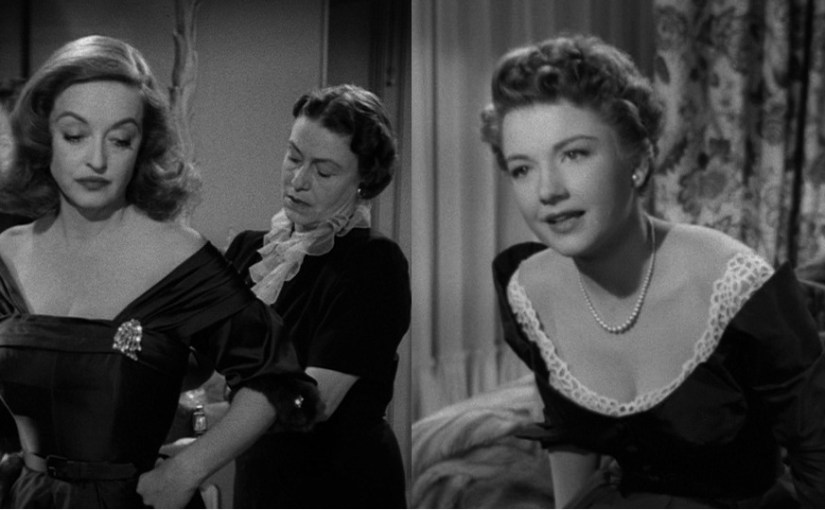
Mankiewicz’ script is brilliantly witty, absolutely biting and sharp. One of the best moments in film belongs to Bette Davis wearing a gorgeous dark evening gown designed by the legendary costumer Edith Head, and used as Margo’s armor ready for social battle. Davis declares “Fasten your seatbelts. It’s going to be a bumpy night.” No line could be so forthright in what to expect of a film like “All About Eve.”

This picture is ranked at the top of many “greatest film” lists. As it should be. This is not a sweeping biographical epic. Rather, it’s a lot of story branches that begin at the introduction of one character and expand in various directions among a handful of others who become disarmed by her ongoing presence. It’s not even that simple as Mankiewicz writes about Eve’s duplicity and how she manages to collide one piece of her destruction with another kind of destruction elsewhere, and the victims are simply blindsided.

Anne Baxter certainly had me fooled as Eve. She’s sweet and innocent on the surface and soon an inner and more evil shell emerges. Bette Davis looks spectacular and delivered one the best female performances of the last hundred years. She can carry herself and keep her guard up and authority in place. There’s a rich and commanding history about Margo that seems easy to believe. She is the queen of Broadway at the film’s beginning. Yet, for a moment her guard is let down and Mankiewicz gives us that window of time for his showcase.

Mankiewicz effectively opens his picture with Eve winning a very exclusive show biz award. She graciously approaches the podium to accept and deliver her speech. However, there are a select handful of individuals who withhold their applause of celebration. Then he flashes back to how we’ve come to this particular moment. It’s a great opening leaving me curious with a bunch of why questions. To watch this sequence the first time leaves you curious. To watch it on a second or third time is to be in on Addison DeWitt’s exclusive story of show biz scheming and diva one-upmanship. I only wonder if Joseph L Mankiewicz was as keen as George Sanders’ character to foresee how much life will come from Eve Harrington’s intrusion upon the lives of Margo & Bill and Karen & Lloyd. Before the age of desperate “if it bleeds, it leads” gossip rags, All About Eve was the real storyteller. 

THE SHAWSHANK REDEMPTION

By Marc S. Sanders

The purest form of humanity can be found in some of the most unexpected places. Frank Darabont’s first film, The Shawshank Redemption, based upon a novella by Stephen King is a perfect example of that truth. In a federal prison, the true test of a man’s character is established. Will a prisoner be as cold hearted as the crime he’s been punished for, or will he find a deeper meaning to his existence for himself and those around him? What if this particular man is actually innocent, wrongfully convicted? Will his innocence of crime be upheld?

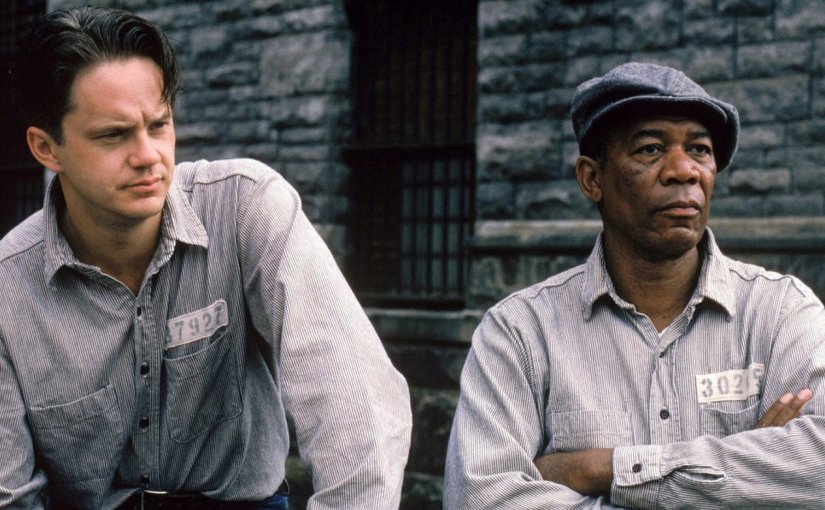
To experience The Shawshank Redemption is to learn about a community that I am completely unfamiliar with, and I’d bargain most of its viewers are as well. Shawshank prison is not a place I would like to check into. Though many of its residents display heart and comradery, nonetheless. These men likely didn’t know they were capable of such merit until Andy Dufresne (Tim Robbins) arrived to serve two concurrent life sentences for murdering his wife and her extramarital lover. Andy says he’s innocent without any desperation or urgency because none of that elevated showmanship would make a difference. The evidence and circumstances at trial unfortunately were coincidental to easily sentence Andy for a crime he didn’t commit. Everyone at Shawshank insist they’re innocent. Likely though, Andy is the only one who can genuinely make that claim.

Andy’s introduction to the prison is hard for the first couple of years. He’s consistently beaten and raped by inmates who need to exhaust their sexual tendencies. Fortunately, he sidles up with Ellis “Red” Redding (Morgan Freeman in maybe my favorite role of his career). Red is the go-to man for contraband resources like whiskey or as Andy requests a small rock hammer and a large poster of Rita Hayworth. Everyone is happy to know a guy like Red. Yet, Andy does not lose sight of his personal value. He was a banker by trade and when an opportunity opens up, he assists the viciously frightening prison guard Byron Hadley (Clancy Brown, who really should have more villainous roles in film beyond his voiceover as Lex Luthor in cartoons) with a legally accepted government tax exemption. More importantly Warden Samuel Norton (Bob Gunton) takes advantage of Andy’s talents to sustain his seemingly innocent money laundering schemes.

There is much education to be had from viewing The Shawshank Redemption. I learned what the term “institutionalized” means from Red’s experience. A man who has served a near half century has become accustomed to prison life. He offers little significance or purpose outside the prison walls. I also learned the value of music and literature and art. It’s needed to survive those lonely nights in a prison cell, or worse in the hole where you can wind up should you step out of line from the Warden’s strict guidelines of adhering to discipline and the Holy Bible. What you hear and what your read stay with you in your heart and mind, offering a most valuable commodity – hope. A life sentence will take away your liberties to walk freely among the masses, but nothing will take away what you’ve absorbed. If you can at least hold on to your memories, then you will never lose hope. Andy reminds Red and his fellow prison inmates of the hope you hold onto no matter how long you are held against your will.

Frank Darabont introduces a spectacular midway scene where Andy finally receives a donation of books and records for a prison library he envisions building for Shawshank. He uncovers a vinyl record of an Italian opera and with complete disregard for rules, he airs the music through the intercom. Darabont gathers gorgeous close ups of the hundreds of prison extras with overhead shots of the yard, woodshop and infirmary. The men freeze for a moment to look up in the sky from where the music is emanating from while mixed in with the soothing voiceover narration from Freeman. It’s a beautifully directed scene. A risky scene for late 20th century audiences who are used to quick cuts of action in their films with powerhouse soundtracks and pop music. Darabont found a way to connect the audience delicately to the film through Andy’s personal values and Red’s learned observations.

The Shawshank Redemption is an exceptional piece of writing. I can’t compare it to King’s source material as I’ve never read the story. Having said that, I’m typically hot and cold on the author’s books and screenplays. Sometimes they go too over the top for me. However, Darabont honed in on a perfect balance of likable characters and honest life within a prison; at least I feel that it’s honest. All men are created with good inside them. What they learn from day one is what can drastically change them and what can come of their sins can revert their instincts. Andy Dufresne is the instrument that redeems the men of Shawshank prison. Tim Robbins is right in this role; maybe his best role for his career as well. He does not underestimate any of the men in Shawshank and keeps to his personal enrichment which he also shares, despite the selfish hypocrisy of those meant to maintain order like the Norton and Hadley.

Morgan Freeman is the man who is becoming more and more institutionalized to prison life, always failing to get paroled for a murder he committed when he was a young and stupid kid. If not for Robbins’ melancholy performance as Andy, Freeman’s performance as Red would not realize a new kind of importance for himself. In fact, many of the inmates wouldn’t be able to acknowledge what they are capable of or what they mean in the world they live in without Red, but more importantly Andy as well. Morgan Freeman and Tim Robbins make for one of the best on screen couples in film history. Their chemistry is magical. Any scene between them can be studied for the weight of emotion or lack there of which the two actors carry. They both went on to win Oscars later in their career, respectively from a pair of Clint Eastwood projects actually, but the argument can be said that the awards should have come their way for Darabont’s film.

The ending to The Shawshank Redemption is an unforgettable and unexpected piece of storytelling that never seems to imply itself before the reveal and yet pleasantly makes so much sense. Maybe the one convenience to build to it’s winning conclusion stems from the location of Andy’s cell within Shawshank prison. Bah!!!! I dismiss that little contrivance to allow me to joyously appreciate this film over and over again.

There are ironies and unfortunate moments to see in The Shawshank Redemption. Still, there are revelations and opportunities to cheer and feel better about yourself when watching the movie. It’s one of the most uplifting films you will ever see. It’s inspiring and imaginative. Most of all it is smart and defiant. The Shawshank Redemption never believes in despair. It only grasps upon the hope of its characters. The Shawshank Redemption is a must see film.

THE LINCOLN LAWYER

By Marc S. Sanders

Michael Connolly authored a series of best seller legal thrillers featuring his famed character Mickey Haller. His most favored book of that series was adapted into a 2011 film called The Lincoln Lawyer with Matthew McConaughey in the role and directed by Brad Furman. I only wish more of Connolly’s books were adapted thereafter, because this movie is at least as good as the novel.

McConaughey is well cast as Haller, a defense attorney who operates out of his Lincoln Town Car working to get low level criminals off on technicalities or by easy settlements with the prosecution. His clients range from prostitutes accused of possession to notorious motorcycle gang members. When these clients can’t pay, Mickey wisely becomes resourceful with favors they can provide later on. One of his former clients drives the car while Mickey works in the back seat making calls out of his mobile office.

Louis Roulet (Ryan Phillippe) has just been arrested for beating up a prostitute at knifepoint. Roulet is a spoiled, preppy thirty something who is protected by the vast wealth of his mother (Frances Fisher) and their successful real estate enterprise. So it’s surprising that Roulet turns to street lawyer Mickey to be his legal counsel. At the same time though, this is a big score in legal fees. So Mickey is enthusiastic to accept the case, and go to trial. Louis doesn’t want it any other way to prove and insist upon his innocence.

It wouldn’t be fair to reveal much more about The Lincoln Lawyer because it’s got a lot of welcome surprises and twists along the way. What I can reiterate is how good an actor Matthew McConaughey is as I’ve written before. He just performs with a relaxed and confident swagger about himself. Mickey Haller is written as a smart and very strategic attorney. He knows the ins and outs of the courtrooms. He not only uses his clients for additional help, but he also sidles up to the bailiffs so he gets his clients cut ahead of the line to quickly face a judge. McConaughey is really good at not glamorizing the intelligence of Mickey Haller, but rather the charming personality of the guy. The character doesn’t come off as having all the answers at his fingertips, even though he likely does. It makes the film that much more dynamic to see McConaughey’s personality ahead of a Sherlock Holmes or Perry Mason kind of lawyer who might telescope everything five steps ahead of what’s eventually going to happen.

The supporting cast of The Lincoln Lawyer is also magnificent with Marisa Tomei, Bryan Cranston, John Leguizamo, Bob Gunton, Michael Pena, Trace Adkins, Josh Lucas and William H Macy. These are just great character actors. Everyone serves a purpose, even if it is just for a few moments.

Again, Mickey Haller is a great, modern day crusader. Like other literary characters such as Alex Cross and Jack Ryan, based on this film, I always hoped McConaughey followed up with at least one or two more additional films. I’d sure as hell be there to watch. Heck, the eventual Oscar winner went on to be a spokesman for Lincoln automobiles. So why couldn’t he have continued to carry the torch on the big screen?

PATTON

By Marc S. Sanders

You may find this hard to believe but as I was watching the epic Best Picture winner of 1970, Patton, I was actually thinking of a dreadful film I had seen the day before called Under The Cherry Moon, featuring and directed by Prince.  How in the hell could that be?  Well, both films are laced with the vanity of their films’ main characters to the umpteenth degree.  However, I’ll save Prince’s piece for another column, when maybe I’m out of excuses to avoid death or a root canal.  The point is both films never tire of the close ups of its featured player to enhance the pride, ego and conceit they do not hesitate to thrive off of.  The difference is that director Franklin J Schaffner knew that to really show what motivated General George S Patton you had to drill for the American warrior’s drive, and Patton’s motivation was truly his own self-worth.  (Prince just wanted one more close up on top of one more close up as a means of self service.  Sorry but that’s not enough of a reason for a character to live.)

Patton is portrayed by George C Scott in an Academy Award winning performance.  No one else could have played this role.  No one else should ever play this role again.  Scott and Patton are symbiont in a camera’s lens.  One can not be imagined without the other.  Schaffner’s film opens in front an American flag that fills the entire screen.  Patton steps up in front.   Somehow, his figure seems like a bigger, more prominent figure than the large backdrop of the stars and stripes.  He delivers a monologue that was aimed at the troops fighting in the second World War, but this is really an introduction to the audience of what to expect for close to the next three hours.  He reminds us that the blood and guts of the Nazis will be used to grease down the tread of our tanks and he will be proud to lead his men on any battlefield that calls for the bloodshed of Hitler’s regime.  In the film’s first five minutes, you know that this biographical character will never sway from what he stands for.

The theme of the film tests the egotism of General Patton.  We see him get dressed in his military uniform before heading in to battle.  His subordinates put his military jacket on.  Another one places his helmet upon the great battalion leader’s head, but it is done with great detail.  This helmet will never fall off.  I can promise you that.  Early in the film, the two star general takes it upon himself to decorate his shirt collar with three stars.  He’s reminded that President Eisenhower has not made his promotion official yet.  Patton proudly dismisses that detail.  None of this has to do with the strategist Patton became known for on the battleground.  George C Scott demonstrates that the General knew when to bestow himself with another honor in his proud military career.  No one else, not even the Commander in Chief, would determine when the General was worthy of another star.

In the heat of battle, Patton happily volunteers historical facts about the regions he is fighting on.  He even insists that he knows for sure what happened before.  He, General George S Patton, was there.  He’s not kidding.  He truly believes that.  History did not deliver General George S Patton.  Rather, General Patton delivered history. 

All throughout the film, Patton is seen in moments of great pride.  He’ll be standing as his jeep caravans his military forces through conflicts in Tunisia and war torn Europe.  General Patton loved to lead, but his leadership was specific to sending a battalion into one conflict after another and what was most important was earning the glory for himself.  The British couldn’t have the accolades.  Certainly, his fellow generals couldn’t either.  Patton is who the Nazis feared.  Patton is the towering six foot tall man who must be seen walking off the bow of a ship into battle when the US back home gets film updates. 

Scott’s character is tested however as Ike loses confidence in the great general.  Patton’s mentality on war does not mesh well with the propaganda of the United States with the other allied countries, particularly Russia.  Patton is not interested in making friends with Russia as he is more concerned with anticipating an eventual disagreement with them and thus, we must be prepared for war.

More significantly, Patton only cared for the bravery of his men.  Early on in the film, Patton arrives at the camp site of a US battalion to take over its leadership.  George C Scott’s presence is all that needs to be said as he visits the mess hall followed by an office and then an infirmary.  Men will no longer show up late for breakfast.  If other men are going to sleep, well then that’s fine as long as it is a means to end with an advantage towards military victory.  Doctors will don their helmets even if it means drilling holes in them to continue properly using stethoscopes, and any man who is being treated for self-inflicted gun shot wounds will not be entitled to a bed for healing.  Get those cowards out immediately.  Hospitals are for those soldiers who proudly shed their blood in the name of the United States of America. 

This last detail is further echoed at a pivotal point in the film.  Patton chastises a crying soldier who is simply terrified of the shelling of war.  No man who dons a military uniform should ever be crying in fear.  Following slapping the boy around, Patton orders that the soldier be sent to the front lines.  My question is how useful is this kid going to be on the front line if he is crippled by his own fears.  Patton would have then slapped me around, most likely.  The front line will certainly wake this kid up and load his weapon to spill some enemy blood. 

The other interesting dynamic to the film falls upon the role of General Omar Bradley played with contradictory delicateness by Karl Malden.  The script by Francis Ford Coppola and Edmund H North display Bradley as a man who came up through the ranks of General Patton.  Yet, because of Patton’s controversial nature as a proud war hero and not a politician representing the ideals of Ike’s administration, Bradley is eventually put in charge of the United States’ positions in the War.  By the time this arrives, the film is only approaching the beginning of its second hour and I could only imagine how Patton is going to take this. He’s advised by his friend Bradley to calm his nature and maybe even question his motivations for battle.  Yet, Patton can only see that his apprentice has taken over and he has been grounded or meant to serve as a decoy to Hitler’s armies.  This is a complete misuse of his skills and his pride as an American symbol.  Patton is relegated to delivering speeches to gracious European women.  This is beneath him.  Adding insult to injury, the dog he proudly walks by his side is a fraidy cat when confronted with a woman’s little yappy pup.  The great general’s ego has been terribly bruised.

General Patton might have been controversial but the film serves as a means to show his imperfections ahead of his historical conquests.  When Patton is questioned as to how he can overthrow Hitler’s positions in various parts of Europe within two days of heavy snowfall, Patton is proud to say that he alone has trained his men to overcome any ordeal they are faced with.  His men are killers; killers of Nazis.  The doubt of other military leaders is proven wrong thanks to the General’s insistence.  Sure, the old general might have been a pain in the ass for the United States, but how would the war have really ended for the Nazis if they hadn’t have had to deal with the great leader?  Periodically, during the course of the film we see how the Nazis try to gage what Patton will do next.  It makes no difference how the United States are censoring their general.  The Nazis stare at a proud photograph of him, knowing he is still out there.  Where is Patton leading his forces to, and how will they ever explain it to their Fuhrer? 

George C Scott is truly a great presence here. Schaffner’s work with the camera must also be recognized.  The film is epic because of its scale.  Years before the age of CGI and a great war film like Steven Spielberg’s Saving Private Ryan, this film from 1970 showed vast settings populated with tons of extras and infinite tanks and vehicles, as well bomber planes.  It’s astounding.  How was this all accomplished?  Other films like …Ryan or The Thin Red Line would show more intimate fights among the opposing forces.  Shootouts and one on one grappling.  Patton shows the enormous battles.  Tanks are overturned, bombs are dropped right in the middle of a sea of extras.  The film was also awarded for its art direction and its hard to question why.  It’s unbelievably impressive.

As the film directly says, Patton lives for the love of war.  Therefore, the ending is a little sad.  The war ended.  The Nazis fell to the triumph of Patton, the United States and their allies.  Schaffner simply offers a wide shot of Scott walking alone into a field of no significance.  Other biographical films would resort to a death bed moment.  That’s too easy an escape sometimes.  In a way, the film could be a tear jerker.  Mind you, I didn’t cry at the end of Patton.  However, any film must have a certain sense of sorrow when a character no longer serves any meaningful purpose in life.  The heart might continue to tick, but the soul no longer has anything left to accomplish.  Coppola and North knew that, as well as Schaffner, and George C Scott knew so as well.  Once the war had ended, a proud (very, very proud) man was put out to pasture.  That has to be more meaningful than any physical passing.

THE CINCINNATI KID

By Marc S. Sanders

I never learned how to play poker.  I’ve hardly ever stepped foot in a casino.  I played a slot machine once, at the encouragement of my wife and lost $2.63.  It nearly ended our marriage. I know I can have an addictive personality.  Therefore, I opted to steer clear of the tables and hold on to the funds I earned, thereby respecting my limitations.  Nevertheless, I always get a kick out of watching a gambling movie.  Give me any film set in Vegas or Atlantic City, and I’ll get hooked on watching the actors sitting around the smoke-filled tables while putting down the wildest and craziest hands imaginable.  New Orleans during the Depression also makes for a great setting for Steve McQueen as The Cincinnati Kid.

Norman Jewison took over directing duties following the firing of Sam Peckinpaugh.  Jewison has been more inventive in other films like The Thomas Crown Affair, In The Heat Of The Night or Moonstruck (maybe his best film).  Yet, what he lacks in by the book filmmaking, he makes up for in embracing his colorful collection of actors beyond straight man McQueen.  Joan Blondell is exceptionally fun as the buxom drag smoking, card dealing Lady Fingers. Karl Malden is fine as the weak sidekick/would have been mentor to The Kid, Rip Torn is a good behind the scenes villain looking to fix a high stakes game to make himself whole, while getting some vengeance.  The one player you love to watch though, is Edward G. Robinson as The Man to beat; strike that, call him The Man that anyone would love to sit at a table if only to just play his game.  He is the regally clad Lancey Howard and he’s the elder one, The Number One, to beat.  Confident with street swagger, Steve McQueen leads this film as the kid who knows he can beat Lancey, but he’s got to beat him fairly.  No help from anyone who is looking to fix the match for their own personal stake in the game.

Two women also highlight this film wonderfully, Ann Margaret and Tuesday Weld.  Both have a sexy style to them, but their performances vary based on their character backgrounds.  McQueen is positioned between them.  Margaret portrays Melba, as Malden’s dame on the side.  She’s the gal who likes to go to the cock fights and hop in bed with an available man nearby.  Weld aptly plays the innocent farm girl, Christian.  I like to view the red head and the blond as angel and devil on the shoulders of the protagonist.

Again, there’s nothing so eyepopping here, but the cast is entirely engaging.  It’s the film’s second act that lays on the excitement as The Kid, Lancey and a host of other players, like a sloppy card shark played by Jack Weston and an elegant Cab Calloway participate in a binge til your broke stud game in a smokey hotel room.  Bills are tossed into the center of the green velvet covered table.  The smoke gets thicker.  The ties get looser, and the fun is watching everyone else get undone while McQueen and Robinson maintain their cool.  The hands that are played are always the biggest, most unlikely hands to match one another, over and over again, but then again in a movie there’s really nothing fun about a club, spade, heart and two diamonds of different denominations.  The suspense builds in Hal Ashby’s editing of the one-on-one climatic match as thousands upon thousands are nonchalantly tossed in the pot before that fifth card on each side of the table is ultimately revealed.  Will The Kid reign supreme or will Lancey uphold his reputation?  This is what going to the movies are all about. You’ll appreciate the ending to The Cincinnati Kid is not all that obvious as you get closer and closer to its finish.

TERMS OF ENDEARMENT

By Marc S. Sanders

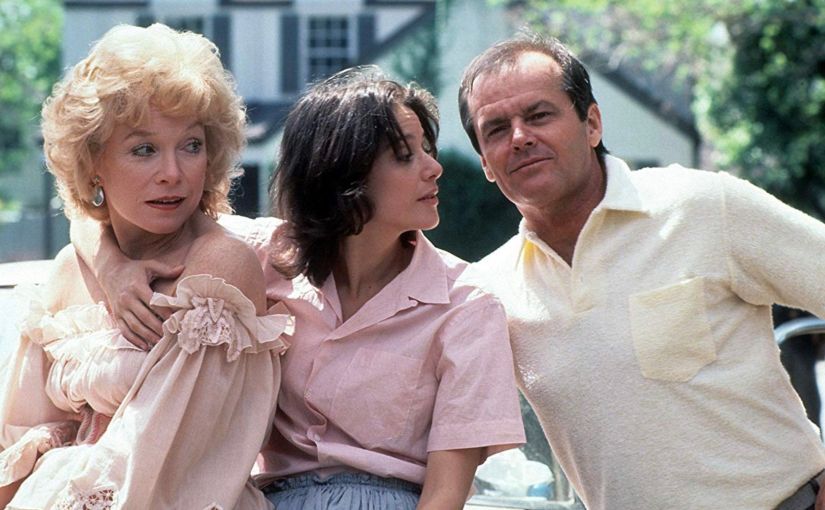
Acclaimed television writer James L Brooks’ first feature film was the 1983 Best Picture Winner Terms of Endearment.  The movie succeeds in more ways than one because of its varied relationships among the characters.  You have Aurora Greenway (Shirley MacLaine) and her daughter Emma Greenway-Horton (Debra Winger).  There’s Emma and her husband Flap Horton (Jeff Daniels).  There’s Aurora and Flap, and then there is Aurora and her neighbor Garrett Breedlove (Jack Nicholson).  Sounds like a lot to take in for a two hour picture, and yet Brooks manages to adapt a script from Larry McMurtry’s novel that smoothly covers realistic depth and dimension among these characters, and how they connect with one another.  Brooks is at least an incredibly efficient writer/director.  Honestly, I’m not complimenting him nearly enough.

Shirley MacLaine provides one of the best female performances to ever grace the silver screen.  She doesn’t have to utter a word of dialogue to say so much about how Aurora feels.  One of her greatest facial expressions is when she is addressed by her grandson as “Grandma!”  This moment is so utterly hilarious that the studio selected it to close out the original theatrical trailer.  If anything is going to get you in the seat at the theatre it’s this moment.  Aurora is a widow who can be difficult to please, judgmental and always conscious of her part in the world-even while she is hosting multiple gentlemen suitors in her Houston, Texas home.  This character is so powerful that it is hard to understand why Hollywood really never followed suit with presenting more films focused on the middle age woman or man.  There are still interesting things to be found in being a widow and dealing with ageism, motherhood and a resurrection of sexuality.  Think about The Golden Girls which dominated television sets on Saturday nights for most of the decade.

Aurora disapproves of Emma marrying Flap.  Flap has no imagination or drive and is as devoid of affection as his name suggests.  Best he can do for Emma and their three children is find whatever college professor job he can muster and uproot his family from one mid-western state to another.  Emma knows of her mother’s disdain for Flap, and can’t disagree with her.  She knows Flap is a loser, but if it means aggravating her mother then it is worth it at least to marry him.  Early in the film it amuses Emma to frustrate her mother a little more and a little more.  Contrary to Aurora’s instincts, Emma is naively unaware that life settles in soon enough and the happy nuptials fade away.

Still, Aurora and Emma have a strong mother/daughter relationship where numerous phone calls each day happen between them.  These conversations consist of Emma reluctantly telling her mother that she may be pregnant, yet again, or that Aurora is proud to let her guard down and approach the boorish, drinking next door neighbor astronaut, Garrett, played with a devil may care seductiveness from Jack Nicholson.  Aurora’s serene peacefulness in her beautiful backyard garden and home is always disrupted by Garrett’s loud bellow before diving into his swimming pool.  Still, she can’t help but be attracted to him while putting on a façade of disapproval in his presence.  The first lunch date that Aurora and Garrett share must be one of the best dates ever depicted on film.  The scene might have been written and staged by Brooks, but it is thankfully hijacked by Nicholson and MacLaine.  One of the funniest moments to ever come out of 1980s cinema for sure.  There’s much reason that MacLaine won Best Actress and Nicholson won Best Supporting Actor.  These actors easily stage a scene of realistic comedic chemistry while later expressing deep rooted drama and affection with one another.  Not easy to do all in one film.

Brooks masterfully writes these characters with such authenticity that you find yourself legitimately laughing at a scene or a piece of dialogue, while the person sitting next to you might embrace the dramatic element of the very same moment.  Both responses to random moments in Terms Of Endearment allow varied reactions like that.  When Emma suspects Flap of committing adultery, pay attention to the dialogue and the performance from Winger and Daniels.  Emma allows Flap to dodge a lie he’s about to tell by warning him that he may have just lost his senses, but if he continues down a wrong path, then he will end up worth less than he already is.  He doesn’t fight her on that observation.  Hard to explain here but listen to the vocabulary Brooks applies to Emma’s dialogue and watch how Winger traps Daniels.  You may nod with a smirk, or you may feel frightened for Emma and her marriage. 

I always say Terms Of Endearment is a comedy first and a drama second.  The film steers towards a frightening fate for the Aurora and Emma.  However, before that third act sequence there is so much to treasure, love and laugh at in the film.  When a cloud of imminent loss feels like it may approach, that is when the dramatic elements step forward.  To truly feel loss, you had to treasure wonderful moments with a loved one or a friend.  You had to value something important in your heart and soul to feel so terribly frightened and mad and hysterical when days might seemingly appear numbered.  James L Brooks and Larry McMurtry remind us of that.  Every person on the planet is destined for this feeling at one point or another.  What happens when the inevitable arrives is what sustains Terms Of Endearment to it’s satisfying end.  A character may appear on a hotel staircase to reconnect with support.  A hug goes a little longer than expected, and for the first time the one who normally lets go first actually tries to keep the moment frozen in time.  A gift from long ago is recovered to touch someone emotionally.  Brooks includes all of these moments in his film and that’s what I embrace most importantly.  Cinematically speaking, these points in the film are heightened by a memorable soundtrack of quirkiness and passage of life from composer Michael Gore.  His music is so effective that it has been used countless times over to enhance trailers for other films marketed at audiences that this picture was catered for.

Yes, after numerous viewings, Terms Of Endearment never fails to me put me in tears.  Like ugly crying!  I prefer to watch it alone actually, because I connect with the characters differently than most people I know, including my wife.  It’s a very personal film for me.  It reminds me of loss that I have felt and experienced.  More importantly though, it reminds me of all I’ve had, and all I continue to hold on to.  Terms Of Endearment is one of my favorite films.

SCHOOL TIES

By Marc S. Sanders

Robert Mandel’s adaptation of a story from Dick Wolf might be regarded nearly 30 years later as the film with the next generation of up-and-coming brat packers, but School Ties remains an underrated and topically important film nonetheless.  Just as it is still a problem of today, victimized by ignorance and unfounded bigotry, anti-Semitism was an issue that spread like a social disease within the confines of a prep school New England community in the 1950’s.

Brendan Fraser is David Greene, a high school senior awarded a scholarship at the school in order to usher in a championship football season as their quarterback.  David is well aware of his ultimate purpose for his scholarship and he brushes that aside as just one year of attendance will ultimately lead to acceptance at an Ivy League school.  He’s just like any other handsome boy attending the school, and he’s immediately accepted among the masses.  He’s hilarious at mischievous horseplay with the French teacher.  The beautiful girl (Amy Locane) at the nearby girls’ school is taken with him.  His football skills are applauded.  It may be a little surprising that he stems from the blue-collar town of Scranton, Pennsylvania and he buses the tables at dinner time, but David is an all-around okay guy who can knock over a linebacker while passing exceptional touchdown passes.  Amid this environment of different Christian denominations and WASP culture, however, David knows that he will stand apart if he reveals he is Jewish.  Therefore, he tolerates the casual jokes and accepts that it’s best to hide his Star of David necklace. 

The most important relationship occurs between David and his back up quarterback, Charlie (Matt Damon, before he became a superstar, but already looks like he’ll be a superstar).  Charlie begrudgingly accepts that David got to cut in line to be the star player.  As David becomes more of the celebrity on campus, Charlie is proud to be by his side.  Yet, Charlie has his own pressures to live up to as the fifth in line of his esteemed family who must carry on the legacy at the school followed by attending Harvard the following year. 

The roadmap of School Ties is easy to navigate.  You know when each note of the script is about to be played.  There will be a swastika that will shockingly appear.  Fist fights will happen.  The blue blood parents and faculty will interfere preaching their own “codes of honor” and the school’s storied 193 year history.  Yet, the film works very, very effectively.  The dialogue isn’t hokey and nothing feels like what could have been an after school special. 

No debate among the viewers.  Anti-Semitism is evil and thoughtless without merit or justification.  Questions appear where is it right to ask if David should have hidden his Jewishness or was he even lying about being Jewish, when in fact he just wasn’t even asked.  Is it right that David confronts his problems with his fists first?  Yet, Wolf’s script, apparently based on personal experience, delves further into the mounting pressures of these prep school kids who are primed from birth to be the latest model churned out from the respective family lineage for greatness in academics and athleticism.  Much of the material is devoted to the horror of actually not acing a class, and I appreciate that it’s not diminished to a standard line of “my parents are going to kill me.”  Raw emotion and stress are legitimized among these students.

The third act comes with no foreshadowing as a cheating scandal is suddenly introduced. Collectively the boys must debate who is the guilty party and why are they the guilty party.  Is it because one is Jewish, or is it because one actually cheated?  Good dialogue, good debate, but this also may be where the standard stuff spills over a little too much.  As such, the ending hinges on the third act, when it should have embraced more of the film as a whole.

The cast is made up of, at the time, soon to be superstars like Fraser, Damon, Chris O’Donnell, and Ben Affleck.  School Ties should be regarded as a winning audition for these guys’ careers that were only just on the horizon.  Their respective performances here are just as good as any of their most well-known roles, and they are happy to hide in the background as extras or step up for a camera shot.

ROUNDERS

By Marc S. Sanders

Recently, I watched The Cincinnati Kid with Steve McQueen and it reminded me how much I enjoy a good poker movie, and I don’t even play cards.  Shortly thereafter, I took it upon myself to watch Rounders directed by John Dahl.  A few things occurred to me.  Poker movies do not acknowledge an organization called Gamblers Anonymous.  I guess to do so would be too much of a downer when the real suspense lies in the close ups of these talented players trying to read and outplay one another across the table.  Addictions become all too real and movies are not about reality but rather enhanced reality.

Rounders explores a seedy underground world of poker in modern day New York City.  Its community is made up of guys with names like Teddy KGB (aka The Mad Russian with ties to the mob), Joey “Knish,” and Worm.  There’s also a heavy who conveniently comes in to collect debts, and his affectionate name is Gramma.  These guys are portrayed by an outstanding cast of actors; respectively John Malkovich, John Turturro and Edward Norton.  Gramma is Michael Rispoli looking squat but all muscle under a derby hat while residing in his brothel of hookers who work for him.  All of these characters couldn’t be any more different.  The only thing they have in common is the game.  Gramma is the destiny that follows you after the game.  The other thing they have in common is the storytelling device of mentor, both good and bad. 

Knish maintains a conservative career approach to poker that allows him to pay his bills and alimony, and has groomed a baby faced “rounder” known as Mike McDermott.  He doesn’t look like he belongs with these shadowy figures but maybe that’s why he’s so good at the table.  KGB is the devil that’s not in disguise.  He’s the Oreo chomping Russian psycho with an appropriate, yet overly laid on Bolshevik accent. Worm is Mike’s pal who won’t let up to entice his childhood friend to keep the juice going because poker, honest or more importantly shady, is all that matters. 

Matt Damon is Mike in one of his most underappreciated roles.  Mike looks like a law student with a promising career.  I said he looks like that.  The film however shows that Mike is not a law student at all.  At least he shouldn’t be.  Early on in the film, Mike’s britches get too big for him and he loses everything such as his tuition money and rent and anything else he’d been saving up for.  Knish offers to help him get back in the game, but Mike swears off poker like someone who perhaps would swear off fatty foods.  I guess it’s not an addiction that is taking over his livelihood such as with his devoted law school student  girlfriend Jo, played by Gretchen Mol.  In Rounders, law school and love are the inconvenience.  Not poker.

Nine months go by and Mike picks up his childhood best friend, Worm, played with exceptional sleaze by Edward Norton.  Mike resists Worm’s advances to get back in the neighborhood games where they were masters at the hustle.  Worm is desperate and eager to play because it’s all he wants to do and he has an acknowledged drive to simply self-destruct in endless debt.  Mike’s devotion to Worm is tough for him to compromise and pretty soon his personal vouch for his friend gets them both into trouble where binge gaming is their only option.

The step-by-step play of the story is predictable here.  We know there’ll be one big game at the end with a monster win.  Mike will face set backs along the way.  He’ll have mentor moments and arguments with Jo.  But so what.  Look at the actors this film has to offer, and follow along with a great script of dialogue too. 

Rounders came out in 1998 when Matt Damon was surprising the world with his original script Good Will Hunting.  This movie is one of the first films where he got top billing and his name above the title.  He has so many good scenes because many of them play like duets.  Damon vs Malkovich.  Damon with Turturro.  Damon with, and sometimes against, Norton. 

My favorite pairings are the scenes he shares with Martin Landau who plays Mike’s law professor, Abe Petrovsky.  Landau personally touched me as the son of Jewish immigrants where each generation went on to Rabbinical school.  Petrovsky describes for his law student, Mike, that through his own personal experience that our destiny chooses us.  Often, we don’t choose what we have to become.  The Petrovsky character was raised in the Jewish orthodox community where I also had experience while attending Yeshiva for ten years.  I knew this man that Landau so accurately portrays.   Beyond my review, I have to share that this character spoke to me and reunited me with the Rabbis who taught me in elementary school. Personally, Petrovsky assured me that it was okay that I did not follow in the footsteps of my teachings at Yeshiva.  It wasn’t for me, much like law school is not for Mike.  Mike has a talent for something else.  Still, it’s a very risky talent.  Rounders would like to tell you that everything in life is worth taking risks.

I’m not sure I agree with the philosophy of Rounders.  Gambling can easily turn into a terrible addiction.  My father played all the games at the casinos on occasion, but he never stayed very long and he only went infrequently like when he was on a business trip.  He always told me that he would not be sure he’d be able to stop if he took up the game.  I knew exactly what he was talking about which is why I never even opted to learn.  I know my limitations.  Rounders doesn’t focus on limitations, though.  Limitations are for nerds, I guess.  Rounders is all about searching for strategy to improve your game.  It’s movie money.  So, there’s only pretend risk as Mike aspires to beat the best of the underground, come out alive from the violations of his pal and then move on to Vegas where he’ll give it a shot at the World Series of Poker.

There’s one other aspect I admire about Dahl’s film.  I looked for it on this most recent viewing and I’m telling you I couldn’t see it anywhere.  Dahl never, ever shows you the full hands of the players.  Either you see only a part of the river of a Texas Hold ‘Em game or you see the pair of cards the players hold, but never both in any round of the various card playing.  Dahl’s approach like the Mike’s philosophy is not so much playing the cards as it is to show the players play against each other.  The ticks and expressions they give like how they smoke or drink or even how they eat Oreo cookies out of their poker chip rack.  It’s very effective compared to other poker scenes in films like The Sting or even Casino Royale.  With a fine tuned script by David Levien and Brian Koppelman, it is fair to say that anyone knows what hand beats a flush or two pair or whatever.  More importantly, what matters is what read is ultimately gonna win you the table.  Rounders is all about winning the table, not the hand.

MARATHON MAN

By Marc S. Sanders

John Schlesinger contributed to the long line of political paranoid thrillers that came out in the 1970s with Marathon Man, with a screenplay by William Goldman based upon his own novel.  Most films are not constructed this way any longer.  Here is a picture that, albeit may have large plot holes, leaves you curious as to what it all means while you are watching it for the first time.  Don’t belabor yourself with watching it again as a way to piece it altogether with logic and sense.  You’ll only be keeping yourself up at night.

Marathon Man begins with several different incidents occurring at different parts of globe.  A man is tirelessly running through Central Park.  In Manhattan, two elderly men get into a heated road rage argument that leaves them dead in a massive explosion.  A box of band aids is taken out of a safe deposit box and later smuggled beneath a box of chocolates.  In Paris, an explosion occurs after a sharp dressed man gets into a car.  A little later, that man is violently attacked in his hotel room, leaving a very bloody mess.  A couple is mugged, only the hoodlums are dressed in business suits.  Another man is found with his throat slashed in the balcony of an opera house.  A white haired man hiding out in South America starts to shave his head.  What does it all mean?  How are all of these occurrences connected?

As long as vague moments like these don’t carry on too long, I’m likely to be hooked because I consider myself a curious fellow.  Thankfully, Goldman’s script pieces the characters together with a few hair raising twists that I didn’t see coming.

Without giving too much away, Dustin Hoffman plays a marathon runner/Columbia University history major with a bleak family background.  Beyond his comprehension, he is connected or will find himself connected to each one of these early moments in the film.  Once a person very close to him turns up dead in his apartment, the hysteria sets in.  Hoffman plays this quite well as he is always trying to catch his breath while soaked in sweat and remaining the lightest of sleepers.  Schlesinger creates a terrifying moment with a bathroom door that Hoffman is trying to hide behind.  It reminded me of Kubrick’s use of an axe with a bathroom door that would come out four years after this picture, with The Shining.

Laurence Olivier is a mysterious elderly man who has arrived in New York, eventually coming face to face with Hoffman. Thus, leading to one of the most uncomfortable torture scenes in film history.  Cancel any upcoming dental appointments that are scheduled soon after watching Marathon Man.  You’ll thank me for it.

The set up and players are eventually explained, albeit at breakneck speed when the tension is very high.  Put it this way. It’s a challenge to sum up exposition when it’s being dictated in a high-speed car chase.  So, on the first viewing, you might miss a few details here and there.  Nevertheless, I knew who the good guys were, I knew who the bad guys were and simply hearing the word “Nazi” in any given line of dialogue is enough for me to know how sinister this all is.

I can’t deny the ending feels a little hokey as it takes place in a Central Park reservoir system with platform stairwells and waterfalls all around.  Yet the tension remains as a young Dustin Hoffman (a hot commodity of 1970s actors) pairs up with the legendary performer, Laurence Olivier.  As I came to understand, Olivier was suffering from a terrible cancer diagnosis while making this picture.  Unbelievably, he never shows his illness, as his performance is electric with a well-deserved Oscar nomination.  Hoffman was striving for method by exhausting himself personally.  I know about the legendary story where Olivier suggested he simply “try acting.”  Hoffman later clarified that conversation and explained it had more to do with a personal divorce he was going through and late night drinking at Studio 54.  Whatever!!!  The ailments these great actors were experiencing at the time lends perfectly to the paranoia. 

I try to avoid movie trailers these days.  They give away much too much.  I had not seen one trailer or commercial for Marathon Man, prior to experiencing it for myself.  All I was aware of was the infamous dental torture scene with the famous line “Is it safe?”  Out of context, I found it to give me goosebumps.  Within the framework of the film, it’s utterly disturbing and it only heightens the suspense that Schlesinger and Goldman were striving for. 

RAIN MAN

By Marc S. Sanders

It may surprise some people that I don’t find Dustin Hoffman’s performance of autistic savant Raymond Babbitt to be the best feature in Barry Levinson’s Rain Man.  On the contrary, the best thing about the film is Tom Cruise’s cynical, hyper active portrayal of Raymond’s younger brother Charlie.  I’m not knocking Hoffman.  He’s absolutely memorable, authentic and brilliant.  It’s so brilliant though, that it overshadows what Cruise accomplished with his part. 

Those of you who have read some of my reviews before, may recall how much I praise the best character arcs to be found in stories.  The character starts out one way and by the time the conclusion arrives, this person is completely different; practically unrecognizable.  Hoffman did this in Kramer Vs Kramer and Tootsie, Al Pacino did this in The Godfather.  Bryan Cranston used five seasons of television to do this in Breaking Bad.

Before I ever saw Rain Man for the first time, many years ago, I never knew what autism was.  I don’t even think I ever heard the word autistic before this film arrived.  I guess I was wrapped in my naïve bubble.  Now watching it years later, I see the special talents that autism can present for a person living with it, as well as the challenges that come with a person nearby who cannot comprehend the diagnosis, and carries no patience for it. 

Screenwriters Barry Morrow and Ronald Blass are wise to show an odd pairing of brothers in this film.  The movie begins when Charlie, deep in debt with his high-performance sports car dealership, learns that his estranged father has passed away.  Dad only leaves him with a gorgeous 1949 Buick Roadmaster convertible.  A $3 million estate is awarded to a trust fund meant to support Raymond; the autistic brother Charlie does not recall ever having.  Charlie’s arrogance and desperation to cover his insurmountable debts drive him to yank Raymond out of his care facility and embark on a cross country road trip back home where he intends to settle the estate by how he thinks he deservedly sees it.  During the course of the trip, Charlie gets a quick education about himself and Raymond’s condition. 

Tom Cruise might look like late 1980’s cool and stylish in his linen suits and button up silk shirts with sunglasses, but his glamour does not overshadow how bitter of a guy Charlie really is.  That’s what I embrace in his performance here.  It should have been nominated for an Oscar; definitely a glaring oversight by the Academy.  Charlie looks like a guy always moving at super speed, about to collide with a wall.  He bosses around his assistant salesman with outbursts and disruptive clapping hands.  Levinson is good at showing close edits of that.  He gives no attention to his girlfriend, Sussana (Valerie Golino), even when she is trying her best to have him stop for a second and realize the special condition and attention that Raymond needs.  As Charlie’s journey continues down the back wood roads of western America, he has no choice but to uncover a realization in his own hyperactivity, and even recognize a different kind of hyperactivity that Raymond possesses. 

Raymond is the autistic person whose mental capacity must follow strict guidelines of watching The People’s Court and Jeopardy.  He has to have to certain meals on certain days.  He can not ride in a car when it is raining.  He can not fly on airlines that carry historical statistics of crashing.  Fire alarms and hot faucet water are violently upsetting.  There is a rigid, uncompromising pattern to Raymond’s behavior and lifestyle.  Because he can’t compromise, Rain Man carries some humorous and outrageous scenes where Charlie must adjust to Raymond’s limitations.  I still feel sorry for the woman who has no choice but to surrender her television and living room in the middle of day so that Raymond can watch his program, while her children are deprived of their cartoons.

Hoffman is great in focus and concentration.  Much like when he adopted the persona of a woman in Tootsie, you never see him sway from the performance of severe autism in his Raymond character.  Because he is so straight down the line here from beginning to end, I have to really admire Cruise’s change in character over all.  Rain Man really is a story about Charlie Babbitt.  Not so much Raymond Babbitt. Charlie changes during the course of the film.  Raymond does not. 

There are a lot of eye-opening moments in Levinson’s film.  You get an education in what autism really is, or at least the unique case that Raymond possesses.  He can memorize a phone book in one night or count the number of tooth picks that have fallen on the floor with simply a glance.  Complex multiplication can instantly be done in his head.  It’s fascinating.  Charlie even discovers a way for Raymond to resolve his financial crisis, thereby leading to an energetically satisfying jaunt in Las Vegas. 

Barry Levinson has assembled two fantastic actors for an engaging film that avoids preachiness and sorrow.  Yet, Rain Man is rewardingly sensitive.  Levinson says a million words with simply a close up moment of Hoffman gently leaning his head on Cruise’s temple.  Quiet moments like that which arrive following scatter brained moments earlier make for a range of emotions I treasure in a picture like this.

I look at Rain Man or Magnolia or Born On The Fourth Of July, and I wish Tom Cruise would take a break from the endless Mission: Impossible films.  Heck, there’s even another Top Gun film on its way!  Why doesn’t he focus on the roles that welcome his skills as a very effective actor?  (American Made was a recently oddly different kind of character for him. Great film by the way!)  I have an affection for most of his films, regardless of the category. I really do.  If only his action pictures could take a rest for a change, and allow the acting scenes to come back into play.