HOUSE OF GUCCI (2021)

by Miguel E. Rodriguez

Director: Ridley Scott
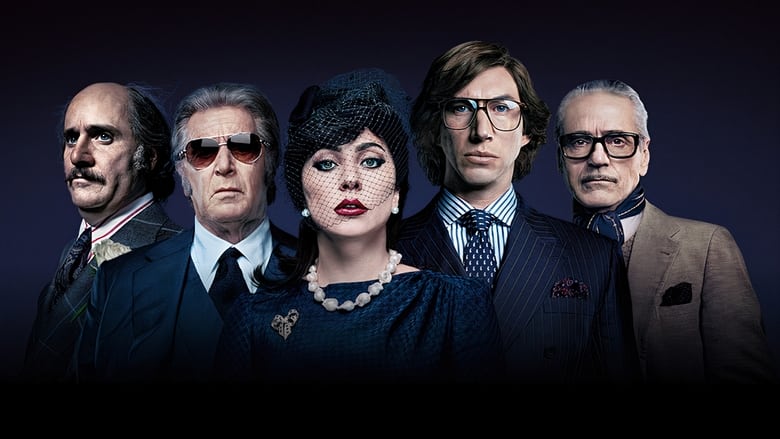
Cast: Lady Gaga, Adam Driver, Jared Leto, Al Pacino, Jeremy Irons, Salma Hayek
My Rating: 5/10
Rotten Tomatometer: 61%

PLOT: An outsider marries into the Gucci family, and her unbridled ambition triggers a downward spiral of betrayal, revenge, and violence.


Watching Ridley Scott’s House of Gucci was a curious experience.  I could see glimmers of a great entertainment through bars of slow pacing, a meandering story, and unanswered questions.  The performances are top-notch, no question, but they are at the service of a movie that doesn’t seem interested in meeting their level of passion.

Inspired by true events, the movie tells the story of Patrizia Reggiani, a young woman from humble beginnings who meets and eventually marries Maurizio (Adam Driver), one of the heirs to the Gucci fashion empire.  Patrizia is played with fury and fire by Lady Gaga, who seems destined for another Oscar nomination.  Her character is portrayed as a latter-day Lady Macbeth, someone who sees through the deceptions of her new husband’s business associates and manipulates people and events for her family’s benefit.  In true tragic form, her ambitions threaten to derail everything she loves.

Adam Driver plays Maurizio as a rather slow fellow who disinherits himself so he can marry Patrizia but finds a way back into the fold via his uncle, Aldo (Al Pacino), who sees Maurizio as a good substitute for his own disappointing son, Paolo.  Paolo is played by Jared Leto, in another of the film’s performances destined for Oscar recognition.  Buried underneath flawless makeup and a skin cap, Leto portrays Paolo as a self-deluded buffoon whose fashion designs aren’t so much daring as unfortunate.  (Apparently, pastels and brown were never meant to mix…who knew?)

I mention the performances because they are the sole highlights of the film.  For two-and-a-half hours, these performances play against a backdrop of one dreary scene after another. Sure, the performances are fun to watch, but at the end of the day, if they don’t have anything interesting to say, it gets a little boring.  We get behind-the-scenes intrigues and betrayals that seem to owe more than a little to earlier crime epics by Scorsese and Coppola, but there was nothing to get really excited about.  Nothing grabbed me.

Ridley Scott’s films are normally way more imaginative than this.  They look better.  The cinematography is usually more inspired.  I’m not talking about his action or sci-fi epics, either.  I mean his small-scale triumphs like Matchstick Men or Thelma & Louise.  What happened here?  Was he not inspired by the story?  There is great material here, more than enough back-stabbing and lying and cheating to go around.  Yet everything is subdued, and plods, and inspires more yawns than anything else.  I didn’t experience any kind of excitement or passion one way or the other for any of the characters, or for the story.  It just didn’t make me care.

By the time House of Gucci is over, we’ve seen betrayals, marital infidelity, divorce, back-stabbing business deals, sex, and murder.  I have a friend who wrote a stage play that has almost all of those things, and it was WAY more entertaining than this film.

LA LA LAND (2016)

by Miguel E. Rodriguez

Director: Damien Chazelle
Cast: Ryan Gosling, Emma Stone, John Legend
My Rating: 9/10
Rotten Tomatometer: 91% Certified Fresh

PLOT: While navigating their careers in Los Angeles, a jazz pianist (Gosling) and an actress (Stone) fall in love while attempting to reconcile their aspirations for the future.


SPOILER ALERTS! MULTIPLE SPOILER ALERTS!


La La Land was greeted by the American public in one of two ways.  There was no middle of the road.  You either loved it or hated it.

Critics loved it.  It broke records at the Golden Globes that year and was the odds-on favorite to win Best Picture at the Oscars (Moonlight took the prize instead, and deservedly so).

When it came to the viewing public, people were immediately divided into opposing camps, with each trying to convince the other they were wrong.  “It’s homage!” cried one camp.  “It’s derivative and sad!” cried the other.

Me?  I’m part of the “loved-it” camp.  And after re-watching it tonight, for the first time since seeing it in theatres, I have no plans to change my mind.

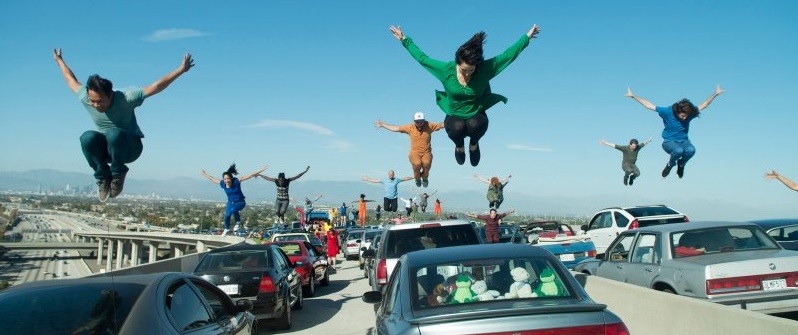
I once wrote that there is no movie more in love with “old Hollywood” than The Artist.  Well, La La Land is more in love with classic movie musicals, specifically, than any other modern movie in recent memory.  It opens with an astonishing musical number, “Another Day of Sun”, set on a Los Angeles overpass.  In a breathtaking feat of choreography and cinematography, scores of dancers perform nifty moves in and around a traffic jam, incorporating a live band inside what looks like a UPS truck, in one single take…or at least what LOOKS like one single take.  Could be some CG in there.  Who cares?  It’s awesome, and it sets the tone right away: this will be like one of those old musicals where people break into song and dance without warning.  You can stay where you are or you can leave now, but this is what’s happening.

After that, we settle in to a tried and true story of boy (Sebastian [Ryan Gosling], a jazz pianist who wants to start his own jazz club) meets girl (Mia [Emma Stone], an aspiring actress looking for a break).  This part of the story was old when Mickey Rooney and Judy Garland did it in countless other films, so yeah, I get it.  I can see why some folks called it derivative.

But that criticism neatly dismisses the underlying subplot about the Old vs. the New.  Sebastian desperately wants to start a jazz club that plays the greats – Monk, Coltrane, Davis – because, as he says in a passionate speech to Mia, jazz is dying.  Nobody wants to hear it anymore.  It’s old.  (He decries a nearby club that combines jazz, samba, and tapas, or some such nonsense.)  “They worship everything and value nothing,” he laments.

But Keith, a fellow musician (played by John Legend) tries to get him to see sense.  (“How are you gonna be a revolutionary if you’re such a traditionalist?”)  History is written by the people who strike out in a new direction.  Sebastian himself uses this philosophy with Mia, who has gotten tired of auditioning for the same teachers and doctors and coroners over and over again.  He tells her to do something different if you’re tired of the same old/same old.  She takes his advice and starts writing a one-woman play about her life.

And here’s where it gets cool.  While the characters in the movie are urging each other to embrace new concepts, La La Land still has one foot firmly in the past, i.e., the grand musical traditions of Gene Kelly and Fred Astaire and Cyd Charisse, etcetera.  Two later numbers stick out in my mind.  One is a twilight duet between Sebastian and Mia, shot on location in the Hollywood Hills when the sky is that perfect shade of somewhere-between-pink-and-purple.  They sing a little and then they do a beautiful dance together, but they’ve just met, so they’re careful to dance ALONE together…watch it and you’ll see what I mean.  Right out of Vincente Minnelli.  (Let’s be clear…Gosling and Stone are not exactly Fred and Ginger, but they do a damn sight better than I could do myself, so I give them props.)

Another number with classic-musical overtones is set during the first giddy months of their relationship.  With little or no singing (can’t remember which), we follow Sebastian and Mia as they tick off Los Angeles landmarks, finishing at the famous Griffith Observatory.  They enter the planetarium, and in a gloriously giddy moment of cinematic fantasy, they rise into the air and dance among the stars and galaxies before falling perfectly into their seats and sharing a kiss.  I no longer remember what I did the first time watching this movie, but this time around, I watched that whole sequence with a goofy grin on my face.  If you can’t enjoy watching people dancing in the stars, well…

At one point, Sebastian tells someone, “You say ‘romantic’ like it’s a dirty word.”  I like that.  This movie is, above all, romantic, in spite of how it ends.  It’s romantic in the sense that it revels in the unreasonable, illogical hope that everything will work out okay in the end.  Sometimes it does, sometimes it doesn’t, but that doesn’t mean you can’t still dream.  (There’s even a song about this exact thing, sung by Emma Stone in a sequence near the end that oozes romance and heartbreak.)

But all of this is nothing…nothing…compared to the emotional roller-coaster of the last thirty minutes of the movie.  It’s here that La La Land gets all serious in the middle of the fluff, because it explores the nature of success and what is necessary to achieve it.  Sebastian is touring with a band that pays well…but it’s not exactly a jazz ensemble.  Mia is just about ready to give up acting…until a casting agent gives her an opportunity to star in a movie shooting in Paris for four months.  These two characters, for whom the audience has been rooting for the previous 90 minutes, are on a downward spiral, and the only way to save their relationship would be for one or the other to completely give up on their dreams.  But neither of them would ask that of the other.  So they go their separate ways.

WHAT?  After all this they don’t wind up together?  Well…what would you have preferred?  An ending that awkwardly keeps them together, with him, say, playing jazz in a French club while she shoots a movie in Paris during the day?  Enjoying success together?  Having kids?  Sure, that kind of ending is POSSIBLE.  (In fact, in one of the many highlights of the movie, you even get a tease of what that might have been like.)  But, hey.  Isn’t that just the traditionalist way of looking at things?  Why not strike out in a different direction?  Do something no one’s doing.  End your movie where each character gets what they’ve always wanted their entire lives…even if that means they don’t get each other.

Boy, that last sentence sounds harsh.  But that’s what this movie’s about, and I think the film’s detractors simply couldn’t get past the grand tradition that demands the two leads wind up together.  They wanted Singin’ in the Rain, and instead they got the musical equivalent of The Remains of the Day.  (Maybe not quite that extreme, but I trust the point is made.)

ANYWAY.  Like I said, I just finished watching this a couple of hours ago, and I am no less convinced of its greatness.  Even though it’s a wrench watching their relationship head towards the rocks, the movie makes up for it at the end with half an hour of glorious, emotional catharsis that left me feeling wrung out, but in a good way.  It’s not quite a tragedy, but not quite a comedy.  Like life itself, it falls somewhere in between.

MIDNIGHT SPECIAL (2016)

by Miguel E. Rodriguez

Director: Jeff Nichols
Cast: Michael Shannon, Joel Edgerton, Kirsten Dunst, Adam Driver, Sam Shepard
My Rating: 10/10
Rotten Tomatometer: 83% Certified Fresh

PLOT: Two men go on the run with a child in tow, pursued by federal agents and by members of a cult who believe the child has special powers.


The general concept of “mystery” in a film is a subtle art.  Not enough mystery, and people will say they’ve seen it all before.  Too much mystery, and people will wonder why they’ve spent good money to be confused for two hours.

Every now and then, though, a movie comes along that shows everyone else how it’s done.  It manages to plunge the viewer headlong into the story with little to no exposition, provides just enough clues to keep things intriguing without giving the game away, and supplies a climax that is not just satisfying, but revelatory.  Prometheus is one of those movies.  So is Freaks (2018).

And so is Midnight Special, from director and screenwriter Jeff Nichols (Take Shelter, Mud).

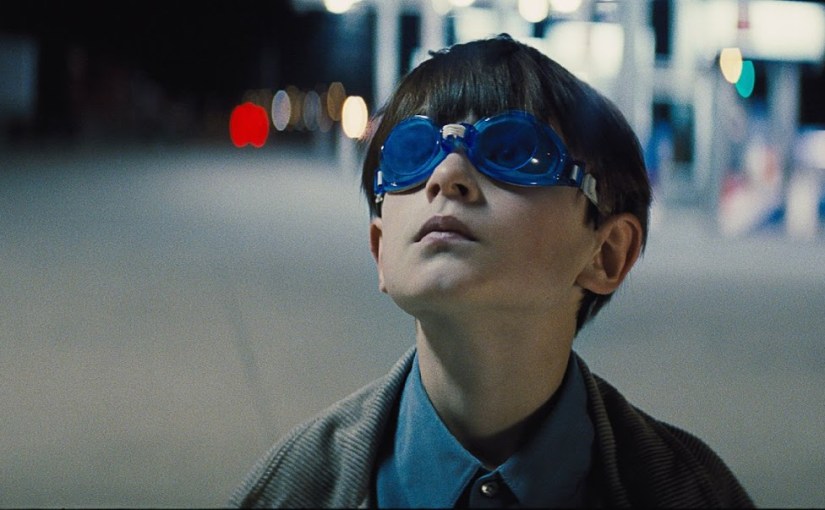
This movie grabs you right from the opening minutes.  Two men appear to be holed up in a hotel room with a young boy wearing blue swim goggles.  Cardboard and duct tape cover the windows.  A news broadcast on the TV reports on the young boy’s kidnapping.  However, he does not appear to be distressed in any way.  One of the men may or may not be his father.  He goes willingly when they vacate the room and hit the road.

In another part of the country, a pastor watches the same newscast with concern.  He later leads a church service, but the scripture reading consists of non-sequiturs and random numbers.  The FBI interrupts the service and hauls each and every church member in for questioning about the missing boy.

What the deuce is going on here?  How is this church connected to the boy?  Where are the two men taking the boy?  What’s with the blue goggles?  What is so important about this boy that the two men with him would be willing to kill for him?

These are all very good questions.  Whenever the movie takes the time to answer one of the questions, two more spring up in its place.  And I may as well tell you now: not every question will get an answer.  But instead of feeling frustrated, I just got more and more involved in the film.  I felt like I was an active participant in figuring out the story, along with the characters.  There’s nothing quite like feeling involved in a movie, rather than simply watching a movie.

When the revelations arrive about where the men are headed with the boy, why they’re headed there, and why the FBI is interested, I’m not gonna lie, I was gobsmacked.  In retrospect, I suppose I should have seen some of the plot points coming a mile away.  But that’s the beauty of the screenplay and the direction.  I wasn’t interested in trying to second guess what surprises were in store.  As a result, when the surprises arrived, I was constantly in a state of jaw-dropping amazement.

I would also like to point out the great restraint used by the filmmakers when it came to the few scenes that required CGI enhancement.  There are a hundred ways these scenes could have gone wrong, resulting in a shot that completely takes you out of the movie.  They avoided all those pitfalls and instead created scenes of startling beauty, even when things seem to be going wrong…or when they at last go right.

This is a movie that deserves to be seen with as clean a slate as possible.  It didn’t exactly make a dent in the pop-culture zeitgeist, so it’s not likely you’ll see any spoilers on the internet without Googling the movie, but why would you want to do that?  Keep an open mind, don’t ask how it ends, and find a way to see this movie.  You won’t be disappointed.

CLOUD ATLAS (2012)

by Miguel E. Rodriguez

Directors: Lana Wachowski, Lilly Wachowski, Tom Tykwer
Cast: Tom Hanks, Halle Berry, Jim Broadbent, Hugo Weaving, Jim Sturgess, Doona Bae, Ben Whishaw, Keith David, Susan Sarandon, Hugh Grant
My Rating: 10/10
Rotten Tomatometer: 66%

PLOT: An exploration of how individual lives impact one another in the past, present, and future, as one soul is shaped from a killer into a hero, and an act of kindness ripples across centuries to inspire a revolution.


Okay, faithful readers, I hope you’re comfortable.

Cloud Atlas is one of those movies like Baraka that leaves me with the urgent need to tell people how amazing it is.  It’s visually spectacular, thought-provoking, and hopelessly optimistic about love and the good side of human nature, even in the face of the worst humanity has to offer.

Based on a critically acclaimed novel by David Mitchell, the movie tells six separate stories, linked by the fact that a core group of actors plays all the principal roles in each story, and by the fact that at least one actor in each story carries a curious birthmark shaped a bit like a comet or a shooting star.  Each story is separated from the others by decades or centuries, taking place in the years 1849, 1936, 1973, 2012, 2144, and an apparently post-apocalyptic 2321.

I cannot imagine the lengths to which the filmmakers, and the film editor in particular, went to make this movie work.  The film jumps freely from one story to another, forward, back, forward, and back again, somehow maintaining a clean flow and keeping each storyline absolutely clear.  Although the stories are unique, the editing keeps the idea of connection alive for nearly three hours.  Just based on the editing alone, that makes Cloud Atlas kind of exhilarating to watch, especially when things heat up in the 2144 segment.

Let me see if I can quickly summarize each story, without giving too much away:

  • 1849 – An American lawyer visits property holdings overseas and witnesses the brutal whipping of a slave, who stows away on the lawyer’s ship returning to San Francisco; meanwhile, an unscrupulous doctor has plans to steal the lawyer’s gold en route.
  • 1936 – A struggling composer, Robert Frobisher, is hired as an amanuensis (a fancy word for a music stenographer) to another aging composer, which allows Frobisher to compose his own masterpiece, The Cloud Atlas Sextet. The aging composer demands credit for the piece and threatens to expose Frobisher’s bisexuality, including his deep, unconditional love for a gentleman named Rufus Sixsmith.
  • 1973 – An investigative reporter stumbles onto a conspiracy at a nuclear power plant, thanks to a whistle-blowing report written by none other than Rufus Sixsmith, now in his sixties.
  • 2012 – An author on the run from hooligan creditors takes refuge in what he thinks is a hotel, but is in fact a nursing home, to which he has inadvertently committed himself.  He and three other residents plan a daring jailbreak.
  • 2144 – Set in a vastly futuristic New Seoul, a renegade “fabricant” is brought in for questioning by the ruling government known as Unanimity.  The fabricant, known only as Sonmi-451, spins a tale of oppression, liberation, and horrific realization as she becomes the voice of a revolution that will ripple across centuries.
  • 2321 – In a post-apocalyptic Hawaii, peaceful Valleysmen live in constant fear of attacks from vicious cannibals, the Kona tribe.  They also receive periodic visits from Prescients, a highly advanced society that apparently lives offshore.  One day, a Prescient, Meronym, asks a Valleysmen leader to guide her to a remote mountain peak where she hopes to send an SOS signal to off-world colonies.

Confused yet?  Don’t be.  The editing keeps everything crystal clear.

But that’s just the clinical description of the movie.  What catapults Cloud Atlas into the stratosphere is how the fancy editing and visual effects occasionally take a back seat to a really deep philosophical question that leaves me with a sense of awe.  It’s really a what-if question, one of the greatest what-if questions of human existence.

What if…death isn’t the end?

I know that countless other movies have asked this question. We all have our own answers and beliefs.  I am not suggesting that Cloud Atlas has somehow figured out THE answer to this question, or that the answer it provides somehow trumps your own beliefs. But of all the movies I’ve seen on this topic, Cloud Atlas is the only one that really, genuinely, truly left me in awe of the possibilities it proposes.

I mentioned earlier that key roles are played by the same actors over and over again in each of the stories.  While that was initially distracting, I realized that the filmmakers were actually making a genius move.  It was nothing more than a simple way of illustrating the concept that a life in one era is echoed in another, decades or centuries later.  Heavy makeup is used to indicate how one person’s life as an Asian woman could, in theory, be echoed in the life of a Mexican woman in another era.  Or perhaps the life of a British man might be echoed later as a British woman.

And then there’s the question of that recurring birthmark.  One key character from each storyline bears a birthmark that resembles a shooting star.  So many people (including me the first time around) wanted to attach some kind of conventional story-based meaning to that birthmark.  Did it mean these characters were all somehow blood-related?  Was it a prophecy of some kind?  Something mentioned in the book, perhaps, that had to be left out of the film for pacing reasons, or some such thing?  No.  It’s just another visual reinforcement of the idea of recurrence, or reincarnation.

And that’s where I get awestruck by the movie.  Reincarnation is not a new concept in films, but Cloud Atlas really got under my skin.  Imagine.  What if…the person you love, your soulmate, the one you’ll love until the day of your death…what if, centuries hence, you’ll meet each other again?  Maybe you’ve walked down the street, or been eating in a restaurant, and for a fleeting second you lock eyes with a total stranger across the room, and you think, “I KNOW that person,” but the moment passes and life goes on.  What if that happened because you have met in some past life?

Or maybe you go on a date, and it goes phenomenally well, as if you’ve known each other for ages?  Well…maybe you have.  It’s your destiny to meet and love this person because you’ve already done it before.

I know I’m getting a little woo-woo/touchy-feely here.  It’s not a new idea.  It’s just that Cloud Atlas presents the idea so well that my breath gets taken away when I think about its implications.

I just have to bring up the stunning visuals again.  There’s a scene where the composer, Frobisher, is writing to his lover, Rufus Sixsmith, and there’s a passage where, in his mind, he meets Sixsmith in a china shop.  In a wonderfully poetic moment, they start smashing the china in slow motion as Frobisher’s composition plays in the background.  Then, just as the music reaches a crescendo, the two of them stop in place, and hundreds of china vases and plates rain down from the ceiling in slow motion, hanging in space, descending slowly to the ground like gigantic snowflakes.

I’m at a loss.  I’ve come to the end of whatever I can discuss about this movie without repeating myself endlessly.  I want to reiterate that I don’t believe this movie has THE answer to what lies beyond death.  But it has a truly lovely hypothesis, one that leaves me awestruck with its implications.

So let me just end with a line from the movie that makes my heart swell every time I hear it.

“I believe there is another world waiting for us, Sixsmith. A better world…and I’ll be waiting for you there. I believe we do not stay dead long. Find me beneath the Corsican stars, where we first kissed.”

MONEYBALL (2011)

by Miguel E. Rodriguez

Director: Bennett Miller
Cast: Brad Pitt, Jonah Hill, Philip Seymour Hoffman, Robin Wright, Chris Pratt
My Rating: 9/10
Rotten Tomatometer: 94% Certified Fresh

PLOT: The general manager of the Oakland A’s attempts to assemble a winning team on a lean budget by employing computer-generated analysis to acquire new players.


On paper, Moneyball should not work as a movie. What have you got?  A feel-good sports story about the 2002 Oakland A’s utilizing the science of statistics to assemble the right combination of players to get them into the playoffs.

I mean, really?  Specifics aside, a Cinderella story about an underdog sports team trying to make it to the big game is one of the oldest, most predictable tropes in film.  Shall I count them off? Major League, The Bad News Bears, Bull Durham, The Mighty Ducks, Little Giants, Cool Runnings, Hoosiers…need I go on?

And in Moneyball, we barely even get to see any baseball action itself.  The movie is more concerned with the behind-the-scenes action, beating the trade deadline, shaking up the scouting crew, trying to get the manager to believe in the new system.  We don’t really see any major baseball action until we get close to the finale.

[SPOILER ALERT…unless you’re a HUGE baseball fan, in which case you were already aware of this.]

And let’s talk about that finale, while we’re at it.  The A’s make it to the 2002 ALDS elimination game, and what happens?  They LOSE.  Say what???

So why, oh why, does Moneyball work the way it does?

…no, really, I’m asking.  Because I’m not 100% sure myself.  Let me just tick off my thoughts as they occur to me here.

  1. There’s the screenplay.  Here’s some good advice: when you want to make a movie about a potentially dry subject, get both Steven Zaillian AND Aaron Sorkin to write your script.  The pace of the movie is stately, even sedate, but the dialogue is crisp, clean, and precise, getting to the point as efficiently as possible without being flashy.  In one memorable scene, someone walks up to the General Manager’s office and says just one word: “Peña,” and then walks away.  The GM takes it in, says, “Okay”, and calmly stands and flips his desk over.  The whole thing is over in 15 seconds.  I can imagine another movie wasting a lot of time with extra words or edits, but not “Moneyball.”  (SPARTAN.  That’s the word I’m thinking of.  The dialogue is spartan.)
  2. There’s the editing.  The dialogue is sleek and uncluttered, but there is a lot of information that has to be conveyed to those audience members who may not know what a box score is, or what a DH is, or why Billy Beane (the GM, played by Brad Pitt) doesn’t CARE whether his new first baseman can even field the ball properly, as long as he gets ON BASE when he’s batting.  Rather than use flashy editing to generate false suspense or excitement, the Oscar-nominated editors use more of that spartan vibe, with occasional jumps to real-world film clips of the actual team or individual players.  This is especially helpful when the film’s middle section details the woeful first half of the season under the new statistics-based system.  Again, not flashy, but effective.  Very hard to pull off, and deservedly recognized.
  3. There’s the structure…which I guess points back to both the screenplay and editing, but I’m just saying.  As I said, it’s a classic, well-worn trope.  Good guys get knocked down for the count – the A’s flat-out suck for the first half of the season – but then they suddenly start winning games and crawling back into contention.  As many of these films that I’ve seen, I still found myself unwittingly getting caught up in the spirit of the comeback.  In actual fact, the 2002 season is the one where the real Oakland A’s threatened to break the American League record for longest winning streak.  And it all comes down to one at-bat in the bottom of the ninth.  Because of COURSE it does.
  4. …and that sort of brings up another point.  Is there another sport that has as much innate mythology as baseball?  Sure, football has its share of comeback stories, and so does hockey and everything else.  But with baseball…lemme tell you.  A few years ago when the Chicago Cubs were on the verge of winning their first World Series in a hundred-and-eight years, I watched Game 7, rooting for the Cubs.  For those Cubs fans who watched as well, you’ll recall: that game was unmerciful.  The Cubs blew a three-run lead, they ended nine innings in a 6-6 tie, and then there was a RAIN DELAY before the 10th inning started.  But I will never forget that moment when the Cubs made the final out, and they wound up winning 8-7.  It was glorious.  …well, watching Moneyball, watching that section when the A’s are creeping up to winning twenty games in a row, I found myself grinning and laughing spontaneously, without even realizing I was doing it, and I remembered what it was like to watch the Cubs win.  And a big part of it has to do with that unexplainable psychic connection we have to the game itself, that sense of the romantic when someone clobbers a game-winning homer, or makes a dramatic catch to save a no-hitter, or when a relief pitcher retires the side with bases loaded.  I’m not a true baseball fan, I’ll admit…but I know good drama when it happens.  Moneyball gets that aspect of the game just right.

(I haven’t even mentioned the sterling performances from the principal actors, particularly Jonah Hill, who nabbed an acting nomination for one of the most underplayed characters in history.)

In the end, Moneyball is exactly like the Oakland A’s in the film.  It’s an unlikely combination of talent that generated surprising results and was critically acclaimed, gathering six Oscar nods.  It failed to win a single Oscar…much like the A’s were eventually eliminated from the playoffs in 2002.

But in the end, it’s not the shutout at the Oscars that I remember.  It’s the fact that this is still one of the best sports movies I’ve ever seen, and definitely one of the top 2 or 3 baseball films I’ve ever seen.

INCENDIES (2010, Canada)

by Miguel E. Rodriguez

Director: Denis Villeneuve
Cast: Mélissa Désormeaux-Poulin, Lubna Azabal, Maxim Gaudette
My Rating: 10/10
Rotten Tomatometer: 93% Certified Fresh

PLOT: Twins living in French Canada journey to the Middle East to fulfill their mother’s last wishes by discovering their family history.


A few years before French-Canadian director Denis Villeneuve made a big splash in American cinema with Sicario, Arrival, and Blade Runner 2049, he directed Incendies [French for “flames” or “fires”…I had to look it up].   This is one of the best films I’ve ever seen.  It’s a mystery, a melodrama, and an urgent plea for peace, all at once.  It’s heartbreaking, engaging, absorbing, and beautiful to look at.  There are two directors currently working who I believe have successfully picked up the mantle left behind by Stanley Kubrick.  Denis Villeneuve is one of them.

(The other is Alejandro G. Iñárritu [Babel, The Revenant], but let’s not get sidetracked…)

A mother dies.  At the reading of her will, her twin son and daughter receive a mission: go to the Middle East and track down their previously unknown father and brother, and give them letters in sealed envelopes.  Only then will the mother allow a headstone to be erected on her gravesite.

The brother, Simon, is skeptical, owing to the mother’s strange behavior in her later years, but the daughter, Jeanne, dutifully follows her mother’s wishes and travels to an unnamed country in the Middle East and begins the laborious process of tracking down anyone who knew her mother and father.

We also get flashbacks of the mother, Nawal, in her younger years, paralleling the daughter’s search.  We learn that Nawal, a Christian, fell in love with a Muslim, Wahab, which is a BIG no-no, to say the least.  Soon, Wahab is out of the picture, and Nawal gives birth to a son who is immediately taken from her arms and delivered to an orphanage.

So far, this is standard soap opera material, but it’s depicted with gorgeous cinematography and spot-on direction.  Director Villeneuve uses a lot of wide shots that have a stark beauty; they reminded me of some of the memorable vistas from Bonnie and Clyde and The Deer Hunter.

When Nawal gets a little older, she decides to track down her son.  This is made difficult owing to the state of war that now exists between Muslims and Christian Nationalists.  Attacks and reprisals make it nearly impossible to find accurate records.  She travels alone from one burned-out orphanage to another looking for clues.  At a key moment, she flags down a bus, but is very careful to first hide her crucifix necklace and put on a head-covering.  Can’t be too careful.

At this point, regrettably, I have to abandon summarizing the story, because the less you know about what happens after Nawal gets on that bus, the more effective those events will be.  Suffice to say it’s a life-changing event, one that sends her on a wildly careening path from activist to assassin to political prisoner.

All of this, naturally, comes as a shock to her children, Jeanne and Simon, who are starting to think this search for missing family members may be a mistake.  At one point, someone makes an important statement: “Sometimes, it’s better not to know some things.”

So…what is this movie really about?  It’s not just about the mystery of the missing family members, which is enough of an engine to make a compelling movie on its own, especially when it’s intertwined with the mother’s past.  But there is a deeper, much more profound level to Incendies that is not apparent until the movie’s final sections, when the threads of Nawal’s past converge in a moment of shattering revelations.  The movie beautifully hides its real motives along the way so you get blindsided by its true message, its true heart.

I dunno, maybe I’m getting too mushy.  But that’s the effect this movie had on me.  I’ve only experienced this kind of emotional catharsis after a precious few films.  It’s impossible to fully describe it without giving away the secrets lying at the heart of Incendies.

THE SQUID AND THE WHALE (2005)

by Miguel E. Rodriguez

Director: Noah Baumbach
Cast: Jeff Daniels, Laura Linney, Jesse Eisenberg, Anna Paquin
My Rating: 9/10
Rotten Tomatometer: 92% Certified Fresh

PLOT: Two young brothers deal with the divorce of their parents in 1986 Brooklyn, specifically the Park Slope neighborhood.


I started writing this as a “conventional” review, and I found myself unable to make it more than a simple summary of the plot.  I have rarely seen a movie that has left me more inarticulate than this one.  I can tell you the movie works, and works extremely well, but I am unable to explain exactly why.

It’s a simple story of a husband and wife going through divorce, deciding on joint custody of their two sons, and the complications that ensue.  The husband, Bernard (Jeff Daniels), is a literature professor and a published novelist, but who hasn’t had anything published for some time.  The wife, Joan (Laura Linney), is in the final stages of getting her own first novel published.  This fact may or may not be one of the causes of the divorce, but Bernard is pretty sure it is.  Their sons, Walt (high school senior, played by Jesse Eisenberg) and Frank (maybe 12 years old), deal with this news in a predictable manner: initial numb acceptance, then some acting out a little later.

Bernard, whose well-educated narcissism is impossible to miss, almost cheerfully informs the sons that he and Joan will share joint custody evenly during the week.  One of the sons asks, “How can you share us evenly?”

“I’ll have you every other Thursday,” Bernard explains helpfully.  This answers the question without making anything better.

Walt starts a relationship with a classmate whom he coldly describes as “cute, but not gorgeous.”  Bernard casually invites a female student to live in a vacant room in his new house.  Joan and Bernard fiercely protect their “days” with their sons.  Frank starts drinking beer and masturbating in public places (this is handled with much more discretion than that description would have you believe).

But the story itself is not what makes this movie such a pleasure.  It’s the movie’s style and editing that create a unique experience.  The movie clocks in at an unthinkable 81 minutes, WITH credits.  I learn from the bonus features on the Blu-Ray that it was shot on Super-16 film stock with a mostly hand-held camera, lending the film a low-budget, documentary look that enhances its “reality”.  Scenes last only long enough for us to get the point before a jump cut takes us to the next plot point.  Normally, this creates in me a sense of nervousness or anxiety, but for some reason it didn’t work that way.  I never felt cheated or short-changed.  It all just felt “right.”  It gave me the same sensation I get when I’m reading a really good short story with sharply-drawn characters and impeccable dialogue.

That may sound like more details than I had promised at the beginning, but it’s really just a clinical description.  Words can’t express how the film’s brevity, atmosphere, dialogue, and characters all combined to produce one of the most touching films about family and/or divorce that I’ve ever seen.

(No, I HAVEN’T seen Marriage Story by this same director, Noah Baumbach, but I will get around to it one day.  Today is not that day, though.)

1917 (2019)

by Miguel E. Rodriguez

Director: Sam Mendes
Cast: Dean-Charles Chapman, George MacKay, Colin Firth, Mark Strong, Benedict Cumberbatch
My Rating: 10/10
Rotten Tomatometer: 89% Certified Fresh

PLOT: Two British soldiers during the First World War are given an impossible mission: deliver a message deep into enemy territory that will stop 1,600 men, including one of the two soldiers’ brothers, from walking straight into a deadly trap.


Bear with me for a second…I promise I’ll actually get to the movie in a second.

I’m not a professional movie critic.  I write reviews simply because it amuses me to do so, and because one of my friends made it possible for him and I to post our reviews in an online forum.  For about two months, though, I haven’t written a single review.  I pondered this with Marc a little while ago, and the only reason I could come up with was that I didn’t feel INSPIRED to write something.

Not that I haven’t seen good movies in those two months. Waves, Uncut Gems, Star Wars: The Rise of Skywalker, Jumanji: The Next Level, Frozen 2, Little Women, Bombshell, maybe one or two others – they were all good, even great.  (In the case of Uncut Gems and Waves, I’d even call them “must-see” events.)  But I never felt compelled to run home and put pen to paper, or fingers to keyboard.  I simply felt that I had nothing to contribute where those movies were concerned.

Well, tonight I saw 1917, and now I have to say, this is a different case altogether.

For anyone who’s not quite aware of why this movie is so special, aside from it just being really good, 1917 was hyped as being told in one single shot with a camera that follows two soldiers through battlefields and countrysides as they attempt to deliver an important message to a distant company of English soldiers.  No cuts to different angles, no cuts at all, in fact.  (Actually, there IS a single cut, but more on that later.)

While I originally felt it was a bit of a stunt to get it noticed at Oscar time (remember Birdman [2014]?), after seeing the movie it was abundantly clear that this was no mere trick to dazzle an audience with.  This specific story is particularly suited to this specific method of filming.  It forces the audience to empathize with these two soldiers immediately, and only them.  I was reminded for some reason of Saving Private Ryan, and a line spoken by Tom Sizemore: “This time the mission is a man.”  Well, this time, the men are the mission, and the mission is paramount.  The single-take strategy has the uncanny ability to put us in the shoes of these soldiers more so than many other war films.  You feel like you’re right there in the mud with the empty artillery shells and the corpses and the rats.

And that’s the supreme achievement of the movie: its ability to put us there and KEEP us there for two hours without ever calling attention to the fact that, “Hey, we haven’t cut yet and it’s been over a half hour!”  A lot of that has to do with camera placement and movement and, of course, the actors’ ability to keep us engaged.

But one thing that I kept noticing throughout the movie was the small details.  I’m not going to remember them all, but they included:

  • At one point, the British soldiers walk through an abandoned German bunker.  In a throwaway detail, the name “KLARA” is seen scrawled on one of the walls.  The camera doesn’t focus on it, but it just passes by.
  • We encounter a group of British soldiers, and of them is a Sikh.  The other soldiers are doing bad impressions of their superior officers, but the Indian’s impression is clearly better than the other Englishmen, with proper diction, upper-class accent, everything.
  • In the British trenches, various sections have unique names.  The one I remember most clearly is “Paradise Alley.”
  • As they walk, one of our two heroes notices cherry trees, and he quickly rattles off several different varieties of cherries.  He knows them because his family has an orchard back home.
  • An intense scene where someone has to literally wade through dozens of corpses.
  • In one remarkable scene, the movie pauses to listen to a song. Fighting is imminent, death may arrive at any moment, but for a brief moment, everything stops. It’s a brilliant moment…almost holy.

Little things like that.  The reason I bring them up is because some of them seemed unnecessary to the story, but they colored the story so that it felt more real than most.  And the closing credits reveal that this movie is based on stories told to director Sam Mendes by his grandfather, who served in World War One.  So many, if not all, of those little details were probably one hundred percent REAL details, the kind of details that could only be remembered by someone who was there.

Another reason the movie is so suspenseful is because we’ve become subtly programmed to believe that, in a war movie, the ending can’t be too Hollywood; otherwise, it’s not real enough.  The soldiers must deliver a message.  Will they even survive long enough to deliver the message?  Assuming they do, will the officers receiving the message even follow the order?  A civilian appears at one point…will they live?  They engage in combat…who will live and who will die?  I was on edge the whole movie because I never really felt “safe”, which was EXACTLY the kind of feeling you want when you’re watching a war movie.  In my opinion.

Now, about that whole single-shot thing.  There actually IS one cut, a SINGLE cut, during the whole movie.  You’ll know it when it happens.  But when you’ve seen as many movies as I have, you’ll also notice “invisible wipes”, where the camera passes by something in the foreground – a pillar, or a rock, or a tree – that comes in between the camera and the person/object being filmed.  Using clever editing and lighting, you can cut two shots together using that pillar/rock/tree as the splicing point.  And there is a LOT of that going on in this movie.

I’m not taking anything away from the achievement of the film, it’s spectacular.  It’s just something I noticed that I could not UN-notice for the duration of the film.  A minor quibble, nothing more.

1917 is definitely a top contender for Best Picture of 2019.  I have only seen a handful of World War I movies, but this is certainly one of the very best.  I’d rank it up there with Kubrick’s Paths of Glory any day.

SCENT OF A WOMAN

By Marc S. Sanders

When it comes to Thanksgiving films, majority turn to that John Hughes road picture.  However, there’s another film that is just as meaningful to the spirit of the holiday and that is Martin Brest’s Scent Of A Woman which features Al Pacino’s Oscar winning Best Actor performance; at last!!!!

Before Chris O’Donnell became Robin in some tired Batman movies or a tough guy on NCIS, he was the staple prep school achiever (see also School Ties).  Here he plays Charlie, a student attending a prestigious boarding school in New Hampshire.  He does not have the wealthy background of his classmates and without the funds to go home for Thanksgiving, he opts to accept a weekend job tending to retired Lt. Col. Frank Slade, U.S. Army (Pacino).  Frank is a frightening lost soul with Pacino’s signature outbursts.  What’s even more challenging is that Frank has been plagued with blindness following a reckless accident with a hand grenade.  Unbeknownst to Charlie, Frank assumes control once his niece’s family leaves town for the weekend and sends himself with Charlie in tow to New York City.  Frank plans to enjoy a pleasant stay at the famed Waldorf Astoria, have a nice meal, crash his older brother’s holiday dinner, get a new tailored suit, bed a beautiful girl and drive a Ferrari.  Afterwards, he’s going to blow his brains out in full dress uniform.

This is not a problem Charlie needs to be dealing with right now.  The pressure is on the young man to identify the students of a prank that occurred just before the holiday break.  The Dean of Students (James Rebhorn) has given Charlie and another student, the privileged George Jr. (Phillip Seymour Hoffman, in a very early role) the weekend to ponder how they should respond.  Charlie, however, seems to face expulsion and likely an opportunity to miss out on admittance to Harvard.  George Sr., a former student and benefactor, will likely save his son.  Frank has predicted this outcome, and Charlie can’t deny that it is likely the truth.  Charlie’s dilemma is in his own morals as a man.  He’s not a snitch who will sell out his future to satisfy the esteemed integrity of the prep school and the ego of the Dean.

I miss the director, Martin Brest.  He has some magnificent films on his resume (Beverly Hills Cop, Midnight Run & Scent Of A Woman).  His other two popular films are broader in action comedy.  Here he is much more sensitive, and he uses the legacy of Pacino’s craft to the highest level.  He allows Al Pacino the freedom to be intimidating and frightening and intrusive.  A most uncomfortable Thanksgiving dinner at Frank’s brother’s house begins with awkwardness and ends in terrifying fear for Frank and all at the dinner table. 

Brest also lives up to the title of the picture.  There’s really not a main female character in the picture.  However, the camera captures a woman entering the frame at random times for Frank’s heightened senses to kick in.  If Frank is going to end his life soon, then he will at least absorb the finest things the world has to offer and that is a beautiful woman.  Charlie doesn’t realize this yet, having spent most of his days at an all-boys private school.  Martin Brest does such good work.  He’ll position his close up on Pacino doing his work and then a brown-haired young lady will enter from behind.  The scene will shift gears from morose to eye opening. Simple, yet great technique at play here.

Pacino may have won the Oscar, where some debate this was not his finest material and that it was a more likely a long-time coming career award at this point.  The portrayal has also become spoofed so many times over since the release of the film (Seinfeld) and “Hoo Ahh!”.  Still, look at the individual scenes on display here.  There are so many different angles to this guy.  Frank Slade is a lonely man who doesn’t directly identify his sorrow, but rather masks it with drill sergeant persona.  Yet, Frank is also a charming man who graciously does a sensual tango in the middle of a dining room with a beautiful young girl (Gabrielle Anwar).  Reader, if you are a regular subscriber to my write ups, then you know I adore a dance scene that occurs within a non-musical.  Scent Of A Woman may feature the number one ranked scene in that category.  Try not to grin or smile during this marvelous centerpiece.  How fortunate for Anwar – the one woman who got to do a tango on film with the great Al Pacino.  I’m thankful it is cemented in my consciousness for eternity.  It’s an amazing scene; one that can be taken out of context from the film and adored on You Tube, many times over.

Pacino and O’Donnell have brilliant chemistry together and it makes sense that the story takes place during the Thanksgiving weekend.  These are two men from very different backgrounds and neither realizes how much they need to be rescued by one another.  Charlie will have to literally save Frank’s life, no matter how intimidating he appears.  Frank will have to save Charlie’s future against an established school that’s offered up some of the country’s most brilliant minds.  Poor Charlie from Oregon, without the coat tails of a legacy to ride upon doesn’t fit the mold for the next President or championship football coach.  Both issues have insurmountable odds of being overcome, and yet these two are the only ones who plow through the challenges.

Scent Of A Woman has delightful moments to simply watch, such as a blind Frank driving a Ferrari through So Ho district and of course that tango scene, but this is an actor’s piece for sure.  The climax confirms that distinction.  The holiday weekend has come to an end and Charlie must face his peers and the Dean and confirm what he will do, but Frank will make sure to attend this makeshift trial. Then the opportunity is given for an outstanding monologue performance that only confirms one simple notion.  Al Pacino is one of the greatest film actors in history. I imagine the dialogue for this wrap up scene is quite something to read on a page.  However, to watch Pacino bring it to life is something else entirely. 

Therefore, on this Thanksgiving, I’m thankful for Al Pacino and Chris O’Donnell and Martin Brest, along with the tango, and I’m especially thankful for Scent Of A Woman.

THERE WILL BE BLOOD (2007)

by Miguel E. Rodriguez

Director: Paul Thomas Anderson
Cast: Daniel Day-Lewis, Paul Dano, Ciarán Hinds
My Rating: 10/10
Rotten Tomatometer: 91% Certified Fresh

PLOT: A story of family, religion, hatred, oil, and madness, focusing on a turn-of-the-century prospector in the early days of the business.


My first draft of this review got up to nearly 1300 words before I realized I was just spinning my wheels.  This is quite simply one of the most original, most daring, most engrossing films of the new millennium that I have ever seen.  And after a while, my first draft became just a list, ticking off and describing scenes that I feel make it great, rather than a precise review.

So instead of giving a full film summary, which you can find elsewhere online, I’m going to try and instead give an actual review.  I’m going to gush a little bit (no pun intended), because it’s a masterpiece, but I’m just going to have to live with that, I guess.

When I first saw this movie (with my good friend Marc Sanders, as it happens, at a free preview), I remember leaving the theater feeling inspired.  Daniel Day-Lewis’s Oscar-winning performance in There Will Be Blood has, to this day, been in the back of my mind every time I’m on stage, whether it’s a drama, comedy, or whatever.  It genuinely makes me want to be a better actor.  Oh, I’ve seen great performances before from the likes of Nicholson, Hoffman, O’Toole, and the rest, but there’s something about the laser-like intensity of Day-Lewis’s performance as Daniel Plainview that had me gawping at the screen in awe as the film played out.  I can’t fully explain it.  It was, and remains, a religious experience to behold.

(For those of you unfamiliar with the story, Daniel Plainview is a turn-of-the-century prospector who thrives in the early days of the oil boom in America, but when his ambition crosses paths with a fire-and-brimstone preacher named Eli Sunday, things get a little testy.)

So, there you go, the acting is not just top-notch, it’s revelatory.

But then there’s the movie itself, exhibiting a level of craftsmanship I haven’t seen since the heyday of Stanley Kubrick.  The plot itself reads like one of those summaries of films that great directors dreamed of making, but were unable to for various reasons, like Kubrick’s unrealized biography of Napoleon.  I mean, who wants to see a 160-minute movie about oil drilling?  Why would anyone care?  Why should anyone care?

Director Paul Thomas Anderson’s ingenuity relies heavily on the acting and casting choices, and of course the ingenious screenplay, but any discussion of the film also has to mention the score.  As much as any other element, the film’s musical score creates and sustains a mood of dread and suspense over such banal scenes as pipeline being laid, oil derricks being built, men surveying land, etcetera.  The atonal and urgent score suggests that what we’re seeing is the prelude to some sort of apocalyptic event or incipient bloodshed.  It keeps you on the edge of your seat, as if around the corner an earthquake or mass murder is waiting.

(Sometimes the ABSENCE of the score is just as disturbing, as in the scene in a church when Daniel Plainview is reluctantly baptized, or most of the scenes in the finale, taking place in 1927.)

But ticking off these technical details still feels lacking.  This is the second draft of this review, and I still feel as if I’m not getting across how much this movie works on the viewer.  Or, at least, how it worked on ME.  This was only the third time I’ve watched the movie since first seeing it in 2007, and I was hooked all over again, right from the opening shot, with those dissonant strings playing over a panorama of sunbaked hills and scrub brush.

The movie just FEELS perfect.  It’s anchored by Daniel Day-Lewis, who is in literally every scene except two that I can recall.  But the artistry of everything else at play is just…I am at a loss for words.  It is, as another review puts it, “wholly original.”  There is just nothing else like it.  Sure, it’s definitely inspired by Kubrick, but it takes things to another level.

It’s one of the best films I’ve ever seen.