ONCE UPON A TIME…IN HOLLYWOOD (2019)

by Miguel E. Rodriguez

Director: Quentin Tarantino
Cast: Leonardo DiCaprio, Brad Pitt, Margot Robbie, Timothy Olyphant, Dakota Fanning, Bruce Dern, Luke Perry, Al Pacino, Kurt Russell
My Rating: 10/10
Rotten Tomatometer: 84% Certified Fresh

PLOT: A fading television actor and his stunt double strive to achieve fame and success in the film industry during the final years of Hollywood’s first Golden Age in 1969 Los Angeles.


Quentin Tarantino’s ninth film is a little bit like Beethoven’s Ninth Symphony.  It’s big, bombastic, and goes the long way around the barn to get to the finale, but in the end it all makes sense and is a transcendent experience.

Let’s see, where do I start?

First of all, the film’s evocation of 1969 Los Angeles is like Mary Poppins: practically perfect in every way.  I’m no fashion scholar or visual historian, but every exterior shot of the city was pretty convincing to my layman’s eyes.  The movie theatres, the movie posters, the restaurants (anyone else remember “Der Weinerschnitzel”?), the cars, those HUGE sedans sharing the road with VW Bugs and M/G’s…it’s clear they did their homework.

There’s the performances by the two leads.  Tarantino once said he considered himself the luckiest director in modern history because he was able to get DiCaprio and Pitt to work on the same film.  Can’t argue with him on that score.  They carry the film in a way that few other tandems could have.  (Newman and Redford come to mind.) Mind you, DiCaprio and Putt don’t look much like each other, considering one has to be the other’s stuntman, but you get the idea.

Above all, there’s the story.  DiCaprio plays Rick Dalton, a former leading man from ‘50s TV westerns who is now playing colorful bad guys in ‘60s TV westerns.  Brad Pitt plays Cliff Booth, the stuntman who’s been taking the dangerous falls for Dalton for years.  Dalton happens to live next door to Roman Polanski and Sharon Tate on Cielo Drive in the Hollywood Hills.

All the trailers, and all the industry buzz, reveal that the Manson family and Sharon Tate play a part in the film.  That’s no spoiler.  Given what we know about those events, the movie plays like Gimme Shelter, the landmark documentary about the ill-fated concert at Altamont that was actually due to take place a few months after the events of this film.  It’s all very suspenseful, in the sense that we know what’s coming, but we’re just not sure how the movie is going to approach it.  So every scene with poor Sharon Tate in it is overshadowed by the fact that we know her ultimate fate in history.

It’s like the famous Hitchcock analogy of suspense.  Two people are eating at a restaurant when a bomb suddenly goes off under their table…that’s surprise.  Put those same two people at the restaurant, where the audience knows there’s a bomb under the table, but it doesn’t go off right away as the two people eat and converse and have dessert, and we’re wondering will they leave BEFORE the bomb goes off or not…?  That’s suspense.

And that’s the genius of this movie, with Tarantino’s sprawling, winding screenplay.  We get to know Rick Dalton and Cliff Booth intimately, we get the rhythms of their relationship, of Dalton’s mood on set, of Booth’s quiet acceptance of his role as Dalton’s sole support system.  We are treated to lengthy scenes showing Dalton at work on the set of a TV western, so we can appreciate the vast differences between an actor and their characters.  There’s a brilliant backstage scene between Dalton and a child actor who is impossibly, hilariously advanced for her age, and who winds up giving Dalton some goodhearted advice.

And interspersed through it all is Sharon Tate.  Sharon Tate bopping to music at home.  Sharon Tate picking up a female hitchhiker on her way into town.  Sharon Tate almost passing, then backing up to admire with youthful excitement, her name on the marquee of a movie theatre, right next to (gasp) Dean Martin’s name!  Sharon Tate dancing, walking, smiling, drinking…living.  She’s the diner at the restaurant, and the Manson family is the bomb we know will eventually go off.  It casts a pall over the proceedings, but not in a bad way.  It’s an interesting way to bring the reality of the situation into focus from time to time.

And now I have to end this review before I inadvertently give away certain, ah, plot elements that elevate Tarantino’s film from a mere character study or period piece into the heady heights of cinematic transcendence.  I have not myself read any reviews of the film, so I can only guess that whatever negative reviews are out there probably center on the film’s finale, or perhaps on its meandering script.  All I can say, or will say, is that I am firmly on Tarantino’s side on this one.  The way the conclusion was written and filmed is the kind of thing that people will still be talking about years from now.

So just take it from me.  If you’re a movie fan, and ESPECIALLY if you’re a Tarantino fan, this is right up your alley.  It’s easily his most slowly paced movie since Jackie Brown, but that just gives you time to e-e-e-ease into the characters, like putting on a tailored suit piece by piece.  This film, like Beethoven’s Ninth, is a masterpiece.

UNITED 93 (2006)

by Miguel E. Rodriguez

Director: Paul Greengrass
Cast: Ben Sliney, Khalid Abdalla, Corey Johnson
My Rating: 10/10
Rotten Tomatometer: 90% Certified Fresh

PLOT: A real-time account of the events on United Flight 93, one of the planes hijacked on September 11th, 2001, and of the chaos on the ground as the FAA and the military grasped what was happening.


There are a handful of movies that can still make me cry when watching them, even on repeat viewings, and even then it doesn’t always happen.  Fearless, directed by Peter Weir, is one of them.  The finale of Edward Scissorhands still has the power to choke me up.  The transition from black-and-white to color at the end of Schindler’s List can still bring a lump to my throat given the right circumstances.

But only one movie has made me shed real tears every single time I watch it, and I’ve seen it now at least four times.  I used to watch it every time September 11th came around, as a sort of (morbid?) remembrance of that terrible day.  I haven’t done so the last couple of years simply because the emotional reaction I have to the movie and the events it depicts is just too much to deal with.

Paul Greengrass’ United 93 is unlike any other film about 9/11 that I’ve ever seen.  Many people praised Oliver Stone’s World Trade Center when it came out, but I found that movie too pumped up with melodrama and forced situations.  United 93, on the other hand, takes a documentary approach and simply follows the passengers and crew boarding their flight, like any other, on their way to a date with destiny that nobody saw coming.

Intercut with the flight itself are scenes on the ground, in various air traffic control centers, and the FAA itself.  One of the masterstrokes of the film was to cast Ben Sliney as himself.  Ben Sliney, for those who don’t remember, was the FAA Operations Manager on 9/11.  In fact, it was his first day on the job in that new position that very morning.  It was his decision, after seeing the carnage in NYC and the Pentagon, to take the unprecedented step of grounding ALL air traffic over the United States.

The movie’s effectiveness comes partly from the re-enactments of the ground controllers, trying to make sense of garbled messages coming from first one, then two, then three flights, something about people taking control – and then seeing those flights disappear from radar coverage.  And then someone in the tower sees smoke coming from downtown New York…  Those scenes, more than any documentary I’ve seen, really bring back the memories of that morning for me, the disbelief and utter shock of seeing that building burning and smoking.  And then the second plane hits…

But the movie’s real power is with the flight that ultimately didn’t hit a significant target, crashing instead in a field in Pennsylvania.  (There has been some speculation about its intended target, but the truth is we’ll never know.)  The scenes aboard United 93 have been pieced together using recorded phone conversations from passengers, flight deck recordings, and data on the plane’s flight path.  There’s no way to know how accurate some of these events are, but the point of the movie is that it feels 100% real.  The fear on the face of the hijackers, the fear of the passengers, the slow realization that this flight is headed to another target, and their gradual determination to do something about it.

Watching those scenes, with the knowledge that this flight will eventually crash with total loss of life, is an unbearably sad experience.  The final few minutes of the film, as the passengers rush their attackers and frantically try to break down the cockpit door, fills me with dread.  I find myself thinking, unreasonably, “Maybe this time they’ll get to the cockpit in time…maybe THIS time they’ll get the one pilot among the passengers behind the wheel this time…”  But no.

So WHY, oh, WHY do I give this movie a “10” when it’s such an immensely tragic experience?

Because this movie does not feel like a cheap attempt to cash in on a national tragedy.  Instead, it feels more like a memorial to those brave souls who did everything they could to keep themselves alive, to keep their attackers from fulfilling their evil deeds.  As much as any soldiers who gave their lives attacking a beach head, these everyday civilians deserve our gratitude, and they should be acknowledged as genuine heroes.  I believe United 93 treats them as such.

ROCKETMAN (2019)

by Miguel E. Rodriguez

Director: Dexter Fletcher
Cast: Taron Egerton, Jamie Bell, Richard Madden, Bryce Dallas Howard
My Rating: 8/10
Rotten Tomatometer: 86% Certified Fresh

PLOT: A musical fantasy about Elton John’s (Egerton) breakthrough years in the 1970s.


Much more so than Bohemian Rhapsody, Rocketman feels like a genuine musical.  On top of that, it also provides much more insight into the lead character than Rhapsody did.  I did feel that it was stretching a bit, trying a bit too hard to pluck the old heartstrings towards the end of the film.  But the fact remains that I was more invested in the Elton John character than Freddie Mercury.

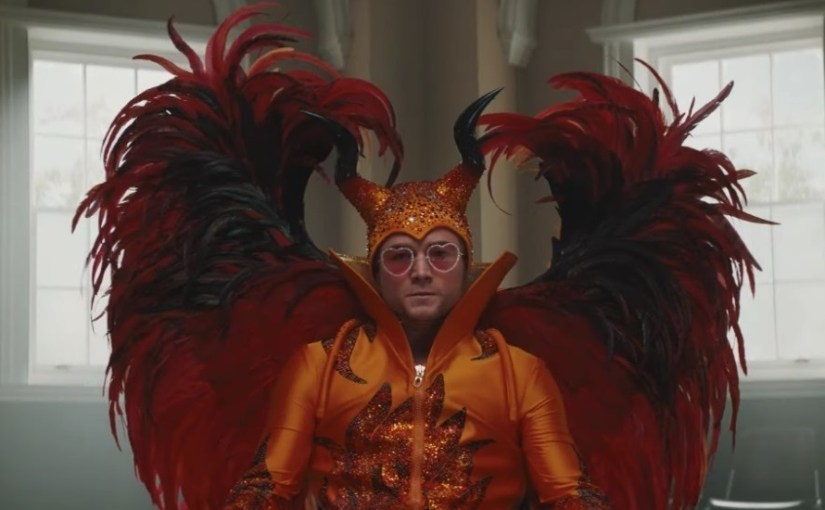
I think a big part of that improvement is due to the way Rocketman is structured.  The entire film is played out in a series of flashbacks, ostensibly during a group therapy session at a rehab clinic.  I say “ostensibly” because, in the opening moments of the film, he apparently walks into the session moments after abandoning his Madison Square Garden concert.  He is in full Elton John regalia: a flaming orange and red outfit complete with spreading wings on his back and devil horns on his head.  Through most of the film (after his meteoric rise to fame), he will do his best to live up to the devilish nature of this costume.

(This structure is not new…see, for example, De-Lovely, in which Cole Porter defends his life to a mysterious figure at the moment of his death.)

I have said over and over again, on Facebook and to my fellow cinephiles, how I cannot handle movies or TV shows with loathsome characters as the leads.  I can never and will never watch the TV show Mad Men.  No power on earth will ever compel me to sit through another screening of What About Bob? If someone had shot Jennifer Lawrence’s character in American Hustle with a shotgun, I would have cheered.

And yet here is Rocketman, featuring a lead character who, in the course of the movie…let me see…gets himself addicted to drugs and alcohol, succeeds in alienating anyone and everyone close to him, attempts suicide, gets the venue city name wrong during a massive concert (that’s a BIG no-no), ditches the people who made him famous in the first place out of misplaced affection for his smarmy manager/lover, and marries a woman (out of nowhere) knowing full well he is gay.

He does all of these things, and yet I was still on his side.  Weird, right?  The last time I felt that kind of empathy for a troubled lead character was in Ray.  (I’m not equating the two films, just remarking on their similarity.)  If I had to draw a line connecting those two films, and why I was able to handle their anti-social tendencies, the first things that come to mind are their music and their backstories.  The music produced by Ray Charles and Elton John (and Elton’s inseparable collaborator, Bernie Taupin) is on such a level that it was intriguing to me to watch their characters evolve, to see where such music comes from, and how much suffering is sometimes (always?) necessary for greatness to be achieved.

Another aspect of Rocketman’s success is the way unique visual tricks were used to convey the extreme emotional impact of certain events in Elton John’s life.  I’m thinking especially of his first concert at the famed Troubador nightclub in Los Angeles.  After a few agonizing seconds of nervous silence, Elton and his band break into “Crocodile Rock”, and when the bouncy chorus begins with its high, ‘50s-esque falsettos, there is a glorious moment when Elton, the band, and the crowd slowly levitate in the air, transported by the music.  I can imagine the real Elton John describing that moment in that specific way.  Or any number of performers describing their one supremely perfect moment in the spotlight, that one fleeting moment in time when it felt like the world revolved around them and their music, or their monologue, or their pas-de-deux.  It’s a magical sequence.

I cannot call Rocketman a perfect biopic.  As I mentioned before, it tries a little too hard at the end.  There is a bit of speechifying that is intended to get a gut-wrenching emotional reaction, but which I felt was a little too much of a muchness.  But it is an improvement on Bohemian Rhapsody.  I got a much fuller picture of Elton John’s life before he became THE Elton John, and as such, I was much more invested in how things turned out.

BROKEBACK MOUNTAIN (2005)

By Miguel E. Rodriguez

Director: Ang Lee
Cast: Heath Ledger, Jake Gyllenhaal, Randy Quaid, Michelle Williams, Anne Hathaway
My Rating: 10/10
Rotten Tomatometer: 87% Certified Fresh

PLOT: The story of a taboo romantic relationship between two cowboys, and their lives over the years.


Brokeback Mountain is the kind of movie that makes me wish I was a better communicator, like Lost in Translation.  I know I love these movies, I know WHY I love these movies, but it’s difficult for me to put into words.

Brokeback is, of course, the movie that will forever be known among the snark peddlers as “that gay cowboy movie,” which is insultingly reductive.  That’s like referring to Star Wars as “that space movie.”  To reduce the movie to those terms is to totally ignore the boundless riches to be had by watching it, I mean really watching it.

For one thing, damn, just LOOK at it.  Look at the way the skies fill the frame, with clouds hanging heavily over the mountains and the dusty streets and the trailer parks.  Director Ang Lee makes the sky into a tangible character all its own, much like Kubrick did with the Overlook Hotel.  It infuses every outdoor scene with a sense of the largeness of the world around us.  It’s a fitting backdrop for the intimate story presented to us.  In fact, those huge scenic backdrops are kind of a throwback to the ‘70s, to the films of Cimino and Arthur Penn and Bertolucci, when painting a picture with the camera was two-thirds of the story.  Virtually every outdoor scene in Brokeback Mountain is worthy of framing in an art gallery.  Stupendous.

The movie turns on the story of two men who unexpectedly and passionately fall in love in 1963, a time when gay love was still taboo, at least in polite society, and especially in any given cowboy community.  But as the story winds its way through almost twenty years in the lives of these men, it becomes less about the FACT of their affair, and more about the enormous sense of yearning and loss that comes from desperately wanting something that you can’t have.  Who among us has never felt that kind of insane desire?  Not necessarily for a person, even, but for anything at all?  A crippled man who longs to walk, or a blind man who yearns to see.  A dream job.  A dream vacation.  That’s what this movie is about.

Heath Ledger delivers the performance that really put him on the map.  His portrayal of Ennis Del Mar is incredibly subtle, although his Western accent flirts with impenetrability at times.  I love the way he shambles and mumbles through his role, virtually the entire movie, which pays off in that fantastic scene by the lake (“I wish I knew how to quit you!”) when this hulk of a man is torn down by his own unspoken passion.

Again…I’m not a poet, so this really doesn’t quite get at the mood generated by the movie.  It’s no feel-good film, that’s for sure, but it’s worth seeing by anyone who loves world-class storytelling.  Don’t let anyone, or your own preset notions, steer you different.

ROMA (2018)

By Miguel E. Rodriguez

Director: Alfonso Cuarón
Cast: Yalitizia Aparicio, Marina de Tavira, Diego Cortina Autrey
My Rating: 10/10
Rotten Tomatometer: 96% Certified Fresh

PLOT: A year in the life of a middle-class family and their maid in Mexico City in the early 1970s.


The closing credits of Alfonso Cuarón’s intensely personal, emotionally powerful Roma state unequivocally (in Spanish) that the entire movie was shot on 65mm film.  This is an important choice with a movie that communicates its emotional beats with strong, crisp visuals that don’t feel like a traditional movie.  To me, Roma feels like looking through an old, well-preserved photo album of a family I don’t know.  But the closer I look at the pictures, the more I can intuit how their lives are no less important or vital than my own.

More than most films, Roma exemplifies one of Roger Ebert’s core beliefs about film.  He said that movies “are like a machine that generates empathy. It lets you understand a little bit more about different hopes, aspirations, dreams and fears. It helps us to identify with the people who are sharing this journey with us.”

That’s how I felt watching Roma.  I never really felt like I was watching a film.  Director Cuarón (who served as his own cinematographer) uses his camera and shrewd editing to create the idea that I was looking at a fondly remembered memory instead of a traditional, plot-furthering movie sequence.  I didn’t grow up in Mexico or have a maid, but within just a few seconds of the opening scene – hell, during the opening CREDITS – I was sucked into the world of the film.

Another important element of this movie’s success is the exquisite sound design.  Over the opening credits, we see nothing except a close-up of some sort of tiled surface.  Soapy water spills over it a couple of times. We hear a mixture of street sounds, but not a busy street.  At one point a jet airliner flies far overhead, visible in the sky as reflected in a puddle of water. We can hear birds, and people talking and shouting in the distance, and a street vendor, and the occasional dog barking, and…it succeeds in placing you firmly in the world of the movie. It all feels completely organic, not engineered.

I’ve just realized I haven’t said a word about the plot.  The story, in itself, is nothing extraordinary.  We follow several months in the lives of a middle-class family in Mexico from 1970 to 1971.  They have a maid, Cleo, who discharges her duties with efficiency, who is beloved by the family children, who has a life of her own outside of her employer’s household.  Through various personal upheavals, both in her own life and the life of the family she works for, they all grow incredibly close.  …and I can almost hear your eyes glazing over as you read those words.

But, as is the case with every other film, what’s important is not WHAT this movie’s about, it’s about HOW it tells the story.  And Roma, if nothing else, solidifies Alfonso Cuarón’s standing as one of the great modern masters of cinematic storytelling.  In his hands, this humdrum story of middle-class life becomes a hymn to nostalgia. There’s a brief scene of everyone gathered around a television set, watching a variety show.  The sight of their smiling faces, illuminated by the screen, triggered a memory of my own family sitting around the TV back in ancient history, before VCRs and even cellphones(!), and watching the ABC Movie of the Week, like The Towering Inferno or Grey Lady Down.  It’s rare for a film to affect me like that.

I have to tread carefully here, because I want to mention a key event that occurs in the latter half of the film.  It’s immensely harrowing, all shot in one take (indeed, IMDb tells me it was shot only ONCE and not repeated).  In any other movie, I would say that it’s the kind of thing a screenwriter would throw in as a shamelessly manipulative plot twist, designed solely to elicit unearned emotions from the audience.  In Roma, however, the movie has so thoroughly worked its magic that the event, when it happens, is not shameless, but shocking and heartbreaking.  I was not watching an actor or actress.  I reacted as if I was watching a home movie of a real person going through a traumatic event, and it was devastating.  THAT’S the kind of rare cinematic event that I live for.

Roma is a black-and-white film shot in Spanish, with English subtitles, and which leans heavily on visual storytelling.  This may not be your cup of tea.  But if you like film at all, if you like the kind of movie where you can drink in the visuals like you were at a museum where the pictures breathed and lived and loved, then you owe it to yourself to see Roma as soon as possible.

MATCH POINT (2005)

By Miguel E. Rodriguez

Director: Woody Allen
Cast: Jonathan Rhys Meyers, Scarlett Johansson, Emily Mortimer, Brian Cox
My Rating: 10/10
Rotten Tomatometer: 76% Certified Fresh

PLOT: At a turning point in his life, a struggling, engaged tennis instructor (Rhys Meyers) falls for an aspiring actress (Johansson), who also happens to be engaged…to his soon-to-be brother-in-law.


Watching Match Point is as exhilarating as any moviegoing experience I’ve ever had.  It’s pure soap, much like its uncredited (but obvious) inspiration, 1951’s A Place in the Sun with Elizabeth Taylor and Montgomery Clift.  But a crucial decision is made by the main character in Allen’s film that shifts everything into darker territory more comparable to Hitchcock than George Stevens.

One of the best things about the film is the editing.  It’s not a short film, clocking in at just over two hours, but everything feels pared down to the bare essentials.  The passage of time is indicated in efficient pans or quick cuts.  Unnecessary conversations are cut short.  Winter changes to spring in a single fade.  Allen wastes no time in getting to the meat of the story, and it makes for a film that hurtles along breathlessly.

The performance by the lead, Jonathan Rhys Meyers, is also a key factor.  Watching it again for the first time in quite a while, I was struck by how measured his deliveries are.  There’s nothing wrong with it on a technical level, but it always feels like he’s acting or performing.  Even when his character, Chris, interacts with his girlfriend who eventually becomes his fiancé, nothing he does feels real.  It’s almost distracting, how theatrical his performance is compared to everyone else’s.  I was thinking, “Well, I guess Rhys Meyers is the best they could get to stay under budget.”

EXCEPT…when he meets Scarlett Johnasson’s character, Nola.  Only then do his eyes and face reflect the lust in his words.  They flirt fiercely for about a minute before they’re interrupted, but the damage is done.  He’s hooked.  And it’s at THAT point I realized the “staginess” of his acting in previous scenes was intentional, because his character WAS acting.  Chris is ALWAYS putting on a performance for everyone around him, except Nola.  With Nola, we see the real Chris, the focused, hungry Chris who will stop at nothing to get what he wants.

It’s a brilliant layer to a brilliant film.  Woody Allen has created a movie that starts out exactly like so many of his previous character-driven art-house films, so much so that we never suspect the surprises in store.  For the score, he chose stock opera recordings, really OLD opera recordings that sound so scratchy I wonder if any of them were actually being played on the old Edison cylinder players.  It’s the PERFECT topping.  It creates a uniquely Allen-esque atmosphere that lulls us into the feeling that, well, I know where THIS is going.

But I assure you, you don’t.

Pay particularly close attention to the various discussions of luck peppered throughout the film.  At multiple milestones in the film, luck plays a HUGE part, not always for the good.  Are these plot conveniences?  Well, how much of our own lives are governed by luck, good or bad?  An acquaintance of mine was killed in a wreck where a truck toppled onto him from a highway overpass.  Another was killed because someone was driving at night with no headlights.  Another friend contracted breast cancer, but is now in remission.  I have two uncles who last cancer battles.  Yet another acquaintance, the daughter of a friend, beat childhood leukemia.

Luck is inextricably linked with our existence, to the degree that it’s a little frightening.  We can bitch and moan about plot contrivances in movies and convenient phone calls and the rest, but if you step back, everything in existence is a contrivance: random meetings and phone calls and stoplights that keep us from hitting that pedestrian, and missed flights on airplanes that end up crashing, etcetera.

That’s REALLY what Match Point is drilling down to.  We live our lives, we play our roles, we follow the scripts WE choose…or are they chosen for us? Even without the backdrop of luck as a metaphysical discussion, the movie is an absolute top-notch thriller, one of the best of 2005, or any year, for that matter.  But it’s that next level hanging in the background that makes it my favorite Woody Allen film.

QUICK TAKE: Munich (2005)

By Miguel E. Rodriguez

Director: Steven Spielberg
Cast: Eric Bana, Daniel Craig, Ciarán Hinds
My Rating: 9/10
Rotten Tomatometer: 77% Certified Fresh

PLOT: After the terrorist group Black September kills Israeli athletes at the 1972 Olympic Games, Israel responds by sending covert hit squads after the men responsible.


Munich is an engrossing film that doesn’t pretend to have easy answers.  Anyone who comes out of the movie thinking that Spielberg has either denounced or commended Israel’s actions in the aftermath of the 1972 attack wasn’t paying attention.  The film simply portrays the aftermath in an extremely even-handed manner, presenting both sides of the argument without making a judgement call itself.  If there’s a judgement call to be made, that’s on you.

To make a movie that hinges on an attack by Arab terrorists just four years after 9/11 was a risky move.  Four years sounds like a long time, but I can assure you, it was still fresh in everyone’s minds at the time.  The film closes on an image of the New York skyline as it appeared in the ‘70s, complete with the digitally restored Twin Towers.  Aside from being an extremely effective visual statement tying the events in the film to today’s world, it was a little eerie.

Eric Bana is a mass of contradictions, a committed Israeli soldier who leads a squad of assassins, but who starts to have misgivings after a couple of close calls.  Their targets are essentially assigned via a safety deposit box.  No questions, no discussion: kill these men. But he starts asking the very questions that can’t be answered.  He wants proof that these assassinations are making a difference.  All he sees are newly vacant spots in the organization being filled by terrorists even MORE extreme than the one before.  So what’s the point?

Suffice to say, it’s one of Spielberg’s finer efforts, and it will challenge you to think critically about your deeply held views, whatever they may be.  And isn’t that a workable definition of “art?”

QUICK TAKE: Mary Queen of Scots (2018)

By Miguel E. Rodriguez

Director: Josie Rourke
Cast: Saoirse Ronan, Margot Robbie, Guy Pearce
My Rating: 6/10
Rotten Tomatometer: 60%

PLOT: Mary Stuart attempts to unite England and Scotland, but her cousin, Elizabeth I, refuses to acknowledge her sovereignty, resulting in years of treachery and political maneuvering.


I came into Mary Queen of Scots with only movie knowledge to guide me, mostly from Elizabeth, the 1998 film starring Cate Blanchett.  After watching this movie, I can honestly say that, in terms of knowledge, not much has changed.  All I learned was that Mary Stuart would stop at nothing to keep the throne, which she believed was her birthright, and her cousin, Elizabeth I, refused to acknowledge that birthright because of her religion.  I think.  And much heartbreak and backstabbing ensued, resulting in Mary Stuart’s beheading.  (That’s not a spoiler, we see it happening at the very beginning.)

This isn’t so much a BAD movie, as it is a DENSE movie.  It assumes the audience knows much more about Elizabethan intrigues than I obviously do.  It becomes clearer as the movie progresses, but for the first 20 or 30 minutes, I was a little lost.  There is some excitement during a military attack, not to mention the unexpected exhibition of cunning linguistics, but for the most part the movie is content to sit back and simply regard the drama without getting invested in the story.  It was rather bland.  Not boring, just lacking in flavor.

The biggest draws here are the performances from the two female leads.  Saoirse Ronan and Margot Robbie are riveting, Robbie in particular as Elizabeth I.  She disappears into the role, without any trace of her previous screen personas.  Ronan’s Scottish brogue is on point, and she brings Mary Stuart to fiery, red-headed life.  But the surrounding story density never seems to let the actors swing for the fences.  It was a muted experience.

Fans of this historical period will likely enjoy Mary Queen of Scots more than I, much as Queen fans adored Bohemian Rhapsody more than non-fans.  I wouldn’t necessarily run to theaters, though.  Maybe wait for cable or Netflix.  Yeah.

QUICK TAKE: Syriana (2005)

By Miguel E. Rodriguez

Director: Stephen Gaghan
Cast: George Clooney, Matt Damon, Jeffrey Wright, Christopher Plummer, Chris Cooper, Amanda Peet
My Rating: 8/10
Rotten Tomatometer: 72%

PLOT: A politically charged epic about the state of the oil industry in the hands of those personally involved and affected by it.


Syriana reminds me of one of those puzzles made out of twisted nails, where the challenge is to untangle them, even though it appears to be impossible.  The difference is, with Syriana, I don’t get tired of trying.  At least, not yet.

The movie is a pleasure to watch, but hard to explain.  It’s a convoluted tale that starts with an impending merger between two oil companies, detours into political and legal intrigue, and sprinkles in some religious fanaticism by the time we get to the end.  I’ve watched it five times, and I still have questions about the plot.  I JUST watched it, and I’m still not entirely sure who Christopher Plummer’s character is and why he matters at all to the story.

Normally, a movie this confusing would turn me off.  (Examples: Full Frontal [2002], The Fountain [2006], The Counselor [2013])  But when I watch Syriana, I get the sense that, underneath the twisty plot and maddeningly oblique dialogue, there lurks a great truth.  Maybe the plot is confusing because, really, the situation it’s describing is so confusing in real life.  Maybe any attempt to parse the complexities of U.S. relations with oil-producing countries is a fool’s gambit to begin with.  So the movie just jumps in with both feet and separates the watchers from the listeners.  You’ve really got to ACTIVELY listen for two hours to make ANY sense of the movie.

Maybe that’s not your thing.  Fair enough.  This is the kind of movie that I can’t defend on objective grounds.  You’re either gonna like it or not.  For myself, I get sucked into it every time I watch, even if I don’t understand it all 100%.  So.  There you go.

PRIDE & PREJUDICE (2005)

By Miguel E. Rodriguez

Director: Joe Wright
Cast: Keira Knightley, Matthew Macfadyen, Rosamund Pike, Carey Mulligan, Donald Sutherland
My Rating: 9/10
Rotten Tomatometer: 86% Certified Fresh

PLOT: Jane Austen’s immortal novel receives yet another makeover, with Keira Knightley as the headstrong Elizabeth Bennet, who finds herself reluctantly falling for the brooding, distant Mr. Darcy.


The words “sumptuous” and “painterly” came to mind repeatedly while watching director Joe Wright’s delightful version of Pride & Prejudice.  Much like Kubrick’s Barry Lyndon, the images in Pride & Prejudice appear lifted from paintings of landscapes and portraits you’d find hanging in any given museum.  The details are as stunning as anything you’d find in a Merchant Ivory film.  It’s just gorgeous to look at.

The screenplay clips along at a nice pace, and the English accents are a tad thick at times, so you’ll definitely want to be paying close attention to the dialogue.  While the cinematography is masterful, this is above all a film of words.  It’s not exactly Shakespearean, but there are times when sentence construction coils on itself like a highway cloverleaf.

Other random thoughts:

  • The casting of Keira Knightley is utterly perfect, but Matthew Macfadyen looks JUST a shade too old for her, although it’s entirely possible that was normal for the period.  Who WOULDN’T fall in love with this woman?
  • Carey Mulligan makes her screen debut in this film as one of the Bennet sisters.  Both she and Jena Malone are suitably obnoxious and giggly playing teenage girls, but they do look a little too old for the part.  Just sayin’.
  • Donald Sutherland is magnificent as the patriarch of the Bennet family.  His love for his wife and daughters is supremely evident, as is his frequent exasperation at their nattering and chattering.  His somewhat frazzled wardrobe is the perfect indicator of his inner self.
  • I just have to mention the cinematography again here.  There are one or two long takes (not Goodfellas long, but long nevertheless) that are like a master class in conveying information using minimal dialogue.  It doesn’t hurt that the costuming and production design are flawless.
  • Two words: Judi Dench.  Reportedly, the director convinced her to be in this movie by writing her a letter in which he stated, “I love it when you play a bitch.”  She delivers in spades.
  • In today’s world, I wonder what folks would think of Mr. Darcy’s actions.  He falls for Elizabeth, but she rebuffs him when she believes he ruined her sister’s prospects of marriage.  He then proceeds to assist her family enormously, but behind the scenes, and then tells her, “Surely you must know…it was all for you.”  Today’s PC watchdogs might call that stalking.  Discuss.

As a general rule, I am not a huge fan of Jane Austen adaptations.  It is a measure of the quality of this movie that I felt compelled to make it part of my collection (along with Ang Lee’s Sense & Sensibility and Patricia Rozema’s under-appreciated Mansfield Park).  As period pieces go in general, I would rank it comfortably with Amadeus and Barry Lyndon.  It’s a gem.