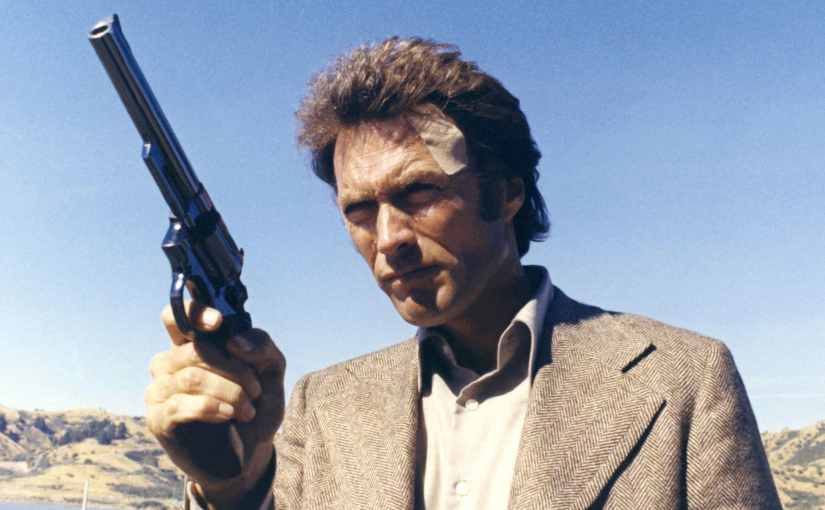
THE TAKING OF PELHAM ONE TWO THREE (1974)

By Marc S. Sanders

I’m a big fan of gritty, urban crime thrillers.  A wealth of them came out in the 1970s.  There was a rawness to their material.  They were equal opportunity offenders, picking on every race and demographic out there. It only lent an honesty to the characters that occupied these spaces.  The two guys that easily come to mind are Dirty Harry and Popeye Doyle from The French Connection.  Still, there were others that wedged their way through the cracks.  The Taking Of Pelham One Two Three from 1974 belongs in this fraternity of films as well. 

Walter Matthau is Lt. Zachary Garber, who has a ho hum job working the law enforcement area of the New York City subway system.  Beyond muggings and vagrants lying around you wouldn’t expect any major crimes to happen underground and thus Zach moves with a slow pace that never gets him upended or panicked.  Yet, on the day that he is giving a tour to some visiting Japanese subway architects, a hijacking of the train to Pelham Bay, number one two three, occurs.  Four armed men, only designated by Mr. Blue, Mr. Green, Mr. Grey and Mr. Brown don fake mustaches, hats and overcoats.  They are demanding a cash ransom from the city in the amount of one million dollars.  Zach and his crew have less than an hour to respond with the money, or Mr. Blue (Robert Shaw) will order the killing of one hostage for every sixty second delay.

Joseph Sargent’s film then steers its way into several conundrums.  Even if the ransom is paid according to the criminals’ exact instructions, how are these guys going to make an escape from underground?  What’s the nebbishy mayor supposed to do?  He’s in bed with the flu and he doesn’t know how to respond to this kind of craziness.  What’s the point of him making a public appearance near the scene of the crime? 

Long before everyone’s favorite hostage flick, Die Hard, came about Sargent’s movie was poking fun at the humorous and inconvenient cracks that leak out of a serious captive crisis.  First you gotta get the mayor to agree to the demands and as his wife (Doris Roberts) sensibly points out, there are seventeen potential voters on that train.  Then, you gotta count the money and drive it from uptown to midtown before the clock runs out.  That’s not so easy.  You think New Yorkers get out of the way when a speeding patrol car is barreling through the city? 

Zach doesn’t have it so easy as well.  Schluby Walter Matthau is great at trying to contain a situation but his co-workers are not so understanding.  Rush hour is less than two hours away and this stand still train is holding up the subway traffic.  Dick O’Neil and Jerry Stiller are genuine hilarity born directly out of the concrete jungle for roles like this. O’Neil has to keep all tracks open and the trains moving.  Initially, Stiller doesn’t take this seriously – a precursor to his Frank Costanza role on Seinfeld.

Robert Shaw was always one of the best villains and antagonists with films like From Russia With Love, The Sting, and Jaws.  He’s just as good here, but like those other characters, Mr. Blue is unique.  He carries a uniform, hospital cornered method, and he keeps it to the letter so well, that he’s relaxed enough to play his crossword puzzle as he waits for the money to arrive.  Martin Balsam is Mr. Green, a nervous underling recruited for operating the train.  Hector Elizondo is a crazed kamikaze kind of guy who might just knock the criminals plan out of whack because he’s a little too trigger happy.

The Taking Of Pelham One Two Three carries a simple plot.  What makes it complicated though are the characters surrounding the story.  There are a few levelheaded guys on both sides, but it’s the others around them and even the daily happenings of New York City that tilts any progress to be made off kilter. 

The city and many of these characters are unpredictable and therefore surprises will trip everything up just when it all seems to fall into place.  This even happens in the very, very, very last scene and caption of the film.  I’d love to share what a simple involuntary action that can break any of our concentrations does for a couple of these guys, but then I’d spoil the fun.  Trust me though, you get the last laugh before the end credits roll.
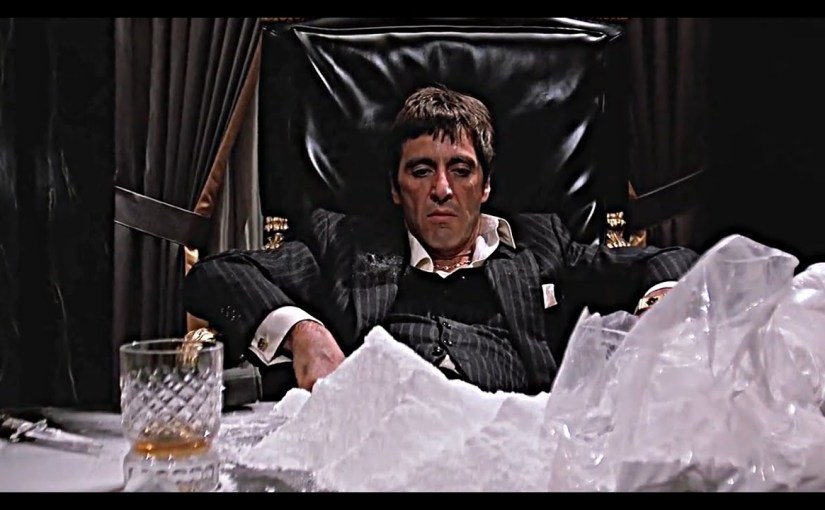
SCARFACE (1983)

By Marc S. Sanders

On Thanksgiving Day when we glutton ourselves with an abundance of food, it seemed highly appropriate to watch one of the most self-indulgent pieces ever put on film.  Brian DePalma’s Scarface with a script written by Oliver Stone and featuring Al Pacino.  This is a movie that brags about its boastfulness.  I mean look at everything that is mashed into this thing.  Blood, bullets, lots of cocaine and too much Al Pacino.

Pacino is Cuban refugee Tony Montana.  He is one of a handful of small time criminals who is shipped over to the United States when Castro wanted less people to oversee.  Refugee camps are fenced up under the highways of Southern Florida where no law is enforced among the tented populations.

Soon after Tony arrives he’s hot on the scene of pushing the newest underground product through Miami – cocaine.  With his buddy Manny (Steven Bauer) the two men get in good graces with a well dressed sleaze named Omar (F Murray Abraham), who is second in command to an established drug kingpin named Frank (Robert Loggia).  For Tony and Manny it’ll only be a matter of time before they take over as the numbers one and two bad guys.  That’ll include Tony marrying Frank’s blond trophy girlfriend Elvira (Michelle Pfeiffer in her breakout role) and winning a trusting partnership with a South American drug czar named Alejandro (Paul Shenar).  If you ever expect to get killed, you don’t want to be by the orders of Alejandro.  A helicopter serves much more of a purpose once it takes flight.

Scarface is a step-by-step movie or a climb up a three-hour ladder and then a gradual drop down off a balcony into a bloody fountain below.  There’s no depth and it works like a shopping list that you check off as it moves along. Props and houses and suits and jewelry and cars and cocaine and cash have more significance than what anyone has to say. Other than Tony, none of the people in this film matter. What Tony acquires and what he says about himself is all that is important.

This is a big ass movie with bloody graphics and killings, mountains of drugs and money, a lot of fucks, a gaudy estate home, a way over the top Al Pacino and lots and lots and lots of bullets and guns to go with them.  The film only settles for one chainsaw killing, though.  At the time, I recall that scene was up for big debate on the film’s MPAA rating.  Brian DePalma wanted to up the ante on brutality to grab moviegoers’ attention.  The scene remains quite stomach churning.

DePalma’s best work is at the beginning of the Scarface.  Following the establishing real life footage of the Cuban refugees arriving by boats in search of an American dream, Tony is taken into custody and questioned by a batch of immigration agents.  DePalma only keeps one steady camera focused on a very tan Pacino with a faint signature scar on his left cheek, sitting in the middle of the room and putting on a Cuban accent that only he could uniquely own.  Pacino’s concentration in this moment is admirable as he responds to questions from all different directions.  It’s all done in one take with the director’s camera circling around Pacino.  After this introduction is over, the tone of the movie changes for the next two hours and ten minutes into a gritty interpretation of Lifestyles Of The Rich And Famous.

Oliver Stone’s dialogue with Brian DePalma’s set ups don’t require much of the other actors.  It’s like everything caters to an always inebriated, hyperactive Al Pacino doing his Tony Montana with the gold chains and wide collared shirts over the linen suits.  He’s a motor mouth of endless f-bombs, with a slinky Michelle Pfeiffer in a blond bob-cut, dressed glittery evening gowns, at his side.  She has nothing of significance to say.  This is all you learn about Elvira; what you see of her materialism and all the coke she snorts.  She never smiles or exudes any connection to the Pacino character.  It’s all eye candy.  In fact, there’s never a clear answer of what becomes of this character.  That’s a problem because the movie is so much about Tony Montana, nothing else matters.

Other characters not given enough attention are Tony’s sister Gina (Mary Elizabeth Mastrantonio) and their mother (Miriam Colon).  Momma despises Tony for the criminal thug he is while Gina becomes enamored with the wealth and drug night life.  Unfortunately, Momma only has one meaty scene and Gina’s purpose to the script is to lend reason for another character’s eventual demise.  Both of these actresses are very good with what little they have.  Yet so much is devoted to Tony’s indulgence and the mania that Pacino brings that they are sidelined as well.

Brian DePalma seems to be more proud with how excessive he can make this guy than actually turning him into a guy.  Wait until you see the mansion that Tony gets. His office alone is of black, gaudy exuberance. His master bedroom contains a small swimming pool size tub right in the middle of the carpeted floor.  That setting occupies a fifteen-minute-long scene of Tony in a bubble bath, watching his five TV screens while not talking about anything meaningful except himself as he chastises Manny.  Elvira is only there to uphold her dread for her husband as she snorts coke off of her vanity.  When they both leave, an Oliver Stone monologue ends with a now recognizable sound byte of “Well say ‘allo to da bad guy!” Ah! Big deal! Tony never seemed so bad ass as he does feel obnoxious.

Again, Scarface is about not much else except the conceit of sleazy criminal.

When someone has to die it becomes a long drawn-out process as Tony, aka Pacino, puts on a performance or delivers a sermon.  Tony will meet with kingpins from Columbia along with other South Americans and dirty government officials.  There will be 5-7 guys in the room but for the most part it is only Tony talking.

“Say ‘allo to my little fren!” is one of the most memorable lines to come out of the 1980s decade of excess and it arrives during the ongoing and endless bloody shootout that closes the film.  There’s buckets of blood and truckloads of ammunition fired off.  These machine guns seem designed to kill things twice the size of elephants.  Little Al Pacino, with a ginormous cannon gripped in one hand, gets hit in all places and extremities except the head so that he can keep ranting – I mean this guy never shuts up – and going as he fends off the armies of goons coming at him from all directions.  Truly, it’s laughable and nowhere is it ever absorbing.  It’s like I’m watching someone else play a first-person shooter video game during a sleepover.  My friend is entertained while I’m just watching him be entertained.

Scarface comes to an abrupt halt when the final shootout stops.  There’s no footnote to ponder or real news story to follow up on.  The credits roll and the orchestral strings of the soundtrack cut in. You get the idea that DePalma, Stone, and Pacino became exhausted over this monster of a movie and simply declared “Okay! That’s enough!”

Considering the later insightful pieces that Oliver Stone delivered like Platoon and JFK, I wish he explored more of the politics and Cuban dealings affecting the United States.  As this film arrived in 1983, soon after there would be more of an intellectual standpoint to make us aware of a very real drug epidemic in this country.  It may appear to be sending some kind of message, but Scarface doesn’t challenge the brains that flourished this contraband industry.  Forty five minute episodes of Miami Vice tell more than this three-hour opus.

Plenty of gangster films like Chinatown, The Godfather, and Goodfellas offer up the greed and ego of the criminal mind, but the men of those pictures are never as self-indulgent or off putting as Tony Montana.

Besides, what does it say about a movie called Scarface when no one calls the main guy Scarface, and you hardly ever see the scar graced across his profile?  The real Scarface, Al Capone, would be very disappointed in Al Pacino.

AMERICAN GANGSTER

By Marc S. Sanders

My favorite kind of crime dramas are the ones that tackle the grit.  The screenwriters and directors go for where the itty-bitty stuff scrounges up into something bigger for either the career criminal or the low-level cop.  These guys start out as butterflies flapping their wings and before you know it their legacies and pursuits are as big as hurricanes.  Movies like The French Connection or Heat operate on these trajectories.  How did we get from there to HERE?

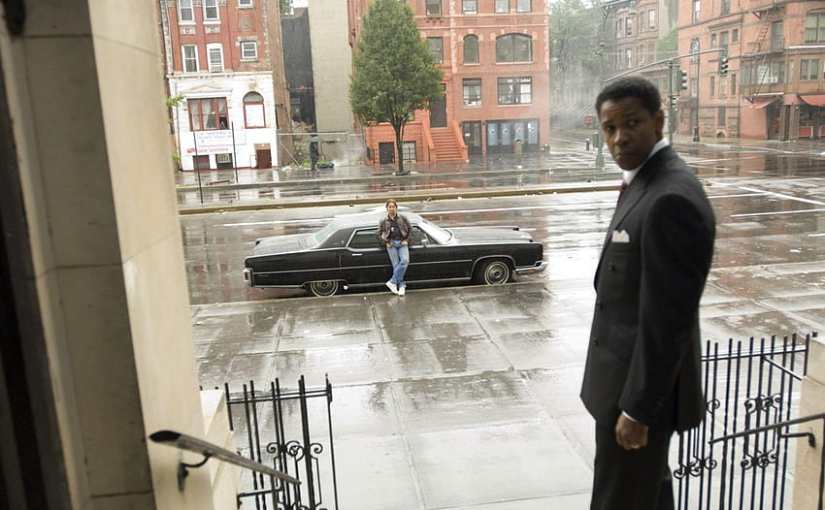
Ridley Scott went in an unconventional direction away from his science fiction eye and ancient history recollections when he directed American Gangster with a screenplay by Steve Zallian based on the true stories of Harlem drug kingpin Frank Lucas (Denzel Washington) and narcotics detective Richie Roberts (Russell Crowe).

These two sensational actors don’t share one scene together until the epilogue of this always interesting three-hour opus.  Yet, in their second film together their pairing is as classic as DeNiro and Pacino or Newman and Redford.  I hope before they retire, these men pair up for at least one more film.  

Ridley Scott and his nominated art directors, Arthur Max and Beth A Rubino, capture a gritty urban, crime ridden Harlem of the 1960s/70s.  The streets are filthily here, as well as in the five New York boroughs and all the way across the bridge into New Jersey.  Frank’s markets carry a very wide berth. The buildings are distressed and cracked.  The clothes are of the hippie era with polyester suits.  This is where Frank Lucas moves his imported contraband, white powder heroin, labeled exclusively as “Blue Magic.”  The film provides a convincing source locale deep within the jungles of Vietnam where thousands of kilos are shipped to Frank for sale on the street.  The purity of the drug is beyond compare.  Scott and his art designers place you directly in this time period of dingy grime and among the sweaty Viet Cong and rivers to finally arrive at the crop Frank purchases his products from.

Once he finds his footing by eliminating the competition and recruiting his brothers and cousins to run his business, Frank invests in creature comforts with a furnished penthouse apartment for himself and a beautiful mansion for his mother (Ruby Dee in an Oscar nominated performance that comes off so naturally; you’d think she’s sitting at the Thanksgiving table with you).  He marries a beautiful Puerto Rican wife that he treats like a princess. Frank is smart.  He stays under the radar by wearing conservative suits and not making many waves like going out at nights and showing himself around the social scene.  He knows famous athletes like boxer Joe Lewis or the staff on the New York Yankees that could give his nephew a shot at being a pitcher. Still, his profile manages to stay low. Like his mentor, he just operates a business with a viable commodity.  He tells his younger brother (Chiwetel Ejiofor) that the loudest one in the room is the dumbest and the most likely to get caught.  So, mind how you carry yourself, how you dress yourself and how you flaunt yourself.

A separate story has no business intersecting with Frank’s plight until something gives.  Richie Roberts is a good, honest cop. Though he’s also a lousy husband and father. He has been assigned to head up a task force that will bust the top of the assorted drug empires.  He needs those rare breed cops who are not on the take and follow a strict policy of law enforcement ethics.  His team will not bust a common street hustler.  They will be looking for the kingpins with unquestionable evidence to put them away for good.

American Gangster follows two separate stories for most of its running time.  At least during the first two acts of the film, Frank and Richie are unaware of one another.  It’s only through some gradual surveillance that the cop finally gets a whiff of an idea and starts to move methodically towards a conclusion. The methods are the fascinating parts the movie.

When Denzel Washington plays a villain it’s always memorable and contrary to popular opinion, Frank Lucas is my favorite of his antagonists, especially compared to his Oscar winning work in Training Day.  Watch how he walks or sits on a sofa and broods over how his family and his business are functioning.  He’s the only African American actor I can see playing this guy because I’m always convinced that whoever Denzel Washington portrays, it’s a character who will never be intimidated.  This guy faced down Gene Hackman during a threat of nuclear holocaust. Not many other actors can do that so authentically.

Russell Crowe works like that hero who doesn’t want to wear the cape.  Richie Roberts succeeds on so many levels where his peers surrender to their inhibitions.  This cop passes the bar exam while fighting for custody of his kid on top of going after the empirical criminals who litter the streets in drugs and murder.  I’m reminded of his role in The Insider, where he used a similar American accent.  Richie is not as temperamental or hard wired as that guy, but he is at least as focused on doing what’s right regardless of threat or distraction.  Russell Crowe has a way of getting audiences to admire the concentration needed for many of his complicated characters.  You have as much tunnel vision as he wants the men he’s portraying to have. You are zoned in with what his characters live by.  You only trust their standards.

There are signature staples within the construct of this true story adaptation.  There are gunfights.  Punches are thrown.  The guy at the top beats up one of his cronies when he gets out order.  Yet, what stands this material apart from others is that now I’m watching how Denzel Washington and Russell Crowe handle everything.

The truth behind the story of a black gangster defying the dirty cops and the Italian mobsters who were thought to run the metropolitan undergrounds is amazing.  It’s so interesting to see how novel Frank is with smuggling the product from one side of the world to the other. Then, you see how he uses his family members to distribute to the consumers and collect the monies. Ridley Scott provides all the breadcrumbs in an easy-to-understand fashion.  

Painted against the landscape of an unwinnable Vietnam War that just won’t end, power is acquired and thus the best police officers are forced to change their approach.  So again, you see two different stories that start out small and undetected.  Frank and Richie are the most careful and meticulous of guys in their respective fields.  Therefore, it only makes sense that their paths don’t cross until their missions are nearly over.

There’s much to learn from American Gangster.  

You get an idea of how the harm of the war was not exclusive to just what was happening over in Vietnam.  There were more indirect effects to that crisis impacting the streets of New York and New Jersey.  

You see what subtleties an investigation will collect upon before pouncing on to a bigger stake.  You also learn how to handle a criminal empire with trust and dignity rather than announcing your immorality. You witness the sheer defiance of a righteous guy in what is supposed to be a law-abiding field. Steve Zaillian’s script is not just good guy vs bad guy. It’s each of these guys holding on to the top while trying to catch up with or stay away from each other.

American Gangster is a very thorough and well-planned biographical thriller.  

THE HOT ROCK

By Marc S. Sanders

I’m a sucker for a good caper.  Capers play like strategy games.  An object (Hitchcock called them MacGuffins) needs to be acquired.  It doesn’t matter so much what the object is.  The importance falls within the pursuit. 

William Goldman wrote The Hot Rock, adapted from a novel by Donald E Westlake who penned a series of books focusing on the ex-convict John Dortmunder and his further adventures.  In the film, he’s played by Robert Redford. 

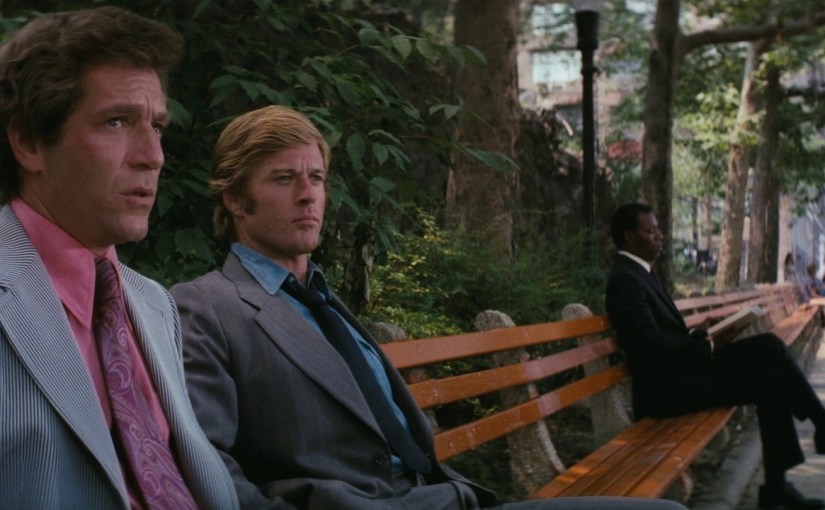
On the day that John is released from a New York state prison he’s picked up by his inept brother-in-law Kelp (George Seagel) who escorts him to Central Park.  Kelp wants John to be the fourth member of a team and steal a priceless diamond.  A man by the name of Dr. Amusa (Moses Gunn) sits about five feet away from them on a park bench.  Amusa breaks it down for the men, but they get interrupted by an elderly woman who sits between them to feed the pigeons.  This is what you can expect from The Hot Rock, a film structured under one pesky inconvenience after another.

This rock is currently on display at the Brooklyn Museum, on loan by an African country who has no business having possession of the valuable.  The stone belongs with Amusa’s country and he’s ready to pay Kelp and his crew $25,000 each to pull of the heist.  He’ll also, reluctantly, front some funding monies ahead of the theft for preparations. 

Like in all of these kinds of movies, John is ready to do one last job.  Then he’s out for good.  However, one last job turns into four last jobs.  Without spoiling too much, the rock gets relocated from one place to another.  So, a late-night heist at the museum turns into a break in a prison, and then it’s somewhere else and somewhere else after that.

As Hitchcock describes, you never care about the MacGuffin.  For movie purposes, you see it on display in its majestic glory, encased in a glass box right in the center of the museum, but so what.  The question is to uncover how the guys are going to get it out of there.  The Hot Rock doesn’t work nice and neatly like Ocean’s 11 or The Score.  In those movies, there are things that don’t go according to plan.  In The Hot Rock, nothing goes the way it should. Honestly though, it should be funnier than it really is. 

I recall there was a movie called Quick Change with Bill Murray doing his best to get out of New York City following a bank robbery.  It was comedic all the way through and maybe that’s because it was Bill Murray of Caddyshack and Ghostbusters fame, not to mention Saturday Night Live.  Robert Redford is the rugged actor of the time in 1972, though.  Not a comic and he plays Dortmunder like a serious kind of thief, even with his famous blond locks and toothy grin.  George Segal along with Ron Leibman and Paul Sand are bumbling chatter mouths, but are they funny?  Segal’s character steals a car to pick up John and we see him trying to figure out how to drive the dang thing, nearly running over Redford.  I never believed he did not know how to not drive the car. 

BY THE WAY: Ever notice in movies that they’ll show someone does not know how to drive a car by having them accidentally turn on the windshield wipers?  That’s all that is done.  That and having the car drive in S shape patterns as if the steering wheel suddenly took on a life of its own.  Then the scene comes to a halt with a startling slam on the brakes.  Never fails.  This happens over and over again in the movies.

Zero Mostel appears as the father/attorney for Paul Sand’s character.  It’s Zero Mostel, but Goldman’s script doesn’t give him much material to play with.  It’s not a silly caper flick because suddenly Zero Mostel of The Producers makes an appearance.  Look at Ocean’s 11, and see what Carl Reiner is doing.  There’s an organic affection for Reiner’s character that Mostel never achieves here. 

Peter Yates directed The Hot Rock a couple of years after the car chase thriller, Bullitt with Steve McQueen.  He impressed audiences with what two cars pursuing one another across the hilly streets of San Francisco could accomplish.  In this film from the early 1970s, Yates attempts to dazzle the audience with a few more speeding car stunts but they just don’t cut the corners.  Everything on screen looks like Yates and his crew are trying too hard.  There’s a helicopter sequence and much time is devoted to seeing how the chopper flies low over the Hudson River and then soars above the Twin Towers, still under construction at the time.  Look everyone!  Ron Leibman is flying a helicopter and Robert Redford and the rest look woozy about it all.  Thing is that James Bond movies were already doing this kind of schtick (with special effects) year after year by this time.  Peter Yates just doesn’t offer up anything that looks like a new sensation.

I’m actually surprised The Hot Rock has not been remade like Ocean’s 11 or The Italian Job.  In this film, the tools and skills are left to the guys and their cons. There’s no computer overrides or laser sensors to assist them.  Today, all of the techno stuff would be there with lots of closeups of fingers tapping away on a keyboard and then data entries appearing on a monitor.  In between, would be the comedy and would you believe of all people, I thought Will Farrell would be the guy to play the straight man and lead the charge.  The comedy of the situations would remain, but the thieves would be nerdy geniuses, each having their unique abilities and quirks. 

The set up is there for a remake.  Who you cast and what is done with it is up to the filmmakers. 

COP LAND

By Marc S. Sanders

You need look no further than the HBO series The Sopranos to see that the state of New Jersey is often regarded as a red headed stepchild in comparison to the empires of crime found in New York.  In fact, two years before that series debuted, many of the varied cast members (Edie Falco, Frank Vincent, Robert Patrick, Annabella Sciorra, and Arthur J Nascarella) appeared in writer/director James Mangold’s second film Cop Land, which carried the same kind of regards for the two thirds of the known Tri State area.  Tony Soprano always had to surrender to Johnny Sack and his crew if you know what I mean.  There’s Jersey…but then there is New York!

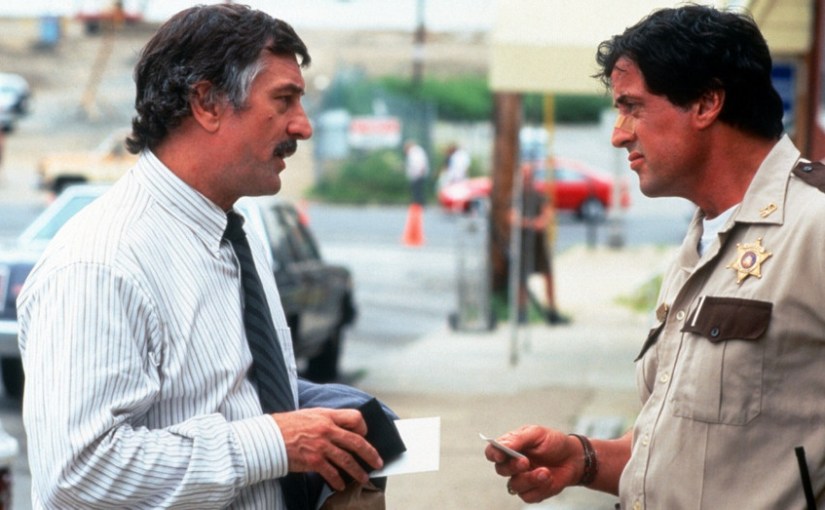
A whose who of staple actors for New York crime and corruption films take center stage including Harvey Keitel, Ray Liotta, and Robert DeNiro.  Yet, the spotlight belongs to Sylvester Stallone in what is arguably the most unsung and best role, next to Rocky Balboa, of his entire career. 

Stallone portrays the pot-bellied schlub Freddy Heflin.  He is the Sherrif of small-town Garrison, NJ where the cops who work within the city, across the bridge, reside comfortably here.  Freddy aspired to be one of those celebrated officers dressed in pressed blue uniforms, but he could not get past the physical due to a loss of hearing in his right ear.  He got that when he was kid and rescued someone from a sinking car that crashed in the river.  Perhaps Freddy wished that never happened.  Maybe his life would have been much more colorful like these New Yorkers.  I can understand the poor guy’s self-reflection.    

An internal affairs investigator named Moe Tilden (another of many convincing New York variations for Robert DeNiro) brings reasonable suspicions of corruption to Freddy’s attention.  How do these guys live so well based on the salary they earn on the police force?  Too often they have been connected with reputed mobsters, and incidents are quickly swept under the rug and kept quiet.  It stands to reason that the cover ups they commit happen in the home state of Jersey, outside of Moe’s jurisdiction.  Moe needs Freddy to quickly offer up anything he knows or witnesses. 

In particular, the leader of these guys, Ray Donlan (Harvey Keitel), might have something to do with the disappearance of his nephew Murray (Michael Rapaport) who was regarded as a young hero cop but is now at the center of a shooting incident gone wrong while driving across the bridge.  Donlan and gang fake a suicide for the kid, but with no body turning up in the river, it’s not so far-fetched to believe that perhaps he’s still alive and hiding out somewhere.

Cop Land works like an Us vs Them observation.  Freddy is the pawn for these guys to keep up appearances while this friendly town operates on other levels.  He’s the guy they can rely on to look the other way and mind his own business.  What I like about Mangold’s script is the dilemma with Stallone’s character.  Who could ever intimidate Sylvester Stallone after Rocky II?  He’s one of the biggest muscle men in film history. Yet here he is the weakling.  Most importantly, he’s utterly believable in this role that’s nowhere in the same league as Rambo or Rocky. 

The cast is as magnificent as you would expect.  Harvey Keitel looks like the family man but he’s got other nefarious ideas bubbling under his exterior.  Robert Patrick fills a role as Keitel’s heavy in a frazzled departure from his anal-retentive evilness that premiered in Terminator 2.  Ray Liotta is the second star of this picture sharing some good scenes with Stallone.  You’d think Liotta was the more seasoned actor even though Stallone came on the scene a few decades before.  Liotta is playing a guy who maybe once lived with a good soul but is now checkered and weary.  How I wish Ray Liotta had more significant screen time during his film career.

The setting works like an intimidating character here. The other supporting players flesh out the environment of Stallone’s sheep herding through a bed of wolves.  Those actors consist of Cathy Moriarty, Annabella Schiorra, Peter Berg, John Spencer and of course Frank Vincent who is a regular in these kinds of pictures.

Cop Land teeters on what Martin Scorsese or Sidney Lumet might have done with this picture.  It only falls short due to a wrap up ending with an unsurprising shootout.  What works so well as a pressure cooker crime drama devolves into blood and bullets and that is a letdown because it’s an easy way out.  In Lumet’s hands for example, the film would have taken advantage of at least an additional half hour to drive the piece into the arena of the public court system (a welcome opportunity for another all-star cameo from the likes of Al Pacino or Sean Penn.   I think the film would have been even smarter for doing so.  The avenue that James Mangold takes with his film is not terrible.  It just feels a little unrewarding or worthy of everything that was wisely executed before.

Cop Land should be seen for the dilemmas it hinges on and then for the various acting scenes among this terrific all-star cast.  Usually, actors will boast that they got to share screen time with Robert DeNiro.  I’m sure guys like Robert Patrick and Michael Rapaport place those experiences high on their mantles.  However, I bet all of these guys said what an honor it was to share the screen with Sylvester Stallone in a performance uncharacteristic of his usual criteria. 

James Mangold’s Cop Land is a terrific crime drama.

POINT BREAK (1991)

By Marc S. Sanders

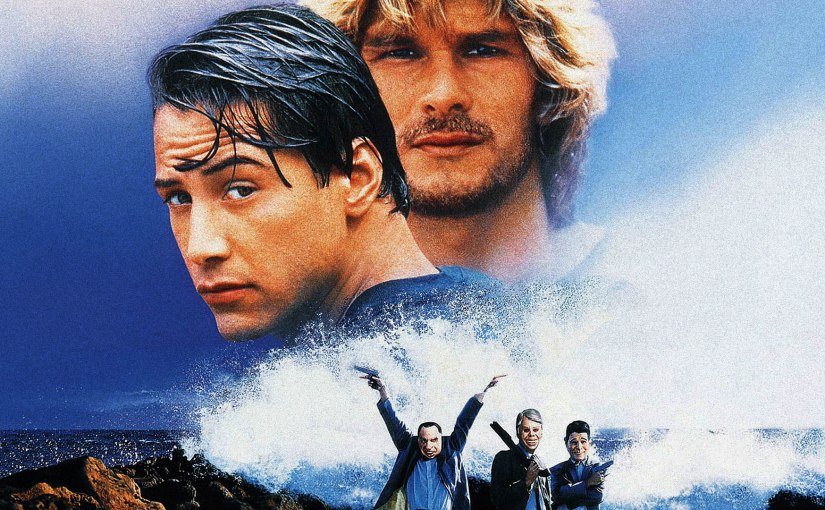
Stop me if you heard this one before.  Richard Nixon, Gerald Ford, Jimmy Carter and Ronald Reagan walk into a bank…

Yeah.  That’s right.  I’m talking about Kathryn Bigelow’s Point Break.  There’s a line in the movie where the rookie FBI hero, Johnny Utah (Keanu Reeves), is described by his new supervisor as being young, dumb and full of cumb.  Pretty fair assessment.

Much of this crime caper works despite the silly summary.  Agent Utah’s seasoned partner Pappas, played by Gary Busey, believes that a series of coastal California bank robberies are being committed by surfers who roll into town each year when the waves are at their most tubular.  They don silly looking rubber masks in the appearance of the Ex-Presidents of the United States to commit their ninety second smash and grab.  Fortunately, Johnny Utah looks and talks like Keanu Reeves who was raised in Hawaii and has experience playing a gomer like this in two other movies that were headlined by some dudes named Bill & Ted.  As well, don’t forget what he hilariously did in Ron Howard’s Parenthood.  Yes, Johnny Utah should fit right in with the California surf.

Point Break does not take itself seriously in its first half.  Johnny has to learn how to look the part of a surfer with a neon pink board amid the colony of saltwater dwellers.  Standard stuff pops up like the angry supervisor (John C McGinley) who screams about no progress being made.  Unfortunately, a romantic love interest named Tyler has to enter the fold played by an actor I’ve never been fond of, Lori Petty.  I’m supposed to believe that she is going to teach Johnny how to ride the waves and chastise him when he’s doing it wrong, and then he’s going to fall hard for her when she delivers one arbitrary piece of dialogue after another.  “What’s this pig board piece of shit?”  “Too much testosterone around here. Later!” Also, for those intimate scenes in the dark calm waters with the moon and stars gleaming in her eyes, Tyler has to ask Johnny something along the lines of “What’s that strange look you got?”  and “There it is again.”  Maybe it’s not all Petty’s fault.  The script doesn’t give her much to work with honestly.  Nothing Tyler says is relevant.  How it is delivered by Petty is not the least bit intriguing and honestly with only few nip/tucks, this character storyline could have been saved for special edition DVD featured deleted scenes that you’ll only watch once and never share on You Tube. 

On to the good stuff. 

You can see how amazingly talented a director like Kathryn Bigelow really is and it is no surprise that a couple of decades of experience led her to a well-deserved Oscar for directing The Hurt Locker.  Going all the way back to films like Blue Steel and Point Break demonstrated that Kathryn Bigelow made a name for herself based on stellar filmmaking skills.  Just look at the sky diving footage alone.  You see all the tricks as the camera follows the daredevils out of the plane and into the sunny blue sky with genuine close ups and acrobatic flips to relish in.  Sensational work.  Gorgeous photography and smooth, unshaking camera operations. Nothing artificial in these sequences.

Moreover, there is the surfing of course.  The checkered bag guy of this action picture is another variation of a dashingly handsome Patrick Swayze with shaggy dirty blond hair, dirty blond facial whiskers and his distinctive voice that if it could be described as dirty blond it would be dirty blond. Plus, a chiseled chest to show off during a karate fight scene.  He plays a guy named Bodhi.  I guess Walter, Melvin, Murray and Jack would not be cool enough.  (My dad, uncle, and grandfathers by the way.)  While Johnny maintains his undercover investigation with Pappas watching from the outside, he becomes enamored with Bodhi and his crew.  They like him in return.  Yet are these those Ex-Presidents who are robbing the banks?

Point Break is a smarter thriller than I think the filmmakers even realized because other than Lori Petty it is cast very well with Reeves and Swayze in the lead roles and a fun cooky Gary Busey on the side.  These actors are game for the quick moving adventures that Bigelow strives for.  There’s a fantastic foot chase through the back streets of Santa Monica following one such bank robbery.  This scene alone is eligible for a Best Editing Oscar with handheld Steadicams following the running players in and out of houses, around flaming gas stations and backyards with barking dogs and dense red light running traffic getting in the way.  Amazing film work.

The surfing would have to be stellar if the antagonists are in fact surfers. The photography is magnificent with narrow waves curving over the cameras directly pointing at Swayze, Reeves and cast coming right towards the screen while balanced on their boards with golden suns hovering overhead.

While Point Break does not seem to know when to end because the credits could have rolled up on three or four different occasions, at least the film insists on having fun with itself. 

I recall in The Predator Olivia Munn’s character went to MIT with a science major that somehow also included military trained special ops in its elite curriculum. I’m expected to believe that nonsense.  On the other hand, when I see Bill’s friend Ted has graduated in the top two percent of his FBI class at Quantico, Viginia, I can buy it.  I don’t have to dwell on it. Now I can enjoy the ride from a sky diving standpoint or a choppy mariner’s perspective.  My suspension of disbelief is bought, sold and paid for. 

Point Break is a smart thriller with a dangerously fun, zippy edge to it.

THE TAKING OF PELHAM ONE TWO THREE (1974)

by Miguel E. Rodriguez

DIRECTOR: Joseph Sargent
CAST: Walter Matthau, Robert Shaw, Martin Balsam, Hector Elizondo
MY RATING: 9/10
ROTTEN TOMATOMETER: 98% Certified Fresh

PLOT: An NYC transit chief must outmaneuver a gang of armed professionals who have hijacked a New York subway train and threatened to kill one hostage per minute unless their demands are met.


How?  How is it possible that it’s taken me this long, until fifty years after its release, to finally watch the original The Taking of Pelham One Two Three?  Until now, my knowledge of the film included only its title, its basic plot, and the fact it was remade with John Travolta and Denzel Washington.  Now that I’ve seen the original, my desire to watch the remake has dwindled from microscopic to zilch.  This is one of the most thrilling heist films I’ve ever seen, and its influences are clearly felt in the best thrillers in the decades since its release, from Die Hard to Speed to Reservoir Dogs.

In the first half of the 1970s, widely regarded as one of New York City’s worst decades (at least by me, anyway), four armed men methodically hijack a subway train, decouple the engine from the rest of the train, and bring it to a stop between stations.  Their leader, known only as Mister Blue (Robert Shaw), radios the transit system authorities with his ultimatum: deliver one million dollars to the train in one hour and leave quietly or he and his companions will kill one hostage for every minute the money is late.

The chaos that ensues is sprinkled with the kind of humor I did not expect from any cop thriller made before Die Hard.  The transit chief, Lt. Garber (Walter Matthau as an unlikely but strangely convincing action hero), must interrupt a tour he is giving to a visiting cadre of Japanese subway officials.  Colorful dialogue is provided to the transit system engineers and administrators as their carefully maintained schedule is destroyed by the hijackers.  One of Garber’s associates shows where his priorities lie when, in the middle of a hostage crisis, he complains, “Jesus…you realize the goddamn rush hour starts in an hour?!”  This and many other moments provide welcome comic relief, but they are also firmly grounded in the reality of career officials under a great deal of stress.  There is never a moment that doesn’t feel exactly right.

When it becomes clear the hijackers mean business and will have no compunction about following through on their threats, important logistical questions arise.  Where will they get the million dollars from?  The bedridden city mayor (who bears an uncanny resemblance to Ed Koch, four years before the real Koch was elected) doesn’t know.  The hijackers want it in specific numbers of bundles of fifties and hundreds.  How long will it take to assemble the money correctly, assuming they even GET the money?  Lt. Garber raises an interesting question: where will the hijackers go once they get their money?  They can’t simply get off at the next station, and they can’t leave the controls of the train while it’s in motion, thanks to the “dead man’s switch” that prevents such a thing.  What’s their end game?  Another transit official, played by Jerry Stiller, has the answer: “They’re gonna fly the train to Cuba.”

These and many other questions (including why the train is called Pelham One Two Three) are answered during the film’s running time, although one of them is answered without getting too specific because either it really is impossible to do so, or the filmmakers had no desire to lay out a step-by-step procedural for budding criminals.

One of the most important factors in the film’s success is its slam-bang pacing.  I’m not saying it’s cut together like Run Lola Run or an MTV video, not at all.  But the flow of the film is meticulously managed to keep the suspense going even when not much is happening on the train for their one-hour waiting period.  This is accomplished by having a local beat cop happen upon the train and provide close-cover reconnaissance to the transit authorities.  There’s also suspense among the passengers, obviously, as they plead with their captors.  (They provide more comic relief when one of them asks how much their captors are asking for their release.  “One million dollars,” one of them answers.  The hostage takes a perfectly timed beat, then says, “That’s not so terrific.”  Welcome to New York, ladies and gentlemen.)

Everything comes together so efficiently, so elegantly, that it’s a bit depressing that the film’s director, Joseph Sargent, would return to his roots and make a string of TV movies with only one other high-profile film to his name 1987’s Jaws: The Revenge.  That these two movies were made by the same director is mind-boggling.

I do have one quibble, though, and I will do my best to spoil as little as possible.  It involves a showdown where one man has a gun and the other doesn’t, and the infamous “third rail” in New York’s subway system.  If someone can successfully explain to me why one of those two men makes the choice he does, I will be happy to mail them a shiny new penny.  As it stands, that man’s decision made zero sense to me.  It almost felt like the screenwriter had written himself into a corner.  It was the one questionable moment in the entire film for me, but it did not ruin the movie, for what it’s worth.  It’s still an amazing ride.

The Taking of Pelham One Two Three deserves to be mentioned on any list of great ‘70s thrillers like The French Connection and Dog Day Afternoon, especially the latter with its tricky mix of humor and suspense.  It grips you with its realism and credibility right from the opening scenes and barrels along with barely a minute to breath right up to the literal final image.  This is superior filmmaking, and any fan of film, at any level, needs to add this to their must-watch list.

THE FRIENDS OF EDDIE COYLE (1973)

by Miguel E. Rodriguez

DIRECTOR: Peter Yates
CAST: Robert Mitchum, Peter Boyle, Richard Jordan, Steven Keats, Alex Rocco
MY RATING: 9/10
ROTTEN TOMATOMETER: 98% Certified Fresh

PLOT: After his most recent arrest has him looking at a long prison sentence for repeat offenses, an aging Boston gangster must decide whether or not to snitch on his friends to avoid jail time.


When scrolling through movie titles online or on your favorite streaming service, you might be forgiven for thinking that a 1973 movie with a title like The Friends of Eddie Coyle is a dialogue-driven character study by John Sayles or John Schlesinger, about a group of friends gathered at a hunting cottage or a class reunion or something.  Imagine my surprise when I watched it, and it turned out to be a nearly-forgotten gem of early ‘70s crime films.  (I’d call it a neo-noir, but it was released over fifty years ago now, so I’m not sure the term “neo” applies anymore.)  Featuring spare, economical storytelling reminiscent of other crime classics like Rififi [1955] or The Killing [1956], The Friends of Eddie Coyle is indeed a character study, but one that manages to downplay even Robert Mitchum’s heroic persona.

Eddie Coyle is getting old, and he knows it.  He’s currently facing up to 5 years in jail when he goes in front of a judge in a few days, but his old associates still rely on him to obtain “clean” firearms to use in pulling bank robberies.  The first time we see him doing this thankless job, he tells his cocky young supplier a story about why he has extra knuckles on his left hand, a speech that might have been written by a multiverse version of Quentin Tarantino.  (In fact, the bank robberies are accomplished when Eddie’s friends hold the bank manager’s family members hostage, so he’ll open the vault without question, a method paraphrased by “Pumpkin” in the opening scene of Pulp Fiction.)  Mitchum delivers this mini-logue with his trademark brand of world-weariness and menace, leading us to believe at the outset that he’s a man not to be trifled with, when in fact he’s little more than a glorified gofer for his bosses.

The film oozes a 1970’s atmosphere in every frame, but somehow it doesn’t feel all that dated.  There are no long zooms or extended chase sequences.  The most suspenseful scenes are the two bank robberies and one aborted car chase that is over as soon as it starts.  (I actually thought that was pretty clever, subverting our expectations by ending the chase after about fifteen seconds; this method was also put to good use in 2003’s not-as-bad-as-you-think S.W.A.T.)  The dialogue feels more modern, laced with f-words and racial epithets that, again, feel more at home in a Q.T. film than in a Robert Mitchum movie.  For my money, there may be a few movie-watching experiences that can top hearing Robert Mitchum telling someone to go f— himself, but I can’t think of what they are right now.

Director Peter Yates (Bullitt, Breaking Away) never once strains for effect, never showboats.  Like John Huston’s The Asphalt Jungle, it is content to merely set the stage and observe what happens, letting the events and the characters drive the plot instead of contrived action scenes or fancy camera movements.  Instead of becoming bored, I was drawn into Eddie’s dilemma, his conflict between loyalty to his so-called friends and his desire to stay out of prison.  Complicating matters is the fact he has a wife and three school-age kids; they all live in a tiny townhouse where you can touch both walls of the kitchen with your arms outstretched.  This is a wrinkle uncommon in most gangster films, where the heavies lead unattached lives.

When Eddie approaches a federal agent (Richard Jordan) and asks if the New Hampshire judge will look favorably on Eddie’s sentencing if he agrees to squeal on his gunrunner friend, I felt a little sorry for him, and that’s a neat trick.  Because of Mitchum’s presence, you almost automatically want to root for him to do the right thing, but because of the character he’s playing so well, I just got the feeling that things were not going to end well for him, and I was right.  After getting a taste of what Eddie has to offer in terms of high-profile arrests, the federal agent leaves him dangling, telling him the judge will keep him out of jail if he keeps ratting on his buddies.  Poor Eddie is in an impossible situation, and the irony is, when he finally makes his decision, it’s already too late…but I don’t want to spoil anything.  It’s a brilliant catch-22 that left me feeling even sorrier for Eddie than I did before.

The whole movie is like that.  We’re shown right up front that Eddie is a criminal.  But the hands-off filmmaking approach allows the viewer to make up his own mind.  You could, I suppose, watch this movie in one of two mindsets: either you empathize right away with Eddie and his predicament, or you can take him at face value and watch the movie waiting to see if he gets what’s coming to him, both for being a crook AND for squealing on his friends.  Either way, I think the movie’s resolution satisfies both interpretations, which is not an easy task.

If you sit down to watch The Friends of Eddie Coyle, just remember that it’s not The French Connection or Heat or anything splashy or flashy.  It’s a grim, gritty crime drama with a bona fide legend playing a petty thug instead of a crime lord.  Mitchum fits the bill, and the movie fits Mitchum.  The Boston environments – all shot 100% on location – mirror the way Eddie walks and talks: gray, blank, tired.  Beneath that grimy coating, though, is a rather brilliant character study of a man whose life has brought him to a crossroads where he must decide what’s more important to him, his friends or his life.  (His decision kinda surprised me, I’ll be honest.)

MAGNUM FORCE

By Marc S. Sanders

If you don’t know by now, I’m a huge admirer of Clint Eastwood’s work. His talents broach so many facets.  He acts.  He produces. He’s likely even better when he’s in the director’s chair.  He actually sings and he has even orchestrated his own music for some of his films.  Ever since I was first introduced to him at a young age when he played Dirty Harry Callahan and Fido Beddo, partnered with Clyde the orangutan, I was fascinated by his coolness and confidence in his stature on screen.  Whether he’s raising a fist, donning a scowl, giving a smirk or a squint of his narrow eyes or using his most famous prop, a .44 Magnum handgun, as an extension of his right arm, I’ve always been magnetically drawn to what he does on screen.

Online, a common question is asked: What is your favorite Clint Eastwood movie?  If I have to choose one, I guess it would have to be Magnum Force, the follow up to Dirty Harry.  Yet, I always believed Magnum Force could not operate without hitching on to the impact and message from Dirty Harry.  I can’t just like The Godfather Part II without liking the first film.  I can’t just love The Empire Strikes Back without liking its box office predecessor.  Same goes for The Lord Of The Rings pictures.

Magnum Force works so well because it questions what celebrated the Harry Callahan character that Eastwood portrayed two years prior.  This is a San Fransisco cop who defies authority when he knows that a danger must be suppressed without the inconvenience of bureaucratic red tape and police procedurals that ultimately will work in the criminals’ favor if not taken care of immediately.  As the first film demonstrated, it is easy for us to side with Harry’s desperation because we know the crazed killer is on the loose and he is only going to kill again and again while never surrendering or negotiating.  This second follow up film (in a series of five) tests the ideology of Eastwood’s character. 

A series of grisly murders are occurring within the city and it appears that a traffic cop is committing the acts.  The victims are the worst mobsters and pimps within San Fransisco who time and again have been overlooked for their crimes and/or have been released from trial or prisons based on technicalities.  A handful of characters within Magnum Force remind us that someone is saving the taxpayers a lot of money each time the body count increases. 

There’s a slight mystery to this film.  Harry encounters four rookie cops (David Soul, Robert Urich, Kip Niven and Tim Matheson) who seem very likable.  They are admirable of Harry’s reputation.  Harry is impressed by their shooting skills in particular.  Another traffic cop is an old friend of Harry’s, a guy named Charlie McCoy (Mitchell Ryan) who is on the edge and might pose a threat if he continues working the streets.  Any of these men could be suspects to these vigilante murders as it is soon realized that the scene of some of these crimes are similar. Often, cars are pulled over for traffic violations.  As well, ballistics indicate that the weapons of choice are normally a .357 Magnum, the standard issued firearm for a police officer.

The debate with Harry’s philosophy, firmly established in the prior film, is staged against that of his superior, Lt. Briggs.  He’s played by Hal Holbrook who is one of the best antagonists in all of Eastwood’s films.  They play so well against one another.  Early on, Briggs declares he’s never once had to pull his gun out of his holster.  Callahan sarcastically salutes the lieutenant by reminding him that men have got to know their limitations and that’s where the measure of asking what is ultimately necessary in fighting crime.  Where does it begin and when does it end?

Harry Callahan is that unusual cop who is frowned upon for the actions he takes in his own hands.  Other cops in movies played by Stallone or Gibson go to extreme measures simply for the cinematic action of it all.  Callahan is never thanked or given any serious commendations for what he executes with his .44 Magnum, a weapon that is as outside the lines as Harry himself. 

The difference between Harry and whoever this vigilante is must be deciphered and much of Magnum Force’s grey area is all that is seen.  Eventually, the black vs white clarity reveals itself and a telling lesson presents itself between what Harry Callahan stands for and what guise a vigilante operates under.  At the risk of revealing too much, the best scene of the picture occurs between Holbrook and Eastwood’s characters as they sum up the entirety of the film before the climax.  This film is over fifty years old and still the assortment of mindsets found within Magnum Force are worth pondering. Callahan is put to the test one time before in a haunting parking garage.

Beyond what’s worth considering among these many dangerous philosophies, this is a solid action picture with thrilling and well edited shoot outs among the cops and robbers.  A hilarious plane hijacking is derailed by Harry when he poses as a pilot.  Later there’s a store robbery that is undone and then there is a warehouse port exchange of gunfire that puts Harry and his partner in unexpected danger. 

There is an interesting target competition between the cops that implies what Harry suspects.  I like this scene in particular because it gives an inside look into how police officers interact and admire one another when not on the streets.  Yet, when one particular cop cannot get a thought out of his mind, it carries over into the action of the moment.  At the combat range, Harry fires his gun at one particular target that may cause you to sit up in your chair a little.  Often, Eastwood performs with little to no dialogue in his films and this is one very informative moment.

As much as I’m a big fan of Magnum Force, the penultimate scene always sticks in my craw a little.  Callahan is pursued on foot within the bulk of a freighter.  There is very little light provided in this sequence as Harry moves down one corridor or around a corner elsewhere.  It’s hard to see what is happening and who is where or who I am looking at.  For such a thrilling movie, this is a bit of a letdown as overall much of the action of this movie is driven by the plot.  Nothing feels random in Magnum Force.  Everything moves towards more story development or realizations.  Yet, I have to be somewhat forgiving only because this darkened scene occurs after all of the cards are put on the table and all the hero has to do is survive.

Just before the foot chase, there is a thrilling car chase with Eastwood actually doing the driving that takes us through the well-known twists of Lombard Street.  Director Ted Post wisely covers this from an overhead shot.   The car careens up and down the steep slopes of San Fransisco’s avenues and there are plenty of intense close ups of Eastwood behind the wheel accompanied by the screeching tires, bullets bouncing off the windshield and motors humming.  I have declared it before, the best place to have a car chase is in San Fransisco.  Surprisingly, this pursuit hardly ever gets categorized with the great ones like Bullitt, The French Connection, Ronin or The Seven Ups.

If you have never seen Magnum Force, check it out.  It is off color at times, but the exploits of Harry Callahan and the scum he’s forced to associate with were never about political correctness.  Still, there is much to debate, argue, and lend some serious thought to, especially in a newly unsteady climate of police acceptance and procedure.  My one recommendation though is to watch it as a double feature with the original Dirty Harry to truly see the two sides of Harry Callahan’s coin. 

NOTE: An interesting fact I just realized at the end of Dirty Harry, the cop shoots the bad guy with his right hand.  Later, he tosses his badge, but with his left hand.  Especially with Magnum Force as a follow up film, I see the internal struggle of Harry Callahan pitting his gun up against the mindsets that come with his badge.

THE SCORE

By Marc S. Sanders

Nothing like a good heist thriller.  Am I right? 

It is hard to believe that Marlon Brando’s final performance was with Robert DeNiro and yet the two were never part of the same cast before.  Finally, though, the Oscar winning actors, who were both recognized for portraying Vito Corleone, teamed up for a little film that contained some daring thrills while also welcoming some crackling good acting scenes together.  Edward Norton joined them, and it worked sensationally.  The Score, directed by Frank Oz, is a forgotten gem, or in this case as priceless as the gold and jeweled scepter the three set their sights upon stealing.

Filmed on location in Montreal, DeNiro portrays Nick, a professional thief who is very disciplined in his work and would never dare commit a heist in his own town where he publicly operates as a jazz nightclub owner.  As the opening scene suggests, he only practices outside of his city and usually outside of Canada.  Yet, a brash cocky kid named Jack (Norton) enters his private life with a proposition too good to pass up.  DeNiro’s handler/investor, Max (Brando), urges Nick to overcome his reluctance and team up with Jack for one last score that’ll rake in thirty million dollars. Once the job is done, six million is earmarked for Nick.  Finally, Nick can get out of this business and move on with his nightclub mortgage paid off.  He can also get more serious with his stewardess girlfriend Diane (Angela Bassett). 

The MacGuffin?  A scepter from the 1600s that was crafted for French royalty.  It is currently locked in a state of the art safe located within the basement of the Montreal Customs Building.  This fortress is equipped with cameras, security guards, sensors, you name it.  Jack is working on the inside, posing as a mentally challenged maintenance man.  He supplies all the intel to Nick with ways to get inside showing him who is doing what, where and how.  Nick then prepares the strategy around what information is collected.

The shakedown of The Score is nothing unfamiliar.  The enjoyment comes from the acting scenes between the actors, especially when it is DeNiro and Brando.  It is as thankful to see these two legends perform on screen as it was to see DeNiro team up with Al Pacino in Michael Mann’s Heat.  This older interpretation of Brando is so entertaining.  He has a lot of fun with Max’ sarcasm and when he curses it just comes so naturally.  Just a huge departure from what the actor did in classics like Streetcar and On The Waterfront.  DeNiro is great at chastising Brando’s character with the risks he’s taking at getting them in trouble.  Their dialogue works beautifully with their performances.

Same goes for DeNiro and Norton.  It’s not so much a mentor/student relationship.  Right from the start, there is friction. Nick is overly cautious while Jack is anything but.  Yet, the film primarily focuses on the thieves’ preparation for the big job and the characters speak as if there is a trust or honor among them, but the skepticism remains.  Often Jack is defiant of Nick’s specific instructions.  Norton is great going at odds with DeNiro.

Once the wheels are set in motion, the pattern of the script is to introduce one unexpected obstacle after another.  At one point the men realize they need a particular access code.  So, an exchange in a public park has to take place. Against Nick’s wishes, Jack plays a potentially dangerous game.  Later, it is learned that the scepter might be moving on from Montreal.  So, the job has to be completed much sooner than planned.  Max seems to be hiding some details as well that leave Nick uneasy.  By the time all these bridges are crossed you have a solid foundation for the first two acts of the film before the heist gets going.  It’s all good stuff.  The epilogue to the picture is very satisfying as well with a couple of unexpected twists thrown in.  When a bag gets unzipped, you’ll likely be nodding your head and applauding.

Edward Norton is a fantastic character actor (when he’s not being a straight lead in other films).  Just like in films such as The Incredible Hulk, Fight Club and especially his debut Oscar nominated performance, Primal Fear, he dons a dual personality for this role.  Norton easily contorts his physicality to portray “Brian” the guy who’s working on the inside of the Customs Building.  When the persona is shed though, Jack is a guy that most need to be careful to trust or go up against.  Edward Norton demonstrates such ease with the transitions from one personality to the other. 

Angela Bassett is terrific actor, but her character belongs in another movie.  The one shortcoming is that Bassett feels more like a prop for DeNiro’s motivation rather than a fully-fledged love interest.  Out of context, the scenes they share are really impressive, but within the framework of the picture, Bassett comes off as an inconvenient detour.  It’s not her fault.  The relationship between Nick and Diane just does not seem to belong here.  I never had any urge for their happily ever after wrap up.  I was only concerned with Nick, Jack and Max pulling off the score.

Another minor shortcoming is Howard Shore’s soundtrack for the film.  It plays with loud horns that scream official action.  Yet, when the scenes are absent of music or only accompanied by soft jazz performances from Mose Allison and Cassandra Wilson does The Score feel like it is in its quiet mood comfort zone.  Howard Shore’s louder pitch just feels a little too intrusive here because these guys operate in whispers and clandestine actions.  I especially get a kick out of how Nick and Jack use their special tools that quietly click and turn and thump with no other sound in the area.  Their hardware work like musical instruments. 

Overall, this is a delicious, sophisticated thriller with an outstanding cast and Frank Oz’ direction thankfully does not get too inventive because he knows he’s assembled an A plus collection of actors.  Oz also has the art design and scenic details within Montreal working to his advantage. The locales are peppered in with a welcome French culture along the cobblestone streets.  DeNiro and Brando seem very comfortable and absorbed in this city that’s rarely used as a backdrop in film. Lastly, the procedure of the actual theft at play is a lot of fun to watch as it all seems plausible but still impressively crafty.

It’s worth your risk to check out The Score on a Friday or Saturday night when you need to get away from the chaos of everyday life.  It’s a quiet, relaxed suspense yarn that’s so very pleasing.

NOTE: If you have not seen the film yet, I encourage you to stay away from the trailer which can be found online.  I believe too many of the twists and surprises contained within the movie are revealed simply to bait an audience.  The less you know about what happens, the more satisfying the picture is.