THE MAJOR AND THE MINOR (1942)

by Miguel E. Rodriguez

DIRECTOR: Billy Wilder
CAST: Ginger Rogers, Ray Milland, Rita Johnson, Robert Benchley
MY RATING: 9/10
ROTTEN TOMATOMETER: 100% Fresh

PLOT: A frustrated city woman disguises herself as a 12-year-old girl to get a cheaper train ticket, but her plan backfires when she winds up befriending a very adult Major on the train.  Risqué hilarity ensues.


Billy Wilder’s The Major and the Minor, contains big laughs, true love, and comic/cosmic misunderstandings – in other words, it’s a classic farce from the fledgling career of one of Hollywood’s true legends.  However, there are certain plot elements that I suspect would make this movie virtually unfilmable today, at least not without tinkering with the structure here and there.  I think the plot points in question will be glaringly apparent to any reasonable viewer, so if I acknowledge them with only the occasional eye roll in my review, I hope readers will forgive me.  It is not my intention to prepare a compare/contrast treatise on prevailing attitudes towards women during the 1940s versus today.  You don’t need me to tell you that the very concept of an adult male bunk-bedding with a strange 12-year-old girl he just met (among other plot devices) raised my eyebrows.  It is firmly a product of its more innocent time. But the whole endeavor is so breezy and carefree that I think it would be a shame to give this film a pass without hearing more about it.  So, here goes.

Ginger Rogers plays the lead, Susan Applegate.  Having only seen Rogers in the occasional dance film with Fred Astaire, I was bowled over by how naturally comic she is.  Based on this movie alone, she could have given Lucille Ball or Rosalind Russell a run for their money.  Anyway, Susan Applegate is fed up with living in NYC.  Tired of being besieged by lechers at every turn, she quits her job – her 25th in a year! – and tries to buy a train ticket back home to Iowa.  When she finds herself short on cash, she dresses up as a 12-year-old girl to get a ticket at half price.  Her real troubles begin when the train gets underway, as the conductors are not movie-dumb enough to fall for her act.

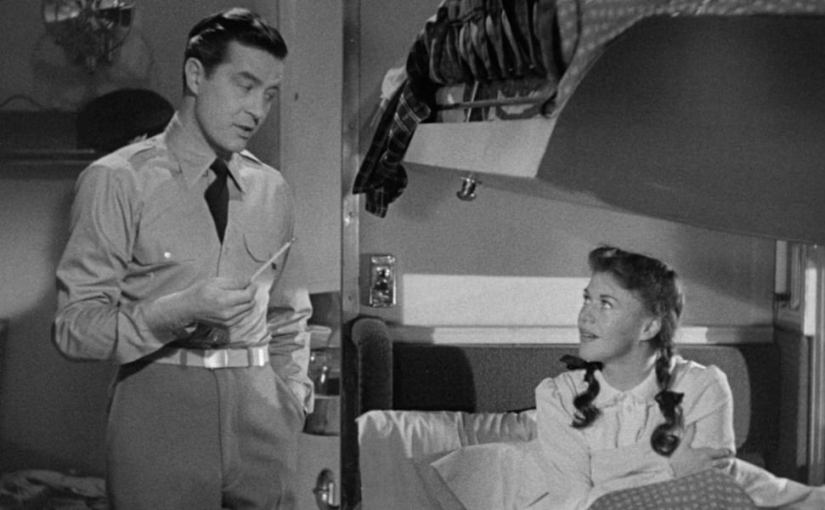
She winds up hiding in the compartment belonging to Major Philip Kirby (Ray Milland in a mildly uncommon comic role).  Because he has a bum right eye, he falls for Susan’s story (she calls herself Su-Su to complete the façade) and takes it upon himself to be her impromptu guardian.  Through an unfortunate series of events – a blocked train track, the unexpected arrival of Kirby’s beautiful fiancé, Pamela, and some ill-timed misunderstandings – “Su-Su” finds herself being whisked away to a military school with Major Kirby promising to get her on the next available train back to Iowa.  Trust me, it all makes sense, I’m leaving a lot of details out, otherwise we’d be here all night.

The rest of the film involves Su-Su’s misadventures on the military school campus, surrounded by three hundred school-age boys who are inexplicably attracted to this girl who somehow has the presence of an adult woman.  They like her, but they’re not quite sure why.  The same phenomenon begins to afflict the Major himself, which makes him extremely uncomfortable (understandably so), which makes things more complicated for Susan because SHE’S beginning to fall in love with HIM, and meanwhile Kirby’s future sister-in-law sees right through Susan’s disguise and wants Susan to help her break up the impending marriage, and 20 different cadets show up to escort Su-Su to the school dance, and so on and so on and so on.

This was only Wilder’s second film, but already we can see ideas and situations that he would return to in some of his future films.  The woman disguising herself as a girl is a funhouse-mirror version of the men disguising themselves as women in Some Like It Hot.  We get the reverse situation, a girl becoming a woman, in Sabrina.  The idea of how tough it is to live in the big bad city is echoed in The Apartment.  And if you really squint, you might even see an early forerunner of Norma Desmond in Major Kirby’s beautiful but devious and controlling fiancé…it’s a stretch, but I think it’s valid.

The performance by Ginger Rogers in this movie was a revelation to me.  I had absolutely no idea she could play this kind of character.  She plays everything so believably, whether she’s Susan or “Su-Su.”  In scenes where she’s near Major Kirby, her longing for him is palpable, but her outward reactions are perfectly subtle: a slight pause before a reply, a constant gaze, only occasionally a little mugging when he’s not looking at her, and always making sure to keep her brassy voice in a higher register to sound more girly.  I learn from IMDb that she was anxious to play this role because she was able to draw from her own experiences: as a younger woman, when she toured vaudeville halls with her mother, she would often make herself appear younger to get cheaper train tickets.  Who knew?

Ray Milland had a trickier time of it in this movie.  He manages to pull it off, but imagine the minefields he had to navigate.  He plays a grown man who is the self-appointed guardian of a 12-year-old girl who, by his own admission at one point, looks like a full-grown woman in the right light.  There’s a scene where he feels compelled to at least try to explain the facts of life to Su-Su so she’ll understand why all the cadets are attracted to her like a moth to a light bulb.  (In one of the less-enlightened moments of the film, he advises her: “Maybe if you made yourself a little less attractive…”  HUGE eye-roll.)  Now, we as audience members know there’s really no problem with his mild flirtations because, of course, Su-Su is really Susan.  But HE doesn’t know that.  Wilder has the good sense to pull everything back from the brink before anything unsavory occurs.  It’s one of the best high-wire acts I can think of in a comedy.

(I’m itching to relate all the hilarious Wilder-esque bits peppered throughout the movie, like finding the occasional burnt end in a delicious brisket, but I am anxious to avoid spoilers.  There’s the tap dance, the Veronica Lake look-alikes, “the Maginot Line”, the cigarette on the train…oh, too many to list.  They’re wonderful.)

As with the best farces, a crisis occurs and it seems as if all is lost, but fear not.  Wilder is not known as a genius for nothing.  If you think this romantic comedy from the early forties is not going to have a happy ending, you need to see more movies.  The Major and the Minor is a delight from start to finish.  And if the last line doesn’t quite come up to the standards of “Well, nobody’s perfect!”…well, I mean, what does?

[Note: It’s also interesting to know that The Major and the Minor was filmed and released in 1942, it’s set very specifically in May of 1941, before Pearl Harbor.  Here and there are in the movie are references to Kirby’s desire to be stationed abroad in case war breaks out.  There’s a moment when he confesses that no woman would want to marry a military man stationed overseas, only getting a letter from him once every two weeks.  The reply he gets is very direct, clearly indicating where Wilder stood on the matter: “I think you underestimate us, Mr. Kirby.  Perhaps all a woman wants is to be a photograph a soldier tacks above his bunk or a stupid lock of hair in the back of his watch.”  Sexist?  Or patriotic?  Discuss.]
THE RULING CLASS (United Kingdom, 1972)

by Miguel E. Rodriguez

DIRECTOR: Peter Medak
CAST: Peter O’Toole, Alastair Sim, William Mervyn, Carolyn Seymour, Arthur Lowe
MY RATING: 8/10
ROTTEN TOMATOMETER: 77% Fresh

PLOT: A member of the British House of Lords dies, leaving his estate to his son. Unfortunately, his son thinks he is the one true God made flesh.  Murder and mayhem ensue.


Re-watching The Ruling Class for the first time in some fifteen years, I came up with a great but still imperfect way to describe it: Being There directed by Terry Jones and written by Terry Gilliam.  It has more religious blasphemy than Life of Brian – not a great example because Life of Brian is not technically blasphemous, but whatever – and more exuberant overacting than any two Nicolas Cage movies put together.  There’s nudity (but no sex), a little cross-dressing, murder, auto-erotic asphyxiation, impromptu musical numbers, and more jabs at organized religion and class structure than you can poke a burning cross at.  It feels a little too chaotic for its own good at times, but I am willing to forgive those transgressions because I am so grateful for its periodic flights of fancy and for the deliciously hammy performance from Peter O’Toole.  Is it a masterpiece?  Not quite.  But you just can’t turn away from it.

One day, the veddy-veddy proper 13th Earl of Gurney dies after a mishap involving a silken noose, a tutu, and a dislodged stepladder.  His brother, Sir Charles Gurney, is dismayed to learn that the heir to the Gurney fortune and name is none other than Jack (Peter O’Toole), the 14th Earl of Gurney.  We see the reason for Charles’s dismay when we see Jack for the first time…dressed as Jesus Christ, in a brown robe and white rope belt and long golden locks down to his shoulders.  He tells everyone he is God.  Someone asks him, “How do you know you’re God?”  He answers with unassailable logic: “Simple.  When I pray to Him, I find I am talking to myself.”  He also says things like, “For what I am about to receive, may I make myself truly thankful.”

Charles realizes he must have Jack committed to wrest away control of the family fortune, but he cannot do so until Jack has an heir.  But Jack (who insists on being referred to as “J.C.”) refuses to marry because he says he’s already married to the Lady of the Camellias, which everyone knows is the name of a less-famous novel by Alexandre Dumas fils.  To get around this inconvenience, Charles arranges for his own mistress to impersonate the Lady.  Meanwhile, Charles’s wife, Lady Claire, puts the moves on Jack’s psychiatric doctor to distract him because he opposes the marriage, citing Jack’s condition.  And always in the background is Tuck, the family butler, who received 30,000 pounds from the 13th Earl’s will, but stays in service apparently just to blow raspberries and say exactly what’s been on his mind for the last several years.  I would say he’s the comic relief, but he’s more like a demented court jester.

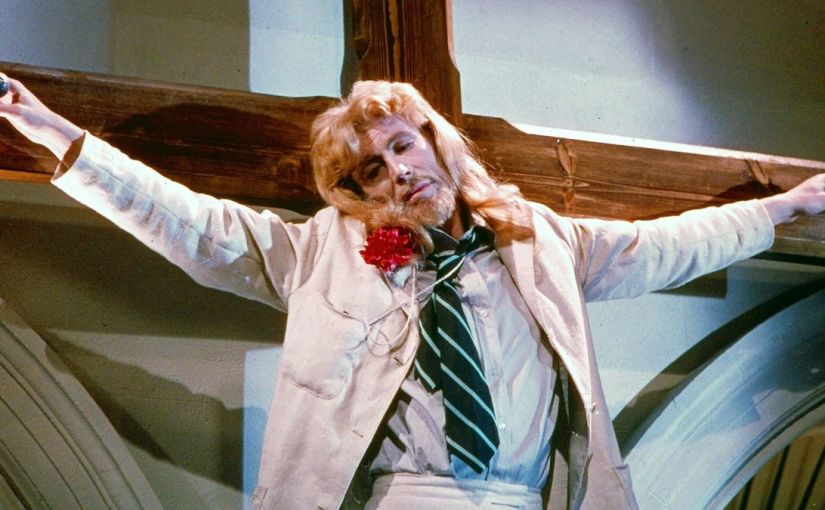
Peter O’Toole’s performance as Jack must be seen to be believed.  Imagine, say, Daniel Day Lewis or a young Robert De Niro, dressing up as Jesus Christ, talking animatedly to flowers, and taking a nap while standing on a life-size crucifix, arms outstretched.  At one point, Jack woos the faux Camille by impersonating a bird, and she follows suit.  You haven’t lived until you’ve seen Peter O’Toole dressed in an impeccable white ensemble, strutting across the lawn, head bobbing like an oversize pigeon, and literally cooing.

The Ruling Class is clearly a jab at its namesake, the upper-class nobs and snobs of England who firmly believe they rule their country simply because they are more suited to it than anyone else.  They never suffer from the same human foibles as the lower classes do, and if they do, it’s never acknowledged, or acknowledged and hushed up, or blamed on someone or something else.  The film is based on a stage play, which explains the occasional fourth-wall breaks and the frequent interruptions for short musical numbers, which further enhances the Python-esque feel of the movie.  I would imagine it was much more notorious upon its release than it might be today, but the message itself hasn’t dated.

That message is especially brought home when Jack is ostensibly cured, after a fantastic sequence involving a second psychotic patient, a lightning storm, and a vision of a gorilla wearing a top-hat and a tux.  However, his “cure” has an unintended side effect.  To everyone else, it looks like he’s back to being himself: Jack, the 14th Earl of Gurney.  But a creepy monologue in the attic reveals his secret.  He no longer believes he’s God, nor does he believe he’s Jack, the 14th Earl.  He believes he’s another historical “Jack,” the one who stalked prostitutes in 19th-century London.  He has visions of old London streets.  In one masterful scene, he is in the sitting room of his country house, and as he crosses the floor, the house magically transforms into an old London cobblestone street at night, in an uncut take with no visual effects.  I can imagine Terry Gilliam nodding approvingly at that absurdist touch.

What will become of the “new” Jack?  Will he remain a member of the ruling class to which he was born, whether he deserves it or not?  Will his former doctor, or his wife, ever learn of Jack’s new persona?  With his newfound purpose, he delivers a speech to the house of lords in favor of capital punishment, quoting no fewer than three verses from the Old Testament.  Their response to his words serves as the macabre capper to the film.

TOM JONES

By Marc S. Sanders

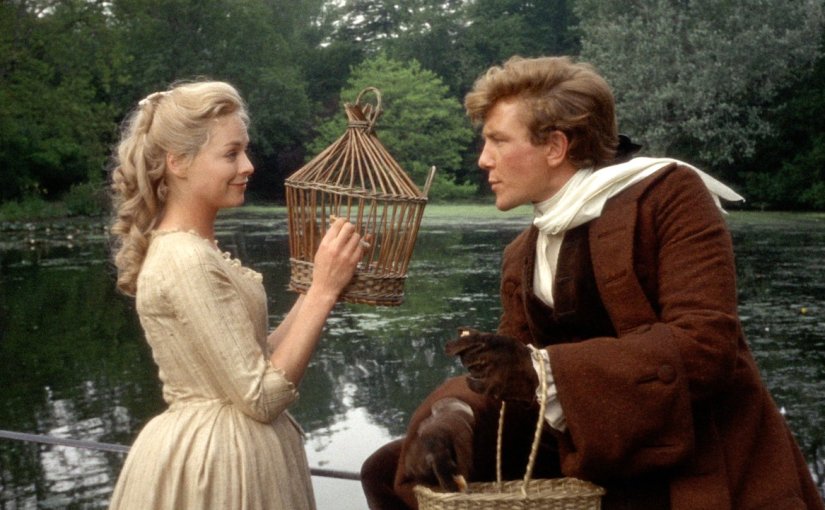
Watching Tom Jones I wondered if the Monty Python troupe took inspiration from producer/director Tony Richardson’s film.  It’s all quite madcap.  With Albert Finney as the lead title character, there’s a zany quality to this eighteenth century piece adapted from Henry Fielding’s novel The History Of Tom Jones, A Foundling.

The film opens like a silent movie with title cards being used to emote dialogue.  The Squire Allworthy (George Devine) returns to his estate and upon retiring for bed, he discovers newborn Tom beneath the blankets.  Allworthy decides to raise the child. 

The film transitions to a talkie picture and Tom grows up to be portrayed by Albert Finney.  The orphan man gets himself into all kinds of predicaments, notably with an assortment of women but his true affections are directed towards Sophie (Susannah York), the daughter of the neighbor Squire Western. The cad known as Blifil (David Warner, in his very first film role) convinces Allworthy that Tom is a villain and thus he’s excised from the estate with cash to seek out his own fortune.  Interactions lead to unexpected circumstances for Tom, including being robbed penniless, crossing paths with the butler who was presumed to be his father, and being sentenced to death for murder after he rescues an endangered maiden from the assault of a British red coat (Julian Glover).

Tom Jones takes unexpected turns in its narrative, and it leads to big laughs.  Upon discovering that his wallet is stolen, Albert Finney breaks the fourth wall seeking the viewers assurance that he is not making it up.  Other characters are depicted in freeze frame silliness as they eavesdrop on Allworthy.  There’s lots of running around escapades as Tom flees from being caught with a couple of mistresses.  I was waiting for the Benny Hill music to cue in, though John Addison’s score suffices well to keep it all lighthearted during such times when the film speeds up with a Keystone Kops kind of pace.

A film like Tom Jones is not what I normally gravitate towards.  Going back and forth, there’s lots of screaming banter and deep English dialects that swallow the words being uttered.  Drunken debauchery is relied upon for Hugh Griffith as Squire Western; he was one of five actors nominated for the film.  At one point, Griffith falls off his horse and the animal lands on top of him.  Apparently, this was not stunt work as Griffith notoriously showed up drunk each day on set and the horse easily overtook him.

Albert Finney, though, is a comedy gem as he innocently portrays Tom with no ill intent.  Watching him here in his youth, he’s adorable with an occasional prince and pauper romantic interpretation of his performance. A memorably hilarious scene involves Tom and a lady mistress seducing one another from both sides of the table as they gorge themselves with a bevy of food including pheasant, pears, potatoes and so on. Without Finney’s fearlessness in leading this sloppy, drooling scene, I’m not sure it would have worked as well. Richardson elongates the moment between the two to build the laughter.

I’m impressed with much of the filmmaking from Tony Richardson.  Cameras must have been mounted on horseback to get up close pursuit during a sporting hunt of a deer that also included a large number of rabid dogs.  Still, I was a little queasy in the follow up scene when the deer is slaughtered amid the canines barking for a portion. Technically speaking though, the film works on many levels.

As well, I could not help but consider that a modern filmmaker like Yorgos Lanthimos (Poor Things, The Favorite) adopted some of Richardson’s comedic approach.  Tom Jones is proudly weird and obscure just like Lanthimos’ storytelling.

Yet, I cannot comprehend the praise awarded to this movie, including Best Picture and Director as well as the nominations in cast performances by critics, Oscars and BAFTAS.  I’m convinced of the period timing and what the script and actors lend to the film, but I’ll never say any of it left me enraptured in the novelty.  It’s a cute story, but that’s all.  Kind of like Arthur with Dudley Moore, where the innocent man child happily lives within his sophomoric mentality while uncovering who he truly loves.  There is likely more to take away from Tom Jones, but I didn’t recognize it.

If anything, as I continue my trek towards watching and reviewing every Best Picture winner in Oscar history, I’m at least glad I got Tom Jones checked off my list.  At times, it’s delightful and it’s also proudly oddball in its execution.  What constitutes it as the best film of 1963? Reader, I’m just not sure.  Yet, it is at least entertaining with much praise for Albert Finney and cast.

MARCEL THE SHELL WITH SHOES ON (2021)

by Miguel E. Rodriguez

DIRECTOR: Dean Fleischer Camp
CAST: Jenny Slate, Dean Fleischer Camp, Isabella Rossellini
MY RATING: 9/10
ROTTEN TOMATOMETER: 98% Fresh

PLOT: Marcel, a tiny talking seashell with big shoes and one googly eye, becomes the subject of a documentary.


Years ago, I went to see Happy Feet.  The premise was absurd – singing penguins, give me a break – but as soon as Nicole Kidman’s character sang the first words of Prince’s Kiss, I remember thinking, “Okay, this movie is only going to work if I just give in to the concept.”  I did, and it did (for the most part).  Some movies are like that.  If you’re the kind of person who brings too much logic to the movie theater, who’s always wondering, when a movie character just orders “a beer” at a bar, how does the bartender know what to bring him…if you’re that kind of person, then Marcel the Shell with Shoes On is not for you.  Trust me.  I’m trying to give a public service message here.  If you watch a James Bond movie and sit there the whole time going, “That couldn’t happen…that couldn’t happen”…then skip Marcel and go find a Werner Herzog documentary.  Cave of Forgotten Dreams is excellent.

However, if you enjoy flights of fancy, fits of whimsy, and a gently aggressive cuteness factor balanced nicely by, not one, but two potentially tear-jerking plot developments – all centered on a talking seashell – then have I got a movie for you.

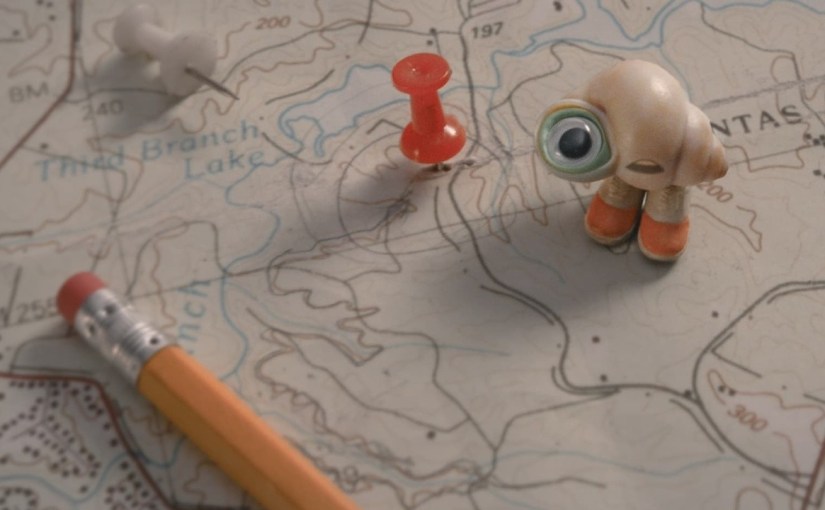
The story: A down-on-his-luck documentary filmmaker (Dean Fleischer Camp) moves into an Airbnb with his dog.  After following some odd clues around the house, he discovers his diminutive roommate: Marcel (voiced by Jenny Slate), a pebble-sized seashell with one eye – a googly eye – and tiny shoes, with a voice that sounds like your favorite childhood puppy was granted the gift of speech.  Dean discovers that Marcel has lived in this house for some time with his grandmother, Connie (voiced by Isabella Rossellini!).  There used to be an entire community, including many of Marcel’s family members, but they all vanished one traumatic night when the couple that used to live in the Airbnb got into an argument and the man stormed off with his luggage…carrying some unwitting passengers.

Now Marcel fends for himself, while Nana Connie helps in the garden.  Dean, the filmmaker, asks some excellent questions.  How does Marcel get around the house?  Why, by traveling inside a tennis ball using it like a tiny hamster ball; it’s okay as long as you don’t mind knocking some things over every once in a while.  What does he eat?  Mostly fruit from the tree growing outside.  How does Marcel get it out of the tree all by himself?  Using the mixer in the kitchen and a long length of rope, of course.  I could explain it, but it’s funnier if you find out for yourself how that works.  How does Marcel reach high places in the house?  Well, if he can’t jump it, there’s plenty of honey in the house, and honey is sticky, and that’s why there are sometimes little footprints all over the walls.  (Marcel asks Dean his own important questions: “Have you ever eaten a raspberry?  Um, and what was that like?”)

This is all unbearably cute.  I’m still not sure why I responded to it so strongly.  This is not normally my kind of material.  But the sight of this little seashell with one eye plopping down in front of the TV to watch 60 Minutes with his Nana just brought a smile to my face.  (Marcel explains, “We just call it ‘the show.’  That’s how much we love it.”)

One of the most charming elements of this movie is how it trucks along giving us one cuteness blast after another, and then it blindsides you with sentiments that are so simple and direct that they hit you in the feels before you even realize what’s happened.  As Marcel recounts the story of his family’s disappearance that fateful night, he sheds a tear or two.  Then he says:

“And then the next day, there was a really sunny day with a good breeze.  And I just remember thinking, if I was somebody else, I would really be enjoying this.”

I don’t know about you, but that statement really hits home with me, for all sorts of reasons that I won’t bore you with.  There are several moments like that in the film.  Here’s another one:

“Have you ever done that before, like, when there’s a party in your house?  Sometimes it’s easiest to rest when you go off by yourself and you can still hear the noise of the party, and you feel safe knowing that so many people are around, that you can have a rest?”

I identified with that so strongly that I can point to events in my life when I did exactly that, literally.  Hearing those words spoken in Marcel’s guileless, childlike tones almost felt…I might be overstating this a little…therapeutic.  It was a mildly bizarre experience for me.

Meanwhile, in events that uncannily mirror exactly what happened with the original Marcel shorts in real life, Dean posts his videos online and starts getting a phenomenal response.  He suggests that Marcel post a plea online to see if the online community can help track down his family.  This leads to some rather unfortunate attention-seekers, but it does provide a motivation for Marcel to take his first trip to the outside world, riding on the dashboard of Dean’s car.  If the idea of a teeny tiny seashell getting carsick and vomiting a teeny tiny little bit and apologizing every time…if you don’t find that even a little cute, I pity you.

Events progress rapidly (the movie is just over 90 minutes long).  There is an incident involving Nana Connie and some hooligans who break into the Airbnb.  The producers of 60 Minutes reach out to Dean and Marcel and ask if Lesley Stahl can come to the house and interview them.  Marcel says no, not until Nana Connie is better.  …and what happens after that I will not reveal, because it involves some of the most heartfelt passages of the film as the depth of Marcel’s relationship with his grandmother is tested, and the grandmother displays the kind of wisdom and sacrifice that would feel at home in an O. Henry story.

When so many films out there celebrate cynicism and snark, what a treat it is to find one that just wants to make you feel a little better.  I could not put it any better than Marcel himself:

“Guess why I smile a lot.  Uh, ‘cause it’s worth it.”

THE PURPLE ROSE OF CAIRO (1985)

by Miguel E. Rodriguez

DIRECTOR: Woody Allen
CAST: Mia Farrow, Jeff Daniels, Danny Aiello, Dianne Wiest, and…Jeff Daniels
MY RATING: 10/10
ROTTEN TOMATOMETER: 93% Fresh

PLOT: In 1935 New Jersey, a movie character walks off the screen and into the real-world life of a lonely, unhappily married woman.


I can imagine that it would be absurdly easy to poke holes in The Purple Rose of Cairo.  The premise is outlandish, taking place in the real world but firmly in the realm of fantasy.  It stretches the suspension of disbelief to the breaking point, then goes a little further.  It asks the audience member to forget cynicism and snark for eighty-two minutes and give in to the kind of hopeless romanticism that exists only on the movie screen.  And then, amid all that glorious make-believe, it abruptly confronts you with the knowledge that, yes, this kind of thing really does only happen in the movies, and the real world can be messy and unforgiving and sad.  Yes…but at our lowest points, we can always turn to Fred and Ginger, and Bogey and Bacall, and Luke and Leia, and Gene Kelly, and Hogwarts and the Emerald City.  The Purple Rose of Cairo reminds us that the movies allow us to escape reality for an hour or three.  Sign me up.

This movie’s plot is the embodiment of the “high-concept pitch.”  What if a movie character walked off the movie screen and tried to live in the real world?  I don’t have any statistics to support this, but I’m pretty sure there are at least 18,337 other films with variations of this fish-out-of-water scenario, most memorably Splash, Last Action Hero, and Who Framed Roger Rabbit.

In this version, Mia Farrow plays Cecilia, a semi-depressed housewife in 1935 New Jersey, living in a small town still in the grips of the Great Depression.  Her husband, Monk (Danny Aiello), claims he’s looking for work, but we only ever see him pitching pennies with his buddies or making life miserable for Cecilia at home.  Her wages from her waitressing job go directly to rent and groceries, and anything left over goes to Monk.  Amid this bleakness, Cecilia goes to see the new film opening at the local theater, The Purple Rose of Cairo, starring a dashingly handsome actor named Gil Shepherd in the supporting role of archaeologist Tom Baxter (both roles played by a young Jeff Daniels).  She is swept away by the glitter, glamour, and romance of the film.

Imagine her surprise when, during one of the many screenings she attends, Tom Baxter abruptly stops mid-sentence, breaks the fourth wall, and speaks directly to Cecilia from up on the screen.  “My God, you must really love this picture…I gotta speak to you.”  And he simply walks off the screen, much to the consternation of the movie audience, and walks out of the theater, arm in arm with Cecilia.  The wit with which Woody Allen handles the reactions of the audience AND the movie characters Tom leaves behind is priceless.  The characters and the real people react with perfect logic, so the effect is not one of slapstick (I can see an Adam Sandler version of this movie beating the joke to death), but one of a strange mixture of high and low comedy.  To relate the scenes here word for word would ruin the magic.  (An African-American maid steals every scene she’s in.)  Tom and Cecilia go off together, and the rest of the film is, from a plot perspective, fairly predictable.

What makes this movie unique is how it tells the story.  Tom knows what an amusement park is, but he has no clue what popcorn tastes like.  (“Been watching people eat it for all those performances.  When they rattle those bags, though, that’s annoying.”)  He has fallen instantly in love with Cecilia…love at first sight.  Tom hides in the city, and Cecilia lies to Monk to go back and see Tom the next night.  A nice touch comes when calls start coming in to RKO that the Tom Baxter character in prints being shown in other cities is also trying to escape his gilded silver-screen cage.  (“He almost made it in Detroit.”)  There’s the inevitable showdown between Tom and Monk.  Tom only knows the moves he uses on film, but Monk fights dirty.  However, the fight still doesn’t end quite as I expected…another nice touch.

The real crisis occurs when the studio calls in Gil Shepherd, the actor who PLAYS Tom Baxter, to New Jersey so he can try to wrangle his creation back into the movie where he belongs.  There is the expected confusion when Cecilia bumps into Gil, mistaking him for Tom.  The plot thickens even more when Gil starts falling in love with Cecilia herself, and she finds herself in a pickle.  She tells Gil, “I just met a wonderful new man.  He’s fictional, but you can’t have everything.”

The commentary being made here regarding our fascination with movie characters (and the movies themselves) as opposed to the actors who play them seems simple, but in trying to analyze it like a “real” critic, I feel helpless in the face of the ingenuity of the situation.  My words aren’t doing justice to the almost poetic elegance on display.  The more you love movies, the more you’ll appreciate what I’m desperately trying to convey.

There are two moments/sequences that elevate The Purple Rose of Cairo from a dramatic exercise into the realm of genuine movie magic.  One is when Tom wants to show Cecilia a night on the town, but they have no money (Cecilia is broke, and all of Tom’s movie money is fake).  But he remembers that, in the “fake” Purple Rose movie, the scene coming up after the one he abandoned takes all the characters to the Copacabana.  It’s here that the viewer simply must suspend what little disbelief remains and give in to the simple but grand gesture of watching Cecilia herself appear on the black-and-white screen with all of the people she’s been watching night after night.  They go to the Copa, and after watching the singer who’s supposed to be Tom Baxter’s love interest, Tom and Cecilia head out for a night on the town, as only 1930’s movies could provide.  (The maître d’ provides one of the movies biggest laughs when he suddenly realizes he can do whatever he wants…and does.)

But the greatest moment is the very ending, which I will try desperately not to spoil here.  It’s here where we get to the heart of what Woody Allen is really trying to say: The movies are here and real life is there, and never the twain shall meet.  Is this a depressing point of view?  Well, I mean…yeah, a little.  But it’s also indisputably true.  If we walked around like we were actually in a movie, we’d never lock our doors behind us when we walked into our apartment.  Everyone’s phone numbers would begin with “555”.  We’d turn on the light when answering the phone at night (who does that, really?).  But in the real world, none of that is true.  In the real world, hearts get broken, sometimes for good.  We get fired.  People die.  WE die.  Love the movies, Allen is saying, but never forget that you’re flesh and bone, and that actions have consequences.  I’m reminded of a good line from Ready Player One: “As terrifying and painful as reality can be, it’s also the only place that you can get a decent meal.”

The final shot of the movie, of Cecilia smiling through her tears, moved me like I’ve rarely been moved before.  It reminded me, perversely, of some of the worst times in my life because it was at those dark times that the movies came to my aid.  I went through a fair episode of depression in my twenties; a friend showed me Harold and Maude, and it literally changed my life.  During the Covid lockdown, I was furloughed, and the maddening Florida unemployment website sapped my will to live, figuratively speaking; my best friend, out of the blue, bought me a copy of Star Wars: The Rise of Skywalker just to cheer me up…and it did.  During that same period, several different films were in constant rotation in my movie room, all of which provided spectacular ways of escaping real life: Blade Runner 2049, Prometheus, The Martian, Interstellar, Gravity, and Sunshine [2007].  Not all laugh riots, to be sure, but they were excellent tonics against the constant worry of unemployment and disease.

And in 2017, Hurricane Irma threatened Florida.  For the first time, I was genuinely frightened that we would finally see real danger from a hurricane.  Miraculously, a local multiplex chose to stay open until almost the eleventh hour, and to get our minds off the approaching storm, I took my girlfriend to see the new remake of Stephen King’s It.  For two hours, we got scared out of our wits in the best way possible.  We escaped reality, and collectively we had our real-world fears literally exorcised.  I cannot tell you how grateful we were to have that brief respite from our troubles.

Those are the memories that came back to me in the final sequence of The Purple Rose of Cairo.  Yes, the real world is still the only place to get a decent meal, and it remains imperfect and sometimes painful.  But the movies are as close as a button click or a car ride.  They’re implausible and sometimes unrealistic and not always perfectly written.  But The Purple Rose of Cairo just wants to remind us of their power to cheer us up and transport us.

GENTLEMEN PREFER BLONDES (1953)

by Miguel E. Rodriguez

DIRECTOR: Howard Hawks
CAST: Jane Russell, Marilyn Monroe, Charles Coburn
MY RATING: 7/10
ROTTEN TOMATOMETER: 88% Certified Fresh

PLOT: A couple of showgirls on a cruise to France get themselves involved in a plot involving a private detective, a diamond tiara, and the occasional musical number.


Why did I watch Gentlemen Prefer Blondes, a musical from 1953 featuring Jane Russell and Marilyn Monroe?  Well, it happens to be listed in the movie compendium 1,001 Movies You Must See Before You Die, for one thing.  And there’s the uber-famous production number “Diamonds Are a Girl’s Best Friend” performed by Marilyn Monroe in that iconic pink dress that showcased her shimmy like nothing else I can think of.  And it’s directed by Howard Hawks, one of my favorite directors from Hollywood’s golden years (His Girl Friday, The Big Sleep, Bringing Up Baby, many others).

While the song and the actors and the direction are competent, I didn’t quite get involved in the story as much as I hoped I would.  There’s no denying the wattage generated by Monroe whenever she’s on screen, and the screenplay by Charles Lederer provides some amazing little zingers, some of which I’m shocked got past the 1953 censors.  (When a man is asked which girl he would save from drowning first, Russell or Monroe, the man replies in admiration, “Those girls couldn’t drown.”)  But the plot, which I won’t even bother describing here, is merely a nail on which to hang those visuals of Jane and Marilyn strutting their stuff in exuberant Technicolor dresses and the occasional song or three.  Make no mistake, from a narrative standpoint, Gentlemen Prefer Blondes is pure farce, top to bottom.  (And no wonder, it’s based on a stage musical.)  You either give in to the formula or you don’t.  And I’ll admit, there were times when I didn’t.  There’s a song and dance number at a Parisian café which I thought was unnecessary, and the tortuous route traveled by the tiara, especially its final hiding place, stretched the logical part of my brain to the limit.

But, on the other hand…yeah, it was fun.  Set logic aside and surrender to the sights and sounds, and Gentlemen provides substantial eye and ear candy.  And there are some genuine laughs.  Like the subplot about Monroe looking through the passenger manifest looking for gentlemen traveling “with valets”, who must therefore be rich.  She finds one, Henry Spofford III, and arranges for him to be seated at her dinner table.  The revelation of Mr. Spofford’s true nature is one of the comic high points.

Or the bit towards the end where Jane Russell gets to have her cake and eat it, too.  Thanks to the machinations of the plot, Russell not only gets top billing for the movie, but she also gets to lampoon her sexy costar by impersonating Marilyn Monroe.  (In fact, if I didn’t know any better, I’d say that her appearance in a courtroom wearing a fur coat that conceals all until she crosses her fishnet-clad legs may have provided at least SOME inspiration to that one scene in Basic Instinct.  YOU know which scene I’m talking about, perv.)

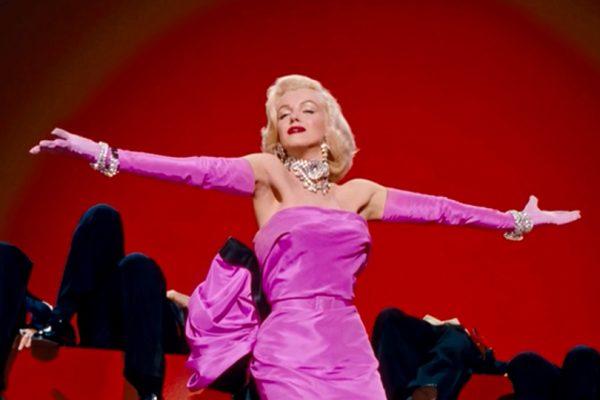
But when it comes down to it, if for nothing else, you’ve got to watch Gentlemen Prefer Blondes just to see Marilyn Monroe singing “Diamonds Are a Girl’s Best Friend.”  She may play ditzy and dumb for the whole rest of the movie, but in this number, Monroe is totally and fully in command of her body, the camera, and the audience in that strapless pink dress which looks like it’s held up by sheer willpower.  For several minutes, she coos, struts, bumps, shimmies and shakes, and there’s nothing you can do but just watch in awe.  Almost as much as she did in Some Like It Hot, she simply embodies sexual…sexual…you know what, she just embodies sex.  I suppose there’s a more literary way to describe it, but I’m too tired to think of it.

Gentlemen Prefer Blondes may not feature the dancing feet of Gwen Verdon or Gene Kelly, or the vocal stylings of Debbie Reynolds or, well, Gene Kelly, or the literary complexity of West Side Story or A Star Is Born.  But when you have a song and dance number that is literally inimitable (sorry, Madonna, nice try), who cares?  I can think of plenty of worse ways to spend an evening than watching Jane Russell and Marilyn Monroe for 90 minutes.

[Side note: Penni was NOT a fan of how Monroe’s character constantly called her fiancé “daddy.”  Not sure why I’m mentioning that, but it just made it funnier to me every time Monroe said it.]

FARGO

By Marc S. Sanders

The seeds of a crime begin in the dead of winter, in a saloon, located in Fargo, North Dakota.  A car salesman requests two thugs kidnap his wife so that they can demand an eighty-thousand-dollar ransom from his wealthy father-in-law.  The salesman will split the monies with the crooks and all will be well.  Hold on there!  It’s not as simple as it looks.

The Coen Brothers (Joel and Ethan) completed some of their most legendary work when they opted to “adapt” a supposedly true story that sheds blood over the snow-covered plains of northern Minnesota when all of the characters involved choose not to cooperate with one another.  The unpredictable is what keeps their film Fargo so engaging.  With each passing scene, you ask yourself “What next????”

Jerry Lundegaard (William H Macy, in my favorite role of many good ones from him) is the salesman who gets in over his head.  This cockamamie scheme of his stems from a need to land a get rich quick investment, but he doesn’t have the money and his father-in-law Wade Gustafson (Harve Presnell) certainly won’t lend it to him.  Steve Buscemi and Peter Stormare are the hired criminals, Carl and Gaere.  As quick as the agreement is made, Jerry wants to call off the arrangement, but things are already set in motion.  The kidnapping occurs, albeit sloppily, and a late-night pullover on a dark, snow covered back road leads to the bloody shootings of three people. 

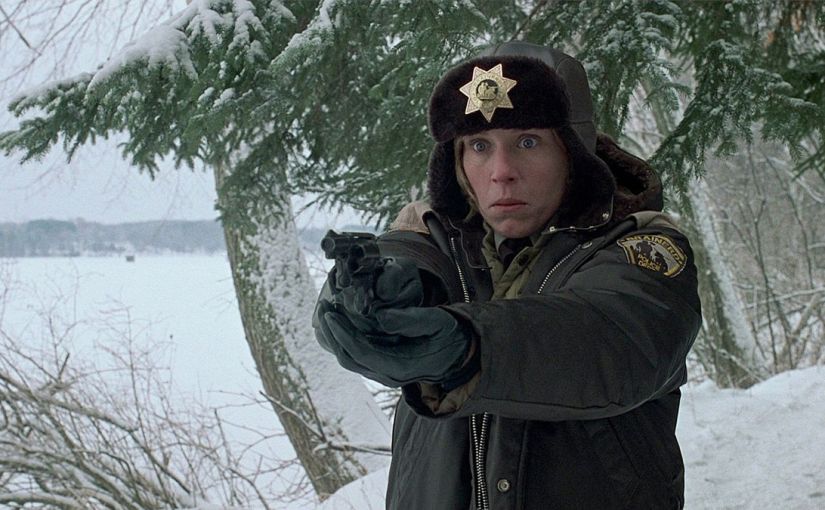
Marge Gunderson (Frances McDormand, in her first Oscar winning role) is awoken early in the morning.  Her sweet husband makes her a quick breakfast and she’s off in a jiff to inspect the crime scene of the three murders.  She is seven months pregnant, but she’s got a job to do.

Murder, kidnapping, fraud, and embezzlement piece together the Coens’ Oscar winning script.  What makes Fargo special though is how out of frame it all seems among these odd and quirky characters.  The Minnesotan dialects and vernacular (“You betcha!!” “You’re darn tootin’!” “Oh, for Pete’s sake!!!”) from Marge and Jerry do not seem standard in a story like this.  Even their names – Lundegaard and Gunderson – seem totally out of place here.  However, the pregnant, sweet natured police officer should not be underestimated, and the puppet master behind this plot should have known better.  In fact, other than Marge, no one should be doing what they’re doing, and yet that’s exactly what spins everything off the rails.

The Coens humanize the characters of their film.  Marge must stop inspecting the grisly crime scene because her morning sickness is about to overtake her.  “No, I think I’m gonna barf!” It is not the blood or the cold winter that’s holding her back.  Natural pregnancy gets in the way.  When clues lead her to Minneapolis for an overnight stay, she takes advantage of meeting with a high school friend.  Their meet-up has nothing to do with the central plot, but the writers insist on showing Marge during her off hours.  It’s a hilarious scene and Frances McDormand’s timing is naturally comedic with a guy who just has an overenthusiastic way about himself.  Marge is not just a smart cop.  She’s got a life outside of her career as a loving wife, friend and soon to be mother.

As well, Jerry insists to Wade not to contact the police and let him deal directly with the kidnappers when they call.  Wade isn’t just going to sit by for long though.  He got to the top of his powerful pyramid by taking things head on.  Jerry just doesn’t have the instinct to realize this is how the cards will fall.  Wade was not to be involved, under any circumstances.  Yet, that’s exactly what is happening.  This is not good Jerry.

Carl and Gaere (These names!!!!  I’m telling ya.), as crooked hoods, have no honor among themselves.  One might betray the other and that could lead to another gory, very gory, yet inventive moment. 

Other than Marge, either no one is particularly smart in Fargo, or they are just not seeing the possible outcomes all the way through.  Still, even the dumbest of folk can make a turn of events gone awry so fascinating.  When one tiny detail gets out of place, then the players improvise. That only twists several other expectations to go off kilter and the dominoes begin to tumble.  Very quickly, as everything has unraveled, it is any wonder how this all began in the first place. 

Fargo demonstrates that crime is hardly committed with a perfect plan.  Fortunately, the imperfections are at least as entertainingly curious as the perfections found in so many other films.  Oh, you betcha!!!!! 

LOCAL HERO (United Kingdom, 1983)

by Miguel E. Rodriguez

DIRECTOR: Bill Forsyth
CAST: Burt Lancaster, Peter Riegert, Fulton Mackay, Denis Lawson, Peter Capaldi
MY RATING: 8/10
ROTTEN TOMATOMETER: 100% Certified Fresh

PLOT: An American oil company has plans for a new refinery and sends someone to Scotland to buy up an entire village, but things don’t go as expected.


Local Hero is not normally the kind of movie I gravitate to.  It’s not slow, but it’s deliberate.  It’s not hilarious, but it’s funny.  It’s not plotless, but it meanders and skips around.  It’s not flashy, it’s not glossy, and it’s not kinetic.  I can easily remember a version of myself that might have turned this movie off after the first thirty minutes.

But today, at this time in my life, for whatever reason, something made me look at this movie in a different way than I might have once upon a time.  The movie started to resemble a memory.  Not one of my memories, but like someone else’s memory, like I was listening to someone tell a story about this one time when he went to Scotland and something happened that didn’t exactly change his life, but it made him look at the world differently.  Fiction or not, Local Hero plays not as a movie, but as a recollection.  Its charm carried me through the entire film.

And I’m not talking about the kind of charm you might see in any 2 or 3 movies set in Scotland or Ireland.  Normally, in films set in and around the British Isles, the villages one might find there are laid back, yes, but filled with eccentric characters who know each other’s business, are friendly but cautious around outsiders, and who are loud and boisterous at the local pub.  In Local Hero, the most eccentric characters are the Americans, and the village pub might fill up, but you’ll never have to raise your voice to be heard.  It’s an interesting switch.

The story: A Texas oil company wants to buy the entire village of Ferness in Scotland so it can turn the surrounding area into a giant oil refinery.  The company’s CEO, Felix Happer (Burt Lancaster), sends a junior executive, Mac (Peter Riegert), to Scotland to facilitate the deal.  When Mac arrives, he gets his first taste of culture shock, not due to all the eccentricities he finds, but due to how quiet this town is.  He is checked into the local hotel by Gordon Urquhart (Denis Lawson, aka “Wedge Antilles” in the Star Wars films), who also turns out to be the town’s bartender, the town treasurer, and the head chef in the hotel’s kitchen.  Mac is accompanied by an eager Scottish assistant, Oldsen (an impossibly young Peter Capaldi), who develops a crush on a local scientist and runs from one assignment to another as if his arms were on fire.

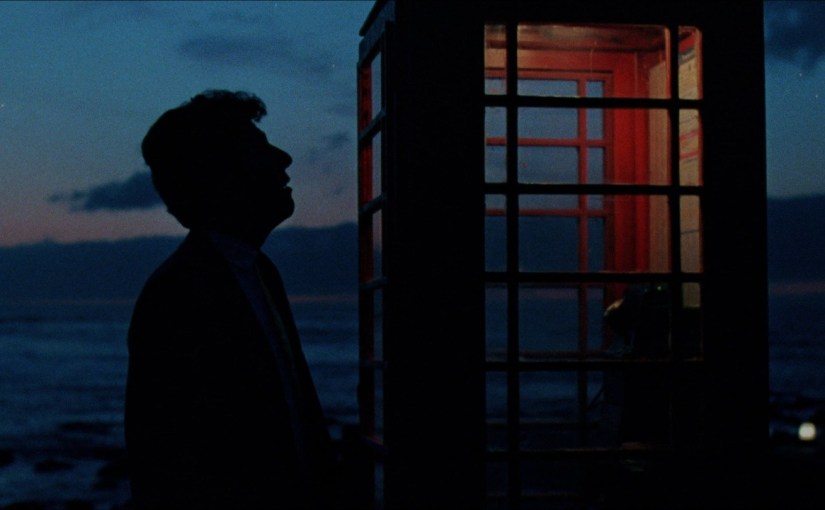
Local Hero throws curveballs every chance it gets.  You’d expect the citizenry to get indignant at the idea of an American mega-corporation wanting to buy their town.  But when the locals get an idea of how much each person would get, they become instant supporters.  When they all convene at the local church, the Reverend is not an inexperienced youth or a crusty old soul, but an African gentleman who, according to the story he tells Mac, came to Scotland to learn the ministry and just…never left.  Happer, the CEO, insists on periodic updates from Mac, and since this is 1983, Mac has to call Texas from a red phone booth just outside the hotel.  But Happer seems less interested in the deal than in the potential discovery of a comet, somewhere in the constellation Virgo.

All of this is told in the laid-back manner of someone telling a story around a campfire.  There are little jumps forward that omit what might seem to be key information, but we pick up on it right away.  Little details emerge, like the motorcyclist who always seems to be roaring down the town boulevard just in time to nearly run Mac over.  There’s a moment when Mac encounters a group of men near the beach, has a pleasant conversation, then notices a baby in a stroller.  “Whose baby?”  His question is met with an uncomfortable silence as the men slowly look at each other, and Mac wonders what just happened.  And the beautiful thing is, that’s it.  That’s the end of the scene.  No one ever answers the question, and we never find out why not.

That kind of thing would normally infuriate me, but in this movie, it reinforced the idea of a fond memory.  I can easily imagine someone telling the story and saying, “And that was it!  No one ever said whose baby it was!  I still don’t know whose baby it was!”  It has the ring of real life, it’s not played up for laughs, and there’s no punchline at the end.  The punchline is that there IS no punchline.

There is a nice moment when Mac has had one or two whiskeys too many one night, and he gets on the phone with Happer in that red phone booth.  Suddenly, the sky starts to glow and glisten – the aurora borealis.  Mac gets excited and tries to explain to Happer what’s going on, but he lacks the vocabulary.  “I wish I could describe it to you like I’m seeing it!”  I know how he feels.  It’s how I felt when I went to Alaska for the first time in decades and traveled on a cruise ship through a narrow fjord and saw towering cliffs covered in trees and intermittent waterfalls cascading over rocks so everything looked primeval, like something out of The Lord of the Rings.  Just describing it doesn’t convey how it felt.  It’s a short moment in the movie, but I felt the reality of it in my bones.

In an interview on the Criterion Blu-ray, the film’s producer, David Puttnam, talks about how, when this movie was made, the general public’s idea of comedy was Airplane! and Blazing Saddles.  If it wasn’t zany, it wasn’t considered a comedy.  He wanted to help make a film that tried to remind audiences that comedy doesn’t automatically mean pratfalls and fart jokes.  Comedy can be gentle.  Local Hero is as gentle as they come.  It’s marvelous closing shot speaks volumes, and it wouldn’t have had the same impact if the story had been told any other way.

NIMONA (2023)

by Miguel E. Rodriguez

DIRECTORS: Nick Bruno, Troy Quane
CAST: Chloë Grace Moretz, Riz Ahmed, Eugene Lee Yang, Frances Conroy
MY RATING: 9/10
ROTTEN TOMATOMETER: 94% Certified Fresh

PLOT: Framed for a crime he didn’t commit, a knight in a futuristic world reluctantly accepts the help of a shapeshifting teenager to prove his innocence.


Just when I thought the Spider-Verse animated films held the current monopoly on creating cool futuristic worlds, along comes Nimona with its delirious fusion of medieval pageantry with flying cars, cellphones, and annoying TV jingles.  Put aside what some will no doubt call its “woke” agenda/storyline and just drink in the amazing visuals, as knights in shining armor wield swords as they ride hoverbikes into battle.  (There is the occasional horse, naturally…some traditions apparently die hard in this version of the future.)

The pre-requisite prologue explains how a brave warrior queen, Gloreth, defeated a vile monster a thousand years ago.  To maintain vigilance against any future attacks, Gloreth’s subjects erected a wall around their magnificent city and created the Institute, a sort of school-for-knights, to train their protectors from generation to generation.

One thousand years later, the city prepares to matriculate its current class of knights, including, for the first time in their history, a commoner, Ballister (Riz Ahmed), championed by the current Queen Valerin as a symbol of progress.  What matters a knight’s lineage if his heart is brave, and his spirit is bold?  This choice has not gone over well unanimously in the queendom, unfortunately, but she is confident in her choice.  However, in a twist of fate, Ballister’s sword malfunctions during the knighthood ceremony, resulting in the Queen’s death, and Ballister, minus an arm, finds himself a fugitive.

He has exactly two allies.  One is his romantic partner and fellow knight candidate, Ambrosius Goldenloin, a direct descendant of Gloreth herself, who spearheads the search for Ballister in an attempt to keep someone else from killing him outright.  The other is a flighty, impetuous teenager who tracks Ballister down the following night and offers her services as sidekick to what she thinks is the newest villain in town, Ballister the Queen Slayer.  This is Nimona (Chloë Grace Moretz), a shapeshifter who can assume any form she desires, although her favorites appear to be a pink rhinoceros and a giant pink whale.  She likes pink.  And punk, as it turns out.

I imagine one could be cynical and say that what follows story-wise is nothing new: our heroes overcome initial adversities and suspicions of each other, they track down clues, deal with one or two serious crises, and eventually expose the truth of what really happened the day the Queen was killed.  But that’s like saying The Stand is about a bunch of people who survive the end of the world and eventually defeat the bad guy.  Well, duh.  Nimona doesn’t offer anything outrageously subversive in the story department.  What it offers is a fresh new imagination and perspective in how it tells this story, especially when it comes to the character of Nimona herself, the very definition of the rebel outsider who literally doesn’t fit in anywhere.

What makes great kids films work – what makes MOST films work – is how it invites the juvenile audience to identify with the main character.  In Pinocchio, what little kid doesn’t know what it’s like when a lie grows out of control?  In The Wizard of Oz, what little kid has never felt homesick?  In Harry Potter and the Sorcerer’s Stone, what kid has never dreamed that they were special, not really meant for everyday life?

In Nimona, what kid has never felt alienated at some point in their life because of something that makes them different?  They’re not as old as the grown-ups.  They’re not as young as little babies anymore.  They’re in an in-between world where they’re only as strong as the friends they make, if they’re lucky enough to make friends.  What if there is something inherently different about them?  Nimona has tried shapeshifting before, tried to explain her gift, but people immediately think of her as a monster instead of someone who’s gifted.  There are echoes of the X-Men films here, too, but those mutants were lucky enough to find a home at Xavier’s mansion.  Nimona is not so lucky.  So, she decides to embrace the monstrous role society thrusts upon her.  I imagine there are lots of people out there who feel the same to one degree or another.  I’m not a sociologist, but it seems logical.

The real villain of the story (I won’t reveal their identity) does everything in their power to manipulate the narrative in the eyes of the public.  At one point, their scheme is all but exposed, but they discover yet another way to maintain power: turn society on itself.  They reveal the existence of the shapeshifter, explaining to the city that the real monster could be sitting next to you, or playing with your child, or living in your house.  The sinister nature of this ploy made me genuinely angry, mostly because of how effective it is, both in the film and in real life.  When you’re too busy fighting each other, the true villains win.

Enough philosophy.  Nimona stands among the best animated films yet produced by Netflix (Klaus, Guillermo del Toro’s Pinocchio).  There is plenty of humor to go around to leaven the moments when the film goes deep into territories unexplored even in the best Pixar movies.  (Correct me if I’m wrong, but I can’t recall a Pixar film where a character contemplates suicide as an alternative to grief.)  The end credits inform me that Nimona is based on a graphic novel.  Guess what I’m looking for on Amazon in a few minutes.

THE MAN IN THE WHITE SUIT (United Kingdom, 1951)

by Miguel E. Rodriguez

DIRECTOR: Alexander Mackendrick
CAST: Alec Guinness, Joan Greenwood, Cecil Parker, Michael Gough
MY RATING: 8/10
ROTTEN TOMATOMETER: 100%

PLOT: An altruistic chemist invents a fabric which resists wear and dirt as a boon to humanity, but both big business and labor realize it must be suppressed for economic reasons.


First, a brief history lesson:

“The Ealing comedies is an informal name for a series of comedy films produced by the London-based Ealing Studios during a ten-year period from 1947 to 1957. Often considered to reflect Britain’s post-war spirit, the most celebrated films in the sequence include Kind Hearts and Coronets (1949), Whisky Galore! (1949), The Lavender Hill Mob (1951), The Man in the White Suit (1951) and The Ladykillers (1955)… Many of the Ealing comedies are ranked among the greatest British films, and they also received international acclaim.” – from Wikipedia

There.  That summarizes it way better than I could.  Watch enough British films and the term “Ealing Studios” will invariably come up.  Their comedy films have a breezy, economical quality, sometimes combined with dark humor and almost always with something to say about the conditions in Britain at the time.

The Man in the White Suit is a prime example of the Ealing comedies (although Kind Hearts and Coronets is my personal favorite).  In this film, the versatile Alec Guinness portrays Sidney Stratton, an unemployed inventor with a head for chemistry and textiles.  He stumbles upon a formula that he believes will create the ultimate cloth: impervious to stains and virtually unbreakable.  After a series of pyrotechnic failures, he cracks the code and makes a white suit out of his miracle material.

The storytelling for this whole first half of the film is quick as lightning.  Director Mackendrick wisely realizes that lengthy exposition is the enemy of good pacing, so we get a lot of quick scenes that linger only long enough to make their point before we fade into the next one.  While watching it, I began to worry that this rapid rhythm would hinder my investment in the story, but in retrospect, it almost feels like we’re inside Sidney’s head.  On film, he’s almost always running, rarely strolling except when he’s trying to fool any casual observers.  When he makes his breakthrough, his speech becomes a rattling string of syllables that might require subtitles to decipher, his excitement nearly derailing his ability to talk.

Once he creates this magical cloth and fashions a suit out of it (resorting to blowtorches to cut the suit patterns), he beams.  What a boon to mankind!  You can’t damage it, you can’t get it dirty…it’s the only suit you’ll ever have to buy!  What a windfall!  Well, not so fast.  He immediately encounters resistance from both sides of the textile supply chain.  The laborers who work in the textile mills don’t like it because they envision making only one set of clothes per person and that’s it; it never needs replacing.  Competing companies (management) don’t like it because no one will buy anything else, and it will put them out of business.  Sidney becomes caught in this tug of war, and the whole second half of the film becomes a variation of chase scenes as Sidney struggles to publicize his invention while labor and management fight to suppress it.

There’s an interesting subplot when management tries to persuade Daphne, the daughter of the company’s owner, to seduce Sidney into signing away his rights to his invention.  In an era when most women’s roles were relegated to love interests, her reaction to this offer is unique: she calmly asks, in so many words, “How much is this worth to you?”  She negotiates her fee much the same way as a high-priced escort might.  The board members are scandalized when they realize exactly what they’re asking her to do, and what is being negotiated.  But instead of shying away from it, Daphne embraces it.  Neat.  (Her “seduction” of Sidney has a clever resolution that I did not see coming.)

Like other great films, The Man in the White Suit offers a lot to chew over after the credits roll.  Sure, the last half of the film offers lots of comedy and chase scenes and farcical situations to satisfy any film lover.  But the underlying concept is more interesting the more I think about it.  It’s not exactly a NEW idea, but interesting, nevertheless.  One of the workers at the textile mill tells Sidney: “The razor blade that never gets blunt.  And the car that runs on water with a pinch of something in it.  No.  They’ll never let your stuff on the market in a million years.”  We’ve all heard the urban myths of rubber tires that never wear out, or even the cars that run on water (just saw that one on the internet the other day).  Are they real?  Probably not.  But it’s fun to think so, to imagine the shadowy forces suppressing brilliant inventions for the purpose of commerce.

But there’s a flip side to the story.  During Sidney’s pursuit, he runs into an old washer woman and asks for a coat to cover his suit (the material’s properties make it practically luminous at night).  She happens to know about Sidney and his invention, and she tells him, “Why can’t you scientists leave things alone?  What about my bit of washing when there’s no washing to do?”  More than anything else, this gives Sidney pause, and I can almost hear him thinking, in the back of his head, the immortal words of Ian Malcolm: “Your scientists were so preoccupied with whether or not they could that they didn’t stop to think if they should.”

In this way, The Man in the White Suit offers more food for thought than I would have expected.  It’s making a statement about the inevitability of scientific progress, pleading with the responsible parties to be more, well, responsible with their actions.  This film was released only six short years after America ended World War II by dropping atomic bombs on Japan, so the question resonates more dramatically than you might expect from such a breezy comedy.

I can almost hear you asking, “Yeah, but is it funny?”  Yes, this delightful Ealing comedy is in the best traditions of the form.  It’s not too heavy, asking the big questions but wisely not answering them.  It has plenty of smiles and laughs.  And for those who have never seen Alec Guinness as a young man in the movies, it’s a treat to watch a very young Ben Kenobi cavorting on the screen with his eyes bugged out and a silly grin on his face.  And if it offers food for discussion afterwards, all the better.

P.S. Look for a very young Michael Gough in the cast, aka “Alfred” in Tim Burton’s Batman.