MIDNIGHT IN PARIS (2011)

by Miguel E. Rodriguez

Director: Woody Allen
Cast: Owen Wilson, Rachel McAdams, Marion Cotillard, Kathy Bates, Adrien Brody, Tom Hiddleston, Alison Pill, Léa Seydoux, Michael Sheen
My Rating: 10/10
Rotten Tomatometer: 93% Certified Fresh

PLOT: A nostalgic screenwriter travels with his fiancée’s family to Paris where, every night at midnight, he inexplicably finds himself going back in time to the 1920s.


The best of times is now / As for tomorrow, well, who knows?
La Cage Aux Folles

It’s currently 11:05 at night on a Sunday evening.  I’m getting older, so if I’m smart, I should get off to bed, owing to the fact I have to get up early tomorrow to get ready for work.

But I can’t.  I have just re-watched Woody Allen’s Midnight in Paris for only the second time in my life, and I have revised my original rating of 9 up to a 10.  And I am just bursting to write about how wonderful this movie is.  I’m hoping that I can reach someone who has not seen it before, so I can convince them that, even if they’ve never seen a Woody Allen movie before, this is the one they should start with.  Yes, even over Annie Hall or Manhattan or even Match Point.  In my mind, Midnight in Paris captures the voice of the artist as he is reaching a certain age and has something important to say about nostalgia, and how sometimes it’s not always what it’s cracked up to be.

Gil Pender (Owen Wilson) is a Hollywood screenwriter trying to complete his first novel.  He and his fiancée, Inez (Rachel McAdams), travel to Paris with her family so he can perhaps get inspired by one of the all-time great cities of the world.  He is immediately smitten with the atmosphere of the place; the movie opens with a wordless montage of static shots of Parisian cafés, streets, museums, statues, apartment buildings, and, of course, the Eiffel Tower.  The sequence sounds simple on paper, but the effect is – I don’t know how to describe it.  It captures the ineffable romance of the place.  More so than any other movie set in Paris, Midnight in Paris really, REALLY makes me want to go there.

Gil and Inez seem happy enough, but he is a little more antisocial than she is.  He is star-struck by Paris, but Inez is not incredibly fond of it.  They bump into an old friend of Inez’s, a pleasant enough man who turns out to be a bit pedantic; during a museum tour, he presumptuously corrects the tour guide on details of the life of Auguste Rodin.  This is not the kind of guy I would want to be stuck with on an elevator.

One night, Gil goes walking by himself on the Paris streets and gets a little lost.  Long story short, he inexplicably finds himself transported back to Paris of the 1920s, when the cafés were full of American expats and frequent visitors like Ernest Hemingway, F. Scott and Zelda Fitzgerald, Cole Porter, Gertrude Stein, T.S. Eliot, Pablo Picasso, Salvador Dalí, etcetera.  As a writer, Gil is over the moon; it just so happens his unfinished novel is about a man who runs a “nostalgia shop”, so this pleasant turn of events is a welcome tonic to his vaguely unhappy days back in the present.

Watching the scenes of Gil rapturously conversing with Hemingway, or goggling at Cole Porter playing the piano, I was swept away by the audaciousness of this movie.  It’s illogical and steeped in fantasy and seems to be begging not to be taken too seriously.  But it is a pure joy to watch.  I immediately identified with Gil.  I found myself imagining how I would respond if I were somehow transported back to a time and place when some of my own idols walked the Earth: Hollywood, the 1940s, walking around and conversing with Orson Welles, Alfred Hitchcock, Jimmy Stewart, Katharine Hepburn.  Or even not so far back: the 1970s, having lunch with young Spielberg and Coppola and Lucas, and Pacino and Streep and DeNiro, discussing film and life and getting insight into their inner workings.

From our perch in the present, it’s easy for us to look back at the past and say, well, those were the days.  Just earlier today, I was having an online discussion about the difference between CGI and practical effects in movies like Star Wars or The Lord of the Rings and even Honey, I Shrunk the Kids.  We tell each other that older movies felt more real because the effects were made with real props occupying real space, whether they were miniatures or matte paintings or what have you.  And we say, “Man, they just don’t make them like that anymore.  They knew what they were doing back then.”

That’s Gil.  He looks around at the shimmering jewel of Paris in the 1920s and he’s convinced that this is “where it’s at.”  What can today’s world offer in comparison to sitting in a café and discussing art with Salvador Dalí and Luis Buñuel?  Or the pleasure at hearing Ernest Hemingway tell you he’ll hate your book, even if it’s good, because that would make you a better author than him?  Or getting constructive notes on your novel from Gertrude Stein?

The story progresses.  Gil becomes infatuated with a beautiful woman from the past, Adriana (a luminous Marion Cotillard), and it becomes harder and harder for him to go back to his own present each night.  Inez’s father gets suspicious and hires a private detective to follow Gil during his midnight strolls.  You may ask how a private detective can follow someone who is traveling back in time.  Well, my friend, that is an EXCELLENT question, one which the movie answers in satisfying and gut-busting fashion in the final reel.

But the heart of the movie lies in the touching, revealing segment when Gil and Adriana go even further back in time, this time in a horse-and-carriage, back to the Belle Époque, the “Beautiful Age” of Paris, which lasted from about the 1870s to the 1910s.  Adriana, who lives — lived — in the ‘20s, is entranced with this even more bygone era.  She feels about the Belle Époque the way Gil feels about the ‘20s.  To her, the ‘20s are slow-paced, a drudge.  But, oh, to be back in the 1890s!  Dinner at Maxim’s, the Moulin Rouge, meeting Toulouse-Latrec and Gauguin and Degas!  How wonderful those days must have been compared to the Boring Twenties!

And there’s the message of the movie.  We can grouse and grumble about the modern world all we want.  The movies are dime-a-dozen.  The books even more so.  The music is crap.  Cell phones have turned us into tiny-screen junkies.  But, oh, to be back in the good old days of the 1980s, when the music was gnarly, and the movies were iconic, and the books were amazing, and everything was just better.

But we forget that, in the ‘80s, people were grousing and grumbling about THAT era, and they longed for the more sedate and rosy era of the 1950’s.  And in the ‘50s, people said the ‘30s were the BEST.  DECADE.  EVER.  And so on and so on.

It’s human nature for us not to realize what we’ve got going for us until it’s gone.  We are living in glorious times.  (Coronavirus and politics notwithstanding…gimme a break, I’m trying to make a point here.)  Look around.  Really SEE it.  Embrace it.  We don’t need a time machine to go back to our glory days.  We’re IN our glory days.  Just wait.  In 20 years, you’ll look back on the 2010s and say, “Man, wasn’t that a time?”

If you take nothing else away from the above review, remember this: Midnight in Paris is pure charm, is laugh-out-loud funny, and is the best Woody Allen film since Match Point.  So if you haven’t seen it, you really, really, REALLY need to make a point to do so.

PARASITE (2019)

by Miguel E. Rodriguez

Director: Bong Joon Ho
Cast: Kang-ho Song, Sun-kyun Lee, Yeo-jeong Jo
My Rating: 10/10
Rotten Tomatometer: 99% Certified Fresh

PLOT: Ki-taek and his family, all unemployed, take peculiar interest in the wealthy and glamorous Parks, as they ingratiate themselves into their lives one by one.


Watching Parasite reminded me of the first time I saw Pulp Fiction.  I told my friends that it was like being on a roller-coaster at night wearing a blindfold: you have no idea where you’re going or what’s coming, but the ride is exhilarating.

That’s Parasite.  The hype is real.  This is one of the best movies I’ve ever seen, and if you plan on seeing it, I would highly recommend you do so BEFORE reading further.  I have no plans to spoil ANYTHING, but the less you know about the movie before going in, the better.

(You’ll have to bear with me, I’m writing this shortly after seeing the movie myself, it’s currently 11:14 PM, and I’m starting to get a little tired, but I want to get this all down before I pass out, so it may get a little “rambly” for a while.  You’ve been warned.)

Parasite is many things.  It’s a social commentary, a black comedy, a family drama, and a Hitchcockian thriller all rolled into one delicious Korean dish.  (The film and filmmakers are Korean.)  The beauty of the movie is that it manages to be all those things without losing track of itself.  I can’t count how many movies I’ve seen that attempted a tonal shift in the middle or at the end, and it just falls flat.  Where lesser movies failed, Parasite succeeds.

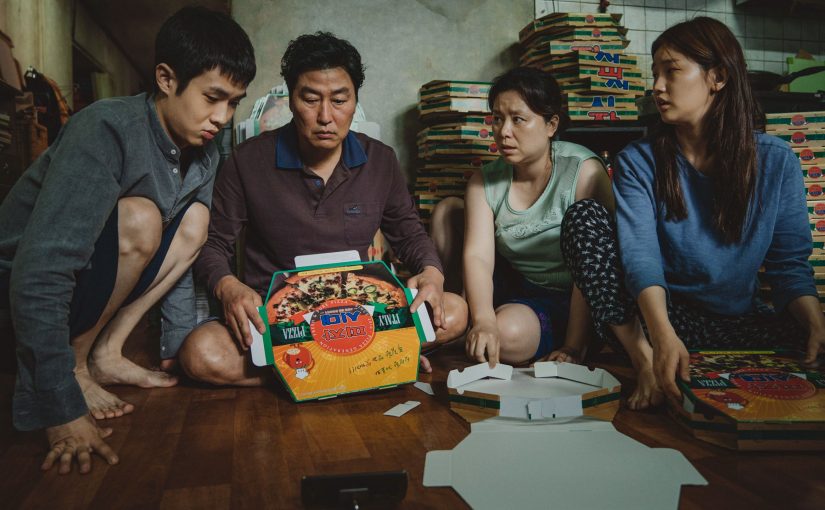
The plot involves a nuclear family, the Kims (father, mother, college-aged son and daughter), living in near-poverty in a sub-basement.  They fold pizza boxes to make a little cash.  They steal wi-fi from a shop next door.  When fumigators spray outside their street-level window, they open it wide to take advantage of the free pest control.  They aren’t starving, but they are desperate.  Yet they don’t appear to be beaten down by their condition.  They’ve become a family of hustlers, not in any criminal manner, but in ways that enable them to get by on the bare minimum until one of them can get a leg up.

Opportunity knocks one day when a friend of the son, Ki-woo, gets him a job as an in-home tutor for the high-school daughter of a wealthy family, the Parks.  Ki-woo changes his name to Kevin, then suggests to Madame Park that her 7-year-old son could use an art tutor.  This gets his sister, Ki-jung hired.  She changes her name to Jessica and finds a creative way to get her father hired as Mr. Park’s personal driver.  Then the Parks’ long-time housekeeper somehow has to be eliminated so the MOTHER can get hired.

Before long the entire family is working for the Parks, though it’s important to note the Park family has no idea their new employees are all related.  This is all done with great humor, not in a farcical way (that will come later), but in such a way that you find yourself rooting for this down-on-its-luck family of con artists to finally get a taste of the good life.

There’s a long scene where the Parks have gone camping, and the Kims gather in the enormous living room of the Parks’ lavish home and just sit and eat and drink and talk and get drunk.  This is the family drama/social commentary part of the movie.  There’s something a little sad about seeing these people who are like any other people, who seem no less deserving than the Parks, but their best-laid plans have come to nothing, and the highlight of their lives is to get hammered in somebody else’s house.  Suppose Kevin falls in love and decides to marry the girl he’s tutoring, when she’s a little older.  Who will they get to be his parents?  Will they need to hire actors?

Trust me, I haven’t spoiled ANYTHING.  Swearsies.  This movie is brilliantly, ingeniously split into two parts.  The first half is prologue.  The second half is genuinely, literally breathtaking.

Something happens that forces the Kim family to examine and re-evaluate their life choices up to the present.  It also forces them to do some very fast thinking indeed, which is where some of the funniest and darkest comedy takes place.  This is where the movie really takes off, where it had me reminiscing about the twists and turns in Pulp Fiction.

And nothing…nothing can prepare you for the finale.  About which I’m saying nothing.  Again.

From a cinephile’s perspective, Parasite is miraculous.  It manages to be several different things all at once, allowing you to savor every individual aspect of it without any one part of it overpowering the other parts.  The screenplay is unbelievably inventive.  The direction is sure-footed and masterful.  The acting is pitch perfect throughout.  It made me think, it made me laugh, it made me cringe, it made me say, “Oh S#i+!” MANY times, and it made me bring my hand to my mouth like a shocked Victorian-era woman many, MANY times.

I say again.  The hype is real.  You owe it to yourself to see this movie whenever you can.

[Ed. note: the Criterion blu-ray of Parasite contains an interesting experiment: a black-and-white version of the film, which is apparently how the director originally envisioned the film, and which might account for its stark imagery in places.]

BROKEBACK MOUNTAIN (2005)

By Miguel E. Rodriguez

Director: Ang Lee
Cast: Heath Ledger, Jake Gyllenhaal, Randy Quaid, Michelle Williams, Anne Hathaway
My Rating: 10/10
Rotten Tomatometer: 87% Certified Fresh

PLOT: The story of a taboo romantic relationship between two cowboys, and their lives over the years.


Brokeback Mountain is the kind of movie that makes me wish I was a better communicator, like Lost in Translation.  I know I love these movies, I know WHY I love these movies, but it’s difficult for me to put into words.

Brokeback is, of course, the movie that will forever be known among the snark peddlers as “that gay cowboy movie,” which is insultingly reductive.  That’s like referring to Star Wars as “that space movie.”  To reduce the movie to those terms is to totally ignore the boundless riches to be had by watching it, I mean really watching it.

For one thing, damn, just LOOK at it.  Look at the way the skies fill the frame, with clouds hanging heavily over the mountains and the dusty streets and the trailer parks.  Director Ang Lee makes the sky into a tangible character all its own, much like Kubrick did with the Overlook Hotel.  It infuses every outdoor scene with a sense of the largeness of the world around us.  It’s a fitting backdrop for the intimate story presented to us.  In fact, those huge scenic backdrops are kind of a throwback to the ‘70s, to the films of Cimino and Arthur Penn and Bertolucci, when painting a picture with the camera was two-thirds of the story.  Virtually every outdoor scene in Brokeback Mountain is worthy of framing in an art gallery.  Stupendous.

The movie turns on the story of two men who unexpectedly and passionately fall in love in 1963, a time when gay love was still taboo, at least in polite society, and especially in any given cowboy community.  But as the story winds its way through almost twenty years in the lives of these men, it becomes less about the FACT of their affair, and more about the enormous sense of yearning and loss that comes from desperately wanting something that you can’t have.  Who among us has never felt that kind of insane desire?  Not necessarily for a person, even, but for anything at all?  A crippled man who longs to walk, or a blind man who yearns to see.  A dream job.  A dream vacation.  That’s what this movie is about.

Heath Ledger delivers the performance that really put him on the map.  His portrayal of Ennis Del Mar is incredibly subtle, although his Western accent flirts with impenetrability at times.  I love the way he shambles and mumbles through his role, virtually the entire movie, which pays off in that fantastic scene by the lake (“I wish I knew how to quit you!”) when this hulk of a man is torn down by his own unspoken passion.

Again…I’m not a poet, so this really doesn’t quite get at the mood generated by the movie.  It’s no feel-good film, that’s for sure, but it’s worth seeing by anyone who loves world-class storytelling.  Don’t let anyone, or your own preset notions, steer you different.

THE FRENCH CONNECTION

By Marc S. Sanders

Popeye’s in town.

“You been picking yer feet in Poughkeepsie?”

One of the first gritty crime dramas.

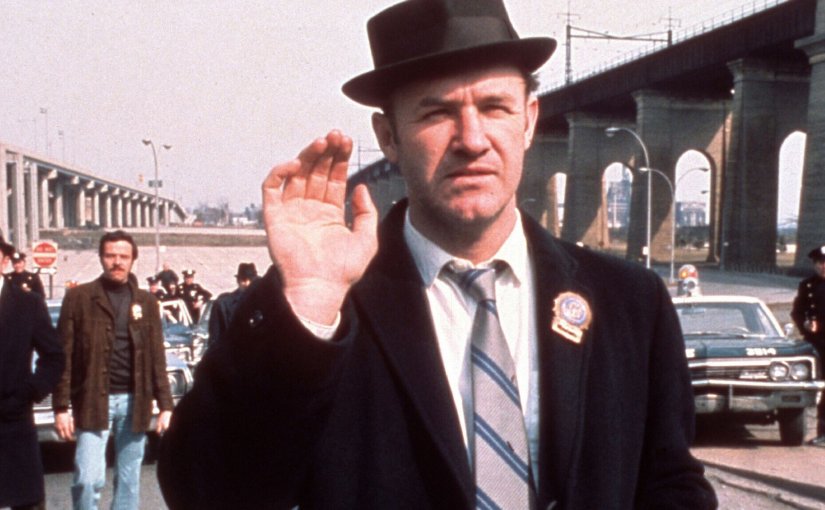
With modern cinema offering huge bravura performances a la Daniel Day Lewis or Christoph Waltz these days, it’s any wonder that today’s generation of movie goers would be puzzled that Gene Hackman won the Best Actor Oscar for this film, The French Connection, which also happened to win Best Picture. His character has no big monologues, no huge crying scenes. In fact for most of the film, he’s slamming guys up against a wall or following them up and down the dirty Brooklyn streets. Yet, his accolades were nothing short of deserved.

Watch as Hackman’s Popeye Doyle gradually exhausts himself in pursuit of “Frog 1.” His character starts out as a thrill seeking detective only to find his limits pushed against a better cat and mouse player. Dialogue isn’t sophisticated here to show his state of mind, but rather his expressions offer everything. Simply look at his close up following the extensive car search (an incredibly satisfying scene for me as a viewer).

If that’s not enough, the car/foot chase through Brooklyn is one that still has not been matched. See how it was done before CGI.

A simple drug deal is plotted perfectly from Marseille to New York, and best of all, it is all true (well mostly).

What’s most curious is the film provides one of the oddest and most unforgiving endings in a film ever. Perhaps you’ll agree (????). But, remember…THAT IS HOW IT HAPPENED!!!!

This was a film from 1971 that was raw in its language, gritty in its setting, spiteful and unafraid of the image it would leave, and that is why it won Best Picture, Best Director and Best Actor.

Bottom line, it would never have been made today. Never!

(Word of advice, ignore the sequel. A prime example of Hollywood shamelessly cashing in.)

SUNSET BLVD

By Marc S. Sanders

One of Billy Wilder’s most famous films is Sunset Blvd. A film that’s always escaped me despite seeing two productions of the stage musical, most recently on Broadway with Glenn Close as Norma Desmond. No matter how it is interpreted, it is a haunting story narrated from the grave of young screenwriter, Joe Gillis. In the 1950 film, Joe is played by William Holden. Norma is played by Gloria Swanson, with Erich von Stroheim as her butler Max.

Joe is a down on his luck screenwriter trying to avoid his car being repossessed. Events lead him toward hiding the car in the garage of a mysterious mansion belonging to one time silent film star, Norma Desmond, now obsolete during the age of talkies. She was big at one time. Though Norma insists she is big. “…it’s the pictures that got small.”

Joe is caught in Norma’s web, feeling obligated to write her story while she provides him with all the money and clothes that she can, to keep him close with no opportunity to escape. Even a sneak away to a New Years Eve party leaves Joe feeling compelled to return to Norma where Max has set up living quarters for him.

Holden’s voiceover narration is wry and descriptive like a novelist’s words being emoted vocally. Feelings are shared allegorically. It lightens the mood of Wilder’s film which is a quite dark and strangely sad depiction of a one time film star who has aged amid her isolation and is all but forgotten among the Hollywood elite. Even Cecil B DeMille (playing himself) doesn’t carry much interest in Norma anymore. It’s especially quite telling later in the film when she unexpectedly shows up on the Paramount lot. She had been called upon, but not necessarily for a new role, rather something else entirely.

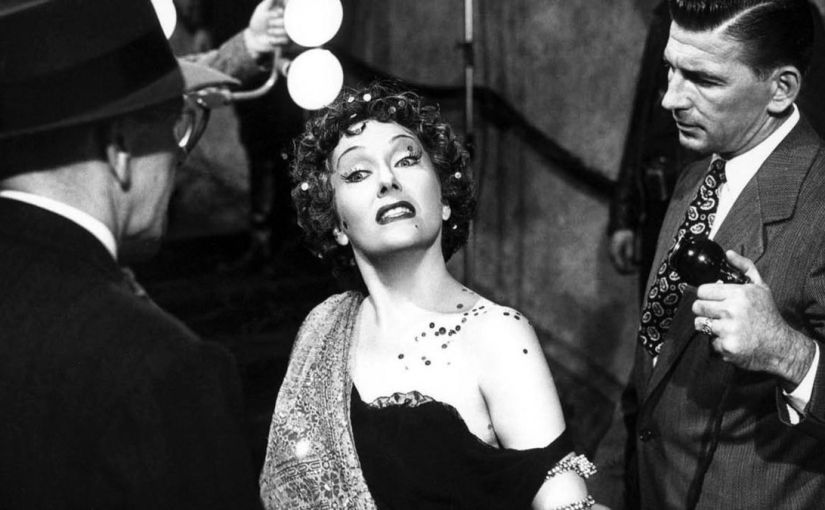
Swanson is unforgettable as Norma; one of the greatest and most memorable film characters to ever grace the screen and the part is drawn out so well within the Oscar winning script from Wilder and his long time collaborator Charles Brackett. Swanson gives honesty to Norma’s madness; look at the famous final stair descending scene. It doesn’t get much better or more impactful than that. Don’t believe me? Go watch Carol Burnett spoof that moment. It’s one of the greatest cinematic moments ever placed on celluloid.

I digress.

Yet, I get Norma’s refusal to accept the changes to Hollywood films. She tells the modern screenwriter, Joe, that back then they had FACES, not dialogue. I get it Norma. I truly get it.

Joe is challenged to maintain his own present state of mind. He’s a writer with ideas like a baseball picture. Only he needs a producer to invest. Sure the money comes to him easy from Norma but it’s conditioned under her rules and unwavering possessiveness. It’s a shame when Joe only gets an opportunity at something following meeting Betty Schaefer (Nancy Olson), a pretty, up and coming writer herself, and engaged to his best friend. Joe is stuck. He has to be covert in sneaking away to write with Betty unbeknownst to Norma. Worse, he has to resist the urge to get intimate with Betty as well. Joe has multiple problems to contend with here all stemming from being stuck in someone else’s past that offers no stimulation sexually or creatively. Wilder and Brackett pen a perfect character conundrum. Joe has no escape.

It may sound silly but I couldn’t help but think of Paris Hilton while watching Sunset Blvd. I’ve never followed the heiress’ comings and goings. However, I recall a time in the early 2000s when Hilton would be all over reality TV. She was in every magazine and on every gossip headline. Not anymore. Reality TV, like network TV, is losing its flame quickly to the newest medium of streaming services. Hilton is now 15 years older. (Desmond is only 50 in the film, when she’s all but washed up.) Could Paris be wondering what’s become of her starlight? Is Paris waiting for the “Joe” who she’ll insist on being her boy toy? My mind actually drifted towards this subject!!!!

If anything, it tells me that Sunset Blvd still holds relevance. Mediums change and those that were once prominent sadly become obsolete. Either we change with the times, or we opt to be abandoned by an ever developing future.

Sunset Blvd should be seen simply as a reminder that our history never stays stagnant. However, a danger lies in refusing to move on or in Norma’s case losing the opportunities to move on. We might all be ready for our close up Mr. DeMille, but doesn’t that mean someone needs to be holding the camera?

PULP FICTION

By Marc S. Sanders

No one can deny that Quentin Tarantino’s classic film, 1994’s Pulp Fiction is one of the greatest screen accomplishments of the latter half of the 20th century. It’s strange, lurid, scary, unforgivingly funny and altogether different from practically anything that came before it. How did the Weinstein brothers with Miramax films prophesize the energy it would surge in mainstream audiences?

When I first saw the film I was apprehensively going with two college friends who insisted I see what they experienced from a prior viewing. Suddenly, I realized that alternate surf 70s rock, black suits, and a kinetic visit to the restaurant known as Jack Rabbit Slims could entertain and make me look further than just a facial close up.

Tarantino entertains the lens of his camera by making his audience the camera. A drug dealer scrambles to find a medical book to awaken a boss’ wife who is dying from a potent heroin overdose, and the camera stands in place only frantically swinging left and right. The camera doesn’t move while everyone in the scene remains in a panic, frightened of administering an adrenaline shot. The camera stands still to allow the audience to stand in the room as well. It’s very unusually funny, but unnerving and suddenly we are amid the clutter of crime and drugs frightened of a terrible fate.

Another scene follows two gangsters down the hall as they debate whether a foot massage equates to fellatio on a woman. They look serious as they earlier regretted bringing shotguns to their destination but here they are having a debate likely reserved for men’s locker room talk. Is a foot massage really worthy of dropping a guy out of a four story window into a glass enclosed garden below? I mean, apparently the poor guy developed a speech impediment.

Tarantino used Pulp Fiction as an excuse to show how criminals inadvertently lead their lives to the unexpected, beyond a cliché cop bust. Two guys might be settling a personal vendetta, but somehow get interrupted by a redneck gang rapist and his chained up “gimp.” Two other guys might be trying to deliver a briefcase and yet somebody’s brains splatter all over the inside of a car. Another guy might have left behind a family heirloom gold watch as he and his girlfriend run for their lives, or they might suddenly acknowledge a moment of clarity when death seemingly walks out of a bathroom door.

Some might not agree but I always consider Tarantino’s colorful film characters to be rather two dimensional. What you see is all you see. There are no hints at an underlying motivation or a background to anyone you meet in Pulp Fiction, or any of his other films. Normally, that’s a negative in my book but with Quentin Tarantino it is what’s expected. He’s a masterful script writer of the situation. A well known fan of kung fu and lurid crime movies of the B variety, gangsters like Vincent Vega, Jules Whitfield, Marsellius Wallace, Butch Coolidge and Winston Wolf (even the names are entertaining) get caught up in just a random moment in time. Beyond the incident nothing else matters, and just to make it fun Tarantino uses his favorite editor, Sally Menke, to scramble everything out of order. I like to think the script was assembled this way to demonstrate that what happens in one instance doesn’t reflect what happens in another. Every brief moment is bookended. Again, two dimensional characters who don’t reach an intended karma. It doesn’t matter what’s been done before or what will be done next. It only matters in the moment.

The cast is great. Likely, you know who all the players are by now. The best compliment is that they obviously listened closely to the director’s vision. They spoke his language which had yet to be very mainstream before this film’s release. They are a pioneering cast of great talent and many owe quite a bit to Tarantino for jump starting and reviving their careers.

Pulp Fiction is a rousing expedition in sin and surf music symphony with endless quotable and un-PC dialogue that revolutionized filmmaking and brought about risk taking movie makers. It’s just exciting and fun and wild and it especially became a favorite upon seeing one of my favorite kinds of scenes-a dance sequence. If you incorporate dancing into a non musical film, you’ll likely win me over.

Spoiler alert: Vincent & Mia win the dance contest, and right they should. Chuck Berry’s “You Never Can Tell” became that other popular film song once Pulp Fiction hit the scene.

Thank you Quentin Tarantino.

GREEN BOOK

By Marc S. Sanders

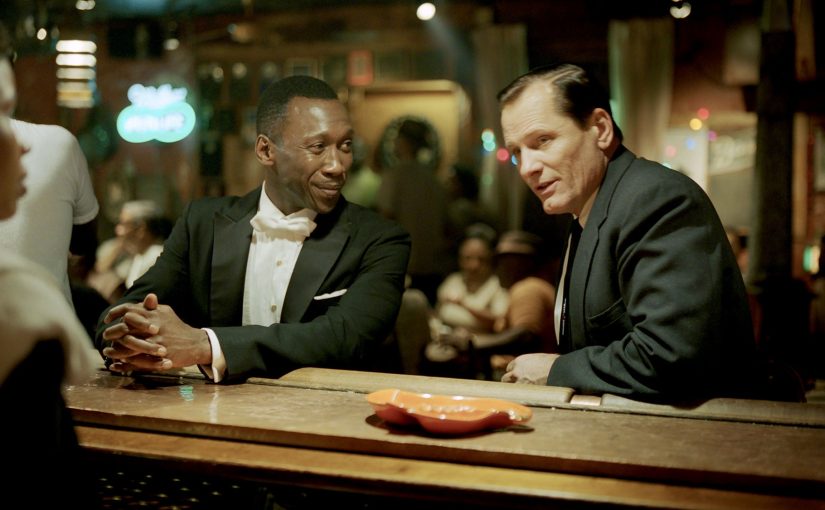
The biggest surprise of Green Book is who its director is, the unlikely Peter Farrelly of The Farrelly Brothers, directors of Dumb & Dumber and There’s Something About Mary. Yet, when I reflect on the film it should not be a surprise. The Farrellys are known for raunchy humor, but often it stems from an honest source. When Viggo Mortensen’s character Tony folds an entire pizza pie in half and then scarfs it down whole, that’s a Farrelly touch but likely also what an Italian club bouncer raised in the Bronx would do without any consideration. He’d also win out in hot dog eating contest. Mortensen’s character is a far cry from his Russian Heyman in Eastern Promises or Stryder in The Lord Of the Rings. The pizza and hot dog scenes are great moments in a film weighted down by the Uncle Tom mentality of Deep South USA in 1962. Peter Farrelly needed to direct this film, and it just might be the best picture of the year.

Tony (or “Tony Lip” as he’s known among his peers) is hired by Dr. Don Shirley played with such eloquence by Mahershala Ali. Dr. Shirley is an African American pianist, arguably the best in the world and ready to embark on a tour of the Midwest to Southeast of the country. It’s not that simple however as Dr. Shirley is all too aware of the racial prejudice that will befall him. Tony is hired to be Dr. Shirley’s driver as he has the toughness to look out for Shirley in the event that it is necessary. Sadly, the film shows that Tony is more than necessary.

There’s much comedy here between Ali, playing the well spoken “Felix” role, against Mortensen in the “Oscar” part. Tony and Don are worlds apart having virtually no understanding how the other half lives or what they are forced to compromise with on a daily basis. The hardships that Green Book offers focus more on Dr. Shirley as he is forced into humiliating circumstances where he is offered only an outhouse to use or denial of entry into a dining room. He could be wearing the sharpest of tuxedos, while Tony is a self aware “goombah” slob with no civility and Dr. Shirley remains the one to be overlooked. His value to Deep South America is to play his Steinway piano like meager jester.

There’s much to learn about our country’s mid 20th century history in Green Book. It’s a film I encourage families with pre-teen children to see. Not only will they learn of disillusioned hatred and treatment of black minority, but they will be entertained as well. References to Robert and John Kennedy are presented as well Aretha Franklin, and a Boston Celtics player (Name I cant recall).

The comedy that Farrelly brings keeps the audience engaged. The best dramas possess great comedy like Steel Magnolias, Terms Of Endearment, The Help, and even Kramer vs Kramer. If we can laugh along with our characters, then we will appreciate them that much more when harm and pain strikes. We want to ease their pain and be angry for them when those moments arrive. Their comedy of natural behaviors breeds affection for them. When they are compromised, we cry for them. Farrelly executes this format perfectly.

Mahershala Ali is a stand out here. He is snobbish at times towards the unmannered Tony but he is never deserving of his dismissiveness. He is a victim of the “colored mentality.” If not for the color of his skin, Dr. Shirley would have been regarded by all as a man of integrity; a hero to the American people. Sadly in 1962, many could not see past skin color. Thankfully, a great moment towards the end reminded me that it was in fact many…but not all. Watch the movie, and then tell me if you know what I’m referring to.

Remember, this is probably the best picture of 2018. Bring your children to see Green Book. Keep your children aware.

PARASITE

By Marc S. Sanders

I first discovered director Bong Joon-Ho when I watched his futuristic sci fi adventure Snowpiercer. I loved that film despite how absurd the set up was. Absurdity, though, is a credit to his craft. That’s why his latest film Parasite is a hugely successful interpretation of class warfare within South Korea. It might all appear drastically unlikely. Yet, it’s all absolutely possible when you reflect on the film after you’ve seen it.

Parasite begins almost like a farce and ends in deep, realistic horror that you’d never expect, even after you surpass the films midway surprise.

It’s best I leave much of the film’s details out. The less you know the better. I knew nothing at all about the film beyond the numerous accolades it has received. I was better off for it.

Joon-Ho’s film makes its point quickly that there is always someone better off than us and always someone worse off. (This was a theme carried over from Snowpiercer.). A poor family living off scrap money for folding pizza boxes while living in a cramped, bug ridden basement is still better off than the drunk who pisses on the street, outside their window. Just as an upper class family with all the best things in life are better off than them.

It’s only when this poor family find opportunity to dupe their way into this wealthy home through jobs they are hired for that we eventually see how lighthearted material, compliments of Joon-Ho and his writing collaborator, Jin Wan Han, can convincingly escalate into class warfare politics that even their characters ever hardly acknowledge, or are aware of. Is the wealthy matriarch really aware where her family chauffeur stems from or where he lives? The off putting scent of someone’s presence can quickly turn a tide or an impression.

I might sound vague, but I have no choice. It would be a betrayal to the imagination of the best film of 2019 if I spelled the film out for you.

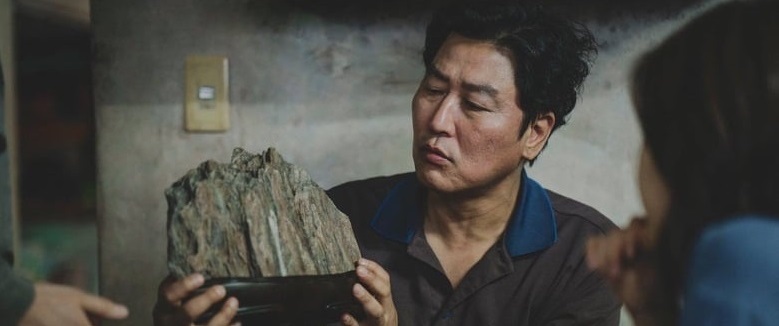
Simply know that I truly appreciate the symbolic research Parasite presents as it makes note of a Korean child’s fascination with Native Americans, and how their plight parallels the story. Even that drunk taking a piss on someone else’s territory. Even the gift of a stone sculpture told me how one can be crushed or weighted down by his own country.

Parasite begins as one movie and ends as maybe five other different movies. It’s a farce. It’s wry and conveniently ironic; maybe silly at one point. It’s suspenseful and surprising. It’s also shockingly horrific.

I recently declared Clint Eastwood’s film Richard Jewell the best film of year. I stand corrected.

Parasite is the best film of the year.

DRIVING MISS DAISY

By Marc S. Sanders

Mainstream films released by big studios suffer from a major problem these days.  Too often, they don’t allow their characters to breathe.  Films today rush to the climax or the action or the cliffhanger that’ll whet our appetites for a sequel or a crossover or a toy product.  Bruce Beresford’s Driving Miss Daisy escaped all of those conventions.  In fact, I’d argue that Beresford made a buddy picture with his Best Picture Winner based upon Alfred Uhry’s well received play.

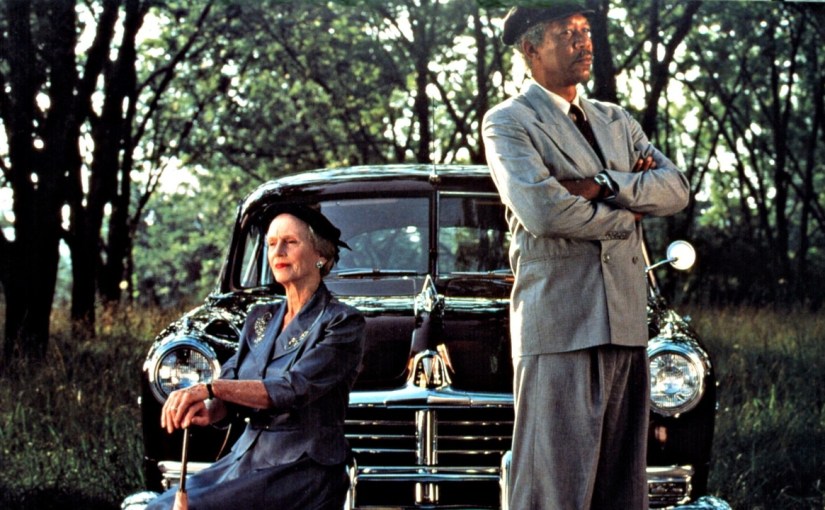
Daisy Werthan (Jessica Tandy, who won the Oscar, and held the record for oldest recipient) is an insistently independent old southern Jewish woman living in Georgia.  She drives her car where she wants to and whenever she wants to go somewhere.  However, following an accident in her driveway, her son Boolie (Dan Aykroyd in a very surprisingly good performance) breaks the hard truth to Daisy that her driving days are over since it’s likely no insurance company will ever affordably cover her.  Boolie recruits Hoke Colburn (Morgan Freeman in one of the most gentle and delicate performances of his amazing career) to chauffer the proud woman around her Georgia neighborhood.  Naturally, Daisy does not take well to Hoke at first.

The film begins in the 1950’s and then spans roughly 20 years from that point.  I love how Beresford presents the passage of time.  The cars that Hoke carries Daisy in change as the years go by.  As a new car is shown parked in Daisy’s garage, the relationship and eventual friendship of Hoke and Daisy become stronger and, on some occasions, franker and more honest.  With Hans Zimmer’s energetic score that seems to accelerate the speed of the automobiles Hoke drives, Driving Miss Daisy feels like a very sweet and tender film.  It is.  Moreover, it’s an alive picture.  However, the film does not ignore the prejudiced mentality that’s embedded within the south.  A telling moment occurs when Hoke is driving Daisy to a family gathering in Alabama.  Why would an elderly black man with an elderly Jewish woman sitting in the back seat be met with such disdain by policemen who question their presence while eating lunch on the side of the rode?  I won’t repeat the officer’s comment here, but it is ugly and a sad reflection of how things were.  Are things still that way?

Uhry’s script adaptation from his play does not stop there though.  He questions Daisy’s own stance.  She takes no issue with black people catering to her and her home on regular basis, and she becomes enamored with Martin Luther King’s inspiring wisdom.  So, when she is given the opportunity to see Dr. King speak in person, it only makes sense that Hoke will question why he was invited last minute to join her.  After so many years of servitude, why did Daisy wait until Hoke literally drove up to the location of the speech to invite him in?  I’d argue that it never occurred to Daisy, and I think Alfred Uhry believed that is part of the problem.

Both Daisy and Hoke experience anti-Semitism and racism in the mid twentieth century south.  Ironically, the film demonstrates that common victimization is one reason why they need one another.  I’m thankful that Beresford does not show a burning synagogue for dramatic effect.  Instead, he relies on Uhry’s dialogue as Hoke breaks the news to Daisy when they are on their way for morning Shabbat services.  How does Daisy feel in this circumstance?  The synagogue can be rebuilt.  The horror of knowing this kind of hate exists will never be erased.  That’s the terrible shock.  As well to empathize, Hoke describes how as a child he saw his uncle get lynched and hung from a tree.  Daisy and Hoke unite in the hate that surrounds them.

The performances of Freeman, Tandy and Aykroyd are exquisite.  Their dialect for each of their respective characters rings so true of the Georgian southern regions they stem from.  Freeman has an enunciation that rings of a black man who never learned to read.  He even develops a laugh that seamlessly works into his dialogue and reaction to Daisy’s stubbornness.  His posture is marvelous as an elderly gentleman who will walk slowly while hunched over.  It just looks so natural. Aykroyd is in no way doing one of his comedy characters.  He carries the gut of a well-fed southern man who’s become successful with his family business while not taking every fit that his mother has so seriously.  If any of us have had to tend to an elderly relative, then we can certainly relate to Boolie’s position.  Tandy is wonderful at method acting; it should be studied in performance art classes.  She was an elderly woman already when cast in the role.  Yet, as the years carry on through the story, she changes her gait to how this woman’s bones might become more brittle, or how she might speak slower or smile or frown or chew her food.  She has such a fire in every one of her scenes.  A heartbreaking scene where she appears to be having a frantic form of dementia is very eye opening as she paces her historic two-story home looking for papers she graded years earlier as a teacher.  The younger Freeman (playing a far older man) has to keep up with Tandy in this moment; even Beresford’s steady cam has to move quickly to keep focus.

Recently, I had reviewed Terms Of Endearment, and I alluded to the fact that not enough films about middle age people are focused upon, or at least given the commercial attention that they should be given.  Why is that?  So many middle age and elderly characters are so interesting.  I said it before.  Look at The Golden Girls sitcom.  After all, characters with more years behind them have had more moments to live and breathe. Actually, they have a longer history with more nuances and meaningful events they have already encountered, as opposed to twenty somethings with hot cars, pecs and guns.  Film studios are missing out on a wealth of great storytelling. 

Driving Miss Daisy is well paced story of friendship and fear, and often natural comedic material within its three lead roles.  It’s never boring.  It’s only more and more interesting as the years of the story pass by.  It’s simply an endearing buddy picture of the finest quality. 

CRASH (2005)

By Marc S. Sanders

Paul Haggis’ vignette themed script for Crash should not have won Best Screenplay. The film he directed should not have won Best Picture. Could it be that because this picture is masked as that special movie with that especially poignant message that it got the recognition I don’t think it ever deserved? I can appreciate the attempt at bringing hot button social issues like racism and injustice to light, but it does not need to be as immaturely contrived as this picture.

Crash occurs over two days within the city of modern day Los Angeles. A select group of characters of different social classes and ethnicities are covered, and the film circumvents back and forth among their perspectives. For the most part, all of these people have major social hang-ups with people outside their race. The first example shows us that if a white woman who is simply cold on a winter night hugs her husband tightly for some warmth, apparently a couple of black men will automatically believe this woman is fearful of their approach.

Especially today, I know that prejudice exists, but to this extreme and this contrived…I’m not sure. I guess I’m not sure because I have not experienced it enough to be convinced yet. When I read a friend’s testimony of falling victim to racial prejudice I lean towards believing everything they tell me. I guess it’s this movie, Crash, that left me feeling dubious and maybe that’s because the circumstances seem way too forced.

A racist cop (Matt Dillon) will pull over a well to do Muslim man (Terrence Howard) driving a high priced SUV and perform a sobriety test for no reason. Then the cop will deliberately frisk the man’s wife (Thandie Newton) with digital penetration. The next day, it’ll just happen to be that this woman will have no choice but to be rescued from a burning car by this same racist cop. Now I’m supposed to believe that the racist cop is not so bad, and the woman learns to become more tolerant. Well gee, thank heavens for coincidences!

The Muslim man (a television show director) gets car jacked the following day, and in a tense pull over moment he’s mistaken as the criminal. Fortunately, the partner of the racist cop (Ryan Phillipe) is there to subdue the situation. I’m sorry, but life doesn’t work out to be this tidy. Call me cynical, but more often than not we are not given a second chance at first impressions.

One of the real car jackers (Chris “Ludacris” Bridges) gets a moment of clarity and suddenly he’s generously giving out his last forty dollars to a group of Asian people being held in a van for human trafficking. Forgive me. If I want to begin respecting this car jacker who has held multiple people at gun point and even runs over a man, only to toss him out on the drive up to the Emergency Room, I’ll be more apt to do so if the criminal turns himself in.

I dunno. Maybe I’ve got a personal issue with Crash. It could not be more apparently preachy in how it patronizes me to simply understand the seething hate and criminal violations of its characters. I’m supposed to empathize with the racist cop because his ill father can’t get the health care he’s entitled to? I’m supposed to understand the prejudicial anger that the WASP wife (Sandra Bullock) of a District Attorney (Brendan Frasier) expresses because she no longer trusts her dedicated Hispanic housekeeper or the locksmith (Michael Pena) changing the locks on their house following a car jacking?

No. Paul Haggis didn’t earn that response from me in almost all of the short story scenarios his film offers. Maybe it’s because I tend to compartmentalize my episodes. I like to think that I don’t allow one experience with one kind of person cloud my judgement on the next person I encounter. A waiter can totally screw up my order and can even mouth off to me in a heated moment. Yet, I’ll return to the restaurant on another occasion because it’s likely I’ll run into a different waiter.

Haggis depicts people who appear to have a blanket opinion of other people with different backgrounds. These are all extremely prejudiced people with next to no understanding of where each of them stem from. An angry Persian man (Shaun Toub) puts blame on the locksmith after his convenience store is ransacked. The locksmith was only trying to explain that the back door needed to be replaced. The Persian refused to listen because his English is limited. So he just gets angry and curses the locksmith out. Haggis opts to insert a language barrier between the two men to serve up an eventual tense and dramatic moment in a neighborhood driveway with a loaded gun and a little girl. A loaded gun and a little girl! Yup, I think they teach these are the true ingredients for effective drama on the first day of screenwriting class. Again, it all comes about a little too forced.

The conveniences and ironies that bubble up at times are surprising. “Oh that guy is that guy’s brother! I see.” Things like that. However, I don’t think that is necessarily the strength of the picture.

In a film like Magnolia, we are treated to the vignettes of a handful of people too. However, not every single one of those people are sketched by means of their prejudiced natures. They are drawn by a variety of different elements whether it be a traumatic past or an inclination to do good. Then it’s kind of fun to uncover how each player is connected to one another.

In Crash, the players are only connected by the hate they carry within themselves, and Paul Haggis forces a redemption upon most of them with small gestures or a line of dialogue or the purity of a welcome snowfall to close out the film. Sorry, life is lot more messy and complicated than that. I guess I’m saying I may have learned a lot more about human nature from a downpour of frogs than a downpour of snow.