By Marc S. Sanders
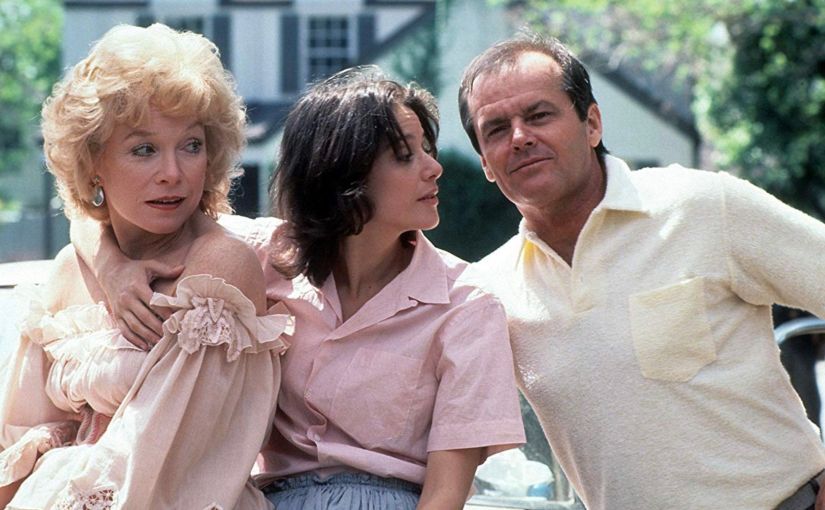
Acclaimed television writer James L Brooks’ first feature film was the 1983 Best Picture Winner Terms of Endearment. The movie succeeds in more ways than one because of its varied relationships among the characters. You have Aurora Greenway (Shirley MacLaine) and her daughter Emma Greenway-Horton (Debra Winger). There’s Emma and her husband Flap Horton (Jeff Daniels). There’s Aurora and Flap, and then there is Aurora and her neighbor Garrett Breedlove (Jack Nicholson). Sounds like a lot to take in for a two hour picture, and yet Brooks manages to adapt a script from Larry McMurtry’s novel that smoothly covers realistic depth and dimension among these characters, and how they connect with one another. Brooks is at least an incredibly efficient writer/director. Honestly, I’m not complimenting him nearly enough.
Shirley MacLaine provides one of the best female performances to ever grace the silver screen. She doesn’t have to utter a word of dialogue to say so much about how Aurora feels. One of her greatest facial expressions is when she is addressed by her grandson as “Grandma!” This moment is so utterly hilarious that the studio selected it to close out the original theatrical trailer. If anything is going to get you in the seat at the theatre it’s this moment. Aurora is a widow who can be difficult to please, judgmental and always conscious of her part in the world-even while she is hosting multiple gentlemen suitors in her Houston, Texas home. This character is so powerful that it is hard to understand why Hollywood really never followed suit with presenting more films focused on the middle age woman or man. There are still interesting things to be found in being a widow and dealing with ageism, motherhood and a resurrection of sexuality. Think about The Golden Girls which dominated television sets on Saturday nights for most of the decade.
Aurora disapproves of Emma marrying Flap. Flap has no imagination or drive and is as devoid of affection as his name suggests. Best he can do for Emma and their three children is find whatever college professor job he can muster and uproot his family from one mid-western state to another. Emma knows of her mother’s disdain for Flap, and can’t disagree with her. She knows Flap is a loser, but if it means aggravating her mother then it is worth it at least to marry him. Early in the film it amuses Emma to frustrate her mother a little more and a little more. Contrary to Aurora’s instincts, Emma is naively unaware that life settles in soon enough and the happy nuptials fade away.
Still, Aurora and Emma have a strong mother/daughter relationship where numerous phone calls each day happen between them. These conversations consist of Emma reluctantly telling her mother that she may be pregnant, yet again, or that Aurora is proud to let her guard down and approach the boorish, drinking next door neighbor astronaut, Garrett, played with a devil may care seductiveness from Jack Nicholson. Aurora’s serene peacefulness in her beautiful backyard garden and home is always disrupted by Garrett’s loud bellow before diving into his swimming pool. Still, she can’t help but be attracted to him while putting on a façade of disapproval in his presence. The first lunch date that Aurora and Garrett share must be one of the best dates ever depicted on film. The scene might have been written and staged by Brooks, but it is thankfully hijacked by Nicholson and MacLaine. One of the funniest moments to ever come out of 1980s cinema for sure. There’s much reason that MacLaine won Best Actress and Nicholson won Best Supporting Actor. These actors easily stage a scene of realistic comedic chemistry while later expressing deep rooted drama and affection with one another. Not easy to do all in one film.
Brooks masterfully writes these characters with such authenticity that you find yourself legitimately laughing at a scene or a piece of dialogue, while the person sitting next to you might embrace the dramatic element of the very same moment. Both responses to random moments in Terms Of Endearment allow varied reactions like that. When Emma suspects Flap of committing adultery, pay attention to the dialogue and the performance from Winger and Daniels. Emma allows Flap to dodge a lie he’s about to tell by warning him that he may have just lost his senses, but if he continues down a wrong path, then he will end up worth less than he already is. He doesn’t fight her on that observation. Hard to explain here but listen to the vocabulary Brooks applies to Emma’s dialogue and watch how Winger traps Daniels. You may nod with a smirk, or you may feel frightened for Emma and her marriage.
I always say Terms Of Endearment is a comedy first and a drama second. The film steers towards a frightening fate for the Aurora and Emma. However, before that third act sequence there is so much to treasure, love and laugh at in the film. When a cloud of imminent loss feels like it may approach, that is when the dramatic elements step forward. To truly feel loss, you had to treasure wonderful moments with a loved one or a friend. You had to value something important in your heart and soul to feel so terribly frightened and mad and hysterical when days might seemingly appear numbered. James L Brooks and Larry McMurtry remind us of that. Every person on the planet is destined for this feeling at one point or another. What happens when the inevitable arrives is what sustains Terms Of Endearment to it’s satisfying end. A character may appear on a hotel staircase to reconnect with support. A hug goes a little longer than expected, and for the first time the one who normally lets go first actually tries to keep the moment frozen in time. A gift from long ago is recovered to touch someone emotionally. Brooks includes all of these moments in his film and that’s what I embrace most importantly. Cinematically speaking, these points in the film are heightened by a memorable soundtrack of quirkiness and passage of life from composer Michael Gore. His music is so effective that it has been used countless times over to enhance trailers for other films marketed at audiences that this picture was catered for.
Yes, after numerous viewings, Terms Of Endearment never fails to me put me in tears. Like ugly crying! I prefer to watch it alone actually, because I connect with the characters differently than most people I know, including my wife. It’s a very personal film for me. It reminds me of loss that I have felt and experienced. More importantly though, it reminds me of all I’ve had, and all I continue to hold on to. Terms Of Endearment is one of my favorite films.