SEVEN

By Marc S. Sanders

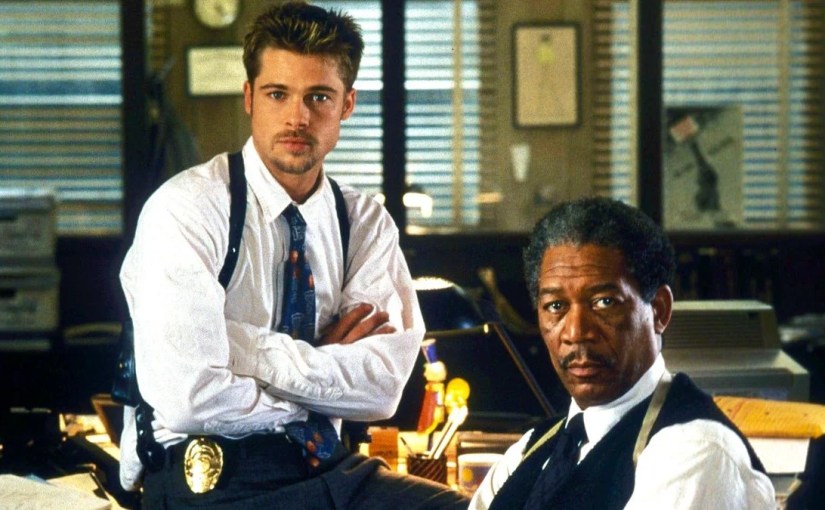
There’s an interesting dynamic to David Fincher’s Seven that is not touched upon often enough.  Beyond the clever and grisly murders set to a theme of the Seven Deadly Sins, the two police detective protagonists are carved from completely different molds.  The spine of Fincher’s film, written by Andrew Kevin Walker, focuses on how these men approach the craft of the killer’s accomplishments.  One man wants to cut to the chase, find the criminal and cuff him.  The other wants to study the nature of this mystery man, and only then will it lead to the suspect’s true identity.

Detective William Somerset (Morgan Freeman) stems from a time gone by for the cinematic detective.  He’s the trench coat wearing investigator who examines and connects dots, never resorting to fists or police intimidation with a gun.  Newly assigned Detective David Mills (Brad Pitt) dons the leather jacket with the cute goatee and boy blond haircut.  He’s more apt to making fun of the sick weirdo they are chasing, hardly lending any valuable insight or observations.  Somerset will approach with respect for the killer and his work.  Mills, with nowhere near the experience of his new partner, will disguise his loss of where to begin with this case by resorting to cheap shots at the killer’s expense, calling him Yoda and surmising this guy must be pleasuring himself in peanut butter, perhaps.

Fincher is widely recognized for the dark photography of his films, like the cherry wood hallways of Harvard in The Social Network or the lurid neighborhoods in movies like Zodiac and Gone Girl.  In Seven, the setting is very much a character in and of itself, but other than the fact that it is a California (thanks to a throw away piece of dialogue) metropolitan area, we never know the name of this city.  It is a dreary, ongoing rain-soaked environment that hinders the police officers and keeps everyone contained in the film, especially David’s wife Tracy (Gwyneth Paltrow), unsettled.  The city has no name or identity.  Therefore, the police officers who occupy it are not the stereotypical cops designed for this place.  One works as a tired, wise and experienced Colombo figure, minus the sarcasm.  The other is an aggressive hot shot who is over trying to prove himself to peers and superiors.  Now he wants to be in charge.  They both follow the footsteps of the mystery together.  Yet, they are reading different roadmaps.

With seven days left before retirement, Somerset meets newly arrived Mills.  They are quickly dispatched to a filthy apartment for an ugly murder scene of an odd nature.  It is a scene labeled as Gluttony by the killer.  Greed follows shortly thereafter, and Somerset knows none of this random.  Whoever has orchestrated these two executions is methodical and resourceful, with a point to prove.  The artistic measure and inspiration are too creative, far from the sloppiness of a standard stabbing or gunshot to the head.  Somerset already knows five more murders will likely turn up and doesn’t want to get involved.  He’s seen enough.  Mills has the cavalier attitude.  Find the freak, and maybe take him out in a blazing shootout.  It’s reckless. 

Could Seven be an answer to how cop movies performed at one time and how they act now?  Seven may be the closest outline of pairing Humphrey Bogart’s Sam Spade with Mel Gibson’s Martin Riggs.  Sure, the murder scenes are hard to look away from, as deliberately repulsive as they are.  Even after multiple views of the film, I still get curious with how the killer planned all of this out to the absolute most minute detail.  However, ninety percent of the dialogue is exchanged only between Freeman and Pitt. Paltrow has a couple of scenes that help paint the sad picture of life in this city, but ultimately the film belongs exclusively to the two cop characters.  Seven has one action scene, but it primarily covers how the two men respond to the nature of what they come upon.  Mills will crack jokes that maybe his college pals would snicker at.  Somerset asks the young man to just be quiet while he explores the scene.  Mills gets grossed out by a bucket of vomit.  Procedurally, Somerset will ask Mills if there was any blood in it.  Mills will resort to Cliff’s Notes on the Seven Deadly Sins.  Somerset will spend his evening in the library, digging through the original source.  Mills will kick down a door without authority.  Somerset will protest against that action without following the standards of procedure.  It’s a dichotomy of impatience versus patience.

The two men actually don’t come to a common platform until the third act of the picture, when the rain has subsided, the sun comes out, and the killer opts to surrender himself.  Still, the mystery of his purpose remains and there’s an unknown element of what to expect next.  So, while the partners may agree that there’s more to come, they still respond to the killer, in person, differently.  Mills can only yell at the deranged suspect and call him names.  Somerset interviews the gruesome and imaginative architect with questions. 

Seven is a sensational crime drama.  It’s eerie, creepy and appreciatively sickening in its crimes.    The outline of some of the killer’s actions might seem conveniently questionable or far-fetched.  Some of the crime scenes were planned over a year’s time. Others were not meant to be revealed until a certain point within these particular seven days.  So, the writing might be a little too overly precise.  However, that should not be dwelled upon.  Rather, one kind of cinematic cop is not the standard in Hollywood films anymore.  Another kind of cop has filled that void in its stead. 

Andrew Kevin Walker’s script follows a very structured outline.  It’s not until the story’s infamous end does the film divert itself, as it is almost unfathomable that it could have actually happened. 

It is fortunate that David Fincher was allowed vast liberties with the production of only his second film, following the abysmal Alien 3 which famously took away any of the personal oversight he depended on as a rookie filmmaker.  With Seven, Walker and Fincher draw out four characters quite well – Somerset, Mills, the city with Tracy as its spokesperson, and the killer’s actions.  Blend these elements together and see if they make for a good product.  Fact is they couldn’t be any more disagreeable, but the chemistry works perfectly. 

Seven is a sensational movie and will likely always remain as one of David Fincher’s best films.

TRON

By Marc S. Sanders

I was not raised on video games.  My father refused to allow us to have them in the house. While I was envious of every kid that owned an Atari 2600, dad didn’t want us to get addicted to them.  I wouldn’t know until later on how thankful I was for that rule he stood by.  I like arcade games for a once and a while escape, but once I reach the banana board (which isn’t often) on Ms. Pac Man, I’ve had my fill.

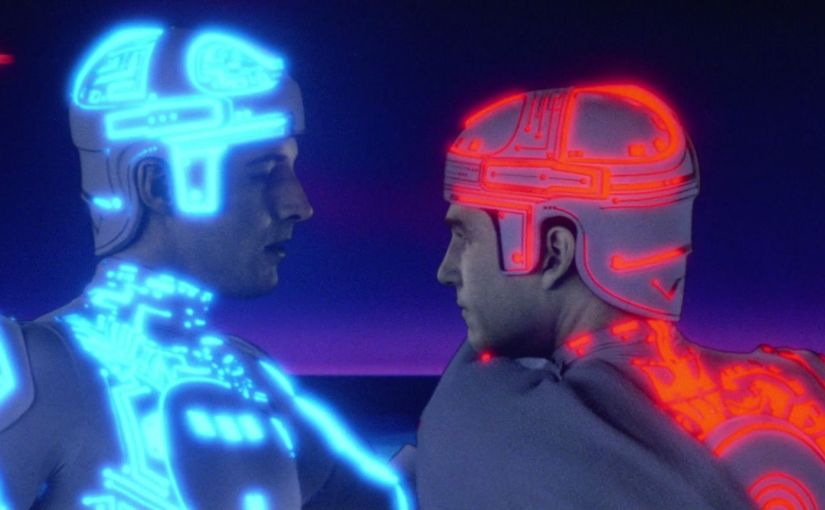
I recall seeing at least a few scenes of Walt Disney Studios’ Tron back when it was released on VHS.  Way back then, just like now, I just was never so impressed by it.  I can forgive the thin characterizations of really the only 5-7 actors with speaking roles.  Yet, the visuals and sound really do nothing for me.  What am I looking at?  Grids!  Just grids or endless squares.  A blank chess board looks more exciting to me.  The players in the film are dressed in what are presumed to be digitized armor that have carved out glowing blue and red lights.  Their human faces are grainy grays.  It all seems so flat to me, like that awful Pac Man adaptation Atari developed for their game consoles. 

Jeff Bridges plays Flynn, a game software developer done dirty by a corporate conglomerate led by a man named Dillinger (David Warner, the bad guy with the British accent).  Dillinger, along with a super computer intelligence known as the Master Control Program, have stolen Flynn’s intellectual property for dynamic new video games.  Since that time, Flynn has been making efforts to hack into the computer system and steal back what was originally his to begin with.  Master Control Program always fends him off, though.

A side story involves Bruce Boxleitner as Flynn’s colleague, Alan, working for the corporation. Alan has just developed a new security system known as TRON.  Dillinger puts a stop on the TRON program however.  Flynn, Alan and a third colleague named Lora (Cindy Morgan) break into the corporate computer lab one night, and before you know it, while attempting to hack in, Flynn is zapped right into the computer system, where he finds himself ensconced in a series of gladiator like games that were part of his original program write ups.

Master Control Program has the capability to erase Flynn from existence but insists on having him compete in the games that involve frisbees that deflect lasers and drive colorful racing cycles.  All of these games occur on this boring grid.

The actors mentioned above are utilized in the film much like The Wizard Of Oz.  They are introduced in the real world for the brief exposition portion of the film, and then later used to represent the TRON program (Boxleitner), as well as other elements that serve or perform under the eye of Master Control Program in the digital computer world.  The only real entity is known as a “user,” and that is Flynn.

I got sleepy watching Tron.  I think it is because like many video games it does not challenge me to figure things out or solve the dilemma. How can I envision Flynn escaping this world before he’s zapped out of existence?  I have no idea, because I’ve not been shown anything that demonstrates how this computer world functions.  Basic video games, at least from the early 1980s, were primarily about timing your button pushes and jerking the joystick accurately and timely.  Like the film Tron, they were never about application of the mind. 

No.  Movies are not meant for me to solve their riddles all the time.  Often, if I’m not trying to figure out how to resolve a story’s conflict, then I’m at least absorbed in the writing and performances of the cast.  The music might heighten the adventure or suspense.  The set designs will dazzle me.  Don’t get me wrong.  This Star Wars fanatic loves visual effects, but without any kind of story or suspense for the players and their outcome, what’s left to watch?  Tron is as dimensional as a blank index card for me. All these grids and lines are no more exciting than office stationery.

Tron from 1982 may seem very outdated, forty years later, but as a ten-year-old, I recall not being impressed either.  The sound design is annoying as when the digital players walk with clunk, clunk footsteps.  The objects on film are just sketched out, geometric glowing, colored lines on a black background. There is no depth, at all, to Flynn, Lora, Alan, Dillinger, or their computer counterparts.  In 1982, this might have been groundbreaking. For the Atari lovers this may have been the answer to many of their prayers.  I dunno.  Maybe I couldn’t relate or understand back then because my tyrant for a father denied me of an Atari game console.  I certainly don’t understand the fascination now. 

I have a 100-sheet pad of graph paper, here in my desk.  I’ll stand my Darth Vader action figure on a page and just stare at it for five minutes.  There!  Now, I can say I’ve watched Tron for a third time.

THE OMEN (1976)

By Marc S. Sanders

The best horror films don’t have to splash blood all over my popcorn.  I’m flattered that at times, a schlock monster fest will tantalize me with a half alive victim’s laced up intestines hanging out of the belly as they walk towards the camera.  Oh, my how long and endless and bloody they are.  Thank you so much for the garage sale autopsy.  Still, I hardly get impressed with that kind of junk.  Terror is most effective for me when the scares come from the mind of the characters and who occupies the surroundings. 

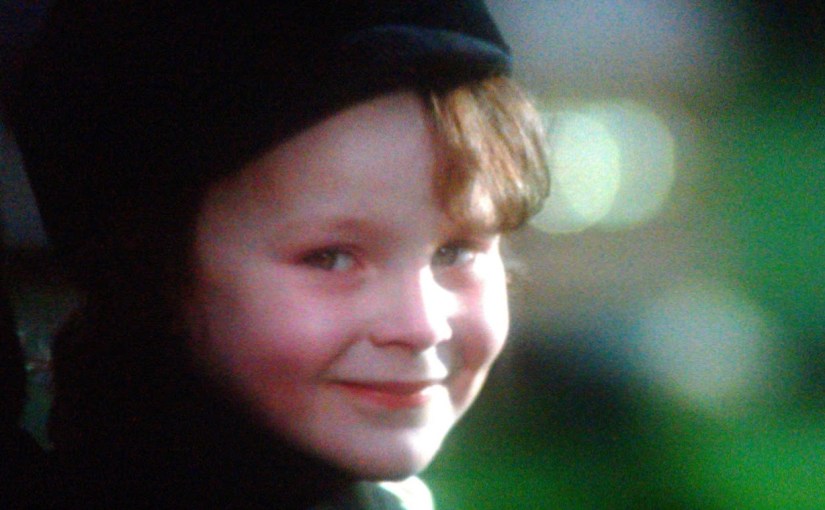
One of the best ways to scare the bejezzus outta me is when you make a child the monster.  Six year old Damien is a monster.  He’s no kind of kid that I would welcome in my house, and I’d think twice before throwing the little devil a birthday party or taking him to the zoo.  Damien may just be the Antichrist of Richard Donner’s 1976 film The Omen.

Gregory Peck made a long-awaited return to the cinematic screen as Robert Thorn, an American Ambassador to Great Britain.  His wife Katherine, played by Lee Remick, have a son named Damien, delivered on June 6, at 6pm.  Think about that point in time for a second and then maybe you’ll have an idea of where this film is going.  Think about the name Damien.  Does it perhaps sound like another word that’ll send shivers up your spine?

Robert and Katherine are a happy couple.  They feel blessed to have a child of their own and after Damien’s sixth birthday has arrived, odd trappings seem to occur.  Their nanny seems to know how to put a damper on the birthday party.  Rottweilers don’t take too friendly to the Thorns, and the replacement nanny, Mrs. Baylock (Billie Whitelaw), is…well…just watch the movie and you’ll see what Mrs. Baylock is like.  (I shudder just typing her name, Mrs. Baylock….gah!!!!!  I must forge ahead.)  As well, there is a priest who keeps visiting Mr. Thorn insisting he knows something about Damien that cannot be ignored.

What works to put the scare into The Omen is that it does not rely so much on supernatural stunts or effects.  It should never be so easy to presume that an angelic child could actually be the son of Satan.  Leave the clues, but don’t be so overt.  If it’s too obvious, then the film fails.  In order for the film to work successfully, put some doubt into what is or isn’t possible.

Lee Remick is quite good as the wholesome loving mother and wife gradually turning into a woman disturbed by her own child.  Try to imagine that dynamic for second.  It’s perfect movie material.  It’s been done before in films like The Bad Seed or in later years with the dreadful The Good Son.  To pull it off, to be disturbed and frightened of your own six year old boy, requires pacing in the script and a range of performance to get to that point and understand what the maternal character is going through. 

Gregory Peck is a seemingly likable politician.  Unheard of, I know.  I think Peck’s reputation contributes here.  He’s not so quick to accept that these odd occurrences add up to something supernatural.  If it is the case, he’ll find out for himself. 

Richard Donner, in his first cinematic film, sets up magnificent scenes.  There’s that birthday party I mentioned before.  So wholesome, and innocent, and eventually it becomes unforgettably tainted.  A trip to a cemetery at night never bodes well.  Of course, our experience with scary movies heightens our alertness when a tomb or a grave is investigated, but still, while we can expect something to happen, it’s the not knowing what happens that leaves us on edge. 

As I watched The Omen, with goosebumps all over, I was challenged with reasoning out how the film would resolve itself.  Thankfully, it leaves you thinking and perhaps trembling a little bit.  At least it did for me.  So much so, that before turning in for bed, I had to turn on an episode of Seinfeld to remind myself that though the devil or his offspring might be nearby, at the very least I can be amused by the ongoing sins of George Costanza.

WAR OF THE WORLDS (2005)

By Marc S. Sanders

There’s a harsh reality to science fiction in the 21st century.  When the aliens arrive on Earth, a little girl will ask her dad “What is it?  Is it terrorists?”  Steven Spielberg’s interpretation of H.G. Wells’ War Of The Worlds covered that territory when it was released four brisk years after 9/11.  All these years later and there’s still some legitimacy to that sadly reasonable question.  I find it interesting that one of the most pioneering novels in sci fi was published just ahead of the twentieth century paving the way for endless approaches to alien arrivals and attacks on Earth.  When Spielberg approaches it on his third try, the trope may have been done to death, but now the reality of the response is updated and all too real, and brutally disturbing.

Tom Cruise is the lead in this adaptation, and he is arguably in the most vulnerable role of his career.  He plays a storage bin dock loader, only regarded as a half caring deadbeat and divorced dad to his teenage son (Justin Chatwin) and 10-year-old daughter (Dakota Fanning). After his ex-wife (Miranda Otto) drops the kids off for the weekend, there’s an uncomfortable game of catch in the backyard followed by the beginning of the mayhem.  What appears like a lightning storm evolves into dead batteries and no electricity along with odd wind currents and hammering echoes.  When the people all around the main characters in their New York neighborhood get vaporized, then naturally their first instinct is to think it’s terrorists.  In today’s science fiction, terrorists are real and aliens are not.

Later, once the extra terrestrials (not the friendly kind who consume Reece’s pieces) have viciously introduced themselves, Spielberg’s film resorts to demonstrating mass exodus of the people of Earth.  Military units advise folks to “keep movin’.”  When the attacks happen, people scatter in different directions.  When a ferry is leaving the mainland, helpless folks rush for the dock, desperately climbing over the gates and leaving loved ones behind.  Spielberg hasn’t forgotten about the unlawful occupations from world history.  He simply applies it to a Tom Cruise action piece.

Tim Robbins shows up as a crazed man hiding in a farmhouse basement with a shotgun ready to begin a one-man revolution.  Cruise tries to contain the hysteria.  A scene like this could have had Nazis or aliens circumventing on the floor above, as the central characters remain as quiet as the Jews used to do in the basement below.  The parallels are eerily the same. 

Still, I respect the reality of the piece.  For one thing, much of the film, scripted by Josh Friedman and David Koepp is pulled right from H.G. Wells’ pages, including the nice and tidy ending that eventually arrives.  Don’t knock it.  That’ how Wells wrote the story to begin with.  Spielberg and crew don’t invent their own new image of the invaders.  They are still the tall three-legged tripods towering over the people of Earth and blasting them with their “heat rays.”  My favorite touch of this film is using Morgan Freeman’s vocals as the bookended narrator reciting Wells’ novel text, nearly word for word.  It’s a welcome salute to the memorable radio show that Orson Welles lent to the story decades before. 

I consider this adaptation of War Of The Worlds to be an observational picture or a reactionary film.  Cruise is not super skilled with fighting techniques and weapons handling.  All he can do is watch and react.  He’s an everyman here, which is actually quite unusual for him when you gloss over his resume.  This is not Maverick or Ethan Hunt: Superspy.  His purpose is to watch and return his kids to their mother in Boston, assuming she is still alive.  The success of the mission here only depends on getting the kids back to mom. 

Dakota Fanning and Justin Chatwin go against the grain of so many other Spielberg kid characters.  They are not intuitive or inventive.  Especially for Fanning’s character, she is just a scared little girl.  Not a Goonie and not like Gertie, who is scared for the sake of humor with precocious one liners.  If aliens were attacking the Earth, this is how my kid would react. 

Once it is established that this movie is a Spielberg running man film, then you may be grateful for the realistic mentality of the story’s community.  You’ll also appreciate the amazing set pieces accompanied by John Williams’ original score that plays like a drive-in monster movie or a Twilight Zone episode.  The aftermath of a plane crash on a Jersey suburban neighborhood is very convincing.  A runaway train set ablaze intrudes upon the cast with great surprise.  A cracked piece of concrete that gets swallowed up below only to immediately vomit a tripod in the air for instant attack is eye popping. 

War Of The Worlds is a well-crafted film, and the thought was definitely invested in its approach ahead of making it.  Yet, I won’t say it’s fun escapism.  It’s a reminder of the unrelenting realities we live in now.  Sadly, it’s not reaching to say that maybe we live in a time where it is in fact every person for themselves.  Even Cruise’s son insists on going off on his own, abandoning both him and his sister with nary a care at all.  Unlike Close Encounters or E.T., there’s not much to laugh or grin at in this Spielberg alien film.

The 2005 adaptation of War Of The Worlds is certainly loyal to H.G. Wells.  It may be realistic in the human nature of its science fiction, but in the end, it is also a very bleak film.  There’s much to marvel at, but once the movie is over, as my colleague Miguel and I often recommend to one another, it’ll likely be best that you get outside and bathe in the warm sun under a blue sky, roll around in the grass with your dog, and taste an apple for the first time all over again.  It’s about all we have left to embrace what little is left of our sanity.

KISS THE GIRLS

By Marc S. Sanders

When you’re watching a movie and one character says “Now wait here. Let me handle this!” what do ya think is gonna happen? When you’re watching a movie and one character says “Kate, we’ve covered every inch of those woods. There’s no building there!” whatcha think? You think there actually is a building there?

Let me ask you this, what do you think happens in the film Kiss The Girls?

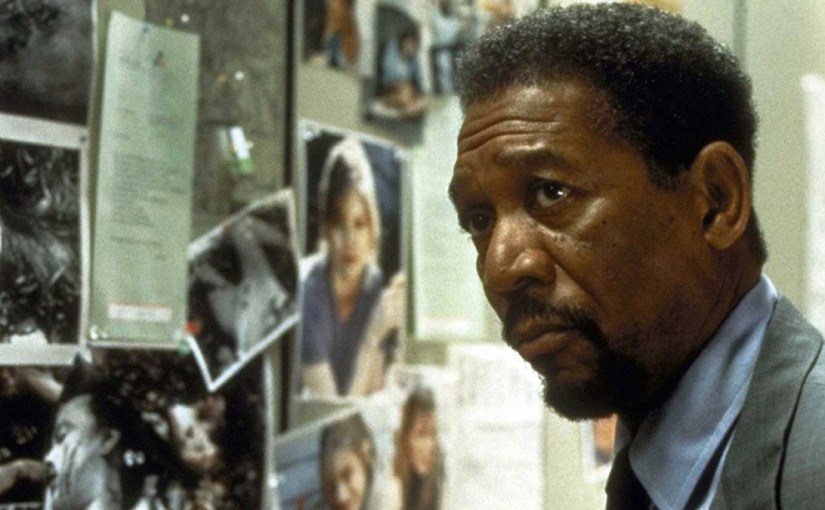
Yup! A whole lot of this nonsense and more that I could cover endlessly. Adapted from James Patterson’s best selling novel featuring his forensics detective hero Alex Cross, Kiss The Girls begins as an effective thriller focusing on the backgrounds of its two leads: dependable Morgan Freeman as Cross, and Ashley Judd as Dr. Kate McTiernan, a skilled surgeon with a specialty in kick boxing (that may come in handy later). At first, we see these characters handling snippets of storylines related to their careers. Cross defuses a suspenseful suicide situation. McTiernan has to console a family whose little girl was in a motorcycle crash. There’s good acting and emotion going on here and I was hoping the film would live up to the promise of these scenes; the characters’ expertise now being applied to Patterson’s main story. It doesn’t.

Instead, the movie just mires itself in plot holes and filler where one character insists on working alone while the other insists on not sitting idly by. This is not character development. This is ping pong volleying. Kate is kidnapped by a serial “collector” of smart, young, beautiful and highly intelligent women by someone regarded as “Casanova.” When Alex’ niece is one of the women taken, he travels from Washington DC to Raleigh, NC to join the investigation.

Soon after Kate has been taken, she manages to be the only one to escape from some hidden dungeon located in the woods. She joins Alex at every turn to find Cassanova and rescue the other captives. Okay. So that’s not a bad set up.

Where it falls apart is in the development. Kate managed to escape by jumping into a river where she’s retrieved by two kids. So wouldn’t law enforcement just sweep that entire area? I mean be really thorough, top to bottom! Surely, you’ll pick up footprints or scents from the dogs. Well, Alex says they did. Fortunately, his niece’s boyfriend finds the map. You know…the map that’s hidden in the library that no one else is aware of and shows this dungeon or whatever it is that’s there. Only one guy, ONE GUY, knows about this map????

When an hour and forty minutes has surpassed, you bet that map is gonna turn up. Remember, also when someone says wait in the car, the one thing you do is not wait. You know, this is a movie. So, Mr. Freeman, please spare me the act of surprise when Ms Judd walks into the bar you’re scoping out. This is all unnecessary, and boring and tired and old.

Kiss The Girls is another film with THAT TWIST! Was it really needed though? Just when the film apprehends the bad guy, and the ladies are recovered safely, there’s a gotcha moment in Kate’s kitchen with lots of knives and pots and pans to play with. Gary Fleder directed this 1997 disturbing thriller in a post age of The Silence Of The Lambs and Seven, which are far superior films. It’s not a film dependent on gore or torture porn, but it’s got the dark stone lined halls for haunted house creepiness. I’m good with that. It’s a thriller after all.

The film’s best assets, however, are Freeman and Judd. These are two top class actors who invest themselves in performance. If only they were working with a much more believable story.

It’s the implausibility in the script that make my eyes roll.

THUNDERBOLT AND LIGHTFOOT

By Marc S. Sanders

There are good Clint Eastwood films and there are bad Clint Eastwood films. You’d probably guess where I rank 1974’s Thunderbolt and Lightfoot (T & L).

I’m amazed. Director Michael Cimino, at the time, was really only known for polishing Eastwood’s Dirty Harry flick Magnum Force into a great crime drama of cop vigilantism. Then he does this picture, and how did anyone at Warner Bros trust him with The Deer Hunter a few years later? Sure, that film won Best Picture, but should anyone really have been surprised when the box office nuclear bomb, known as Heaven’s Gate came along, and bankrupted Orion Pictures? You think the producers of that turd said, “Fellas, we never considered Thunderbolt and Lightfoot. Hindsight 20/20. We shoulda known better.”

Back to the subject at hand. T & L is mindless of any coherence. Two criminals just happen to find each other randomly on some out of nowhere highway while running from the law (for Lightfoot) and a couple of bumbling henchmen (for Thunderbolt). Their respective crimes are unconnected. Eastwood’s quiet, familiar, tough guy demeanor (Thunderbolt) meets up with wild boy Jeff Bridges (Lightfoot) and then they eventually get to a plot of devising some kind of money heist with early adversaries George Kennedy and Geoffrey Lewis, former crime pals of Thunderbolt. However, they need to arrange to acquire a cannon, get on a job digging water lines for housing properties, work as ice cream delivery guys, hitch a ride in a redneck’s Dodge Challenger, and have Lightfoot dress in drag. There’s also a schoolhouse, no longer located where it once was, with a secret stash hidden behind a blackboard.

Doesn’t this seem like much too much effort for an ordinary bank heist in 1974? Security personnel and systems were probably not as sophisticated back then, no? Eastwood made an easier time of escaping from Alcatraz then all the work put in here.

The movie is sweaty, dirty, stupid, and it just doesn’t make sense really. Bridges actually got an Oscar nomination in the supporting actor category, up against nearly the entire cast of The Godfather Part II, for this film, and I’m…well…perplexed. How was that possible? Best guess, Cimino, who also wrote this dreck, decides to have Lightfoot die at the end. (There!!!!! I ruined it for you!!!!) Problem is I don’t know why or how. He’s not shot or wounded. There’s never an indication that he is ill. The script is too dumb to consider any kind of foreshadowing of his demise. The guys are just driving along with the money in backseat, and Lightfoot appears weak all of the sudden. Thunderbolt pulls over to the side and his partner just quietly dies in the passenger seat. Cimino cues up the Paul Williams music and the end credits appear. Bridges had a death scene. So, Bridges has to get a shot at Oscar glory. The math ain’t pretty but it’s the best logic that I can come up with.

THE GIFT

By Marc S. Sanders

Blumhouse Pictures had a monster year in 2017 with the release of Jordan Peele’s smash hit thriller Get Out.  It was by no means some slasher film for cheap scares.  It built on those typical shocks to deliver a message over a well-crafted three act storyline that commented on present day race relations while the action of it all knocked the hell out of you.  Get Out was one of my favorite films of that year.  

Having just watched Joel Edgerton’s The Gift from 2015, I see a pattern from Blumhouse.  This is a company intent on making high grade material on very small budgets.  This company knows how to spend its money wisely, while showing you something that looks familiar but is altogether new.

Edgerton wrote and costars in The Gift as a stranger who intrudes on the life of a happy couple with a promising future, played with great chemistry by Jason Bateman and Rebecca Hall.  

Casting Bateman and Hall was a smart move.  In other respective efforts from both actors, they are at their best by giving the less is more approach to their resume of performances.  In this film, they come off as nothing special really when the film begins; happy and minding their own business.  It’s important because it enhances the disruption of Edgerton’s character, Gordo “the weirdo.” All that Gordo is doing is being friendly by leaving gifts on the couple’s doorstep. Harmless, really, but I found my own instincts on alert. The question is, however, was I ever right to question my instincts in the first place.

The Gift is a top notch psychological thriller.  Do Edgerton and Blumhouse follow the same trite cliches of suspense films like this though? That’s what is eye catching about the film.  You really don’t know how developments are going to end up until the movie is completely over.  For the most part, this film is wildly unpredictable.

I really liked it.  It was a new kind of disturbed piece written with foreshadowed detail by Edgerton.  He writes with common, nervously laughable awkwardness for his couple to struggle with.  This new guy is only signing his cards with happy faces and leaving gifts.  What’s so wrong about that?  

Edgerton’s direction is just as fine with wide shots during the daytime suburban scenes to offer comfort for Hall’s housewife character, and a narrow lens to unsettle you as you peer down a dark endless hallway.  For cripes sakes, it’s only your house.  Is your new house really that scary?

The ending is satisfying for me even if I did predict an early scene would return to make its point later.  Narratively speaking though, I credit the screenplay for inventing something beyond a final fight that would probably include kitchen knives and crashes through windows followed by someone falling to his gruesome death from a great height, or drowning a villain in a bathtub before shooting him when he miraculously comes back to life. 

See, that’s what the other movies are doing. Films like The Gift and Get Out are completely doing something else entirely.

BACK TO THE DRIVE-IN

By Marc S. Sanders

I have a confession to make.  As much of a movie lover that I am, I have never seen a movie at a drive-in theater.  I should know better.  Fortunately, I had the honor of learning about this well-established culture of Americana while getting a private screening of a new documentary film called Back To The Drive-in, written and directed by April Wright.

Back To The Drive-in covers the resiliency of eleven different drive-in theaters spanning from Massachusetts, down to Texas, across to the state of Nebraska, and California beyond.  All of these institutions have likely been around longer than three times the age of most of their teenage and twentysomething employees.  They may be located in different areas of the greater United States, but many of these outdoor movie palaces have no choice but to contend with the same ailments that accompany a new age of living during the time of the Covid pandemic.  That’s the common theme April Wright covers as she turns on her cameras allowing the owners, their families and staff to discuss experiences, frustrations, worries and uncompromised passion for the drive-in.

The craft of Wright’s film is beautiful.  There are vast overhead shots of each drive-in that transition perfectly into the intimacy of a lived-in office or a concession stand down below.  As her film moves from one drive-in to the next, the chapters open like picture perfect post cards of an American institution that has survived for over 60 years.  My only familiarity with drive-in movies likely stem from episodes of the sitcom Happy Days, where Richie and Potsie would make out with their girlfriends in the front seat during the monster movie.  This insightful documentary, however, showcases how drive-ins operate in an age of new technology or lack thereof.  It also presents problems that have been ongoing since long before Covid arrived. 

The unpredictability of weather abounds for many of these owners. The most interesting story for me comes from the Wellfleet drive-in located near Cape Cod, Ma.  The owner, John Vincent, is a friendly enough gentleman, who tells of his history working for the drive-in first in the ticket booth while he was a teenager back in 1987, all the way up to now being a proud and concerned owner.  Warts and all, he loves the drive-in.  The offensive f-word for him, though, is fog.  With his business located near the ocean, it is hard to tell if the large outdoor screen will offer up a good enough picture for the Saturday night film.  Each time April Wright’s documentary returns to footage from Wellfleet, I was in suspense.  Mr. Vincent talks about how on a good night he’d have 300 cars parked ahead of the feature presentation.  On this night, with imminent fog, it’s lucky he has 117 cars.  Every time Wellfleet appeared in the film, the fog only looked thicker and thicker.  Fog has become an all too real fear.

A common problem for all of the drive-ins is the weather.  Another location is concerned about lightning in the area.  It goes with the territory that the managers and operators regularly monitor the weather apps.  I want to know what they did in the ‘60s to prepare for this uncertainty. 

Supply shortages, inflation, worker shortages.  All of these drive-ins face the same threats.  Wellfleet also contends with out-of-date technology where the speakers are burned out and the underground wiring needs repair.  Yet, that means digging up concrete at a huge expense.

As the time period focuses on the drive-in attractions in response to Covid, it seems to present a small favor for these businesses.  At the start of the pandemic, when new Hollywood pictures were being released in limited supply, there was at least the escapism of the drive-in for consumers who were exhausted over quarantining.  People could at least catch a classic flick like Back To The Future, and maintain social distancing within their own cars.  Still, Brian Smith who owns Coyote out of Fort Worth, Texas has to protect his teenage staff from angry, foul-mouthed patrons unwilling to cooperate with mask mandates while visiting the concession stand.  He talks about how he looks out for the kids who work for him, but even depression and the challenge to keep up with school is overwhelming. 

Now that vaccinations have provided relief from isolation, the struggle is all the more real for these business owners.  Ben and Nora Harroun who operate Galaxy Drive-in Ennis, Texas mention competing with streaming services for new film releases.

Other drive-ins attempt to reinvent what they have.  Field Of Dreams located in Ohio is offering up live concert entertainment.  Quasar in Nebraska was an I-70 drive-in refurbished by Rod and Donna Saunders with the latest technology and architectural designs.  Their friends said they were crazy to invest in this, but for the Saunders it is crazy to let an institution fade away.  Their retirement was meant to sustain the atmosphere accompanied with a drive-in movie.

There’s a culture to this industry.  These owners talk with one another and share their love for this uncertain and struggling industry.  Drive-ins seem outdated in an age of comfortable multiplexes and the convenience and safety of at home streaming.  They share each other’s pain while also appreciating the value a film like F9 (Fast & Furious) can draw on a Saturday night.  They take pride in the specialty food crafts they sell at the counter from funnel cakes to a delectable pulled pork sandwich for seven dollars.   To many of us, selling a box of Nerds candy or not selling chocolate products to avoid the risk of melting, might seem like a mundane awareness, easily taken for granted.  To these folks, it means the difference of the outcome of their current season in the age of Covid.  April Wright captures a young girl describing how she burned a scar into her finger on a popcorn machine.  These are proud war wounds, accepted within the ongoing challenge of keeping a business afloat and a decades long tradition alive.

April Wright’s documentary is breathtaking.  As her camera soars above the wide-open spaces of worn-out grass and cratered concrete with large movie screens at the edge, you absorb the history of places within the United States urging us to rediscover again.  Our eyes only opened a little during a desperate time in 2020, but these preservationists wonder if they will be able to hold on.  I won’t spoil the outcomes some of these businesses face during a footnote of coverage featured in the end credits, but perhaps a follow up piece is on the horizon from Ms. Wright.  These drive-in locales live with unstable fluidity.  Doubt, accompanied with hope, is what I walked away with following my viewing of the picture.  What will the American drive-in theater look like in a year from now?

LIGHTYEAR

By Marc S. Sanders

It’s kind of neat to see the evolution of a classic film character when you are a fully aware adult.  In 1995, I had no idea what the term Pixar meant, or knew the impact it would have with the Disney brand as a whole or on the cinematic landscape.  Pixar is now as pioneering as Skywalker Sound or Industrial Light and Magic.  There’s Pixar, and then there’s everything else.  Back in ’95, I was age 23, and my intuition never perked up that I was watching a touchstone character like Buzz Lightyear who would become as grand today as Batman and Elvis turned out to be in an ever-changing pop culture lexicon. Buzz Lightyear is by far one of the company’s most inventive creations.

Jump to nearly thirty years later, with four Toy Story adventures, and endless amounts of merchandising the Space Ranger has been primed for a more personal adventure beyond the imagination of a young child possessing an action figure in his playroom.  Lightyear tells of the adventure that leant to merchandising of the toy depicted in the Toy Story fictional world.  (Try not to think too hardly on that description.)

Buzz Lightyear (Chris Evans) is the eminent Space Ranger of Star Command, out to explore strange new worlds and seek out new life and– STOP! That’s another franchise.  When Captain Lightyear comes upon an unchartered planet, complications in unexpected science fiction adventure ensue.  Buzz and the small colony living on his global spaceship are marooned on this planet with no immediate solution for getting off and returning to Earth, 4.2 billion light years away.  Buzz makes it his mission to uncover a new kind of resource fuel that will eventually help the colony make its eventual return home.  Yet, with each experimental try, the minutes he spends in his super speed orbits around the planet equate to years for the colony who have set up habitation below.  His comrades on the ground below continue to age while Buzz does not.

I needed help with this picture.  My wife had to explain the staple lesson that usually comes with each Pixar film that I just didn’t catch while watching Lightyear.  I don’t think I’m spoiling anything, but the film reminds us to accept the hand dealt to us and appreciate what has come even if we never expected or planned on the circumstances in the first place.  It’s a good lesson.  I guess I just wish Lightyear made it a little clearer.  There’s a lot of mud on the windshield that I needed to wipe away before I realized what the message was about.

Maybe I was not fair with this film.  Tim Allen was not invited back to lend his recognizable voiceover to the character.  I guess Pixar is insistent that he’s reserved only for the toy version of the character.  Chris Evans is fine, mind you, and he doesn’t overdo it.  Yet, I could not help but think Tim Allen would have been just as capable and even more entitled to voice the role yet again.

Perhaps I was thinking that if Pixar wanted to go in another animated direction with the character, it just seemed completely fruitless.  How different could Lightyear be from the Toy Story films if the animated design is pretty similar in every frame?  Honestly, it doesn’t look like a new kind of device.  So that was a problem for me, as well.  It wasn’t inventive enough.  Maybe it’s time for a live action version of the space traveler.  Imagine Chris Evans wearing a live action and tactile version of the famous astronaut costume with the colorful buttons.  I still say that could work, and it’s what Disney/Pixar should have considered.

Maybe I’m getting bored with the time travel motif.  Isn’t everyone doing that these days?  Doesn’t it also seem like all our heroes are meeting their future selves and struggling to understand their current predicament?  Lightyear hinges on these story developments, and when the moments arrive my eyes rolled in the back of my head.  Time travel stories are very tricky for me to appreciate.  Often, the narrative paints itself into a corner, unable to explain itself back correctly.  Only two films that come to mind have worked their way out of it almost seamlessly – Back To The Future and 12 Monkeys.

So, while I love the lesson that Lightyear offers, the standard carbon copy plot outline left me unfocused at times.

The voiceover cast is well done with Keke Palmer, Taika Waititi and James Brolin.  The animation is gorgeous, most especially when Buzz is piloting his super jet around the planet’s sun. The atmosphere of the planet is fun when it becomes a nuisance with giant flying insects and vines that come alive to entangle the characters at any given moment.

Science Fiction can go to infinity and beyond with the directions it can take.  There is absolutely no limit.  With today’s technology in filmmaking and the endless resources that Disney provides, why didn’t the filmmakers try a little harder with Lightyear? Again, a live action interpretation would have allowed it to stand apart from the character’s prior Toy adventures, and some different avenues in space exploration would have opened a leaner and more entertaining story.  If Star Trek can do it, Lightyear can do it too.

I think Pixar tried to go the route of Christopher Nolan, by way of Interstellar.  However, Lightyear is designed for people of all ages where the brain of the show is in reminding us how to carry ourselves through life, and not to uncover the twists that a brilliant filmmaker like Nolan has become recognized for.  I didn’t want to resolve a puzzle in fictional science.  Lightyear is trying too hard to be to be brainy and thus we get distracted from its “The More You Know” lesson in self-effacement.

NATIONAL LAMPOON’S ANIMAL HOUSE

By Marc S. Sanders

When a film opens with two students walking across a college campus as the classical horn music of proud alumni accompany them, and then one of the students stops to pull up his fly, you know you are probably in for a contrast of ideals.

Animal House set a new standard in comedy featuring a John Belushi whose expressions and improvisations appeared too fast for the camera to catch everything he’s doing. The script never gave him much dialogue because his routines of smashing beer bottles, smashing guitars, smashing beer cans and just getting smashed merited no dialogue. He might have looked like a dirty slob, but he was a craftsman of facial expressions.

Every scene of Animal House plays like an episode of an ongoing sitcom; a raunchy one at that. A dead horse, a pledge ceremony, a toga party, a sabotaged parade, and a food fight. Each topic is the title of a sitcom’s various episodes.

John Landis directed the snobs vs slobs script co-written by Harold Ramis, and 40 years later the material still holds up. Then again, 40 years later, I wonder if this film would even get made. I’d rather not dwell on that.

What I do know is that this movie is still funny. Outrageously funny.