FLASH GORDON

By Marc S. Sanders

How can anyone not like Mike Hodges’ camp celebration of a savior hero vs a destructive villain?

Flash Gordon was penned by Lorenzo Semple Jr, writer on the 1960s Batman TV show. His first draft is the one and only draft which producer Dino DeLaurentis approved for shooting. A glossy, flashy and fetishistic approach was adopted for the film, and it became timelessly memorable.

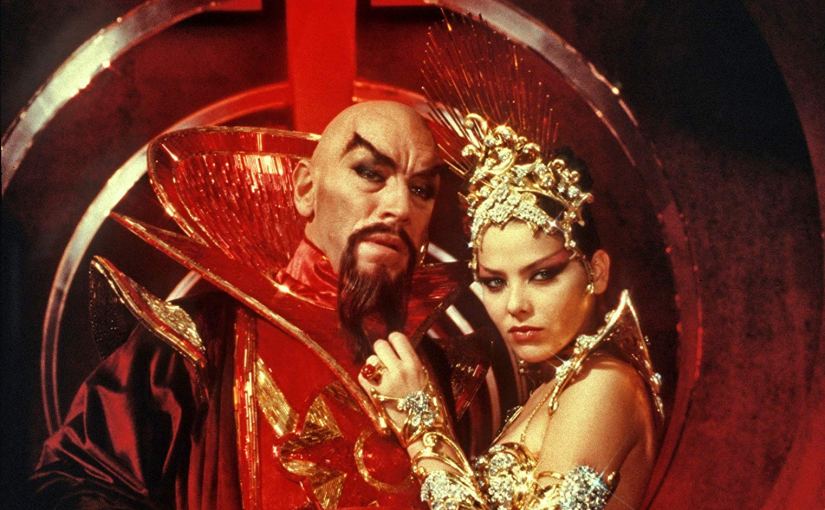
What thrills me about the film is its appreciation for the original, pioneering comic strips on which the film is based. Max Von Sydow’s Ming The Merciless is pulled right from the newspapers in his gloss pinks, reds, golds and blacks costume wear. The inflection of his voice is otherworldly from the start (“Klytus, I’m booooored. What do you have for me to play with today?”)

Sam Jones is a level down in the relatable hero of Christopher Reeve, but he’s enjoying every minute of his hero character schtick. He’s perfect for Semple’s playful writing and he looks like a champion.

Timothy Dalton and Brian Blessed are great side characters on opposite ends; one distinguished, the other gluttonous and proud.

The best flavor of the film is its soundtrack. Thank you Queen!!! Their musical touch is an early inspiration to some modern Marvel films like Guardians of the Galaxy, and Thor: Ragnarök, clearly showing direct influence from Flash Gordon. Freddy Mercury, Brian May and company relish in heavy pounding drums and special effect sounding guitars to deliver a cheerleading rock anthem. “Flash…aaaah!!! He’s a miracle!”

Dino DeLaurentis saw opportunity following the success of science fiction with Star Wars. He produced Flash Gordon with his own style, not as a copycat. The film became a fantasy with characters bleeding rainbow colors, pet midgets, cat fighting concubines, great hall football fighting with aluminum watermelons, weird lizard creatures, hawkmen, half egg-shaped planets, and even a thrilling fight to the death on a tilting platform with protruding spikes, the best scene amid all the camp craziness.

It’s all great. Flash Gordon is the savior of the universe. “He’s a miracle!!!!”
THOR

By Marc S. Sanders

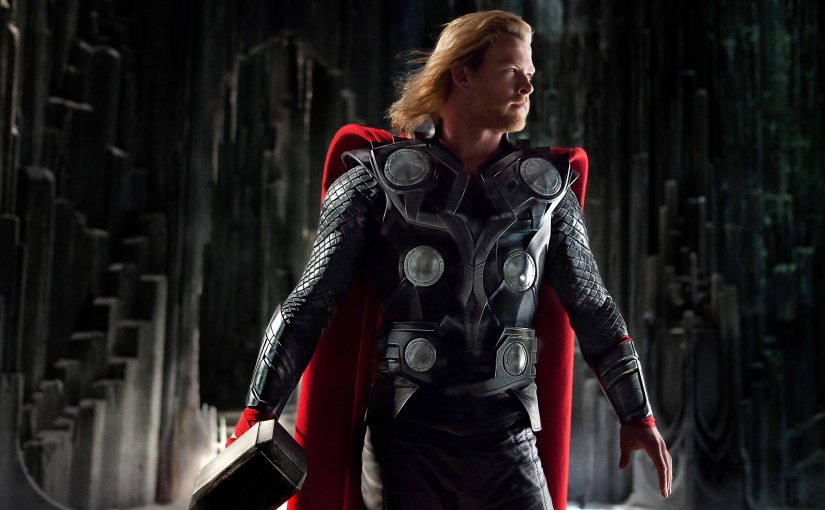
Chris Hemsworth is the God of Thunder who must learn to grow up if he is to inherit the throne over the land of Asgard from his father Odin (a welcome Anthony Hopkins), and more importantly become worthy of lifting his mighty hammer. Hemsworth is great; full of cocksure assuredness, humor and heroics. Chris Hemsworth makes you believe he’s the only guy who could play Thor.

Thor’s adversary is the God of Mischief, Loki played by one of Marvel’s best actors, Tom Hiddleston. This is a guy who plays so many different levels. If one didn’t know the story of Thor and Loki, I’d argue they might be shocked at some of the turn of events Hiddleston masterfully orchestrates with simple facial expressions and passiveness that progressively switch over to madness, obsession, jealousy, envy and deceit. Hiddleston effectively spins all the plates perfectly.

Natalie Portman plays the love interest carrying the torch of least significance that Liv Tyler and Gwenyth Paltrow held in prior Marvel films. That’s a pattern the Marvel films will begin to improve upon with the next film in line.

Director Kenneth Branagh is the right guy for this movie. Inspired Shakespearean settings and dialogue overlap with modern day America. Branagh brings a nice balance to it, and he also directs his actors well. A great exchange of dialogue and performance occurs midway through between Hiddleston and Hemsworth. Branagh gets good close ups of both actors as the conniving villain manipulates the naive hero. The camera angles move at a slant almost evoking a necessary confusion between what is true and what is a lie. Moments like this allow Thor to be more than just an action film. There are nice opportunities for acting as well, and because of that Hiddleston especially has become quite treasured among loyal fans.

Compliments must also go towards the setting of Asgard. I normally frown on immersive CGI normally. Not here though. Asgard is as regal as anything Peter Jackson offered in his Tolkien films, complete with a striking rainbow bridge and towering structures. I want to tour through that whole land. It’s that spectacular. Characters also work well with the CGI, especially the fire breathing, metallic Destroyer.

Thor is a great introduction to the legendary comics character. The film offers a character arc of change much like what was captured with Tony Stark in the first Iron Man. The character must grow and learn about his identity over the course of the film in order to have legs for future installments. This film accomplishes that feat, and thus Chris Hemsworth has become a box office draw while his most popular character to date has become a screen favorite.

BACK TO THE FUTURE PART III

By Marc S. Sanders

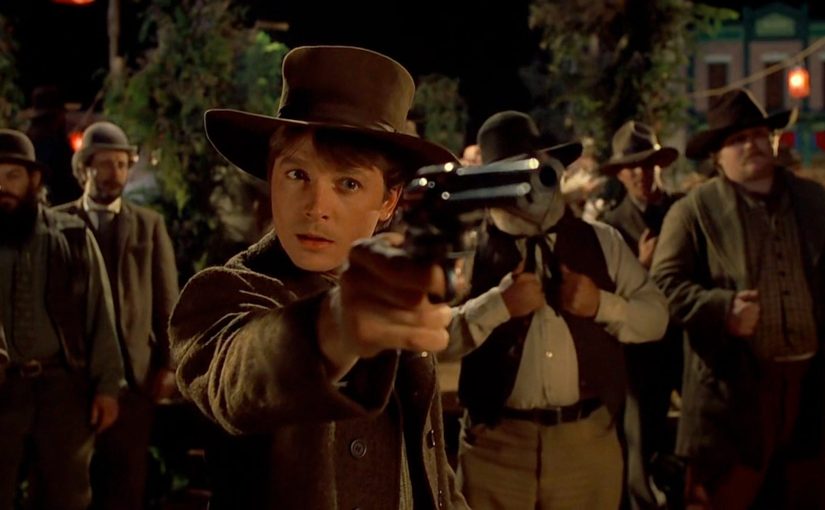
I think Bob Gale and director Robert Zemeckis forgot one thing about Back To The Future Part III. It was supposed to be a time travel movie. Sure, Marty McFly (Michael J Fox) travels back to the Hill Valley of the Old West in the year 1885, but once he gets there, there is not a lot of material for the beloved DeLorean.

The film picks up immediately where the last film cliff hanged. Marty is left trapped in 1955, and he receives a letter sent to him 70 years earlier from his present day Doc Brown companion (Christopher Lloyd) originally from 1985. You still with me? When Marty realizes that Doc gets shot in the back by Mad Dog Tannen (character actor great, Thomas F Wilson), he arranges with the 1955 Doc to send him back to the Old West and prevent that from ever happening.

From there, the film turns into a staple Western. There’s the calvary, Indians on horseback, quick draw duels in the street, a saloon, stage coach and wagons. Most importantly, there’s a steam engine to push the DeLorean to the necessary 88 miles per hour to send our heroes back to the future. That dilemma is solved quickly and early on. They now just have to wait for the train to arrive.

So the film calms down to allow a charming Mary Steenburgen as Clara Clayton, a schoolteacher, to capture the affection of the good ol’ Doc. When the romance seems impossible though, we get a depressed Doc. A depressed Doc Brown is never good for a movie. Consider this. It’d be so easy to just wait for the moment to travel back in time. However, obstacles get in the way, right? In the fantastic first film, Marty has to play guitar at the school dance to get the necessary first kiss between his parents thereby solidifying his existence. That’s fun…and then he kills it while performing “Johnnie B. Goode.” Here, the moment to time travel is approaching, but it can’t happen because Doc is depressed. What’s so fun about that?

Like Part II, Part III is watchable. It’s not terrible by any means. It’s just a little stale. The best gag, however, is Marty taking on the name of “Clint Eastwood” to build his status in the town. This allows a lot of inside jokes. What would’ve sent this film into the stratosphere is if they got the legend himself to make at least a cameo. Alas…. I can dream and wonder.

Back To Future Part III ends the film on a sweet message similar to what you get from other fantasies like The Wizard Of Oz or Willy Wonka & The Chocolate Factory. It reminds me that despite its shortcomings, the entire Future trilogy is great to share with the whole family. No doubt, there’s always something to look at and focus on.

Still, some movies that require focus specifically, takes work. The first film allowed me to wonder. Wonder if all of this could be true one day. Wonder how they thought all this up. Wonder how Marty is actually going to get back to the future.

If I have to choose, I’d rather not focus. I’d rather just wonder.

BACK TO THE FUTURE PART II

By Marc S. Sanders

Back To The Future Part II is a paint by numbers or recipe film more than just a film. This has to be done, so that that can be done, cook on high for just over two hours and all will be wrapped up. Because it is so focused on covering all bases it forgets the wonder and fun of the original film, and just gets down to business. Watching this film makes you feel like dad just won’t throw the football around with you in the front yard. He’s got work to do.

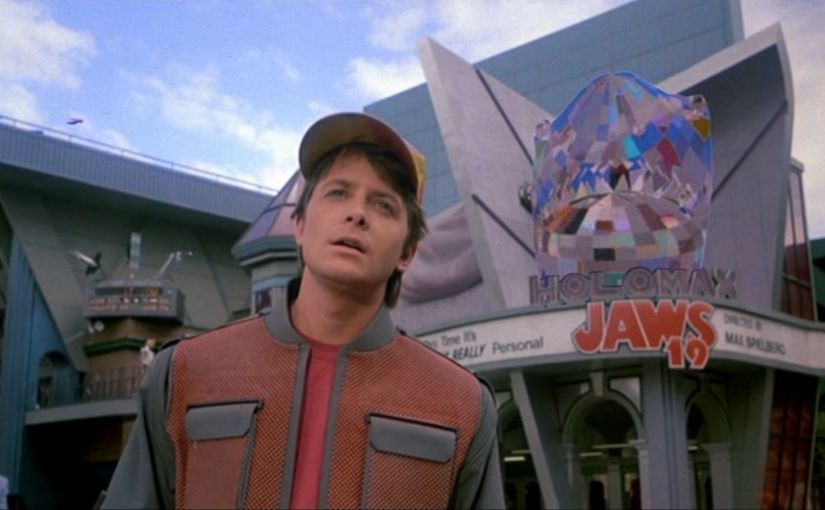
The sequel picks up immediately where the first film ended with Doc Brown (Christopher Lloyd) taking Marty McFly (Michael J Fox) and his girlfriend Jennifer (Elisabeth Shue) to a very zany looking future in the year 2015, complete with flying cars, Jaws 19, the abolition of lawyers, and opportunities to get a redesign of your body complete with a replacement of your spleen and colon just like Doc explains. When an elderly Biff Tannen gets a hold of a sports encyclopedia, he travels back in time to 1955 to tell his younger self to make bets he can’t lose. Now the future is entirely changed, riddled with crime, and Biff in absolute power. Worst of all, the brute is married to Lorraine, Marty’s mom (Lea Thompson, regrettably not given much to do this time around). So, Doc and Marty need to travel to 1955 to set things right all over again.

Look, if you were gonna make a sequel to Back To The Future, this is likely what the script was going to spit out. It’s a watchable film. However, it’s lost the soul of the original installment. It feels like an office project. The comedy is absent. A long sequence shows a middle age Marty in 2015 talking on video phone remotely with his bullying boss, and getting fired, with fax machines all over the house spitting out the message as well. This is supposed to leave me in awe? This is funny?

The second half of the film in 1955 has Marty pursuing Biff the bully while trying to get the sports book back. Biff, played by Thomas F Wilson, is more or less doing the same thing as the first film. Only he’s not the dumb buffoon we laughed at the first time. He doesn’t have George to bully around this time. You realize Biff and George made a perfect comedic pair. That’s missing here. So he bullies some little kids and with extreme harshness and tries to kill Marty on several occasions. It’s not so funny this time. It’s cruel.

A fun motif (that also carries forward in Part III) is that the actors are playing their characters at different ages 30-60 years apart from one another. Fox, Wilson and Shue also play their kids or grandkids. A nerdy Marty Jr is nerdy, but not quite funny. Fox is not doing the fantastic humor that Crispin Glover did as George in the first film. He’s just wearing an oversize jacket with his jeans inside out and squeaking his voice. Meh…not funny, just there.

Robert Zemeckis’ sequel is just okay. It’s disappointing because he and his collaborator Bob Gale worked so inventively on the first film. The construction is solid. I still love the various transformations of Hill Valley, California. If the film were made today that’d all be done with CGI. I appreciate the texture in the construction of the town’s past, present and future. Each time period allows me to look around and see what’s replaced what and so on. So, I’m truly grateful for that.

All and all though, Zemeckis and Gale had all the right ideas. They just didn’t have the best execution in mind.

BACK TO THE FUTURE

By Marc S. Sanders

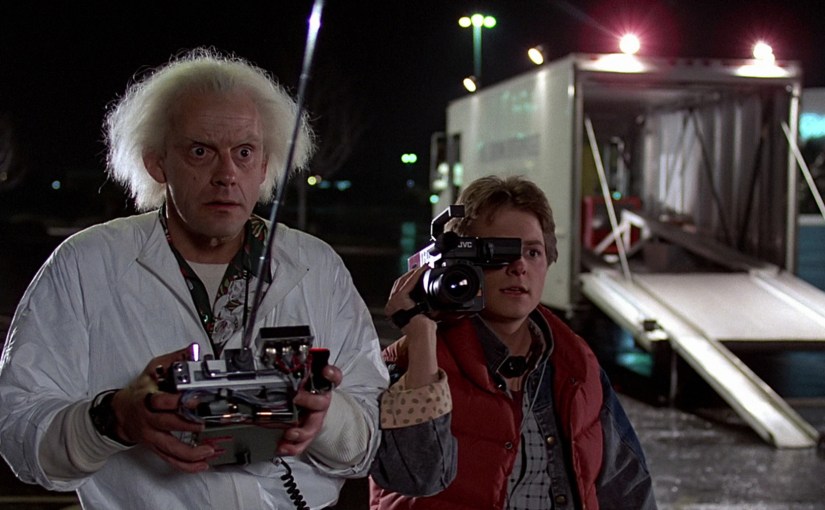
One of the best fantasy films of all time is Robert Zemeckis’ Back To The Future. No matter how many times I see it I’m astounded by the imagination and attention to detail that is invested in its script penned by Zemeckis and Bob Gale.

First, there is the set that stands in for the town of Hill Valley, California. To set up the film which took place in the film’s present shooting period of 1985, everything appears modern from Pepsi Free soda to Huey Lewis and the News and Marty McFly’s (Michael J Fox) parka vest.

Through a set of circumstances, when Marty travels back in time to November 5, 1955, suddenly the hit song is “Mr. Sandman” and his vest is mistaken as a life preserver. But look at Hill Valley!!!! Twin Pines Mall is now Twin Pines Ranch belonging to a farmer. A exercise workout locale is the corner diner where the future mayor is a waiter, and Marty’s domestic subdivision isn’t even built yet. Zemeckis and his crew are religiously faithful to observing the “science” of time travel.

His minister so to speak is Doctor Emmett Brown (a should have been Oscar nominated Christopher Lloyd; absolutely brilliant in his bug eyed, crazy hair, fun loving role). Doc’s time machine comes by means of a DeLorean automobile – perfectly sci fi like. Marty recruits the younger version of Doc to get him back to his present day, or Doc’s future.

Complications occur when Marty interferes with how his parents originally met thereby causing his mother, (Lea Thompson also superb and maybe should’ve been nominated as well) a teen at the time, into falling in love with Marty. Now Marty is at risk of being erased from existence, while his mother has the hots for him.

Complications are compounded endlessly in Back To The Future, and it’s easy to learn all that is at stake. That’s only the skeleton of the nominated screenplay. The dialogue works beautifully as well. Imagine telling someone living in 1955 that Ronald Reagan is President in 1985, and see how he’ll respond. The conservative culture of 1955 vs the free liberal lifestyle 1985 clash so well in the film’s comedy.

Outstanding performances make up one of the greatest casts of all time. It’s difficult to believe that Eric Stoltz was originally cast as Marty. Michael J Fox is so perfectly natural in his hysteria and cool, yet panicky, swagger. Crispin Glover is hilarious as Marty’s ultra-nerd dad, George McFly, and Thomas F Wilson is one of the top ten on- screen bullies of all times as the towering buffoon Biff Tannen.

Without question, Back To The Future is one of the most imaginative films ever made. It has wonder, comedy, suspense, song (yes…we even learn how Chuck Berry came to play “Johnny B Goode”), and brilliant characterizations. It is wholly original in its creativity. It’s fast moving, and it’s great fun.

Credit also goes to Alan Silvestri’s catchy orchestral soundtrack. It is magnificent in accompanying the adventure and misunderstandings that occur. You see the film once, and you never forget Silvestri’s music.

Back To The Future is a magnificent film that every kid should eventually see.

CHRISTOPHER ROBIN

By Marc S. Sanders

Disney’s Christopher Robin is a live action interpretation of a classic story that I approve of. Like Maleficent, it’s a film that is based on new, original material with familiar and beloved classic characters of the Disney machine-unlike recent reinventions of Beauty & The Beast and Aladdin. Those films are just the same with minor tweaks that don’t generate enough hype or interest for me. (No—I will not be seeing The Lion King. I already saw it back in 1992.)

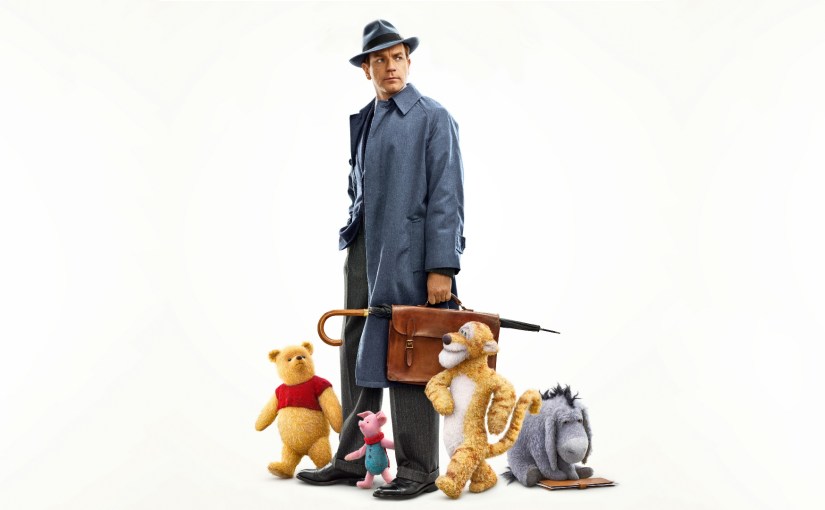
Marc Forster (Quantum Of Solace and Finding Neverland) directs while never losing sight of the fact that Winnie The Pooh, Tigger, Piglet, Eeyore, etc all stem from classic children’s literature by A.A. Milne. The film opens with a backstory on the title character starting with his playful adolescent connection to Pooh & Friends, followed by his departure from them into a strict boarding school and then into adulthood (played sweetly by Ewan MacGregor). Christopher falls in love with Evelyn (Hayley Atwood) and before their child is born he is sent off to war only to return as a no nonsense efficiency manager for a luggage company. He has forgotten his friends who live and do nothing (which always leads to something) in 100 Acre Woods. Worse, Christopher never laughs nor hardly acknowledges his daughter Madeline. He is not a child anymore.

This is the film that Steven Spielberg probably wanted when he directed Robin Williams and Dustin Hoffman in 1991’s Hook. It just came off too clunky and messy at the time.

As the story continues, Forster is not so covert in his symbolism of Christopher Robin shedding his crotchety adult persona and returning to his childhood whimsy. Christopher crawls through the hole in the tree, muddies his suit, loses his briefcase and disregards his paperwork.

I found myself rooting for Christopher’s new found happiness and his revived love for his wife and daughter. I loved the stuffed animal interpretations of the Pooh characters (with voice work from Jim Cummings, Brad Garrett and Toby Jones). Yet, the tears at the sweetness of it all never arrived. As quick as the film began, it was never a challenge to realize how it would all turn out.

So no surprises to be had in Christopher Robin, but an original story to appreciate nonetheless. That’s good enough for me.

A WRINKLE IN TIME

By Marc S. Sanders

Oprah Winfrey has a big head.

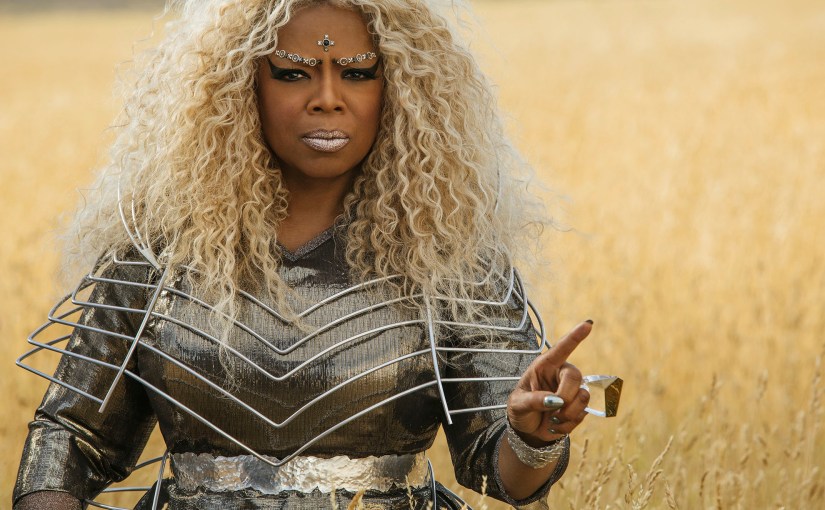
I don’t mean a big head as in a large ego. I mean Oprah Winfrey has a BIG HEAD. So BIG that I caught every sprinkle of glitter in her eyebrows and lipstick that it looked like it came out of the discount basket at Justice For Girls. Why do I focus on this first and foremost? Well…because that is about where the scope of imagination stops in Ava DuVernay’s direction of A Wrinkle In Time.

Remember the first time you saw The Wizard of Oz? Remember when Dorothy walks out of her monochromatic home and into the brightly lit Munchkinland? Judy Garland walked cautiously. Spoke carefully (“Toto, I have a feeling we’re not in Kansas anymore.”) There was a reaction to all of the grandeur and strangeness. Now, over 82 years later, many fantasies on film refuse to take inspiration from that timeless cinematic moment. A Wrinkle In Time definitely doesn’t.

In Duvaraney’s interpretation, Reese Witherspoon, dressed in a white king size bedsheet with hideously bright orange hair can just appear in the living room of a home and no one has nary a response to the unusual. There is neither panic, nor a “wow,” not an eye bulge, not a large swallow of gulp. Nothing. The protagonist, Meg, and her mother just say who are you (actually I’m not sure they even said that), and Reese puts on her over exaggerated smile and cheerful vocal inflection and speaks in some kind limerick dialogue. She walks out the front door, disappears into the night, and no one says anything; no one ponders anything. There is no imagination in the filmmaking here, nor in the scriptwriting. This is a fantasy, right?

Mindy Kaling is another fantasy character in garish makeup and costume. She quotes expressions from various poets and artists from history. Why? I don’t know. What does she lend to Meg’s mission? Yawn!!!! Nothing.

Zach Galifianakis accepted the role of another weird character that Johnny Depp probably turned down, and would have likely been offered to Robin Williams had he still been alive. Zach has nothing to say either.

Meg has a little brother named Charles Wallace. I know this because the script hammers away this kid’s name over and over again. Charles Wallace. Charles Wallace. CHARLES WALLACE!!!!! Not just Charles. This kid is always addressed as CHARLES WALLACE!!!! There’s a drinking game in the making. Give the movie 15 minutes and I promise you, you will be heavily intoxicated after hearing CHARLES WALLACE again and again and AGAIN!!!!

All of these claims go back to my one main, sole issue with this film. A complete lack of imagination and awareness of its fantasy.

DuVernay films Oprah as a towering 20 foot presence (literally) and fills in every void of space on the screen with her head. “CHARLES WALLACE” is about all Meg says to her little brother; there’s no sibling connection. Lastly, the most glaring error, is there is no reaction to the wonder of this fantasy. Were any of the actors informed there would be more to the green screens they were filming in front of?

So, it’s a nay for me. If you are going to do a fantasy make sure everyone in the production gets the memo please.

Oh yeah, Meg is on a mission to find her missing father in the universe of time or something like that. Yeah. That whole thing never mattered much to me. It didn’t really seem to matter much to Meg either.

A CHRISTMAS CAROL (1984)

by Miguel E. Rodriguez

A CHRISTMAS CAROL (12/17/1984)
Director: Clive Donner
Cast: George C. Scott, David Warner, Joanne Whalley, Edward Woodward, Susannah York
My Rating: 10/10

PLOT: In 19th-century London, a bitter old miser who rationalizes his uncaring nature learns real compassion when three spirits visit him on Christmas Eve.

——————————

[SPOILER ALERTS! (For anyone whose souls are so dead they have never seen or read A Christmas Carol before…)]

The TV version of A Christmas Carol that first aired on CBS in 1984, starring the legendary George C. Scott as Ebenezer Scrooge, is the best version of Charles Dickens’ story that I’ve ever seen.

Oh, but let me tell you why.

Without exception, every other version I’ve ever seen, including live theatre versions, have made humor and lightness their prevailing mood. The musical Scrooge (1970) does have its share of dark moments towards the end, but the darkness is derailed by an unnecessary detour into cartoonish humor (while in the depths of Hell, no less). I’m not saying that making the story fun is wrong, necessarily. After all, it’s a Christmas story, with a strong message of redemption, so why shouldn’t it be a joyous experience? Right?

Ah…but this 1984 version takes a novel approach. It realizes what I’ve always known all along: that this is, above all, a ghost story with a Christmas message. And not all ghost stories are merry and bright.

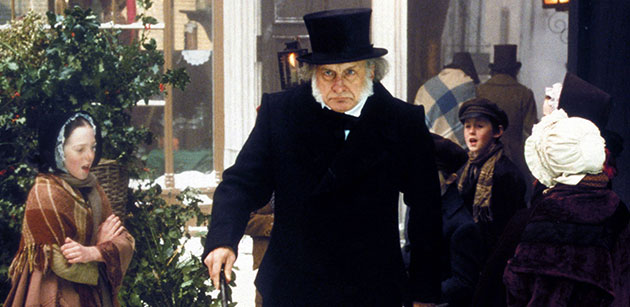
Take the Ghost of Christmas Present, for example. In this version, he’s played by Edward Woodward, with a deep booming voice, an absurdly hairy chest, and hidden stilts making him upwards of 7 feet tall. His eyes twinkle, but something about his grin and hearty laughter gives you the sense of a cat toying with a mouse. There are moments when he berates poor Scrooge for his vices, and his voice becomes intense, and the smile vanishes from your face, and he tells Scrooge that his life may be worth less than MILLIONS of other souls like Tiny Tim, and…it’s quite a moment. It reminds you that this is a morality tale.

Another example, of course, would be the ever-popular Ghost of Christmas Yet to Come. In every other version I’ve seen, this specter doesn’t speak, just points, usually with some kind of musical flourish. This version is no different, except the filmmakers ingeniously use an intensely creepy sound effect whenever this Ghost points or nods. It’s like someone pulling a violin bow across a huge piece of sheet metal. The effect is not comic or melodramatic. It’s deeply unsettling.

Of course, yet another reason to love this version is the towering performance from George C. Scott as the proto-Grinch, a man for whom Christmas is just an “excuse for picking a man’s pocket every twenty-fifth of December.” He injects moments of sly humor if you watch carefully (to the mute Ghost of Christmas Yet to Come, he mutters, “You’re devilishly hard to have a conversation with”), but for the most part he plays the character completely straight with nary a grin to be seen except on the rarest occasions. This is an aspect missing from every other version. The prevailing wisdom seems to be to amplify and overdo the character of Scrooge, so he’s not as unlikable, I guess. Not this time. Scott creates a mean, heartless, ruthless businessman who would as soon bankrupt you as say two words to you. Even Albert Finney’s interpretation in Scrooge, as completely as he disappears into the role, is not as dark and merciless as George C. Scott’s version.

It’s that darkness that appeals to me here. Yes, yes, the ultimate scenes of happiness and redemption are all there – the boy on the street, Scrooge skipping around his room, “giddy as a drunken man”, the massive turkey – but I love this version because it remembers its roots. This is a gothic ghost story, and as far as I’m concerned, any version of A Christmas Carol would do well to remember that.

THE CHRONICLES OF NARNIA: PRINCE CASPIAN (2008)

by Miguel E. Rodriguez

Director: Andrew Adamson
Cast: Ben Barnes, Georgie Henley, Skandar Keynes, William Moseley, Anna Popplewell, Peter Dinklage, Warwick Davis, Liam Neeson, Eddie Izzard
My Rating: 9/10
Rotten Tomatometer: 66%

PLOT: The Pevensie siblings return to Narnia, where they are enlisted to once again help ward off a tyrant and restore the rightful heir to the land’s throne, Prince Caspian (Barnes).


If The Chronicles of Narnia: Prince Caspian had been released in a world without the Lord of the Rings trilogy and the Harry Potter franchise, I believe (but cannot prove) it would have been hailed as one of the great works of fantasy cinema, with deeply drawn characters, political intrigues, spectacular battle scenes, and scores of wondrous creatures, some of the best put on film.  Unfortunately, we don’t live in that world, and despite scoring over $400 million at the box office, it fell far shy of its 2005 predecessor, The Lion, the Witch and the Wardrobe, and was declared a failure.

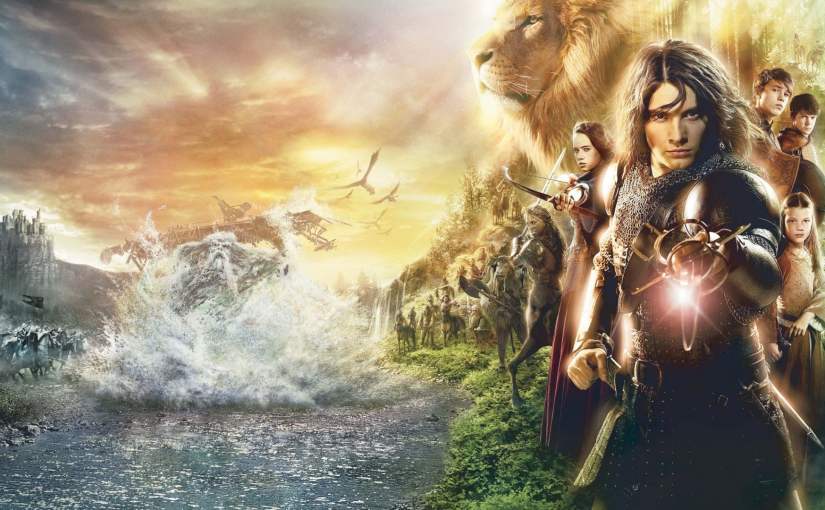
I don’t mean to suggest that previous franchises are to blame for this so-called failure, but in re-watching it, it’s virtually impossible not to compare Prince Caspian to its epic predecessors, especially Lord of the Rings.  Look at the visuals of the final epic battle in front of Aslan’s How.  A massive army slowly advances on a stone-built fortress, while giant catapults hurl boulders from a safe distance.  Narnia?  Or the Battle of Pelennor Fields in The Return of the King?  At one point, a small army of sentient trees intervenes.  Narnia?  Or the Battle of Orthanc at the end of The Two Towers?  Susan Pevensie wards off numerous attackers using only a bow and arrow.  Shades of Legolas, wouldn’t you say?

Whatever.  It takes a conscious effort of will, but I believe it is possible to enjoy Prince Caspian on its own merits rather than judging it by comparison.  Once you can do that, this is a highly enjoyable adventure.  It captures the spirit of the source material, while also combining a childlike enthusiasm for all things fantastic, from centaurs to minotaurs to talking badgers, with a dark, mature storyline involving Game-of-Thrones-level castle politics.

In Prince Caspian, the Pevensie children are living their lives in 1942 London when they are once again magically transported back to Narnia, where they once ruled as beloved kings and queens.  However, time seems to move much faster in Narnia; whereas only a year has passed in the real world since they returned to London, over a thousand years have elapsed in Narnia.  During that time, the castle where they sat in power has been reduced to overgrown ruins that are barely recognizable.  Narnians (magical creatures) are forced to live in hiding.  And Aslan himself is nowhere to be found.

I found this particular story element rather powerful, but it’s hard to pinpoint why.  If I had to guess, it’s because it’s almost like a post-apocalyptic tale.  “We used to live here, when things were good.  Now something terrible has happened, and everything we’ve known is reduced to ruin.  What do we do now?  How do we rebuild?”  That kind of thing.  I guess.

Anyway, I won’t bore you with a full summary, which you can find online.  There’s a prince who’s been exiled by his greedy uncle, a talking mouse voiced by Eddie Izzard – an outspoken atheist appearing in a movie based on a work of Christian fiction, how ‘bout that? – daring rescues, single combat, an ingenious trap, and a provocative ending that suggests at least one Earthly traveler may have visited Narnia even before the Pevensies.

I think this is one of the most underrated and unfairly dismissed fantasy films in recent years.

SHAZAM! (2019)

By Miguel E. Rodriguez

Director: David F. Sandberg
Cast: Zachary Levi, Mark Strong, Asher Angel, Adam Brody, Djimon Hounsou
My Rating: 9/10
Rotten Tomatometer: 91% Certified Fresh

PLOT: Fourteen-year-old Billy Batson’s life is changed forever when he is tapped to be the recipient of all the powers of a god by an aging wizard.


What’s that, you say?  The trailers for Shazam! look like something that should have gone straight to video?  Looks kinda stupid?  Like something along the lines of 2011’s abysmal Green Lantern crossed with Sky High?

Well, you’re not wrong in terms of the trailer.  However, like all the best trailers, it only shows you what it WANTS to show you, and keeps the best stuff hidden until you pay your admission fee.  And what the trailers DON’T show you is the heart, appeal, and just plain fun of Shazam!  It’s the DC Extended Universe’s answer to Guardians of the Galaxy.

Plug the director’s name, David F. Sandberg, into IMDb, and you discover that his biggest credits to date are the Lights Out movie (a one-trick horror pony) and Annabelle: Creation, unseen by me, but which intuition tells me was not exactly a superhero movie.  So he would not seem to be the ideal candidate to helm a movie that tries to bring some constantly-requested fun into DC’s dark universe of films.  But whatever Sandberg learned on those other movies was worth learning, because he has created a comic-book movie that’s just about as much fun as Spider-Man: Into the Spider-Verse.  Like someone remade Big where the little kid turns into Superman instead of Tom Hanks.

The beginning of the film is pretty standard comic-book stuff.  The origins of a key character, background on young Billy Batson (played by Asher Angel, a young actor who is the spitting image of Arya Stark on Game of Thrones, has anyone seen the two of them in the same room together, just saying), and his introduction into a foster home unique in the world of comic-book films, at least to my knowledge.  Billy’s new foster home is a melting pot of cultures, from Asian to (I think) Samoan, with siblings ranging in age from about 9 to 18.  There was something kinda cool about it, but not distracting.  Just…unique.

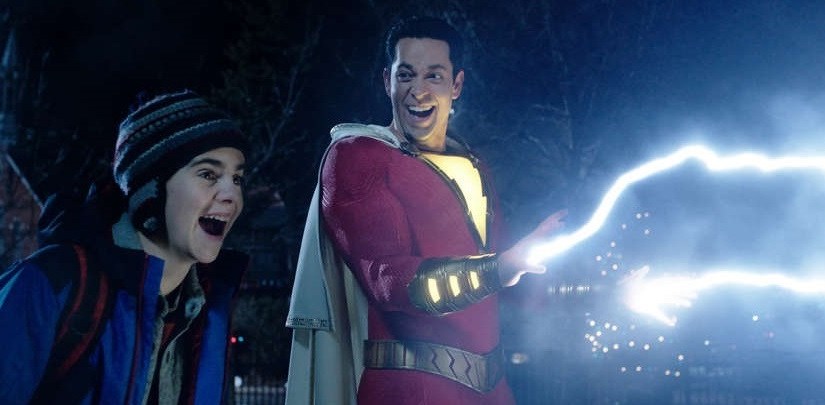
When Billy miraculously gains his powers (in a scene that is distinctly Potter-esque, what with wizards, lightning bolts, and orphans), one of his foster siblings, Freddy, becomes his manager, owing to the fact that he’s an expert on superheroes, particularly Superman and Batman, although he can also be seen wearing a t-shirt with the Atlantean logo on it…nice touch.   The scenes where Freddy and Billy attempt to determine the extent of Billy’s new powers are worth the price of admission.  And they have a certain logic.  If a bullet shot from a gun bounces off your brand-new super-suit, AND your body has completely transformed, how do you know if your HEAD is bulletproof or not?  Speaking for myself, I’d just use my super-speed and get out of the way, but that’s not really definitive enough for our heroes.

Anyway.  The movie uses a lot of comedy and just enough super-villainy to get us through the story without bogging us down in the deep dark psyche of the villain.  And it builds to one of the most inspired climaxes I’ve seen in a comic book movie in a really long time.  I don’t want to give too much away, but I will say this: just remember that throne room.

Don’t let the kitschy nature of the trailers scare you away.  This is a great, FUN movie.