THOR: THE DARK WORLD

By Marc S. Sanders

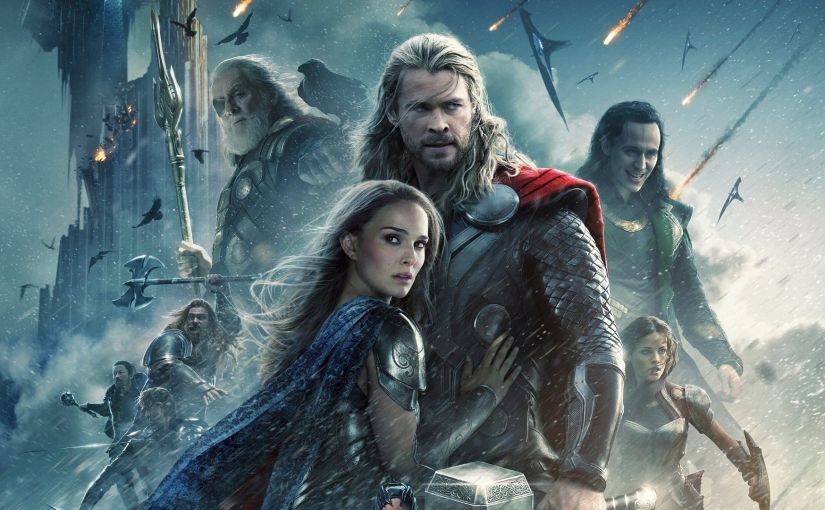
Like Louis Letterier’s The Incredible Hulk, director Alan Taylor’s Thor: The Dark World is a very underrated installment in the Marvel Cinematic Universe. It focuses on a lot of humor with well edited action and moments that allow all the major players to offer up good material.

First Chris Hemsworth as Thor. Yeah, he’s doing the same thing and that’s fine. If it ain’t broke, don’t fix it. Moving on… This is an important chapter in the MCU, as it introduces the second of the legendary Infinity Stones, the red Aether, which consumes Thor’s love interest from Earth, Jane Foster, played by Natalie Portman. Fortunately, it provides better writing for Portman to play with. She really is the MacGuffin of the film, and she works as a story device to explore more of Asgaard, one of the best set pieces in all of the Marvel films. Jane uncovers the mysterious stone, or rather liquid, that has been hidden away for centuries; this is all Lord Of The Rings stuff. Once she finds the stone and is consumed with it, then the film segues into its originality.

Apparently, it’s not good if the Aether is used for destruction while the Nine Realms are in Convergence, which we are told happens every 5,000 years. What is Convergence? Well, that’s where it’s fun to watch Thor: The Dark World. The Nine Realms line up, literally like a rainbow of circles stacking on top of one another. It’s really cool to look at. What’s more fun is how Jane and her crew drop random objects into an open space within a deserted London warehouse and then it disappears, and then drops back down to them from above their heads. Sometimes, they drop something, only the objects don’t return at all. I like all of this stuff, because it’s all visual and ultimately that is what movies are about. Showing us something. Asgaard, The Convergence, Thor’s swing of his hammer, the Aethar, it’s all fun to see. I’ll credit Alan Taylor’s direction for a lot of this. He’s shown great achievements in Game Of Thrones. He carries his visions over to Thor’s universe.

Next is the villain is Malekeith, the head of the Dark Elves, with some really wicked looking makeup, and it only gets more wicked as he progressively gets more powerful. He wants to get the Aether and bring the Nine Realms into Darkness. Christopher Eccleston (best known for G.I. Joe; that should tell you something) takes on this role which is nothing special. I don’t care so much about the villain in this film as I do about the conflict of the story. The conflict is the real treat. Eccleston is nothing special. He’s not bad. He’s not good. He’s just nothing special. Moving on…

Tom Hiddleston is back as the trickster Loki, one of the best written characters in all of the Marvel Cinematic Universe. The script gives him a lot to play with and opportunities to irritate and antagonize Thor who reluctantly recruits his assistance. “Well done. You just decapitated your grandfather.” See the movie (again?) and you’ll love the timing of this line. Hiddleston has fun with the levity of Loki but there is a sad central story to the adopted son of Odin. During his first appearance in the film, following his incision of the New York alien invasion from The Avengers, Loki is arrested in chains to stand before his father, and Hiddleston clicks his heels together at attention, giving a serious grimace before declaring “I really don’t see what all the fuss is about.” Hiddleston continues to work and develop at this favorite character who remains tricky and unpredictable. I love it.

Anthony Hopkins is back as Odin, Thor’s father. Yeah, he’s doing the same thing and that’s fine. Again, if it ain’t broke, don’t fix it. Moving on…

There’s a lot of fantastic sci fi and fantasy sequences to this film and from a CGI perspective, it’s artistically beautiful. It’s just a fun ride of exploration. Thor was never a favorite comic book character of mine growing up. The MCU opened my eyes to something special in his adventures and those that surround him. It’s even great when Thor jumps on the tube to return to a battle in Greenwich Village. I’m expecting some energetic debate on my feelings towards this film. Bring it on and I’ll match you. As Thor might say after his hammer turns a giant rock monster to rubble, “Anyone else?”

Reader, if I can quote this film three times in a review that should tell you how much I love Thor: The Dark World.

THE SHAPE OF WATER

By Marc S. Sanders

I love fantasy and science fiction for one simple rule. A writer/director’s imagination can be limitless. Rules for a good fantasy are normally established in the exposition, and as long as those rules are not violated, a viewer will accept the narrative all the way to the end. The Shape Of Water is loyal to its set up.

Director/Co-Writer, Guillermo Del Toro continues his reputable streak of very adult (yet playful) fantasy. In 50 years, I would not be surprised if Disney/Pixar remade this film and Pan’s Labyrinth for younger PG audiences simply because the roots of the stories are so well played out.

Here is a Cold War love story between an alien and a good soul played by Sally Hawkins doing her best mute. Hawkins is bright eyed and wonderful. She’s a character that doesn’t judge and only recognizes despair for salvation. I thought she was great at conveying her performance through the limits of only facial expression, sign language, sex and self pleasure in a bathtub. Try to avoid snickers at that last description. It really is an honest, necessary reflection of a lonely innocent woman. I appreciated the writing and performance there.

Michael Shannon is back on screen playing a frightening villain…again. The reasons for his ruthless intentions were never clear to me, but either Shannon is that good an actor or he’s gotta be like this in real life. This is not a guy I’d ever want to cut in line at Starbucks, much less audit his books. He’s scary good.

Didn’t find much point to Richard Jenkins lonely neighbor except to drive a van, eat pie, be unemployed and be a token homosexual. Same with Octavia Spencer. Was she channeling a more subtle Whoopi Goldberg from Ghost? Don’t get me wrong. Jenkins and Spencer are fine actors here, and their characters are likable, but they don’t add much to the story except to be Hawkins’ sidekicks. Too much story was devoted to them though unnecessarily. Del Toro and his co-writer might have used them for too much filler.

Del Toro doesn’t stop with the new material as the two hours swim on by at a nice pace. We are treated to a wonderful Busby Berkeley song and dance moment that is just inviting to be spoofed by the Wayans or Zucker brothers, sensual nudity is there, not for perversion, but to send home the message that though this relationship is weird, it’s also the real deal. I bought it all the way through. Racism and gay prejudice are perhaps unnecessary in a film like this but there is key lime pie. Cats are consumed. Cold War espionage is on hand with Russian spies, dirty American government politics is there too, and oh yeah, there’s an amphibious alien who seems like any one of Spielberg’s extra-terrestrials we’ve seen before. Yet, I’ll take this one as well because he’s narrated into a very mature love story that is hard not to like.

As quick as the movie begins, you know how it is going to end. Again I don’t mind. Most of the execution rescues the story’s predictability.

Del Toro won Best Director and the film was awarded Best Picture at the Oscars. It’s not what I would pick, but there could be worse choices from that year’s selections.

I liked The Shape Of Water. Most of it at least.

THE LORD OF THE RINGS: THE RETURN OF THE KING

By Marc S. Sanders

I remember film critic Gene Siskel once said that to take issue with the length of a film is not entirely fair. After all, you are getting more movie for your buck. Would Siskel have felt that way about The Lord Of The Rings: The Return Of The King? Peter Jackson closes out the film adaptation of JRR Tolkien’s sweeping fantasy with an epic that allows you to marvel at everything you see, but does that mean we want to feel as overly exhausted as its main protagonist, Frodo Baggins, feels? Trust me. Poor Frodo looks wiped.

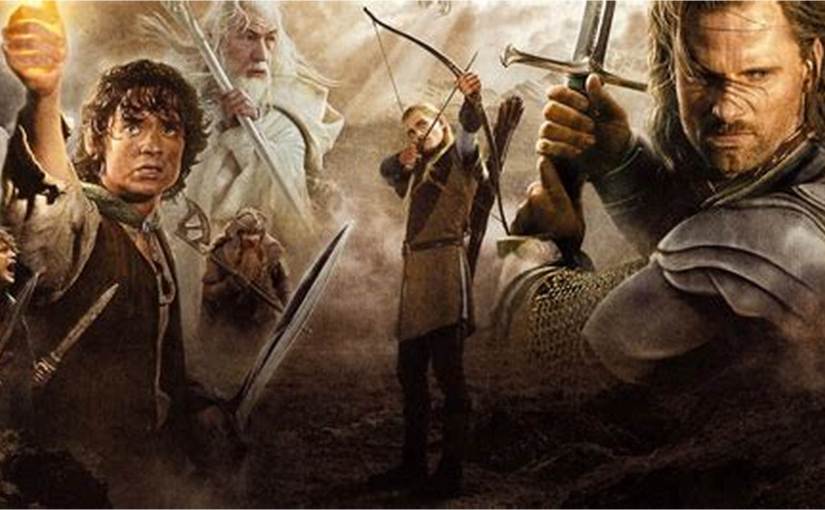
More battles are enacted in the third film. Jackson just changes the dynamics up a little bit. Now armies don elephants with a number of enormous, curved tusks. Another army has a different looking giant troll. Haven’t seen elephants before. Haven’t seen that kind of troll yet either. As well, there is another King who is apprehensive to cooperate in the fight against Sauran and his Orc minions. There’s also a green glowing ghost army. Meanwhile, Frodo and Sam (Elijah Wood and Sean Astin) continue their journey to Mount Doom where the almighty Ring must be destroyed. Gollum (Andy Serkis) remains as their untrustworthy guide.

Jackson seemingly covers every page written by Tolkien. I’m talking about depicting every dream each character has or line they utter or slow motion expression they offer, or walk that they take. Peter Jackson is a completist.

The Return Of The King won Best Picture along with a bevy of other Oscars. Seemingly it should have won anyway. The first two films were recognized with Best Picture nominations as well. For the third film to win was to honor the entire trilogy and its achievements in filmmaking. The Lord Of The Rings trilogy reinvented movie making as a whole. The bar was set so much higher following its release and huge reception of these films.

That being said, it takes endurance to stay with the picture. Most especially with The Return Of The King as the film has multiple endings. Just when you think it’s over, it’s not, and it’s tedious and a little frustrating. Jackson seemed to have too hard a time saying farewell to his digital Middle Earth with its endearing characters.

The length is a problem I have with the film, but none of it seems wasteful either. Every caption and scene carry an importance to it. At least that’s how Jackson wants you to feel. The question is, if a number of momentary scenes had not been woven into the final edit, would I miss it, and my answer would be likely not.

THE LORD OF THE RINGS: THE TWO TOWERS

By Marc S. Sanders

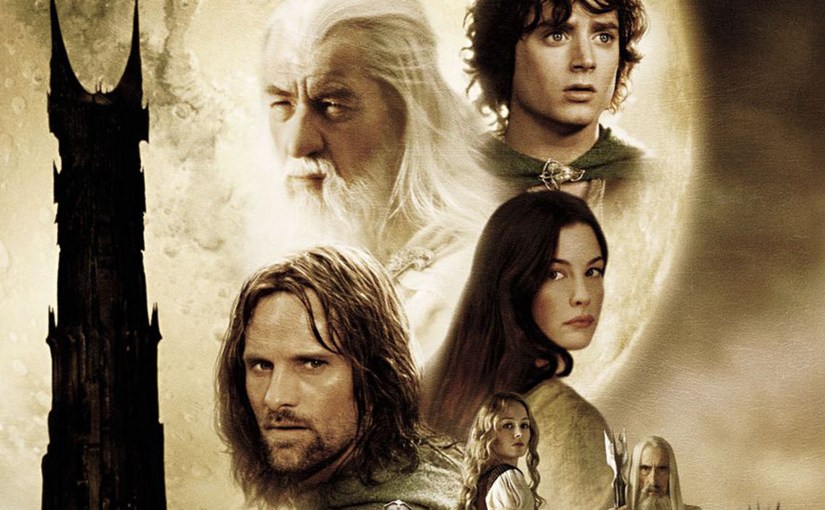
Peter Jackson’s second installment film adaptation of JRR Tolkien’s The Lord Of The Rings trilogy is The Two Towers. The captivating fantasy themes that audiences discovered in the first film continues.

Battle scenes with Orc armies are well edited and staged perfectly in digital settings. The film’s ending with a long, drawn-out battle located at the stone castle Helms Deep is stunning, full of heroic actions executed by favorite characters like Legolas the Elf (Orlando Bloom), Gimli the Dwarf (John Rhys-Davis) and especially Aragorn, destined to be King (Viggo Mortensen).

The Two Towers is almost marvelous with the exception of an overstayed welcome of the Ents – life size talking trees. Treebeard is the main Ent character, where the Hobbits Merry and Pippin take shelter by sitting on his branches. The effects of the Ents work. When the film returns to this storyline however, the narrative drags and the audience suffers. Treebeard converses in his own speak with the other Ents, the Hobbits ask “well?” and it’s supposed to be amusing that all they said was good morning. It’s not amusing. It’s boring.

The big centerpiece of the film belongs to Andy Serkis doing his full body animated effect to bring the untrustworthy, dual personality Gollum/Sméagol to life. Serkis should have received an Oscar nomination as he piggy backs on the continuous journey that Samwise Gamgee (Sean Astin) takes with the ring bearer Frodo (Elijah Wood). Gollum can’t resist what he once owned for himself-the “precious” Ring. Frodo’s good instincts insist upon not harming Gollum or Sméagol while Sam has strong reservations.

Jackson’s second film offers up a heightened urgency on all fronts. He’s good at showing the weight of the ring upon the psyche of Frodo and Gollum and he leaves time for other stories where Saruman’s (Christopher Lee) army conquers more lands-allegorical to the period of time when Tolkien wrote his novels following Nazi occupation within Europe.

Jackson is a completist and no stone is left unturned. A large portion of the film is appreciated even when you consider that you can take a bathroom break anytime Treebeard shows up.

THE LORD OF THE RINGS: THE FELLOWHSHIP OF THE RING

By Marc S. Sanders

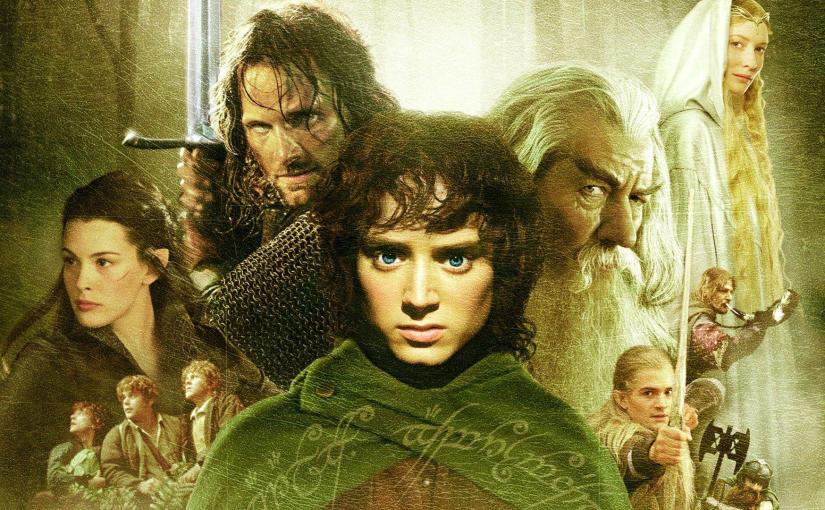
JRR Tolkien was one of the 20th Century’s greatest fantasy writers. The Lord Of The Rings series was a dense, sweeping epic inspired by the torn European climate during World War II and its conflict with the Axis nations, particularly Hitler and his organized Nazi Germany.

Peter Jackson found the opportunity to adapt Tolkien’s works. In 2001, The Fellowship Of The Ring amazed audiences with its epic landscape of Middle Earth, Isengard and Mordor where the fiery Mount Doom is located and the evil eye of Sauron waits for a resurgence of overthrow.

Much happens in each three hours plus Rings films. Tolkien’s story is not so much plot, but moreover a journey from one adventure to another. What’s special is that the main hero is a small, kind Hobbit named Frodo Baggins (Elijah Wood) who has been tasked with carrying the dangerously powerful “One Ring To Rule Them All” back to Mount Doom and destroy it. He is aided by eight fellows, three other Hobbits and four representatives of various nations and backgrounds to protect and escort him. The most significant member is the wise wizard Gandalf The Grey played by Ian McKellen in an Oscar nominated performance. The other characters’ significance become more established in later films.

This first installment is my favorite of the series because it is the most absorbing. I believe in the all but sinister and deadly value of Tolkien and Jackson’s MacGuffin, the Ring. Jackson does well of posing the threat of danger each time Frodo dons the Ring for the sake of invisibility while the Orc army of Saruman, Sauron’s Wizard henchman played by Christopher Lee, bears down on the Fellowship. The film shows one battle after another but the suspense is heightened each time as we become more familiar with Jackson’s digital world. It’s also quite dramatic to see Frodo become consumed in fear and a kind of sickness as the possession of the Ring weighs upon him. To precisely show that transition requires a three hour film, and Elijah Wood is up to the task, always appearing quite angelic and unsure of his assignment. Wood is quite the underrated actor.

There are a multitude of character descriptions in The Fellowship Of The Ring and a number of them come into play when centered around the viewpoint of the Ring. Backstories for others are really not necessary but Jackson attempts to cram as much of Tolkien’s narrative as possible. Beyond Frodo, and maybe Gandalf, the other most interesting character here is that of Boromir played by Sean Bean, often playing a variation of a hero in his films, but quite good at not being worthy of endless accolades. Boromir is a great character to show how the temptation of the Ring can cloud and poison the mind. Bean evokes that of one who might be a weak addict, needing a quick fix of the Ring’s power. There’s a complexity to his performance. Boromir is likable but Sean Bean makes the character quite shocking as well. He’s not a villain but his internal weakness presents a conflict for Frodo and his band. Sean Bean never got enough recognition for his role here.

Peter Jackson is the real hero though. This series is a massive cinematic accomplishment. Everything feels gratefully familiar. Perhaps that is from reading Tolkien’s visually descriptive books, or maybe even the animated film from the seventies. There’s something to see in every corner of the screen. It’s a world come alive in leaves, creatures on land or in the sky, sorcery and swords, flames and even saloons of overflowing drink and large platters of food. The Shire where Frodo lives with his uncle Bilbo (an excellent and jovial Ian Holm) comes off as a happy utopian village of farming and Hobbit celebrations of laziness and relaxation from any outside elements. Jackson contrasts this beautifully against the majesty of Rivendell and the hell of Mordor. It’s a nuanced universe.

Again, for me this first installment remains the best as it is cinched up tightly in its exposition and narrative. Later films are just as grand but maybe sidestep away from themselves a little.

I never got that impression with The Fellowship Of The Ring. Everything I see belongs in the film.

THE TRUMAN SHOW

By Marc S. Sanders

Perhaps The Truman Show directed by Peter Weir demonstrates that no matter what time period a person exists in, he/she/they will never be limited to life within a television set.  Life is meant for more than just stories coming from an electric box.

Jim Carrey portrays Truman Burbank who is the star of the addicting and ratings bonanza 24/7 television program known as The Truman Show.  Since his birth, Truman has been observed by the world.  His parents are actors.  His friends are too.  Co-workers and neighbors and townsfolk as well.  His wife Meryl (Laura Linney) is just an actor.  It’s all fake.  Yet, for Truman it’s all real.  He has no idea that he is a worldwide guinea pig meant for complete observation.

Now that Truman is in his thirties, though, he is becoming wise to the fact that something doesn’t feel right.  Every day, for example, is no different than the one before.  It’s all routine.  He kisses his wife on his way out the door.  He waves to his neighbors.  He always teeters on selling an insurance policy to two dweeby twin brothers.  He picks up a magazine at a local stand in the center of his harbor island town.  He responds positively to his boss and then he comes home and mows his lawn. 

It’s only when odd occurrences appear that Truman starts to think and for the television show’s creator, Christof (Ed Harris), that’s a dangerous risk for the longevity of the program.  Christof manipulates everything that happens to Truman thereby manufacturing his fear of the ocean.  An episode from long ago focused on Truman’s near fatal drowning accident with his “father” who went missing.  That fear keeps Truman contained and unable to explore beyond Christof’s inserted limits.  His program allows for sponsorships like the six pack of beer that Truman’s best friend Marlon (Noah Emmerich) always carries or the household products that Meryl uses at “home.”

Peter Weir’s film is concerned with discovery.  Efficiently speaking, he presents the script written by Andrew Niccol with a “how it works” narration as part of a fast moving first act.  When we, the viewers of the film (not the viewers of the show within the film) are accustomed to Truman’s normalcy, then we perk up when we see something out of place like a set door that reveals a backstage catering counter for cast and crew.  We find it amusing when the weather doesn’t work properly and it only rains directly over Truman, and nowhere else.  What would Truman make of a stage lamp falling out of nowhere from a clear blue sky? Christof would not even think to imagine. Even more disturbing is when one of the program’s actors does not cooperate with the illusion, like a girl named Lauren (Natasha McElhone) when she attempts to reveal the truth to Truman as they genuinely become attracted to one another.  Suddenly, “her father” whisks her over to a mysterious place called “Fiji,” and Truman becomes fixated on visiting that locale one day.

Unlike Paddy Chayefsky’s Network, I don’t consider The Truman Show to be brilliantly prophetic.  Ever since the television was invented, we’ve become addicted to the images emanating from the box in the center of our living rooms.  So, I guess I’m not as fascinated with this film as others have claimed.  The viewers depicted in the movie like regular bar patrons, old ladies who are sewing throw pillows and blankets while watching on their sofas, and parking garage security guards working out of their enclosed booth, are hooked.  They’d never even think of falling asleep or changing the channel.  We are not however, and are left with observing Jim Carrey doing another silly role sprinkled with some sensitivity and an intelligence that is slowly becoming aware.

Perhaps Weir and Niccol are toying with the idea of God, and his play toy that he calls man or in this case Truman (True-Man).  God has the will to control a person and keep him contained, but his invention will eventually develop a mind of its own.  Intelligence breeds defiance and a want for freedom.  History continues to show that.  Therefore, man will build up the gumption to sail across the treacherous seas in search of what’s out there beyond what the eye can see.  God will test and test and test.  Man will either pass or fail, again and again.

In this age of endless reality tv programs, far be it for me to say that the set up of The Truman Show is unlikely.  Yet, it still does not seem possible.  It’s ridiculously over the top.  (Watch me eat my words one day.)  So, Peter Weir’s picture is a fantasy, I guess.  However, is it a fantasy I really care about?  Unlike the viewers of the program within the film, I never cared about Truman.  I never cared about Christof, Truman’s antagonist.  I definitely don’t care about the actors in the tv show.  Sure, Niccol’s script is an idea: “What if a guy was born and raised and lived within a television show?”.  However, is this an idea that is worth running through with?  What’s to gain from the picture? I guess I missed a number of episodes or a couple of seasons to empathize or follow the ongoing story. 

Having seen all the episodes of The Sopranos or Breaking Bad or even Cheers and The Big Bang Theory, I was there from the beginning.  So, I was concerned with the outcome of Tony Soprano and Walter White and whether Sam & Diane would make it as a couple.  Truman Burbank is just another Jim Carrey caricature that I just don’t care about.  So, you’ll have to excuse me if I go check out what’s on the other channel instead.  Maybe Jeopardy is on.

FLASH GORDON

By Marc S. Sanders

How can anyone not like Mike Hodges’ camp celebration of a savior hero vs a destructive villain?

Flash Gordon was penned by Lorenzo Semple Jr, writer on the 1960s Batman TV show. His first draft is the one and only draft which producer Dino DeLaurentis approved for shooting. A glossy, flashy and fetishistic approach was adopted for the film, and it became timelessly memorable.

What thrills me about the film is its appreciation for the original, pioneering comic strips on which the film is based. Max Von Sydow’s Ming The Merciless is pulled right from the newspapers in his gloss pinks, reds, golds and blacks costume wear. The inflection of his voice is otherworldly from the start (“Klytus, I’m booooored. What do you have for me to play with today?”)

Sam Jones is a level down in the relatable hero of Christopher Reeve, but he’s enjoying every minute of his hero character schtick. He’s perfect for Semple’s playful writing and he looks like a champion.

Timothy Dalton and Brian Blessed are great side characters on opposite ends; one distinguished, the other gluttonous and proud.

The best flavor of the film is its soundtrack. Thank you Queen!!! Their musical touch is an early inspiration to some modern Marvel films like Guardians of the Galaxy, and Thor: Ragnarök, clearly showing direct influence from Flash Gordon. Freddy Mercury, Brian May and company relish in heavy pounding drums and special effect sounding guitars to deliver a cheerleading rock anthem. “Flash…aaaah!!! He’s a miracle!”

Dino DeLaurentis saw opportunity following the success of science fiction with Star Wars. He produced Flash Gordon with his own style, not as a copycat. The film became a fantasy with characters bleeding rainbow colors, pet midgets, cat fighting concubines, great hall football fighting with aluminum watermelons, weird lizard creatures, hawkmen, half egg-shaped planets, and even a thrilling fight to the death on a tilting platform with protruding spikes, the best scene amid all the camp craziness.

It’s all great. Flash Gordon is the savior of the universe. “He’s a miracle!!!!”

THOR

By Marc S. Sanders

Chris Hemsworth is the God of Thunder who must learn to grow up if he is to inherit the throne over the land of Asgard from his father Odin (a welcome Anthony Hopkins), and more importantly become worthy of lifting his mighty hammer. Hemsworth is great; full of cocksure assuredness, humor and heroics. Chris Hemsworth makes you believe he’s the only guy who could play Thor.

Thor’s adversary is the God of Mischief, Loki played by one of Marvel’s best actors, Tom Hiddleston. This is a guy who plays so many different levels. If one didn’t know the story of Thor and Loki, I’d argue they might be shocked at some of the turn of events Hiddleston masterfully orchestrates with simple facial expressions and passiveness that progressively switch over to madness, obsession, jealousy, envy and deceit. Hiddleston effectively spins all the plates perfectly.

Natalie Portman plays the love interest carrying the torch of least significance that Liv Tyler and Gwenyth Paltrow held in prior Marvel films. That’s a pattern the Marvel films will begin to improve upon with the next film in line.

Director Kenneth Branagh is the right guy for this movie. Inspired Shakespearean settings and dialogue overlap with modern day America. Branagh brings a nice balance to it, and he also directs his actors well. A great exchange of dialogue and performance occurs midway through between Hiddleston and Hemsworth. Branagh gets good close ups of both actors as the conniving villain manipulates the naive hero. The camera angles move at a slant almost evoking a necessary confusion between what is true and what is a lie. Moments like this allow Thor to be more than just an action film. There are nice opportunities for acting as well, and because of that Hiddleston especially has become quite treasured among loyal fans.

Compliments must also go towards the setting of Asgard. I normally frown on immersive CGI normally. Not here though. Asgard is as regal as anything Peter Jackson offered in his Tolkien films, complete with a striking rainbow bridge and towering structures. I want to tour through that whole land. It’s that spectacular. Characters also work well with the CGI, especially the fire breathing, metallic Destroyer.

Thor is a great introduction to the legendary comics character. The film offers a character arc of change much like what was captured with Tony Stark in the first Iron Man. The character must grow and learn about his identity over the course of the film in order to have legs for future installments. This film accomplishes that feat, and thus Chris Hemsworth has become a box office draw while his most popular character to date has become a screen favorite.

BACK TO THE FUTURE PART III

By Marc S. Sanders

I think Bob Gale and director Robert Zemeckis forgot one thing about Back To The Future Part III. It was supposed to be a time travel movie. Sure, Marty McFly (Michael J Fox) travels back to the Hill Valley of the Old West in the year 1885, but once he gets there, there is not a lot of material for the beloved DeLorean.

The film picks up immediately where the last film cliff hanged. Marty is left trapped in 1955, and he receives a letter sent to him 70 years earlier from his present day Doc Brown companion (Christopher Lloyd) originally from 1985. You still with me? When Marty realizes that Doc gets shot in the back by Mad Dog Tannen (character actor great, Thomas F Wilson), he arranges with the 1955 Doc to send him back to the Old West and prevent that from ever happening.

From there, the film turns into a staple Western. There’s the calvary, Indians on horseback, quick draw duels in the street, a saloon, stage coach and wagons. Most importantly, there’s a steam engine to push the DeLorean to the necessary 88 miles per hour to send our heroes back to the future. That dilemma is solved quickly and early on. They now just have to wait for the train to arrive.

So the film calms down to allow a charming Mary Steenburgen as Clara Clayton, a schoolteacher, to capture the affection of the good ol’ Doc. When the romance seems impossible though, we get a depressed Doc. A depressed Doc Brown is never good for a movie. Consider this. It’d be so easy to just wait for the moment to travel back in time. However, obstacles get in the way, right? In the fantastic first film, Marty has to play guitar at the school dance to get the necessary first kiss between his parents thereby solidifying his existence. That’s fun…and then he kills it while performing “Johnnie B. Goode.” Here, the moment to time travel is approaching, but it can’t happen because Doc is depressed. What’s so fun about that?

Like Part II, Part III is watchable. It’s not terrible by any means. It’s just a little stale. The best gag, however, is Marty taking on the name of “Clint Eastwood” to build his status in the town. This allows a lot of inside jokes. What would’ve sent this film into the stratosphere is if they got the legend himself to make at least a cameo. Alas…. I can dream and wonder.

Back To Future Part III ends the film on a sweet message similar to what you get from other fantasies like The Wizard Of Oz or Willy Wonka & The Chocolate Factory. It reminds me that despite its shortcomings, the entire Future trilogy is great to share with the whole family. No doubt, there’s always something to look at and focus on.

Still, some movies that require focus specifically, takes work. The first film allowed me to wonder. Wonder if all of this could be true one day. Wonder how they thought all this up. Wonder how Marty is actually going to get back to the future.

If I have to choose, I’d rather not focus. I’d rather just wonder.

BACK TO THE FUTURE PART II

By Marc S. Sanders

Back To The Future Part II is a paint by numbers or recipe film more than just a film. This has to be done, so that that can be done, cook on high for just over two hours and all will be wrapped up. Because it is so focused on covering all bases it forgets the wonder and fun of the original film, and just gets down to business. Watching this film makes you feel like dad just won’t throw the football around with you in the front yard. He’s got work to do.

The sequel picks up immediately where the first film ended with Doc Brown (Christopher Lloyd) taking Marty McFly (Michael J Fox) and his girlfriend Jennifer (Elisabeth Shue) to a very zany looking future in the year 2015, complete with flying cars, Jaws 19, the abolition of lawyers, and opportunities to get a redesign of your body complete with a replacement of your spleen and colon just like Doc explains. When an elderly Biff Tannen gets a hold of a sports encyclopedia, he travels back in time to 1955 to tell his younger self to make bets he can’t lose. Now the future is entirely changed, riddled with crime, and Biff in absolute power. Worst of all, the brute is married to Lorraine, Marty’s mom (Lea Thompson, regrettably not given much to do this time around). So, Doc and Marty need to travel to 1955 to set things right all over again.

Look, if you were gonna make a sequel to Back To The Future, this is likely what the script was going to spit out. It’s a watchable film. However, it’s lost the soul of the original installment. It feels like an office project. The comedy is absent. A long sequence shows a middle age Marty in 2015 talking on video phone remotely with his bullying boss, and getting fired, with fax machines all over the house spitting out the message as well. This is supposed to leave me in awe? This is funny?

The second half of the film in 1955 has Marty pursuing Biff the bully while trying to get the sports book back. Biff, played by Thomas F Wilson, is more or less doing the same thing as the first film. Only he’s not the dumb buffoon we laughed at the first time. He doesn’t have George to bully around this time. You realize Biff and George made a perfect comedic pair. That’s missing here. So he bullies some little kids and with extreme harshness and tries to kill Marty on several occasions. It’s not so funny this time. It’s cruel.

A fun motif (that also carries forward in Part III) is that the actors are playing their characters at different ages 30-60 years apart from one another. Fox, Wilson and Shue also play their kids or grandkids. A nerdy Marty Jr is nerdy, but not quite funny. Fox is not doing the fantastic humor that Crispin Glover did as George in the first film. He’s just wearing an oversize jacket with his jeans inside out and squeaking his voice. Meh…not funny, just there.

Robert Zemeckis’ sequel is just okay. It’s disappointing because he and his collaborator Bob Gale worked so inventively on the first film. The construction is solid. I still love the various transformations of Hill Valley, California. If the film were made today that’d all be done with CGI. I appreciate the texture in the construction of the town’s past, present and future. Each time period allows me to look around and see what’s replaced what and so on. So, I’m truly grateful for that.

All and all though, Zemeckis and Gale had all the right ideas. They just didn’t have the best execution in mind.