THE CHRONICLES OF NARNIA: THE LION, THE WITCH AND THE WARDROBE (2005)

By Miguel E. Rodriguez

Director: Andrew Adamson
Cast: Tilda Swinton, James McAvoy, Jim Broadbent, Liam Neeson
My Rating: 8/10
Rotten Tomatometer: 76% Certified Fresh

PLOT: In London, during the German blitzkrieg, four children travel through a wardrobe and discover the fantastic land of Narnia.


In the ranks of books aching for cinematic adaptations, C.S. Lewis’ classic fantasy riff on Christian symbolism surely must have been at the top of Hollywood’s list for years.  With the raging success of Peter Jackson’s Lord of the Rings and the Harry Potter films, someone must have decided it was finally time to get this on movie screens.

The only problem is, TCON: TLTWATW [it’s a mouthful] will inevitably be compared to those other immensely successful franchises.  As a result, while the movie itself succeeds admirably, I find myself thinking, “Yeah…but it doesn’t QUITE pack that Return of the King punch.”

But film appreciation/criticism/whatever is not about how a movie performs in comparison with other films.  It’s about how the movie tells its own story in its own way.  So.

This first installment in the Narnia franchise is a good old-fashioned, rollicking fantasy yarn.  Elements of the film will remind people of everything from Star Wars to Spartacus, in all the good ways.  There is, perhaps, a tendency to believe this movie is only for children, particularly due to the talking animals and the fact that the main characters are children.  (There’s also the unexplained appearance of no less than Father Christmas himself.)  But I disagree.  I think the story has a lot to offer to both kids and adults.

Take, for example, the overt Christian overtones of the story.  [SPOILER, SPOILER, SPOILER, SPOILER ALERT!!!]

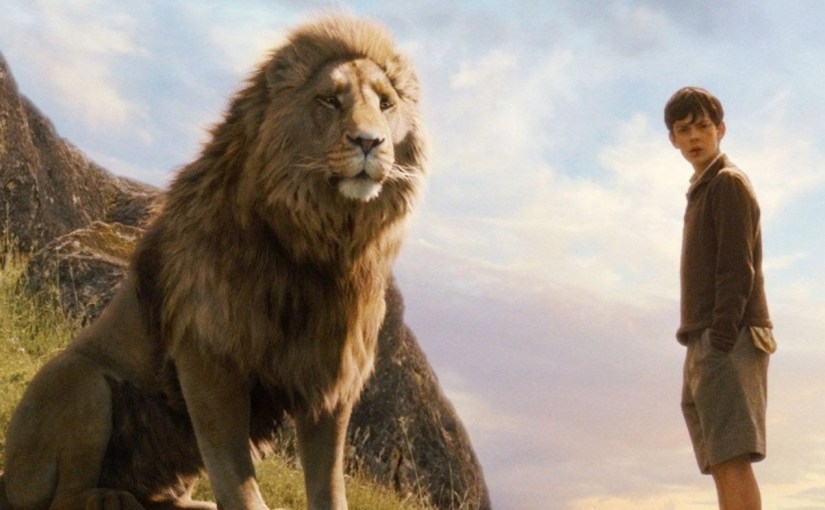
Aslan, the lion king of Narnia, sacrifices his life to redeem the life of Edmond, one of the Pevensie children who briefly turned traitor.  The White Witch murders Aslan in an unexpectedly creepy ritual featuring orcs, minotaurs, and what appear to be some kind of vampire hybrids.  But, because of the “old magic”, Aslan returns to life.  There hasn’t been a Jesus story this obvious since E.T.…or maybe The Matrix.

This might make some folks believe the whole film is some kind of Christian propaganda, but it’s not.  To me, it’s a way of simply re-framing an ancient story in a way that brings that story to life for modern audiences.  Robert Zemeckis tried the same thing with Beowulf, of which I can only say, hey, better luck next time.  George Lucas did it with Star Wars, Cecil B. DeMille did it with The Ten Commandments, and so on and so on.

If I’m going to be picky, I give it an “8” instead of a higher score because of the “deus ex machina” nature of the finale, which can hardly be surprising due to the Biblical influence of the story.  It feels a little too convenient.  And I thought the battle scenes, while entertaining, were a little too bloodless…but what are you gonna do, they needed to keep it PG, this is a Disney film, for gosh sakes.

SCROOGE (1970)

By Miguel E. Rodriguez

Director: Ronald Neame
Cast: Albert Finney, Alec Guinness, Edith Evans
My Rating: 9/10
Rotten Tomatometer: 75%

PLOT: In 19th-century London, a bitter old miser who rationalizes his uncaring nature learns real compassion when three spirits visit him on Christmas Eve (except this one is a musical).

[SPOILER ALERTS! (For anyone whose souls are so dead they have never seen or read A Christmas Carol before…)]


I happened to watch this musical version of A Christmas Carol shortly after watching my absolute FAVORITE version, the CBS TV movie starring George C. Scott as Scrooge.  The two could not be any different, but I can say that, were it not for an absurd cartoonish moment near the finale, this musical would be tied with the TV version as my favorite adaptations.  More on that cartoony moment later.

Albert Finney was only 34 years old when he played the skinflint Scrooge in this 1970 version, and I have to say, the makeup and acting ability on display to turn him into a crusty, hunched-over old man are phenomenal.  There’s a scene where movie magic allows Finney to be onscreen as old Scrooge AND young Scrooge at the same time; as a child, I was convinced they were two different actors.  It’s truly astonishing.

The musical numbers lend a slightly corny air to the storytelling, diminishing the gothic nature of the ghostly visitations.  However, it does make the movie more FUN than other adaptations.  The songs (music and lyrics by Leslie Bricusse of Jekyll and Hyde fame) do capture the spirit of the scenes, in particular “Thank You Very Much” (sung, in a moment of delicious irony, at Scrooge’s death during his visit with the Ghost of Christmas Yet to Come) and my favorite INDIVIDUAL number, the jig danced at Fezziwig’s party: “December the Twenty-Fifth.”  (I would imagine some of these are available on YouTube, for anyone who hasn’t seen the movie and wants a sneak preview before committing to the whole thing.)  The weakest number would have to be the (thankfully) brief song by Jacob Marley, played with vigor by Alec Guinness.  Let us all give thanks Obi-Wan Kenobi was never called on to sing in the cantina on Tattoine.

But the absolute highlight of the movie – really, the BEST reason to watch the film, in my opinion – is the grand finale.  (You’ll have to bear with me, I love this moment, and I want to make sure my description convinces anyone who HASN’T seen the movie to take the plunge.)

It takes place after Scrooge has awakened on Christmas day, a changed man, and has purchased the enormous turkey.  As he skips merrily to Bob Cratchit’s house, with several children in tow, he starts to sing the song originally sung to him by the Ghost of Christmas Present, “I Like Life.”  This kicks off the longest sustained sequence of pure joy in a musical that I can recollect off the top of my head.  Scrooge nearly cleans out a toy store and dons a Father Christmas costume (prompting a delightful reprise of a song called “Father Christmas).  At one point, a troop of bell-ringers perform an elaborate, smile-inducing bit.  As he begins to rip up his debt sheets, “Thank You Very Much” is reprised.  The gathering crowd swells until the narrow streets are jam packed with dancers and singers.  His encounter with Bob Cratchit while decked out as Father Christmas is flat out hilarious.  The finale swells and swells, getting more and more joyous, until it feels like the entire city has turned out to get in on the fun.

Watching that number again today, I found, to my delight, that I was, ah…getting a little verklempt.  Now, don’t get excited, I’m not saying I shed actual tears.  I will say, though, that it wouldn’t have taken much to push me over the edge.  THAT’S why the movie is so good.  It’s very, VERY close to perfect.

And why ISN’T it perfect?  Oh, but let me tell you.

Whenever this movie was shown on television, a curious thing always happened.  In the TV version, the Ghost of Christmas Yet to Come scares Scrooge into falling into his own grave, and he falls and falls…and abruptly, everything goes black, and we see him lying in what appears to be a coffin-shaped hole in the ground.  And then there was a commercial.  And when we get back to the movie, Scrooge is struggling on the floor next to his bed, with his bedsheets wrapped around his head and neck like snakes, and he sounds like he’s choking, and the movie proceeds from there.

Well…what happened?  There’s obviously footage missing, right?  For years and years, I assumed that, whatever was missing from the television airings, it was deemed too terrifying to show on TV.  Maybe he wakes up in Hell, and snakes attack him, which would explain the bedsheets.

Nope.  The DVD version ends the mystery.

In a TERRIBLE move, Jacob Marley shows up again to escort Scrooge to his new quarters in Hell.  This time, Alec Guinness REALLY camps it up, trotting along down the corridors of Perdition as if the ground was too hot to keep his feet down any longer than he has to.  The set design for this version of Hell looks more like a forgotten room in Willy Wonka’s chocolate factory than anything else.  Marley presents Scrooge with the chain he was forging in life (you know the story), and it’s so big, he says, “they had to take on extra devils in the foundry to finish it.”  I mean, really?  They couldn’t have just cut right to him waking up in bed after falling?  They had to add this utterly unnecessary cartoonish button?

It’s this scene that prevents me from marking this movie as a “10.”  Remove that altogether, we’ve got near perfection.  Alas.

But, setting that aside, this is a truly great Christmas film.  It makes the story fun, especially that finale.  If it doesn’t reach the gritty realism of the George C. Scott version, well, we’re kind of talking apples and oranges here.  This is a real treat.

FANTASTIC BEASTS: THE CRIMES OF GRINDELWALD (2018)

By Miguel E. Rodriguez

Director: David Yates
Cast: Eddie Redmayne, Katherine Waterston, Jude Law, Johnny Depp
My Rating: 7/10
Rotten Tomatometer: 40%

PLOT: Magizoologist Newt Scamander (Redmayne) searches Europe for a young man harboring a powerful talent, but must contend with dark forces led by the notorious dark wizard, Gellert Grindelwald (Depp).


[SPOILER ALERTS!!!]

In a nutshell, Fantastic Beasts: The Crimes of Grindelwald is more exposition than spectacle, delivering chunk after chunk of background information on new and existing characters, culminating in a filial revelation that, frankly, I found more than a bit unbelievable.  (But then, I originally thought Vader was lying to Luke Skywalker, so there you go.)  The movie also has a weird habit of introducing characters and then forgetting about them, either altogether or for long stretches of time.  (Wasn’t Bunty interesting?  Two scenes, then nothing.)

But, I have to say, I loved the creatures again, just as I did in the first installment.  The obscurial, for example, is a deceptively hard creature to bring to life, and it’s just as imposing and fearsome this time around.  I loved seeing the niffler again, and who wouldn’t?  The Chinese dragon creature, the Zouwu, was the highlight of all the creatures for me, if for no other reason than the charming method used to calm it down.

I did have a problem following the action during the film’s opening sequence, Grindelwald’s escape.  In all the worst ways, it resembled one of the main fight scenes from Ang Lee’s “Hulk.”  It takes place at night, in driving rain, and a lot of the action happens too fast for the eye to follow.  I might as well have been watching an abstract screen saver.

Being a middle chapter, there were also a lot of threads left hanging, no doubt to whet our appetites for the third chapter, but frustrating nevertheless.  I felt some key information was left out in Yusuf Kama’s story.  The French witch in charge of the archives in the French Ministry of Magic seemed to know more than she was letting on…did she know immediately that she was being hoodwinked?  It was nice to see Nicolas Flamel…but who was he talking to in that big book of his?  A prophecy is mentioned repeatedly…but no one is ever able to finish it without being interrupted.  The woman who fatally pulls a wand on an auror at the big gathering in the finale was glimpsed earlier in the film.  Why?  Was she meant to be important?

I haven’t read the negative reviews of the film, but I would imagine these questions and the density of the screenplay are key points in their arguments.  I have no counterargument.  The screenplay is indeed very dense.  But the visuals are a treat, however rare they were.  It was extremely cool, on a Potterhead level, to see Hogwarts again.  (An audience member applauded when it appeared on screen.)  The creatures are, naturally, fantastic.

I can only hope that these great gobs of backstory pay off in future installments of the franchise.

HARRY POTTER AND THE GOBLET OF FIRE (2005)

By Miguel E. Rodriguez

Director: Mike Newell
Cast: Daniel Radcliffe, Emma Watson, Rupert Grint, Ralph Fiennes, Brendan Gleeson
My Rating: 9/10
Rotten Tomatometer: 88% Certified Fresh

PLOT: A young wizard (Radcliffe) finds himself competing in a hazardous tournament between rival schools of magic, but he is distracted by recurring nightmares.


[DISCLAIMER: This review will more than likely contain spoilers, as well as Potterhead references galore.  I apologize in advance.]

When I first saw this movie, I grieved over how much of the enormously entertaining book had been sacrificed on the altar of box office viability.  Why not make two films out of it?  (Which they did later on with the final book, of course.)  What happened to Winky?  What on earth is going on with the tournament scoring?  (Seriously, try to keep track of it…it makes no sense in the film.)  Where’s the subplot about how Rita Skeeter obtains her inside information?

Watching it again years later, for perhaps the 6th or 7th time, I think I’m a little mellower.  Comparing a movie to its source material is a fool’s errand.  There’s a great story about how, years ago, someone complained to Raymond Chandler how Hollywood had ruined his book, The Big Sleep.  Chandler calmly pointed to a bookshelf, and said, “Well, there’s my book right there.  Hollywood didn’t ruin it.  It still exists.”  (I’m paraphrasing, to be sure.)

So.  Movies and books, apples and oranges.  To quote Carl Weathers in Predator: “It comes with the job.  I can accept it.”

Having said all that, I think the best way to give my impression of the film of H.P.a.t.G.o.F. is to list what it gets right and what it gets wrong.

RIGHT: The second task, involving hidden treasures in the Black Lake.  I loved the look of the mermen and mermaids and the hinkypunks.  This scene managed to captured almost exactly what I saw in my head when I read the book.

WRONG: The first task, involving retrieving a golden egg.  We see FAR too little of how the other contestants fared in their attempts, jumping right past the first three just to see what Harry does.

RIGHT: “Mad-Eye” Moody.  I’ll never be able to read the books again without seeing Brendan Gleeson’s magnificent performance in my head.  That amazing enchanted eye, the facial tics, the glee with which he transforms a student into a ferret…it’s perfect.

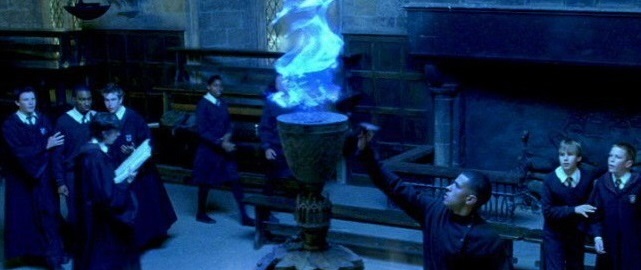
WRONG: The Yule Ball.  As it appears in the film, it literally brings the movie to a halt.  It’s all about the interpersonal relationships between Ron, Hermione, and Harry, but nothing happens to move the plot forward.  I can’t help thinking there was a better way to stage this pivotal event.

RIGHT: The events in the graveyard.  I can recall vividly the moment when I read the words, “He was dead” in the book.  I sat up on the sofa, my eyes grew wide, and I exclaimed out loud, “Holy s**t!”  The movie gets this entire sequence right.  As I recall, the graveyard covered two or three entire chapters in the book, and the film condenses it nicely into a 10-minute sequence.  (Approximately.)  It’s the moment, in both the books and the films, when the franchise became much more than “kid stuff.”

WRONG: Snape’s role in the film.  The movie curiously omits the incredibly relevant moment in the book when, after Dumbledore observes the Dark Mark on Snape’s arm, he tells him, “You know what to do.”  And Snape nods curtly and leaves the room.  That comes into play to a GREAT degree in the latter stages of the franchise.  Ah well.

And I’ll leave it there.  I could go on.  All in all, it’s a good film, a great spectacle, and a turning point for the series.  They could have called it, Harry Potter and the Advancement of Maturity.

FROZEN II

By Marc S. Sanders

You’re not going to see anything you haven’t seen before in Frozen II. All that that you have witnessed in other Disney classics, particularly in the original film, is back again. Still, that doesn’t mean you’ll be disappointed either. Walt Disney Studios has become so meticulous and masterful at putting out project after project that they have literally altered the blueprint of the world’s pop culture psyche. Elsa is the modern day Cinderella. Anna is the modern day Ariel.

Frozen II opens with a flashback story involving young Anna & Elsa frolicking together before bed only to be told a story by their Father of a time when their grandfather led the people of Arrendelle to an enchanted forest and encountered the people of Northuldra. A dam is built as a gesture of peace to help Northuldra, and soon after both peoples witness the spirits of Earth, Wind, Fire & Water. It’s probably a more nuanced story in the visual sense, than I can describe here. Actually, the film gradually shows more to this tale as it progresses. Yet I dare not spoil anything.

Jump to present soon after where the last film left off and everyone is living happily ever after. Elsa is at peace but concerned over a repeatedly harmonious call from far away. Kristoff is stressed over how to propose to Anna-an overdone story only new to kids under 10. He is given too much story and is the weakest element of the picture. Even his solo number, though sung well, is even way too corny for a genuine laugh.

The call that Elsa hears doesn’t stop and is soon followed by a disturbance within the kingdom causing the streets to come up and strong winds to overtake everyone. It is up to Anna, Elsa, Olaf and the rest to journey into the enchanted forest where grandfather explored and uncover the source of the problem.

Frozen II is almost as good as the first film. The characters remain likable and colorful. The music is very strong and easy to learn. Maybe that’s because many of the songs seem to have an identical tempo to every number from the first film. “Show Yourself” sung by Idina Menzel as Elsa is this film’s “Let It Go.” “When I’m Older” is an adorable variation of “Summer” sung by Josh Gad as Olaf, the lovable, comic relief little snowman.

Again, you’re not gonna find anything new here, but the experience is lighthearted fun that’s impossible to resist.

Beyond the uninteresting Kristoff storyline-he gets an opportunity to ask for Anna’s hand in marriage, stutters and stutters, and gets interrupted…again! Yeah! You know what I’m talking about.

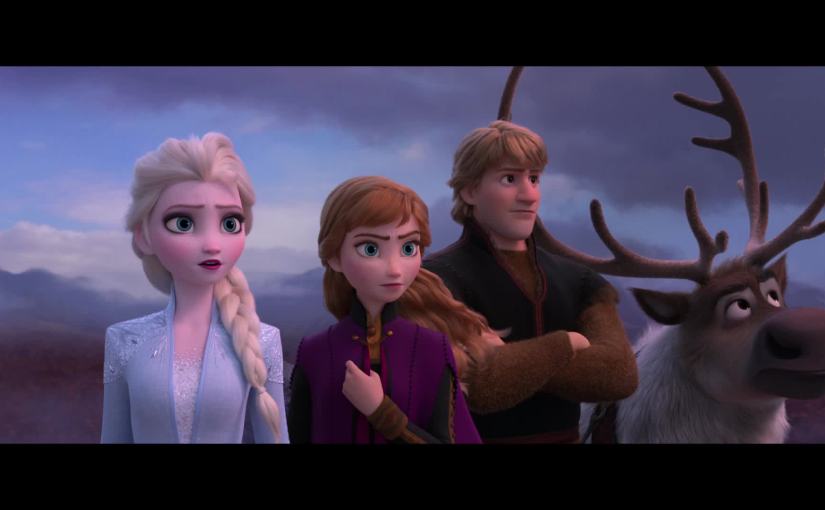
Frozen II has glorious animation that makes you wonder if the Swarovski franchise has an actual mine for all of its crystal products. Gorgeous animation of glass like cathedrals within the land and snowflakes in the sky offer prisms of color in blue, purple and pink. Directors Jennifer Lee & Chris Buck, using a script penned by Lee, give you something eye popping to take in with nearly even caption. It’s positively beautiful.

I took my daughter to see The Addams Family animated update. It was good. Had a message I appreciated. Yet, I couldn’t feel wowed by anything. When you are seeing a Disney production like Frozen II vs a Universal production like an Addams Family retread, you can’t fully appreciate what Universal settled for in its artwork of skinny legs and fat heads for its characters. I’m paying the same price for both films. I’m devoting comparably the same amount of time to both films. Universal gave me an overcooked hamburger. Disney gave me a juicy steak.

Make the right choice. Go see Frozen II. It’s a terrific experience for all ages.

MALIFICENT: MISTRESS OF EVIL

By Marc S. Sanders

Maleficent: Mistress Of Evil has a strong cast and a serviceable approach for the sequel to Disney’s 2014 live action hit. Yet, the film falters anyway.

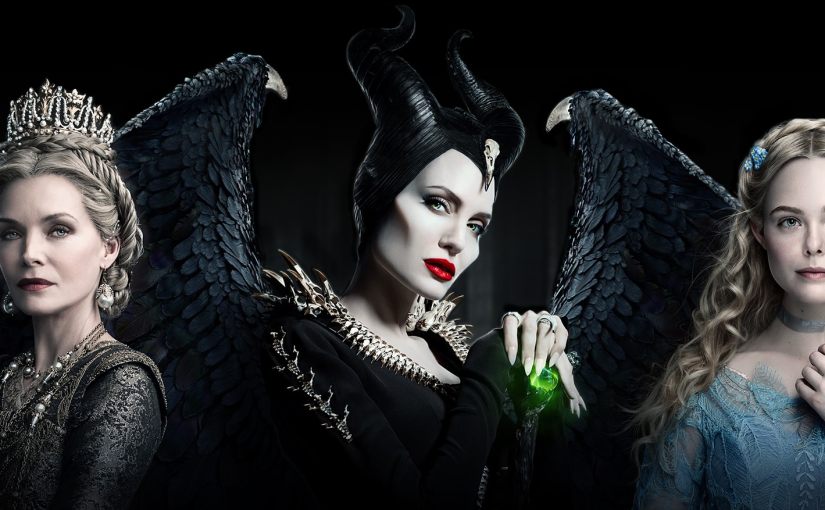
First, and this is always something that irks me, the sub title is completely inappropriate. (Like Star Wars: The Phantom Menace where the only menace was Jar Jar Binks, who was never my first choice to be a phantom.). The film carries a bait and switch title. Did the marketing department at the Happiest Place On Earth even watch the film? Angelina Jolie returns as the title character, still dressed in stereotypical evil black. However, the script penned by Linda Woolverton, Noah Harpster and Micah Fitzerman-Blue offer up an adoring struggle for her to keep up appearances. Never does the film imply that Maleficent returns to her evil impulses. Rather, she’s only characterized by Michelle Pfeiffer’s evil queen as such. So there’s a betrayal of advertising going on here.

The film directed by Jochaim Ronning is a Meet The Fockers variant. When Princess Aurora (Elle Fanning), who was unofficially adopted by Maleficent, gets engaged to the Prince, naturally the in laws have to become acquainted. As expected, dinner does not go very well and the King is spellbound, leaving Maleficent as the scapegoat forced into running underground where she meets up with her fellow fairy community ready to wage war against the human kingdom.

Pfeiffer’s queen uses this as an opportunity to convince the kingdom to wipe out the fairies. Yeah. You’ve heard this story a hundred times before.

I can forgive the redundancy of the storytelling. However, Rollins can’t get his film right. The cinematography is annoyingly murky in darkness and clouds and mist. Doesn’t matter if it’s the fairy kingdom, the castle or even the forest in daylight. Rollins serves up murky, dramatic effect for the sake of murky dramatic effect. It’s hardly visible. This film has Angelina Jolie and Michelle Pfeiffer. If I want to emit drama, I’m gonna rely on them to bring their game.

As well, and disappointingly, Jolie is hardly in the film, at least not enough to justify the title. Rather, Pfeiffer is here to chew up much of the scenes. There are long periods of storytelling where Jolie is nowhere to be seen. She actually doesn’t appear for at least the first 15 minutes. Again, like the title itself, the film under promises what it sells. I have no problem with Pfeiffer or Fanning. They’re really good. Yet, there’s just too many opportunities for them to exchange dialogue and threats, and not much else. Yes, you get to see the fairy kingdom, but they really are a miserable angry bunch for a family oriented film. The 3 fairies led by Imelda Staunton? Yup. They’re here…hardly though and they were the most fun of the last film. Maleficent’s sidekick, Diaval (Sam Riley) – the half man/raven? Well he’s only there when Maleficent is there (literal sidekick) and tell us he wishes he could be turned into a bear. What do you think happens? Incidentally, the CGI bear is nothing great, an uncolorful blur of roaring with a raven beak.

All of these elements present themselves but never follow through with any humor or fun or eye opening surprise. Instead we get a lot of Pfeiffer and Fanning.

The third act is straight out of Lord of the Rings with swords and shields and marching and charging. Meh. I was bored with all of this and the CGI of fairy flights and swoops looked blurry.

Clearly, Disney prioritized preparation of the film for IMAX and 3D. Can we let this go for a change, and just make a movie, please? It’s apparent, watching a 2D standard presentation of this film, where the 3D pops were to occur. Yet, it’s a lousy sacrifice for a simple view.

Maleficent: Mistress Of Evil is a shameless, opportune cash grab on Disney’s behalf. Crank out the sequel, prime it for 3D, get Jolie back for whatever time she’s available, and make sure to slap on a title that amps up the darkness that audiences relish and surefire goosebumps.

I like the story. The execution however fell very short however. No one will remember this sequel in a year from now.

AVATAR

By Marc S. Sanders

James Cameron is the guy with the ambitious talent, and yet he more often than not has a missing link in his widening imagination. It never surprised me that Titanic was nominated for a slew of Oscars and still the one thing that was not recognized was Cameron’s overly melodramatic screenplay. That shortcoming carries over to Avatar from 2009.

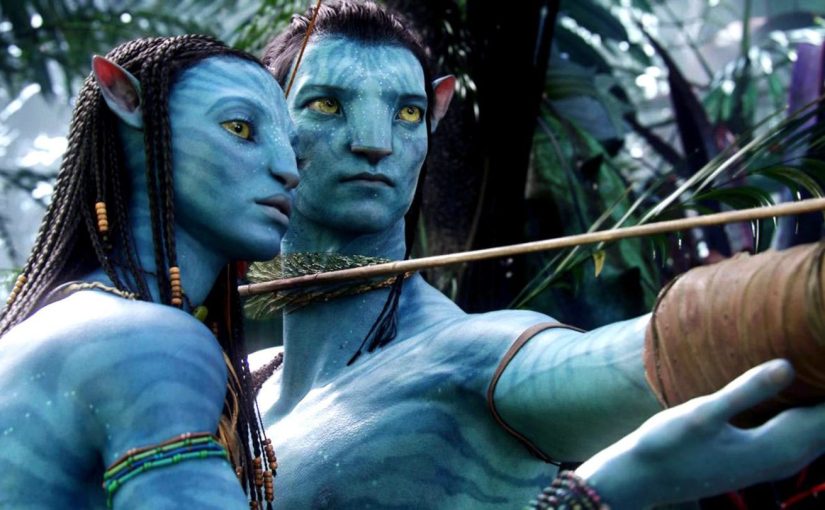
As a naysayer of 3D viewing who is giving you this review, I was initially so impressed with this picture featuring tall blue people with tails and big ears that I saw film twice. Still, I couldn’t get past the simplicity of the story. Avatar is Pocohontas. Avatar is Dances With Wolves. Avatar is Ferngully. (Okay. That last one I only heard from Miguel and his girlfriend Penni. I’d never seen Ferngully.)

Jake Sully (Sam Worthington) is a Marine now confined to a wheelchair and recruited to replace his deceased soldier brother on a mission to meld his mind with an “avatar” body of a native of the neon jungle planet known as Pandora. The actual Greek meaning of the name Pandora is never considered for any kind of thought provoking significance. Jake is assigned to learn about the natives known as the Na’Vi and expose a tactical weakness in their fighting skills and weaponry. Jake works alongside the scientist known as Grace (Sigourney Weaver) to connect with the people. The evil military corporation led by a mean grunt named Colonel Miles Quaritch (Stephen Lang) is in need of collecting a valuable mineral known as “unobtainium.” Grace’s priority is not the mineral. She’s more concerned with connecting and peacefully studying the people. On Jake’s first tour into the wild, he ends up stranded overnight. Gradually, his mission for the means of the military and corporation dwindle as he bonds with a Na’Vi named Self (Zoe Saldana). Soon, he identifies only with aiding the Na’Vi declaring his will to defend their planet against the greedy humans.

Much of Cameron’s near 3 hour film is a travelogue of the fictional Pandora and the customs and behaviors of the Na’Vi along with the creatures they share the planet with like oversized dog looking animals and winged dragon variations that the natives can ride on their backs. Neon plant life is shown in excess. Rivers and streams as well. Wide open skies too. It’s amazing to look at for sure, but eventually the novelty wears off. More or less, a lot of these trees are just glowing palm trees.

Because the film’s central storyline is so simplistic and familiar it’s not very gripping. When a Na’Vi dies or a precious worship tree tumbles at the behest of the military’s destruction, the Na’Vi wail in their own way. It just didn’t hold me so much because I didn’t feel a connection to the sci fi the film presents. James Cameron can paint a picture like no other. Somehow though, his prints are devoid of much emotion. The dialogue is clunky or cheesy in its nature. Regrettably, this has always been his problem going back to films like The Abyss or even the original Terminator. All BIG IDEAS, but weak development.

Avatar enchanted audiences back in 2009 thanks to its 3D. It was positively immersive and you felt surrounded by the nature of it all. At home, that effect is sorely missing and so you are left dazzled during the film’s exposition, but worn out on its long winded and simple storytelling.

Apparently, James Cameron is filming the next three sequels back to back to back. Three more movies of this? Really? Look, the guy has a great track record and has mostly defied the pessimists over the years when his budgets go through the roof, but I can’t see another nine hours of this material to hold me interested or thirsting for more of either Pandora or what the blue people still have yet to offer.