THE LITTLE MERMAID (1989)

By Marc S. Sanders

What I hearken back to most when I watch The Little Mermaid is my junior year of high school in 1989.  If you were around at that time, then maybe you realized how much of an impact the characters of Ariel, Sebastian, Flounder, Scuttle and Ursula The Sea Witch had on kids, but teen pop culture as well.  Batman was big that year.  Disney’s underwater, romantic, musical adventure was at least as large.  Driving home from school, everyone I knew were singing along to celebrated numbers like Kiss The Girl, Les Poisson, Under The Sea and Part Of Your World.  My drama class couldn’t get enough of Poor Unfortunate Souls.  Oh, how overdramatic we would get in Mr. Locklair’s class while emulating Pat Carroll.  I still harmonize Ariel surrendering her voice.  Yes!  I can hold the tune!!!!  There is no denying The Little Mermaid cast a spell over the student body at Berkeley Preparatory School in Tampa, Florida.

The Little Mermaid is an important entry in the Disney lexicon.  Disney films were considered substandard, tired and stale before this release.  However, the adored fable based upon a story from Hans Christian Anderson awakened something that still carries on.  The music within the film from beloved writers Alan Menken and Howard Ashman were delivered like Broadway showstoppers.  The quality of the songs was elevated with gorgeous calypso and reggae harmonies, and vocal characterizations as colorful as the underwater life depicted on screen.

Ariel (Jodi Benson) is the title character who dreams of what life is like above the surface.  Her father, King Triton, strictly forbids her from going above the water.  In his eyes, humans are ghastly.  That’s a problem because his daughter is enamored with handsome Prince Eric (Christopher Daniel Barnes).  Like a sixteen-year-old who sneaks out of the house through a bedroom window, Ariel visits the nefarious and alluring sea witch, Ursula (a rapturous Pat Carroll in one of the best fantasy villain roles to ever appear in the movies).  The deal is Ursula will turn Ariel into a human for three days.  In exchange the little mermaid must surrender her gorgeous singing voice.  If Eric does not give Ariel a kiss of true love by the time the sun sets on the third day, then her soul belongs to Ursula for all eternity. Ariel gets some help from Sebastian the crab (also a sea-life orchestral conductor), innocent Flounder, and a zany seagull named Scuttle (Buddy Hackett).

The animators at Disney use everything at their disposal to burst wondrous color within the film.  There’s life brought to the sea life within the backgrounds from a blowfish who BLOWS, to the Octopus and the shrimp and swordfish.  Even the random bubbles that float around are marvelous to look at. Nothing is off limits and life under the sea seems so much more enticing compared to the ho hum activities that we humans endure each day with traffic jams and junk mail.

Other Disney productions like Alaadin and Beauty And The Beast that followed, offer some life lessons for the protagonists to consider.  The Little Mermaid doesn’t actually.  It rests upon wishes and dreams for Ariel.  I’m thankful for that.  It’s such a glorious picture that I coast through on the fantasy of it all.  Ariel takes me on adventures to explore shipwrecks and her grotto where her human collectibles are stashed.  I get to carefully approach the dark imagery of Ursula’s caverns where countless, slimy, pitiful souls suffer, while the tentacled monster delights in her vanity with Pat Carroll’s gleeful voiceover.  It’s just enough for me.  Disney doesn’t always have to preach, and I think it’s why The Little Mermaid is my favorite of all of their films. 

Every moment is beautifully drawn in shape and color.  Still for a film that came six years before the Pixar evolution, the expressions of the characters come off so naturally.  Look at Sebastian’s fear and frustration as he tries to keep up with an independent Ariel.  Pay attention to Ariel’s nervous reaction when she encounters Eric on the beach after she’s become human.  She’s animated to try and straighten her hair and grin her teeth because its as if the popular kid in school is walking across a disco lit gymnasium to ask her for a dance.  The animation is purely inspired by natural, human behavior that we are all too familiar with.  When drawn like this, we can’t help but be impressed.

The songs are the highlights though.  The compositions are so lively and easy to pick up and sing along to, like we all did in high school.  The lyrics are equally impressive like the most brilliant of dialogue.  When Ursula makes her campaign for why this trade would be advantageous for Ariel (Poor Unfortunate Souls), I can’t help but believe her.  She’ll have her looks and pretty face.  It’s only her voice!  You got a point there Ursula.  The best villains always have the most sound reasonings behind their motivations.

Sebastian (Samuel E Wright) makes a strong argument for why life Under The Sea is so much better than living on land.  His enthusiasm in song is completely convincing.  Life under the sea is nothing but a party.  Let’s go.

Jodi Benson gives a strong voiceover performance as Ariel.  I’m hearing a firm and independent young woman who stands her ground and will defy any orders to go after what she desires.  Her rendition of Part Of Your World is one of Disney’s most treasured and celebrated moments in film history when accompanied with the setting of Ariel’s towering grotto of props that we humans take for granted like fish hooks and dining utensils, especially a dinglehopper…you know…a fork!  This is what a kid dreams of becoming when alone in her room with no one there to judge her true feelings and desires.  It’s truly glorious.

The one scene that does give me pause is the dramatic discovery King Triton has of Ariel’s secret vault of collectibles.  By the end of the moment, his temper has grown so big, that he unleashes the power of his trident to destroy everything she’s treasured.  I’ve always said this looks brutally familiar to how a father might take a baseball bat to a kid and her room, teetering on domestic violence.  The scene is memorable but unnerving all the same.  Still, I have to remind myself that this is a fantasy, and this is only a movie. 

Nonetheless, The Little Mermaid is a timeless film filled with magic and whimsy and daring escapes and big laughs that are not just relegated for eight-year-olds.  As adults, we remember those butterfly feelings of our first crush and what held us back from pursuing it further.  We can relate to what the characters do for, and towards each other.  Again, everyone from the deliciously wicked villain down to the defiantly brave protagonist and her sidekicks have a point and very human understandings for why they exist and what they want out of life.  Being a mermaid or a crab or a sea monster doesn’t make any of these people any less human. 

FIGHT CLUB

By Marc S. Sanders

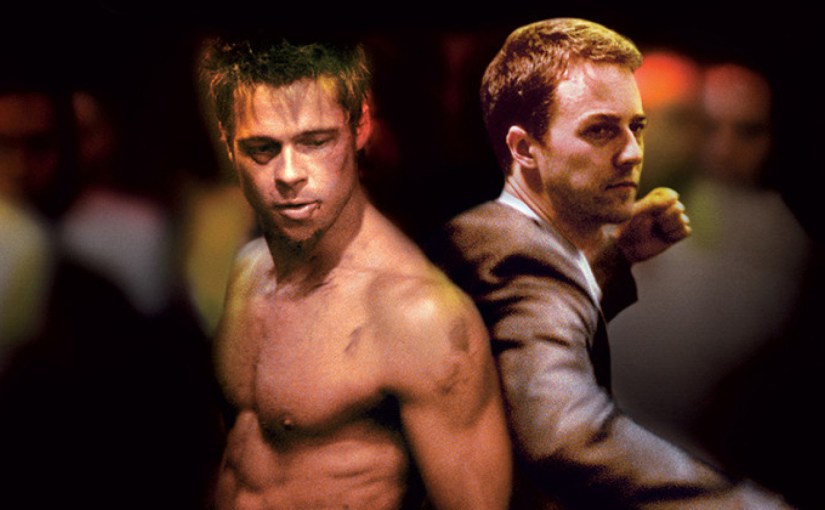
David Fincher’s Fight Club is a deliberately ugly and dreary film. It has to be to evoke the insomnia its narrator (Edward Norton) suffers from, as well as his lonely depression that offers no answers for his purpose to exist or to be loved by another person.

To alleviate his need for something fulfilling, the narrator resorts to attending support groups for men suffering from illnesses and debilitating diseases like testicular cancer. There he meets a former body builder named Bob (the singer Meat Loaf) who has developed floppy breasts after going through hormone therapy. Bob follows the processes of the self help group and embraces on to Norton’s character as a means of support; stuffing his face into Bob’s breasts. The narrator eventually becomes accustomed to this maternal practice and the ritual of attending these meetings as a regular process. However, he feels he is getting upstaged by Marla (Helena Bonham Carter), a punk looking girl with dark eyeliner and wild jet-black hair.

Even though Marla and the narrator negotiate who attends what meetings and on what night, Norton meets another punk like reckless character known as Tyler Durdin (memorably played by Brad Pitt) who manufactures and sells soap but also edits film reels, sneakily inserting penis images into family films. Tyler also works as a waiter at a high-end restaurant where he proudly adds a little of “himself” to all the courses that are served.

The narrator only works at a boring desk job where his boss uses any opportunity to look down upon him and chastise him on his performance or appearance, but never recognizing anything further within his nature. The boss could care less about him. Naturally, the narrator becomes in awe of Tyler’s behavior. Tyler is a rebel and offers much more beyond Bob’s comfort. Tyler serves a purpose for the narrator to pursue.

When Tyler challenges the narrator to hit him as hard as he can it eventually leads to a new kind of gathering for both of them, a support group known as Fight Club. Men from all over soon gather underground to partake of letting out their aggressions with bare knuckle fists and wrestling. Anyone attending gets a therapeutic vibe from bleeding and bruising themselves upon one another. The narrator certainly feels better.

Going a step further leads Tyler and the narrator to fight back against a system of order and capitalism. Their philosophy picks up traction and soon a form of revolution is taking place across the entire country. Somehow, the narrator is taken off guard by this new belief system.

There’s a lot to consider and question in Fight Club, though I’m not sure I care for the film as a whole to debate its message. Sometimes it feels like it’s not moving anywhere. Norton’s character learns things about his own consciousness and need to falsely subject himself as a cancer survivor or as an underground brawler because he has nothing else really going for him. I get that, but why should I care or like it?

Tyler Durdin resides in a broken down house on the other end of the city that is leaking from every pipe and it’s electricity could ignite another fire that maybe this decrepit dwelling survived once before. Tyler is happy with his home and happy to share it with the narrator as well as Marla whom he has endless sex with. Tyler doesn’t want the fancy trappings. It’s revolting to even possess such materialism and suck off the tit of a capitalist regime. With the narrator at his side, he encourages a fight against the power of commercialism and wealth. Find a way to destroy the structures of what the country has built itself into, perhaps.

That’s the message of Fight Club. I just can’t lay claim that I cared for the execution of the revolt. I’m supposed to laugh at Tyler’s antics at times like when he steals the gross liquid fat from liposuction patients to manufacture the soap he sells. Yes, we get a moment where the bags of fat leak and splatter all over the place. It was just never amusing for me. I found no symbolism in this passage. It’s just absolutely disgusting. When Tyler happily pisses in someone’s soup, I don’t think it’s funny either. I don’t like Tyler. I don’t envy him or want to be him. I don’t find anything to cheer for with him. I’ve got more admiration for John Bender in The Breakfast Club than I do for Tyler Durdin. I might respect what he stands for to a degree as we are a culture brainwashed by advertising and commercialism. I just don’t care for the actions taken by this so-called martyr on behalf of the self-described unfortunates like Norton’s narrator.

I also find it ironic and quite hypocritical that Fincher’s film is a call to stand up to materialism and commercialism and yet the cast is headlined by Brad Pitt, arguably one of the biggest box office stars of the last 30 years, complete with his name above the title and his image front and center ahead of Edward Norton’s on the film posters that promote the film. Pitt is also the guy you see first, last and all over the middle of any of the film’s trailers and advertisements.

Now tell me, is that not a contradiction in terms?

THOR: LOVE AND THUNDER

By Marc S. Sanders

Taika Waititi’s Thor: Love And Thunder doesn’t just operate as a standard Marvel Super Hero movie.  I think it encapsulates what moviegoers treasure when watching a film, and that consists of a gamut of emotions with the opportunity to absorb the best in sight and sound.  Even if we are watching a guy fly through the skies with a cape that’ll be marketed into a million toys and t-shirts, sight and sound are nothing without brains behind a script.  It’s fortunate that a director like Waititi always works with that in mind.  Marvel overseer Kevin Feige knows how to recruit talent behind the camera and you just can’t go wrong with the architect of a spoof on the surface, yet an all too horrifyingly real film underneath, like the widely acclaimed Jo Jo Rabbit.

I’ve always laid claim to the fact that movies largely recognized as “tear jerkers” like Steel Magnolias and Terms Of Endearment are actually comedies first, and then dramatic sob stories second.  I’m serious about that observation.  Why?  Because if a film is going to go to great lengths to risk the outcome of one of its main characters, then it must get its audience to embrace and deeply love that person first.  The best avenue to that approach is to outrageously laugh and cheer that character on ahead of what’s to come.  Taika Waititi’s second film to center on the God of Thunder does just that.  The best reward I got from Thor: Love And Thunder is that I laughed quite often (as the trailers imply), but I also teetered on tears as well.  Good fantasy storytelling will incorporate an all too real conflict with its protagonists and then introduce the strange and unusual as an escape.  The best example may be The Wizard Of Oz, and the simple set up of Dorothy and the risk of her perishing with her dog Toto in a threating tornado.  More recently, I also think about Guillermo Del Toro’s Pan’s Labyrinth centering on a young girl in early twentieth century war torn Europe.  Again, Waititi’s coming of age during Nazi occupation opus, Jo Jo Rabbit, follows this formula as well.  Without spoiling too much from Thor’s latest adventure, Waititi presents an all too real and unforgiving circumstance for one of the film’s characters and then segues into his delightfully and never too weird assortment of settings and characters.

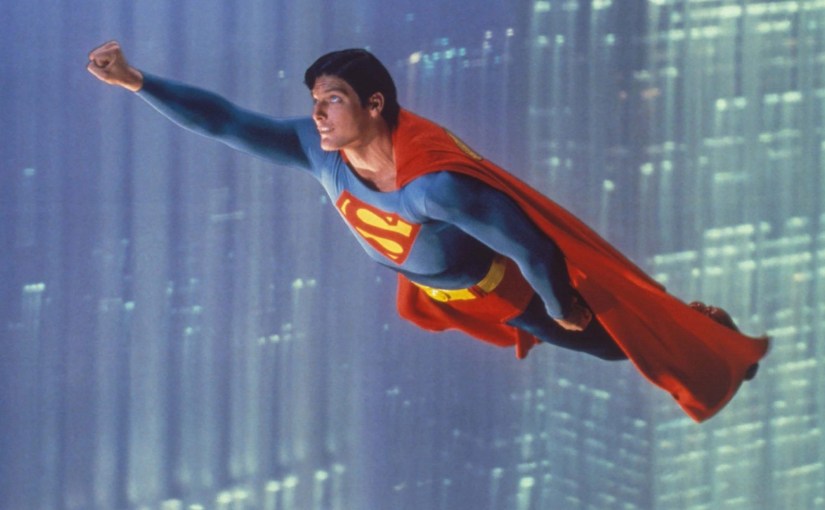
It’d be easy to think that by what may be the sixth or seventh time we’ve seen Chris Hemsworth in the garb of this character that anything inventive would have been exhausted by now.  Not so.  A new dimension in storytelling arrives midway through the film that presents a different crisis for the proud God.  Hemsworth really approaches it beautifully.  It was reminiscent of Christopher Reeve in the original Superman, actually.

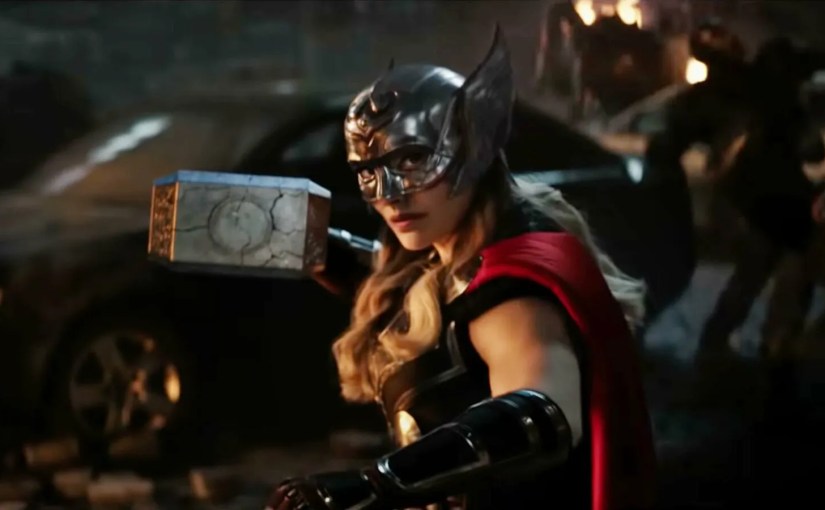
A supporting cast of return players work well together, particularly Natalie Portman, who is given a much more fleshed out and well considered character arc than her two previous Thor films. (Early on, Marvel Studios was notorious for not writing good female characters in any of their pictures.  They were just presented as glamorous damsels in distress. Thankfully, that’s well behind them by now.)  Portman returns as the on again/off again love interest, Dr. Jane Foster, for Thor.  Even better though, Jane actually becomes Thor!!!!! (No spoiler there.  Just look at the trailer or marketing poster.)  There’s great on-screen interaction with Portman and Hemsworth, even when it’s a montage of past dating episodes like in ridiculous Halloween costumes or having a domestic squabble as any typical married couple might have.  Hollywood should reunite these two for a romantic comedy in the vein of Rob Reiner/Nora Ephron material.  Chris Hemsworth is a much better partner than Ashton Kutcher ever was in a past Natalie Portman film.  Put Chris Hemsworth together with Natalie Portman again and they could become as adoring as Tom Hanks and Meg Ryan did.

By the time the fourth movie comes, does it really matter who the villain is played by?  Well, when you are writing a smart script amid ridiculous visuals like Taika Waititi is known for, the answer is yes.  This film surprisingly opens on a downer prologue that necessitates good dramatic acting amid silly CGI and garishly loud costumes.  It’s fortunate that Christian Bale, who regularly performs on a method level comparable to Daniel Day Lewis, was available to portray the scrawny, pale and scarred Gorr The God Butcher.  Bale puts all his talents into what could’ve been a throwaway role like, say a Ghostbusters bad guy.  (Can anyone tell me who actually played Gozar in the 1984 film????)  This is another notch in Bale’s repertoire of outstanding credits that should not be overlooked.  You can sympathize with Gorr, as well as be frightened of him.  There’s much range in this character on the same level as the Thanos villain from earlier Marvel films.

Russell Crowe has a fun appearance as the God known as Zeus.  He looks over the top ridiculous and he works in antics that seem like they came out of episodes of Who’s Line Is It Anyway?  Put it this way, I haven’t forgotten how Crowe walks down a staircase yet.  If Russell Crowe is anything of an educated performance artist, then when he was getting sized up in wardrobe, I’m sure the wheels were turning and he was considering what tics could work for that of a God drowning proudly in his own vanity.

Tessa Thompson and Taika Waititi are thankfully back, respectively as Valkyrie, King of the fishing/tourist destination New Asgard, and the simply innocent rock guy buddy, Korg.  The Guardians Of The Galaxy are here too.  It’s a fun bit of material they have to play with.

In another director/screenwriter’s hands, any Thor film would likely get boring with its standard formal Shakespearean like vocabulary and artificial CGI.  Isn’t that an ongoing problem with CGI anyway?  So often it looks to fake.  Because Taika Waititi opts for bright colors and odd shapes and sizes of setting and background characters, nothing could look artificial, because the fantasy is always acknowledged as over the top by the very characters occupying the space.  A glass castle of pinks and purples that resembles gigantic glass Mary Jane bongs or science lab beakers is accepted in a Thor film, just as much as munchkin size, owl like creatures with small beaks are a terrorizing army in flying jet skis with mounted laser guns.  Mix in a blaring rock soundtrack and Waititi hits the notes where it’s okay to laugh at the silliness of it all. In other moments, he’ll invite his audience back in from recess to take in what’s hard and difficult to live with and endure.  Again, Waititi pleasantly surprised me with the balancing act of outrageous comedy against crushing drama when he made Jo Jo Rabbit.  The blend works so well here in not so typical Marvel fashion.

Thor: Love And Thunder left me thinking that it is the best of the superhero’s four films.  It’s measure of laughs and choked up drama kept engaged and I appreciated the experience.  Remember, I recalled Steel Magnolias and Terms Of Endearment in this write up.  If you don’t take that comparison lightly, then hopefully you’ll have the same experience I did with this installment of the Marvel franchise.

PS: Hats off to the trailers for not incorporating everything the film has to offer.  Within the first fifteen minutes of the movie, I was actually taken aback by an element I never considered or expected.  It only enhanced my perspective of the film.

PSS: Anyone that knows me, knows that I love Guns N Roses.  Consider me a born-again fan.  Particularly Sweet Child O’ Mine will always be one of my most favorite songs.  This film reminded me that it was the first song my daughter heard the day after she was born, when I sang it to her in the hospital room. 

MALIFICENT

By Marc S. Sanders

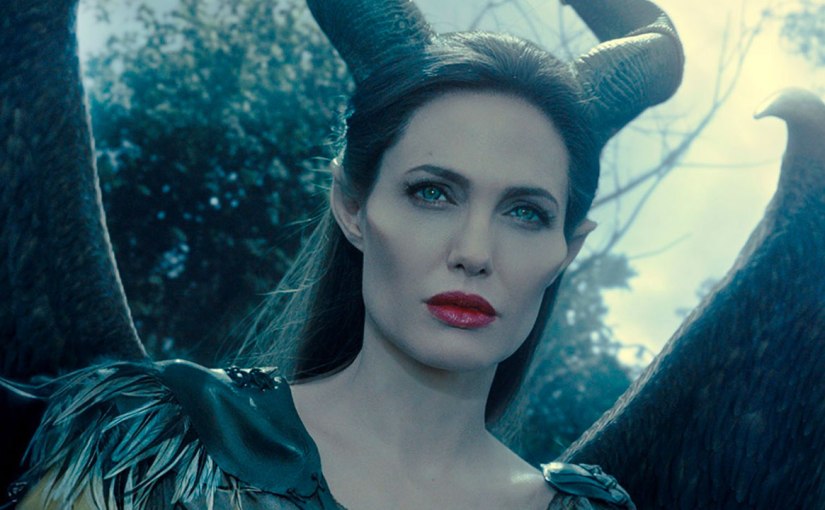
The wagon train of live action adaptations of Disney animated classics reached its pinnacle with 2014’s Maleficent. Much credit going towards Angelina Jolie’s portrayal of the title character. However, the visuals cannot be dismissed either. It’s a gorgeous film directed by Robert Stromberg.

Stromberg brings his wealth of experience in visual effects (Avatar and Master And Commander: The Far Side Of The World) to his directorial debut. The fantasy world of Maleficent’s forest, as well as the looming castle on its outskirts are dressed in gorgeous colors and vast dimension of pathways and caverns. The magical spells wafting in greens, golds, blues and reds, wielded by the characters, including the three protective fairies (led by a strong Imelda Staunton) is hypnotic and blends beautifully with the live actors’ performances. It’s as bold in the visual department as anything cropped up by Peter Jackson or James Cameron.

What makes this brisk 90 minute film special is a different point of view from the classic film Sleeping Beauty. Is there justification to a villain’s actions? Stromberg and Jolie certainly make a case for it. It’s a reminder that there are two sides to every story. Anyone ever consider that maybe Maleficent might have been betrayed at one point? I’ll be damned. At least that’s what I thought, after watching this film.

No one in life is born evil. I like to think people are made evil or perceived as evil. This film is a great example of that, much like the musical Wicked or the recent hit film Joker.

Jolie offers up the frightening aspects of the fairy dressed in black that we’ve been familiar with all these years. However, she’s fortunate that the capable script from Linda Woolverton offers up opportune moments to consider her soft, sensitive side. There are moments of no dialogue as Maleficent observes Princess Aurora (Sleeping Beauty) grow, and she develops a reluctant (it’s hard to resist calling her “Beasty”) affection for the child. Maleficent will even participate in a playful mud fight. There are more than just evil machinations going on here.

Unlike the other Disney live action iterations, Maleficent shows something new and unexpected. It harbors my appreciation for the film whereas Beauty And The Beast or Aladdin did not because they just churned out the same old thing.

If Stromberg’s film suffers from one weakness I’d say it could have used a stronger performance from Sharlto Copley (The A Team film adaptation) as the antagonist, Aurora’s father and Maleficent’s first love; the eventual king. There was not much threat from this guy. He was no match in character much less performance against Jolie.

Still, Maleficent is a great character film with lots of fun, whimsical visuals to explore.

THE WIZARD OF OZ

By Marc S. Sanders

The Wizard Of Oz will always be one of the greatest films ever made.

It’s a visually spectacular marvel of filmmaking and creativity. The accomplishments it achieves in performance, fantasy and musical tones work on any generation who has seen it since its debut on August 15, 1939.

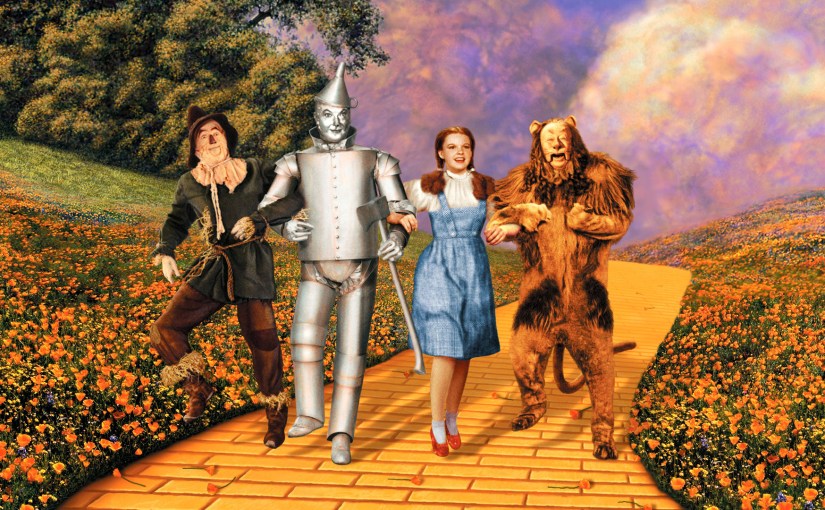
Victor Fleming directed the adaptation from L Frank Baum’s successful series of books. Wisely, the picture opens in black and white where we meet Dorothy, one of the best cast roles in film history with the legendary Judy Garland. She lives on her Kansas farm with her dog Toto and her Auntie Em and Uncle Henry, along with some friendly farmhands called Huck, Hickory & Zeke. Following an unexpected twister, Dorothy and Toto are sent into the heavens while in their farmhouse. When the house finally lands, Fleming has Dorothy open the door to a kaleidoscope of wondrous color. Dorothy has arrived in Munchkin land located in the Land of Oz. The adventure begins.

Nearly any film of fantasy and adventure can be traced back to The Wizard Of Oz. It features the thoughtful mentor with Glinda The Good Witch, and the lovable sidekicks that Dorothy encounters known as the Scarecrow (Ray Bolger), the Tin Man (Jack Haley) and the Lion (Bert Lahr). It also has one of the greatest on screen villains of all time, The Wicked Witch of the West (Margaret Hamilton). The story pursues objects (ruby slippers, a brain, a heart, courage and a broomstick) for the heroes to acquire, years later to be identified by Alfred Hitchcock as “MacGuffins.”

Victor Fleming with Baum’s ingenuity inspired great storytellers of a future in movies yet to come. Authors like JK Rowling and JRR Tolkien or CS Lewis absorbed the will to compose never before conceived imagination thanks to The Wizard Of Oz. So many moments throughout the land far away from Kansas are so inventive. There’s endless the candy colored scenery of Munchkin land, along with a dark forest where trees come alive to argue and throw apples at you. The Witch’s foreboding castle with the crystal ball is ominous and frightening. The Emerald City where the great and powerful Oz resides is spectacular in life and cheerfulness. I still look in awe at the scenic design of the film questioning how it was all done. Matte paintings of endless depth for background give off the vastness of the land as the famous Yellow Brick Road stretches infinitely over rolling hills behind Dorothy and her friends as their journey continues.

The Wizard Of Oz is also an inspiration for the movie musical. Every song is unforgettable. Is there a greater song in film history than “Somewhere Over The Rainbow?” Dance sequences are totally engaging. Try not to love the ease of watching Dorothy skip along the road to “We’re Off To See The Wizard.” Ray Bolger’s rubber legged straw man clumsiness during his first scene with “If I Only Had A Brain,” seems to defy the limits of what a human body can do. Bert Lahr’s “If I Were King Of The Forest” is comedically inspired; the number that pauses the story for a moment as an escape among the characters’ adventure. As a kid I loved to roll my tongue on the word “forrrrrrrrrest.”

Margaret Hamilton’s green skinned wicked witch dressed in black with the pointed hat set a standard in villainy. It instilled some of the first fears many children ever experience to this day. Hamilton’s evil cackle with her determination to obtain Dorothy’s ruby slippers never leaves your mind once you see the performance. The Witch inspired any kind of horror film, and terrible villains we love to hate like Darth Vader, Maleficent, Hannibal Lector or Lord Voldemort. Evil queens and bad guys from the Disney vault only began from the seeds that Hamilton laid out.

So many of the greatest achievements in film history are contained in The Wizard Of Oz. It’s an outstanding musical, an incredible adventure and a brilliant fantasy. It’s beautifully cast and so creative on every technical level necessary for its flights of fancy.

More than any other film ever made, every person should see The Wizard Of Oz at least once in their lifetime.

ARTEMIS FOWL

By Marc S. Sanders

Why can’t Disney adapt a good book anymore? They massacred A Wrinkle In Time. Now they’ve taken a hatchet to Artemis Fowl, a Disney + byproduct that was shamelessly shelled out during the height of the pandemic.

There had to have been a more fleshed out, extended film here. Scenes are taped together with no bridge. All I can imagine is some suit insisted on cutting the guts out of director Kenneth Branagh’s film to ensure that its target kid audience would sit still, at least for 95 minutes. The same line of thinking had to have been applied to Ava Duvernay’s A Wrinkle In Time. Both films introduce characters that serve no purpose or make no sense. One character here shows up just to shout “Artemis!”

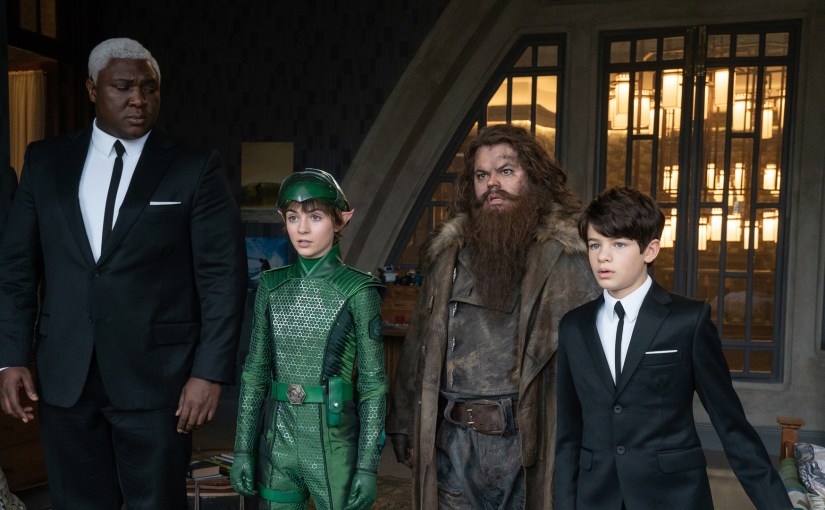
Speaking of the title character, what is he really? We are told by the narrator known as Mulch Diggums (Josh Gad) that Artemis Jr (an uninteresting kid actor named Ferdia Shaw who must’ve gotten the part cuz he looks good with sunglasses) is one of the greatest twelve-year-old geniuses of all time. He literally has an answer for any question that comes his way. So we’re told! Fact is, all this kid does is shoot a laser gun and wear a black Tarantino suit and tie. Never once in this film did I see Artemis Fowl demonstrate any of his genius, mind bending abilities. He surfs in the ocean outside his Ireland mansion. Does that merit the aptitude of a genius?

Artemis Sr (Colin Farrell) is apparently believed to be a thief of rare, priceless collectibles. After telling his son about some tale involving fairies that live in an underworld, he is soon kidnapped. It is now up to Junior with his trusty butler (Nonso Anosi) to rescue him. This butler doesn’t measure up to Batman’s Alfred. All this butler does is introduce young Artemis to a basement he was never aware of. Mulch also explains that if you call him Butler, he’ll snap you in two. Too bad we never got to see that. (Why tell us, dammit????) Then….AND I AM GOING TO SPOIL THIS SURPRISE….he dies. Tears must flow of course, but all I ever thought of was that gee, I hardly knew this guy.

Artemis Jr must recover a MacGuffin called the “Auculus.” How many times must I hear the word Auculus in a span of an hour and a half? The Auculus. The Auculus. THE AUCULUS!!!!!! Enough already. The filmmakers must believe that the more you say it, well then the more important the Auculus must be. My question: WHAT IN THE HELL DOES THIS AUCULUS EVEN DO?????

Judi Dench is here but only for the purpose of wearing a green leather trench coat that appears to weigh her down and doing what I think is likely a terrible enunciation of an elderly Irish lady’s accent. She plays the General of the fairy army. Dench is awful in this role and appears as lost in the effects as I was. Half the time I didn’t know what was going on. All of the time Judi Dench didn’t know what was going on.

The one main fairy is Holly Short (Lara McDonald) sent on a mission to go to Artemis’ mansion. Once she gets there, I truly lost track of why she was there to begin with. However, she seemed to have more activities to do than the title character is ever given. Once again, the super genius Artemis just shoots a gun. Holly at least gets to fly around with her motorized wings; yes, this is a fairy with an engine to activate her wings.

Artemis Fowl is a gorgeous looking picture. The special CGI effects are truly dazzling to look at with incredible color, but only if I’m watching a fireworks display at Magic Kingdom. Within a story, I have no clue what purpose any of the visuals serve or what possible results could come of anything. Nothing is explained here; much like this Auculus I talked about earlier.

The culture of the film is a failure as well. We are shown that this story is rooted out of Ireland. Where’s the Irish inspiration though? There’s no sense of inspiring traditions to learn from or appreciate. The soundtrack is hardly Celtic. Truly criminal is casting a Jewish Josh Gad and an English Judi Dench. For authencity’s sake, couldn’t actual Irish talent have been used instead of terrible dialects from marquee names?

There had to be a better film here. I’m talking a 2 1/2 hour film with solid, interesting exposition with mystery and questions like the first Harry Potter film. Nothing is of any consequence or comprehension here. How could I be so lost with this film?

This is a pattern for Disney of late. They acquire the rights to some wonderful children’s stories and then just mix some kind of slop in a slow cooker. A Wrinkle In Time, John Carter, and now this dreck. I don’t understand though. If the studio is so committed to packing so much into Avengers and Star Wars movies then why can’t they do the same with its other properties? I promise that kids will sit engaged with a longer film if it’s constructed with care. I know it.

Artemis Fowl is a squandered opportunity. They had the beloved novel by Eoin Colfer to springboard off of, and I know, without even reading the book, that they disregarded almost everything that made this story so special. It couldn’t be more apparent.

Artemis Fowl is a textbook example of when Hollywood does a complete disservice to its author as well as its target audience. It’s a criminal adaptation. It’s a betrayal of the intelligence that kids really come equipped with. It’s a terrible violation of culture and it’s an awful, awful, awful film.

DOCTOR STRANGE

By Marc S. Sanders

The first MCU movie that makes the biggest departure from any of the other installments in the franchise.

Doctor Strange operates on a level beyond punchy powers as Avengers director Joss Whedon noted. The film explores a very far, very fictional belief in the mystical arts and magic. So much so that sometimes characters like The Ancient One and Mordo speak in an English that is so foreign and so confusing. Still, I’m not complaining.

I enjoyed this film immensely. Benedict Cumberbatch is so right in the role of Stephen Strange. His character’s arrogance is not over the top, but necessary and evident. I really liked his transition from expert surgeon to a permanently damaged physical person and then onto The Sorcerer Supreme complete with the Cloak of Levitation, a better and more deserving way to describe it than just another cape.

The morphing of city landscapes and neighborhoods into arced and flipped and reverse mazes are really fun and change shape with crisp sound editing and music.

Good supporting work is also on display from Rachel McAdams, Chiwetel Ejiofor and especially Tilda Swinton. My one wish is that the villain played by the very capable Mads Mikkellsen was fleshed out more. He’s an actor who can handle heavy roles. Regretfully, I don’t think the script gives him enough to do here.

This Marvel chapter stands on its own with little reliance on the other films. However, the green infinity stone at play here is easier to understand now that I’ve seen Avengers: Infinity War. I’m talking about The Time Stone, of course!

Doctor Strange is a solid film; one that I would love to watch again a year from now and likely feel just as entertained.

NOTE: stay away from the 3D Blu Ray discs. Watch it in 2D. Having seen the 3D in theatres the first time, I clearly remember not enjoying the film very much. It was blurry and dark. At times the picture didn’t look crisp. The 3D effort was a nuisance and a terrible distraction. Less is more. Stick with 2D.

SUPERMAN: THE MOVIE

By Marc S. Sanders

Richard Donner’s Superman: The Movie is one of the best biographical films of a fictional character ever made.  Yes.  It absolutely is a biography.  How can you call it anything but?  The visitor from the planet Krypton is embedded so deeply within the lexicon of worldwide pop culture and historical significance that he rests within all of our subconsciousness.   When we think of ongoing problems in the world from natural disasters to destructive wars or famines and disease, or to even kittens stuck in trees, for a split second we all consider how simple we could go on with our lives if only Superman were here to rescue us. 

By 1978, forty years after Joel Siegel and Joe Shuster created the character, visual effects were at a more than adequate level to convince us that a man could fly. Thus, the man with the red cape was ready to appear on the big screen.  With creative input from writer Mario Puzo, Donner’s film goes through various stages of life from when the extra terrestrial is a new born baby, to a toddler, then a teenager and on to a thirty something adult.  While living on the planet Earth, his powers may make him virtually invincible, but he’s far from godlike.  He cannot prevent the unforgiving nature of death.  He can’t be everywhere all at once.  He can’t even perform on the same level as his colleagues or friends, who are skillfully beneath him.  It would be unfair to have Clark Kent on your football team.

To watch Superman is to see a mini-series over a span of nearly two and a half hours.  We begin on the white crystal planet of Krypton featuring one of the greatest actors of the twentieth century, Marlon Brando, cast as the father of the superhero to be.  Brando is Jor-El.  He serves the planet as a prosecutor and a political leader with an expertise in science.  He’s championed for his knowledge, but he’s also challenged by his peers when he is certain of his planet’s demise. Thus, he must release his newborn son, known as Kal-El, into the far reaches of space to survive.  The script here takes an almost Shakespearian approach in debates of facing inevitability.  Brando’s authoritative screen presence is perfect here. 

Kal-El moves on to Earth, particularly Smallville, Kansas, and the nature of the film changes personality.  1950s Americana becomes our main character’s environment with endless plains of crop fields and farm land as Kal-El becomes identified as Clark Kent, the teenager who develops a crush on the high school cheerleader and gets bullied in the process while he must deliberately withhold all that he’s capable of by influence from his adoptive parents (Glenn Ford and Phyllis Thaxter).  Life for any of us is never complete until we experience the death of a loved one and Donner showcases that here to demonstrate that Kal-El/Clark can not prevent what’s meant to happen when biologically our bodies shut down.  Not even a super man can save us. 

Clark reaches age 18, usually perceived by most as a turning point into adulthood and through a means of Krytonian process he’s educated until his thirtieth birthday upon the rules and boundaries he must function within while on Earth.  He learns of his ancestry and then Donner changes the setting of his film once again into the furthest extreme from quaint Smallville. 

We have transitioned to sprawling Metropolis where Clark works as a mild-mannered reporter at The Daily Planet.  Christopher Reeve plays Clark/Superman and there was no one who could have filled the role better.  Physically, Reeve is the example by which all super human character portrayals still look towards.  Yet, the Julliard trained actor performs the dual personality so well.  When he dons Clark’s glasses you feel as if you are looking at another actor from when he’s dressed in the blue and red costume of Superman.  His posture and voice inflections are so distant from each character he’s playing.  Christopher Reeve was a stellar actor of versatility. 

In Metropolis, we are also introduced to an impure villain, Lex Luthor (Gene Hackman, who never got enough praise for this role) focused on greed and individual power for him to consume at the expense of everyone else on Earth. 

As well, just as life must bring us towards the experience of loss, it also must introduce us to love in the form of Lois Lane. Margot Kidder does a magnificent job of the hustle and bustle career woman with a sense of romance and need for ongoing adventure.  A reporter’s life will only give you that some of the time.  Superman will let you live that every day.  In life, we all start with valuing one person in our lives beyond our immediate family, and Lois serves that purpose to Clark’s perspective. 

Donner takes advantage of comedy and slapstick when Metropolis comes into play.  It’s not as polished as Krypton.  Nor is it as calm and reserved as Smallville.  Again, the personality changes.  Reeve plays Clark as a persona of the inept and gullible newcomer nerd to hide his powerful alter ego.  Hackman’s Lex is accompanied by Ned Beatty as a bumbling sidekick to play off of. (This same actor was a frighteningly powerful and intimidating corporate CEO in Network just a few years prior!) Valerie Perrine holds her own against Hackman as Lex’ alluring dame to have a tete a tete of sarcasm with. Kidder is the leader of Metropolis’ populace always on the go so much that she’s not even aware of her insensitivity to poor Clark.  A great gag is that as a good as a reporter as she is, Lois has terrible skills in spelling.  (There’s only one p in ‘rapist’.)

Maybe you’ve never seen Superman from 1978, or maybe it’s been too long since you last took it in.  It remains a watch that’s worthwhile.  Donner’s film covers so much of this one individual’s life that also includes two separate ancestries.  I get hot and cold on biographical films, sometimes.  It’s a tough scale to measure.  Sometimes filmmakers don’t show you enough.  I thought the film Ray, ended too suddenly on its depiction of Ray Charles.  Sometimes, it’s an overabundance of material.  The Last Emperor and Chariots Of Fire seemed to never end, and became mired in long, drawn-out, sleep-inducing pieces of dialogue.  Superman allows just the right amount of time to live within these different parts of Kal-El/Clark Kent/Superman’s life that you get familiar with who the main character encounters and how he responds to those around him. You also witness how these environments respond back to him.  You get a sense of what he stands for and where he feels insufficient and where feels strong and secure, as well as valued by others. 

It might be crazy to believe, but biographical writers and filmmakers should turn towards Richard Donner’s film for an outline that perfectly establishes every scene and moment that’s cut into its mold.  Superman: The Movie?  When I want to tell the life story of Golda Meir, or Barack Obama or Joseph Stalin or Jesus Christ?  Yes, Superman.  If we are crazy enough to follow the exploits of a man who wears a cape and flies through the sky, then why can’t we believe he can provide the answers to the great mysteries of life better than any of us?

FANTASTIC BEASTS: THE SECRETS OF DUMBLEDORE

By Marc S. Sanders

That’s it.  I’ve had it.  Enough already.  After three unnecessarily long movies, if you can’t get it right then what’s the point anymore?

Fantastic Beasts: The Secrets Of Dumbledore, the third film in the Harry Potter prequel series, is an absolute failure beyond any magical or Muggle measure of comprehension. It operates with the same handicaps that crippled the prior installment, The Crimes Of Grindelwald, and maybe picked up an additional dozen or more problems along the way.

I don’t understand it Warner Bros.  Following the abysmal reviews of the prior film and the tepid overall assessment of the first, why, with all the monies at your disposal, would you settle for a boring piece of production work like this, all over again? This new film’s main attraction is simply men in dull grey wool suits and overcoats speaking to one another in quiet English whispers.  Every so often they do something quirky like pull a wand out of their pocket.  Fleetingly, they use them.  How novel. 

It boggles my mind that this world from Rowling’s colorful imagination was at one time intended for pre-teens and young adults.  I’ve seen political debates or Sunday morning commentary programs with more flair.

The fault in these films holds primarily with the creator, J.K. Rowling, and David Yates, the director that’s helmed the last four Potter films and all of the Beasts films up to date.  I’m so exhausted in saying it.  ROWLING NEEDS AN EDITOR!!!!!  There is so much fat on this meat that is impossible to swallow.  Someone needs to speak up and advise her to save this scene and that scene for the DVD extras.  One curse that this film suffers from is the exact same thing that the second film dealt with.  A background story is told, with a majestic fade up and fade down and fade up again flashback.  It takes a good five minutes to tell this tale, and then someone else chimes in and says hold on, that’s not how it happened at all.  Then a new character starts from the beginning and apparently tells us the real story as it truly occurred.  Why in the hell should I trust this new character if you’re now telling me not to believe the lies of the former?  Fodder like this stretches this fantasy towards a distant two- and half-hour mark, though it feels like four.

David Yates has always been a problem.  Look, I know nothing about a camera or the most up to date technology in filmmaking or digital making, but I’ve seen enough special effects laden films in my time.  The prologue to this film commits the same visual atrocity as the prologue to the prior film.  Here, our main hero, Eddie Redmayne’s Newt Scamander – a magic zoologist – is observing a magical deer like creature deliver her offspring.  Suddenly, some other magic figures come upon the sight and attempt to zap the creature and Newt with their wands.  It’s the middle of the night amid a dense forest/jungle of thick plant life and trees.  We see flashes and blurs.  We hear ear piercing sound effect swishes, and the music from James Newton Howard (which is quite good) carries to a high volume.  Just like the last film, though, action scenes like this are murky.  It’s like the lens is covered with the bottom of a soda bottle filled with vinegar.  I can’t tell who is chasing who or who is zapping who, who dies or who lives.  Yates is not doing any favors for what bills itself as fantastical adventure.  When he isn’t shooting action scenes like this, his direction seems to perform on cruise control at a top speed of 15 mph.  There’s little drama or interest in any of the speaking scenes that drag on and on.

The movie’s story picks up with whatever cliffhangers were left from the last time.  It’s really not necessary for me to recap.  They hold little relevance here. 

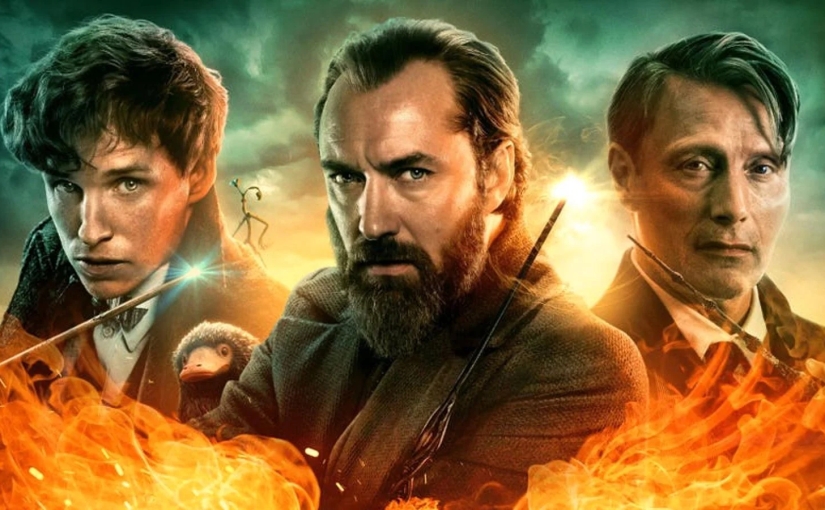
Basically, Grindelwald (Mads Mikkelson, now taking over from a controversial Johnny Depp) is getting his bearings together with the troubled young man Credence (Ezra Miller) who we were told earlier is the brother to the Albus Dumbledore (a well-cast Jude Law).  Once again, Dumbledore recruits his former prized pupil Newt Scamander to locate the criminal Grindelwald and defeat him.  Newt assembles his brother, his assistant (neither of which we hardly get to know; so why should I disclose their names) and his Muggle baker friend Jacob Kowalski (Dan Fogler). Two more new characters round out this fellowship.  However, if you are looking for a real, solid fellowship, go back to those movies where the characters go after a plain gold ring.  That is fantasy at its finest.  This is the back story of a National Geographic issue found in your grandmother’s attic.

A whole lot of nothing happens for long stretches of time.  Grindelwald has managed to get the criminal charges against him dropped, and arranged to become a viable candidate to be elected the head of the magical world.  That spells trouble though, as he believes in complete genocide of the entire Muggle/No Maj population.  Dumbledore, his former lover, stands on the other side of that debate.  What does this have to do a with a magic deer that was delivered many moons ago when this movie started?  Well, you find out……….eventually, but your patience will be shot to hell.

Only one good scene in the film works on a sort of mischievous Spielberg direction (like the Cairo sequence in Raiders) where a “shell game” with various suitcases is passed around through a small village.  This turns up in the third act and finally we see some fun magic arrive.  Wands are lit up that trap one wizard in a transparent brick wall.  Props are turned into glass globes to trip over, and the characters smirk at one another through the hijinks.  This one scene provides some welcome reminiscence of Quidditch and other prop pieces from earlier Potter films. Until this moment, no one is enjoying themselves in this movie.  There’s next to no humor or cuteness from Newt’s assortment of magic wildlife. There’s no discovery from any magic spells.  Dumbledore doesn’t even have any secrets to disclose, save one. 

Yates and company fail as well with the details.  When we get to visit Hogwarts, it’s terribly boring and dull.  There’s no interesting Easter eggs or wonderment to savor.  No new rooms or tunnels to uncover.  No silly spells or magic props or ghosts to engage with. 

A glaring part of this new series is also conspicuously missing.  Tina (Katherine Waterston), puppy love interest of Newt, is hardly seen nor acknowledged.  Her role was a large part of the first film, minimized in the second film and only welcomed this time as a close up with no more than four words of dialogue.  Maybe not even that much.  Why establish this romance angle for the hero, if she’s hardly to be used?

The one error that really stands above all else is Grindelwald played by Mikkelson.  This is such an underrated character actor destined to be in every popular film franchise.  He’s done Marvel, James Bond, Star Wars, now Potter, and he’ll be in the new Indiana Jones film.  I welcome him to have this role in the Beasts series.  Yet, he looks nothing at all like Depp’s appearance.  Mikkelson just wears a grey wool suit and tie with an overcoat.  Depp had bleach blond hair and pale white skin for a foreboding albino characterization.  I’m not suggesting a complete duplication of what was formerly seen, but there’s a huge difference in looks between the two actors who have now occupied this part.  Reader, when there’s an absence of story, mundane dialogue and distorted visuals to settle for in a big budget movie, this is where my mind is going to run off to.  Mikkelson looks like he’s showing up for a read through rehearsal before the full-dress performance.  At the very least, couldn’t you dress the guy in the same unusual silk vests and fabrics that the other guy wore?  Put the different colored lenses in his eyes?  It truly makes me wonder if there was a stipulation in Mikkelson’s contract – he’ll do the role, but he refuses to look like a clown.  You just can’t not see how far apart this is from what’s been traditionally shown already.

Two more films are promised to be released in this prequel series.  Really? Another two more near three hours pieces of tripe?  Well, according to my Potter versed daughter, it has to be that way.  These films take place near the end of the 1920s.  There’s the climactic showdown that must be depicted between Dumbledore and Grindelwald though, and according to Rowling’s timeline, that occurred in the late 1940s. 

So, we got another twenty or so years of this.  Friends, watching these three films, I feel as if I’ve gone about sixty.

EVERYTHING EVERYWHERE ALL AT ONCE

By Marc S. Sanders

Exploring the science fictional context of parallel universes can turn your thought process into a tailspin.  It can leave you up at night trying to find the center of a never-ending spiral.  Maybe that is why this gradually more common story line is reviving itself in current films like the next Doctor Strange installment from Marvel, or DC’s The Flash with multiple Batmans, and the unexpected surprise of Everything Everywhere All At Once.

My first experience with a multi-verse concept happened one Saturday morning in the early 1980’s.  At age 7 or 8, my favorite cartoon, Hanna Barbara’s Superfriends, explored a Universe of Evil.  Following a volcanic eruption, an evil Superman exchanged places with the noble Superman that we all know.  They each found themselves in opposite universes.  For the good Batman, there was an evil Batman, dressed in pink.  (Pink is evil????)  Evil Robin had a mustache itching to twirl.  Aquaman had an eyepatch.  Later, I hypothesized that this simple plot catered for kids was likely inspired by the famous Star Trek episode Mirror, Mirror.  (Evil Spock donned the evil goatee. Mwah ha ha ha ha!!!!!) These two storylines, which I highly recommend you seek out and watch, were very cut and dry in the concept of multiple universes.  There was a Yin and Yang structure of just black and white.  Everything Everywhere All At Once welcomes diverse complexity in its storytelling.  In this film, nothing is black and white.  Instead, everything consists of infinite shades of grey and gray.

The Wang family are Chinese immigrants buried in demanding and overwhelming tax obligations from the IRS while trying to manage a California laundromat.  Evelyn (Michelle Yeoh) is the matriarch who is married to Waymond (Ke Huy Quan) and they have a daughter Joy (Stephanie Hsu).  Upon visiting the IRS agent assigned to their case, Deidre (Jamie Lee Curtis, who finally found something else to do besides another Halloween retread), odd occurrences take place.  Evelyn is warned by Waymond with suddenly a strange and very different personality to act upon their current situation, like getting off an elevator and turning to the right, not the left.  Just trust me when I say that while you will likely be bewildered for a while as the exposition unravels itself, it will all pay off satisfyingly.  Somehow in another universe that is performing parallel to the one we first see in the film Joy is a villain bent on destroying Evelyn…and that’s not even half of what’s out of place.

I saw this film directed by the “Daniels” (Dan Kwan and Dan Scheinert) with my Cinephile colleagues, Miguel and Thomas.  After it was over, it was no surprise that they knew what I was talking about when I said this film is the reason why good editing is necessary in a film.  Because the Daniels introduce not one or two parallel universes, but SEVERAL, and there is so much happening…well…all at once.  I’d argue most shots in the film last no longer than an average 8-10 seconds because the multiple universe equivalents of Evelyn, Waymond, Joy and Deidre switch on a blink of your eye.  I warn you not to make a quick bathroom exit.  Quick flashes of scenes are relevant towards something else you may see in the next minute or an hour later.

Anyway, I’ll bet you never realized that there is a universe where the people have raw hot dog like fingers.  There’s also a universe where Evelyn is a street sign twirler, and a good thing there is an Evelyn like that to help another Evelyn fend off of a bunch of attackers in a different universe.  There’s also a world where humanity doesn’t exist.  Yet the equivalent of Evelyn and Joy are represented by two rocks.  That’s right.  Rocks with no limbs, no way of speaking vocally.  Yet, the film cleverly has the characters or products of its earth communicate with one another.  There’s even a different variation of the Pixar creation, Ratatouille.  Replace the rat with a racoon and see what transpires.

So, what does this all lead to?  Fortunately, there is a reason for these different worlds to collide and it leads to a valuable lesson in love and understanding within family.  Now that may sound hokey, but the film demonstrates that none of us are the same in what we are affectionate about, or what’s important to us.  How a daughter considers a girlfriend is not going to be easy for a mother to accept as any more than a friend.  The Daniels’ film carries much profoundness among its silliness depicted on the surface.

Having only seen Everything Everywhere All At Once one time so far, I could not help but laugh often and uncontrollably at what I was looking at, and the laughter becomes contagious when watching the film in a crowded theatre.  What made my movie going experience with this film quite fascinating though is that I responded in tune with the rest of the crowd.  Once you get past looking at Michelle Yeoh and Jamie Lee Curtis (two recognizable and accomplished actors) flap their hot dog fingered hands at each other, eventually you recognize the “normalcy” of that particular universe.  You are no longer laughing with them.  Now you are accepting the people and how they function in that specific environment.  Same goes for the rock universe.  The Daniels are brave enough in their direction to just show two inanimate rocks perched on a ledge and communicating with subtitles of very aware and well written dialogue.  It looks completely crazy at first.  Later, you yearn for the impending destiny of those rocks.

Much symbolism is tucked into the Daniels’ script as well.  The most telling is that it focuses on an Asian immigrant family obligated by law to honor American tax codes.  The Deidre character portrayed by Jamie Lee Curtis is not so empathetic to the Wangs’ comprehension of resolving tax violations.  Basically, two different cultures are butting heads with no progress because they have a different viewpoint on how things function.  Wisely, this serves as a springboard to demonstrate how multiple universes will lack perfect chemistry as well when they collide.  None of this is written off as communication barriers.

I imagine on a second viewing, I likely will look at Everything Everywhere All At Once through a different lens.  I won’t laugh as much because I’ve grown acclimated to what were once very odd and strange environments for these characters that dwell within.  Instead, I’ll be even more observant and appreciative of the film as it presents different behaviors and cultures encountering one another.  This is a very good picture that is worth multiple viewings for sure.

In fact, this film is such a pleasant surprise, that I am comfortable suggesting this early on that I will consider it one of the best films of 2022.  If at least Everything Everywhere All At Once does not receive an Oscar nomination for Best Screenplay, then it would be a terrible disappointment.  The imagination of its endless devices is just so inventive.  Heck, I’ll throw my hat out there and strongly suggest nominations for Michelle Yeoh’s performance, along with Best Editing for Paul Rogers (this guy should win the award) and Best Picture of the year.

See Everything Everywhere All At Once in a movie theatre with a crowd and/or a large group of friends.  You may just have a cathartic experience of how human nature responds when getting acclimated to what at first appears to be so foreign.