NIGHTBITCH (2024)

by Miguel E. Rodriguez

DIRECTOR: Marielle Heller
CAST: Amy Adams, Scoot McNairy, Jessica Harper
MY RATING: 7/10
ROTTEN TOMATOMETER: 59%

PLOT: A woman pauses her career as an artist to be a stay-at-home mom, but her domesticity takes a surreal turn.


[SPOILER ALERT…if you plan on seeing Nightbitch, avoid this review.  This movie, like most movies, works best on the viewer if they have no idea what’s happening or what’s about to happen.  Consider yourself Spoiler-warned.]

Nightbitch shoots out of the starting gate like a thoroughbred – or a greyhound, if you will – but about halfway through, it runs out of narrative steam.  I felt like a gambler watching a horse race, watching my horse lead the pack around the first turn, already spending the winnings in my head, and then my horse fades a bit, then a bit more, and by the time we get to the finish line, I’m tearing up my ticket in frustration.  I needed a WIN, not a PLACE.  There goes my trifecta.

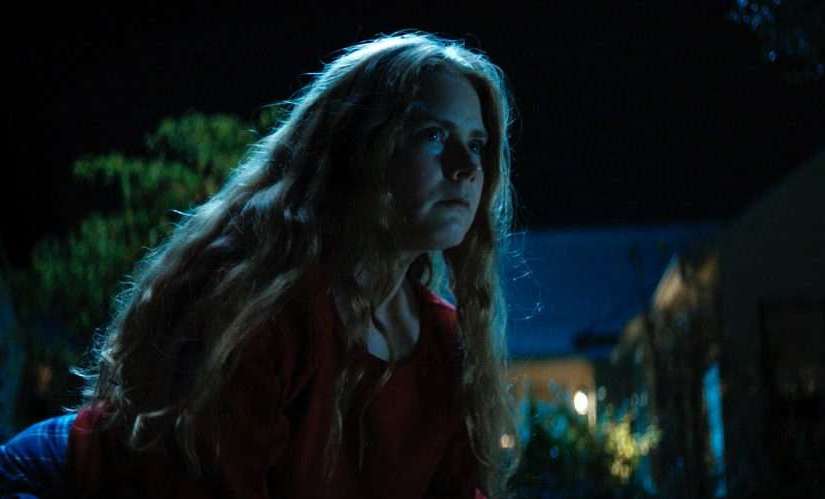
Amy Adams plays an unnamed Mother who has put her promising career as an artist on pause to be a stay-at-home mom while her also-unnamed Husband (Scoot McNairy) pursues his career as a…um…well, whatever it is, he has to travel a lot, leaving Mother at home with, you guessed it, Son (played by adorable twins Arleigh and Emmett Snowden).  Referred to throughout the movie as “my guy” and “sport” and “little buddy,” Son is a typical toddler in the throes of the terrible twos: cute for long stretches, maddeningly frustrating for longer stretches.  [Ed. Note: the author is not a father, has no plans on becoming a father, and will never possess the immense dedication it takes to rear a child, so don’t expect him to embrace the chaos of toddler-hood because it ain’t gonna happen.]

Mother is going through an identity crisis, set up in a brilliant opening scene where Sally, the woman who assumed Mother’s job at an art gallery, asks her, “Do you just love getting to be home with him [Son] all the time?”  Mother answers the question with a little more honesty than Sally or anyone had a right to expect, including this tidbit: “I am deeply afraid that I am never going to be smart, or happy, or thin ever again.”  I am a straight Hispanic cisgender male, so I’m here to tell you, I will never understand that mindset, but I am reasonably certain there are untold millions of moms out there who, if they listened to Mother’s opening statement, would say, “AMEN, sister.”

A little later, Mother delivers an internal monologue where she reflects that, as a mother, you can squeeze someone into the world “who will one day pee in your face without blinking.”  Again, I’m not a parent, but I know that’s truth in cinema right there.

After a few more establishing scenes of Mother interacting with Son, who absolutely REFUSES to go to sleep at night or eat anything for breakfast except, apparently, hash brown patties fried in butter, some odd things start to happen.  At the playground, some stray (?) dogs approach her as if she’s their best friend.  Mother notices her sense of smell has become much more acute.  Son helpfully points out that her back is hairy.  And, in a creepy Cronenberg-y moment, she notices a lump growing at the base of her spine just above her rump.  Curiosity gets the best of her.  She heats a needle, lances the lump, and…well, if you remember the title of the film, you have an idea of what pops out of that lump.

This was all wonderfully thrilling stuff as a movie lover.  I’m thinking, “My god, this is a Spike Jonze movie told from a woman’s perspective!  I’ve never seen anything like this!  This is gonna be GREAT!”  Mother starts to enjoy eating a lot of meat.  She starts to play “doggie” with Son, growling and barking at each other like two puppies.  The two of them eat their lunch at a deli with no silverware…or hands, to the consternation of other diners.  Son doesn’t sleep at night, so Mother, in a genius parenting move, buys a dog bed and gets Son to play “doggie” and sleep in the dog bed at night.  Presto, problem solved!

And more and more dogs start showing up at her door, at night, sometimes bringing gifts: small dead animals.  One night she walks outside, starts digging around, and an astonishing transformation takes place…

I know, I know, SPOILERS, I get it.  But it’s important to get across just how brilliantly original the first act of the film is, because the second act is, alas, all downhill.  I am not saying that the film’s message is unimportant, not at all.  I admire the film because of its message, and because it was being delivered in such an original way.  But then we get into conflict with Husband, who is desperately trying to understand why their 2-year-old is now sleeping in a dog bed on the floor, or why their cat suddenly turned up dead on the front porch, or why his wife suddenly wants a separation.  It must be said, Nightbitch is remarkably even-handed with the Husband’s dialogue.  He is not reduced to a 2-dimensional sitcom husband.  When she lays into him for not supporting her career, he fires back with a well-reasoned argument.  Their dialogue could be turned into a first-rate play.

But instead of exploring the surreal nature of Mother’s new condition, the movie settles into soap-opera territory, with only the occasional nod to the mystical incidents in the first act.  I distinctly remember, in the middle of the second act, feeling as if a balloon had deflated in the plot.  I imagine defenders of the film might say, “Well, the second act is where the weird stuff has to take a back seat to deal with the real issues at hand.”  Okay, maybe that’s true from a real-world perspective, but to me, it felt as if the filmmakers were on the verge of showing us something mindboggling, then backed away from the precipice at the last minute.

Does that make me guilty of critiquing a movie for what I wanted as opposed to what I got?  I guess it does, as much as I dislike that tendency in myself.  I feel there are so many different ways the movie could have gone in act two, could have leapt gleefully over the edge of convention and truly broken the mold with this movie.  When it became clear what they were doing instead, my elation evaporated.

I give Nightbitch a generally favorable score, though, based on the mad inventiveness of the first act and the plot in broad strokes, and also on the incredibly brave performance from Amy Adams, who maybe has two scenes in the entire film where she seems to be wearing any makeup.  She also appears to have to put on some weight for the role, which is not something I can ever recall seeing a female actor do.  Male actors have turned that kind of thing into a cottage industry, but when was the last time you saw a woman do it?  That took guts.  Watch Nightbitch for Amy Adams’ performance and for the story, even if the movie doesn’t follow its own plot to a satisfying conclusion.

GONE WITH THE WIND

By Marc S. Sanders

Gone With The Wind is probably the first of the sweeping epic.  It spans a transitional period in history from the American Civil War and through the aftermath known as Reconstruction.  Contained within these historical contexts are the prominent Georgian Southern Plantation residents. They court and romance one another ahead of the war. They celebrate with welcome glee, ready to fend off the horrible Yankees of the North who desire to put an end to black slavery.  Nearly ninety years later Victor Fleming’s film, based on Margaret Mitchell’s bestseller, is an impressive piece of movie making with set designs and shots that remain superior to many modern films of today. 

At the top of the character pyramid is young Scarlett O’Hara (Vivien Leigh), the spoiled Southern Belle of a wealthy Irish plantation owner.  Her spoiled livelihood pines only for the noble and dashing Ashley Wilkes (Leslie Howard).  Yet, he has committed himself to his cousin and Scarlett’s best friend Melanie (Olivia de Havilland).  Enter Rhett Bulter (Clark Gable), a self-made wealthy prospector who is taken with Scarlett. She gives him the coldest of shoulders as she waits for Ashley to leave Melanie and have him all to herself. 

Before the soap operas of radio and television arrived, there was Rhett and Scarlett in a competition of romantic swordplay. As you watch Gone With The Wind, you see how the relationships change with marriages and children, along with death as a cost of war.  If it wasn’t for how well this collection of actors perform, all of this storytelling would feel quite hammy by today’s expectations.  Yet, Clark Gable is undeniably handsome and confident as Rhett.  His stature is so impressively consistent with that pencil thin perfect mustache to enhance his proud grin.  He doesn’t wear the costumes of 1860 regality.  The costumes wear Clark Gable.  If the film were ever to be remade, no one could match what Gable delivered.  Vivien Leigh is also unforgettable.  Scarlett is hard to like, though amusing in how she holds to her convictions of rejecting Rhett’s advances while still obsessing over Ashley.  Sometimes you want to shake this spoiled brat down to reality.  Yet, as the film demonstrates, reality shellshocks the young lady as the war overcomes and she must learn to fend for herself and those closest to her.  Viviene Leigh is radiant, and she epitomizes this character amid the vibrant colors of her dresswear and her piercing eyes that focus on what is important to her.  Whether it is schoolgirl flirtations or determined survival, Viviene Leigh is always focused on Scarlett’s stubborn strengths, which at times are also her weaknesses.

The construction of Gone With The Wind is what stays with me most.  Knowing what we know of our country’s bloody history, it’s surprising to see how excited the men of the South are to enlist in the Confederate Army, defending their ways of Southern gentility and slave ownership.  Yet, even for a film, Victor Fleming does not shy away from the atrocities of war.  Before Oliver Stone demonstrated the false heroism that a man like Ron Kovic expected to find in Vietnam (Born On The Fourth Of July) or even what could be found in the first acts of All Quiet On The Western Front, Gone With The Wind was there to flip the coin first.  The same men who bucked their horses and fired their pistols in celebration of going off to fight either never returned or they came back to a thinly spread, elderly doctor ready to sever their limbs. 

The most unforgettable shot of this film occurs when naïve Scarlett traipses across a long block of wounded men to find the doctor and insist he tend to Melanie who is about to deliver a child.  The number of extras and the amount of detail and design in this one scene is astounding.  It’s truly a walk back in time and it never glamourizes an unforgiving history.  You cannot help but be marveled at this wide shot; one of the best I’ve ever encountered.

Following this moment, Scarlett is forced to grow up as Sherman’s forces advance through Atlanta and Savannah burning everything in sight, including what’s most precious, her plantation home known as Tara.  The art design of Tara should be studied in film school.  Victor Fleming’s crew show a beautiful expanse of land and prominence to open the film, just ahead of the Civil War, then it is followed by a pillaged and burn stained remnant of invasion that could not be fended away.  Fleming also captures stunning silhouettes of Scarlett and others with the foreground bathed in a burnt orange sunset or a grey and gloomy sky.  An unleafed oak tree is off to the side lending to the foreground and implying a current barrenness of what was once a luxurious South.  Just ahead of the film’s intermission, Victor Fleming completes his canvas on film showing a defiant Scarlett with a raised fist delivering her self-sworn testimony to reviving Tara for a new day.  It’s just another unforgettable moment in all of film history.

The length of Gone With The Wind feels overwhelming clocking in at just under four hours.  Still, the picture moves and progresses through historical landscapes and the developments of young Scarlett as she moves from her unquestioned reliance from Mammy, her house servant (Hattie McDaniel, the first African American to win an Oscar) and on to her courtships and marriages.  During her transitions, she must contend with lack of food, money and resources for herself and the slaves she’s grown up with at Tara, as well as the other plantation widows and wives.  Scarlett also must grow up quickly to find ways to fend off tax demands of Union Carpetbaggers.  All of these character developments hold my interest much more than the battle of the sexes engaged between her and Rhett.  These characters are wonderful.  Pure cuts of cinema grandeur.  However, I was caught up more in their recoveries following an undeniable defeat at the hands of war and what little was left behind.

When the film returns to the soap opera chapters, it is not so much that I am admiring Vivien Leigh, Clark Gable, Olivia de Havilland or Leslie Howard.  I am much more engaged in the backgrounds they occupy.  The rubble of carnage followed by the grand reconstructions that remedied their new situations.  Rhett and Scarlett fight for common ground in their eventual marriage, have a child and then emotionally toy with one another.  It’s nothing boring.  However, it is a lot of same old, same old and Margaret Mitchell’s sweeping epic finds sad resolutions to their dilemma of uncommon grounds with each other.  Arguably, these resolves in the storylines are a little too convenient as the story works to draw your tears while keeping you engaged in the drama.  Gone With The Wind is so legendary though, and still one of the biggest revenue earning films of all time. It is likely had I seen this film at the end of the 1930s when technicolor films were rare treats, that anything put on the screen would take me away in the splendor and heartache.  I reflect on the film after watching it for a second time and I still do not like Scarlett.  However, I admire what she endures and how she persists.

In 1939, Victor Fleming directed both The Wizard Of Oz and Gone With The Wind, two films with only the commonality of technicolor achievements.  They remain two of the greatest cinematic triumphs of all time and will always carry that honor.  I’d argue that Fleming was a Francis Ford Coppola, or a James Cameron or George Lucas of his time.  A pioneering and aggressive filmmaker looking to invent a new way to absorb moving images on a screen, accompanied by grand instrumental soundtracks and actors who complimented zoom ins and outs with his camera.  Victor Fleming is a director who truly remains unmatched.  When you watch these two films, you are carried off into unfamiliar times and places. You are forced to observe beyond what appears closest to you.  The immediate stories do not stop with Dorothy or Scarlett.  Look at Munchkinland or war-torn Savannah as far as your eye can take it. Fleming has something all the way back there, that far out, for you to see and collect in your consciousness.

Today, Gone With The Wind is accepted as a piece with an asterisk next to its title.  The treatment of African Americans in the film along with their dialects and appearances is held into question.  Should these people be depicted in this manner?  Ahead of the film, streaming on MAX currently, there is a warning label of what some may consider inappropriate content even though the film remains preserved in its original final edits.  It should be.  How blacks were cast in films and how blacks were treated in history can not be changed and if we are to improve on our future of filmmaking and the histories that have yet to come, then the worst thing we could ever do is disregard the errors of our ways and whitewash over how any people were regarded and what our perspectives looked like.  Hattie McDaniel’s character may be the most beloved and memorable character in Gone With The Wind.  She’s a scene stealer whenever Gable or Leigh share a moment with her.  It speaks volumes that she could win the Oscar during a time when overt prejudice was never subtle. She was not even permitted in the theatre to accept her trophy. Clark Gable almost didn’t attend the ceremony in protest of her restriction.  McDaniel held that he go in honor of the film.  Still, Ms. McDaniel insisted that she’d rather play a maid on screen a hundred times over than live the life of a real maid fulfilling the servitude of someone else’s demands. 

Ahead of the challenging progress that came over twenty years later with the civil rights movement, McDaniel demonstrated a need for people of color to connect and relate to any kind of movie watcher.  Gone With The Wind would not have the reputation it has always held without Hattie McDaniel or Butterfly McQueen (as Prissy, another house servant).  To wit, these actors upheld what was being fought for within the Civil War and how those of the deep south lived and treated one another.  While we should be sensitive to how blacks were treated at this time, I am also grateful for their contributions into a historical depiction of a violent and unfair period.

Gone With The Wind takes commitment to watch.  Yet, it is such an important masterpiece in filmmaking.  It carries an immense significance that I believe it is one of a select number of films that must be watched in everyone’s lifetime.  I expect to still be breathing when the film reaches its one hundredth anniversary, and while some critics and skeptics poke at its shortcoming in sensitivity, I also hope that those who wish not to censor or erase an often-cruel history will give the picture its ongoing salutes and applause.  I’ll be at that Fathom event in the movie theater for that one hundredth anniversary.  This film was made to last a full century after its debut and then to last another hundred years thereafter.

It’s a masterful, epic and unforgettable piece of movie making.

PEARL (2022)

by Miguel E. Rodriguez

DIRECTOR: Ti West
CAST: Mia Goth, David Corenswet, Tandi Wright, Emma Jenkins-Purro
MY RATING: 10/10
ROTTEN TOMATOMETER: 93% Certified Fresh

PLOT: In 1918, a young Texas woman on the brink of madness pursues stardom in a desperate attempt to escape the drudgery, isolation, and lovelessness of life on her parents’ farm.


I originally gave Pearl a rating of 9 out of 10 because it was not quite as terrifying as its predecessor, X [2022], but I have decided to amend that to a 10 out of 10 based solely on the performance by Mia Goth in the title role.  If her performance had appeared in anything other than an indie horror film, I firmly believe she would have been nominated for an Oscar, or at least a Golden Globe.  But I’ll get to that in a second.

Pearl is a prequel to the acclaimed horror flick X, in which most of a porno film crew is stalked and murdered by an insane old woman, Pearl, and her equally insane old husband, Howard, in Texas in 1979.  It starred Mia Goth as Maxine, a stripper who was convinced she was meant for bigger and better things.  This time, in the prequel, Goth plays Pearl as a young woman growing up in Texas, but this time it’s 1918.  World War I is on the verge of ending, but the Spanish Flu pandemic is in full swing; folks in town don’t go anywhere or do anything in town without wearing a cloth mask over their nose and mouth.  (Sound familiar?)

Pearl’s home life is not quite functional.  In her first scene, over a lush score that sounds as if it were imported from the 1940s, Pearl dances in the barn and talks to a cow and a goat and a horse, like Snow White, about how she’s going to become famous and leave town, and everyone will know her name.  Then a goose waddles in from outside and interrupts her conversation; Pearl gets an odd look in her eye, grabs a pitchfork, sidles up to the goose, aaaand you can probably guess the rest.  (The gator from X makes a nice cameo shortly thereafter.)  Meanwhile, that ‘40s musical score punctuates the action like a Disney movie.  The effect is profoundly odd, but compelling.

We learn more about Pearl’s home life with her invalid father and domineering mother, Ruth (Tandi Wright).  She married young, but her husband, Howard, was called off to war in Europe, leaving her alone with her less-than-ideal parents.  She dreams of fame, but Ruth, with her strong German accent, sternly reminds Pearl of her responsibilities to her father and the farm.  One day, Pearl rides her bicycle to town to buy medicine for her father (sounds like the beginning of a fairy tale) and decides to go to the movies, which were very different in 1918.  She meets the strikingly handsome projectionist (David Corenswet, aka the new Superman) who encourages her to take the time to live her own life before it’s too late.  On her way home, Pearl stops in a cornfield, finds a scarecrow, and engages in a charming little song and dance with him…until her mind plays tricks on her and the encounter turns into something altogether different.

The whole movie is like that.  Shot in vivid colors and featuring an evocative soundtrack, it alternates between The Wizard of Oz and Joker.  (In fact, IMDb trivia notes that female fans of this movie call it “the female Joker.”)  It keeps you off balance in all the best ways, threatening to fly apart, but Ti West’s direction and Mia Goth’s performance manage to hold everything together in a satisfying, but disturbing, whole.  As with X, I can acknowledge the achievement, but I’m damned if I can explain how it was done.

There are many highlights in Pearl: her audition for a traveling dance show.  Pearl wheeling her father to the edge of the lakeside dock.  The scarecrow.  The tipping point between Pearl and her mother.  The pig on the porch.  (Gross.)  The look on her father’s face when Pearl dresses him up for a gentleman caller.  But the pièce de résistance of the entire film is, without question, Pearl’s monologue.

In a movie in which Mia Goth teeters on overkill in several scenes, the screenplay (co-written by Goth and Ti West) provides Pearl with a heart-rending soliloquy that should be more famous than it is.  Pearl’s sister-in-law, Mitsi (Emma Jenkins-Purro), sensing that Pearl is troubled, encourages her to indulge in a little play-acting: “Pretend I’m Howard.  What do you want to say to me?”  What follows is a 7-minute speech, most of it captured in an unbroken 5-minute take that must be seen to be believed.  In it, Goth expresses virtually every emotion imaginable as she unburdens herself, purges herself of all her repressed rage at her husband for leaving her alone, at her mother for holding her back from her dreams, at her father for having the temerity to fall ill and causing her to remain home for his sake.

Does this speech excuse her violent behavior?  Not at all.  But it explains it as well as any other serial killer movie I’ve ever seen.  I was reminded a little bit of Charlize Theron in Monster [2003], who also played a woman who committed terrible crimes, yes, but who was pushed into making those choices by her family and a society who little noticed or cared about her situation.  That’s how stirring Goth’s performance is, that I would compare it to one of the greatest performances ever captured on film.  In a movie that flirts with parody a couple of times, this last speech grounds it and the main character firmly in the real world.  It’s truly astonishing.

I’m almost sorry I saw Pearl AFTER watching X.  Almost.  It kind of makes me want to go back and watch X again, armed with all this new information on Pearl’s backstory.  It also solidifies the psychic connection between Pearl and Maxine, which was touched on several times in X, and which I imagine will be revisited in some way in Maxxxine [2024]…but I’m just speculating.  Pearl is good enough to stand with any of the best serial-killer-origin stories ever made.

(P.S.  As with X, you’ll want to make sure you watch the credits, except this time you want to stay with it until the last image fades to black…you’ll know what I mean.  IMDb informs me this crazy, creepy moment happened because after the last line, director Ti West refused to yell “Cut” and just let the camera run, and the actor in question, being a professional, simply stayed in character.  It’s remarkably unsettling.)

FORCE OF EVIL (1948)

by Miguel E. Rodriguez

DIRECTOR: Abraham Polonsky
CAST: John Garfield, Beatrice Pearson, Thomas Gomez, Marie Windsor
MY RATING: 8/10
ROTTEN TOMATOMETER: 100% Fresh

PLOT: A crooked lawyer working for a numbers-running “combine” nevertheless tries to get his older brother to quit the racket himself when an even bigger combine tries to move in.


On the surface, Force of Evil looks and feels like a B-movie: low production values, populated by talented bit players elevated into larger roles [John Garfield being the exception, naturally], and looking like it was shot on the fly by a television crew.  Of course, reading that sentence back to myself, I realize I could also be describing Hitchcock’s Psycho [1960], but Force of Evil feels even more low rent than that.  There are shadows present in brightly lit rooms that could only be caused by stage lights behind the camera.  Oddly timed edits draw attention to themselves and threaten to take the viewer out of the movie.  The female roles are literal representations of the so-called “Madonna-Whore” complex, limited to expressions of fluttering tension or full-on seduction.  The dialogue, at least near the beginning, is filled with legal and financial jargon that had me rewinding a couple of scenes to try to digest what the characters were saying.

And yet, Force of Evil exudes a strange power through its unique use of language and the borderline-Shakespearean nature of its tragic story, involving a crooked lawyer (John Garfield) who works for a numbers racket, but nevertheless tries to convince his older brother to quit the business when a larger “combine” threatens to take over.

John Garfield, God love him, was no Brando or Bogart, but in this movie, the screenplay provides him and everyone else with dialogue that feels lifted out of a stage play that was translated into English from some foreign language.  Here’s a line from Leo Morse (Thomas Gomez) to his younger brother, Joe (Garfield):

“Do you know what that is, Joe?  Blackmail!  That’s what it is!  Blackmail!  You’re crazy!  You’re absolutely crazy mad!”

Another example:

“All right.  I am sensible.  I am calm.  I’ll give you my answer calmly and sensibly.  My final answer.  My final answer is finally NO.  The answer is no – absolutely and finally no, finally and positively no!  No, no, no!  N – O!”

To call that kind of language “stylized” is an understatement.  The repetitive words, the broken-up clauses…tilt your head and it could almost read as poetry.  In fact, in Martin Scorsese’s introduction on the Force of Evil Blu-ray, he relates a story where a critic watching a screening of the film exclaimed, “My god, it’s written in free verse!”

While I acknowledge the screenplay’s poetic form, I found an even more contemporary comparison: David Mamet.  I semi-recently watched his film Homicide [1991] and wrote in my review that “…Mamet’s signature word choices…suggest an almost Shakespearean construction, as if the words are being shoehorned into a buried structure or pattern that operates subconsciously…trying to create a mood reminiscent of Greek tragedy…”  Those words apply equally well to Force of Evil’s screenplay by director Abraham Polonsky and Ira Wolfert.  I got a distinctly Mamet-esque vibe from the dialogue in this 1948 film, with just a dash of Aaron Sorkin, perhaps.

(Ebert once said that Pulp Fiction [1994] is a movie that he could watch with the picture turned off, just so he could listen to the crackling dialogue.  Force of Evil could just as well fit that mold, in my opinion.)

There’s even a Mamet vibe to Garfield’s acting style, as he rarely cracks a smile or any other expression for the entire film; we only sense changes in tone by the volume of his voice, not by the expression on his face…much like the lead actors in Mamet’s House of Games [1987].  That stylization sets Force of Evil apart from many of its film-noir counterparts.  To be sure, other noirs have their share of stylized dialogue and characters, but this movie sets some kind of stylization bar that must be heard to be believed.

The story can be summarized easily (see the top of this review), but it is powerful in its simplicity, at least when it comes to the interplay between Joe and his older brother.  As for the female characters, they are sadly stuck in placeholder roles that are there either as eye candy (Marie Windsor, a film-noir regular in her first major role) or as the young woman, Doris (Beatrice Pearson), helpless before the wiles of a wicked smooth-talking man like Joe Morse.  No Ida Lupones or Barbara Stanwycks or Lauren Bacalls here.  However, there is an interesting conversation between Joe and Doris that gives us an interesting insight into Joe’s character, as well as hiding a discussion of moral relativism in plain sight.

Joe is doing the ‘40s film equivalent of “putting the moves” on Doris, telling her baldly that she WANTS him to be wicked to her, “because you’re wicked, really wicked…you’re squirming for me to do something wicked to you – make a pass for you, bowl you over, sweep you up, take the childishness out of you, and give you money and sin.  That’s real wickedness.”  In so many words, he’s telling her that she’s ASKING for it.  This is not a nice man.  He goes further.  He tells her:

“If I put my hand in my pocket and gave you a ruby, a million-dollar ruby for nothing, because you’re beautiful and a child with advantages and because I wanted to give it to you without taking anything for myself – would that be wicked?”

In Joe’s mind, charity isn’t just for suckers, it’s downright evil.  Doris mounts a good defense, telling Joe how she hasn’t been fooled by magicians or smooth-talking men since she was a little girl.  Joe keeps following his path of logic, but an interesting thing happens.  He incriminates himself, and at the end of the scene he seems to realize it:

“To go to great expense for something you want, that’s natural.  To reach out to take it, that’s human, that’s natural.  But to get your pleasure from not taking, from cheating yourself deliberately like my brother did today, from not getting, from not taking…don’t you see what a black thing that is for a man to do?  How it is to hate yourself and your brother, make him feel that he’s guilty, that…that I’m guilty?”

There’s that free verse in action again, with those repetitive phrases.  His own amoral code trips him up, and the camera lingers on Joe’s haunted face for a moment before we fade into the next scene.  I mention this exchange because it’s so atypical of even some of the greatest noirs, which are usually full of hard-boiled dialogue about heaters and button men and glamorous dames.  In Force of Evil, we’re invited to turn inwards with our anti-hero and compare our definition of evil with his, as Doris does later in the film.

The film ends with several scenes of shocking violence, including a murder that looks inspired by Battleship Potemkin [1925] and a three-way shootout in a darkened office.  There is a remarkably evocative shot as Joe hurries down a staircase, and it appears as if he is making his own descent into hell.  Force of Evil has recently been critically re-evaluated; after years of being dismissed as nothing more than an assembly-line noir thriller, it was recently restored by UCLA and the Film Foundation and was also selected to the National Film Registry.  It’s not the greatest film noir I’ve ever seen, but if you’re a fan of the genre, you owe it to yourself to hunt down a copy and give it a look…or more appropriately, a listen.

A COMPLETE UNKNOWN (2024)

by Miguel E. Rodriguez

DIRECTOR: James Mangold
CAST: Timothée Chalamet, Edward Norton, Elle Fanning, Monica Barbaro, Boyd Holbrook
MY RATING: 9/10
ROTTEN TOMATOMETER: 79% Certified Fresh

PLOT: In 1961, Bob Dylan arrives in NYC for the first time.  Four years later, his groundbreaking performance in Newport changed the music world forever.


The 1994 documentary Hoop Dreams began as a small-scale, 30-minute project concentrating on two inner-city boys who dreamed of making it to the NBA.  It was supposed to cover only a few months in their lives, but as their stories progressed, the filmmakers just continued filming, and the sprawling documentary eventually covered five years and became an absorbing three-hour odyssey.

In a weird way, that’s how I felt about James Mangold’s Dylan biopic A Complete Unknown.  The movie opens with no backstory, no flashbacks, just a disheveled young Bobby Dylan (Timothée Chalamet) arriving in 1961 New York City with his guitar, determined to meet his idol, legendary folk singer Woody Guthrie, hospitalized at the time with Huntington’s disease and no longer able to sing or speak.  In Guthrie’s hospital room, Dylan also meets another folk legend, Pete Seeger (Edward Norton), in what must count as one of the greatest musical summit conferences of all time.

The way this scene is shot, it almost feels like, after it’s over, it could be the end of a marvelous short film about three legends bumping into each other.  But, like Hoop Dreams, this biopic remains focused on the unknown Bobby Dylan, with his nasal whine and preternatural gift for lyrics, for five years.  He eventually gets more and more exposure and cuts his first album.  Along the way, he meets two women who will be his emotional touchstones during the film: the celebrated Joan Baez (Monica Barbaro), whom Dylan accuses of being and singing “too pretty,” and Sylvie Russo (Elle Fanning), who becomes his girlfriend despite his flirtations with Ms. Baez.

But throughout the film – and this is one of the reasons I enjoyed it more than I thought I would – we remain focused almost exclusively on Dylan, the man and his music.  We are treated to countless scenes of Dylan performing live, Dylan recording in a studio, Dylan scratching out a new song note for note and word for word.  If a soundtrack album were ever compiled of the full-length versions of all the songs we hear in A Complete Unknown, I have to believe it would be between two to three hours long, if not more.

Why did I react so favorably to this kind of treatment?  My two favorite musical biopics of all time are Ray [2004] and Amadeus [1984].  Amadeus certainly contains a LOT of music, much like A Complete Unknown, but we are given a lot of background information into Mozart’s life, his relationship with his father, his childhood years, and so on, whereas the Dylan film presents him as a blank slate without a single flashback to his younger years.  Ray is much more in the vein of your “traditional” musical biopics like Walk the Line [2005, also directed by Mangold] or Bohemian Rhapsody [2018], containing the standard story beats of struggles in their personal lives, a haunting past, liberal-to-moderate use of flashbacks, you get the idea.

I suppose part of my enjoyment of A Complete Unknown stems from the fact that, even though I’m not a Dylan fan, or Fan with a capital F, I appreciate the songs themselves, with their intricate lyrics and folksy rhythms, so I thoroughly enjoyed the myriad musical breaks.  I also liked the way the movie did not spoon-feed me chunks of information it felt I needed to know.  Instead of the movie telling me how I should feel about a scene or a moment with clunky dialogue or exposition, it simply presents a situation and kind of stands back from it, allowing me to form my own emotional reactions to the material.  That’s a tricky storytelling method; one false step and you’re left with a story with no heart, no meat in the middle.  But A Complete Unknown pulls it off extremely well.  I’m sure there’s a way to explain how they did it, but I’m not the one to try.  I just know that it works, and that’s enough for me.

Any discussion of this movie must necessarily include Timothée Chalamet’s magnetic performance as Bob Dylan.  It is destined for an Oscar nomination.  I am reliably informed that Chalamet did all the singing himself (as did Norton and Barbaro as Seeger and Baez, and Boyd Holbrook as Johnny Cash), and he went to great lengths to mimic Dylan’s trademark sound.  Combined with the pitch-perfect hair and makeup, it really feels like the real Dylan onscreen, especially when the movie jumps forward to the Newport Music Festivals of ‘64 and ‘65.  Of course, I wasn’t alive back then, but I have seen pictures and documentary footage of the man himself, and Chalamet is utterly convincing.  Even if you’re not a Dylan fan, this movie is worth watching just to see Chalamet’s performance…he’s that good.

My colleague, Marc Sanders, mentions in his review how the production design of the film went to great lengths to recreate early-1960s New York City, and I second that statement.  It’s as utterly convincing as Chalamet himself, especially when it comes to the various “underground” music clubs Dylan performs in, clubs where the folk music revolution was born.  I get the feeling that anyone who watches this movie, who was also alive at the time, will be easily transported back to that era when Kennedy’s Camelot was in full swing, as was the hippie movement, the folk movement, the civil rights movement, the Cold War, the Beatles.  There are aspects of this film that I may never fully appreciate since I was born in the early ‘70s, but I get the gist.

I feel compelled to rebut a specific argument from my girlfriend, who did not like the movie because it did not give us any real background information about who Bob Dylan really is.  (We only get a single tantalizing glimpse when someone leafs through one of his old scrapbooks that had been delivered to a “Mr. Zimmerman.”)  All the movie does, so her argument goes, is present us with a performer singing his music, culminating in a pivotal big concert, of which the same could be said of many other biopics that came before.  A Complete Unknown could just as well have been about Richie Havens, or Jerry Lee Lewis, or Janis Joplin, or anyone else.  There is no real personal conflict presented in the film.

To which I have to say…that’s not quite true.  I acknowledge the absence of background story and flashbacks, but for me, as I said, that’s a strength, not a weakness.  It follows the theme set up by the film’s title, after all.  Also, there is a real conflict in the story, as Dylan, after becoming the figurehead for the folk music movement in America, takes the unprecedented step of recording an album and performing live songs that are (gasp!) non-acoustic.  He complains that his fans want him to sing “Blowin’ in the Wind” for the rest of his life. This generates shockwaves throughout the folk community, and at one of his concerts where he performs an electric set, the crowd jeers, throws trash at him, and even calls him “Judas.”  That pretty much counts as “conflict,” in my opinion.

A Complete Unknown goes down as one of the best films of 2024 that I’ve seen.  For Dylan fans, it is an absolute must-see.  For fans of great acting, it’s also a must-see.  If you’re not a Dylan fan at all, well, it’s not likely to change your mind, but do yourself a favor and give it a chance.  Not many musical biopics, or films of ANY kind, are made this well and with as much loving care as A Complete Unknown.

A COMPLETE UNKNOWN

By Marc S. Sanders

A drifter hitches a ride into New York City with a guitar on his back looking for Woody Guthrie.  He only comes to realize that his musical idol is in a New Jersey hospital ward with a debilitating illness. The drifter just came from Jersey.

The young stranger eventually catches up with the legendary folk singer, and a friend named Pete Seegar.  He plays a song he wrote for the ill and mute Mr. Guthrie and the men are dazzled by this young man.  This is Bob Dylan, and he writes music and lyrics as quickly as he breathes.  But where did this wunderkind stem from?  To everyone that encounters Bob Dylan, he’s simply A Complete Unknown.

Timothée Chalamet delivers a blazingly convincing performance as Bob Dylan, surely a front runner for the Best Actor Oscar.  The appearance is easy to get used to. The dialect and expressions of what I’d like to think is the summit of what most of us know about the musician never falters from an apathetic expression or that mumbling hoarseness we all know.  Everything from the clothes to the shaggy brown hair to the sunglasses and motorcycle he confidently rides perfect this embodiment. In James Mangold’s latest musician biography (prior credits include the Johnny Cash bio Walk The Line), with Timothée Chalamet in this role, I was truly watching a Bob Dylan of the early to mid-1960’s.

Any movie has a conflict for its story to work around.  There’s more than one conflict in A Complete Unknown, but Bob Dylan would not know that.  He’s content with doing what he does and has not one care for what anyone else wants him to be or wants him to share.  Bob lacks much concern for the tumultuous times of the mid twentieth century either.  JFK and Malcolm X are assassinated.  The Vietnam War persists.  The Cuban Missile Crisis terrifies everyone.  Yet, Bob only focuses on his songwriting.  He’ll make connections with Pete Seegar (Edward Norton) and develop a sometimes-romantic tryst but mostly singing partnership with Joan Baez (Monica Barbaro).  He also gets involved with Sylvie Russo (Elle Fanning), one of his first fans.  However, no matter what they might expect of the performer, he’s only going to follow the path that drives him.  Therefore, that will be their own respective problems to contend with, not his.  Bob is only going to follow that path that he chooses.

Sylvie wants to know more about her live-in boyfriend who only tells tales of when he moved with a travelling carnival.  Joan wants to know where he learned to play guitar or even how he developed a knack for poetic lyricism.  Later, she’ll want to play the original numbers that solidified their friendship on stage despite his stubbornness not to agree.  It becomes curious when photo albums are delivered, addressed to a Robert Zimmerman.  Pete and his other peers want Bob, a now marquee name, to hold on to the grassroots of folk singing.  Bob will not acquiesce though.  Like other masterful musicians such as Prince or John Lennon and Elton John, Bob Dylan is going to continue to reinvent himself. 

In a matter of months, the signer becomes a nationwide superstar and he can’t walk the streets without getting bombarded; something he never wanted.  He performs with a passion for the music he’s written and he persists in making the next new thing with his talents as he transitions from acoustic to electric guitar and incorporates keyboards and drums to accompany his performances.  His friend Pete sees a berth becoming wider from the folk music he parades at annual festivals in Newport, Rhode Island and what Dylan insists on only playing.  Record producers (primarily represented by actor Dan Fogler) beg the singer to perform his older familiar tracks, but Bob Dylan only wants to move on to what is new and fresh. 

A Complete Unknown is full of such energy because it delivers what was produced by the guy who composed all of these magnificent and magnetic tracks from Song To Woodie to Blowin’ In The Wind to Like A Rolling Stone and to The Time’s They Are A Changing and A Hard Rain’s A-Gonna Fall.  You might not know or even understand all the verses by heart, but you quickly catch on to the choruses. To hear these newly composed songs pulled out of a dusty attic for an updated biography, performed by Timothée Chalamet in underground bars, at concert festivals or even in messy apartments is addicting.  You don’t want the actor to stop the song.  You don’t want the film to cut away from any of the numbers and you wish the concert would never end.  Like Joan Baez, Bob Dylan’s works stay with you.

I’ve become a huge admirer of James Mangold.  He’s a writer/director who does not criticize his subjects.  He empathizes with them and respects their boundaries.  We might find frustrations in people like Bob Dylan or Johnny Cash, but Mangold does not compromise the biography.  He finds reasons for you to like these men even while those who stand in their circles might not care for their attitudes. 

The director is also skillful at showing the history of the time.  Like the last Indiana Jones film he covered, the settings are so authentic.  New York City in A Complete Unknown is depicted down to the finest detail including the yellow street signs within the small boroughs of damp Brownstones and city streets that Bob Dylan navigates. The musty interiors of Woody Guthrie’s hospital room or Pete Seegar’s cabin home are shot with a hazy photography.  The Newport music festival, full of concert spectator extras feels like it was pulled from a documentary; what maybe a calm and relaxing Woodstock might have looked like.

Beyond Timothée Chalamet, the cast of this film is superb.  Elle Fanning need not say a word as James Mangold provides an assortment of close ups depicting her pain of wanting to love Bob Dylan but knowing she just can’t.  Her complexion turns into a weeping pink without one tear shed.  Monica Barbaro is on the cusp of becoming a marquee name in films.  The actress who was recently in action material with Tom Cruise and Arnold Schwarzenegger hides so well under the folk appearance of Joan Baez and she carries an immense stage presence. Scoot McNairy is Woody Guthrie who never speaks and only stares straight ahead during visits from Bob and Pete. Yet, the silent performance offers the only character who truly understood the value of an enigmatic Bob Dylan. Edward Norton has given a new range as a liberal and calm Pete Seegar who uses folk music as an escape from the turmoil of the times and not as a harbor to protest or fight an authority with aggression and violence.  He might wish for his friend Bob Dylan to uphold the value of folk music, but he knows he can’t keep a bird caged in one place either.  Norton’s introductory scene in a courthouse with a banjo in hand is unforgettable.  The casting is simply perfect in A Complete Unknown.

Since I saw this film on Christmas Day, I have not stopped thinking about it, and I think I want to see it again in a theater with a speaker system that amplifies the power of Bob Dylan’s guitar and mumbly vocals.  Right now, nothing sounds better.

A Complete Unknown is one of the best films of the year.

BLACK ORPHEUS (France, 1959)

by Miguel E. Rodriguez

DIRECTOR: Marcel Camus
CAST: Breno Mello, Marpessa Dawn, Lourdes de Oliveira
MY RATING: 8/10
ROTTEN TOMATOMETER: 88% Certified Fresh

PLOT: The Greek myth of Orpheus and Euridice is translated into a modern-day story (with an all-black cast) set in during Carnaval in Rio de Janeiro.


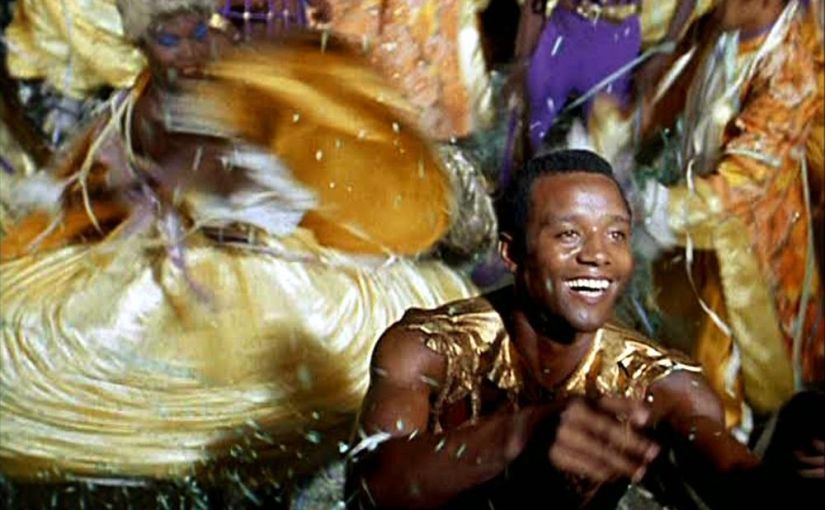
In the first two-thirds of Black Orpheus, there are scarcely more than 2 minutes strung together at a time without some kind of music or sound effects thumping away in the background.  This gives the film a subtle real-world backdrop, which is good, because Black Orpheus is a fantasy through and through.  Critics, now and at the time of its release, complained that French director Marcel Camus ignored the reality of the Brazilian favelas, or slums, in favor of depicting Rio as a non-stop party.  This is a valid point.  However, I believe that, in this movie, reality has no place.  This is a love story, a myth, a tragedy, and a travelogue all rolled into one.  Reality must take a back seat in movies like this.

(And, heck, somebody must have liked it because it won both the Palme d’Or at Cannes AND the Best Foreign Film Oscar that year, a rare feat.  True, there were extenuating circumstances [numerous French critics had problems with the emerging French New Wave], but let’s not turn this into a classroom, shall we?)

If you’re familiar with Greek mythology, then the plot of Black Orpheus is nothing new.  Orfeu (Breno Mello, a non-professional actor) is a streetcar conductor engaged to the sexy, vivacious Mira, but he is not exactly thrilled about it.  Meanwhile, Eurydice (Marpessa Dawn, who actually hailed from Pittsburgh, not Brazil) gets lost in the city on the way to visit her cousin, Serafina, who lives in a ramshackle favela neighborhood.  She asks Orfeu and his boss, Hermes, for directions, and for Orfeu it’s love at first sight.  The rest of the movie will involve Orfeu wooing Eurydice, who worries about a strange man who might be following her, while trying to ditch Mira, with Serafina’s help.  Also assisting Orfeu, while acting as a Greek chorus in miniature, are two street urchins, Benedito and Zeca, who envy Orfeu’s lovely guitar playing, which Orfeu claims is what makes the sun rise every morning.

Apart from the story itself, the things I noticed at the outset were the presence of riotous colors in the costumes and the Brazilian countryside, and the music.  Lots and LOTS of music, but not a great deal of songs.  Black Orpheus is billed as a musical, but I’d have to say it’s a quasi-musical.  In a standard musical, characters break out into song, and no one notices because otherwise we’d be watching a play.  In Black Orpheus, every song is diegetic…someone asks Orfeu to play a song on his guitar, for example, or the Carnaval participants sing a rousing song while on parade or at a huge dance.  And I want to mention again that, while Orfeu is singing a quiet song to Eurydice, the constant percussion of the Carnaval pulses behind it, completely at odds with his song.  You would think it would become a cacophony, but it doesn’t.  It makes his quiet song much quieter, which may sound counterintuitive, but it works.

The mythic tone of the story keeps the film from flying off into ridiculous territory amid all the revelry.  Without mythology, Black Orpheus would be a soap opera.  A pivotal scene occurs during a massive dance contest, as Eurydice has disguised herself as her cousin, Serafina, so Mira doesn’t recognize her.  But Mira sees through the disguise and threatens to kill Eurydice.  Mira chases her, and unseen by anyone else except Eurydice, a man dressed all in black wearing a skull mask follows them both.  This is Death.  Earlier he had nearly chased Eurydice off a cliff, but Orfeu had saved her.  “I am not in a hurry,” he said, “we shall meet soon.”  With that in mind, his presence during this second chase is tinged with suspense.  It’s a very Hitchcockian element, the threat of danger juxtaposed with a dance or a party.  Good stuff.

So, it’s fair to say I enjoyed this movie a little more than I expected to.  But the bonus features on the Blu-ray brought up an interesting point.  Detractors of the film pointed out that, despite taking place mostly in a slum, the actual reality of those slums (both then and now) is anything but festive, no matter how much bossa nova music you play or how many songs you sing.  It’s highly unlikely these people would have had the wherewithal to create such stylized, colorful costumes while having to deal with the reality of poverty, all while looking down the mountainside at the distant concrete high rises of the higher classes.

Does Black Orpheus ignore reality?  Well…yes, it does.  Myths, by definition, have little to do with reality in the first place.  Would it have been possible to tell this mythical story, retaining its coincidences and absurdities and supernatural elements [especially towards the end], while also keeping its feet firmly on the ground and making a socially conscious statement about the horrible living conditions in Brazil?

I don’t think so.  Or, if you did, it wouldn’t be held together very well.  Black Orpheus is simply re-telling a very, VERY old story and re-imagining it as if the Greek gods had lived atop Sugarloaf Mountain instead of Olympus.  When you start with that kind of premise, reality goes out the window.  You have to focus on the story’s emotional beats, the pleasant assault on the senses and, occasionally, logic.

This opens a whole separate argument: is it a film’s responsibility to BE authentic, or just to FEEL authentic?  For example, Titanic [1997] feels authentic to me, a layman, but I’m sure historians and other experts could point to any number of things that were simply not true in the film.  Fair enough, but that doesn’t affect my enjoyment of the film as it was presented to me.  It FELT authentic, and that’s enough for me.  The only way to make a movie like that 100% authentic would be to turn it into a documentary.

Black Orpheus FEELS emotionally authentic to me, a layman, who is not a social anthropologist.  I look at the colors and vibrancy on display, visually and in the story itself, and while a small part of me acknowledges, “This isn’t real life”, another part of me says, “Well, if I wanted real life, I wouldn’t be watching a movie, would I?”

THE CHINA SYNDROME

By Marc S. Sanders

The China Syndrome explores the inherent risk that comes with a reliance on nuclear energy.  It also touches upon the moral choices within the field of journalism.  Most importantly though, it’s a hell of a thriller.

Kimberly Wells (Jane Fonda) is an on the scene reporter doing light fare topics for the evening news, like the novelty of singing telegrams for example.  With her subcontractor cameraman, Richard Adams (Michael Douglas, also one of the film’s producers), they cover a story on how a nuclear power plant operates.  During their tour, a very frightening accident stops short at only being a threat.  While the top brass at the company downplays the incident, Richard manages to record the panic-stricken activity happening among the operators in their soundproof control room.  As Kimberly and Richard gather information about what really happened, they are told they only were so close to what can be described as a China Syndrome – the underground nuclear rods could have overheated, imploded and the blast would have ruptured through the core of the earth where even China could feel it on the other side of the world.  

The corporate elites (led by Richard Herd) are the villains of this picture.  The could be hero is Jack Godell (Jack Lemmon), a could be whistleblower.  Jack oversees the whole operation and following that frightening scene begins to do his own kind of investigation.  What happened only makes sense because due diligence was not upheld, and inconsistencies are being neglected. Problems are only expected to get worse because they are not contained. There would be an enormous monetary expense that will put the company at a loss.  Initially, Jack wants to remain quiet, but the idea of what he’s certain will eventually happen is conflicting him.  As well, Kimberly and Richard’s pursuit of what truths he holds is gnawing at him.  

Jack Lemmon is a frazzled, yet sensible, marvel in this film.  I love the unspoken subtleties of this guy.  Best I could see is that Jack Godell is unmarried and has no children, nor friends beyond the faint connections he shares with his work colleagues, particularly one played by Wilford Brimley.  This only enhances Godell’s isolation in a them-against-him matchup.  Lemmon is great at emoting a sorrow and regret to his character.  He tells the journalists that he loves that plant.  It’s all he has in life and now it spells a certain, eventful doom if the faults in operation are not exposed.  Like Michael Mann’s The Insider, which was released over two decades later, the unlimited resources of this company will do everything in their power to silence this liable peon who works for them.  

The other side of The China Syndrome focuses on Fonda’s character.  When this film was released in 1979, it was the norm to not take a woman reporter seriously.  They were best used as attractive figureheads with beautiful hairstyles and well applied makeup to shift the seriousness of the news over to stories about dogs who can do tricks or hot air balloon happenings.  This film could have made more of a campaign to embrace the female journalists with heavier topics.  Instead, Jane Fonda’s character is not a fighter so much for deserved recognition in a male dominated world.  She’s actually just trying to circumvent around the unspoken chauvinism of her industry and get to the heart of this story that she witnesses firsthand.  The news station would rather her efforts be focused elsewhere.

Richard, the cameraman, is not embraced by Kimberly’s news station and therein lies the debate of airing what appears to be a story of urgency for the benefit of the public.  Yet, the station does not want to face a lawsuit.  What do the principles of journalism mandate even when there’s a monetary and reputational risk to their institution?  

Plenty of films with these kinds of dilemmas have come out following The China Syndrome.  What’s remarkable is the authentic feel of this fictionalized account.  Ahead of the release, the real-life companies that were developing a need for nuclear power were lambasting this film, insisting there was no validity to this story.  They were adamant that the production and maintenance of nuclear power was completely safe and well monitored. Twelve days after this film hit theaters in March 1979, the Three Mile Island accident occurred in Harrisburg, Pennsylvania when a partial nuclear meltdown of a reactor occurred. Traces of harmful gases and iodine were released into the atmosphere, and the incident was rated a Level 5, an “Accident with Wider Consequences.”  I do not believe Michael Douglas and his co-producers/filmmakers necessarily set out to make a statement. Though there are protesting movements peppered throughout the film. It’s a frightening irony, however, when life imitated fiction. 

 Jane Fonda and Jack Lemmon put the suspense of The China Syndrome into play. There’s an awareness to what could happen with technological advances in nuclear energy especially if they are not carefully observed and addressed.  

Over forty years later, do we really know what’s going on and even if we did, what could any of us do about it?

CONCLAVE

By Marc S. Sanders

conflict

noun

  • 1.
    a serious disagreement or argument,

conclave

noun

con· clave ˈkän-ˌklāv 

Synonyms of conclave

1

a private meeting or secret assembly

especially  a meeting of Roman Catholic cardinals secluded continuously while choosing a pope 

2

a gathering of a group or association

As I watched Edward Berger’s new film, Conclave, the word “conflict” came to mind based simply off of the same prefix the two terms share.  This picture does not just depict a sequestered assembly to elect a new Pope for the Roman Catholic Church.  It goes further because nothing goes as expected for the Dean of the Conclave, Cardinal Lawrence (Ralph Fiennes, doing Oscar caliber work).  

Now that the Pope has passed away, the various cardinals assemble, and all seem to have their own impressions of who should take the reins.  Cardinal Bellini (Stanley Tucci, man I love this guy) is the liberal candidate, tolerant and supportive of the gay population and accepting of women in authoritative positions.  Cardinal Tedesco (Sergio Castellitto) is on the conservative side believing the position should rightly return to an Italian with restrictions and containments of liberal ideals that have diminished what the church used to stand for.  There is also Bishop Tremblay (John Lithgow) who has an abundance of support to no one’s surprise. A few others earned some votes during the initial balloting, but it’s seemingly of no big consequence. Still, over the course of the film, multiple votes will have to be counted until the minimum majority necessary for a new Pope is collected.

The men of God convene in a formality of faith, swearing their handwritten votes before the Almighty.  Yet, Lawrence, as a dean of ethics and morality, is becoming apprised of some questionable irregularities among his peers.  While some of these men are earning more and more support with each passing tally, new developments present themselves forcing Lawrence to question if there should be some investigations to determine if some of these men are qualified to acquire the Papacy beyond an election.  Hence, the conclave is getting gravely interrupted by an overwhelming number of conflicts for Lawrence to consider.

I must stop there with my summary of Berger’s film, based on the novel by Robert Harris.  This is a top notch drama helmed by an outstanding cast.  At the very least the adapted screenplay by Peter Straughan will win the Oscar.  The dialogue is aggressive and forthright when it needs to be.  An institution like the Roman Catholic Church operates on secrecy.  However, it’s so interesting to see these devout men of God challenge one another. Just because they are the highest priests does not constitute them beyond sin or even corruption.  As Stanley Tucci’s character demonstrates, they might not be polite either.  Simply honest when their personal stance is challenged.  

The script is also quietly ponderous.  Ralph Fiennes shows an internal conflict between his duties to the church and how he truly characterizes some of his peers.  He even begins to wonder if he should continue as a priest. Has his faith remained uncompromised? Frankly, how can a priest of the highest order live satisfyingly knowing that no person is of an upmost perfection even if they swear by their faith? Still, the strict expectations of a widespread religion will demand contexts of that notion.

Constructively, Conclave has a gripping energy.  The performances from especially Fiennes, Tucci and Lithgow are magnetic as soon as they enter the piece.  Isabella Rossellini delivers an under-radar performance as a nun who works with a necessary audaciousness to her character.  She knows things that should never have occurred.  Yet, how will she confront these intimidating, stark, red-robed figureheads?  Does she even have a right or authority to speak?

The music from Volker Bertelmann could belong in Hitchcock thriller if Bernard Hermann wasn’t available.  It keeps you alert and never anchors your feelings as new developments come to light.  The composition only enhances the weight of the drama.  

Edward Berger is an observant director.  Ahead of the conclave he reminds you that even telephones are not permitted inside and tossed in a heap outdoors.  The priests are smokers. Personally, I find that surprising as cigarettes almost seem like a mild narcotic and a contradiction of how I envision a Catholic priest should behave.  Nevertheless, Berger also gives you a close up of a pile of cigarette butts tossed on the ground just ahead of being sequestered. These men turn off the world outside to focus on this important election. It’s as if they live in a submarine below the surface.

Conclave wil be a very divisive film.  Politically, it’s apparent that it favors one side (liberal vs conservative) over another.  In addition, it is not shy about showing its characters with their assortments of fault.  I am not educated in Catholicism.  Though I am well aware of the value it holds across its worshippers.   For many, their faith is held above all else and those people will find a discomfort with this picture.  I might even be understating that assessment.  Some folks of the Catholic order, and maybe other denominations of Christianity, will even take grave offense to this fictionalized depiction.

Conclave is truly conflicting.

Because I do not hold any value in Catholicism, much less any religion anymore (just a shred for the Judaic customs I was raised on), I did not hold any bias or objections to Edward Berger’s film. Rather I was engaged in how difficult it is to balance yourself as a Catholic priest.  For Cardinal Lawrence, Ralph Fiennes is neither likable nor unlikable but I certainly felt his character’s frustrations and the challenges he is obliged to navigate.  

Who is judging these Cardinals? 

God?  

Or is it each one of them?  

Conclave is built on one believable, yet shocking, surprise after another.  Still, when the big twist at the end arrives, it is completely blind siding and Straughan’s script leaves his audiences with a new question that’s practically impossible to contend or compromise.  

Again, Conclave is very, very conflicting.

Nevertheless, this is one of the best films I have seen in a very long time.  So much so, that I cannot wait to see it again.

Conclave is one of the best films of the year.

CARMEN JONES (1954)

by Miguel E. Rodriguez

DIRECTOR: Otto Preminger
CAST: Harry Belafonte, Dorothy Dandridge, Pearl Bailey, Brock Peters, Diahann Carroll
MY RATING: 8/10
ROTTEN TOMATOMETER: 75% Fresh

PLOT: The Bizet opera Carmen is translated into a modern-day story (with an all-black cast) of a sultry parachute factory worker and a GI who is about to go to flying school during World War II.


Otto Preminger’s Carmen Jones will be (or OUGHT to be) remembered for many things, but the thing I will remember it for the most is the dynamic presence of the sexy, sultry Dorothy Dandridge in the titular role.  She may not have done her own singing – nearly all the major characters’ singing voices were dubbed by opera singers – but, by God, she knew how to own a role.  In the first five minutes, she steals the movie lock, stock, and barrel when she performs that first aria in the mess hall.  It’s like watching a Marilyn Monroe film: everything around her pales in comparison to her sheer magnetism, although with Dandridge (at least with the character of Carmen), you can see an intelligence behind the sexiness.  Dandridge thoroughly deserved her Oscar nomination.  A quick Google check shows she had some stiff competition that year: Grace Kelly, Judy Garland, Audrey Hepburn, and Jane Wyman…although how Kelly pulled out a win over Dandridge AND Garland will forever remain a mystery to me.

ANYWAY.

In this modern retelling, Carmen Jones is a factory worker during World War II, making parachutes for the war effort.  During the opening aria, she sets her sights on Joe (Harry Belafonte), a naïve GI in love with a country girl, Cindy Lou, from his hometown.  If I’m being completely honest, nothing in the film matches the simmering sexual energy of this opening number.  Carmen slinks from table to table in the mess hall, modestly dressed, but with complete knowledge of exactly how to work with what’s available.  She flirts shamelessly with Joe, right in front of Cindy Lou.

Later, Carmen gets in a knock-down, drag-out catfight with Frankie (Pearl Bailey, the only principal actor whose singing voice WASN’T overdubbed) and is arrested by the MPs.  Joe, who was just about to elope with Cindy Lou, is ordered to drive Carmen to a town some 50 miles away, since the Army can’t put civilians in jail.  This sets up another opportunity for Carmen to flirt with Joe, as she does everything but unbutton his pants during their drive.  The more he resists, the more she wants him.

…but I don’t want to simply summarize the plot, which was a mystery to me since I have never seen a production of Carmen.  (The ending is mildly pre-ordained, because, hello, it’s an opera.)  I want to express my admiration of this film, particularly for its ambition.  I’m no film scholar, but I’m prepared to bet that in 1954, there weren’t an awful lot of big studio films being directed by A-list directors featuring an all-black cast.  The fact this film exists at all is, I think, a minor miracle.  I won’t attempt to put words in the mouth of anyone in the black community, but at that time in cinematic and American history, I have to believe this was seen as a giant leap forward, AND a giant risk.  (There is probably MUCH more to this story, but I do not want to turn this article into a research paper.)

Otto Preminger’s directing style in Carmen Jones also deserves recognition.  A factoid on IMDb trivia states: “This film contains just 169 shots in 103 minutes of action. This equates to an average shot length of about 36 seconds, which is very high, given the 8-10 seconds standard of most Hollywood films made during the 1950s.”  This is important because those longer shots create, in many places, an illusion of watching a stage performance.  For instance, if I remember correctly, that opening aria that I keep going on about – Dandridge is SMOKING – runs for about 4-5 minutes and has only three total shots.  Towards the middle of the film, there’s an astonishingly long take that travels from a bar across the room to a table, following a group of five people, all singing simultaneously at multiple points.  The shot lasts just under five minutes, but it feels much longer.  It’s a brilliant piece of work.

The tragic arc of Carmen Jones may seem inevitable, as I said before, but it remains an entertaining watch.  You can see the dominos falling, and you bemoan the choices Joe makes as he falls under Carmen’s spell, but I mean, LOOK at her.  There’s a scene that I’m sure would bear the Tarantino stamp of approval as Carmen paints her toenails and coyly asks Joe to blow on them for her so they can dry faster.  Dayum.  Show me a straight man who wouldn’t fall for that kind of treatment from a woman who looks like Dorothy Dandridge and I’ll show you a dead man.

If I wanted, I could get nitpicky about Carmen Jones.  Has it aged well?  Not exactly.  Does it feature great acting aside from Dandridge?  Not exactly.  Does it look natural to hear an operatic tenor burst forth from Harry Belafonte’s mouth?  Not exactly.  But Carmen Jones is a landmark of black cinema in an era when schools and government buildings still had segregated water fountains and restrooms.  Based on that fact alone, I consider Carmen Jones to be a vital step in Hollywood’s painfully slow racial evolution. (It is also a painful reminder of a career that might have been; Dandridge died 11 years later at only 42.)