
ELYSIUM

By Marc S. Sanders

Neill Blomkamp is that writer/ director who escapes my memory until I see a movie trailer with one of his signature robot designs weaved into the populace of his dystopian stories, like in his widely recognized District 9 and Chappie, which I’ve yet to see.  These androids are as capable as humans but primarily devoid of feelings and follow stringent programming with no exceptions.  That way order is maintained without an interference of subjectivity.  These figures are not plotters like HAL 9000 or companions like R2D2, but they have strength through arms and legs to restrain anyone out of line, and thus that’s a hard obstacle to circumvent when you are a human member of a vastly overpopulated Earth who desperately needs to reach the orbital space station Elysium where the wealthy thrive and survive with technology designed to cure any illness or injury.

Matt Damon is Max, a former street criminal, now factory worker on parole who dwells among the detritus of filth, crime, sickness and starvation left behind on Earth.  An accident with a piece of machinery exposes him to radiation that only allows him less than five days to live.  His one chance is to board Elysium and take advantage of a quick remedy that will cure him and prolong his life.

Jodie Foster is Delacourt, the business-suited, high-powered official who keeps a tight ship on the station in space.  She ensures that all traffic in and out are strictly enforced to uphold the enchanting Utopia for the uber-rich.  She’ll go so far as to order vessels shot down on approach. That still doesn’t prevent rebellious outlaws from trying to make way.  Food and medicine are scarce below on Earth.

Max conspires with a known rebel (Wagner Moura) who will get him on board Elysium in exchange for downloading all files about the ship that are stored in the mind of an executive (William Fichtner).  Delacourt contracts a bounty hunter named Kruger (Sharlto Kopley) to hunt down Max and extract the files while also keeping him from making his journey.  

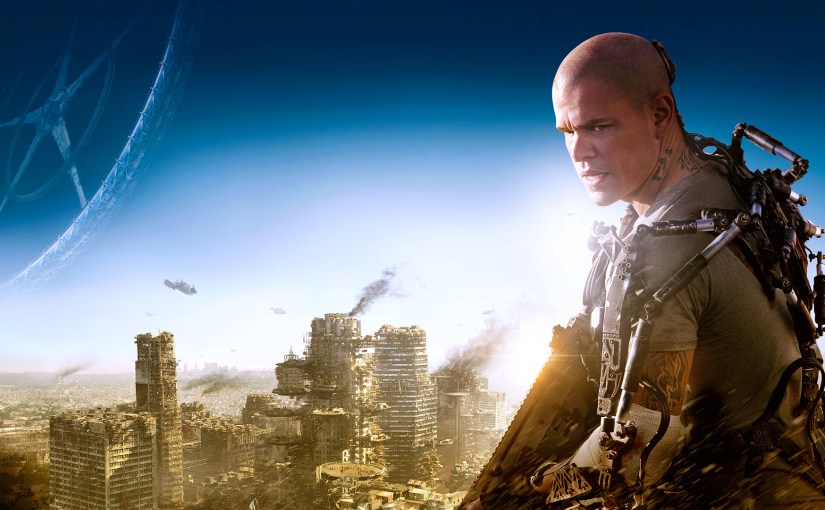
Elysium boasts some spectacular visual effects ranging from all of the robotics that work against Max and his rebel comrades to the ships that travel across the skies of a dirty Los Angeles and up into the reaches of space.  The space station is shaped like a hexagonal satellite and filled with stunning upper-class decor.  It’s quite the country club for the one percent of one percenters with pools, tennis courts and well-manicured lawns.  Everything is colorfully lit while the daytimes of L.A. are distressed with dirty brown and grey hues.  Blomkamp demonstrates the wide expanse of class warfare with the two environments.  This film deserved Oscar recognition for art direction and special effects.  Outstanding work.

As Damon was still in his Jason Bourne phase, he looks everything of the suffering muscled, action hero, complete with a kind of steel frame screwed into his chest, back and head to keep him upright and ready to run and fight.  Damon, accompanied by Blomkamp’s designs look like a spawn of a Phillip K Dick story.  You can easily group Elysium with Blade RunnerTotal Recall and Minority Report.  Though Elysium released five years later, it operates like a pre-cursor to Wall-E with stacks and stacks of high-rise garbage on Earth, while the elite live happily in the heavens.

Still, the set ups never feel entirely complete.  Something always felt like it was missing.

I think Blomkamp’s outline extends more validity to its fiction thirteen years after its release.  It’s not overtly stated but there’s no denying that the heroes are battling against an anti-immigration regime, lacking feeling for those that do not measure up to the wealthy and upper class.  I believe I appreciate Elysium a lot more now, than had I seen it back in 2013. 

Call me woke if you want!  It’s such a stupid, invented moniker to argue against compassion, anyway.

This film is lacking though.  Blomkamp could have offered more contrast between the two regions.  For the wealthy, there’s a very cold Jodie Foster who’s not lending much depth except to give the orders that identify her as the villain.  Delacourt debates with the President (Faran Tahir) of the station but I could not easily identify what they disagree on.  What’s he doing here and what exactly is on his mind?

Sharlto Kopley’s character looks like another Mad Max spawn with a very hard to understand dialect and a barbaric exterior.  Not exactly a villain I love to hate.  I gave up trying to comprehend anything he was saying and only regarded him as the guy that Matt Damon had to outrun, and out-punch if he’s ever to reach his destination.  

Alice Braga is Frey, the adult version of Max’ childhood friend.  As an ER nurse, she has her own reasons to get Max on Elysium.  Her daughter is stricken with leukemia.  She’s a side story and Blomkamp’s film could have just focused on Damon’s peril to run like in The Fugitive.  It’s rare I see Frey helping Max’ plight.  Braga’s stay is over welcomed with a lot of cutting room floor material.

Elysium has good action and outstanding special effects that build a convincing future year of 2154. It’s not a perfect thriller, but its themes are clearly relevant to the concerns of most Americans and illegal immigrants.  

Are our governing bodies, taking into account all manners of people and social classes, or are they functioning with a harsh and violently forceful approach?  Add another half hour to this movie, and excise some irrelevant characters in the cast, and this likely would have shown a clearer, more precise grim future of a year 2154 that looks a lot like real life modern day social structure.
IRON MAN

By Marc S. Sanders

It’s fair to say in 2008, a new pop culture phenomenon occurred and that was the Marvel Cinematic Universe (MCU). The first of a collection of highly successful crossover films was Iron Man featuring a Robert Downey Jr that was offering little promise in box office and commitment following stints in prison for his personal drug addictions. Director Jon Favreau felt that Downey was right for the title role, also known as brilliant, genius, wealthy playboy Tony Stark. Favreau’s confidence, as it turned out, was right all along.

Iron Man is an origin film. Tony Stark is a man with everything, but because of a lack of surviving family following the deaths of his parents, really, he sadly has nothing.

After being captured by Afghan terrorists, Stark, the world famous weapons manufacturer, has an epiphany and opts to take his billion dollar company in a new direction by halting production on all weaponry. Stark’s partner, Obadiah Stane played by Jeff Bridges, tries to contain Stark’s new campaign, and in turn becomes an adversary to contend with.

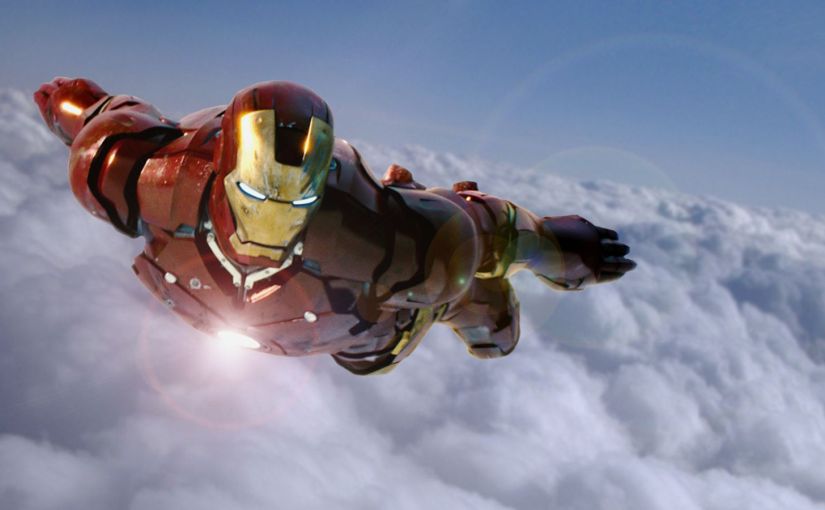
This is a summary of a great story, and even better, I have yet to discuss the main attractions of the film, the Iron Man suits. Sci fi and adventure movies work best when the highlighted visuals are not the story, but rather what accompanies the narrative. Iron Man is not so much about the suit. Moreover, it’s about the guy who built and wears the suit.

Downey is perfect in the role. Sure, his sarcasm and impulse to perform off script can get a little tiresome, but Downey also stops to give Tony Stark some heart as he bashfully pines for Pepper Potts played by Gwyneth Paltrow as his adorable sidekick in business. Also, his maturity comes into focus following his will to undo what he’s wrought prior to his captivity. It’s a great character arc of dimension and change.

Jeff Bridges plays one of my favorite MCU villains. At least I think so, because I understand where Stane is coming from. He’s gotta answer to his stockholders. Stark and Stane are in the money business regardless of the products they market and manufacture. He’s not all about global domination. He’s a man of responsibility. Bridges went with the comic book iteration of Stane from the late ‘80s publications by going bald with a devilish goatee. His height and broad shoulders plus his age match well against Downey. Bridges’ stature is intimidating opposite Downey’s reckless lack of care and immaturity through the first half of the film. Stane puts an arm around your shoulder, and you know you’re in trouble. So, it works really well here. Jeff Bridges really ranks as one of MCU’s most overlooked gems, now over 10 years and over 20 films in.

Favreau depicts some all too real and scary moments of terrorism and violence. This is all a step above the fantasy actions later to be seen from the likes of other Marvel villains like Loki, Ultron or Thanos.

It’s sadly ironic. One terrorist kicking a local in the head is harder for me to watch than a godlike giant who eliminates half the world’s population. Still, Favreau takes advantage of Downey’s comic timing and playful chemistry with Paltrow as well. Plus, there’s Terrence Howard as the no nonsense army colonel and friend “Rhodey” Rhodes (played in later films by Don Cheadle). Had Favreau not found that balance of heavy and light, we might not have seen the longevity of this continuing franchise.

The action scenes work well too. The Iron Man and Iron Monger (Stane’s costume) engage in a well edited and choreographed fight scene in the streets and evening skies of Malibu. Stark is plagued with weaknesses to add some “yikes” moments as he faces off against the hulk size Monger with Stane in control. These scenes are not blurry. It’s really what the action scenes of the Transformers films needed.

“Iron Man” foreshadowed a lot of fun material we were meant to see in later films. Blink and you’ll miss a certain patriot’s shield and stay for the first of many legendary end credits scenes that introduces an important character, leading to an eventual hit television series as well as becomes instrumental for all of these fun crossover moments.

Iron Man is an important film in cinematic history. It blazed a trail in big box office that’s given audiences lots of escape. The success of this franchise has attempted to be matched, but no other franchise has yet to come close. Sorry Star Wars and DC Comic films.

For now, the Marvel Cinematic Universe is as bulletproof as the Iron Man.

NOTE: Stan Lee cameo salute….Was that the real Hugh Hefner?!?!?!?

STAR TREK (2009)

By Marc S. Sanders

Well Batman did it, and James Bond did it.  So why can’t Star Trek do it too? 

JJ Abrams adopted another franchise to direct when he rebooted the outer space western originally conceived by Gene Rodenberry over 50 years ago.  He did well with it too, if you are willing to dismiss the final polish to the look of the picture that Abrams couldn’t resist.  Not so much a polish as it is a tarnish, unfortunately.

I was late to the party of realizing that Abrams has a terrible habit of using “lens flares” on many of his films.  Now that I’m attuned, I can’t help but notice.  I typically get quite entertained by his pictures.  Mission: Impossible III is still the best of the series as far I’m concerned.  The Force Awakens thankfully carried the original trilogy tradition of the Star Wars franchise.  His one original film that he directed, Super 8, is criminally underrated.  However, those films were spared the over saturated and very unwelcome lens flare that dominates his first Star Trek film.  The film opens with an outstanding special effects battle as a Federation starship is being overwon by a Romulan war ship.  The sets of the bridge and decks of the ship are slanted to emote chaos.  There are sparks of fire falling all over the place.  Crew members are being sucked into space, and falling over each other.  And there’s lens flares aplenty which are not so distracting within all the hysteria depicted.  The scene climaxes with the birth of one of the two most celebrated franchise characters, James T Kirk.  It’s a spectacular opening sequence that seems to uphold the traditions of Star Trek while feeling fresh with outstanding visual effects.

Afterwards, the visual effects stay on course with the updated technology that Hollywood now relies upon.  Nothing here looks CGI.  It all feels tangible, hot, and operationally functional.  Abrams accomplished a great looking science fiction film, but then he and his cinematographer spray painted a graffiti of light streaks that never end.  Crew members will be walking down a hallway – there’s a lens flare.  A character gets abandoned on a deserted snow planet – there are more lens flares.  A bar fight occurs, only to be blinded by lens flares.  Every time a guy throws a punch, it’s literally followed with a lens flare.  A hearing in an assembly room takes place.  Why do we need streaks of light in here of all places?  If I were on vacation and taking in the sights of the Golden Gate Bridge in San Francisco within this future, my pictures would be terrible.  Apparently, lens flares have taken over the state of California.  (I guess I should be thankful knowing the state did not in fact eventually sink to the bottom of the ocean.)

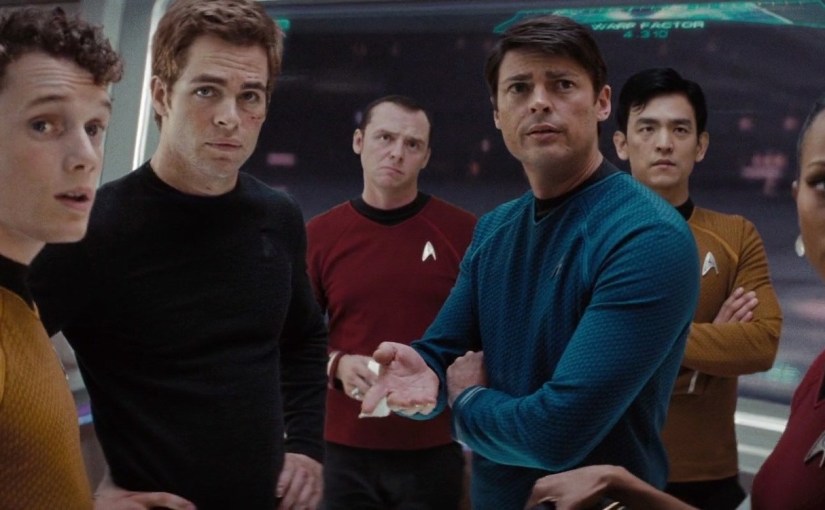
The rebooted story line is fine, yet simple.  A Romulan terrorist named Nero (Eric Bana) from a further distant future is obsessed with exacting revenge on Spock.  Next to that plot, this film serves more as opportunity for production company Paramount Pictures to reintroduce the beloved seven main characters of the original series of television and films with new actors.  Chris Pine is one of the best casting selections.  His Captain Kirk is his own performance and yet when he finally sits in that captain’s chair on the bridge, I could recognize the stature and expressions of William Shatner.  He gives a nice salute to the character and the original actor who played him.  Zachary Quinto is also good as Spock, though this character is distant cry from the original Leonard Nimoy portrayal.  I found it interesting.  This Spock has greater challenges with emotions harbored in the human side of his brain.  Karl Urban is fantastic at taking over the reigns of DeForrest Kelley as “Bones” McCoy, the Enterprise’s eventual resident doctor.  Urban is given the opportunity to be hilariously cynical upon his entrance into the film.

While the visual effects and sets are at the top of their game with Abrams and crew sparing no expense, it is a little eye opening to see the sexuality of the characters take a step forward.  Abrams is not shy about showing Zoe Saldana as Uhura disrobe into her under garments with Kirk standing on the other side of the bedroom.  I’m not offended or prudish about this material but was it really necessary to go with the Porky’s angle?  It doesn’t have to be a requirement to take some of the most beautiful actors in the world and get them to strip to uphold a film.  Star Trek always had much more to offer than that.  Scenes like this come off like a cheap shot.  Pine and Saldana are better actors, worthy of favored franchise fare (DC and Marvel films) than just material like this. 

There are some surprises in this reboot for both the casual and obsessed fans.  It’s kind of welcome actually as it takes the familiar universe of Roddenberry’s conception and turns it on its head.  Certain well known locations and characters arrive at unexpected fates.  Though, unfortunately, the alternate timeline motif pushes its way through the middle of the picture.  I fear for these kinds of stories.  All they do, time and again, is open up unanswered and (forgive me for the pun) illogical answers.  Marvel and DC films are on their way to doing this with their upcoming films following the year 2021 and I can see the whole thing unraveling at the seams.  Was it necessary here, though?  I really didn’t think so.  Abrams had an opportunity to win back an appearance of an actor from the original series and it seemed forced into the film like a square trying to fit into a circle.  The older installments had their moment in the sun.  Let that go.  Focus on this new cast and this new vision.

Again, this Star Trek is a gorgeous looking film full of color and clean looking set designs all around.  The bridge of the Enterprise is something that I’d love to see in person.  The cast is actually quite perfect filling the shoes of their respective roles.  However, JJ Abrams tried too hard I think with a couple of plot developments, and an extremely distracting and very unwelcome LENS FLARE.  I KNOW I’M REPEATING MYSELF.  YET I’M NOT BEING ANY MORE REDUNDANT THAN ABRAMS WAS WITH THE STUPID BLINDING PIECE OF LIGHT. 

Maybe the next time I watch this picture, I’ll wear my sunglasses.