
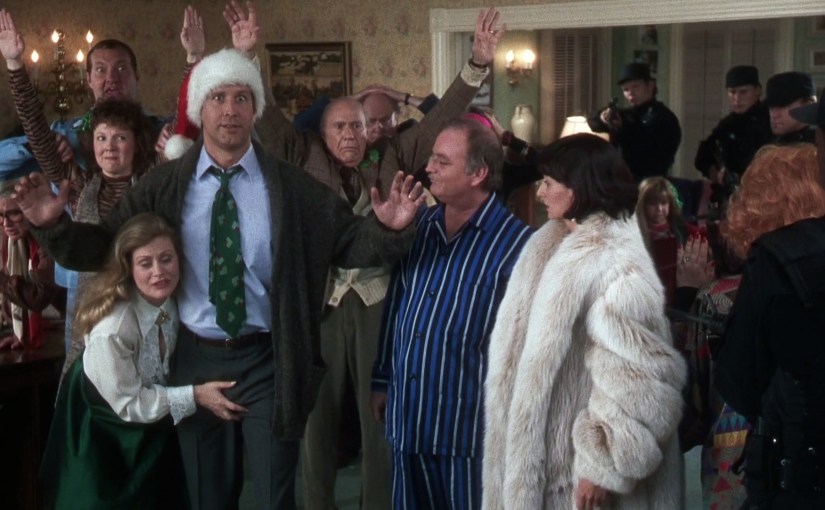
NATIONAL LAMPOON’S CHRISTMAS VACATION

By Marc S. Sanders

Not until December 25, 2021, had I seen National Lampoon’s Christmas Vacation.  Friends and colleagues couldn’t believe it, the same way they can’t believe I’ve never eaten a cheeseburger.  I’m not a big Chevy Chase fan.  I think the one film I like of his, because of him, is Neil Simon’s Seems Like Old Times.  The guy is just not a draw for me.  My fellow Cinephiles (Thomas Pahl, Miguel Rodriguez and Anthony Jason) introduced me to Fletch earlier this year.  Wow, did that movie start with a really interesting premise that just stumbled like 2,000-pound stone slowly sinking to the bottom of a very deep and empty sand trap.  The film didn’t work because of Chevy Chase.  Once it got past its exposition, Fletch relied too heavily on boring and unfunny schtick from a very unfunny Chevy Chase.  I was waiting for Christmas Vacation to fall into that same trap.  For a fraction of the film, thankfully, it didn’t.

By and large, what works with Christmas Vacation is because of its writer John Hughes, who writes with the consistency of humor that worked in Ferris Bueller’s Day Off and especially Planes, Trains and Automobiles.  The slapstick is most apparent here, then in other Hughes film released before.  (Home Alone would win that record title a year later, of course.)  As I said, Christmas Vacation relies entirely on the slapstick element.  There is no sensitive allowance for warm hugs or coming of age realizations and character arcs.  Clark Griswold gets in one predicament after another.  Like a mediocre Three Stooges short, some of those predicaments work.

Pun intended, the biggest highlight is when Clark decorates his Chicago suburb home with an infinite number of lights, eventually disrupting the next-door neighbors intimate candlelit dinner and blinding them into pratfalls.  The timing is pure John Hughes craftsmanship; John Hughes…not Chevy Chase

Stupid set ups include Clark getting trapped in the attic, unbeknownst to the rest of the family, as well as him hanging from the outside gutters and losing control of a tall ladder.  What works in these moments are what worked for the humor in Ferris Bueller with the school principal character, or Steve Martin’s character in Planes, Trains… .  Clark tries to come up with a way to get out and tip toe across the floor beams of the attic, trying to avoid a haphazard accident in the process.  The floors creak.  The items he finds in the attic squeak and grind.  When he’s hanging from the gutter, the rusty piece of metal is gradually giving way as he holds on for dear life.  I appreciated the prop humor.  The victim might be Chevy Chase, but that could’ve been anybody.  I guess sometimes, the pie is funnier than the one who gets it in the face.  So, there are moments that work.  I like the beginning as well where the dumb patriarch takes his family out to the forest to literally cut down a tree and then carries his optimism that he can actually fit it in the living room.  Moe, Larry and Curly had this kind of positivity when they convinced the Hoi Polloi that they could repair a plumbing problem in a mansion.

Much doesn’t work here either, though.  An overabundance of relatives show up to celebrate the holiday.  The set up is the same as in Hughes’ first film, Sixteen Candles.  However, in that film, each grandparent was given a moment to stand out among the masses.  Christmas Vacation doesn’t capitalize on that so much despite great talent that features Diane Ladd, Doris Roberts and EG Marshall.  No relative is a given a personality or unique and humorous annoyance.

The most remembered relative is Randy Quaid’s Cousin Eddie, but honestly, I found nothing funny about the guy and I thought he only served for irritated facial expressions to capture Chevy Chase in close up.  I know.  I know.  Before seeing this film, I was well aware of the “Shitter’s full” routine.  Okay.  Okay. Shit, poop, doodie, whatever you want to call it is funny.  Shit is God’s endless joke on the living beings he/she/they created.  A two word sentence of dialogue while draining a hose full of shit does not a movie make, though.  Otherwise, there is nothing marvelous about Randy Quaid in this film or the other relative extras that appear.  Clark’s (third time recast) kids could have also been funny but the script doesn’t let them.  There was just no material for these people on the page.  We know how pitch perfect actors like Juliette Lewis and Johnny Galecki have become over their careers.  I’d argue they are funnier and more talented actors than Chevy Chase ever was, but like the other supporting players the script didn’t consider the talent.  Beverly D’Angelo is back as Clark’s wife too.  Moving on…

I could have had regretted watching this film.  I finally, finally, FINALLY gave in per the insistence of practically everyone I know, on a whim, when I saw it available on HBO Max.  I don’t regret watching it.  Truly I don’t.  Yet, I don’t feel better having done so either.  Christmas Vacation is not an all-time great comedy or holiday film.  I don’t believe it did anything for anyone’s career.  Notice I didn’t mention the director’s name, because it doesn’t matter and I haven’t heard from that guy since this picture.

The film is just there, I guess, and as each passing December comes and goes, it is awarded new life…. unlike the electrocuted, exploding cat that perishes under a love seat.  Now that’s funny! Thankfully, this precious feline gave up his lives for a chuckle from me.  Had it been Chevy Chase though, then this review might have gone in another direction.
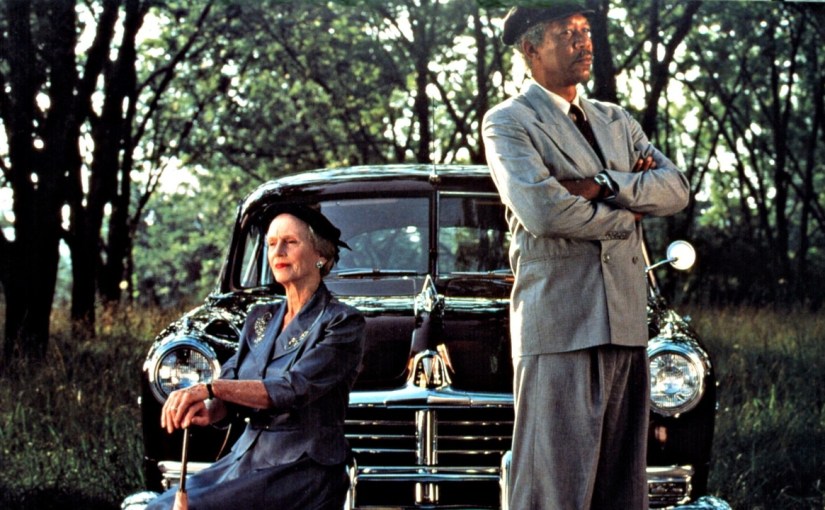
DRIVING MISS DAISY

By Marc S. Sanders

Mainstream films released by big studios suffer from a major problem these days.  Too often, they don’t allow their characters to breathe.  Films today rush to the climax or the action or the cliffhanger that’ll whet our appetites for a sequel or a crossover or a toy product.  Bruce Beresford’s Driving Miss Daisy escaped all of those conventions.  In fact, I’d argue that Beresford made a buddy picture with his Best Picture Winner based upon Alfred Uhry’s well received play.

Daisy Werthan (Jessica Tandy, who won the Oscar, and held the record for oldest recipient) is an insistently independent old southern Jewish woman living in Georgia.  She drives her car where she wants to and whenever she wants to go somewhere.  However, following an accident in her driveway, her son Boolie (Dan Aykroyd in a very surprisingly good performance) breaks the hard truth to Daisy that her driving days are over since it’s likely no insurance company will ever affordably cover her.  Boolie recruits Hoke Colburn (Morgan Freeman in one of the most gentle and delicate performances of his amazing career) to chauffer the proud woman around her Georgia neighborhood.  Naturally, Daisy does not take well to Hoke at first.

The film begins in the 1950’s and then spans roughly 20 years from that point.  I love how Beresford presents the passage of time.  The cars that Hoke carries Daisy in change as the years go by.  As a new car is shown parked in Daisy’s garage, the relationship and eventual friendship of Hoke and Daisy become stronger and, on some occasions, franker and more honest.  With Hans Zimmer’s energetic score that seems to accelerate the speed of the automobiles Hoke drives, Driving Miss Daisy feels like a very sweet and tender film.  It is.  Moreover, it’s an alive picture.  However, the film does not ignore the prejudiced mentality that’s embedded within the south.  A telling moment occurs when Hoke is driving Daisy to a family gathering in Alabama.  Why would an elderly black man with an elderly Jewish woman sitting in the back seat be met with such disdain by policemen who question their presence while eating lunch on the side of the rode?  I won’t repeat the officer’s comment here, but it is ugly and a sad reflection of how things were.  Are things still that way?

Uhry’s script adaptation from his play does not stop there though.  He questions Daisy’s own stance.  She takes no issue with black people catering to her and her home on regular basis, and she becomes enamored with Martin Luther King’s inspiring wisdom.  So, when she is given the opportunity to see Dr. King speak in person, it only makes sense that Hoke will question why he was invited last minute to join her.  After so many years of servitude, why did Daisy wait until Hoke literally drove up to the location of the speech to invite him in?  I’d argue that it never occurred to Daisy, and I think Alfred Uhry believed that is part of the problem.

Both Daisy and Hoke experience anti-Semitism and racism in the mid twentieth century south.  Ironically, the film demonstrates that common victimization is one reason why they need one another.  I’m thankful that Beresford does not show a burning synagogue for dramatic effect.  Instead, he relies on Uhry’s dialogue as Hoke breaks the news to Daisy when they are on their way for morning Shabbat services.  How does Daisy feel in this circumstance?  The synagogue can be rebuilt.  The horror of knowing this kind of hate exists will never be erased.  That’s the terrible shock.  As well to empathize, Hoke describes how as a child he saw his uncle get lynched and hung from a tree.  Daisy and Hoke unite in the hate that surrounds them.

The performances of Freeman, Tandy and Aykroyd are exquisite.  Their dialect for each of their respective characters rings so true of the Georgian southern regions they stem from.  Freeman has an enunciation that rings of a black man who never learned to read.  He even develops a laugh that seamlessly works into his dialogue and reaction to Daisy’s stubbornness.  His posture is marvelous as an elderly gentleman who will walk slowly while hunched over.  It just looks so natural. Aykroyd is in no way doing one of his comedy characters.  He carries the gut of a well-fed southern man who’s become successful with his family business while not taking every fit that his mother has so seriously.  If any of us have had to tend to an elderly relative, then we can certainly relate to Boolie’s position.  Tandy is wonderful at method acting; it should be studied in performance art classes.  She was an elderly woman already when cast in the role.  Yet, as the years carry on through the story, she changes her gait to how this woman’s bones might become more brittle, or how she might speak slower or smile or frown or chew her food.  She has such a fire in every one of her scenes.  A heartbreaking scene where she appears to be having a frantic form of dementia is very eye opening as she paces her historic two-story home looking for papers she graded years earlier as a teacher.  The younger Freeman (playing a far older man) has to keep up with Tandy in this moment; even Beresford’s steady cam has to move quickly to keep focus.

Recently, I had reviewed Terms Of Endearment, and I alluded to the fact that not enough films about middle age people are focused upon, or at least given the commercial attention that they should be given.  Why is that?  So many middle age and elderly characters are so interesting.  I said it before.  Look at The Golden Girls sitcom.  After all, characters with more years behind them have had more moments to live and breathe. Actually, they have a longer history with more nuances and meaningful events they have already encountered, as opposed to twenty somethings with hot cars, pecs and guns.  Film studios are missing out on a wealth of great storytelling. 

Driving Miss Daisy is well paced story of friendship and fear, and often natural comedic material within its three lead roles.  It’s never boring.  It’s only more and more interesting as the years of the story pass by.  It’s simply an endearing buddy picture of the finest quality.