THE MAGIC FLUTE (Sweden, 1975)

by Miguel E. Rodriguez

DIRECTOR: Ingmar Bergman
CAST: Josef Köstlinger, Irma Urrila, Håkan Hagegård, Birgit Nordin
MY RATING: 8/10
ROTTEN TOMATOMETER: 91% Fresh

PLOT: Valiant prince Tamino and his zestful sidekick Papageno are recruited by the Queen of the Night to save her daughter from the clutches of evil.


Here lies the noble, magical illusion of the theater.  Nothing is; everything represents. – Ingmar Bergman

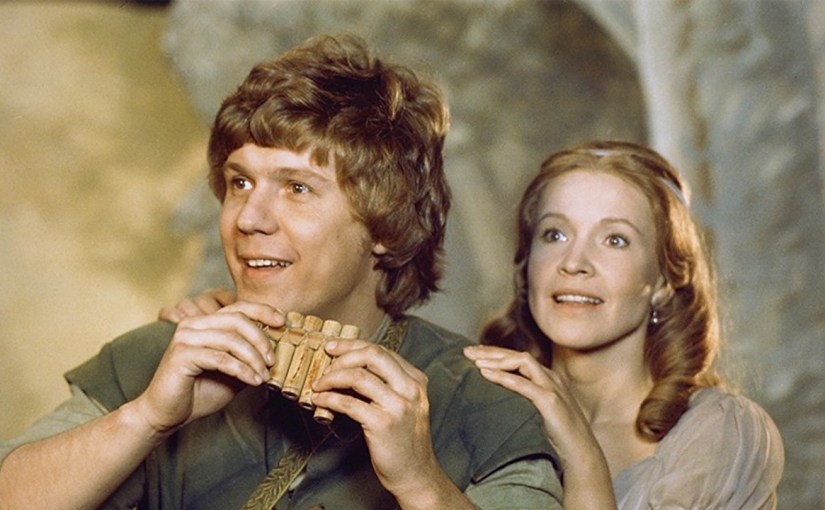
Ingmar Bergman’s whimsical staging of Mozart’s opera The Magic Flute is a movie made by a theater fan, for theater fans…and to a certain degree, it’s about theater fans.  I use the word “staging” instead of “film of” because, throughout the movie, Bergman never once lets us forget that we’re watching a staged production.  The opera’s overture plays over shots of the audience members, and at intermission we watch actors passing the time by playing chess or smoking where they shouldn’t be.  Once or twice, we see the hands of the stage crew as they move from one “cue card” to the next.  Fishing wire is clearly visible when objects “float.”  But the very artificiality of the production is what makes it so charming.  It celebrates artifice and scorns reality.  It wouldn’t surprise me if this were one of the favorite films of Tim Burton or Terry Gilliam.

Since my only previous knowledge of the story of The Magic Flute comes from a precious few scenes in the film Amadeus (1984), here’s a brief summary for anyone else who knows as much about opera as I do.  The brave, handsome prince Tamino and his enthusiastic sidekick Papageno are recruited by the Queen of the Night to rescue her beautiful daughter, Pamina, from the clutches of the evil Sarastro.  Before the opera is over, there will be revelations, separations, reunions, laughter, tears, semi-divine intervention, and even an operatic strip-tease.  There are monsters, woodland creatures, villains, three angelic young boys in a hot air balloon, and, of course, a magic flute.  And it’s all portrayed as it might be seen if we were watching it on a real stage in a real theater, with some obvious cinematic licenses taken with time and space.

I’m gonna be brutally honest: having never seen an opera, I had moderate-to-low expectations of how much I would enjoy it, even if the music is by my second-favorite classical composer of all time.  (Beethoven is the king, and that is that.)  But Bergman’s film sidestepped my expectations by not trying to present anything in a realistic way, or by simply staging a live production and just filming it from multiple cameras.  By keeping everything clearly artificial, clearly staged, and occasionally using clever movie tricks, The Magic Flute held my attention, making me curious about what other tricks Bergman might have up his sleeve.

For example, he’ll start a scene with a wide shot, showing the entire stage with the flats and fake backdrops, then cut to a medium shot, making us think we’re in the space we just were, then panning over to reveal a completely separate set that was invisible before.  But because it’s been established that we’re in the realm of theater, this kind of spatial paradox isn’t jarring, it’s almost expected.  You can get away with certain things in theater, especially opera, especially in a fantasy, that would never fly in a regular movie.  In The Magic Flute, a person’s face can be completely made over with a simple edit.  A picture in a locket can come to life.  A journey through a fantastic hellscape can be suggested by clever editing and careful camera placement.

But what if you simply don’t like opera?  Is The Magic Flute enough to convert you?  I mean…maybe?  If you’re a fan of the films of Terry Gilliam, particularly Brazil (1985) and The Adventures of Baron Munchausen (1988), then this movie is going to be right up your alley.  They share the same visual strategies and production design sensibilities.  Even if you believe you don’t like opera, The Magic Flute could still win you over for at least this one movie, simply because it’s such fun to look at.

Looking back over what I’ve written so far, I don’t believe I’ve accurately conveyed how the deliberate “fakeness” of the film enhances its effectiveness.  Live theater has the ability to get audiences to suspend their disbelief in a way that film cannot always achieve.  I’ve seen community theater productions where, for example, the walls of a café are supposed to “fly” off the stage revealing a night sky, and the effect was accomplished by simple lighting tricks.  A clubhouse foyer can be magically transformed into a golf course with a green carpet and some more selective lighting.  In live theater, the audience is constantly aware that it’s fake, but when they’re in the grip of a good story, their mind fills in the blanks.  That’s the effect Bergman is going for in The Magic Flute, and it works.

So, in the end, what you have here is a love letter to the stage, to opera, to Mozart, to fantasy.  Throughout the film, Bergman will cut to the face of young girl, an audience member, who watches with rapt attention and an almost Mona Lisa-esque smile.  Not only is he reminding us, the viewer, that this is a staged production, but maybe he’s also sending a reminder to filmmakers to never forget that, for a movie or play or opera to work, you have to remember who you’re making it for: the paying audience.  Speaking as an occasional audience member myself, I know that, when I buy a ticket, I want to be taken out of myself.  I want to believe that a man can fly, or that a wooden puppet can come to life, or that a valiant prince can overcome three tasks to win the heart of his beloved.  The Magic Flute is a tribute to the magic-makers and the storytellers, to the genius of Mozart, and to the people out there in the dark who make it all possible.

NIGHTBITCH (2024)

by Miguel E. Rodriguez

DIRECTOR: Marielle Heller
CAST: Amy Adams, Scoot McNairy, Jessica Harper
MY RATING: 7/10
ROTTEN TOMATOMETER: 59%

PLOT: A woman pauses her career as an artist to be a stay-at-home mom, but her domesticity takes a surreal turn.


[SPOILER ALERT…if you plan on seeing Nightbitch, avoid this review.  This movie, like most movies, works best on the viewer if they have no idea what’s happening or what’s about to happen.  Consider yourself Spoiler-warned.]

Nightbitch shoots out of the starting gate like a thoroughbred – or a greyhound, if you will – but about halfway through, it runs out of narrative steam.  I felt like a gambler watching a horse race, watching my horse lead the pack around the first turn, already spending the winnings in my head, and then my horse fades a bit, then a bit more, and by the time we get to the finish line, I’m tearing up my ticket in frustration.  I needed a WIN, not a PLACE.  There goes my trifecta.

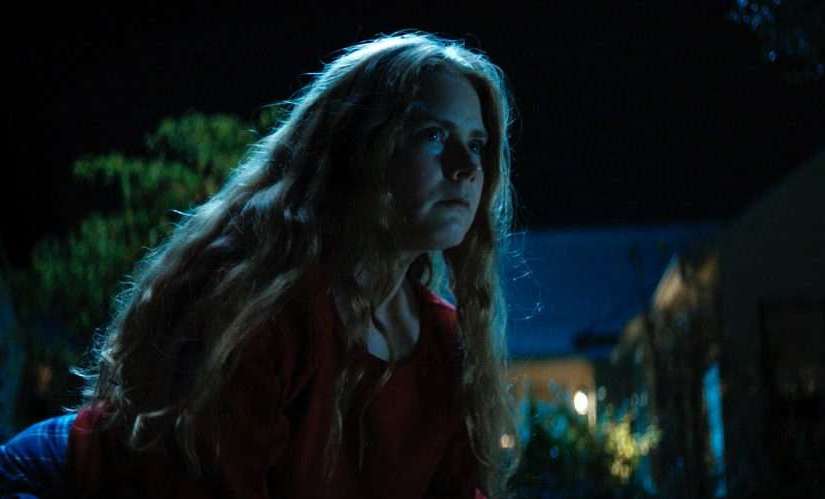
Amy Adams plays an unnamed Mother who has put her promising career as an artist on pause to be a stay-at-home mom while her also-unnamed Husband (Scoot McNairy) pursues his career as a…um…well, whatever it is, he has to travel a lot, leaving Mother at home with, you guessed it, Son (played by adorable twins Arleigh and Emmett Snowden).  Referred to throughout the movie as “my guy” and “sport” and “little buddy,” Son is a typical toddler in the throes of the terrible twos: cute for long stretches, maddeningly frustrating for longer stretches.  [Ed. Note: the author is not a father, has no plans on becoming a father, and will never possess the immense dedication it takes to rear a child, so don’t expect him to embrace the chaos of toddler-hood because it ain’t gonna happen.]

Mother is going through an identity crisis, set up in a brilliant opening scene where Sally, the woman who assumed Mother’s job at an art gallery, asks her, “Do you just love getting to be home with him [Son] all the time?”  Mother answers the question with a little more honesty than Sally or anyone had a right to expect, including this tidbit: “I am deeply afraid that I am never going to be smart, or happy, or thin ever again.”  I am a straight Hispanic cisgender male, so I’m here to tell you, I will never understand that mindset, but I am reasonably certain there are untold millions of moms out there who, if they listened to Mother’s opening statement, would say, “AMEN, sister.”

A little later, Mother delivers an internal monologue where she reflects that, as a mother, you can squeeze someone into the world “who will one day pee in your face without blinking.”  Again, I’m not a parent, but I know that’s truth in cinema right there.

After a few more establishing scenes of Mother interacting with Son, who absolutely REFUSES to go to sleep at night or eat anything for breakfast except, apparently, hash brown patties fried in butter, some odd things start to happen.  At the playground, some stray (?) dogs approach her as if she’s their best friend.  Mother notices her sense of smell has become much more acute.  Son helpfully points out that her back is hairy.  And, in a creepy Cronenberg-y moment, she notices a lump growing at the base of her spine just above her rump.  Curiosity gets the best of her.  She heats a needle, lances the lump, and…well, if you remember the title of the film, you have an idea of what pops out of that lump.

This was all wonderfully thrilling stuff as a movie lover.  I’m thinking, “My god, this is a Spike Jonze movie told from a woman’s perspective!  I’ve never seen anything like this!  This is gonna be GREAT!”  Mother starts to enjoy eating a lot of meat.  She starts to play “doggie” with Son, growling and barking at each other like two puppies.  The two of them eat their lunch at a deli with no silverware…or hands, to the consternation of other diners.  Son doesn’t sleep at night, so Mother, in a genius parenting move, buys a dog bed and gets Son to play “doggie” and sleep in the dog bed at night.  Presto, problem solved!

And more and more dogs start showing up at her door, at night, sometimes bringing gifts: small dead animals.  One night she walks outside, starts digging around, and an astonishing transformation takes place…

I know, I know, SPOILERS, I get it.  But it’s important to get across just how brilliantly original the first act of the film is, because the second act is, alas, all downhill.  I am not saying that the film’s message is unimportant, not at all.  I admire the film because of its message, and because it was being delivered in such an original way.  But then we get into conflict with Husband, who is desperately trying to understand why their 2-year-old is now sleeping in a dog bed on the floor, or why their cat suddenly turned up dead on the front porch, or why his wife suddenly wants a separation.  It must be said, Nightbitch is remarkably even-handed with the Husband’s dialogue.  He is not reduced to a 2-dimensional sitcom husband.  When she lays into him for not supporting her career, he fires back with a well-reasoned argument.  Their dialogue could be turned into a first-rate play.

But instead of exploring the surreal nature of Mother’s new condition, the movie settles into soap-opera territory, with only the occasional nod to the mystical incidents in the first act.  I distinctly remember, in the middle of the second act, feeling as if a balloon had deflated in the plot.  I imagine defenders of the film might say, “Well, the second act is where the weird stuff has to take a back seat to deal with the real issues at hand.”  Okay, maybe that’s true from a real-world perspective, but to me, it felt as if the filmmakers were on the verge of showing us something mindboggling, then backed away from the precipice at the last minute.

Does that make me guilty of critiquing a movie for what I wanted as opposed to what I got?  I guess it does, as much as I dislike that tendency in myself.  I feel there are so many different ways the movie could have gone in act two, could have leapt gleefully over the edge of convention and truly broken the mold with this movie.  When it became clear what they were doing instead, my elation evaporated.

I give Nightbitch a generally favorable score, though, based on the mad inventiveness of the first act and the plot in broad strokes, and also on the incredibly brave performance from Amy Adams, who maybe has two scenes in the entire film where she seems to be wearing any makeup.  She also appears to have to put on some weight for the role, which is not something I can ever recall seeing a female actor do.  Male actors have turned that kind of thing into a cottage industry, but when was the last time you saw a woman do it?  That took guts.  Watch Nightbitch for Amy Adams’ performance and for the story, even if the movie doesn’t follow its own plot to a satisfying conclusion.

RED ONE

By Marc S. Sanders

Santa Claus has been kidnapped.  It’s up to Dwayne Johnson and Chris Evans to rescue him before Lucy Liu has to explain to all the Presidents and Prime Ministers across the world that there might not be a Christmas.  It’s one thing to read this as pertinent information.  It’s another to say it out loud with a straight face.  I’m now convinced that Lucy Liu is the most amazing actress of all time.  Not a curve, not a wrinkle, not a twitch in her stoic expression. Still, I believe Christmas is going to happen.

Yes, ol’ St. Nick (J.K. Simmons) has been captured.  His bodyguard is Cal (Dwayne Johnson), also head of security at the North Pole.  He is determined to get the bearded man in red back before Christmas Eve, and he partners up with a petty computer hacker mastermind, lacking any Christmas spirit, named Jack (Chris Evans).  The guys will argue with each other before they connect as buddies. You know how this works.  They’ll follow the leads to find out who and why “Red One” was taken. 

Red One works as a fun action picture with pretty cool and imaginative visuals like I’d count on from director/writer Jake Kasdan, son of Lawrence.  As a Christmas movie though? It needs a lot more tinsel.  

J.K. Simmons is not a conventional fat man Santa with a jolly “Ho Ho Ho.”  This dude is a weightlifter and, well, he talks like the guy from Whiplash and those Spider-Man movies.  Pair him up with the bruising Dwayne Johnson and this Santa is the morose police captain who would sit behind a desk, handing out the next Lethal Weapon assignment.  

The director of security is played by Lucy Liu, dressed in a black starched pantsuit, stressing the urgency of the problem.  Like the rest of the cast, save Evans, she takes Christmas way serious and that’s where the problem lies with Red One.  It’s not gleeful or celebratory of the holiday.  When she warns us that Christmas may not come, how am I supposed to respond to such a dire consequence?  Should I be scared? Am I supposed to laugh or cry?  When Doc Brown told Marty McFly he may be erased from existence, well you know that was pretty heavy (and not as trivial as something wrong with the gravitational pull of the earth).  When Lucy Liu and The Rock talk about NO CHRISTMAS of all things, I gotta wonder if I’ll get my annual Chinese dinner with my Jewish family.  Red One feels like a cliffhanger episode of NCIS.  Even Die Hard was more in line with the Christmas spirit than this flick.  John McClane declared his “Ho Ho Ho!” when he got a machine gun.  No one in this movie seems to have a sense of humor.  Chris Evans cracks some one-liners as if he’s shying away from the hokey script that everyone else embraces like a Tom Clancy novel.  

What works in Red One is the visual imagery of a wicked Christmas witch and assorted trolls and monster mayhem, particularly from Krampus (Santa’s gholish beast of a brother played by Kristofer Hivju) who gives a hilarious beatdown on The Rock.  There’s also a cute way to disarm some beastly polar bears who can encase our heroes in ice. The designs of the North Pole look cool as an industrial military base specializing in toy manufacturing.  However, we could have seen some cool gadgetry with this factory.  Instead, there’s a lot of underground mazes to circumvent that we barely get a look at amid the fast pace of the action scenes.

Cal is gifted with a power wristlet that packs a punch, shrinks him down for fighting advantages and has the ability to turn Hot Wheels cars into life size Chevrolet products for quick travel.  Naturally, Cal also knows that storage closets found in any toy store will transport you to another part of the world.  Nifty!  Not holiday spirited though.

The chases and fights work.  Johnson and Evans make for an okay buddy cop kind of pair.  The designs of the movie hold.  Yet, what’s missing is a spirit of Christmas magic.  Again, the holiday of Santa with his magical reindeer and cookies and stockings all feel hollow here.  Something is definitely missing because it’s hard for me to pinpoint who this film is catered for.  Families?  Red One comes off too nihilistic for that crowd ready to enjoy everyone’s comfort during winter break.  It’s too hokey just for the adults or the action movie lover.  A threat of Santa Claus missing with Christmas at risk also seems too overwhelming for the under 8 crowd.  

I got a kick at everything I saw on screen but there’s no one to connect with or empathize, and even for this Jewish guy, there’s an absence of Christmas tidings to behold from music to decor to the common recognizable tropes. Even when Santa poses as a shopping mall iteration, Simmons’ tough guy exterior doesn’t lend to any sort of joy or whimsy that comes with the holiday.

The sad irony is that Cal wants to retire because he sees more pessimism and materialistic selfishness in the adults these days.  Santa tries to convince Cal to reconsider as the spirit of the holiday will return.  If that’s true, then St Nick with a J. Jonah Jameson disposition does not offer much promise.  

These guys are rescuing Santa Claus like they are rescuing the President Of The United States, and frankly who the hell has liked any of the Presidents Of The United States of late?

RED ONE (2024)

by Miguel E. Rodriguez

DIRECTOR: Jake Kasdan
CAST: Dwayne Johnson, Chris Evans, Lucy Liu, J.K. Simmons
MY RATING: 8/10
ROTTEN TOMATOMETER: 30%

PLOT: After Santa Claus is kidnapped, the North Pole’s Head of Security must team up with a notorious hacker in a globe-trotting mission to (all together now) save Christmas.


Jake Kasdan’s Red One is by no means perfect, but it is not nearly as bad as the plethora of negative reviews would have you believe.  The Rotten Tomatoes website lists such jabs as:

  • “…forgettable as a first dusting of snow.”
  • “…offers big-budget visuals but lacks soul…”
  • And my favorite: “An ugly, under-lit, joyless slog, devoid of any holiday charm or sense of fun.”

Let me first address that “under-lit” comment.  I first attempted to watch this movie at our local AMC cineplex, and I noticed that the ads and previews were so dim that parts of the screen looked almost black.  I petitioned the manager to adjust the projector settings twice, but to no avail.  (“That projector has been giving us problems for two weeks.”)  When the movie started and it was just as dark as the previews, I gave it up as a lost cause, left and got a refund, and streamed it on Prime instead, and on our big-screen HD TV, presto, no more under-lit areas.  Everything was perfectly visible, clear, and bright.  So, it’s entirely possible that that reviewer’s issue with the screen being “under-lit” could have been a projector issue, and NOT a problem with the film itself.  Just wanted to throw that in there.

As far as those other negative comments go, well, I don’t know what kind of mindset those folks were in as they watched Red One, but it’s difficult for me to comprehend how anyone could call it “joyless.”  I found it charming and funny myself.  But then, when it comes to holiday movies, I have always been partial to the ones that attempt to provide logical solutions to the massive logistical problems involved in getting one man to travel the entire globe in a single night, delivering presents to every household that’s waiting for them.

For example, in The Polar Express, we are treated to a semi-industrial North Pole that runs like clockwork and (thanks to convenient time dilation) can get everything into Santa’s sleigh so he can dash away just before midnight. Red One ups that ante right from the get-go.

After he has taken a brief holiday in the city – masquerading as, of course, a mall Santa – the real Santa Claus, call sign “Red One” (J.K. Simmons), is driven to the nearest military airbase in an armored limo with a motorcade escort.  Accompanying him is his Chief of Security, Callum Drift (Dwayne Johnson)…because of course the real Santa would have a bodyguard.  It just makes sense.  Then, at the airbase, under blacked-out radar coverage, Santa’s state-of-the-art sleigh, powered by eight gigantic reindeer and carefully monitored by NORAD, takes off for the North Pole with a fighter jet escort.

I dunno, man, I just ate this stuff up with a spoon.  The imagination and attention to detail that went into creating this version of the Santa mythology brought a smile to my face for pretty much the entire movie.  Another example: I mentioned to my girlfriend that this version of Santa Claus is not very fat, which is usually a given.  But then there’s a scene where Santa lifts weights in a gym as Drift spots him, and I thought, okay, I can buy that.  Santa needed to drop a few pounds. It sounds absurd writing it out like that, but I’m telling you, for me it all made sense.

So, like I said, right away I was on board with the logistics of the story.  Then the real plot kicks in when Santa is kidnapped under everyone’s noses by a gang of bad guys who manage to infiltrate the North Pole’s highly sophisticated defensive measures.  The only way Drift and his colleagues will have a chance of retrieving Santa before Christmas Eve is with the help of Jack O’Malley (Chris Evans), a talented but amoral tech genius who claims he can track down anyone, anywhere, anytime.

There’s the usual backstory of Jack’s son who lives with his mother and her husband, and Jack was never father material to begin with, but the son is going to play in a concert on Christmas Eve, and so on.  I’m not saying this material is irrelevant, but for me it was secondary to my enjoyment of how the filmmakers were treating all the mythological/fantasy/sci-fi material.  We get talking polar bears [not the Golden Compass kind, the Zootopia kind], murderous snowmen who are seemingly invincible, tech gadgets that turn Matchbox cars into full-size vehicles [I want one!], a whole new use for Rock ‘Em Sock ‘Em Robots, and we even get to meet Santa’s brother.  Yep…his brother.

I mention all these details because they are what I responded to mostly during the film.  The plot?  The plot is, let’s face it, standard thriller fare, with a reasonably interesting big-bad and hidden connections and a few surprises, but because the filmmakers went to such great lengths to provide a fascinating backstory for all the mythological characters and how the North Pole is organized logistically, I didn’t particularly care if the story was perhaps shallow and mildly predictable to anyone who has seen more than 10 movies in their lives.  I’m not ashamed to admit it.

But because of how the filmmakers were telling the story this time around, I just ate it up.  Dwayne Johnson and Chris Evans are a decent screen pairing.  Bonnie Hunt as Mrs. Claus was a treat.  Lucy Liu was perhaps the most wasted of the entire cast, although she does get one very brief kicking-ass scene.  The motive behind Santa’s kidnapping was credible.  There was nothing in the movie that broke its own set of rules, which is more than I can say of quite a few would-be thrillers out there.

Heck, I’m just gonna say it: Red One is the Galaxy Quest of Christmas movies.  You either buy into the preposterous, but logically sound, premise and laugh for a while, or you don’t.  As for me, I’ll be watching this one again next Christmas.  Or maybe sooner.

SCROOGED

By Marc S. Sanders

Bill Murray with director Richard Donner delivered their contribution to the Charles Dickens assortment of A Christmas Carol iterations with a modern update called Scrooged.  Until now, this movie eluded me.  Yet I can’t deny it has all the ingredients for a sure-fire green light to make the movie.  Bill Murray? Doing Ebenezer Scrooge?  Stop everything people!  Get this ready for December.  STAT!

Unfortunately, it misses the mark.  

Now, I’m supposed to like this miser by the end of the story, right?  So then why is Murray’s personification so annoying and unappealing by the end? If I was his nephew, I’d rescind my invitation to come over for Christmas dinner.

The best and most hilarious part of Scrooged occurs in the beginning following the easily recognizable Danny Elfman instrumentals.  Santa and his elves are happily making toys when suddenly terrorists attack the North Pole and Lee Majors jumps out of nowhere ready to bear arms with ol’ St. Nick and his crew.  I was sad to realize this was only a TV commercial for the station programming that Murray’s character oversees.  If there is a God, he’ll reveal the location of the lost film for The Night The Reindeer Died.  Earlier this year I saw Lee Majors needlessly squandered away in the terrible Fall Guy adaptation.  It crushes me that he got this same kind of treatment over thirty years prior.

Bill Murray is the uncaring and thoughtless Frank Cross.  When we meet him on Christmas Eve day, he’s firing an executive (Bobcat Goldthwaite) for simply disagreeing with him.  Also, in typical overplayed Bill Murray fashion, Frank insists that his assistant Grace (Alfre Woodard) ignore the needs of her family during the holiday and get work done with him.  Grace of course filling in for the Bob Cratchit role.  

Following a few other gags to parade the comedian’s antics around, Frank is encountered with the Jacob Marley stand in, played by John Forsythe.  At this point I’m still with the picture even if the breadcrumbs are easy to follow.  Forsythe, in his grotesque makeup, works well against the clown who leads this movie.  (Not a bad scene together between Charlie and Bosley. “Hello Angels!”).

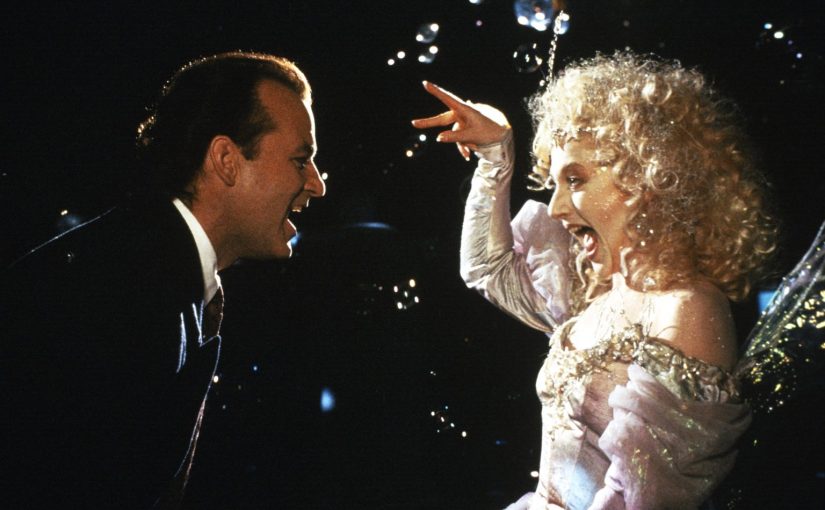
It’s when the follow up ghosts make appearances that my mind ponders what I’ll be writing about in this review.  Ghosts of Christmas Past (David Johansen) and Present (Carol Kane) enter on cue and right away I grew bored and uninterested.  

Johansen is a cabbie, or just another screeching screamer like Murray.  He’s laughing at Frank’s demise and past missed opportunities, but I’m not seeing what’s funny or even heartbreaking.  Neither theatrical mask of comedy or tragedy is functioning.  Carol Kane does her typical schtick with the high-pitched baby talk voice, dressed in a fairy get up.  Beyond that familiar routine, she commits every kind of Three Stooges smack and painful tug on Frank’s face that you can imagine.  Why of all things does she rely on a toaster to upper cut the jerk in his face?  I mean why a toaster???? If the comedy works, then I should not be wondering why a toaster or a pie or two by four or an anvil.

There’s nothing wisely written here.  The screaming and the smacking get old very fast and it gets in the way of a potential love story passed by that the script was promising for the Frank Cross character and his crush Claire (Karen Allen, whose smile always lights up a room).  I never felt like Bill Murray was ever listening to Karen Allen in the scenes they share.  Did they even rehearse this stuff?  Too often, Bill Murray seems to just be winging it, and it wouldn’t make a difference if Karen Allen even memorized her lines.

Scrooged starts out with fresh, quality made National Lampoon material but then waddles into the same typical chapters of Dickens’ holiday story.  However, while it hammers the familiar story beat by beat and you tell yourself there’s the Fred character and there’s the mute kid covering for a crippled Tiny Tim and there’s Yet To Come, you got Bill Murray who was granted too much artistic license to improvise, and has thus squeezed out all of the sensitivity and spirit that we expect from A Christmas Carol.

I’m sorry but I think I liked this Frank Cross a whole lot more before he was visited by the ghosts.  This is one Scrooge who should’ve been allowed to sleep through Christmas.

PS: If anyone can find a DVD print of The Night The Reindeer Died, I’m ready to review it.

WICKED PART ONE

By Marc S Sanders

The blessing of film is that it provides a channel to forms of entertainment that not everyone necessarily has access to.  I was never fascinated with the Tony Awards so much (even though I attended three live ceremonies) because the nominees were exclusive to what was performed in the last year on Broadway in New York City.  How can I or the rest of the country get enamored with the best of the best when we hardly have access to see any of the performances?  With movies, well you just go to the movies!

Wicked is one of the few musicals in the last twenty years that has taken on a worldwide fascination.  It was a very long novel before it became the touring stage production following a massive debut on Broadway. Perhaps because the story returns to a familiar setting, the fantastical land of Oz, the book and show carried a strong appeal.  Wicked arrived with an established brand.  Who doesn’t know The Wizard Of Oz?  Nevertheless, Wicked never needed magical ruby slippers (or rather silver as author L Frank Baum intended) to find its footing.  It’s always been worthy of its accolades apart from any other properties.  The new film, directed by John M Chu, will become a timeless classic all by itself.  Despite some technical issues, this cinematic adaptation is wondrous.

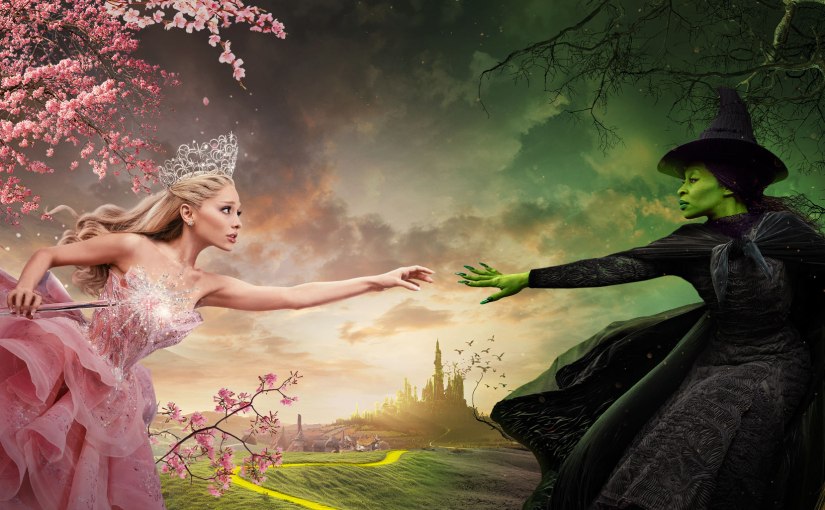
Elphaba (Cynthia Erivo) is the green skinned awkward teen, who was rejected by her father and only served a purpose to tend to her wheelchair bound sister Nessarose (Marissa Bode).  She accompanies them to drop her sister off at the esteemed magical school known as Shiz.  However, the headmistress of the institution, Madame Morrible (Michelle Yeoh), requests that Elphaba stay on as a student that she will personally teach as well.  Elphaba is roomed with the self-absorbed Galinda (Ariana Grande), where their relationship is frictional at first and later adoringly empathetic.  Eventually, we come to realize the destinies of these young ladies will develop into what is all too familiar in L Frank Baum’s eternal The Wizard Of Oz – Elphaba becomes The Wicked Witch Of The West while Galinda is recognized as Glinda, the pinkishly tender Good Witch Of The North. 

This Part One iteration of Wicked is very faithful to the stage production.  Every recognizable number is included from the operatic “No One Mourns The Wicked” to the giddily cheerful “Popular” to the climaxing, fist pumping, take charge “Defying Gravity” that closes out Act One.  The latter number is arguably one of the most well recognized and beloved theatrical songs of the twenty-first century thus far.  The edits and choreography of every number is magnificent, full of energy, and the harmonies work like natural dialogue as opposed to something like West Side Story where it’s not crazy to ask exactly why rival street gangs suddenly break out into song while trying to knife one another. 

John M Chu makes sure that his cast use every prop and set piece available.  You can’t help but grin while Ariana Grande does a circular swan flight from a chandelier while making a case for why it’s best to be popular.  “One Short Day” is a massive declaration within narrow school courtyards and corridors that berth out toward wide open endless fields into a vast blue sky for Elphaba to declare what she yearns for.  Cynthia Erivo has that knack to sing and perform personally to her character’s own subconscious when she’s in these intimate, private moments.  She then bursts out with confident volume to show that as repulsive as she might appear to everyone around her, the soul inside is what is beautiful.  In order to cast Elphaba, you really need one of the most beautiful singing voices in the world because the character is most stunning when she is expressing herself vocally. 

Ariana Grande is good. Though I still prefer the two iterations of the character that I saw on stage prior to this film.  Her performance is a different interpretation than what is traditionally in a live production.  I especially noticed that change when her character attempts to explain how to properly pronounce her name of Galinda.  The stage version of this memorable moment induced the laughs from me more.  As beautiful as Grande is in her characterization and singing, she’s not so humorous as the live stage performances.  So, the humor of Galinda, the self-entitled spoiled rich girl with everything, is not as strong.  As well, at the top of the film, I had an issue with understanding precisely what Ariana Grande was singing at first.  Was she harmonizing or was she singing dialogue?  Perhaps, that is not so much a fault of the actress as it is the recording.  Yet, the issue does not last long, and soon you are treated to Galinda laying it all out there.  She might not be as funny this time, but she’s incredibly charming and loved by her surrounding entourage of student followers, especially from Bowen Yang (Saturday Night Live) and Bronwyn James. 

The sets are spectacular and I learned afterwards that they are mostly physically constructed.  So, there is a texture to the schoolgrounds of Shiz with bridges and babbling brooks as well as regal castle-like architecture.  This is a Universal picture and many may presume that Disney would have produced something like this musical fantasy.  However, in Disney’s hands, much of this film would have been polished in a grandiose, yet artificial, CGI.  John M Chu and his crew went the smart route and diminished the cartoon sheen that comes with CGI.

My issue though is in the cinematography.  Regrettably, I could not see Wicked in a Dolby cinema.  So, we settled for a traditional theatre at AMC which was fine.  Yet, I was wondering at first if there was something wrong with the projector.  A lot of the scenes taking place in the daytime seemed washed out, especially with close ups on Ariana Grande and her complexion.  Then I concluded that John M Chu’s cinematographer relied on a lot of blaring sunlight for many of the scenes.  I imagine it was used to contrast the dark green complexion of Elphaba, emphasizing how much she doesn’t belong in this environment and amping up what an eyesore the character must feel like within the world of Shiz.  When Elphaba dominates a scene or a caption or when the film arrives at the Emerald City, the photography is just right.  Elsewhere at Shiz, it’s very oversaturated with a fuzzy kind of look to it.  Was I wearing the wrong spectacles?  Wait, I don’t wear glasses or contacts!  I could not get past this for much of the film. There was just too much white light, and it didn’t compliment the pinks and pales that accompany Galinda and some of the environments and extras.

My wife and I agreed we are going to see it in theatres at least one more time within a Dolby surround sound.  You should too.  We missed the surround sound of the winning music blaring through the entire theatre.  In a traditional theatre, the sound feels as if it is only coming from the front, or behind the screen.  Dolby or IMAX enhance the audible as if your mind is right at the center of an orb with the most gorgeous, pitch perfect sounds accompanying you.  Dolby and IMAX will also enrich the colors, and Wicked is most certainly vibrant.  Every scene looks like a completed coloring book, despite my one noted imperfection.  A year after Barbie, and pink is still in.  Greens and blacks are just as impactful.

Wicked is magnificent entertainment, worth seeing again.  The music is enchanting and easy to catch on to.  It’s fun and dramatic and every lyric works to shape the characters.  The story is magnificent as well with eye opening twists while allegorically adopting a message demonstrating the harm of prejudice.  There’s also opportunity to show where life can be a disappointment at times when you encounter false idols and learn truths about yourself and those you have grown close to.  I speak in vague terms on these accounts so as not to spoil what this powerful story delivers.

The film is smart in invention as well.  There are good, solid moments that were never staged in the live performances, but thanks to the art of filmmaking new ideas seem totally appropriate where the classic 1939 film, The Wizard Of Oz, are referenced.  Though, I have yet to see Part Two, I can confidently say Wicked works as a solid prequel.

I was one of the skeptics who believed breaking this film into two parts was a shameless studio cash grab.  It certainly seems that way and maybe it is, but considering how good this new musical film adaptation is, I am eager for another installment.  So, I will happily fork over more admission money a year from now and I am confident that I’ll wholeheartedly enjoy Wicked Part Two.  This is a brilliantly creative story with a strong cast, sensational music and eye-popping invention.  I may know what becomes of the characters and how this story ends, but I can’t wait to see it reenacted for its latter half, and I am eager to see what new creations present themselves in its next chapter. 

Wicked is one of the best films of the year.  A triumphing soar through the skies on a magical broomstick.

TWO PEOPLE EXCHANGING SALIVA (FRANCE)

By Marc S. Sanders

For a short film with a running time of only thirty-five minutes, Two People Exchanging Saliva (aka DEUX PERSONNES ÉCHANGEANT DE LA SALIVE) offers a lot to tell within its absurdist universe thanks to writers/directors Natalie Musteata and Alexandre Singh.  Reflecting on the film, which I saw during the After Dark collection of shorts at the 2024 AFI Film Festival, my list of imagery grows longer and longer and I am grateful for it.  There’s much to remember, even nearly a full week after seeing the film.

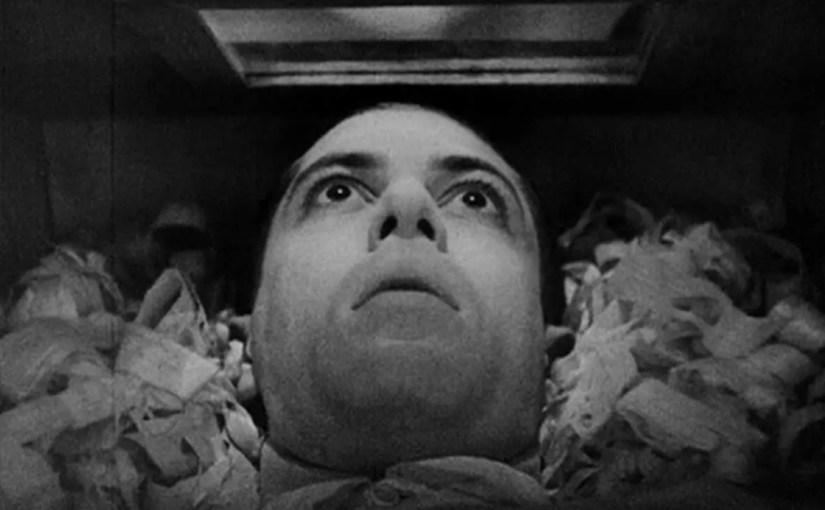
Shot within a department store located off the Champs-Élysées within the heart of Paris, the film is a gorgeous black and white presentation with striking lighting to illuminate a wide collection of settings.  Shoe racks never looked so ethereal.  A staircase leading upward feels very curious.  Piles of cardboard boxes feels terrifying before I even know what they are to personify.  Yet, the oddities that Musteata and Singh introduce are what tempts you to learn more about the rules they have set up for this fictional cosmos.

Malaise (Luàna Bajrami) is a salesperson at this store and like the rest of the staff, she must exhale her breath directly into the nose of a security guard before starting her shift.  She is suppressed by a domineering supervisor, Pétulante (Aurélie Boquien).  It cannot be more apparent that Pétulante feels threatened by her best customer’s favorability for Malaise.  That customer is Angine (Zar Amir Ebrahimi).  Among these three ladies, this comes off like a common soap opera love triangle that has been seen many times before.  Yet, the writers/directors throw some spice at this centerpiece.

Within this world, kissing is outlawed, punishable by death.  Hence the necessary requirement for a breath smell.  Ingest some garlic or other reprehensible aromatic food to divert any temptation from breaking the law.  Furthermore, products are sold at a cost of slaps to the face.  Several players exhibit the scabs and bruises, as well as nosebleeds, that evidence their purchases.  Looking at Angine it’s easy to see she is certainly a high-priced shopper.

With these set ups in place, the story can take off and rely on bold imagery.  We witness Malaise’s fear of what can happen if she commits to her attraction for Angine when the apparent crime of kissing occurs within the store.  We fear that Pétulante will pounce on prohibitive kissing in order to win her prized client back while getting her underling, Malaise, permanently out of the picture.  We see the great lengths of tormented slapping Angine endures in order to have another shopping experience with the innocent Malaise. 

The film serves reminders of the nature of punishment if a kiss is committed between two people.  The criminals are literally boxed up and disposed in a junk heap of other boxes that encase people just like them.  Musteata and Singh’s most powerful shots are of this pile of boxes dumped into a landfill toppling one over the other.  It’s like something from George A Romero film, like Night Of The Living Dead.  No big effects here.  Nothing that looks like a large expense beyond collecting a enormous supply of cardboard boxes.  Yet, when piled together in an outdoor area under the shine of their black and white cinematography from Alexandra de Saint Blanquat, it’s terribly haunting.

My wife and I got to speak with Natalie Musteata and Alexandre Singh on a few occasions during the 2024 AFI Film Festival.  They explained how the idea of this dystopian universe came to them while quarantining in their New York home during Covid.  They went through the steps of obtaining financial backing and they discovered that it would be more cost effective to shoot the picture in France than in the United States.  As well, they had access to a department store in Paris after it had closed for the night.  They went through the process of setting their scenes, rehearsing their actors, coordinating lighting and camera positioning within the few hours available to them before sunrise when the store would reopen.  Listening to them, I could envision the tight scheduling pressures they must have experienced in making this film.

I also find it interesting that they assembled this film during Covid. Simply shaking hands with others was highly discouraged to avoid a spread of disease. Highly charged debates on reproductive rights are so prominent right now too.  In Two People Exchanging Saliva, it’s not hand shaking that is impermissible, it’s something much worse, but also more intimate – kissing.  As well, in order to live off of materialism, one must fall victim to an abuse of their bodies, and they have the marks to show for it just beneath their eyes and across their profiles.  In this world, people are limited and exposed to the will of a domineering enforcement.  I salute the allegories found in the short film.  It may sound silly on the surface.  Natalie and Alex even laughed while explaining the plot of their film before we had a chance to see it.  Still, it is not altogether farfetched.  When can we live truly independently without a threat of punishment, when all we want is a will to live and love with one another?

Two People Exchanging Saliva was the winner of the Grand Jury Prize at the 2024 AFI Film Festival, and I could not be happier for the filmmakers’ accolades.  It’s worthy of its merits.  If you can find this outstanding short film I highly encourage you to take a little over a half hour out of your day to experience something entirely unique, while beautifully presented. 

Seek out your local art houses for a film short festival coming soon.  Two People Exchanging Saliva should be included in any collection that’s being offered.  Now I’m hoping an Oscar nomination is on the horizon for Natalie and Alex.  Bon Chance!!!!

MEGALOPOLIS

By Marc S. Sanders

Francis Ford Coppola’s Megalopolis is undeniably the director’s most ambitious project of his long career.  Like other films, Coppola put up the entire $120 million to finally make the picture, including selling his well-known vineyard to make it happen.  Every penny he invested is well spent.  Especially seeing it on IMAX, this is an absolutely gorgeous motion picture, like James Cameron’s Avatar films.  I mean…wow do the colors pop and shine.  

However, as beautiful as the visuals are in Coppola’s self-described “Fable” (it literally says that in the title card), it is mostly devoid of substance beyond the paint by numbers debates that cause conflict among these very strange characters.

In New Rome City, an alternative reality to the Big Apple (the Statue of Liberty holds the torch in her left hand), Caesar Catalina (Adam Driver) is a “designer” who recently invented Megalon, a substance that he believes is the answer to a utopian future.  It’s indestructible and it can be molded to serve practically any purpose.  For example, you don’t even have to walk to where you’re going.  Step on the Megalon puddle and it will move you there.  Not much of a departure from the flat movable floors you find in nationwide airports.  This is one of Megalon’s major innovations, designed to impress me?

Megalon can also be used for healing, and it has the ability of transparency.  It is more durable than wood, steel or concrete.  It’s truly the next greatest wonder of resources.  Frankly, I was more dazzled by the Vibranium found in Wakanda.

As Caesar the artist pushes his agenda for absolute Utopia, the hardened Mayor Franklyn Cicero (Giancarlo Esposito) is the opposing side of the argument declaring Utopia to be an impossibility.  Caught in between the two figures is Julia (Nathalie Emmanuel), daughter of Cicero and in love with Caesar.  Gotta have a soap opera element to this piece so the stubborn divide between these two men remains firmly in place.

Just as in typical political rings, the Mayor works to smear Caesar the idealist who is solely focused on his end goal design.

Outside the boundaries of their public quarrel are other overly colorful and garish looking characters such as the banker Hamilton Cressus III (Jon Voight), his wife, the gossip reporter Wow Platinum (Aubrey Plaza), Constance Cassius Catalina who is Caesar’s mother (Talia Shire), a lone, crazed revolutionist and nephew to the Mayor called Clodio Pulcher (Shia LeBeouf) and Nush “The Fixer” Berman (Dustin Hoffman).

These names are exhausting.  Coppola’s film is even more tiresome.  The filmmaker truly must believe he is the second comings of both Nostradamus and William Shakespeare.  The ego of this picture could not be more apparent.  The director’s head must be THAT BIG to believe he has the nerve to tell this story of such biblical proportions.

Much of those character names, and the actors who play them, are here for show and tell.  Their value to this piece is nowhere near as prized as anyone living in Harry Potter’s world, though. Megalopolis only takes time to calm itself down when the three principal players have scenes isolated to themselves or when they only occupy the screen together.  Otherwise, this movie serves as vehicles for much of the cast to be adorned with updated and trendy Roman costume wear, from fig leaf crowns to golden armored chest plates.  At times, LeBeouf is so unrecognizable in hair, makeup and clothes you don’t even realize you’re looking at him.  

The performances are all over the place.  I never once believed that whatever Dustin Hoffman was talking about that he knew what he was even saying or representing.  Shia LeBeouf mostly runs with the privilege of getting to say “Fuck Caesar!” while finding motivation only in whatever weird appearance he’s dressed in.  Adam Driver can lead a picture for sure, but here he looks like he showed up for filming with a bewitching overnight hangover.  

This is a film that cannot be ignored for its technical achievements at Oscar time.  For no reason other than aesthetics, Driver and Emmanuel will share a scene while balancing themselves on swinging steel construction beams high above the city. The view is spectacular.  All undeniably eye opening.  You also cannot look away from the costumes or scenic art direction.  The sound mixing in an IMAX theater totally envelops you in this weird world.  It’s a digital film’s dream just like James Cameron banks on.  

Still, maybe none of these efforts will be recognized because frankly much of the visuals, audio and physical construction make zero sense or relevance to the central storyline that Coppola is striving for.  Namely, the possibility for Utopia versus the practicality of simply living through life with the necessity for economics, technology, healthcare, fuel and on and on and on.

Of all films I thought about while watching Megalopolis, my mind went to William Shatner’s Star Trek V: The Final Frontier.  Shatner had the idea to have the Enterprise crew meet face to face with the almighty God.  Well, if you’re going to deliver God to a movie house, without George Burns or Morgan Freeman in the role, you’re setting yourself up to disappoint at least half or maybe even one hundred percent of your audience.  When you factor in the tremendous assortments of beliefs and religions, I’d argue no two people who believe in God, see the ethereal, omnipotent entity in the same way.  The same goes for Utopia.  How can Francis Ford Coppola be so audacious as to believe audiences will accept Caesar’s vision of a perfect land?  

Reader, he can’t!

My Utopia is different than your Utopia.  This is practically an untouchable subject and Francis Ford Coppola is far from the fabled prophet that the world needs or will draw their attention to.

Still, I remained as open minded as I could with Megalopolis all the way towards the ending that finally arrived.  The Utopia shown on this giant IMAX screen was told by the film’s narrator (Laurence Fishburne, also paying Caesar’s chauffeur) that the world was showered in gold dust.  A far cry from the Bible’s claim of arriving upon a land of milk and honey.  Why should I ever need the nourishment of milk and honey when I can have gold dust?

Think about that for a second.  Gold Dust.  I know.  The narrator is being allegorical.  Still, couldn’t that be interpreted as a little too materialistic for the Utopia we yearn for?  Gold is only a precious metal the same way a diamond is only a precious stone, or the Atari 2600 is now an expired precious commodity among former twelve year old kids in the 1980s.  

I have little shame.  I’m an admitted materialistic kind of guy.  My Mustang and my flat screen TV and my Star Wars collectibles mandate that I am. Yet, none of these possessions have ever delivered me into a paradise of perfection.  The Mustang needs precious fuel to operate.  Try as I might, I can’t collect everything.  My flat screen TV is still on the fritz.  (DAMN YOU BEST BUY GEEK SQUAD!!!)

Coppola contradicts himself with the conclusion of his fantasy opus.  He pans over the extras who occupy this film with big toothy grins of enormous gratitude while the very well dressed and bejeweled surviving characters of his story seem to be shot from an elevated stage above me, the viewer, and all who occupy a brightly lit Times Square located within the heart of New Rome City.  I am meant to look up to these giants!!! 

THIS IS UTOPIA???  

No!  I could never accept this interpretation of grand decadence as the enigmatic paradise we have all envisioned in dreams and discussion and literature.  Shouldn’t Utopia consist of a life where stress is absent, and pain is a foreign unfamiliar word and feeling? I’m not even giving Utopia its fair due.  It’s practically impossible to describe, but I’m at least certain that the rich shades of gold and black glamours within a Times Square shopping district is not the way to go.  Yet, Francis Ford Coppola is suggesting this is all that it is.  A Times Square showered in gold dust.

Frankly, I normally would give much more credit to the man who pioneered the stellar Godfather films along with the bombastic Apocalypse Now and the intimate The Conversation.  He’s never been more short sighted though, than when he finally made his “fable,” Megalopolis.

The greatest flaw and tragedy of Megalopolis is the very broad contradiction that Francis Ford Coppola declares within his fictional, fantasy-like prophecy.  Once the “fable” is all over, I feel like I paid an enormous amount of money for a cult like weekend seminar meant to brainwash me into broadening heights of positivity and awareness, showered in gold dust of course.  

Where’s The High-Level Minister Coppola?  

I’d like my money back because this preach is no more believable than an L Ron Hubbard doctrine.  Battlefield Earth just might be a little more convincing Megalopolis.

GHOST

By Marc S. Sanders

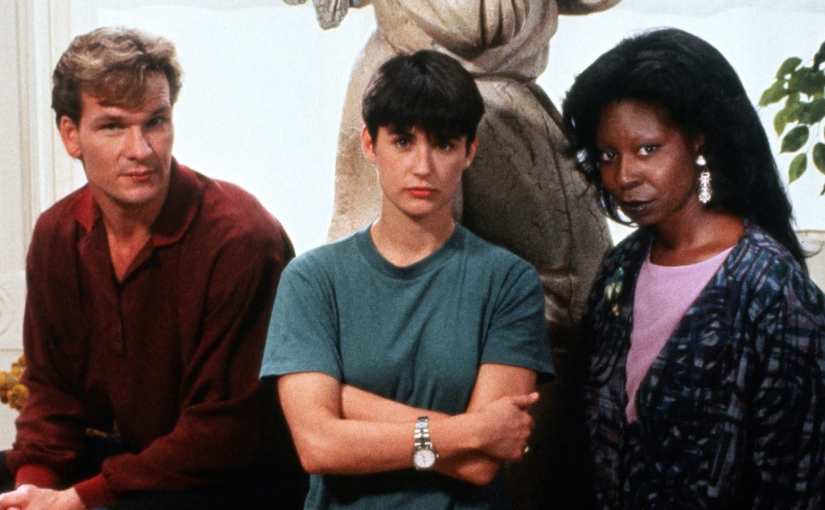
For a perfect blend of the supernatural, suspense, mystery, drama, romance and comedy, the first film that will always come to mind is the surprise hit film Ghost from 1990.  One of the zany Zucker brothers, Jerry to be more precise, who introduced the world to slapstick spoof (Airplane!, The Naked Gun) directed this film turning Demi Moore into a ten-million-dollar actress, placing Patrick Swayze ahead of his Dirty Dancing looks and earning Whoopi Goldberg a very well-deserved Academy Award.  Ghost was a film for all kinds of movie goers.

Sam Wheat (Swayze) is an up-and-coming New York City business executive who loves his new live-in girlfriend, Molly (Moore) even if he can only say “Ditto!” when she tells him she loves him.  Shortly after the picture begins Sam is gunned down following an evening at the theatre.  Unbeknownst to Molly and anyone else living on earth, Sam’s spirit lives on though, and he realizes that he was not the victim of some random mugging/murder.  Now, Sam must find out who arranged to have him killed and why, while also protecting Molly from becoming a victim.

Along the way, Sam crosses paths with a phony con artist, working as a medium, named Oda Mae Brown (Goldberg) who turns out to be the real thing when she can actually hear Sam’s voice and communicate with him.  Sam must recruit Oda Mae to be a go between for him with Molly and everyone else necessary to follow up on in order to resolve the mystery of his sudden death.

Ghost succeeded in every category of filmmaking.  Rewatching the film decades later, I believe Demi Moore should have gotten an Oscar nomination.  Her close ups on camera with beautiful, muted colors from Adam Greenberg’s cinematography are masterful.  Greenberg should have been nominated too.  He’s got perfect tints of pearl whites both on the cobble stone streets of New York with the outer architecture of the apartment buildings, as well as within the studio apartment where the couple lives.  He strives for an ethereal look with his lens. Gold often occupies Molly’s close ups with dim lighting.  Blues and blacks and steel glinting shines follow Sam’s trajectory. 

Look at the lonely scenes that Moore occupies in the couple’s apartment.  There’s a haunting image of isolation with no dialogue capturing the young actress at the top of a staircase when she eventually rolls a glass jar off the top and it shatters below.  It’s one of the moments that defines a sorrowful character, and not many cry on screen better than Demi Moore.  Later, Sam is engaging in a pursuit through the subway system and races down a steep blue escalator in the dead of night.  Zucker places Greenberg’s camera at the bottom of the escalator to show the depth of hell that Sam may be risking continuing his chase.  The images and transitions of this whole movie from scene to scene are stunning.

I mistakenly recall Whoopi Goldberg as just a comedienne doing her stand up schtick in this film.  Not so.  Goldberg looks radiant on film and while she starts out comically as the script calls for, she eventually resorts to sensitive fear of what her paranormal partner demonstrates as real within this fantasy.  There are so many dimensions to this character.  She’s silly.  She’s exact in her nature for what’s at stake and the dialogue handed to her from Bruce Joel Rubin’s Oscar winning script compliments the actress so well. Goldberg never looks like she’s working for the awards accolades. Yet, she earned every bit of recognition that followed her.

Patrick Swayze makes more out of the straight man role than what could have been left as simple vanilla.  His spirit character uncovers more and more about his afterlife and what happened to him as the film moves along. With each discovery, you’re convinced of Sam’s surprises and what he becomes capable of as a ghost.  Long before superhero films became the novelty, Sam Wheat operates like one who has to learn of his origin and then acquire his new talents and powers to fend off the bad guys.

Jerry Zucker, working with Rubin’s script, Greenberg’s photography and Oscar nominated editing from Walter Murch, along with haunting yet sweet scoring from Maurice Jarre, builds a near perfect film.  The narrative of Ghost shifts so often from comedy to crime to drama to romance and the various natures of the piece hinge so well off each other.  That’s due to storytelling and the editing necessary to smooth out any wrinkles.  You become absorbed in Jerry Zucker’s direction, especially with the movie’s most famous scene where Demi Moore and Patrick Swayze are sensually doing pottery together accompanied by Bill Medley’s rendition of “Unchained Melody.”  Watch that scene with someone you love or take it in on a late Saturday night by yourself with no one to distract you with cackles and eye rolls.  You’ll see how effective Zucker’s work is along with Swayze and Moore upholding the scene in a dark, empty apartment.  Take it as seriously as the scene was originally constructed.  (Then go watch Zucker’s Naked Gun 2 ½ for a chuckle.)

The mystery of Ghost works well with surprises if you are watching it for the first time.  You build trust with a character only to realize it is a ruse for something else.  I do not want to give too much away.  For viewers who have never seen the film, maybe you’ll see an early twist as soon as the film begins.  Maybe not.  Either way, Ghost performs very naturally, unlike a forced kind of twist that M Night Shyamalan too often relies upon.  I do advise that you not watch the trailer that was used for Ghost as I believe it deals out too many of the film’s secrets.

There are movies that I watch over and over again because I love to relive the special moments they offer.  Ghost has those kinds of gifts and yet I have not seen it in ages.  I’m glad.  To experience the picture again was such a treat.  While I recalled all of its secrets, this time I was able to take in the various technical achievements and the assembly of the piece, along with outstanding performances. 

I have no problem saying that Ghost possesses the best performances within the vast careers of Demi Moore, Patrick Swayze and Whoopi Goldberg.  Ghost still holds up. It deserves a rewatch and an introduction to new generations.

SUPERMAN II

By Marc S. Sanders

It’s time for the man in the red cape and blue tights to fall in love with Lois Lane, but wouldn’t you know it?  Three Krytonian criminals possessing the same powers as our hero have arrived on Earth with a means to dominate the planet and exact revenge on the son of their jailer.  Superman II picks up where Richard Donner’s original 1978 smash left off.  It remains a fantastically fun and breathless sequel.

Richard Lester (A Hard Day’s Night) gets the directing credit on this film following one of Hollywood’s most infamous behind-the-scenes stories.  While I’m a big admirer of Donner’s body of work, I think it was a blessing that Lester finished the job.  I’ve seen what Donner was intending to do on a special Blu Ray cut, and it just does not work. The characters make odd choices that seem inconsistent with how they were perceived in the first film.  That’s all I need to say about that comparison right now, though. 

In the original theatrical release, the story expands on the relationship between Superman & Lois (Christopher Reeve, Margot Kidder) as well as Clark Kent and Lois.  Eventually, both relationships intersect with one another, and Lois realizes the man she’s been admiring and the one she hardly takes notice of are one and the same.  The problem for Superman, known by his krypton name Kal-El, son of Jor-El, is if it is acceptable to be intimate with an earthling. 

Meanwhile, Lex Luthor (Gene Hackman) has escaped prison to entice three villains from Krypton into a partnership that will allow them to take over the Earth and destroy Superman.  The trio is led by General Zod (Terence Stamp) with the wicked Ursa (Sarah Douglas) and the mindless and mute Non (Jack O’Halloran).  Following their attack on Houston, or as they call it the “Planet Huuston,” and the White House, it is on to Metropolis in search of Kal-El.

I’ve offered up quite a bit of what Superman II provides and I am not even close to sharing all it’s adventurous features and character dynamics.  This is a solid picture all the way through, and it begins with the casting.

I’ll be bold by declaring that Christopher Reeve as Clark Kent/Superman is one of the best casting decisions in film history.  Think about this for a moment.  As good as Henry Cavill was in Zach Snyder’s films, thirty years later, and how well some of the WB iterations have been, the contrary point that most people make is that none of them are Christopher Reeve.  From the smile, his handsome face, clear voice with perfect enunciation and even the signature hair curl over the forehead, no one has looked as good as a superhero come to life better than Mr. Reeve.  When he’s flying, even with outdated visual effect backgrounds, you are still convinced that Christopher Reeve knows exactly how to fly.

Following the director shake up on this picture, it is said Gene Hackman refused to shoot some scenes or do follow up edits.  You can tell when there is a double in place for him and you can hear the different vocal sound bites from Lex Luthor.  Nevertheless, what survived from Hackman’s participation is silly and twisted like you would expect from a modern-day, dastardly villain or as he declares himself to be “the greatest criminal mind of our age.” Some of these lines look hokey on paper, but Hackman invests his showmanship once again in the character.  I love it.  On all of those top ten lists, Gene Hackman as Lex Luthor is the one that everyone is regrettably forgetting about.

Margot Kidder is just as committed.  Lois Lane is best when she is the go-getter and Kidder is thoroughly convincing at not just being seen in the stunts and action but actually performing through Lois’ fears, sense of daring, and adoration for the love of her life.  Near the beginning of the film, there’s a great close up of Kidder looking up into the heights of the Eiffel Tower as Superman flies a hydrogen bomb out of danger.  No dialogue, but you can read it all over Margot Kidder’s face.  There goes my hero.  Watch him as he goes.  Few love interests in superhero films have ever matched what Margot Kidder accomplished in these pictures.

The action scenes are great set ups.  I get a chill down my spine every time I watch the showdown in Metropolis between the three baddies against the man in blue and red.  However, Richard Lester never neglects the acting throughout the whole two hours, particularly by the leads, as well as the Shakespearean maniacal performances from Stamp and Douglas.  Furthermore, the extras throughout Metropolis, Houston and even in Niagara Falls are performing very well and therefore turning the various settings into characters themselves.  Just as the fight over Metropolis is to begin, a cabbie declares “Man, this is gonna be good!”  Isn’t that guy speaking for the audience?  I remember the room applauding in the theater at that line.  When Superman rescues a child in Niagara Falls, a woman utters “What a nice man!” Clifton James, from a couple of James Bond movies, resurrects that redneck persona and it works better here as the guy who clashes with the imposing new visitors.  All of these walk on characters further shape the purpose of the visitors from space.  None of it depends on B-movie tripe like declaring “Peace!”  The personality of the folks meet the strangers from a strange land.  Sometimes it is done for means of slapstick, but it is always very entertaining.

Superman II is a perfect complement to the original film thanks especially to the cast.  Reeve gives multiple performances of Clark and Kal-El that could not be more different.  Kidder takes her character in new directions upon learning the surprises the script has in store for Lois.  Hackman is doing the same routine, but fortunately it’s welcome because I can not get enough of his antics.

This sequel really set the bar high and the next installments for Reeve came nowhere close. Though I actually have an affection for Superman III with that internal struggle depicted in the junk yard scene; one for the ages. 

The first two movies are legendary and Warner Bros/DC films realize they still have not superseded what was done over forty years ago.  The studios are not trying hard enough. However, more to the point, the filmmakers back then got it absolutely perfect, and you cannot beat Superman, nor can you beat perfection.