WICKED FOR GOOD

By Marc S. Sanders

Wicked For Good is a crowning achievement in fantasy and musical wonder.  It soars across a wide expanse of never-ending settings within the wonderful world of Oz and delivers a series of messages to walk away with.  Try not to think about Wicked the next time you turn on CNN or FOX News.

Jon M Chu directs again after Wicked Part One.  Both films were actually shot as one large project but then divided.  I was suspect when I heard this was how the Broadway musical was going to be done for film.  Was there that much material, interesting enough for two full-length movies?  With a pair of new numbers drafted by original composition writer Stephen Schwartz, the answer is a profound yes.  This may be Act II of the musical but it does operate as a sequel. The new film leaps in time from when our host of characters were young students at Shiz Academy.  All are adults now with respective responsibilities and therefore they’ve grown and changed.  Sadly, but wisely, the film moves in directions that are parallel to many current events happening today. 

The wise animals of Oz are being oppressed.  The first film hinted that animals should be seen not heard.  The second part of the story executes that mantra all too realistically as they lose their power of speech and are destined not to be free but rather caged like in internment camps.  Those that have not been taken are performing mass exodus under the newly constructed yellow brick road. 

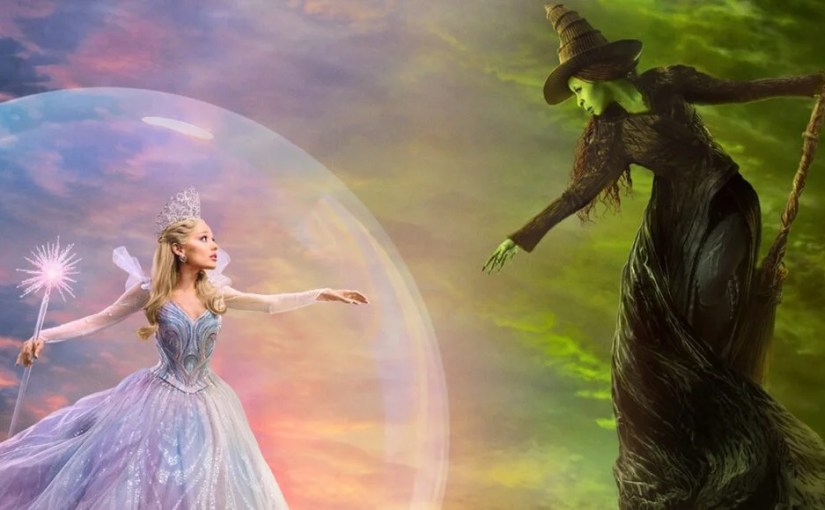
Untrue propaganda sweeps through Oz as Madame Morrible (Michelle Yeoh) uses the false influence of The Wizard (Jeff Goldblum) to unite the kingdom into believing the empathetic green skinned Elphaba (Cynthia Erivo) is the Wicked Witch of The West, on mission of terror.  Citizens of Munchkinland and the Emerald City believe the lies and live in fear of her presence.  Glinda (Ariana Grande), decked in beautiful pinks with a sparkly wand and a convenient flying bubble craft, serves as a poster girl for hope with the illusion of having enchanting powers to protect.  Elphaba’s sister Nessarose (Marissa Bode) succeeds as the governor of Oz following the death of the girls’ father.  Nessarose has grown coldhearted, particularly to her one true love Bok (Ethan Slater), who by decree must remain held captive under her authority.  He’s literally forbidden to immigrate by train. These are not the students of Shiz that we grew up with. 

I hate to use Wicked For Good as a metaphor for political purposes, but that’s exactly where my mind went to, and I’m grateful for it.  I believe there is much wrong occurring each day in the United States and throughout the world. I’m at least thankful that artistry like cinema and stage prevents us from burying our heads in the sand.  Conveniently, there’s a triggering and emotionally engaging storyline to hold on to.

Wicked was spawned off of L Frank Baum’s classic fairy tales. Part of the fun is seeing how these new stories are threaded towards his classic story of a girl from Kansas who arrives in Oz and befriends three unusual charmers while on her journey to meet The Wizard.  I’d argue that more people are familiar with the classic Warner Brothers film from 1939 than Baum’s series of books, and this Universal picture seems to adhere to the original production especially.  Elpheba delivers a new song called “There’s No Place Like Home” that’s woven beautifully into the picture.  Glinda sings about “The Girl In The Bubble” to emulate her personal conflict with how she is meant to serve.  Classic lines like “I’m off to see The Wizard” are provided.  Hints at a lion (voiced by Coleman Domingo) being fearful, along with a character’s heart becoming too small are referenced with weighty importance.  Another character is asked if he’s lost his mind.  It’s satisfying how original the Wicked properties are while being comfortably familiar.

The cast is sensational.  Cynthia Erivo is a wonderful performer who hides in her role with an American accent and her Broadway voice to belt.  She performs so convincingly that it becomes easy to look past the green skin and watch the woman who is challenged.  Michelle Yeoh and Jeff Goldblum have those unusual appearances and distinct personalities that serve a fantasy world like Oz.  Marissa Bode demonstrates tremendous strength as the disabled character who probably traverses through the biggest change of the whole cast.  Ariana Grande is a terrific actor and a lovely singer.  As I noted about the prior film, her Glinda is not my favorite, though.  The three others I saw on stage performed with a bubblier delivery and did not rely so much on Grande’s hair flip.  Jonathan Bailey is a dashing and charming hero, carved out for the prince of fantasy.  Ethan Slater’s Bok suffers through unwinnable oppression, and thus his character is more tragic this time.  It’s crushing to see, but his performance is completely relatable.

I watched the first film as a refresher ahead of seeing For Good and it occurs to me how triumphant these films are.  This whole story could have been contained in a ninety-minute Disney blueprint.  Yet, Jon M Chu, along with Stephen Schwartz want to entertain the audience through the narrative. So, it will stop where we are reading the movie, allowing us ample time to witness the world around us and what these characters of fantasy endure.  It’s odd sometimes to see the street toughs of West Side Story break into song as they are trying to knife one another in the streets.  In Wicked, it is never strange to see a witch or a munchkin or a prince break out into harmony to express their happiness, anger, sadness or wickedness.  The music and vocalizing build the vivid textures of the sets into grander designs. 

I can be told what happens next in the further adventures of Elphaba and Glinda and just move to the next chapter until they live happily ever after.  It’s better if the characters take their time to share as many thoughts and emotions as they can through song, dance, visual effects and action.  That’s what sets musicals apart from other fares of drama and comedy.

The Wicked films, and more importantly the musical, will remain timeless as much as Star Wars, Star Trek and Harry Potter.  They will never be dated.  They will only capture the hearts, laughs, tears and harmony of further generations to come decked in their favorite shades of green and pink.
SOMETHING WICKED THIS WAY COMES (1983)

by Miguel E. Rodriguez

DIRECTOR: Jack Clayton
CAST: Jason Robards, Jonathan Pryce, Vidal Peterson, Shawn Carson, Royal Dano, Diane Ladd, Pam Grier(!)
MY RATING: 5/10
ROTTEN TOMATOMETER: 62%

PLOT: In a small American town, a diabolical circus and its demonic proprietor grant wishes to the townsfolk…for a price.


Something Wicked This Way Comes answers the question: What would the Disney version of Needful Things (1993) look like?  Instead of the Devil opening a curio shop in the middle of town, we get a malevolent carnival impresario, Mr. Dark, and his devilish carnival that promises delights beyond your wildest dreams.  But beware, for the price of having your wish granted comes straight out of The Twilight Zone.

And no wonder, the screenplay was written by Ray Bradbury, based on his novel.  Too bad the movie fell victim to studio interference, resulting in jarring tonal shifts, some awkward edits, and two re-shot scenes where the two child stars are clearly a year older and a year taller than they appear elsewhere in the film.

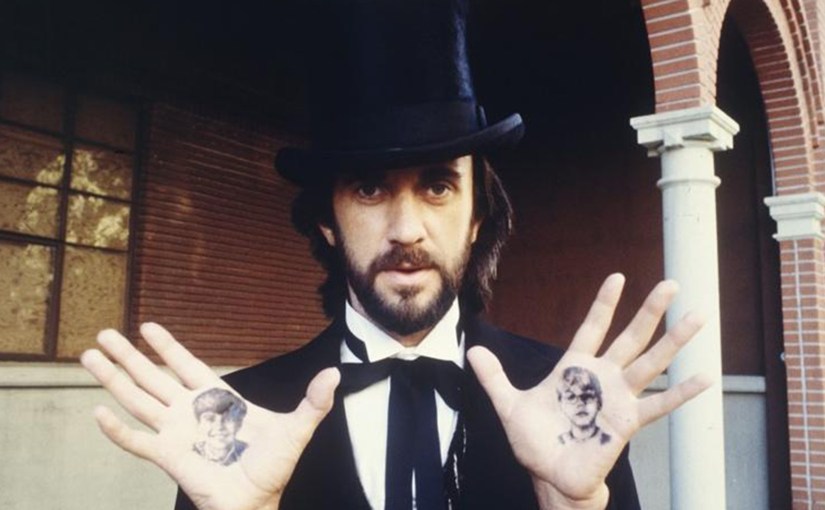
The movie starts out as feel-good Americana, right out of Normal Rockwell: a small midwestern town in what looks like the late 19-teens or early ‘20s, complete with a town square, a general store with the obligatory cigar-store Indian out front, and a friendly bartender with one arm and one leg.  We are introduced to Will and Jim, our two child protagonists, and Will’s father, Charles (Jason Robards), who looked to old to have an 11-year-old son in 1968, let alone 1983, but whatever.

So, there’s that part of the movie, where it looks like it’s going to be a gentle fantasy like Field of Dreams (1989) or something, with the background score to match…but then really weird things start happening.  A local eccentric vanishes after seeing a ghostly woman inside a funeral parlor.  Mister Dark’s Pandemonium Carnival opens just outside of town.  We watch as the local miser takes a ride on the Ferris Wheel with a beautiful woman…but she’s the only one who gets off the ride at the end.  The disabled bartender sees a marvelous reflection in the House of Mirrors and walks in…but never comes out.  Our two heroes, Will and Jim, witness something incredible when they peek under the big top at a broken-down carousel that only runs in reverse…

And so on.  I’ve seen umpteen versions of this story, and so have you.  It can be done well, but it takes a singular vision.  Watching this movie felt like someone spliced two films together and hoped no one would notice.  First of all, who in their right minds casts Pam Grier as a non-speaking character called The Dust Witch?  Granted, she’s a looker, but you don’t cast Pam Grier in a movie just because she’s beautiful.  You gotta give her something to do besides seduce men and stare menacingly, which, granted, she does better than most, but what a waste!  I wanted to hear her vow to bring the powers of darkness down upon your village in a fiery rage, or something, I dunno, anything.

But that’s a side point compared to the horrors awaiting our heroes.  In a scene right out of your nightmares, our two heroes are faced with an army of tarantulas in their bedrooms in the middle of the night.  So many tarantulas, in fact, that in one horrifying moment, you can see the bedsheets moving from the sheer numbers of arachnids under the covers.  (This was one of those re-shot scenes where the kids are a year older.)  Much later in the film, Mr. Dark grips someone’s hand so hard that we see the victim’s hand literally splitting open – in a VERY brief shot, mind you, but there is no question of what has happened, as the victim wears a bandage on that hand for the rest of the movie.

What is this horrific material doing in a Disney movie, for crying out loud?  Something Wicked This Way Comes arrived during a transitional period for Disney, when they were testing the waters with more adult-themed fare – The Watcher in the Woods had been released a few years earlier, and Touchstone Pictures was on the brink of breaking out with Splash (1984).  But when it came to this weird hybrid family/horror movie, they got a little gun shy.

According to the invaluable IMDb, after a poorly-received test screening, Disney execs delayed the film’s release for a year so the film could be re-edited, an opening narration could be added, additional scenes could be shot and old ones replaced, and an entirely new score could be composed by maestro James Horner.  In their attempts to make the movie more family-friendly, they were the embodiment of the axiom “too many cooks in the kitchen.”  On an early laserdisc commentary, Ray Bradbury stated that much of his original intention for the film was destroyed as a result of these after-market edits.

There is a really, REALLY good movie trapped inside the existing version of Something Wicked This Way Comes.  Watch the movie, and you can see that really good version peeking through here and there (it feels like there was a LOT more that could’ve been done with Jonathan Pryce’s rendition of Mr. Dark).  As it is now, the movie is little more than an object lesson on why so many directors dream of getting “final cut” in their contract…so something like THIS doesn’t happen.

THE WIZ

By Marc S. Sanders

It always surprised me that Sidney Lumet is the credited director of The Wiz, the black cultured musical interpretation of L Frank Baum’s celebrated fantasy The Wizard Of Oz.  Now that I’ve seen it with adult eyes and a tremendous appreciation for the director, it’s template makes sense knowing that I’m looking through the lens of Lumet.  Dorothy might arrive in the land of Oz, but Oz sure looks like a journey through the five boroughs of New York City, and of course Sidney Lumet is one of the all-time great storytellers of what happens within one of the greatest cities in the world.

With electrifying music penned by Quincy Jones and a screenplay by Joel Schumacher, The Wiz follows the step-by-step moments of the beloved tale.  However, everything looks like a new invention. 

Diana Ross was a sensation at the time this film was in the making and she campaigned so hard for the role of Dorothy that the script modified the age of the character to 24, thus allowing a thirty-something to convincingly play the role of an unsure kindergarten teacher with an opportunity to move on to high school academics.  On a snowy Thanksgiving night, our heroine is cast off in a twisting blizzard, landing in the Munchkinland of Oz.  Toto, a gray schnauzer, has accompanied her.  These munchkins are graffiti figures who come alive out of the concrete walls of a Harlem basketball court and neighborhood park.  It’s a brilliant invention of set design that deviates from the familiar.  The Wiz opts to maintain an urban theme.

Michael Jackson is the Scarecrow, though made of paper garbage, not straw.  A peanut butter cup wrapper enhances his nose.  He’s heckled by street guys garbed in crow likenesses when Dorothy comes upon him.  Lumet maintained a 70’s vibe to this film to fall in line with Jones’ music.  All of this design works, including the cartoon like cabs that ritually appear and abandon the characters as they embark on the Yellow Brick Road with the Chrysler Building rising in the distance.

The Tin Man is portrayed by Nipsey Russell.  He’s discovered in an amusement park junkyard where he’s crafted out of rickety old junk.  Terrific makeup here.  Ted Ross breaks out of the lion shelled statue famously erected outside of the New York Public Library.  Within the land of this Oz, a New York flavor answers for all of Baum’s familiar creations. 

Not everything works so well in The Wiz.  I’m impressed among these great talents of black entertainment that Lena Horne is cast as the Good Witch Of The South, but her one true moment at the end of the film is wasted with baby angels floating in the background of a very false looking starry backdrop.  Lena Horne is shown for the briefest of moments as Dorothy crash lands in Oz but then does not come back until the end of the film.  She sings a message to Dororthy about believing in herself.  It’s an awful moment and drains a lot of the energy from the film. Cheesy and awkward.

The course of the movie is invested so well by hundreds of costumed extras along with Diana Ross and Michael Jackson.  Nipsey Russell keeps up just fine. Ted Ross could have done more as he transferred from the live stage to this film.  His portrayal is not a standout from what Burt Lahr did with the role of the Cowardly Lion.  Diana Ross with Jackson are the leaders with nonstop energy, though.  Michael Jackson’s performance is clumsy but falls beautifully in line with all of the music.  His physical prowess in dance is part of what made him a star.  Diana Ross does not stop.  She never looks out of breath, and she puts such gusto into leading this company of musical performers.  It’s such a joy to watch both of them strut to Ease On Down The Road and Everybody Rejoice/Brand New Day.  These are two of the best and most memorable songs in the picture because of what Diana Ross does on screen with the numbers.  I especially love Brand New Day.  I’m hearing it now in my head as I write and fondly recall the wide shots that Lumet devotes to the enormous feats of choreography.  May be the best scene in the film.

Lest I forget Mabel King, as Evillene – this story’s Wicked Witch.  She is not introduced until after the great Wiz orders the four travelers to kill her.  When she does arrive, in her home based “Sweat Shop” it’s an amazing moment.  Mabel King is best known as Raj and Dee’s strict mother on the TV show What’s Happening!!!  Growing up, I’ve always been a fan and Mabel King is a sensational performer.  Her vocals give off such power and demand during her song Don’t Nobody Bring Me No Bad News.  Evillene marches down the stage in her puffed-up costume wear of glittered red with a large updo to command her little Winkees.  She certainly hijacks the picture from Diana Ross and Michael Jackson.  This is a performance that is Oscar worthy.  An absolute scene stealer.

As for The Wiz himself, it is Richard Pryor.  He’s cute in what was supposedly his first film where he donned his familiar mustache.  He’s silly but not so much fun.  Sometimes he’s just garbling like he forgot his lines and does his Richard Pryor schtick that he’d later rely on in The Toy and Superman III.  What impresses me is the costume choice for the character.  He’s eventually revealed to be the phony Wiz who operated the giant intimidating head, and he’s dressed like a literal homeless person from the streets of Harlem. 

Sidney Lumet worked with Jones and Schumacher to help us envision a modern New York as a world of urban, but colorful, fantasy.  The Yellow Brick Road goes down into the subway tunnels for some threatening moments of suspense as well as through an old amusement park, maybe located in Coney Island.  The Emerald City appears on the other side of the Verrazano Bridge, and it is Manhattan lit up in green.  The centre of the city is Lincoln Center where the inhabitants dance in red, yellow and green depending on the traffic light raised high above the famous circular fountains.  I believe the mysterious Wiz is located at the top of one of the Twin Towers.  Lumet used what he knew and applied a colorful brush of fantasy over the entire Metropolitan area.  I say it is brilliant.  Familiar like it should be, but still a fresh idea as Dorothy leaves her home of Harlem for the more extravagant of locales where she seeks out the famous Wiz hoping for a way home.

A Broadway and touring stage company of The Wiz is performing currently and I hope not too much of what is featured in this film has been washed over. 

The Wiz is dated to a disco era but most of the songbook still works with high energy and passion.  A strong appreciation remains, and maybe that’s because L Frank Baum’s original story is so timeless.  This cast along with Quincy Jones and Sidney Lumet, plus creative inventions in makeup from Stan Winston still hold up.  You’ll tap your foot if you turn this soundtrack on your radio or you opt to take in the visuals of this kaleidoscope of color and sound on your flat screen.

DRAGON HEART: ADVENTURES BEYOND THIS WORLD

By Marc S. Sanders

Dragon Heart: Adventures Beyond This World is an ambitious animated film catered towards a young audience, but carrying a lot of imagery and themes designed for an adult crowd.  The film, directed by Isamu Imakake (Cowboy Bebop: The Movie) performs as a Sunday School lesson where the students were never picked up by their parents at the end of the day.  The artwork is incredible and some of the best I’ve ever seen, but there’s a lot of heavy material to weigh here with allegorical visuals that justify a very stern PG-13 rating.

Ryusuke is a middle schooler from Tokyo who spends the summer with his cousin Tomomi.  One day the boy and girl go on a nature walk and get swept away with the strong current of the Anabuki River.  They encounter a wise old man named Ameno Hiwashino Mikoto and a beautiful wide eyed green dragon in flight.  The old man explains to the teens that they are dead and now must sojourn through the spiritual worlds of hell where devious serpents interfere and butchering surgical doctors are thirsty for hacking patients into bloody pieces.  One embodiment dons sunglasses and a tropical shirt.  He cages a frightened Tomomi, while her cousin dodges the god’s attacks with tennis balls in an attempt to rescue her.  I’m not sure of the design options in this particular sequence.  The action is quite engaging, though.

The children’s race to avoid these harsh encounters occupy the center of the picture.  The last act reunites them with Ameno Hiwashino Mikoto who arranges for the kind dragon to escort them to Shambhala, a heavenly locale consisting of a variety of thousands upon thousands of gods. Vishnu, the god of India, is singled out for a select ritual.

In spite of my Jewish upbringing, I do not consider myself very spiritual or religious any longer.  I applaud anyone who safely adheres to what guides them in a positive light of assurance, safety and peace.  The adventure of Dragon Heart serves as a vehicle towards spiritual awakenings from a source of Eastern and Asian culture.  The film seems to expect any disciple to witness the worst in humanity if their soul is ever to discover the best within a realm of the afterlife.  Reader, that is likely you and me and everyone else in the theater.  

I may be speaking vague, but so is the gospel of Dragon Heart.  Naturally, children, who are green at being tested, are selected for going on this adventure.  This mysterious and wise old man entraps them to choose for themselves how to lead their lives and use their souls.  It is their souls that are important because the script tells us that we do not merely live within flesh and bone.  Our soul and spirit live on after our physical body expires.

By the end of the film, I fear that Ryusuke and Tomomi will be knocking on my front door with scripture pamphlets with their bicycles parked on my driveway.  Personally, that does not leave me feeling very comfortable.  It’s the preachiness of Dragon Heart: Adventures Beyond This World that leaves me feeling queasy.

This is a gorgeous picture of radiant color.  Outdoor natures look so absorbing.  Green grass flows naturally in a breeze.  Rivers cheerfully flow and you want to drink from them.  Ryusuke is especially enthusiastic to explore the various mountain landscapes including Everest and thus you want to accompany him.  The skies are bright enough to glide through the air.  

The various dimensions of hell are equally convincing.  In many circumstances, you’re looking at some of your worst nightmares come alive.  In fact, for a pre-teen watching this film might incur a fear of doctors whose bloodthirsty grins emote through their surgical masks as they race at you with chainsaws and curved knives.  Freddy Krueger is like a Disney character compared to these guys.  My wife would never get past the snakes either.

Dragon Heart: Adventures Beyond This World does its job, but perhaps it works too well.  The animated imagery is so powerfully strong in what it shows that it is potentially traumatizing to certain viewers – definitely children and those who embrace the spiritual potential of religion.

While the film intends to conclude on a soaring positive note, it’s the journey to this destination that is quite unsettling.  

Once again, who is this film catered for? I know that god fearing worship is often sermoned by ministers, prophets and scriptures, but should any kind of religion or spiritual guidance put us in therapy too?

VAMPYR (Germany, 1932)

by Miguel E. Rodriguez

DIRECTOR: Carl Th. Dreyer
CAST: Julian West, Maurice Schutz, Rena Mandel, Sybille Schmitz
MY RATING: 8/10
ROTTEN TOMATOMETER: 98% Certified Fresh

PLOT: A drifter obsessed with the supernatural stumbles upon an inn where a severely ill adolescent girl is slowly becoming a vampire.


Carl Th. Dreyer’s Vampyr [pronounced “vom-PEER” in this German version] is not the scariest vampire film I’ve ever seen, but it is definitely one of the creepiest.  There’s a difference.  Dreyer’s film doesn’t move with the pacing seen in more standard horror fare.  Instead, it forsakes typical plot development for scenes that linger on the horrific or the unexplained.  In its own way, it is more directly related to the films of David Lynch than to any other contemporary monster movies of the time (Dracula or Frankenstein, for example, both 1931).

The story is fairly simple, but it belies the complex imagery that awaits the viewer.  A young drifter, Allan Grey, happens upon an inn from which he thinks he can hear animal sounds, or perhaps a young woman screaming.  The village doctor, who looks like a bespectacled long-lost relative of Doc Brown from Back to the Future, vehemently denies the presence any animals or young women on the property.  The innkeeper invites Allan to stay the night.  In the middle of the night, Allan’s sleep is interrupted by a mysterious visitor to his room who intones, “The girl must not die!”  The gentleman then leaves a package on Allan’s desk and writes a most portentous message: “TO BE OPENED ONLY UPON MY DEATH.”

What is this book?  What did Allan hear?  And how do you explain the shadows he saw on his way to the inn?  Shadows of people running along the lane – with no corresponding people attached to them?  Wouldn’t YOU like to know.

Vampyr is positively drowning in atmosphere.  Dreyer apparently shot many scenes with a piece of thin gauze over the lens, creating a misty layer that makes everything feel like a dream, even when Allan is awake.  Allan goes on frequent excursions around the inn and the surrounding property, and it’s here where most of the fantastical imagery is seen, especially when it comes to disembodied shadows.  In one mildly unsettling sequence, a shadow of a man with a peg leg descends a ladder and appears to sit on a bench…re-joining itself to a peg-legged man already sitting on the same bench.

There’s a lot more, but I don’t want to just write a list.  However, I am compelled to mention one sequence in particular that exudes as much creepiness as anything I’ve ever seen from this cinematic era.

It turns out there is, not one young woman at the inn, but two: Gisèle and Léone.  Léone is seen early on, confined to her bed with a mysterious illness, which we later learn has been brought on by her contact with a seldom-seen old woman who lurks somewhere on the property.  And there are some odd injuries on her neck…UH oh.

At one point, Léone awakes while Gisèle is alone with her.  I don’t remember what they discuss, but Léone goes into this weird sort of trance.  Without the use of any strange Chaney-esque makeup or camera tricks, Léone’s face becomes an object lesson in creepiness.  Her eyes open wide, her face breaks into a creepy grin, and she slowly moves her head from side to side, while Gisèle backs away in terror.  It might be the scariest sequence in the film, one which could easily compare to any subsequent monster or vampire movie.

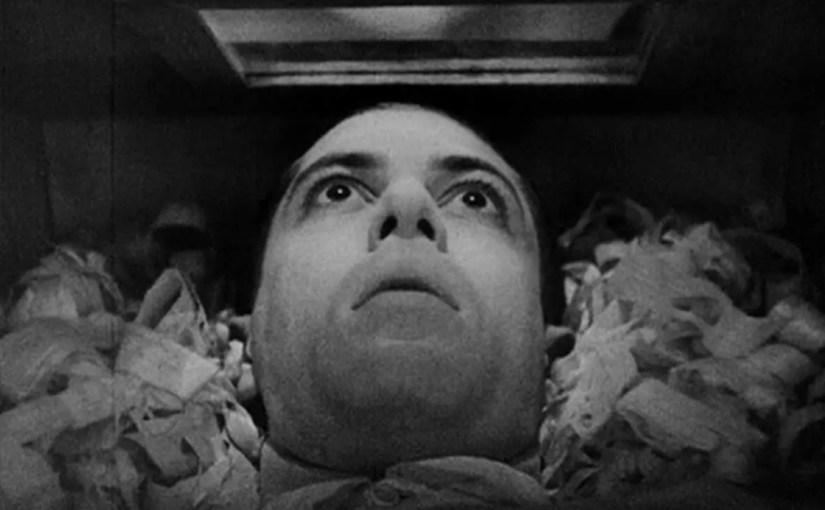
Later, Dreyer throws more camera tricks at us in increasingly imaginative ways.  Allan dreams of a skeleton handing him a bottle of poison.  A dead man’s face appears in the sky during a sudden thunderstorm.  Dreyer includes camera moves that would fit right into any modern film.  And in a sequence that reminded me of Wes Craven’s The Serpent and the Rainbow (1988), Allan watches as his own body is sealed inside a coffin with a tiny square window for his apparently dead eyes to look out of.

If nothing else, Vampyr is an interesting artifact of cinema’s transitional era from silent to sound.  Even though there is a conventional soundtrack and we hear people’s voices as they speak, a lot of expository information is provided via title cards and long looks at passages from a book of vampire lore.  Given that the vampire mythology was then not as popular as it is today, I can forgive these beats that tend to bring the momentum to a halt.

While Nosferatu (1922) and the Bela Lugosi Dracula are much more famous, Vampyr is worth a look if you’re a horror fan.  While it doesn’t involve the kind of fear factor I tend to expect as a child of the 1970s and ‘80s, it is nevertheless creepy as hell. 

THE MAGIC FLUTE (Sweden, 1975)

by Miguel E. Rodriguez

DIRECTOR: Ingmar Bergman
CAST: Josef Köstlinger, Irma Urrila, Håkan Hagegård, Birgit Nordin
MY RATING: 8/10
ROTTEN TOMATOMETER: 91% Fresh

PLOT: Valiant prince Tamino and his zestful sidekick Papageno are recruited by the Queen of the Night to save her daughter from the clutches of evil.


Here lies the noble, magical illusion of the theater.  Nothing is; everything represents. – Ingmar Bergman

Ingmar Bergman’s whimsical staging of Mozart’s opera The Magic Flute is a movie made by a theater fan, for theater fans…and to a certain degree, it’s about theater fans.  I use the word “staging” instead of “film of” because, throughout the movie, Bergman never once lets us forget that we’re watching a staged production.  The opera’s overture plays over shots of the audience members, and at intermission we watch actors passing the time by playing chess or smoking where they shouldn’t be.  Once or twice, we see the hands of the stage crew as they move from one “cue card” to the next.  Fishing wire is clearly visible when objects “float.”  But the very artificiality of the production is what makes it so charming.  It celebrates artifice and scorns reality.  It wouldn’t surprise me if this were one of the favorite films of Tim Burton or Terry Gilliam.

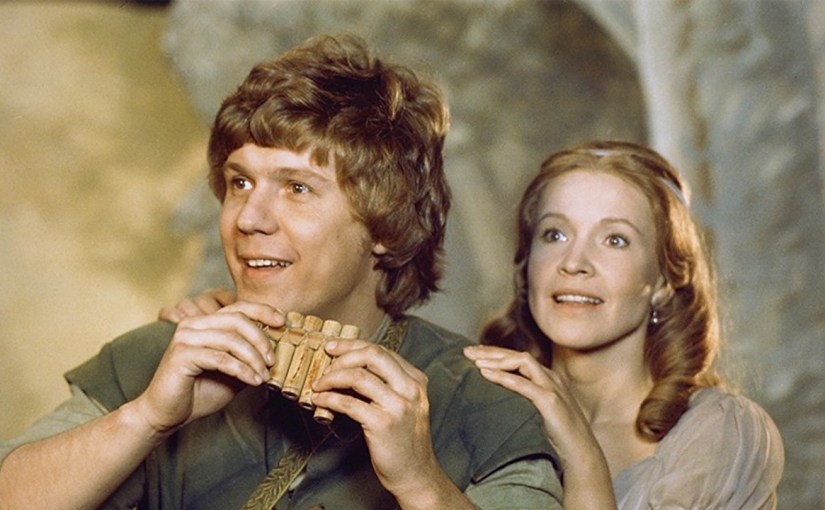
Since my only previous knowledge of the story of The Magic Flute comes from a precious few scenes in the film Amadeus (1984), here’s a brief summary for anyone else who knows as much about opera as I do.  The brave, handsome prince Tamino and his enthusiastic sidekick Papageno are recruited by the Queen of the Night to rescue her beautiful daughter, Pamina, from the clutches of the evil Sarastro.  Before the opera is over, there will be revelations, separations, reunions, laughter, tears, semi-divine intervention, and even an operatic strip-tease.  There are monsters, woodland creatures, villains, three angelic young boys in a hot air balloon, and, of course, a magic flute.  And it’s all portrayed as it might be seen if we were watching it on a real stage in a real theater, with some obvious cinematic licenses taken with time and space.

I’m gonna be brutally honest: having never seen an opera, I had moderate-to-low expectations of how much I would enjoy it, even if the music is by my second-favorite classical composer of all time.  (Beethoven is the king, and that is that.)  But Bergman’s film sidestepped my expectations by not trying to present anything in a realistic way, or by simply staging a live production and just filming it from multiple cameras.  By keeping everything clearly artificial, clearly staged, and occasionally using clever movie tricks, The Magic Flute held my attention, making me curious about what other tricks Bergman might have up his sleeve.

For example, he’ll start a scene with a wide shot, showing the entire stage with the flats and fake backdrops, then cut to a medium shot, making us think we’re in the space we just were, then panning over to reveal a completely separate set that was invisible before.  But because it’s been established that we’re in the realm of theater, this kind of spatial paradox isn’t jarring, it’s almost expected.  You can get away with certain things in theater, especially opera, especially in a fantasy, that would never fly in a regular movie.  In The Magic Flute, a person’s face can be completely made over with a simple edit.  A picture in a locket can come to life.  A journey through a fantastic hellscape can be suggested by clever editing and careful camera placement.

But what if you simply don’t like opera?  Is The Magic Flute enough to convert you?  I mean…maybe?  If you’re a fan of the films of Terry Gilliam, particularly Brazil (1985) and The Adventures of Baron Munchausen (1988), then this movie is going to be right up your alley.  They share the same visual strategies and production design sensibilities.  Even if you believe you don’t like opera, The Magic Flute could still win you over for at least this one movie, simply because it’s such fun to look at.

Looking back over what I’ve written so far, I don’t believe I’ve accurately conveyed how the deliberate “fakeness” of the film enhances its effectiveness.  Live theater has the ability to get audiences to suspend their disbelief in a way that film cannot always achieve.  I’ve seen community theater productions where, for example, the walls of a café are supposed to “fly” off the stage revealing a night sky, and the effect was accomplished by simple lighting tricks.  A clubhouse foyer can be magically transformed into a golf course with a green carpet and some more selective lighting.  In live theater, the audience is constantly aware that it’s fake, but when they’re in the grip of a good story, their mind fills in the blanks.  That’s the effect Bergman is going for in The Magic Flute, and it works.

So, in the end, what you have here is a love letter to the stage, to opera, to Mozart, to fantasy.  Throughout the film, Bergman will cut to the face of young girl, an audience member, who watches with rapt attention and an almost Mona Lisa-esque smile.  Not only is he reminding us, the viewer, that this is a staged production, but maybe he’s also sending a reminder to filmmakers to never forget that, for a movie or play or opera to work, you have to remember who you’re making it for: the paying audience.  Speaking as an occasional audience member myself, I know that, when I buy a ticket, I want to be taken out of myself.  I want to believe that a man can fly, or that a wooden puppet can come to life, or that a valiant prince can overcome three tasks to win the heart of his beloved.  The Magic Flute is a tribute to the magic-makers and the storytellers, to the genius of Mozart, and to the people out there in the dark who make it all possible.

NIGHTBITCH (2024)

by Miguel E. Rodriguez

DIRECTOR: Marielle Heller
CAST: Amy Adams, Scoot McNairy, Jessica Harper
MY RATING: 7/10
ROTTEN TOMATOMETER: 59%

PLOT: A woman pauses her career as an artist to be a stay-at-home mom, but her domesticity takes a surreal turn.


[SPOILER ALERT…if you plan on seeing Nightbitch, avoid this review.  This movie, like most movies, works best on the viewer if they have no idea what’s happening or what’s about to happen.  Consider yourself Spoiler-warned.]

Nightbitch shoots out of the starting gate like a thoroughbred – or a greyhound, if you will – but about halfway through, it runs out of narrative steam.  I felt like a gambler watching a horse race, watching my horse lead the pack around the first turn, already spending the winnings in my head, and then my horse fades a bit, then a bit more, and by the time we get to the finish line, I’m tearing up my ticket in frustration.  I needed a WIN, not a PLACE.  There goes my trifecta.

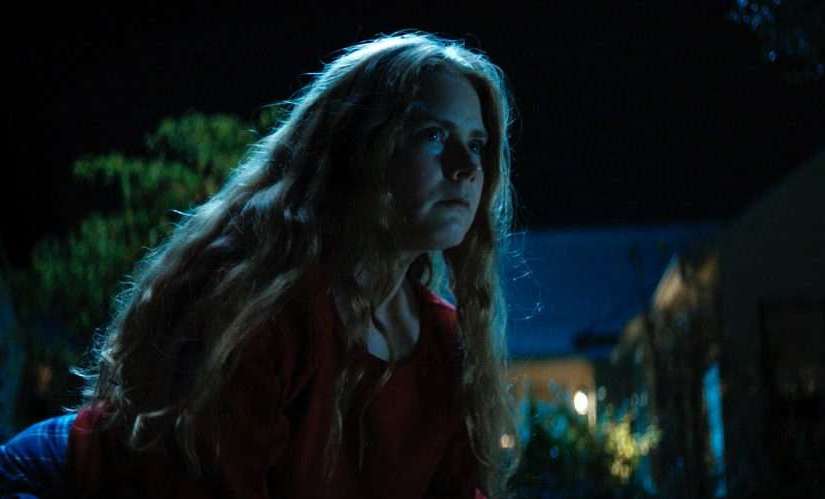
Amy Adams plays an unnamed Mother who has put her promising career as an artist on pause to be a stay-at-home mom while her also-unnamed Husband (Scoot McNairy) pursues his career as a…um…well, whatever it is, he has to travel a lot, leaving Mother at home with, you guessed it, Son (played by adorable twins Arleigh and Emmett Snowden).  Referred to throughout the movie as “my guy” and “sport” and “little buddy,” Son is a typical toddler in the throes of the terrible twos: cute for long stretches, maddeningly frustrating for longer stretches.  [Ed. Note: the author is not a father, has no plans on becoming a father, and will never possess the immense dedication it takes to rear a child, so don’t expect him to embrace the chaos of toddler-hood because it ain’t gonna happen.]

Mother is going through an identity crisis, set up in a brilliant opening scene where Sally, the woman who assumed Mother’s job at an art gallery, asks her, “Do you just love getting to be home with him [Son] all the time?”  Mother answers the question with a little more honesty than Sally or anyone had a right to expect, including this tidbit: “I am deeply afraid that I am never going to be smart, or happy, or thin ever again.”  I am a straight Hispanic cisgender male, so I’m here to tell you, I will never understand that mindset, but I am reasonably certain there are untold millions of moms out there who, if they listened to Mother’s opening statement, would say, “AMEN, sister.”

A little later, Mother delivers an internal monologue where she reflects that, as a mother, you can squeeze someone into the world “who will one day pee in your face without blinking.”  Again, I’m not a parent, but I know that’s truth in cinema right there.

After a few more establishing scenes of Mother interacting with Son, who absolutely REFUSES to go to sleep at night or eat anything for breakfast except, apparently, hash brown patties fried in butter, some odd things start to happen.  At the playground, some stray (?) dogs approach her as if she’s their best friend.  Mother notices her sense of smell has become much more acute.  Son helpfully points out that her back is hairy.  And, in a creepy Cronenberg-y moment, she notices a lump growing at the base of her spine just above her rump.  Curiosity gets the best of her.  She heats a needle, lances the lump, and…well, if you remember the title of the film, you have an idea of what pops out of that lump.

This was all wonderfully thrilling stuff as a movie lover.  I’m thinking, “My god, this is a Spike Jonze movie told from a woman’s perspective!  I’ve never seen anything like this!  This is gonna be GREAT!”  Mother starts to enjoy eating a lot of meat.  She starts to play “doggie” with Son, growling and barking at each other like two puppies.  The two of them eat their lunch at a deli with no silverware…or hands, to the consternation of other diners.  Son doesn’t sleep at night, so Mother, in a genius parenting move, buys a dog bed and gets Son to play “doggie” and sleep in the dog bed at night.  Presto, problem solved!

And more and more dogs start showing up at her door, at night, sometimes bringing gifts: small dead animals.  One night she walks outside, starts digging around, and an astonishing transformation takes place…

I know, I know, SPOILERS, I get it.  But it’s important to get across just how brilliantly original the first act of the film is, because the second act is, alas, all downhill.  I am not saying that the film’s message is unimportant, not at all.  I admire the film because of its message, and because it was being delivered in such an original way.  But then we get into conflict with Husband, who is desperately trying to understand why their 2-year-old is now sleeping in a dog bed on the floor, or why their cat suddenly turned up dead on the front porch, or why his wife suddenly wants a separation.  It must be said, Nightbitch is remarkably even-handed with the Husband’s dialogue.  He is not reduced to a 2-dimensional sitcom husband.  When she lays into him for not supporting her career, he fires back with a well-reasoned argument.  Their dialogue could be turned into a first-rate play.

But instead of exploring the surreal nature of Mother’s new condition, the movie settles into soap-opera territory, with only the occasional nod to the mystical incidents in the first act.  I distinctly remember, in the middle of the second act, feeling as if a balloon had deflated in the plot.  I imagine defenders of the film might say, “Well, the second act is where the weird stuff has to take a back seat to deal with the real issues at hand.”  Okay, maybe that’s true from a real-world perspective, but to me, it felt as if the filmmakers were on the verge of showing us something mindboggling, then backed away from the precipice at the last minute.

Does that make me guilty of critiquing a movie for what I wanted as opposed to what I got?  I guess it does, as much as I dislike that tendency in myself.  I feel there are so many different ways the movie could have gone in act two, could have leapt gleefully over the edge of convention and truly broken the mold with this movie.  When it became clear what they were doing instead, my elation evaporated.

I give Nightbitch a generally favorable score, though, based on the mad inventiveness of the first act and the plot in broad strokes, and also on the incredibly brave performance from Amy Adams, who maybe has two scenes in the entire film where she seems to be wearing any makeup.  She also appears to have to put on some weight for the role, which is not something I can ever recall seeing a female actor do.  Male actors have turned that kind of thing into a cottage industry, but when was the last time you saw a woman do it?  That took guts.  Watch Nightbitch for Amy Adams’ performance and for the story, even if the movie doesn’t follow its own plot to a satisfying conclusion.

RED ONE

By Marc S. Sanders

Santa Claus has been kidnapped.  It’s up to Dwayne Johnson and Chris Evans to rescue him before Lucy Liu has to explain to all the Presidents and Prime Ministers across the world that there might not be a Christmas.  It’s one thing to read this as pertinent information.  It’s another to say it out loud with a straight face.  I’m now convinced that Lucy Liu is the most amazing actress of all time.  Not a curve, not a wrinkle, not a twitch in her stoic expression. Still, I believe Christmas is going to happen.

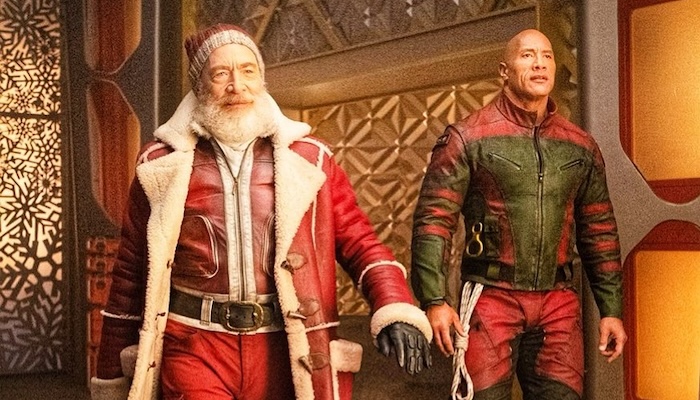
Yes, ol’ St. Nick (J.K. Simmons) has been captured.  His bodyguard is Cal (Dwayne Johnson), also head of security at the North Pole.  He is determined to get the bearded man in red back before Christmas Eve, and he partners up with a petty computer hacker mastermind, lacking any Christmas spirit, named Jack (Chris Evans).  The guys will argue with each other before they connect as buddies. You know how this works.  They’ll follow the leads to find out who and why “Red One” was taken. 

Red One works as a fun action picture with pretty cool and imaginative visuals like I’d count on from director/writer Jake Kasdan, son of Lawrence.  As a Christmas movie though? It needs a lot more tinsel.  

J.K. Simmons is not a conventional fat man Santa with a jolly “Ho Ho Ho.”  This dude is a weightlifter and, well, he talks like the guy from Whiplash and those Spider-Man movies.  Pair him up with the bruising Dwayne Johnson and this Santa is the morose police captain who would sit behind a desk, handing out the next Lethal Weapon assignment.  

The director of security is played by Lucy Liu, dressed in a black starched pantsuit, stressing the urgency of the problem.  Like the rest of the cast, save Evans, she takes Christmas way serious and that’s where the problem lies with Red One.  It’s not gleeful or celebratory of the holiday.  When she warns us that Christmas may not come, how am I supposed to respond to such a dire consequence?  Should I be scared? Am I supposed to laugh or cry?  When Doc Brown told Marty McFly he may be erased from existence, well you know that was pretty heavy (and not as trivial as something wrong with the gravitational pull of the earth).  When Lucy Liu and The Rock talk about NO CHRISTMAS of all things, I gotta wonder if I’ll get my annual Chinese dinner with my Jewish family.  Red One feels like a cliffhanger episode of NCIS.  Even Die Hard was more in line with the Christmas spirit than this flick.  John McClane declared his “Ho Ho Ho!” when he got a machine gun.  No one in this movie seems to have a sense of humor.  Chris Evans cracks some one-liners as if he’s shying away from the hokey script that everyone else embraces like a Tom Clancy novel.  

What works in Red One is the visual imagery of a wicked Christmas witch and assorted trolls and monster mayhem, particularly from Krampus (Santa’s gholish beast of a brother played by Kristofer Hivju) who gives a hilarious beatdown on The Rock.  There’s also a cute way to disarm some beastly polar bears who can encase our heroes in ice. The designs of the North Pole look cool as an industrial military base specializing in toy manufacturing.  However, we could have seen some cool gadgetry with this factory.  Instead, there’s a lot of underground mazes to circumvent that we barely get a look at amid the fast pace of the action scenes.

Cal is gifted with a power wristlet that packs a punch, shrinks him down for fighting advantages and has the ability to turn Hot Wheels cars into life size Chevrolet products for quick travel.  Naturally, Cal also knows that storage closets found in any toy store will transport you to another part of the world.  Nifty!  Not holiday spirited though.

The chases and fights work.  Johnson and Evans make for an okay buddy cop kind of pair.  The designs of the movie hold.  Yet, what’s missing is a spirit of Christmas magic.  Again, the holiday of Santa with his magical reindeer and cookies and stockings all feel hollow here.  Something is definitely missing because it’s hard for me to pinpoint who this film is catered for.  Families?  Red One comes off too nihilistic for that crowd ready to enjoy everyone’s comfort during winter break.  It’s too hokey just for the adults or the action movie lover.  A threat of Santa Claus missing with Christmas at risk also seems too overwhelming for the under 8 crowd.  

I got a kick at everything I saw on screen but there’s no one to connect with or empathize, and even for this Jewish guy, there’s an absence of Christmas tidings to behold from music to decor to the common recognizable tropes. Even when Santa poses as a shopping mall iteration, Simmons’ tough guy exterior doesn’t lend to any sort of joy or whimsy that comes with the holiday.

The sad irony is that Cal wants to retire because he sees more pessimism and materialistic selfishness in the adults these days.  Santa tries to convince Cal to reconsider as the spirit of the holiday will return.  If that’s true, then St Nick with a J. Jonah Jameson disposition does not offer much promise.  

These guys are rescuing Santa Claus like they are rescuing the President Of The United States, and frankly who the hell has liked any of the Presidents Of The United States of late?

RED ONE (2024)

by Miguel E. Rodriguez

DIRECTOR: Jake Kasdan
CAST: Dwayne Johnson, Chris Evans, Lucy Liu, J.K. Simmons
MY RATING: 8/10
ROTTEN TOMATOMETER: 30%

PLOT: After Santa Claus is kidnapped, the North Pole’s Head of Security must team up with a notorious hacker in a globe-trotting mission to (all together now) save Christmas.


Jake Kasdan’s Red One is by no means perfect, but it is not nearly as bad as the plethora of negative reviews would have you believe.  The Rotten Tomatoes website lists such jabs as:

  • “…forgettable as a first dusting of snow.”
  • “…offers big-budget visuals but lacks soul…”
  • And my favorite: “An ugly, under-lit, joyless slog, devoid of any holiday charm or sense of fun.”

Let me first address that “under-lit” comment.  I first attempted to watch this movie at our local AMC cineplex, and I noticed that the ads and previews were so dim that parts of the screen looked almost black.  I petitioned the manager to adjust the projector settings twice, but to no avail.  (“That projector has been giving us problems for two weeks.”)  When the movie started and it was just as dark as the previews, I gave it up as a lost cause, left and got a refund, and streamed it on Prime instead, and on our big-screen HD TV, presto, no more under-lit areas.  Everything was perfectly visible, clear, and bright.  So, it’s entirely possible that that reviewer’s issue with the screen being “under-lit” could have been a projector issue, and NOT a problem with the film itself.  Just wanted to throw that in there.

As far as those other negative comments go, well, I don’t know what kind of mindset those folks were in as they watched Red One, but it’s difficult for me to comprehend how anyone could call it “joyless.”  I found it charming and funny myself.  But then, when it comes to holiday movies, I have always been partial to the ones that attempt to provide logical solutions to the massive logistical problems involved in getting one man to travel the entire globe in a single night, delivering presents to every household that’s waiting for them.

For example, in The Polar Express, we are treated to a semi-industrial North Pole that runs like clockwork and (thanks to convenient time dilation) can get everything into Santa’s sleigh so he can dash away just before midnight. Red One ups that ante right from the get-go.

After he has taken a brief holiday in the city – masquerading as, of course, a mall Santa – the real Santa Claus, call sign “Red One” (J.K. Simmons), is driven to the nearest military airbase in an armored limo with a motorcade escort.  Accompanying him is his Chief of Security, Callum Drift (Dwayne Johnson)…because of course the real Santa would have a bodyguard.  It just makes sense.  Then, at the airbase, under blacked-out radar coverage, Santa’s state-of-the-art sleigh, powered by eight gigantic reindeer and carefully monitored by NORAD, takes off for the North Pole with a fighter jet escort.

I dunno, man, I just ate this stuff up with a spoon.  The imagination and attention to detail that went into creating this version of the Santa mythology brought a smile to my face for pretty much the entire movie.  Another example: I mentioned to my girlfriend that this version of Santa Claus is not very fat, which is usually a given.  But then there’s a scene where Santa lifts weights in a gym as Drift spots him, and I thought, okay, I can buy that.  Santa needed to drop a few pounds. It sounds absurd writing it out like that, but I’m telling you, for me it all made sense.

So, like I said, right away I was on board with the logistics of the story.  Then the real plot kicks in when Santa is kidnapped under everyone’s noses by a gang of bad guys who manage to infiltrate the North Pole’s highly sophisticated defensive measures.  The only way Drift and his colleagues will have a chance of retrieving Santa before Christmas Eve is with the help of Jack O’Malley (Chris Evans), a talented but amoral tech genius who claims he can track down anyone, anywhere, anytime.

There’s the usual backstory of Jack’s son who lives with his mother and her husband, and Jack was never father material to begin with, but the son is going to play in a concert on Christmas Eve, and so on.  I’m not saying this material is irrelevant, but for me it was secondary to my enjoyment of how the filmmakers were treating all the mythological/fantasy/sci-fi material.  We get talking polar bears [not the Golden Compass kind, the Zootopia kind], murderous snowmen who are seemingly invincible, tech gadgets that turn Matchbox cars into full-size vehicles [I want one!], a whole new use for Rock ‘Em Sock ‘Em Robots, and we even get to meet Santa’s brother.  Yep…his brother.

I mention all these details because they are what I responded to mostly during the film.  The plot?  The plot is, let’s face it, standard thriller fare, with a reasonably interesting big-bad and hidden connections and a few surprises, but because the filmmakers went to such great lengths to provide a fascinating backstory for all the mythological characters and how the North Pole is organized logistically, I didn’t particularly care if the story was perhaps shallow and mildly predictable to anyone who has seen more than 10 movies in their lives.  I’m not ashamed to admit it.

But because of how the filmmakers were telling the story this time around, I just ate it up.  Dwayne Johnson and Chris Evans are a decent screen pairing.  Bonnie Hunt as Mrs. Claus was a treat.  Lucy Liu was perhaps the most wasted of the entire cast, although she does get one very brief kicking-ass scene.  The motive behind Santa’s kidnapping was credible.  There was nothing in the movie that broke its own set of rules, which is more than I can say of quite a few would-be thrillers out there.

Heck, I’m just gonna say it: Red One is the Galaxy Quest of Christmas movies.  You either buy into the preposterous, but logically sound, premise and laugh for a while, or you don’t.  As for me, I’ll be watching this one again next Christmas.  Or maybe sooner.

SCROOGED

By Marc S. Sanders

Bill Murray with director Richard Donner delivered their contribution to the Charles Dickens assortment of A Christmas Carol iterations with a modern update called Scrooged.  Until now, this movie eluded me.  Yet I can’t deny it has all the ingredients for a sure-fire green light to make the movie.  Bill Murray? Doing Ebenezer Scrooge?  Stop everything people!  Get this ready for December.  STAT!

Unfortunately, it misses the mark.  

Now, I’m supposed to like this miser by the end of the story, right?  So then why is Murray’s personification so annoying and unappealing by the end? If I was his nephew, I’d rescind my invitation to come over for Christmas dinner.

The best and most hilarious part of Scrooged occurs in the beginning following the easily recognizable Danny Elfman instrumentals.  Santa and his elves are happily making toys when suddenly terrorists attack the North Pole and Lee Majors jumps out of nowhere ready to bear arms with ol’ St. Nick and his crew.  I was sad to realize this was only a TV commercial for the station programming that Murray’s character oversees.  If there is a God, he’ll reveal the location of the lost film for The Night The Reindeer Died.  Earlier this year I saw Lee Majors needlessly squandered away in the terrible Fall Guy adaptation.  It crushes me that he got this same kind of treatment over thirty years prior.

Bill Murray is the uncaring and thoughtless Frank Cross.  When we meet him on Christmas Eve day, he’s firing an executive (Bobcat Goldthwaite) for simply disagreeing with him.  Also, in typical overplayed Bill Murray fashion, Frank insists that his assistant Grace (Alfre Woodard) ignore the needs of her family during the holiday and get work done with him.  Grace of course filling in for the Bob Cratchit role.  

Following a few other gags to parade the comedian’s antics around, Frank is encountered with the Jacob Marley stand in, played by John Forsythe.  At this point I’m still with the picture even if the breadcrumbs are easy to follow.  Forsythe, in his grotesque makeup, works well against the clown who leads this movie.  (Not a bad scene together between Charlie and Bosley. “Hello Angels!”).

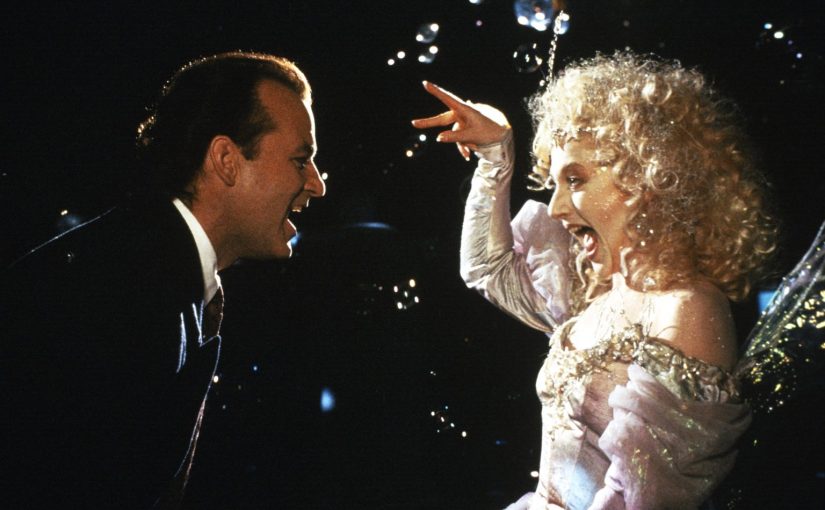
It’s when the follow up ghosts make appearances that my mind ponders what I’ll be writing about in this review.  Ghosts of Christmas Past (David Johansen) and Present (Carol Kane) enter on cue and right away I grew bored and uninterested.  

Johansen is a cabbie, or just another screeching screamer like Murray.  He’s laughing at Frank’s demise and past missed opportunities, but I’m not seeing what’s funny or even heartbreaking.  Neither theatrical mask of comedy or tragedy is functioning.  Carol Kane does her typical schtick with the high-pitched baby talk voice, dressed in a fairy get up.  Beyond that familiar routine, she commits every kind of Three Stooges smack and painful tug on Frank’s face that you can imagine.  Why of all things does she rely on a toaster to upper cut the jerk in his face?  I mean why a toaster???? If the comedy works, then I should not be wondering why a toaster or a pie or two by four or an anvil.

There’s nothing wisely written here.  The screaming and the smacking get old very fast and it gets in the way of a potential love story passed by that the script was promising for the Frank Cross character and his crush Claire (Karen Allen, whose smile always lights up a room).  I never felt like Bill Murray was ever listening to Karen Allen in the scenes they share.  Did they even rehearse this stuff?  Too often, Bill Murray seems to just be winging it, and it wouldn’t make a difference if Karen Allen even memorized her lines.

Scrooged starts out with fresh, quality made National Lampoon material but then waddles into the same typical chapters of Dickens’ holiday story.  However, while it hammers the familiar story beat by beat and you tell yourself there’s the Fred character and there’s the mute kid covering for a crippled Tiny Tim and there’s Yet To Come, you got Bill Murray who was granted too much artistic license to improvise, and has thus squeezed out all of the sensitivity and spirit that we expect from A Christmas Carol.

I’m sorry but I think I liked this Frank Cross a whole lot more before he was visited by the ghosts.  This is one Scrooge who should’ve been allowed to sleep through Christmas.

PS: If anyone can find a DVD print of The Night The Reindeer Died, I’m ready to review it.