THE KILLERS (1946)

by Miguel E. Rodriguez

Director: Robert Siodmak
Cast: Burt Lancaster, Ava Gardner, Edmond O’Brien (and William Conrad in a small role…and yes, he was a big fella even then)
My Rating: 8/10
Rotten Tomatometer: 100%

PLOT: An insurance investigator tries to get to the bottom of a strange case involving a man who waited calmly for two men to find him and kill him.


Over the last several months, I’ve been digging a little more into the film noir genre, specifically going back to the ‘40s and ‘50s, and I’ve discovered some gems.  Pickup on South Street (1953), for example, featuring one of the most violent fight scenes to be found outside of a Tarantino film.  Or The Killing (1956), an early Stanley Kubrick film depicting the kind of ruthless behavior that I didn’t think was permitted at the time.  I’m discovering that, for the adventurous moviegoers back then, there were films available to see that might have made their parents or grandparents gasp in horror.

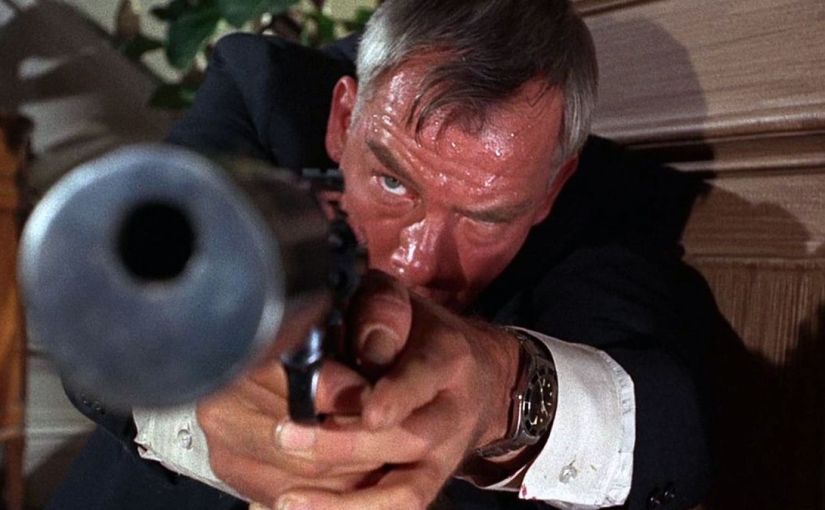
Take the movie I watched today, The Killers (1946), the film noir that introduced Burt Lancaster to the world.  It’s based on a short story by Ernest Hemingway that was also adapted into a film in 1964, starring Lee Marvin, Angie Dickinson, and, in his last film role, Ronald Reagan.  [Watch this space for a review of that film, coming soon.]  At the beginning of this movie, we’re introduced to two thugs who walk into a small town, cloaked in the kinds of shadows and light that only film noir can get away with.  After terrorizing the patrons of a small diner, they walk to a nearby boarding house and up the stairs to a room occupied by Ole Anderson, aka “The Swede” (Lancaster), who has been alerted to their arrival but makes no effort to escape or call the cops.  He simply awaits his fate.

And what a fate.  The two thugs burst into the room and obliterate the Swede in a hail of gunfire that goes on for quite a long time, even by today’s standards.  (Later, the coroner describes the Swede’s body as being nearly “cut in half” by the barrage…yikes.)  This being 1946, we don’t see any of the actual carnage, but the implication is there.

The movie proceeds in a series of flashbacks.  An insurance investigator named Jim (Edmond O’Brien) tries to find out two things: why the Swede named a kindly hotel maid as beneficiary of his life insurance policy, and what happened to the $250,000 payroll that the Swede helped steal from a hat factory.  Now that I think about it, The Killers is almost like a thick-necked, brass-knuckles, gun-toting variation on Citizen Kane.  We never see anything about the Swede that wasn’t directly observed by someone Jim tracks down, and as Jim continues to dig, things just get mysteriouser and mysteriouser.

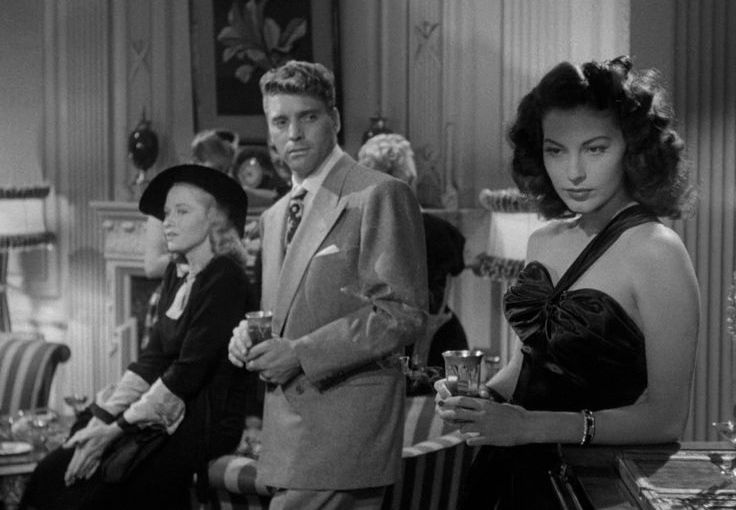
Figuring prominently in the Swede’s backstory is Kitty Collins, played by the ravishing Ava Gardner.  This was not her first film, but The Killers is the movie that put her on the map for good.  We first see Kitty when the Swede goes to a fancy party with his girlfriend, Lilly.  Alas, Lilly is no match for the sultry Kitty, who is wearing the kind of stunning black gown that inspires poetry when it isn’t simply driving men crazy.  How crazy?  At one point, when Kitty is caught by a cop wearing shoplifted jewelry, the Swede claims responsibility, slugs the cop, and winds up doing three years in jail for her.  Talk about being Kitty-whipped.

Naturally, as Jim, the insurance guy, meets more people, the Swede’s story comes more sharply into focus, but there’s still the mystery of what happened to all that money.  The robbery was indeed pulled off by the Swede with three other guys, but none of them have the money, and the Swede doesn’t have the money, so where is it?  As it turns out, the hat factory they stole from is insured by the same company that provided the Swede’s life insurance policy, so it’s in Jim’s best interest to get to the bottom of everything and recover the money, even if it means getting involved with the same kinds of thugs who killed the Swede in the first place.  That’s okay, though.  Jim is prepared.  He carries his own piece, and he comes up with a cool plan to get the guilty parties to confess as much as possible before they wind up dead…or he does.

The Killers is an example of a film that helped define, or at least refine, the relatively new film noir genre.  Similar films centering on crime, criminals, and punishment had been around since the ‘30s, but the real granddaddy of them all, The Maltese Falcon, had only been released five years earlier in 1941.  Since then, World War II came and went, and as dark as noir had been, it got even darker and more violent than Bogey was when he slapped Peter Lorre around.  With this film, director Robert Siodmak turned everything up to eleven.  The shadows aren’t just dark, they’re black, which of course makes the periodic pools of light that much more striking.

And the characters mean business, too.  Among the bad guys, there’s one named Colfax who doesn’t look like much – sort of like a moderately well-built school principal.  But when a genuine thug threatens to fight him, he doesn’t posture like a bully.  He just sits back in his chair and calmly tells the thug: “You’ve got quite a reputation yourself.  You’re supposed to be a troublemaker.  Okay.  Make some.”  And you just know that if the thug so much as lifts a finger, he’ll get it broken for his trouble.  It’s an interesting scene that reminded me of Goodfellas: “Paulie may have moved slow, but it was only because Paulie didn’t have to move for anybody.”

(I should also mention the flashback involving the payroll robbery.  In today’s films, when we marvel at long takes involving complicated camera moves, it’s good to be reminded that, three-quarters of a century ago, The Killers gave us a heist sequence that starts at ground level, follows the robbers up a staircase, shows the actual robbery, follows them back down into their getaway cars, and even provides a small-scale shootout as they drive away – all in one uncut take, using a camera about the size and weight of a SmartCar.)

While I thoroughly enjoyed The Killers, I wouldn’t quite put it in the same weight class as, say, Out of the Past or The Big Sleep, but it’s got all the right ingredients, it tells a good story well, it gives us Ava Gardner in that gown, and it provided a great springboard for the films that came after.  Good film noir is fine; GREAT film noir is better.  This is one of the great ones.

[P.S.  The scene near the beginning of the film where the two thugs terrorize the people at the diner reminded me strongly of the scene in No Country for Old Men when Anton Chigurh quietly tells the store clerk to “call it.”  They were just as calm and serene and tightly coiled as Chigurh.  Pretty creepy.]

IN THE HEAT OF THE NIGHT

By Marc S. Sanders

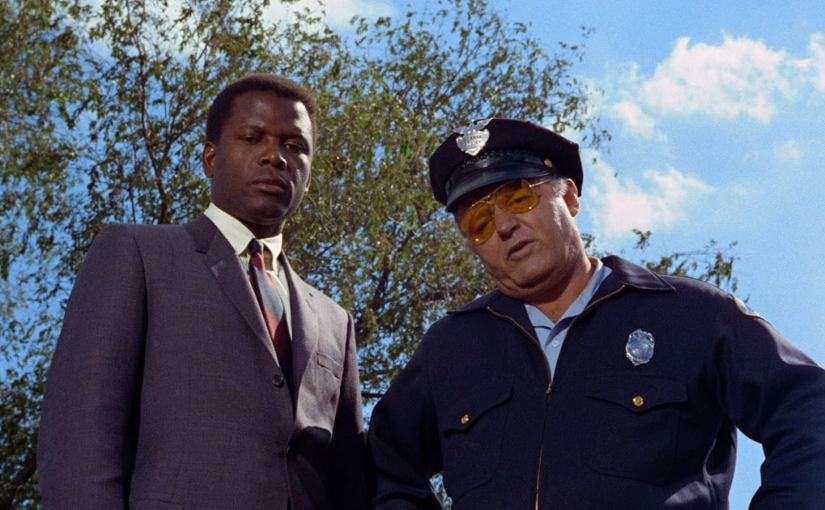
In 1967, just before the assassination of Dr. Martin Luther King Jr, Norman Jewison’s film In The Heat Of The Night won five Academy Awards including Best Picture, Best Actor for Rod Steiger and Best Adapted Screenplay by Sterling Silliphant.  While it is easy to classify the movie as a crime drama/murder mystery/detective story, the setting and themes of racial prejudice overshadow who the killer is or the motive.  As the film progressed, I grew less curious of who bludgeoned white businessman Philip Colbert to death and why.  It was much more important to understand exactly why Steiger’s Mississippi Police Chief Gillespie is so quick to believe that a well dressed and cooperative black man who was simply apprehended for waiting at a train station would be the culprit.  The black man is Virgil Tibbs (Sidney Poitier), a Philadelphia police detective.

After Tibbs has an opportunity to identify himself, Gillespie shamelessly requests his services in solving the crime.  Murder doesn’t happen often in Sparta, Mississippi.  Tibbs’ supervisor speaks highly of his officer’s capabilities.  Tibbs knows how to look for signs of rigor mortis on the deceased.  He knows how to identify that the killer was right-handed and he knows that when another suspect is quickly brought in, that he can’t be the killer either.  Still, many of the heated conversations between Gillespie and Tibbs are the same.  Their back and forths even become redundant at times.  Gillespie, nor the deputies and other residents of Sparta, are apt to listen to a “colored” person.  At one point, Tibbs is put in a cell for not agreeing with Gillespie’s conclusions.  He’s also ordered on two or three occasions to get out of town.  Tibbs is not so willing to surrender though, even if he’s regarded with racial disdain.  The impression is that this murder will not be so challenging for Tibbs to solve, if only he had a little more time and cooperation.  So, the riddle of the crime is not the overall conflict of In The Heat Of The Night.  More so, it is the racial hatred that a deep south Mississippi town has for an educated and skillful black man from up north.  

I read that the film was shot primarily in Sparta, Illinois.  Poitier made that request for his own safety while a tense period within America was occurring against the backdrop of the civil rights movement.  Jewison’s film is quite brave.  In the face of racial divide within the United States, this film still got made.  Yet, it had to be produced with an abundance of caution. 

A telling scene happens in the middle of the picture.  Tibbs requests Gillespie escort him to a wealthy cotton plantation owner’s home.  As they drive up to the home, they pass by the black cotton pickers collecting the crops under the hot sun.  They meet in the estate green house with a Mr. Endicott, who comes off very cordial to Tibbs at first.  However, when a slight accusatory question comes from Tibbs, Endicott slaps him across the face.  Tibbs responds with a slap right back at him.  In Mississippi, a black man better know his place, even if the prime suspect of a murder is a wealthy white man, or more simply just white.  It’s a classic moment in film history.  However, it remains an important scene and maybe its significance should be all the more heightened in modern day 2022 with the Black Lives Matter mentality at the forefront; where police/African American race relations are being tested. 

Three white men were recently sentenced to life in prison without parole for the hate crime killing of a black jogger named Ahmaud Marquez Arbery in the state of Georgia.  All that Mr. Arbery was doing was jogging through a neighborhood.  He didn’t have a weapon.  He hadn’t come in contact with anyone to even slightly suspect a threat.  He was noticed by these three criminals, and because he didn’t belong in that area, he was brutally murdered for the color of his skin.  Evidence would reveal where these men stood with regards to black people as a history of various texts that were clearly racial in nature were later uncovered.  If it wasn’t going to be Mr. Arbery who was murdered, it was eventually going to be another black person who would fall victim to these men. 

Though Dr. King was murdered shortly after the release of In The Heat Of The Night, I’m cautiously optimistic that racial hatred has lessened and the generations that followed learned from the misgivings of their ancestors.  Still, the term “hate crime” is often used in news reports today.  The debate of the Confederate flag and its argument for keeping it flying still has to be pondered.  Fifty years later, I cannot understand why, though. 

I will never forget a vacation I took with my family to Stone Mountain in Georgia back in 2005.  It was fourth of July and we were picnicking on the lawn next to a couple of teenagers while waiting for the fireworks.  I struck up a conversation with a local teenage girl and the flag and the confederacy along with the carving of Confederate leaders (Stonewall Jackson, Robert E. Lee and Jefferson Davis) on the rock sight were brought up.  Her defense of these topics was “It’s history.  Not hate.”  I became much wiser in that moment.  I was just a naïve Jewish guy who was raised in New Jersey.  I was not aware enough.  Much still hadn’t been learned and a whole lot needed to be unlearned.  History is not a reason to celebrate.  History is not meant to honored.  History is meant to be remembered for our rights, and especially our wrongs.  Much of history should not be repeated, and yet that’s what happens all too often.

In The Heat Of The Night is another example of the power of films.  So much is debated about what is taught in our schools.  A proposal of law for “Don’t Say Gay” is likely to be passed in Florida where it’s deemed impermissible to discuss homosexuality in elementary schools.  Books are continuing to be restricted from availability in libraries.  So, if our institutions of learning are being censored, then we have to rely on other mediums.  Movies like Schindler’s List or In The Heat Of The Night or Do The Right Thing offer those opportunities.  Films open a window to view love and hate as well as tolerance and prejudice.  We can never afford to look at our world with rose colored glasses.

ELEVATOR TO THE GALLOWS (1958, France)

by Miguel E. Rodriguez

Director: Louis Malle
Cast: Jeanne Moreau, Maurice Ronet, Georges Poujouly
My Rating: 10/10
Rotten Tomatometer: 93% Certified Fresh

PLOT: A married woman and her lover hatch an apparently foolproof plan to kill her husband (his boss), but a split-second decision at a crucial moment sends everything into a tailspin.


We plan, God laughs. – old Yiddish proverb

Let me get this out of the way right at the top: Elevator to the Gallows is one of the best crime drama/thrillers I’ve ever seen.  It holds its own against anything by Hitchcock or Clouzot.  With admirable focus and restraint, first-time director Louis Malle (My Dinner with Andre, Vanya on 42nd Street) crafts a gripping illustration of how the best laid plans can fall apart because of one minor miscue.

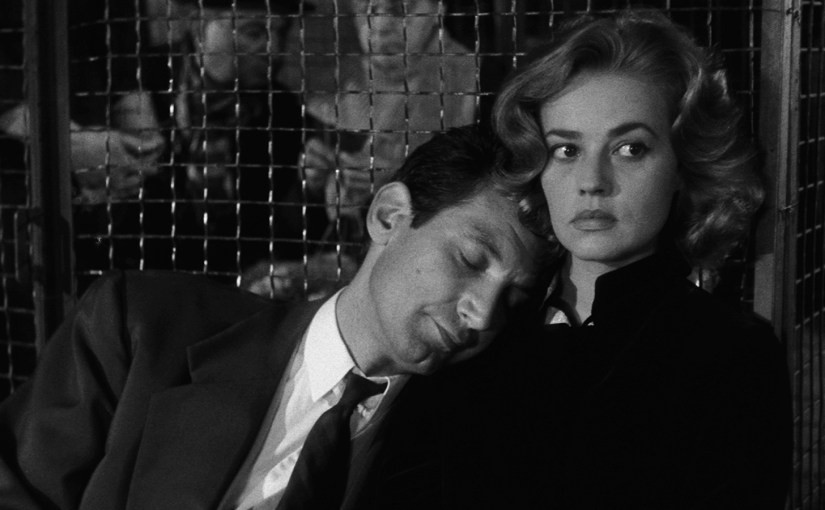
The film cuts right to the chase at the opening scene, showing a phone conversation between Florence Carala (Jeanne Moreau) and her lover, Julien Tavernier.  They discuss their plans for Julien to kill her husband in his office on a Saturday evening, after which he’ll pick her up at a café where she’ll be waiting, and that will be that.  Everyone will assume her husband is in Geneva on business, and no one will discover the murder, which Julien will arrange to look like a suicide, until Monday morning, giving Florence and Julien plenty of time to make their escape.

(I liked how we never got any flashbacks of the relationship between Florence and Julien.  All we need to know is, they’re lovers, they’re desperate enough to commit murder, and that’s it.  Very concise.  I love it.)

Julien’s plan involves using a grappling hook to avoid using the office elevator to get to his boss’s office one floor above his.  He proceeds with the plan, nearly getting caught in the process, but he’s able to commit the crime and leave the building with several witnesses as an alibi, witnesses who will say they never saw him enter his boss’s office before he left.  So far so good.

Julien gets to the street, takes the top down from his convertible, takes one last look back at the building…and realizes he left a vital clue in full view of any pedestrian or street cop.  Leaving his car running, he decides to run back into the office building and retrieve the evidence before the night guard shuts off the power for the night.

Unnoticed by Julien, a florist and her bad-boy boyfriend have been having an argument at the shop next to his car.  The boyfriend sees this rich man leave his convertible on the street…with the engine running…

Thus begins a Hitchcockian odyssey that leaves Julien stranded in an elevator, his car and his identity stolen, and his mistress stranded on the streets wondering where the hell her lover is.  At one point, Florence sees Julien’s car drive by the café where she’s waiting…she can’t quite make out the driver, but who is that girl in the car with him?!  Has she been betrayed at the last minute?

The film follows the younger couple, Louis and Véronique, as they tool around in Julien’s car, eventually winding up at a roadside motel, and unwittingly making friends with two German tourists.  They even share drinks with the Germans and take some candid photos using a little spy camera in Julien’s raincoat.  (We learn that Julien was in the Foreign Legion and was well-trained as a soldier – maybe even in spycraft.)  I found myself wondering why we were wasting time with this larcenous couple…until they decide to check into the motel as Mr. and Mrs. Tavernier to cover their own tracks.

The screenplay ingeniously heaps one hasty decision on top of another so that, just when it seems Julien might be in the clear, something else happens that makes it seem impossible he won’t be discovered or at the very least blamed for something he didn’t do.  Meanwhile, Julien is desperately trying to escape the elevator, using a penknife as a screwdriver, getting excruciatingly close to tripping a vital switch that’s just out of his reach.  He eventually tries to get out using the old climbing-the-cable trick…which is of course exactly when a night watchman is making his rounds.

This story is so good, I can’t believe there hasn’t been an American remake.  And it’s not like there aren’t other great films out there that cut right to the chase and never look back for flashbacks or additional material.  I’m not sure what makes Elevator to the Gallows so good, to be honest.  Maybe I was rooting for Florence and Julien when they are clearly not the good guys.  Maybe it’s the economy of the storytelling, or the screw-turning twists that lead the police to believe Julien has committed more than one murder.  At one point, Louis and Véronique make a startling decision that had me yelling at the screen.

Words fail me on this one.  I can’t describe it any better than by saying this is one of the best films I’ve ever seen, certainly one of the best film-noirs I’ve ever seen, and a movie that I’ll bet Hitchcock watched while thinking to himself, “Damnation…I wish I’d thought of that.”

BRUTE FORCE (1947)

by Miguel E. Rodriguez

Director: Jules Dassin
Cast: Burt Lancaster, Hume Cronyn, Charles Bickford, Ann Blyth
My Rating: 9/10
Rotten Tomatometer: 94%

PLOT: A convicted felon tries to organize a prison break under the nose of a sadistic chief guard who is on the verge of becoming the new warden.


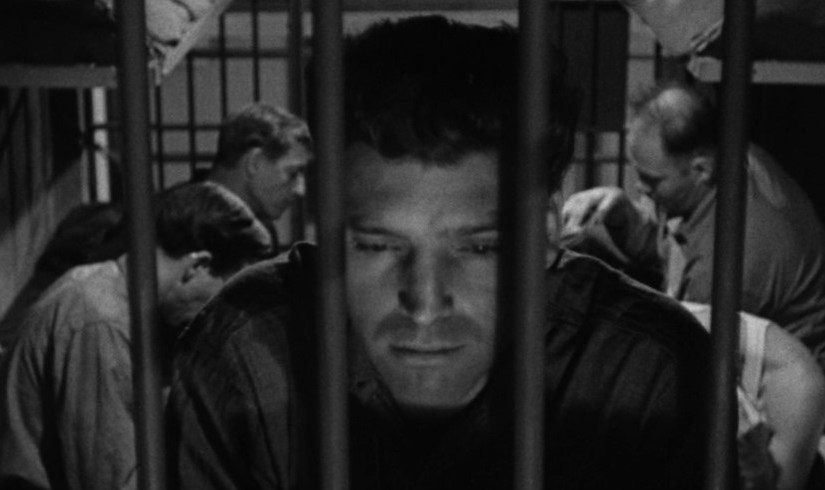
In Brute Force, released seventy-five years ago, we are witness to: a man getting crushed by a metal press, a suicide, a brutal interrogation with the help of a length of metal pipe, a prisoner machine-gunning dead cops out of sheer frustration (okay, you got me, that part is off camera), and the kind of nihilistic ending that you typically only see in old French films.  Wages of Fear, for example.  I mean, this movie is violent by TODAY’S standards, let alone just a couple of years after World War II ended.

Joe Collins (Burt Lancaster in only his second film) is just getting out of solitary confinement at Westgate Penitentiary when he sees one of his cellmates being driven out of prison…in a hearse.  This only solidifies his resolve to escape with the help of his remaining cellmates.  Meanwhile, we get glimpses of life elsewhere in the prison.  The current warden is a trembling coward who addresses the prisoners only through a P.A. system in his office.  The prison physician, Dr. Walters, sees injustice and top-down barbarism on a daily basis and has his own method of escape: whiskey.  Inmate informants and stool pigeons are dealt with promptly and carefully.

Looming above everyone, despite his relatively small stature, is Captain Munsey (Hume Cronyn).  He has the real power at Westgate.  He rarely raises his voice and even stops his lieutenant from beating a prisoner unnecessarily.  But he unflinchingly doles out punishments and even strong-arms other convicts into ratting out their buddies.  Of course, the stoolies are usually found out and wind up dead.  Shame about that.

The crux of the story is the escape plan, an ambitious endeavor involving capturing the yard tower which controls the gate and lowers the drawbridge – an actual drawbridge! – to the mainland.  Between making these plans and various other intrigues involving the warden and an imperious visiting government official, we are also treated to flashbacks showing how some of Joe’s cellmates wound up in prison to begin with.  Here the film gets a little overly melodramatic, a typical trait of many dramas of the ‘40s, but director Jules Dassin wisely doesn’t dwell on them for too long.  The scenes do just enough to create more audience empathy for these “bad men” without bathing in soap.

I put “bad men” in quotes because these guys are, in fact, criminals, but they’re also our protagonists.  When it comes to Joe himself, it seems clear by his demeanor and his flashback that he wasn’t just a criminal, he was a leader of criminals, head of his own little gang.  This is not a very nice man.  The only convict sharing a cell with Joe who might conceivably be considered a “good guy” is Tom, a man who embezzled money from the company he worked for to buy his frustrated wife a fur coat.  Everyone else looks capable of perpetrating real violence.

Why do we root for these men?  Partly because it’s in our nature to support anyone who is out to give authority figures the finger.  From Cool Hand Luke all the way to Hannibal Lecter and beyond, we are instinctively drawn to men and women who are bucking the system.  But it’s especially prominent in this movie where we see these men at the mercy of a broken system that eventually revokes all their privileges, even visiting hours, in the name of restoring discipline.  Armed guards watch the prisoners everywhere, even in the chapel.  There is no longer any attempt at actual rehabilitation.  In the prison’s auto garage, a prisoner is asked what he’s learned while working there.  His answer: “I’ve learned that, when I get out, I don’t wanna be a mechanic.”  He hasn’t learned anything.  He’s just learned that it’s better to not get caught.  For this we pay our taxes?

So, yes, there is a strong message in Brute Force.  It’s not especially subtle, especially during the liberal Dr. Walters’ various monologues about the corrupting nature of power and the futility of expecting lasting behavioral changes through punitive measures.

But what stood out to me was the unexpected level of violence in the story.  Sure, some of it is discreetly left off screen, but what is left to the imagination can be infinitely worse than what the screen shows us.  Case in point: Se7en, where we are always shown murder scenes, never the murders themselves.  Or the infamous ear scene in Reservoir Dogs, where we never actually see the deed being done, yet it’s remembered as one of the most violent scenes in film history.

In Brute Force, during an interrogation, we see Captain Munsey winding up to deliver several blows with a lead pipe to the head of a handcuffed prisoner.  We push past the prisoner, so we only see Munsey, and down comes the first blow.  We hear the impact, then cut to just outside Munsey’s office where other officers are killing time playing cards or writing reports.  And through the doorway we hear more impacts, one after the other after the other.  Some officers look uncomfortably toward the office but make no move to stop what’s happening in there.  One officer is so disturbed he throws down his cards and stalks away.  Right away, we’re thinking, jeez, if HE’S that upset, something terrible is going on in that office.

This is not the kind of “realness” I was expecting from a 1947 film.  And it doesn’t end there.  There are other little vignettes of violence during the climactic escape attempt that made me gasp, including a hand-to-hand fight where one guy appears to be getting hit in the head and neck with a belt of machine gun bullets…for real.  At least twice.  Looked convincing to me, anyway.

Jules Dassin (1911-2008) is known for directing some of the best loved film noirs of all time, including The Naked City [1948], Night and the City [1950], and Rififi [1955], which won him the Best Director award at Cannes that year.  His best films are steeped in atmosphere and a fatalistic sense of…well, fate, an idea that no matter how hard we kick and scream at the walls of our existence, any attempts to escape will be met with massive resistance and will most likely end in failure, or at best only a partial victory.  Not a particularly uplifting outlook, but who says all movies must have a happy ending?  Sometimes you get the bear, sometimes the bear gets you.  By the end of Brute Force, Dassin ingeniously combines those two outcomes.  Tricky.

INTERNAL AFFAIRS

By Marc S. Sanders

Internal Affairs has a promising start as we see Richard Gere as decorated officer Dennis Peck compromise a police shooting in favor of his fellow officer (Michael Beach) who has just shot a fleeing unarmed suspect in the back. Right away it’s apparent that Gere is the bad guy here and soon we will see how Andy Garcia as new Los Angeles Internal Affairs officer Raymond Avila will investigate Peck for his violations. Unfortunately, the movie from director Mike Figgis reduces itself to simply having the male characters of the film, including William Baldwin as another dirty, drug addicted cop, physically abusing the female characters around.

This film from 1990 shows its age for sure with frizzy hair sprayed dos and large lapel jackets and skinny ties, but that was not my main issue. It would not be until 2006 in the Martin Scorsese film The Departed that we would see what I was hoping for with Internal Affairs; how a dirty cop works, and how the righteous cop gives pursuit. If only Figgis’ film was smart enough to focus on the method behind Dennis’ actions of crime and police superiority. Instead, we get a Richard Gere who actually shows he can play an effective bad guy, psychologically messing with Andy Garcia’s character by giving him the illusion that he’s having an affair with his wife. What’s Garcia’s response to this? He slaps his wife, played by Nancy Travis, in the middle of a crowded restaurant. When the two clear the air about what’s going on, they slap each other again before making up.

Gere also slaps and physically threatens his own wife played by Annabella Sciorra to drive the point home that she better not talk to the Internal Affairs department. As well, Gere also slaps around his mistress, a wife of one of his criminal associates. William Baldwin’s character slaps around his wife too. You seeing a pattern here?

It’s one thing to depict domestic abuse in film. There’s room for that. Because it sadly happens all too often, it’s appreciated if it’s handled with sensitivity. Here though, the abuse against women is used as a punchline to a scene, one after the other, and the overall theme of the picture is not supposed to be domestic violence. It bothers me that Mike Figgis tosses this kind of material around like effective drama, seemingly trying to make it look sexy to smack a good looking woman around by a good looking man. About the only woman in the cast not to get abused is Laurie Metcalf as Garcia’s lesbian mentor and partner. She gets referred to as a “dyke,” by both the villain and the hero of the film. This is just a very cold, thoughtless picture that runs short on imagination.

How does Garcia get the idea to investigate Gere’s character? He just has a sneaky feeling about the guy. That’s all that’s necessary to move things along here. In a better police film like The French Connection, the cops were displayed with step-by-step surveillance tactics that first put them on to a low rent street hood that ultimately leads to something bigger. We saw a method to their instincts that led to something tangible and proof worthy. I wish Mike Figgis, with a screenplay by Henry Bean, delved more deeply into what made the Dennis and Raymond characters so good at what they do. Films like Heat and Dirty Harry explore those backgrounds. Internal Affairs just takes the cheap shots of beating and dominating the women in these characters’ lives, while never showing the drive for what they do. Ultimately, the film comes up short sighted, and especially very, very insensitive. This is just an abusive film.

21 BRIDGES

By Marc S. Sanders

What a huge loss it is to no longer have Chadwick Boseman after being taken so early in life by cancer.  His heroic role in Black Panther is what is arguably celebrated most.  However, even a small, standard cop film like 21 Bridges is evidence of his magnetism on screen.

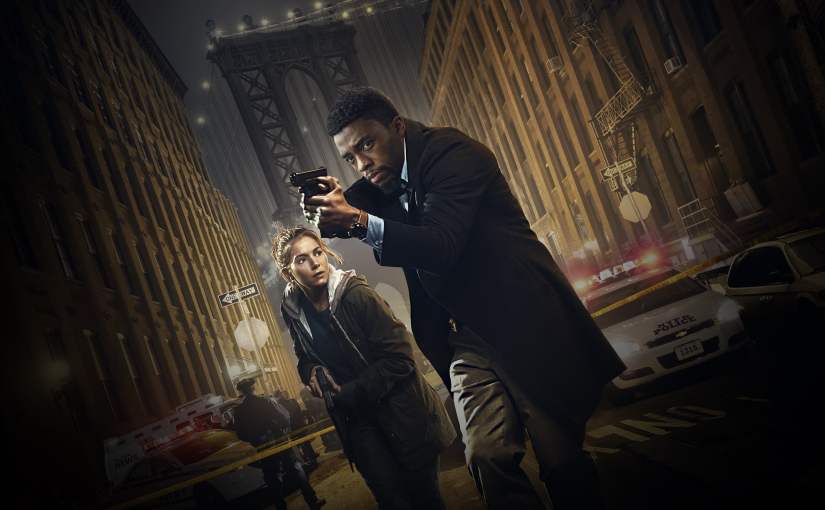
In this movie, Boseman portrays Andre Davis, a New York police detective who is under investigation by Internal Affairs for an abundance of shooting incidents.  Yet he is still on the beat.  When he is summoned to the aftermath of a violent crime scene after midnight in Manhattan, it is up to Andre and his new partner Frankie Burns (Sienna Miller) to track down two killers who ran off with a large supply in cocaine while taking out seven police officers in the getaway.   The best way to catch the bad guys is to shut down the twenty outlets off of Manhattan Island. That means all bridges, tunnels and ferries are closed off until sunrise.  Now it becomes a closed off maze to locate and apprehend the men.  One problem for Andre and Frankie is that the entire police force is looking to taking out the suspects as punishment for killing their comrades.  Andre is actually not the shoot first cop he’s unfairly being characterized as, though.  Sounds simple and familiar, yes.  However, Andre slowly realizes that there may be a complicated conspiracy involved. 

Directed by Brian Kirk, 21 Bridges won’t rank up there with Andrew Davis’ The Fugitive or even the best of the Dirty Harry installments, but the film moves at a brisk pace and the action is spectacular, and at times unexpected.  The early heist of the drugs from an underground wine cellar is fast and shocking when a shootout erupts that goes for a thankfully suspenseful long time.  Kirk doesn’t make it easy for the bad guys (Steven James, Taylor Kitsch) to make their escape.  When they do, the desperation is engaging. 

While this picture didn’t generate much box office success, there’s no question that Boseman would have been a go to leading man in the same vein as Keanu Reeves or Tom Holland has become. My theory: it should not have been released against blockbuster power hitters. Had it come out in January or February, this would have been a sleeper hit for sure. Boseman looks great as the hero and righteous cop, competing with the standard police veterans (JK Simmons) who remind the hero he doesn’t know what he’s talking about, etc.  We, the viewers, know better though.  Boseman looks very cool and athletic in his dark blue overcoat and drawn pistol, running through the streets of Chinatown or within apartment staircases and hallways as he maintains the chase.  Chadwick Boseman is just a solid leading man.  No question about it.

The script by Adam Mervis and Matthew Michael Carnahan is full of surprises that fit in the sense of the picture.  Nothing comes out of left field, but I wasn’t looking for surprises either.  So, when a new development presented itself, I appreciated it.  It kept the movie alive.

So again, Chadwick Boseman is huge loss within the Hollywood ranks.  I read that a sequel was considered.  I would have liked to see that with Boseman reprising his role because it’s a good part for him.   

If you have grown tired of watching the Marvel and Star Wars films and series for the 50th time and you’re looking for something new, seek out 21 Bridges.  It’s a first-rate solid crime thriller.

THE ENFORCER

By Marc S. Sanders

It’s no surprise that Harry Callahan is a chavaunistic son of a bitch. He has never been one to be shy about his prejudices, after all. In 1976, viewers found it endearing in an ironic way. Today, the character would never be produced into a studio film.

The third entry in the popular Dirty Harry series called The Enforcer is good but does not hold up as well as I remember. By the end, Harry must upgrade from blowing the bad guy away with a bazooka. He can no longer settle for his trusty .44 Magnum. It makes sense. Make everything your protagonist normally does do the same thing he’s always done, only make it bigger, and more actiony!!!! Not much interest in the on-screen chemistry that Clint Eastwood will have with said bazooka though.

Fortunately, there’s a better angle here and that is through actor Tyne Daly, as Harry’s new partner. Daly is terrific as one of San Francisco’s first female Police Inspectors who has to live up to the muster of a violent city as she accompanies a violent cop. It’s a great character that draws out feelings in Harry. She gives him pause to care and think beyond himself. Eastwood and Daly are where the chemistry is really at.

Everything else is kind of a waste really. Callahan never goes toe to toe with the main bad guy, a leader of a militant group terrorizing the city. This villain is nothing great or exciting.

Still, beyond Daly there are some great action scenes such deescalating a liquor store hold up by plowing a squad car through its front door. Makes sense, right?

SUDDEN IMPACT

By Marc S. Sanders

The very first R rated picture I ever saw in theaters was the fourth installment of Clint Eastwood’s Dirty Harry franchise, entitled Sudden Impact.  I was eleven years old and I loved it.  My brother Brian took me with his best friend Nick.  Age 11 and I’m in a crowded theater on a Saturday night watching a brutally violent and sometimes funny crime drama with the cop who carries the .44 Magnum.  Looking back, it felt like a rite of passage.  It felt rebellious.  I’d now be the coolest kid in school as I recount for them everything I was allowed to see that their parents refused to even consider.

Brian introduced me to many of what remain my favorites this very day.  He introduced me to Jackie Gleason in The Honeymooners,and then at age 8 or 9 I must have watched the first of Eastwood’s series, Dirty Harry, on video tape.  At that age, you just want to get to the next shootout where Harry allows his bloodletting revolver do the talking while he finishes his hot dog.  I watched those first three films (Dirty Harry, Magnum Force and The Enforcer) over and over again.  As an adult, I more so appreciate the themes of the San Francisco cop, Harry Callahan.  He always had a low tolerance for the bureaucratic BS of court procedure and legal precedent.  He was always smart enough to know who the real bad guys were and that was enough to bring them in. If they didn’t cooperate, well then there were other means. 

The first two films in the series question Harry’s procedures and philosophies.  The third film, although entertaining to a degree, deviated from that.  The fourth film returns to test Harry’s beliefs in police enforcement and justice.  Only this time, it’s actually from the perspective of a gang rape victim, played by Sondra Locke.

Much of the first hour of Sudden Impact is episodic.  Scene after scene shows Harry’s encounters with various hoods that he has a connection too.  Harry disrupts a wedding to undo a vicious mobster.  Later, those guys try to take him down.  Some punk kids get off on a technicality in court.  They’ll have something to say to Harry as well, and just in case you need a little more action, there is that very memorable coffee shop robbery where Harry tempts all of us to “Go ahead.  Make my day.”  There’s also good laughs as Harry is gifted a bulldog he calls Meathead. 

Weaved within these various moments is a separate story focusing on a beautiful painter who has a knack for killing men with one bullet to the genitals and another to the head.  She has revenge on her mind following a gang rape of her and her sister ten years prior.  Eventually, Harry is assigned to investigate and he is on his way to a fictional neighborhood known as San Paulo (filmed in Santa Cruz).  Harry has to navigate around a difficult police captain (Pat Hingle) as the killings continue to happen out here.

I’ve always been fascinated with the Dirty Harry series.  Surprisingly, when I do internet searches on the films and character, I don’t find much that explores the measure of rights and law.  Yet, beyond the sometimes-comic book violence of the pictures there’s much to question and think about.  Is Harry right with his chosen actions?  After all, the films make clear that the bad guys are the bad guys.  The writing however, makes it a challenge when legality interferes and the rights of men and women are tested.  Sudden Impact does the same thing.  With Eastwood directing, he makes the viewers witnesses to what the Locke character is subjected too.  That should be enough, right?  Real life is not that clean cut though.  However, in an age of internet surfing and headline breezing, people are endlessly tried in the court of public opinion and not a court of law.

The first film in the series had Harry declare that the law is crazy.  The second film tested the protagonist when he uncovers that people supposedly on his own team were carrying out vigilante murders against the worst mobsters and pimps in the city, as a means to clean up the streets.  Now, another and more personal vigilante appears.  What makes Harry right and these others wrong?  I don’t think any of the five films in the series ever give a clear-cut answer.  That’s okay.  I’d be frightened if there were a direct response, because it remains a complex issue.  When the courts fail us, what is there left to do?

Do not mistake me.  I am not calling for violence.  I’m just questioning a system that is sometimes broken.    

Recently, a local trial wrapped up where a retired police officer shot a man in a movie theatre who became argumentative and belligerent when he wouldn’t turn off his cell phone.  Popcorn was thrown, a gun was drawn and a man was instantly killed.  The retired police officer was found not guilty by a jury of his peers.  The court of public opinion by and large have been outraged with this verdict.  The grieving widow felt as if justice was not served.  Followers of the story didn’t either.  Another story focused on a beloved teacher who was hit by a car in a school parking lot.  I actually got into a public Facebook debate with someone who said the driver should be punished to the full extent of the law.  I questioned if the driver is truly guilty of murder or manslaughter.  It could have just been an accident.  We are humans to a fault.  How do we know the teacher didn’t just step in front of the car without looking?  The opposing view insisted the driver had to be speeding.  Maybe.  Yet, at the time neither of us knew that.  A car going at 5 mph can just as easily crush a human to death as a car going at 30 mph.  I insisted to the person I was sparring with that she was riding a slippery slope of presumption without all of the facts disclosed.  A police report has yet to be publicly disclosed.  Circumstances always come into play.

I know I’m digressing.  With a Dirty Harry picture like Sudden Impact, it’s laid all out for you.  Harry will request that four robbers put down their guns before introducing his friends Smith & Wesson.  He’ll also consider the circumstances after a woman’s life has been permanently scarred with no one to side with her.  A police officer should not be judge and jury.  Yet, it’s reassuring those films like Sudden Impact or Dirty Harry will allow a comeuppance for the wrongdoers in the world. During the closing minutes of the film, Sondra Locke delivers a monologue that at least is worth consideration even if it’s not agreeable.  I don’t believe our society should turn into a wild west circus where you can get gunned down in a movie theater over thrown popcorn.  I do believe however, that evidence must be taken more seriously in many circumstances.  Suspicion must be valued more often. 

Sudden Impact might have a right-wing attraction to it.  It glorifies gun violence, for the sake of action entertainment.  Harry doesn’t just have a .44 Magnum.  Now, he also has a .44 Magnum Auto Mag!!!!  (Whatever that is!)  Ironically, this picture is primarily told from a woman’s point of view where she wants to be believed and she wants justice, much like many of the messages of the Me-Too movement that gained major traction in 2019.  It’s insisted that when a victim says they have been raped or assaulted, no matter how far back the incident occurred, it should be believed.  The argument is where’s the proof?  Like Harry Callahan though, proof is not always the end all be all.  Instinct and common sense sometimes have to prevail.  Again, it’s a slippery slope, but it’s also always worth questioning.  Harry Callahan is always worth questioning.

DOG DAY AFTERNOON

By Marc S. Sanders

Sidney Lumet uses his best strengths in this ridiculous Brooklyn bank robbery that is actually based on fact.

Here, Al Pacino and his cohort, John Cazale, play inadvertent stupidity without compromise. If two of the three stooges went on to do drama, this would be the material they’d use.

A simple bank robbery with little to no planning spirals out of control and into sheer pandemonium. Nothing goes right even when Pacino’s dimwit character, Sonny, is deluded enough to believe all is going in his favor. He immediately earns the support of the encroaching Brooklyn community only to lose them when he shows his true homosexual nature. Then he’s blindsided as to what happened. Layered in drenching sweat, Lumet wisely takes advantage of Pacino’s best up close facial expressions. Utter delirium!!!!!

Once again, Lumet’s camera moves while his best actors remain naturally in place. Al Pacino does his thing and trusts his director will find his shots. As the cop initially in charge, Charles Durning does as well. Pacino and Durning especially have great scenes together in the middle of a heavily populated New York Street as the robber shines off the cop, and the cop does his best to obtain some measure of control. It’s a scream fest for the ages. “Attica! Attica!” Pacino and Durning’s best career performances were always the ones where it looked like neither of them were ever acting. Dog Day Afternoon is one those better examples.

Frank Pierson’s jagged script of wild turns makes every person whose an extra like the pizza delivery man, for instance, caught up in the hysteria. The pizza kid shouts out to the crowd “I’m a star!!!” It’s great reason to applaud Sidney Lumet’s control over a crew and the entire company of extras he’s employed. This film is a rare example where all of the extras (seemingly the entire Brooklyn population) are as integral as the leads. The setting is the main antagonist from the media all the way to the observers who can’t look away and can only cheer, yet mock as well. Brooklyn, New York is a great character here.

Most fascinating about Dog Day Afternoon is that it is all based on fact from the media circus to dumb bank robbers with a need to steal in order to fund a lover’s sex change operation. It’s ridiculous. It’s funny. It’s frighteningly stressful and it’s all true.

This was released following the first two Godfather films and confirms the enormous range Al Pacino possesses with his performance talents. Hyperactive and dumb here as gay bank robber, Sonny; quietly contained, evil as Michael Corleone. His range was through the roof in the 70s before absorbing his loud, crackling, smokers voice. It was when the script outshined Pacino and before the current age of writing being catered to its bankable star.

Lumet also allows great moments for the hostages who become undone to the point of regretfully using foul language, to actually befriending their captors. He’s a director who efficiently leaves no stone untouched.

Chris Sarandon as Leon, Sonny’s male gay spouse is great here too. He’s full of melodrama, panic, worry, and a New York maternal despair. Another great scene is a phone exchange between Pacino and Sarandon. It might appear funny at first, especially in the 70s when homosexuality was lampooned often with the other F-word, but anyone who appreciates the filmmaking of Lumet will quickly contain their snickering when they realize a gay man is equal flesh, bone and feelings like anyone else.

Dog Day Afternoon is very telling of an out of the closet social media future. The story will always get grabbed regardless of danger or sensitivity. People will get swept up in the hoopla (a teller hostage quickly boasts her brief fame on television “Girls, I was on TV!”), police will overextend their privilege, helicopters will swarm, the criminals will demand their moment in the spotlight, and the public will serve as jury per the majority.

It’s a vicious cycle but considering it is a 1975 masterpiece, it’s all disturbingly valid and sensationally true.

TRAINING DAY

By Marc S. Sanders

When I first saw Antoine Fuqua’s Training Day in theaters, I found it difficult to watch. The violence or the induced police brutality is very strong. There’s no humor and there’s no thrill. Just an in your face pull over excuse for a cop to exercise his strong arm with his two strapped nickel played Barettas.

Jump to the present and it’s even harder to look at because what the film perpetuates is quite parallel to how many parties view law enforcement and people of color today. Training Day isn’t pretty, nor is it assuring. It’s more or less glamorized evil with a good-looking Denzel Washington driving a gorgeous looking pimped out black Chevy Monte Carlo.

Washington gives an Oscar winning turn (though I’ve seen him in more deserving and nuanced roles; Hello? Malcolm X, anyone?) as narcotics detective Alonzo Harris. He begins his day taking on a new partner named Jake Hoyt (Oscar nominee Ethan Hawke), a boy scout looking cop fresh out of his uniform and into street clothes eager to advance his career and eventually get the kind of big house that other high salary detectives reside in.

Alonzo knows the streets of Los Angeles so well that he can literally stop his car in the middle of an intersection and every other driver will circumvent around him with no protest. Alonzo is here to show Hoyt how to learn the streets for himself and earn the respect of the various gangs and pushers that will lead to the big busts. Only thing is that Alonzo Harris is not a good man. This is a cop who uses his badge as a way of power and intimidation. In this one day, with each passing moment, Hoyt questions his own training and considers if crossing line after line is how you get ahead. Does Alonzo truly know what it means to be a cop making a difference? Does Alonzo care? Does Hoyt care, or does he only concern himself with his career aspirations?

There’s no question that Fuqua’s film is very well made. His dirty, criminally ridden Los Angeles is very convincing and the command that Washington has with his corrupt cop role is all the more intimidating. However, I didn’t feel good with the film after it ended. I didn’t learn anything about race or social classes in America. I didn’t learn that a cop can be a hero. After all, Jake Hoyt doesn’t exactly take the noble approach to surviving his first day in the new job.

There’s a lot of preaching monologues from Alonzo Harris, who is a pretty frightening guy. He’ll his gun at his apprentice’s head, as a means to convince him to smoke some street PCP, because it’s a first step in knowing these streets. Hoyt gives in to the pressure. Still, none of this tells me anything.

Harris goes from one questionable incident to another and Hoyt gives merely dubious expressions but not much else. Eventually, as things boil over between the two men, Hoyt takes the law into his own hands rather than following procedures.

Training Day dictates who is the good guy and who is the bad guy. In the film, however, the good guy more or less becomes the bad guy by the end. That simply didn’t sit right with me. All the necessary ingredients are here for a good cop/bad cop thriller, but I didn’t feel quite good about myself when the film closed out. There really is no one who comes up triumphant. There’s nothing to question about my own view of the world we live in, and there’s too much edge to allow for any kind of suspense. Alonzo Harris is just a bad, bad guy and John Hoyt is never really a good guy. He’s a wimp succumbing to an evil brainwash.

So, then what’s left is to wonder exactly what is there to truly appreciate in Training Day, and the answer is practically nothing except the construction of the film and Washington’s performance. Otherwise, the film is a harsh fiction never concerned with conveying a message within a real problem area of the United States. I would’ve appreciated a response to a harsh reality.