JOKER (2019)

by Miguel E. Rodriguez

Director: Todd Phillips
Cast: Joaquin Phoenix, Robert De Niro, Zazie Beets
My Rating: 10/10
Rotten Tomatometer: 68%

PLOT: In early-‘80s Gotham City, mentally-troubled comedian Arthur Fleck, disregarded and mistreated by society, embarks on a bloody downward spiral of crime and social revolution.


Most comic book movies, by default, require at least a little pre-existing knowledge of the universe inhabited by these characters, in order for the stories to make sense.  There are precious few exceptions.  Batman Begins (2005) is one.  Superman (1978) is another.  And now we have Joker, an origin story like no other, presented to the viewer as if no previous Batman movies existed, as if the Joker was a creature as new and original as Hannibal Lecter was nearly thirty years ago.  (Or, dare I say, Travis Bickle, over FORTY years ago…)

It’s incredible, if not impossible, to believe this film was directed by a man (Todd Phillips) whose most famous movies to date have been the Hangover trilogy and Old School.  There is nothing in this gritty psycho-drama that bears any resemblance to anything Phillips has directed before.

And I haven’t even mentioned Joaquin Phoenix’s performance yet.  More on that later.

The story: Arthur Fleck (Phoenix) is an everyman, your average nobody, living in Gotham City in the early ‘80s, a time of garbage strikes, graffiti-riddled subways, and a porno theater on every downtown corner.  He lives with his invalid mother and pays the bills as a clown-for-hire, doing everything from entertaining bedridden children to sandwich-boarding on the street.  His real dream is to be a stand-up comedian and appear on a late-night talk show hosted by Murray Franklin (Robert De Niro), whom he idolizes like a long-lost father.

(The similarities of this plot point to The King of Comedy [1983] have been well-documented and need not be explored here; that would require a whole separate article.)

So far, this is really heavy material, a real downer.  But then the screenplay strikes gold.  It turns out Arthur suffers from an unsettling, but very real, affliction, although it’s never quite named in the film: Pathological Laughter or Crying (PLC). Also known as the pseudobulbar effect, it is a neurological condition defined by episodes of uncontrolled laughter or crying.  People with PLC often laugh out loud or cry for no apparent reason.

In other words, Arthur simply bursts out laughing for no reason, and often, as we’ll see, at the most inopportune or inappropriate moments.

To me, this was genius.  It gives a legitimate grounding for the Joker’s iconic laugh.  What would normally be comic-bookish or hammy in previous incarnations becomes a little sad.  I felt empathy towards this guy whenever his affliction overcame him, especially in the scene on the bus when he’s amusing a little kid by pulling goofy faces, and the kid’s mom tells him to stop bothering her child, and he starts laughing despite his obvious disappointment.  The empathy for me came when I could see through the laughter, could see Arthur’s face contorting with genuine sadness and misery even as he guffawed helplessly.  It was touching.

The real turning point of the movie comes when he is accosted by three drunken yuppies on a subway, and he starts laughing uncontrollably, and the yuppies start beating him up…but they don’t know about the gun he’s carrying for protection.

But that’s enough of the plot.  I think I’ve described only the parts of it that you might have guessed anyway from the trailers.  The sensationally well-told story, not to mention the complexity of the story itself, is only one half of the movie’s greatness.

The other half, it must be said, is Joaquin Phoenix’s performance.  The trailers don’t do it justice.  A lot of the performance has to do with his tortured facial expressions when he has a laughing fit.  There are a couple of extraordinarily long shots where Arthur SHOULD be crying, but is instead laughing, and his agony is evident.  He WANTS to cry properly, but he can’t.  I don’t know how he pulled it off, but you can see both emotions on his face at the same time.  It’s a masterstroke.

Another remarkable factor at work in his performance is his subtle nods to previous Jokers in movies, and even TV.  If you watch really carefully, you’ll notice a quick reference to Mark Hamill’s celebrated voice work as the Joker in the Batman animated series and films; Cesar Romero’s eccentric dance moves from the ‘60s television series; and Heath Ledger’s hair.  (If there’s a reference to Nicholson, I must have missed it.)  I just thought it was a brilliant touch to bring in all of those influences and incorporate them into this newest incarnation, as if to acknowledge the pop-culture roots of this character, while still breaking new ground.

Joker is the comic-book movie for people who don’t like comic-book movies (even Deadpool).  It’s The Dark Knight crossed with Se7en and Taxi Driver.  It’s utterly unlike any comic-book movie I’ve ever seen, and I doubt anyone will ever be able to make another one like it without comparing it to this one.

TRANSSIBERIAN (2008)

by Miguel E. Rodriguez

Director: Brad Anderson
Cast: Woody Harrelson, Emily Mortimer, Ben Kingsley, Eduardo Noriega, Kate Mara
My Rating: 9/10
Rotten Tomatometer: 93% Certified Fresh

PLOT: An American couple takes a trans-Siberian train ride across Russia, but things take an odd turn when they meet another mysterious young couple.


One of the reasons I like writing about movies is that it gives me the opportunity to talk up great movies that I’ve discovered off the beaten track.  Movies like the stunning stop-motion film Mary and Max (2009), or Sunrise (1927), hands-down the greatest silent film I’m ever likely to see, or Wild Tales (2014), an Argentinian anthology film that plays like The Twilight Zone crossed with Quentin Tarantino.

Or Transsiberian, a virtually unknown film from 2008 that is one of the finest examples of Hitchcockian suspense in the modern era.  It was an international co-production of – get this – Germany, the UK, Spain, and Lithuania.  It was co-written and directed by Brad Anderson, a man who’s directed a LOT of episodes of various television shows, and so has a good sense of efficiency and economy in his style and pacing.  It has yet another stunning Ben Kingsley performance as a Russian narcotics detective.  And it turns the screws on the heroine of the story in such a way that you can tell exactly why she’s doing what she’s doing, when every good instinct says she should be doing the exact opposite.

After a brief prologue involving a police investigation in Vladivostok, we meet Roy and Jessie (Woody Harrelson and Emily Mortimer), a married couple traveling home from China after a faith-based missions trip.  They decide to take a 6-day train trip across the Russian continent because Roy feels it would be nice to take an adventure…plus, he LOVES trains.  He’s one of those enthusiasts who don’t realize when they’re boring you with talk of gauges and coal-burners and cow-catchers. (Sheldon Cooper would have loved this guy.)  Jessie seems like a nice woman, but she seems to be keeping this adventure at arm’s length; you can tell she’d rather be flying coach than spending six days in a double-berth cabin.  I empathized with her right away.  They make a good couple, even though he wants kids and she doesn’t, she smokes and he’d like her to quit, he drinks and she doesn’t, et cetera.  Pretty normal.

A little while into their trip, Roy and Jessie meet the couple they’re sharing a cabin with, Abby and Carlos (Kate Mara and Eduardo Noriega).  Abby seems much younger than Carlos, but Jessie lets that slide, especially because Carlos seems to take an immediate interest in Jessie, and he doesn’t seem too concerned about hiding it.  Abby seems annoyed, but says nothing.  Roy is too jazzed about being on trains and interacting with the locals to really notice.  Carlos also seems to be pretty cagey about the souvenirs he’s carrying around in his suitcase.

At one of their scheduled stops, both couples leave the train to stretch their legs.  When the train leaves for the next leg, Jessie suddenly realizes something: Roy’s not on the train.  She didn’t see him get back on.  In fact, no one can recall seeing Roy re-board the train.  The movie plays a little by making us think one thing has happened, when it may or may not have…we can’t be sure.

And then, in true Hitchcock fashion, things start to spiral into one unexpected development after another, until the movie becomes about something entirely different than what you thought it was going to be.  Without getting into too many other details, Jessie finds herself trapped in a lie that she absolutely cannot back out of, no matter how much she wants to, because doing so would cause more harm than good.  Even when she’s presented with a life or death situation, she still can’t go back on it, and the story is constructed so tightly that it’s never for a moment unclear on her motivations.  You always see the “why” to her actions.

This other level to the movie is what separates it from the pack and places it in a higher weight class.  The screenplay is a masterpiece of suspense.  There’s a scene involving her camera that had me yelling, “Oh, NO!” at the screen…and I’ve SEEN the movie before.  You won’t believe the amount of suspense that will be generated with a slightly-open camera bag, or the fact that there’s never a garbage can around when you need one, or just the absence of a train stewardess.

This movie stands apart in its genre because the characters behave EXACTLY as they should, with perfect logic, and it never feels forced.  The bad guys are never too stupid, and the good guys are never too smart.  (They get pretty lucky a couple of times, but what are you gonna do?)  I don’t think I’m giving anything away by saying that, by the end, some characters are happy and others are not quite so much, but I don’t think you’ll be able to guess who will last that long.

This is a treasure of a film to be sought out and…uh, treasured.

RUNNING SCARED (2006)

by Miguel E. Rodriguez

Director: Wayne Kramer
Cast: Paul Walker, Cameron Bright, Vera Farmiga, Chazz Palminteri
My Rating: 8/10
Rotten Tomatometer: 41%

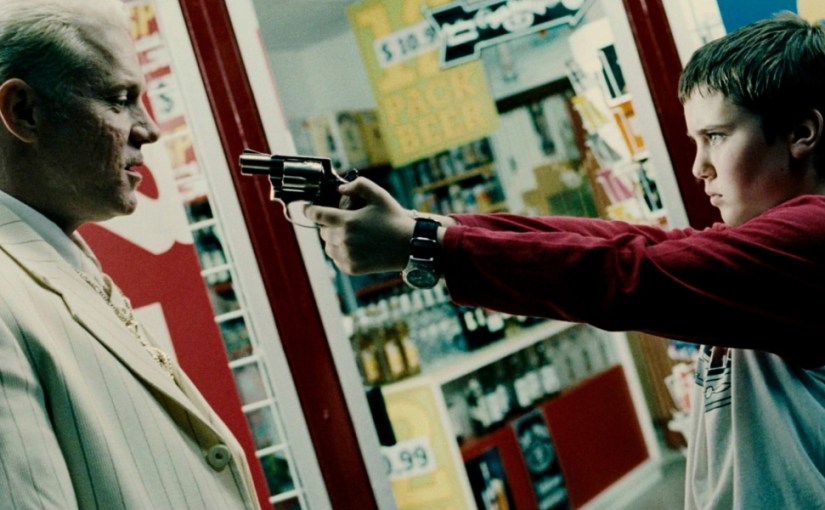
PLOT: A low-ranking thug (Walker) is entrusted by his boss to dispose of a gun that killed corrupt cops, but things spiral out of control when the gun somehow winds up in the hands of his neighbor’s son (Bright).


So…okay.

First of all, this is most assuredly NOT a remake of the quintessentially ‘80s comedy thriller of the same name, starring Billy Crystal and Gregory Hines, who, although they were very funny, were two of the most unconvincing street cops since…ever.

No.  This is one of the most twisted, sordid, blood-soaked retelling of a Grimms-esque fairy tale I’ve ever seen.  Like someone kidnapped Quentin Tarantino and force-fed him only moonshine and methamphetamines for a week, then told him to sit down and re-write the story of Hansel and Gretel, but to make it take place in modern-day lower-middle-class New Jersey, and don’t forget the guns, Russian thugs, and brief, um, cunning linguistics.

Yeah.  It’s that kind of movie.

I haven’t read the negative reviews of this film, so I couldn’t tell you what turned so many people OFF.  I can only report what turned me ON.

A big part of it is the energetic storytelling at work: lots of digitally enhanced camera tricks, the occasional rewind, tilting the camera when you really didn’t have to, sudden speed-ups…very stylistic.  Tony Scott did a bit of the same thing in Domino, released a few months earlier, and Oliver Stone sort of pioneered this kind of thing with the wildly weird Natural Born Killers.  So it’s not like I haven’t seen this before, but it really works with this lurid material.

Which brings me to another big part of why I like this movie: the story.  On the surface, it’s your standard kid-in-peril, race-against-time thriller.  Paul Walker absolutely, positively HAS to get his hands on the dirty gun that Cameron Bright manages to steal and go into hiding with.

But tilt your head and squint your eyes, and you can see the whole thing is basically a guns-blood-and-broads version of a classic fairy tale, where a young innocent traverses the unforgiving countryside while being pursued by deadly forces.  On the way, he meets up with various colorful characters, who aren’t all bad, but they’re certainly not all good.

In this case, instead of trolls and ogres, our innocent character encounters, not necessarily in this order: the Russian mafia, a hooker with a heart of gold, her vengeful pimp, a creepy homeless guy, crooked cops, his own abusive father, and, in the movie’s squirmiest moment, a creepy married couple who show an inordinate amount of compassion for, and interest in, this lost child, and who seem to have the most nefarious motives of anyone else in the film.

And that’s just the “B” story.

The “A” story revolves around Paul Walker’s character trying to retrieve the gun Bright has stolen.  He bounces around like a pinball with his own son in tow, spewing profanity like it’s going out of style, beating up lesser thugs, lying to superior thugs, always just one step behind Bright who is sure Walker is going to kill him.

I dunno, for me, the dynamic camerawork and the shocking subject matter all worked.  It’s a fun, trippy ride, with just desserts getting served all around.  I’m sure people have an issue with the ending, but what would they have preferred when it comes to a popcorn movie like this?

After all, how do MOST fairy tales end?

JOHN WICK: CHAPTER 3 – PARABELLUM (2019)

by Miguel E. Rodriguez

Director: Chad Stahelski
Cast: Keanu Reeves, Halle Berry, Ian McShane, Laurence Fishburne, Anjelica Huston
My Rating: 9/10
Rotten Tomatometer: 89% Certified Fresh

PLOT: Picking up precisely where John Wick 2 left off, legendary assassin John Wick (Reeves) must fend off wave after wave of bounty hunters intent on collecting the $14 million bounty on his head.


You gotta love how John Wick: Chapter 3 – Parabellum starts.  About 30 seconds of opening credits, and then bang, the action picks up exactly where John Wick: Chapter 2 ended.  Wick is on the run through New York City, trying to find safe haven for himself (and his dog, aptly named “Dog”) before he becomes “excommunicado”.  At that point, a global network of assassins will make him their target and kill him.

Well…they’ll TRY to kill him.

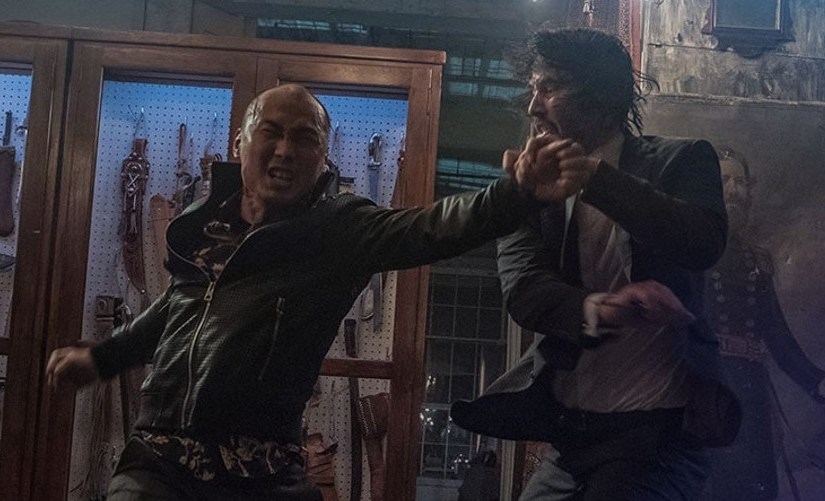
Let’s be blunt: you’re either a fan of the John Wick franchise, or you’re not.  These films are not for the casual moviegoer.  There’s just enough story to hang the fight scenes on, no more.  Everything we need to know about the John Wick character, we’ve gleaned from the first two films, and even that is minimal.  There’s no subtext, no neo-modern, meta-textual considerations to be discussed in terms of the screenplay.  The movie has but one purpose: to show off spectacularly choreographed fight scenes in which the good guy obliterates a crapload of bad guys.

I think I read somewhere there are eleven separate fight scenes in the film.  As such, the filmmakers were careful to make the fight scenes as distinctive as possible, especially when it comes to the weapons that are used.  Among these weapons are (let me see if I can remember them all): fists, knives, swords, axes, pistols, shotguns, machine guns, several thick books, a chisel, a couple of pissed-off attack dogs, and a belt.

Watching this movie was exhilarating for me.  The action scenes tapped into that teenaged part of me that used to love watching Enter the Dragon or The Good, the Bad and the Ugly.  I mean, I still love those movies, but for some reason, during Parabellum, I was positively giddy.  There was a sense that the filmmakers were attempting to provide us with the ULTIMATE action movie, the zenith, the ne plus ultra.  And I’ve gotta say, the last time an action movie gave me those kinds of vibes was The Matrix Reloaded during the freeway car chase.

There’s not much more to say about the movie.  Like I said, it has one purpose, and it does it extremely well.  If you love great fight scenes, congratulations, Christmas came early.

THE FRENCH CONNECTION

By Marc S. Sanders

Popeye’s in town.

“You been picking yer feet in Poughkeepsie?”

One of the first gritty crime dramas.

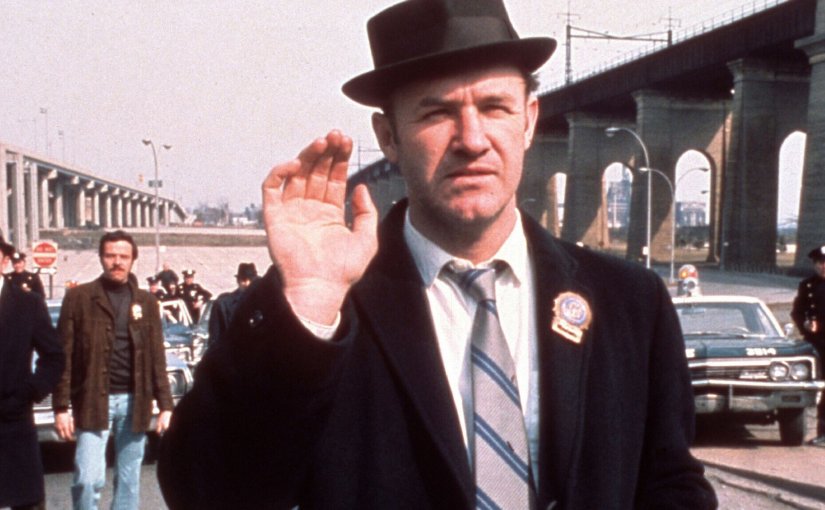
With modern cinema offering huge bravura performances a la Daniel Day Lewis or Christoph Waltz these days, it’s any wonder that today’s generation of movie goers would be puzzled that Gene Hackman won the Best Actor Oscar for this film, The French Connection, which also happened to win Best Picture. His character has no big monologues, no huge crying scenes. In fact for most of the film, he’s slamming guys up against a wall or following them up and down the dirty Brooklyn streets. Yet, his accolades were nothing short of deserved.

Watch as Hackman’s Popeye Doyle gradually exhausts himself in pursuit of “Frog 1.” His character starts out as a thrill seeking detective only to find his limits pushed against a better cat and mouse player. Dialogue isn’t sophisticated here to show his state of mind, but rather his expressions offer everything. Simply look at his close up following the extensive car search (an incredibly satisfying scene for me as a viewer).

If that’s not enough, the car/foot chase through Brooklyn is one that still has not been matched. See how it was done before CGI.

A simple drug deal is plotted perfectly from Marseille to New York, and best of all, it is all true (well mostly).

What’s most curious is the film provides one of the oddest and most unforgiving endings in a film ever. Perhaps you’ll agree (????). But, remember…THAT IS HOW IT HAPPENED!!!!

This was a film from 1971 that was raw in its language, gritty in its setting, spiteful and unafraid of the image it would leave, and that is why it won Best Picture, Best Director and Best Actor.

Bottom line, it would never have been made today. Never!

(Word of advice, ignore the sequel. A prime example of Hollywood shamelessly cashing in.)

DIRTY HARRY

By Marc S. Sanders

The very first R rated film I ever saw was Dirty Harry. I was probably 7 or 8 when my brother introduced me to it, and it eventually led to my first R rated film to see in the theatres, Sudden Impact, the fourth film in the series.

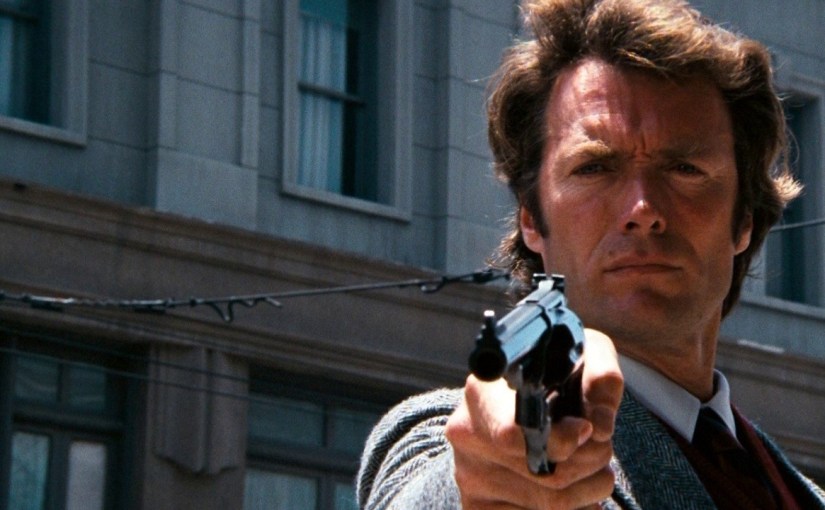
The original installment had such an influence on me, and it remains as one of my favorite films. I did not necessarily understand at the time the complex, albeit simplistic summary, of the law and the barriers Harry Callahan breaks to get the bad guy. I was more impressed with the 44 Magnum he carried and sociopathic behavior of the serial killer, Scorpio.

All these years later, followed by numerous viewings, and I’m just grateful director Don Siegel’s film was actually made. Had it been considered today for a treatment, it would have never come to light. The film is too candid and frank in its liberties of racist undertones and the underworld of a seedy San Francisco during the 1970s. Harry just didn’t care about the sensitivity of any demographic. He also just didn’t care about what was at stake to capture a hardened, dangerous, apathetic killer. Arguably, and only in the fictional world of film, audiences were probably grateful for that. Cut the bullshit. We all know who the guilty party is. Let’s get him off the streets, regardless of what is mandated to avoid any further loss of life. At least through the first 4 of the 5 Dirty Harry films that has been the common theme. (I’m especially fond of Magnum Force for challenging Harry’s own code of law enforcement. There are great debates to think about in that film.)

Dirty Harry is a deliberately ugly film. Siegel shows the worst of people at times, including Harry. Yet, there are sick people on the streets like actor Andy Robinson’s Scorpio killer that treat murder, mayhem and extortion as a twisted game of insane pleasure. Robinson was perfect in this role, a precursor I thought for Heath Ledger’s Joker many years later. Only a guy like Dirty Harry Callahan is right to nab a guy like this.

The film offers great moral questioning on the rights of men whether they are clearly the culprit or not. Miranda and several amendments are appropriately referenced and questioned. Is it ever appropriate to exercise brute force on a suspect? Can a near impossible scenario justify any actions of that measure? “Well then the law’s crazy,” Harry says. Even by today’s standards you can’t help but wonder if Harry is right.

What would be Harry’s opinion of today’s ongoing theme of domestic abuse among NFL athletes? Fair trials, and innocent until proven guilty are necessary but (at least this is how I feel) the circumstances of these stories make it abundantly clear that the guy did it. He beat his girlfriend into oblivion. The evidence is so much easier to uncover these days. It’s easy for me to say this from the comfort of my own home and not on a jury box. What would Harry think? He always knew to see beyond the bullshit. Heck, if I ever got a chance to interview the guy, all he’d probably tell me is get out of here. He’s got work to do. Harry Callahan was never up for sharing anyway.

QUICK TAKE: A History of Violence (2005)

By Miguel E. Rodriguez

Director: David Cronenberg
Cast: Viggo Mortenson, Maria Bello, Ed Harris, William Hurt
My Rating: 9/10
Rotten Tomatometer: 87% Certified Fresh

PLOT: A mild-mannered husband and father (Mortenson) becomes a local hero through an act of violence, which sets off repercussions that will shake his family to its very core.


A History of Violence is an art film disguised as a Hollywood thriller.  It makes some statements about the nature of violence that would be at home in an Ingmar Bergman film, but cloaks them in a conventional plot that, unbelievably, is based on a graphic novel.  (I’ve read that graphic novel, which goes down some gruesome paths not explored by the movie.)

It’s riveting.  As a pure thriller, this movie is gangbusters.  (I thought the ending was a tad abrupt, so I take away a point.)  The central mystery, about an everyman who is mistaken for a ruthless killer, will keep you guessing.  It also has some troubling things to say about violence itself.  Through various events in the film, it’s almost like the moral of the story is the equivalent of Patrick Swayze’s famous line from Roadhouse: “Be nice, until it’s time to NOT be nice.”  Gandhi would not have approved.

I can’t recommend this movie enough.  Find it, watch it, do it.

PULP FICTION

By Marc S. Sanders

No one can deny that Quentin Tarantino’s classic film, 1994’s Pulp Fiction is one of the greatest screen accomplishments of the latter half of the 20th century. It’s strange, lurid, scary, unforgivingly funny and altogether different from practically anything that came before it. How did the Weinstein brothers with Miramax films prophesize the energy it would surge in mainstream audiences?

When I first saw the film I was apprehensively going with two college friends who insisted I see what they experienced from a prior viewing. Suddenly, I realized that alternate surf 70s rock, black suits, and a kinetic visit to the restaurant known as Jack Rabbit Slims could entertain and make me look further than just a facial close up.

Tarantino entertains the lens of his camera by making his audience the camera. A drug dealer scrambles to find a medical book to awaken a boss’ wife who is dying from a potent heroin overdose, and the camera stands in place only frantically swinging left and right. The camera doesn’t move while everyone in the scene remains in a panic, frightened of administering an adrenaline shot. The camera stands still to allow the audience to stand in the room as well. It’s very unusually funny, but unnerving and suddenly we are amid the clutter of crime and drugs frightened of a terrible fate.

Another scene follows two gangsters down the hall as they debate whether a foot massage equates to fellatio on a woman. They look serious as they earlier regretted bringing shotguns to their destination but here they are having a debate likely reserved for men’s locker room talk. Is a foot massage really worthy of dropping a guy out of a four story window into a glass enclosed garden below? I mean, apparently the poor guy developed a speech impediment.

Tarantino used Pulp Fiction as an excuse to show how criminals inadvertently lead their lives to the unexpected, beyond a cliché cop bust. Two guys might be settling a personal vendetta, but somehow get interrupted by a redneck gang rapist and his chained up “gimp.” Two other guys might be trying to deliver a briefcase and yet somebody’s brains splatter all over the inside of a car. Another guy might have left behind a family heirloom gold watch as he and his girlfriend run for their lives, or they might suddenly acknowledge a moment of clarity when death seemingly walks out of a bathroom door.

Some might not agree but I always consider Tarantino’s colorful film characters to be rather two dimensional. What you see is all you see. There are no hints at an underlying motivation or a background to anyone you meet in Pulp Fiction, or any of his other films. Normally, that’s a negative in my book but with Quentin Tarantino it is what’s expected. He’s a masterful script writer of the situation. A well known fan of kung fu and lurid crime movies of the B variety, gangsters like Vincent Vega, Jules Whitfield, Marsellius Wallace, Butch Coolidge and Winston Wolf (even the names are entertaining) get caught up in just a random moment in time. Beyond the incident nothing else matters, and just to make it fun Tarantino uses his favorite editor, Sally Menke, to scramble everything out of order. I like to think the script was assembled this way to demonstrate that what happens in one instance doesn’t reflect what happens in another. Every brief moment is bookended. Again, two dimensional characters who don’t reach an intended karma. It doesn’t matter what’s been done before or what will be done next. It only matters in the moment.

The cast is great. Likely, you know who all the players are by now. The best compliment is that they obviously listened closely to the director’s vision. They spoke his language which had yet to be very mainstream before this film’s release. They are a pioneering cast of great talent and many owe quite a bit to Tarantino for jump starting and reviving their careers.

Pulp Fiction is a rousing expedition in sin and surf music symphony with endless quotable and un-PC dialogue that revolutionized filmmaking and brought about risk taking movie makers. It’s just exciting and fun and wild and it especially became a favorite upon seeing one of my favorite kinds of scenes-a dance sequence. If you incorporate dancing into a non musical film, you’ll likely win me over.

Spoiler alert: Vincent & Mia win the dance contest, and right they should. Chuck Berry’s “You Never Can Tell” became that other popular film song once Pulp Fiction hit the scene.

Thank you Quentin Tarantino.

BEST SELLER

By Marc S. Sanders

It’s kind of sad when two very good actors are provided with really subpar material.  The writing can naturally make the performers look bad.  Two things can happen.  The actors might try too hard or they may not try hard enough.  A perfect example of that is John Flynn’s crime drama Best Seller with James Woods and Brian Dennehy.  Woods tries too hard.  Dennehy isn’t trying at all.

Brian Dennehy is Dennis, a Los Angeles undercover cop.  Following a department robbery in 1972, he writes about the experience and then he is on his way to also being a best-selling crime novelist.  Fifteen years go by.  He’s still working the streets and chasing bad guys while also writing.  Though now he’s got writer’s block. 

James Woods is Cleve, a professional hitman, who enters Dennis’ life and convinces him to write a book about Cleve’s experiences.  Cleve’s motivation for this is to expose a crooked politician that he used to do jobs for and at the same time, the book will become a best-selling true crime novel for Dennis. So, Cleve escorts Dennis around various parts of the country from California to New York then back west to Oregon.  Cleve shows Dennis a bedroom in New York where he successfully executed a man with details about where the victim fell to how he did it, step by step.  There’s not a shred of dialogue or discovery in this scene.  A real estate agent giving a tour of an empty model home is more eye opening.  Cleve also brings Dennis to his parents home for a sleepover where he can gain some background material on Cleve’s upbringing.  Having just seen the ninety minute film, I can not recall one thing that was discussed at the dinner table with mom and dad.  Dennis never looks interested.  Dennis doesn’t even have a tape recorder or a pad to write on.  Dennis isn’t even necessarily convinced that Cleve is the hitman he says he is.  I was convinced, however.  Ten minutes into the film, Cleve saves Dennis’ life by shooting a criminal that was about to kill Dennis and he had pretty good aim with his silencer hand gun.  What more do you need to know?  If Dennis is such a good cop, why can’t he realize what is in front of him?  Was that the dilemma of Best Seller?  To see if Dennis believes Cleve is an expert hitman? 

The story is utterly ridiculous.  It doesn’t help however that James Woods carries himself like a nut job when Flynn directs him in cool postures adorned with stylish Ray Bans and knitted 1980’s suits.  He gets hyper in front of people he’s threatening and prefers unusual sexual positions with women he just met.

Brian Dennehy hardly looks like he’s in character.  His dramatic moments have no impact.  He seems undisturbed by this weird guy he’s travelling the country with.  Wouldn’t a seasoned cop even keep his guard up while with this likely hitman?  Not even a couple of near misses on killing them both seem to faze his Dennis character.  The men make a quick escape from a bomb laced taxi cab and they hardly discuss or consider who is behind the attempt on their lives. 

I’m not sure what was to be accomplished with this film.  It doesn’t explore anything remotely interesting. It’s mostly as boring as Brian Dennehy seems in his role.  Both of these actors have had better material to work with in their careers and they work best as supporting character actors like Woods in Casino and Hercules, or Dennehy in First Blood and Presumed InnocentBest Seller was not a box office hit or even a sleeper hit.  It’s not hard to see why.

WHITE BOY RICK

By Marc S. Sanders

Matthew McConaughey is probably my favorite actor that I somehow always forget about. He always has that god Ol’ boy dialect and yet he hides it so well no matter what role he plays, whether he’s a space traveler in a heavy sci fi drama like Interstellar, an AIDS victim drug dealer in Dallas Buyers Club (his Oscar winning performance), or an over the top unscrupulous stock trader in The Wolf of Wall Street. In White Boy Rick, he’s an unscrupulous black market Detroit gun dealer. Selling out of the trunk of his car, he justifies his trade by telling his son Rick it is a constitutional right to own a gun and sweetening his sales with silencers by metaphorically comparing them to up selling fries to go with a burger. His intensity as this sleazy guy is downright remarkable. A great moment for me was simply a close up of him walking down the hallway of a hospital. This guy knows how to perform in front of a camera. I’ll say it again. His intensity is remarkable. He’s seemingly worthy of an Oscar nomination. Yet, it’s likely come December this film just won’t be remembered.

The title character was first a junior gun runner per the inspiration of his father and was quickly recruited by the FBI to be an inside buyer and seller to the drug houses in the Detroit slums during the mid 80s. In a community of black criminals, with one major player married to the sister of the city’s mayor, Rick earns his moniker of White Boy Rick by speaking the lingo and dressing the part. Thick gold chains with large jeweled crosses are a status symbol. So naturally Rick shows his prominence by donning a Star of David. It makes no difference if he’s unaware of its Jewish symbolism. His bling builds his stature. From FBI insider, Rick gradually moves on towards dealing drugs on his own street smarts and a means to sustain himself along with Dad and his junkie sister as well as his grandparents. He’s a natural.

Newcomer Richie Merritt is very good in the part of Rick and holds his own against McConaughey. His attitude overcomes his father’s experience. He’s smarter than his father actually and he’s a better talker than his father. His one flaw was not realizing his inevitable future.

The director is Yann Demange, a filmmaker I’m not familiar but a skilled guy nonetheless. He captures a dirty snow covered Detroit in 1984-87 very well with dark crack houses, wet streets and a crowded skating arena. These locales are where these guys dwell. The photographery looks worn out and offers that uncozy winter feel. The only glamour of this atmosphere comes mink coats worn by the dealers and their gaudy Run DMC gold chains.

Here’s hoping I’m wrong and this small film gains some more traction and following. It’s a good true story that I never heard of. It’s got a solid cast that easily blends into this dangerous underground, and its performances are worthy of recognition during awards season.