SCROOGED

By Marc S. Sanders

Bill Murray with director Richard Donner delivered their contribution to the Charles Dickens assortment of A Christmas Carol iterations with a modern update called Scrooged.  Until now, this movie eluded me.  Yet I can’t deny it has all the ingredients for a sure-fire green light to make the movie.  Bill Murray? Doing Ebenezer Scrooge?  Stop everything people!  Get this ready for December.  STAT!

Unfortunately, it misses the mark.  

Now, I’m supposed to like this miser by the end of the story, right?  So then why is Murray’s personification so annoying and unappealing by the end? If I was his nephew, I’d rescind my invitation to come over for Christmas dinner.

The best and most hilarious part of Scrooged occurs in the beginning following the easily recognizable Danny Elfman instrumentals.  Santa and his elves are happily making toys when suddenly terrorists attack the North Pole and Lee Majors jumps out of nowhere ready to bear arms with ol’ St. Nick and his crew.  I was sad to realize this was only a TV commercial for the station programming that Murray’s character oversees.  If there is a God, he’ll reveal the location of the lost film for The Night The Reindeer Died.  Earlier this year I saw Lee Majors needlessly squandered away in the terrible Fall Guy adaptation.  It crushes me that he got this same kind of treatment over thirty years prior.

Bill Murray is the uncaring and thoughtless Frank Cross.  When we meet him on Christmas Eve day, he’s firing an executive (Bobcat Goldthwaite) for simply disagreeing with him.  Also, in typical overplayed Bill Murray fashion, Frank insists that his assistant Grace (Alfre Woodard) ignore the needs of her family during the holiday and get work done with him.  Grace of course filling in for the Bob Cratchit role.  

Following a few other gags to parade the comedian’s antics around, Frank is encountered with the Jacob Marley stand in, played by John Forsythe.  At this point I’m still with the picture even if the breadcrumbs are easy to follow.  Forsythe, in his grotesque makeup, works well against the clown who leads this movie.  (Not a bad scene together between Charlie and Bosley. “Hello Angels!”).

It’s when the follow up ghosts make appearances that my mind ponders what I’ll be writing about in this review.  Ghosts of Christmas Past (David Johansen) and Present (Carol Kane) enter on cue and right away I grew bored and uninterested.  

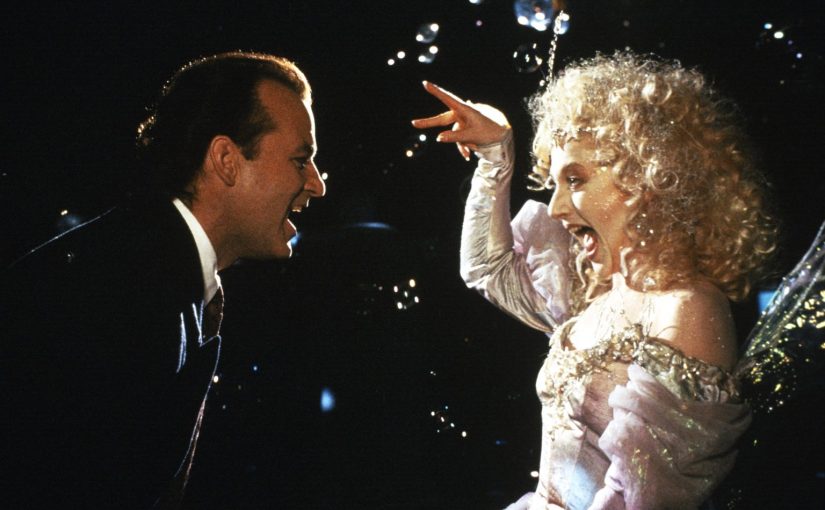
Johansen is a cabbie, or just another screeching screamer like Murray.  He’s laughing at Frank’s demise and past missed opportunities, but I’m not seeing what’s funny or even heartbreaking.  Neither theatrical mask of comedy or tragedy is functioning.  Carol Kane does her typical schtick with the high-pitched baby talk voice, dressed in a fairy get up.  Beyond that familiar routine, she commits every kind of Three Stooges smack and painful tug on Frank’s face that you can imagine.  Why of all things does she rely on a toaster to upper cut the jerk in his face?  I mean why a toaster???? If the comedy works, then I should not be wondering why a toaster or a pie or two by four or an anvil.

There’s nothing wisely written here.  The screaming and the smacking get old very fast and it gets in the way of a potential love story passed by that the script was promising for the Frank Cross character and his crush Claire (Karen Allen, whose smile always lights up a room).  I never felt like Bill Murray was ever listening to Karen Allen in the scenes they share.  Did they even rehearse this stuff?  Too often, Bill Murray seems to just be winging it, and it wouldn’t make a difference if Karen Allen even memorized her lines.

Scrooged starts out with fresh, quality made National Lampoon material but then waddles into the same typical chapters of Dickens’ holiday story.  However, while it hammers the familiar story beat by beat and you tell yourself there’s the Fred character and there’s the mute kid covering for a crippled Tiny Tim and there’s Yet To Come, you got Bill Murray who was granted too much artistic license to improvise, and has thus squeezed out all of the sensitivity and spirit that we expect from A Christmas Carol.

I’m sorry but I think I liked this Frank Cross a whole lot more before he was visited by the ghosts.  This is one Scrooge who should’ve been allowed to sleep through Christmas.

PS: If anyone can find a DVD print of The Night The Reindeer Died, I’m ready to review it.

CARRY-ON

By Marc S. Sanders

Action movies have been done to death, haven’t they?  Yet, don’t we still get a kick out of them?

Sure, I need my TCM classics like It Happened One Night or my updated biographies like Angelina Jolie’s Maria, but action movies are like the best junk food without any of the calories.  Still, an action picture has to have that special attraction if it is to stand apart from the others.  I got bloated by the time I got to the fourth Lethal Weapon.  The first is a perfect wham bang shoot ‘em up set during Christmas time. Now Netflix grants us a long-lasting candy cane with its airport run around chaser flick known as Carry-On.

What makes this mad bomber fest a smash is that the hero, TSA agent Ethan Kopek (Taron Egerton), actually cries out of fear and pain as the bad guy beats up on him and frightens him into direct obedience.  He begs with tears coming down his cheeks for the bad guy to just stop with his mission.  He screams “WHY ME?”  The Rock, Stallone, Schwarzenegger, Willis, Ford, Gibson – those guys don’t cry.  Yet, little Ethan Kopek does, and once he gets his wits about him does he truly become a super hero.  I recall the moment happens in the last twenty minutes of the picture.  Ethan throws off his pansy TSA uniform shirt and makes a go at saving the day in his black undershirt.  Now he’s earned John McClane’s respect.

On the busiest travel day of the year, December 24th, Ethan is assigned to scan the carry on luggage ensuring travelers have not packed contraband items.  He and his colleagues have to put up with all the typical TSA complaints that come with the job.  My hat’s off to screenwriter T.J. Fixman for allowing some time to show the challenges of this occupation.  It adds some truth, comedy and depth to a thankless job that’s hardly celebrated or acknowledged like cops, doctors, athletes, and attorneys.  

Ethan is handed an earpiece and a mysterious voice, provided by Jason Bateman, gives him direct instructions to allow one black suitcase with a red ribbon to pass through inspection.  If Ethan deviates in any way at all, the voice promises that Nora (Sophia Carson) will be killed.  She is Ethan’s pregnant girlfriend and also runs airport security at LAX.  

Movies like this function like a game or sport.  The villain sets up boundaries.  How is Ethan going to save the day or get around the unexpected while trying to avoid harm to Nora or the airport as a whole?  As far as he knows, he is always being watched by the guy talking in his ear.  There’s rules and obstacles he must observe.  Granted, Carry-On allows a lot of unlikely and hard to buy conveniences to let our hero obtain the advantage, but he’s also not Superman, and at times when you believe Ethan is coming out ahead, Bateman’s antagonist changes up the game.  

Heck! A bomb is activated not at the end of the movie, but dead center right in the middle of the story.  Normally, the end all be all explosive serves as the final exclamation point with the expected digital clock countdown.  However, in Carry-On if it can get deactivated, there will still be more story to go.  Bateman’s villain really has everything thought out and Egerton’s character has no choice but to man up to the plate once again.

A side story with Danielle Deadwyler as an investigative cop named Elena will eventually intersect with the main narrative.  It’s nothing special until a car ride on the way to the airport plays Wham’s Last Christmas on the radio and the scene explodes into a mind-blowing thrill reminiscent of what I saw in Children Of Men twenty years ago.  The construction of this scene alone is absolute fun.  

Deadwyler’s character is written with a lot of carte blanche to allow Ethan to save the day.  No, none of this is ever likely to be how things go.  Yet, I recall Arnold Schwarzenegger being thrown out of an airplane and surviving a crash landing in a garbage heap thirty thousand feet below (Eraser).

If you watch Carry-On, I will not be surprised if you protest its merits based on a collection of plot holes.  The most glaring one to me is that LAX does not look nearly as crowded as the script insists, nor what I’d expect on Christmas Eve day.  Also, traffic is really easy to get around on the way to the airport.  (New Orleans fills in for Los Angeles.). However, just because Dreamworks and Netflix cut corners on spending for more extras and scenic inconveniences, it does not mean my enjoyment with the film is suspended. 

To make up for where the film’s budget might have come in the way, there are storyline surprises that enter from nowhere. Logic is applied to what’s inserted at these opportune times.  Ethan and Elena experience a set back and now new forms of game play must take hold.  You accept what’s thrown at you because of the cast and set ups.

Taron Egerton is a deliberately wimpy, but also an attractive, unlikely hero.  Jason Bateman ranks with other impressive Die Hard type movie villains like Alan Rickman, Tommy Lee Jones and Dennis Hopper.

Carry-On’s director, Jaume Collet-Serra, is well aware of the near miss escapes that allow his movie to…well…carry on.  He really doesn’t try to hide or distract from the plot holes or questions that audiences may argue.  Yet, I say who cares? This cast of mostly unknowns step up to embrace the dialogue and circumstances of the script while trying to win the game.  

Look, anything you see in Carry-On can theoretically happen.  

Would it happen?  

Let’s just change the subject please.  You have a plane to catch.

BLACK ORPHEUS (France, 1959)

by Miguel E. Rodriguez

DIRECTOR: Marcel Camus
CAST: Breno Mello, Marpessa Dawn, Lourdes de Oliveira
MY RATING: 8/10
ROTTEN TOMATOMETER: 88% Certified Fresh

PLOT: The Greek myth of Orpheus and Euridice is translated into a modern-day story (with an all-black cast) set in during Carnaval in Rio de Janeiro.


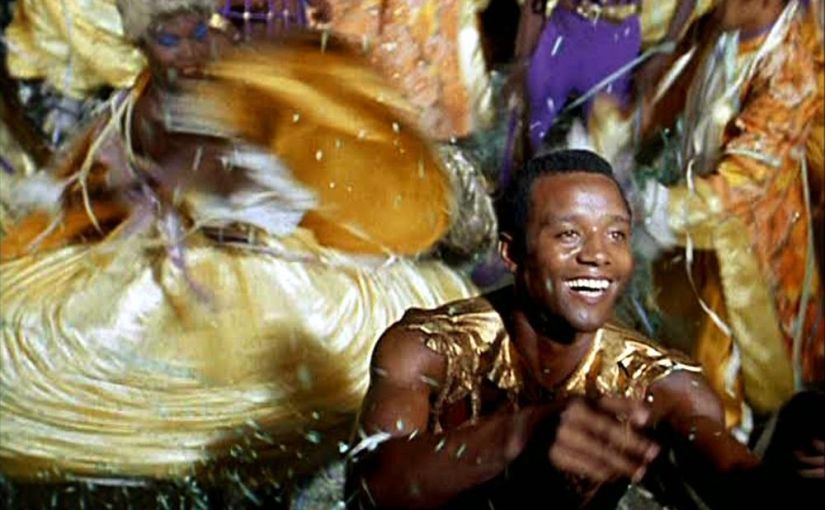
In the first two-thirds of Black Orpheus, there are scarcely more than 2 minutes strung together at a time without some kind of music or sound effects thumping away in the background.  This gives the film a subtle real-world backdrop, which is good, because Black Orpheus is a fantasy through and through.  Critics, now and at the time of its release, complained that French director Marcel Camus ignored the reality of the Brazilian favelas, or slums, in favor of depicting Rio as a non-stop party.  This is a valid point.  However, I believe that, in this movie, reality has no place.  This is a love story, a myth, a tragedy, and a travelogue all rolled into one.  Reality must take a back seat in movies like this.

(And, heck, somebody must have liked it because it won both the Palme d’Or at Cannes AND the Best Foreign Film Oscar that year, a rare feat.  True, there were extenuating circumstances [numerous French critics had problems with the emerging French New Wave], but let’s not turn this into a classroom, shall we?)

If you’re familiar with Greek mythology, then the plot of Black Orpheus is nothing new.  Orfeu (Breno Mello, a non-professional actor) is a streetcar conductor engaged to the sexy, vivacious Mira, but he is not exactly thrilled about it.  Meanwhile, Eurydice (Marpessa Dawn, who actually hailed from Pittsburgh, not Brazil) gets lost in the city on the way to visit her cousin, Serafina, who lives in a ramshackle favela neighborhood.  She asks Orfeu and his boss, Hermes, for directions, and for Orfeu it’s love at first sight.  The rest of the movie will involve Orfeu wooing Eurydice, who worries about a strange man who might be following her, while trying to ditch Mira, with Serafina’s help.  Also assisting Orfeu, while acting as a Greek chorus in miniature, are two street urchins, Benedito and Zeca, who envy Orfeu’s lovely guitar playing, which Orfeu claims is what makes the sun rise every morning.

Apart from the story itself, the things I noticed at the outset were the presence of riotous colors in the costumes and the Brazilian countryside, and the music.  Lots and LOTS of music, but not a great deal of songs.  Black Orpheus is billed as a musical, but I’d have to say it’s a quasi-musical.  In a standard musical, characters break out into song, and no one notices because otherwise we’d be watching a play.  In Black Orpheus, every song is diegetic…someone asks Orfeu to play a song on his guitar, for example, or the Carnaval participants sing a rousing song while on parade or at a huge dance.  And I want to mention again that, while Orfeu is singing a quiet song to Eurydice, the constant percussion of the Carnaval pulses behind it, completely at odds with his song.  You would think it would become a cacophony, but it doesn’t.  It makes his quiet song much quieter, which may sound counterintuitive, but it works.

The mythic tone of the story keeps the film from flying off into ridiculous territory amid all the revelry.  Without mythology, Black Orpheus would be a soap opera.  A pivotal scene occurs during a massive dance contest, as Eurydice has disguised herself as her cousin, Serafina, so Mira doesn’t recognize her.  But Mira sees through the disguise and threatens to kill Eurydice.  Mira chases her, and unseen by anyone else except Eurydice, a man dressed all in black wearing a skull mask follows them both.  This is Death.  Earlier he had nearly chased Eurydice off a cliff, but Orfeu had saved her.  “I am not in a hurry,” he said, “we shall meet soon.”  With that in mind, his presence during this second chase is tinged with suspense.  It’s a very Hitchcockian element, the threat of danger juxtaposed with a dance or a party.  Good stuff.

So, it’s fair to say I enjoyed this movie a little more than I expected to.  But the bonus features on the Blu-ray brought up an interesting point.  Detractors of the film pointed out that, despite taking place mostly in a slum, the actual reality of those slums (both then and now) is anything but festive, no matter how much bossa nova music you play or how many songs you sing.  It’s highly unlikely these people would have had the wherewithal to create such stylized, colorful costumes while having to deal with the reality of poverty, all while looking down the mountainside at the distant concrete high rises of the higher classes.

Does Black Orpheus ignore reality?  Well…yes, it does.  Myths, by definition, have little to do with reality in the first place.  Would it have been possible to tell this mythical story, retaining its coincidences and absurdities and supernatural elements [especially towards the end], while also keeping its feet firmly on the ground and making a socially conscious statement about the horrible living conditions in Brazil?

I don’t think so.  Or, if you did, it wouldn’t be held together very well.  Black Orpheus is simply re-telling a very, VERY old story and re-imagining it as if the Greek gods had lived atop Sugarloaf Mountain instead of Olympus.  When you start with that kind of premise, reality goes out the window.  You have to focus on the story’s emotional beats, the pleasant assault on the senses and, occasionally, logic.

This opens a whole separate argument: is it a film’s responsibility to BE authentic, or just to FEEL authentic?  For example, Titanic [1997] feels authentic to me, a layman, but I’m sure historians and other experts could point to any number of things that were simply not true in the film.  Fair enough, but that doesn’t affect my enjoyment of the film as it was presented to me.  It FELT authentic, and that’s enough for me.  The only way to make a movie like that 100% authentic would be to turn it into a documentary.

Black Orpheus FEELS emotionally authentic to me, a layman, who is not a social anthropologist.  I look at the colors and vibrancy on display, visually and in the story itself, and while a small part of me acknowledges, “This isn’t real life”, another part of me says, “Well, if I wanted real life, I wouldn’t be watching a movie, would I?”

CRIMSON TIDE

By Marc S. Sanders

A little over a year ago, having just seen Christopher Nolan’s Oppenheimer, I shared with friends how it is sadly surprising that a nuclear weapon has not been launched by a super power country since the bombs were dropped on Hiroshima and Nagasaki.  Those two bombs certainly served their purpose in response to the Pearl Harbor attack of 1941.  I deem it sad that any of us consider this a possibility that can easily be repeated. With all of the threats that continue worldwide with weapons testing, technological advancements and arms trading, it’s frightening to wonder what can ever be expected. Is it easier to execute a command like that again, now that it has been done?  It’s got to be a little surprising that the United States did not respond that way following the 9/11 attacks.  Tony Scott’s Crimson Tide comes close to providing an answer by weighing sound vs unsound reasoning. 

This is not only my favorite of Tony Scott’s films, but the movie also offers maybe my favorite performances from Denzel Washington and Gene Hackman.  The two actors of different generations are equal in measure as they debate what should be done, along with how the submarine they command, the U.S.S Alabama, should respond while in the midst of a revolutionary conflict stemming out of Russia.  

Washington is Commander Hunter, recruited at the last minute to serve as the Executive Officer aboard the Alabama.  Hackman is Captain Ramsey who proudly leads the charge of the sub with an intimidating welcome to Hunter.  Before any kind of real conflict comes their way, Ramsey puts Hunter to the test.  An uncomfortable dinner conversation, wisely written by Robert Towne (Chinatown), has the Captain question Hunter’s stance on using nuclear force to deliver a harsh defeat to the enemy.  Hunter’s position though is the real enemy is war itself.  Ramsey and his commanding staff have no reply to the new member’s observation.

Another moment occurs when Ramsey orders a missile launch drill while Hunter is assisting with containing an on-board fire in the galley.  The Captain has his reasons that Hunter cannot truly debate. Besides, Ramsey precisely tells his XO to “bite (his) fucking tongue,” even if he doesn’t agree with him.

The centerpiece of the officers’ conflict arrives when they receive a fractured message from command.  Ramsey’s instinct is to launch missiles at Russia based on the presumption that the Soviet rebels have overtaken the country’s arms.  Though Hunter cannot deny the concern, he will not agree to a missile launch until they receive the entirety of the broken order.  This occupies the second half of the film, and it becomes a back-and-forth mutiny of power.  The Captain is relieved of command but then retains control and the crew is divided between the leaderships of these two characters.

Having recently seen and reviewed the submarine classic Das Boot, it’s fair to say that film feels much more authentic and maybe it should be much more tense than any other movie of its kind.  Crimson Tide is glossier with outstanding interior cinematography on a studio constructed set designed to tilt like a maritime vessel should.  The dashboards and colored lighting are fancier.  The cast is good looking as Tony Scott obtains close up shots of them beaded in glistening perspiration with no facial hair.  Crimson Tide is definitely a Hollywood picture.  However, the screenplay from Michael Schiffer is razor sharp with not one wasted piece of dialogue.  In addition to Robert Towne’s contribution, Quentin Tarantino also script doctored a portion of the piece as well which includes a well-placed Star Trek allegory. 

There’s a jolt of energy to Crimson Tide that Das Boot has at times, but because of the latter’s three hour plus running time it also slumbers like life should while living on a submarine.  It is the theatrics of Crimson Tide that hold my attention on many repeat viewings.  I’d never want to question a guy like Captain Ramsey, but I’d be grateful that someone like Commander Hunter is around to stand in protest.  

I wish Gene Hackman and Denzel Washington had done another film together.  Their conflicted chemistry is second to none.  You like them both equally in the scenes they share together, or individually.  The timing of their tempos is perfect.  They find just the right moments to be alarming in a quiet way and save other opportunities for shocking outbursts.  The best actors practice their scripts this way and avoid any traps of overdramatizing.

Tony Scott made this film before his penchant for chaotic angles and grainy captions took over much of his other films to come hereafter.  Crimson Tide is cut perfectly from one scene to another with outstanding colors of blue, red and green lights that illuminate the cast while they stand at their posts.  Washington, Hackman as well as a sensational supporting cast (Viggo Mortensen, James Gandolfini, George Dzundza, Steve Zahn, Matt Craven, Lillo Brancato) do fine work and respond beautifully to the director’s camera positions. 

It’s impossible not to feel the tension accompanied with the progression of this film.  It serves as a motivation to wonder if we act on what we know or don’t act on what we don’t know.  As taut and dramatic as Crimson Tide is, you find yourself considering if those with access to the real-life red button consider all that could come of their decisions.  

Crimson Tide may tidy itself up after two hours, but the movie still makes me ponder if this planet’s military forces are thinking each and every day about if we are preventing nuclear war or if we are on the cusp of waging a nuclear holocaust.

This is one of my most favorite films. 

THE TAKING OF PELHAM ONE TWO THREE (1974)

By Marc S. Sanders

I’m a big fan of gritty, urban crime thrillers.  A wealth of them came out in the 1970s.  There was a rawness to their material.  They were equal opportunity offenders, picking on every race and demographic out there. It only lent an honesty to the characters that occupied these spaces.  The two guys that easily come to mind are Dirty Harry and Popeye Doyle from The French Connection.  Still, there were others that wedged their way through the cracks.  The Taking Of Pelham One Two Three from 1974 belongs in this fraternity of films as well. 

Walter Matthau is Lt. Zachary Garber, who has a ho hum job working the law enforcement area of the New York City subway system.  Beyond muggings and vagrants lying around you wouldn’t expect any major crimes to happen underground and thus Zach moves with a slow pace that never gets him upended or panicked.  Yet, on the day that he is giving a tour to some visiting Japanese subway architects, a hijacking of the train to Pelham Bay, number one two three, occurs.  Four armed men, only designated by Mr. Blue, Mr. Green, Mr. Grey and Mr. Brown don fake mustaches, hats and overcoats.  They are demanding a cash ransom from the city in the amount of one million dollars.  Zach and his crew have less than an hour to respond with the money, or Mr. Blue (Robert Shaw) will order the killing of one hostage for every sixty second delay.

Joseph Sargent’s film then steers its way into several conundrums.  Even if the ransom is paid according to the criminals’ exact instructions, how are these guys going to make an escape from underground?  What’s the nebbishy mayor supposed to do?  He’s in bed with the flu and he doesn’t know how to respond to this kind of craziness.  What’s the point of him making a public appearance near the scene of the crime? 

Long before everyone’s favorite hostage flick, Die Hard, came about Sargent’s movie was poking fun at the humorous and inconvenient cracks that leak out of a serious captive crisis.  First you gotta get the mayor to agree to the demands and as his wife (Doris Roberts) sensibly points out, there are seventeen potential voters on that train.  Then, you gotta count the money and drive it from uptown to midtown before the clock runs out.  That’s not so easy.  You think New Yorkers get out of the way when a speeding patrol car is barreling through the city? 

Zach doesn’t have it so easy as well.  Schluby Walter Matthau is great at trying to contain a situation but his co-workers are not so understanding.  Rush hour is less than two hours away and this stand still train is holding up the subway traffic.  Dick O’Neil and Jerry Stiller are genuine hilarity born directly out of the concrete jungle for roles like this. O’Neil has to keep all tracks open and the trains moving.  Initially, Stiller doesn’t take this seriously – a precursor to his Frank Costanza role on Seinfeld.

Robert Shaw was always one of the best villains and antagonists with films like From Russia With Love, The Sting, and Jaws.  He’s just as good here, but like those other characters, Mr. Blue is unique.  He carries a uniform, hospital cornered method, and he keeps it to the letter so well, that he’s relaxed enough to play his crossword puzzle as he waits for the money to arrive.  Martin Balsam is Mr. Green, a nervous underling recruited for operating the train.  Hector Elizondo is a crazed kamikaze kind of guy who might just knock the criminals plan out of whack because he’s a little too trigger happy.

The Taking Of Pelham One Two Three carries a simple plot.  What makes it complicated though are the characters surrounding the story.  There are a few levelheaded guys on both sides, but it’s the others around them and even the daily happenings of New York City that tilts any progress to be made off kilter. 

The city and many of these characters are unpredictable and therefore surprises will trip everything up just when it all seems to fall into place.  This even happens in the very, very, very last scene and caption of the film.  I’d love to share what a simple involuntary action that can break any of our concentrations does for a couple of these guys, but then I’d spoil the fun.  Trust me though, you get the last laugh before the end credits roll.

WHIPLASH

By Marc S. Sanders

It’s impossible to find absolute perfection.  I don’t care if it’s in the field of medicine, law, mathematics, art or even music.  No one is THE ONE.  Yet, if you are determined to partake in that hunt, it’s likely you’ll scream with frustration.  You might think you’re on to something but still it’s not quite the one.  Maybe, however, you will force your search for the one if you throw a chair at your gifted student, scream some of the ugliest obscenities, impose threats, slap him, allow the tears to run, force a literal blood draw, or sweat them into numbing exhaustion.

Whiplash is the name of a piece of jazz music originally composed by Hank Levy.  It is also the title of Damien Chazelle’s brilliant first film, and the best to come out of 2014. Allegorically speaking, the term takes on a harsher connotation.   The word whiplash gives me an image of torn skin and hot, dripping blood.

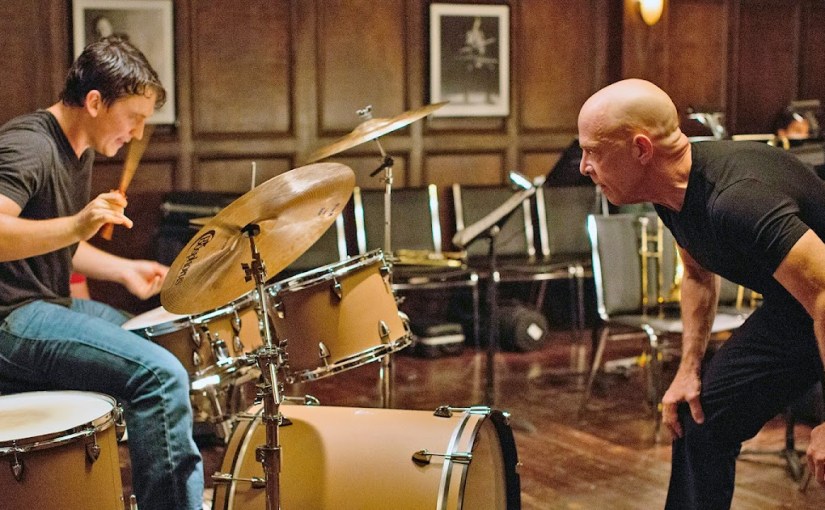
Andrew (Miles Teller) attends the Shafer Conservatory in New York.  He’s a jazz drummer who gets hand picked by the esteemed conductor Terence Fletcher (J.K. Simmons, in a well deserved Oscar winning role) to join his elite class.  Mr. Fletcher is cordial at first and a little instinctive as he’ll stop his musicians short of getting past one note before asking them to start again.  A hand gesture with a headshake and a wince.  Now go again.  Another gesture.  Go again.  One more gesture.  Again. Now an outburst of violent rage.

Individually, Andrew and Terence are determined with unhealthy mindsets to obtain levels of achievement that appear impossible to grasp.  The boy wants to get to where his drummer idol Buddy Rich plateaued.  The teacher wants to find the next Charlie “Bird” Parker.  These men of different generations are terribly talented.  Terribly I say because their passion for music is their self-imposed and cruel undoing.

Chazelle has much respect for the field of contemporary jazz.  I like jazz but I know nothing about how a piece is assembled so rhythmically among an assortment of instruments from the drums to the harp to the cello to the 88 keys and the various horns.  Put them all together, and there’s an atmospheric magic to what’s churned out.  It’s beautiful and bewildering.  Complicated, yet mesmerizing.  In Whiplash though, the music may be the worst antagonist because the frustrations that arrive with trying to become a master are unforgiving.

A late scene in the film shows Terence Fletcher, an altogether tyrant of a teacher, playing melodic nightclub piano in a bar.  He’s applauded and appreciatied as he presses down on the final key.  He thanks his audience with a nod.  Nevertheless, J.K. Simmons shows a different level of frustration.  Up to this point, the actor’s character has been a series of screaming eruptions.  In this moment, the man looks like he wants to cry.  No matter what he plays or how well loved he is, Terence Fletcher knows it could have been better.  So, if he lives with his suffering, then he will teach his best students to suffer through music as well.

Andrew is on the cusp of living his own life.  With a mother no longer in the picture, he still shares movie times with his father (Paul Reiser) perhaps so his father can still be a father, or maybe it is to remain a child to someone.  He’s starting a what could be a promising relationship with a girl named Nicole (Melissa Benoist), but his need to be a better drummer interfere and the only way he’ll know he’s at least as good as Buddy Rich is if he satisfies his teacher.  That’s the only sure sign.  

Does Terence turn Andrew into a monster, or is it the music?

This will always be one of Miles Teller’s best roles.  He’s got that innocent, quiet way about him, but as he gets “mentored” by this new composer, he changes.  He becomes devoid of care for Nicole and rebellious towards the lack of respect he receives from family and fellow students.  Like a chess champion, the art of drumming turns the drummer into an unloving creature soaked in blood and sweat.  This ongoing trajectory might make him a better musician but it will also bring him to an end result that matches his teacher.  

Beyond the energy of the music, Damien Chazelle steers a thrilling duo.  Simmons is an outstanding villain as a guy you can only hate until you see the motivations he’s only trapped himself into.  Only then you might just sympathize. Teller is circling the waters of a dangerous relationship with music.  Chazelle allows his picture to swim towards defiance with bloody and painful persistence. The epilogue of the film demonstrates precisely what these two men are searching for.  It’s only when you arrive at the end of Whiplash do you realize and empathize with the internal and physical pains these people choose to weigh on themselves.

To my ears, music is a beautiful, universal language.  

For the scribes, it’s an agony they choose to bear.

THE CHINA SYNDROME

By Marc S. Sanders

The China Syndrome explores the inherent risk that comes with a reliance on nuclear energy.  It also touches upon the moral choices within the field of journalism.  Most importantly though, it’s a hell of a thriller.

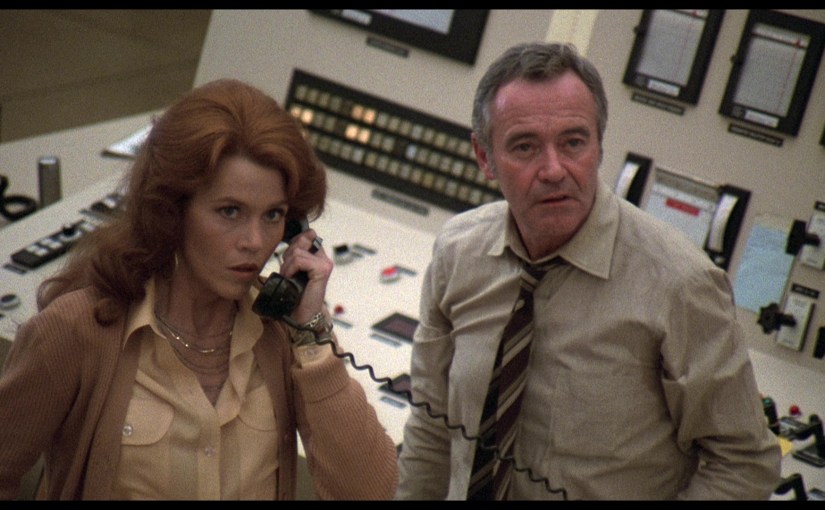
Kimberly Wells (Jane Fonda) is an on the scene reporter doing light fare topics for the evening news, like the novelty of singing telegrams for example.  With her subcontractor cameraman, Richard Adams (Michael Douglas, also one of the film’s producers), they cover a story on how a nuclear power plant operates.  During their tour, a very frightening accident stops short at only being a threat.  While the top brass at the company downplays the incident, Richard manages to record the panic-stricken activity happening among the operators in their soundproof control room.  As Kimberly and Richard gather information about what really happened, they are told they only were so close to what can be described as a China Syndrome – the underground nuclear rods could have overheated, imploded and the blast would have ruptured through the core of the earth where even China could feel it on the other side of the world.  

The corporate elites (led by Richard Herd) are the villains of this picture.  The could be hero is Jack Godell (Jack Lemmon), a could be whistleblower.  Jack oversees the whole operation and following that frightening scene begins to do his own kind of investigation.  What happened only makes sense because due diligence was not upheld, and inconsistencies are being neglected. Problems are only expected to get worse because they are not contained. There would be an enormous monetary expense that will put the company at a loss.  Initially, Jack wants to remain quiet, but the idea of what he’s certain will eventually happen is conflicting him.  As well, Kimberly and Richard’s pursuit of what truths he holds is gnawing at him.  

Jack Lemmon is a frazzled, yet sensible, marvel in this film.  I love the unspoken subtleties of this guy.  Best I could see is that Jack Godell is unmarried and has no children, nor friends beyond the faint connections he shares with his work colleagues, particularly one played by Wilford Brimley.  This only enhances Godell’s isolation in a them-against-him matchup.  Lemmon is great at emoting a sorrow and regret to his character.  He tells the journalists that he loves that plant.  It’s all he has in life and now it spells a certain, eventful doom if the faults in operation are not exposed.  Like Michael Mann’s The Insider, which was released over two decades later, the unlimited resources of this company will do everything in their power to silence this liable peon who works for them.  

The other side of The China Syndrome focuses on Fonda’s character.  When this film was released in 1979, it was the norm to not take a woman reporter seriously.  They were best used as attractive figureheads with beautiful hairstyles and well applied makeup to shift the seriousness of the news over to stories about dogs who can do tricks or hot air balloon happenings.  This film could have made more of a campaign to embrace the female journalists with heavier topics.  Instead, Jane Fonda’s character is not a fighter so much for deserved recognition in a male dominated world.  She’s actually just trying to circumvent around the unspoken chauvinism of her industry and get to the heart of this story that she witnesses firsthand.  The news station would rather her efforts be focused elsewhere.

Richard, the cameraman, is not embraced by Kimberly’s news station and therein lies the debate of airing what appears to be a story of urgency for the benefit of the public.  Yet, the station does not want to face a lawsuit.  What do the principles of journalism mandate even when there’s a monetary and reputational risk to their institution?  

Plenty of films with these kinds of dilemmas have come out following The China Syndrome.  What’s remarkable is the authentic feel of this fictionalized account.  Ahead of the release, the real-life companies that were developing a need for nuclear power were lambasting this film, insisting there was no validity to this story.  They were adamant that the production and maintenance of nuclear power was completely safe and well monitored. Twelve days after this film hit theaters in March 1979, the Three Mile Island accident occurred in Harrisburg, Pennsylvania when a partial nuclear meltdown of a reactor occurred. Traces of harmful gases and iodine were released into the atmosphere, and the incident was rated a Level 5, an “Accident with Wider Consequences.”  I do not believe Michael Douglas and his co-producers/filmmakers necessarily set out to make a statement. Though there are protesting movements peppered throughout the film. It’s a frightening irony, however, when life imitated fiction. 

 Jane Fonda and Jack Lemmon put the suspense of The China Syndrome into play. There’s an awareness to what could happen with technological advances in nuclear energy especially if they are not carefully observed and addressed.  

Over forty years later, do we really know what’s going on and even if we did, what could any of us do about it?

CONCLAVE

By Marc S. Sanders

conflict

noun

  • 1.
    a serious disagreement or argument,

conclave

noun

con· clave ˈkän-ˌklāv 

Synonyms of conclave

1

a private meeting or secret assembly

especially  a meeting of Roman Catholic cardinals secluded continuously while choosing a pope 

2

a gathering of a group or association

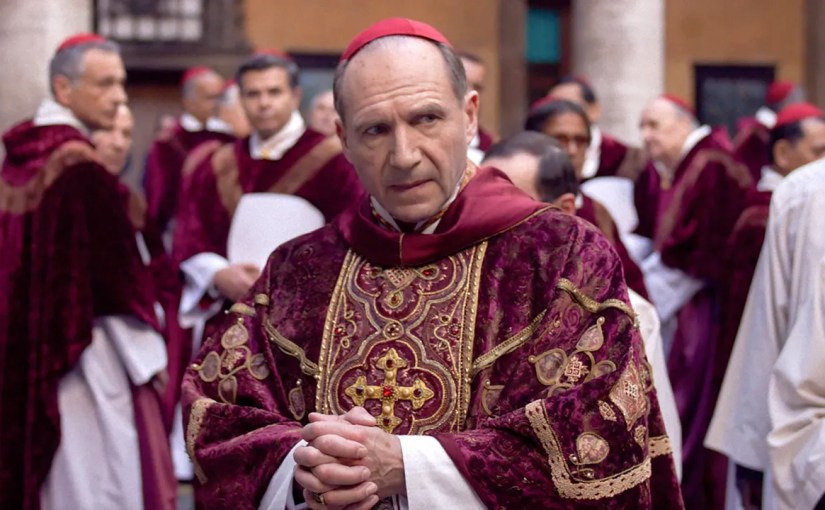
As I watched Edward Berger’s new film, Conclave, the word “conflict” came to mind based simply off of the same prefix the two terms share.  This picture does not just depict a sequestered assembly to elect a new Pope for the Roman Catholic Church.  It goes further because nothing goes as expected for the Dean of the Conclave, Cardinal Lawrence (Ralph Fiennes, doing Oscar caliber work).  

Now that the Pope has passed away, the various cardinals assemble, and all seem to have their own impressions of who should take the reins.  Cardinal Bellini (Stanley Tucci, man I love this guy) is the liberal candidate, tolerant and supportive of the gay population and accepting of women in authoritative positions.  Cardinal Tedesco (Sergio Castellitto) is on the conservative side believing the position should rightly return to an Italian with restrictions and containments of liberal ideals that have diminished what the church used to stand for.  There is also Bishop Tremblay (John Lithgow) who has an abundance of support to no one’s surprise. A few others earned some votes during the initial balloting, but it’s seemingly of no big consequence. Still, over the course of the film, multiple votes will have to be counted until the minimum majority necessary for a new Pope is collected.

The men of God convene in a formality of faith, swearing their handwritten votes before the Almighty.  Yet, Lawrence, as a dean of ethics and morality, is becoming apprised of some questionable irregularities among his peers.  While some of these men are earning more and more support with each passing tally, new developments present themselves forcing Lawrence to question if there should be some investigations to determine if some of these men are qualified to acquire the Papacy beyond an election.  Hence, the conclave is getting gravely interrupted by an overwhelming number of conflicts for Lawrence to consider.

I must stop there with my summary of Berger’s film, based on the novel by Robert Harris.  This is a top notch drama helmed by an outstanding cast.  At the very least the adapted screenplay by Peter Straughan will win the Oscar.  The dialogue is aggressive and forthright when it needs to be.  An institution like the Roman Catholic Church operates on secrecy.  However, it’s so interesting to see these devout men of God challenge one another. Just because they are the highest priests does not constitute them beyond sin or even corruption.  As Stanley Tucci’s character demonstrates, they might not be polite either.  Simply honest when their personal stance is challenged.  

The script is also quietly ponderous.  Ralph Fiennes shows an internal conflict between his duties to the church and how he truly characterizes some of his peers.  He even begins to wonder if he should continue as a priest. Has his faith remained uncompromised? Frankly, how can a priest of the highest order live satisfyingly knowing that no person is of an upmost perfection even if they swear by their faith? Still, the strict expectations of a widespread religion will demand contexts of that notion.

Constructively, Conclave has a gripping energy.  The performances from especially Fiennes, Tucci and Lithgow are magnetic as soon as they enter the piece.  Isabella Rossellini delivers an under-radar performance as a nun who works with a necessary audaciousness to her character.  She knows things that should never have occurred.  Yet, how will she confront these intimidating, stark, red-robed figureheads?  Does she even have a right or authority to speak?

The music from Volker Bertelmann could belong in Hitchcock thriller if Bernard Hermann wasn’t available.  It keeps you alert and never anchors your feelings as new developments come to light.  The composition only enhances the weight of the drama.  

Edward Berger is an observant director.  Ahead of the conclave he reminds you that even telephones are not permitted inside and tossed in a heap outdoors.  The priests are smokers. Personally, I find that surprising as cigarettes almost seem like a mild narcotic and a contradiction of how I envision a Catholic priest should behave.  Nevertheless, Berger also gives you a close up of a pile of cigarette butts tossed on the ground just ahead of being sequestered. These men turn off the world outside to focus on this important election. It’s as if they live in a submarine below the surface.

Conclave wil be a very divisive film.  Politically, it’s apparent that it favors one side (liberal vs conservative) over another.  In addition, it is not shy about showing its characters with their assortments of fault.  I am not educated in Catholicism.  Though I am well aware of the value it holds across its worshippers.   For many, their faith is held above all else and those people will find a discomfort with this picture.  I might even be understating that assessment.  Some folks of the Catholic order, and maybe other denominations of Christianity, will even take grave offense to this fictionalized depiction.

Conclave is truly conflicting.

Because I do not hold any value in Catholicism, much less any religion anymore (just a shred for the Judaic customs I was raised on), I did not hold any bias or objections to Edward Berger’s film. Rather I was engaged in how difficult it is to balance yourself as a Catholic priest.  For Cardinal Lawrence, Ralph Fiennes is neither likable nor unlikable but I certainly felt his character’s frustrations and the challenges he is obliged to navigate.  

Who is judging these Cardinals? 

God?  

Or is it each one of them?  

Conclave is built on one believable, yet shocking, surprise after another.  Still, when the big twist at the end arrives, it is completely blind siding and Straughan’s script leaves his audiences with a new question that’s practically impossible to contend or compromise.  

Again, Conclave is very, very conflicting.

Nevertheless, this is one of the best films I have seen in a very long time.  So much so, that I cannot wait to see it again.

Conclave is one of the best films of the year.

CARMEN JONES (1954)

by Miguel E. Rodriguez

DIRECTOR: Otto Preminger
CAST: Harry Belafonte, Dorothy Dandridge, Pearl Bailey, Brock Peters, Diahann Carroll
MY RATING: 8/10
ROTTEN TOMATOMETER: 75% Fresh

PLOT: The Bizet opera Carmen is translated into a modern-day story (with an all-black cast) of a sultry parachute factory worker and a GI who is about to go to flying school during World War II.


Otto Preminger’s Carmen Jones will be (or OUGHT to be) remembered for many things, but the thing I will remember it for the most is the dynamic presence of the sexy, sultry Dorothy Dandridge in the titular role.  She may not have done her own singing – nearly all the major characters’ singing voices were dubbed by opera singers – but, by God, she knew how to own a role.  In the first five minutes, she steals the movie lock, stock, and barrel when she performs that first aria in the mess hall.  It’s like watching a Marilyn Monroe film: everything around her pales in comparison to her sheer magnetism, although with Dandridge (at least with the character of Carmen), you can see an intelligence behind the sexiness.  Dandridge thoroughly deserved her Oscar nomination.  A quick Google check shows she had some stiff competition that year: Grace Kelly, Judy Garland, Audrey Hepburn, and Jane Wyman…although how Kelly pulled out a win over Dandridge AND Garland will forever remain a mystery to me.

ANYWAY.

In this modern retelling, Carmen Jones is a factory worker during World War II, making parachutes for the war effort.  During the opening aria, she sets her sights on Joe (Harry Belafonte), a naïve GI in love with a country girl, Cindy Lou, from his hometown.  If I’m being completely honest, nothing in the film matches the simmering sexual energy of this opening number.  Carmen slinks from table to table in the mess hall, modestly dressed, but with complete knowledge of exactly how to work with what’s available.  She flirts shamelessly with Joe, right in front of Cindy Lou.

Later, Carmen gets in a knock-down, drag-out catfight with Frankie (Pearl Bailey, the only principal actor whose singing voice WASN’T overdubbed) and is arrested by the MPs.  Joe, who was just about to elope with Cindy Lou, is ordered to drive Carmen to a town some 50 miles away, since the Army can’t put civilians in jail.  This sets up another opportunity for Carmen to flirt with Joe, as she does everything but unbutton his pants during their drive.  The more he resists, the more she wants him.

…but I don’t want to simply summarize the plot, which was a mystery to me since I have never seen a production of Carmen.  (The ending is mildly pre-ordained, because, hello, it’s an opera.)  I want to express my admiration of this film, particularly for its ambition.  I’m no film scholar, but I’m prepared to bet that in 1954, there weren’t an awful lot of big studio films being directed by A-list directors featuring an all-black cast.  The fact this film exists at all is, I think, a minor miracle.  I won’t attempt to put words in the mouth of anyone in the black community, but at that time in cinematic and American history, I have to believe this was seen as a giant leap forward, AND a giant risk.  (There is probably MUCH more to this story, but I do not want to turn this article into a research paper.)

Otto Preminger’s directing style in Carmen Jones also deserves recognition.  A factoid on IMDb trivia states: “This film contains just 169 shots in 103 minutes of action. This equates to an average shot length of about 36 seconds, which is very high, given the 8-10 seconds standard of most Hollywood films made during the 1950s.”  This is important because those longer shots create, in many places, an illusion of watching a stage performance.  For instance, if I remember correctly, that opening aria that I keep going on about – Dandridge is SMOKING – runs for about 4-5 minutes and has only three total shots.  Towards the middle of the film, there’s an astonishingly long take that travels from a bar across the room to a table, following a group of five people, all singing simultaneously at multiple points.  The shot lasts just under five minutes, but it feels much longer.  It’s a brilliant piece of work.

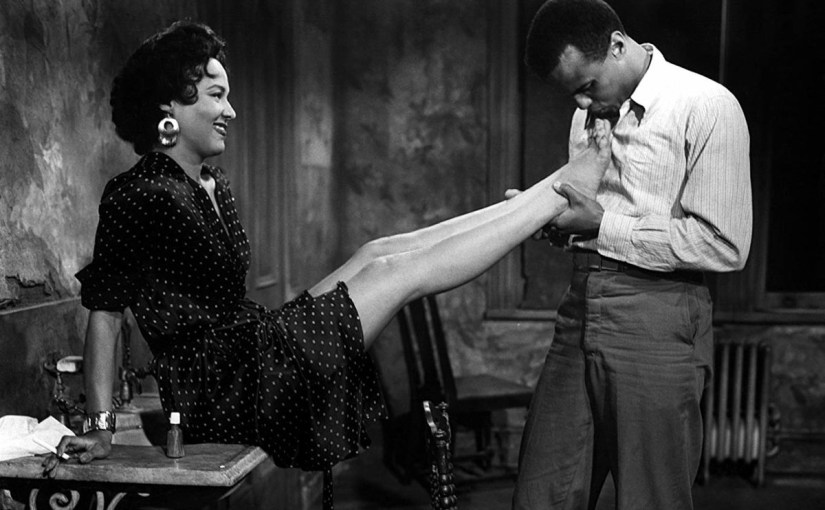
The tragic arc of Carmen Jones may seem inevitable, as I said before, but it remains an entertaining watch.  You can see the dominos falling, and you bemoan the choices Joe makes as he falls under Carmen’s spell, but I mean, LOOK at her.  There’s a scene that I’m sure would bear the Tarantino stamp of approval as Carmen paints her toenails and coyly asks Joe to blow on them for her so they can dry faster.  Dayum.  Show me a straight man who wouldn’t fall for that kind of treatment from a woman who looks like Dorothy Dandridge and I’ll show you a dead man.

If I wanted, I could get nitpicky about Carmen Jones.  Has it aged well?  Not exactly.  Does it feature great acting aside from Dandridge?  Not exactly.  Does it look natural to hear an operatic tenor burst forth from Harry Belafonte’s mouth?  Not exactly.  But Carmen Jones is a landmark of black cinema in an era when schools and government buildings still had segregated water fountains and restrooms.  Based on that fact alone, I consider Carmen Jones to be a vital step in Hollywood’s painfully slow racial evolution. (It is also a painful reminder of a career that might have been; Dandridge died 11 years later at only 42.)

MONTE WALSH (1970)

by Miguel E. Rodriguez

DIRECTOR: William A. Fraker
CAST: Lee Marvin, Jeanne Moreau, Jack Palance, Mitchell Ryan
MY RATING: 7/10
ROTTEN TOMATOMETER: 89% Fresh

PLOT: An aging cowboy realizes that the West he knew and loved will soon be no more – and that there will be no room for him, either.


Based on this film, Monte Walsh, and the other two films he directed, A Reflection of Fear [1972] and The Legend of the Lone Ranger [1981], I think it would be charitable to say that William A. Fraker’s best films are the ones where he served instead as director of photography, such as Bullitt [1968], WarGames [1983], and Tombstone [1993], among many other notable movies.  Am I saying Monte Walsh is a bad film?  No, but it’s certainly not as bad as Gene Siskel’s 1-star rating, nor is it as stellar as Roger Ebert’s 4-star rating.  I give it a 7-out-of-10 on my scale because of the way the second half of the film builds and builds so that the outbursts of violence feel earned and motivated instead of cliched.

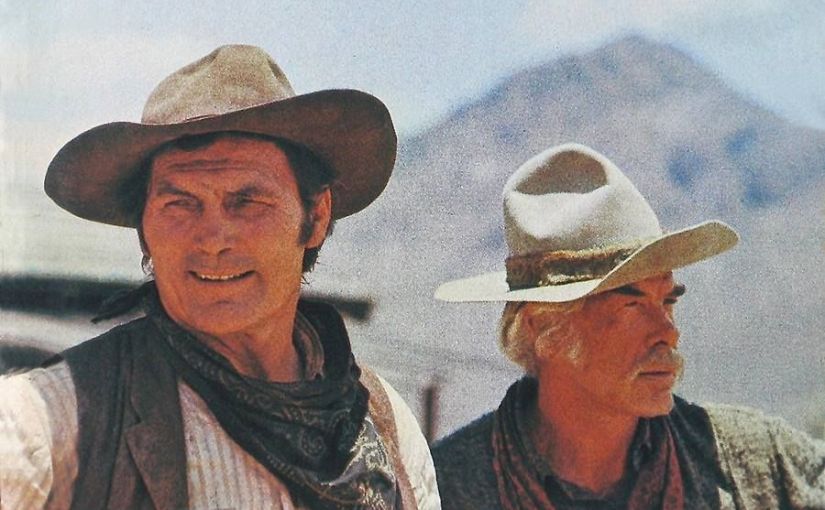
Monte Walsh (Lee Marvin, grizzled as ever, even with a handlebar moustache) and his friend and partner, Chet (Jack Palance in a rare non-villainous role), come down off a mountainside after a rough winter keeping watch on Mr. Brennan’s herd of cattle, only to get news that Brennan’s ranch has been purchased by a corporate entity, Consolidated Cattle.  Brennan offers them a steady job, which they reluctantly take, but deep inside they know this means their prairie-roaming way of life is coming to an end.  Chet is prepared to accept this, but Monte chafes at the idea.  “I ain’t doing nothing I can’t do from a horse,” he warns Brennan.

We get entertaining glimpses of the ranch hand life, complete with the saloon fights and the stinky cook.  Monte dallies with a French madame, Martine (played by the exotic Jeanne Moreau).  At one point, Monte and Chet ride out and meet a weathered old ranch hand who is “riding fence,” or inspecting every foot of fence around the ranch for repairs…the only work he’s cut out for anymore.  “Looks like his life is over with,” they say, and you can tell they’re looking into their own future.

The thrust of the film is one I’ve seen in many other westerns before this one: “The old West is changing, and there’s no place in it for people like us anymore, so we’d better evolve or die.”  This theme is present in Once Upon a Time in the West [1968], Butch Cassidy and the Sundance Kid [1969], and especially The Wild Bunch [also 1969]…seemed to be a trend for westerns at the turn of the decade, for some reason.  Monte Walsh handles it in an episodic format, kind of like another Lee Marvin film, The Big Red One [1980].  It doesn’t quite tell a straightforward plot with a pre-determined story arc.  It skips around a little bit, painting a picture without telling a conventional story.

There can be a sense of freedom in this kind of storytelling.  Unshackled by traditional story beats – at least for the first half – the movie is laid back, asking the viewer for a little patience as it slowly lays down building blocks for the finale.  However, I must report that I found this section of the movie a little slow.  I grew impatient.  I felt I was being set up for something, but pretty soon I just wanted the movie to get on with it.  Butch Cassidy sort of works that way, but you had two of the most photogenic stars who ever lived as the two leads.  I struggled to care the same way for Jack Palance as I did for Paul Newman.

But then an unexpected scene of violence occurs, setting into motion a series of events that culminate in a tragic series of deaths that, I must admit, had me glued to the screen as they unfolded.  Because of the gangbusters nature of this section, I am inclined to forgive the film’s shortcomings in its first half.  Here, we see, yes, Monte must evolve or die, and even if it’s never in any real doubt what he will choose, it’s entertaining to watch him make that choice.

If not for the second half of the picture, I might not even be writing about Monte Walsh.  I didn’t care for the opening song (even if it WAS sung by Mama Cass), some of the movie felt ripped off from several other westerns, and I was borderline bored for the first half.  But if you stick with Monte Walsh until the end, I think you’ll agree it’s worth a look.