A REAL PAIN

By Marc S. Sanders

Sometimes I take notice of how the title and credits appear in a film.  The director or the title supervisor had to put some thought into how the font and lettering appears on the screen at the start of a film.  Woody Allen was always very simple with his basic white lettering centered on a black screen.  Star Wars jumps at you across a galaxy of stars and then zooms away from you.  The Godfather appears with that hand grasping strings of a marionette.  I imagine writer/director Jesse Eisenberg opted to put the words A Real Pain to the left of Kieren Culkin’s closeup shot as the film begins.  When it concludes, the title again appears but now it is to right of a nearly identical pose of the actor.  During a five-day guided tour through Poland, we are accompanying the two leads, and we will uncover what defines a real pain all the way from left to right.

Eisenberg and Culkin portray Jewish cousins, David and Benji, who are reconnecting during their adulthood by joining a tour group in Poland that is focusing on historical locations related to the Holocaust.  Their grandmother recently passed away and earmarked monies for them to take this trip and visit her childhood home that she lived in before the Nazis took over and erected the Warsaw Ghetto along with concentration camps that killed millions of Jews and Europeans by the command of Adolf Hitler. Their tour guide promises an informative but likely triggering experience for the men and the four others who are accompanying them.  What becomes concerning though is that Benji wildly expresses himself during unexpected and inconvenient moments.

Even if David is uncomfortable with his cousin’s behavior, Benji is at least funny at first as he upstages James the tour guide (Will Sharpe) and gains a quick influence over the group.  Later though, Benji will alarm and frustrate everyone.  His grandmother was the most treasured person in his life.  Now that she’s gone, there’s a deep void left for him, and he has been exceedingly hyperactive and perhaps harmful to himself.  A train ride in the first class section is declared inappropriate to Benji as he reminds everyone of the purpose of this little vacation and journey into the dark times of Polish history.  Should they be able to live so comfortably, eating the finest delicacies as they journey to places mired in deep suffering from a horrible past?  David will eventually share what truly disturbs him personally, when he thinks about his cousin.  

Kieren Culkin delivers one of the best performances you’ll find anywhere in 2024.  His timing is so rhythmic even if you cannot predict when Benji is going to detract focus from the tour, and over towards what tremendously irks him.  The comedy he delivers, from Eisenberg’s very intuitive and sensitive script, is quite amusing but it all stems from an anger and sadness that the character cannot contain.  I can’t think of many actors who could play this kind of part.  It’s like watching Robert DeNiro in one of his manic roles that he performed under Martin Scorsese, like in The King Of Comedy or Taxi Driver.

Jesse Eisenberg is worthy of accolades as well.  He directs a heartbreaking monologue of his character trying to explain his cousin’s unhinged behavior.  His focused composure eventually is shaken as he directs his camera to zoom in closer and closer to him, across a dinner table.  David may have a sustained foundation of life with a loving wife and child back home, but he carries a pain that resides within his first cousin.  Eisenberg’s script compliments his well-planned direction, and he handles every perfect beat of the man he plays from the schlubby way he dresses to the baseball cap he wears over his bushy hair.  Despite their thirty-something ages, David and Benji connected as kids with their grandmother there for them.  Now that she’s gone, the sorrow normally found in a kid does not live as comfortably well in an adult body.

A Real Pain will motivate you to book a flight to Poland.  Eisenberg’s film works like a vivid travelogue and every backdrop is rich in color and restored history. That is until the tour group arrives at the Majdenak Concentration Camp.  The horrors that played out here are preserved so that visitors will realize the most absolute cruelty that man is capable of.  Other than the footsteps of the actors and the whisper of green nature on a sun-drenched day, no one speaks other than a few comments from James.  We see a caged collection of old shoes that belonged to men, women and children who were imprisoned and died at this location.  Eisenberg shows us the showers that gassed so many people to death.  The walls are splotched in blue smears.  Watch the film and you will discover their significance.  Life size ovens are also on display.  It’s terribly overwhelming.

What you may believe was a real pain in Benji no longer compares when the film arrives at the camp.  It’s not so much that Benji is a pain.  He only carries the pain that his grandmother and ancestors endured and witnessed.  

Reader, just writing this out leaves me shaken, quite frankly.

There’s a wholesome feeling when the boys, who are now men, arrive at their grandmother’s childhood home.  A spirit seems to talk to the pair and they share some dialogue but Jessie Eisenberg’s film also seeks some closure for his characters.  I will not reveal what they do at the front door. Once I finished watching the picture, I read an insightful quote from Jesse Eisenberg regarding this scene.  He says he was looking for David and Benji to do something that might have been most appropriate during a time when their grandmother lived here as a child, but now, nearly ninety years later, the gesture only serves as an inconvenience or a hazard.  I could relate.  History changes the course of how we live and abide. What seemed right to do at one point in life can no longer be accommodating at another time, regardless of if the sentiment was meant with noblest intention.

A Real Pain could be considered a coming-of-age film.  The characters resort to sneaking on to rooftops to smoke pot or hitch a train ride without paying, or travel with the most basic duffel bags for a European trip.  They dress like high school or college kids.  One dresses primarily in blue and the other in red until a well-timed turn of events has the characters switch colors. Benji speaks with what appears to be a lack of respect for his elders, despite the intelligence and sensitivity in the points he makes.  This trip allows the former boys to grow up, according to their grandmother’s design, long after her death.

Some people have told me they were unsatisfied with the open-ended conclusion to A Real Pain.  Not me.  Like the positioning of the film’s title at the beginning and end, I feel like I went on a journey from point A to point B; from left to right.  I looked back in history and for a short while lived among a present period, in a different part of the world.  These experiences are with me now.  Yet, for a guy like Benji, he should not be less lonely or less melancholy or less of whatever he feels on any given day.  His pain has not subsided.  Maybe though, it feels more reasonable and accepting.  I still carry empty places in my heart now that my parents are gone, and I’ve had to accept the surprising loss of a close friend. The way Benji or any of us learn to carry on is to find a justice for the pain and sorrow we carry under a new kind of normal. 

David returns to the loving welcome of his wife and child.  Only now, he has a better understanding of the real pain his cousin is experiencing and what his grandmother survived.

A Real Pain is worthy of more than just the two Oscar nominations it received (for Culkin’s performance and Eisenberg’s screenplay).  It is one of best and most engaging films of the last few years.  A triumph in natural dialogue and thought, while serving as a visual masterpiece in silent anger, sadness, and sensitivity.

What is especially evident is that Jesse Eisenberg is an accomplished director, and an even better writer. In addition, Kieran Culkin is a blazing dynamo of both comedic and dramatic talent. In A Real Pain, he wears both masks exceptionally well.

THE BRUTALIST

By Marc S. Sanders

Before I started writing this article, I had to marinate on my impression of Brady Corbet’s magnum opus film, The Brutalist.  It has the makings of a biography but it’s fiction.  It indulges practically every inch of a Holocaust survivor’s life after immigrating to America.  It takes daring approaches in its photography particularly since it was filmed using an antiquated 35 mm print in Vista Vision. (The director found it appropriate to use the filming methods that were available during the mid-century decades when most of the film takes place. Wise and insightful choice.) Despite using questionable AI techniques, two of the leads use impressive dialects and fluently speak in Hungarian and Hebrew as well.  Set designs, score, sound, visuals.  It’s all here.  Yet, I don’t feel I wholeheartedly enjoyed the experience of watching the picture, and this is coming from a guy who had the entire AMC auditorium #16 to himself on a chilly Thursday afternoon at 4:45pm.  Not a cell phone lit in my line of sight or a crying baby within earshot.  The theater was my oyster.  The Brutalist was not.

Adrien Brody won his first Oscar at age 29 for Roman Polanski’s The Pianist.  He earned his accolades for a heartbreaking performance.  He arguably works even harder as a visionary architect named László Tóth.  This nuanced creation from Brady Corbet is a most convincing historical character…of fiction, that is.  

László arrives on Ellis Island, separated from his wife and niece by concentration camp assignments during the war.  The ladies remain in captivity while he reunites with his brother, Atilla (Alessandro Nicola) and Christian sister-in-law who reside in Philadelphia, operating a custom furniture and carpentry shop.

Enter a raving mad and wealthy industrialist named Harrison Lee Van Buren (Guy Pearce) who arrives home to find out his son Harry Lee (Joe Alwyn) has hired the carpenters to redo a library as a big surprise.  Harrison is outraged at the finished product and denies payment for the job, thus causing a permanent rift between László and Atilla.  László is kicked out of his brother’s home following an accusation of making a pass at the wife, and he can only find refuge within a church shelter.  

Harrison has a change of heart however when his socialite friends take a special liking to the new room.  He tracks László down, pays him for the work, invites him to a Christmas party and subsequently insists he stay on the property while also connecting the Hungarian with an attorney who will make efforts to reunite him with his wife and niece who remain overseas.  

Meanwhile, an ambitious Harrison conjures up big plans right off the top of his head.  He wants to commission László to design an enormous building consisting of a library, a gymnasium, theatre and a chapel on a wide expanse of Pennsylvania land nearby his grand estate.  The building will be erected in honor of his loving mother’s memory.  A humble László accepts the assignment though he’s funding a heroin addiction with the monies given to him by Harrison.  

Though The Brutalist is fiction, I believe it should still be considered a lesson in north eastern American history.  As building gets underway, a perfectly timed intermission in the middle of the film arrives when we learn of Pennsylvania state’s aggressive campaign to manufacture and build with the precious commodity of US steel.  Fictionally speaking, we have Harrison Lee Van Buren and László Tóth to thank for these newly created jobs of construction and commodity developments.

There is a whole lot of story to tell in this three-and-a-half-hour picture that traverses through decades.  Brady Corbet’s depiction of his main character, László, runs the gamut of so many circumstances.  He’s a stranger in a strange land, even towards his newly Americanized brother who has shed his Jewish identity for prosperity.  The Anglo Christian mentality of Harrison Lee Van Buren, along with his family and fellow socialites, curiously study László as the alienated man he appears to be.  Loneliness is not a direct message that Corbet offers in the film, but how can László not feel lonely in this new land without the sensibilities of a wife to help him mind his boundaries and stay away from the poisons of heroin or personal betrayals that will challenge him?

The second half of The Brutalist oversees László growing accustomed to reuniting with his wife, Erzsébet (Felicity Jones), who has drastically changed in her physicality since they were last together.  Their primarily mute niece, Zsófia (Raffey Cassidy), has arrived as well.  The problem is that László has had opportunity to shed his weakness of being a Holocaust prisoner while taking charge of his most mesmerizing architectural design yet. His family’s arrival does not feel conducive with his new way of life, both intimately and religiously. The Brutalist covers a lot of conflicts while also showing massive progress for Harrison’s grand investment and László’s treasured work.  

After providing all of this exposition for the film, I think I’m ready to deliver my point.  It’s too much.  There’s so much story here that some of it feels unwelcome.  László’s heroin addiction never seems to add up or intrude effectively enough.  Because of the long running time of the movie, there are long sections where any reference to his yearning for heroin feels neglected.  This man of energetic and artistic passion is hardly ever weighed down by his vice and I questioned just how important it was for the drug addiction to be included in the film.  The script goes in so many different directions at times, it feels like it forgot about this important monkey that should be on László’s back.

László also gets challenged by Harrison’s American business and architectural partners which is one more conflict.  Unexpected fallbacks also occur that affect both László and Harrison’s years-in-the-making plans.  Then there is László’s friendship with an assistant who started as a fellow drug addict.  Finally, there is László and Erzsébet and the problems they face intimately and as common partners. The reunification of the married couple has new, unexpected dynamics to face.

It’s a lot.  While I never minded the running time of The Brutalist, all of these layers of storytelling become exhausting.  

Guy Pearce actually impressed me the most.  I loved his character and the shrewdness he exhibits to everyone he shares a scene with.  His gruff dialect with a pencil thin mustache, slicked back hair and perfectly tailored suits are distinct, but his presence in a room is always felt even when the camera is not on him or if he has nothing to say.  His stature gave me an impression of Rockefeller, a man with the appropriate and seemingly out of reach dreams that will deliver a future of advanced American building and development.  I may have loved Harrison Lee Van Buren’s story more than László Tóth’s.

However, I got angry with the film as the story was beginning its descent towards the end. Harrison commits a truly unexpected and heinous act that arrives out of nowhere.  This is a fictional story. So, I feel comfortable with my stance that what Brady Corbet opts for Pearce’s character seems wrong and unjust; a downright inappropriate take that did not add up for me.  Guy Pearce is giving a career high performance, but I did not care for how his character’s trajectory concluded.

Felicity Jones is a powerhouse actress as Erzsébet.  She appears so confident within the skin of her character as a defiant woman, unhinged by any sort of attempted intimidation from her husband or the Van Burens.  

Adrien Brody is the sure front runner to win a Best Actor Oscar, though I wish Ralph Fiennes would finally get his due recognition for Conclave.  There are so many directions that László Tóth is pulled in.  This is a very challenging personification for an actor to belabor.  For this one character alone, The Brutalist feels like five different movies are being played at once.  If you have read my reviews before then you may know that I’m a big admirer of multi-dimensional characters.  It’s hard to find a character this nuanced.  Michael Corleone is a comparison that comes to mind.  As I write this review, it astounds me how much depth I’m reflecting on within Corbet’s script and Brody’s performance.

I told a friend who has also seen the film that The Brutalist feels like a marriage between Paul Thomas Anderson’s There Will Be Blood and Milos Foreman’s Amadeus.  While these characters are considered audacious, great artists beyond comparable realms, they are never the most powerful people in the room.  The power belongs to those with the resources of wealth and those who proudly carry the rank and titles bestowed upon them.  For the artists, men of power stand in the way of the achievements they strive for, forcing them to vent their frustrations with self-harm and abuse towards the ones closest to them.

Everything I saw in Brady Corbet’s film is interesting.  Beginning with the arrival on Ellis Island and the Statue of Liberty towering over a lost László, all the way to a visit at the seemingly unreachable mountains of Italy where beautiful, white porcelain exists in the highest reaches of nature.  You feel like you have traveled to places uncharted by most people of this Earth.  It’s breathtaking.  

The Brutalist follows the trajectory of a man arriving in America to accomplish his dreams and obtain a destiny he feels worthy of.  Only there are obstacles that will divert his path and thus a different outcome may arrive. 

Visually and with Brady Corbet’s ambition for this picture, The Brutalist is often astonishing to absorb.  Still, at least on my one and only viewing thus far, the film was overwhelmingly abundant, and I could not feel comfortable with all of it coming at me once.  Then again, that is likely how László and Erzsébet Tóth felt upon their arrival in the land of the free.

THE WILD ROBOT (2024)

by Miguel E. Rodriguez

DIRECTOR: Chris Sanders
CAST: Lupita Nyong’o, Pedro Pascal, Bill Nighy, Stephanie Hsu, Ving Rhames, Mark Hamill, Catherine O’Hara
MY RATING: 10/10
ROTTEN TOMATOMETER: 97% Certified Fresh

PLOT: An intelligent helper robot winds up stranded on an island populated only by wild animals.  To survive its new environment, it adjusts its programming, with unexpected results.


Just days after watching Flow [2024], a dialogue- and human-free animated film about animals struggling to survive after a cataclysmic flood, I watched The Wild Robot, also human-free, also starring mostly animals, and also about the struggle for survival, but it adds conventional dialogue and an intelligent robot in search of its purpose.  In broad, REALLY broad strokes, they are similar, but don’t bother asking me which one is better.  I give them both a ten-out-of-ten, each for different reasons from the other.  Flow may be literally unique, at least in my experience, but The Wild Robot tames its genre and bends it to its will, creating one of the most heart-tugging movie experiences since Wall*E [2008].  If you’re prone to crying during a movie, this is a three-hanky film, at least.  (Penni went through five, herself.)

On a dark and stormy night, a mysterious container washes up on the shores of an uninhabited island.  Inside is Rozzum 7134, an intelligent helper robot with exceptional physical capabilities and the speaking voice of Lupita Nyong’o.  Hope she gets her royalty checks.  Upon escaping her would-be watery coffin, Rozzum searches the island for the one thing that will give her existence meaning: a task to complete.  The opening scenes get us off to a hilarious start as she tries to complete tasks for various animals, to no avail.  In an intelligent bit of screenwriting, she powers down for a couple of days and, through passive listening, effectively learns the language of the animals around her.  In a lesser movie, this feat might have been handled with the push of a button.  I liked the fact the writers went for something a little easier to swallow, science-fiction-wise.

Through circumstances which I will not reveal, Rozzum winds up as the guardian for a newly-hatched gosling, and as the unlikely friend of a fox named Fink (Pedro Pascal, whose voice was utterly unrecognizable; I thought it was Matthew Broderick).  The gosling imprints on Rozzum, which she finds bothersome.  A helpful mom opossum, Pinktail (Catherine O’Hara), warns Rozzum that the gosling must learn to feed itself, swim, and fly by the next fall so he can migrate with the other goose; otherwise, it will starve during the harsh winter.  Presto…a task!

Eventually, Rozzum is shortened to Roz and she names the gosling Brightbill (Kit Connor).  As she undertakes her task of raising the gosling, Roz’s programming…evolves.  She starts to actually care for the little guy.  She starts asking questions that robots aren’t supposed to ask.  She exhibits all the early warning signs of helicopter-momism.  And all the while, she debates whether to activate the internal beacon that will let her makers know where she is…

Because the plot is so dependent on tugging those heartstrings, that’s all I’ll say about it.  Let me talk instead about Wild Robot’s visual style.  The backgrounds and characters are gorgeous, sumptuous, evocative of oil or acrylic paintings.  I could mention two or three specific shots right now that contain some of the most beautiful animated imagery I’ve seen since Pinocchio [1940], but I don’t want to give anything away.  (Hint: butterflies and geese.)  In this way, among others, it shares a lot of DNA with Flow, whose backgrounds and characters also resembled hand-painted objects.  I don’t even want to think about how long it took to create such a painterly style and make it look so effortless and organic.

I also liked the way Wild Robot used its story to make a pointed commentary, but not in the direction I thought it would go.  From the trailers, I assumed it would be yet another paint-by-numbers story about preserving nature or life, which was already covered as well as it possibly could be covered by Brad Bird’s The Iron Giant [1999].  Instead, Wild Robot makes some eloquent statements about the terrifying task of parenthood.  At one point, Roz, who is programmed to solve problems, discovers the task she’s undertaken – raising a gosling, i.e., being a parent – is a task that could potentially never end.  She experiences the fear of almost losing a child.  The joy of watching Brightbill learn to fly, while at the same time realizing that means he will one day migrate.  As I list the plot points here, it sounds like the movie is composed of cliches, but I can assure you, it’s not.  All of these nuances, and many more, are allowed to occur organically without the slightest hint of being nudged along by the screenplay.

DreamWorks has created possibly their best animated film since…gosh, I’ll go all the way back to The Prince of Egypt [1998].  It’s a crowd-pleasing adventure with a point, which is a hallmark of only the best science-fiction movies/stories.  There are real stakes on the line.  There are some actual deaths in the story, which surprised me for some reason, but there you are.  It looks sensational.  It’s smart.  I can’t say enough about it.  The Wild Robot was one of my most favorite films of 2024.

THE LAST SHOWGIRL

By Marc S. Sanders

I dunno.  Maybe we grow up twice in our lifetime.  

Growing up is hard to do.  As a kid I loved playing with all my Star Wars, He-Man and GI Joe toys.  Now that I’m in my 50s, I see pictures of those toys online that are long gone, and I tell my wife how I wish I could escape back into that comfortable universe of limitless imagination.  Often, I miss being a child.

Beyond a boring desk job, as an adult I’ve moved on to acting to maintain my sanity, now going on close to 35 years.  Only, I do not memorize lines as well as I used to and there are fewer roles for an over middle-aged guy.  I miss many of my favorite parts that I portrayed on stage in my earlier decades.  I direct more often now, staying off the stage, and I guide actors to a point where I imagine how I would have portrayed the role.

Leaving these periods of my past behind is hard to accept and as I watched Gia Coppola’s The Last Showgirl, I could deeply relate to the anguish felt by Shelly (Pamela Anderson, in a gut-wrenching performance).  I believe anything we are good at, or that we have complete self confidence in is hardest when we are stripped of our talents.  Arthritis can mar a concert pianist, a unreliable memory can weaken an actor, bad knees can curse an athlete, and for Shelly who has been a Las Vegas showgirl for over thirty years, aging is working against her preservation.  Even worse is knowing that your performance niche carries no interest with audiences any longer.  Shelly’s show is being closed down in two weeks and an updated high-flying circus will occupy the venue.  

Coppola’s present day film appears to be shot on an 80’s camcorder.  The colors and sparkles of Vegas entertainment are glitzy only from the costume wear of Shelly and her fellow performers.  Otherwise, the cinematography is as colorless and burned out as an old home movie.  

Jamie Lee Curtis is unrecognizable at first. She plays Annette who is casino cocktail waitress and out of the showgirl business for a number of years now.  He complexion is craggily and overly tan.  Her hair is damaged, likely from years of hairspray treatments.  Her makeup is overdone in deep blue mascara and rouge.  She’s probably thirty pounds heavier and this has aged her out of her dancing career.  This is hard.  She’s a friend to Shelly, but she’s deeply mad at her newfound reality that will never match what she once was.  Total Eclipse Of The Heart could not be a more appropriate needle drop during a crushing scene among the slot machines of a busy casino.

Pamela Anderson plays Shelly as innocently naive and sweet to the younger performers (Brenda Song, Kiernan Shipka) who still have the youthful looks that will grant them opportunities after their show closes.  Shelly is affectionate and attendant to the younger girls’ insecurities.  She’s a maternal hen the young ladies pay attention to.  On the other hand, Shelly no longer looks like a blond babe who came out of the TV show Baywatch.  That is why casting Pamela Anderson in this role is so smart.  The actor ran the beaches in bathing suits while being an 80s rocker tag along with the drummer from Motley Crue.  Now she’s in her 60s and must adjust her talents and physical assets of wrinkles and crow’s feet to portray a lost soul like Shelly, a girl thrust into an immediate future of no purpose, no need and a lot less hope.  Who can Shelly turn to when her insecurity attacks?

Anderson is definitely up to the task of this role.  Her squeaky voice with a detectable girly lisp fights to uphold an optimistic extrovert.  This girl must have been a Marilyn Monroe of this industry at one point. Inside though, Shelly is in terrifying pain and Coppola’s script allows for several different scenes where her fear explodes organically.  One time it’s on a date with her stage manager Eddie (Dave Bautista, looking like a muscle head that you’d find in Vegas, but not in a showy superhero movie).  Later, Shelly has to pour her regrets out to her estranged college age daughter (Billie Lourd) who resents being placed below a risqué cheesy showgirl act while she was growing up.  

The most heartbreaking moment occurs when Shelly auditions with an unnatural and unsure toothy smile to become club dancer.  The director is unsubtle and apathetic at deteriorating whatever Shelly has left to grasp. Finally, Shelly the former, lovable showgirl must release the pain of her new reality that she’s been stabbed with.  Within a career mostly highlighted with buxom beach running and bathing suit footage, Pamela Anderson delivers her best dramatic scene anyone will ever encounter from her.  This is not just some cheapo dancer draped in stiletto heels, feathers and plastic bling with gigantic headdresses to balance.  This is a real person who has become extinct of her normalcy.  She could’ve performed elsewhere, but she’s three decades older now and on the surface, to the superficial folk of the nightlife scene, she’s not the T & A that people desire anymore.

The Last Showgirl explores the challenges of transition.  Change confronts all of us eventually.  We get older and maybe less healthier.  We are not as flexible and we move slower.  We become less intuitive and analytical too.  We also become displaced and replaced.  

Gia Coppola’s film, written with touching sensitivity by Kate Gersten, opted to follow a career that hinges primarily on aesthetics, but also on a culture that has outlived its shelf life.  Glitz and blingy glamour are not what’s sought after anymore.  Las Vegas has partly become a tourist attraction on a level of amusement park scale with nifty rides, concerts and family fare like circuses.  Shelly and Annette no longer fit in this newer design.  Yet they are not cars or buildings you demolish and replace.  These women have lives that were never prepared to be spit out and discarded.

The Last Showgirl shows a harsh reality.  The performances from its cast of current younger generations to the older material carried by Bautista, Curtis and especially Pamela Anderson are grounded in a range of reactionary authenticity.  Change arrives for each of these people.  Yet, the effects run a spectrum of differing perspectives, and the most hopeless and complex circumstance is delivered affectionately by a surprising Pamela Anderson in a heartbreaking performance.  Her work is so well done in this film. 

FLOW (Latvia, 2024)

by Miguel E. Rodriguez

DIRECTOR: Gints Zilbalodis
MY RATING: 10/10
ROTTEN TOMATOMETER: 97% Certified Fresh

PLOT: Somewhere deep in a forest wilderness, a solitary Cat barely survives a cataclysmic flood by clambering into a boat with an assortment of other animals; their survival will depend on their ability to help each other.


Nearly twenty-five years ago, Disney released an animated film called Dinosaur [2000] that was touted as being an industry game-changer.  The premise was revealed in a stunning, epic-length teaser trailer that fired my imagination.  Some of you may remember it.  Using state-of-the-art CG animation, and with no spoken dialogue, we watched as a dinosaur egg on prehistoric Earth was flipped out of its nest, carried away by scavengers, dropped into a river, swallowed and regurgitated by a fish, then plucked out of the water by a pterodactyl that soared over magnificent real-world vistas and plains before being dropped accidentally into a jungle canopy where the egg was discovered by a family of, I think, prehistoric lemurs.  A reminder: all with no spoken dialogue.

I remember thinking, wow, Disney is going to attempt the impossible: create a feature-length animated movie with no spoken words.  I was stoked.  What an experiment!  Hasn’t been done since Fantasia [1940]! And if anyone can pull it off, it’ll be Disney, right?  Imagine my disappointment when I went to see the movie, the opening scene plays out exactly as shown in the teaser, the lemurs peek through the foliage at the fallen egg, and one of the lemurs opens its mouth…and talks.  Not just human speech, but with a New York-Brooklyn-esque accent that almost sounded like Bugs Bunny.  Dreams shattered.

I mention that story because Flow, the recent winner of the Golden Globe for Best Animated Motion Picture, promised the same thing in its trailer: an animated film without words, starring only animals on a perilous journey.  I was skeptical.

Until I watched the movie today.  Not only does it deliver on its promise (making Dinosaur look shallow and childish by comparison), it sets some kind of crazy bar for mystical, awe-inspiring visuals that I would put on the same level as Avatar [2009] or Dune [2021].  Yes.  They’re that good.  And, according to IMDb, it was all created using only Blender, a free, open-source animation software tool.  Flow is a remarkable accomplishment.

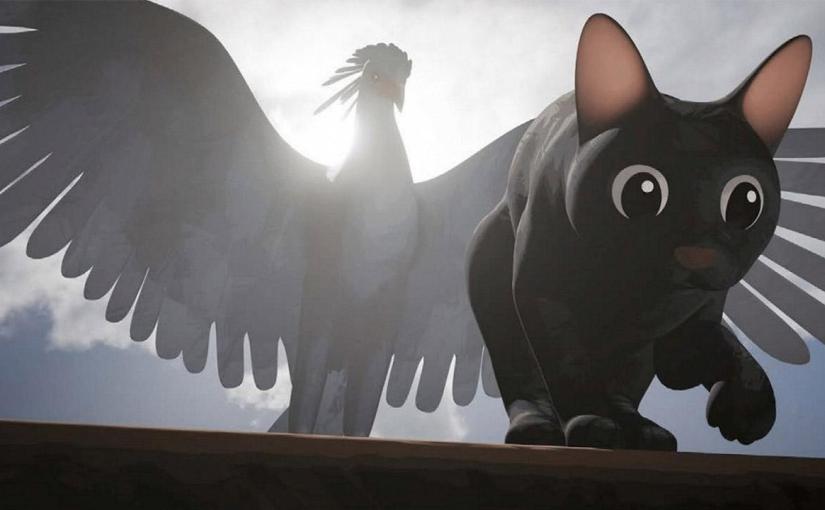
The story opens with Cat wandering a forest.  None of the animals are named, of course, nor were they named by the animators.  They were all referred to simply by their species or breed: Cat, Whale, Bird, etc.  After being chased by some dogs, including a friendly Retriever, Cat curls up in the top floor of an abandoned, expensive-looking forest cabin with nary a human in sight.  Where are all the people?  No answer is given.

With ominous abruptness, a cataclysmic flood sweeps through the forest, leaving Cat and Retriever stranded at the cabin as the waters steadily rise.  Retriever hops into a passing rowboat occupied by the other dogs from an earlier scene, but Cat understandably passes on this opportunity and eventually finds itself sharing a second boat occupied by a grunting, monosyllabic Capybara.

…but this simple plot summary doesn’t begin to do justice to the experience of simply watching this film.  I am super glad I saw it on the big screen first, 3rd row back, so the screen filled my field of view.  The whole movie reminded me of the best oceanic scenes in Finding Nemo [2003], crammed with detail, lavishly rendered, so that you sort of fall into the world.  There are hints to indicate that the forest and the lands beyond, now flooded, were once populated by humans, but they have all disappeared.  Statues of animals.  Top floors of houses still untouched by water, but not for long.  And, on a distant hilltop, a massive statue of a cat, on which Cat must find refuge at one point.

The look of the film is something I’m not going to be able to describe very well.  Partnered with the smooth CG animation itself, the main animal characters nevertheless have a hand-painted quality to their coats and fur.  The virtual camera moves as if being held by a real cameraman, reminiscent of the best scenes in the first Avatar.  There is a magical, spiritual sequence towards the end of the film (you’ll know the one I mean) that took my breath away and rivals anything from Pixar or Studio Ghibli.  I may not know precisely what it means, but to be honest, I didn’t care then, and I don’t care now.  I just know that it is a spectacular scene.  There are subtle hints that this world may not even be Earth as we know it, or when we know it.  Mystery abounds!  I love it.

I must give special mention to the animation of the lead character.  Cat has moments of cat behavior so specific and real that, even if you’re not a cat person or watched umpteen cat videos on YouTube, you will recognize it as being 100% authentic.  For that matter, the same could be said of all the animals in the film.  I must be honest and report that there are times when, viewed through a lens of “is-this-realistic”, the animals behave in a way that does not compute with reality.  I highly doubt a capybara would be able to figure out how to work the rudder of a sailboat…and yet, in this movie, it does, and it’s fine.

Which brings me to the one problem I can imagine some folks might have with the film: the ending.  I can’t tell if the right descriptor is “elliptical” or “open-ended” or “inconclusive.”  Perhaps it’s a plea from the filmmakers for cooperation and teamwork in an age where uncontrollable outside forces are doing their best to prevent it; like these animals, we’re all in the same boat.  Or maybe that’s not the message.  The beauty of Flow is that the ending is subject to interpretation, thanks to the lack of dialogue simply telling us what it means.

Frankly, I’m not too fussed about extracting the message from Flow.  I am too grateful that a film like this even exists to lose sleep over its Deeper Meaning.  It is a film constructed out of wondrous sights that harken back to the days of Pinocchio and Fantasia [both 1940], when animators and filmmakers gave equal weight to story and visuals, and it’s one of the best animated films I’ve ever seen.

MAXXXINE (2024)

by Miguel E. Rodriguez

DIRECTOR: Ti West
CAST: Mia Goth, Elizabeth Debicki, Michelle Monaghan, Bobby Cannavale, Giancarlo Esposito, Kevin Bacon
MY RATING: 8/10
ROTTEN TOMATOMETER: 72% Certified Fresh

PLOT: In 1985 Hollywood, adult film star and aspiring actress Maxine Minx finally gets her big break. But as a mysterious killer stalks the starlets of Hollywood, a trail of blood threatens to reveal her sinister past.


When I started posting my blissful reviews of X and Pearl [both 2022], I got one response more than any other: “Wait till you get to MaXXXine; it’s the weakest of the trilogy.”  Having just watched it, I would say that calling MaXXXine the weakest film in this trilogy is like calling Return of the Jedi [1983] the weakest film in the original Star Wars trilogy.  You may be technically correct, but it’s still a great ride and a better film than many others in this genre.

Six years after the bloody events of X, we pick up the story of Maxine Minx (Mia Goth) as she auditions for a film role in Los Angeles.  She’s been signed by a devoted but semi-skeevy agent, Teddy (Giancarlo Esposito in a fabulously bad hairpiece), and she has experienced modest success as a porn star.  But she longs to spread her wings in “legitimate” films, because as we all remember, Maxine craves fame more than anything in the world.  As she never tires of repeating: “I will not accept a life I do not deserve.”

Just as things start looking up for Maxine’s career, a package is left on her doorstep…a VHS tape labeled ominously, “For Maxine.”  When she pops it into her VCR, she’s treated to a shot from her filmed but unfinished porn movie from six years ago…evidence which would link her to those horrific murders and endanger her newfound success.  Meanwhile, the infamous real-life serial killer Richard Ramirez, aka “The Night Stalker”, terrorizes Los Angeles at night, not to mention a copycat killer who is branding his victims with pentagrams.  How these murders are linked to Maxine, and when and where John Labat (Kevin Bacon) comes into play, is not for me to divulge.  And one by one, Maxine’s friends and co-workers are turning up dead…

The plot of MaXXXine is nothing new, let’s face it.  What makes it sparkle is the wit and TLC provided by director Ti West and his collaborators.  For anyone who was alive in 1985, this film is like a stroll down memory lane.  I found myself thinking about Quentin Tarantino’s Once Upon a Time…in Hollywood [2019], with its loving recreation of late-1960s Los Angeles and serial-killer-related plotline.  That’s not to say MaXXXine is ripping off Q.T.’s film, not at all.  Both films have an immense affection for their respective timeframes and have gone to great lengths to immerse us in that culture.

Another filmmaker that came to mind during MaXXXine was Jordan Peele, director of his own trio of horror neo-classics: Get Out [2017], Us [2019], and Nope [2022].  Ti West’s films share a lot of characteristics with Peele’s films.  The Maxine trilogy looks like a million bucks on screen, despite what must have been very limited budgets.  The plots and screenplays are airtight with one or two minor exceptions.  (Peele’s plots are more Twilight Zone than reality, so they get a bit of a pass on plausibility.)  And the characters are intelligent, sharply drawn, and rarely fall into cliched behavior.

If MaXXXine is not quite as terrifying as its predecessors, I’m prepared to forgive it.  Whatever it lacks, it makes up for in its besottedness with Hollywood.  There is a scene where one character chases another through a Universal backlot (oddly deserted, but whatever); they run through various movie sets, including the town square featured in Gremlins [1984] and Back to the Future [1985], winding up at – and I almost could not believe this – the Bates Motel and even inside the Bates house behind it.  Only a director/screenwriter deeply in love with the movies, and horror films specifically, would dare to write a scene like that into their script, and I loved it.  (Trivia note: they had to get permission from the Hitchcock estate first…awesome.)

I haven’t even mentioned the movie’s subtext.  The movie Maxine has gotten a part for is being directed by a woman, Elizabeth Bender (the pleasingly towering Elizabeth Debicki), who believes The Puritan II is her chance to prove that her voice is worth listening to in an industry dominated by male voices, especially in 1985.  If the only way to get people to listen is to make a B-list horror movie with A-list concepts/ideas, so be it.  Two of the best horror movies I’ve seen in recent years were directed by women: The Babadook [2014] and Saint Maud [2019].  And yet, out of over 1,850 movies in my personal collection, only 70 were directed by women.  I guess things haven’t changed that much in the movie industry in forty years.  Discuss.

MaXXXine begins with a quote from Bette Davis.  I won’t recite the quote here, but it implies that an actor isn’t a star until they’re considered a monster.  I hope that’s not true.  But for Maxine Minx…if that’s what it takes, well, then…that’s what it takes.

NIGHTBITCH (2024)

by Miguel E. Rodriguez

DIRECTOR: Marielle Heller
CAST: Amy Adams, Scoot McNairy, Jessica Harper
MY RATING: 7/10
ROTTEN TOMATOMETER: 59%

PLOT: A woman pauses her career as an artist to be a stay-at-home mom, but her domesticity takes a surreal turn.


[SPOILER ALERT…if you plan on seeing Nightbitch, avoid this review.  This movie, like most movies, works best on the viewer if they have no idea what’s happening or what’s about to happen.  Consider yourself Spoiler-warned.]

Nightbitch shoots out of the starting gate like a thoroughbred – or a greyhound, if you will – but about halfway through, it runs out of narrative steam.  I felt like a gambler watching a horse race, watching my horse lead the pack around the first turn, already spending the winnings in my head, and then my horse fades a bit, then a bit more, and by the time we get to the finish line, I’m tearing up my ticket in frustration.  I needed a WIN, not a PLACE.  There goes my trifecta.

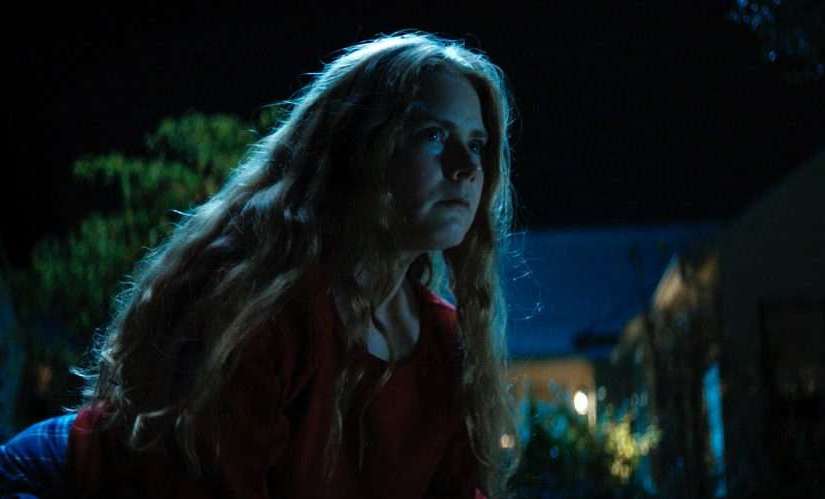
Amy Adams plays an unnamed Mother who has put her promising career as an artist on pause to be a stay-at-home mom while her also-unnamed Husband (Scoot McNairy) pursues his career as a…um…well, whatever it is, he has to travel a lot, leaving Mother at home with, you guessed it, Son (played by adorable twins Arleigh and Emmett Snowden).  Referred to throughout the movie as “my guy” and “sport” and “little buddy,” Son is a typical toddler in the throes of the terrible twos: cute for long stretches, maddeningly frustrating for longer stretches.  [Ed. Note: the author is not a father, has no plans on becoming a father, and will never possess the immense dedication it takes to rear a child, so don’t expect him to embrace the chaos of toddler-hood because it ain’t gonna happen.]

Mother is going through an identity crisis, set up in a brilliant opening scene where Sally, the woman who assumed Mother’s job at an art gallery, asks her, “Do you just love getting to be home with him [Son] all the time?”  Mother answers the question with a little more honesty than Sally or anyone had a right to expect, including this tidbit: “I am deeply afraid that I am never going to be smart, or happy, or thin ever again.”  I am a straight Hispanic cisgender male, so I’m here to tell you, I will never understand that mindset, but I am reasonably certain there are untold millions of moms out there who, if they listened to Mother’s opening statement, would say, “AMEN, sister.”

A little later, Mother delivers an internal monologue where she reflects that, as a mother, you can squeeze someone into the world “who will one day pee in your face without blinking.”  Again, I’m not a parent, but I know that’s truth in cinema right there.

After a few more establishing scenes of Mother interacting with Son, who absolutely REFUSES to go to sleep at night or eat anything for breakfast except, apparently, hash brown patties fried in butter, some odd things start to happen.  At the playground, some stray (?) dogs approach her as if she’s their best friend.  Mother notices her sense of smell has become much more acute.  Son helpfully points out that her back is hairy.  And, in a creepy Cronenberg-y moment, she notices a lump growing at the base of her spine just above her rump.  Curiosity gets the best of her.  She heats a needle, lances the lump, and…well, if you remember the title of the film, you have an idea of what pops out of that lump.

This was all wonderfully thrilling stuff as a movie lover.  I’m thinking, “My god, this is a Spike Jonze movie told from a woman’s perspective!  I’ve never seen anything like this!  This is gonna be GREAT!”  Mother starts to enjoy eating a lot of meat.  She starts to play “doggie” with Son, growling and barking at each other like two puppies.  The two of them eat their lunch at a deli with no silverware…or hands, to the consternation of other diners.  Son doesn’t sleep at night, so Mother, in a genius parenting move, buys a dog bed and gets Son to play “doggie” and sleep in the dog bed at night.  Presto, problem solved!

And more and more dogs start showing up at her door, at night, sometimes bringing gifts: small dead animals.  One night she walks outside, starts digging around, and an astonishing transformation takes place…

I know, I know, SPOILERS, I get it.  But it’s important to get across just how brilliantly original the first act of the film is, because the second act is, alas, all downhill.  I am not saying that the film’s message is unimportant, not at all.  I admire the film because of its message, and because it was being delivered in such an original way.  But then we get into conflict with Husband, who is desperately trying to understand why their 2-year-old is now sleeping in a dog bed on the floor, or why their cat suddenly turned up dead on the front porch, or why his wife suddenly wants a separation.  It must be said, Nightbitch is remarkably even-handed with the Husband’s dialogue.  He is not reduced to a 2-dimensional sitcom husband.  When she lays into him for not supporting her career, he fires back with a well-reasoned argument.  Their dialogue could be turned into a first-rate play.

But instead of exploring the surreal nature of Mother’s new condition, the movie settles into soap-opera territory, with only the occasional nod to the mystical incidents in the first act.  I distinctly remember, in the middle of the second act, feeling as if a balloon had deflated in the plot.  I imagine defenders of the film might say, “Well, the second act is where the weird stuff has to take a back seat to deal with the real issues at hand.”  Okay, maybe that’s true from a real-world perspective, but to me, it felt as if the filmmakers were on the verge of showing us something mindboggling, then backed away from the precipice at the last minute.

Does that make me guilty of critiquing a movie for what I wanted as opposed to what I got?  I guess it does, as much as I dislike that tendency in myself.  I feel there are so many different ways the movie could have gone in act two, could have leapt gleefully over the edge of convention and truly broken the mold with this movie.  When it became clear what they were doing instead, my elation evaporated.

I give Nightbitch a generally favorable score, though, based on the mad inventiveness of the first act and the plot in broad strokes, and also on the incredibly brave performance from Amy Adams, who maybe has two scenes in the entire film where she seems to be wearing any makeup.  She also appears to have to put on some weight for the role, which is not something I can ever recall seeing a female actor do.  Male actors have turned that kind of thing into a cottage industry, but when was the last time you saw a woman do it?  That took guts.  Watch Nightbitch for Amy Adams’ performance and for the story, even if the movie doesn’t follow its own plot to a satisfying conclusion.

THE SUBSTANCE

By Marc S. Sanders

It’s no surprise that a science fiction gore fest would make its way on the silver screen intent on enhancing our lives as we grow out of adult youth.  Plastic surgery and bust enhancements, unwanted hair removal, butt lifts and Botox are common vernacular discussed in magazine articles, infomercials and talk shows.  Well known actors rely on beauty preservations and enhancements to uphold their careers or give themselves a needed boost to stay relevant.  I mean come on, Tom Cruise wouldn’t naturally look like that.  Still?  Let’s get real.

What I admire about Coralie Fargeat’s The Substance is how she applies her updated Frankenstein experiments within the boundaries of Hollywood glitz and glamour.  Her film starts out ironic, then reflective and concludes on B level satire.  Wasn’t this how The Toxic Avenger came to be?

Fortunately, the brains of the writer/director overcome the beauty that’s attempted.

Elisabeth Sparkle (Demi Moore) is an obvious nod to Oscar winner Jane Fonda.  She is unbelievably gorgeous and physically fit, especially for a fifty-year-old award-winning starlet. (Incidentally, Demi Moore is over age 60.) She has found a second career success as a daily TV workout video hostess. Yet, she senses that her expiration of youth is quickly approaching.  It could not be more apparent from what her sleazy producer Harvey shares with her.  This jerk has no filter and tells it like it is. Audiences want younger and curvier, and Elisabeth ain’t it.  Harvey is played by Dennis Quaid and Farageat is not shy about presenting this guy with every priority of superficiality.

Elisabeth gets axed from her show.  Fortunately, she comes upon a possible remedy for her aging dilemma known as The Substance.  After some toiling about, Elisabeth agrees to try this clandestine idea out promising a better, more improved version of herself.  

The kit to make this all happens is delivered.  First is a needle injection and further instructions mandate without compromise that every seven days Elisabeth must return from the alter ego that spawns from her.  Except this is not so much an alter ego as it is alter body.  Literally from behind Elisabeth’s back enters Sue (Margaret Qualley).  Both Elisabeth and Sue are reminded by the mysterious voice on the phone that they are “one,” and they must use the contents of their kits to nourish one another’s bodies daily plus, and without fail, surrender to a seven-day hibernation while the other roams the earth.  Every seven days they must alternate.

Sue, with Elisabeth’s psyche, gets the job as the replacement hostess and Harvey goes nuts for her as the ratings and her popularity soars.  The Substance is serving its purpose.  

Yet, what happens when the two egos do not cooperate with the program’s mandates?  Well, you find out with an assortment of grotesque and ugly side effects that develop both mentally, and especially physically.  The Substance tackles some extraordinary consequences ranging from multiple personality disorders that joust with one another, and insecurities that even beauty enhancements could never resolve.

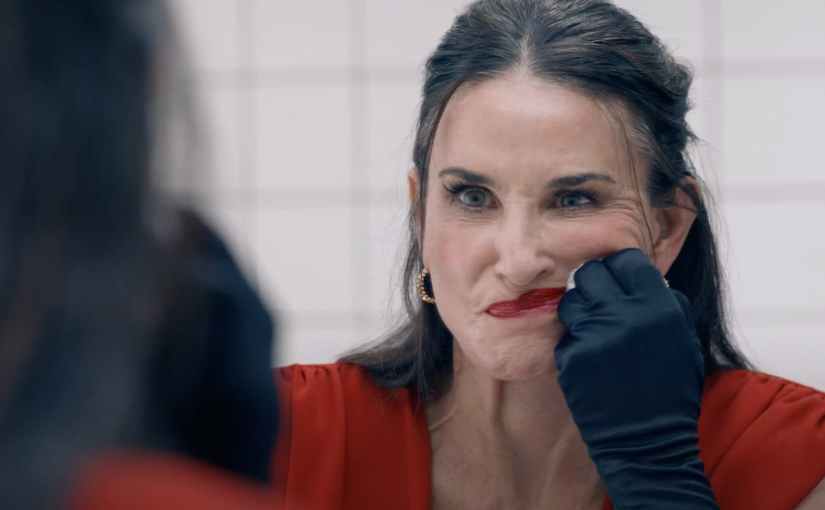
Amid all of the ugly gore of blood and fluids and stitching and rotted, infected skins is a jaw dropping performance from Demi Moore.  The Substance is deliberately not big on dialogue as it depends more on perception and facial response.  The best example is when Moore as Elisabeth prepares herself for a date and builds up an unnerving frustration as her character focuses on her reflection in the mirror.  I read that Demi Moore slapped and rubbed the skin of her face raw while shooting this scene in take after take.  Her commitment to the scene could not be more evident.  A later scene with her adorned in offensively aged makeup is at least as aggressive for the actress.  A food binge goes maniacal, and Demi Moore is sensationally focused on its messiness and engorgement.

The Substance is very smart from beginning to end.  Yet, the conclusion is outright ridiculous, and Coralie Fargeat clearly wants it that way.  It’s not only that Elisabeth and Sue suffer at the punishments of their own hubris, but Harvey and those that put appearances over any kind of, well, substance must succumb to their own superficial priorities.  Fargeat takes what could have been a comparable messy Three Stooges pie in the face route where everyone’s dignity has to be shed.  The blinders of beauty get washed away in an overwhelming deluge.

The Substance is elevated to an absurd narrative as quick as it begins.  No one is glamorized even if this is Hollywood.  We get close ups of Harvey gorging himself on sloppy, saucy cocktail shrimp while Elisabeth watches in disgust.  Later, the physical side effects go by way of famous makeup artist’s Rob Bottin’s work on films like John Carpenter’s The Thing.  The director tosses obvious nods to Stanley Kubrick’s The Shining with a ghastly orange hallway and reminiscent geometrically zig zag carpeting.  Even a men’s room designed in cherry blood red harkens back to that film.  Food is repulsive in this film that focuses on body image.  Colors of all kinds are loud, garish, and bright.  The director doesn’t want you to wince at only the very graphic details of Elisabeth and Sue’s ongoing transformations.  If these characters are going to feel or behave ugly, then the world they live will feel at least as repulsive.

A friend of mine who takes to curious kinds of horror and fright fests was eager to see The Substance.  She watched the night before I did and was angered by the ending that she found ridiculously over the top.  Definitely no argument there.  Yet, because this is satire offering a reflection of truth, as gross as the film is and as absurd as the ending gets, it logically adds up.  

We can try all we want to hold on to our youth and outer appearances.  However, either we must learn to become satisfied with the limitations that science can offer or we will pay penalties for defying what is instructed of ourselves.  The Substance is beyond any sense of science.  This film tosses hints at the viewer that Elisabeth, and later Sue, should think twice about what they choose next.  Then again, whoever thinks twice in one these B movie schlock fests, anyway?  

I even think this film goes a step further.  In cancer patients, chemotherapy remains the leading remedy for treatment of the illness.  We turn to its resolve despite the sickening side effects that stem from its program.  We want to live and we will compromise our ways to go on living.  Elisabeth Sparkle needs to remember though that she does not suffer from cancer.  She’s an insecure woman who isn’t ready to face change.  I’m not minimizing how the character feels.  I can relate.  She is facing a hard, agonizing truth from her perspective. I took steps in my lifetime to enhance my appearance and mentally and physically it was not the best option for me.  

It’s fortunate that Demi Moore allows me to relate to what’s traumatizing her.  Margaret Qualley does well holding up the other half of the picture as her side of this one personality gets drunk off the attention and perfection she’s entered into this new world.  

Commonly speaking, I also thought of the Queen from Snow White And The Seven Dwarfs.  An elegant woman so insecure with her beauty against that of a young girl and she sees no other way to come out on top than to change into an ugly, old hag.  Like Elisabeth in The Substance, the Queen in Snow White will accept a notion of looking worse before it gets better.  Since this film is satire, don’t we all go through experiences like this at one time or another?

Some of us learn.  Some of us persist and persist though.

NOSFERATU (2024)

by Miguel E. Rodriguez

DIRECTOR: Robert Eggers
CAST: Lily-Rose Depp, Nicholas Hoult, Bill Skarsgård, Aaron Taylor-Johnson, Willem Dafoe
MY RATING: 8/10
ROTTEN TOMATOMETER: 85% Certified Fresh

PLOT: The true OG vampire movie gets a fresh coat of paint in this gothic tale of obsession between a haunted young woman and the terrifying vampire infatuated with her.


Allow me to begin, as so many great films do, with a couple of flashbacks.

2018: The indie band Weezer records and releases their polarizing cover of Toto’s stone-cold classic “Africa.”  While recorded and produced with all the modern techniques at their disposal, fans of both bands say, correctly, that this new version is virtually identical to the original…so what was the point?  Couldn’t they have put some kind of new spin on it, like (for better or worse) UB40 and their cover of “Can’t Help Falling in Love”?  Why bother?

1991: Orion Pictures releases The Silence of the Lambs, an adaptation of Thomas Harris’s terrifying psychological thriller.  It goes on to win the coveted “Big Five” at the Oscars: Best Picture, Director, Actor, Actress, and Screenplay (Adapted).  Having devoured the book during one summer vacation, I go to a screening expecting to be wowed.  But…because the filmmakers stuck SO closely to the book (with some minor exceptions), there is little to no suspense for me.  While I am genuinely floored by how well-made and well-acted the film is, I do not experience any of the thrills and chills felt by those viewers who had NOT read the book.  I knew ahead of time what they would find in the corpse’s throat in the funeral parlor, how Lecter would escape from the courthouse, and how Starling would stumble upon Buffalo Bill’s house.  Don’t get me wrong, it’s a stellar movie.  But it was never truly scary for me.

Which brings me to Robert Eggers’s long-gestating remake of THE original vampire movie, Nosferatu.  Based on the immortal silent classic of the same name from 1922, directed by F.W. Murnau, the story will be familiar to any serious film/horror buffs, especially since Murnau “borrowed” liberally from Bram Stoker’s novel, Dracula, without first obtaining legal permission from Stoker’s estate.  How liberally?  Here’s a quote from IMDb: “All known prints and negatives were destroyed under the terms of settlement of a lawsuit by Bram Stoker’s widow.”  The only way the film survived was via 2nd-generation copies from other countries around the world.  Plagiarism?  Or homage?  I would normally say here, “You be the judge,” but the courts seem to have answered that question pretty definitively.

I mention this because every version of the Dracula mythology, starting with Nosferatu all the way through the semi-campy Hammer films to Coppola’s famous “low-tech” version and beyond – all of them tell the same story with only minor changes.  Consequently, the thing I look for in those films is not WHAT they’re telling me, but HOW they’re telling it.  Any student of pop culture knows Bruce Wayne’s origin story, so Batman Begins [2005] holds no surprises there, but the story is told extremely well, and so you roll with it, you know what I mean?

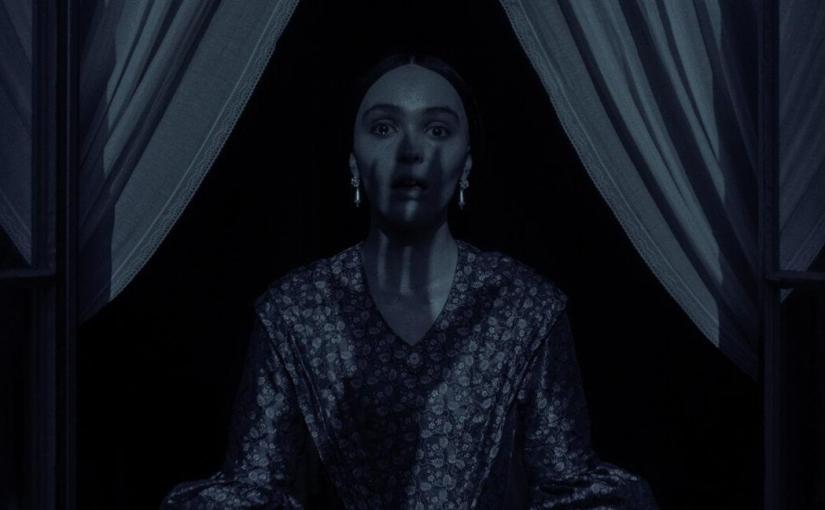
With Eggers’s Nosferatu, the production values on display are magnificent.  Eggers gets the mood and tone of a genuinely gothic horror story exactly right, as I knew he would, based on his previous films, especially The VVitch [2015].  The colors are muted to recreate the vibe of a black-and-white film, which paradoxically makes some of the scarier scenes even scarier.  The performances all around are top notch.  Poor Nicholas Hoult is saddled with the thankless Thomas Hutter role, stuck in straight-man mode the entire film; but Lily-Rose Depp had me thunderstruck with her performance as Ellen, Thomas’s wife, and the dependable Bill Skarsgård delivers the goods as Count Orlok, with a proper Transylvanian moustache (right out of the history books, haters) and an accent thick enough to tar ten miles of a country road with.

But let’s think about this for a second.  Those of you unfamiliar with the story of Nosferatu might be thinking to yourselves, “Who’s Thomas Hutter?  Who’s Ellen?  Don’t you mean Jonathan Harker and Mina?”  Well, naturally, those are the names the vast majority of filmgoers are going to be familiar with, not Thomas and Ellen and Count Orlok (which for my money is a much creepier name than “Dracula,” but I digress).

And therein lies part of the problem with this film.  I was so thoroughly familiar with the Dracula story that, even though this new film is a wonder to behold, it held very little suspense for me, since I knew exactly what was going to happen next, beat for beat.  There are, of course, cosmetic differences here and there: Thomas’s visit to a Romani village before he arrives at Orlok’s castle…Orlok’s straight-up possessions of Ellen…the highly effective jump-scares with the dogs here and there.  But I’ve seen it all before, MANY times.

(By contrast, I just recently watched one of the greatest slasher movies I’ve ever seen, X [2022], and it has virtually every slasher-movie-trope imaginable, and yet it somehow managed to transcend its own genre and become some kind of crazy masterpiece.)

In fact, in a very unexpected twist, there actually were two genuinely scary/creepy moments for me, and neither of them featured Count Orlok himself, at least not in the flesh.  They both involved Ellen, Thomas’s new wife, who becomes literally possessed by Orlok’s influence in scenes that legitimately give The Exorcist [1973] a run for its money.  Ellen thrashes about, rolls her eyes into the back of her head, speaks in an unnaturally guttural croak, bends backwards impossibly far – is Lily-Rose Depp a contortionist on the side? – and generally scares the bejeezus out of her husband and the audience.  On the strength of these two scenes alone, in addition to the general excellence of filmmaking craft on display, I would have no hesitation in recommending Nosferatu to moviegoers.

So, yes, despite my disappointments at the story level, given there were virtually no surprises plot-wise, I still give the movie a favorable rating just because it’s so well made.  If it had been created in a vacuum, if there had never been a vampire movie before this one, I believe I would have been creeped out to a much greater degree than I was, and this would have been hailed as an instant masterpiece.  But it is darkly beautiful to look at and wonderfully moody; there are many shots that are very nearly duplicates of shots from the original, which I enjoyed on a film-geek level.  I look forward to Robert Eggers tackling purely original material again.  He knows what he’s doing.

RED ONE

By Marc S. Sanders

Santa Claus has been kidnapped.  It’s up to Dwayne Johnson and Chris Evans to rescue him before Lucy Liu has to explain to all the Presidents and Prime Ministers across the world that there might not be a Christmas.  It’s one thing to read this as pertinent information.  It’s another to say it out loud with a straight face.  I’m now convinced that Lucy Liu is the most amazing actress of all time.  Not a curve, not a wrinkle, not a twitch in her stoic expression. Still, I believe Christmas is going to happen.

Yes, ol’ St. Nick (J.K. Simmons) has been captured.  His bodyguard is Cal (Dwayne Johnson), also head of security at the North Pole.  He is determined to get the bearded man in red back before Christmas Eve, and he partners up with a petty computer hacker mastermind, lacking any Christmas spirit, named Jack (Chris Evans).  The guys will argue with each other before they connect as buddies. You know how this works.  They’ll follow the leads to find out who and why “Red One” was taken. 

Red One works as a fun action picture with pretty cool and imaginative visuals like I’d count on from director/writer Jake Kasdan, son of Lawrence.  As a Christmas movie though? It needs a lot more tinsel.  

J.K. Simmons is not a conventional fat man Santa with a jolly “Ho Ho Ho.”  This dude is a weightlifter and, well, he talks like the guy from Whiplash and those Spider-Man movies.  Pair him up with the bruising Dwayne Johnson and this Santa is the morose police captain who would sit behind a desk, handing out the next Lethal Weapon assignment.  

The director of security is played by Lucy Liu, dressed in a black starched pantsuit, stressing the urgency of the problem.  Like the rest of the cast, save Evans, she takes Christmas way serious and that’s where the problem lies with Red One.  It’s not gleeful or celebratory of the holiday.  When she warns us that Christmas may not come, how am I supposed to respond to such a dire consequence?  Should I be scared? Am I supposed to laugh or cry?  When Doc Brown told Marty McFly he may be erased from existence, well you know that was pretty heavy (and not as trivial as something wrong with the gravitational pull of the earth).  When Lucy Liu and The Rock talk about NO CHRISTMAS of all things, I gotta wonder if I’ll get my annual Chinese dinner with my Jewish family.  Red One feels like a cliffhanger episode of NCIS.  Even Die Hard was more in line with the Christmas spirit than this flick.  John McClane declared his “Ho Ho Ho!” when he got a machine gun.  No one in this movie seems to have a sense of humor.  Chris Evans cracks some one-liners as if he’s shying away from the hokey script that everyone else embraces like a Tom Clancy novel.  

What works in Red One is the visual imagery of a wicked Christmas witch and assorted trolls and monster mayhem, particularly from Krampus (Santa’s gholish beast of a brother played by Kristofer Hivju) who gives a hilarious beatdown on The Rock.  There’s also a cute way to disarm some beastly polar bears who can encase our heroes in ice. The designs of the North Pole look cool as an industrial military base specializing in toy manufacturing.  However, we could have seen some cool gadgetry with this factory.  Instead, there’s a lot of underground mazes to circumvent that we barely get a look at amid the fast pace of the action scenes.

Cal is gifted with a power wristlet that packs a punch, shrinks him down for fighting advantages and has the ability to turn Hot Wheels cars into life size Chevrolet products for quick travel.  Naturally, Cal also knows that storage closets found in any toy store will transport you to another part of the world.  Nifty!  Not holiday spirited though.

The chases and fights work.  Johnson and Evans make for an okay buddy cop kind of pair.  The designs of the movie hold.  Yet, what’s missing is a spirit of Christmas magic.  Again, the holiday of Santa with his magical reindeer and cookies and stockings all feel hollow here.  Something is definitely missing because it’s hard for me to pinpoint who this film is catered for.  Families?  Red One comes off too nihilistic for that crowd ready to enjoy everyone’s comfort during winter break.  It’s too hokey just for the adults or the action movie lover.  A threat of Santa Claus missing with Christmas at risk also seems too overwhelming for the under 8 crowd.  

I got a kick at everything I saw on screen but there’s no one to connect with or empathize, and even for this Jewish guy, there’s an absence of Christmas tidings to behold from music to decor to the common recognizable tropes. Even when Santa poses as a shopping mall iteration, Simmons’ tough guy exterior doesn’t lend to any sort of joy or whimsy that comes with the holiday.

The sad irony is that Cal wants to retire because he sees more pessimism and materialistic selfishness in the adults these days.  Santa tries to convince Cal to reconsider as the spirit of the holiday will return.  If that’s true, then St Nick with a J. Jonah Jameson disposition does not offer much promise.  

These guys are rescuing Santa Claus like they are rescuing the President Of The United States, and frankly who the hell has liked any of the Presidents Of The United States of late?