OPPENHEIMER

By Marc S. Sanders

Christopher Nolan is one of the modern-day directors that you can rely on for brainy science fiction whether they are in embedded in dream subconsciousness, intergalactic space travel, transcendences of time, or even putting a fresh polish on a favorite superhero.  With Oppenheimer, he triumphs with exploring the actual prophets of science in the twentieth century, particularly its title character J Robert Oppenheimer, the brilliant physicist played convincingly well by Cillian Murphy.  Nolan doesn’t just stop at the assembly and discovery of science though.  He uncovers the consequences of Oppenheimer’s innovation and genius insight.  Dr. Oppenheimer might have been the man who knew too much and arguably that cost him quite a bit, personally.  Additionally, the so-called lab rat of his atomic bomb, namely the planet Earth, suffered the expense of a, at the time, troubling present day, and a still ongoing future. 

This movie seems to start right in the middle of its story and as a viewer you need to claw your way through the dense foliage to find its beginnings and what comes afterwards.  The first two scenes of the movie are titled “Fission” and “Fusion.”  There are no time periods specified by a font caption, however.  The differences in various points in history are distinguished by where J Robert Oppenheimer is located during select points in his life.  For seconds at a time, the film will change its photography from vibrant color to black and white, for example.  The characters will either look more aged with grey hair and some wrinkles or during more youthful time in their lives.  At one point Oppenheimer is being recruited by Lewis Strauss (Robert Downey, Jr) to head the department of a new kind of weapon development.  Work the science to make a difference.  There’s another time period where he’s being interrogated in a small room by a governmental suit and tie committee.  Oppenheimer is also in his classroom or debating and working with colleagues.  Another story observes his progress with building the atomic bomb among a collection of other engineers and scientists in a desert town, Los Alamos, specifically built at his own request, under the order of the nothing but militant Colonel Leslie Groves (Matt Damon), to conduct his work and research while hiding in plain sight. 

The film also covers Oppenheimer’s association with possible suspects of the Communist Party during the stressful pre-cold war era of McCarthyism.  Questions arise if his reliable brother Frank (Dylan Arnold) is a communist or even his mistress (Florence Pugh).  Does that in turn make Oppenheimer a communist as well?  If that is the case is J Robert Oppenheimer, the man tasked with ultimately ending World War II in favor of the Allies, sharing secrets with Russia and/or the Communist Party?

Nolan’s film gets easier to watch as it moves along, but you must get used to his pattern of filmmaking.  If you have never seen a Christopher Nolan film, I do not recommend you start with Oppenheimer.  His work is recognized for fast paced edits of different time periods and conversations.  There is much information to decipher. As well, there’s a very large collection of welcome characters to sort through, who worked with or against Oppenheimer.  Having only seen it once, I was captivated with the picture, but I know that I need to see it again.  The quick edits, working beautifully against the soundtrack orchestrations of Ludwig Göransson (nominate him for an Oscar, please), happen a mile a minute.  I appreciated this method because it enhanced the urgency of Dr. Oppenheimer in the eyes of the world, first as the savior of the united Allies against the last remaining superpower of the Axis countries, Japan. Then later focus is on whether it is in the United States’ best interests for the regarded physicist to have security access to the country’s most secret weapons and technological progress in a post war age.

People have been cajoling about how they know the ending to Oppenheimer.  They drop the bomb, of course!  (Twice actually.)  However, they do not know the entire story adaptation that Christopher Nolan as director and screenwriter presents. 

Cillian Murphy is perfectly cast. Give him an Oscar nomination.  He serves the confident, assured scientific leader who becomes envious of competing powers who achieve the impossible, like splitting the atom, while also admiring peers and mentors like Niels Bohr and Albert Einstein (Kenneth Branagh, Tom Conti).  All these men are interested only in what can be accomplished.  The superpowers that fight in war, though, are interested in how these accomplishments of modern science can be used to their advantage at a cost of collateral damage.  It is these conflicts of interests that Nolan admirably demonstrates over the course of the film. 

A telling scene for me, that I won’t forget, is when Robert Oppenheimer meets Harry Truman (Gary Oldman, doing an unforgettable cameo).  As the physicist exits the Oval Office, having shared his concerns and scruples with the Commander in Chief, Nolan includes a throwaway line delivered by the President, that I won’t soon forget.  It will not be spoiled, here.  Yet, the dialogue speaks volumes of what the United States held important regarding the servants who did the country’s bidding.  The scene closes like a stab in the heart, and suddenly science is no longer just facts within our planet.  Science is now questioned on whether it should ever be acted upon. Those questions certainly have remained as long as I’ve been alive to read about our never-ending world climate.  These inquiries will be here for many generations after I’m gone as well; that is if men and women’s recklessness with science doesn’t destroy the Earth before then.  At one point, Oppenheimer shares a small fraction of possibility for the end of the world when they activate and test their first atomic bomb. Matt Damon’s Colonel Groves’ asks for a reiteration of that observation.  Is this finding worth even the smallest, most minute risk?

Emily Blunt portrays Kitty Oppenheimer.  She’s marvelous as a lonely alcoholic wife to Robert, and a mother minding a home built in the desert while her husband serves an important purpose.  I didn’t take to her presence in the film until her grand moment arrives during an interrogation scene.  As the character gives her testimony regarding Oppenheimer’s communist ties, Blunt locks herself in for a wealth of awards in late 2023/early 2024.  Once you’ve watched the movie, you’ll likely know which scene I’m referring to and you can bet it’ll be that sample clip shown on all the awards programs.  This might not be Blunt’s best role, because it is rather limited within crux of the film, but I’d argue it is her greatest scene on film that I can remember.

Oppenheimer is a three-hour film, and it demands its running time.  There are so many angles to the man that few really know about.  Many know it was he who instrumentally built the atomic bomb that to date has only been used twice within a period of four days.  Thankfully never since.  Nolan emphasizes how unaware we are of how carefree the doctor’s government supervisors performed with the weapon he agreed to build.  Don’t just drop the bomb once.  Send a message to Japan by dropping it twice so they know to no longer engage in this ongoing war.  Choose the area where an army/government official didn’t honeymoon though.  It’s too beautiful a region.  Tens of thousands of men, women and child civilians perished immediately following the strikes.  Many others died weeks later following exposure to the nuclear effects that followed.  All issued as a horrifying cost to end a war that was already being won now that Hitler was dead.

Mechanically, Christopher Nolan does not disappoint either.  I watched Oppenheimer in a Dolby theater and I highly recommend it over a traditional one.  However, beware of the sound.  It is a LOUD!!!!!  Your seat will rattle early in the film when Cillian Murphy is shown in close up imagining the collision of atoms, protons, and neutrons.  How a star naturally dies in space runs through Oppenheimer’s consciousness as well, and then we see how a black hole forms.  Nolan offers a Cliff’s Notes edit of science doing its job.  Murphy performs so well when he’s not speaking and cut against the quick edits of Nolan’s visual and sound effects of science at play.  It shows how an educated scientist thinks beyond what is documented on a chalkboard or in a textbook.  J Robert Oppenheimer used to teach about the building blocks and natural destruction that occurs within the universe.  Regrettably, what he learned about natural function soon becomes manufactured capability when the professor accepts the task of building scientific destruction with his bare hands. Man stole fire from the Gods.

Oppenheimer is so dense in the scope of science and the scientist behind it.  That’s a huge compliment.  It’s an engaging film with much to tell, and a lot more to think about afterwards.  It accomplishes what the best movies do.  It leaves you thinking long after the film has ended.  More importantly, it’ll leave you frightened for the future based on the behavior of this planet’s past. 

Oppenheimer is one of the best films of the year.

BARBIE

By Marc S. Sanders

Having just returned from donning my pink t-shirt to watch Greta Gerwig’s box office smash Barbie, I am certainly relieved that I watched the film with my wife.  Just when I thought I understood everything I was watching in the movie, my better half explained to me that my perception was wrong.  Yet, I still believe Barbie was a magnificent experience that allowed me to reminisce about my pre-teen years occupied with my favorite toys (Kenner’s Star Wars figures and playsets).  I applaud this film for going even deeper than that though.  Barbie reflects on the patterns between men and women primarily in the fields of career, objectivity, and social stature.  As pink as the film is, and it is pinker than a truck load of Pepto Bismol, it is also observant and telling.

Someone commented on a Facebook post when I announced that I was seeing the film that Barbie is a “woke” movie.  I am so sick of that term, honestly, and it has nothing to do with which side of the political aisle I sit on, because I no longer sit on any side.  While watching Margot Robbie as the main “Barbie” of a whole community of “Barbies” in Barbie Land, I never recognized said “wokeness.”  Only afterwards did my wife have to explain where it likely exists within the film.  I still don’t think it’s a fair observation though.  Barbie and Ken dolls, Skipper and even the pregnant Midge doll and the lonely Allan doll and all their accessories are marketed by Mattel to a demographic for young girls.  Greta Gerwig’s script though questions what could threaten a Barbie Land.  Frankly, the only thing imaginable (besides opening the film on the same day as a biographical film about the man who invented the atomic bomb), is if the world of Barbie was no longer Barbie & Ken, but rather Ken & Barbie and a male dominated finish conquered Barbie Land following Ken (Ryan Gosling) reading up on some books about horses and machoism.  Very inventive, as well as comedically endearing to watch how Barbie and all the other Barbies undo what’s been done by Ken and all the other Ken variations.

A second storyline is really what rang true to me.  America Ferrara portrays Gloria, a mother in the Real World who has lost a bond with her daughter Sasha played by Arianna Greenblatt. Sasha has long outgrown spending time with Gloria and playing with Barbies together.  Sasha is a typical moody teenager.  This is crushing to Gloria and real-world thoughts enter the mother’s mind by the will of nature, including the uncertainty of death and even worse…cellulite.  Barbie (Margot Robbie) realizes the effect it has on her and with guidance from Weird Barbie (Kate McKinnon) embarks on a journey to the Real World to right what is wrong with the girl who plays with her.  Barbie is in for a surprise though. 

One day I will weave into one of my original plays about the time I showed my father my brand-new Star Wars TIE Fighter ship.  I demonstrated for him how the wings pop off.  His response was an artificial “Oh wow!” and then a return to his dinner with further discussion about his workday.  At six years old, I could even identify how uninterested he was.  This moment from so many years ago came back to me as I observed Ferrara’s emptiness.  The mother has lost her daughter, the same way my young self lost my father. 

Toys can draw out nurturing emotions of happiness, and perhaps disappointments, when we are young and imaginative.  As adults, a desire for a recapture of youth can blossom.  My generation yearns for the toys they played with and are even willing to pay enormous amounts of money for that tangible memory with what are now considered antiques.  Toys have always been a part of my life.  I was never an athlete.  I got much more pleasure out of playing with my action figures and my made-up car chases and shootouts in my bedroom. 

Gerwig’s script, co-written with Noah Baumbach, is quite intuitive.  Barbie and Ken (Robbie, along with wonderfully sweet and naïve Ryan Gosling) try to perfect what is imperfect about themselves and end up making things drastically worse for their respective existence within the Barbie World.  Barbie may fear bad breath and try to escape death, but how will that affect the pink, plastic world she stems from?  Ken tries to learn more from the Real World to enhance his noticeability with Barbie and deal with his insecurities against the other theatrical Kens he exists with. Does learning change Ken into a better version of himself, though?  Experience and exposure to foreign situations are necessary to enhance oneself but go a little too far and it might become a reminder to be careful what you wish for.

Mattel is even spoofed by means of Will Farrell and his posse of dark suit executives and the office’s grey cubicles representing white collar corporate America.  What Barbie and Ken have unleashed could have drastic consequences on the commodity of their bestselling dolls and playsets.  Honestly, I was waiting for an appearance by He-Man to enter the fold.  How would this carry over to the Masters Of The Universe??????

Barbie is more complex than the cheerful advertisements, the toy brand or even the bubbly appearances from Robbie, Gosling, McKinnon and the rest of the cast may appear to be. I’ve already heard it described as strange, and definitely not a movie for kids.  There’s a reason it is PG-13.  Mature themes are at play amid the sunniness of President Barbie, Astronaut Barbie, Supreme Court Justice Barbie, Mermaid Ken and Beach Ken.  Greta Gerwig didn’t want to settle for a just a happy go lucky fantasy.  The Barbie doll has existed for over fifty years and by now, nearly a quarter of the way into a new century, she better serve more purpose than a perfect smile, arched feet, and cheerful shades of pinks and yellows.  Gerwig sought to uncover the role Barbie has for girls and women at age 5, 8, 15, 30, 50 and on and on. 

I must recognize some of the attractions contained in the picture.  An inspired opening of the film had me rolling as Barbie answered the call of Stanley Kubrick’s classic 2001: A Space Odyssey.  (Makes me sad that I was the only one laughing in a full theater.)  Gerwig also took wise advantage of the multitalented Gosling with a collection of musical song and dance numbers.  I never really cared for the song “Push” by Matchbox Twenty, until Ryan Gosling and his Ken mates applied it as a substitute to Robbie’s Barbie and her Barbie gals’ adoration for “Closer To Fine” by the Indigo Girls.  Gosling puts such energy into his performance.  He’s certainly the go-to actor for musical films like Barbie and La La Land.  Those days on The Mickey Mouse Club truly paid off.

Barbie is a vibrant and very smart film.  I’m just not sure everyone will respond to it like I did.  It is no surprise that moviegoers resent that it is not catered for young children or that there’s an oddness to some of the stories.  You may not care for it.  Who knows?  Maybe you’ll find it to be “woke,” but I hope you’d look deeper than that.  I appreciate it on a personal level however, remembering back to my time as a kid with a toy or two that were more than just pieces of molded plastic.  Rather, my Boba Fett and Han Solo figures were often the best friends to spend time with and it’s only sad that dad may have missed out on what was truly special for his son. Still, even Barbie reminds me that none of us are perfect and that’s okay.

MISSION: IMPOSSIBLE DEAD RECKONING PART 1

By Marc S. Sanders

The object of the Mission: Impossible films is not to wow its audience with thought provoking questions of politics or Cold War intrigue or even daring and uncompromisingly evil villains (apart from Phillip Seymour Hoffman).  The elements of espionage coursing through the TV series are non-existent in the film adaptations.  I’m not watching a film based on a John LeCarre spy novel.  By the time the seventh installment has arrived, titled Dead Reckoning Part 1, the goal of the film series is to sketch out the set ups for one action piece after another.  Only they must be bigger, bolder, and seemingly that much more impossible to overcome for their hero, Tom Cruise (playing a guy named Ethan Hunt).  The action is once again top notch.  The glues that bind these displays of bravado together, you know where the characters have to talk and give us a semblance of a plot, is as nil as the scotch tape that assembles a stretch of film reel into a running time length of nearly two hours and forty-five minutes.

The locales are as grand as any travel getaway. We go through a labyrinthine airport.  A techno night club works as a meeting place for a bunch of characters. There are journeys to the Arabian Desert, Rome, Venice, and a beautiful ride along the famed Orient Express.  Shot on digital, this movie is a gorgeous travelogue.

Let’s get the problems out of the way, though.  The MacGuffin that Ethan Hunt and his trusty pals Benjy and Luther (Simon Pegg, Ving Rhames) have been assigned to recover is two parts of a specially designed key.  One part is supposedly with the disavowed MI6 agent Ilsa Faust (Rebecca Ferguson).  The other half is questionable as to who possesses it, but a thief known only as Grace (Hayley Atwell) may be significant in finding it.  Put the two halves of the key together and it will unlock something that no one seems to know of, or where it is located.  Here’s my first issue.  The audience does know what the key unlocks because it is shown in the first three minutes of the film.  So, while the cast of characters act dumbfounded, we know all along.  So, there goes any curious interest I may have for wanting to follow through with this. 

The other problem is that the same conversation happens over and over and over again.  Lines like (and I’m paraphrasing here, or maybe I’m not) “If this key gets into the wrong hands…” and “Whatever this does unlock, Ethan, could spell the end of the world…” or “It’s important that both halves of the key are not put together…”  or “Whatever this does unlock…”  (See?  Even I just repeated myself in this write up.) Except, we know what it unlocks!!!!!  The same exchange of dialogue occurs over and over.  The redundancy exhausts itself.  It occurs so much in fact that it’s writer/director, Christopher McQuarrie, relied upon the repetitive dialogue to stretch this next M:I chapter into two films instead of one (Part 2 is scheduled to be released in 2024).  I don’t recall the context of any of Ving Rhames’ lines going further than what I have presented here, for example.

The film is also a little too character heavy.  I never understood why two agents (Shea Wigham, Greg Tarzan Davis) are constantly pursuing Ethan.  Just was not clear for me. Heightened suspense?  That’s the best excuse I can think of.  The White Widow from the prior film (Vanessa Kirby) also appears.  Not much purpose to her.  Cary Elwes is the deputy director, there at the beginning and later towards the end, but again I was not entirely certain of his contribution to the story.  Even Ilsa Faust does not seem to have much value, except to work as a step in Ethan’s ongoing trajectory for the key.  I think Rebecca Ferguson had no more than five lines in the whole picture.

Finally, Ethan Hunt seems to be up against an omnipotent enemy, an AI program known as The Entity.  The humans doing the bidding of this phantom program consist of a goatee wearing Esai Morales and his henchwoman, played by Pom Klementieff.  She looks straight out of a James Bond picture and makes for a good car chase through the stone cobbled streets of Rome in a tank like Hummer.  Morales is as boring as most of the other the M:I villains.

What works for the film is what Tom Cruise really wants to impress you with though.  Riding a speeding motorcycle off a mountain and parachuting his way down.  That’s actually a near sixty-year-old Tom Cruise performing that feat.  Very impressive.  The car chase with a handcuffed Cruise and Atwell in a puny yellow Fiat versus an unbeatable Hummer and an army of Italian police vehicles is fun on the level of Roger Moore’s Bond films.  Most impressive for me is the final act where the famed Orient Express train tumbles off a bridge with a gap in the middle, car by car with all the furnishings, piano included, pouring out while Ethan and Grace hold on for dear life. 

It’s the high stakes stunts that work.  Whatever smidge of a story there is fails though.  The script by McQuarrie and Erik Jendresen lacks so much that the cliffhanger the film ends on doesn’t leave me yearning for more because it only hearkens back to the beginning.  The characters catch up to what the audience has known for the last three hours.  So, I’m not losing sleep wondering with what happens next.

Of course, I’ll go see the Part 2 installment.  Tom Cruise won’t let me down in whatever daredevil achievements he’s dreaming of doing next.  However, am I going to these movies to watch Mission: Impossible, or to watch an aggressively updated version of Circus Of The Stars?

INDIANA JONES AND THE DIAL OF DESTINY

By Marc S. Sanders

When a film director, the writers, and producers are trying to make a fifth installment of a franchise that spans over forty years, centered around one of the most iconic characters in history, it is important to consider every factor involved in the process.  My colleague, Miguel, commented that Indiana Jones And The Dial Of Destiny had four writers attached to the project.  Normally, I call that a shortcoming.  When you’re stumped for imagination, turn to yet another writer.  In this case, however, I believe it served to ensure they were providing a fitting send off to the famed archeologist in search of rare antiquities.  Dr. Jones’ final silver screen adventure hits all the right notes thanks to storytellers focused on imagination and sensitivity for the celebrated character.

James Mangold, a director who I don’t think gets enough credit for his accomplishments (Walk The Line, Logan, Ford Vs Ferrari, 3:10 To Yuma) takes over for a busy Steven Spielberg who occupies the producer’s chair this time.  The Dial Of Destiny has a modern Mangold gloss to the cinematography, compared to the distressed, washed out films of Indy’s earlier adventures.  However, it remains a very well-constructed film that should be recognized especially for some outstanding editing.  At the center of the film is a swashbuckling chase through Tangiers on three-wheel scooters and cars. It is as breathless as any of Mangold’s prior work or Spielberg’s pieces.  In fact, all the fined tuned action sequences function so beautifully.   Give the editors an Oscar nomination now!  The DC superhero films need to take a lesson from this esteemed house of Spielberg.

The film has a wonderful prologue worthy of being in the same fraternity with the other films in the series as Indy (a de-aged Harrison Ford) and his colleague (Toby Jones) come face to face with Nazis as Hitler’s reign is quickly collapsing.  The set up of the titled MacGuffin is introduced aboard a high-speed locomotive through German territory.  Flash forward to 1969 in New York City, and it is the eve of Dr. Jones’ retirement being overshadowed by America’s parade celebration of the moon landing.  Circumstances that our hero was never looking for occur and before you know it, Indiana Jones is riding horseback through a subway tunnel after being set up by his long-lost goddaughter, Helena Shaw (Phoebe Waller-Bridge).  Clandestine antagonists are hot on their trail, particularly a professor who goes by the name of Schmidt (Mads Mikkelsen). Then it is on to Morocco, followed by a diving expedition among a school of threatening eels. Sicily is next, and I dare not even reveal where the final destination takes place, but it’s a welcome and very appropriate surprise.  Bravo to the promotion machinists for not even hinting where this new film eventually escorts Indy and his pals.

When George Lucas invented the famed archeologist with the fedora hat, crackling whip, and leather jacket, I believe he was simply looking to arrange with Steven Spielberg to offer an update of the Saturday cliffhanging serials they watched as adolescents.  Indiana Jones was not a character in Raiders Of The Lost Ark.  He was a carving.  Harrison Ford occupied the well-worn image. Spielberg’s silhouettes of the man kept him thankfully recognizable.  Later films gave the world traveler more depth with back stories pertaining to his father (a timelessly memorable Sean Connery) and his one true love Marion (Karen Allen; isn’t she great?).  Indiana Jones is an archeologist by trade. Yet, in an age of advancing technology with television sets in every home during the 1980s and video games being updated quicker than people pay for them, the character is cinema’s greatest historian and one its most adoring adventurers.  The greatest achievement that The Dial Of Destiny offers is an absolutely perfect send-off to the character that movie goers have gotten to know since he first appeared in 1981, when he was the best alternative to James Bond.

Unlike the British secret agent, though, I truly believe only one actor can play Indiana Jones.  All five films demonstrate that Harrison Ford is irreplaceable.  Unlike Bond, who is written to adapt to the respective modern age in which every new film is produced, Ford has aged in line with Jones.  Indiana Jones is a traveler through the history of the twentieth century, researching and uncovering evidence of centuries past.  In his youth he’s fallible, and his improvisation to get out of a tight squeeze remains thematically the same during his elder years.  Time passes and evolves over the twentieth century, but Dr. Jones’ profession and vast intelligence lives in a past before evolution and technological advancement.  

This film features snippets of 60s rock music and references the moon landing.  Jones clearly is grumpily dismissive of these new discoveries.  They are not appropriate in his world. His best skills in the field to fend off what interferes with him are a weapon of ancient times (his whip), some hard-hitting punches and a six-shooter pistol.  Other than his researched knowledge, he doesn’t advance further than that.  So, the character ages physically and out of modern date, just as the man who portrays him does as well.  Ford goes shirtless in one scene.  The wrinkles, grey hair, pot belly and love handles show.

The cast is very welcoming in this latest movie.  Phoebe Waller-Bridge is especially fun and spunky in the same vein as Karen Allen.  She’s smart and instinctual.  Daringly adventuresome too.  I know she’s a newly celebrated screenwriter, but I’d love to see more of her in front of the camera as well.  Toby Jones is that character actor who always looks fitting for a period piece.  Mads Mikkelsen is who casting agents dial up for the quiet, yet scary, villain that the best heroes in film need to face off against.  He’s not doing anything we haven’t seen him do before, but he works well as a smart Nazi stooge.  Antonio Banderas is here, not doing much really.  A kid actor named Ethann Isidore joins the party, reminiscent of the Short Round character, and John Rhys-Davies as Indy’s trusty pal Sallah returns for a few scenes to welcome applause.

The cast is dynamic, and all have their shining moments, but the film belongs to Harrison Ford. I regard his latest performance with a warm smile as a salute to his distinguished career of playing those everyman roles without the bulked-up muscles or tough guy bravado.  He never had the skillful soldier like ease of getting out of any dangerous situation like a Stallone or Schwarzenegger.  Ford steers his characters to those pictures where none of them, including Indiana Jones, ever expect to get caught up in grand adventures.  Yet, when it happens his performances leave you yearning for him to triumph and win out in the end.  The best example is Indiana Jones, of course.  He carries his audiences with the smarts of the character and the pursuit of the unknown and what we can learn more about.  The Indiana Jones series is one of the greatest inventions to ever grace a movie theater.  Because they are born out of history, they will always remain timeless and priceless with each passing generation that discovers these wonderful films.

It’s good to have Indiana Jones back in theaters.  I can’t wait to see this movie again.

ASTEROID CITY (2023)

by Miguel E. Rodriguez

DIRECTOR: Wes Anderson
CAST: More Actors Than You Can Shake a Stick At
MY RATING: 5/10
ROTTEN TOMATOMETER: 76% Certified Fresh

PLOT: In the mid-1950s, a roadside motel in a fictional mid-Western flyspeck plays host to a junior stargazing event that unexpectedly escalates, changing everyone’s world view forever.  …sort of.


Asteroid City, Wes Anderson’s latest film, feels like a collector’s edition box of Cracker Jack with no prize inside.  Or a cake that has prize-winning decorations, but it’s hollow inside.  It looks phenomenal; one of my fellow cinephiles, Anthony, predicts it will be nominated for cinematography and production design, and I agree with him.  But where the heart of the film should be is simply a crater like the one around which the fictional town of Asteroid City was built.  This is yet another star-studded cast for Wes Anderson, but Anderson has given them very little to do other than wear colorful costumes, look solemnly into the camera, and speak in very precise phrases.

This strategy has served him very well…no…EXTREMELY well in the past.  Moonrise Kingdom (2012) and Grand Budapest Hotel (2014) spring immediately to mind.  But some crucial piece of machinery is missing from Asteroid City.  The characters are colorful and quirky, but at the end of the day, I simply didn’t care about what they did or said.  (Well…except when actress Midge Campbell [Scarlett Johansson] decides to rehearse her nude scene for her next-door neighbor…I did care about that.)

The film opens with a pillarboxed segment in black-and-white.  Our host (Bryan Cranston) explains that we’re about to watch a staged presentation of the newest play from author Conrad Earp (Edward Norton), who proceeds to lay out the “set” for us.  “Upstage right is the crater…upstage left are the motel cabins”, etc.  Then the screen expands to full letterbox and we are treated to eye-popping Kodachrome desert landscapes as we follow a 165-car freight train as it passes by Asteroid City.  Well, “City” should be in quotes…the population is officially listed at eighty-seven.

This is some wacky city.  It’s as if Wes Anderson watched every Coen Brothers film set in the Midwest, from Raising Arizona to No Country for Old Men, and filtered them through a Looney Tunes cartoon written by Charlie Kaufman.  Vending machines on the porch of the rental office sell everything from snacks and drinks to martinis and parcels of local real estate.  (Cost for the real estate parcels: forty quarters…they’re not big parcels.)  An abandoned highway overpass lurks on the outskirts.  Periodically, a police chase roars down the otherwise empty highway, guns firing and sirens blaring.  The residents say nothing about this phenomenon.  And every now and then, the town shakes from nuclear testing being done hundreds of miles away, but close enough that the mushroom clouds are visible.

Man, I love this kind of thing.  The stage is set for one of the all-time great satires, or maybe just a flat-out fairy tale.  We meet the cast of characters who have congregated here to honor young geniuses who have invented everything from rocket packs to particle guns to a projector strong enough to project an image on the moon.  A full rundown of all these characters would wind up being a novella, but if you’re acquainted with Anderson’s work, they will all be familiar to you in one way or another.  (Not least because many of them have worked on Anderson’s other films.)  They have also gathered to witness a rare astronomical event: a solar ellipse.  Not an eclipse.  An ellipse.  The mechanism required to view an ellipse without damaging your retinas looks like something out of Brazil.

Again, I normally love this kind of stuff, really, I do.  But…okay, look, first of all, the film intermittently takes a break from the movie itself to yank us out of the story and show us an event in the playwright’s life that led to the casting of Augie Steenbeck.  Or to show us a rehearsal where an acting coach (Willem Dafoe) encourages the actors – that we’ve already been watching perform in the movie/play – to improvise what it’s like to wake up by first falling asleep.  There’s even a moment where the host shows up where he really shouldn’t be.  And when one of the actors has a moment of existential crisis concerning the character he’s playing, he simply walks off the set, goes backstage and asks the director (Adrien Brody) why he’s doing what he’s doing.

…I mean…what IS this?  Conceptually, I get it, even if it’s a little heavy-handed.  (“What’s my motivation?”  “You’ll have to figure it out as you go along.”  “That’s too hard!”  “Well, that’s life.”)  But…why is it here?  Anderson worked with non-linear structure before in Grand Budapest Hotel, and it worked marvelously.  Here, it feels indulgent.  In fact, many of the scenes in the movie feel that way.  There’s a moment where an army general (Jeffrey Wright) announces he’s going to deliver a speech he’s prepared for the occasion of the “ellipse.”  But this is no ordinary speech.  It’s practically beat poetry, delivered with the kind of conviction that only Jeffrey Wright’s magnificent voice can provide, but…but…why is it here?  Even in this weird, cotton-candy, retro-fever-dream of a movie, this “speech” felt out of place and just plain goofy.  In fact, quite a lot of the scenes between characters felt less like story and more like the kind of dialogues you find in source books for actors.  (101 Scenes for Two and Three Actors…that kind of thing.)

I will provide full disclosure and say the movie did deliver some decent laughs and chuckles.  There is an event that occurs during the ellipse (I’ll have to tread carefully here) that may not be entirely unexpected, but it’s executed and timed so well that I laughed pretty much through the whole scene.  It’s the kind of thing I imagine Buster Keaton and Charlie Chaplin would have thoroughly enjoyed, if I may be so bold.  There is also the problem of the disposition of a Tupperware container holding a valuable, ah, keepsake.  Oh, and that roadrunner was awesome.

But by the time Asteroid City rolled credits, I didn’t feel like I had seen one of Wes Anderson’s best films.  (The Royal Tenenbaums remains his best film, in my opinion.)  This almost felt like a movie made on a whim, kinda like, “Hell, I don’t know if this’ll work, but if I get enough star power behind it, this may turn out to be something.”  Alas, it did not.

SPIDER-MAN: ACROSS THE SPIDER-VERSE

By Marc S. Sanders

Spider-Man: Across The Spider-Verse is a gorgeous kaleidoscope of color and kinetic energy.  Joaquim Dos Santos, Kemp Powers and Justin K Thompson are a directing powerhouse trio making every scene, moment, or caption completely unique from anything you’ve seen before.  This movie never stops being inventive with itself, all the way down to its end credits.

Within the first half hour of the film, two stories unfold where two “Spider heroes” from different dimensions are struggling with maintaining their costumed alter ego while grasping with lying to their families.  Reader, having just seen the 2023 live action interpretation of The Little Mermaid, I can tell you that in comparison, Across The Spider-Verse is more frank and honest in its characters with what makes them tick and what pains them during their adolescent years.  The acting in this film of various forms of animation is sensational.  Often, animated films don’t let up on the high energy, like the Minions movies for example.  It can get tiring.  This Spider-Man picture allows those quiet intimate moments where it is hard for any teenager to come to terms with his or her parents.  Gwen and Miles are fearful of disappointing those that are close to them.  They’re also reluctant to surrender the secrets they value only with themselves.  Thus, it puts a strain on their respective familial relationships. 

Eventually, the two friends must even come to grips with secrets they’ve kept from one another.  It doesn’t matter that these characters are superheroes.  This is a coming-of-age film on the same level and maturity that writer/directors John Hughes and Cameron Crowe approached with many of their films.  Most teenagers have something unusual in them, and part of growing up is sometimes struggling with whether to ever let our guard down.  The conflicts that Gwen and Miles experience are trying to figure out what is best for themselves and the relationships they have with their parents.  I really felt for them in those quiet moments when the music was turned off and the fast paced scene changes that moved the film’s adventures came to a welcome pause.  Santos, Powers and Thompson know the beats to uphold their story.

Gwen Stacey (Hailee Steinfeld) is known as Spider-Gwen.  Miles Morales (Shameik Moore) is known as Spider-Man, residing in different dimensions of Earth separate from Peter Parker’s interpretation that most people are familiar with.  Complications arise when an inventive new villain causes mayhem in Miles’ neighborhood.  This guy is known as Spot (Jason Schwartzman), who opens holes or portals for him to transport objects like, say an ATM machine from one spot to another as he tries make way with his robbery loot.  Seems like a simple villain of the week, but then Spot gets some ideas and before you know it, Miles is following Gwen into another alternate dimension in pursuit of the dastardly mischief maker. 

Much like we see in time travel films like Back To The Future, if you mess up what was meant to be, it could alter everything else a million fold.  Just one tiny pebble rippling across the water can cause all sorts of trouble, and without even realizing it, Miles’ heroics may have caused a problem that can’t be undone.  This only invites more trouble for the poor kid.

The real treat of Across The Spider-Verse is what Gwen and Miles encounter, which is pretty much the entire history of the most famous Marvel Comics character of all time.  So many different interpretations of Spider-Man eventually lend to this story, and each one serves a purpose within the two-hour film.  My comic book experience allowed me to recognize so much from cartoons of the 1960s to the Saturday morning series of the 80s, and all the way through the various iterations found in newspaper pages and comic magazines. The last 20 years of films are also given their due.  It’s unbelievable how deep the filmmakers go.  Still, you don’t have to know about one single Spider-Man to follow this picture and appreciate all of its frolics.

Beyond a Best Animated Film Oscar, here is an animated film worthy of a nomination in film editing.  Miles and Gwen call it threading.  I love that term!  When they are swinging over skyscrapers and then down into the valleys of the metropolitan city streets alongside the multi lanes of traffic, buses and cabs, through alleyways, over sidewalks, and then up into the skies again, only to run atop an elevated train, the action moves so fast and seamlessly.  It’s a glory to watch it play out.  It feels like a wonderous amusement park ride.  The action is bridged together beautifully in different shades of reds, blues, greys, pinks, and purples.  This is how you assemble a film and take passion in the project.

I did think the movie ran about ten or fifteen minutes too long.  However, the ending packs such a punch.  When the film finishes, I defy you not to hearken back to the first time you saw The Empire Strikes Back, or The Fellowship Of The Ring, or Avengers: Infinity War.  The preview audience that my Cinemaniac pal Anthony and I were a part of roared with cheers at the conclusion of this film with tremendous applause.  Put it this way, reader, sadly the theatre we saw this film at left me wanting a better sound system.  The volume was way too low.  However, it never hindered the thrilling experience we had with this inventive picture story.  (That’s another recommendation.  See Spider-Man: Across The Spider-Verse with the best sound system you can find on the best screen you can uncover.)

Spider-Man: Across The Spider-Verse may be one of the top 10 best films of the year.  I know I’ll be considering it for my list come late December/early January.  Few films get as inventive as this, and it is definitely one of the best Spider-Man films to ever grace a movie screen.

THE LITTLE MERMAID (2023)

By Marc S. Sanders

Film remakes can go either way.  It’s even more of a challenge for it to succeed artistically if the original interpretation is such a favorite among the masses.  The 2023 updated version of Disney’s The Little Mermaid directed by Rob Marshall is fair, but it also never overcomes the challenge.

The new film primarily repeats the same story that many are familiar with.  A youthful mermaid girl named Ariel dreams about living among the humans above the surface.  Her father refuses the idea as he finds humans to be vile and dangerous.  Ariel makes a deal to trade in her beautiful voice to Ursula, the sea witch, in exchange for becoming a human.  She is granted three days to fall in love with Prince Eric.  If at the end of the three days she has not kissed the prince with a means of true love, she will turn back into a mermaid and will remain a prisoner of Ursula forever.

To call this new film adaptation of the Hans Christian Anderson fairy tale a live action film is only partially true.  If we are to witness the undersea life of mermaids and talking fish, well then, it’ll have to be animated somewhat, even if it is done digitally.  Therefore, to have the freedom to animate the sequences set to unforgettable numbers like “Part Of Your World” and “Under The Sea,” I wish the filmmakers were paying a little more attention. 

Consider some lyrics to “Under the Sea:”

Down here all the fish is happy…

Up there all the fish ain’t happy

They’re sad, cuz they’re in the bowl

It doesn’t win my attention if Sebastian the singing crab is singing about fish while the heroine of the story, Ariel, is swimming among dolphins who are scientifically regarded as mammals!!!!!!  You can show me any number of different colorfully prancing ocean dwellers, and you show me dolphins?????  In a musical number, the choreography must serve the purpose of the song.  In the original 1989 film, every animated image of any particular song lines up with the lyrics of numbers written by Alan Menken and Howard Ashman.  Regrettably, Rob Marshall seems to have turned the sound off while reinventing this moment. 

Sadly, I didn’t care for the updated composition of “Under The Sea” (an Oscar winning number) or “Part Of Your World.”  Why alter the notes and vocal delivery of some of the most famed pieces in Disney’s musical library?  Steven Spielberg’s update of West Side Story didn’t do that.  Spielberg knows that if ain’t broke, don’t fix it.  These are favorites!!!!  I can’t be the only one who doesn’t like it when the artists change everything about his/her/their greatest hits when I’m at their concerts.  The same accounts here. 

Still, it’s not all bad in this new The Little Mermaid.  Most of the cast is quite good.  Newcomer Halle Bailey (sure to be memorable in the upcoming musical version of The Color Purple) is sensational and she’s wonderful to look at as either the mermaid or the human version lacking a voice.  She has a wonderful singing voice and she’s a terrific actor against a CGI world of complicated water shots and imaginary creatures serving as her companions.  Melissa McCarthy is unrecognizable as Ursula, the sinister squid sea witch.  Her voice has a gruff intimidating edge to it and her torso and head donned in purple texture flow nicely with the CGI tentacles.  Javier Bardem is not doing his best work here because the script doesn’t demand it of him, but he fits in nicely as Triton, king of the undersea and father to Ariel.

Jacob Trembley lends a preteen personality to Flounder whose role is significantly diminished in this update.  That’s a mistake.  Instead, we get more of Scuttle who doesn’t look like a pelican any longer but is a bird who can somehow hold his breath under water for long periods of time to carry on panicked conversations with her pals.  Awkwafina voices Scuttle, and though I heard some laughter from the audience in response to her performance, it just didn’t win me over.  I found this Scuttle to be a nuisance that took me out of the film with each appearance.  The hip hop rap number (written by Lin Manuel Miranda) she performs was a very underwhelming substitute for comedy.  What was sacrificed was the hilariously silly, slapstick number from the original, where the French chef enthusiastically sang “Les Poisson,” as he torments poor Sebastian in a kitchen full of knives, boiling water and searing hot stoves.

Sebastian, the well-known sidekick, is just okay.  Daveed Diggs is a talented vocal performer, but I don’t think the final product served him well.  Often, I looked at this little guy and was not impressed, as remembrances of disappointment came back to me when I saw Jar Jar Binks for the first time.  Just like that Star Wars character, the googly eyes are detached from the head and Sebastian only evokes expression in that one area.  Nothing is done with the tiny mouth or cheekbones or ears.  Not even his claws or tiny legs offer much to do.  This crab lacked life.  As my colleague Miguel simply put it, the crab was not funny.  He just wasn’t funny in the slightest. 

A nice surprise comes from Jonah Hauer-King as the dashing Prince Eric, rescued from a shipwreck by a mysterious woman with a hypnotically, sensuous voice.  Eric’s role is thankfully expanded with the inclusion of his mother the island Queen (Noma Dumezweni).  Grimsby, the Prince’s aid, is also a welcome appearance (Art Malik) with more to do this time around.

I know for sure that I preferred the second half of the film over the first where new surprises are offered.  Rob Marshall’s film switches the influence of the story to a calypso/Caribbean vibe which is different from the slightly implied Greek environment of the 1989 piece.  This change allows a variety of different people of color and cultures to blend nicely together with believability.  After Ariel transforms into a human and Eric guides her across the island for a day of fun and escape, the story and settings come alive in color and calypso harmony.  In this area of the picture, much of the script is concentrated on Eric and his debates with his mother and her disapproval of the undersea colonies.  Confidant conversations also arise between Eric and Grimsby that I liked.  There’s more innocent flirtations between him and Ariel.  Hauer-King has good scenes with all of his co-stars from Halle Bailey to Noma Dumezweni and Art Malik.  The first half of the film is where much of the underwater life takes place, and it only convinced me so far, really taking me out of the film with the reinvention of the movie’s most famous songs.

Ultimately, like the live action interpretations of Aladdin and Beauty And The Beast this new version of The Little Mermaid is not a must watch and as much as I’m impressed with Melissa McCarthy, Halle Bailey and Jonah Hauer-King, I can’t recommend seeing it at $15 a ticket.  Why should you when the easily accessible and wholly original film is available?  This is just an unnecessary venture.

I’ve grown up as a Disney fan, but once again the Mouse House is demonstrating a lack of will to broaden its imagination.  They’d rather run in with another cash grab at the box office by issuing a substandard product repeat. 

AIR

By Marc S. Sanders

Pop culture for me began in the early 1980s.  Burger King had Star Wars glasses to collect. Everyone was running to the theatres to see Beverly Hills Cop.  Ray Parker Jr asked us who we were gonna call, and a little old lady wanted to know “Where’s The Beef?” 

Apparently, basketball was big too.  I wouldn’t know.  I only followed sports once in a blue moon.  However, I wanted the high-top sneakers that all the guys were wearing, the Nike Air Jordans.  Couldn’t make a free throw shot to save myself, but I explained to my mom that I just had to wear the shoes.  I owned two pair – one was charcoal and white and the other were black and blue.  Beautiful accessories to go with my Levi jeans, Ralph Lauren Polo shirts and my Member’s Only jacket.

All of these memories flooded back to me as I watched Ben Affleck’s latest directorial production called Air.  The film recaps how Nike, a distant leading third place sneaker brand in the USA, signed the eventual greatest basketball player to ever perform on an NBA court, Michael Jordan of the Chicago Bulls, as the celebrity face for its flagship shoe that still reigns supreme today, over forty years later.  Air is not so much a sports movie, as it is that rare breed of film hardly touched upon.  Air is an inspirational, stand up and cheer success story of capitalism and materialism. 

The year is 1984.  Nike’s headquarters reside in the sleepy state of Oregon.  Affleck’s longtime friend Matt Damon portrays Sonny Vacarro, an out of shape Vice President of Marketing for Nike who is tagged with finding the next flash in the pan basketball star to sponsor their shoes.  Sonny can recite statistics and facts about any past or present player in the league verbatim.  He also has a knack for recognizing the potential of up-and-coming stars fresh out of high school and college.  Nothing seems interesting, however.  Sonny religiously watches videotapes of game footage and one night it occurs to him that a rookie kid named Michael Jordan is the answer to Nike’s stagnant profit and loss statements. 

Sonny’s got challenges to overcome though, like convincing his fellow executives played by Jason Bateman and Chris Tucker to jump on his campaign.  He also needs to get Phil Knight (Nike’s CEO, played by a bearded and often barefoot Affleck) to invest their entire $250,000 budget in the faith of one player with no proven track record, as opposed to spending the money on multiple players.  It’s like playing roulette with everything on Red 23.  Perhaps the hardest obstacle will be swaying Mr. Jordan’s tough and intuitive mother, Deloris Jordan (Viola Davis, a clear front runner for Best Supporting Actress), to go with this company, as opposed to Adidas and Converse who seemingly can provide for any of her son’s requests, including a shiny red Mercedes coupe on top of any dollar figure imaginable.

Ben Affleck’s direction, with Alex Convery’s script, works so well because it operates on industry.  Vaccaro not only travels unexpectedly to the Jordans’ home in North Carolina, but he’s constantly working the phone on Michael Jordan’s ball busting, slick and foul-mouthed sports agent (Chris Messina giving a hilarious performance worthy of a nomination as well.).  The negotiations these guys communicate with hinges on how descriptively ugly they can be with their dialogue and tete a tete cursing.  Every conversation has to end with that much more of a dramatic hang-up.  Sonny also must take the elevator down to the design center basement, and delegate a quirky kind of guy (Peter Moore, played by Matthew Maher) with designing a shoe that stands above anything ever seen before. 

There’s a process to how to some of the most well recognized manufactured goods in the North American continent came to be and continue to circulate for decades on end.  It could be Coca Cola, or Ray Ban sunglasses or Ford Mustangs or Nike Air Jordans.  Matt Damon is the energetic thread that is connected to every ingredient and participant responsible for this finished product. 

Outside of the operation is the quiet Deloris Jordan protecting the best interests and image of her talented son.  She will ensure he is not taken for granted and most importantly he will be the one credited for every consumer who puts a pair of Air Jordan shoes on their feet. 

In less than two hours, Ben Affleck uses Convery’s script with perfect efficiency and time devoted to a passion for Sonny Vaccaro and a careful process of examination by Deloris Jordan.  Matt Damon and Viola Davis are so much in tune with their respective roles. In fact, the whole picture is perfectly cast.

This is a story that takes place in boring offices and cubicles.  Yet, the film comes alive with a culturally relevant soundtrack of pop culture music of its specific year, 1984, when life for middle class families seemed easier following an exhausting Vietnam War and an assurance of politics from a US President who held office for most of the decade.  People went to the movies in the summertime. They watched Dallas and Miami Vice on Friday nights.  Teens wore the one glitter glove on their hand as a salute to Michael Jackson.  Kids collected Care Bears, He-Man toys, and Garbage Pail Kids cards, and they saved up their money to emulate a basketball superstar by wearing his brand name shoes.

Too often films reflect back on business and industry that has betrayed the buyers and investors.  Films like The Big Short and a few interpretations of Bernie Madoff’s pyramid scheme come to mind.  I’m waiting for the movie that will focus on one of the greatest foul ups in business history, New Coke.  Air reminds me that we don’t have to always embrace the tragedies of business operations by focusing on where it has failed us time and again. 

Nike Air Jordans are an expensive epitome of materialistic need.  Yet, business is also about giving consumers what they want, and if that is done, then its success spreads to prosperity and financial security for many parties throughout the nation and the world.  Air is a film that should be shown to business majors in universities.  It teaches the art of risk, passion and confidence when taking on an investment and holding on to who can be each generation’s next hero. 

Air is a standout film, and I’ll accept the risk of declaring it one of the best films of 2023.

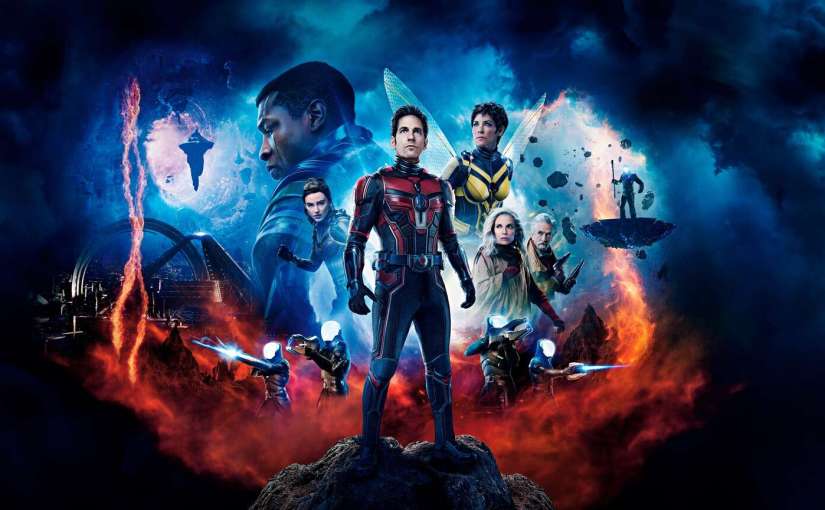
ANT-MAN AND THE WASP: QUANTUMANIA

By Marc S. Sanders

Ant-Man And The Wasp: Quantumania is a fun frolic through the Quantum Realm, another dimension that was uncovered in previous chapters within the Ant-Man series of films.  I’m not watching a potential Best Picture nominee for 2023.  I’m watching a glorious kaleidoscope of colors and visual effects with likable characters, and the setup of a new big bad villain for upcoming installments for the Marvel Cinematic Universe.  It’s not a perfect movie.  It’s corny and hokey at times, but I was with the picture the whole way.

I do believe these sci fi superhero franchise films are getting way too diluted.  I think there are more Marvel films now, all working within a shared universe, then there are episodes of single seasons of television shows.  A lot of these films do not stand apart any longer and hinge on events or hanging threads that occur in prior installments.  It makes for a lot of homework and time spent on the consumer to keep track of everything, and where everyone was last left off.  With Disney + adding in multiple Marvel streaming series to watch as well, I’m sorry but my days feel like they need to be extended beyond the standard 24 hours.  The economic term known as “The Law Of Diminishing Marginal Utility” hearkens back to me at this point, all these years later after we first met Robert Downey Jr. as Iron Man in 2008.  Are viewers getting tired of the superhero phenomenon?  Superhero movies rule the box office these days.  Westerns did it four or five generations ago.  How many new westerns do you now see each year?

The blessing of Quantumania is that it does not rely abundantly on other material in the Marvel Cinematic Universe.  Scott Lang (Paul Rudd) reintroduces himself in a very adoring Paul Rudd-like way with a voiceover and thereafter, he is unexpectedly sucked into the Quantum Realm, along with his daughter Cassie (Kathryn Newton), his current partner Hope Van Dyne (Evangeline Lilly), aka The Wasp, and his mentors Hank Pym and Janet Van Dyne (Michael Douglas, Michelle Pfeiffer).  The gang must primarily depend on Janet to navigate them through this world of inconsistency and oddball inhabitants where no two characters seem to look alike.  Janet was marooned in the Quantum Realm for thirty years before finally being rescued.  What concerns her the most is one who is first referred to as “The Conqueror,” and later identified as the frightening superman known as Kang (Jonathan Majors), who was mysteriously exiled to this place.  As Janet describes, Kang has made the prison of the Quantum Realm his empire and now he wants to use the technology that our heroes possess to break free of this dimension and cause all kinds of chaos in the real world and other parallel universes.

The best assets to the film are the scenes between Jonathan Majors and Michelle Pfeiffer.  Granted, their dialogue could apply to any other kind of movie.  A lot of ping pong arguments between the villain and hero, which if I remember correctly go something like “You don’t understand.” and “I’ll never let that happen.”  This verbiage could also be suitable in a Meryl Streep tearjerker or a courtroom drama.  It’s pretty standard.  We’ve seen discussions like this a million times before.  Fortunately, my state of mind was not demanding of thought-provoking conversation.  The magnetism of their acting in front of the expansive CGI environment kept me hooked.   Jonathan Majors simply looks like a very frightening threat.  He’s calm at one point and later raging like a lunatic.  The man has levels.  If he were reciting the ingredients of chocolate chip cookies, I’d be on pins and needles. 

I do not think Quantumania is going to wow most audiences.  In fact, it’ll be a divisive film.  It’ll go half and half.  Though I really do not like to rank films any longer because it feels so pointless, I got into a debate with my wife and daughter about which one was better.  Quantumania or Wakanda Forever.  Both films have their merits, but I left the latest Black Panther film feeling a little depressed and exhausted.  That was a long time to feel morose for a superhero film.  The ladies, however, appreciated the story of that film over this one.  (I wanted to see the Black Panther suit a lot sooner.  I wanted a handful of people to be cut from the film, and I thought the Namor character was very boring.  Look for my review on this site.)

With Quantumania, audiences are either going to like the weirdness that is splashed all over the screen.  Splashed is not a strong enough word.  Try SPLATTERED!!!! Everywhere you look there is something abnormal to see from one corner to the next.  On the other hand, viewers will think the Quantum Realm and its inhabitants are just too bizarre, and the Marvel filmmakers are scraping the bottom of the barrel in imagination.  Sorry, but I got a kick out of the tall stilt guy with a spot light lamp for a head.  I thought the pink goo guy was cute.  I also giggled at the fat head henchman, with scrawny arms and legs, known as M.O.D.O.K. (with Corey Stall, making an MCU return).  The functionality of this character is deliberately lacking and comes off like Looney Tunes cutting room material, but that’s also why he is here.  If there was anything looking remotely normal in the Quantum Realm, well then it isn’t the Quantum Realm, I guess.  Bill Murray even shows up, but if you need a bathroom break, this is when you should go.  All of this looks way too stupid, yes!  Then again, stupid can be entertaining and stupid is often taken with subjectivity. So, I’m just one guy’s opinion. 

Quantumania is maybe the most unsophisticated of all the Marvel films.  More so than the Guardians movies, or the most recent Thor installment.  With a happy go lucky Paul Rudd, an army of ants and some of the most bizarre CGI extras found anywhere it proudly stands tall on that pedestal of ultra, ultra, ULTRA weird.  I think director Peyton Reed accomplished what he set out to do with this film.  The question is will the film win majority of approval within the nerd land of keyboard warriors like myself, who share their perspectives on the internet.  Well, the movie gets my vote at least.

YOU PEOPLE

By Marc S. Sanders

You People has me wondering how we could have stepped so mind bogglingly far back in social tolerance and understanding.  I give people far more credit than the foundations that Jonah Hill and Kenya Barris, who wrote the film together, describe in this movie.  (Barris directed, as well.) People cannot be this cruel and stupid, can they?  Someone give me hope! Give me assurances, please!!!!!

You People is a send up of the Meet The Parents formula, or more specifically Guess Who’s Coming To Dinner? In the latter example, an African-American doctor is brought to the home of his Caucasian fiancée to be introduced to her parents.  Later, the woman meets his parents.  There is an understandable sense of surprise for the characters in both scenarios.  Yet, none of the parties carry the instinct to embarrass each other or allow them an opportunity to lie just to impress and speak with moronic naivety.  The film was never catered for big laughs, but rather more towards awareness and understanding. 

With a cast that includes Jonah Hill, along with Julia Louis-Dreyfus and Eddie Murphy, all well known for huge comedic achievements, You People is designed for the laugh out loud moments.  That’s great.  It sounds very promising, and it was a movie I was looking forward to watching.  However, did the comedy have to come at the expense of stereotyping Black Muslims as angry and intimidating and freely dropping the N-word, while White Jews are dumb, ill informed, clumsy lying cocaine users?

The pattern of Barris’ film is very structured.  For every scene of father-in-law to be Eddie Murphy paired with Jonah Hill, there is also a scene on the other side of mother-in-law to be Julia Louis-Dreyfus paired with Lauren London, portraying Hill’s fiancé.  Murphy does his comedic best in expression and stature with or without dark sunglasses on, while Hill sits very uncomfortably next to him, whether it is in the car or at his bachelor party getaway in Las Vegas where his buddies ask him to call his cocaine dealer.  Cuz, you know, all Jewish guys have a go-to cocaine dealer on speed dial. 

Julia Louis-Dreyfus does her comedic best trying to impress Lauren London by acting aware of what a black person has had to endure and over-complimenting her hairstyles and appearance.  She’s ready to go all “Karen” at the front desk of a luxury spa when she suspects racial discrimination towards London’s appearance.  Later, she will commit slapstick sin by accidentally pulling off the hair weave extensions of one of London’s friends.

I refer to comedic best because the two SNL alumni are so good on camera even if their script is nothing but insulting junk, devoid of validity.  Their expressions are reminiscent of Murphy’s best stand up routines and Louis-Dreyfus’ hilarious sitcom portrayals.  However, these collection of scenes are written with an obnoxiously overabundance of cringe and discomfort.  How these characters treat one another is utterly disgraceful.

Upon an initial meeting at the dinner table, a comparison of suffrage by means of black slavery vs the Holocaust is brought up.  You know what?  Neither incident within our world history is worse than the other.  They’re both horrendous and could never merit comparison.  Yet, here they are being presented as punchlines for outrageous comedy in terms of one upmanship.  Murphy’s character, along with Nia Long as his wife, will announce their admiration for Louis Farrakhan, while Julia Louis-Dreyfus will point out the speaker’s antisemitic doctrines.  In response, she will accidentally light fire to Murphy’s prized Muslim hat gifted by the minister.  If I were to translate this mathematically, Black Muslims celebrating antisemitic gospel equates to White Jews as insensitive klutzes. 

You People is nothing but one insulting moment after another.  In every scene, someone is the punchline at the expense of the writers’ unfair and incorrect blanket approach categorization for what these two demographics must be like. What a huge misfire. 

These are some of my favorite comedic actors.  Lauren London even looks like she can hold her own in scenes with her co-stars.  The potential for talent is hard to match here.  There could have been debates as to who should officiate the wedding and what themes the reception should have, or what the bride and groom should wear. Imagine an argument over the cake topper.  Actually, as I recall there are moments like this in the film.  Nevertheless, they dwindle into conclusions that demonstrate Black Muslims should be feared while White Jews are clueless morons. 

As a conservative Caucasian Jew myself, none of what is depicted in You People could be further from the truth.  I’ve known a few Muslim people and I never caught this kind of vibe from them or who they associate with, or what they practice.  I’ve also never felt uncomfortable in their presence.

The failure of this film lies within the insensitivity of its ignorant script.  This movie could have demonstrated a clash of cultures.  Instead, it relies on moments to squirm at uncomfortably with some of the worst people any of us could ever know.

The next time Jonah Hill and Kenya Barris want to make a movie, they need to read a book and speak with who they select for their subject matter.  Even better, just turn on the camera and let Eddie Murphy and Julia Louis-Dreyfus start talking…about anything!  They are far more intelligent and creative than anything on display here.