THE COMMUTER

By Marc S. Sanders

Sometimes it gets boring to have your suspension of disbelief tested with a movie.  Especially if it is a movie where there’s that eye in the sky that can see everything the hero does, thereby making his dilemma that much harder.  Downright impossible, actually.

You know what I mean when I say eye in the sky?  That’s where the villain or the antagonist can see everything the hero attempts to do to save the day, and every time he tries something like making a cell phone call or writing a secret message on a piece of paper (hidden next to his thigh under the table) for someone else to see, the bad guy always knows what he’s doing. It’s a wonder if the protagonist can even take a leak in private.

In The Commuter, Liam Neeson plays a former New York cop, now insurance salesman, who takes his morning and afternoon train from upstate into the city and then back after work.  Everyday, it’s the same regulars on the train while Neeson’s character, Michael MacCauley, reads the classic literature books that his son is assigned to cover for school.  I guess it’s the way they bond, and it’s pretty fortunate that this is Mike’s hobby because on the day he gets fired from his job, it might come in handy.  Go figure.  These bad guys messed with the wrong avid reader.  I mean he’s reading The Grapes Of Wrath for heaven’s sake.

Just before Mike enters the train, his wallet and cell phone are pickpocketed.  He defeatedly slumps down in his seat and shortly after an alluring woman named Joanna played by Vera Farmiga sits across from him and proposes a hypothetical.  Find twenty-five thousand in cash hidden somewhere in the bathroom.  Then seek out a passenger who identifies as Prynne and swipe the bag that person is holding.  Once that is done, he’ll collect an additional seventy-five thousand, but it must be done before the train reaches the Cold Spring station.  Joanna leaves the train making the offer sound so simple.

Considering Mike just lost his job and he’s got no cash savings as well as his son’s college tuition to pay for, he retrieves the hidden money and tries to make a clean getaway at the next stop.  However, he’s immediately halted by someone who gives him an envelope with his wife’s wedding ring in it.  Now, he knows this woman and whoever else is setting him up with his wife and son in possible danger.

As he finds a way to communicate with Joanna by phone, Mike tests just how serious she and her cohorts are, and that’s when a couple of people wind up dead.  Ultimately, the only way out of this conundrum is for Mike to find out which passenger is Prynne.

Much of the running time of The Commuter is occupied with red herrings.  Could Prynne be the punk girl with the nose ring (Florence Pugh)?  Is it the asshole Investment Banker with the phone earpiece?  Maybe it’s the guy all dressed in black?  Or the one with the guitar case?  Yeah.  It could be any one of these folks who Mike does not recognize as regular travelers.  I won’t even tell you if any of the people are the real Prynne or not, but I knew what to expect from this kind of storytelling pattern.  Mike finds a way to small talk some of them and seek out clues.  He uses the conductors by explaining that he sees something suspicious and suggests they look in their parcels.  At times, I felt like I was playing the Clue or Guess Who?  or Twenty Questions.  I dunno.  This kind of set up for a movie just seems too silly.

Sixty-year-old Mike also engages in hand-to-hand fist fights with some suspects.  I don’t know how old Liam Neeson is, but Mike says he’s sixty, and sixty-year-old Mike endures getting his head bashed through more than one speeding train window, plus a couple of knife slashes and some ass kickings, in his pursuit for the truth.  I know.  He’s a cop so he’s got fighting skills.  That’s okay.  I buy that, but to have your head bashed through doubled paned windows while this commuter train is going a hundred miles an hour? Well, that’s enough stretching for one day.

So how does Joanna stay one step ahead of Mike to ensure he’s playing by the rules?  Well, apparently there are cameras positioned in the overhead vents of every train car that can follow his every move.  C’mon now!  I’d rather the writers and director simply turn this into a sci fi cheapo and declare the villain omnipotent.  This train is at least six cars long.  Maybe seven, and the length of each one is maybe five yards if I’m being conservative, and I’m supposed to believe that these cameras cover every nook and cranny of every single train car?  Seriously, stop stretching.  You’re bound to pull something.

I stayed with The Commuter until the end because frankly I was curious who Prynne turned out to be and what the significance of this particular passenger was to the interests of Joanna. It actually works.  It’s Mike’s convenience in detective work and the powers operating against him that’s ridiculous. 

Moreover, the visuals are incredibly distracting in this picture.  The CGI could not be more apparent anytime Liam Neeson throws a punch or takes one across the chin or out a broken window.  The animation of the CGI appears terribly false.  It looks unfinished and rushed for editing as Neeson’s facial expressions of pain and struggle contort in odd ways.  The bad guys he gets into fisticuffs with appear to have the same problem.  Truly some of the worst action scenes I can remember watching in quite some time. 

The speed of the train looks false as well.  I read where Liam Neeson said that the settings within the train cars were shot on a soundstage.  Afterwards, director Juame Collet-Serra was challenged with changing the outdoor scenery of the train on a constant basis to simulate ongoing speed and movement.  I imagine this is all incredibly challenging.  I don’t know how to do it.  However, it just does not work.

The visuals for most of The Commuter fail tremendously.  Last year’s most recent installment of Mission: Impossible demonstrated how a speeding train should look in an action picture.  With this movie though, the finalized print was rushed for that all so busy January release in 2018.  Look, if you can’t do it right, then let somebody else handle the job, or better yet, make a better movie.

The Commuter would have been a much better and much shorter film had Mike never let his curiosity overtake him and go to the bathroom for that money.  Mike, why couldn’t you just stay in your seat and finish reading your Steinbeck?

AVENGERS: INFINITY WAR

By Marc S. Sanders

Avengers: Infinity War is a really FAT movie. Like ORCA FAT (thank you Keyser Soze), because it is chock full of so much to see. If this equated to gorging on junk food, after two hours and forty minutes, I would have a diabetic cardiac arrest immediately following the credits. Is this a film that is worth that handicap, however? You bet it is.

There is an ensemble of top Hollywood talent portraying a huge cast of characters, once again, and thus another installment has surfaced in the franchise that allows them to have various moments to shine. Producer Kevin Feige with all of Disney’s support, has mastered the formula to ensemble casting and production, as good as when George Clooney and company performed under Steven Soderbergh’s direction in the Ocean’s 11 remake. Thousands of special effects shots do not overpower the stage presence of the actors. The Marvel movies succeed because a story is always written first. Then witty dialogue comes thereafter, and then valid, convincing shock value. The special effects are the final ingredient. This is what the Transformers franchise and (yes, I’ll even own up to it) the Star Wars prequel trilogy (about ¾ of it) failed to achieve. This successful formula gives merit to the (at the time) biggest opening weekend ever, worldwide, and Avengers: Infinity War deserves the accolades.

How good is it? Well, reflecting back to May 1980, when sitting in a crowded theatre watching the ending to The Empire Strikes Back, by comparison I think audiences have finally been served up a cliffhanger (10 years in the making) that is just as effective. How is this all going to wrap up from here? How is this all going to be resolved? Reader, I don’t know if the next chapter will be satisfying. I don’t know if we will feel cheated like Annie Wilkes from Stephen King’s Misery. Presently, however, I’m turning an ending like this over in my mind; the same way I did with my pals in 1980 debating the survival ratio of Han Solo and if Darth Vader has told the truth, and if that was Vader’s brain or head that I saw, and who is this “another” that Yoda referred to….and that, my friends, is what makes a spectacular film. I don’t care if it gets watered down in the hype and McDonald’s promotions and toys. If you can mull over a movie long after it has ended, for days, even months and years, then a film like The Empire Strikes Back and Avengers: Infinity War has more than served its purpose.

Josh Brolin provides a villain with a justification to his madness. He’s not just twirling his mustache to be mischievous and sinister. He has a destiny to fulfill, and his portrayal of the mad titan Thanos does not compromise. This is a beast of a purple villain with size 52 boots and gold-plated armor with a chin that looks like it was clawed by Wolverine. Thanos cries, actually cries, while committing his crimes. He’s not just cackling. He flat out says that he executes his actions all so that he can relax and retire. Isn’t that what we are all trying to do, anyway? Nothing wrong with that. Guy sounds like a CEO to a large corporation. Maybe Thanos is updated to resemble an Elon Musk. 

All of the other actors from main staple Robert Downey Jr to Chris Pratt to Chadwick Boseman to Zoe Saldana and Chris Hemsworth, and so on, remain consistent to what we’ve seen of various prior installments. Their gimmicks continue to avoid becoming stale. Audience applause is cued by their appearances. These are well loved characters.

As an avid comic book reader of the silver age (1980s), Avengers: Infinity War presents itself as of one those annual limited series runs that were special because they were MAIN EVENTS!!!! My favorite back then was Marvel’s Secret Wars. Typically, a comic book from the 1980s would average about 18-22 pages with advertisements sprinkled in. Nearly every scene in this film equates to one issue of a limited run of a main event. That is a why a fat movie like this succeeds. The cast of characters are separated in various story lines. The scenes are given their time to flesh out and develop to move the subplots and overall story along. Each scene is like reading a new 18 page issue comic book. If I’m watching a comic book film, by golly, I want to see how a comic book is brought to life in a cinematic medium. Marvel’s films succeed greatly over DC’s films (produced by Warner Bros) because they rely on the source material. They know they got the goods. Cast it right, adapt it properly and go with that. If it ain’t broke, don’t fix it. A wealth of material (nearly 70 years) and Marvel/Disney uses it all. (How does DC/Warner Bros miss the mark so often?)

Of all of the Avengers films, Infinity War is definitely the best one. Ironically, I wasn’t expecting it to be. I was waiting for this stuff to get old and tiring. It just hasn’t faltered yet. It hasn’t gotten lazy yet. It all seems so fresh still. It’s a fantastic cinematic accomplishment. Sure, its main story is a guy chasing down six different colorful MacGuffins. So what! It’s simple. It allows the characters to stand out from there. An organized plotline like this doesn’t take much effort or time to explain its purpose. It states its conflict early on, and then the show stopping moments present themselves. One after the other after the other until a monster of an ending that is so jaw dropping, head shaking, thrilling and gasping, satisfyingly arrives. 

More importantly, the MacGuffin search drives the motivations and fleshes out the film’s main character, Thanos. This Marvel installment belongs to Josh Brolin as Thanos. Everyone else serves as his antagonists. What matters is that the bad guy wins this time, just like demonstrating that an Empire will strike back. Ironic that Spider-Man makes a humorous correlation to that celebrated franchise from almost forty years ago.

Avengers: Infinity War ended up in my top 10 list of 2018, and still holds as the best film in the Marvel Cinematic Universe.

THE MULE

By Marc S. Sanders

Earl Stone (Clint Eastwood) was once considered one of the best horticulturalists in the country.  In fact, he devoted more of his time to raising the most unique flowers and plants that anyone could find than he ever did to his wife, Mary (Dianne Weist) or his daughter, Iris (Alison Eastwood).  He even missed Iris’ wedding, to attend an award reception in his honor.  At age 90, though, Earl is quickly forgotten by his ardent fans thanks to the ease of ordering horticultural specimens off the internet.  There’s no longer value in meeting the maker.  Just as Earl never took account for his family like he did with his beloved occupation.

Clint Eastwood portrays Earl Stone in The Mule, which he also produced and directed.  Written by the Nick Schenk, this film is one of Eastwood’s best directing efforts.  It is inspired by a real life story where the forced to retire horticulturalist finds himself working as a drug mule for the Mexican cartel.  Earl is corralled into making easy money by driving a duffel bag across country.   At the destination, he leaves his truck and returns shortly thereafter to find large amounts of cash in his glove compartment for his trek.  

Earl is so naive to all this activity though that he doesn’t even know how to use the various cell phones the dealers give him for each new journey.  It’s only on the third drive that he opens the bag to find kilos of cocaine.  

Earl is a perfect front for the cartel.  The Don (Andy Garcia) sees the value of this camouflage.  Who’d ever suspect a frail ninety year old Korean War veteran, who’s never gotten a traffic ticket, of doing their bidding? Certainly, the sharp witted FBI agents (Bradley Cooper, Michael Peña) could only get as close as determining this mule is driving a black pickup truck.  Beyond that they are at a loss, despite the leeway and patience awarded to them by their superior (Laurence Fishburn).

This film boasts an outstanding cast from all four corners of its various stories.

The Mule works so well because of Eastwood, the filmmaker.  He offers thrilling overhead highway shots (with no car chases) of Earl’s pickup truck running parallel to a helicopter as well as how the cartel escorts follow behind.  There’s humor in how impatient they get with the old codger by how slow he drives and the old time music he listens and sings along to.  Wait until you see two tough armed Mexican cartel members relent to singing along to Dean Martin.  Eastwood cuts and stages these hilarious moments that are most welcome, even if they had no business being in a story like this.

Clint Eastwood’s performance is really shining through.  You recognize his signature scowl and his heightened walk despite his frail physicality.  The Earl Stone character is so well drawn and Eastwood, as director and especially actor, answers every demand of the script sharing celebrated scenes with Andy Garcia who treasures his prize mule and gifts him a couple of women to make him feel comfortable.  Other moments allow wonderful exchanges between him and Dianne Weist as Mary, Earl’s estranged and very ill ex-wife.

The Mule is a crime picture, sometimes lighthearted and on occasion heavily serious.  Yet, it’s also a well-drawn out family drama.  Earl is grateful for the rewards that come with being a drug mule.  He’s generous to his friends.  He modestly treats himself.  He lends attention to his adult and loving granddaughter (Taissa Farmiga).  He accepts Iris’ disregard for him.  Yet, none of these gestures buy back or exchange any time he’s lost with the family he never got to know.

The film plays like two different movies until finally a sacrifice must be made to appease one part of Earl’s life versus the other.  I almost wished for everything new that came upon Earl in his late life to remain on that trajectory.  Yet, like the best stories, interference will eventually get in the way.  It’s that much more crushing when Earl’s new pattern is upended.  Still, that’s what makes for good drama.

I highly recommend seeking out Clint Eastwood’s The Mule. It surprised me in the best ways possible.  I did not expect to be so impressed.  Eastwood continues to be an inspiration with the persistent longevity of his talents as an actor, a screen legend, and a gifted filmmaker.  The Mule shows he’s as sharp as he ever was before in some of the best films of his decades long career. 

MISSION: IMPOSSIBLE FALLOUT

By Marc S. Sanders

Mission: Impossible Fallout is the best of the so far seven films in the series.  It is carried not only by the stunts that Tom Cruise insists on risking his middle-aged self to perform, for the sake of his fans. As well, the film’s casting and the puzzle twisting script from Christopher McQuarrie, writing with inspiration from his famed Oscar winning screenplay for The Usual Suspects is a treat for the eyes and mind.  If this were a novel, I’d quickly be turning each page to see what comes next.  Like McQuarrie’s well-known invention of Keyser Soze, this movie questions Who is John Lark?  Is Ethan Hunt (Cruise) John Lark? 

Hunt chooses to accept the mission of locating this unidentified Lark who is interested in purchasing enough plutonium to wipe one third of the world population, likely in and around Pakistan and China.  However, the CIA doesn’t trust Hunt’s cavalier instincts and insists he partners up with a hulking Henry Cavill playing an agent named Walker.  Benji and Luther (Simon Pegg, Ving Rhames) are back for hacking, field work and some clever mask trickery.  Ilsa Faust (Rebecca Ferguson), the dubious British MI6 agent from the prior film (Rogue Nation) is a welcome surprise and just as perplexing with her actions.  The big bad, Solomon Lane (a snake like Sean Harris), also returns.

Like all the M:I films, Fallout operates with the same kind of formula.  We have to accept the promise that there’s a world ending MacGuffin.  Ethan and the team are assigned to find who has it and who wants to buy it and can use it.  All of this is written outside of the lines of planning out the action scenes these pictures are recognized for.  It’s as if Cruise, with his producer hat on, sketches stunts with skydives, cars, motorcycles, trucks and helicopters and then assigns his writer/director to apply words for the donut filling within the movie.  Mustn’t forget a reason to include a running sequence for Ethan to perform on rooftops.  Fortunately, all of it works best here, more than in any of the other films.

What sells these pictures, and again Fallout is the best example, is the photography and editing applied to these scenes.  Two sequential car/motorcycle chases occur throughout the streets of Paris.  (Look!  I see our honeymoon hotel, The Hotel Regina located across from the Louvre, as Ethan races by in a BMW!!!!!)  A smashing three-person fist fight in an impeccably white men’s room is a brawl for the ages. 

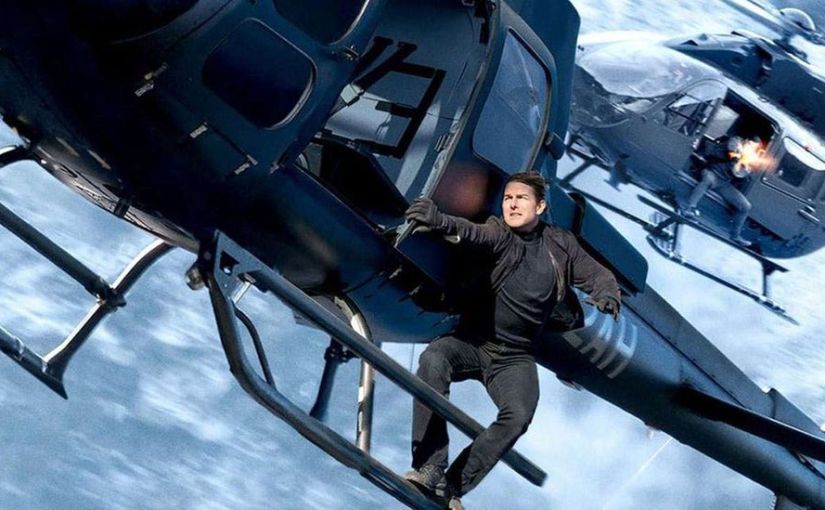
The highlight of this installment is a helicopter chase above and within a mountain valley that first focuses on Tom Cruise himself climbing a rope up, up, up to a chopper and swinging his legs onto the railing to get a foothold.  There’s time dedicated to him falling and inching his way back into the vehicle.  Then it becomes a chopper chase followed by a collision that ends with the remains wedged within a narrow mountain crevice.  What a set piece this is!  Absolutely outstanding camera work.  The wide and close editing, sound and visuals work so perfectly in sync with one another.  I don’t want to watch the making of documentary for this picture.  The trickery of McQuarrie’s camera crew is such a treat.  I’d rather savor the finished product on repeat viewings.

Juxtaposing against this chopper fight are two other scenarios involving Ethan’s teammates.  This is where I’m especially grateful for Christopher McQuarrie’s writing.  Two bombs are rigged in line with each other, and a detonator also must be retrieved by Ethan.  The whole team has to work cohesively, otherwise it is sayonara to much of the Asian continent if both devices explode.  McQuarrie’s “impossible mission” is orchestrated beautifully with suspense cranked way up.  His imagination for adventure allows a magnificently edited third act.  To date, I consider the stakes here to be the highest in the entire series.

The presence of this collection of actors is marvelous with recognition deserving of Henry Cavill donning an untrusting mustache and looking like a brutal, blunt instrument against the superspy Ethan Hunt.  Cavill also plays CIA agent wisely.  He’s got a stoic expression for most of the film but that is because he trusts the audience will assume what a dangerous threat he can be.  Cavill occupies one of the best characters in the seven films.

Mission: Impossible Fallout is truly one of the most thrilling pictures you’ll find.  What’s most important is the action serves the story.  Action just for the sake of action is tiring like in the Fast/Furious films.  There has to be a cost and a tangible feeling to the speed, obstacles and pain that good action scenes serve their characters and the story as a whole.  When Ethan falls from a helicopter or has to jump out a window, I grip both arm rests and let out a collective bellow with the audience.  Films with the grandest of adventure must draw out responses like that.  Otherwise, it’s all just a ho hum journey to the end credits.  Fallout is anything but a stroll.  It’s an absolute balls to the wall, explosive crowd pleaser.

SKYSCRAPER

By Marc S. Sanders

Dwayne “The Rock” Johnson helms a film stuffed with beefcake, gusto, an artificial leg, and LOTS OF DUCT TAPE. Even his world-famous chest tattoo makes a cameo.

Skyscraper is his latest action piece, and it makes no bones about how absurd its set pieces and stunts are.  This is a self-aware picture; self-aware of all its UN-likelihood.  It has to be.  

The writer of this piece, that is not a Die Hard ripoff, is Rawson Marshall Thurber (rolls off the tongue like Spielberg, Coppola and Scorsese) is also the director.  I can almost promise this guy wrote this script in airport terminals and secluded library corners with his iPad knowing how out of control this hostage/burning building film would be and just laughed hysterically, like a mad scientist, as he typed.  Heck, he probably took his old GI Joes out of the shoe box and used them to storyboard on the tall oak tree in his backyard.  This guy should be given all jobs first considered for Michael Bay.  He knows the audience will roll their eyes at everything they are seeing, and he goes even crazier with the next set piece.  

MILD SPOILER ALERT IF YOU HAVE NOT SEEN THE TRAILERS:

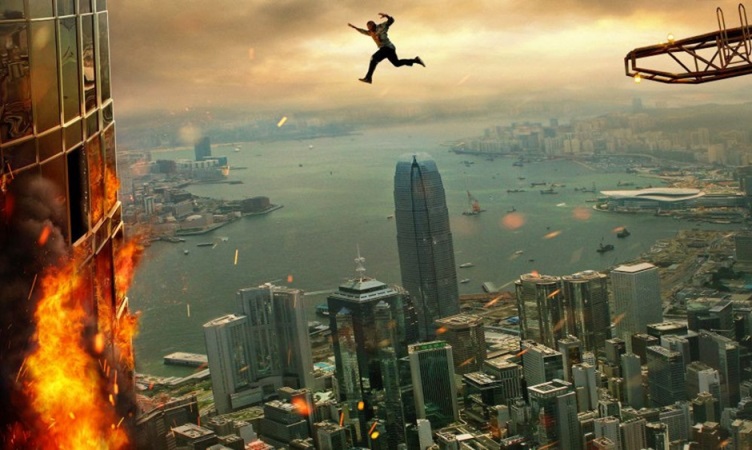
It’s not enough that Johnson, with an artificial leg, can climb a sky high crane while a skyscraper (hence the title) blazes to pieces next to him.  He then makes a ridiculous leap from said crane to said skyscraper through a broken window.  What?!?!? It could happen!!!!! Same as you can put sticky duct tape on your hands and shoes, and climb the outside of the building with the same artificial leg, like Spider-Man.

So, what do you think reader? Did I like Skyscraper?  You bet I did.  The edits are sharp.  I know The Rock isn’t going to perish, but when his hand slips from a ledge, you bet I jumped.  I laughed with such glee at each moment of ridiculous suspense. I loved the badassery of Neve Campbell playing the reverse of a distressed damsel wife to Johnson.  

On top of all that, this skyscraper, located in Hong Kong, and reportedly 5 times the size of the Empire State Building, is a gargantuan setting of the best technology.  Known as The Pearl, this is one super cool building of over 220 floors plus a fun house hall of mirrors dome at the top.  How that dome helps the world or even just the building beats the hell outta me.  It’s just amazingly cool and that’s why it’s there. 

So yes!!!!  Go see Skyscraper. Throw your logic and snobby intolerance for the absurd off the roof and have a great time at the movies.

SOLO: A STAR WARS STORY

By Marc S. Sanders

To those who naysayed this standalone installment in the galaxy far, far away, all I say is you are trying too hard to be pleased.  Shut up and have some fun, will ya?

Solo: A Star Wars Story presents a film that stands on its own, relying on mysterious legendary side stories only talked briefly about for the last fortysomething years like the Kessel Run, Sabaac card games, dice and the origin of how Chewbacca met everyone’s favorite space smuggler, Han Solo, plus the Millennium Falcon and the scoundrel Lando Calrissian.  

My brother and even a few friends of mine (Joe Pauly) grew up loving John Wayne’s films. No one else epitomized a Hollywood western better than The Duke.  He was their childhood hero.  For me, it is the generation after that which introduced the space cowboy Han Solo played by Harrison Ford.  He is not anywhere near a multi-dimensional character; pretty one note if you ask me (which ironically is opposite of what I demand in any kind of storytelling these days).  

Captain Solo was the guy who would make it up as he goes; never planning ahead or considering others beyond his trusted furry partner and his beloved spaceship.  He’d poorly talk his way out of trapped situations and when that didn’t work, he was a fast draw with his blaster.  

The screenwriters for Solo, legendary Lawrence Kasdan with his son Jonathan, were all aware of Han’s placement in this space opera, while constructing this film.  Only this time they intended on showing how that devil may care came about. It reminded me of a similar approach writer Paul Haggis took with the reinvention of James Bond in Casino Royale.    A lone hero trusts very little beyond his own arrogance and self-assurance.  The Kasdsans used that technique as the spine for this story and it works.

Director Ron Howard is the right guy to fill in following a notorious director incident beforehand.  Howard keeps the film moving fast with casualties you might not expect to perish, revealing masks (an under looked theme of the original films), traitors, fast ships, fast cars, and their pursuits and chases.  A favorite scene, saluting the Western, is a thrilling train robbery across a snowy mountain that seamlessly changes its angle and vector at times.  It’s as awesome a scene as it promised in the trailers.  

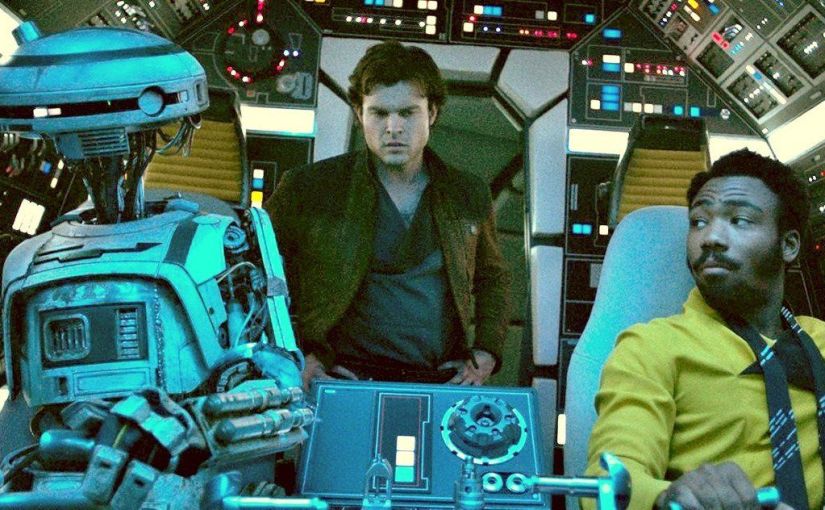
Howard is best at keeping the film grounded in actors rather than tired CGI cartoons.  He definitely makes Han, Lando and the rest look convincing trying to steer a ship or carry a blaster and play cards.

The cast is great.  Alden Ehrenreich is fine in the role; young, cocky, brash, handsome.  I wasn’t looking for him to do a Harrison Ford impersonation.  That would only look like a 12:45 am Saturday Night Live skit. The guy had to do his own thing, not someone else’s much like the Batman and Bond films have done before.  Donald Glover is perfect as Lando, even adopting Billy Dee Williams own way of pronunciation (“Han” vs Ha-an”).  Still, he makes the part his own.  He’s fun to watch.  Beyond some mild makeup scarring, Paul Bettany makes for a really uncomfortable crime lord, like a suave Miami Vice drug kingpin, and Woody Harrelson is just right in the inspirational pirate role; gruff and tough and educating.  Emilia Clarke is finally directed properly in a film.  (I still haven’t forgotten her awful Terminator: Genisys Sarah Conner portrayal.). She is dangerously sexy, but smarmy and cocky like Carrie Fisher was.  She’s a great femme fatale of the 1940s beautifully incorporated into some very thick sci fi.  

This was such a fun time at the movies.  Go ahead.  Accuse me of my bias, but as well shouldn’t I be expected to be a tough demanding critic of all new Star Wars material?  I’d probably be wanting it to match the magic of the original trilogy.  Well no.  I don’t want it that way.  I want new and fresh ideas, while still recognizing George Lucas’ used universe settings.  Disney and Lucasfilm continue to move along, stretching their imagination in monies well spent while also following the rules of smart aleck characters, film western motifs, Eastern cultures and death-defying cliffhangers.  Had the Star Wars franchise remained with Fox, audiences would not be getting the treats we’ve been blessed with for these last 10 years.

Solo really only has two minor misfires.  The droid L3, Lando’s Co-pilot, does not live up to Anthony Daniels nor Alan Tudyk and their high brow robot attitudes.  Why? Because it’s hard to understand what L3 is truly saying.  The lines are garbled at times; drowned out by the robot dialect I guess, and maybe also by a mostly origninal score.

As well, there is one ending moment that’s eye opening, but puzzling with little demand for it.  It was one surprise that did not seem to be well thought out and considering this is a stand alone film, it left me unsure of what Lucasfilm hoped to gain from it.  The moment was too distracting for me.  Yet it’s in there and it’s not the worst offense.  Just very very unnecessary and perplexing.

Solo: A Star Wars Story is none other than great fun with something to think about.   I was laughing out loud.  The audience we were with was clapping and cheering.  That’s why Star Wars films continue to thrive.  Their audiences get caught up in the ride, especially when the films are relatable while not taking themselves too seriously.

SORRY TO BOTHER YOU (2018)

by Miguel E. Rodriguez

Director: Boots Riley
Cast: LaKeith Stanfield, Tessa Thompson, Jermaine Fowler, Omari Hardwick
My Rating: 6/10
Rotten Tomatometer: 93% Certified Fresh

PLOT: In an alternate present-day version of Oakland, telemarketer Cassius Green discovers a magical key to professional success, propelling him into a universe of greed.


[Author’s Note: In my mind, it’s virtually impossible to discuss Sorry to Bother You without making comparisons to Jordan Peele’s Get Out and Us.  But I will give it the old college try…]


Boots Riley’s directorial debut, Sorry to Bother You, has been described by Riley himself as an absurdist dark comedy combined with magical realism and science fiction.  Talk about your genre mashups.  While other directors have proven this kind of filmmaking is not only possible but profitable (Being John Malkovich [1999], Eternal Sunshine of the Spotless Mind [2004]), Riley’s film feels like he bit off a little more than he could chew.  After it was over, instead of feeling like I had seen something groundbreaking and provocative, I felt like I had just sat through an ambitious student film.  At some point, it lost its way.

Cassius Green (LaKeith Stanfield) is an underachiever with an improbably gorgeous girlfriend named Detroit (Tessa Thompson), a performance artist who specializes in the kind of art that involves water balloons, spent bullet casings, and recitations from The Last Dragon (1985).  All righty, then.  Cassius is hired as a telemarketer at a company where the fact that he falsified his résumé and brought in fake trophies shows initiative.  On his first day on the job, the film shows flashes of promise.  As he makes the calls, his workstation magically drops into the homes of the people he’s calling, a perfect representation of the intrusion these callers make.  After repeated failures, an old-timer named Langston (an underused Danny Glover) gives him a tip: Use your white voice.  “I’m not talking about Will Smith-white.  That’s just proper.”  Now THAT’S funny.

So Cassius starts using a white voice (overdubbed by David Cross) on his calls, and wouldn’t you know it, he becomes the highest-selling telemarketer on the sales floor.  This is not fantasy, as far as I’m concerned.  I recently watched a documentary where a Latino man submitted hundreds of résumés while job hunting with no responses.  In desperation, he changed his name on his résumé from “Jose” to “Joseph.”  Presto…the calls started rolling in.  True story.

Anyway, Cassius gets a promotion and is moved upstairs to be a “Power Caller.”  Meanwhile, the other telemarketers organize and strike for better wages, so Cassius is derided as a scab every time he comes to work.  But then he discovers what he’s actually selling as a Power Caller.  It has something to do with a company called WorryFree, a system whereby workers sign a lifetime contract to live and work in a single communal location with no paychecks.  One of their slogans is, “If you worked here, you’d be home now!”

WorryFree is run by Steve Lift, played by Armie Hammer at his smarmy best.  In the movie’s most pointed satirical moment, Lift invites Cassius to a party where he goads Cassius into rapping for his party guests.  “Come on, you’re from Oakland, I refuse to believe you don’t know how to rap!”  Cassius tries some feeble rhymes, and then he realizes exactly what Lift and his party guests want to hear.  His solution is controversial, provocative, and hilarious.  I won’t spoil it for you…it’s the high point of the film.

Meanwhile, there are other scenes involving the strike, the strikers, an underground movement called Left Eye, a Claymation sequence, horses, and a nearly-naked Detroit wearing a costume that looks inspired by Janet Jackson’s infamous Rolling Stone cover shoot.  It’s all a little haphazard and cluttered and unfocused.

I believe this movie has a point.  I think it comes closest to MAKING its point when it deals specifically with how the telemarketing company and Steve Lift plan to transform their workforce to increase profits, and with how Cassius deals with the conflict between his steadily increasing paychecks and his moral conscience.  But in between those scenes are myriad other plotlines and side notes that were merely distracting rather than world-building.  (For example, did we really need those scenes where Detroit may or may not get involved with another man?  Was it necessary for Steve Lift’s party to devolve into an Eyes Wide Shut situation?  And in the name of M. Night Shyamalan…was that ending really necessary?)

Sorry to Bother You seems to have struck a chord with many viewers.  I am not one of them.  After it was over, I found it impossible not to compare it to other recent films like Get Out, Us, or even BlacKkKlansman.  Those films found their through lines, made their points, AND were also massively entertaining.  Sorry to Bother You feels like it fell short of the finish line with those goals in sight.

BLACK PANTHER

By Marc S. Sanders

Ryan Coogler’s Black Panther is a stand out film among what has become an overpopulated Marvel Cinematic Universe.

It is a super hero film for sure, complete with the standard gadgets, super strength and abilities, action and over the top science fiction. Yet, this film did not have to be a superhero narrative to drive home the message of its story. This could have been an Oliver Stone film rooted in political quagmire. It could have been a John Hughes teen rip off film that takes place in a typical Wasp suburban school.

A question embraces this film. Simply, when is it appropriate to share?

Chadwick Boseman plays the title character also known as T’Challa, and following the recent death of his father he becomes the next king of the fictional African based country of Wakanda, a location hidden from the rest of the world so that no one else can take advantage of its most precious resource, Vibranium, which has allowed for the most sophisticated technology, weaponry and even medical advancements ever known. How it’s all lumped together, who knows? Pick up a Marvel Comics Encyclopedia for that answer. T’Challa is tasked with whether it is a moral obligation to share the resource with the rest of the world. However, if it is provided, will the Vibranium be taken advantage of for nefarious purposes?

(SIDE NOTE: Reviewing all of these Marvel films is getting to be trying, as I feel resorted to using the same terminology some times; words and phrases like “hero,” “villain,” “nefarious purposes” and “also known as.”)

His nemesis is Eric Killmonger played by Michael B. Jordan; this guy is going to get an Oscar one day. Killmonger is an educated, skilled soldier and cousin to T’Challa who was abandoned by Wakanda following his own father’s betrayal of the country. He grew up in the projects of Oakland, California. Killmonger returns to Wakanda with the purpose of becoming king and allowing the tech and resources Wakanda possesses to be used by the outside world, particularly by populations of African descent and people of color who have endured a history of suffering. Once again, Marvel Studios scores with a villain you want to root for and endorse. Just like Jeff Bridges’ Obidiah Stane in the first Iron Man film, you have to recognize the stance that Killmonger holds on his side of argument. That’s great writing. It’s not so much that Killmonger is a slaughterer. He really isn’t at all. Once he overthrows the hero, the mission is only just beginning as he wishes to right the wrongs of Wakanda for never providing in the first place. It’s ironic really. This guy sides on the fact that he doesn’t want a wall, while the protagonist is doing all he can to maintain a divider to the outside world. In 2018, was there another film that really reflected the sign of the times so succinctly?

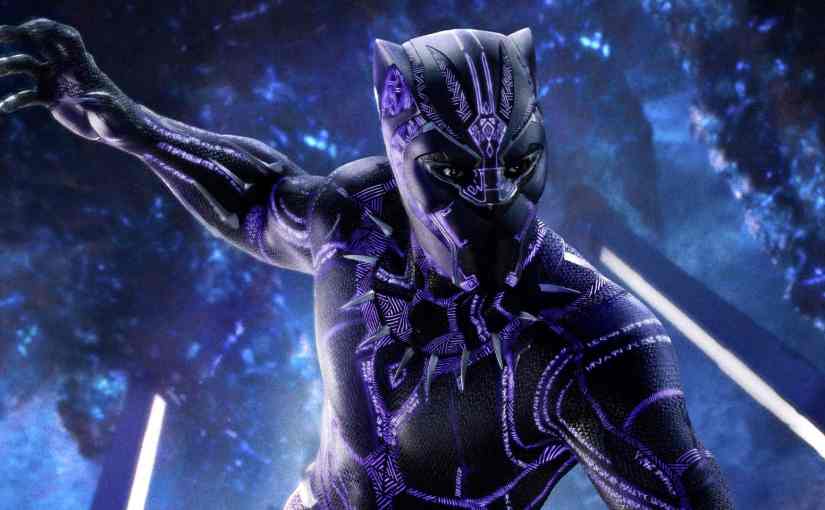
Coogler makes a beautiful sweeping film of country and special effects. The Wakandan ships are very cool. Overhead shots of Africa and the camp bases of various tribes are astonishing. One particular tribe resides on a winter like mountainside and the leaders room is spectaculary decorated in horizontal lumber hangings. T’Challa’s staff of mostly female combat warriors and scientists led by Lupita Nyong’o are really exciting. At times the film takes inspiration from some of the best standards of the James Bond films, as his sister introduces her latest inventions for the Black Panther suit. Naturally, the Black Panther costumes are stand outs in the film, black with glowing power enhancements of purples and yellows.

Is Black Panther worthy of a Best Picture nomination and an abundance of awards attention? I’m still not sure. It’s a very strong piece that is light years ahead of any DC Universe film, but it has great characters and messages like most of the Marvel films and even some of the more recent Bond films featuring Daniel Craig. Maybe it is one of the best films of they year, and maybe it should be a Best Picture nominee, but perhaps only because 2018 did not offer a wealth of extraordinary film achievements to begin with. I found merits in all of the 8 Best Picture nominees in this particular year, but I also found problems with many of them too (don’t get me started on A Star Is Born); shortcomings that in another year with better films would keep many of these nominees from ever being considered for the grand prize.

Yet, as I document these thoughts, I think about Black Panther again. Truly, it does not have anything negative in its feature. Ryan Coogler directed and wrote a very focused and thought provoking film. Yup! It was truly one of the year’s best films.

A QUIET PLACE

By Marc S. Sanders

M Night Shamylan is kicking himself right now for not thinking of this story.  All it took for director/co-writer John Krasinski was very, very minimal dialogue, some well skilled young actors and his brilliantly, talented wife Emily Blunt to pull off one of the best pictures of 2018.

Another desolate, post-apocalyptic future has occurred and thankfully this story does not feature tired zombies or vampires.  Krasinski uses old fashioned techniques to hide or mistakenly reveal his characters to the boogie men with no other agenda except to shut out all of the noise. A silo, a basement, a waterfall, fire, a nail, a hearing-impaired character, bare feet, a toy space shuttle, sand, lights and fireworks. I accepted every plot device used in the film, and each element is a miniature story in and of itself.  As well, when there are moments that allow the four main characters to actually talk, there stands to be good reason for it and I bought all of it.

Emily Blunt is an incredible actress full of hard concentration and Krasinski does not let up on long running close ups to heighten her tension of isolation surrounded by the most terrifying threats, all while enduring a physical emergency.  She stares without a blink.  She effortlessly shakes with paranoia, and she evokes pain of the worst kind; all without uttering a sound or saying a word.  This is the same actress who played a snobby diva in The Devil Wears Prada, and later went on to portray the most popular nanny of all time, Mary Poppins.  This performance should not be overlooked.  It’s incredible.  You don’t need monsters in your face to be afraid.  All you need is Emily Blunt to carry you along.  

Krasinski springboards his terror off the best horror films from Jaws to The Shining to Alien to The Blair Witch Project and the original Paranormal Activity.  Yet, he does manage to pioneer his craft with A Quiet Place.  This is not something you have seen before. Hiding in silent fear has been done to death.  The girl always hides in the closet from the killer.  Here, you can hide, but staying out of sight won’t necessarily save you or do you any favors.  These creatures just might be prepared for that.  So, now you have something new to wrestle with.  Can you keep quiet?  This script does not make that easy. If ever a movie was to justify the need for Oscar categories like Sound and Sound Effects Editing, then this is the film to turn to.  These tools give reason for the storyline more overtly than any other that I can imagine.  You do not take the sound for granted, and you do not take the lack of sound for granted either.

Miguel Rodriguez and I originally saw this picture in a Dolby theatre.  It’s a telling film that gives reason for a Dolby theatre in the first place.  A film like this is worthy of the upgraded ticket price. (By the way, Mig, you still owe me $11.00.)

Put John Krasinski up as a top-notch director.  I believe this film was granted a very small budget, but like the best directors to come before him, he has managed to put up big screams and the best in dramatic storytelling with little expense. He even manages to tug at your heartstrings if you allow it. The ending was a huge pay off for me personally.  John Krasinski gives you a horror film, but he’ll make sure you have something to think about while you’re watching it, and long after you have left the theatre.

A SIMPLE FAVOR

By Marc S. Sanders

Director Paul Feig has a great approach to directing women and how characters interact with one another. Bridesmaids was one of the best ensemble comedies of the last twenty years. With A Simple Favor, adapted by Jessica Sharzer from the novel by Darcey Belle, Feig goes for the twisty mystery.

A Connecticut suburban mommy vlogger named Stephanie (Anna Kendrick) befriends an ice cold three piece suit business executive rebel mom named Emily (Blake Lively) when their elementary school age sons become friends. These women couldn’t be more different. Neither really has friends. Stephanie teaches unseen internet surfers the latest recipes or arts and crafts. Emily teaches Stephanie how to make martinis, drink and how to make your place in the world by saying “Fuck you!” to someone’s face, especially if it’s your boss.

As the exposition progresses, Stephanie becomes relied upon to watch after Emily’s son, Nicky, all too often. One day though, Emily doesn’t come to pick Nicky up and all but disappears with no trace. Stephanie attempts to uncover what happened. She talks with Emily’s husband (Henry Golding) who was out of town at the time of the disappearance. She makes the mystery an ongoing theme on her vlog and invites theories from her viewers. Comments range from “I bet it’s the husband.” to “That poor little boy.” Furthermore, Stephanie begins to adopt some of Emily’s aggressive traits to pursue her own investigation. Kendrick’s change in character is one of the more fun elements of the film. She becomes a modern day Jessica Fletcher or Nancy Drew.

The script for A Simple Favor plays like the better seasons of Desperate Housewives, or as mad as the film Wild Things with Denise Richards & Neve Campbell with outrageous sexual episodes that are meant to deceive or play with your mind. Twists that I wouldn’t dare reveal occur to deepen the mystery even further and Paul Feig’s film even seems to have a Jekyll/Hyde personality at times.

Anna Kendrick is bubbly, fun and quirky. Blake Lively is lethal and harsh. Both actresses are great contrasts to each other. What allows these two ladies to get drawn to one another and eventually call themselves “best friends” is their lack of friendship with anyone else and the very, very dark secrets they both possess. When the set ups are done, the ladies’ histories may or may not become instrumental in Emily’s disappearance and Stephanie’s curiosity for the truth.

As ridiculously far fetched as A Simple Favor is, I liked it because it kept me guessing. More so, I was really wondering who the true perpetrator was. I did not trust any of the players in the film, not even Stephanie, and so I was engaged.

A Simple Favor is one of those films where you won’t know if you liked the film until it reaches its conclusion. A mystery must depend on how satisfying the resolution is. Is it believable? No matter how absurd everything is, again, is…it…believable? For a time, I was hoping, UTTERLY HOPING, this was not going to go the way of Fight Club or Secret Window. If you’ve seen those films then you know what I’m talking about.

So again, is it believable? Yeah! I like to think so. Therefore, I gotta recommend the film.