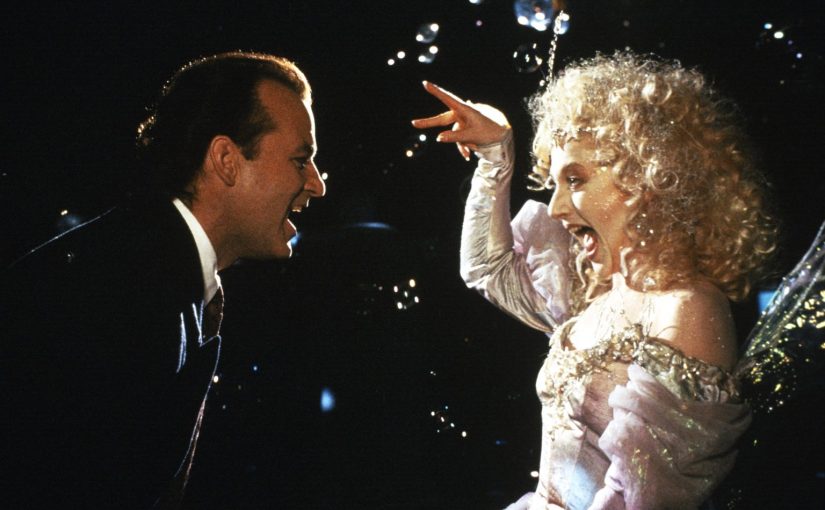
SCROOGED

By Marc S. Sanders

Bill Murray with director Richard Donner delivered their contribution to the Charles Dickens assortment of A Christmas Carol iterations with a modern update called Scrooged.  Until now, this movie eluded me.  Yet I can’t deny it has all the ingredients for a sure-fire green light to make the movie.  Bill Murray? Doing Ebenezer Scrooge?  Stop everything people!  Get this ready for December.  STAT!

Unfortunately, it misses the mark.  

Now, I’m supposed to like this miser by the end of the story, right?  So then why is Murray’s personification so annoying and unappealing by the end? If I was his nephew, I’d rescind my invitation to come over for Christmas dinner.

The best and most hilarious part of Scrooged occurs in the beginning following the easily recognizable Danny Elfman instrumentals.  Santa and his elves are happily making toys when suddenly terrorists attack the North Pole and Lee Majors jumps out of nowhere ready to bear arms with ol’ St. Nick and his crew.  I was sad to realize this was only a TV commercial for the station programming that Murray’s character oversees.  If there is a God, he’ll reveal the location of the lost film for The Night The Reindeer Died.  Earlier this year I saw Lee Majors needlessly squandered away in the terrible Fall Guy adaptation.  It crushes me that he got this same kind of treatment over thirty years prior.

Bill Murray is the uncaring and thoughtless Frank Cross.  When we meet him on Christmas Eve day, he’s firing an executive (Bobcat Goldthwaite) for simply disagreeing with him.  Also, in typical overplayed Bill Murray fashion, Frank insists that his assistant Grace (Alfre Woodard) ignore the needs of her family during the holiday and get work done with him.  Grace of course filling in for the Bob Cratchit role.  

Following a few other gags to parade the comedian’s antics around, Frank is encountered with the Jacob Marley stand in, played by John Forsythe.  At this point I’m still with the picture even if the breadcrumbs are easy to follow.  Forsythe, in his grotesque makeup, works well against the clown who leads this movie.  (Not a bad scene together between Charlie and Bosley. “Hello Angels!”).

It’s when the follow up ghosts make appearances that my mind ponders what I’ll be writing about in this review.  Ghosts of Christmas Past (David Johansen) and Present (Carol Kane) enter on cue and right away I grew bored and uninterested.  

Johansen is a cabbie, or just another screeching screamer like Murray.  He’s laughing at Frank’s demise and past missed opportunities, but I’m not seeing what’s funny or even heartbreaking.  Neither theatrical mask of comedy or tragedy is functioning.  Carol Kane does her typical schtick with the high-pitched baby talk voice, dressed in a fairy get up.  Beyond that familiar routine, she commits every kind of Three Stooges smack and painful tug on Frank’s face that you can imagine.  Why of all things does she rely on a toaster to upper cut the jerk in his face?  I mean why a toaster???? If the comedy works, then I should not be wondering why a toaster or a pie or two by four or an anvil.

There’s nothing wisely written here.  The screaming and the smacking get old very fast and it gets in the way of a potential love story passed by that the script was promising for the Frank Cross character and his crush Claire (Karen Allen, whose smile always lights up a room).  I never felt like Bill Murray was ever listening to Karen Allen in the scenes they share.  Did they even rehearse this stuff?  Too often, Bill Murray seems to just be winging it, and it wouldn’t make a difference if Karen Allen even memorized her lines.

Scrooged starts out with fresh, quality made National Lampoon material but then waddles into the same typical chapters of Dickens’ holiday story.  However, while it hammers the familiar story beat by beat and you tell yourself there’s the Fred character and there’s the mute kid covering for a crippled Tiny Tim and there’s Yet To Come, you got Bill Murray who was granted too much artistic license to improvise, and has thus squeezed out all of the sensitivity and spirit that we expect from A Christmas Carol.

I’m sorry but I think I liked this Frank Cross a whole lot more before he was visited by the ghosts.  This is one Scrooge who should’ve been allowed to sleep through Christmas.

PS: If anyone can find a DVD print of The Night The Reindeer Died, I’m ready to review it.

CARRY-ON

By Marc S. Sanders

Action movies have been done to death, haven’t they?  Yet, don’t we still get a kick out of them?

Sure, I need my TCM classics like It Happened One Night or my updated biographies like Angelina Jolie’s Maria, but action movies are like the best junk food without any of the calories.  Still, an action picture has to have that special attraction if it is to stand apart from the others.  I got bloated by the time I got to the fourth Lethal Weapon.  The first is a perfect wham bang shoot ‘em up set during Christmas time. Now Netflix grants us a long-lasting candy cane with its airport run around chaser flick known as Carry-On.

What makes this mad bomber fest a smash is that the hero, TSA agent Ethan Kopek (Taron Egerton), actually cries out of fear and pain as the bad guy beats up on him and frightens him into direct obedience.  He begs with tears coming down his cheeks for the bad guy to just stop with his mission.  He screams “WHY ME?”  The Rock, Stallone, Schwarzenegger, Willis, Ford, Gibson – those guys don’t cry.  Yet, little Ethan Kopek does, and once he gets his wits about him does he truly become a super hero.  I recall the moment happens in the last twenty minutes of the picture.  Ethan throws off his pansy TSA uniform shirt and makes a go at saving the day in his black undershirt.  Now he’s earned John McClane’s respect.

On the busiest travel day of the year, December 24th, Ethan is assigned to scan the carry on luggage ensuring travelers have not packed contraband items.  He and his colleagues have to put up with all the typical TSA complaints that come with the job.  My hat’s off to screenwriter T.J. Fixman for allowing some time to show the challenges of this occupation.  It adds some truth, comedy and depth to a thankless job that’s hardly celebrated or acknowledged like cops, doctors, athletes, and attorneys.  

Ethan is handed an earpiece and a mysterious voice, provided by Jason Bateman, gives him direct instructions to allow one black suitcase with a red ribbon to pass through inspection.  If Ethan deviates in any way at all, the voice promises that Nora (Sophia Carson) will be killed.  She is Ethan’s pregnant girlfriend and also runs airport security at LAX.  

Movies like this function like a game or sport.  The villain sets up boundaries.  How is Ethan going to save the day or get around the unexpected while trying to avoid harm to Nora or the airport as a whole?  As far as he knows, he is always being watched by the guy talking in his ear.  There’s rules and obstacles he must observe.  Granted, Carry-On allows a lot of unlikely and hard to buy conveniences to let our hero obtain the advantage, but he’s also not Superman, and at times when you believe Ethan is coming out ahead, Bateman’s antagonist changes up the game.  

Heck! A bomb is activated not at the end of the movie, but dead center right in the middle of the story.  Normally, the end all be all explosive serves as the final exclamation point with the expected digital clock countdown.  However, in Carry-On if it can get deactivated, there will still be more story to go.  Bateman’s villain really has everything thought out and Egerton’s character has no choice but to man up to the plate once again.

A side story with Danielle Deadwyler as an investigative cop named Elena will eventually intersect with the main narrative.  It’s nothing special until a car ride on the way to the airport plays Wham’s Last Christmas on the radio and the scene explodes into a mind-blowing thrill reminiscent of what I saw in Children Of Men twenty years ago.  The construction of this scene alone is absolute fun.  

Deadwyler’s character is written with a lot of carte blanche to allow Ethan to save the day.  No, none of this is ever likely to be how things go.  Yet, I recall Arnold Schwarzenegger being thrown out of an airplane and surviving a crash landing in a garbage heap thirty thousand feet below (Eraser).

If you watch Carry-On, I will not be surprised if you protest its merits based on a collection of plot holes.  The most glaring one to me is that LAX does not look nearly as crowded as the script insists, nor what I’d expect on Christmas Eve day.  Also, traffic is really easy to get around on the way to the airport.  (New Orleans fills in for Los Angeles.). However, just because Dreamworks and Netflix cut corners on spending for more extras and scenic inconveniences, it does not mean my enjoyment with the film is suspended. 

To make up for where the film’s budget might have come in the way, there are storyline surprises that enter from nowhere. Logic is applied to what’s inserted at these opportune times.  Ethan and Elena experience a set back and now new forms of game play must take hold.  You accept what’s thrown at you because of the cast and set ups.

Taron Egerton is a deliberately wimpy, but also an attractive, unlikely hero.  Jason Bateman ranks with other impressive Die Hard type movie villains like Alan Rickman, Tommy Lee Jones and Dennis Hopper.

Carry-On’s director, Jaume Collet-Serra, is well aware of the near miss escapes that allow his movie to…well…carry on.  He really doesn’t try to hide or distract from the plot holes or questions that audiences may argue.  Yet, I say who cares? This cast of mostly unknowns step up to embrace the dialogue and circumstances of the script while trying to win the game.  

Look, anything you see in Carry-On can theoretically happen.  

Would it happen?  

Let’s just change the subject please.  You have a plane to catch.

CRIMSON TIDE

By Marc S. Sanders

A little over a year ago, having just seen Christopher Nolan’s Oppenheimer, I shared with friends how it is sadly surprising that a nuclear weapon has not been launched by a super power country since the bombs were dropped on Hiroshima and Nagasaki.  Those two bombs certainly served their purpose in response to the Pearl Harbor attack of 1941.  I deem it sad that any of us consider this a possibility that can easily be repeated. With all of the threats that continue worldwide with weapons testing, technological advancements and arms trading, it’s frightening to wonder what can ever be expected. Is it easier to execute a command like that again, now that it has been done?  It’s got to be a little surprising that the United States did not respond that way following the 9/11 attacks.  Tony Scott’s Crimson Tide comes close to providing an answer by weighing sound vs unsound reasoning. 

This is not only my favorite of Tony Scott’s films, but the movie also offers maybe my favorite performances from Denzel Washington and Gene Hackman.  The two actors of different generations are equal in measure as they debate what should be done, along with how the submarine they command, the U.S.S Alabama, should respond while in the midst of a revolutionary conflict stemming out of Russia.  

Washington is Commander Hunter, recruited at the last minute to serve as the Executive Officer aboard the Alabama.  Hackman is Captain Ramsey who proudly leads the charge of the sub with an intimidating welcome to Hunter.  Before any kind of real conflict comes their way, Ramsey puts Hunter to the test.  An uncomfortable dinner conversation, wisely written by Robert Towne (Chinatown), has the Captain question Hunter’s stance on using nuclear force to deliver a harsh defeat to the enemy.  Hunter’s position though is the real enemy is war itself.  Ramsey and his commanding staff have no reply to the new member’s observation.

Another moment occurs when Ramsey orders a missile launch drill while Hunter is assisting with containing an on-board fire in the galley.  The Captain has his reasons that Hunter cannot truly debate. Besides, Ramsey precisely tells his XO to “bite (his) fucking tongue,” even if he doesn’t agree with him.

The centerpiece of the officers’ conflict arrives when they receive a fractured message from command.  Ramsey’s instinct is to launch missiles at Russia based on the presumption that the Soviet rebels have overtaken the country’s arms.  Though Hunter cannot deny the concern, he will not agree to a missile launch until they receive the entirety of the broken order.  This occupies the second half of the film, and it becomes a back-and-forth mutiny of power.  The Captain is relieved of command but then retains control and the crew is divided between the leaderships of these two characters.

Having recently seen and reviewed the submarine classic Das Boot, it’s fair to say that film feels much more authentic and maybe it should be much more tense than any other movie of its kind.  Crimson Tide is glossier with outstanding interior cinematography on a studio constructed set designed to tilt like a maritime vessel should.  The dashboards and colored lighting are fancier.  The cast is good looking as Tony Scott obtains close up shots of them beaded in glistening perspiration with no facial hair.  Crimson Tide is definitely a Hollywood picture.  However, the screenplay from Michael Schiffer is razor sharp with not one wasted piece of dialogue.  In addition to Robert Towne’s contribution, Quentin Tarantino also script doctored a portion of the piece as well which includes a well-placed Star Trek allegory. 

There’s a jolt of energy to Crimson Tide that Das Boot has at times, but because of the latter’s three hour plus running time it also slumbers like life should while living on a submarine.  It is the theatrics of Crimson Tide that hold my attention on many repeat viewings.  I’d never want to question a guy like Captain Ramsey, but I’d be grateful that someone like Commander Hunter is around to stand in protest.  

I wish Gene Hackman and Denzel Washington had done another film together.  Their conflicted chemistry is second to none.  You like them both equally in the scenes they share together, or individually.  The timing of their tempos is perfect.  They find just the right moments to be alarming in a quiet way and save other opportunities for shocking outbursts.  The best actors practice their scripts this way and avoid any traps of overdramatizing.

Tony Scott made this film before his penchant for chaotic angles and grainy captions took over much of his other films to come hereafter.  Crimson Tide is cut perfectly from one scene to another with outstanding colors of blue, red and green lights that illuminate the cast while they stand at their posts.  Washington, Hackman as well as a sensational supporting cast (Viggo Mortensen, James Gandolfini, George Dzundza, Steve Zahn, Matt Craven, Lillo Brancato) do fine work and respond beautifully to the director’s camera positions. 

It’s impossible not to feel the tension accompanied with the progression of this film.  It serves as a motivation to wonder if we act on what we know or don’t act on what we don’t know.  As taut and dramatic as Crimson Tide is, you find yourself considering if those with access to the real-life red button consider all that could come of their decisions.  

Crimson Tide may tidy itself up after two hours, but the movie still makes me ponder if this planet’s military forces are thinking each and every day about if we are preventing nuclear war or if we are on the cusp of waging a nuclear holocaust.

This is one of my most favorite films. 

THE TAKING OF PELHAM ONE TWO THREE (1974)

By Marc S. Sanders

I’m a big fan of gritty, urban crime thrillers.  A wealth of them came out in the 1970s.  There was a rawness to their material.  They were equal opportunity offenders, picking on every race and demographic out there. It only lent an honesty to the characters that occupied these spaces.  The two guys that easily come to mind are Dirty Harry and Popeye Doyle from The French Connection.  Still, there were others that wedged their way through the cracks.  The Taking Of Pelham One Two Three from 1974 belongs in this fraternity of films as well. 

Walter Matthau is Lt. Zachary Garber, who has a ho hum job working the law enforcement area of the New York City subway system.  Beyond muggings and vagrants lying around you wouldn’t expect any major crimes to happen underground and thus Zach moves with a slow pace that never gets him upended or panicked.  Yet, on the day that he is giving a tour to some visiting Japanese subway architects, a hijacking of the train to Pelham Bay, number one two three, occurs.  Four armed men, only designated by Mr. Blue, Mr. Green, Mr. Grey and Mr. Brown don fake mustaches, hats and overcoats.  They are demanding a cash ransom from the city in the amount of one million dollars.  Zach and his crew have less than an hour to respond with the money, or Mr. Blue (Robert Shaw) will order the killing of one hostage for every sixty second delay.

Joseph Sargent’s film then steers its way into several conundrums.  Even if the ransom is paid according to the criminals’ exact instructions, how are these guys going to make an escape from underground?  What’s the nebbishy mayor supposed to do?  He’s in bed with the flu and he doesn’t know how to respond to this kind of craziness.  What’s the point of him making a public appearance near the scene of the crime? 

Long before everyone’s favorite hostage flick, Die Hard, came about Sargent’s movie was poking fun at the humorous and inconvenient cracks that leak out of a serious captive crisis.  First you gotta get the mayor to agree to the demands and as his wife (Doris Roberts) sensibly points out, there are seventeen potential voters on that train.  Then, you gotta count the money and drive it from uptown to midtown before the clock runs out.  That’s not so easy.  You think New Yorkers get out of the way when a speeding patrol car is barreling through the city? 

Zach doesn’t have it so easy as well.  Schluby Walter Matthau is great at trying to contain a situation but his co-workers are not so understanding.  Rush hour is less than two hours away and this stand still train is holding up the subway traffic.  Dick O’Neil and Jerry Stiller are genuine hilarity born directly out of the concrete jungle for roles like this. O’Neil has to keep all tracks open and the trains moving.  Initially, Stiller doesn’t take this seriously – a precursor to his Frank Costanza role on Seinfeld.

Robert Shaw was always one of the best villains and antagonists with films like From Russia With Love, The Sting, and Jaws.  He’s just as good here, but like those other characters, Mr. Blue is unique.  He carries a uniform, hospital cornered method, and he keeps it to the letter so well, that he’s relaxed enough to play his crossword puzzle as he waits for the money to arrive.  Martin Balsam is Mr. Green, a nervous underling recruited for operating the train.  Hector Elizondo is a crazed kamikaze kind of guy who might just knock the criminals plan out of whack because he’s a little too trigger happy.

The Taking Of Pelham One Two Three carries a simple plot.  What makes it complicated though are the characters surrounding the story.  There are a few levelheaded guys on both sides, but it’s the others around them and even the daily happenings of New York City that tilts any progress to be made off kilter. 

The city and many of these characters are unpredictable and therefore surprises will trip everything up just when it all seems to fall into place.  This even happens in the very, very, very last scene and caption of the film.  I’d love to share what a simple involuntary action that can break any of our concentrations does for a couple of these guys, but then I’d spoil the fun.  Trust me though, you get the last laugh before the end credits roll.

WHIPLASH

By Marc S. Sanders

It’s impossible to find absolute perfection.  I don’t care if it’s in the field of medicine, law, mathematics, art or even music.  No one is THE ONE.  Yet, if you are determined to partake in that hunt, it’s likely you’ll scream with frustration.  You might think you’re on to something but still it’s not quite the one.  Maybe, however, you will force your search for the one if you throw a chair at your gifted student, scream some of the ugliest obscenities, impose threats, slap him, allow the tears to run, force a literal blood draw, or sweat them into numbing exhaustion.

Whiplash is the name of a piece of jazz music originally composed by Hank Levy.  It is also the title of Damien Chazelle’s brilliant first film, and the best to come out of 2014. Allegorically speaking, the term takes on a harsher connotation.   The word whiplash gives me an image of torn skin and hot, dripping blood.

Andrew (Miles Teller) attends the Shafer Conservatory in New York.  He’s a jazz drummer who gets hand picked by the esteemed conductor Terence Fletcher (J.K. Simmons, in a well deserved Oscar winning role) to join his elite class.  Mr. Fletcher is cordial at first and a little instinctive as he’ll stop his musicians short of getting past one note before asking them to start again.  A hand gesture with a headshake and a wince.  Now go again.  Another gesture.  Go again.  One more gesture.  Again. Now an outburst of violent rage.

Individually, Andrew and Terence are determined with unhealthy mindsets to obtain levels of achievement that appear impossible to grasp.  The boy wants to get to where his drummer idol Buddy Rich plateaued.  The teacher wants to find the next Charlie “Bird” Parker.  These men of different generations are terribly talented.  Terribly I say because their passion for music is their self-imposed and cruel undoing.

Chazelle has much respect for the field of contemporary jazz.  I like jazz but I know nothing about how a piece is assembled so rhythmically among an assortment of instruments from the drums to the harp to the cello to the 88 keys and the various horns.  Put them all together, and there’s an atmospheric magic to what’s churned out.  It’s beautiful and bewildering.  Complicated, yet mesmerizing.  In Whiplash though, the music may be the worst antagonist because the frustrations that arrive with trying to become a master are unforgiving.

A late scene in the film shows Terence Fletcher, an altogether tyrant of a teacher, playing melodic nightclub piano in a bar.  He’s applauded and appreciatied as he presses down on the final key.  He thanks his audience with a nod.  Nevertheless, J.K. Simmons shows a different level of frustration.  Up to this point, the actor’s character has been a series of screaming eruptions.  In this moment, the man looks like he wants to cry.  No matter what he plays or how well loved he is, Terence Fletcher knows it could have been better.  So, if he lives with his suffering, then he will teach his best students to suffer through music as well.

Andrew is on the cusp of living his own life.  With a mother no longer in the picture, he still shares movie times with his father (Paul Reiser) perhaps so his father can still be a father, or maybe it is to remain a child to someone.  He’s starting a what could be a promising relationship with a girl named Nicole (Melissa Benoist), but his need to be a better drummer interfere and the only way he’ll know he’s at least as good as Buddy Rich is if he satisfies his teacher.  That’s the only sure sign.  

Does Terence turn Andrew into a monster, or is it the music?

This will always be one of Miles Teller’s best roles.  He’s got that innocent, quiet way about him, but as he gets “mentored” by this new composer, he changes.  He becomes devoid of care for Nicole and rebellious towards the lack of respect he receives from family and fellow students.  Like a chess champion, the art of drumming turns the drummer into an unloving creature soaked in blood and sweat.  This ongoing trajectory might make him a better musician but it will also bring him to an end result that matches his teacher.  

Beyond the energy of the music, Damien Chazelle steers a thrilling duo.  Simmons is an outstanding villain as a guy you can only hate until you see the motivations he’s only trapped himself into.  Only then you might just sympathize. Teller is circling the waters of a dangerous relationship with music.  Chazelle allows his picture to swim towards defiance with bloody and painful persistence. The epilogue of the film demonstrates precisely what these two men are searching for.  It’s only when you arrive at the end of Whiplash do you realize and empathize with the internal and physical pains these people choose to weigh on themselves.

To my ears, music is a beautiful, universal language.  

For the scribes, it’s an agony they choose to bear.

THE CHINA SYNDROME

By Marc S. Sanders

The China Syndrome explores the inherent risk that comes with a reliance on nuclear energy.  It also touches upon the moral choices within the field of journalism.  Most importantly though, it’s a hell of a thriller.

Kimberly Wells (Jane Fonda) is an on the scene reporter doing light fare topics for the evening news, like the novelty of singing telegrams for example.  With her subcontractor cameraman, Richard Adams (Michael Douglas, also one of the film’s producers), they cover a story on how a nuclear power plant operates.  During their tour, a very frightening accident stops short at only being a threat.  While the top brass at the company downplays the incident, Richard manages to record the panic-stricken activity happening among the operators in their soundproof control room.  As Kimberly and Richard gather information about what really happened, they are told they only were so close to what can be described as a China Syndrome – the underground nuclear rods could have overheated, imploded and the blast would have ruptured through the core of the earth where even China could feel it on the other side of the world.  

The corporate elites (led by Richard Herd) are the villains of this picture.  The could be hero is Jack Godell (Jack Lemmon), a could be whistleblower.  Jack oversees the whole operation and following that frightening scene begins to do his own kind of investigation.  What happened only makes sense because due diligence was not upheld, and inconsistencies are being neglected. Problems are only expected to get worse because they are not contained. There would be an enormous monetary expense that will put the company at a loss.  Initially, Jack wants to remain quiet, but the idea of what he’s certain will eventually happen is conflicting him.  As well, Kimberly and Richard’s pursuit of what truths he holds is gnawing at him.  

Jack Lemmon is a frazzled, yet sensible, marvel in this film.  I love the unspoken subtleties of this guy.  Best I could see is that Jack Godell is unmarried and has no children, nor friends beyond the faint connections he shares with his work colleagues, particularly one played by Wilford Brimley.  This only enhances Godell’s isolation in a them-against-him matchup.  Lemmon is great at emoting a sorrow and regret to his character.  He tells the journalists that he loves that plant.  It’s all he has in life and now it spells a certain, eventful doom if the faults in operation are not exposed.  Like Michael Mann’s The Insider, which was released over two decades later, the unlimited resources of this company will do everything in their power to silence this liable peon who works for them.  

The other side of The China Syndrome focuses on Fonda’s character.  When this film was released in 1979, it was the norm to not take a woman reporter seriously.  They were best used as attractive figureheads with beautiful hairstyles and well applied makeup to shift the seriousness of the news over to stories about dogs who can do tricks or hot air balloon happenings.  This film could have made more of a campaign to embrace the female journalists with heavier topics.  Instead, Jane Fonda’s character is not a fighter so much for deserved recognition in a male dominated world.  She’s actually just trying to circumvent around the unspoken chauvinism of her industry and get to the heart of this story that she witnesses firsthand.  The news station would rather her efforts be focused elsewhere.

Richard, the cameraman, is not embraced by Kimberly’s news station and therein lies the debate of airing what appears to be a story of urgency for the benefit of the public.  Yet, the station does not want to face a lawsuit.  What do the principles of journalism mandate even when there’s a monetary and reputational risk to their institution?  

Plenty of films with these kinds of dilemmas have come out following The China Syndrome.  What’s remarkable is the authentic feel of this fictionalized account.  Ahead of the release, the real-life companies that were developing a need for nuclear power were lambasting this film, insisting there was no validity to this story.  They were adamant that the production and maintenance of nuclear power was completely safe and well monitored. Twelve days after this film hit theaters in March 1979, the Three Mile Island accident occurred in Harrisburg, Pennsylvania when a partial nuclear meltdown of a reactor occurred. Traces of harmful gases and iodine were released into the atmosphere, and the incident was rated a Level 5, an “Accident with Wider Consequences.”  I do not believe Michael Douglas and his co-producers/filmmakers necessarily set out to make a statement. Though there are protesting movements peppered throughout the film. It’s a frightening irony, however, when life imitated fiction. 

 Jane Fonda and Jack Lemmon put the suspense of The China Syndrome into play. There’s an awareness to what could happen with technological advances in nuclear energy especially if they are not carefully observed and addressed.  

Over forty years later, do we really know what’s going on and even if we did, what could any of us do about it?

CONCLAVE

By Marc S. Sanders

conflict

noun

  • 1.
    a serious disagreement or argument,

conclave

noun

con· clave ˈkän-ˌklāv 

Synonyms of conclave

1

a private meeting or secret assembly

especially  a meeting of Roman Catholic cardinals secluded continuously while choosing a pope 

2

a gathering of a group or association

As I watched Edward Berger’s new film, Conclave, the word “conflict” came to mind based simply off of the same prefix the two terms share.  This picture does not just depict a sequestered assembly to elect a new Pope for the Roman Catholic Church.  It goes further because nothing goes as expected for the Dean of the Conclave, Cardinal Lawrence (Ralph Fiennes, doing Oscar caliber work).  

Now that the Pope has passed away, the various cardinals assemble, and all seem to have their own impressions of who should take the reins.  Cardinal Bellini (Stanley Tucci, man I love this guy) is the liberal candidate, tolerant and supportive of the gay population and accepting of women in authoritative positions.  Cardinal Tedesco (Sergio Castellitto) is on the conservative side believing the position should rightly return to an Italian with restrictions and containments of liberal ideals that have diminished what the church used to stand for.  There is also Bishop Tremblay (John Lithgow) who has an abundance of support to no one’s surprise. A few others earned some votes during the initial balloting, but it’s seemingly of no big consequence. Still, over the course of the film, multiple votes will have to be counted until the minimum majority necessary for a new Pope is collected.

The men of God convene in a formality of faith, swearing their handwritten votes before the Almighty.  Yet, Lawrence, as a dean of ethics and morality, is becoming apprised of some questionable irregularities among his peers.  While some of these men are earning more and more support with each passing tally, new developments present themselves forcing Lawrence to question if there should be some investigations to determine if some of these men are qualified to acquire the Papacy beyond an election.  Hence, the conclave is getting gravely interrupted by an overwhelming number of conflicts for Lawrence to consider.

I must stop there with my summary of Berger’s film, based on the novel by Robert Harris.  This is a top notch drama helmed by an outstanding cast.  At the very least the adapted screenplay by Peter Straughan will win the Oscar.  The dialogue is aggressive and forthright when it needs to be.  An institution like the Roman Catholic Church operates on secrecy.  However, it’s so interesting to see these devout men of God challenge one another. Just because they are the highest priests does not constitute them beyond sin or even corruption.  As Stanley Tucci’s character demonstrates, they might not be polite either.  Simply honest when their personal stance is challenged.  

The script is also quietly ponderous.  Ralph Fiennes shows an internal conflict between his duties to the church and how he truly characterizes some of his peers.  He even begins to wonder if he should continue as a priest. Has his faith remained uncompromised? Frankly, how can a priest of the highest order live satisfyingly knowing that no person is of an upmost perfection even if they swear by their faith? Still, the strict expectations of a widespread religion will demand contexts of that notion.

Constructively, Conclave has a gripping energy.  The performances from especially Fiennes, Tucci and Lithgow are magnetic as soon as they enter the piece.  Isabella Rossellini delivers an under-radar performance as a nun who works with a necessary audaciousness to her character.  She knows things that should never have occurred.  Yet, how will she confront these intimidating, stark, red-robed figureheads?  Does she even have a right or authority to speak?

The music from Volker Bertelmann could belong in Hitchcock thriller if Bernard Hermann wasn’t available.  It keeps you alert and never anchors your feelings as new developments come to light.  The composition only enhances the weight of the drama.  

Edward Berger is an observant director.  Ahead of the conclave he reminds you that even telephones are not permitted inside and tossed in a heap outdoors.  The priests are smokers. Personally, I find that surprising as cigarettes almost seem like a mild narcotic and a contradiction of how I envision a Catholic priest should behave.  Nevertheless, Berger also gives you a close up of a pile of cigarette butts tossed on the ground just ahead of being sequestered. These men turn off the world outside to focus on this important election. It’s as if they live in a submarine below the surface.

Conclave wil be a very divisive film.  Politically, it’s apparent that it favors one side (liberal vs conservative) over another.  In addition, it is not shy about showing its characters with their assortments of fault.  I am not educated in Catholicism.  Though I am well aware of the value it holds across its worshippers.   For many, their faith is held above all else and those people will find a discomfort with this picture.  I might even be understating that assessment.  Some folks of the Catholic order, and maybe other denominations of Christianity, will even take grave offense to this fictionalized depiction.

Conclave is truly conflicting.

Because I do not hold any value in Catholicism, much less any religion anymore (just a shred for the Judaic customs I was raised on), I did not hold any bias or objections to Edward Berger’s film. Rather I was engaged in how difficult it is to balance yourself as a Catholic priest.  For Cardinal Lawrence, Ralph Fiennes is neither likable nor unlikable but I certainly felt his character’s frustrations and the challenges he is obliged to navigate.  

Who is judging these Cardinals? 

God?  

Or is it each one of them?  

Conclave is built on one believable, yet shocking, surprise after another.  Still, when the big twist at the end arrives, it is completely blind siding and Straughan’s script leaves his audiences with a new question that’s practically impossible to contend or compromise.  

Again, Conclave is very, very conflicting.

Nevertheless, this is one of the best films I have seen in a very long time.  So much so, that I cannot wait to see it again.

Conclave is one of the best films of the year.

SCARFACE (1983)

By Marc S. Sanders

On Thanksgiving Day when we glutton ourselves with an abundance of food, it seemed highly appropriate to watch one of the most self-indulgent pieces ever put on film.  Brian DePalma’s Scarface with a script written by Oliver Stone and featuring Al Pacino.  This is a movie that brags about its boastfulness.  I mean look at everything that is mashed into this thing.  Blood, bullets, lots of cocaine and too much Al Pacino.

Pacino is Cuban refugee Tony Montana.  He is one of a handful of small time criminals who is shipped over to the United States when Castro wanted less people to oversee.  Refugee camps are fenced up under the highways of Southern Florida where no law is enforced among the tented populations.

Soon after Tony arrives he’s hot on the scene of pushing the newest underground product through Miami – cocaine.  With his buddy Manny (Steven Bauer) the two men get in good graces with a well dressed sleaze named Omar (F Murray Abraham), who is second in command to an established drug kingpin named Frank (Robert Loggia).  For Tony and Manny it’ll only be a matter of time before they take over as the numbers one and two bad guys.  That’ll include Tony marrying Frank’s blond trophy girlfriend Elvira (Michelle Pfeiffer in her breakout role) and winning a trusting partnership with a South American drug czar named Alejandro (Paul Shenar).  If you ever expect to get killed, you don’t want to be by the orders of Alejandro.  A helicopter serves much more of a purpose once it takes flight.

Scarface is a step-by-step movie or a climb up a three-hour ladder and then a gradual drop down off a balcony into a bloody fountain below.  There’s no depth and it works like a shopping list that you check off as it moves along. Props and houses and suits and jewelry and cars and cocaine and cash have more significance than what anyone has to say. Other than Tony, none of the people in this film matter. What Tony acquires and what he says about himself is all that is important.

This is a big ass movie with bloody graphics and killings, mountains of drugs and money, a lot of fucks, a gaudy estate home, a way over the top Al Pacino and lots and lots and lots of bullets and guns to go with them.  The film only settles for one chainsaw killing, though.  At the time, I recall that scene was up for big debate on the film’s MPAA rating.  Brian DePalma wanted to up the ante on brutality to grab moviegoers’ attention.  The scene remains quite stomach churning.

DePalma’s best work is at the beginning of the Scarface.  Following the establishing real life footage of the Cuban refugees arriving by boats in search of an American dream, Tony is taken into custody and questioned by a batch of immigration agents.  DePalma only keeps one steady camera focused on a very tan Pacino with a faint signature scar on his left cheek, sitting in the middle of the room and putting on a Cuban accent that only he could uniquely own.  Pacino’s concentration in this moment is admirable as he responds to questions from all different directions.  It’s all done in one take with the director’s camera circling around Pacino.  After this introduction is over, the tone of the movie changes for the next two hours and ten minutes into a gritty interpretation of Lifestyles Of The Rich And Famous.

Oliver Stone’s dialogue with Brian DePalma’s set ups don’t require much of the other actors.  It’s like everything caters to an always inebriated, hyperactive Al Pacino doing his Tony Montana with the gold chains and wide collared shirts over the linen suits.  He’s a motor mouth of endless f-bombs, with a slinky Michelle Pfeiffer in a blond bob-cut, dressed glittery evening gowns, at his side.  She has nothing of significance to say.  This is all you learn about Elvira; what you see of her materialism and all the coke she snorts.  She never smiles or exudes any connection to the Pacino character.  It’s all eye candy.  In fact, there’s never a clear answer of what becomes of this character.  That’s a problem because the movie is so much about Tony Montana, nothing else matters.

Other characters not given enough attention are Tony’s sister Gina (Mary Elizabeth Mastrantonio) and their mother (Miriam Colon).  Momma despises Tony for the criminal thug he is while Gina becomes enamored with the wealth and drug night life.  Unfortunately, Momma only has one meaty scene and Gina’s purpose to the script is to lend reason for another character’s eventual demise.  Both of these actresses are very good with what little they have.  Yet so much is devoted to Tony’s indulgence and the mania that Pacino brings that they are sidelined as well.

Brian DePalma seems to be more proud with how excessive he can make this guy than actually turning him into a guy.  Wait until you see the mansion that Tony gets. His office alone is of black, gaudy exuberance. His master bedroom contains a small swimming pool size tub right in the middle of the carpeted floor.  That setting occupies a fifteen-minute-long scene of Tony in a bubble bath, watching his five TV screens while not talking about anything meaningful except himself as he chastises Manny.  Elvira is only there to uphold her dread for her husband as she snorts coke off of her vanity.  When they both leave, an Oliver Stone monologue ends with a now recognizable sound byte of “Well say ‘allo to da bad guy!” Ah! Big deal! Tony never seemed so bad ass as he does feel obnoxious.

Again, Scarface is about not much else except the conceit of sleazy criminal.

When someone has to die it becomes a long drawn-out process as Tony, aka Pacino, puts on a performance or delivers a sermon.  Tony will meet with kingpins from Columbia along with other South Americans and dirty government officials.  There will be 5-7 guys in the room but for the most part it is only Tony talking.

“Say ‘allo to my little fren!” is one of the most memorable lines to come out of the 1980s decade of excess and it arrives during the ongoing and endless bloody shootout that closes the film.  There’s buckets of blood and truckloads of ammunition fired off.  These machine guns seem designed to kill things twice the size of elephants.  Little Al Pacino, with a ginormous cannon gripped in one hand, gets hit in all places and extremities except the head so that he can keep ranting – I mean this guy never shuts up – and going as he fends off the armies of goons coming at him from all directions.  Truly, it’s laughable and nowhere is it ever absorbing.  It’s like I’m watching someone else play a first-person shooter video game during a sleepover.  My friend is entertained while I’m just watching him be entertained.

Scarface comes to an abrupt halt when the final shootout stops.  There’s no footnote to ponder or real news story to follow up on.  The credits roll and the orchestral strings of the soundtrack cut in. You get the idea that DePalma, Stone, and Pacino became exhausted over this monster of a movie and simply declared “Okay! That’s enough!”

Considering the later insightful pieces that Oliver Stone delivered like Platoon and JFK, I wish he explored more of the politics and Cuban dealings affecting the United States.  As this film arrived in 1983, soon after there would be more of an intellectual standpoint to make us aware of a very real drug epidemic in this country.  It may appear to be sending some kind of message, but Scarface doesn’t challenge the brains that flourished this contraband industry.  Forty five minute episodes of Miami Vice tell more than this three-hour opus.

Plenty of gangster films like Chinatown, The Godfather, and Goodfellas offer up the greed and ego of the criminal mind, but the men of those pictures are never as self-indulgent or off putting as Tony Montana.

Besides, what does it say about a movie called Scarface when no one calls the main guy Scarface, and you hardly ever see the scar graced across his profile?  The real Scarface, Al Capone, would be very disappointed in Al Pacino.

AMERICAN GANGSTER

By Marc S. Sanders

My favorite kind of crime dramas are the ones that tackle the grit.  The screenwriters and directors go for where the itty-bitty stuff scrounges up into something bigger for either the career criminal or the low-level cop.  These guys start out as butterflies flapping their wings and before you know it their legacies and pursuits are as big as hurricanes.  Movies like The French Connection or Heat operate on these trajectories.  How did we get from there to HERE?

Ridley Scott went in an unconventional direction away from his science fiction eye and ancient history recollections when he directed American Gangster with a screenplay by Steve Zallian based on the true stories of Harlem drug kingpin Frank Lucas (Denzel Washington) and narcotics detective Richie Roberts (Russell Crowe).

These two sensational actors don’t share one scene together until the epilogue of this always interesting three-hour opus.  Yet, in their second film together their pairing is as classic as DeNiro and Pacino or Newman and Redford.  I hope before they retire, these men pair up for at least one more film.  

Ridley Scott and his nominated art directors, Arthur Max and Beth A Rubino, capture a gritty urban, crime ridden Harlem of the 1960s/70s.  The streets are filthily here, as well as in the five New York boroughs and all the way across the bridge into New Jersey.  Frank’s markets carry a very wide berth. The buildings are distressed and cracked.  The clothes are of the hippie era with polyester suits.  This is where Frank Lucas moves his imported contraband, white powder heroin, labeled exclusively as “Blue Magic.”  The film provides a convincing source locale deep within the jungles of Vietnam where thousands of kilos are shipped to Frank for sale on the street.  The purity of the drug is beyond compare.  Scott and his art designers place you directly in this time period of dingy grime and among the sweaty Viet Cong and rivers to finally arrive at the crop Frank purchases his products from.

Once he finds his footing by eliminating the competition and recruiting his brothers and cousins to run his business, Frank invests in creature comforts with a furnished penthouse apartment for himself and a beautiful mansion for his mother (Ruby Dee in an Oscar nominated performance that comes off so naturally; you’d think she’s sitting at the Thanksgiving table with you).  He marries a beautiful Puerto Rican wife that he treats like a princess. Frank is smart.  He stays under the radar by wearing conservative suits and not making many waves like going out at nights and showing himself around the social scene.  He knows famous athletes like boxer Joe Lewis or the staff on the New York Yankees that could give his nephew a shot at being a pitcher. Still, his profile manages to stay low. Like his mentor, he just operates a business with a viable commodity.  He tells his younger brother (Chiwetel Ejiofor) that the loudest one in the room is the dumbest and the most likely to get caught.  So, mind how you carry yourself, how you dress yourself and how you flaunt yourself.

A separate story has no business intersecting with Frank’s plight until something gives.  Richie Roberts is a good, honest cop. Though he’s also a lousy husband and father. He has been assigned to head up a task force that will bust the top of the assorted drug empires.  He needs those rare breed cops who are not on the take and follow a strict policy of law enforcement ethics.  His team will not bust a common street hustler.  They will be looking for the kingpins with unquestionable evidence to put them away for good.

American Gangster follows two separate stories for most of its running time.  At least during the first two acts of the film, Frank and Richie are unaware of one another.  It’s only through some gradual surveillance that the cop finally gets a whiff of an idea and starts to move methodically towards a conclusion. The methods are the fascinating parts the movie.

When Denzel Washington plays a villain it’s always memorable and contrary to popular opinion, Frank Lucas is my favorite of his antagonists, especially compared to his Oscar winning work in Training Day.  Watch how he walks or sits on a sofa and broods over how his family and his business are functioning.  He’s the only African American actor I can see playing this guy because I’m always convinced that whoever Denzel Washington portrays, it’s a character who will never be intimidated.  This guy faced down Gene Hackman during a threat of nuclear holocaust. Not many other actors can do that so authentically.

Russell Crowe works like that hero who doesn’t want to wear the cape.  Richie Roberts succeeds on so many levels where his peers surrender to their inhibitions.  This cop passes the bar exam while fighting for custody of his kid on top of going after the empirical criminals who litter the streets in drugs and murder.  I’m reminded of his role in The Insider, where he used a similar American accent.  Richie is not as temperamental or hard wired as that guy, but he is at least as focused on doing what’s right regardless of threat or distraction.  Russell Crowe has a way of getting audiences to admire the concentration needed for many of his complicated characters.  You have as much tunnel vision as he wants the men he’s portraying to have. You are zoned in with what his characters live by.  You only trust their standards.

There are signature staples within the construct of this true story adaptation.  There are gunfights.  Punches are thrown.  The guy at the top beats up one of his cronies when he gets out order.  Yet, what stands this material apart from others is that now I’m watching how Denzel Washington and Russell Crowe handle everything.

The truth behind the story of a black gangster defying the dirty cops and the Italian mobsters who were thought to run the metropolitan undergrounds is amazing.  It’s so interesting to see how novel Frank is with smuggling the product from one side of the world to the other. Then, you see how he uses his family members to distribute to the consumers and collect the monies. Ridley Scott provides all the breadcrumbs in an easy-to-understand fashion.  

Painted against the landscape of an unwinnable Vietnam War that just won’t end, power is acquired and thus the best police officers are forced to change their approach.  So again, you see two different stories that start out small and undetected.  Frank and Richie are the most careful and meticulous of guys in their respective fields.  Therefore, it only makes sense that their paths don’t cross until their missions are nearly over.

There’s much to learn from American Gangster.  

You get an idea of how the harm of the war was not exclusive to just what was happening over in Vietnam.  There were more indirect effects to that crisis impacting the streets of New York and New Jersey.  

You see what subtleties an investigation will collect upon before pouncing on to a bigger stake.  You also learn how to handle a criminal empire with trust and dignity rather than announcing your immorality. You witness the sheer defiance of a righteous guy in what is supposed to be a law-abiding field. Steve Zaillian’s script is not just good guy vs bad guy. It’s each of these guys holding on to the top while trying to catch up with or stay away from each other.

American Gangster is a very thorough and well-planned biographical thriller.  

DAS BOOT (GERMANY)

By Marc S. Sanders

Wolfgang Peterson demonstrated how much suspense he can squeeze out of the tightest of movies when he embarked on filming one of the most realistic and famous submarine movies of all time, Das Boot (translated as The Boat).

During World War II, a German U-Boat is assigned to carry out missions of war within the deep Atlantic.  The purpose is simply for attack and never to question motivations or reasons.  Because these Nazi sailors have no concept of the politics or the totalitarianism behind the Führer, it is not hard to empathize with their plights at sea.  Life on a submarine is no party.

The Captain of the vessel is played by Jürgen Prochnow, the only recognizable actor in the whole cast.  However, all of these men are working just to get by one more day within the very narrow confines of the sub.  In fact, the main character is the submarine.  Rarely has a setting been so evident.  I was told that Peterson used miniature cameras, rare for use in the late 1970s when the film was shot.  He would tightly hold the projector and pursue his cast of shipmates down one galley way after another.  He’d put the camera right up against their face and profiles.  The concentration of these actors to ignore the filming is astounding.  Wolfgang Peterson provides a very clear documentary style to the piece.  Herbert Grönemeyer portrays a war correspondent, easily used within the context of the story to accept Peterson’s approach of simply witnessing the activities and claustrophobia aboard a boat that is primarily under hundreds of feet of ocean water.

To my knowledge, Das Boot is a fictional story loosely based off of accounts from an actual military journalist who was aboard a similar cruiser during the war.  I suppose the film could have been told from an Allies perspective rather than the Axis German superpower.  However, the film works and as a viewer, as you become more engrossed in the picture, you become blinded to the fact that these men served Adolph Hitler.  There’s hardly a swastika in the film.  So, I’m seeing men like any other cadets and officers serving a military branch, working to survive while completing the assignments bestowed upon them.

The torment comes in all forms.  The controls are old and clunky.  It gets very dark at times.  The vessel does not move at a comfortably smooth pace.  They have no choice but to eat rotten food.  It is so bad that the bread turns blue or green.  The men are unbathed and you can practically smell the stench of their body odor and the raw sewage that remains behind.  Sleeping quarters are cramped and are never efficient.

There is such miniscule space available for these people to carry on. The top officers get their exclusive table, but they must get up and move out of the way during dinner, while seamen pass them by on their way to different stations.  Luxury is not afforded for anyone.  The beards of the men become longer.  Wolfgang Peterson shot the film in sequence to accurately show the progression of their beards.  It maintained proper continuity as their sojourn of the boat carried on. 

Most agonizing is when the submarine attacks back at the crew.  A long sequence of suspense occurs following a surprise attack from the air.  The boat has dive into the depths of the ocean, but their controls are malfunctioning and they just continue to sink and sink.  Nuts and bolts pop out of nowhere like ricocheting bullets as the water pressure gets heavier.  My car or my smart phone is more technologically developed and capable than this sub, and I question how this clunker can even withstand the compression.  To maintain balance and direction, the men have to race to the front or back of the ship applying their body weight to work like a scale. 

Imagine the boat coming to a rest on a rocky perch hundreds of feet deep underwater.  There is no propulsion or engine power.  No communications either and the crew has less than a few hours left to survive among the carbon monoxide flooding the ship.  It’s a helpless scenario and at multiple points during the movie, I was convinced this is how it will all end.  Often, I was prepared not to be surprised how this all wrapped up at any given period of time.  Das Boot is a long film. The special edition is over three and a half hours. So, you get a vibe of how stretched out this crew has been away, cramped in these quarters.  Because Peterson stages these challenging scenarios to be extensive, you easily relate to the stress of these men. 

War is hell, even for the Nazis.  The Captain agonizes over a successful attack he’s accomplished when he takes out an American naval destroyer.  He’s done his job well, but he’s angered as he witnesses the aftermath through his binoculars.  Crewmen are set ablaze as they fall off the ship and into water below, and he wonders where the rest of their convoy has gone.  Shouldn’t they be rescuing their men?  This Captain is not a Nazi.  He’s a pawn on a chess board, not assigned to think of the fallen, but rather to do what he is told, absent of questions or emotions.

I do not want to spoil the ending but I cannot recall feeling so much anguish for a collection of Nazi officers before.  Another submarine movie was bold enough to say that the only true enemy in war is war itself and having watched Das Boot, I can clearly see the meaning behind that perspective.  This is not a war picture where one side torments and personally tortures individuals before brutally killing them with gunshots to the head.  In a submarine, the crew is somewhat blind to what they must attack. They are only aware of the environment that troubles them. The men of Das Boot don’t curse the Americans or the British, or the Jews.  They show no prejudice.  That’s not their mentality.

When I see them overcome one daunting challenge after another, I’m relieved for these Germans.  They survived.  They made it. 

However, after watching for over three and a half hours, the final sequence and frame send me a cold, all to real reminder of what occurred during that terrible world war less than eighty years ago and it the film’s ending is the only way this picture could have ended.

Das Boot is a masterpiece of filmmaking.