FLIGHTPLAN (2005)

by Miguel E. Rodriguez

Director: Robert Schwentke
Cast: Jodie Foster, Peter Sarsgaard, Sean Bean (who, miraculously, does NOT die in this film)
My Rating: 8/10
Rotten Tomatometer: 37%

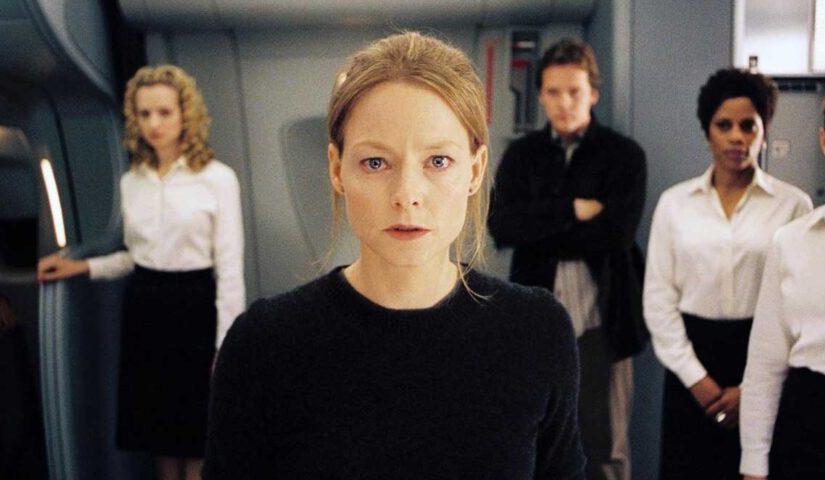
PLOT: A bereaved woman (Foster) and her daughter are flying home from Berlin to America. At 30,000 feet, the child vanishes, and nobody will admit she was ever on the plane.


I get it. Flightplan strains at the leash of credibility. A lot. In order for the plot to work, the audience has to believe that a number of people would have to be involved in a massive conspiracy, a cacophony of coincidences that screams “CONTRIVED” to any sane moviegoer.

But, as ridiculous as it seems, the movie still works incredibly well, even upon repeat viewings. Director Robert Schwentke has not exactly distinguished himself since this film (credits include R.I.P.D., Red, and the last two Divergent movies), but Flightplan displays a surefire command of tone, creating a claustrophobic atmosphere while keeping the camera free to move around the plane along seemingly impossible paths.

This film is a classic example of what Roger Ebert called a “locked room” puzzle. A girl is missing on an airplane – admittedly a very LARGE airplane, but still. There are only so many places she can be. The plane is searched, but she’s nowhere to be found, leaving only two possibilities: she was never there to begin with, or someone’s lying. But who? And why? She thinks she recognizes an Arab passenger on the plane…was he staring in her apartment window the previous night? Is she going crazy, or has there been an actual kidnapping? That’s the central mystery, and it carries the movie for most of its brief running time.

(There’s a neat section where Foster’s character (who, coincidentally, helped design the plane they’re on), monkeys around with the plane’s electronics and gets the oxygen masks to fall, to create a diversion for herself. Tell you what, that would get MY attention.)

The final resolution is…well, let’s say it answers all the questions of what happened without addressing HOW it happened. A lot of folks found that unsatisfactory (thus the 37% on Rotten Tomatoes), but the movie is so well-made and executed that, by the time the credits rolled, I didn’t mind it so much. But, you know…that’s just me.

SIDE EFFECTS (2013)

by Miguel E. Rodriguez

Director: Steven Soderbergh
Cast: Jude Law, Rooney Mara, Catherine Zeta Jones, Channing Tatum
My Rating: 10/10
Rotten Tomatometer: 83% Certified Fresh

PLOT: A young woman’s world unravels when an anti-depressant prescribed by her psychiatrist has unexpected side effects.


Side Effects is a rare creature indeed: a movie released during the first two months of the calendar year that is not only good, it’s stunningly good.  It’s too bad almost no one even remembers this movie exists.

Steven Soderbergh’s film tells the story of a young woman, Emily (Rooney Mara), who suffers from depression after her husband returns home from serving a prison term for insider trading.  After a series of events where she apparently tries to harm herself, she sees a psychiatrist, Dr. Banks (Jude Law) who prescribes a brand new anti-depressant called Ablixa.  While it is effective, it also comes with some side effects, including sleepwalking.

One day, Dr. Banks gets a call: Emily has stabbed someone to death, and she did it while sleepwalking, which was caused by the Ablixa.  Banks interviews her; she remembers nothing of the incident.  But now the doctor’s professional and personal life is in turmoil as well.

What we have here is a classic Hitchcockian story…actually, two stories for the price of one.  You’ve got Emily, the wrong woman in the wrong place at the wrong time.  She didn’t ask for any of this.  She just wanted to feel better, be a better wife, be a better person.  And the drugs were working: she was feeling better, doing better at work, doing better with her husband…but now, thanks to this drug and its unintended side effects, people think she’s crazy.

And you’ve got Dr. Banks, the wrong man also in the wrong place at the wrong time.  He was doing his job, prescribing medication that he felt would help…and it WAS helping.  But thanks to this unforeseeable tragedy, his practice dries up.  Who wants to see a psychiatrist whose patient killed someone due to medicine he prescribed?  This creates problems in his personal life: he just bought a new apartment, but now his income is severely diminished.  He and his wife fight more than they used to.  And so on.

…and that’s where I’ll leave it because, like all the best films, it’s better if you watch Side Effects cold, not knowing what to expect.  No doubt there are people out there who saw the various twists and turns coming, but I am not one of them.  I was utterly hoodwinked, and I loved it.

We are a culture of pills and quick fixes, the quicker the better.  Side Effects is remarkably even-handed in presenting us with both sides of the worst-case scenario involving this culture.  (Or I guess one of the worst-case scenarios, but I don’t want to get sidetracked.)  Not only is this strategy effective in providing mental fodder while watching, but it’s also a great storytelling device.  Whose side should we be on?  Historically, “Big Pharma” has been one of the handiest movie villains since the Nazis.  The public perception of mega-corporations with billions of dollars at their disposal, dollars that are used to cover up embarrassing media stories and pay off corporate whistle-blowers, is just too perfect not to use in movies.  But Side Effects gives us the other side of that coin, the dedicated physicians and psychiatrists who are committed to helping people using the best available methods.  If a pill can help people, who would blame a doctor for wanting to prescribe it?  …unless the side effects turned out to be a little extreme?

That conundrum is at the heart of the movie.  But on the surface, it’s just a fantastic mystery/thriller.  Soderbergh directs with restraint, using very few camera moves.  Everything we see is presented with a minimum of flash and maximum impact, so when you’re watching the third act of the movie, you can remember everything you saw in the first two acts with great clarity.

It’s a little bit like a Gene Kelly dance routine.  You know he must have worked for hours to get those moves down, but when you see him in action, he barely looks like he’s working at all.  That’s what Side Effects feels like.  The film is telling a complicated story, but it doesn’t feel like it’s working hard.  It’s just gliding along, showing you this scene, showing you that scene, ho-hum, pay attention now, all leading to the fantastic payoff at the end.

I don’t know if Side Effects is available to stream or not, but I heartily recommend it regardless.

PROMETHEUS (2012)

by Miguel E. Rodriguez

Director: Ridley Scott
Cast: Noomi Rapace, Michael Fassbender, Charlize Theron, Idris Elba, Guy Pearce, Logan Marshall-Green
My Rating: 10/10
Rotten Tomatometer: 73%

PLOT: A deep-space research vessel arrives at a distant moon, searching for clues to the origins of mankind.  What they find instead threatens their lives and the lives of everyone back on Earth.


I am at a loss to explain the mediocre Tomatometer score for Prometheus, Ridley Scott’s long-awaited return to the universe he created in Alien [1979].  Intellectually, I can hear the arguments:

  • “Where’s the Xenomorph?”
  • “So did the ‘Engineers’ create humans or what?”
  • “Is that planet at the beginning supposed to be Earth?”
  • “Where’s the Xenomorph?”
  • “Why did that idiot scientist approach the snake-looking creature?”
  • “How is the android able to break almost all of Asimov’s Laws of Robotics?”
  • “What’s with the open-ended ending that provides no resolution?”
  • “WHERE’S THE XENOMORPH???”

I get it.  You hear Ridley Scott is making a prequel to Alien and you build up a lot of expectations, especially after watching some of the sorrier sequels that piled up after Aliens [1986].  When you go into a movie expecting one thing and get another, people get hacked off.  I feel you, bro.

But to those people who dismissed Prometheus because it didn’t deliver what they expected to get, all I can say is: your loss.  Because Prometheus is one of the greatest sci-fi movies of all time, in my humble opinion, and it’s mostly for the very same reasons that people disliked it in the first place.

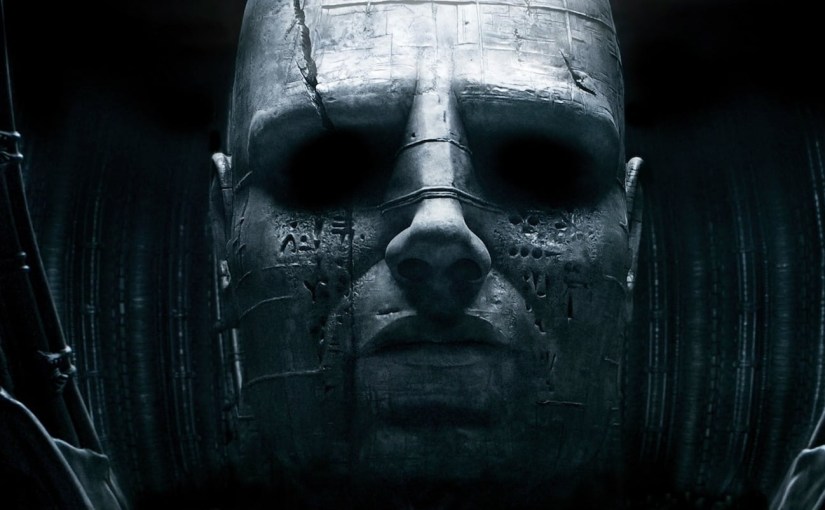
After a brief prologue set in an unknown time in an unknown place, we jump to the year 2093, when a deep-space research vessel arrives at a far distant moon, searching for clues to the origin of mankind.  Dr. Elizabeth Shaw (Noomi Rapace) says they were led to this specific moon by “Engineers”, humanoid beings who are visible in ancient cave drawings from across the globe.  She believes the Engineers can provide an answer, THE Answer, to Life, the Universe and Everything. (Apologies to Douglas Adams.)

Instead of Engineers, Dr. Shaw and her expedition discover miles of underground caverns and a room full of canisters that turn out to contain a horrifying contagion that attack the body at a cellular and/or genetic level, creating painful mutations that, if they don’t kill the host outright, turns them incredibly violent.  We also get a glimpse of the famous “space jockey”, the fossilized alien creature seated in some kind of contraption inside the spaceship in Alien.  So at LAST we’re in familiar territory.

But still no Xenomorph.

The story progresses, the shipboard android turns out to be less than trustworthy, people die in creative and horrifying ways, an Engineer actually turns up, we get a couple more visually spectacular tie-ins to the first Alien…but by the time we get to the end, what gives?  The movie’s obviously over, but we haven’t gotten any answers to the burning questions: Who are the Engineers?  If that was an Engineer in the prologue, was that supposed to be Earth?  If it WASN’T Earth, why even HAVE that prologue?  And don’t try to tell me that was a Xenomorph at the end…

Well, here’s my two cents.

First, of all, expectations are tricky.  They can color and compromise your entire movie-watching experience.  When I went to see Prometheus, I did have my own set of expectations, but as the movie settled in and it became clear that the movie had other designs, I had to consciously shake myself loose of my expectations and embrace what was being presented to me.

Second of all, the visuals are stunning.  I happened to see this in 3-D, and it’s one of a handful of movies where the technology was used PERFECTLY.  No gimmicky shots of spears or harpoons or whatever being pointed out of the screen.  It was used as it should always be used: as a tool to further immerse you into the world of the film without overloading you or being ridiculously obvious.  The gorgeous landscapes during the prologue and during our heroes’ descent to the surface are awe-inspiring.

And then, the story.  I was completely okay with the open-ended nature of the story, and I’ll tell you why.

There are some films out there that play Prometheus’s game of asking questions and not answering them.  One of the most famous examples is Stanley Kubrick’s adaptation of 2001: A Space Odyssey [1968].  If you’ve never read the book, I defy you to provide a concise explanation of the last thirty minutes of that movie.  But that didn’t bother people, because the goal was to get the viewer to ask questions, to provoke discussions about the movie that would eventually get around to some of the same questions asked in Prometheus: Why are we here?  What is our purpose?

And then there are other films that play that open-ended game and fail.  The one that comes immediately to mind is Darren Aronofsky’s The Fountain [2006].  By the end of that movie, my head was locked in a tilted position like a cocker spaniel hearing a strange noise.  If I had been a cartoon character, the word balloon over my head would have been all question marks.  I once read a full description of what was really going on in that film, but to the degree that I understood it, I simply didn’t care.  If I have to go that much work to “get” a movie, the movie didn’t do its job.

There are those who say that’s what Prometheus did, throwing us in the deep end and making us do some mental heavy lifting with no payoff.  But I disagree.

I think, for me, it has to do with the very nature of the questions Prometheus is asking.  “If we could discover the answers to the riddles of our existence, to what lengths would we go, or should we go, to get those answers?  And do we even want to know the answers?  Are we better off NOT knowing?”  These are questions that, almost by definition, can’t be answered in any satisfying way.  So Prometheus presents a possible answer, but then teases it away so there is still some mystery in the story.  If the characters in Prometheus had discovered some kind of document that laid out the Engineers’ plans in detail, I would have felt cheated.  It would have been woefully anticlimactic.  I liked it better that the biggest questions went unanswered, so I could formulate my OWN theories about the Engineers, their plans, their methods, their history, their future, etcetera.  It’s much more stimulating to let my imagination run riot.

(Granted, some of those questions are answered in Alien: Covenant [2017], but that movie still had the guts to leave some things to the imagination by the end.)

Prometheus couches deep philosophical riddles about our very existence within a crackling good thriller with spectacular visuals from beginning to end.  It stands tall as one of the best prequels ever made…Xenomorph or no Xenomorph.

BLADE II (2002)

by Miguel E. Rodriguez

Director: Guillermo del Toro
Cast: Wesley Snipes, Kris Kristofferson, Ron Perlman, Norman Reedus, Donnie Yen
My Rating: 9/10
Rotten Tomatometer: 57%

PLOT: Blade, half human/half vampire, forms an uneasy alliance with the vampire nation in order to combat a new breed of monster, the Reapers, who are feeding on vampires and humans alike.


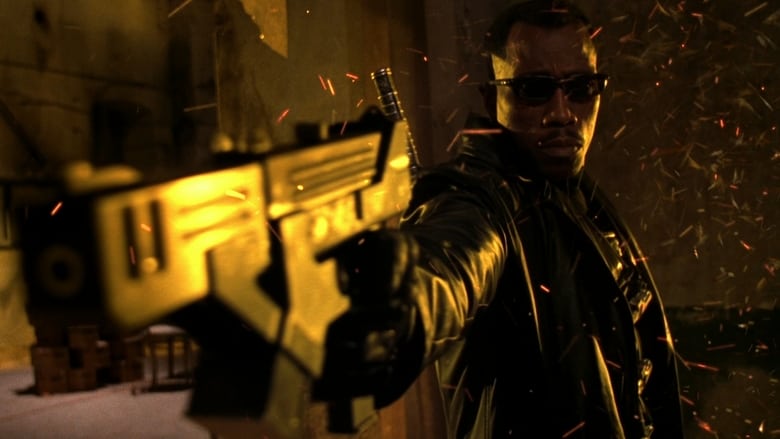
Why don’t more people like this movie?  It’s like someone took the best fight scenes from The Matrix, removed the pretentious plotting, added a crapload of gore, and created one of the best villains in the history of vampire movies: the Reaper, an evil-looking creature whose lower jaw splits wide down the middle to reveal a blood-sucking appendage that might even give the Xenomorph nightmares.

Blade II is lean and mean.  Director Guillermo del Toro has gone on record as saying this was not exactly the movie he intended to make, as it doesn’t keep precisely to the Blade “canon” (in case you didn’t know, Blade is a lesser-known Marvel comics character who is scheduled to eventually make an appearance in the Marvel Cinematic Universe).  However, despite his misgivings about this film, del Toro nevertheless created an action-horror masterpiece.

If you’re a fan of action films, what do you like?  Because it’s all here.  There are five great fight scenes, including a doozy in Blade’s own lair between Blade and two vampire ninjas wearing elaborate headgear that makes them look like humanoid bugs.  You like a great villain?  Here’s Jared Nomak, the vampire who carries the Reaper virus, whose wounds heal by themselves almost instantly, and who carries a dark secret.  His fighting skills are equal to those of Blade himself, who must learn to use more than brute force if he’s going to defeat Nomak.  (And let’s not overlook the cameo by Asian superstar Donnie Yen.)

You like a good story?  We got that, too.  Blade’s sworn enemies, the vampire nation, are forced to approach Blade for help when it becomes apparent they are no match for the Reapers.  Blade HAS to help, because who will the Reapers go after once they dispatch all the vampires?  Humans.  So you have the whole “uneasy alliance” going on, with no one more uneasy than Reinhardt, a vampire played by a deliciously malevolent Ron Perlman.  Reinhardt goes along with the plan, but can’t resist poking the tiger by asking Blade, “…can you blush?”  Blade’s response gives a whole new meaning to the term “kill switch.”  Game, set, match.

This is also a horror film, let’s not forget.  You like scares?  How about the part where a Reaper gets pinned to a wall with a ninja sword through its stomach…but escapes by crawling backwards up the wall, forcing the sword to slice through his body as he skitters away, unfazed by the damage?  YIKES.  We got gore, too.  Blade and company perform an autopsy on a dead Reaper.  I haven’t seen that much detailed gore since the autopsy in John Carpenter’s The Thing.

I mean, seriously.  This movie has everything I want in an action movie that’s also a horror film.  It covers ALL the bases.  (I could’ve done without the quasi-love-story, but it’s not dwelt on too much, so I can live with it.)  What more could anyone ask for?

(Also, it’s great to listen to on a bad-ass audio system…BOOMING bass and sound effects.  Great stuff.)

KNOWING (2005)

by Miguel E. Rodriguez

Director: Alex Proyas

Cast: Nicolas Cage, Rose Byrne, Ben Mendelsohn (plus an early sighting of a young Liam Hemsworth in his first movie role)
My Rating: 9/10
Rotten Tomatometer: 33%

PLOT: M.I.T. professor John Koestler links a mysterious list of numbers from a 50-year-old time capsule to past and future disasters and starts to wonder…what happens when the numbers run out?


[SPOILER ALERTS…not that anyone is going to rush out and stream this, but whatever, still … SPOILER ALERTS]

Knowing is a polarizing film from Alex Proyas, the visionary director of The Crow (1994) and Dark City (1998).  It tells the story of an M.I.T. professor whose son is given an envelope that has been sealed inside a time capsule for 50 years.  Inside the envelope is a list of seemingly random numbers that appear to be meaningless, until he notices a pattern emerging.

I remember when this movie came out very well.  I was stoked to go see it because Alex Proyas is one of my favorite directors. But it got PANNED right out of the gate.  And most of the negativity stemmed from the movie’s ending, which turned off the vast majority of moviegoers who thought was the equivalent of someone saying, “It was all a dream!”

Knowing does NOT have one of your typical Shyamalan-esque endings.  The ending follows the strict logic of everything that has come before and arrives at an astonishing, awe-inspiring conclusion that left me gobsmacked.  But more on that later.

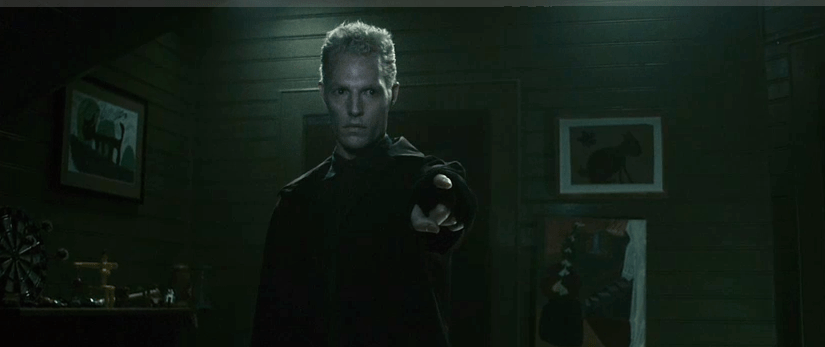
Let’s talk about how Knowing works.  First, everything about the movie sets us up for what appears to be a standard horror movie with Nicolas Cage’s son apparently in danger from mysterious pale figures in dark coats who show up at their house in the middle of the night and just stand there…watching the house.  Creepy.  At one point, one of them somehow gets INSIDE the house, a sequence that ends with the boy having a nightmarish vision of a raging forest fire.

These are, so far, basic horror tropes.  But director Proyas uses skillful styling and editing to create something that feels as creepy and suspenseful as any horror movie I’ve seen.  In fact, every time I watch Knowing, I find myself still on edge during certain scenes, particularly the ones involving the pale strangers.

Another feature of the movie that I feel elevates it is the visceral nature of the key scenes involving various accidents.  See, that 50-year-old list of numbers is actually a list of dates on which various catastrophes occurred over the last 50 years, along with the number of casualties…and Nicolas Cage’s character, John Koestler, can plainly see that three of them are coming up in the next few days.

So it’s a foregone conclusion that we, the audience, are going to see some sort of major accidents.  And, man…I have never seen, before or since, such astonishing, nerve-racking sequences of horrible accidents in films.  I don’t want to be a spoiler, but I CAN say that I guarantee this is one movie that will never be an option for in-flight movie channels on commercial airliners.  I mean…when it happens, it’s out of the blue, and it feels as real as these things can get with CGI.  It literally takes my breath away every time I watch, and I’ve seen it like ten times.  Easily.

So now that Koestler has proof the list is real, the question that keeps nagging at him is…what happens when the numbers run out?

And that’s where Knowing leapfrogs over other genre thrillers and actually becomes ABOUT something.  Before finding that fateful list, Koestler asks his students at M.I.T. to write a paper on determinism versus coincidence in the natural world.  That is, do you believe that everything up to this point has happened for a reason, or is literally everything we do completely random, with no purpose or design?  Koestler believes in the latter, even though he’s the son of a minister, a man with whom he’s had no contact for years.

Koestler has his reasons.  Years ago, his wife was killed in a hotel fire, an event which he perceives as a random accident.  But then he gets this list, and it seems as if someone has been able to accurately predict seemingly random events.  This list flies in the face of everything he’s believed for years.  If these accidents are predictable, is everything ELSE predictable?  Is there a REASON for the accidents?  Is life more than just the result of millions of years of evolution and genetic mutations?

Koestler cannot square this list with his personal beliefs, and it’s that conflict that’s at the heart of the movie.  Knowing forces its main character (and, by extension, the audience) to make a decision one way or the other.  Is there a plan for existence, or is it random?  How long can he ignore the evidence of his own eyes before he makes his choice?

And over all of that, there’s still the issue of the list running out of numbers.  What happens then?  The end of the world?  Is he destined to SAVE the world?  Or stand by helplessly as pre-determined events spin forward out of his control?

This is why the movie stands above other genre sci-fi thrillers.  It poses tough questions and forces us to confront our own beliefs.  And the movie does not take the easy way out by trying to have it both ways.  The finale of Knowing is as implacably logical as it is visually stunning.

Detractors of the movie decry this finale as a “deus ex machina” that cheapens everything that came before.  I even remember some mild laughter in the audience when I first saw it.  But seriously…given everything that happened before, what ELSE would have been a good ending?  Have Koestler wake up from a dream?  Have him discover that it was all really a government experiment?  A drug-fueled hallucination?

None of those would have worked NEARLY as good as the ending the movie DOES provide.  As I said before, it follows the logic of its own story to the bitter end, and gives us some spectacular visuals into the bargain.  It doesn’t cheat, it doesn’t pander or cop out.  We have gone from point A to point B, and the only way out is through point C.  When you think about it, isn’t that kind of audacious?  How many movies have had the nerve to follow the courage of its own convictions?  (I’m reminded of The Bridge on the River Kwai with its own fatalistic finale, combining spectacular visuals with an ending that was not a “happy” one by any stretch of the imagination.)

I stand behind this movie as one of the great sci-fi mystery thrillers.  Love the ending or hate it…I challenge you to come up with an ending that would have been better than the one presented in the film.

PARASITE (2019)

by Miguel E. Rodriguez

Director: Bong Joon Ho
Cast: Kang-ho Song, Sun-kyun Lee, Yeo-jeong Jo
My Rating: 10/10
Rotten Tomatometer: 99% Certified Fresh

PLOT: Ki-taek and his family, all unemployed, take peculiar interest in the wealthy and glamorous Parks, as they ingratiate themselves into their lives one by one.


Watching Parasite reminded me of the first time I saw Pulp Fiction.  I told my friends that it was like being on a roller-coaster at night wearing a blindfold: you have no idea where you’re going or what’s coming, but the ride is exhilarating.

That’s Parasite.  The hype is real.  This is one of the best movies I’ve ever seen, and if you plan on seeing it, I would highly recommend you do so BEFORE reading further.  I have no plans to spoil ANYTHING, but the less you know about the movie before going in, the better.

(You’ll have to bear with me, I’m writing this shortly after seeing the movie myself, it’s currently 11:14 PM, and I’m starting to get a little tired, but I want to get this all down before I pass out, so it may get a little “rambly” for a while.  You’ve been warned.)

Parasite is many things.  It’s a social commentary, a black comedy, a family drama, and a Hitchcockian thriller all rolled into one delicious Korean dish.  (The film and filmmakers are Korean.)  The beauty of the movie is that it manages to be all those things without losing track of itself.  I can’t count how many movies I’ve seen that attempted a tonal shift in the middle or at the end, and it just falls flat.  Where lesser movies failed, Parasite succeeds.

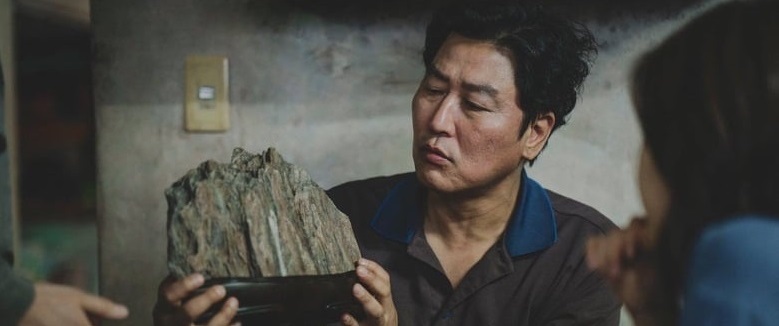
The plot involves a nuclear family, the Kims (father, mother, college-aged son and daughter), living in near-poverty in a sub-basement.  They fold pizza boxes to make a little cash.  They steal wi-fi from a shop next door.  When fumigators spray outside their street-level window, they open it wide to take advantage of the free pest control.  They aren’t starving, but they are desperate.  Yet they don’t appear to be beaten down by their condition.  They’ve become a family of hustlers, not in any criminal manner, but in ways that enable them to get by on the bare minimum until one of them can get a leg up.

Opportunity knocks one day when a friend of the son, Ki-woo, gets him a job as an in-home tutor for the high-school daughter of a wealthy family, the Parks.  Ki-woo changes his name to Kevin, then suggests to Madame Park that her 7-year-old son could use an art tutor.  This gets his sister, Ki-jung hired.  She changes her name to Jessica and finds a creative way to get her father hired as Mr. Park’s personal driver.  Then the Parks’ long-time housekeeper somehow has to be eliminated so the MOTHER can get hired.

Before long the entire family is working for the Parks, though it’s important to note the Park family has no idea their new employees are all related.  This is all done with great humor, not in a farcical way (that will come later), but in such a way that you find yourself rooting for this down-on-its-luck family of con artists to finally get a taste of the good life.

There’s a long scene where the Parks have gone camping, and the Kims gather in the enormous living room of the Parks’ lavish home and just sit and eat and drink and talk and get drunk.  This is the family drama/social commentary part of the movie.  There’s something a little sad about seeing these people who are like any other people, who seem no less deserving than the Parks, but their best-laid plans have come to nothing, and the highlight of their lives is to get hammered in somebody else’s house.  Suppose Kevin falls in love and decides to marry the girl he’s tutoring, when she’s a little older.  Who will they get to be his parents?  Will they need to hire actors?

Trust me, I haven’t spoiled ANYTHING.  Swearsies.  This movie is brilliantly, ingeniously split into two parts.  The first half is prologue.  The second half is genuinely, literally breathtaking.

Something happens that forces the Kim family to examine and re-evaluate their life choices up to the present.  It also forces them to do some very fast thinking indeed, which is where some of the funniest and darkest comedy takes place.  This is where the movie really takes off, where it had me reminiscing about the twists and turns in Pulp Fiction.

And nothing…nothing can prepare you for the finale.  About which I’m saying nothing.  Again.

From a cinephile’s perspective, Parasite is miraculous.  It manages to be several different things all at once, allowing you to savor every individual aspect of it without any one part of it overpowering the other parts.  The screenplay is unbelievably inventive.  The direction is sure-footed and masterful.  The acting is pitch perfect throughout.  It made me think, it made me laugh, it made me cringe, it made me say, “Oh S#i+!” MANY times, and it made me bring my hand to my mouth like a shocked Victorian-era woman many, MANY times.

I say again.  The hype is real.  You owe it to yourself to see this movie whenever you can.

[Ed. note: the Criterion blu-ray of Parasite contains an interesting experiment: a black-and-white version of the film, which is apparently how the director originally envisioned the film, and which might account for its stark imagery in places.]

FREAKS (2019)

by Miguel E. Rodriguez

Directors: Zach Lipovsky and Adam B. Stein
Cast: Emile Hirsch, Bruce Dern, Lexy Kolker
My Rating: 9/10
Rotten Tomatometer: 87% Certified Fresh

PLOT: A sheltered young girl (Kolker) discovers a bizarre, threatening, and mysterious new world beyond her front door after she escapes her father’s protective and paranoid control.


In the tradition of one of my very favorite sci-fi films, Midnight Special (2016), Freaks is a sci-fi mystery that doesn’t pander, doesn’t spoon-feed (except when it HAS to), and doesn’t insult my intelligence.  It premiered in 2018 at the Toronto International Film Festival, was picked up by a distributor two days later, and surfed the festival circuit for over a year, winning multiple awards, before finally getting a US/Canada release in 2019.

The story opens with a young girl, Chloe (a brilliant performance from Lexy Kolker), who lives with her father in a ramshackle house with covered windows and locked doors.  She takes a peek out the window through curtains that have been duct-taped to the windowsill and sees an ice cream truck outside; in the sky above she spots birds that seem to be…frozen in place?  Hm.  THAT’S weird.

As the opening section unfolds, we learn that the father is doing everything in his power to keep his daughter safe from something dangerous in the world outside their front door.  (She has never set foot outside.)  The movie is cagey at this point about explaining exactly what that something is, and immediately I thought, “Aw, man…is this gonna be another rip-off of A Quiet Place?”  The father walks around the house performing maintenance on drapes and boards and locks, and constantly reminding her daughter how dangerous it is outside, and how he’s doing all this to keep her safe.  Shades of Stranger Things, right?

So the first couple of acts of the movie felt like rip-offs of…sorry, homages to previous contemporary sci-fi entertainments.  The girl portraying Chloe delivers a fantastic, natural performance, but that wasn’t enough for me to shake that feeling of, “Man, I’ve seen all this before.”

At random intervals, Chloe starts to see things.  People in her room, in her closet.  Sometimes these people talk to her, and she talks back.  Are they ghosts?  We’ve learned that Chloe’s mother is dead…could one of these visions be her mother?  And what’s the story with that weird ice cream truck at the beginning, with the creepy, smiling old man who seems to know more than he’s letting on?

These are all threads that make you THINK you know where the story is headed, and you may or may not be right.  You may already think you know what the rest of the movie’s about just based on my description above.  Fair enough.

As for me, I was bamboozled when the true nature of the girl, her father, and the world outside her house was revealed.  I’m not talking about a Sixth Sense kind of reveal that’s kept a secret until the last 5 minutes of the movie.  This movie makes its “reveal” with about an hour left (I’m guesstimating), so I basically felt like I got two movies in one.  Or maybe two episodes of an EXCELLENT cable miniseries.  Once the “reveal” is, well, revealed, the movie shifts into high gear and doesn’t ease off until literally the final frame.

The joy of Freaks is that reveal at the halfway point, and what they do with it afterwards, so it’s extremely hard to know what else I can say without spoiling the fun of discovering it for yourself.  I could mention the visual effects, which are relatively minimal, but EXTREMELY effective, especially during the finale.  I could mention the screenplay’s deliberate attempts to make certain plot points analogous to the current immigration debate.  (I’m gonna mangle this, but one of the lines goes something like, “If you attempt forced relocation, that will only force them underground.”)  I could mention the way certain clues are hidden in plain sight, once you get to the endgame of the movie.

But you won’t get another word from me about the story.  You deserve to discover this one yourself.  I cannot recommend this highly enough.  It’s not quite a PERFECT film, but what are you gonna do, they can’t all be Midnight Special.  I never saw one trailer, not one Facebook ad or YouTube video about Freaks.  I only saw it by pure luck tonight because the showing was at a better time than Ready or Not.

I’m telling you.  Seek this one out. It’s a winner.

TRANSSIBERIAN (2008)

by Miguel E. Rodriguez

Director: Brad Anderson
Cast: Woody Harrelson, Emily Mortimer, Ben Kingsley, Eduardo Noriega, Kate Mara
My Rating: 9/10
Rotten Tomatometer: 93% Certified Fresh

PLOT: An American couple takes a trans-Siberian train ride across Russia, but things take an odd turn when they meet another mysterious young couple.


One of the reasons I like writing about movies is that it gives me the opportunity to talk up great movies that I’ve discovered off the beaten track.  Movies like the stunning stop-motion film Mary and Max (2009), or Sunrise (1927), hands-down the greatest silent film I’m ever likely to see, or Wild Tales (2014), an Argentinian anthology film that plays like The Twilight Zone crossed with Quentin Tarantino.

Or Transsiberian, a virtually unknown film from 2008 that is one of the finest examples of Hitchcockian suspense in the modern era.  It was an international co-production of – get this – Germany, the UK, Spain, and Lithuania.  It was co-written and directed by Brad Anderson, a man who’s directed a LOT of episodes of various television shows, and so has a good sense of efficiency and economy in his style and pacing.  It has yet another stunning Ben Kingsley performance as a Russian narcotics detective.  And it turns the screws on the heroine of the story in such a way that you can tell exactly why she’s doing what she’s doing, when every good instinct says she should be doing the exact opposite.

After a brief prologue involving a police investigation in Vladivostok, we meet Roy and Jessie (Woody Harrelson and Emily Mortimer), a married couple traveling home from China after a faith-based missions trip.  They decide to take a 6-day train trip across the Russian continent because Roy feels it would be nice to take an adventure…plus, he LOVES trains.  He’s one of those enthusiasts who don’t realize when they’re boring you with talk of gauges and coal-burners and cow-catchers. (Sheldon Cooper would have loved this guy.)  Jessie seems like a nice woman, but she seems to be keeping this adventure at arm’s length; you can tell she’d rather be flying coach than spending six days in a double-berth cabin.  I empathized with her right away.  They make a good couple, even though he wants kids and she doesn’t, she smokes and he’d like her to quit, he drinks and she doesn’t, et cetera.  Pretty normal.

A little while into their trip, Roy and Jessie meet the couple they’re sharing a cabin with, Abby and Carlos (Kate Mara and Eduardo Noriega).  Abby seems much younger than Carlos, but Jessie lets that slide, especially because Carlos seems to take an immediate interest in Jessie, and he doesn’t seem too concerned about hiding it.  Abby seems annoyed, but says nothing.  Roy is too jazzed about being on trains and interacting with the locals to really notice.  Carlos also seems to be pretty cagey about the souvenirs he’s carrying around in his suitcase.

At one of their scheduled stops, both couples leave the train to stretch their legs.  When the train leaves for the next leg, Jessie suddenly realizes something: Roy’s not on the train.  She didn’t see him get back on.  In fact, no one can recall seeing Roy re-board the train.  The movie plays a little by making us think one thing has happened, when it may or may not have…we can’t be sure.

And then, in true Hitchcock fashion, things start to spiral into one unexpected development after another, until the movie becomes about something entirely different than what you thought it was going to be.  Without getting into too many other details, Jessie finds herself trapped in a lie that she absolutely cannot back out of, no matter how much she wants to, because doing so would cause more harm than good.  Even when she’s presented with a life or death situation, she still can’t go back on it, and the story is constructed so tightly that it’s never for a moment unclear on her motivations.  You always see the “why” to her actions.

This other level to the movie is what separates it from the pack and places it in a higher weight class.  The screenplay is a masterpiece of suspense.  There’s a scene involving her camera that had me yelling, “Oh, NO!” at the screen…and I’ve SEEN the movie before.  You won’t believe the amount of suspense that will be generated with a slightly-open camera bag, or the fact that there’s never a garbage can around when you need one, or just the absence of a train stewardess.

This movie stands apart in its genre because the characters behave EXACTLY as they should, with perfect logic, and it never feels forced.  The bad guys are never too stupid, and the good guys are never too smart.  (They get pretty lucky a couple of times, but what are you gonna do?)  I don’t think I’m giving anything away by saying that, by the end, some characters are happy and others are not quite so much, but I don’t think you’ll be able to guess who will last that long.

This is a treasure of a film to be sought out and…uh, treasured.

UNITED 93 (2006)

by Miguel E. Rodriguez

Director: Paul Greengrass
Cast: Ben Sliney, Khalid Abdalla, Corey Johnson
My Rating: 10/10
Rotten Tomatometer: 90% Certified Fresh

PLOT: A real-time account of the events on United Flight 93, one of the planes hijacked on September 11th, 2001, and of the chaos on the ground as the FAA and the military grasped what was happening.


There are a handful of movies that can still make me cry when watching them, even on repeat viewings, and even then it doesn’t always happen.  Fearless, directed by Peter Weir, is one of them.  The finale of Edward Scissorhands still has the power to choke me up.  The transition from black-and-white to color at the end of Schindler’s List can still bring a lump to my throat given the right circumstances.

But only one movie has made me shed real tears every single time I watch it, and I’ve seen it now at least four times.  I used to watch it every time September 11th came around, as a sort of (morbid?) remembrance of that terrible day.  I haven’t done so the last couple of years simply because the emotional reaction I have to the movie and the events it depicts is just too much to deal with.

Paul Greengrass’ United 93 is unlike any other film about 9/11 that I’ve ever seen.  Many people praised Oliver Stone’s World Trade Center when it came out, but I found that movie too pumped up with melodrama and forced situations.  United 93, on the other hand, takes a documentary approach and simply follows the passengers and crew boarding their flight, like any other, on their way to a date with destiny that nobody saw coming.

Intercut with the flight itself are scenes on the ground, in various air traffic control centers, and the FAA itself.  One of the masterstrokes of the film was to cast Ben Sliney as himself.  Ben Sliney, for those who don’t remember, was the FAA Operations Manager on 9/11.  In fact, it was his first day on the job in that new position that very morning.  It was his decision, after seeing the carnage in NYC and the Pentagon, to take the unprecedented step of grounding ALL air traffic over the United States.

The movie’s effectiveness comes partly from the re-enactments of the ground controllers, trying to make sense of garbled messages coming from first one, then two, then three flights, something about people taking control – and then seeing those flights disappear from radar coverage.  And then someone in the tower sees smoke coming from downtown New York…  Those scenes, more than any documentary I’ve seen, really bring back the memories of that morning for me, the disbelief and utter shock of seeing that building burning and smoking.  And then the second plane hits…

But the movie’s real power is with the flight that ultimately didn’t hit a significant target, crashing instead in a field in Pennsylvania.  (There has been some speculation about its intended target, but the truth is we’ll never know.)  The scenes aboard United 93 have been pieced together using recorded phone conversations from passengers, flight deck recordings, and data on the plane’s flight path.  There’s no way to know how accurate some of these events are, but the point of the movie is that it feels 100% real.  The fear on the face of the hijackers, the fear of the passengers, the slow realization that this flight is headed to another target, and their gradual determination to do something about it.

Watching those scenes, with the knowledge that this flight will eventually crash with total loss of life, is an unbearably sad experience.  The final few minutes of the film, as the passengers rush their attackers and frantically try to break down the cockpit door, fills me with dread.  I find myself thinking, unreasonably, “Maybe this time they’ll get to the cockpit in time…maybe THIS time they’ll get the one pilot among the passengers behind the wheel this time…”  But no.

So WHY, oh, WHY do I give this movie a “10” when it’s such an immensely tragic experience?

Because this movie does not feel like a cheap attempt to cash in on a national tragedy.  Instead, it feels more like a memorial to those brave souls who did everything they could to keep themselves alive, to keep their attackers from fulfilling their evil deeds.  As much as any soldiers who gave their lives attacking a beach head, these everyday civilians deserve our gratitude, and they should be acknowledged as genuine heroes.  I believe United 93 treats them as such.

RUNNING SCARED (2006)

by Miguel E. Rodriguez

Director: Wayne Kramer
Cast: Paul Walker, Cameron Bright, Vera Farmiga, Chazz Palminteri
My Rating: 8/10
Rotten Tomatometer: 41%

PLOT: A low-ranking thug (Walker) is entrusted by his boss to dispose of a gun that killed corrupt cops, but things spiral out of control when the gun somehow winds up in the hands of his neighbor’s son (Bright).


So…okay.

First of all, this is most assuredly NOT a remake of the quintessentially ‘80s comedy thriller of the same name, starring Billy Crystal and Gregory Hines, who, although they were very funny, were two of the most unconvincing street cops since…ever.

No.  This is one of the most twisted, sordid, blood-soaked retelling of a Grimms-esque fairy tale I’ve ever seen.  Like someone kidnapped Quentin Tarantino and force-fed him only moonshine and methamphetamines for a week, then told him to sit down and re-write the story of Hansel and Gretel, but to make it take place in modern-day lower-middle-class New Jersey, and don’t forget the guns, Russian thugs, and brief, um, cunning linguistics.

Yeah.  It’s that kind of movie.

I haven’t read the negative reviews of this film, so I couldn’t tell you what turned so many people OFF.  I can only report what turned me ON.

A big part of it is the energetic storytelling at work: lots of digitally enhanced camera tricks, the occasional rewind, tilting the camera when you really didn’t have to, sudden speed-ups…very stylistic.  Tony Scott did a bit of the same thing in Domino, released a few months earlier, and Oliver Stone sort of pioneered this kind of thing with the wildly weird Natural Born Killers.  So it’s not like I haven’t seen this before, but it really works with this lurid material.

Which brings me to another big part of why I like this movie: the story.  On the surface, it’s your standard kid-in-peril, race-against-time thriller.  Paul Walker absolutely, positively HAS to get his hands on the dirty gun that Cameron Bright manages to steal and go into hiding with.

But tilt your head and squint your eyes, and you can see the whole thing is basically a guns-blood-and-broads version of a classic fairy tale, where a young innocent traverses the unforgiving countryside while being pursued by deadly forces.  On the way, he meets up with various colorful characters, who aren’t all bad, but they’re certainly not all good.

In this case, instead of trolls and ogres, our innocent character encounters, not necessarily in this order: the Russian mafia, a hooker with a heart of gold, her vengeful pimp, a creepy homeless guy, crooked cops, his own abusive father, and, in the movie’s squirmiest moment, a creepy married couple who show an inordinate amount of compassion for, and interest in, this lost child, and who seem to have the most nefarious motives of anyone else in the film.

And that’s just the “B” story.

The “A” story revolves around Paul Walker’s character trying to retrieve the gun Bright has stolen.  He bounces around like a pinball with his own son in tow, spewing profanity like it’s going out of style, beating up lesser thugs, lying to superior thugs, always just one step behind Bright who is sure Walker is going to kill him.

I dunno, for me, the dynamic camerawork and the shocking subject matter all worked.  It’s a fun, trippy ride, with just desserts getting served all around.  I’m sure people have an issue with the ending, but what would they have preferred when it comes to a popcorn movie like this?

After all, how do MOST fairy tales end?