SEVEN

By Marc S. Sanders

There’s an interesting dynamic to David Fincher’s Seven that is not touched upon often enough.  Beyond the clever and grisly murders set to a theme of the Seven Deadly Sins, the two police detective protagonists are carved from completely different molds.  The spine of Fincher’s film, written by Andrew Kevin Walker, focuses on how these men approach the craft of the killer’s accomplishments.  One man wants to cut to the chase, find the criminal and cuff him.  The other wants to study the nature of this mystery man, and only then will it lead to the suspect’s true identity.

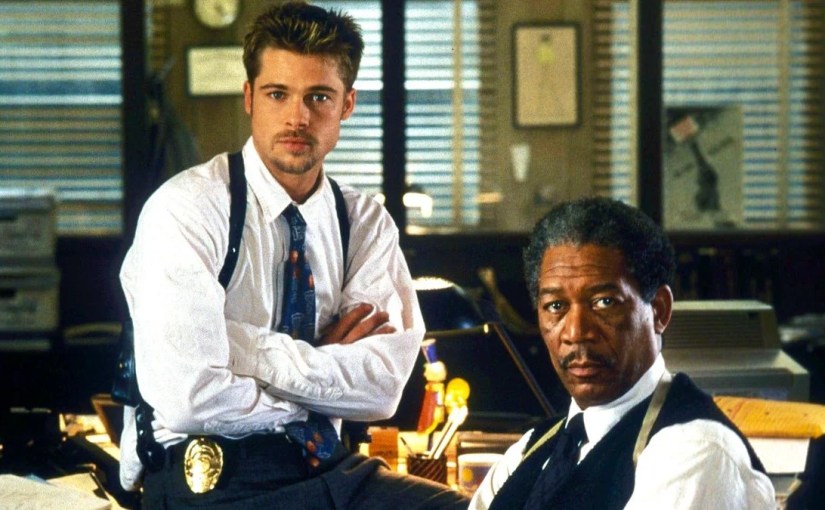
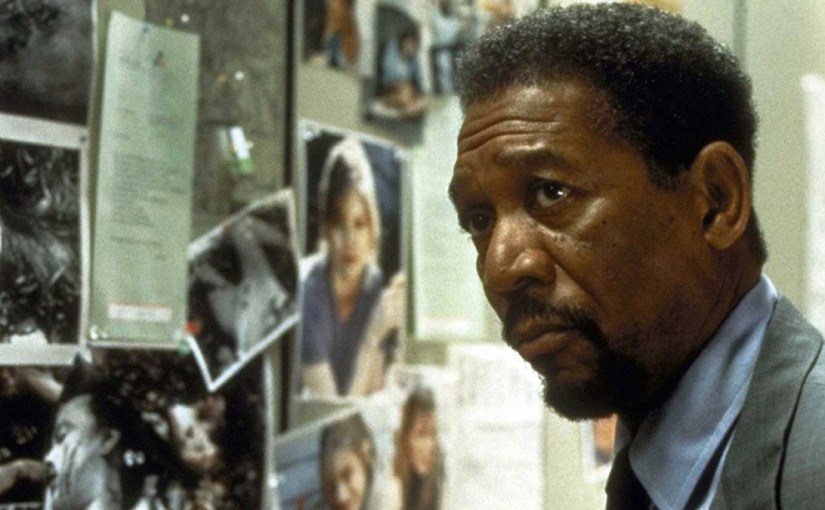
Detective William Somerset (Morgan Freeman) stems from a time gone by for the cinematic detective.  He’s the trench coat wearing investigator who examines and connects dots, never resorting to fists or police intimidation with a gun.  Newly assigned Detective David Mills (Brad Pitt) dons the leather jacket with the cute goatee and boy blond haircut.  He’s more apt to making fun of the sick weirdo they are chasing, hardly lending any valuable insight or observations.  Somerset will approach with respect for the killer and his work.  Mills, with nowhere near the experience of his new partner, will disguise his loss of where to begin with this case by resorting to cheap shots at the killer’s expense, calling him Yoda and surmising this guy must be pleasuring himself in peanut butter, perhaps.

Fincher is widely recognized for the dark photography of his films, like the cherry wood hallways of Harvard in The Social Network or the lurid neighborhoods in movies like Zodiac and Gone Girl.  In Seven, the setting is very much a character in and of itself, but other than the fact that it is a California (thanks to a throw away piece of dialogue) metropolitan area, we never know the name of this city.  It is a dreary, ongoing rain-soaked environment that hinders the police officers and keeps everyone contained in the film, especially David’s wife Tracy (Gwyneth Paltrow), unsettled.  The city has no name or identity.  Therefore, the police officers who occupy it are not the stereotypical cops designed for this place.  One works as a tired, wise and experienced Colombo figure, minus the sarcasm.  The other is an aggressive hot shot who is over trying to prove himself to peers and superiors.  Now he wants to be in charge.  They both follow the footsteps of the mystery together.  Yet, they are reading different roadmaps.

With seven days left before retirement, Somerset meets newly arrived Mills.  They are quickly dispatched to a filthy apartment for an ugly murder scene of an odd nature.  It is a scene labeled as Gluttony by the killer.  Greed follows shortly thereafter, and Somerset knows none of this random.  Whoever has orchestrated these two executions is methodical and resourceful, with a point to prove.  The artistic measure and inspiration are too creative, far from the sloppiness of a standard stabbing or gunshot to the head.  Somerset already knows five more murders will likely turn up and doesn’t want to get involved.  He’s seen enough.  Mills has the cavalier attitude.  Find the freak, and maybe take him out in a blazing shootout.  It’s reckless. 

Could Seven be an answer to how cop movies performed at one time and how they act now?  Seven may be the closest outline of pairing Humphrey Bogart’s Sam Spade with Mel Gibson’s Martin Riggs.  Sure, the murder scenes are hard to look away from, as deliberately repulsive as they are.  Even after multiple views of the film, I still get curious with how the killer planned all of this out to the absolute most minute detail.  However, ninety percent of the dialogue is exchanged only between Freeman and Pitt. Paltrow has a couple of scenes that help paint the sad picture of life in this city, but ultimately the film belongs exclusively to the two cop characters.  Seven has one action scene, but it primarily covers how the two men respond to the nature of what they come upon.  Mills will crack jokes that maybe his college pals would snicker at.  Somerset asks the young man to just be quiet while he explores the scene.  Mills gets grossed out by a bucket of vomit.  Procedurally, Somerset will ask Mills if there was any blood in it.  Mills will resort to Cliff’s Notes on the Seven Deadly Sins.  Somerset will spend his evening in the library, digging through the original source.  Mills will kick down a door without authority.  Somerset will protest against that action without following the standards of procedure.  It’s a dichotomy of impatience versus patience.

The two men actually don’t come to a common platform until the third act of the picture, when the rain has subsided, the sun comes out, and the killer opts to surrender himself.  Still, the mystery of his purpose remains and there’s an unknown element of what to expect next.  So, while the partners may agree that there’s more to come, they still respond to the killer, in person, differently.  Mills can only yell at the deranged suspect and call him names.  Somerset interviews the gruesome and imaginative architect with questions. 

Seven is a sensational crime drama.  It’s eerie, creepy and appreciatively sickening in its crimes.    The outline of some of the killer’s actions might seem conveniently questionable or far-fetched.  Some of the crime scenes were planned over a year’s time. Others were not meant to be revealed until a certain point within these particular seven days.  So, the writing might be a little too overly precise.  However, that should not be dwelled upon.  Rather, one kind of cinematic cop is not the standard in Hollywood films anymore.  Another kind of cop has filled that void in its stead. 

Andrew Kevin Walker’s script follows a very structured outline.  It’s not until the story’s infamous end does the film divert itself, as it is almost unfathomable that it could have actually happened. 

It is fortunate that David Fincher was allowed vast liberties with the production of only his second film, following the abysmal Alien 3 which famously took away any of the personal oversight he depended on as a rookie filmmaker.  With Seven, Walker and Fincher draw out four characters quite well – Somerset, Mills, the city with Tracy as its spokesperson, and the killer’s actions.  Blend these elements together and see if they make for a good product.  Fact is they couldn’t be any more disagreeable, but the chemistry works perfectly. 

Seven is a sensational movie and will likely always remain as one of David Fincher’s best films.

KISS THE GIRLS

By Marc S. Sanders

When you’re watching a movie and one character says “Now wait here. Let me handle this!” what do ya think is gonna happen? When you’re watching a movie and one character says “Kate, we’ve covered every inch of those woods. There’s no building there!” whatcha think? You think there actually is a building there?

Let me ask you this, what do you think happens in the film Kiss The Girls?

Yup! A whole lot of this nonsense and more that I could cover endlessly. Adapted from James Patterson’s best selling novel featuring his forensics detective hero Alex Cross, Kiss The Girls begins as an effective thriller focusing on the backgrounds of its two leads: dependable Morgan Freeman as Cross, and Ashley Judd as Dr. Kate McTiernan, a skilled surgeon with a specialty in kick boxing (that may come in handy later). At first, we see these characters handling snippets of storylines related to their careers. Cross defuses a suspenseful suicide situation. McTiernan has to console a family whose little girl was in a motorcycle crash. There’s good acting and emotion going on here and I was hoping the film would live up to the promise of these scenes; the characters’ expertise now being applied to Patterson’s main story. It doesn’t.

Instead, the movie just mires itself in plot holes and filler where one character insists on working alone while the other insists on not sitting idly by. This is not character development. This is ping pong volleying. Kate is kidnapped by a serial “collector” of smart, young, beautiful and highly intelligent women by someone regarded as “Casanova.” When Alex’ niece is one of the women taken, he travels from Washington DC to Raleigh, NC to join the investigation.

Soon after Kate has been taken, she manages to be the only one to escape from some hidden dungeon located in the woods. She joins Alex at every turn to find Cassanova and rescue the other captives. Okay. So that’s not a bad set up.

Where it falls apart is in the development. Kate managed to escape by jumping into a river where she’s retrieved by two kids. So wouldn’t law enforcement just sweep that entire area? I mean be really thorough, top to bottom! Surely, you’ll pick up footprints or scents from the dogs. Well, Alex says they did. Fortunately, his niece’s boyfriend finds the map. You know…the map that’s hidden in the library that no one else is aware of and shows this dungeon or whatever it is that’s there. Only one guy, ONE GUY, knows about this map????

When an hour and forty minutes has surpassed, you bet that map is gonna turn up. Remember, also when someone says wait in the car, the one thing you do is not wait. You know, this is a movie. So, Mr. Freeman, please spare me the act of surprise when Ms Judd walks into the bar you’re scoping out. This is all unnecessary, and boring and tired and old.

Kiss The Girls is another film with THAT TWIST! Was it really needed though? Just when the film apprehends the bad guy, and the ladies are recovered safely, there’s a gotcha moment in Kate’s kitchen with lots of knives and pots and pans to play with. Gary Fleder directed this 1997 disturbing thriller in a post age of The Silence Of The Lambs and Seven, which are far superior films. It’s not a film dependent on gore or torture porn, but it’s got the dark stone lined halls for haunted house creepiness. I’m good with that. It’s a thriller after all.

The film’s best assets, however, are Freeman and Judd. These are two top class actors who invest themselves in performance. If only they were working with a much more believable story.

It’s the implausibility in the script that make my eyes roll.

THE GIFT

By Marc S. Sanders

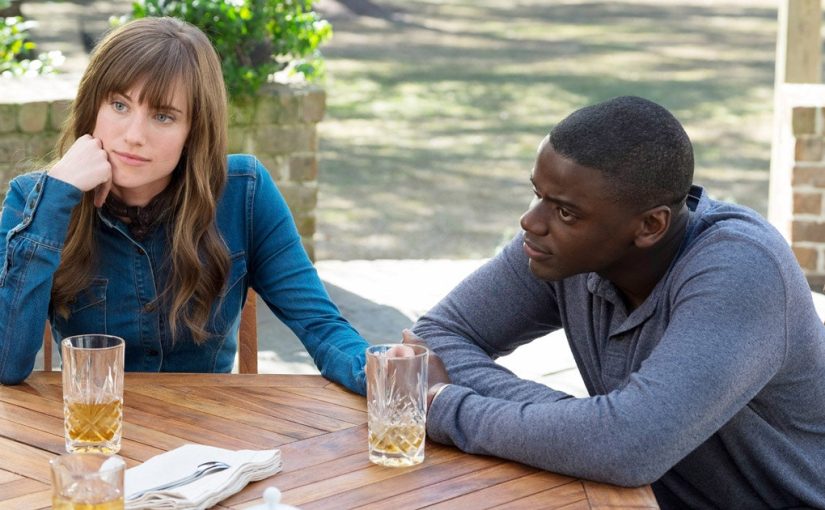
Blumhouse Pictures had a monster year in 2017 with the release of Jordan Peele’s smash hit thriller Get Out.  It was by no means some slasher film for cheap scares.  It built on those typical shocks to deliver a message over a well-crafted three act storyline that commented on present day race relations while the action of it all knocked the hell out of you.  Get Out was one of my favorite films of that year.  

Having just watched Joel Edgerton’s The Gift from 2015, I see a pattern from Blumhouse.  This is a company intent on making high grade material on very small budgets.  This company knows how to spend its money wisely, while showing you something that looks familiar but is altogether new.

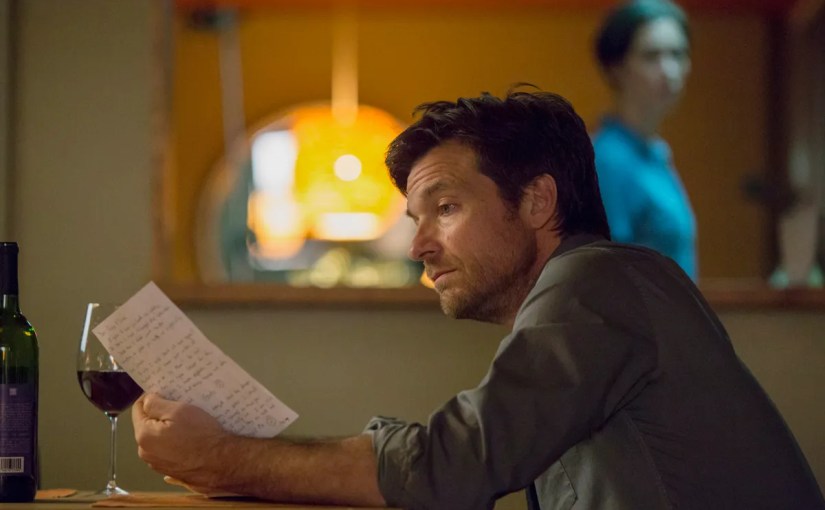
Edgerton wrote and costars in The Gift as a stranger who intrudes on the life of a happy couple with a promising future, played with great chemistry by Jason Bateman and Rebecca Hall.  

Casting Bateman and Hall was a smart move.  In other respective efforts from both actors, they are at their best by giving the less is more approach to their resume of performances.  In this film, they come off as nothing special really when the film begins; happy and minding their own business.  It’s important because it enhances the disruption of Edgerton’s character, Gordo “the weirdo.” All that Gordo is doing is being friendly by leaving gifts on the couple’s doorstep. Harmless, really, but I found my own instincts on alert. The question is, however, was I ever right to question my instincts in the first place.

The Gift is a top notch psychological thriller.  Do Edgerton and Blumhouse follow the same trite cliches of suspense films like this though? That’s what is eye catching about the film.  You really don’t know how developments are going to end up until the movie is completely over.  For the most part, this film is wildly unpredictable.

I really liked it.  It was a new kind of disturbed piece written with foreshadowed detail by Edgerton.  He writes with common, nervously laughable awkwardness for his couple to struggle with.  This new guy is only signing his cards with happy faces and leaving gifts.  What’s so wrong about that?  

Edgerton’s direction is just as fine with wide shots during the daytime suburban scenes to offer comfort for Hall’s housewife character, and a narrow lens to unsettle you as you peer down a dark endless hallway.  For cripes sakes, it’s only your house.  Is your new house really that scary?

The ending is satisfying for me even if I did predict an early scene would return to make its point later.  Narratively speaking though, I credit the screenplay for inventing something beyond a final fight that would probably include kitchen knives and crashes through windows followed by someone falling to his gruesome death from a great height, or drowning a villain in a bathtub before shooting him when he miraculously comes back to life. 

See, that’s what the other movies are doing. Films like The Gift and Get Out are completely doing something else entirely.

WILD TALES

By Marc S. Sanders

Humans were meant to be distressed.  It just goes with the territory.  It’s in our nature to distress one another and respond with another layer of distress.  It’s also a cosmic element of practically any environment we find ourselves in.  Within our journeys of life, when we are striving to be better as a spouse, a parent or worker, it takes an acceptance of stress to get to where we want to be.  It’s only when we die that we can truly rest in peace.  Wedding planning or road rage or airline travel can be overly taxing. Your car could get towed, a person from your past could turn up or you can even become unreasonably extorted when faced with extenuating circumstances.  It all seems so unfair or inconvenient or intrusive.  So, I find it interesting that director Damián Szifron would provide the credits of the cast and crew for his film Wild Tales against a backdrop of wildlife animals.  Humans may be the dominant species, but even they have animal instincts that can spiral wildly out of control.

With writer, Germán Servidio, Szifron offers up six different short stories in this Argentinian film that was nominated for Best Foreign Language Film at the 2014 Oscars.  Each story focuses on an opportunity for revenge or an experience of high stress where people come in contact with other people.  Granted, some of the stories are so outrageous in circumstance, response and outcome that I’d find them hard to believe they truly happened if someone vouched for it.  For example, you likely never saw a wedding reception like the one staged in this film.  I don’t care who you are.  YOU NEVER SAW A WEDDING LIKE THIS!!!!  Still, this is a very entertaining film that left me curious with how each story was going to play out.

A truly engaging airline experience prologues the credits when a beautiful model strikes up a conversation with the elderly gentlemen across the aisle.  When a woman in the next row can’t help but eavesdrop on their exchange, a most unexpected event occurs.  Doom awaits!!!  More importantly, though, why does it await?  It’s a brilliant opening, likely never to occur in real life, but altogether unexpected and humorously shocking.

Following the credits, a question of morality and revenge plays out in an after-hours diner when someone from a waitress’ past enters for a late night meal.  This is the most incomplete vignette of the bunch, but the narrative remains interesting. 

Listed below the airline tale, my next favorite tale involves a road rage incident between the driver of a beautiful black Audi and someone who drives an old jalopy of a car.  Likely, it is the most relatable of all the stories.  We’ve all either experienced some form of road rage, or read about it, or have committed or been tempted to engage.  There’s a strong lesson to be learned from this story and it is rather incredible how this encounter between two descends into madness.

Stories of extortion and unfair city policies fill out the other slots, before finally closing on a wedding from hell.

What’s interesting is that while the stories may rely somewhat on their dialogue, I believe I could watch Wild Tales without knowing much of what is being said.  The cast is phenomenal in expression and response.  Szifron quickly sets up the scene and then has his various token characters react to what faces them.  We see the extremes a bride goes to when an unexpected guest appears at her reception.  We are the lone witness to how a driver will seize an opportunity when another driver is stranded on a lonesome highway with a flat tire.  We can understand the persistence a man will uphold in order to prove he did not commit a parking violation.  Wild Tales does not depend on crackling dialogue.  Instead, the visuals and the performances do a lot of the work.

Too often, I hear that people will not watch films with subtitles.  They cannot stand to “read” a film.  Come on!!!!  You have to allow yourself the opportunity to uncover amazing documents of cinematic escapism beyond the American fare.  No film hinges on the subtitles that flash across the bottom of the screen.  Like any movie, the primary element is the photography of the piece.  Since I am not much of a traveler, domestic or international, it is so refreshing when I’m reminded that cultures, behaviors and customs outside my comfort zone of the United States, are not any different from me or the people I surround myself with.  We are all capable of love, drama, humor, sacrifice, crime and an innate possibility of flying off the handle in very, very extreme ways, whether we are justified or not. 

I am not familiar with many foreign pictures.  Honestly, I don’t get motivated enough to seek them out.  I need to lighten my reluctance.  It is fortunate that my colleague, Miguel E Rodriguez, provided this entertaining, mischievously fun collection of devilish short thrillers to our Cinephile movie group for a Sunday viewing.  Damián Szifron has crafted a film that you can’t take your eyes off.  The photography is striking with amazing camera angles such as a point of view from inside an airplane luggage compartment or from the sidewalk ground level where an automobile owner discovers that his car has been wrongfully possessed.  Miguel says moments like these are Tarantino inspired.  Maybe.  I like to think I’m watching a film by Damián Szifron, an insightful and skilled director at the top of his game.

SUSPECT

By Marc S. Sanders

Okay. Fair Warning. I am going to spoil this movie with my review. Why? Well, if you haven’t seen Suspect, directed by Peter Yates, then I’m telling you that you absolutely do not ever need to see Suspect directed by Peter Yates.

What is Suspect worthy of 33 years later? Nothing beyond my personal allowance to spoil the film for you. I know! It goes against my principals as a film critic, but I choose, for YOU, MY READERS, to fall on my sword.

Scripts of any variation whether they be stage plays, television episodes or feature films should always show the unusual. If it’s mundane, it should never be made. You don’t want to watch two hours of someone brushing their teeth. You want to watch epic films like Malcolm X or witness a man that flies in Superman: The Movie or the murderous ways a person will devote his affection for his mother in Psycho. Unusual and special stories make the best stories. Unusual! Not utterly preposterous!

Now, I’m sure in the annals of trial law there had to have been a handful of cases where a defense attorney got involved socially and/or romantically with a member of the jury. Otherwise, we’d never hear of the term “jury tampering.” So, there’s something unusual to sink our teeth into. Preposterous though (AND I WARNED YOU) is that within this very same trial, you know the one where the defense attorney and jury member are getting some from each other on the side, that one, the presiding judge turns out to be the killer. Okay. Now Mr. and Mr. Filmmaker, you’re no longer using your imagination. You’re just throwing spaghetti at the wall, hoping it’ll all stick.

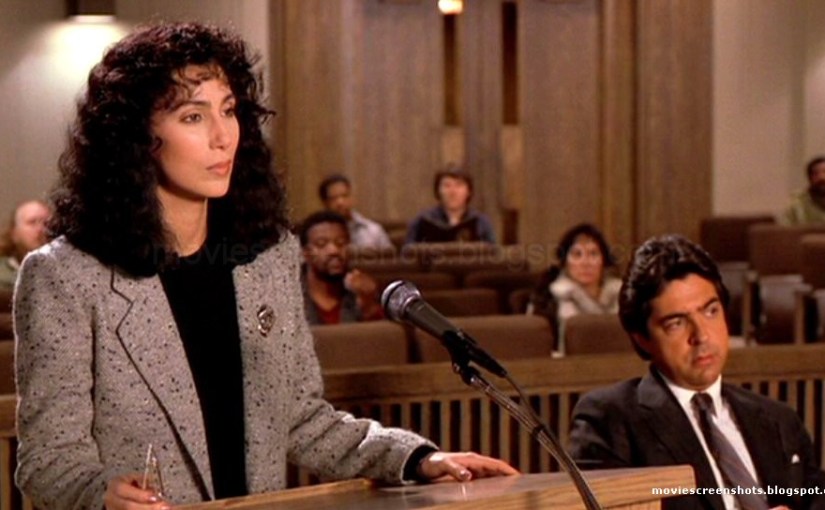
Cher plays a public defense attorney named Kathleen Riley. Dennis Quaid is a handsome DC lobbyist named Eddie Sanger serving on the jury. Liam Neeson is the deaf mute title character who is a vagrant homeless person, and John Mahoney is the presiding judge aka the actual killer revealed at the end. Lawyer and juror meet up outside of court to find clues and eventually make out. The judge is the killer. People please!!!! Washington DC is not this effed up, is it? (Maybe don’t answer that.)

Frankly, Kathleen is not a very good attorney. She’s not aggressive enough with her objections and I don’t think she applies herself well enough to win her case. In fact, without Eddie’s self motivation to dig into the case himself and help her out, then this suspect (Neeson) doesn’t have a chance in hell of being exonerated. The victim, a political staff member, had her throat slashed. Kathleen doesn’t even consider if the killer is right or left handed? Really? Eddie did at least. Still, I’m okay with watching an inept lawyer in a movie. Too often, movies show us lawyers that are too brilliant and quick on their toes. They’re almost too brainy. So, okay yeah, I’ll accept a lawyer whose not the sharpest crayon in the box for a change of pace.

On the other hand, Mahoney, the actual killer, is easy to predict when he voluntarily takes this case and then rules against literally every objection that Kathleen brings up. Every single one! Plus it stands to follow Roger Ebert’s economy of characters. There’s only so many characters in your multiple choice of cast members to consider as the killer. I can’t fathom Quaid, the juror, as the killer, nor Cher the defense attorney. So either Neeson, the suspect on trial, is the killer (not likely because then why have a movie) or it’s the judge. Nah! It couldn’t be the judge. Could it? Hmmmm.

Washington DC makes for a great setting for legal thrillers or courtroom dramas. It’s full of secrets and government and dealings and politics. A million and a half motivations and any one of its residents could find a reason to kill. The script for Suspect, written by Eric Roth, never cares to try that hard though. We are treated to a wasteful side story of Eddie doing some lobbying for milk (I’m sorry. MILK? LIKE DAIRY MILK????) when he’s not in court. He sleeps with a congresswoman to get her vote…and why am I seeing any of this?

There’s no build up in the murder trial either. The few expert witnesses called to the stand are forgettable. Nor do they foreshadow anything. Cher’s character doesn’t seem to work hard enough in questioning a witness. Instead, this dumb lawyer relies on a juror she shouldn’t ever be talking to.

Once again, normally, it’s against my policy to spoil a film. After 40 years, I won’t even spoil The Empire Strikes Back, cuz someone out there still hasn’t seen it. However, this film is ridiculous. This would even be too ridiculous for a Maury Povich episode or a Lifetime TV movie. How absurd must one murder trial be?

Think about it. All in one movie. One murder trial. One case. The defense attorney is involved with a juror AND the judge is the killer????? There are odds….and then there are gazillion to one shots.

PANIC ROOM

By Marc S. Sanders

There are few films I come across where a phone call to 911 is immediately put on hold. There are few films I come across where the one in danger has an opportunity to speak face to face with a policeman while the burglars factually can not hear, and will still not relay that she, her daughter and her ex-husband are in danger. There are few films. Just a few. David Fincher’s stupid excuse for a cat and mouse thriller known as Panic Room is one of those few films.

I can forgive loopholes on occasion for the sake of maintaining suspense and to simply have a complete movie. I can not forgive it here however. Opportunities open up easily for Jodie Foster and Kristen Stewart to take an upper hand. Equally so, moments open up for the bad guys as well, played ineptly by Forest Whitaker, Dwight Yoakum and Jared Leto. The game of outsmarting you might find depicted in Home Alone is more sensible than David Koepp’s mindless script.

The three bad guys break into a home equipped with a sealed panic room. As they get in, Foster and Stuart make it into the secure area before being taken captive.

Fincher does great camera work within a 3 story New York brownstone. He can capture in a single shot a close up of a breathless Foster in one half of the screen while a menacing figure walks covertly down an adjacent hallway on the other half. The labyrinth of the house looks good in darks and midnight blues. That’s where the attributes of Panic Room stop, however.

Everything else is controlled by manufactured contrivances offered up by Koepp’s script. Security cameras can be smashed while it just so happens that the thieves are not watching the monitors. When the electronic door to the room is opened, no one will hear a thing until a lamp topples over. You don’t even here the buzzing or slam of the steel plated door. You can also sneak around the wooden floors and will not be heard until Koepp’s writing and Fincher’s direction allow it. Otherwise these old floors will creak and echo. I talk often about how the environment in a film is a character in and of itself, like the Overlook Hotel in The Shining. Well if this brownstone is giving a performance in this film, then it dropped a line, came in too early, came in too late and missed a dozen cues during its performance.

Policemen will come to the door and nary insist on coming inside the home, where a dead body lay as well as a wounded hostage and various wreckage is strewn about. Foster knows the bad guys can’t hear a conversation while they are in the panic room, but she will still not share the fact that she’s in peril. Why????

Most infuriating is that 911 will take an emergency call and put her on hold. That’s where I checked out. Nothing else mattered.

Panic Room is beyond intelligence in so many ways.

Oh yeah, also there are no neighbors within an adjacent neighborhood of brownstones that ever hear the commotion at hand.

My colleague Miguel might say, “well then you’d never have a movie.” My reply is Panic Room doesn’t seem like it ever was a movie to begin with.

UNLAWFUL ENTRY

By Marc S. Sanders

The boogeyman is dressed as a police officer!

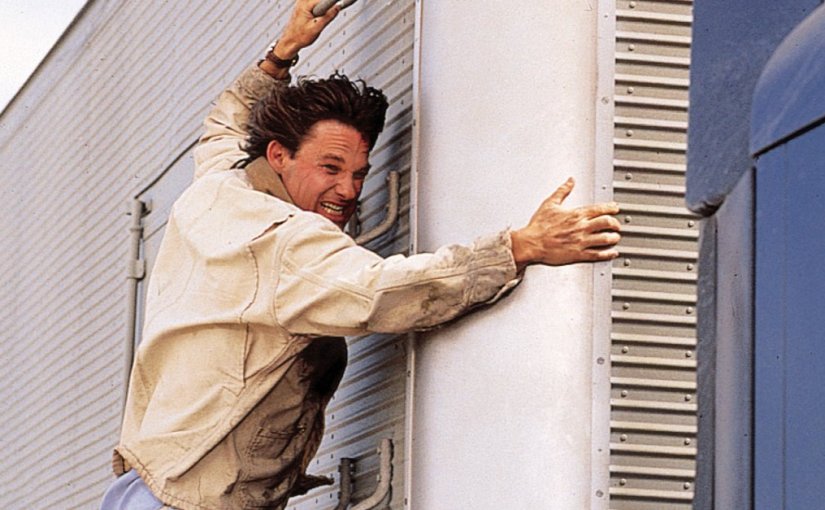
In 1992’s Unlawful Entry, Jonathan Kaplan (The Accused) directs a well-played Ray Liotta as a psychotic cop named Pete Davis who is terrorizing a yuppie couple named Michael & Karen Carr (Kurt Russell, Madeleine Stowe). The Carrs experience a home intruder who puts a knife to Karen’s throat. Officer Davis offers comfort to the pair and happily volunteers the arrangements for a high-tech alarm system. The first mistake that Michael makes is sharing the password with trusty Pete. You’ll expect that to come into play later on. Maybe what inspired the password will work itself into the film as well. Hmmmmmm?????

It’s difficult for Pete to resist the obsession he has for Karen and so he begins a campaign to get Michael out of the way. First, he demonstrates his brutality by offering Michael the opportunity to senselessly beat up the home intruder for no other purpose than personal satisfaction. When Mike refuses, Pete finishes the job. Later, Mike makes efforts to keep Pete out of their lives. It’s hard to do that when a highly decorated cop is involved. Karen, his own loving spouse, won’t even truly believe Mike; neither will the police chief.

As Pete continues with his intentions, Mike’s credit cards are maxed out, he loses a high priced client that Pete has been talking to, parking tickets add up, and so on. Pete also appears at the house at inopportune times like when Karen is taking in a swim or creepily stepping into their bedroom while the married couple is having sex. Eventually, Mike is put out of the way when he’s imprisoned after being framed as a drug dealer. Now Karen is all alone for a terrifying third act that you’ve likely seen hundreds of times before.

Unlawful Entry is engaging while you’re watching, but it does not convey much. The happenings all appear probable if a deranged cop wanted to go through all this trouble. Therefore, Ray Liotta owns the picture. Yet, what did I learn here? Don’t call the police?

For Kurt Russell, this is the first of two “husband is being terrorized” roles for him. Later, Russell would headline the cast of a better film to fall in this genre called Breakdown. Still, I like Russell here. He starts out as a guy who is not capable of fighting for the sake of his wife. He regrettably admits that shame to Pete early on. Pete pounces on that advantage to win Karen. Later, the strength of Mike’s short temper followed by his fear push him to do what he must to protect himself and his wife.

Madeleine Stowe is a good actress. There’s just not much for her to do with this part. She’s the spouse who opts not to believe her husband’s concerns. If she did, there wouldn’t be much of a movie. The third act is all action and blood and falling down the stairs and running back up the stairs. It’s no surprise really. Though it is convenient that Michael is finally able to post bail and get home in time for a final confrontation with Pete.

One thing that kept echoing in my head though was that as good as Ray Liotta is (he’s very, very good actually; very primal and deceiving), he is terrorizing a woman named “Karen.” Every time he says the name Karen, all that comes back to me is the film Goodfellas where he more or less tormented and disrespected Lorraine Bracco known as, you guessed it, Karen. A rule should be put in place, Liotta can no longer be cast with other characters named Karen. His Karen quota is maxed out.

WITNESS

By Marc S. Sanders

Recently, I viewed The Last Emperor and one issue I had was that it was challenging to comprehend the in-depth culture of the people it depicted. I really wanted to learn and pass the final exam with flying colors. Sadly, this was an AP class that I just wasn’t qualified for.

Now that I have watched Witness for the first time in many moons, I can honestly say there is an approach where you can get absorbed in a thrilling crime drama while also appreciating the core values of the community the film focuses on, namely the Amish who reside in the state of Pennsylvania. It’s a much easier film to learn from. That’s for sure.

Peter Weir directed Harrison Ford to his only Oscar nomination to date. Ford plays police officer John Book, opposite Kelly McGillis as Rachel Lapp, a widowed Amish mother traveling by train from home to visit family. At a layover stop in Philadelphia, her young son Samuel (Lukas Haas, in one of the best child performances I’ve ever seen, so bright, observant and wide eyed) witnesses a murder committed by a decorated narcotics police officer (Danny Glover). When Book gets wind of who the cop is, all three of their lives are in danger and they are forced to flee and hide back at the Lapps’ home among the Amish community. Book, however, has taken a gun shot wound following an attempt on his life. The Amish see no choice but to heal him, especially at Rachel’s insistence.

Weir, with a marvelous script by Earl & Pamela Wallace and William Kelley, shows the intersection of two extremely different ways of life where an “Englishman’s” belief in aggressive tactics conflicts with the peaceful nature of people looking to never get involved with any other culture. A romance may seem inevitable between the two leads but it’s a difficult one to embrace. It’s truly forbidden, not simply by the elder Amish and their respective code, but both Book and Rachel know it can’t happen either.

Because we are aware of this forbidden romance that seems to break through anyway, there’s a terrific dance scene at night lit only by headlights within the barn. Ford and McGillis really shine through in this scene as it is the first escape from the fear they have for their lives and the code they honor and are reluctant to violate. It’s the best scene in the whole film. It presents possibilities for different people to interact despite the barriers that prevent such feelings and actions. They laugh and swing naturally. It’s a different kind of moment for Harrison Ford, unconventional when compared to a large majority of the action film roles he’s widely recognized for.

With a biting soundtrack of suspense from Maurice Jarre, Peter Weir also focuses on the theme of intrusion. When the climactic and certainly expected shootout sequence on the farm is to begin, it’s frightening and disturbing to actually see men in suits holding shotguns amid an unarmed society. There’s a masterful shot at dawn of the three men marching down the hill quickly approaching the farm. These aren’t cops being covert. These are cops storming a palace of peace and tranquility. It’s hard to watch because of the stain it leaves.

Josef Sommer is the lead dirty cop and he plays a great villain, truly an uncelebrated bad guy character, as the years have gone on. He’s a decorated officer who comes off with an intent that looks like it’s noble, until nobility will no longer work and intimidation has to set in. Weir shoots Sommer at a lower angle to give him an imposing height.

Ford is terrific. You see some of the Han Solo vibe in the character. He’s a tough cop after all, but then he transitions into an awakened man healed by the more primitive methods of the Amish and their drive to simply build and nurture. Another good moment occurs when Book contributes to building a barn with the other men. He shares lemonade with them. Assists with lifting the framework and hammering along. Two communities are no longer clashing. They are now blending.

McGillis is also very good in her role. She is determined to honor her background, but questions if she is capable of sin and defends her position later.

Witness gives an in depth look into the daily life of the Amish, literally how they farm, build and dress. Book wakes up with them before sunrise to milk the cow and he experiences what they endure from pesky tourists looking for photo ops. It makes for some funny moments as well as an opportunity to cheer for the stand he eventually takes.

Another funny moment is when Ford dons the Amish attire for the first time; it doesn’t exactly compliment him well at first. Book’s adaptability to his new community is awkward to grasp.

Witness presents a bird’s eye view into a very private way of living, and I saw a very large picture.

Beyond that, it’s also a crackling, good thriller.

THREE DAYS OF THE CONDOR

By Marc S. Sanders

Sydney Pollack is such a hero of Hollywood filmmaking. He was a terrific actor and a better director. As Three Days Of The Condor opens I got completely engrossed in its simple, yet frightening set up.

Joseph Turner (Robert Redford) arrives at his office where he works day to day as a “book reader.” He chats a little with his colleagues, jots a few notes down, and steps out the back door to pick up lunch for everyone. When he returns, he finds the entire office staff has been shot to death. This seems like a common day in the life of an Everyman, until it’s not. Alfred Hitchcock capitalized on this motif over and over again.

Turner makes a phone call and is asked for his code name, but before he reveals he’s known as “Condor,” he asks a very good question to the man on the other end of the line. Why is it so important that Turner reveals his code name, but the man he called doesn’t feel the need to share his own?

Having recently watched the film adaptation of The Firm with Tom Cruise, made almost twenty years after this film, I can see that Sydney Pollack knows how to not only build suspense very, very quickly but also how to maintain it too. Still, in both films the complications of the why and how become overbearing. With Three Days Of The Condor, it’s best to just watch the tight editing and well drawn characterizations all the way from Max Von Sydow as a disciplined assassin to John Houseman as the elder authority who relaxes himself with his tweed suit and bow tie behind a large table as the problems unfold. Cliff Robertson is Higgins, the contact for Turner. He’s serviceable in the part.

The entire first hour of the film is perfection; taut and gripping as we uncover what purpose Turner as a book reader serves, and for whom. The second hour found me feeling less engaged, regrettably. To aid himself, Turner kidnaps a woman shopping in a sporting goods store. Faye Dunaway plays Kathy Hale. He forces Kathy to take him back to her apartment where he hides out. Never would it occur to me that these two characters over the course of a day and a half would fall for one another and make passionate love. This is not that kind of movie, and yet there it is. Some producer must have said “Fellas, we’ve got Dunaway and Redford on screen. This is a no brainer.” Faye Dunaway is fine in the part. I bought that out of desperation Redford would hold her at gun point and force her to help. But, c’mon! Really? They gotta bang each other too????

As for the plot behind killing people, the film doesn’t work its way into car and foot chases. It relies on its wording. The problem for me is that Turner works it all out himself. There’s little reference back to earlier moments for an audience to connect the dots along with the hero. So when Turner realizes one of the motivations is in regards to oil trading, I was trying to figure when anyone said anything about oil to begin with. Revelations just seem to be pulled out of a rabbit’s hat at times. They could have said people had to be murdered because the price of milk went up by fifty cents, and that would’ve held about just the same amount of weight as oil. What ABOUT oil????? Nothing ever needed to be so explicitly discussed here.

Part of the fun sometimes in Hitchcock films, for example, is simply seeing the man unexpectedly on the run and then watching how he outwits his adversaries. Harrison Ford does that in The Fugitive. Tom Cruise did it in The Firm. Cary Grant did it plenty of times with Hitchcock. In this film, however, I never felt there was any need to explain. Once it tried to grow a brain, I thought sometimes less is more, because now I’m stuck feeling frustratingly confused amid a lot of convoluted mumbo jumbo, on top of an out of left field, unsubstantiated love sequence.

Three Days Of The Condor was one of the best, edge of your seat suspense stories I’d seen…until it wasn’t.

EVERYTHING EVERYWHERE ALL AT ONCE (2022)

by Miguel E. Rodriguez

Directors: Dan Kwan, Daniel Scheinert
Cast: Michelle Yeoh, Stephanie Hsu, Ke Huy Quan, James Hong, Jamie Lee Curtis
My Rating: 10/10
Rotten Tomatometer: 96% Certified Fresh

PLOT: A middle-aged Asian woman tries to do her family’s taxes with mind-bending results.


Every once in a while, a movie comes along that is so daring and original that any attempt to accurately describe it feels futile.  Scott Pilgrim vs. the World was one of them.  Being John Malkovich was another.  And now comes Everything Everywhere All at Once, a sci-fi action brainteaser that feels as if it were written by Terry Gilliam and Quentin Tarantino and directed by Stephen Chow (Kung Fu Hustle, Shaolin Soccer…two movies that also meet that “indescribable” criterion).  It feels like an episode of Black Mirror crossed with Jackie Chan and a dash of David Lynch and Terrence Malick.  If you can’t find anything to like in this movie, check your pulse.

Evelyn Wang (Michelle Yeoh) opens the film trying to do her family’s taxes.  She and her husband, Waymond (Ke Huy Quan – “Short Round” from Temple of Doom!!), carry stacks and stacks of receipts to their local IRS branch and try to explain to their case worker (a dowdy Jamie Lee Curtis) how a karaoke machine can be deducted as a business expense.  However, before that can happen, after a series of very strange events involving Waymond and a pair of Bluetooth headsets, Evelyn finds herself immersed in a trans-dimensional battle between the forces of good, led by an alternate-universe version of Waymond – the “Alpha Waymond,” if you will – and someone called Jobu Tupaki, a being or person who is hunting for Evelyn in every conceivable parallel universe.  All Evelyn has to do is use these weird headsets to access the infinite multiverse and harness the skills learned by the infinite Evelyns before Jobu Tupaki can track her down and kill her.

To access the multiverse in such a way, one must commit random acts of…randomness, which leads to bizarre scenes of individuals doing some very weird things to access special skills.  What kind of weird things, you ask?  Things involving…sticks of lip balm, putting your shoes on the wrong feet, saying “I love you” to a stranger, or wiping someone else’s nose for them and…well, use your imagination.

That’s seriously just scratching the surface.  I haven’t even mentioned Evelyn and Waymond’s daughter, Joy; their laundromat; Evelyn’s elderly grandfather, Gong Gong (veteran character actor James Hong – 450 film and TV credits and counting); or the divorce papers Waymond has on his person.

This movie is a trippy, joyous, tightrope-walking masterpiece.  There are moments where you can sense it tap-dancing on the line of self-parody, then jumping over it and daring the audience to go along with it.  If there are some people that say they were unable to follow where this movie leads, I can’t really say I’d blame them.  Not many movies would ask you to take it seriously, then include a scene involving two rocks having a conversation via, I guess, ESP.  Or where the two lead characters turn into piñatas.  Or where Jamie Lee Curtis staples a piece of paper to her own head.  Or where the fate of the world might hinge on who gets their hands (in a manner of speaking) on a trophy shaped like…a very specific kind of toy.

HOT DOG FINGERS, people.  HOT.  DOG.  FINGERS.

I’m frankly amazed this movie didn’t collapse on itself.  There are so many ways it could have gone wrong, and so much it wants to say, while trying to be simultaneously massively entertaining and heartbreakingly poignant.

From a technical standpoint, I think it’s the frontrunner for the Best Film Editing Oscar for 2022.  This movie jumps from one parallel universe to the next and the next and back again so frequently that I got whiplash, BUT it was never confusing or mystifying.  It was always crystal clear what I was watching and why I needed to see it.  I could list any number of films or TV shows that have attempted this kind of thing on a much more modest scale and failed.  This is like the Who Framed Roger Rabbit of film editing.  It has been done so well and on such a grand scale that it seems unlikely anyone will try to tell this kind of story in the same way again.

Some may quibble at the mildly melodramatic resolution of the conflict among Evelyn, the “Alpha” universe, and Jobu Tupaki.  I can understand that viewpoint, but honestly, I just rolled with it when it came around.  And so did the theater audience I was with the night I saw it.  We all laughed uproariously on cue, sometimes for something funny, sometimes in sheer disbelief at what we had just seen.  But when the wrap-up started to come together, we all hushed and waited to see what would happen.  Even when it involved a parallel universe with something called Raccacoonie.  (It’s a long story…)

I hope I’ve conveyed how crazy good this movie is while preserving some of its best surprises.  I haven’t felt this urgent about getting the word out about a great movie since I saw Roma.  To call this an entertaining night at the movies does a serious injustice to the words “entertaining” and “movies.”  It’s more than entertaining and, not to get too hyperbolic, this is more than a mere movie.  It’s a masterwork, a collision of grand ambition and even grander moviemaking.  I plan on seeing it at least once more in theaters, if only just to see what I may have missed the first time around.  (And maybe also to tune more carefully into audience reactions at key moments, like the performance trophies, or those two rocks.  Who knew two rocks could be funny?  Like REALLY funny?)