FAREWELL, MY LOVELY (1975)

DIRECTOR: Dick Richards
CAST: Robert Mitchum, Charlotte Rampling, John Ireland, Sylvia Miles, Anthony Zerbe, Harry Dean Stanton, Jack O’Halloran, Joe Spinell, Sylvester Stallone
MY RATING: 9/10
ROTTEN TOMATOMETER: 71% Fresh

PLOT: When a giant ex-con fresh from prison asks Philip Marlowe to find his missing sweetheart, Marlowe winds up entangled in multiple murders, prostitutes, and a sultry trophy wife.


Because it was released only a year after Chinatown (1974), it is tempting to compare Farewell, My Lovely to that landmark film noir, but although they are in the same genre, the two films are apples and oranges…or at least apples and pears.  Both feature hard-nosed private eyes accepting cases that turn out to be more complicated and far-reaching than they appear, both feature multiple unexpected deaths, and both feature curvy, smoky-eyed dames with dangerous secrets and aging husbands.  All true to the genre.  But Chinatown breaks (successfully) with film noir in several key areas, while Farewell, My Lovely achieves its lofty heights while still remaining faithful to the bedrock tropes of vintage film noir, right down to the tired voice-over narration from the hero.  I have no idea how faithful it is to the Raymond Chandler novel by the same name, but if the book is half as entertaining as the movie, I may have to track it down and give it a read.

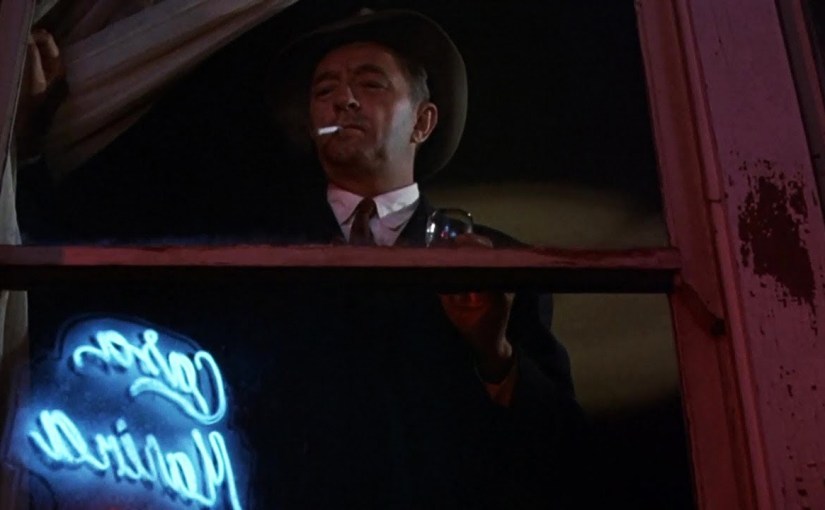
Robert Mitchum plays legendary gumshoe Philip Marlowe, the third version of the character I’ve ever seen after Humphrey Bogart (The Big Sleep, 1946) and Elliott Gould (The Long Goodbye, 1973).  Compared to the other two, Mitchum is by far the most shambling version, but I mean that in a good way.  We first see him staring out of a rundown hotel room in downtown Los Angeles, some time in 1941.  We know the timeframe because of a calendar here and there, and because Marlowe is obsessively following Joe DiMaggio’s progress, as he is on the verge of breaking the record for hits in consecutive games.  That’s a nice touch.  Marlowe’s world-weary narration plays over Mitchum’s sagging face and drooping cigarette, and the spell is complete: we are in the hands of one of the great genre pictures, from a story by one of the greatest mystery writers of his generation.

Marlowe’s story starts as a flashback, a story he’s relating to similarly-weary Lieutenant Nulty (John Ireland).  See, it all began when Marlowe was tracking down a rich family’s runaway daughter.  Soon thereafter, “this guy the size of the Statue of Liberty walks up to me.”  This is Moose Malloy, an ex-con fresh out of the slammer after serving seven years for armed robbery and making off with $80,000, which was never recovered.  Moose is played by Jack O’Halloran, whom cinephiles will recognize immediately as the overly large/tall man who played Non, the mute superpowered henchman in 1980’s Superman II.  To see this man actually string words together into sentences was a strange experience, but I eventually got used to it.

Moose wants Marlowe to find his sweetheart, Velma, who hasn’t written to him the last six years of his stretch.  Next thing you know, someone takes a potshot at Moose on the street, Moose winds up killing a guy in a bar, and Marlowe follows Velma’s trail to an insane asylum, and that’s still just the tip of the damn iceberg, because now there’s this guy who wants Marlowe to help deliver $15,000 in ransom to some other guys who stole a jade necklace…and we STILL haven’t seen the rich trophy wife yet.

And round and round it goes.  I have seen other films that attempted to combine this many plot threads and they wound up a jumbled mess.  Not this movie.  Farewell, My Lovely skillfully walked that tightrope and held my interest all the way through.  I was never lost, never confused…except for a couple of places where the soundtrack obscured a word or two, but I don’t know if that’s the soundtrack’s fault or the actors for mumbling too much.  Plus, this movie contains one of the single greatest interrogation sequences I’ve ever seen, starring Marlowe, two thugs, and the madame of a whorehouse.  It starts semi-normal, escalates with a shocker, then tops the first shocker with something I didn’t think even a hardcase like Philip Marlowe would do.  But the more I watched this movie, the more I got the sense (whether it’s true or not, I don’t know) that this Mitchum version of Marlowe is truer to the literary Marlowe than we ever got previously, in terms of Marlowe’s principles.

I should also mention the dialogue, which contains some of the best one-liners and comebacks I’ve ever had the pleasure of listening to.  For example:

  • Marlowe describing a large house he’s driving up to: “The house wasn’t much.  It was smaller than Buckingham Palace and probably had fewer windows than the Chrysler Building.”
  • Marlowe on his billing practices: “I don’t accept tips for finding kids.  Pets, yes…five dollars for dogs, ten dollars for elephants.”
  • Marlowe describing the obligatory femme fatale (Charlotte Rampling): “She had a full set of curves which nobody had been able to improve on.  She was giving me the kinda look I could feel in my hip pocket.”
  • Marlowe when the femme fatale asks him to sit next to her: “I’ve been thinking about that for some time.  Ever since you first crossed your legs, to be exact.”

Dialogue and lines like this are dangerous because they have been the targets of so many parodies for so long that modern audiences may have forgotten how to take them at face value.  But in Farewell, My Lovely, it comes off perfectly as a tribute to the classic noirs of the 1940s and ‘50s, a tip of the hat to the giants of the past.

Conversely, this movie also reminded me of many of the best eighties thrillers I remember watching, which is ironic considering it was released in 1975.  Movies like Body Heat and Jagged Edge and Silverado, whose purpose for existing seemed to be just to tell a freaking awesome story, unburdened with subtextual layering but laden with style and wit and intelligence, paying homage to their cinematic ancestors by emulating them without plagiarizing them.  There are no doubt film historians who could analyze this film scene by scene and explain exactly what the filmmakers were really trying to tell us underneath the ingenious dialogue and intricate plotting.  But even if I knew or understood all of that, I maintain the best reason for seeking out and watching Farewell, My Lovely will always because it’s just a damn good movie.

(…if for no other reason because of that interrogation scene…I had to rewind it a couple of times just to get my shocked laughter out of my system…)

CAPTAIN PHILLIPS

By Marc S. Sanders

“You had thirty thousand dollars, and a way to Somalia. It wasn’t enough?”

– Captain Richard Phillips

Paul Greengrass is a director with a documentary style technique.  Look no further than his salute to the hero hostages of United flight 93 on 9/11.  United 93 depicted an ordinary Tuesday of people going about their business on commercial airlines and in working in radio towers. Eventually, it was nothing but ordinary.  Greengrass reminded us of the day the world permanently changed.  He applied the same technique to his film Captain Phillips when a commercial cargo ship was hijacked by Somali pirates looking for a large amount of American dollars to bring back to their tribes. 

Tom Hanks is Captain Rich Phillips, an Irish American Naval captain residing in Vermont.  When the film starts, the captain is packing up one last bag and signing off his computer.  The screen shows a trajectory course that he will command the American cargo ship Maersk Alabama around the horn of Africa and make do on his delivery of hundreds of corporate cargo containers.  Though he’s well aware, he is given official warnings to be mindful of Somali pirates in the area.  When he rides with his wife (Catherine Keener) to the airport though, it is not international threats that concern him.  Rather it is whether their son is going to start taking his life seriously with grades and aspirations.  Whatever Captain Phillips does faces professionally is simply routine.  No matter how dangerous, it’s his family back home that concerns him most.

Even in this opening throw away scene, Greengrass looks like he’s shooting reality TV with a cameraman placed in the back seat of the characters’ SUV, getting shaky side shots of the husband and wife taking a drive to the airport.  The handheld technique will carry over the course of the film and sometimes it will relax itself when caution is of utmost importance.  Other times, it will emote frenzied chaos when desperation and time have overloaded the senses.

The film allows time for the Somali pirates led by an unknown, but eventual Oscar nominated actor named Barkhad Abdi to assemble a group of four to lead a charge into the deep waters seeking out a target to hijack and pillage.  They are armed with machine guns and foolish gusto, which will be hard to negotiate.  After one day’s failure, the pirates manage to overtake the ship and then Captain Phillips must subvert the pirates away from the majority of his crew hidden within the confines of the large engine room of the ship. 

As the second half of the film takes over, it becomes a claustrophobic encounter aboard a small lifeboat.  The pirates have taken Phillips as their hostage along with thirty thousand dollars in cash and their plan is to return to the shores of their country and negotiate with the United States for the Captain’s release.

With no navigation for the pirates to follow, the Navy intercepts the lifeboat with a battleship and an aircraft carrier in nearby waters. Now it becomes a strategic plan for Phillips to stay alive while the armed services try to peacefully end this conflict with no harm to the hostage.

The length of Captain Phillips is close to two and a half hours and you realize it because that is the point.  The main subject at the heart of this true story was held in this tiny boat with limited vision of what was occurring outside, fighting rough seas while constantly being berated in a foreign language by his captors.   It’s also never easy for any authority to negotiate with powers that are operating with dizzying confusion and helplessness.  The only advantage these pirates have is to hold on to their prized captive.  There is nowhere to run, or swim, or much less spread out in this tiny ocean vehicle that lacks any kind maritime direction or security.  Paul Greengrass makes sure you know this as he often points his camera upwards from tiny crevices on the floor, lining up at the pirate players along with Barkhad Abdi and Tom Hanks.  Sometimes a cameraman must have been standing and pointing a handheld down at Hanks watching his captors while he tries compute his next move.  Within these cramped quarters, you can smell the body odor and feel the desperate need for a shower, a drink of water or a morsel of food as these people remain contained within this floating box.

Elsewhere, I’m especially impressed with how Paul Greengrass observes the routines of the Navy and US Seals who are doing their best to end this situation.  The Seals, who are also sharpshooters, covertly parachute on to the nearby aircraft carrier, gear up and position themselves.  It’s so routine even though I know they are being especially careful.  Some tactics for easy movie narration are likely adopted here.  The commander makes clear that they need green targets, not red.  I’m sure it is more complex than that. How these military men speak and carry stoic expressions like it is another day at the office works in converse to the chaos occurring in the tiny boat that everyone has their eyes set upon.  Yet, Greengrass’ documentarian strategy remains consistent in both environments.  You are getting a “You Are There” experience to uphold the film’s authenticity.

Tom Hanks is great and easy to rely on as usual.  However, his performance does not seem so impressive until you finally witness his sensible and alert demeanor deteriorate and crumble to pieces.  You might know the ending to this heart pounding story, but I won’t spoil it here. A final scene bears the right side of an equal sign to all the hysteria you watched add up before. Tom Hanks’ penchant for improvisation is what strengthens the epilogue of the film, following a harrowing climax.  It might just be his best scene ever on film.  Knowing his celebrated career, I gave that declaration quite a bit of thought.

Captain Phillips is a taut, sensational thriller where common sense cannot easily win against irrational thinking. Still, that is exactly what took place. You involuntarily hold your breath until the film suddenly goes quiet, the director’s camera stops in place, and a sharp order is given.  Only then do you finally exhale and slowly sit back in your seat.  Paul Greengrass is a master at timing out the tension.

MAXXXINE (2024)

by Miguel E. Rodriguez

DIRECTOR: Ti West
CAST: Mia Goth, Elizabeth Debicki, Michelle Monaghan, Bobby Cannavale, Giancarlo Esposito, Kevin Bacon
MY RATING: 8/10
ROTTEN TOMATOMETER: 72% Certified Fresh

PLOT: In 1985 Hollywood, adult film star and aspiring actress Maxine Minx finally gets her big break. But as a mysterious killer stalks the starlets of Hollywood, a trail of blood threatens to reveal her sinister past.


When I started posting my blissful reviews of X and Pearl [both 2022], I got one response more than any other: “Wait till you get to MaXXXine; it’s the weakest of the trilogy.”  Having just watched it, I would say that calling MaXXXine the weakest film in this trilogy is like calling Return of the Jedi [1983] the weakest film in the original Star Wars trilogy.  You may be technically correct, but it’s still a great ride and a better film than many others in this genre.

Six years after the bloody events of X, we pick up the story of Maxine Minx (Mia Goth) as she auditions for a film role in Los Angeles.  She’s been signed by a devoted but semi-skeevy agent, Teddy (Giancarlo Esposito in a fabulously bad hairpiece), and she has experienced modest success as a porn star.  But she longs to spread her wings in “legitimate” films, because as we all remember, Maxine craves fame more than anything in the world.  As she never tires of repeating: “I will not accept a life I do not deserve.”

Just as things start looking up for Maxine’s career, a package is left on her doorstep…a VHS tape labeled ominously, “For Maxine.”  When she pops it into her VCR, she’s treated to a shot from her filmed but unfinished porn movie from six years ago…evidence which would link her to those horrific murders and endanger her newfound success.  Meanwhile, the infamous real-life serial killer Richard Ramirez, aka “The Night Stalker”, terrorizes Los Angeles at night, not to mention a copycat killer who is branding his victims with pentagrams.  How these murders are linked to Maxine, and when and where John Labat (Kevin Bacon) comes into play, is not for me to divulge.  And one by one, Maxine’s friends and co-workers are turning up dead…

The plot of MaXXXine is nothing new, let’s face it.  What makes it sparkle is the wit and TLC provided by director Ti West and his collaborators.  For anyone who was alive in 1985, this film is like a stroll down memory lane.  I found myself thinking about Quentin Tarantino’s Once Upon a Time…in Hollywood [2019], with its loving recreation of late-1960s Los Angeles and serial-killer-related plotline.  That’s not to say MaXXXine is ripping off Q.T.’s film, not at all.  Both films have an immense affection for their respective timeframes and have gone to great lengths to immerse us in that culture.

Another filmmaker that came to mind during MaXXXine was Jordan Peele, director of his own trio of horror neo-classics: Get Out [2017], Us [2019], and Nope [2022].  Ti West’s films share a lot of characteristics with Peele’s films.  The Maxine trilogy looks like a million bucks on screen, despite what must have been very limited budgets.  The plots and screenplays are airtight with one or two minor exceptions.  (Peele’s plots are more Twilight Zone than reality, so they get a bit of a pass on plausibility.)  And the characters are intelligent, sharply drawn, and rarely fall into cliched behavior.

If MaXXXine is not quite as terrifying as its predecessors, I’m prepared to forgive it.  Whatever it lacks, it makes up for in its besottedness with Hollywood.  There is a scene where one character chases another through a Universal backlot (oddly deserted, but whatever); they run through various movie sets, including the town square featured in Gremlins [1984] and Back to the Future [1985], winding up at – and I almost could not believe this – the Bates Motel and even inside the Bates house behind it.  Only a director/screenwriter deeply in love with the movies, and horror films specifically, would dare to write a scene like that into their script, and I loved it.  (Trivia note: they had to get permission from the Hitchcock estate first…awesome.)

I haven’t even mentioned the movie’s subtext.  The movie Maxine has gotten a part for is being directed by a woman, Elizabeth Bender (the pleasingly towering Elizabeth Debicki), who believes The Puritan II is her chance to prove that her voice is worth listening to in an industry dominated by male voices, especially in 1985.  If the only way to get people to listen is to make a B-list horror movie with A-list concepts/ideas, so be it.  Two of the best horror movies I’ve seen in recent years were directed by women: The Babadook [2014] and Saint Maud [2019].  And yet, out of over 1,850 movies in my personal collection, only 70 were directed by women.  I guess things haven’t changed that much in the movie industry in forty years.  Discuss.

MaXXXine begins with a quote from Bette Davis.  I won’t recite the quote here, but it implies that an actor isn’t a star until they’re considered a monster.  I hope that’s not true.  But for Maxine Minx…if that’s what it takes, well, then…that’s what it takes.

CARRY-ON

By Marc S. Sanders

Action movies have been done to death, haven’t they?  Yet, don’t we still get a kick out of them?

Sure, I need my TCM classics like It Happened One Night or my updated biographies like Angelina Jolie’s Maria, but action movies are like the best junk food without any of the calories.  Still, an action picture has to have that special attraction if it is to stand apart from the others.  I got bloated by the time I got to the fourth Lethal Weapon.  The first is a perfect wham bang shoot ‘em up set during Christmas time. Now Netflix grants us a long-lasting candy cane with its airport run around chaser flick known as Carry-On.

What makes this mad bomber fest a smash is that the hero, TSA agent Ethan Kopek (Taron Egerton), actually cries out of fear and pain as the bad guy beats up on him and frightens him into direct obedience.  He begs with tears coming down his cheeks for the bad guy to just stop with his mission.  He screams “WHY ME?”  The Rock, Stallone, Schwarzenegger, Willis, Ford, Gibson – those guys don’t cry.  Yet, little Ethan Kopek does, and once he gets his wits about him does he truly become a super hero.  I recall the moment happens in the last twenty minutes of the picture.  Ethan throws off his pansy TSA uniform shirt and makes a go at saving the day in his black undershirt.  Now he’s earned John McClane’s respect.

On the busiest travel day of the year, December 24th, Ethan is assigned to scan the carry on luggage ensuring travelers have not packed contraband items.  He and his colleagues have to put up with all the typical TSA complaints that come with the job.  My hat’s off to screenwriter T.J. Fixman for allowing some time to show the challenges of this occupation.  It adds some truth, comedy and depth to a thankless job that’s hardly celebrated or acknowledged like cops, doctors, athletes, and attorneys.  

Ethan is handed an earpiece and a mysterious voice, provided by Jason Bateman, gives him direct instructions to allow one black suitcase with a red ribbon to pass through inspection.  If Ethan deviates in any way at all, the voice promises that Nora (Sophia Carson) will be killed.  She is Ethan’s pregnant girlfriend and also runs airport security at LAX.  

Movies like this function like a game or sport.  The villain sets up boundaries.  How is Ethan going to save the day or get around the unexpected while trying to avoid harm to Nora or the airport as a whole?  As far as he knows, he is always being watched by the guy talking in his ear.  There’s rules and obstacles he must observe.  Granted, Carry-On allows a lot of unlikely and hard to buy conveniences to let our hero obtain the advantage, but he’s also not Superman, and at times when you believe Ethan is coming out ahead, Bateman’s antagonist changes up the game.  

Heck! A bomb is activated not at the end of the movie, but dead center right in the middle of the story.  Normally, the end all be all explosive serves as the final exclamation point with the expected digital clock countdown.  However, in Carry-On if it can get deactivated, there will still be more story to go.  Bateman’s villain really has everything thought out and Egerton’s character has no choice but to man up to the plate once again.

A side story with Danielle Deadwyler as an investigative cop named Elena will eventually intersect with the main narrative.  It’s nothing special until a car ride on the way to the airport plays Wham’s Last Christmas on the radio and the scene explodes into a mind-blowing thrill reminiscent of what I saw in Children Of Men twenty years ago.  The construction of this scene alone is absolute fun.  

Deadwyler’s character is written with a lot of carte blanche to allow Ethan to save the day.  No, none of this is ever likely to be how things go.  Yet, I recall Arnold Schwarzenegger being thrown out of an airplane and surviving a crash landing in a garbage heap thirty thousand feet below (Eraser).

If you watch Carry-On, I will not be surprised if you protest its merits based on a collection of plot holes.  The most glaring one to me is that LAX does not look nearly as crowded as the script insists, nor what I’d expect on Christmas Eve day.  Also, traffic is really easy to get around on the way to the airport.  (New Orleans fills in for Los Angeles.). However, just because Dreamworks and Netflix cut corners on spending for more extras and scenic inconveniences, it does not mean my enjoyment with the film is suspended. 

To make up for where the film’s budget might have come in the way, there are storyline surprises that enter from nowhere. Logic is applied to what’s inserted at these opportune times.  Ethan and Elena experience a set back and now new forms of game play must take hold.  You accept what’s thrown at you because of the cast and set ups.

Taron Egerton is a deliberately wimpy, but also an attractive, unlikely hero.  Jason Bateman ranks with other impressive Die Hard type movie villains like Alan Rickman, Tommy Lee Jones and Dennis Hopper.

Carry-On’s director, Jaume Collet-Serra, is well aware of the near miss escapes that allow his movie to…well…carry on.  He really doesn’t try to hide or distract from the plot holes or questions that audiences may argue.  Yet, I say who cares? This cast of mostly unknowns step up to embrace the dialogue and circumstances of the script while trying to win the game.  

Look, anything you see in Carry-On can theoretically happen.  

Would it happen?  

Let’s just change the subject please.  You have a plane to catch.

CRIMSON TIDE

By Marc S. Sanders

A little over a year ago, having just seen Christopher Nolan’s Oppenheimer, I shared with friends how it is sadly surprising that a nuclear weapon has not been launched by a super power country since the bombs were dropped on Hiroshima and Nagasaki.  Those two bombs certainly served their purpose in response to the Pearl Harbor attack of 1941.  I deem it sad that any of us consider this a possibility that can easily be repeated. With all of the threats that continue worldwide with weapons testing, technological advancements and arms trading, it’s frightening to wonder what can ever be expected. Is it easier to execute a command like that again, now that it has been done?  It’s got to be a little surprising that the United States did not respond that way following the 9/11 attacks.  Tony Scott’s Crimson Tide comes close to providing an answer by weighing sound vs unsound reasoning. 

This is not only my favorite of Tony Scott’s films, but the movie also offers maybe my favorite performances from Denzel Washington and Gene Hackman.  The two actors of different generations are equal in measure as they debate what should be done, along with how the submarine they command, the U.S.S Alabama, should respond while in the midst of a revolutionary conflict stemming out of Russia.  

Washington is Commander Hunter, recruited at the last minute to serve as the Executive Officer aboard the Alabama.  Hackman is Captain Ramsey who proudly leads the charge of the sub with an intimidating welcome to Hunter.  Before any kind of real conflict comes their way, Ramsey puts Hunter to the test.  An uncomfortable dinner conversation, wisely written by Robert Towne (Chinatown), has the Captain question Hunter’s stance on using nuclear force to deliver a harsh defeat to the enemy.  Hunter’s position though is the real enemy is war itself.  Ramsey and his commanding staff have no reply to the new member’s observation.

Another moment occurs when Ramsey orders a missile launch drill while Hunter is assisting with containing an on-board fire in the galley.  The Captain has his reasons that Hunter cannot truly debate. Besides, Ramsey precisely tells his XO to “bite (his) fucking tongue,” even if he doesn’t agree with him.

The centerpiece of the officers’ conflict arrives when they receive a fractured message from command.  Ramsey’s instinct is to launch missiles at Russia based on the presumption that the Soviet rebels have overtaken the country’s arms.  Though Hunter cannot deny the concern, he will not agree to a missile launch until they receive the entirety of the broken order.  This occupies the second half of the film, and it becomes a back-and-forth mutiny of power.  The Captain is relieved of command but then retains control and the crew is divided between the leaderships of these two characters.

Having recently seen and reviewed the submarine classic Das Boot, it’s fair to say that film feels much more authentic and maybe it should be much more tense than any other movie of its kind.  Crimson Tide is glossier with outstanding interior cinematography on a studio constructed set designed to tilt like a maritime vessel should.  The dashboards and colored lighting are fancier.  The cast is good looking as Tony Scott obtains close up shots of them beaded in glistening perspiration with no facial hair.  Crimson Tide is definitely a Hollywood picture.  However, the screenplay from Michael Schiffer is razor sharp with not one wasted piece of dialogue.  In addition to Robert Towne’s contribution, Quentin Tarantino also script doctored a portion of the piece as well which includes a well-placed Star Trek allegory. 

There’s a jolt of energy to Crimson Tide that Das Boot has at times, but because of the latter’s three hour plus running time it also slumbers like life should while living on a submarine.  It is the theatrics of Crimson Tide that hold my attention on many repeat viewings.  I’d never want to question a guy like Captain Ramsey, but I’d be grateful that someone like Commander Hunter is around to stand in protest.  

I wish Gene Hackman and Denzel Washington had done another film together.  Their conflicted chemistry is second to none.  You like them both equally in the scenes they share together, or individually.  The timing of their tempos is perfect.  They find just the right moments to be alarming in a quiet way and save other opportunities for shocking outbursts.  The best actors practice their scripts this way and avoid any traps of overdramatizing.

Tony Scott made this film before his penchant for chaotic angles and grainy captions took over much of his other films to come hereafter.  Crimson Tide is cut perfectly from one scene to another with outstanding colors of blue, red and green lights that illuminate the cast while they stand at their posts.  Washington, Hackman as well as a sensational supporting cast (Viggo Mortensen, James Gandolfini, George Dzundza, Steve Zahn, Matt Craven, Lillo Brancato) do fine work and respond beautifully to the director’s camera positions. 

It’s impossible not to feel the tension accompanied with the progression of this film.  It serves as a motivation to wonder if we act on what we know or don’t act on what we don’t know.  As taut and dramatic as Crimson Tide is, you find yourself considering if those with access to the real-life red button consider all that could come of their decisions.  

Crimson Tide may tidy itself up after two hours, but the movie still makes me ponder if this planet’s military forces are thinking each and every day about if we are preventing nuclear war or if we are on the cusp of waging a nuclear holocaust.

This is one of my most favorite films. 

THE TAKING OF PELHAM ONE TWO THREE (1974)

By Marc S. Sanders

I’m a big fan of gritty, urban crime thrillers.  A wealth of them came out in the 1970s.  There was a rawness to their material.  They were equal opportunity offenders, picking on every race and demographic out there. It only lent an honesty to the characters that occupied these spaces.  The two guys that easily come to mind are Dirty Harry and Popeye Doyle from The French Connection.  Still, there were others that wedged their way through the cracks.  The Taking Of Pelham One Two Three from 1974 belongs in this fraternity of films as well. 

Walter Matthau is Lt. Zachary Garber, who has a ho hum job working the law enforcement area of the New York City subway system.  Beyond muggings and vagrants lying around you wouldn’t expect any major crimes to happen underground and thus Zach moves with a slow pace that never gets him upended or panicked.  Yet, on the day that he is giving a tour to some visiting Japanese subway architects, a hijacking of the train to Pelham Bay, number one two three, occurs.  Four armed men, only designated by Mr. Blue, Mr. Green, Mr. Grey and Mr. Brown don fake mustaches, hats and overcoats.  They are demanding a cash ransom from the city in the amount of one million dollars.  Zach and his crew have less than an hour to respond with the money, or Mr. Blue (Robert Shaw) will order the killing of one hostage for every sixty second delay.

Joseph Sargent’s film then steers its way into several conundrums.  Even if the ransom is paid according to the criminals’ exact instructions, how are these guys going to make an escape from underground?  What’s the nebbishy mayor supposed to do?  He’s in bed with the flu and he doesn’t know how to respond to this kind of craziness.  What’s the point of him making a public appearance near the scene of the crime? 

Long before everyone’s favorite hostage flick, Die Hard, came about Sargent’s movie was poking fun at the humorous and inconvenient cracks that leak out of a serious captive crisis.  First you gotta get the mayor to agree to the demands and as his wife (Doris Roberts) sensibly points out, there are seventeen potential voters on that train.  Then, you gotta count the money and drive it from uptown to midtown before the clock runs out.  That’s not so easy.  You think New Yorkers get out of the way when a speeding patrol car is barreling through the city? 

Zach doesn’t have it so easy as well.  Schluby Walter Matthau is great at trying to contain a situation but his co-workers are not so understanding.  Rush hour is less than two hours away and this stand still train is holding up the subway traffic.  Dick O’Neil and Jerry Stiller are genuine hilarity born directly out of the concrete jungle for roles like this. O’Neil has to keep all tracks open and the trains moving.  Initially, Stiller doesn’t take this seriously – a precursor to his Frank Costanza role on Seinfeld.

Robert Shaw was always one of the best villains and antagonists with films like From Russia With Love, The Sting, and Jaws.  He’s just as good here, but like those other characters, Mr. Blue is unique.  He carries a uniform, hospital cornered method, and he keeps it to the letter so well, that he’s relaxed enough to play his crossword puzzle as he waits for the money to arrive.  Martin Balsam is Mr. Green, a nervous underling recruited for operating the train.  Hector Elizondo is a crazed kamikaze kind of guy who might just knock the criminals plan out of whack because he’s a little too trigger happy.

The Taking Of Pelham One Two Three carries a simple plot.  What makes it complicated though are the characters surrounding the story.  There are a few levelheaded guys on both sides, but it’s the others around them and even the daily happenings of New York City that tilts any progress to be made off kilter. 

The city and many of these characters are unpredictable and therefore surprises will trip everything up just when it all seems to fall into place.  This even happens in the very, very, very last scene and caption of the film.  I’d love to share what a simple involuntary action that can break any of our concentrations does for a couple of these guys, but then I’d spoil the fun.  Trust me though, you get the last laugh before the end credits roll.

THE CHINA SYNDROME

By Marc S. Sanders

The China Syndrome explores the inherent risk that comes with a reliance on nuclear energy.  It also touches upon the moral choices within the field of journalism.  Most importantly though, it’s a hell of a thriller.

Kimberly Wells (Jane Fonda) is an on the scene reporter doing light fare topics for the evening news, like the novelty of singing telegrams for example.  With her subcontractor cameraman, Richard Adams (Michael Douglas, also one of the film’s producers), they cover a story on how a nuclear power plant operates.  During their tour, a very frightening accident stops short at only being a threat.  While the top brass at the company downplays the incident, Richard manages to record the panic-stricken activity happening among the operators in their soundproof control room.  As Kimberly and Richard gather information about what really happened, they are told they only were so close to what can be described as a China Syndrome – the underground nuclear rods could have overheated, imploded and the blast would have ruptured through the core of the earth where even China could feel it on the other side of the world.  

The corporate elites (led by Richard Herd) are the villains of this picture.  The could be hero is Jack Godell (Jack Lemmon), a could be whistleblower.  Jack oversees the whole operation and following that frightening scene begins to do his own kind of investigation.  What happened only makes sense because due diligence was not upheld, and inconsistencies are being neglected. Problems are only expected to get worse because they are not contained. There would be an enormous monetary expense that will put the company at a loss.  Initially, Jack wants to remain quiet, but the idea of what he’s certain will eventually happen is conflicting him.  As well, Kimberly and Richard’s pursuit of what truths he holds is gnawing at him.  

Jack Lemmon is a frazzled, yet sensible, marvel in this film.  I love the unspoken subtleties of this guy.  Best I could see is that Jack Godell is unmarried and has no children, nor friends beyond the faint connections he shares with his work colleagues, particularly one played by Wilford Brimley.  This only enhances Godell’s isolation in a them-against-him matchup.  Lemmon is great at emoting a sorrow and regret to his character.  He tells the journalists that he loves that plant.  It’s all he has in life and now it spells a certain, eventful doom if the faults in operation are not exposed.  Like Michael Mann’s The Insider, which was released over two decades later, the unlimited resources of this company will do everything in their power to silence this liable peon who works for them.  

The other side of The China Syndrome focuses on Fonda’s character.  When this film was released in 1979, it was the norm to not take a woman reporter seriously.  They were best used as attractive figureheads with beautiful hairstyles and well applied makeup to shift the seriousness of the news over to stories about dogs who can do tricks or hot air balloon happenings.  This film could have made more of a campaign to embrace the female journalists with heavier topics.  Instead, Jane Fonda’s character is not a fighter so much for deserved recognition in a male dominated world.  She’s actually just trying to circumvent around the unspoken chauvinism of her industry and get to the heart of this story that she witnesses firsthand.  The news station would rather her efforts be focused elsewhere.

Richard, the cameraman, is not embraced by Kimberly’s news station and therein lies the debate of airing what appears to be a story of urgency for the benefit of the public.  Yet, the station does not want to face a lawsuit.  What do the principles of journalism mandate even when there’s a monetary and reputational risk to their institution?  

Plenty of films with these kinds of dilemmas have come out following The China Syndrome.  What’s remarkable is the authentic feel of this fictionalized account.  Ahead of the release, the real-life companies that were developing a need for nuclear power were lambasting this film, insisting there was no validity to this story.  They were adamant that the production and maintenance of nuclear power was completely safe and well monitored. Twelve days after this film hit theaters in March 1979, the Three Mile Island accident occurred in Harrisburg, Pennsylvania when a partial nuclear meltdown of a reactor occurred. Traces of harmful gases and iodine were released into the atmosphere, and the incident was rated a Level 5, an “Accident with Wider Consequences.”  I do not believe Michael Douglas and his co-producers/filmmakers necessarily set out to make a statement. Though there are protesting movements peppered throughout the film. It’s a frightening irony, however, when life imitated fiction. 

 Jane Fonda and Jack Lemmon put the suspense of The China Syndrome into play. There’s an awareness to what could happen with technological advances in nuclear energy especially if they are not carefully observed and addressed.  

Over forty years later, do we really know what’s going on and even if we did, what could any of us do about it?

HERETIC

By Marc S. Sanders

Heretic operates like you’re playing Dungeons & Dragons but adapted into an Escape Room experience.  The stakes at play are bigger than just your life.  You have no choice but to truly test your faith.  Can you adhere to the religious beliefs you always vowed to uphold when a lunatic is holding you captive?

Sister Barnes and Sister Paxton (Sophie Thatcher, Chloe East) are two impressionable young ladies who are proud to spread the gospel of The Church of Jesus Christ of Latter Day Saints from door to door.  With bicycles and pamphlets in hand, proudly wearing their name tags, they visit the homes of those who have recently expressed interest in the church.

As a dark and stormy night approaches, they knock on the door of an eerie house that belongs to the charming Mr. Reed (Hugh Grant in an utterly surprising role).  Once the ladies are assured that the gentleman’s wife is at home, ready to offer some blueberry pie, they happily enter and are quickly engaged in an unsettling test that will carry on through the evening.

I went into Heretic not knowing a single thing about the film and that made my encounter with the piece that much more interesting.  It’s a disturbing thriller that always kept me curious.  Mr. Reed seems to go on tangents that eventually get to a point where the Sisters are confused, but eventually coherent of the strange man’s demonstrations.  The film is not shy about challenging practically every religious denomination known to man from Christianity to Judaism to Islam and Mormonism.  According to Mr. Reed the ten thousand other doctrines spread across the planet need also be questioned.

Higher powers and miracles – do they really exist?

There’s no doubt that Heretic is a suspenseful thriller teetering on horror but unlike most effective efforts in this genre I was never uneasy with the picture.  It doesn’t rely on jump scares and only gore introduces itself when it must serve the storytelling.  However, it’s an intelligent character study where the heroines are challenged over and over again while remaining in captivity.  So, I was always enthralled with how Sister Barnes and Sister Paxton will entertain their destiny from one step to another.  Stay for pie or don’t.  Lie or tell the truth.  Choose the purple door or the green door.  Belief or Disbelief.

As someone who is primarily educated in Judaism only, it was still not hard to follow the wordy, rambling dissertations of Mr. Reed.  He easily compares his own take on religion to the different interpretations found in music from bands like The Hollies and Radiohead, as well as the various editions of the board game Monopoly which suddenly take on new meanings.  He even brings up Jar Jar Binks to deliver a point.  It’s odd.

Hugh Grant is an unlikely selection for a role like the charming, yet sinister Mr. Reed.  As weird as he is in this darkened house with endless hallways, I wanted to trust him through most of the first half of the picture.  I didn’t care if there was a haunting corridor or staircase to walk down.  This is Hugh Grant of Notting Hill fame.  Grant’s resume of roles lends to the surprising effectiveness of his part here.  He’s always been that adoring charmer on screen.  Ian McKellan or Anthony Hopkins?  I’d never trust them.  Hugh Grant?  Well, why wouldn’t I?

I was hoping-praying actually-that Heretic would not dissolve into a sick rape and slasher movie typical of when young girls are welcomed into a creepy, inescapable house.  That’s cheap, exploitative thrills.  Fortunately, this movie never goes that route.  

The roles of the two Sisters are brilliantly written.  To open the piece, before you know anything about Sister Barnes and Sister Paxton the two women are sitting on a park bench that bears a seedy condom advertisement while staring into a heavenly Utah sky. The topic of their conversation is of a pornographic nature.  Sinful and mischievous, despite the value they hold in their religion and the proud purpose they serve with the church.  These are complex characters that are compelled by their antagonist to make some fair hypotheses about if they genuinely embrace what they claim to value and share with a community.

Heretic is most definitely a psychological thriller with some grotesque imagery.  It gets its audience caught in a trapped claustrophobia thanks to a lot of spooky atmospheric labyrinths.  Furthermore, its strengths lie in the writing, directing and most importantly three of the best performances to come out this year from Hugh Grant, Sophie Thatcher and Chloe East.  

This is a thinking thriller for anyone who has ever uttered a single prayer at least once in their lifetime.  If that’s you, then Mr. Reed may have some questions for you.  Get out of the rain and step inside.  

TRAP

By Marc S. Sanders

The devil is in the details and when you are watching an M Night Shyamalan film it’s transparent enough to know the writer/ director has a penchant for disregard.  He’ll put the two by fours together but he doesn’t hammer the nails into place treating his structure with less sturdiness than a house of cards.

His latest thriller Trap gains from a respectable, though nothing great, performance by Josh Hartnett as a psychotic serial killer named Cooper, also known as The Butcher.  However, Shyamalan takes away the actor’s credibility by allowing his portrayal to make unbelievable escapes while also being granted an ability to eavesdrop on people while attending a loud pop/rock concert with his pre-teen daughter, Riley (Ariel Donoghue). 

Cooper and Riley have a great father/daughter relationship.  She’s beyond thrilled to see her favorite singer, Lady Raven (Saleyka Shyamalan, the director’s real-life daughter), live on stage.  He’s thrilled to accompany her while munching on stadium snacks and granting the dutiful empathy she needs from middle school drama. Cooper only gets alarmed though when he sees an overwhelming amount of police officers and FBI agents roaming all over the stadium.  He asks some questions and learns that this event is being used as a means to capture the infamous killer on the loose known as The Butcher.  Now Cooper must play a game of cat and mouse by evading the authorities while not alarming Riley.

Once again, Shyamalan has an enticing set up, but then he doesn’t deliver.  First it’s hard to swallow Hartnett’s character listening in on conversations happening yards away down hallowed hallways, or even backstage where Lady Raven’s voice is blaring through stadium speakers while she’s dancing and singing in front of thirty thousand fan girls.   Reader, I saw Sting in concert performing one of the quietest songs imaginable, “Fields Of Gold,” and I still could not hear my wife ask me to get her a Coke when she was standing right next to me.

Midway through the film it only gets more ridiculous and even corny as Lady Raven ends up at the family home where Cooper’s wife (Alison Pill) and children become enamored with the celebrity playing piano in their living room.  Then there is an overly long scene meant to offer terrifying suspense when a character locks herself in the bathroom.  Then it’s back to Raven’s limo and then onto a new house and then back to the first house.

The structure of Shyamalan’s script seems to always paint itself into a corner.  So what does the writer do? If he’s trapped with no idea, well he just deepens the corner further and further.  He defies his blueprint, and pushes those two by fours further and further out.  

All of it is hard to digest.  Cooper needs to escape a limousine surrounded by swarms of both fans and police officers. Cut to the next shot and Josh Hartnett’s character is walking away from the commotion unbeknownst to everyone else who stayed glued to the doors and windows of the limo.  Excuse me but none of the car doors ever opened.  I didn’t even see the sunroof open.  Yet, the film insists the guy escaped from the vehicle.  So just go with it.  OKAY??? 

The irony of a film called Trap is that the filmmakers could not even figure out the traps they devised.  Therefore, they’ll just disregard offering up the sleight of hand and move along.

No good magician insists his audience trust him when he says that his assistant who stepped in the box has disappeared.  A good magician, or even a bad magician, is at least smart enough to know that we need to see it for ourselves.  

THE SHADE

By Marc S. Sanders

A ghost story works best when a mystery can be upheld.  Something so shocking or fascinating must draw you in and stay with you so that you want to look around every nook and cranny you see on screen and uncover clues that will eventually give you solid answers to the questions you have.  Writer/director Tyler Chipman, partnered on a script with David Purdy, to deliver The Shade.  His prowess with a camera had me darting my eyes from one corner of the screen to the next.

Newcomer Chris Galust portrays Ryan, a pot smoking student, who looks after his younger brother James (Sam Duncan) while his mother Renee (Laura Benanti) works the late shifts at the hospital.  When he is not delivering pizzas or working on his talents for tattoo artistry, Ryan is attending sessions with a mental health counselor (Michael Boatman) to discuss his attacks of anxiety.  Except that is an understatement.  Ryan awakens from night terrors where he encounters a ghoulish woman in skeletal white skin.  Charlotte Stickles portrays this phantom, known as The Harpy, and she puts on a terrifying performance to complement her grotesque makeup design.

These haunting episodes seem to amplify once Ryan’s disturbed brother Jason (Dylan McTee) returns home from school.  Jason is usually stand offish.  He’s disrupting the house in the middle of the night with loud death metal music blaring from his room.  He looks exhausted with a pale complexion and droopy eyes, and the two older brothers seem to get into bouts with one another very easily.

Chipman and Purdy plant a lot of intriguing seeds for a good campfire thriller.  I was curious through the whole course of the film.  The cast is especially top notch with an engaging performance from Chris Galust.  It’s easy to buy into all of his fear and panic. 

Tyler Chipman is also a promising filmmaker.  He’s got magnificent shots that made me blink twice because I am not a jump scare kind of guy.  So, when Ryan opens a medicine cabinet or the creaking door of Jason’s bedroom, for example, and there’s a change in angle, I got nervous for what would appear on the other side.  Camera shots loom on a darkened closet where something appears to be crawling inside of it.  All of this is very effective work in shot, editing and performance combined. 

The prologue to the film is positively eye catching.  Tyler Chipman depicts a late-night ride out to a cemetery and the whole sequence is cut beautifully, with a nervous, young boy staying back by the headlights of the truck, to the inebriated father who slovenly walks towards a tombstone and draws a gun from his pocket to a flame that goes out of control, and then on to the figures cloaked in black who emerge from the darkened woods.  The film had my attention from the start.

Yet, despite a solid cast, I wish the script for The Shade was stronger.  There’s too much written for the Ryan character from his job at the pizza place, to working on his tattoo art, and then providing scenes with friends at a campfire and sharing time with a girlfriend.  All the side characters in these various locations, do not serve much purpose.  Most of these people are unnecessary, including Ryan’s girlfriend Alex (Mariel Morino), who is never put in danger and never lends to the mystery at hand.  Morino is doing the job that the script demands of her but her character does not hold enough weight to belong in the final cut of the film.  Simply being a worrier for Ryan is not enough.

As well, Michael Boatman’s character works more like a collector of information than someone who can lend some clues or new intel to the mystery of The Shade.  During one of a handful of scenes with Boatman, Galust’s character only seems to relay an experience that the audience has already seen.  Once Ryan finishes his description, the moment ends and nothing new is established.  This is just repetitive.

Benanti’s character could have served more purpose, as the mother to these characters.  Not enough exposition is provided for the ghostly encounters that Ryan experiences, and I was hoping Benanti’s character would offer some Act 3 surprising insight and development. Renee always looked like she had a twist in the story to share.

Tyler Chipman needs to continue on with his filmmaking career.  He knows how to handle a camera that will lead to impactful edits with effective imagery, and he cast his film very, very well.  Yet, the writing of the script is too crowded with unnecessary characters that serve no purpose and weigh down the storyline.  Instead of arguing over who should be buttering a pizza crust or having a drawn-out drunken fight during a campfire outing, more attention could have been put towards the set up provided in the first few scenes of The Shade

As I understand through IMDb, Chipman first made this tale into a film short.  I’d be up for seeing a director’s cut of The Shade now that it is a full movie.  I want to learn more about The Harpy and her direct connection to Ryan and his family.  I imagine mom and Jason have more to share.  I simply wish they offered more of their knowledge in the finished product.