LOVE, ACTUALLY

By Marc S. Sanders

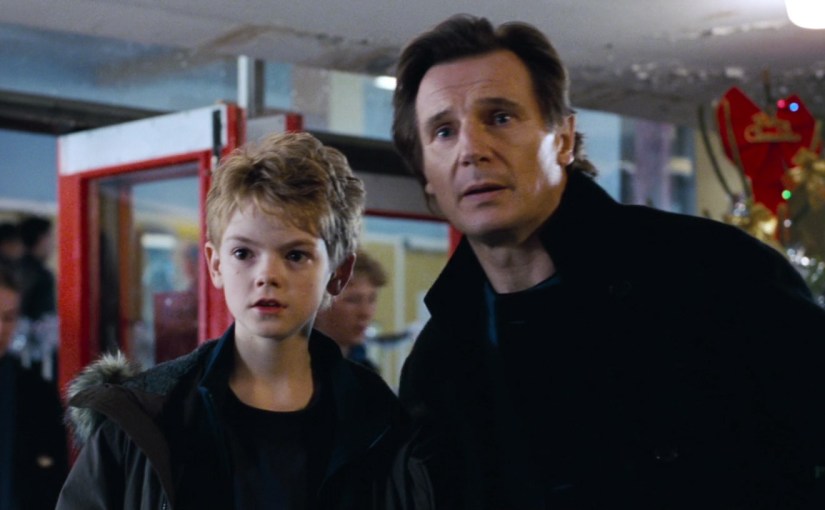
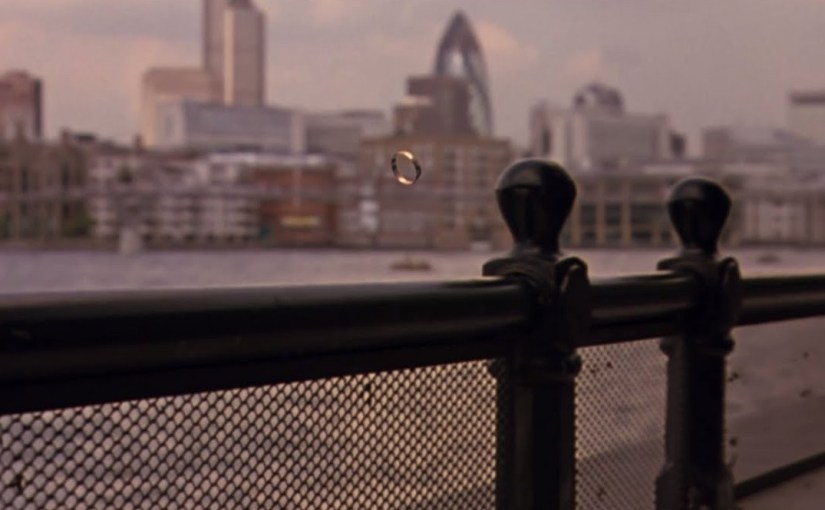
Love, Actually is like a warm favorite blanket to snuggle up in. Richard Curtis writes and directs a collection of the greatest British actors (along with American Laura Linney) in a kaleidoscope of love and relationships against the backdrop of beautiful London, England during the five weeks leading up to Christmas.

I won’t list my favorite characters or actors. In a film this treasured, this loved and this appreciated, that would be like picking your favorite child. It’s impossible when every single storyline is perfectly executed with thought and tenderness.

The stories of love uncovered, love that’s lost, love based in friendship, and love drowning in heartache beautifully jump from one to the next and then back again. Curtis is wise to not show all of the facets of each story early on. Some stories reveal more about themselves later that’ll leave you hurting for those that are not so merry and those that offer plenty of cheer.

I’m especially happy that Curtis did not compromise in the language or subject matter of his tales. Strong language at times makes for some memorable dialogue and nudity presents a normality to how we really are with those we have affections for.

It’s fair to say everyone in life experiences some variation of love. Yes! I mean everyone. Richard Curtis reminds you that love is a natural instinct, and so we can not focus on the easily recognized gloom of our world. To have these stories captured around Christmas time only enhances what we treasure, or what we wish we didn’t have to endure at times. Curtis’ blazing soundtrack helps along the way.

Love is hard. Love is challenging. Love will sweep you off your feet and love will destroy everything you thought you had. However, love will never leave you with complete regret. It’s never the love we have for someone that we regret. It’s only a wish to have it wholesome, healthy, happy and pure.

Love, Actually is all around.

LA LA LAND (2016)

by Miguel E. Rodriguez

Director: Damien Chazelle
Cast: Ryan Gosling, Emma Stone, John Legend
My Rating: 9/10
Rotten Tomatometer: 91% Certified Fresh

PLOT: While navigating their careers in Los Angeles, a jazz pianist (Gosling) and an actress (Stone) fall in love while attempting to reconcile their aspirations for the future.


SPOILER ALERTS! MULTIPLE SPOILER ALERTS!


La La Land was greeted by the American public in one of two ways.  There was no middle of the road.  You either loved it or hated it.

Critics loved it.  It broke records at the Golden Globes that year and was the odds-on favorite to win Best Picture at the Oscars (Moonlight took the prize instead, and deservedly so).

When it came to the viewing public, people were immediately divided into opposing camps, with each trying to convince the other they were wrong.  “It’s homage!” cried one camp.  “It’s derivative and sad!” cried the other.

Me?  I’m part of the “loved-it” camp.  And after re-watching it tonight, for the first time since seeing it in theatres, I have no plans to change my mind.

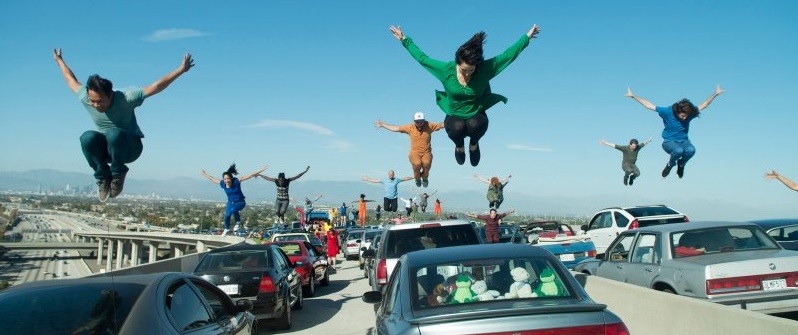
I once wrote that there is no movie more in love with “old Hollywood” than The Artist.  Well, La La Land is more in love with classic movie musicals, specifically, than any other modern movie in recent memory.  It opens with an astonishing musical number, “Another Day of Sun”, set on a Los Angeles overpass.  In a breathtaking feat of choreography and cinematography, scores of dancers perform nifty moves in and around a traffic jam, incorporating a live band inside what looks like a UPS truck, in one single take…or at least what LOOKS like one single take.  Could be some CG in there.  Who cares?  It’s awesome, and it sets the tone right away: this will be like one of those old musicals where people break into song and dance without warning.  You can stay where you are or you can leave now, but this is what’s happening.

After that, we settle in to a tried and true story of boy (Sebastian [Ryan Gosling], a jazz pianist who wants to start his own jazz club) meets girl (Mia [Emma Stone], an aspiring actress looking for a break).  This part of the story was old when Mickey Rooney and Judy Garland did it in countless other films, so yeah, I get it.  I can see why some folks called it derivative.

But that criticism neatly dismisses the underlying subplot about the Old vs. the New.  Sebastian desperately wants to start a jazz club that plays the greats – Monk, Coltrane, Davis – because, as he says in a passionate speech to Mia, jazz is dying.  Nobody wants to hear it anymore.  It’s old.  (He decries a nearby club that combines jazz, samba, and tapas, or some such nonsense.)  “They worship everything and value nothing,” he laments.

But Keith, a fellow musician (played by John Legend) tries to get him to see sense.  (“How are you gonna be a revolutionary if you’re such a traditionalist?”)  History is written by the people who strike out in a new direction.  Sebastian himself uses this philosophy with Mia, who has gotten tired of auditioning for the same teachers and doctors and coroners over and over again.  He tells her to do something different if you’re tired of the same old/same old.  She takes his advice and starts writing a one-woman play about her life.

And here’s where it gets cool.  While the characters in the movie are urging each other to embrace new concepts, La La Land still has one foot firmly in the past, i.e., the grand musical traditions of Gene Kelly and Fred Astaire and Cyd Charisse, etcetera.  Two later numbers stick out in my mind.  One is a twilight duet between Sebastian and Mia, shot on location in the Hollywood Hills when the sky is that perfect shade of somewhere-between-pink-and-purple.  They sing a little and then they do a beautiful dance together, but they’ve just met, so they’re careful to dance ALONE together…watch it and you’ll see what I mean.  Right out of Vincente Minnelli.  (Let’s be clear…Gosling and Stone are not exactly Fred and Ginger, but they do a damn sight better than I could do myself, so I give them props.)

Another number with classic-musical overtones is set during the first giddy months of their relationship.  With little or no singing (can’t remember which), we follow Sebastian and Mia as they tick off Los Angeles landmarks, finishing at the famous Griffith Observatory.  They enter the planetarium, and in a gloriously giddy moment of cinematic fantasy, they rise into the air and dance among the stars and galaxies before falling perfectly into their seats and sharing a kiss.  I no longer remember what I did the first time watching this movie, but this time around, I watched that whole sequence with a goofy grin on my face.  If you can’t enjoy watching people dancing in the stars, well…

At one point, Sebastian tells someone, “You say ‘romantic’ like it’s a dirty word.”  I like that.  This movie is, above all, romantic, in spite of how it ends.  It’s romantic in the sense that it revels in the unreasonable, illogical hope that everything will work out okay in the end.  Sometimes it does, sometimes it doesn’t, but that doesn’t mean you can’t still dream.  (There’s even a song about this exact thing, sung by Emma Stone in a sequence near the end that oozes romance and heartbreak.)

But all of this is nothing…nothing…compared to the emotional roller-coaster of the last thirty minutes of the movie.  It’s here that La La Land gets all serious in the middle of the fluff, because it explores the nature of success and what is necessary to achieve it.  Sebastian is touring with a band that pays well…but it’s not exactly a jazz ensemble.  Mia is just about ready to give up acting…until a casting agent gives her an opportunity to star in a movie shooting in Paris for four months.  These two characters, for whom the audience has been rooting for the previous 90 minutes, are on a downward spiral, and the only way to save their relationship would be for one or the other to completely give up on their dreams.  But neither of them would ask that of the other.  So they go their separate ways.

WHAT?  After all this they don’t wind up together?  Well…what would you have preferred?  An ending that awkwardly keeps them together, with him, say, playing jazz in a French club while she shoots a movie in Paris during the day?  Enjoying success together?  Having kids?  Sure, that kind of ending is POSSIBLE.  (In fact, in one of the many highlights of the movie, you even get a tease of what that might have been like.)  But, hey.  Isn’t that just the traditionalist way of looking at things?  Why not strike out in a different direction?  Do something no one’s doing.  End your movie where each character gets what they’ve always wanted their entire lives…even if that means they don’t get each other.

Boy, that last sentence sounds harsh.  But that’s what this movie’s about, and I think the film’s detractors simply couldn’t get past the grand tradition that demands the two leads wind up together.  They wanted Singin’ in the Rain, and instead they got the musical equivalent of The Remains of the Day.  (Maybe not quite that extreme, but I trust the point is made.)

ANYWAY.  Like I said, I just finished watching this a couple of hours ago, and I am no less convinced of its greatness.  Even though it’s a wrench watching their relationship head towards the rocks, the movie makes up for it at the end with half an hour of glorious, emotional catharsis that left me feeling wrung out, but in a good way.  It’s not quite a tragedy, but not quite a comedy.  Like life itself, it falls somewhere in between.

THE ARTIST (2011, France)

by Miguel E. Rodriguez

Director: Michel Hazanavicius
Cast: Jean Dujardin, Bérénice Bejo, John Goodman, James Cromwell, Penelope Ann Miller, Missi Pyle, Malcolm McDowell
My Rating: 10/10
Rotten Tomatometer: 95% Certified Fresh

PLOT: A hugely popular silent film idol must adjust to culture shock when “talkies” suddenly invade the movie business.


Is there a movie more in love with the First Golden Age of Hollywood than The Artist?  I can’t think of one.  Sunset Blvd. comes close, but that was a caustic commentary on the heartless tendencies of studio executives to reject the Old and embrace the New.  The Artist covers the same ground, but in a much more comic fashion.

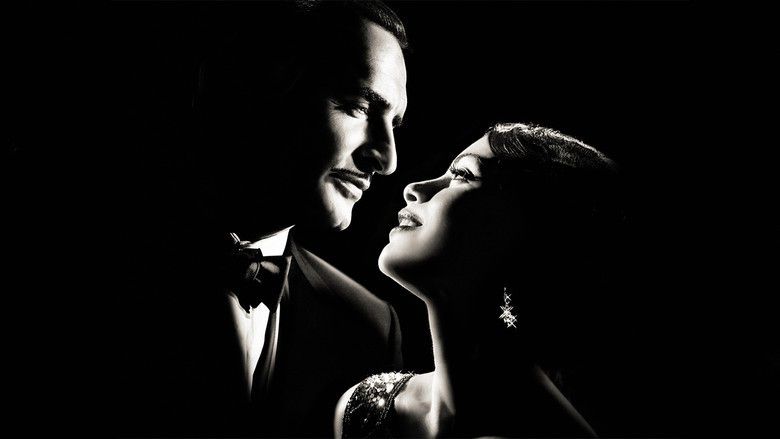
Not to say The Artist pulls its punches.  Not at all.  It tells the story of a silent film idol, George Valentin (Jean Dujardin), who has a meet-cute with a fan, Peppy (the stunning Bérénice Bejo), outside of a movie theatre.  Long story short, she becomes a bit player in numerous silent films and eventually becomes a superstar when the talkies take over Hollywood.  And George?  He struggles, as so many other silent actors did, to acclimate himself to a brave new world where faces and title cards aren’t enough anymore for an audience who is always looking for something new.

And, oh, yeah, did I mention The Artist is itself a silent film?  Shot in black and white?  Filmed in the old 1:33 aspect ratio?  Yeah.  It’s actually pretty cool.  It takes a little while to get used to seeing modern actors moving their mouths and not hearing their voices, but after a while, my brain acclimated itself to this “new” way of watching a movie.

As I was saying, The Artist doesn’t pull its punches in exposing Hollywood’s appetite for the New (in ways I don’t want to give away here), but it is still far more whimsical and audience-friendly than Sunset Blvd.  I’d compare it more to Singin’ in the Rain, if I had to compare it to anything at all.  But The Artist is a singular achievement, and well worth the Best Picture Academy Award for 2011.

There are two scenes in particular that elevate The Artist. In one, Peppy, who has always adored George from afar, finds herself alone in his dressing room.  She spots one of his jackets hanging on a coat rack and embraces it, imagining his arms inside it.  She then slips one of her own arms into the jacket, and voila!  She has a brief love scene where it really feels like she’s interacting with another person’s arm.  It’s a little hard to describe, but the effect is magical.

The second scene is one of my favorite scenes of all time.  George has just gone to see one of Peppy’s new films, a talkie.  The audience loves it, but he is still resistant to the idea.  He retreats to his dressing room, but something bizarre happens.  Remember, up until now, the movie has been completely silent (except for a musical score).  But this time, when he puts a glass down on a table…it clinks.  He stares.  What the heck was that???  He does it again.  Clink!  What’s going on???  He picks up a comb and drops it.  Thunk!  What the hey?!!  He opens his mouth to yell…but nothing comes out!

It’s a wonderfully comic moment, and a perfect way to demonstrate George’s anxiety at what this new technology will mean for him.

The more I think about The Artist, the more I’m realizing that the only way to properly discuss it is to go almost scene by scene, and I certainly don’t want to go down that road, especially for anyone who may not have seen it.  I mean, there’s the dog, George’s butler, the release date for one of his movies (October 24th, 1929, oh dear), the auction, the fire, and the deliriously happy ending, the kind of ending that tends to only exist in movies.

That’s really all The Artist is.  It’s an efficient engine designed to pull at our heartstrings and deliver a feel-good ending after teasing us with darker possibilities here and there.  The fact that it’s black-and-white and silent is a bonus, especially for film buffs.  It may not be realistic, but when it comes to Hollywood’s Golden Age…I mean, who really cared about realism back then?  (Back then, they didn’t need words, they had faces.)

LONG SHOT (2019)

By Miguel E. Rodriguez

Director: Jonathan Levine
Cast: Charlize Theron, Seth Rogen, June Diane Raphael, O’Shea Jackson Jr., Bob Odenkirk
My Rating: 8/10
Rotten Tomatometer: 81% Certified Fresh

PLOT: Secretary of State Charlotte Field (Theron) hires an out-of-work journalist (Rogen) as a speechwriter; when romance unexpectedly occurs, complications ensue.


So, yeah, based on that plot summary, this is not exactly new territory.  We essentially have a gender-swapped The American President, except the President is now a Secretary of State, and Annette Bening is now Seth Rogen, whom the Secretary of State used to babysit in high school.  Sounds kinda kooky, but still nothing earth-shattering, right?

Except that the filmmakers have found a way to take a plot as old as Pretty Woman itself, and as recent as She’s Out of Your League, and inject it with astonishing humor, topical and situational, so that I found myself laughing or grinning through nearly every second of Long Shot.  And that was WITH Talky McTalkerson sitting next to us commenting to himself on the action.  (“How are you gonna say no to that face? … Oh, no, they’re stoned! … Oh, no, he doesn’t understand her!”)  But that’s another story…

I enjoyed so much in this movie, it’s hard to pick it apart for a review.  I’m not sure why.

I liked the gender-bending aspect of it.  It was cool to see a high-octane actor like Charlize Theron deliver the kind of speeches normally reserved for male romantic leads.  And it wasn’t done in an obvious way.  It’s something that only occurred to me after the scene was over.  Most of the time.

I liked the topical aspect.  Seth Rogen’s character is a high-minded reporter working for a liberal newspaper that has just been bought out by a multi-media conglomerate with a reputation for spewing propaganda.  (“Not the good kind, like ours!  The BAD kind!”)  The conglomerate is owned by Parker Wembley, an obnoxious billionaire whose influence extends all the way to the White House.  (I wouldn’t dream of revealing who plays Wembley, but it was a treat once I realized who was under all that makeup.)

The not-so-thinly veiled jabs at Fox News were a nice touch.  Wembley has his own news network, and one of the newscasts asks the question, “Are women smart enough to be in positions of power?  We’ll ask our panelists, Chris Brown, Jeremy Piven, and Brett Ratner.”  (In a movie full of funny lines, that might be the funniest.  Sorry I spoiled it for you.)

I also LOVED a scene between Seth Rogen and his best friend that gets a LITTLE political, but which really made me think about my own attitudes towards people with different political beliefs than mine.  I don’t want to spoil the scene with too many details, but I bring it up just to emphasize how much this movie has going for it besides the obligatory big laughs.

And it has some BIG laughs.  Rogen is an old hand at physical and raunchy comedy, but who knew that Charlize Theron would be able to keep pace with him?  It’s not that she does the same kind of mugging that Rogen does.  It’s the way she underplays her reactions to his behavior, and tries to keep her attraction to him low key for all sorts of reasons that make sense at the time.

Plus, Theron does get her moment in the comic spotlight when, after a hard day at work, she whispers to Rogen, “I want to smoke a molly.”  What follows is something I never thought I’d see: Charlize Theron getting wasted on drugs and dancing at a rave.  I can die happy.

(Trust me, I’m not spoiling too much, because this scene has an AMAZING comedy payoff that had me almost screaming with laughter.)

Long Shot covers some very old territory in very new ways.  There are some amazing insights into the cultural landscape of the late “20-teens” that are fresh and funny and surprisingly thoughtful.  If I had to change one thing about it, I might have tried to come up with a SLIGHTLY different ending, maybe one that didn’t tie everything up QUITE so neatly, but what am I saying?  It’s a romantic comedy.  Like they’re gonna make a rom-com where the girl DOESN’T get the guy, right?

(Yes, wiseguys, I know there are precedents – Roman Holiday among them – but that’s REALLY rare.)

BROKEBACK MOUNTAIN (2005)

By Miguel E. Rodriguez

Director: Ang Lee
Cast: Heath Ledger, Jake Gyllenhaal, Randy Quaid, Michelle Williams, Anne Hathaway
My Rating: 10/10
Rotten Tomatometer: 87% Certified Fresh

PLOT: The story of a taboo romantic relationship between two cowboys, and their lives over the years.


Brokeback Mountain is the kind of movie that makes me wish I was a better communicator, like Lost in Translation.  I know I love these movies, I know WHY I love these movies, but it’s difficult for me to put into words.

Brokeback is, of course, the movie that will forever be known among the snark peddlers as “that gay cowboy movie,” which is insultingly reductive.  That’s like referring to Star Wars as “that space movie.”  To reduce the movie to those terms is to totally ignore the boundless riches to be had by watching it, I mean really watching it.

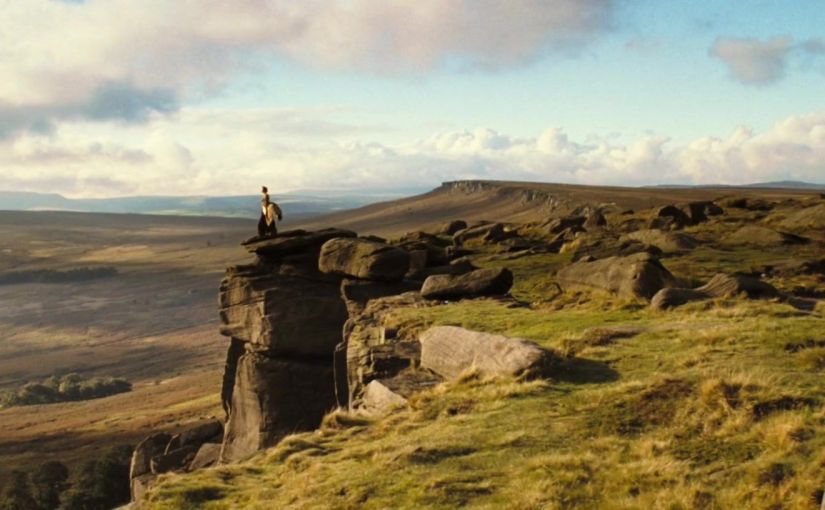
For one thing, damn, just LOOK at it.  Look at the way the skies fill the frame, with clouds hanging heavily over the mountains and the dusty streets and the trailer parks.  Director Ang Lee makes the sky into a tangible character all its own, much like Kubrick did with the Overlook Hotel.  It infuses every outdoor scene with a sense of the largeness of the world around us.  It’s a fitting backdrop for the intimate story presented to us.  In fact, those huge scenic backdrops are kind of a throwback to the ‘70s, to the films of Cimino and Arthur Penn and Bertolucci, when painting a picture with the camera was two-thirds of the story.  Virtually every outdoor scene in Brokeback Mountain is worthy of framing in an art gallery.  Stupendous.

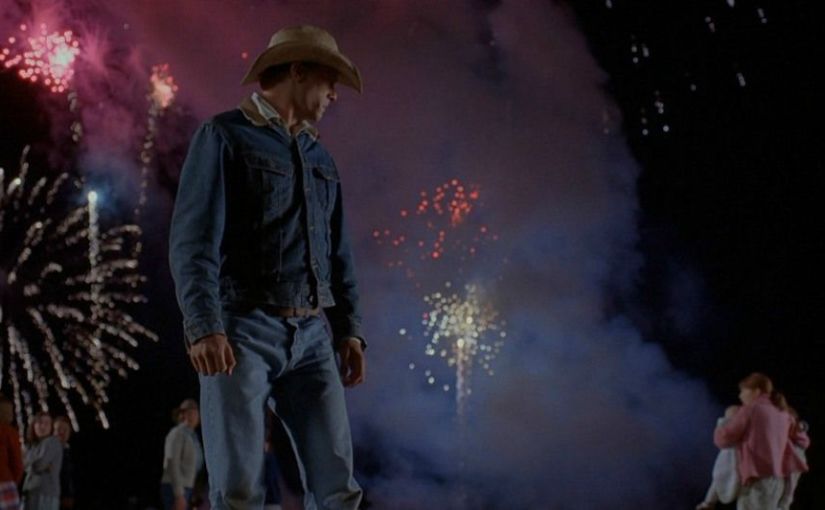
The movie turns on the story of two men who unexpectedly and passionately fall in love in 1963, a time when gay love was still taboo, at least in polite society, and especially in any given cowboy community.  But as the story winds its way through almost twenty years in the lives of these men, it becomes less about the FACT of their affair, and more about the enormous sense of yearning and loss that comes from desperately wanting something that you can’t have.  Who among us has never felt that kind of insane desire?  Not necessarily for a person, even, but for anything at all?  A crippled man who longs to walk, or a blind man who yearns to see.  A dream job.  A dream vacation.  That’s what this movie is about.

Heath Ledger delivers the performance that really put him on the map.  His portrayal of Ennis Del Mar is incredibly subtle, although his Western accent flirts with impenetrability at times.  I love the way he shambles and mumbles through his role, virtually the entire movie, which pays off in that fantastic scene by the lake (“I wish I knew how to quit you!”) when this hulk of a man is torn down by his own unspoken passion.

Again…I’m not a poet, so this really doesn’t quite get at the mood generated by the movie.  It’s no feel-good film, that’s for sure, but it’s worth seeing by anyone who loves world-class storytelling.  Don’t let anyone, or your own preset notions, steer you different.

MATCH POINT (2005)

By Miguel E. Rodriguez

Director: Woody Allen
Cast: Jonathan Rhys Meyers, Scarlett Johansson, Emily Mortimer, Brian Cox
My Rating: 10/10
Rotten Tomatometer: 76% Certified Fresh

PLOT: At a turning point in his life, a struggling, engaged tennis instructor (Rhys Meyers) falls for an aspiring actress (Johansson), who also happens to be engaged…to his soon-to-be brother-in-law.


Watching Match Point is as exhilarating as any moviegoing experience I’ve ever had.  It’s pure soap, much like its uncredited (but obvious) inspiration, 1951’s A Place in the Sun with Elizabeth Taylor and Montgomery Clift.  But a crucial decision is made by the main character in Allen’s film that shifts everything into darker territory more comparable to Hitchcock than George Stevens.

One of the best things about the film is the editing.  It’s not a short film, clocking in at just over two hours, but everything feels pared down to the bare essentials.  The passage of time is indicated in efficient pans or quick cuts.  Unnecessary conversations are cut short.  Winter changes to spring in a single fade.  Allen wastes no time in getting to the meat of the story, and it makes for a film that hurtles along breathlessly.

The performance by the lead, Jonathan Rhys Meyers, is also a key factor.  Watching it again for the first time in quite a while, I was struck by how measured his deliveries are.  There’s nothing wrong with it on a technical level, but it always feels like he’s acting or performing.  Even when his character, Chris, interacts with his girlfriend who eventually becomes his fiancé, nothing he does feels real.  It’s almost distracting, how theatrical his performance is compared to everyone else’s.  I was thinking, “Well, I guess Rhys Meyers is the best they could get to stay under budget.”

EXCEPT…when he meets Scarlett Johnasson’s character, Nola.  Only then do his eyes and face reflect the lust in his words.  They flirt fiercely for about a minute before they’re interrupted, but the damage is done.  He’s hooked.  And it’s at THAT point I realized the “staginess” of his acting in previous scenes was intentional, because his character WAS acting.  Chris is ALWAYS putting on a performance for everyone around him, except Nola.  With Nola, we see the real Chris, the focused, hungry Chris who will stop at nothing to get what he wants.

It’s a brilliant layer to a brilliant film.  Woody Allen has created a movie that starts out exactly like so many of his previous character-driven art-house films, so much so that we never suspect the surprises in store.  For the score, he chose stock opera recordings, really OLD opera recordings that sound so scratchy I wonder if any of them were actually being played on the old Edison cylinder players.  It’s the PERFECT topping.  It creates a uniquely Allen-esque atmosphere that lulls us into the feeling that, well, I know where THIS is going.

But I assure you, you don’t.

Pay particularly close attention to the various discussions of luck peppered throughout the film.  At multiple milestones in the film, luck plays a HUGE part, not always for the good.  Are these plot conveniences?  Well, how much of our own lives are governed by luck, good or bad?  An acquaintance of mine was killed in a wreck where a truck toppled onto him from a highway overpass.  Another was killed because someone was driving at night with no headlights.  Another friend contracted breast cancer, but is now in remission.  I have two uncles who last cancer battles.  Yet another acquaintance, the daughter of a friend, beat childhood leukemia.

Luck is inextricably linked with our existence, to the degree that it’s a little frightening.  We can bitch and moan about plot contrivances in movies and convenient phone calls and the rest, but if you step back, everything in existence is a contrivance: random meetings and phone calls and stoplights that keep us from hitting that pedestrian, and missed flights on airplanes that end up crashing, etcetera.

That’s REALLY what Match Point is drilling down to.  We live our lives, we play our roles, we follow the scripts WE choose…or are they chosen for us? Even without the backdrop of luck as a metaphysical discussion, the movie is an absolute top-notch thriller, one of the best of 2005, or any year, for that matter.  But it’s that next level hanging in the background that makes it my favorite Woody Allen film.

PRIDE & PREJUDICE (2005)

By Miguel E. Rodriguez

Director: Joe Wright
Cast: Keira Knightley, Matthew Macfadyen, Rosamund Pike, Carey Mulligan, Donald Sutherland
My Rating: 9/10
Rotten Tomatometer: 86% Certified Fresh

PLOT: Jane Austen’s immortal novel receives yet another makeover, with Keira Knightley as the headstrong Elizabeth Bennet, who finds herself reluctantly falling for the brooding, distant Mr. Darcy.


The words “sumptuous” and “painterly” came to mind repeatedly while watching director Joe Wright’s delightful version of Pride & Prejudice.  Much like Kubrick’s Barry Lyndon, the images in Pride & Prejudice appear lifted from paintings of landscapes and portraits you’d find hanging in any given museum.  The details are as stunning as anything you’d find in a Merchant Ivory film.  It’s just gorgeous to look at.

The screenplay clips along at a nice pace, and the English accents are a tad thick at times, so you’ll definitely want to be paying close attention to the dialogue.  While the cinematography is masterful, this is above all a film of words.  It’s not exactly Shakespearean, but there are times when sentence construction coils on itself like a highway cloverleaf.

Other random thoughts:

  • The casting of Keira Knightley is utterly perfect, but Matthew Macfadyen looks JUST a shade too old for her, although it’s entirely possible that was normal for the period.  Who WOULDN’T fall in love with this woman?
  • Carey Mulligan makes her screen debut in this film as one of the Bennet sisters.  Both she and Jena Malone are suitably obnoxious and giggly playing teenage girls, but they do look a little too old for the part.  Just sayin’.
  • Donald Sutherland is magnificent as the patriarch of the Bennet family.  His love for his wife and daughters is supremely evident, as is his frequent exasperation at their nattering and chattering.  His somewhat frazzled wardrobe is the perfect indicator of his inner self.
  • I just have to mention the cinematography again here.  There are one or two long takes (not Goodfellas long, but long nevertheless) that are like a master class in conveying information using minimal dialogue.  It doesn’t hurt that the costuming and production design are flawless.
  • Two words: Judi Dench.  Reportedly, the director convinced her to be in this movie by writing her a letter in which he stated, “I love it when you play a bitch.”  She delivers in spades.
  • In today’s world, I wonder what folks would think of Mr. Darcy’s actions.  He falls for Elizabeth, but she rebuffs him when she believes he ruined her sister’s prospects of marriage.  He then proceeds to assist her family enormously, but behind the scenes, and then tells her, “Surely you must know…it was all for you.”  Today’s PC watchdogs might call that stalking.  Discuss.

As a general rule, I am not a huge fan of Jane Austen adaptations.  It is a measure of the quality of this movie that I felt compelled to make it part of my collection (along with Ang Lee’s Sense & Sensibility and Patricia Rozema’s under-appreciated Mansfield Park).  As period pieces go in general, I would rank it comfortably with Amadeus and Barry Lyndon.  It’s a gem.

ANNIE HALL

By Marc S. Sanders

Some of the best comedy comes from watching the suffering of others. One of the best examples of this is Woody Allen’s Best Picture winner Annie Hall. Allen directs and stars in the film, and the suffering his character Alvy Singer endures is by his own mindset. Alvy could never be happy unless he is finding another opportunity to be unhappy. At one point he marries a terrific girl played by Carol Kane. Yet that doesn’t work out. As a child, he finds an allegorical reason to live his life as he does by riding the bumper cars where his father works on Coney Island. Alvy just sees life as one crash after another.

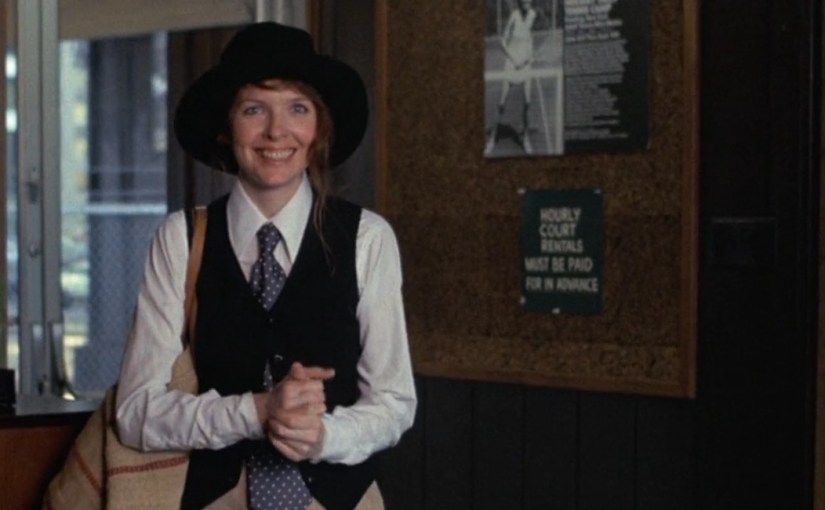
Neurotic doesn’t even begin to describe what Alvy puts himself through. Most especially he becomes insecure with himself as he dates Annie Hall (Diane Keaton, who won her Best Actress Oscar for arguably her best career role). Annie is fun loving and a little flighty. Still, there’s nothing not to love about Annie. She wants to be a singer and Alvy showers her performance with compliments despite a very rough bar crowd. However, when Annie gets reassurance of her talent from others, Alvy is not so encouraging to advance a promising future for Annie.

We see a handful of women that Alvy dates, but most of the ninety minute film focuses on Alvy’s relationship with Annie. Woody Allen penned the script with Marshall Brickman as a loose interpretation of the real life relationship he had with Diane Keaton.

Alvy is a mess. As a child he frustrated his mother with the idea of world ending events yet to come, and thus not much reason to apply himself for a fulfilling life. As an adult, he can’t even wait patiently in a line for a movie because the gentleman standing behind him is aggravatingly wrong on his viewpoint of the films of Marshall McLuhan. The best response to a hilarious scene like this is realized by actually welcoming the real life McLuhan into the frame of the picture to tell off the snobbish jerk standing behind Alvy. I must admit I never heard of Marshall McLuhan myself. Still it’s the idea of running through with a depicted scene like this that’s so dang hilarious. Wouldn’t it be so satisfying to any of us to just have our heroes interrupt a conversation to shamelessly put down our enemies?

That’s what makes Annie Hall a much more special romantic comedy than anything before or thereafter really. Woody Allen breaks the fourth wall at times. He welcomes his adult self into his childhood classroom to debate with his elementary school teachers. Later, he tries to provide a source to his neuroses by bringing both Annie and his best friend Rob (Tony Roberts) into his home to see the relatives Alvy grew up with. These intrusions into scenes of Alvy’s childhood are daringly funny and like nothing I’ve ever seen.

Alvy’s neuroses are so intense that he’ll randomly stop people in the middle of New York to inquire about their sexual experiences. He even unloads his endless dialogue of some of the greatest wit on a horse being ridden by a police officer.

Keaton is perfect for Allen to play against. There’s the hilarious moment of the two of them trying to boil live lobsters. Just between the two of them they are going to be cooking SIX LOBSTERS. Why six? Who cares? The point is to demonstrate a hilariously loving memory at being surrounded by creatures they are both terrified to handle. One lobster even crawls behind the refrigerator and that’s an amusing problem. Annie takes advantage of getting action photos of Alvy with the lobsters. Later in the film, we see that Annie has displayed a collage of this moment on her wall.

Alvy and Annie know they don’t belong together. Yet, it’s hard for them to live without one another too. Annie feels no choice but to call Alvy over at three in the morning to get rid of a spider in her apartment. Alvy obliges without hesitation to leave the bed he’s sharing with his current girlfriend to rush right over to Annie’s aid.

The trying misery they have within themselves is what keeps Annie Hall alive. Interestingly enough is that Allen and Brickman write in a conclusion for the relationship between Alvy and Annie, and show their respective aftermaths. Alvy is a professional stand up comic. Annie dreams of being a singer. What comes of their destinies is refreshing.

I don’t think I could be a close friend to Alvy or Annie. I’d get tired of their ongoing kvetching. That certainly doesn’t mean I don’t like them. I love them actually, and I want them to be happy. Maybe Annie ends up being happy following the events of Annie Hall. For Alvy, I know for sure he’ll be happy so long as he continues to be miserable, and that’s completely fine with me, and I’m certain that’s completely fine with Alvy too.

UNDER THE CHERRY MOON

By Marc S. Sanders

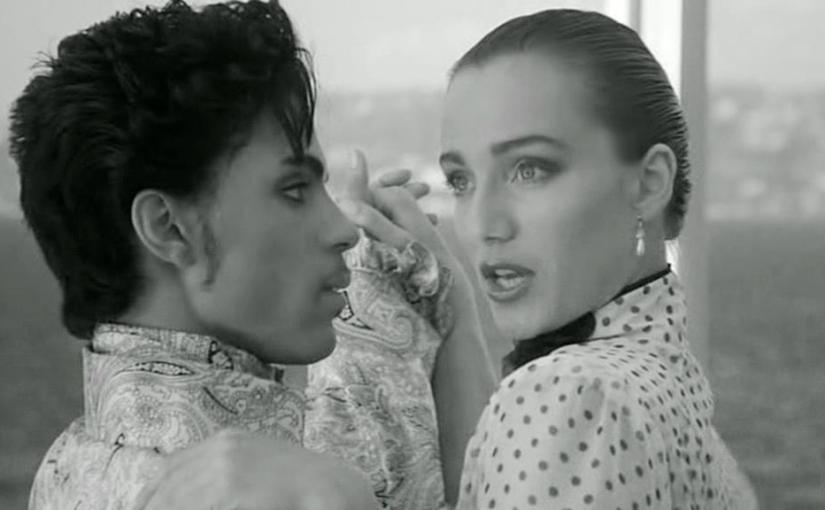
Prince!  The vanity on this guy!!!!!  Watching his second film, Under The Cherry Moon, is to indulge in Prince’s pride, Prince’s ego, Prince’s conceit, Prince’s vanity.  The Purple One, of which I’m an admitted fan of his music, directs his own picture here in beautiful black and white cinematography, compliments of Michael Ballhaus.  That is where the accolades end though.

The film is set along The French Riviera.  Prince never speaks French in the film, nor does anyone else.  So why are we in France again?  He plays a kid named Christopher and along with his best pal, Tricky (musician Jerome Benton) spend their days glorifying Christopher (or Prince as Christopher) and swindling wealthy heiresses as they continue to live a life decadence in outrageous outfits, high heels and a modicum of makeup to especially keep Prince-I’m sorry-Christopher looking gloriously sexy, pretty and handsome.  At night, while putting on music acts in various drinking establishments, they seek out their female prey. 

When Christopher notices Mary (Kristin Scott Thomas, in her feature film debut), he and Tricky go to work.  Somehow Tricky falls instantly in love with Mary.  (I think.  The two hardly have a scene alone together.  Prince monopolizes most of the space.)  Chris plays the “Prince Adonis” with teasing flirtations, ridiculous get ups and so on.  Later, he will fall in love with Mary.  We are supposed to believe Mary falls in love with Chris too.  But let’s come down to reality here, please.  Tricky grows angry and blah blah blah.  You’ve seen this tripe in better fare from the minds of Looney Toons shorts.  A side story character is Mary’s wealthy possessive father, Isaac (Steven Berkoff, playing the same kind of villain he did in Rambo and Beverly Hills Cop).  What do you think he’s here for?  Right!!!!!  He disapproves of Christopher and refuses to let Mary see him.

Beyond the terrible acting of this piece with vomit inducing kissing scenes involving Prince and Thomas, the film is an annoying, pesky love letter from Prince to Prince.  It’d be impossible for me to count how many close ups he does of himself.  Prince is a poet and a brilliant lyricist as well.  However, the script is littered with expressions and slang that feels like they popped into Prince’s head at one time or another.  He must have jotted it down on napkins, and then he passed it all on to the credited screenwriter, Becky Johnston,  instructing her to work this stuff into the dialogue.  Things are uttered out of nowhere, for no reason.  Conversations don’t make sense at times.  Certain words feel like the have a good rhyme.  So, make it work Becky! Mmmkay!

On other occasions, Prince and Kristin Scott Thomas will share scenes together just sitting there with nothing to say, as if it is a director’s (Prince’s) own artistic choice.  Prince is no Terrance Malick.  The gaze and the pose (of Prince!) says it all.  Calvin Klein commercials have more depth.  A phone call scene between the two goes on for a good three minutes.  They never speak into the phone.  They just hold it to their ears.  The edit goes back and forth on them and again…they don’t speak!  Prince makes it exciting by chewing on a cracker.  In another film, this would’ve been cutting room floor material.  You would think this is behind the scenes stuff and the actors were waiting for the sticks to snap and “Action!” to be called out.

Samples of Prince’s music are peppered throughout the movie.  The sounds are good for the most part, but that’s all they are.  Just random sounds.  Most of the music is not complete and seem like samples that were experimented on in a kid’s garage.  The music does not cue up anything.  None of it heightens any developments or drama or comedy.  At times the tunes will obnoxiously interrupt a scene, much like a mariachi band may intrude on an intimate dinner at a quiet restaurant.  Prince loves his music though.  So, he wakes up and tells his film/sound editors to put this and this and this into the film.  Context man.  Context!!!!!!!  What about the context?????

Under The Cherry Moon is an immature film, made by an immature filmmaker with a very mature photographer (Ballhaus).  It’s tripe of the most shamelessly vain kind.  It’s been three days since I saw the picture, and I have yet to think of another film more ridiculously conceited and egotistical.  My Cinephile colleague, Anthony, is a proud Prince fan.  He has a wealth of knowledge on the famed musician.  He’s learned to be forgiving of this film’s shortcomings.  I assured him when we sat down to watch this that I was going in with an open mind, especially when the gorgeous black and white shows up on the screen.  When the movie was over, however, I explained that this might have become something with an admirable B movie cult following, had Prince at least agreed to welcome another director to oversee the picture.  Someone needed to be watching the one in charge and humble the poor guy because if I want to look at various captions of Prince, all I need to do is lay out his album covers on my bed and pick up a Rolling Stone magazine.  I did not have to subject myself to Under The Cherry Moon.

FALLING IN LOVE

By Marc S. Sanders

It goes back to what I’ve always said. If you don’t have a good script, you got nothing. I don’t care if you have powerhouse actors like Robert DeNiro and Meryl Streep in the lead roles, as well as Harvey Keitel and Dianne Weist for support. Without a script without even just a crumb of intelligence, a film will be terrible. In fact, these magnificent actors actually did a romantic film together in 1984 called Falling In Love, and yes it’s got the talent and nothing to say.

This might as well have been a Ferrari with no oil and no gas. DeNiro and Streep are Frank and Molly who meet cute during a hectic Christmas Eve shopping spree in New York City. Director Ulu Grosbard sets up moments through the opening credits and a good long 20 minutes of the players actually crossing paths on the train and then various streets and stores in the city, unaware of each other, before they finally collide their shopping bags with one another in Rizzoli’s Book Store. Wouldn’t you know it? After they’ve collected their things, they realize on Christmas morning that they took each other’s gift for their respective spouses. So Frank’s wife Annie (Jane Kaczmarek) got the book about sailing, and Molly’s husband Brian (David Clennon) got the book about gardening.

Since Frank and Molly ritually take the same train into the city, naturally they will circle back with each other. Frank is an architect working at a construction site, while Molly goes to visit her sick father in the hospital. They sit with one another, exchange phone numbers and have lunch together. A chance at kindling a romance arrives, but can they violate their marriages?

None of this is new. We’ve seen this a million times before. That’s not a reason to give it another try for a story like this. Only don’t make it so dull, and man o’ man is Falling In Love dull. REALLY DULL! Lifetime TV trash is more exhilarating than this.

The script from Michael Christofer has absolutely nothing to say. There’s no life to any of the dialogue. There’s no monologue offered for DeNiro or Streep to recite, that maybe would explore the conflicts they are having within themselves. There’s no time devoted to their connections with Kascmarek and Clennon, respectively.

Falling In Love is nothing more than a series of moments spliced together for Streep and DeNiro to just physically sit with one another. They go to Chinatown. So what? They don’t share any character dimension with themselves. They sneak away to Frank’s friend’s (Keitel) apartment to make love. The scene lacks any kind of passion or yearning. They sit on the train or god forbid fall in despair that they missed each other at the station. Falling In Love is only an empty void of a film.

I can’t compliment DeNiro or Streep because they are not given any tools to work with to bring those bravado performances we are so accustomed to. Christofer’s script gives them friends to talk to. Keitel goes with DeNiro. Wiest goes with Streep. Nothing is shared with these confidants. Keitel’s character is getting a divorce. So? It has no influence on DeNiro’s character. Wiest’s character is a wall to talk to. Nothing more. I know absolutely nothing about her.

What a let down this picture is. This could have been a Fatal Attraction or a When Harry Met Sally… for these two magnificent actors. There could have been, and should have been, something exciting here. It could have had humor, suspense, fear and heck…let’s just say it…love! Nothing is said of any significance. No moment is shown that grabs the viewer. There’s no big scenes to gear up for, and the ending is simply vague in its delivery. Falling In Love is like chewing on cardboard with no seasoning. It’s tasteless, boring, and I’ll remind you once again, it’s really, really, really dull.