NOTTING HILL

By Marc S. Sanders

Notting Hill written by Richard Curtis (Love, Actually) and directed by Roger Michell is a pleasant surprise of a romantic comedy. It’s not a perfect film but it certainly loves every one of its quirky supporting characters, as well as its two straight romantic leads played by Julia Roberts and Hugh Grant.

Grant plays Will Thacker who lives in the Notting Hill district of London where every proprietor is a charming little shop of some form or other; a quaint street where merchants appear on the sidewalks during the weekends selling their art or homemade jams or coffee products. Will owns a travel book shop located across the street from his flat that is whimsically recognized by its big blue front door. His wife left him for another man and now he’s relegated himself to living with a roommate called Spike (character actor Rhys Ifans doing a British equivalent of Cosmo Kramer, Seinfeld’s neighbor).

One day the superstar celebrity Anna Scott (Roberts) simply strolls into Will’s store. They have a quiet moment and he sells her a travel book about Turkey that he didn’t recommend she purchase. Moments later they run into each other down the street when Will spills orange juice all over Anna. From there, a meet cute relationship begins to unfold. It’s not so simple for the pair though as Anna’s enormous celebrity is hard to negotiate; hard for Anna, not hard for Will.

Anna is at ease when she can have a quiet dinner to celebrate Will’s sister’s birthday with his friends or when she can escape her turbulent life of gossip magazines and paparazzi by taking shelter at Will’s flat, even if grungy looking Spike walks in on her taking a bath.

I like Notting Hill. However, the quiet moments shared between Grant and Roberts sometimes carry on too long. Oh my gosh!!!! Will someone say something already????? Hugh Grant has made characters that trip over their words and stumble with what to say into a master craft. Julia Roberts is one actress that a camera loves especially when she’s distressed. A crying moment in any one of her films will milk the scene for every blush, or glassy eye or tear and whisper she can offer. She’s a terrifically skilled actress in almost any film she does. Eventually, we have to move on from all of this though. My patience for some scenes were just running way too long for me at times. Kiss already!!!! Make love already!!!! Scream at each other already!!!!

Fortunately, there’s much escape to be had with the supporting cast, especially Ifans as Spike who is the most absent minded, lovable, dirty underwear wearing and sloppy prig imaginable. Emma Chambers is just as fetching with her scarlet pigtailed haircut as Will’s sister, Honey. Tim McInnery, Gina McKee, James Dreyfus and Hugh Bonneville round out this madcap collection. The birthday dinner party is a great scene for this ensemble as a comedic but relaxed chemistry blends nicely during a competition to see who is suffering the most to earn the last brownie on the dessert plate. The group is unsure how to include a movie star like Anna in their simplicity but Julia Roberts pulls off a trick that even had me fooled. Simply put, for the whole cast, there’s just that much more life and vibrancy when they are all together and it’s not just relegated to only Roberts and Grant in a scene.

Another special moment occurs later when the couple have split up once again. To depict time fleeting by, Roger Michell offers up a transition of Will wearing one outfit but walking through the hustle and bustle of Notting Hill as the weather and seasons seamlessly change all around him from sunlight to rain to snow and spring sunlight again. You even get a glimpse of Honey starting a flirtatious relationship at the beginning of the sequence and by the time it’s over a minute later Honey is breaking up with the guy. It’s a wonderful moment of wordless narration to show Will’s struggle with moving on as time continues to pass by. More importantly, it allows the titled setting to be a character of its own. This is a great example of showing a lovesick character unable to move on while life has no patience to wait for him to catch up.

I like Hugh Grant and Julia Roberts whether it’s in Notting Hill or one of their many other fine movies. I can’t deny the chemistry they have in this film. It works. I only wanted a little more life to the material that was handed to them. Still, Notting Hill is charming and simply a very sweet romantic comedy.

PETER IBBETSON (1935)

by Miguel E. Rodriguez

Director: Henry Hathaway
Cast: Gary Cooper, Ann Harding, Ida Lupino
My Rating: 9/10
Rotten Tomatometer: No rating

PLOT: A successful architect who longs for the love of his childhood friend is delighted to discover that the Duchess who just hired him is in fact his long-lost beloved.  This being melodrama, there is of course much more to the story.


[SPOILERS FOLLOW]

Peter Ibbetson plays like a long-lost Dickens novel, full of melodramatic flourishes and convenient plot contrivances designed to play the audience like a grand piano.  Is it shameless?  Yes.  Is it maudlin?  Yes.  Do I normally like movies like this?  No.  But there is something about this film and its story that got around my defenses and into my heart and soul.  I’ll try to elaborate on that as much as I can, but I don’t know how well I’m going to do.  Good luck.

The story opens, as the title card helpfully explains, in the middle of the last century, which would make it somewhere around the 1850s.  Somewhere in a well-heeled French countryside, two children from neighboring British families play and quarrel with each other, Mimsey and Gogo.  (I am not making that up, though why parents felt the need to inflict those names on their children is utterly beyond me.)  Gogo, the boy, cruelly teases the girl, Mimsey, who nevertheless gives as good as she gets.  Unfortunately, Gogo’s mother dies after a long illness, and when a distant uncle arrives to take Gogo back to England, he realizes he doesn’t want to leave his precious Mimsey.  Together they try to run away and hide, but it’s no use.  The sight of poor Mimsey weeping in the branches of a tree as Gogo is finally taken away was one of the scenes that started to chip away at my armor of cynicism.

Time passes, and Gogo changes his name to Peter and takes his mother’s last name, Ibbetson.  He becomes a successful architect and a valuable asset for his employer.  (In a very Dickensian touch, Peter’s employer is blind…wholly unnecessary to the plot, but that specificity makes it feel even more realistic amid all the other melodrama.)  Peter is successful, yes, but he is unhappy.  He is a bachelor, and when a very pretty girl more or less hits on him at a museum back in France, he takes her for a drink as a matter of courtesy, not out of any real attraction.  His heart still belongs to the lost love of his childhood, you see.  Mimsey is the touchstone of his past, his Rosebud, his green light at the end of the pier, and she will not be easily eradicated.

Initially, I was unsympathetic to the adult Peter.  How can anyone get on with their life if they’re stuck in the past?  It didn’t work for Kane or Gatsby.  If there’s anything the last thirty or so years of my life has taught me, it’s that the past will only weigh you down if you let it.  I’m not suggesting one should literally forget history, but had I been one of Peter’s associates in the film, I would have been constantly reminding him about being grateful for the present rather than bemoaning the mistakes or regrets of the past.  That way lies madness.

Before I get into more story details, I should mention the style of the film and the acting, which is so mannered and stylized that it feels as if it were a silent film that had a soundtrack added as an afterthought.  Gary Cooper may be a legend, but in this film…let’s be blunt, he is no Cary Grant.  Every sentence feels as if it’s been dragged out of him by way of torture.  His charisma is based solely on his imposing height and his dashing good looks, NOT his speech.  (Sorry, I calls ‘em like I sees ‘em.)  The women are not much better acting-wise, though the Duchess of Towers does have some interesting moments.  However, one of the movie’s highlights are the cinematography and subtle visual effects, especially in the late stages of the film.  Look at that scene involving the peculiar qualities in the bars of the jail cell and explain to me 100% how that was accomplished.  It’s so understated and effective that it took me completely by surprise.  I believe it would raise eyebrows with TODAY’S audiences.

I mention all of this about the style and my mindset because I believe that it all contributes to the reaction I had to the film, at which I’m still perplexed.

One day, Peter is contracted to rebuild the stables of an aristocratic family, the Duke and Duchess of Towers.  When Peter first meets Mary, the Duchess, he experiences an unexplainable connection.  His contract requires him to live in the Towers house for several months.  One day they share a conversation and discover that they shared a dream.  This isn’t a case of two people dreaming about the same thing coincidentally.  They actually shared a dream, Inception style, but without the machinery.  How can this be?

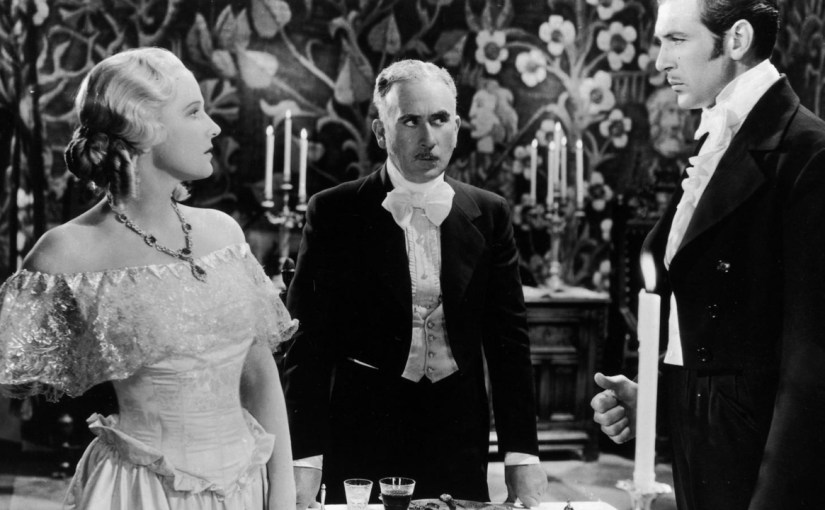
By now, any breathing audience member has already deduced that the Duchess is Mimsey and they are destined for each other.  Alas, Peter and Mary are not as quick on the uptake as we are, and their moment of recognition is delayed until after the peevish Duke confronts them at the dinner table, in a conversation laden with Hays-Code-era double-speak.  “Well, Mr. Ibbetson, are you to be congratulated again?” the Duke asks.  Later, during a second confrontation, the Duke points a gun at Peter and Mary and explains that they will not make love behind his back.  He raises his gun and says, “Get into your lover’s arms.”  Whoa.  Daring stuff for 1935.  It’s during this second confrontation that something goes horribly wrong, and Peter is sent to jail for life.

MORE melodrama?  Hasn’t this movie already had more than its fair share?  Children tearfully separated?  An equally tearful reunion?  Outrageous coincidences?  Shared dreams, for crying out loud?  Oh, you ain’t seen nothing yet.

It’s in the film’s third act, when our hero is in prison, that Peter Ibbetson really started to get to me at some primal level.  Peter and Mary, after being reunited against all odds, are now separated even more cruelly than before.  Peter is so distraught he goes on a hunger strike, chained to his “bed,” which is little more than a wide wooden beam.  (Look at it from a certain angle and he might almost appear to be on a cross, but don’t worry, it’s not that kind of movie.)  When one of his fellow prisoners makes a joke at Mary’s expense, Peter goes a little crazy and starts to throttle him.  Miles away, at the same time, Mary suddenly senses something is wrong.  In the jail, guards use force that’s a tad too excessive to restrain Peter, and at the same exact moment Mary screams.  The two are connected in a mystical way that transcends walls or distance.  They continue to share dreams in which they laugh and walk and talk as if nothing bad had ever happened.  In one dream, he points to a castle in the distance that he has built for his beloved.  I was reminded instantly of the scenes in Inception where Cobb and his wife Mal build entire cities for themselves in their own shared dream.

I’ve already given away too much, far too much than I usually care to.  As much as I want to, I can’t describe the one scene that got me to literally yell, “NO!” at the TV screen.

What fate eventually befalls Peter and Mary, I leave for you to discover.  What remains for me is to try once again to summarize how I felt after the movie was over.  Intellectually, I can see its shortcomings.  The acting is wooden, despite some pretty sharp dialogue.  The music is overwhelmingly romantic and dramatic, commenting on a lot of action unnecessarily, as was the custom back then.  There are one or two odd cuts.  But on an emotional level, the experience of watching Peter Ibbetson was like watching one of Shakespeare’s tragedies.  The only other movies that ever made feel these precise emotions, although not to the exact same degree, are The Remains of the Day and Atonement.  If you know those movies, you know what I’m talking about.

The movie’s final shot is as shamelessly manipulative as these things get.  It’s unabashed romanticism at its best AND its worst.  But you know what?  This movie earns it, and it works.

THE LOST CITY

By Marc S. Sanders

Sandra Bullock’s film The Lost City is nothing more than rollicking fun at the movie theater.  A popcorn movie.  You can simply focus on gorging yourself with endless amounts of popped kernels and large fizzy drinks and you’ll never find yourself lost in a complex plot.  It’s a screwball adventure in the same vein of Romancing The Stone.  What I appreciate is that it is not a duplicate blueprint of Romancing The Stone.  Maybe just the opening scene, but no matter.

Bullock is Loretta, a reclusive romance novelist, who knows that her books are nothing more than cheesy pulp material to the umpteenth degree.  Her agent Beth (Da’Vine Joy Randolph) keeps a positive attitude as she encourages a book tour to promote Loretta’s newest installment in a series that follows the adventures of Loretta’s fictional swashbuckler.  That hero is preserved on the covers of her novels in the image of fashion model, Alan (Channing Tatum) – a Fabio inspiration.  Alan dons the gorgeous blond locks wig with the beefcake chest and the fans seem to go wild for him more than they do for Loretta’s work.  Even the glittery purple jumpsuit with stiletto heels that Loretta dons for an appearance at a book fair doesn’t deter the screaming fans away from Alan’s muscular build and chiseled chin.

When Loretta is captured by a spoiled brat of a villain known as Abigail Fairfax (Daniel Radcliffe), she finds herself having to research the location of a lost city on a remote island rumored to possess treasures beyond anyone’s wildest dreams.  Somehow, within Loretta’s fiction she implied the actual location of this place.  Abigail needs her to delve even further towards the destination.

This all sounds cliché.  It is, actually.  So what!

What saves The Lost City is the screwball comedic approach to the film.  Bullock and Tatum are nearly twenty years apart in age.  Yet, they make a great pair in the same way that Hepburn and Grant did in Bringing Up Baby.  I could care less about the actual lost city and whatever treasure was there.  The symbols etched on an old piece of parchment that Loretta attempts to decipher never mattered to me.  Two days after seeing the movie, I don’t even remember what the lost city revealed when they eventually got there.  I did like the endless pratfalls of Tatum and Bullock, however. 

Channing Tatum looks like the adventurer of a romance novel.  Yet, he’s nothing more than a pretty boy or a “mimbo” as Jerry Seinfeld might describe him.  He’s actually got a crush on Loretta and upon determining that she’s been kidnapped, he recruits the legendary problem solver Jack Trainer (who could only be encapsulated in the form of a gorgeously blond, tan and muscular Brad Pitt) to rescue Loretta.  It’s important to Alan, though, that he gets recognized as the savior.  So, he kind of learns as he goes. 

Adventures in the jungle abound.  There are bad guys on motorcycles.  Guns, of course.  Fires within Alastair’s luxury SUV. Rock climbing.  Rivers with leeches.  Dark caverns and on and on and on.  Yeah.  I’ve seen this all before.  Again, I say so what!  It’s just a fun time at the movies that brought me back to the fast-paced escapades found in the 1980’s films I grew up on.  Yet, it has its own spin thanks to the relationship of Alan and Loretta.

Daniel Radcliffe and his beard are also great characters.  It’s a nice departure from the shoe horned role that’ll never leave him as a certain boy wizard who will not be named here.  He just brings out his fun bratty side.  His beard seems to wink along with him.

A better side story could have come with Da’Vine Joy Randolph though.  As the agent goes from one traveling step to the next as she attempts to find Loretta herself, Randolph just doesn’t look comfortable in the role with her sky-blue pant suit and big breasted physique that is intentionally in your face.  Where’s the slapstick that should be accompanying her?  She’s specifically made up to look like diva luxury and you’re waiting for one disaster after another to befall her. Beyond having to fly on a puddle jumper plane carrying farm animals, she simply survives her trek unscathed.  Either this storyline should have been excised all together, or it should have been rewritten to be just as silly as what Bullock and Tatum are delivering.  A flop in the mud or a slip in the river would have helped this plotline. 

The Lost City is just a cute film for Sandra Bullock and Channing Tatum to look…well…cute together, and in a world where celebrities are slapping each other silly on live television, isn’t this a much better escape on a Saturday afternoon?

BULL DURHAM

By Marc S. Sanders

How Susan Sarandon did not even get nominated for an Oscar for Ron Shelton’s Bull Durham, I’ll never know. Shelton writes the character of the lustrous, Annie Savoy with grace, wisdom and silky sex appeal. It remains one of the best female characters to ever appear on a screen and no one else could have played the part other than Sarandon.

Shelton’s sensational script opens with Annie’s declaration that she believes in the “church of baseball” and from there it waxes poetic on the sport’s religion and traditions as Annie uses her charm to seduce the Durham Bulls’ newest talent, dim witted pitcher Eppy Calvin “Nuke” Laloosh (Tim Robbins) leaving the team’s experienced catcher Crash Davis (Kevin Costner) wanting more. That is until Annie realizes that she’s the one who wants more.

Davis is recruited to groom Nuke for the big leagues. Nuke has got a million dollar fast ball arm but he “…fucks like he pitches. Sort of all over the place.” Crash is the frustrated player with talent but the sun is setting on his opportunity for the big leagues. Dumb Nuke has a future that just doesn’t seem fair to Crash. Annie is no help when she chooses Nuke over Crash to hook up with for the season.

Shelton explores so many dimensions in his script. It does not solely focus on the three primary characters. The screenplay stirs in a mixture of what it’s like to serve on a minor league team with bats and gloves that are cursed, the urge for a rain out game or what present to get Bobby and Millie for their wedding. A call to the mound might settle some of these things.

Shelton directs his script with a very natural approach. Watch Crash and Annie flirt in a batting cage. Costner and Sarandon don’t even flinch as the balls whiz between them. Baseball is a part of these characters. They live and breathe baseball and they relish sex.

Shelton’s last 15 minutes of film offer a celebration of sexual release that appears pleasant, fun and somewhat religious as the chemistry between Costner and Sarandon remains strong. They rattle the whole house it seems and the kitchen will never be the same.

Robbins is great with his idiocy. He wasn’t as well known when this film was released in 1988. His surprise appearance of stupidity is so lovable and welcome. When he tries to think he gets himself in trouble. When he listens to his coaches, Annie and Crash, he excels. The pains he goes through upon their advice is ridiculously hilarious. Don’t forget to breathe through your eyelids, Nuke.

I also gotta recognize Robert Wuhl and Trey Wilson as the managers of the team. They are hilarious but not overt. Wuhl is great as he bellows out encouraging but incomprehensible cheers from the dugout. Wilson looks on with tired facial expressions.

This cast is invested in the cloth of America’s pastime. They know the batting averages. They read the signs. They play for the crowds. It’s as if Shelton moseyed into the town of Durham, North Carolina, put his camera up and watched how another season all played out. His lens could have been working with a documentary mindset.

Bull Durham is one of the best scripts ever written full of brilliant one liners and philosophies that I might not entirely understand what any of it is referencing. Yet when Annie or Crash carry on, I can’t help but suddenly get interested.

Bull Durham is the best baseball film ever made performed by an outstanding cast led by a director with a clear, wide-open vision.

Play ball!!!

KATE & LEOPOLD

By Marc S. Sanders

Fish out of water stories will always be told. Kate & Leopold directed by James Mangold reminded me of the New York City based romantic comedy Big, which was a better variation on that formula.

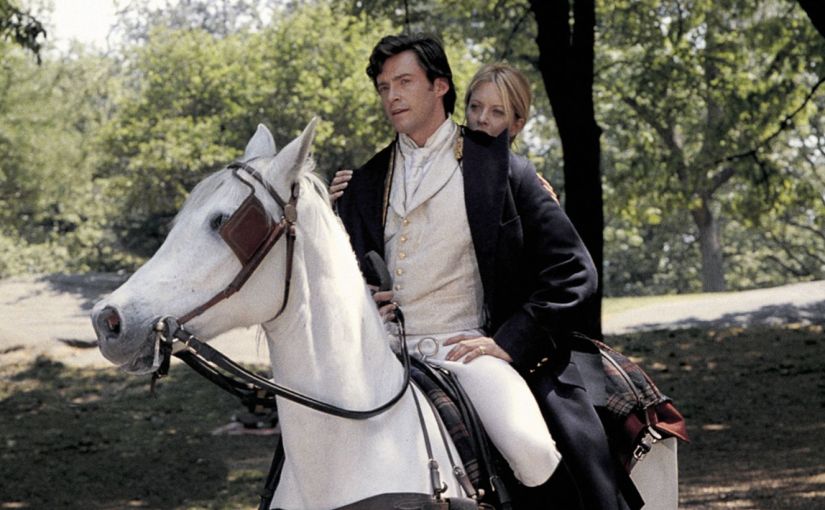
In Kate & Leopold, Hugh Jackman portrays the second title character also known as the Duke of Albany in the year 1876, and apparently the eventual inventor of the elevator. One night, he pursues a curious fellow who is attending an evening ball designed to find a bride for Leopold. The man runs and Leopold gives chase into the rain where they find themselves hanging from scaffolding of what will become the Brooklyn Bridge, designed by-you guessed it-Leopold. The moment of suspense ends with Leopold accompanying the fellow named Stuart (a very miscast Liev Schrieber) into present day New York; a New York unfamiliar to Leopold where manners of grace and elegance have gone out the window and you’re expected to pick up your dog’s poop following a walk.

Let’s get this out of the way, quick. Stuart has uncovered time travel. How does it work? Who cares? Move along.

Stuart’s ex-girlfriend and downstairs neighbor is played by the late 20th century staple resident of the Big Apple movies, Meg Ryan. She’s the Kate of the film’s title. Just like other romantic comedies of this nature, Kate is tense and stressed and trying to land a big account where she’s looking for the right spokesperson for a new butter spread commercial. You think Leopold, in his signature 19th century outfit, may fit the bill? I’m thinking you guessed correctly.

What else do you think happens? Yeah. You’re right. Kate and Leopold start to fall in love.

I grew tired of Kate & Leopold for a few reasons. There’s a side story meant for some slapstick kind of humor where Stuart, who is the “Doc Brown” of this picture, falls down an elevator shaft only to be relegated to a mental ward where he struggles to get in touch with the leads to explain what must be done from here. C’mon!!! A patient in a hospital should be able to make a lousy phone call.

Two, as Leopold romances Kate as well as coaches her brother (Breckin Meyer) in the ways of romance, how does he manage to find the financial resources for a violinist or the decor he uses to uphold his manners of refine? Reader, if I’m occupying myself with these trivial questions, then what do you think might be wrong here?

Chemistry!

Most importantly, the chemistry between Ryan and Jackman seems way off. I didn’t believe for a second these two were falling in love with one another. They speak two different variations of English and while Leopold is a man of great chivalry, I never found a moment in the film where he would be captivated by the modern-day Kate. What did Kate do anywhere in this picture that swept him off his feet? For Kate, when did she fall in love with Leopold? She’s hardly giving him the time of day and he’s really only a convenient opportunity to rescue her big account, but that’s not love for me. That’s not romance. That’s, at best, discovery. Like finding the next big talent or gimmick. If this is what love is, then who fell in love with Mr. Clean and how many years is the Jolly Green Giant married now? Did the Kool-Aid Man find his betrothed when he smashed through her kitchen wall?

In Big, director Penny Marshall found opportunities for the Elizabeth Perkins character to stop and look at the 12-year-old character version of Tom Hanks. Because she stopped and looked, she then still felt comfortable in her own skin. Hanks’ kid like character develops a first crush. A first crush may not be love, but to a 12-year-old, nothing is more confusing or self-occupying.

In Mangold’s film which he co-wrote with Steve Rogers, Leopold admits early on that he’s never been in love. Where’s the weight of his emotions here? I never uncovered those moments between the characters of Kate & Leopold, while a film like Big devoted a wealth of attention to it.

As well, like I said earlier, I could not take my mind off figuring out how Leopold is paying for this elegant rooftop dinner. Where did he get the money, in New York City, to pay for all this?

Know what Tom Hanks did in Big? He got a job!

ARTHUR

By Marc S. Sanders

I would love to be friends with Arthur Bach. Sure I’d be wined and dined, living a lifestyle where money is no object, toy trains are at my disposal, and drinks on a serving platter are brought to me constantly. Arthur has got it all. Well, not all of it. He’s never been in love. He hates his cold hearted father and he only has one friend, his dependable butler, Hobson.

Dudley Moore’s greatest role is Arthur from 1981. The best protagonists in comedy are the ones who go against the order. Arthur is a spoiled kid in an adult’s body. He lives to smile and laugh and drink and play and drink some more and more. It’s easy when you are sitting on three quarters of a billion-dollar fortune. Imagine though if you could lose all of that money. The only way to hold on to wealth is to marry a woman named Susan (Jill Eikenberry) that you are not in love with, simply to merge two wealthy families together for even more industrial power. Arthur is made to be a pawn by his own unloving father, as well as Susan’s ruthless father (Stephen Elliott) who is proud to share how he killed a man when he was eleven years old. No matter. Arthur will just marry Susan and cheat on her, as his elderly grandmother Martha (Geraldine Fitzgerald) suggests.

All seems easy until Arthur becomes over the moon in love with a woman named Linda (Liza Minnelli) who is caught shoplifting a tie in Bergdorf’s in New York City. Arthur can’t stop thinking about Linda but the family would never approve. Linda is a waitress dreaming to become an actress, but lives a poor life with her unemployed father (Barney Martin).

Dudley Moore and Liza Minnelli have one of the best on screen chemistries ever in film. They look like they belong with one another, and their timing is perfectly solid. When they share moments together their on-screen laughter shows up naturally and intermittently. I imagine no matter how many times they rehearsed their scenes together it was never the same way twice.

As an individual performance, Moore works like a great stand up comic having the best show of his life. His drunkenness is hilarious with his slurs and infectious non stop giggles and outrageously loud laughter. He gives The Joker a run for his money in the laughter department.

Early on, he escorts a prostitute to dinner at The Plaza Hotel and his interactions with family members and those of the wealthy social circle are a great contrast in comedy. Throughout the film, Dudley Moore will use every prop he can get his hand on to make his inebriated state all the more funny from simply a telephone to a mounted moose head. Moore is also a helluva piano player.

The most special relationship though is Arthur’s connection to Hobson (beautifully played with blue blood dryness by Sir John Gielgud). A man like Hobson is not one you’d expect to associate with a man as immature and childish as Arthur, but you find a nurturing dimension to Hobson’s character. He’s Arthur’s surrogate father. He teaches Arthur to be practical about his good fortune. At the same time, he doesn’t dismiss Arthur’s happiness. Gielgud is at times surprising and positively touching. He also has some of the best lines in the film. After agreeing to run Arthur’s bath, he retorts with “Perhaps you’d like me to come in there and wash your dick for you, you little shit!” His impression of Linda: “Normally one would have to go to a bowling alley to meet a woman of your stature.”

As Hobson becomes ill, so must Arthur finally learn to grow up. The moment I lost my mother eight years ago, the very first thing that occurred to me was that I am no longer a child. I actually got my first grey hairs immediately after mom unexpectedly passed. No longer was there the protective guidance to make decisions and therefore as Hobson continues to deteriorate, Arthur becomes aware of tough decisions he must make regarding sobriety, wealth and most importantly love. With Hobson by his side, Arthur Bach is a beautiful character arc of comedy and sadness. As a kid growing up in the ‘80s, Arthur Bach was one of the first to demonstrate the change in a character’s arc for me. I really started to recognize depth and dimension; different angles and perspectives that a well written character faces.

The film is over 40 years old, but still has its magic to make you laugh and cry. Arthur is just an enormously touching comedy.

THE QUIET MAN (1952)

by Miguel E. Rodriguez

Director: John Ford
Cast: John Wayne, Maureen O’Hara, Ward Bond, Victor McLaglen
My Rating: 6/10
Rotten Tomatometer: 91% Certified Fresh

PLOT: A retired American with a secret in his past returns to the village of his birth in 1920s Ireland, where he falls for a spirited redhead, whose brother is contemptuous of their union.


John Ford’s The Quiet Man won two Academy Awards, one of them for Ford himself as Best Director, his fourth Oscar in that category, a feat which has yet to be equaled by any other director since.  It is on the National Film Registry, on the AFI’s list of “100 Years, 100 Passions”, and is included in the invaluable annually updated book of 1001 Movies You Must See Before You Die.  It currently carries a 91% Certified Fresh rating on the Rotten Tomatoes website and is JUST outside of the IMDb’s top 250 most highly rated films.

(And, as movie nuts will be happy to tell you, this is also the film E.T. is watching on TV when he’s drunk at home and Elliot is at school with the frogs…)

I mention all of this because I want to stress the amazing “pedigree” of The Quiet Man, a film which many have called John Wayne’s finest, one in which the familiar Wayne swagger is on display, but without the kind of Western bravado that was so integral to his success in the movies.  Yet, despite this rather impressive list of accomplishments, The Quiet Man is not quite as timeless as I hoped it would be.  It’s a relic of romantic attitudes that went out of style with the sexual revolution, the Me-Too movement, and – I’ll just say it – common sense.  It has its moments, of course, but aside from one genuine laugh-out-loud moment and a fistfight for the ages, it’s a bit of a chore.

John Wayne plays Sean Thornton, a man looking to escape his past by reconnecting with Ireland, the land of his birth, some time in the 1920s.  In the process, he falls madly in love with Mary Kate Danaher, a fiery-headed and fierce-tempered lass played by Maureen O’Hara.  Such is the chemistry between these two lovebirds that when they first lay eyes on each other, the normally stoic Mary Kate can barely walk ten feet before turning back to stare at Sean’s goofy grin…once, then twice, then THREE times.  Sean asks an old friend, “Hey, is that real?  She couldn’t be…!”  Yeah.  They talk like that all through the picture.

Anyway, one thing leads to another, and they start courting.  But Mary Kate’s elder brother, Will (played by Victor McLaglen with a face that looks like it was put together by a committee of blind men), is against their union because Sean plans to buy a parcel of land he’s been angling to get for himself.  And because this is the ‘20s, the elder brother’s word is law, so no romance for Sean and Mary Kate.  Until, that is, the townsfolk intercede on behalf of the lovebirds.  Small village, you know…the kind where everybody’s private business is an open secret.

The rest of the story is fairly predictable.  Marriage, Will still objects, a new home, the bride’s determination not to consummate the marriage until she gets her dowry, the false crisis, the big fight between Sean and Will at the climax, and so on.  The movie rises and falls on the chemistry between Sean and Mary Kate and the obstacles to their happiness.  Some formulas are old because they still work, and it is competently exploited in The Quiet Man.

For me, though, I must be honest and say that I was never quite engrossed in the story and atmosphere as I would have hoped.  For one thing, John Ford shot much of the film on location in Ireland, an extravagance not commonly indulged in during the 1950s.  However, there are insert shots here and there that were obviously staged and filmed on a studio set.  They are so obvious they became a distraction, something that has never really bothered me in other films of that era.

For another, the attitudes between men and women in The Quiet Man are hopelessly dated, so much so that I’m surprised this film still enjoys such a high rating on IMDb.  For example, there’s a famous scene where Sean intercepts Mary Kate as she’s about to leave on a train because Sean won’t ask her brother for her dowry.  Sean pulls her from the train and drags her home.  Literally drags her.  As they cross a green field, Mary Kate loses her balance and falls, but Sean barely breaks stride, and she is pulled along the grass like so much flour in a sack.  [The making-of documentary on the blu ray reveals the field was littered with sheep droppings which were not removed at Ford’s insistence.  Ah, showbiz.]  One of the female townsfolk witnesses the scene and yells to Sean: “Sir!  Sir! …here’s a good stick, to beat the lovely lady!”  Say what???

Now look: I’m not advocating for “cancellation” of The Quiet Man.  I’m just saying that you should be warned.  It’s a product of its time as much as Gone with the Wind or Some Like It Hot, full of attitudes and jokes that could never be filmed today except as parody or satire.  I get that, intellectually.  For the sake of this story (there’s a lot I’m leaving out), this scene was a necessary beat so Mary Kate could be finally convinced of Sean’s love and determination, equal to hers in every way.  But scenes like that are so glaring that they took me out of the story, and eventually all I saw was this bully who was pulling this poor woman across poop-littered grass.  What can I say.

Now.  Having said all that…I must admit there is one scene that had me laughing out loud at its daring.  It’s so forthright and downright bawdy, I’m frankly amazed it was allowed to make it into the film at all.  I was about to write a full description below with SPOILER ALERT at the beginning, but I won’t.  It involves a misunderstanding between the local matchmaker and broken furniture.  You’ll know it when you see it.  It was such a risqué joke that theaters in Boston edited it out of their film reels when it was released.  I laughed out loud pretty dang hard.

That brilliant joke aside, The Quiet Man is a serviceable film, showcasing two stars, Wayne and O’Hara, at or near the height of their powers, but who are at the mercy of a melodramatic script that is nearly a parody of itself.  I’m not sorry I watched it, you understand.  It’s a piece of Americana as ingrained in cinema history as Singin’ in the Rain.  But on the whole…I would rather watch Singin’ in the Rain for the fiftieth time than watch The Quiet Man again.  At least, not so soon.  Maybe in a few years.

MOONSTRUCK

By Marc S. Sanders

Moonstruck has to be one of the most delightful romantic comedies of all time thanks to an outstanding cast, an intuitive director (Norman Jewison) and a script full of brilliant dialogue and set ups from John Patrick Shanley.

Loretta Castorini (Cher in her Oscar winning role) is a 37 year old widow. Her husband of two years got hit by a bus. So, naturally when her father, Cosmo (the hilarious Vincent Gardenia), hears the news that Loretta got engaged to the boring schlub Johnny Cammareri (Danny Aiello), he knows this is a bad omen and she should not get married again. Sure, her husband got hit by a bus, but that can only mean that marriage is no good for Loretta. When they wake up Rose (Olympia Dukakis in her well-deserved Oscar winning role), Loretta’s mother, to share the news, she just opens her eyes and asks, “Who died?” This is an adorable Italian family living in Brooklyn and somehow an Irishman wrote the script which was then directed by a Jewish mensch, and everyone is working on all Italian cylinders.

Two minutes into the film and I’m laughing. I’m laughing at Johnny’s wimpy proposal in the local Italian restaurant. I’m laughing at Rose and Cosmo who’ve seen enough of life to know that you don’t get married for love anymore. Rose is for Loretta getting married though. Cosmo doesn’t wanna spend the money.

Just after Johnny proposes, he flies off to Sicily to be by his dying mother’s bedside. He requests that Loretta invite his brother Ronny (Nicholas Cage), who he hasn’t spoken to in five years, to the wedding. Ronny is upset with Johnny. Ronny got his hand chopped off in the bread slicer at his bakery when Johnny was talking with him and Ronny looked the other way.

When Loretta approaches Ronny, before you know it, they are sleeping with each other. Ronny then invites Loretta to see La Boheme at the Met that night. Loretta knows it’s wrong and can’t keep this up. It’s a sin. She goes to confession, but then she also goes to buy a new dress and dye the greys out of her hair.

As well, Cosmo is stepping outside of his marriage, only Rose is not so stupid. She knows what’s going on. When Rose is dining alone, a college professor who strikes out with one attractive student after another joins her table. Rose isn’t gonna do anything. Instead, she asks the question on everyone’s mind “Why do men chase women?” Then she answers it. “Because if they don’t, they think they’ll die.” But they’re gonna die anyway. Right?

It sure looks like my column is just summarizing the film but my breakdown of Moonstruck simply celebrates all that’s good about it. Here’s a film that doesn’t stereotype a New York Italian family. Instead, it shows how they regard one another as well as the people within the neighborhood from the eager to please waiter in the restaurant to the mortician that Loretta works for. The mortician spills butter on his tie. Loretta takes the tie off of him and says she’ll get it cleaned.

Life in the home of Castorini family is shown beautifully with natural humor to display its atmosphere. Cosmo’s quiet elderly father with five yappy dogs on leashes is only a part of every passing day. Like I’ve made claim on other films, the best movies offer smart characters. Everyone has a way of carrying themselves in Moonstruck, and they’re not dumb. They might be cheap like Cosmo or wimpy like Johnny or a little dim like Ronny, not dumb, but they’re all wise to how they handle themselves.

This might seem like a relatively easy, untechnical little New York comedy. Norman Jewison, however, uses a great approach that makes each setting feel like you’re watching the most alive stage play you’ve ever encountered. I’m actually surprised this film has yet to be adapted for the stage. Maybe, just maybe, Moonstruck hasn’t made it to live theatre yet because it’d be damned near impossible to recapture the harmony of this magical cast.

I love Moonstruck.

PRETTY IN PINK

By Marc S. Sanders

Director Howard Deutch directs John Hughes script, Pretty In Pink, by adhering to the familiar themes quickly recognized as Hughes’ signature touch from prior films. Deutch and Hughes maintain a vibe of alternative rock music amid a Chicago public high school community that could never be possible. Did I have this much independence in high school like Molly Ringwald as Andie, her adoring rich boy crush Blaine (Andrew McCarthy), or weirdly annoying (and lovable at the same time) Duckie played by Jon Cryer? And, oh yeah, a high school senior asshole named Steph played by asshole character perfectionist James Spader with his long cigarettes, Italian suits and barely buttoned shirts would never exist in an institution of education. So, there’s that too.

The kids at this school are divided among two different sides of a track-poor (Andie & Duckie) and rich (Blaine & Steph). Never meant to socialize or get along, the conflict of the film occurs when Andie and Blaine fall for one another.

This is Molly Ringwald’s 3rd Hughes film and looking back maybe it was a mistake for her career as she was outgrowing the roles she was getting pigeonholed for. Still, who else could you envision in the role of the aspiring dress designer who is responsible for her schlub of a father she lives with (Harry Dean Stanton), and friends with a weirdly eccentric, 80s punk/alt dressed co-worker played by Annie Potts?

Hughes’ is quite serious here, though the setup is not acceptably realistic, even back in 1986. These characters are competitive with one another for status in a high school setting. What other environment could the outline for Pretty In Pink take place in, though? Prom is on the minds of these “adults.”

Pretty In Pink was never a perfect movie. It has a perfect soundtrack, and I like the cast a lot as well as Hughes’ characterizations. Its glaring imperfection, however, is that these characters fit like a circle in the square setting of high school. The elements clash big time.

Still, I’ve always had an unusual affection for the film. I guess it is because I look past its inaccuracies and accept a playing field and the positions that Hughes and Deutch defiantly assign to the four characters. How does the intrusion of background and status overcome an affection between two people, and can this ever be happily resolved?

The ending was supposed to be different, very different. Yes. I should agree with the original conclusion because the math of the story adds up to that point. However, Reader…I am as defiant a viewer as Hughes and Deutch were as filmmakers. It’s wrong!!!! Nevertheless, I loved the ending that was eventually tacked on. So don’t judge me.

JUST ONE OF THE GUYS

By Marc S. Sanders

Okay. Okay. No need to throw darts my way. Sorry, but I love the 80s teen comedy Just One Of The Guys.

People please!!!!! Please understand my position on this subject. It’s Joyce Hyser!!!! One of my top three crushes from adolescence – Joyce Hyser. Joyce Freakin’ Hyser!!!!!

Now the irony is that while I have-yes, still have, and my wife has accepted this-a crush on Joyce Hyser the point of this film directed by Lisa Gottlieb is that lead character Terry needs to prove that she is more than just good looks. Terry is not just a hot chick. Terry has a brain, and to prove that she has the potential to be a fantastic journalist, she will register in another local high school where she will submit her article that’ll award her a summer internship at the Sun Tribune newspaper. Only thing is to keep her looks from getting in the way, she’ll have to register as a male student.

All the trappings of comedy cross dressing occur like using boys bathrooms and avoiding jock strap inspections from the gym teacher. She also has to put up with keeping her sex starved brother Buddy (Billy Jacoby) from teasing and revealing her secret. As well, her studly college boyfriend can never find out. An unwelcome crush (Sherilyn Fenn) on her male persona is trouble too. Oh yeah, and the typical 80s cinematic bully, actor William Zabka, has returned for the millionth time. There’s a lot packed into this cute flick that’s a loose adaptation of Shakespeare’s Twelfth Night.

Gottlieb’s film also steals elements from Jane Austen. The confused romance angle occurs. Terri decides to make Rick Morehouse (Clayton Rohner) the subject of her article. He’s a James Brown loving guy with no style and a crush on the bully’s girlfriend. Terri transforms him while she becomes Rick’s best guy pal. Only problem is that while Terri is working on finding a prom date for Rick, she’s also falling for him.

There’s a sweetness to Just One Of The Guys that always touched me as a teenager. Joyce Hyser as Terry is written more down to earth than characters from other teen 80s comedies. She has ambition and the movie stays with that theme. It’s important that Hyser is positively appealing in the looks department because it’s the Achilles heel of her character. Too often people are judged by their appearance. Her journalism teacher even suggests that she should pursue modeling with next to no shot at being a journalist. Interesting to see this scene in 2020 following the changes that sprung from “Me Too.” Frankly, the scene seems to have more impact today. It’s unfair to think that way about women. Just One Of The Guys with a script from Dennis Feldman & Jeff Franklin knew that well enough from the mid 1980s.

The film also has great side characters. It does really well in the geek gag department. One loves tiny reptiles, that he keeps housed in his pockets. Two others seem to share the same brain on a B movie science fiction level. They’re especially hilarious. Plus, the film boasts a zippy soundtrack that is one of my favorites.

I’ll also proudly say that the infamous topless scene that comes at the end actually seems necessary here, and not exploitive. It almost has to be done when the reveal is finally dawned upon Rick.

That and one of the best film ending on screen kisses make Just One Of The Guys one of my favorite 1980s byproducts.