WONDER WOMAN

By Marc S. Sanders

Actress Gal Gadot’s breakthrough role is Diana, Princess of Themyscira. The character was carved out of clay by the God known as Zeus to grant a wish to her mother, Queen Hippolyta (Connie Nielsen) for a daughter. She was then raised by Amazon warriors on this isolated island, cut off from the outside world, and populated only by women. When a World War I German plane piloted by Steve Trevor (Chris Pine), an American spy working for the British, crashes into the waters of Themyscira, Diana rescues him. The two partner up in the real world of The Great War, and Diana now introduces herself as Wonder Woman.

The storyline to the much awaited DC Comics hero adaptation is pretty pedestrian. Diana’s naivety puts her on this path to fight in the war to locate the evil God of War, Ares. If she kills Ares, the war ends and everyone lives happily ever after in peace. That’s her impression at least. Trevor has a much more grounded perspective, though he doesn’t squash Diana’s wild imagination.

Wonder Woman is a very welcome film because of its outstanding cast. Gadot is a good actor and the camera loves her. She’s got great chemistry with the always reliable Chris Pine, who is just as good here as he is with the Captain Kirk role. David Thewlis from the Harry Potter films is the English militarist who assigns them to a dangerous mission on the European front lines. He’s great too. I don’t see enough of him in films. Connie Nielsen is fine along with the influential warrior, Antiope (Robin Wright) who teaches Diana how to be a powerful fighter. They’re all entertaining and different kinds of super beings than what we’ve seen in say all the Marvel films. As well, director Patty Jenkins proves that gender should not be a factor in the capabilities of excellent direction. She stages plenty of good moments.

HOWEVER!!!!!!

The plot, as I said before, is very simplistic; kind of boring actually, and immature. Maybe that’s because the villain(s) of Wonder Woman are not very exciting. Danny Huston is flat as a German commander who absorbs a mustard gas chemical that alters his facial appearance for a fleeting moment to offer some CGI effect. However, we never really see him fight anyone, especially Diana. He just walks into rooms and has really nothing to say or do beyond that. There’s also a disfigured scientist who goes by the comic booky name Dr Poison. Oooooo!!!! Scary!!!!! No witty puns. No interesting skills except for a plastic, deformed facial mask. She just sits at a desk and appears studious. An interesting red herring reveals itself late in the film but that’s not available to carry the picture from the beginning. So the journey is bland.

Because the plot is very trying, the film runs a little too long. There’s a lot of talking moments that do not advance or progress the storyline. As I watched the film for only the second time, I kept regarding multiple scenes as cutting room floor material. There’s just a lot of fat to this film that could’ve been trimmed.

Honestly, I was hoping for more adventure. While the CGI is quite apparent, I can forgive that because Patty Jenkins made a great looking film nonetheless. Gal Gadot looks great in the fight sequences and the war torn European sets are really absorbing. However, when you break it down there’s really only three action scenes in this overly long picture. The supporting cast is fine. There’s humor and heart to the film. I like the moment when Diana tries ice cream for the first time. A sweet moment to humanize the character. Pine and Gadot are great scene partners too. I just think that if the story and motivation of Diana was stronger that we could have had a more substantial script. I mean, really? Find a guy in all of Europe, who’s actually a God of War, kill him, and then suddenly everyone will drop their weapons and make love or bake and sew? Is that what’s going to really here by film’s end? I was cringing often as Diana would insist on this being the only resolution to The Great World War. It just sounds too silly for me to swallow.

Warner Bros with DC films almost always, JUST ALMOST, gets there. Not withstanding the dreadful Suicide Squad, they get good actors to play their heroes. The directors are at least decent. They all blend well together but they go cheap on good screenwriters. I keep holding out faith. After six (I think) films in their “Justice League” universe I’m holding out for that 100% score on the next film. “Wonder Woman” is likely only second best for me behind “Man Of Steel,” but I’m thinking the studios still might have something better up their sleeve that we have yet to see. For the time being, I’m remaining optimistic.

KILL BILL VOL. 1

By Marc S. Sanders

Kill Bill Vol. 1 is Quentin Tarantino’s love letter to the best in Kung Fu films. A cinematic celebration for the eyes amid swords, blood and feminine gusto.

I consider Tarantino a writer of two dimensional characters; people with roll off the tongue names like Elle Driver and the only depth he awards them is to provide a code name like a breed of a deadly snake (Black Mamba, Cottonmouth). Multi dimensional characters are an absolute must for me most of the time. The only time I forgive its absence is when I watch Han Solo, Indiana Jones (circa the original Raiders…) and anything introduced by way of QT. Why? Because with these examples it is the situation and depiction of action that offers more than what you see. A ball and chain with a saw blade is wielded by Gogo, the catholic school girl assassin, and we don’t care so much if it hits its target. Rather we care about its traveling trajectory. The ball will zing through the air, sever a wooden table into splinters and zing back to hit its target in the back of the head. QT can thank his loyal editor, the dearly departed Sally Menke for achievements like this.

None of this is serious. It’s a step-by-step storyline of vengeance by Uma Thurman as The Bride, who is vows payback on Bill and his underlings for having the nerve to crash her wedding, leaving her for dead.

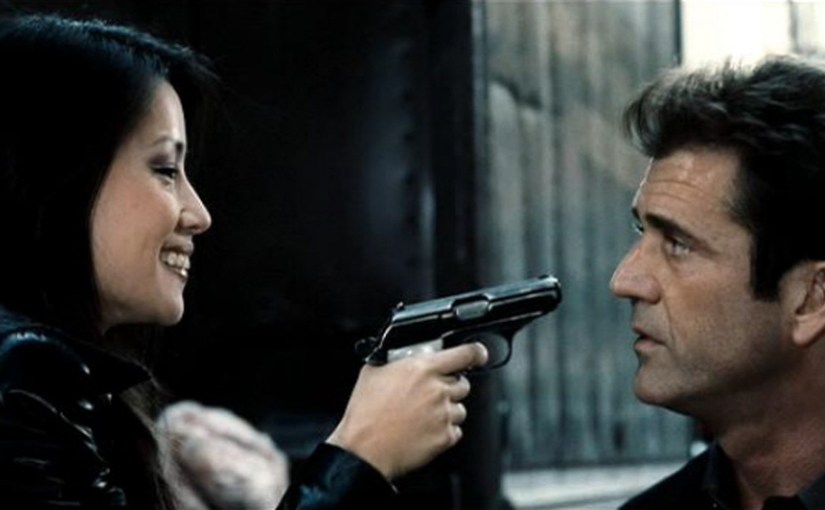
Getting from place to place is the glorious fun of the picture, thanks to a rocking soundtrack and actors (Thurman, a stellar Lucy Liu and a brash Vivica A Fox) ready to recite heightened, forthright dialogue that a 10 year old might give to his favorite action figures. “The baseball diamond where I coach little league and we have ourselves a knife fight.” Only assassins from Quentin Tarantino’s glossary talk like this.

Action scenes are not only gorgeously crafted with knife choreography and plenty of martial arts, but there’s almost a slapstick element to it all, along with a comic book feel. Tarantino is a well-known Three Stooges fan and beyond being an admirer of cinematic heroes. The Bride doesn’t just spill the blood of her opponents (The Crazy 88), she severs limbs and heads, so arteries spray never-ending geysers of blood. By the time the showdown of 1 vs 88 is over, the blood is in such excess, it appears as if the most extreme of pie fights has occurred among the mess. If Wile E Coyote took it up a few notches against the Road Runner, it might border what’s presented in this film. This is Quentin Tarantino with free reign and an unlimited budget providing what Kung Fu cinema fondly remembered from the offerings of legends like Sonny Chiba (who appears as a sword maker here) and Bruce Lee.

Kill Bill Vol. 1 is a glory to behold. It’s a variety of clear cinematography through different lenses Black & white, red with siren sounds, quiet dual set ups in glowing blue, and the purity of Lucy Liu’s code in a snowy white setting. Following a prenote of “Our Feature Presentation” the picture is bright in color and crisp in sound. Cereal is spilled all over a kitchen floor following a knife fight, and you just adore the crunch beneath The Bride’s feet as she walks out.

Overhead crane shots give an outline of a locale’s interior. Scorsese did this for terrifying effect at the end of Taxi Driver. Tarantino uses it as a means for the viewer to be let in on everything The Bride considers or looks for. The 4th film from Quentin Tarantino is so well constructed and so well-orchestrated. You see something new with each repeat viewing.

KILL BILL VOL. 2

By Marc S. Sanders

Kill Bill Vol. 2 offers an entirely different narrative than Volume 1, and that is why Quentin Tarantino is an electrifying storyteller. No two moments seem similar, even if the elements of the scenes (or chapters) seem the same with samurai swords, quick close ups, snap of the finger changes in cinematography and gonzo music cues.

I do prefer Volume 1 over 2 simply because it is a leaner film. This installment has just a little too much fat layered in, such as a storyline focusing on Michael Madsen’s “Budd” character. Not sure it was necessary for a scene where he is getting docked work hours from his boss because he was late. Not sure I needed a scene close to the third act where The Bride meets up with a South American contact before going to meet Bill. The dialogue in a few scenes like these offers nothing and didn’t even bring me the typical smirk I naturally get from QT’s films. They seemed more catered for bathroom breaks during the run of the movie.

Still, there’s a lot of glee and atmosphere in this picture, from a rehearsal wedding in gorgeous black and white with a nice Samuel L Jackson appearance to an enclosed, flashlight lit interior of a buried coffin. Best of all is the centerpiece of the film, The Cruel Tutelage Of Pai Mei (the best scene of both volumes and the salute that sends Tarantino’s love letter for Kung Fu cinema home). I love the Kung Fu Master Pai Mei, easily one of Tarantino’s best characters in all of his films combined. Tarantino works in the extreme close ups that Japanese filmmakers might have used for EXTREME DRAMATIC effect. Everything about Pai Mei is graciously recognizable and hearken back to these movies I’d catch while flipping channels on Saturday afternoon. Frankly, I never stuck with those flicks until the end, but for the fleeting seconds I watched, I got a white robed Kung Fu master Pai Mei to now fully appreciate in Kill Bill Vol. 2.

The Bride could arguably be Uma Thurman’s best role of her career. She’s a great carrier of the Tarantino heroine. The fighting skills she offers and what are deceptively edited in (thanks to Sally Menke) look so natural with her at the lead. You can’t take your eyes off of her, and you love to look at her.

David Carradine is another attraction. It’s rumored that Warren Beatty was up for the role of the sadistic, yet charming, Bill. No way could I see that working out. Carradine was the star of the series Kung Fu. How do you go with anyone else but David Carradine???? Carradine has a gorgeous, gravely stiletto voice that sounds awesome in stereo; deep and guttural. His facial features lend to a history of a villainous, but wise leader.

SPOILER ALERT: I’d be remiss if I didn’t mention QT’s smart imagination for disarming Daryl Hannah’s one eyed deadly assassin, Elle Driver. Find me another movie where an enemy is left in a trailer located in the desert with her remaining eye ripped out while a deadly black mamba snake slithers somewhere nearby. Tarantino closes this storyline by leaving her screaming alone with no eyes…in a desert…WITH A DEADLY BLACK MAMBA SNAKE. Does the audience need to see her die? Definitely not. Use your imagination of this being worse than stranded, and worse than dead. Pardon me but that’s fucking brilliant!

Again, QT’s characters are two dimensional. The Bride and Bill might have a little history behind them but that’s about it. It’s okay though, because this is pulp fiction (pun intended) that comes alive on the screen. No writer/director has ever elevated this kind of material so well.

MAMMA MIA!

By Marc S. Sanders

So at the urging of a close friend of mine, Alicia Spiegel, we all jumped in to watch the Dancing Queens, from the celebrated musical, Mamma Mia!

It’s a fun family film full of gorgeous, eye popping colors.  REALLY EYE POPPING!!!!!  Stay for the closing credits.  Wow Pierce Brosnan! You sure took a huge leap from James Bond here, that’s for sure.  Liberace, and maybe Elton John, would even blush at having to wear some of the costumes on display.  Naturally there are the big musical numbers as well, and big, I mean HUGELY ASTRONOMICAL MOMENTS OF JOY AND CHEERFULNESS!!!!  Jeez, the excitement of Meryl Streep, Amanda Seyfried, Christine Baranski and company make happiness look like an incurable disease. 

The sugar coated, dipped in maple syrup, and showered in Jolt Cola corniness of Mamma Mia! is so sweet, you’ll have a fresh cavity by the time the film reaches its halfway point.  Still, during these challenging times,  it’s not so bad I guess, and likely just what we all need.  

The film concerns itself more with having fun than anything else amid a simple story of a young bride secretly inviting three likely candidates (Brosnan, Colin Firth and Stellan Skarsgard), one of which is potentially her biological father, to her upcoming nuptials, which will take place on the Greek Islands.  This welcomes awkward moments for the gentlemen when they each reunite with Streep.  It’s all very sitcomy.

The soundtrack uses the disco book of ABBA, complete with WaterlooTake A Chance On Me and of course Mamma Mia!.  Though I appreciate the music of ABBA, my main issue is that other than two numbers (Slipping Through My Fingers and my favorite The Winner Takes It All), I could not see how any of the remaining music meshes with the story.   How do the lyrics of these songs drive the story of the musical?  I could not make a connection, and so I found myself asking why are they suddenly breaking out into Dancing Queen, for example.  What does this show stopping number have to do with the structure of the story?  The cast could have just as easily broken into We Will Rock You or Walk Like An Egyptian, and the lyrical relevance to the plot would have been just as separated.  No character sings a song that identifies with their respective purpose to the story.

Meryl Streep always challenges herself.  No two characters of hers are really ever the same, and thus she’s able to pull off a musical lead effectively.  I heard people frowned on Pierce Brosnan’s vocals, but I didn’t take issue.  I liked his duet with Streep.  Seyfried is a good compliment to Streep in a mother/daughter relationship as well.  Christine Baranski as Streep’s best friend is welcome and over the top silly escapism.

It won’t ever be my favorite film musical, but if I’m at a friend’s house and the majority wanna turn this on, then I’ll watch and enjoy the whole gang getting swept up in the Greek Isle setting of Utopian celebration and happiness.  I just won’t need to snack on my Mike & Ike’s or sip on my extra large Coke.  There’s already enough sugar emanating from the screen.

THE APARTMENT

By Marc S. Sanders

You ever come across a film that begins as sweet screwball, and then segues into serious sensitivity?  If you have, then maybe you have seen Billy Wilder’s classic film The Apartment.  Beyond the film being an Oscar Best Picture winner, Wilder’s film demonstrates that there is a screwball mentality in all of us, but we also know when the party must end.

Jack Lemmon plays C.C. Baxter, one of over 31,000 people who works for Consolidated Life in a Manhattan high rise.  He’s a likable fellow who happily does his work with a typewriter amid a sea of other desk jockeys on a floor that seems to expand beyond the architectural limits of the building.  When his eight hour day comes to a close, he’s normally the last one to leave for home because it is likely his apartment located outside of Central Park is occupied with one of the company big wigs that liberally uses his pad to entertain a lady friend beside their respective wives.  Baxter has been relegated to a door mat who holds out hope that any one of these ranking supervisors may one day promote him to an executive position with a private office and a view of the city.  Promise finally opens up when the President of the company, Jeff Sheldrake (Fred MacMurray), summons Baxter to his office to commend him on the positive feedback from the other men in the office and to request some time with the apartment himself.  Sheldrake would like to have some time away from his wife and children to host Fran Kubelik (Shirley MacLaine), the building’s elevator operator.  If Baxter had the availability to his own apartment and a little bit of bravery, he may have asked Fran for an evening out together on another occcasion.

The Apartment begins almost like a farce or sitcom as the revolving door of Baxter’s apartment welcomes one new executive after another.  You may be expecting confusion and misunderstandings that’ll lead to outrageous laughter.  However, poor Baxter is the victim to all of this coming and going by even surrendering his home to Joe Dobisch (Ray Walston) who calls unexpectedly at eleven o’clock at night requesting the place for an hour.  Baxter takes shelter on a park bench in the December cold. The humor of this arrangement is not so funny any longer.  After Sheldrake’s regard for Fran is more apparent, then it’s more clear that these characters are not spawned from the happy home life scenarios of 1950’s television programming.  Sheldrake is only charming to an adorably likable woman like Fran for as long as he cares.  Some might say he’s not terribly cold hearted though.  After all, though he forgets to shop for a Christmas gift for Fran, he offers her a hundred dollar bill from his wallet instead.  Up until this midway point, Shirley Maclaine has been so good at maintaining a cheerful disposition that suddenly her self worth seems a whole lot less than a hundred dollars following Sheldrake’s latest disregard.  Surprisingly, Fran overdoses on a bottle of sleeping pills.  When Baxter discovers her in his bed, he races to revive her with the aid of a doctor neighbor.  Baxter does not give up on helping Sheldrake make this right, while tending to Fran’s recovery on Christmas Eve.  Yet for Sheldrake, this is all an inconvenience and now without even looking for a better way to live, Baxter finds an opportunity to allow his own personal strength to come through against the executives at the office, as well as Mr. Sheldrake, and most importantly with the woman he cares for, Fran.

Jack Lemmon has a energetic method to his performance, as I find he does with most of the roles in his career.  He plays men who never break to sit and breathe.  They are always on the go.  They almost never sleep.  So, his fast paced delivery and flirtation with Shirley MacLaine let Wilder’s film perform at a fast pace.  The range of both Lemmon and MacLaine really work for The Apartment, because they can be naturally funny and intensely serious when the moment calls for it.  Lemmon can sell me as a guy who will use a tennis racket to strain his spaghetti while at the same time standing up for his convictions when life can not allow humor for a moment.  MacLaine can portray a woman with a menial job like an elevator operator and yet still be considered valued and recognized as genuinely hurt when disregarded.  For Fred MacMurray, I think it’s fair to say he actually makes for an effective villain, someone you love to hate, with his portrayal here.  I knew of MacMurray with his television program My Three Sons before I ever saw The Apartment.  What a departure the two roles are.  Here, he is a charming fellow on the outside with a hollow mentality inside.  He’s a man who only cares for his immediate needs.  He can not be inconvenienced with someone else’s feelings whether it is Baxter’s inconvenience or Fran’s despair.  Nothing else matters.  No one else matters.

The film may be called The Apartment, but office politics seems more at play here. Billy Wilder’s film is surprising but it’s honest too.  I doubt many of us would ever surrender our own home night after night to the more powerful and influential.  However, many of us, with a drive to climb a corporate ladder likely have compromised our ideals to get to a higher plateau at one time or another.  Personally, I have to shamefully admit that I have committed such an act.  The Apartment questions when enough is enough.  What’s special about Wilder’s film is that C.C. Baxter must discover if he lives to work or works to live.  

MAN OF STEEL

By Marc S. Sanders

The first time I saw Zack Snyder’s Man Of Steel, I was disappointed.  Very disappointed.  It was only after a second viewing about a year later that I realized I was simply biased and unfair with my perception of the film.  I grew up with the Richards’, Donner and Lester, films that featured Christopher Reeve in the role of Superman/Clark Kent.  Nothing could violate what was done in those films from the ’70s and ’80s. 

My impression of Man Of Steel now is that it is a marvelous film.  It’s an exploration of a stranger in a strange land questioning how to adapt to a living environment that he is not from, nor where anyone around him is genetically built like him either.  Henry Cavill fills the role of the title character.  What’s especially important is that he is not attempting to do what Reeve memorably did before him.  Actually, David S Goyer’s script really doesn’t allow for the hijinks of the prior films.  Clark Kent is not portrayed as a goofy and lovable klutz this time around.  Instead, the boy from Smallville, Kansas is challenged to limit his abilities at the behest of his Earthling father, Jonathan (Kevin Costner).  It’s dangerous for Clark to show all that he is capable of from his super strength to his heat vision.  Clark’s Earth mother, Martha (Diane Lane), is more protective of her son.  A really powerful scene occurs when young Clark is in the classroom and he has a bout with sensory overload of super hearing and super x-ray vision.  He can’t get the encompassing sounds and sights out of his head.  One of many CGI effects in the film come with Snyder showing the skeletal insides of Clark’s classmates and teachers.  It’s frightening; even to an innocent alien boy from another world.  This is good conflict.  Does the world need Clark Kent?  Would Clark Kent be better off someplace else?  Can he manage to live with daily life drowning out his sensibilities?

Another dilemma opens the film on Clark’s home planet of Krypton where he was born with the name Kal-el.  His father, Jor-el (Russell Crowe) has insisted to the governing body that the planet is expected to self destruct soon, and civilization needs to be relocated to another planet.  The politicians refuse to accept his theory.  Jor-el’s friend, the military leader General Zod (Michael Shannon) sides with his opinion.  Though his approach is violent insurrection of the Kryptonians.  Zod is punished for his crimes and sentenced to an eternal prison known as The Phantom Zone before baby Kal-el is shipped away, and the planet implodes with all its inhabitants.

Following this opening, Snyder cuts his film with flashbacks and forwards showing Clark in various different roles as either a fishing boat crewman or a bartender trying his best to remain undercover even when the temptation for use of his powers repeatedly shows itself.  Clark reflects on moments from his childhood when he and his Earth parents questioned how to present himself.  

Superman’s known love interest eventually shows herself, Pulitzer Prize winning reporter for the Daily Planet, Lois Lane (Amy Adams).  She’s following up on an alien ship that has been discovered in the arctic after 20,000 years.  Clark and Lois connect at this moment.  Of all the Superman angles that are familiar to so many of us, this is where Goyer and Snyder perhaps do not focus enough.  Man Of Steel is a satisfyingly long film, but there’s a lot of material and drawn out action to cover as well.  So the Lois and Clark relationship is somewhat sacrificed and not as nuanced as we have experienced in other iterations.

Zod arrives on Earth requesting that Kal-el reveal himself along with the intent to destructively turn Earth into a new Krypton at the sacrifice of the planet’s human population.  Naturally, a city wide battle will ensue. and lemme tell you reader you wanna talk about destroying the village just to save it….well…that’s what happens here.  When New York got destroyed in Marvel’s The Avengers or Ghostbusters, those pictures looked like spilled milk compared to what Superman and Zod do here.

Man Of Steel is the best film of the new Warner Bros/DC universe.  It might be Zack Snyder’s best film as well.  The assembly of the picture is masterful.  Hans Zimmer’s score has these great build ups as Clark discovers more of his capabilities.  It especially lends to when the character dons the cape and costume for the first time ready to leap in the sky and fly.  Snyder shows the efforts needed for Superman to carry out this talent.  The flying doesn’t come easy.  It looks like work on the super hero.  Zimmer’s score starts out quiet and then advances to these powerful notes as Superman soars higher and higher.  The boy from Kansas is making himself into something greater that he has no familiarity with.

Michael Shannon plays another of many kinds of villains and antagonists on his resume.  I’m not sick of this guy’s antics yet.  It’s time he become a James Bond villain.  He plays Zod with an uncompromising determination and disregard for anything else but to rule.  It’s all very sci fi like but I love how unforgiving he is with the role.  Much less Shakespearean than when Terrance Stamp played the part so well with Reeve as the hero.  Shannon is more direct and bloodthirsty.  Michael Shannon just knows how to be scary on film. This kind of personality would work great in a silly comedy from the Farrelly brothers as well.

Amy Adams is fine as Lois, but there’s not much here to work with honestly.  More details of her relationship with Superman come through in later films.  However, this story development soured me on my initial viewing.  The iconic irony of Superman pathos is that as sharp a reporter as Lois Lane is, she can not realize that the guy wearing the glasses who is working right next to her is actually Clark Kent?!?!?! Readers and viewers were always thankfully in on the joke.  On follow up viewings of Man Of Steel, I understand that Goyer and Snyder were never aiming for irony.  Lois knows who Clark really is from the get go. What was once an unforgivable departure for me, no longer is a concern.  There are deeper angles to question in Man Of Steel, like a purpose to others and the freedom to force a change because it can be done.

Snyder and Goyer broach on the well known Christ allegory with Superman.  The film takes place in Clark’s thirty third Earth year.  Jor-el is slain with with a stabbing to his rib.  There’s also the crucifixion  pose on a number of occasions.  I must admit, as a Jew raised conservatively with just the Old Testament, I am not very educated on the texts of Jesus Christ.  However, the basics are explored in Man Of Steel.  Is Superman a savior?  Snyder wisely even has Clark visit with his Smallville priest to question his obligations to Earth and to Zod’s calling, with window artwork of Christ in the background.  

One vice I have with Snyder’s picture is the shameless plugging.  How overt must signage from Sears, U-Haul, 7-Eleven and IHop be?  Granted, all of these summer blockbuster films have the inserts of brand labels going all the way back to the original Superman films.  Here though, the corporate advertising is a true eyesore.  Superman being thrown into the dining area of an IHop is not as memorably funny as when Zod’s underling, Non, crashed into New York’s famed Coca-Cola sign back in 1981.

The seemingly endless battle consuming about forty five minutes of the third act of the film are over the top outrageous.  I might normally be saying I’ve seen enough while casualties are never considered as buildings literally topple over into mushroom clouds of concrete dust.  Still, the cast keeps these moments alive.  Shannon and Cavill, along with Laurence Fishburne as Perry White, the Daily Planet editor, and Amy Adams, actually show risk and fear amid all of this bombastic action.  Still, Snyder is insistent on his freedom to go crazy with CGI effects.  It’s more than a bit much, but the characters up to this point keep me engaged with the film all the way through.  Later DC films in this franchise don’t do it so much for me, but that’s another column altogether.  

Again, what I especially like about Man Of Steel is how Snyder cuts back and forth with the film.  Heroic moments occur and then are reflected back to times in Clark’s childhood with Jonathan and Martha.  With Zimmer’s score, it seems to allow Clark to consider conversations and moments from his past as meaningful to what he is experiencing in the present.  When Zack Snyder stays on this trajectory it makes Man Of Steel more than just another comic book movie for summer box office.  There’s depth from Goyer’s script that Snyder wisely does not disregard.  

Man Of Steel is a new and unfamiliar kind of Superman, but its a very welcome Superman too.

BATMAN V. SUPERMAN: DAWN OF JUSTICE

By Marc S. Sanders

Zack Snyder may have been indulging in too many cookies from the jar when he made Batman v Superman: Dawn Of Justice.  I can not deny how ambitious this film is, but did it ever need to be this ambitious?  There are too many storylines, too many characters, and not enough thought provoking dialogue to really make any sense of the gobblety gook that’s splattered all over the screen.

Reader, my favorite super hero of all time is Batman.  Nearly any variation of Batman (including moments from the dreadful Joel Schumacher films) contains an element that I just love about the character.  Ben Affleck is cast as The Dark Knight here.  He’s fine in the role.  I knew since he had done Daredevil, that he could pull off this part.  He might be too long in the tooth, and too busy an actor/director, for a new series of super hero films, but I digress.  That being said, the movies have gone into overkill on the Batman character.  It’s time the Gotham crusader hide in his cave for a little while and let some of the other super heroes out to play.  Snyder’s film proves my theory.  After all, the true highlight is neither title character in this movie.  

Actually Wonder Woman (Gal Godot) making her big screen debut is the draw above anything else here.  Even that is problematic, though.  I’ve seen this film twice now.  Can anyone tell me why Wonder Woman aka Diana Prince even makes an appearance in this film?  From a story perspective, what justifies Diana creeping into this film, other than to plaster her picture on DVD covers and merchandise a new action figure?

Events begin right after Snyder’s stellar Superman film, Man Of Steel.  An older and experienced Bruce Wayne is dubious of the benefits that Superman (Henry Cavill) can serve on Earth.  After all, his bout with the Krypton villain, General Zod, practically leveled Metropolis.  Heaven forbid if one day this powerful alien with the red cape goes out of control.  Bruce, as well as politicians led by Holly Hunter, ask a wise question.  Who on earth could ever stop him?  So Bruce, with assistance from Alfred (Jeremy Irons playing the well known sidekick more as a strategist, than a polite butler) begin preparing for a seemingly inevitable battle to eliminate the Kryptonian. 

Meanwhile, a young, brainy Lex Luthor (Jesse Eisenberg) is planning for his own undoing of both of these super heroes by living up to the film’s title; pitting the Bat of Gotham against the God of Metropolis; mano y mano.  Like most iterations, Luthor plays with defying the odds of nature.  In this case, he is experimenting with a green element sourced from Krypton which we all know is Kryptonite, as well as extracting blood from the corpse of Zod to create his own monster movie.  That last part feels like a side gig for the supposedly genius villain.

In addition, a mysteriously exotic and beautiful woman is turning up on various occasions.  Somehow, only Bruce seems to take notice of her.  Why?  I don’t know.  There’s really no purpose for him to scope out this person amid a sea of other extras attending a Luthor gala. 

There’s also Lois Lane (Amy Adams) and Martha Kent (Diane Lane).  There’s a retread of Bruce Wayne’s origin story that we’ve seen countless times before.  There’s a bitter and disabled former employee of Wayne Enterprises.  There’s a dream sequence showing vague plague like foreshadowing to come.  There’s an arms dealer/terrorist sequence in the desert for Lois to investigate, and another figure for Bruce to track.  There’s the eventual gladiator battle between the two heroes, and then there’s another battle thereafter for the two guys to team up with the the woman who carries a magic lasso to defeat a Doomsday monster; likely rejected sketches from the Harry Potter and Star Wars franchises.  Oh yeah.  There’s also some teaser material for what’s yet to come in the DC cinematic universe.

Do you see where I am going with all of this?  There’s just too much stuff here.  Eventually it all gets tedious.  A laundry list of storylines with little to no connection with one another feels burdensome.  I wish the screenwriters, Chris Terrio and David S Goyer, finished writing a script before starting another script.  As lengthy as all of these stories feel, they also seem unfinished, and, I can’t understand why.  

Forgive me.  It’s easy to compare the DC Comics film adaptations to the Marvel Comics films that Disney now owns.  The latter franchise seems well structured and outlined.  The former franchise helmed by Snyder seems rushed to catch up to everything that Marvel has already accomplished.  If the intent was to have a huge franchise of films, then why smash all of your material together in one sitting?

That gets back to my viewpoint on Batman.  Why Batman, all over again?  Snyder and the producers really aced it with the casting of Gal Godot.  She is Wonder Woman.  Snyder also struck gold on Man Of Steel with Cavill as Superman.  I wanted more exploration of that guy.  So why make this a Superman and Batman film?  We’ve seen enough Batman through the last thirty years.  Let’s give someone else a chance.  Much could have been accomplished had this installment been a Superman and Wonder Woman team up with maybe a teaser ending of a new Batman yet to come.  This Batman shows me nothing I hadn’t already seen.  There’s a new car and gadgets and cables to swing from.  It’s all been done before.  Lemme see some of what this Wonder Woman can do.  As well, if Wonder Woman is here, then tell me why she is here.  Again, she just comes out of nowhere and never explains why she’s there.  My wife and daughter tried to explain it to me.  Apparently, she wants to acquire a photograph of her with her war comrades from the first World War, and Lex Luthor is in possession of it.  Really?  That’s it?  She just needs to get a sentimental photograph back?  By the way, why does Lex have this photo, and how did she know he has it anyway?

Good stories always answer questions with more questions until it’s eventually tied off at the end.  Moments in Batman v Superman: Dawn Of Justice seem to begin in the middle of their stories with questions that did not answer questions that likely came before, and by the end of the picture, there’s no ending or answers in sight.

I had already reviewed Wonder Woman, and in that column I specifically noted that DC films with Warner Bros always seems to come close, but never gets it completely right.  This film boasts an impressive cast, and all are good in their respective roles.  My approach to this Lex Luthor from Eisenberg might have been different if I were in charge; make him more like a Steve Jobs kinda guy rather than a slight variation of the actor’s other famous role as Mark Zuckerberg.  Still, it’s not good enough and it’s hardly forgivable for what the filmmakers churned out with this picture.  The writers have an infinite wealth of source material to select from.  Pick up a comic book, guys!!!!  They have the funds and opportunity to divide up the best moments of these outstanding characters for the next ten years of film installments.  Nevertheless, they don’t take the time to think strategically, and flesh out the environments and the characters that inhabit these settings.  

Batman v Superman: Dawn Of Justice is just a sloppy mountain of peas, carrots, corn and green beans, with lumpy mashed potatoes and covered in lots of over seasoned gravy.

I, TONYA

By Marc S. Sanders

The will to commit wrongdoing must stem from somewhere; an outside influence or perhaps a genetic makeup, or both.  I think I, Tonya suggests it’s central character suffered under the former possibility. Outsiders put former Olympic figure skater Tonya Harding where she is today with a reputation forever scrutinized and forever tarnished.

Margot Robbie was unjustly denied of the 2017 Academy Award that went to a been there, done that Frances McDormand for the horrible Three Billboards Outside Ebbing, Missouri.

Margot Robbie is one of the most beautiful and talented actresses working today. This film puts her into the stratosphere.  Robbie is unrecognizable beneath the punishing white trash persona of the infamous Tonya Harding.  She is unrecognizable in caked on makeup,  awful periodic perm haircuts, chain smoking, excess drinking and terrible dietary habits that include a shameless plug for Dove chocolate bars.  

Harding is forever notoriously linked to the knee bash heard round the world victimizing her Olympic competition, Nancy Kerrigan.  Margot Robbie does not hold back in displaying Harding’s lack of class and elegance expected in the sport of women’s figure skating.  It’s what Tonya Harding lacks that blocks her from the fame and success expected to come with being a champion athlete. Robbie is fantastic about surrendering her character’s talents for short tempered flare ups, crass behavior and a filthy mouth.  Her facial expressions are shocking.  Stretched fake, Cheshire Cat grins with bulging eyes pull at the pressure Tonya suffered under a hateful mother’s thumb, and an equally abhorrent, stupid husband.  She is forever naïve to how the judges never put her above the competition in points.  I mean this is the only woman to ever successfully accomplish the triple axle!!! 

Equally astonishing is Allison Janey as Tonya’s mother LaVona Harding, an incredibly cruel woman hell bent on making sure Tonya skates for the sole opportunity to endlessly torment her only daughter physically and, even worse, mentally.  Janey joins the exclusive club of cinematic great villains.  This is an unsympathetic woman with no drive to be better at anything except increasing her abuse upon Tonya.  It’s a shocking performance.  Janey appears so comfortable in the cruel insults, offensive language, and non stop smoking all the while her pet parrot sits atop her shoulder.  LaVona is uncompromising in how she punches, throws plates or even tosses a steak knife at her hated daughter.  What a horrible person, and what an amazing performance. You’ll be hard pressed to find a better antagonist in a film these days.

Sebastian Stan chose wisely to accept the role of Jeff Galooley.  It’s a great departure from the Marvel superhero films.  Jeff is a dumb, needy, abusive husband to Tonya; the man who admitted to being the orchestrator of the knee bash (though the movie will tell you it’s not that simply explained).  Stan should have been nominated at least.  It’s not easy to play such a dumb, real life moron, and he excels in the role. What an asshole Jeff Galooley was; what a dumb asshole actually.   He, along with his conspirators, have great chemistry in idiotic planning.  Stan really shows his best moments when he’s being reckless with his rag doll wife, Tonya.   The physical domestic fights are so well edited amid rock ballads from Fleetwood Mac, Laura Brannigan, ZZ Top, and Supertramp. 

Director Craig Gillespie follows the breakneck formula of Martin Scorsese with character interviews, racing steady cams that convinced me that Robbie is as talented a skater herself as Harding was.  She has so many levels of erratic fear, insecurity and tempers.  The method of filmmaking here seems like a slight nod to Raging Bull.  Gillespie takes advantage of all that Robbie brings to the camera.  It’s a perfect marriage of director and actor; as perfect as DeNiro & Scorsese or DiCaprio & Scorsese.  I hope Robbie & Gillespie will be teaming up again soon.

Once again, I have to ask.  How in the hell does that piece of celluloid waste called Three Billboards Outside Ebbing, Missouri get a Best Picture nomination when as far as I’m concerned, I, Tonya clearly stands much higher above it in terms of craft, writing, performance and filmmaking?????  It astounds me.

I, Tonya is without a doubt one of the ten best films of 2017.  I can’t wait to see it again.  It’s unbelievably good.  

Footnote: Do I think any differently or sympathize with Tonya Harding now that I’ve seen this depiction? I don’t think so.  She is clearly a woman who was never given a fair chance at a happy life. She was destructive to herself as much as those that surrounded her.  Yet, she had to also accept responsibility for her actions and behavior.  Any of this could have gone differently.  If only these people were not so stupid or irresponsible.  These people, Tonya Harding included, all had choices to make.  They could have chosen a different option time and again.  Despite some of the positions Craig Gillispie’s film takes, I truly believe Tonya Harding could have opted for a different path while combating her inner and outer demons.  

AFTER HOURS

By Marc S. Sanders

If L. Frank Baum’s classic fantasy The Wizard Of Oz were adapted in a setting of say 1985 New York City in the So Ho section, beginning sometime after 11:30 at night, then it would be a fair argument to change the name of his story to After Hours.  The story would no longer be whimsical. Instead, it would be screwball, with a disturbingly demented narrative from the brilliant but unsettling camera work of Martin Scorsese.  The protagonist would be a lonely yuppie named Paul (Griffin Dunne) who encounters one odd woman after another when all he intended to do was meet up with a kind and attractive young lady named Marcy (Rosanna Arquette) who offered the opportunity of obtaining one of her roommate’s specialty crafts of Parisian bagel & lox paperweights.  (Yes.  You read that description correctly.  Don’t overthink it.)  Unlike Dorothy from Kansas though, the oddballs that Paul meets up with become challenging to him even if they insist on welcoming him into their arms.  These women are not the comfort conveniences of a scarecrow, tin man or lovable lion.

How odd that this film from Scorsese would follow his masterpieces, Raging Bull and Taxi Driver; a major departure from themes of mental disturbance exhibited by characters like Jake LaMotta and Travis Bickle.  Here, the disturbance hinges on paranoia that eventually develops; not seeded in place at the start.  The film relies on absurd situations where Paul inadvertently gets in over his head when all he wants to do is return home and sleep. It quickly dawns upon Paul that it is likely not a good idea to go out after hours when a whole other kind of community is awake, that is uncustomary to his lifestyle.  I was waiting for the film, written by Joseph Minion, to tell me it’s all a dream.  My foolhardy mistake though.  Scorsese would never resort to such a tired, cliché.  If he is going to direct a film of the utmost ridiculous, then he’ll make certain Paul’s unfortunate outcomes are believable…even if they are hard to be believed.

If you’ve seen at least three of Scorsese’s films prior to After Hours, you’ll likely just fall in love with this picture based on his craft with the camera partnered with his always trusty editor, Thelma Schoonmaker.  Cinematographer Michael Ballhaus has his first collaboration here with Scorsese (before Goodfellas and Casino).  Conversations in offices or diners or apartments or bars occur, only they are more exciting than countless other exchanges of dialogue. You will be watching a film that does not sit still and always strives for your attention.  So, while Arquette’s character describes an ex-boyfriend’s obsession with the film adaptation of Oz, your director at play startlingly zooms in on her performance monologue and then circles back to Dunne, her listener on the other side of the table.  No standard quick cuts.  The camera circles and surrounds the players.  A set of keys dropped from a balcony straight down directly towards Dunne’s waiting face below gives an eye opening zoom thanks to Ballhaus’ techniques.

The developments that quickly fall upon Paul are not fair for him.  He loses his only twenty bill that he can rely on, gets caught in torrential downpours of rain, uncovers a suicide, becomes trapped in a punk rock club that wants to give him a tortuous mohawk, and a modern-day pitchfork mob equipped with flashlights and an ice cream truck are hungry for his head because they believe he’s a serial neighborhood burglar.  The poor guy can’t even make a phone call because a ditzy Catherine O’Hara revels in breaking his concentration to remember a phone number.  Teri Garr also appears with a bee hive hairdo as a waitress at an all-night gay diner vying for attention that Paul just can’t afford to give at three o’clock in the morning.  Paul just wants some basic help from anyone who can offer a simple gesture. None of it is that simple however, and the problems build upon one another until they are compounded upon his shoulders so much so that at one point, he literally cannot move out of the physical circumstance he ends up in.  Forgive my vagueness, but I wouldn’t dare spoil what that literally means.  You owe it to yourself to watch the film and find out for yourself.  My first instinct was to go “Come on!!!  Really!!!” Yet, then I remembered this is a film of daring escapes.  Still, Minion’s script and Scorsese’s film turn those breathless escapes into deeper depths of a So Ho hell, as the film proceeds to its inevitable sunrise.

After Hours might have been a subpar John Hughes comedy, only vaguely remembered from the decade of excess, the 1980s.  In Martin Scorsese’s hands though, it’s comedy pathos and yet frightening at times.  Only Scorsese can show us funny, yet bleak.  That’s okay.  It’s different.  I’ve seen the standard slapstick unfortunate circumstances of School Principal Ed Rooney in Ferris Bueller’s Day Off, and countless copycats thereafter.  Scorsese offers up a different, inventive, and very twisted approach for a typical victim of circumstances beyond his control.  

My recommendation for a double feature:  watch Neil Simon’s The Out Of Towners with Jack Lemmon and Sandy Dennis.  Then watch After Hours.  You may begin to understand how New York City can be a vicious and unforgiving beast with enough chutzpah to attack you, even if you never deserved any kind of punishment.  If you’ve ever found yourself in any kind of metropolitan city throughout North America, you’ll likely nod your head at what this poor guy encounters, and you might not feel so singled out.

EDDIE MURPHY’S RAW

By Marc S. Sanders

There is no way.  NO WAY that Eddie Murphy’s Raw would ever be produced today.  Nearly every sentence is of the highest caliber offense of any modern day societal belief.  Still, Murphy’s expressions and delivery are lightning in a bottle.  You can’t help but at least grin at his close ups and physicality.

This guy is so incredibly bright that only his comedic stand up monologues could actually feel like you are learning from a college professor who offers up what guys like Bill Cosby, Michael Jackson and Mr. T are really like.  At the same time, he’s somewhat frank with how men and women communicate. It’s comedy.  It’s terribly exaggerated like comedy needs to be, but I can’t deny at least some truth in what Murphy talks about.  If there wasn’t even a fraction of validity in his material, then it would never have been funny, and Eddie Murphy’s career would have ended well before the 1980s came to a close.