HERETIC

By Marc S. Sanders

Heretic operates like you’re playing Dungeons & Dragons but adapted into an Escape Room experience.  The stakes at play are bigger than just your life.  You have no choice but to truly test your faith.  Can you adhere to the religious beliefs you always vowed to uphold when a lunatic is holding you captive?

Sister Barnes and Sister Paxton (Sophie Thatcher, Chloe East) are two impressionable young ladies who are proud to spread the gospel of The Church of Jesus Christ of Latter Day Saints from door to door.  With bicycles and pamphlets in hand, proudly wearing their name tags, they visit the homes of those who have recently expressed interest in the church.

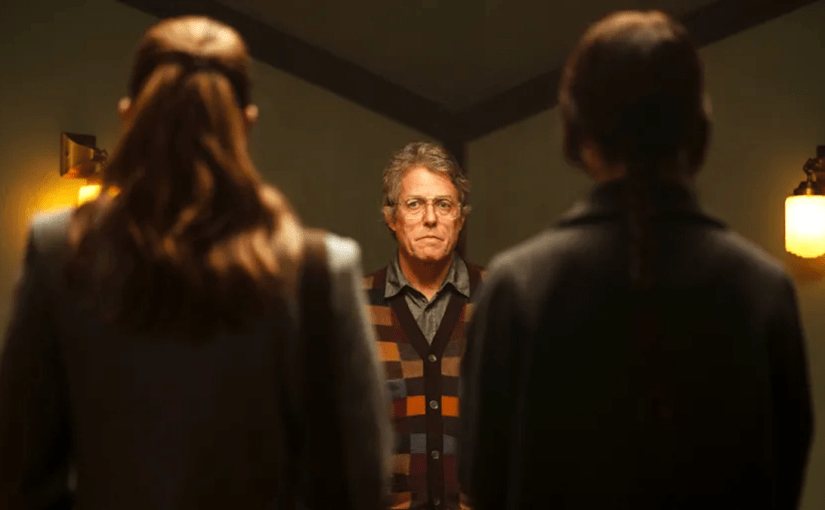
As a dark and stormy night approaches, they knock on the door of an eerie house that belongs to the charming Mr. Reed (Hugh Grant in an utterly surprising role).  Once the ladies are assured that the gentleman’s wife is at home, ready to offer some blueberry pie, they happily enter and are quickly engaged in an unsettling test that will carry on through the evening.

I went into Heretic not knowing a single thing about the film and that made my encounter with the piece that much more interesting.  It’s a disturbing thriller that always kept me curious.  Mr. Reed seems to go on tangents that eventually get to a point where the Sisters are confused, but eventually coherent of the strange man’s demonstrations.  The film is not shy about challenging practically every religious denomination known to man from Christianity to Judaism to Islam and Mormonism.  According to Mr. Reed the ten thousand other doctrines spread across the planet need also be questioned.

Higher powers and miracles – do they really exist?

There’s no doubt that Heretic is a suspenseful thriller teetering on horror but unlike most effective efforts in this genre I was never uneasy with the picture.  It doesn’t rely on jump scares and only gore introduces itself when it must serve the storytelling.  However, it’s an intelligent character study where the heroines are challenged over and over again while remaining in captivity.  So, I was always enthralled with how Sister Barnes and Sister Paxton will entertain their destiny from one step to another.  Stay for pie or don’t.  Lie or tell the truth.  Choose the purple door or the green door.  Belief or Disbelief.

As someone who is primarily educated in Judaism only, it was still not hard to follow the wordy, rambling dissertations of Mr. Reed.  He easily compares his own take on religion to the different interpretations found in music from bands like The Hollies and Radiohead, as well as the various editions of the board game Monopoly which suddenly take on new meanings.  He even brings up Jar Jar Binks to deliver a point.  It’s odd.

Hugh Grant is an unlikely selection for a role like the charming, yet sinister Mr. Reed.  As weird as he is in this darkened house with endless hallways, I wanted to trust him through most of the first half of the picture.  I didn’t care if there was a haunting corridor or staircase to walk down.  This is Hugh Grant of Notting Hill fame.  Grant’s resume of roles lends to the surprising effectiveness of his part here.  He’s always been that adoring charmer on screen.  Ian McKellan or Anthony Hopkins?  I’d never trust them.  Hugh Grant?  Well, why wouldn’t I?

I was hoping-praying actually-that Heretic would not dissolve into a sick rape and slasher movie typical of when young girls are welcomed into a creepy, inescapable house.  That’s cheap, exploitative thrills.  Fortunately, this movie never goes that route.  

The roles of the two Sisters are brilliantly written.  To open the piece, before you know anything about Sister Barnes and Sister Paxton the two women are sitting on a park bench that bears a seedy condom advertisement while staring into a heavenly Utah sky. The topic of their conversation is of a pornographic nature.  Sinful and mischievous, despite the value they hold in their religion and the proud purpose they serve with the church.  These are complex characters that are compelled by their antagonist to make some fair hypotheses about if they genuinely embrace what they claim to value and share with a community.

Heretic is most definitely a psychological thriller with some grotesque imagery.  It gets its audience caught in a trapped claustrophobia thanks to a lot of spooky atmospheric labyrinths.  Furthermore, its strengths lie in the writing, directing and most importantly three of the best performances to come out this year from Hugh Grant, Sophie Thatcher and Chloe East.  

This is a thinking thriller for anyone who has ever uttered a single prayer at least once in their lifetime.  If that’s you, then Mr. Reed may have some questions for you.  Get out of the rain and step inside.  

ALIEN: ROMULUS

By Marc S. Sanders

To make an effective horror film requires the necessary scares to startle an audience, but it doesn’t stop there.  The story has to work. Still, it doesn’t stop there.  You also have to care about the characters of the piece.

I guess one out of three is not bad for a new installment in a nearly fifty-year-old science fiction/monster movie, horror franchise.  However, with Fede Alvarez’ Alien: Romulus, I left wanting more.

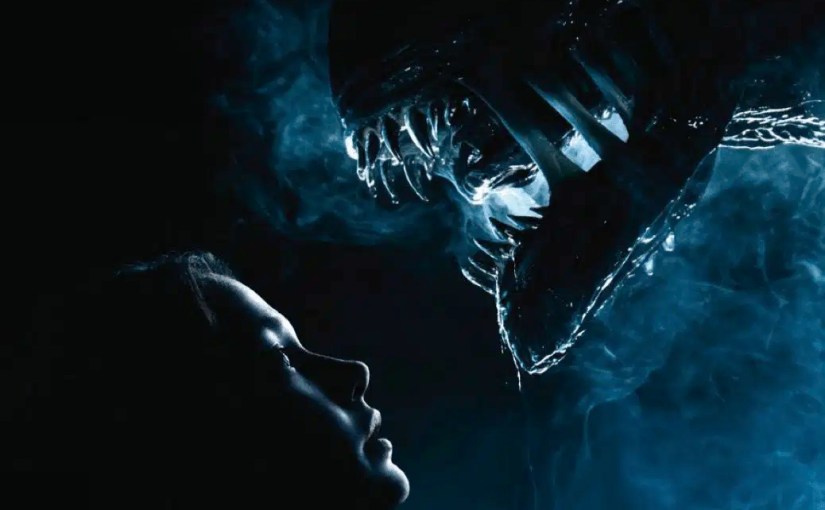
I have no doubt I was the loudest, perhaps most frequent screamer in the Dolby theater last night.  Knowing what I know about Alien, I still get terribly nervous when watching a picture of these grotesque-like creatures, originally designed by H. R. Gigar.  The assortment of Xenomorphs in this film is a faithful treatment to what the monsters should look like.  Teeth, slime, black skeletal frames with scaly limbs and tails.  What these monsters do is another story. It is primarily the same old routine of the creatures from the other films.  Their quiet behavior ahead of their ritual attacks leaves me very nervous and anxious.  I’ve gotta scream at the screen to help me overcome what scare tactics Alvarez and his crew have in store for us.  

Alien: Romulus follows a Michael Myers/Friday The 13th blueprint.  In basic terms, a handful of twentysomethings board a deserted space station as a means to getting off a mining colony overseen by the franchise corporate antagonist Weyland/Yutani.  An audience familiar with the franchise knows this is not going to go well, and soon will expect the clawlike facehuggers, phallic shaped chestbursters and fully developed aliens, aka Xenomorphs, to run around trying to slash, eat, cocoon and build up their population.

Upon attending a screening with my Cinemaniac pals, the guys will testify to my shock and horror at what popped out on screen.  I was terrified for what was coming out of Fede Alvarez’ dark and disturbingly silent settings.  I was nervous when the cast crawled through narrow crevices or stepped into various labs, only to get stuck behind a jammed door or commit a clumsy trip into knee high, unclear water.  Cocooned bodies representing an aftermath of violent carnage sent a doomed message too.  The atmospheric sets alone work well at being terrifying.

Yet, for all of these technical achievements in luridly dark scenic design, jump scare editing, gross looking attacks along with alien “deliveries” and terrifying pursuits and chases, my friend Anthony said it best.  He didn’t care about one single character.  Same for me.  I can’t deny how accurate he is. Like a slasher movie, I could care less if any of the players lived or died.  Even with a periodic countdown during the course of the film, I also didn’t care if they got away from the deserted ship.  So, the suspense never sustained. I was only anxious for when the next monster was going to make an appearance. In the third act, many of the jump scares were nil and upstaged by machine gun shooting and acid (for blood) splashes.

I also didn’t care for the expository scenes either because the information presented was nothing new.  Anything that this gang learns they are suddenly up against has been told to me in all of the other films.  There’s some wink and nod material to salute the other pictures with famous line send ups and even one broad character salute.  It’s fun for a moment but what about this movie and this story

I was also quite bothered by the convenient “just made it out alive” encounters that the main character played by Cailee Spaeny survives over and over.  Anytime danger was knocking at her door her means of survival were not consistent with the long-established fiction of the Alien science of it all.  When I wasn’t screaming, I was asking myself, how is she getting away.  That’s the script not respecting the story elements, the universe or what is presented to an audience, and what they clearly know after almost a dozen pictures.

None of the characters have a personality.  One is Asian with a buzzcut, two are English, and one is pregnant.  The only interesting portrayal is an android named Andy (David Jonnson) who is a sidekick “brother” to Spaeny’s character, and behaves like an autistic savant, until a change comes over him, causing him later to operate like HAL 9000.  Jonnson is really good in this role, and it is unfair that his cast mates were not as fleshed out like most of the other franchise films depicted in portrayals by such actors Ian Holm, Yaphet Kotto, Paul Reiser, Bill Paxton, Lance Henrickson, Charlize Theron, Noomi Rapace, and of course Sigourney Weaver. The characters in this new picture are entirely forgettable and carry no value.

Jump scares with things that come out of dark corners or when crusty hive like walls come alive only go so far.  To effectively win over horror, I need to also care when the next victim is taken down, or about to go through a near death experience on an even playing field.  Romulus comes up short in that department.

Alien: Romulus is decent, but not great as it opts to only think with one side of its brain primarily focused on sneaking up to shiver you in hopes that you’ll pee a little.

NOTE: I knew what not to expect out of this film.  My wish was to see a book end to the last two films that Ridley Scott helmed (Prometheus and Alien: Covenant).  Questions were presented within those films that seemed to promise answers with a later film installment that has yet to come to fruition.  So, the production company seems to have abandoned what they started in response to lackluster box office revenue and a divisive audience response.  Therefore, reinvention came into play once more.  I was always on the enthusiastic side of the divide with those two films. I carry great appreciation for what was done with them, and I was eager for how a prequel trilogy (now remaining incomplete) would wrap up. Alas…

As well, at close to fifty years, if you’re going to keep this up, I believe it’s time to reveal more about the villainous puppet masters, namely “The Company” or to be more specific, Weyland/Yutani.  It has always been supposed how people who work for them may be expendable. Researching and controlling weaponized biological organisms is the company’s main priority.  Yet, how, who and why are these ideas being set in motion?  Does anyone at the top question the company’s practices and look at the moral and ethics of their functions?  Even the Marvel Cinematic Universe has approached these kinds of angles already.  Star Wars as well.  Regrettably after several decades though, the Alien franchise segues away from those perspectives.  This is my take only of course. Yet, I think it’s time to show who else is performing within this house of horrors universe.  Prometheus and Covenant were moving in that direction but sadly they seemed to run out of road. 

SANTA SANGRE (Mexico, 1989)

by Miguel E. Rodriguez

DIRECTOR: Alejandro Jodorowsky
CAST: Axel Jodorowsky, Blanca Guerra, Thelma Tixou, Sabrina Dennison, Adan Jodorowsky
MY RATING: 9/10
ROTTEN TOMATOMETER: 86% Certified Fresh

PLOT: In Mexico, the traumatized son of a carnival knife-thrower and trapeze artist bonds grotesquely with his now-armless mother.


In years past, whenever I read articles or reviews that evoked the name of Alejandro Jodorowsky, it always seemed to be with the reverence and awe befitting a living saint, or at least a holy fool.  He was mentioned alongside words like “fever dream” and “visionary” and “madman.”  His name pops up a little more frequently these days due to the huge popularity of the new Dune films; he was slated to direct his own version of Frank Herbert’s sci-fi masterpiece, but it stalled in the planning stages around 1976, after $2 million had already been spent in pre-production.  (Storyboards of his intended visions for Dune boggle the mind…Google them some time if you’re unfamiliar.  One of the sticking points was that he wanted the movie to be between 10 to 14 hours long.)

I mention all this because it has taken me this long to finally get around to seeing one of Jodorowsky’s films, Santa Sangre, and I can honestly say that all the hyperbole surrounding his name is justified.  It’s not a perfect film, because how could it be?  It’s a film that tells a straightforward story, but the emotions driving the storyteller are on full display, not necessarily his technique.  Or maybe his technique is flawless because the film conveys such raw emotional power.  I don’t know.  I may be unqualified to break this movie down into its component parts to critique it effectively.  All I can say is, if you ever find yourself starved for new images in cinema, Santa Sangre will satisfy you for months, if not years.

A prologue shows us a naked man in a Mexico asylum who apparently believes he is an eagle.  As orderlies dress him, we flash back to the man as a young boy, Fenix, who performs as a magician in a third-rate travelling circus.  His fat father, Orgo, is the ringmaster and a knife-thrower.  His mother, Concha, is a trapeze artist, but she is also the leader of a bizarre sect of Catholicism that worships the figure of a girl who lost both her arms to vicious rapists.  We also meet a young deaf-mute girl, Alma, and her ostensible mother, The Tattooed Woman (she is never called anything else), who seduces Orgo by letting him throw knives at her.  From the documentary on the very loaded Blu-Ray, I learn that the actress playing The Tattooed Woman volunteered to be the “target” while a professional knife-thrower threw real knives at her…including one that lands in an outrageously small space between her thighs.  Crazy.

Later, when Concha discovers them in bed together, she throws acid on Orgo’s genitals.  Enraged, Orgo takes two of his throwing knives and literally disarms Concha.  He later staggers out of his tent and meets an ignominious end by his own hand.  Concha’s son, Fenix, has witnessed most of this while locked inside one of the circus trailers, which PROBABLY influenced his current state of insanity.

In between these two events, we have seen Fenix despair over one of the circus elephants that is clearly dying, blood trickling out of its trunk as his caretaker looks on sorrowfully.  What follows is a scene depicting a funeral procession for the elephant, but the procession is nothing compared to how the elephant and its massive coffin are disposed of.  This and many other circus scenes feel like Fellini by way of David Lynch.

Back in the present…after an outing with other patients at the asylum (played by real Down syndrome patients) goes bad (they are hijacked by a pimp who offers them cocaine), Fenix escapes and reunites with his now-armless mother.  She co-opts him to be her arms in a vaudeville act and at home, where he sits or stands behind her everywhere and manipulates his arms so effectively the illusion of his arms being her arms is complete.

…but I’m just giving you lists.  There is much more to discover in Santa Sangre that I do not want to spoil.  It is a singular experience, lending itself to many and varied interpretations and certainly not appealing to everyone.  Jodorowsky is okay with that.  He says in an interview that he does not make films to make a living.  He only makes a movie when he has something to say.

So…what is he saying in Santa Sangre?  There are elements of domineering motherhood with Concha virtually subsuming the grown Fenix and his arms.  Later developments show us that she has become the most fearsome mother figure since Mrs. Bates.  Is Jodorowsky exorcising some psychic demons from his childhood?  You tell me.

The strange cult led by Concha features in its temple a large pool of blood, supposedly the blood of the disfigured saint that never evaporated.  There is a lot of blood in Santa Sangre…naturally.  There’s the dying elephant, the death of Orgo, a splatter house murder that looks inspired by Sam Raimi’s The Evil Dead, a hallucination where Fenix imagines he is bleeding out like the circus elephant, and more.  Blood is a central element in the Catholic and Christian faiths.  Is Jodorowsky making a grand statement about the inherently gruesome nature of organized religion, where something that is worshipped on one hand is off-putting and hideous on the other?  You tell me.

Jodorowsky cast three of his own sons in the film (one of them, in a small role as the aforementioned pimp, died shortly after the film was completed).  There are no honorable father figures in the film.  Was the movie intended as some kind of cinematic apologia for his failures as a father?

One scene features a man who spies the older version of Alma, the deaf-mute girl from the circus, on a street at night, and holds her with his gaze.  Then he reaches up to his right ear and slowly performs an act that was only hinted at in Reservoir Dogs.  What is Jodorowsky trying to say with this scene?  Jodorowsky helpfully answers this question in an interview: he doesn’t know.  He just heard about this guy who literally pulled a “Van Gogh” and was able to do this weird little trick, so he drafted him into the movie on the spot.  The scene is only there because Jodorowsky thought it looked cool.  Chew on that.

Based on that “explanation”, how much of the rest of the movie may we infer is there just for the sake of being there?  If everything is a symbol for something else, couldn’t we also argue that nothing is a symbol?  For the sake of argument, let’s say that the whole movie doesn’t really symbolize anything aside from Jodorowsky’s overpowering need to put these visions on the screen.  Why can’t it just be, as I mentioned before, a fever dream, a movie composed entirely of images that are not concerned with placating any Hollywood demographic or studio focus groups?  I am reminded of a line from The Adventures of Huckleberry Finn: “Persons attempting to find a motive in this narrative will be prosecuted; persons attempting to find a moral in it will be banished; persons attempting to find a plot in it will be shot.”

That’s not to say Santa Sangre is plotless, not by a long shot.  There is a definite story arc with clearly established characters, surrounded by phantasmagorical imagery.  If Jodorowsky’s motives or morals are not clearly defined, I’m okay with that.  I just know that I’ll be mentally chewing over some of that imagery for a very long time.

[Note: I must point out that the making-of documentary on the Blu-Ray is one of the most informative and entertaining behind-the-scenes docs I’ve ever seen.  From it, I learn that the film was inspired by, among other things, a rehabilitated real-life serial killer that struck up a conversation with Jodorowsky at a bar one day.  That The Tattooed Lady was unable to shower properly for seven weeks due to the fragile nature of her fake tattoos.  That the deaf-mute Alma was played by a real deaf-mute girl.  That for the older Fenix to walk perfectly in step with Concha to be her arms as she walked around, the actress playing Concha would reach behind her and grab him by his testicles.  It’s one of the few making-of docs that I would consider required viewing after watching the movie itself.]

THE INCREDIBLE SHRINKING MAN (1957)

by Miguel E. Rodriguez

DIRECTOR: Jack Arnold
CAST: Grant Williams, Randy Stuart, April Kent, William Schallert
MY RATING: 8/10
ROTTEN TOMATOMETER: 83% Certified Fresh

PLOT: After being exposed to an ominous mist, Scott Carey starts to shrink in size, baffling medical science and subjecting him to unanticipated dangers.


I appreciate the seemingly endless string of 1950s sci-fi/monster movies in the same way I appreciate the short films of Georges Méliès: I acknowledge their place in movie history and their influence on the films of today, but I have no overwhelming desire to hunt them down and watch them.  If that makes me a dilettante, so be it.  I remember watching some of those ‘50s films as a boy on Saturday afternoons, although the titles elude me.  (One of them was in 3-D, requiring a trip to the local 7-11 to get a pair of those funky cardboard glasses.)  As young as I was, I could already see that these were not exactly Hollywood’s best films.  The plots were creaky and repetitive, the special effects were barely passable, the scripts were hammy and the acting even more so.  The ideas behind the stories were more compelling than the movies themselves.

Imagine my surprise, then, when I sat down to watch 1957’s The Incredible Shrinking Man, directed by Jack Arnold, the man behind a few of the most famous entries in the sci-fi/horror craze at that time: It Came from Outer Space, Creature from the Black Lagoon, This Island Earth, and Tarantula.  Even though Shrinking Man appears on the National Film Registry as well as the invaluable list of 1,001 Movies You Must See Before You Die, I was prepared to be mildly bored with cheesy effects and overwrought acting.  Instead, I was genuinely thrilled by the adventures of Scott Carey, an everyman whose body inexplicably starts to shrink and shrink, until one day a housecat poses a mortal threat and a household spider – well, a tarantula – becomes as symbolic as anything from Hemingway.

A plot summary seems mildly superfluous: while boating one day with his wife, Scott Carey unwisely remains topside as a mysterious cloud of mist passes over their boat, leaving his body coated with somehow ominous glitter.  Six months later, he starts to notice his clothes aren’t fitting as they should.  His wife, Louise, barely has to stand on her tiptoes anymore to kiss him.  Doctors are baffled, but promise to do whatever they can, spouting pseudo-scientific nonsense about phospholipids and a “deadly chemical reversal of the growth process.”  There is some unintentionally (?) suggestive dialogue as Scott expresses his concerns to Louise: “I’m getting smaller, Lou.  Every day.”  And: “You love Scott Carey.  He has a size and a shape and a way of thinking.  All that’s changing now.”  Not exactly Michael Crichton, but I rolled with it.

One of the things that sells the movie and the story is the ingenious production design that kicks in when Scott reaches about 36 inches in height.  As he walks around his living room, everything has become larger than life.  When he sits in an easy chair, his head doesn’t even reach the top of the back.  A pencil is larger than a baseball bat.  He despondently visits a diner, where a cup of coffee is as big around as a beer barrel.  This aspect of the film seemed reminiscent of, say, a Disney movie.  It seems obvious at first, but it’s done so well that I was drawn into the illusion completely.  Some clever trick photography manages to put the shrunken Scott in the same frame as the full-size Louise many times.  Even my experienced eyes couldn’t see the “splice” without a lot of searching.

Scott eventually shrinks to just a few inches tall and must resort to living inside a literal dollhouse, another triumph of production design.  This sets up the first major set piece of the movie as their housecat sees the tiny Scott as a tiny morsel and attacks the dollhouse.  Scott winds up in the cellar, Louise comes home and assumes the cat has eaten her beloved husband, and Scott, unable to climb the now-inaccessible staircase, must navigate the menacing wasteland of a dimly lit cellar in search of food and water.

This central portion of the film is what sets it apart from most other similar films of its era.  The screenplay was written by Richard Matheson, based on his book.  Matheson also wrote I Am Legend, and in both stories, there are long passages where a solitary character is alone with his thoughts and must solve life-or-death problems with no one to talk to.  The silence of Shrinking Man during Scott’s adventure in the cellar is striking.  The film started with narration, and I expected it to last throughout the cellar sequences, but the filmmakers wisely decided to keep it minimal and focus instead on Scott’s actions, allowing the audience to think along with him instead of telegraphing what he was thinking.  I was reminded of Cast Away (2000), although poor Scott never gets a Wilson.  Instead, he’s stuck with the resident tarantula that becomes his nemesis.

I should mention the subtext of the story, even though it’s not something that occurred to me while watching.  I’m told in various documentaries that Matheson wrote his novel The Shrinking Man in 1956 during a bout of depression and insecurity as a new father.  Scott’s shrinking reflected Matheson’s own sense of insignificance under the responsibilities of a father and husband in an age of accelerating technology and the fears of the Cold War.  This is something that might have been far more obvious to audiences of the time than it is to a member of Generation X, but in hindsight, it’s an intriguing added level to a story that is compelling enough on its own.  If I wanted to, I could connect this story with Michael Crichton’s Jurassic Park with its ravenous dinosaurs paired with a warning to the scientific community about the dangers of unchecked progress.  Pretty neat.

As fascinating and, at times, terrifying as the cellar sequences are, what really sets Shrinking Man apart from its contemporaries is the ending.  In virtually every other ‘50s monster film, the story ends on some kind of positive resolution where the threat is removed due to some new scientific discovery or an unexpected ally (the germs in The War of the Worlds come to mind) or, like Godzilla, it just disappears into the sunset.  This movie sidesteps that cliché by presenting the audience with an existential statement about the vastness of the universe on both a cosmic and an infinitesimal scale.  I know that sounds dry as hell, and the final monologue flirts with hokeyness, but listen to it carefully, and the ideas in it are grand and mystifying.  It mentions “God” here and there, but if you think of God, not as THE God, but as the unknowable engine of fate and/or the cosmos, the sentiments expressed have thought-provoking implications.  Scott’s last words in the film may sound simplistic, but they’re loaded with meaning, and can be applied to his own situation or to anyone struggling with the meaning of their own existence.  Pretty heady stuff for a sci-fi/special effects genre movie.

Where other films of its kind attempt and fail to ascribe grand themes to their kitschy stories and rubber-suited big-bads, The Incredible Shrinking Man actually made me think.  That’s an accomplishment.

THE LAST HOUSE ON THE LEFT (1972)

by Miguel E. Rodriguez

DIRECTOR: Wes Craven
CAST: Sandra Peabody, Lucy Grantham, David Hess, Fred J. Lincoln, Jeramie Rain, Marc Sheffler, Richard Towers, Martin Kove
MY RATING: 4/10
ROTTEN TOMATOMETER: 65%

PLOT: Two teenage girls heading to a rock concert for try to score marijuana in the city, where they are kidnapped and brutalized by a gang of psychopathic convicts.

*Note: This review contains spoilers.


I am not quite sure where to start with this review.  On the one hand, The Last House on the Left resembles the lowest kind of shock-ploitation movie…and if that’s not a word, it should be.  Rock-bottom production values, bad edits, hammy acting, gratuitous nudity, incongruous music on the soundtrack, and some of the most repulsive violent acts I’ve ever had the displeasure of watching on a movie screen. (Or TV screen, whatever.)

On the other hand, the sickest scenes are followed by an extremely gratifying second act where the chief perpetrators in the first act get what’s coming to them in an orgy of carnage that makes Halloween look like The Little Princess.  So, we’ve got a situation where the traumatic scenes at the beginning are necessary if the over-the-top revenge killings at the end achieve the necessary catharsis.  The question becomes: are you, the viewer, willing to sit through the filmic equivalent of eating a bowl of spider eggs in order to get to the chocolate cheesecake for dessert?

The story is as bare bones as it gets, except for the twist ending (and if you’ve ever seen Bergman’s The Virgin Spring, none of this would have come as a surprise anyway).  Two teenage girls, Mari and Phyllis, head to the city for a rock concert where a band called “Bloodlust” will be performing.  Subtle.  They try to score some weed from a skeevy character in a doorway, and before you can say “cautionary tale”, they’re in the clutches of four psychopaths who proceed to kidnap them, take them to the woods outside of the city, and force the girls to…but I find myself reluctant to even type out what happens to the girls.  Maybe I should leave that stuff out, if for no other reason than to preserve the surprises for any reader who still feels adventurous enough to watch this movie cold, as I did.  Suffice it to say the violent acts that follow are as distasteful as they can get.  If you know anyone who gets turned on or excited by these scenes, delete them from your contacts.

What makes these scenes even more outrageous is the background score used for some of the scenes.  In one shot, the bound and gagged victims are being slowly carried out the window of the apartment where the psychos were being holed up.  The apartment is 2 stories up, so they have to be carried down the fire escape, a delicate process.  And in the background, the score provides us with music that, instead of making the scene harrowing, makes it sound instead like a comedy beat from a cheesy TV comedy.  This jarring musical device is used again when the villains are driving the car out to the woods, with the girls tied up in the trunk, and again during a rape scene, although the music is far less giddy than before…more like a blues tune.

I’m shaking my head even now, thinking about it.  What was Craven thinking?  In interviews on the Blu Ray, Craven talks about how he had been disillusioned by how Westerns and war movies had glamorized violence to the point that it looked “cool” when good guys killed bad guys.  So, he set out to make a movie that showed violence, real and true, and showed the real effects of that kind of violence, without cutting away, without fancy camera tricks, and without anyone feeling good about it afterward.  He wanted to show violence as an ugly act.

Well, he succeeded.  The violence in The Last House on the Left is ugly, depressing, and deplorable.  It’s been said that it’s impossible to make a truly anti-war film because war, by its nature, is exciting.  Well, this may be the first truly anti-violence film, despite the amount of gut-churning violence it contains.  There is nothing exciting about any of it, not even at the end (which I’m getting to, I promise).

But I have to ask myself: while the goal is worthy, was this really the way to go about it?  At one point, the psychos’ leader, Krug, tells one of the girls, Phyllis, to pee her pants, or he’ll cut her friend, Mari.  Phyllis complies, in one of the most downright miserable scenes I’ve ever seen.  They’re forced to disrobe and make out with each other.  In another scene, one of the girls is stabbed so many times she’s disemboweled.

In another one of those Blu Ray interviews, David Hess, the actor who played Krug, nonchalantly mentions how, during a scene where he rapes Mari, the actress (Sandra Peabody) suddenly got this look in her eyes, like she had really gone somewhere else mentally, and he says, “At that point, I knew that if I’d really wanted to, I could have f****d her, and she wouldn’t have done anything.”  What???  So, yeah, the movie up to this point is ugly, unpleasant, repulsive, pick an adjective.  I found myself wondering how Craven found a career after this movie.

But then, a saving grace, plot-wise.  The killers’ car is dead, so they seek help/refuge from the people who live in a nearby house…and wouldn’t you know it, this is where Mari lived with her parents.  After some uneasy conversation, the parents offer them room and board for the night.  At some point, the mother discovers a clue that leads to the inescapable conclusion that these people have murdered her daughter.  She informs her husband, and in the dark of night, he carefully locks all the doors, removes the window handles, and lays out some rudimentary traps that look like nothing so much as the prototypes for Home Alone: whipped cream on the floor, hard-to-see wires in doorways to trip you up, even an ingenious way to electrocute someone that, if it doesn’t actually work in real life, it really should.

The bloodbath that follows is chaotic and messy, much like it might be in real life if an unassuming doctor tried to kill three people.  (Don’t worry, I didn’t lose count…the fourth psychopath has been seduced by Mari’s mother and led out to the neighboring woods where she gets her own revenge, Lorena Bobbitt style.)  To Craven’s credit, his credo for this film remains intact: while the violent acts inflicted on the bad guys do provide a catharsis, they are hardly glamorous or exciting.

(I haven’t even mentioned the two bumbling cops who provide an insanely inadequate level of comic relief…and of them is Martin Kove, who would later achieve fame as the sensei of Cobra Kai in The Karate Kid.)

So, the question remains: are you willing to sit through this series of depraved acts of (pretend) violence that have been designed to remind you that real violence is not cool?  See, I already knew that.  But then, I’m in my fifties.  The Last House on the Left seems geared towards younger mindsets than mine who, at the time (1972), had not yet seen The Silence of the Lambs or The Girl with the Dragon Tattoo, or Henry: Portrait of a Serial Killer, a movie that covers this same ground with equal or even greater impact, but without spending quite so much time depicting the violence it’s eschewing.  Craven’s philosophy and motives are sound.  I am just not a fan of this movie’s method.

P.S.  The story of this film’s surprise success is no doubt well-known, as is the fact this was a fledgling director’s first film.  I assure you, I’m well aware of the backstory, but to delve into that particular rabbit hole would result in a 3,000-word essay, which I have neither the time nor the inclination to write.  I’ve decided to focus on the immediate effect this movie had on me personally.

ONIBABA (Japan, 1964)

by Miguel E. Rodriguez

DIRECTOR: Kaneto Shindô
CAST: Nobuko Otowa, Jitsuko Yoshimura, Kei Satô
MY RATING: 7/10
ROTTEN TOMATOMETER: 90%

PLOT: In feudal Japan, two women kill samurai and sell their belongings for a living. While one of them is having an affair with their neighbor, the other woman meets a mysterious samurai wearing a bizarre mask.


Squint your eyes, and long stretches of Onibaba look as if they were adapted from comic books.  I’m not talking about the eye-popping colors of Kirby, though.  More like the moody noir of Miller or McFarlane…especially Miller.  Extreme closeups, off-centered faces (to make room for word balloons, of course), sneering lips and bared teeth, gratuitous female nudity, shocking violence, the possibility of supernatural elements getting involved in the story – we’ve got all the makings of a new chapter for the Sin City saga.

But Onibaba misses its chance for true greatness by the disappointing nature of its ending, which I cannot, in good faith, describe in detail here.  The last time I felt this cheated by the ending of a film was when I watched the original Night of Living Dead for the first time.  When the credits for that movie rolled, I wanted to throw popcorn at the TV.  Since I didn’t have popcorn, I cursed out my friends instead.  C’est la vie.

The story of Onibaba begins as we see two women – one older, one younger – living in poverty in medieval Japan.  Some later exposition informs us of an ongoing war far away between two warlords.  Weary soldiers from both sides wander into the tall grassy fields where the women live, and the women promptly kill them, take their clothes and belongings, and sell them to local merchant for bags of millet.  (We never learn the women’s names, by the way.  They are identified only by how they relate to Kichi, a man we never see: one is Kichi’s mother, the other is Kichi’s wife.)  The bodies of the men they kill are disposed of in a large, ominous pit hidden by the tall grass.

I should mention yet another stylistic and visual flourish.  The two women live in a grass hut constructed in a vast field of tall grass at least six, possibly seven feet tall.  There is poetry in many shots when the wind rises and pushes the grass.  In one neat overhead shot, the only way we can see a man pushing his way through the grass is by tracking the hole he makes as he walks.  It’s an indescribably lyrical moment in an otherwise mundane scene.

ANYWAY.  A neighbor arrives, Hachi, with sad news for the two women: Kichi has been killed.  When he asks how the women got by during his absence, they are cagey.  It’s here where we get the first of many masterful sequences where faces and eyes are used to convey emotion more vividly than any prose could.  When Hachi propositions the young woman, now a freshly-minted widow, she sneers.  But as days go by, Hachi wears her down, and they begin an affair, much to the mother-in-law’s disapproval.

Night after night, the young widow wanders off to Hachi’s shack, while the mother-in-law sneaks off and follows her, disapproving but never interrupting their liaisons.  All she offers as a rebuke are stern words and resentful glares.  This cycle repeats itself several times, and despite the visually unique methods of showing us these middle passages, I found myself wondering where this was going.  No doubt people more knowledgeable than I can make conjectures about how this might be a representation of Japanese culture at the time: the old severely disapproving of the young, but powerless to stop the march of progress.  It’s not a far-fetched theory, but if so, it’s an obvious one.  So, what’s the point?

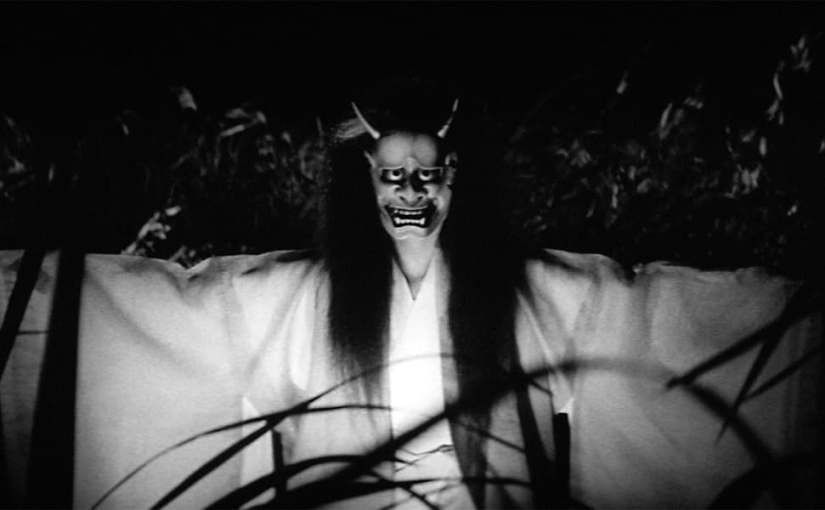
Hope arrives (story-wise) in the form of a tall samurai warrior the mother-in-law encounters in the tall grass one night.  He wears a fearsome demon mask and demands the old woman show him the way to the nearest town.  She asks him to remove the mask.  He refuses, but he assures her that he is very handsome underneath.  Right.

At this point, I was on the edge of my seat.  At last, here we go, some real horror-story stuff.  The mask looks awesomely horrifying, not like the kind of demons we tend to think of, but a weird, bug-eyed, fanged face that still looks vaguely human, which only makes it that much creepier.  When the old woman finally gets her hands on the mask (I won’t say how), she formulates a plan.  The next night, when the younger woman sneaks off to another rendezvous with Hachi, she is confronted by a tall figure with long black hair with the face of a demon…gliding through the grass is if it were floating over the ground.  Floating?  People can’t float.  …what exactly is going on here?

At this point, I was primed for a Twilight Zone kind of twist, revealing the true nature of the samurai warrior, the mask, and the old woman.  (Onibaba translates to “demon woman”, according to the main titles of the movie.)  But what?  I was pleasantly surprised by my eagerness to see what would happen next, even if it were mildly predictable.  The movie had shown great visual flair, so even if the ending was a cliché story-wise, it would look really cool.

But…alas.  The film’s ending teases us with several minutes of truly disturbing stuff psychologically, and then throws it away in a moment of ambiguity, the kind of open-endedness that may inspire discussions on the movie blogs, but which is terribly unsatisfying when it doesn’t work.  And here, unfortunately, it doesn’t work.  It leaves us with more questions than answers, and when “The End” appears, it almost feels like the director and/or screenwriter said, “That’s it, I’m out of story.”

The liner notes of the Criterion Blu Ray for Onibaba inform me that it’s based on an ancient samurai legend, so I guess I can’t totally blame the director/screenwriters.  But I just wish there had been something meatier waiting at the end of what had been a visual treat.  If it had provided a nudge into something deeper or more visceral, I’d have been ready to put Onibaba near the top of my favorite Japanese films.  Visually, it’s stunning with a surprisingly modern feel.  But, oy, that ending.

EYES WITHOUT A FACE (France, 1960)

by Miguel E. Rodriguez

DIRECTOR: Georges Franju
CAST: Pierre Brasseur, Alida Valli, Juliette Mayniel, Edith Scob
MY RATING: 9/10
ROTTEN TOMATOMETER: 97% Certified Fresh

PLOT: A surgeon goes to extreme lengths to give his daughter a new face, which was disfigured in an accident he caused.

[NOTE: This review contains mild spoilers.]


I have become a fan of many of the new breed of horror films released in the last ten years or so – Under the Skin, The Babadook, Get Out, Hereditary, Doctor Sleep, and Saint Maud, just to name a few.  Despite their cosmetic differences, these movies all accomplished the same thing: they got under my skin.  They were genuinely unsettling as their stories unfolded, and they can still creep me out to this day.

Imagine my surprise when I sat down to watch George Franju’s Eyes Without a Face, a French horror film released over sixty years ago, during a time when most mainstream American horror films (Hitchcock aside) were exercises in jump scares, cheesy special effects, and outrageous premises.  I was not prepared for how effectively this movie grabbed me from the outset and, except for a brief middle passage, did not let go.  When a movie from 1960 begins with a woman dumping a corpse into a river…a corpse with a clearly, hideously disfigured face…I don’t know about you, but I sat forward a little in my seat.  Where is THIS going?

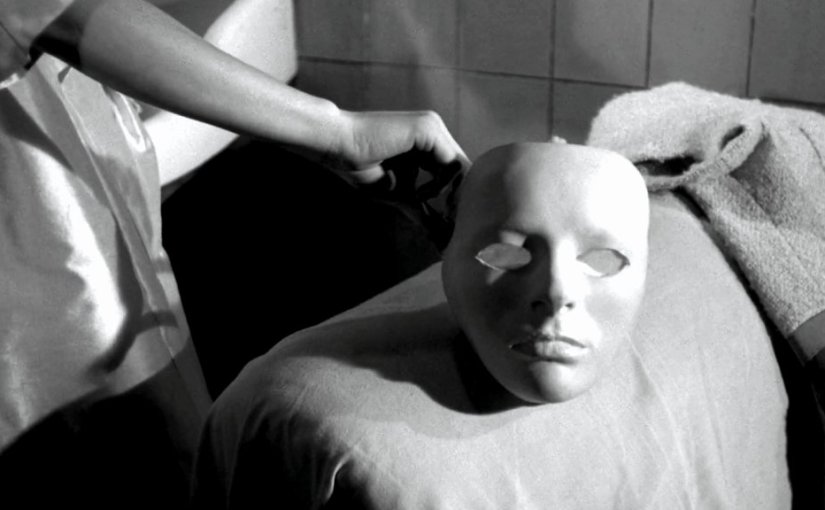
When the body is discovered, the esteemed Dr. Génessier (Pierre Brasseur) solemnly identifies it as his daughter, Christianne.  There is a funeral, Christianne’s fiancé is distraught, and the police are satisfied.  When the good doctor returns home to his large, gothic estate in the country, he goes upstairs to a room where we find his actual daughter, still alive and so disfigured the camera dares not show her face.  The doctor’s assistant, Louise (Alida Valli, still exotic-looking 11 years after The Third Man), brings in a simple but disturbing mask for Christianne to wear.  “Get into the habit of wearing it,” says the doctor.

Who was the girl in the opening scene?  What happened to Christianne’s face?  And why does Louise start searching the nearby city for young unattached women with blond hair and pretty faces?  Why, indeed?

Eyes Without a Face may not have a particularly inscrutable or complicated story, but that doesn’t matter.  The movie unfolds like a modern-day Grimm’s fairy tale, poetic, with princesses locked in tall towers, an evil father figure, and unspeakable violence hinted at but never quite seen.  Except this time, in an unforgettably shocking scene, we witness one of the doctor’s operations.

In most films of this era, shockingly violent acts were tactfully carried out offscreen.  I am thinking, for some reason, of Lawrence of Arabia, where Lawrence must execute a man in order to keep the peace between two Arabian tribes.  Lawrence pulls his gun, we see the bound man try to escape, and we cut to Lawrence as he fires his gun, once, twice, several times.  It’s a shocking scene, but we never see the carnage of those bullets.  It’s left to our imagination.

In Eyes Without a Face, we watch as the doctor gently draws a grease pencil outline around his anesthetized victim’s pretty face.  (“I must try removing it in one large section, not in pieces as before.”  Yikes.)  Then Louise hands him a scalpel, and the camera stays on Louise’s face, and I expected it to stay there for several seconds as the horror of what the doctor was doing was left to our imaginations.  But no.  We cut back to the scalpel piercing the skin as he gingerly follows his outline around her face.  Some excess blood drips down, and Louise dutifully sponges it away.

This is already pretty strong stuff for 1960, at least when I compare it to other films I’ve seen from that era (again, Hitchcock aside).  But I was doubly shocked when the movie didn’t stop there.  The face must still be removed, but to do that we need clamps, more incisions (taking care around the eyes, of course), and we watch this process in several long takes which must have had some audience members fainting in disbelief.

When the doctor is finished, another body must be disposed of, Christianne has a new face, and all seems to be well.  (The doctor reminds his daughter: “Smile.  Smile.  …not too much.”)  What makes this movie great is that there is still so much more to the story, but I’ll leave that for you to discover.

This is the kind of gothic stuff that screams for a remake today, maybe by del Toro or Ari Aster.  Although perhaps they are already fans and have made the decision that the film is too perfect as it is.  I can’t blame that viewpoint.  Eyes Without a Face has just about everything a modern horror fan could desire.  Franju plays many of the film’s creepiest scenes with no score, creating a deeply unnerving mood like in The Blair Witch Project.  It doesn’t shy away from disturbing gore.  Christianne is not just a shrinking violet, but prone to heartbreaking philosophy.  (“My face frightens me.  My mask frightens me even more.”)  To say the resolution of the story is satisfying is an understatement; it takes “poetic justice” to a whole new level.  There is Hitchcockian – or, perhaps more accurately, Clouzot-esque – suspense when Christianne’s fiancé begins to suspect there is something fishy about Dr. Génessier’s clinic and tries to set up a sting operation with the help of local police.

And so much more.  Eyes Without a Face is, for me, one of those buried treasure movies that I normally do not seek out, but when they turn out to be more than worth my time, I can’t help but share it with others.  It holds its own with modern horror films, and then some.  The fact it was made in 1960 still boggles my mind, and that just makes it even more fascinating.

[P.S… According to IMDb, John Carpenter once suggested that the selection of the mask worn by Michael Myers was influenced by Christianne’s mask from this film. I believe it.]

BEETLEJUICE

By Marc S. Sanders

On Friday night, we watched Beetlejuice the movie.  On Saturday afternoon, we watched Beetlejuice the musical, and as soon as the curtain was pulled on the stage and the performance began, I knew exactly what the movie did wrong and what the play did so right.

I saw Tim Burton’s much beloved spooky comedy for the first time just last year with my Cinemaniac pals, which includes the other Unpaid Movie Critic.  The guys were laughing and laughing until it hurt.  I was off to the side thinking how I remember seeing that scene while flipping channels on occasion.  Cute, but ultimately boring.  That’s how I feel about Burton’s second film, following a hilarious debut with Pee Wee’s Big Adventure and just ahead of his blockbuster accomplishments with the first two Batman films.  Beetlejuice is full of big ideas but devoid of content, and I mean that literally, because the title character brilliantly played by Michael Keaton is scarcely in the film.  When he is not on screen, the remaining cast are quite bland or unwelcomingly weird.

Adam and Barbara (Alec Baldwin, Geena Davis) happily reside in a three-story Connecticut home.  Adam indulges in making a scaled model of their picturesque hometown and Barbara…well I can’t recall what she does.  On an errand trip, they haphazardly die and suddenly return to the house.  Yet, they realize quickly that they have expired and what is even less convenient is that they cannot leave the house lest they end up in a kind of limbo threatened by a monstrous sand worm and other unusual experiences. 

Shortly after, Charles and Delia (Jeffrey Jones, Catherine O’Hara), appearing with the typical Tim Burton flavor, move into the house along with his suicidal daughter Lydia (Winona Ryder) and their quirky interior decorator Otho (Glenn Shadix).  They plan to refurbish the house in their own way with Delia’s ugly art sculptures and Charles looking for a reading room.  Adam and Barbara want them out so they can roam free and avoid being contained within the attic. 

Upon discovering that Lydia can speak with them and following an entrance to the Netherworld, they get an idea to scare the new owners away.  Only whatever efforts they set out to make fails miserably and they consider reciting the name of the “ghost with the most” three times to carry him over to their side to do their bidding.

Great storyline.  Sounds great on paper.  So why didn’t it work for me?  Well, Lydia is resigned to her mostly miserable suicidal self and that is neither funny nor empathetic to me.  More importantly, conflict works best when different worlds clash and what I find lacking in several Tim Burton films is that the characters on both sides of the coin are not different enough from one another.  The ghosts or souls or comforts of the Netherworld do not look far enough apart from how Charles, Delia, Lydia and especially Otho behave.  Everyone is weird.  Where is the normalcy to ruin or undo or disagree with? 

Beetlejuice himself is a character to behold though.  Keaton is doing Jim Carrey better than Jim Carrey does and long before that guy was ever discovered.  The actor is working in the area of Robin Williams material, particularly as the Genie from Alaadin.  The issue I have is that Michael Keaton is seldom in the film.  It is a long first act with Baldwin and Davis not doing much of anything before they finally encounter Beetlejuice to have a couple of funny exchanges.  Then they leave him to have mundane conversations with everyone else in the film, particularly Winona Ryder who has nothing to do except dress in her signature, depressing black.  When Keaton finally is summoned, he takes possession of a dinner party with the beloved Calypso tune “Dayo.”  However, we don’t see Keaton in this popular sequence.  Instead, we get Jones and O’Hara with David Niven doing odd contortions to the music with some butt shaking and grotesque facial and body expressions.  I would rather have seen Keaton doing his funny best in a lip sync routine.  What’s in the final cut is just not funny enough for me. Kooky, yes.  Funny, no.

Eventually, the black and white striped suited ghost with green hair is called back for the final act and we get to see him pull all the tricks out of his hat.  However, it’s not enough.  Just as the routine is getting started, it’s over, and then the movie is over. 

There are some inventive sight gags.  Not enough though.  I particularly loved the shrunken headed ghoul with the googly eyes and the pink skinned prostitute whose legs are separated from her torso.  I love when Beetlejuice’s head gets shrunk, and I like when Adam and Barbara’s faces are contorted into odd shapes of gigantic beaks or zany skulls beneath their facial skin.  These are the highlights of this film’s Netherworld and the distance I travel to see it all is smaller than Rhode Island.  In the original Star Wars, I experienced what felt like thousands of alien races.  In Ghostbusters, New York is haunted by one different kind of afterlife from another and another.  In any episode of The Muppet Show, I get to see one breed of silliness before another ridiculous set up is put into play.  The Netherworld setting of Beetlejuice is simply not vast enough.

The stage musical makes up for the shortcomings I have with the film.  The spine of the story is what the two pieces have in common.  After that, the stage play takes more risks.  The musical numbers are absolutely winning.  More significantly though, all the characters are granted more depth and dimension.  The root cause of Lydia’s anguish is explored.  We see the snobbery of Charles just like in the film, but he is also a loving father who recognizes Lydia’s suffering following the loss of his wife/her mother.  Delia also has a desire to connect with her stepdaughter Lydia.  All the elements are given enough attention amidst the craziness offered by Beetlejuice himself who occupies the story from beginning to end.  The character works like a great two-hour stand-up routine with his unlimited imagination of ghoulish trickery and fun.

Burton’s film was released in the late-1980s when updated stop motion effects of the puppet kind were new to the medium of film.  The imagination was there, though it does not hold up as it is very outdated.  Still, Tim Burton was showing his gift for macabre creativity that he has become known for ever since.  Nevertheless, he did not go far enough with the vision of his film, and he did not award any of his characters enough ingredients to let them be unique.  It is not enough that they all speak weird and look strange.  It is better if we can know why they are so uncompromisingly odd.  Beetlejuice the film lacks its variety. More specifically, it lacks its Beetlejuice.

ALIEN: COVENANT

By Marc S. Sanders

I imagine it would take a defiant personality to become a God and bearer of life.  That individual would most likely have to be beyond human to follow through on such an endeavor.  In cinematic fiction, to occupy such a role would require an exceptional actor with a calm yet powerful command.  It is fortunate that in Ridley Scott’s follow up to his Alien prequel, Prometheus, that he was able to recruit Michael Fassbender in the role of David – the android invested in discovering new amalgamations of life from unknown sources within a very deep universe.

I understand Alien: Covenant left many fans and critics divided and that it was not the box office success many were hoping for.  In addition, a follow up chapter to this film seemed more unlikely following Disney buying out 20th Century Fox.  Nevertheless, none of these occurrences dismiss one of best dual role performances I have ever seen, compliments of Michael Fassbender. 

The actor first appears in a prologue as David discussing challenging questions with his maker, the wealthy industrialist Peter Weyland (Guy Pearce), a younger looking iteration than from the prior film.  David has met his maker.  However, he questions who created his own maker.  No satisfying answer comes from the conversation and thus it ends with Weyland commanding his “child servant” to a menial task of serving him tea.  David, we learn, will resent humans who opt to subject his incredible capabilities to menial tasks.  He is destined for greater achievements than servitude.  David is meant to be a God.

The film diverts to a period eleven years after the events of Prometheus.  A massive ship known as The Covenant is embarking on a journey to a paradise where the cryo-sleeping colonists and the hundreds of human embryos in storage will set up a new civilization for themselves.  They have just over seven years left of their journey.  The crew of fifteen who command this expedition are also sleeping while an android named Walter (Fassbender in another role) oversees operations.  Following a collision with a storm-like phenomena in space, the crew is violently awakened and the captain (James Franco) does not survive. A reluctantly nervous replacement named Oram (Billy Crudup) now must lead, and it appears fortunate that Covenant has come upon another nearby planet sending a signal source in the form of a John Denver song.  Why John Denver????? I guess the Beatles and Rolling Stones were too expensive. This locale might suit the colonists’ needs and save them another seven years of travel and unexpected risk.

Oram and the former captain’s wife, Daniels (Katherine Waterston), lead a team down to the planet.  A wheat field is surprisingly found.  There’s beautiful blue sky and mountain ranges.  Water is found.  Still, there’s a disturbing realization. Not a single animal or life form is anywhere.  No insects, no birds, no wildlife, nothing.  Like prior installments in the franchise, it is not long before some crew members get ill, very, very rapidly.  Then the first of several terrifying episodes begins.  All of that is visual and not necessary to recap here.

David makes an “Obi Wan Kenobi” like appearance amid the mayhem and calms everything down.  The highlight of Covenant is when Fassbender as Walter (a down to earth American interpretation of an android) encounters Fassbender as David (a refined English example). Upon entering David’s habitat, it is clear he has been busy over the last decade since he and Dr. Elizabeth Shaw (Noomi Rapace, from Prometheus) arrived on this uncharted planet that was once populated by The Engineers, also from the first film.

At the risk of mild spoilers, I offer the following observations, because the thought provoking aspects of Ridley Scott’s third monster movie, are worthy of insightful conversation. 

Walter and David are undoubtedly the most interesting characters of Alien: Covenant.  They possess two totally opposite mindsets.  Almost like they are the angel and devil figures found on a person’s shoulders.  They regard the value of people differently.  Walter holds humanity in high esteem, ready to assist while they continue explorations of great beyonds.  David is prepared to dismiss them, though they serve a valuable purpose in his own selfish discovery to harbor a new breed of creature – one considered to be a perfect organism.  Experimentation has been David’s sole focus.  Now he may have finally uncovered precisely what he needs for his masterpiece of creation.

There are staple moments and happenings that are no longer surprising in Alien: Covenant because there’s a formula that traditionally worked in the long gestating franchise before.  Nevertheless, the film is far from stale.  The story offers up a well-conceived history to the origins of the alien breed, known as Xenomorphs from other films.  Why and how they came to exist are provided.  Hey, I’ll happily say this is more definitive than the Old Testament.

To witness one actor on both sides of a debate discussing the purpose of human preservation and what value people serve from this point is really a thrill.  Both Walter and David are artificial intelligence.  They are so advanced that they have usurped humans as the greatest thinkers in the universe.  It’s not farfetched in this age of smart phones and an over reliance on technological innovations to incorporate this into a monster movie.  It only enhances and improves upon a tired old Godzilla cliche.  Movies are sometimes quite prophetic.  So, it’s not even ridiculous to categorize a film like Network with a bloody sci-fi horror film like Alien: Covenant or even a couple of Tom Clancy political thrillers.

Alien: Covenant boasts a good cast particularly with Katherine Waterston, Billy Crudup, and an unusually serious Danny McBride as a good ol’ boy pilot named Tennessee.  McBride does well with the drama and horror to come.  He’s not a novelty act.  While these actors may be playing well developed characterizations, I know they are only here for the body count and to keep David and the aliens busy.

Again though, the film especially belongs to Michael Fassbender.  A brilliantly inspired casting choice for the first film in this more recent resurgence of the franchise.  It’s only a huge blessing that he returned, and this next film pounced on his capabilities to balance the two roles on opposite ends of the spectrum.  Regardless of whether he’s playing Walter or David, Alien: Covenant only gets more interesting when Fassbender occupies a scene. 

An especially telling moment is so wisely written with a kind of seductiveness between the androids while one teaches the other to play the flute.  Humans no longer need to program computers.  The computers can work it out themselves, and even develop an intimate attraction for one another.  What’s most delightful is again, I remind you, that Michael Fassbender is the only one working in scenes like this.  How often has an actor gone in for a kiss in another role that he is playing in the same scene?  He hides so well in Walter and David, that you lose sight of the fact that you’re watching only one performer doing all the work.

The final scene of the picture caters beautifully to what Fassbender offers in his two roles.  The story’s conclusion will leave you thinking and wondering what comes next.  Intentional or not, I regard the ending of Ridley Scott’s picture as an homage to other great films like The Silence Of The Lambs and The Usual Suspects.  You may feel shockingly haunted as the end credits roll.

Overall, Alien: Covenant is a chilling, mind-bending masterpiece of science fiction horror and what-if prophecy.

CRIMES OF THE FUTURE (Canada, 2022)

by Miguel E. Rodriguez

DIRECTOR: David Cronenberg
CAST: Viggo Mortensen, Léa Seydoux, Scott Speedman, Kristen Stewart
MY RATING: 5/10
ROTTEN TOMATOMETER: 80% Certified Fresh

PLOT: In a dystopian near-future, the human pain threshold has suddenly disappeared, giving rise to bizarre performance artists who publicly showcase bodily mutations and self-mutilations.


Somewhere at the core of David Cronenberg’s Crimes of the Future is a crackling good thriller waiting to happen.  I was still waiting for it when the end credits rolled.  I couldn’t predict what was going to happen next, which is normally a big plus for me, but the problem was, I didn’t care what was going to happen next.  Just when the movie seemed about to kick into a new gear story-wise, boom, credits.  Shame.

In the near future, human bodies worldwide have started undergoing bizarre mutations involving the development of new internal organs and the disappearance of a pain threshold.  This leads to the proliferation of underground performance artists who are either publicly mutilated or mutilated themselves.  Why?  Because Cronenberg.  We get close ups of the lead character, Saul Tenser (Mortensen), lying in a special chamber while knife-wielding robotic arms controlled by his partner, Caprice (Seydoux), slice, probe, and excavate his thorax in search of unwanted new organs.  Another performer lies in a chair while a surgeon literally cuts grooves into her face.  Yet another performer has grown dozens of additional ears all over his body, and has his eyes and ears sewn shut while he dances to modern music as a voice intones, “NOW is the TIME to LISTEN.”


This is all typical stuff from Cronenberg, who was and is a virtuoso of so-called “body horror,” going all the way back to Scanners, Videodrome, and the remake of The Fly.  It’s so typical, in fact, that the sight of various bodily injuries and mutilations didn’t really faze me as much as I thought it would.  Or should.  Maybe this says more about me than about Cronenberg, but the most off-putting sight was that one dancer with the extra ears.  Everything else, while graphic, didn’t feel “real.”  It all felt like effects.  Instead of recoiling, I found myself thinking, “Wow, how’d they do that?”  (By contrast, the dancer with the ears may yet give me nightmares.)

The storyline of the movie remains maddeningly vague for the first half.  In a weird prologue, we watch as a mother performs an unthinkable act after seeing her son eat a plastic trash can as if it were made of gingerbread.  Saul Tenser seems to encourage the growth of these new organs in his own body, even though they could become harmful over time.  His assistant, Caprice, gets turned on by seeing him getting carved up in his chamber; he seems to enjoy it as well.  They call it “the new sex.”  There is a subplot about a new police division, New Vice (not terribly original), trying to crack down on people who perform these public acts of mutilation.  We watch as an unknown gentleman stalks Saul and Caprice while he eats what looks like a purple chocolate bar.  At a bar, another stranger inexplicably grabs the purple bar and takes a bite out of it himself, and immediately experiences something that makes him wish he hadn’t.

This is all interesting, cerebral stuff, I must admit.  The makings of a dystopian thriller a la Blade Runner or Gattaca (with more blood) are all there.  But the mood and lethargic pacing of the movie literally put me to sleep.  I had to rewind it several times during the first half to catch what I missed.

But then the second half kicks in.  Saul is contacted and asked to perform a public autopsy on a child who may have inherited a surgical self-mutilation from his father, a medical first which might be the signal of a true next step in human evolution, but one which was engineered by man and not by nature.  New Vice reaches out to a deep-cover agent (whose identity I wouldn’t dream of revealing) who is assisting the search for cells of bio-terrorists who are trying to alter the course of human evolution.  Meanwhile, Saul, who has been battling some kind of respiratory affliction for the entire film, is tempted with one of those purple bars.  Caprice undergoes a self-transformation of her own…

And then, when a crucial discovery is made that might change the course of the entire movie…it’s over.

How to describe my disappointment?  I was a huge fan of Cronenberg’s two entries in the genuine, “traditional” crime thriller genre, A History of Violence and Eastern Promises, both starring Mortensen.  Both films are much more conventional than Crimes of the Future, but both are light years ahead in terms of holding my attention.  I naively thought this film (with the word “crimes” right in the title!) would be along the same lines.  Am I critiquing the film I wanted it to be instead of critiquing the film it is?  Maybe I am, because the first half of the movie was so bland and stultifying that I can’t think of anything else to say about it except to compare it to something that I wish it had been.

Crimes of the Future, Cronenberg’s first feature film after an 8-year hiatus, sees him returning to a horror sub-genre that he virtually created, or at least perfected, nearly 40 years ago, and he does have something meaningful to say about what mankind is doing to itself and the planet without regard to future generations.  I just wish he had found a way to say it without boring me for the first fifty-four minutes, then leaving me hanging at the end.