THE MIST

By Marc S. Sanders

I’m tough to satisfy when it comes to monster movies.  Too often they all look the same, or they behave with similar instincts and motives.  There’s a new dinosaur movie coming out this year where they apparently stalk a military unit.  So!  I’ve seen seven Jurassic Parks.  About the only monster that still gets under my skin are the acid pumping, knives for teeth xenomorphs of the Alien franchise.  Everything else is been there, done that, and this includes the insect like pests found within the mist of Steven King’s The Mist, directed by Frank Darabont.  Fortunately, there’s a better and much more engaging attraction to this eat ‘em up blood fest.

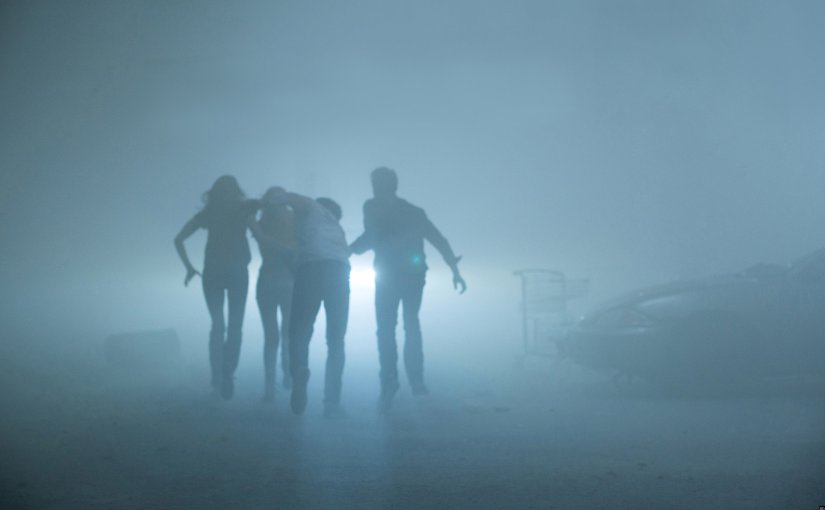
Within another small fictional town in Stephen King’s version of Maine, a dark and stormy night kills the power within the area.  The next morning large fallen trees appear to have damaged the homes of David Drayton and Brent Norton (Thomas Jane, Andre Braugher).  Phones and power remain out, but a curious cloud of mist grows over the lakeside area.  

The gentlemen decide to go into town for supplies with David’s son Billy (Nathan Gamble) in tow.  The checkout line of the supermarket is crowded with tourists and residents when a similar mist envelopes the building and clouds up the expansive front window of the shop.  An elderly man runs through the parking with a bloody nose and urges the shoppers to lock the doors because there are things within this unwelcome mist that are terrifying and bloodthirsty.  I’ll spoil this for you. The old coot is right.  The creepy crawlies are thirsty for blood and hungry for flesh.

You’ve seen much of what Darabont’s screenplay adapts from King’s novella in similar iterations of horror.  The wheel is not reinvented here and though an explanation of this mist and the organisms it conceals is spelled out, nothing is jaw dropping.  Seems similar to how King’s The Stand opened.  The cast of this B movie is what needs to be talked about.

Sure, there are doubters of things terrorizing the community just before the blood is spilled.  Some characters make hard decisions despite the urging of others not to leave the store.  Yet, when these flesh eaters become evident, then the end of days gospel of Mrs. Carmody (Marcia Gay Harden) permeates through the populace of the supermarket.  That’s when The Mist grows a brain to demonstrate the power of fear, threat, and especially influence.  The disturbing Mrs. Carmody exaggerates the purpose of this phenomenon with select biblical scripture both documented and I believe conjured on the fly by her.  Now I am reminiscing back to tenth grade English when I studied Lord Of The Flies.  A tribe forced to live together will ultimately divide.

Darabont so wisely reads a collection of different walks of life forced to either work together or work against each other, both sides with desperate means to survive.  William Sadler is a dimwit mechanic who goes through three different modes of purpose during the film.  He starts with a tough guy mentality, then on to timid fear and regret, and lastly, he’s reawakened to echo the call of Marcia Gay Harden’s religious zealot.   Truly insightful because I often wonder how any person can so easily succumb to the influential beliefs of someone else.  I mean you would have to be dense to allow that to alter your mindset, right? Well Stephen King and Frank Darabont remind me that there’s more dense people on this planet than wise.  A dread of cabin fever only exacerbates to succumb to what someone will tell you. Therefore, let’s observe how the morons respond to the dominant personality.

The action for the sake of jump scares and expected horror does not disappoint too much.  There’s screaming. There’s lots of blood. There’s lots of running too, and monsters and webs and teeth and claws.  A sneak away trip to the pharmacy next door is neat centerpiece, but you’ve seen stuff like this so many times before. Frances Sternhagen gets the opportunity to use a makeshift, bug zapping, flame thrower that made me laugh and cheer.  

The jump scares are not very effective, though.  One bug thuds against the window pane. Otherwise, there’s monster stuff to absorb like tentacles, claws, teeth and webbing. I don’t go for slasher flicks and endless bloodletting gore like most movie makers of this genre attempt to achieve.  Too much blood is boring and a sign of a lack of story.

I was invested in uncovering why this all started.  I was taken with how a small group of people quickly engages in a mob mentality because their individual desperations refuse to satisfy. What instincts will undo people when hope dwindles and your companions turn on you?  Darabont presents some effective moments for these questions. However, once the exposition was out of the way, I didn’t care who lived or died.  My concern was knowing how whoever survives gets out of this dilemma.

The answers come and there is an unexpected ending tacked on by Darabont that is not recounted in King’s work.  Trust me when I say I’ll never forget the conclusion of The Mist.  Same as I’ll never forget the ending to The Sopranos.  That’s not necessarily a compliment though because I think Frank Darabont was only adding unnecessary insult to injury. He resorts to using a terrible psychological epidemic for one last twist of his gleeful, mischievous knife in my back.  I am not spoiling anything for you dear reader, but James Cameron went this route during a sequence in Aliens and it made much more sense, while offering convincing justification.

While you might like the chills and thrills of The Mist, be warned that it’s the ending that’ll leave you angered for days and nights thereafter. I had a furious urge to throw my popcorn at the screen.  

Popcorn can be found on aisle 5 by the way.  Bug spray on aisle 9.
MISERY

By Marc S. Sanders

The worst thing that could have happened to Paul Sheldon is that Annie Wilkes saved his life.

Rob Reiner breaks away from innocent romantic comedy to deliver a violently cruel kind of intimacy. He directs his second Stephen King adaptation, Misery.  (His first was based off King’s novella The Body, which became Stand By Me.)  With next to no prior record with horror or disturbing psychosis, Reiner achieves greatness with this film.  Much like Martin Scorsese, he focuses quite a bit on props that offer no dialogue but say so much.  A cigarette, a match, a champagne flute, a bottle, a beat-up briefcase, a clunky Ford Mustang, along with a gun, a two by four block of wood, a portable grill, a knife, a syringe, a sledgehammer, and a porcelain penguin.  Barry Sonnenfeld is the cinematographer offering brilliant clarities of color for mundane and endless discomfort.

Before leaving his mountainous Colorado cabin, Paul has smoked his cigarette and savored his glass of 1982 Dom Perignon.  He has just completed a new manuscript; a big departure from his best-selling series of novels focusing on his beloved heroine Misery Chastain.  Lady Misery is not how Paul wants to be entirely defined as an author.  

Unfortunately, on his way back down the snowy mountain, he veers off the road and lands upside down in his Mustang, buried within a blizzard.  A hulking figure carries him back to a peaceful, isolated cabin in the woods.  When he awakens two days later, he meets Annie who has already begun to nurse him back to health following two very damaged legs and a popped shoulder blade.  By his grogginess, he might have had a concussion too.  Lucky for Paul because apparently, he cannot reach a hospital or get a call out to his family or literary agent (Lauren Bacall) due to the harsh weather conditions.

It’s also convenient that Annie is quite the fan of Paul’s work, particularly his series of Misery novels.  She has a maternal bedside manner, but oddly enough she becomes irascible at any given moment.  After honoring Annie’s request to read his untitled manuscript, Paul realizes that might have been a mistake.  Annie can easily get unhinged to say the least, and that temper…

Paul Sheldon is portrayed by James Caan, and he was one name on a long list of leading actors considered for the role including Warren Beatty, Robert Redford, Harrison Ford, Robert DeNiro, and Jack Nicholson.  Any one of these guys could have done the part.  However, I can now only see James Caan.  He beautifully plays stationary vulnerability as he’s anchored to a bed for most of the film.  Ironically, for a writing master of words, Caan’s dialogue is not even half of the script that belongs to his counterpart.

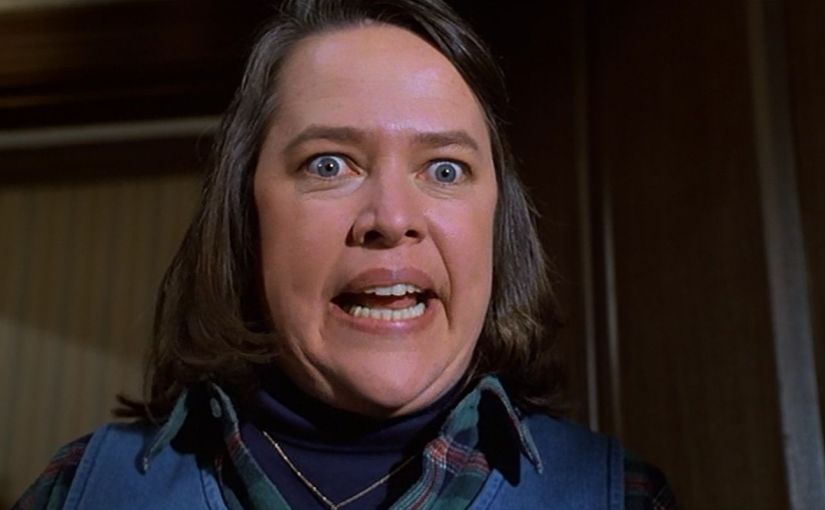
Kathy Bates was deservedly awarded the Oscar and a slew of accolades for her role as Annie Wilkes.  This role put Bates on the map.  Her portrayal is timed so authentically with changes in tempo from childlike enthusiasm to demented rage that she only makes Stephen King seem like that much better of an author than he already was at the time.  Actually, I’d argue that before Misery hit theaters, the Stephen King factory of film adaptations was churning out subpar products like Cujo, Firestarter, Christine, and his own film that he directed Maximum OverdriveMisery elevated the author’s brand back to when it was celebrated with Brian DePalma’s Carrie and Stanley Kubrick’s unforgettable interpretation of The Shining.

I believe what helps is that of all the varieties of horror the author was delivering, Misery did not hinge on the supernatural.  Annie Wilkes is a very real embodiment of capable terror and disturbing psychological handicap.  Kathy Bates effectively demonstrates byproducts of schizophrenia and obsessive, compulsive disorders.  Living alone in the woods with the subconsciousness of an author speaking to her through the pages of his fictional hardcover novels only feeds the beast that she’s become. 

I’m not a big fan of Stephen King’s works.  Often, I find his material of gore stretches too hard for shock value, and hardly ever achieving insightful originality.  To the best of my recollection, I’ve only read Misery, The Stand and It.  That’s enough for me.  I read that as he was writing Misery, he was emoting his alcoholic demons that left him obsessively challenged.  Annie Wilkes developed into that tangible, physical fiend.  This story takes a far step away from the macabre world that built his literary empire.

Rob Reiner does not go for any kind of novel inventions with his film.  He’s simply telling a story with the tools provided by celebrated screenwriter William Goldman (The Princess Bride, Butch Cassidy & The Sundance Kid, All The President’s Men) and his wise adjustments from King’s piece.  Goldman and Reiner wisely cut out a lot of King’s gory schlock.  (That foot scene, for example.  Either way?  YEESH!!!) Smart move, because Annie Wilkes is such force of power personified by the hulking physicality (by choice of Reiner’s lens) and range of Annie Wilkes.  Even though Kathy Bates is short, she is a hulking menace here. Kathy Bates is doing stage work in front of a camera.  I’d argue her performance inspired the idea of eventually converting Misery into a Broadway play that featured Laurie Metcalf and Bruce Willis in the roles.  I wish I could have seen that. 

Goldman wisely allows the picture to move on with another perspective in the form of two characters that were not part of King’s story.  A perfect casting of Richard Farnsworth and Frances Sternhagen as the local sheriff and wife advance the curiosity of Paul’s absence from the world.  They speak for the surrounding areas that don’t reveal what is beneath the blankets of snow where few clues remain, and not even a missing 1965 Ford Mustang can show itself.  They’re funny, quirky, and unusual, almost like a combination of Jessica Fletcher or Miss Marple seeking to resolve the mystery.

Props like a gun and a knife along with visuals like uncontrollable fires and fight scenes are nothing new.  However, it’s when these scenarios are paired with Kathy Bates to victimize a small, weakened James Caan that these items become well filmed properties of Rob Reiner.  So again, I focus on the inanimate objects of Misery because Reiner lends a lot of footage to all of these working pieces.  This revolver suddenly has dialogue of its own through one of Annie’s personalities.  The knife works like a guard dog for Paul.  The aluminum can of lighter fluid sadistically squirts itself to tickle or tease an extreme point for Annie.

The cigarette and champagne flute emote those small, cheating, harmless vice escapes from commitment that awards Paul. 

The sledgehammer puts its foot down.

The match plays both sides of the duality during different points of the film.

Misery is that film that works with a small cast, but with a wide population of environment, in a snug, confined space.  I describe the picture this way because like Annie Wilkes, this exploration in psychological terror operates without fair balance.  When an animal cannot control and subdue its instincts, there’s no telling what to expect, and an unpredictable Annie Wilkes might be one of the scariest personifications any one of us could ever encounter.

THE MUMMY (1932)

by Miguel E. Rodriguez

DIRECTOR: Karl Freund
CAST: Boris Karloff, Zita Johann, David Manners, Arthur Byron
MY RATING: 7/10
ROTTEN TOMATOMETER: 89% Certified Fresh

PLOT: A resurrected Egyptian mummy searches Cairo for the girl he believes to be his long-lost princess from ancient Egypt.


The story of The Mummy is good enough to warrant a mostly positive review from me, even though the storytelling itself lacks zing.  Clocking in it a brisk 73 minutes, my girlfriend called it “the longest 73 minutes ever.”  She has a point.  There are long stretches with no dialogue, and while some of those passages are thick with atmosphere, they tend to bring the film’s momentum to a screeching halt.

However, the underlying plot was still interesting enough to keep my attention during those doldrums.  We learn in the opening scenes that a British archaeologist, Sir Joseph Whemple, dug up the sarcophagus of an Egyptian priest named Imhotep, in Cairo in 1921, along with a sealed box bearing a warning and a curse on whomever opens it.  Naturally, the warning is dismissed, the box is opened, and in a genuinely creepy, chilling scene, the cloth-wrapped mummy in the background comes to life.  In a neat bit of trickery, we never, ever see the mummy itself after it spontaneously revives.  We only see its hand as it reaches into the frame and the reaction from Whemple’s poor assistant who goes insane on the spot.  That is admirable restraint.

Ten years later, Whemple’s son, Frank, returns to Cairo in his father’s footsteps.  He is introduced in typical early-Hollywood fashion with a shot highlighting his strong profile as he looks eagerly into the distance.  I mention this detail because, as it happened, both Penni and I thought the exactly same thing in our heads: “And who is THIS handsome fellow?”  It’s corny, but it’s how things were done back then, what are you gonna do.

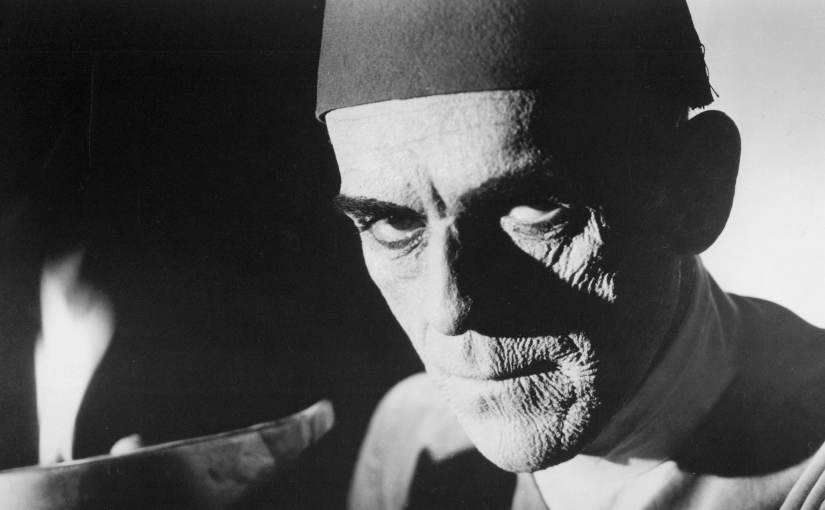
Frank meets a tall, gaunt stranger calling himself Ardath Bey, which as everyone knows is an anagram of “Death by Ra”, so talk about a spoiler alert.  Ardath is, of course, the resurrected corpse of Imhotep from ten years ago, played by the legendary Boris Karloff.  We eventually learn that Imhotep is attempting to resurrect his princess who succumbed to illness thousands of years ago, and whose reincarnated spirit, coincidentally, may reside in the body of the young socialite Helen Grosvenor, vacationing in Cairo this very night, wouldn’t ya know.

That’s the plot in a nutshell.  Imhotep casts various spells and chants various chants and Helen is inexplicably drawn to the mysterious Ardath Bey, and Frank and his father try to unravel everything before poor Helen is killed in a ritual sacrifice.  The story feels admittedly trite, but I tried to imagine what contemporary audiences must have felt when seeing this movie for the very first time, nearly a hundred years ago now.  We don’t get the anticipated scenes of a shuffling, moaning mummy “chasing” its victims in a deserted pyramid.  Instead, Imhotep does most of his damage remotely, via a magical pool of water that works like a CCTV camera.  Maybe that was more disturbing to people, that this malevolent force doesn’t even have to be near his victims to hurt or even kill them.  Come to think of it, that IS a little more disturbing.

I won’t say The Mummy is chock-a-block full of thrills and chills.  It’s not King Kong (1933).  But there is plenty of atmosphere to satisfy the average movie fan; there’s even a “surprise” ending that I did NOT see coming.  But that’s all you’ll get from me.  Mum(my)’s the word.

SPECIAL GUEST REVIEW: THE ROCKY HORROR PICTURE SHOW (1975)

by Ronnie Clements with Screen Gems

Screen Gems reflects on The Rocky Horror Picture Show (1975)… Review by Ronnie (Dorian) Clements on his FB page Screen Gems http://www.facebook.com/screengemsbyronnie


On 14 August, 1975 (50 years ago), The Rocky Horror Picture Show opened at the Rialto Theatre in London. Rocky is still the longest running movie in theatrical history and the biggest cult movie of all time! I doubt if any other film will ever “usurp” it. 

[And whatever you do, forget the 2016 made-for-TV remake. It’s a pale imitation, woefully flat and best left in the vault or preferably down the pooper!]

Screen Gems 70’s Flashback …

The Rocky Horror Picture Show (1975).

A Look Back at the OG (totally re-written for the masterpiece’s 50th anniversary) …

Two of the most unforgettable Saturday afternoons of my life were spent watching live matinee performances of The Rocky Horror Show; years apart, yet equally electric. While the film adaptation, The Rocky Horror Picture Show, has rightly earned its cult status, nothing compares to the raw energy of the stage. Still, the movie captures the essence and outrageous brilliance of the original, preserving it for eternity.

As a screen adaptation of musical theatre, Rocky stands alone. There’s truly nothing else like it. The score is wildly eclectic, veering from tender ballads to glam rock anthems, and yet not a single dud among them. It’s a sonic rollercoaster that defies genre and expectation.

The plot? A delicious mash-up of horror and sci-fi tropes, with a heavy nod to Frankenstein. But what emerges is something wholly original: a campy, chaotic celebration of identity, desire and rebellion.

Written by Richard O’Brien, The Rocky Horror Show premiered at London’s Royal Court Theatre Upstairs on June 19, 1973. The original cast: Tim Curry (Frank-N-Furter), Richard O’Brien (Riff Raff), Patricia Quinn (Magenta), and Nell Campbell (Columbia), all reprise their roles in the film, bringing their eccentric brilliance to the screen.

The stage show holds the record as the longest-running theatrical production in history and it’s still performed around the world. The film, after flopping on its initial release, found new life through midnight screenings in the mid-70s. Word of mouth turned it into a phenomenon. 

Since 1975, it’s been shown continuously in cinemas — the longest theatrical run ever. Every Friday or Saturday night, somewhere in the world, fans gather in costume, props in hand, ready to shout, sing and surrender to the madness. I’ve never attended a midnight screening myself, but I’m told it’s a surreal, unforgettable experience.

The Story …

Brad (Barry Bostwick) and Janet (Susan Sarandon), two squeaky-clean newlyweds, find themselves stranded on a stormy night. Seeking help, they stumble into the gothic lair of Dr. Frank-N-Furter, a self-proclaimed “sweet transvestite from Transsexual, Transylvania”, and his bizarre entourage. What follows is a wild descent into seduction, science and spectacle as Frank unveils his latest creation: the perfect man, built for pleasure.

Does the plot make sense? Not really. But that’s beside the point. It’s pure fantasy, a glitter-drenched fever-dream, powered by a magnificent score and unapologetic theatricality.

Tim Curry was born to play Frank-N-Furter. His performance is iconic, seductive, menacing and utterly magnetic. The rest of the cast delivers with equal flair. The film’s comic book aesthetic (garish lighting, bold colors, exaggerated performances) only heightens its surreal charm.

Themes Beneath the Fishnets …

At its heart, Rocky Horror is a battle between conservatism and counterculture. And, as in life, the establishment unfortunately wins! Frank-N-Furter and Rocky are killed … but … Brad and Janet return to their “normal”, mundane lives. However, the film leaves us questioning what “normal” really means and whether conformity is truly a happy ending! 

WEAPONS

By Marc S. Sanders

The longevity of horror movies and the insatiable appetite that audiences hunger for hinges on curiosity.  Horror is other worldly or beyond commonplace.  It’s unrealized. Stories likely begin with the concept of a particularly unique, unheard of scenario.  

For example, one night in a small suburban neighborhood, what could explain why an entire classroom of elementary school students, taught by Ms. Gandy, leave their homes at exactly 2:17 in the morning, vanish into the darkness and never return? Could Ms. Gandy be behind this mystery?  Also, why is Alex the only student in the class to show up for school the next day?

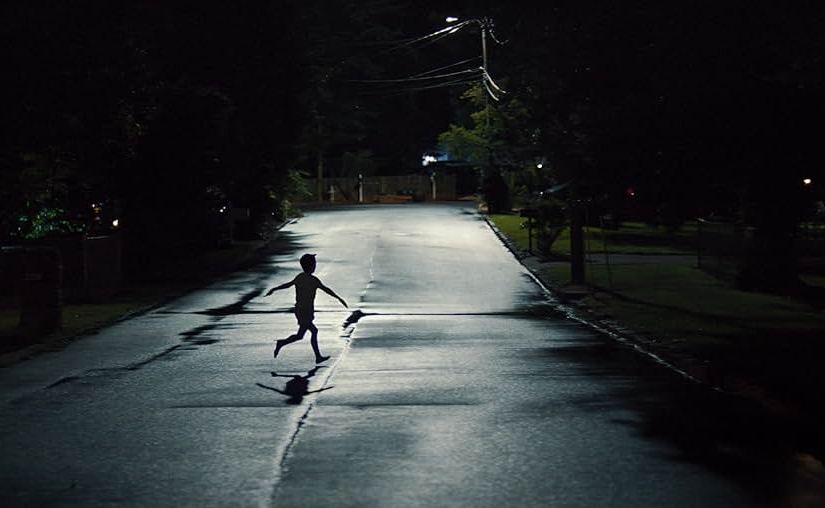
Reader, the trailer for Weapons had me hooked.  The imagery showing the silhouettes of innocent children running into the darkness with their arms outstretched was eye opening.  A young girl narrates the brief camp fire ghost story in the preview. It also opens the film with additional details.  This set up seems odd and different.  Doesn’t sound like another vampire or zombie flick to me.  This was going to be something else.  Frankly, ahead of the release of Zach Cregger’s film, I could not stop thinking about it.  I needed to know the reason behind this phenomenon.  

Yet, anticipation and finally scratching that itch turned out to be disappointing.  

Cregger’s movie answers almost all the questions it offers even if some elements are not wholly consistent as the story unravels.  The only salvation to watching Weapons is not knowing why any of this happened, in particular with the squirrelly young teacher, Ms. Gandy (Julia Garner, whose career continues to impress) at the center of it all.  

Like most second rate horror films though, there are teases of drawn out scenes as you anticipate the next jump scare.  Loud knocking on a front door to motivate the protagonist to go “Helloooooo!!!! Anyone there?,” and then to open the door to an empty street is just as annoying. Especially, if nothing is ever explained of that sequence. Was this wedged into the final cut for another hair raising experience? The best horror has an explanation for EVERYTHING you see. However, I was waiting for a cat or a bird to jump into frame. It’s been done!

There are also the nightmare sequences.  Once again, I have been banged over the head with “It’s just a dream!”  This is such a desperate, last resort trope to stretch out a running time or make up for lost road in storytelling.  Can movies just stop with the “only a dream” sequence please?  Freddy Krueger is the only one who can legitimately lay claim to this tired idea.

While I may not care for the explanations of Cregger’s phenomena, at least I can compliment his skills as a filmmaker during the expository portion of his picture.  The writer/director provides an abundance of tracking shots through the hallways of the school, down neighborhood streets, in Ms. Gandy’s house, and even within the small confines of a liquor store.  

Much of his material is positioned behind his characters and he tracks where they are walking while being limited on showing their facial expressions.  Recently, I watched Alfred Hitchcock’s Notorious and the film initially only shows the back of Cary Grant’s head.  It works as a mysterious character device.  For the first twenty minutes of Weapons, we are primarily only seeing the back of Julia Garner’s head.  I was invested in this movie wondering what is it about this loner teacher who is being admonished as a witch within the community.  This movie is starting out with a modern day Salem. Ms. Gandy is weird and I desperately want to look her in the eye, but Cregger’s direction won’t let me.  So, I can’t get a grasp of this odd individual.  Well played.

The outline of Weapons works like Doug Lyman’s Go or a Quentin Tarantino film.  Cregger said he got inspiration from Paul Thomas Anderson’s Magnolia.  The movie is divided into different perspectives of a collection of characters.  You see the teacher’s experience first, and then respectively of another student’s father (Josh Brolin), a cop (Alden Ehrenreich), a homeless meth addict, and the school principal (Benedict Wong).  Their stories eventually cross paths while more and more clues and answers gradually deliver.

What is surprising are the humorous beats that come out of some of the frightening moments of the picture.  The bonkers ending feels like a salute to a memorable scene from Ferris Bueller’s Day Off.  What comedy derives from the dark elements though felt unwelcome to me.  For a horror picture with fascinating potential, the threats and whatever suspense that was to be expected suddenly feels watered down.  Now, Weapons feels like an uninspired episode of Tales From The Crypt or an exhausting and unnecessary two hour installment of Stranger Things.  This movie had its brains working overtime when it began and then lost its intelligence along the way.

Two characters in the script are given too much unwanted and uninteresting attention here.  When the film arrives at their perspectives, the picture meanderingly drags along offering little of anything substantial.  It felt like I walked into a different movie, far away from the spooky stuff that was eerily described in the beginning of the film.  More material could have been devoted to others in the town with a bigger and more personal stake in the central plot.  There are too many diversions of little significance.  Seventeen children disappeared and yet we only get to know one father and brush by another mom and dad. No one else is feeling the agony of this incident?

There are pertinent clues of simple logic that are overtly ignored as well so that the story can just simply move along.  Specific objects in Ms. Gandy’s classroom suddenly disappear and no one seems to question their absence while this case is being investigated.  Because it’s too apparent, you can’t help but dwell on this inconsistency.  If you’ve participated in an Escape Room, this bit of information will tediously occupy your mindset.  

Weapons has a marvelous idea, but it circumvents common elements of all horror movies too.  There’s a spooky house, nightmares, a haggardly weird old lady, knocks on the doors and lots of darkness too.  I don’t mind any of this.  What gnawed at me though was the simplicity of the answers to the riddles, and the enormous waste of veering off into several characters who bear little importance.

Someone should take this idea of children running away into the night and do it all over again.  I just love the idea. Other screenwriters would have written Zach Cregger’s story and then ripped the pages off their legal pad and tossed the crumpled balls of paper over the shoulder to start again. Cregger seems to have just settled on his first draft.

Weapons feels like a movie where the audience gets to experience a wrenching case of writer’s block, and nothing could be more frustrating.

BRING HER BACK (2025)

by Miguel E. Rodriguez

DIRECTORS: Danny Philippou & Michael Philippou
CAST: Billy Barratt, Sally Hawkins, Jonah Wren Phillips, Sora Wong
MY RATING: 9/10
ROTTEN TOMATOMETER: 89% Certified Fresh

PLOT: A brother and sister uncover a terrifying ritual at the secluded home of their new foster mother.


Bring Her Back is a supremely disturbing modern horror film from the two directors of 2022’s celebrated debut film Talk to Me; it’s right up there with Hereditary [2018] and The Babadook [2014].  It brazenly opens with creepy black and white footage of…something…then appears to drop into “Lifetime-movie” mode, lulling us along until WHAM, something truly unbelievable occurs, and it’s just a roller-coaster ride the rest of the way.  It’s bloody ingenious.  (Emphasis on the “bloody.”)

Andy (Billy Barratt) and the visually-impaired Piper (Sora Wong) are step-siblings who experience an early tragedy, resulting in the two of them being assigned as foster children to Laura (Sally Hawkins), a single mother who has experienced a tragedy of her own.  Her child is Oliver (Jonah Wren Phillips), a 10-year-old boy who has been voluntarily mute since his sister, Laura’s daughter, drowned in their pool, now kept empty.

Ominous signs abound.  Laura’s house is completely encircled by a strip of white paint.  She locks Oliver in his room whenever she leaves the house.  At a funeral, Laura surreptitiously clips some hairs from the body in the casket.  Andy discovers he has started wetting the bed, but he’s 17 years old; Laura ascribes it to stress, but the real reason is far more…invasive.  And over everything is the mute Oliver, lurking in the background, occasionally banging on doors and windows, and more.

Another superb element to the story is the character of Piper, Andy’s visually-impaired sister.  I mention this because the filmmakers deliberately held a casting call for actual visually-impaired actresses, settling on the completely non-professional Sora Wong.  This aspect of her character is utilized to the hilt throughout the movie, in ways I can’t even hint at without spoiling any surprises.  (Okay, I’ll mention one moment…where she knows someone is front of her, feels their head, then turns and asks someone else, “Who is this?”  BRRRRR…)

When the Philippou brothers do drop the hammer and get started with the real horror elements, they do not hold back.  There are scenes here as terrifying and as off-putting (in a good way, I guess?) as anything in [insert your favorite horror film here].  There are images here that I will not soon forget.  In a perfect world, this movie would become so popular among horror fans that those scenes would become part of a pop-culture shorthand.  “The knife scene.”  “The table scene.”  “The Russian videos.”  “The ‘self-snacking’ shot.”

I initially had an issue with the very ending, which felt more, shall we say, heartfelt than the rest of the movie implied was coming.  However, I learn from IMDb that the Philippous had a much grander ending planned.  But everything changed when a close friend of theirs passed away unexpectedly during production; the film is dedicated to him in the closing credits.  Danny Philippou is quoted: “[The film’s ending] goes against the conventions a little bit, but it feels more true to life.”  Watch the film and judge for yourself if he’s right.  As for me, now that I know that piece of trivia, the film’s ending is easier for me to accept.

Here’s hoping that Bring Her Back becomes at least a cult classic.  For someone like me, who’s a bit picky with this genre, it’s an easy pick for a new movie to throw into my annual Halloween rotation.  I enjoyed the hell out of this movie.

SINNERS

By Marc S. Sanders

Ryan Coogler is one of the most inventive writer/directors working today.  This is a filmmaker who will assemble a hundred different ideas into one body of work. All of it makes sense when blended together.  A movie musical sourced in blues and grassroots instruments like banjo, piano, harmonica, foot stomping and guitar stitched together on to a horror film?  Once the wheels get turning, Coogler can’t see it any other way and so he lands upon October 15, 1932, one day and one very long night in Clarksdale, Mississippi where Sinners takes place. 

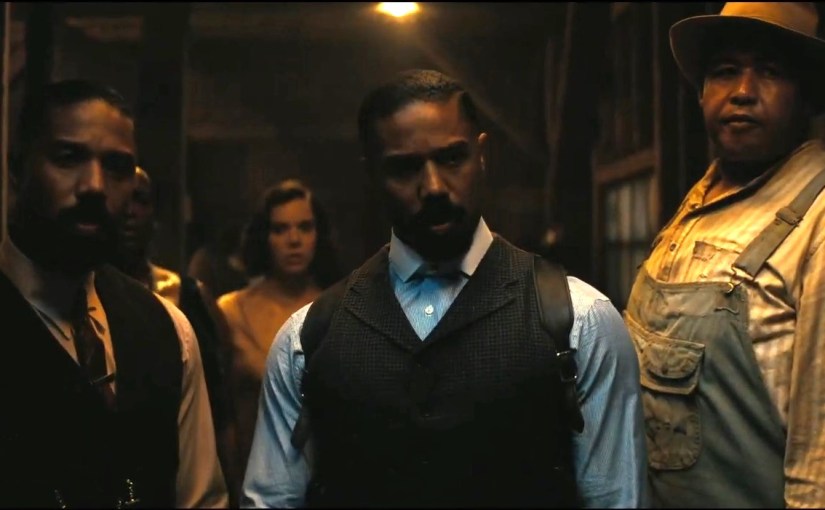
The smokestack twins – Smoke and his brother Stack – return from working with Al Capone in Chicago.  They’ve got lots of money and big plans to open up the Juke Joint when the sun sets.  Michael B Jordan plays the charming gentlemen. Smoke is donned in blue accents, while his brother Stack is identified primarily in red.  Jordan is such a skilled and aggressive actor in everything he does. I truly did not realize he was playing both roles until about a third of the way through the picture.  His performances are so tantalizingly unique and memorable that Jordan has to be a contender for an Oscar nomination.

The boys circumvent the Clarksdale area. First they purchase a barn and the land it dwells upon.  With their pistols at the ready, their purchasing agreement is that the seller’s Klan associates do not come around here.  They go to the train station to recruit Delta Slim (Delroy Lindo) for the piano and harmonica.  Smoke visits Ruthie (Andrene Ward-Hammond) to prepare the most delicious crawfish and shrimp.  Ruthie is also the mother of Smoke’s deceased infant child and they need to catch up on some history that was not tied off.  Stack needs to contend with Mary (Hailee Steinfeld), his sultry lover from the past who was also left behind unexpectedly. 

Most impressive is a debut performance from Miles Caton as Sammie Moore, the local preacher’s son, and the kid who can strum a mean guitar in the back seat of a car or down at the joint.  Sammie looks up to the twins. They will show him how to carry himself.  There’s a history to everyone the men encounter.  Sometimes they are welcome.  Sometimes they’re not, like the Klan, and sometimes they’d rather avoid who they come across as they continue to spread the word about the Juke Joint celebration that’s too come with all the liquor, food, and music they can imagine. 

Michael B Jordan and Miles Caton are definitely Oscar worthy; two very hot properties.  Caton can do it all.  He can sing and act.  He’s as big a surprise as Mikey Madison was with Anora.  You can’t take your eyes off of him and if the guy goes on tour, I’m buying a ticket to see him. 

A prologue narration followed by a disturbing, eye-opening epilogue scene within a town church opens Sinners.  Something unfathomable must have happened at the Juke Joint on this particular night. 

I went into this film having not seen a trailer, a commercial or even reading an article about it.  I was not aware of the blazing bluegrass root music that populates this film, nor of the surprise monster fest that eventually takes overtakes the story.  It was a better viewing experience for me than I imagine had I known some of the details of Coogler’s film.  This gorgeous film accompanied by magnificent sound and visual details with award caliber editing and direction steers into so many different curveball surprises and genres.  Sinners is a film that you go see in the movie theater.  The Juke Joint alone is worth the price of admission.  As memorable a setting as Rick’s Place in Casablanca, the Cantina in Star Wars or Jack Rabbit Slim’s in Pulp Fiction

You read it here first!  The Juke Joint is sure to be a haunted house at Universal’s Halloween Horror Nights.  I promise you.

That being said, my love for the two-and-a-half-hour film dwindled during its last third when the monsters are revealed and the picture spirals into a blood fest battle between heroes and villains with spurting blood, fiery Molotov cocktails, guns and screaming and wrestling and chases upstairs and out the doors and off the balconies.  I’ve seen all of this a hundred times before and as well constructed as a film this is, nothing was surprising me anymore.  Nothing was giving me jump scares. 

For such an imaginative picture, the inventions went into neutral.  The dialogue starts to drain in lieu of schlock gore and the intelligence of this abundance of characters checks out at the door.  Some of what you see looks like material that could have been in Friday The 13th Part 14.  And, well, a lot of the material is a rehash of Robert Rodriguez and Quentin Tarantino’s very proud B movie From Dusk Til Dawn.

Until the final act of Sinners, Ryan Coogler incorporates so much researched and genuine attention into this Jim Crow era film.  I read that while he was making the Creed and Black Panther films, he was feeling withdrawn after a favorite uncle passed away.  This uncle told stories of this Mississippi area, complete with a small immigration of Chinese populace.  Coogler capitalized on that idea and a well-drawn couple named Bo and Lisa Chow (Yao, Helena Hu) are weaved into this story to supply food and drink for the party that’s to come.  No one would ever question if these two were not part of this cast.  They could have been two black actors or even a pair of whites, but Coogler ensures additional flavors are worked into the film with the authenticity to back it.  These are not even walk on roles.  They own two different mercantile stores within the heart of town. 

The best idea to Sinners is when the music is most entertaining at the Juke.  Ryan Coogler has fun with the clay he infinitely molds.  A long Steadicam shot is the centerpiece of the film as it travels through the whole barn that has been transformed into the Joint.  Coogler seamlessly goes for an ethereal or maybe spiritual feel as the sweaty, sexy and rhythmic performers and their music blends into all kinds of jazz, rap and soul found within the future generations of this community.  A turntable scratcher is positioned next to an acoustic guitar player or a banjo, and as deliberately anachronistic as this seems for 1932, it all belongs together within this seasoned stew.

Outside the Juke Joint are the monsters priming for their own celebration to come with Celtic harmonies, clogging and river dancing to get their appetites drooling, literally drooling.  Two communities will clash and it will be for more than just than standard prejudices found along the cotton fields of Jim Crow Mississippi.

This was not an easy review to write.  I do not want to disclose the surprises and turns that Sinners takes.  As well, my experience with the film is a mixed bag.  There is so much new and fresh material found in Ryan Coogler’s picture, but there’s also a lot of staple work that’s all too familiar as well.  What I recognize is not the least bit surprising and it is frankly uninteresting to me.  Sinners needed the creation of a new kind of cinematic monster to uphold its inventions. 

Especially considering that the body horror film The Substance and Jordan Peele’s terrifyingly smart Get Out earned tons of accolades recently, it will not be a surprise if Sinners earns a lot of end-of-the-year nominations as well.  The direction, editing, art design and costume design are equally worthy of large appreciation.  Sinners has likely clinched a spot for Best Picture nomination.  Only the wrap up will deny itself of the trophy though. 

I must end with a long overdue BRAVO to horror.  Often the genre does not get deserved recognition, because so much of it runs on cheap gross out junk or jump scares with no sensible reasoning behind any of it.  Guys like Coogler and Peele are finally working on the braininess which can be found in this area of storytelling and craftmanship.  They know there are scarier things to imagine than a foreboding hockey mask. 

SINNERS (2025)

by Miguel E. Rodriguez

DIRECTOR: Ryan Coogler
CAST: Michael B. Jordan, Miles Caton, Delroy Lindo, Hailee Steinfeld, Wunmi Mosaku, Jack O’Connell
MY RATING: 9/10
ROTTEN TOMATOMETER: 98% Certified Fresh

PLOT: Trying to leave their troubled lives behind, twin brothers return to their hometown to start again, only to discover that even greater troubles are waiting to welcome them back home.


“You keep dancin’ with the devil…one day he’s gonna follow you home.” – Jedidiah in Sinners

Ryan Coogler’s Sinners pulls one of the best head-fakes I’ve seen in a long time.  The initial trailers would have had you believe the film was basically a character study (albeit an intense one) of identical twin brothers trying to run an illegal business in 1932 Mississippi.  Since both brothers are being played by the excellent Michael B. Jordan, aided by a stellar supporting cast, I got the impression it would be a hybrid of Heat, The Cotton Club, and Michael Mann’s Public Enemies.

Sinners does cover much of that fertile ground…for its first half.  Read no further if you’ve been lucky enough not to have seen what the main attraction is, plot-wise, for the film.

We first get a prologue depicting a bloodied young black man bursting into a Sunday church service while holding the top half of a broken guitar neck.  This is Sammie Moore, played by Miles Caton in his film debut.  The rest of the film is a flashback to the previous day.

The Smokestack brothers have returned home.  Smoke and Stack are identical twins, although one of them (Smoke, I think?) has some visible gold in his smile, so that helps distinguish them from each other.  They are both sharply dressed, having returned from Chicago after working for Al Capone for a spell.  They plan to open a juke joint in a building they purchased from a smarmy character named Hogwood, a white man who grins and assures them they won’t have any trouble from the Klan ‘round here.

This whole first half of the movie is masterfully told.  We are presented with fully drawn characters, not generic placeholders to be shuffled randomly later on.  We find out that Sammie is cousin to Smoke and Stack.  We meet Mary (Hailee Steinfeld), a mixed-race woman who was left high and dry romantically when Smoke left for Chicago.  There’s Delta Slim (Delroy Lindo), a nearly-ancient man who plays a mean blues harmonica, whom the brothers want to hire to play in their new joint.  There are the Asian owners of a grocery store, hired to cater their grand opening.

And then there’s actress Wunmi Mosaku, who gives a luminous, heartbreaking performance as Annie, a woman who bore Smoke a child that died as an infant.  One of the highlights of the film shows Smoke reconnecting with Annie in a scene that at first invites some crude jokes, but which later provides a deep emotional resonance in the movie’s closing passages.  I only remember Mosaku as a sizable presence in the one-and-done HBO series Lovecraft Country (2020), but she was also apparently in Deadpool and Wolverine (2024), so now I gotta go back and watch THAT again.  Twist my arm.

The movie plays more like a really good Stephen King novel than any other movie I can think of since Pan’s Labyrinth (2006).  The film’s canvas is painted beautifully and crisply, moving smartly without rushing.  I would hope Sinners gets nominated for its film editing (provided by Michael P. Shawver), not because of the thrilling later sections, but because of how economically the first half of the film provides us with the perfect amount of information to understand everyone’s motivations when the second half arrives, when all hell breaks loose.

I must also mention the film’s, I guess, “mystical” content when it comes to African American history.  Early on, Annie, who is a “hoodoo” practitioner (I don’t think “witch” is the right word here), tells a lovely story about how, every once in a while, a musician comes along who can play so beautifully that their music “pierces the veil” between past, present, and future, inviting the spirits of all three to come together and enjoy the music as one.  There is a magnificent sequence where we get a visual representation of exactly that when Sammie starts to play the blues in the juke joint.  Trying to describe it in print is a fool’s errand, but it is one of the film’s many visual highlights.  Trust me.  You’ll know it when you see it.  It’s as elegant a representation of Black history as I’ve ever seen, and I don’t know how anyone will be able to top it in the future.

All of that, though, is just prologue for the main event: the vampires.  If you’ve read this long and didn’t know that was coming, I’m sorry I spoiled that for you, but you were warned.

The whole second half of Sinners flirts with becoming a straight-up genre picture, which is not a bad thing in itself, but which would have been almost disappointing when stacked against what came before.  However, because we have been given such a thorough grounding in all the characters beforehand, there are real stakes involved in trying to predict who will live and who will die.  Some deaths are almost foregone conclusions, but even those are more affecting than they would have been in other similar films.

Traditional vampire lore is very much at play, especially the bit about having to be invited into a house.  But the filmmakers did add one new bit, which I thought was EXTREMELY effective.  As a vampire is about to feed (or thinks it’s about to), it begins to drool…a thick, gooey saliva that drips from its mouth like ectoplasm.  This is a cool touch, and it makes perfect sense, a Pavlovian response to an imminent meal.  Don’t be surprised if another vampire film in the future steals that from Sinners.  I’d steal it.  Wouldn’t think twice about it.

Sinners undoubtedly has some deeper meanings that I am not qualified to unpack, and I leave it to you to find them.  This is one of the best films I’ve seen this year, and it is deservedly making bank at the box office.  (Over $200 million globally as of May 3rd, 2025.)  It is surprising, it is dramatic, it is thrilling, and it is worth seeing on the big screen.  Trust me.

VAMPYR (Germany, 1932)

by Miguel E. Rodriguez

DIRECTOR: Carl Th. Dreyer
CAST: Julian West, Maurice Schutz, Rena Mandel, Sybille Schmitz
MY RATING: 8/10
ROTTEN TOMATOMETER: 98% Certified Fresh

PLOT: A drifter obsessed with the supernatural stumbles upon an inn where a severely ill adolescent girl is slowly becoming a vampire.


Carl Th. Dreyer’s Vampyr [pronounced “vom-PEER” in this German version] is not the scariest vampire film I’ve ever seen, but it is definitely one of the creepiest.  There’s a difference.  Dreyer’s film doesn’t move with the pacing seen in more standard horror fare.  Instead, it forsakes typical plot development for scenes that linger on the horrific or the unexplained.  In its own way, it is more directly related to the films of David Lynch than to any other contemporary monster movies of the time (Dracula or Frankenstein, for example, both 1931).

The story is fairly simple, but it belies the complex imagery that awaits the viewer.  A young drifter, Allan Grey, happens upon an inn from which he thinks he can hear animal sounds, or perhaps a young woman screaming.  The village doctor, who looks like a bespectacled long-lost relative of Doc Brown from Back to the Future, vehemently denies the presence any animals or young women on the property.  The innkeeper invites Allan to stay the night.  In the middle of the night, Allan’s sleep is interrupted by a mysterious visitor to his room who intones, “The girl must not die!”  The gentleman then leaves a package on Allan’s desk and writes a most portentous message: “TO BE OPENED ONLY UPON MY DEATH.”

What is this book?  What did Allan hear?  And how do you explain the shadows he saw on his way to the inn?  Shadows of people running along the lane – with no corresponding people attached to them?  Wouldn’t YOU like to know.

Vampyr is positively drowning in atmosphere.  Dreyer apparently shot many scenes with a piece of thin gauze over the lens, creating a misty layer that makes everything feel like a dream, even when Allan is awake.  Allan goes on frequent excursions around the inn and the surrounding property, and it’s here where most of the fantastical imagery is seen, especially when it comes to disembodied shadows.  In one mildly unsettling sequence, a shadow of a man with a peg leg descends a ladder and appears to sit on a bench…re-joining itself to a peg-legged man already sitting on the same bench.

There’s a lot more, but I don’t want to just write a list.  However, I am compelled to mention one sequence in particular that exudes as much creepiness as anything I’ve ever seen from this cinematic era.

It turns out there is, not one young woman at the inn, but two: Gisèle and Léone.  Léone is seen early on, confined to her bed with a mysterious illness, which we later learn has been brought on by her contact with a seldom-seen old woman who lurks somewhere on the property.  And there are some odd injuries on her neck…UH oh.

At one point, Léone awakes while Gisèle is alone with her.  I don’t remember what they discuss, but Léone goes into this weird sort of trance.  Without the use of any strange Chaney-esque makeup or camera tricks, Léone’s face becomes an object lesson in creepiness.  Her eyes open wide, her face breaks into a creepy grin, and she slowly moves her head from side to side, while Gisèle backs away in terror.  It might be the scariest sequence in the film, one which could easily compare to any subsequent monster or vampire movie.

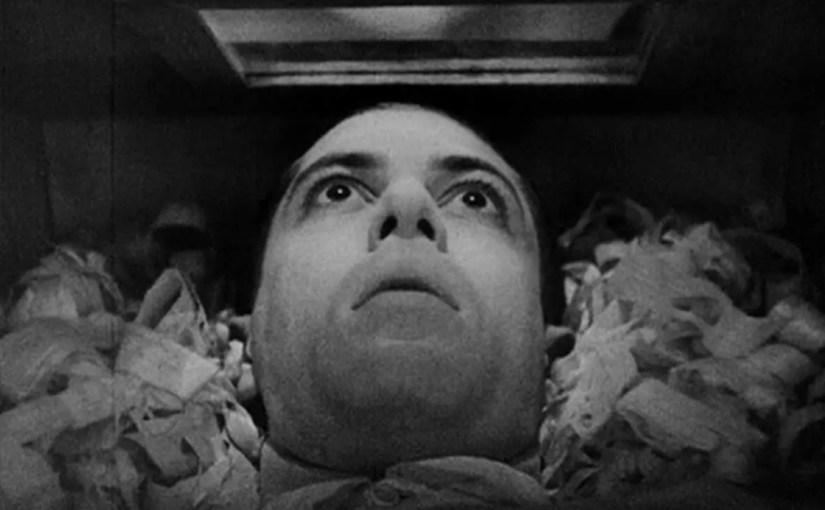
Later, Dreyer throws more camera tricks at us in increasingly imaginative ways.  Allan dreams of a skeleton handing him a bottle of poison.  A dead man’s face appears in the sky during a sudden thunderstorm.  Dreyer includes camera moves that would fit right into any modern film.  And in a sequence that reminded me of Wes Craven’s The Serpent and the Rainbow (1988), Allan watches as his own body is sealed inside a coffin with a tiny square window for his apparently dead eyes to look out of.

If nothing else, Vampyr is an interesting artifact of cinema’s transitional era from silent to sound.  Even though there is a conventional soundtrack and we hear people’s voices as they speak, a lot of expository information is provided via title cards and long looks at passages from a book of vampire lore.  Given that the vampire mythology was then not as popular as it is today, I can forgive these beats that tend to bring the momentum to a halt.

While Nosferatu (1922) and the Bela Lugosi Dracula are much more famous, Vampyr is worth a look if you’re a horror fan.  While it doesn’t involve the kind of fear factor I tend to expect as a child of the 1970s and ‘80s, it is nevertheless creepy as hell. 

MAXXXINE (2024)

by Miguel E. Rodriguez

DIRECTOR: Ti West
CAST: Mia Goth, Elizabeth Debicki, Michelle Monaghan, Bobby Cannavale, Giancarlo Esposito, Kevin Bacon
MY RATING: 8/10
ROTTEN TOMATOMETER: 72% Certified Fresh

PLOT: In 1985 Hollywood, adult film star and aspiring actress Maxine Minx finally gets her big break. But as a mysterious killer stalks the starlets of Hollywood, a trail of blood threatens to reveal her sinister past.


When I started posting my blissful reviews of X and Pearl [both 2022], I got one response more than any other: “Wait till you get to MaXXXine; it’s the weakest of the trilogy.”  Having just watched it, I would say that calling MaXXXine the weakest film in this trilogy is like calling Return of the Jedi [1983] the weakest film in the original Star Wars trilogy.  You may be technically correct, but it’s still a great ride and a better film than many others in this genre.

Six years after the bloody events of X, we pick up the story of Maxine Minx (Mia Goth) as she auditions for a film role in Los Angeles.  She’s been signed by a devoted but semi-skeevy agent, Teddy (Giancarlo Esposito in a fabulously bad hairpiece), and she has experienced modest success as a porn star.  But she longs to spread her wings in “legitimate” films, because as we all remember, Maxine craves fame more than anything in the world.  As she never tires of repeating: “I will not accept a life I do not deserve.”

Just as things start looking up for Maxine’s career, a package is left on her doorstep…a VHS tape labeled ominously, “For Maxine.”  When she pops it into her VCR, she’s treated to a shot from her filmed but unfinished porn movie from six years ago…evidence which would link her to those horrific murders and endanger her newfound success.  Meanwhile, the infamous real-life serial killer Richard Ramirez, aka “The Night Stalker”, terrorizes Los Angeles at night, not to mention a copycat killer who is branding his victims with pentagrams.  How these murders are linked to Maxine, and when and where John Labat (Kevin Bacon) comes into play, is not for me to divulge.  And one by one, Maxine’s friends and co-workers are turning up dead…

The plot of MaXXXine is nothing new, let’s face it.  What makes it sparkle is the wit and TLC provided by director Ti West and his collaborators.  For anyone who was alive in 1985, this film is like a stroll down memory lane.  I found myself thinking about Quentin Tarantino’s Once Upon a Time…in Hollywood [2019], with its loving recreation of late-1960s Los Angeles and serial-killer-related plotline.  That’s not to say MaXXXine is ripping off Q.T.’s film, not at all.  Both films have an immense affection for their respective timeframes and have gone to great lengths to immerse us in that culture.

Another filmmaker that came to mind during MaXXXine was Jordan Peele, director of his own trio of horror neo-classics: Get Out [2017], Us [2019], and Nope [2022].  Ti West’s films share a lot of characteristics with Peele’s films.  The Maxine trilogy looks like a million bucks on screen, despite what must have been very limited budgets.  The plots and screenplays are airtight with one or two minor exceptions.  (Peele’s plots are more Twilight Zone than reality, so they get a bit of a pass on plausibility.)  And the characters are intelligent, sharply drawn, and rarely fall into cliched behavior.

If MaXXXine is not quite as terrifying as its predecessors, I’m prepared to forgive it.  Whatever it lacks, it makes up for in its besottedness with Hollywood.  There is a scene where one character chases another through a Universal backlot (oddly deserted, but whatever); they run through various movie sets, including the town square featured in Gremlins [1984] and Back to the Future [1985], winding up at – and I almost could not believe this – the Bates Motel and even inside the Bates house behind it.  Only a director/screenwriter deeply in love with the movies, and horror films specifically, would dare to write a scene like that into their script, and I loved it.  (Trivia note: they had to get permission from the Hitchcock estate first…awesome.)

I haven’t even mentioned the movie’s subtext.  The movie Maxine has gotten a part for is being directed by a woman, Elizabeth Bender (the pleasingly towering Elizabeth Debicki), who believes The Puritan II is her chance to prove that her voice is worth listening to in an industry dominated by male voices, especially in 1985.  If the only way to get people to listen is to make a B-list horror movie with A-list concepts/ideas, so be it.  Two of the best horror movies I’ve seen in recent years were directed by women: The Babadook [2014] and Saint Maud [2019].  And yet, out of over 1,850 movies in my personal collection, only 70 were directed by women.  I guess things haven’t changed that much in the movie industry in forty years.  Discuss.

MaXXXine begins with a quote from Bette Davis.  I won’t recite the quote here, but it implies that an actor isn’t a star until they’re considered a monster.  I hope that’s not true.  But for Maxine Minx…if that’s what it takes, well, then…that’s what it takes.