ARTEMIS FOWL

By Marc S. Sanders

Why can’t Disney adapt a good book anymore? They massacred A Wrinkle In Time. Now they’ve taken a hatchet to Artemis Fowl, a Disney + byproduct that was shamelessly shelled out during the height of the pandemic.

There had to have been a more fleshed out, extended film here. Scenes are taped together with no bridge. All I can imagine is some suit insisted on cutting the guts out of director Kenneth Branagh’s film to ensure that its target kid audience would sit still, at least for 95 minutes. The same line of thinking had to have been applied to Ava Duvernay’s A Wrinkle In Time. Both films introduce characters that serve no purpose or make no sense. One character here shows up just to shout “Artemis!”

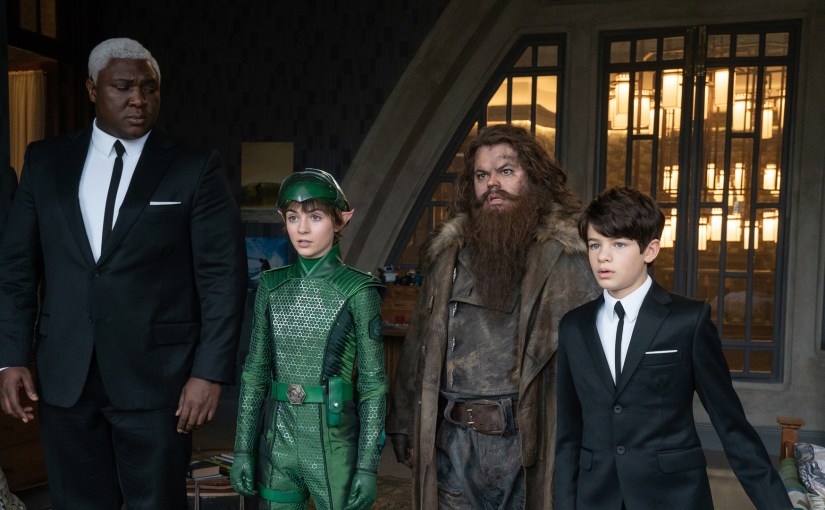
Speaking of the title character, what is he really? We are told by the narrator known as Mulch Diggums (Josh Gad) that Artemis Jr (an uninteresting kid actor named Ferdia Shaw who must’ve gotten the part cuz he looks good with sunglasses) is one of the greatest twelve-year-old geniuses of all time. He literally has an answer for any question that comes his way. So we’re told! Fact is, all this kid does is shoot a laser gun and wear a black Tarantino suit and tie. Never once in this film did I see Artemis Fowl demonstrate any of his genius, mind bending abilities. He surfs in the ocean outside his Ireland mansion. Does that merit the aptitude of a genius?

Artemis Sr (Colin Farrell) is apparently believed to be a thief of rare, priceless collectibles. After telling his son about some tale involving fairies that live in an underworld, he is soon kidnapped. It is now up to Junior with his trusty butler (Nonso Anosi) to rescue him. This butler doesn’t measure up to Batman’s Alfred. All this butler does is introduce young Artemis to a basement he was never aware of. Mulch also explains that if you call him Butler, he’ll snap you in two. Too bad we never got to see that. (Why tell us, dammit????) Then….AND I AM GOING TO SPOIL THIS SURPRISE….he dies. Tears must flow of course, but all I ever thought of was that gee, I hardly knew this guy.

Artemis Jr must recover a MacGuffin called the “Auculus.” How many times must I hear the word Auculus in a span of an hour and a half? The Auculus. The Auculus. THE AUCULUS!!!!!! Enough already. The filmmakers must believe that the more you say it, well then the more important the Auculus must be. My question: WHAT IN THE HELL DOES THIS AUCULUS EVEN DO?????

Judi Dench is here but only for the purpose of wearing a green leather trench coat that appears to weigh her down and doing what I think is likely a terrible enunciation of an elderly Irish lady’s accent. She plays the General of the fairy army. Dench is awful in this role and appears as lost in the effects as I was. Half the time I didn’t know what was going on. All of the time Judi Dench didn’t know what was going on.

The one main fairy is Holly Short (Lara McDonald) sent on a mission to go to Artemis’ mansion. Once she gets there, I truly lost track of why she was there to begin with. However, she seemed to have more activities to do than the title character is ever given. Once again, the super genius Artemis just shoots a gun. Holly at least gets to fly around with her motorized wings; yes, this is a fairy with an engine to activate her wings.

Artemis Fowl is a gorgeous looking picture. The special CGI effects are truly dazzling to look at with incredible color, but only if I’m watching a fireworks display at Magic Kingdom. Within a story, I have no clue what purpose any of the visuals serve or what possible results could come of anything. Nothing is explained here; much like this Auculus I talked about earlier.

The culture of the film is a failure as well. We are shown that this story is rooted out of Ireland. Where’s the Irish inspiration though? There’s no sense of inspiring traditions to learn from or appreciate. The soundtrack is hardly Celtic. Truly criminal is casting a Jewish Josh Gad and an English Judi Dench. For authencity’s sake, couldn’t actual Irish talent have been used instead of terrible dialects from marquee names?

There had to be a better film here. I’m talking a 2 1/2 hour film with solid, interesting exposition with mystery and questions like the first Harry Potter film. Nothing is of any consequence or comprehension here. How could I be so lost with this film?

This is a pattern for Disney of late. They acquire the rights to some wonderful children’s stories and then just mix some kind of slop in a slow cooker. A Wrinkle In Time, John Carter, and now this dreck. I don’t understand though. If the studio is so committed to packing so much into Avengers and Star Wars movies then why can’t they do the same with its other properties? I promise that kids will sit engaged with a longer film if it’s constructed with care. I know it.

Artemis Fowl is a squandered opportunity. They had the beloved novel by Eoin Colfer to springboard off of, and I know, without even reading the book, that they disregarded almost everything that made this story so special. It couldn’t be more apparent.

Artemis Fowl is a textbook example of when Hollywood does a complete disservice to its author as well as its target audience. It’s a criminal adaptation. It’s a betrayal of the intelligence that kids really come equipped with. It’s a terrible violation of culture and it’s an awful, awful, awful film.

DOCTOR STRANGE

By Marc S. Sanders

The first MCU movie that makes the biggest departure from any of the other installments in the franchise.

Doctor Strange operates on a level beyond punchy powers as Avengers director Joss Whedon noted. The film explores a very far, very fictional belief in the mystical arts and magic. So much so that sometimes characters like The Ancient One and Mordo speak in an English that is so foreign and so confusing. Still, I’m not complaining.

I enjoyed this film immensely. Benedict Cumberbatch is so right in the role of Stephen Strange. His character’s arrogance is not over the top, but necessary and evident. I really liked his transition from expert surgeon to a permanently damaged physical person and then onto The Sorcerer Supreme complete with the Cloak of Levitation, a better and more deserving way to describe it than just another cape.

The morphing of city landscapes and neighborhoods into arced and flipped and reverse mazes are really fun and change shape with crisp sound editing and music.

Good supporting work is also on display from Rachel McAdams, Chiwetel Ejiofor and especially Tilda Swinton. My one wish is that the villain played by the very capable Mads Mikkellsen was fleshed out more. He’s an actor who can handle heavy roles. Regretfully, I don’t think the script gives him enough to do here.

This Marvel chapter stands on its own with little reliance on the other films. However, the green infinity stone at play here is easier to understand now that I’ve seen Avengers: Infinity War. I’m talking about The Time Stone, of course!

Doctor Strange is a solid film; one that I would love to watch again a year from now and likely feel just as entertained.

NOTE: stay away from the 3D Blu Ray discs. Watch it in 2D. Having seen the 3D in theatres the first time, I clearly remember not enjoying the film very much. It was blurry and dark. At times the picture didn’t look crisp. The 3D effort was a nuisance and a terrible distraction. Less is more. Stick with 2D.

SUPERMAN: THE MOVIE

By Marc S. Sanders

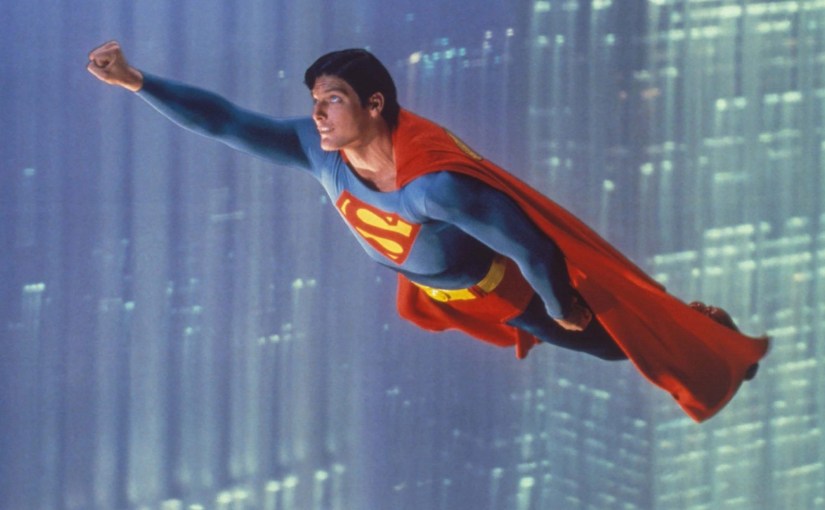
Richard Donner’s Superman: The Movie is one of the best biographical films of a fictional character ever made.  Yes.  It absolutely is a biography.  How can you call it anything but?  The visitor from the planet Krypton is embedded so deeply within the lexicon of worldwide pop culture and historical significance that he rests within all of our subconsciousness.   When we think of ongoing problems in the world from natural disasters to destructive wars or famines and disease, or to even kittens stuck in trees, for a split second we all consider how simple we could go on with our lives if only Superman were here to rescue us. 

By 1978, forty years after Joel Siegel and Joe Shuster created the character, visual effects were at a more than adequate level to convince us that a man could fly. Thus, the man with the red cape was ready to appear on the big screen.  With creative input from writer Mario Puzo, Donner’s film goes through various stages of life from when the extra terrestrial is a new born baby, to a toddler, then a teenager and on to a thirty something adult.  While living on the planet Earth, his powers may make him virtually invincible, but he’s far from godlike.  He cannot prevent the unforgiving nature of death.  He can’t be everywhere all at once.  He can’t even perform on the same level as his colleagues or friends, who are skillfully beneath him.  It would be unfair to have Clark Kent on your football team.

To watch Superman is to see a mini-series over a span of nearly two and a half hours.  We begin on the white crystal planet of Krypton featuring one of the greatest actors of the twentieth century, Marlon Brando, cast as the father of the superhero to be.  Brando is Jor-El.  He serves the planet as a prosecutor and a political leader with an expertise in science.  He’s championed for his knowledge, but he’s also challenged by his peers when he is certain of his planet’s demise. Thus, he must release his newborn son, known as Kal-El, into the far reaches of space to survive.  The script here takes an almost Shakespearian approach in debates of facing inevitability.  Brando’s authoritative screen presence is perfect here. 

Kal-El moves on to Earth, particularly Smallville, Kansas, and the nature of the film changes personality.  1950s Americana becomes our main character’s environment with endless plains of crop fields and farm land as Kal-El becomes identified as Clark Kent, the teenager who develops a crush on the high school cheerleader and gets bullied in the process while he must deliberately withhold all that he’s capable of by influence from his adoptive parents (Glenn Ford and Phyllis Thaxter).  Life for any of us is never complete until we experience the death of a loved one and Donner showcases that here to demonstrate that Kal-El/Clark can not prevent what’s meant to happen when biologically our bodies shut down.  Not even a super man can save us. 

Clark reaches age 18, usually perceived by most as a turning point into adulthood and through a means of Krytonian process he’s educated until his thirtieth birthday upon the rules and boundaries he must function within while on Earth.  He learns of his ancestry and then Donner changes the setting of his film once again into the furthest extreme from quaint Smallville. 

We have transitioned to sprawling Metropolis where Clark works as a mild-mannered reporter at The Daily Planet.  Christopher Reeve plays Clark/Superman and there was no one who could have filled the role better.  Physically, Reeve is the example by which all super human character portrayals still look towards.  Yet, the Julliard trained actor performs the dual personality so well.  When he dons Clark’s glasses you feel as if you are looking at another actor from when he’s dressed in the blue and red costume of Superman.  His posture and voice inflections are so distant from each character he’s playing.  Christopher Reeve was a stellar actor of versatility. 

In Metropolis, we are also introduced to an impure villain, Lex Luthor (Gene Hackman, who never got enough praise for this role) focused on greed and individual power for him to consume at the expense of everyone else on Earth. 

As well, just as life must bring us towards the experience of loss, it also must introduce us to love in the form of Lois Lane. Margot Kidder does a magnificent job of the hustle and bustle career woman with a sense of romance and need for ongoing adventure.  A reporter’s life will only give you that some of the time.  Superman will let you live that every day.  In life, we all start with valuing one person in our lives beyond our immediate family, and Lois serves that purpose to Clark’s perspective. 

Donner takes advantage of comedy and slapstick when Metropolis comes into play.  It’s not as polished as Krypton.  Nor is it as calm and reserved as Smallville.  Again, the personality changes.  Reeve plays Clark as a persona of the inept and gullible newcomer nerd to hide his powerful alter ego.  Hackman’s Lex is accompanied by Ned Beatty as a bumbling sidekick to play off of. (This same actor was a frighteningly powerful and intimidating corporate CEO in Network just a few years prior!) Valerie Perrine holds her own against Hackman as Lex’ alluring dame to have a tete a tete of sarcasm with. Kidder is the leader of Metropolis’ populace always on the go so much that she’s not even aware of her insensitivity to poor Clark.  A great gag is that as a good as a reporter as she is, Lois has terrible skills in spelling.  (There’s only one p in ‘rapist’.)

Maybe you’ve never seen Superman from 1978, or maybe it’s been too long since you last took it in.  It remains a watch that’s worthwhile.  Donner’s film covers so much of this one individual’s life that also includes two separate ancestries.  I get hot and cold on biographical films, sometimes.  It’s a tough scale to measure.  Sometimes filmmakers don’t show you enough.  I thought the film Ray, ended too suddenly on its depiction of Ray Charles.  Sometimes, it’s an overabundance of material.  The Last Emperor and Chariots Of Fire seemed to never end, and became mired in long, drawn-out, sleep-inducing pieces of dialogue.  Superman allows just the right amount of time to live within these different parts of Kal-El/Clark Kent/Superman’s life that you get familiar with who the main character encounters and how he responds to those around him. You also witness how these environments respond back to him.  You get a sense of what he stands for and where he feels insufficient and where feels strong and secure, as well as valued by others. 

It might be crazy to believe, but biographical writers and filmmakers should turn towards Richard Donner’s film for an outline that perfectly establishes every scene and moment that’s cut into its mold.  Superman: The Movie?  When I want to tell the life story of Golda Meir, or Barack Obama or Joseph Stalin or Jesus Christ?  Yes, Superman.  If we are crazy enough to follow the exploits of a man who wears a cape and flies through the sky, then why can’t we believe he can provide the answers to the great mysteries of life better than any of us?

FANTASTIC BEASTS: THE SECRETS OF DUMBLEDORE

By Marc S. Sanders

That’s it.  I’ve had it.  Enough already.  After three unnecessarily long movies, if you can’t get it right then what’s the point anymore?

Fantastic Beasts: The Secrets Of Dumbledore, the third film in the Harry Potter prequel series, is an absolute failure beyond any magical or Muggle measure of comprehension. It operates with the same handicaps that crippled the prior installment, The Crimes Of Grindelwald, and maybe picked up an additional dozen or more problems along the way.

I don’t understand it Warner Bros.  Following the abysmal reviews of the prior film and the tepid overall assessment of the first, why, with all the monies at your disposal, would you settle for a boring piece of production work like this, all over again? This new film’s main attraction is simply men in dull grey wool suits and overcoats speaking to one another in quiet English whispers.  Every so often they do something quirky like pull a wand out of their pocket.  Fleetingly, they use them.  How novel. 

It boggles my mind that this world from Rowling’s colorful imagination was at one time intended for pre-teens and young adults.  I’ve seen political debates or Sunday morning commentary programs with more flair.

The fault in these films holds primarily with the creator, J.K. Rowling, and David Yates, the director that’s helmed the last four Potter films and all of the Beasts films up to date.  I’m so exhausted in saying it.  ROWLING NEEDS AN EDITOR!!!!!  There is so much fat on this meat that is impossible to swallow.  Someone needs to speak up and advise her to save this scene and that scene for the DVD extras.  One curse that this film suffers from is the exact same thing that the second film dealt with.  A background story is told, with a majestic fade up and fade down and fade up again flashback.  It takes a good five minutes to tell this tale, and then someone else chimes in and says hold on, that’s not how it happened at all.  Then a new character starts from the beginning and apparently tells us the real story as it truly occurred.  Why in the hell should I trust this new character if you’re now telling me not to believe the lies of the former?  Fodder like this stretches this fantasy towards a distant two- and half-hour mark, though it feels like four.

David Yates has always been a problem.  Look, I know nothing about a camera or the most up to date technology in filmmaking or digital making, but I’ve seen enough special effects laden films in my time.  The prologue to this film commits the same visual atrocity as the prologue to the prior film.  Here, our main hero, Eddie Redmayne’s Newt Scamander – a magic zoologist – is observing a magical deer like creature deliver her offspring.  Suddenly, some other magic figures come upon the sight and attempt to zap the creature and Newt with their wands.  It’s the middle of the night amid a dense forest/jungle of thick plant life and trees.  We see flashes and blurs.  We hear ear piercing sound effect swishes, and the music from James Newton Howard (which is quite good) carries to a high volume.  Just like the last film, though, action scenes like this are murky.  It’s like the lens is covered with the bottom of a soda bottle filled with vinegar.  I can’t tell who is chasing who or who is zapping who, who dies or who lives.  Yates is not doing any favors for what bills itself as fantastical adventure.  When he isn’t shooting action scenes like this, his direction seems to perform on cruise control at a top speed of 15 mph.  There’s little drama or interest in any of the speaking scenes that drag on and on.

The movie’s story picks up with whatever cliffhangers were left from the last time.  It’s really not necessary for me to recap.  They hold little relevance here. 

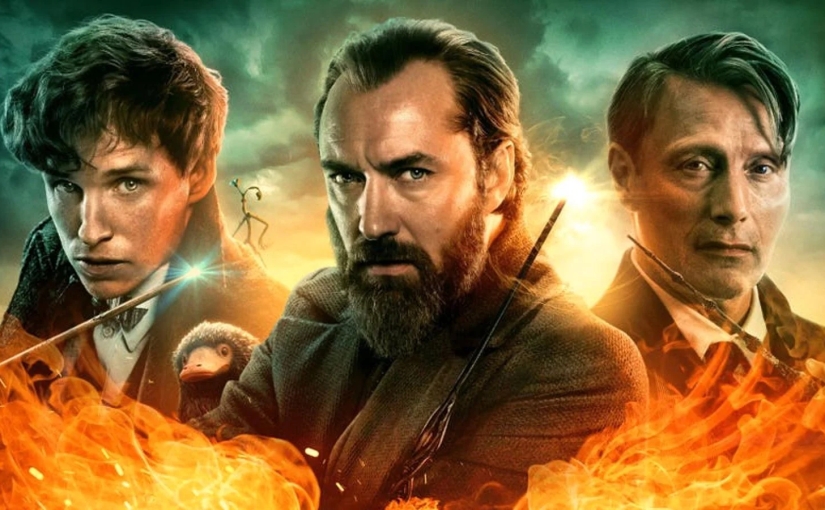
Basically, Grindelwald (Mads Mikkelson, now taking over from a controversial Johnny Depp) is getting his bearings together with the troubled young man Credence (Ezra Miller) who we were told earlier is the brother to the Albus Dumbledore (a well-cast Jude Law).  Once again, Dumbledore recruits his former prized pupil Newt Scamander to locate the criminal Grindelwald and defeat him.  Newt assembles his brother, his assistant (neither of which we hardly get to know; so why should I disclose their names) and his Muggle baker friend Jacob Kowalski (Dan Fogler). Two more new characters round out this fellowship.  However, if you are looking for a real, solid fellowship, go back to those movies where the characters go after a plain gold ring.  That is fantasy at its finest.  This is the back story of a National Geographic issue found in your grandmother’s attic.

A whole lot of nothing happens for long stretches of time.  Grindelwald has managed to get the criminal charges against him dropped, and arranged to become a viable candidate to be elected the head of the magical world.  That spells trouble though, as he believes in complete genocide of the entire Muggle/No Maj population.  Dumbledore, his former lover, stands on the other side of that debate.  What does this have to do a with a magic deer that was delivered many moons ago when this movie started?  Well, you find out……….eventually, but your patience will be shot to hell.

Only one good scene in the film works on a sort of mischievous Spielberg direction (like the Cairo sequence in Raiders) where a “shell game” with various suitcases is passed around through a small village.  This turns up in the third act and finally we see some fun magic arrive.  Wands are lit up that trap one wizard in a transparent brick wall.  Props are turned into glass globes to trip over, and the characters smirk at one another through the hijinks.  This one scene provides some welcome reminiscence of Quidditch and other prop pieces from earlier Potter films. Until this moment, no one is enjoying themselves in this movie.  There’s next to no humor or cuteness from Newt’s assortment of magic wildlife. There’s no discovery from any magic spells.  Dumbledore doesn’t even have any secrets to disclose, save one. 

Yates and company fail as well with the details.  When we get to visit Hogwarts, it’s terribly boring and dull.  There’s no interesting Easter eggs or wonderment to savor.  No new rooms or tunnels to uncover.  No silly spells or magic props or ghosts to engage with. 

A glaring part of this new series is also conspicuously missing.  Tina (Katherine Waterston), puppy love interest of Newt, is hardly seen nor acknowledged.  Her role was a large part of the first film, minimized in the second film and only welcomed this time as a close up with no more than four words of dialogue.  Maybe not even that much.  Why establish this romance angle for the hero, if she’s hardly to be used?

The one error that really stands above all else is Grindelwald played by Mikkelson.  This is such an underrated character actor destined to be in every popular film franchise.  He’s done Marvel, James Bond, Star Wars, now Potter, and he’ll be in the new Indiana Jones film.  I welcome him to have this role in the Beasts series.  Yet, he looks nothing at all like Depp’s appearance.  Mikkelson just wears a grey wool suit and tie with an overcoat.  Depp had bleach blond hair and pale white skin for a foreboding albino characterization.  I’m not suggesting a complete duplication of what was formerly seen, but there’s a huge difference in looks between the two actors who have now occupied this part.  Reader, when there’s an absence of story, mundane dialogue and distorted visuals to settle for in a big budget movie, this is where my mind is going to run off to.  Mikkelson looks like he’s showing up for a read through rehearsal before the full-dress performance.  At the very least, couldn’t you dress the guy in the same unusual silk vests and fabrics that the other guy wore?  Put the different colored lenses in his eyes?  It truly makes me wonder if there was a stipulation in Mikkelson’s contract – he’ll do the role, but he refuses to look like a clown.  You just can’t not see how far apart this is from what’s been traditionally shown already.

Two more films are promised to be released in this prequel series.  Really? Another two more near three hours pieces of tripe?  Well, according to my Potter versed daughter, it has to be that way.  These films take place near the end of the 1920s.  There’s the climactic showdown that must be depicted between Dumbledore and Grindelwald though, and according to Rowling’s timeline, that occurred in the late 1940s. 

So, we got another twenty or so years of this.  Friends, watching these three films, I feel as if I’ve gone about sixty.

EVERYTHING EVERYWHERE ALL AT ONCE

By Marc S. Sanders

Exploring the science fictional context of parallel universes can turn your thought process into a tailspin.  It can leave you up at night trying to find the center of a never-ending spiral.  Maybe that is why this gradually more common story line is reviving itself in current films like the next Doctor Strange installment from Marvel, or DC’s The Flash with multiple Batmans, and the unexpected surprise of Everything Everywhere All At Once.

My first experience with a multi-verse concept happened one Saturday morning in the early 1980’s.  At age 7 or 8, my favorite cartoon, Hanna Barbara’s Superfriends, explored a Universe of Evil.  Following a volcanic eruption, an evil Superman exchanged places with the noble Superman that we all know.  They each found themselves in opposite universes.  For the good Batman, there was an evil Batman, dressed in pink.  (Pink is evil????)  Evil Robin had a mustache itching to twirl.  Aquaman had an eyepatch.  Later, I hypothesized that this simple plot catered for kids was likely inspired by the famous Star Trek episode Mirror, Mirror.  (Evil Spock donned the evil goatee. Mwah ha ha ha ha!!!!!) These two storylines, which I highly recommend you seek out and watch, were very cut and dry in the concept of multiple universes.  There was a Yin and Yang structure of just black and white.  Everything Everywhere All At Once welcomes diverse complexity in its storytelling.  In this film, nothing is black and white.  Instead, everything consists of infinite shades of grey and gray.

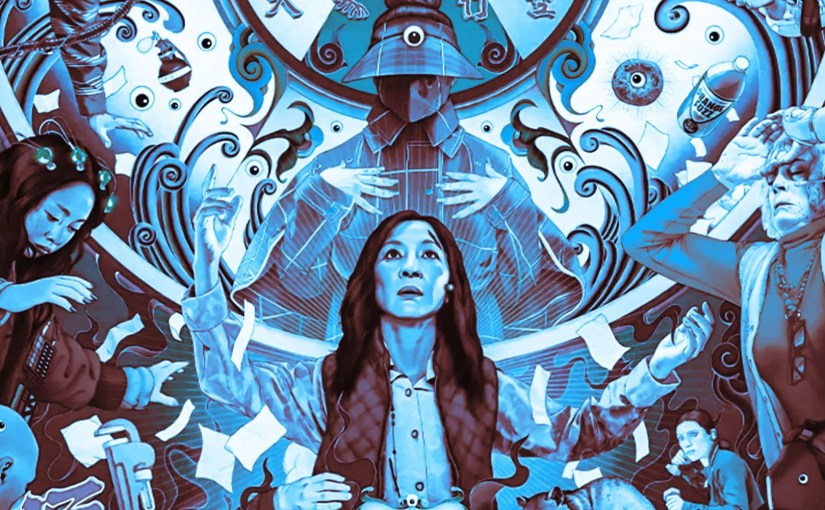
The Wang family are Chinese immigrants buried in demanding and overwhelming tax obligations from the IRS while trying to manage a California laundromat.  Evelyn (Michelle Yeoh) is the matriarch who is married to Waymond (Ke Huy Quan) and they have a daughter Joy (Stephanie Hsu).  Upon visiting the IRS agent assigned to their case, Deidre (Jamie Lee Curtis, who finally found something else to do besides another Halloween retread), odd occurrences take place.  Evelyn is warned by Waymond with suddenly a strange and very different personality to act upon their current situation, like getting off an elevator and turning to the right, not the left.  Just trust me when I say that while you will likely be bewildered for a while as the exposition unravels itself, it will all pay off satisfyingly.  Somehow in another universe that is performing parallel to the one we first see in the film Joy is a villain bent on destroying Evelyn…and that’s not even half of what’s out of place.

I saw this film directed by the “Daniels” (Dan Kwan and Dan Scheinert) with my Cinephile colleagues, Miguel and Thomas.  After it was over, it was no surprise that they knew what I was talking about when I said this film is the reason why good editing is necessary in a film.  Because the Daniels introduce not one or two parallel universes, but SEVERAL, and there is so much happening…well…all at once.  I’d argue most shots in the film last no longer than an average 8-10 seconds because the multiple universe equivalents of Evelyn, Waymond, Joy and Deidre switch on a blink of your eye.  I warn you not to make a quick bathroom exit.  Quick flashes of scenes are relevant towards something else you may see in the next minute or an hour later.

Anyway, I’ll bet you never realized that there is a universe where the people have raw hot dog like fingers.  There’s also a universe where Evelyn is a street sign twirler, and a good thing there is an Evelyn like that to help another Evelyn fend off of a bunch of attackers in a different universe.  There’s also a world where humanity doesn’t exist.  Yet the equivalent of Evelyn and Joy are represented by two rocks.  That’s right.  Rocks with no limbs, no way of speaking vocally.  Yet, the film cleverly has the characters or products of its earth communicate with one another.  There’s even a different variation of the Pixar creation, Ratatouille.  Replace the rat with a racoon and see what transpires.

So, what does this all lead to?  Fortunately, there is a reason for these different worlds to collide and it leads to a valuable lesson in love and understanding within family.  Now that may sound hokey, but the film demonstrates that none of us are the same in what we are affectionate about, or what’s important to us.  How a daughter considers a girlfriend is not going to be easy for a mother to accept as any more than a friend.  The Daniels’ film carries much profoundness among its silliness depicted on the surface.

Having only seen Everything Everywhere All At Once one time so far, I could not help but laugh often and uncontrollably at what I was looking at, and the laughter becomes contagious when watching the film in a crowded theatre.  What made my movie going experience with this film quite fascinating though is that I responded in tune with the rest of the crowd.  Once you get past looking at Michelle Yeoh and Jamie Lee Curtis (two recognizable and accomplished actors) flap their hot dog fingered hands at each other, eventually you recognize the “normalcy” of that particular universe.  You are no longer laughing with them.  Now you are accepting the people and how they function in that specific environment.  Same goes for the rock universe.  The Daniels are brave enough in their direction to just show two inanimate rocks perched on a ledge and communicating with subtitles of very aware and well written dialogue.  It looks completely crazy at first.  Later, you yearn for the impending destiny of those rocks.

Much symbolism is tucked into the Daniels’ script as well.  The most telling is that it focuses on an Asian immigrant family obligated by law to honor American tax codes.  The Deidre character portrayed by Jamie Lee Curtis is not so empathetic to the Wangs’ comprehension of resolving tax violations.  Basically, two different cultures are butting heads with no progress because they have a different viewpoint on how things function.  Wisely, this serves as a springboard to demonstrate how multiple universes will lack perfect chemistry as well when they collide.  None of this is written off as communication barriers.

I imagine on a second viewing, I likely will look at Everything Everywhere All At Once through a different lens.  I won’t laugh as much because I’ve grown acclimated to what were once very odd and strange environments for these characters that dwell within.  Instead, I’ll be even more observant and appreciative of the film as it presents different behaviors and cultures encountering one another.  This is a very good picture that is worth multiple viewings for sure.

In fact, this film is such a pleasant surprise, that I am comfortable suggesting this early on that I will consider it one of the best films of 2022.  If at least Everything Everywhere All At Once does not receive an Oscar nomination for Best Screenplay, then it would be a terrible disappointment.  The imagination of its endless devices is just so inventive.  Heck, I’ll throw my hat out there and strongly suggest nominations for Michelle Yeoh’s performance, along with Best Editing for Paul Rogers (this guy should win the award) and Best Picture of the year.

See Everything Everywhere All At Once in a movie theatre with a crowd and/or a large group of friends.  You may just have a cathartic experience of how human nature responds when getting acclimated to what at first appears to be so foreign.

E.T. THE EXTRA TERRESTRIAL

By Marc S. Sanders

It’s easy to give credit to a magnificent script by Melissa Mathison when talking about E.T. The Extra Terrestrial.  However, director Steven Spielberg clearly invented tricks of his own off her page.  Thus, E.T. strikes a chord with me on a very personal level. 

While my parents never separated or divorced, in my adolescent years I did not have any kind of relationship with my father.  He left for work at 4:30AM and would not come home until nine at night.  He worked Saturdays as well.  I hardly saw him.  He hardly conversed with me.  One time, later on in life, he explained to me that he just never knew how to connect with a child.  It was only then that I understood why his response of “Oh wow!” amazement seemed so fake when I showed him how the wings pop off of my Star Wars TIE Fighter.

Mom was the constant in my life with regular Saturday trips to Burger King, and the comic book and toy stores, while singing along to Barry Manilow in the car.  The adults I viewed in my childhood were mom and my grandmother, Helen.  So, I understand why Steven Spielberg opts to only include Mary (Dee Wallace), the one adult in full focus through most of his picture.  Mary has recently separated from her husband leaving her to tend to their three children. Gertie (Drew Barrymore) is the youngest. Michael (Robert MacNaughton) is eldest.  Elliot (Henry Thomas) is the middle child and main character of the story.  These kids have no other important influence in their lives except their mom and maybe Michael’s buddies.  Their father is only mentioned to be vacationing in Mexico with his new girlfriend, but never seen.

After an alien ship departs Earth while looking for plant life in a California forest, one of the passengers is sadly left behind.  Through a series of suspenseful moments, Elliot welcomes the stranger from a strange world into the comfort of his room full of toys and games.  A connection is immediately made of trust and friendship, but on a science fiction level, there is also psychic bond.  Somehow, Elliot and E.T. share one another’s thoughts and can feel what the other feels.  In a humorous moment, E.T. gets drunk on beer while being left at home alone.  This leads to disruptions caused by Elliot during a frog dissection scene in science class.  Even deeper though is that E.T.’s biological make up doesn’t appear to be suitable for a long stay on Earth.  As E.T. gets more and more ill, so does Elliot.  It is up to him and his siblings to help their new friend “phone home” so he can be rescued. 

The interference in all of this are the government officials who are surveying the suburban neighborhood for clues on E.T.’s whereabouts.  Wisely, and because Mathison’s story is told primarily through the perspective of children, Spielberg shows these men from the waist down.  After all, if Elliot and the others can’t identify with these adults, why is it necessary to show their faces? (In Jaws, the townsfolk can’t identify with the man-eating instincts of a great white shark.  So, why is it necessary to show the animal?)  One adult in particular is a man who has a keychain clipped to his waist.  The film credits the character simply as “Keys” (Peter Coyote).  Only when the safety of Elliot, E.T. and the family are intruded upon in their home, does Spielberg show the faces of these scientists and G-men.  Still, most of them are displayed with intimidating radiation suits and masks on.  If they absolutely have to be shown, then they are going to look more obscure and threatening then any alien from outer space.

E.T. The Extra Terrestrial will always remain as of one Steven Spielberg’s greatest achievements.  That’s saying quite a lot considering his other films like the Indiana Jones series, Schindler’s List, Jaws and Saving Private Ryan.  What sets this picture apart from those others is the gamut of emotions it sends to the generations of audiences that continue to watch the movie over and over again.  It’s very funny at times.  It’s also very scary, and it can be very sad as well.  At one point, Elliot has to explain why a daring escape for E.T. must occur because “This is reality, Greg!”  Of course it is, no adult would ever believe what they’re involved in.  It takes a child to comprehend this wonderment.  The unknown is frightening as well.  What exactly is leaving footprints behind in the shed?  Is it a goblin?  Also, why are frightening looking figures with helmets and astronaut suits barging out of bright light into every doorway of their home?  As well, how does someone from another place adapt to a foreign environment of stuffed animals, flowers, and what’s on T.V. or in the refrigerator?  In two hours time, Spielberg answers for all of these dynamics. You develop a kinship with not just E.T., the cinematic creation, but also the kids who snap at each other and sometimes affectionately curse and tease one another. 

You also feel the sadness of a mother who is trying her best to uphold a home while hiding a sense of abandonment herself.  E.T. was left behind, but so was Mary.  Dee Wallace provides an exceptionally tear-jerking experience on Halloween night.  The following morning, she is distraught to find a missing Elliot finally return home with a high fever.  I see my mother in that scene each time I watch it.  Now that my mom is gone, it’s even more meaningful.

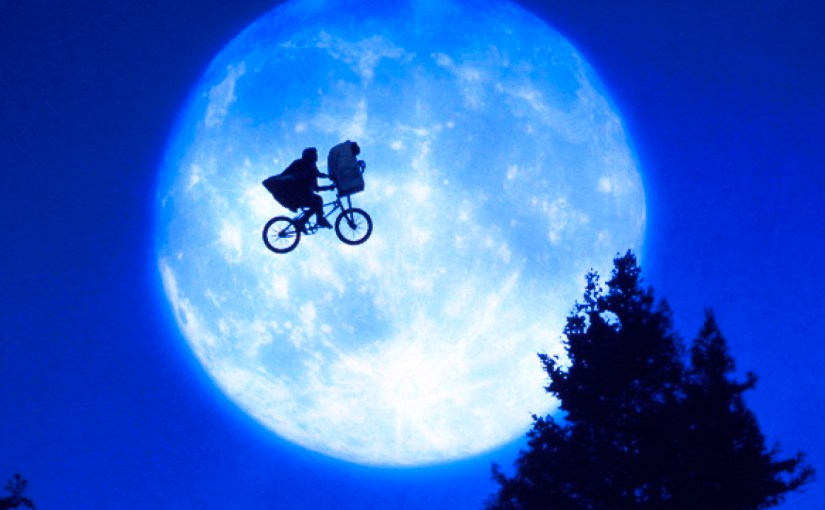
Spielberg’s film also works beautifully with an original score from John Williams.  Williams’ music speaks a language for the characters of the film.  Sometimes, his orchestration is foreboding as someone unseen lurks nearby.  Other times, it soars as the adventure kicks into gear with an outstanding bicycle escape from the government.  Williams also relaxes the pulse of the audience for the tender moments while a friendship of love and support is being built.  Watch how the score enhances the fantasy when E.T.’s fingertip glows and heals a cut on Elliot’s hand.  Williams hits a note that is in sync with Henry Thomas’ amazement.  The best sample of Spielberg’s craft blending well with Williams’ work is when Elliot’s bicycle soars into the sky with E.T. as a passenger.  As they ride across the backdrop of a full moon midnight clear, this movie provides one of the greatest shots in film history.  If there was ever a reason to prove why an original score is so necessary in film, it’s important to use E.T. as an example.

Steven Spielberg was especially sensitive when making E.T. The Extra Terrestrial.  I saw an interview with him where he decided that once E.T. departs the children of the story, the actors themselves would never see him again.  He insisted on that with young Drew Barrymore and Henry Thomas, and he warned them in advance.  Because he was steadfast in that decision, their performances were all the more genuine.  Their tears of love and sadness were kept authentic.   In one documentary, footage following the end of shooting with E.T. shows Barrymore completely distraught in the comfort of Spielberg’s arms.  Spielberg knows that everyone suffers loss.  It’s a rite of passage in life.  My first loss was my grandfather at age 9.  Imagine coming to the understanding for the very first time that someone you’ve grown close to will never be seen ever again. 

That’s the magic that Steven Spielberg possesses.  He can make anything feel real.  His fantasies and frights are true in nature.  Nothing appears ham-handed.  When watching a film from Spielberg, you’re enveloped in its environment.  What’s in front of you is what will terrify you or laugh with you or make you cry.  What you are seeing, and hearing will allow you to reminisce on a time in your life when you were scared or sad or happy or lonely.  Steven Spielberg might have used people from outer space in his films to tell us that we are not alone.  However, we are also not alone in our feelings.  Steven Spielberg reminds us that we all encounter these emotions at point or another and therefore, there’s nothing wrong with responding like any other human being would. 

PETER IBBETSON (1935)

by Miguel E. Rodriguez

Director: Henry Hathaway
Cast: Gary Cooper, Ann Harding, Ida Lupino
My Rating: 9/10
Rotten Tomatometer: No rating

PLOT: A successful architect who longs for the love of his childhood friend is delighted to discover that the Duchess who just hired him is in fact his long-lost beloved.  This being melodrama, there is of course much more to the story.


[SPOILERS FOLLOW]

Peter Ibbetson plays like a long-lost Dickens novel, full of melodramatic flourishes and convenient plot contrivances designed to play the audience like a grand piano.  Is it shameless?  Yes.  Is it maudlin?  Yes.  Do I normally like movies like this?  No.  But there is something about this film and its story that got around my defenses and into my heart and soul.  I’ll try to elaborate on that as much as I can, but I don’t know how well I’m going to do.  Good luck.

The story opens, as the title card helpfully explains, in the middle of the last century, which would make it somewhere around the 1850s.  Somewhere in a well-heeled French countryside, two children from neighboring British families play and quarrel with each other, Mimsey and Gogo.  (I am not making that up, though why parents felt the need to inflict those names on their children is utterly beyond me.)  Gogo, the boy, cruelly teases the girl, Mimsey, who nevertheless gives as good as she gets.  Unfortunately, Gogo’s mother dies after a long illness, and when a distant uncle arrives to take Gogo back to England, he realizes he doesn’t want to leave his precious Mimsey.  Together they try to run away and hide, but it’s no use.  The sight of poor Mimsey weeping in the branches of a tree as Gogo is finally taken away was one of the scenes that started to chip away at my armor of cynicism.

Time passes, and Gogo changes his name to Peter and takes his mother’s last name, Ibbetson.  He becomes a successful architect and a valuable asset for his employer.  (In a very Dickensian touch, Peter’s employer is blind…wholly unnecessary to the plot, but that specificity makes it feel even more realistic amid all the other melodrama.)  Peter is successful, yes, but he is unhappy.  He is a bachelor, and when a very pretty girl more or less hits on him at a museum back in France, he takes her for a drink as a matter of courtesy, not out of any real attraction.  His heart still belongs to the lost love of his childhood, you see.  Mimsey is the touchstone of his past, his Rosebud, his green light at the end of the pier, and she will not be easily eradicated.

Initially, I was unsympathetic to the adult Peter.  How can anyone get on with their life if they’re stuck in the past?  It didn’t work for Kane or Gatsby.  If there’s anything the last thirty or so years of my life has taught me, it’s that the past will only weigh you down if you let it.  I’m not suggesting one should literally forget history, but had I been one of Peter’s associates in the film, I would have been constantly reminding him about being grateful for the present rather than bemoaning the mistakes or regrets of the past.  That way lies madness.

Before I get into more story details, I should mention the style of the film and the acting, which is so mannered and stylized that it feels as if it were a silent film that had a soundtrack added as an afterthought.  Gary Cooper may be a legend, but in this film…let’s be blunt, he is no Cary Grant.  Every sentence feels as if it’s been dragged out of him by way of torture.  His charisma is based solely on his imposing height and his dashing good looks, NOT his speech.  (Sorry, I calls ‘em like I sees ‘em.)  The women are not much better acting-wise, though the Duchess of Towers does have some interesting moments.  However, one of the movie’s highlights are the cinematography and subtle visual effects, especially in the late stages of the film.  Look at that scene involving the peculiar qualities in the bars of the jail cell and explain to me 100% how that was accomplished.  It’s so understated and effective that it took me completely by surprise.  I believe it would raise eyebrows with TODAY’S audiences.

I mention all of this about the style and my mindset because I believe that it all contributes to the reaction I had to the film, at which I’m still perplexed.

One day, Peter is contracted to rebuild the stables of an aristocratic family, the Duke and Duchess of Towers.  When Peter first meets Mary, the Duchess, he experiences an unexplainable connection.  His contract requires him to live in the Towers house for several months.  One day they share a conversation and discover that they shared a dream.  This isn’t a case of two people dreaming about the same thing coincidentally.  They actually shared a dream, Inception style, but without the machinery.  How can this be?

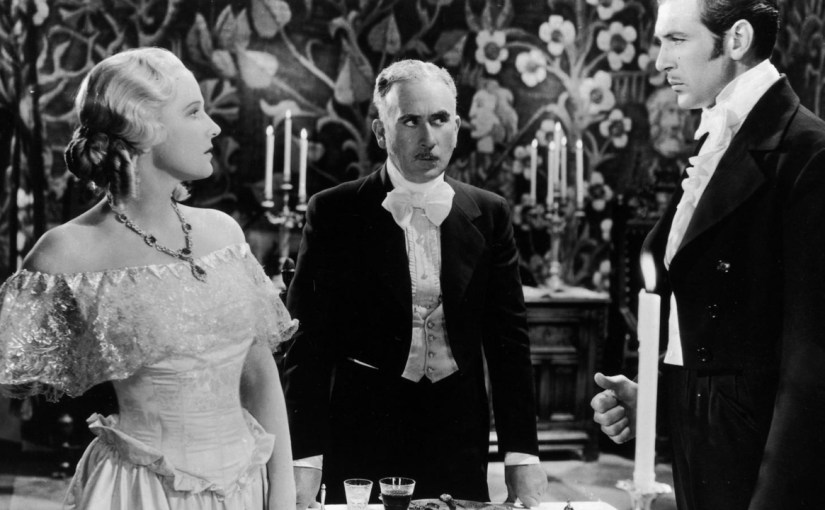
By now, any breathing audience member has already deduced that the Duchess is Mimsey and they are destined for each other.  Alas, Peter and Mary are not as quick on the uptake as we are, and their moment of recognition is delayed until after the peevish Duke confronts them at the dinner table, in a conversation laden with Hays-Code-era double-speak.  “Well, Mr. Ibbetson, are you to be congratulated again?” the Duke asks.  Later, during a second confrontation, the Duke points a gun at Peter and Mary and explains that they will not make love behind his back.  He raises his gun and says, “Get into your lover’s arms.”  Whoa.  Daring stuff for 1935.  It’s during this second confrontation that something goes horribly wrong, and Peter is sent to jail for life.

MORE melodrama?  Hasn’t this movie already had more than its fair share?  Children tearfully separated?  An equally tearful reunion?  Outrageous coincidences?  Shared dreams, for crying out loud?  Oh, you ain’t seen nothing yet.

It’s in the film’s third act, when our hero is in prison, that Peter Ibbetson really started to get to me at some primal level.  Peter and Mary, after being reunited against all odds, are now separated even more cruelly than before.  Peter is so distraught he goes on a hunger strike, chained to his “bed,” which is little more than a wide wooden beam.  (Look at it from a certain angle and he might almost appear to be on a cross, but don’t worry, it’s not that kind of movie.)  When one of his fellow prisoners makes a joke at Mary’s expense, Peter goes a little crazy and starts to throttle him.  Miles away, at the same time, Mary suddenly senses something is wrong.  In the jail, guards use force that’s a tad too excessive to restrain Peter, and at the same exact moment Mary screams.  The two are connected in a mystical way that transcends walls or distance.  They continue to share dreams in which they laugh and walk and talk as if nothing bad had ever happened.  In one dream, he points to a castle in the distance that he has built for his beloved.  I was reminded instantly of the scenes in Inception where Cobb and his wife Mal build entire cities for themselves in their own shared dream.

I’ve already given away too much, far too much than I usually care to.  As much as I want to, I can’t describe the one scene that got me to literally yell, “NO!” at the TV screen.

What fate eventually befalls Peter and Mary, I leave for you to discover.  What remains for me is to try once again to summarize how I felt after the movie was over.  Intellectually, I can see its shortcomings.  The acting is wooden, despite some pretty sharp dialogue.  The music is overwhelmingly romantic and dramatic, commenting on a lot of action unnecessarily, as was the custom back then.  There are one or two odd cuts.  But on an emotional level, the experience of watching Peter Ibbetson was like watching one of Shakespeare’s tragedies.  The only other movies that ever made feel these precise emotions, although not to the exact same degree, are The Remains of the Day and Atonement.  If you know those movies, you know what I’m talking about.

The movie’s final shot is as shamelessly manipulative as these things get.  It’s unabashed romanticism at its best AND its worst.  But you know what?  This movie earns it, and it works.

FANTASTIC BEASTS AND WHERE TO FIND THEM

By Marc. S. Sanders

I really do like the Wizarding World of J.K. Rowling.   The attention to detail is marvelous.  The landscapes she has painted over eight best-selling books that follow the adventures of a boy wizard, are limitless.  A new kind of fun vocabulary was invented thanks to her colorful imagination.  Still, she needs an editor!  Even if it is not a novel, her recent screenplays that follow the escapades of another magical protagonist, Newt Scamander, and his small, distressed suitcase drift off into so many side stories, it is difficult to focus on a central plot at play.  While some might appreciate the assortment of distractions, for me it grows a little frustrating.

Fantastic Beasts And Where To Find Them (great title) is the first of what will become five new films that focus on an earlier time before the famous boy who lived was ever born.  Rowling takes the magic to New York City for the odd, but adorably likable Newt (Eddie Redmayne) to accompany his suitcase that carries the most unusual creatures that any other fantasy has likely ever introduced.  There’s a platypus duck thing that has a penchant for stealing jewelry and coin; perfect for stuffed animal merchandising at Universal Studios.  There’s a purplish-blue mosquito that twittles around.  There’s a dragon and an elephant/rhino combo thing.  There are bright green grasshoppers that hide in Newt’s jacket pocket.  It’s an encyclopedia of Rowling wildlife.

Newt arrives in Depression era New York and some of the creatures flip the buckles on the suitcase open, and before you know it, he’s chasing them through the streets.  Soon after, he gets his bag mixed up with another one belonging to a lovable baker “No Maj” (American term for “Muggle” or non-magic person) named Stanley Kowalski (Dan Fogler).  From there, a partnership is forged, and the men are pursuing the missing animals through the city bank, the zoo, tenement buildings and jewelry shops.  Romantic angles serve the men by way of magical sisters, Tina and Queenie (Katherine Waterston and Alison Sudol).

Parallel to all of this are concerns of a magic criminal known as Grindlewald who is making headlines for his various worldwide offenses.  The North American magic congress is disturbed by these events and rely on a man named Graves (Colin Farrell) to investigate.  As well, there is a No Maj woman (Samantha Morton) leading a chorus of city folk and politicians (including Jon Voight) in the hunt for what are believed to be witches and those that are committing crimes of witchcraft.  This woman serves also as a foster mother to numerous children, two of which are known as Credence and Modesty (Ezra Miller and Faith Wood-Blagrove).  These two in particular are curiously quiet with a dark way about them. 

So, yeah!  There’s a lot going on here.  There are a lot of stories to explore and a lot of characters to meet. As well, there are a lot of animals to learn about.

David Yates has become the go to director for the Harry Potter franchise and he takes up the mantle here as well.  This first film in the new series is gorgeous to look at with its period piece art design and the CGI special effects blend nicely with the human actors. 

However, the film loses itself over and over again with the different avenues it takes.  One moment we are supposed to feel the tension of Grindlewald on the loose. Then we are getting into madcap mischief with two other characters chasing down silly creatures seemingly inspired by a Jumanji theme.  We are also treated to an opportunity to literally step down into the suitcase for a whole other world of different settings where these animals are meant to be housed.  It’s wonderous for sure and Yates simply allows time for observation and nothing else.  Intermittently within the film, we also end up following these two dark children who are altogether disturbing, and we wonder why.  How and when do they come into play?  Rowling’s script is more concerned with painting broad strokes of new environments, rather than staying focused on one trajectory.  At times, I’m asking myself, where did we leave off with this storyline or that storyline.

Eddie Redmayne is adorably quirky, but maybe a little too much.  He has the “Willy Wonka” palette to his wrangler occupation. Though, his dialogue gets swallowed in his modified English accent and it is difficult to comprehend what he is saying.  He’s deliberately mumbling his words to build upon the oddities that come with Rowling’s character.  Newt has a name for each creature in the film, but there’s no way I could understand what he calls them.  I don’t even think his acting partner, Dan Fogler, understands everything being said to him.  On this latest viewing with my wife, we opted to turn the subtitles on our 4K player.

The characters are suitably atmospheric for the dark and unusual that stems from Rowling’s imagination.  Colin Farrell always plays well as the handsome, yet brooding man of mystery.  Ezra Miller seems to come from the cloth of a Tim Burton iteration.  Fogler’s character is the best though.  His expressions of stare at the amazements he’s witnessing for the first time represent the audience.  He’s not the bumbling fool that other storytellers might depict him to be.  He truly can’t believe his eyes at first, but eventually builds an affinity for the fantasy in front of him.

The ending somehow brings all of these characters together. It is engaging for sure with an action-packed encounter with a black cloud blob within the underground subway tracks. Then it is concluded with a celebrity cameo that teases of what’s to come. 

Fantastic Beasts And Where To Find Them is not unwatchable, but it requires extra attention so that you can recall where one story leaves off and then later resumes itself.  Often, I found myself asking how did I get here, and then my mind would wander and I’d get distracted from the continuing narrative. 

There’s no doubt of the kind of power and influence J.K. Rowling has.  If only someone would be brave enough to offer her a little constructive criticism, though.  The Fantastic Beasts series was originally meant to be a trilogy of films.  Then her contract with Warner Bros expanded to five films.  You know what?  With all that Rowling has to share with us, I think she might need ten or twelve films.

THOR: THE DARK WORLD

By Marc S. Sanders

Like Louis Letterier’s The Incredible Hulk, director Alan Taylor’s Thor: The Dark World is a very underrated installment in the Marvel Cinematic Universe. It focuses on a lot of humor with well edited action and moments that allow all the major players to offer up good material.

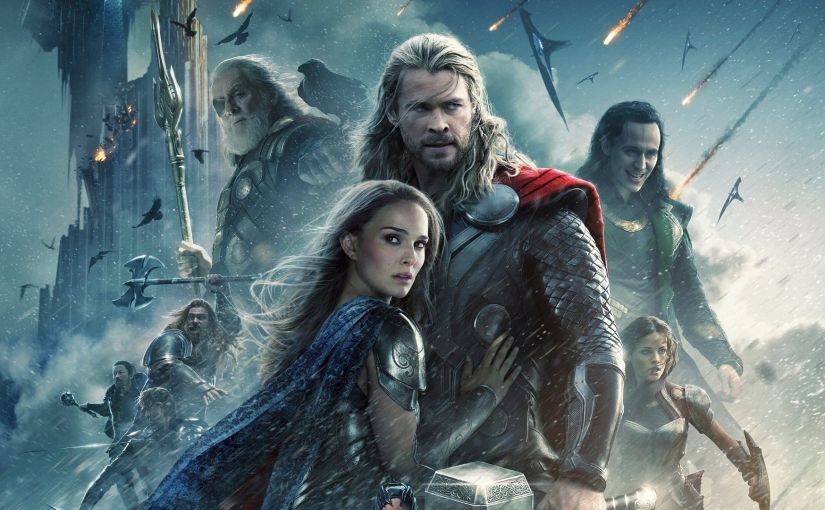
First Chris Hemsworth as Thor. Yeah, he’s doing the same thing and that’s fine. If it ain’t broke, don’t fix it. Moving on… This is an important chapter in the MCU, as it introduces the second of the legendary Infinity Stones, the red Aether, which consumes Thor’s love interest from Earth, Jane Foster, played by Natalie Portman. Fortunately, it provides better writing for Portman to play with. She really is the MacGuffin of the film, and she works as a story device to explore more of Asgaard, one of the best set pieces in all of the Marvel films. Jane uncovers the mysterious stone, or rather liquid, that has been hidden away for centuries; this is all Lord Of The Rings stuff. Once she finds the stone and is consumed with it, then the film segues into its originality.

Apparently, it’s not good if the Aether is used for destruction while the Nine Realms are in Convergence, which we are told happens every 5,000 years. What is Convergence? Well, that’s where it’s fun to watch Thor: The Dark World. The Nine Realms line up, literally like a rainbow of circles stacking on top of one another. It’s really cool to look at. What’s more fun is how Jane and her crew drop random objects into an open space within a deserted London warehouse and then it disappears, and then drops back down to them from above their heads. Sometimes, they drop something, only the objects don’t return at all. I like all of this stuff, because it’s all visual and ultimately that is what movies are about. Showing us something. Asgaard, The Convergence, Thor’s swing of his hammer, the Aethar, it’s all fun to see. I’ll credit Alan Taylor’s direction for a lot of this. He’s shown great achievements in Game Of Thrones. He carries his visions over to Thor’s universe.

Next is the villain is Malekeith, the head of the Dark Elves, with some really wicked looking makeup, and it only gets more wicked as he progressively gets more powerful. He wants to get the Aether and bring the Nine Realms into Darkness. Christopher Eccleston (best known for G.I. Joe; that should tell you something) takes on this role which is nothing special. I don’t care so much about the villain in this film as I do about the conflict of the story. The conflict is the real treat. Eccleston is nothing special. He’s not bad. He’s not good. He’s just nothing special. Moving on…

Tom Hiddleston is back as the trickster Loki, one of the best written characters in all of the Marvel Cinematic Universe. The script gives him a lot to play with and opportunities to irritate and antagonize Thor who reluctantly recruits his assistance. “Well done. You just decapitated your grandfather.” See the movie (again?) and you’ll love the timing of this line. Hiddleston has fun with the levity of Loki but there is a sad central story to the adopted son of Odin. During his first appearance in the film, following his incision of the New York alien invasion from The Avengers, Loki is arrested in chains to stand before his father, and Hiddleston clicks his heels together at attention, giving a serious grimace before declaring “I really don’t see what all the fuss is about.” Hiddleston continues to work and develop at this favorite character who remains tricky and unpredictable. I love it.

Anthony Hopkins is back as Odin, Thor’s father. Yeah, he’s doing the same thing and that’s fine. Again, if it ain’t broke, don’t fix it. Moving on…

There’s a lot of fantastic sci fi and fantasy sequences to this film and from a CGI perspective, it’s artistically beautiful. It’s just a fun ride of exploration. Thor was never a favorite comic book character of mine growing up. The MCU opened my eyes to something special in his adventures and those that surround him. It’s even great when Thor jumps on the tube to return to a battle in Greenwich Village. I’m expecting some energetic debate on my feelings towards this film. Bring it on and I’ll match you. As Thor might say after his hammer turns a giant rock monster to rubble, “Anyone else?”

Reader, if I can quote this film three times in a review that should tell you how much I love Thor: The Dark World.

THE SHAPE OF WATER

By Marc S. Sanders

I love fantasy and science fiction for one simple rule. A writer/director’s imagination can be limitless. Rules for a good fantasy are normally established in the exposition, and as long as those rules are not violated, a viewer will accept the narrative all the way to the end. The Shape Of Water is loyal to its set up.

Director/Co-Writer, Guillermo Del Toro continues his reputable streak of very adult (yet playful) fantasy. In 50 years, I would not be surprised if Disney/Pixar remade this film and Pan’s Labyrinth for younger PG audiences simply because the roots of the stories are so well played out.

Here is a Cold War love story between an alien and a good soul played by Sally Hawkins doing her best mute. Hawkins is bright eyed and wonderful. She’s a character that doesn’t judge and only recognizes despair for salvation. I thought she was great at conveying her performance through the limits of only facial expression, sign language, sex and self pleasure in a bathtub. Try to avoid snickers at that last description. It really is an honest, necessary reflection of a lonely innocent woman. I appreciated the writing and performance there.

Michael Shannon is back on screen playing a frightening villain…again. The reasons for his ruthless intentions were never clear to me, but either Shannon is that good an actor or he’s gotta be like this in real life. This is not a guy I’d ever want to cut in line at Starbucks, much less audit his books. He’s scary good.

Didn’t find much point to Richard Jenkins lonely neighbor except to drive a van, eat pie, be unemployed and be a token homosexual. Same with Octavia Spencer. Was she channeling a more subtle Whoopi Goldberg from Ghost? Don’t get me wrong. Jenkins and Spencer are fine actors here, and their characters are likable, but they don’t add much to the story except to be Hawkins’ sidekicks. Too much story was devoted to them though unnecessarily. Del Toro and his co-writer might have used them for too much filler.

Del Toro doesn’t stop with the new material as the two hours swim on by at a nice pace. We are treated to a wonderful Busby Berkeley song and dance moment that is just inviting to be spoofed by the Wayans or Zucker brothers, sensual nudity is there, not for perversion, but to send home the message that though this relationship is weird, it’s also the real deal. I bought it all the way through. Racism and gay prejudice are perhaps unnecessary in a film like this but there is key lime pie. Cats are consumed. Cold War espionage is on hand with Russian spies, dirty American government politics is there too, and oh yeah, there’s an amphibious alien who seems like any one of Spielberg’s extra-terrestrials we’ve seen before. Yet, I’ll take this one as well because he’s narrated into a very mature love story that is hard not to like.

As quick as the movie begins, you know how it is going to end. Again I don’t mind. Most of the execution rescues the story’s predictability.

Del Toro won Best Director and the film was awarded Best Picture at the Oscars. It’s not what I would pick, but there could be worse choices from that year’s selections.

I liked The Shape Of Water. Most of it at least.