BARBIE

By Marc S. Sanders

Having just returned from donning my pink t-shirt to watch Greta Gerwig’s box office smash Barbie, I am certainly relieved that I watched the film with my wife.  Just when I thought I understood everything I was watching in the movie, my better half explained to me that my perception was wrong.  Yet, I still believe Barbie was a magnificent experience that allowed me to reminisce about my pre-teen years occupied with my favorite toys (Kenner’s Star Wars figures and playsets).  I applaud this film for going even deeper than that though.  Barbie reflects on the patterns between men and women primarily in the fields of career, objectivity, and social stature.  As pink as the film is, and it is pinker than a truck load of Pepto Bismol, it is also observant and telling.

Someone commented on a Facebook post when I announced that I was seeing the film that Barbie is a “woke” movie.  I am so sick of that term, honestly, and it has nothing to do with which side of the political aisle I sit on, because I no longer sit on any side.  While watching Margot Robbie as the main “Barbie” of a whole community of “Barbies” in Barbie Land, I never recognized said “wokeness.”  Only afterwards did my wife have to explain where it likely exists within the film.  I still don’t think it’s a fair observation though.  Barbie and Ken dolls, Skipper and even the pregnant Midge doll and the lonely Allan doll and all their accessories are marketed by Mattel to a demographic for young girls.  Greta Gerwig’s script though questions what could threaten a Barbie Land.  Frankly, the only thing imaginable (besides opening the film on the same day as a biographical film about the man who invented the atomic bomb), is if the world of Barbie was no longer Barbie & Ken, but rather Ken & Barbie and a male dominated finish conquered Barbie Land following Ken (Ryan Gosling) reading up on some books about horses and machoism.  Very inventive, as well as comedically endearing to watch how Barbie and all the other Barbies undo what’s been done by Ken and all the other Ken variations.

A second storyline is really what rang true to me.  America Ferrara portrays Gloria, a mother in the Real World who has lost a bond with her daughter Sasha played by Arianna Greenblatt. Sasha has long outgrown spending time with Gloria and playing with Barbies together.  Sasha is a typical moody teenager.  This is crushing to Gloria and real-world thoughts enter the mother’s mind by the will of nature, including the uncertainty of death and even worse…cellulite.  Barbie (Margot Robbie) realizes the effect it has on her and with guidance from Weird Barbie (Kate McKinnon) embarks on a journey to the Real World to right what is wrong with the girl who plays with her.  Barbie is in for a surprise though. 

One day I will weave into one of my original plays about the time I showed my father my brand-new Star Wars TIE Fighter ship.  I demonstrated for him how the wings pop off.  His response was an artificial “Oh wow!” and then a return to his dinner with further discussion about his workday.  At six years old, I could even identify how uninterested he was.  This moment from so many years ago came back to me as I observed Ferrara’s emptiness.  The mother has lost her daughter, the same way my young self lost my father. 

Toys can draw out nurturing emotions of happiness, and perhaps disappointments, when we are young and imaginative.  As adults, a desire for a recapture of youth can blossom.  My generation yearns for the toys they played with and are even willing to pay enormous amounts of money for that tangible memory with what are now considered antiques.  Toys have always been a part of my life.  I was never an athlete.  I got much more pleasure out of playing with my action figures and my made-up car chases and shootouts in my bedroom. 

Gerwig’s script, co-written with Noah Baumbach, is quite intuitive.  Barbie and Ken (Robbie, along with wonderfully sweet and naïve Ryan Gosling) try to perfect what is imperfect about themselves and end up making things drastically worse for their respective existence within the Barbie World.  Barbie may fear bad breath and try to escape death, but how will that affect the pink, plastic world she stems from?  Ken tries to learn more from the Real World to enhance his noticeability with Barbie and deal with his insecurities against the other theatrical Kens he exists with. Does learning change Ken into a better version of himself, though?  Experience and exposure to foreign situations are necessary to enhance oneself but go a little too far and it might become a reminder to be careful what you wish for.

Mattel is even spoofed by means of Will Farrell and his posse of dark suit executives and the office’s grey cubicles representing white collar corporate America.  What Barbie and Ken have unleashed could have drastic consequences on the commodity of their bestselling dolls and playsets.  Honestly, I was waiting for an appearance by He-Man to enter the fold.  How would this carry over to the Masters Of The Universe??????

Barbie is more complex than the cheerful advertisements, the toy brand or even the bubbly appearances from Robbie, Gosling, McKinnon and the rest of the cast may appear to be. I’ve already heard it described as strange, and definitely not a movie for kids.  There’s a reason it is PG-13.  Mature themes are at play amid the sunniness of President Barbie, Astronaut Barbie, Supreme Court Justice Barbie, Mermaid Ken and Beach Ken.  Greta Gerwig didn’t want to settle for a just a happy go lucky fantasy.  The Barbie doll has existed for over fifty years and by now, nearly a quarter of the way into a new century, she better serve more purpose than a perfect smile, arched feet, and cheerful shades of pinks and yellows.  Gerwig sought to uncover the role Barbie has for girls and women at age 5, 8, 15, 30, 50 and on and on. 

I must recognize some of the attractions contained in the picture.  An inspired opening of the film had me rolling as Barbie answered the call of Stanley Kubrick’s classic 2001: A Space Odyssey.  (Makes me sad that I was the only one laughing in a full theater.)  Gerwig also took wise advantage of the multitalented Gosling with a collection of musical song and dance numbers.  I never really cared for the song “Push” by Matchbox Twenty, until Ryan Gosling and his Ken mates applied it as a substitute to Robbie’s Barbie and her Barbie gals’ adoration for “Closer To Fine” by the Indigo Girls.  Gosling puts such energy into his performance.  He’s certainly the go-to actor for musical films like Barbie and La La Land.  Those days on The Mickey Mouse Club truly paid off.

Barbie is a vibrant and very smart film.  I’m just not sure everyone will respond to it like I did.  It is no surprise that moviegoers resent that it is not catered for young children or that there’s an oddness to some of the stories.  You may not care for it.  Who knows?  Maybe you’ll find it to be “woke,” but I hope you’d look deeper than that.  I appreciate it on a personal level however, remembering back to my time as a kid with a toy or two that were more than just pieces of molded plastic.  Rather, my Boba Fett and Han Solo figures were often the best friends to spend time with and it’s only sad that dad may have missed out on what was truly special for his son. Still, even Barbie reminds me that none of us are perfect and that’s okay.

THE LITTLE MERMAID (2023)

By Marc S. Sanders

Film remakes can go either way.  It’s even more of a challenge for it to succeed artistically if the original interpretation is such a favorite among the masses.  The 2023 updated version of Disney’s The Little Mermaid directed by Rob Marshall is fair, but it also never overcomes the challenge.

The new film primarily repeats the same story that many are familiar with.  A youthful mermaid girl named Ariel dreams about living among the humans above the surface.  Her father refuses the idea as he finds humans to be vile and dangerous.  Ariel makes a deal to trade in her beautiful voice to Ursula, the sea witch, in exchange for becoming a human.  She is granted three days to fall in love with Prince Eric.  If at the end of the three days she has not kissed the prince with a means of true love, she will turn back into a mermaid and will remain a prisoner of Ursula forever.

To call this new film adaptation of the Hans Christian Anderson fairy tale a live action film is only partially true.  If we are to witness the undersea life of mermaids and talking fish, well then, it’ll have to be animated somewhat, even if it is done digitally.  Therefore, to have the freedom to animate the sequences set to unforgettable numbers like “Part Of Your World” and “Under The Sea,” I wish the filmmakers were paying a little more attention. 

Consider some lyrics to “Under the Sea:”

Down here all the fish is happy…

Up there all the fish ain’t happy

They’re sad, cuz they’re in the bowl

It doesn’t win my attention if Sebastian the singing crab is singing about fish while the heroine of the story, Ariel, is swimming among dolphins who are scientifically regarded as mammals!!!!!!  You can show me any number of different colorfully prancing ocean dwellers, and you show me dolphins?????  In a musical number, the choreography must serve the purpose of the song.  In the original 1989 film, every animated image of any particular song lines up with the lyrics of numbers written by Alan Menken and Howard Ashman.  Regrettably, Rob Marshall seems to have turned the sound off while reinventing this moment. 

Sadly, I didn’t care for the updated composition of “Under The Sea” (an Oscar winning number) or “Part Of Your World.”  Why alter the notes and vocal delivery of some of the most famed pieces in Disney’s musical library?  Steven Spielberg’s update of West Side Story didn’t do that.  Spielberg knows that if ain’t broke, don’t fix it.  These are favorites!!!!  I can’t be the only one who doesn’t like it when the artists change everything about his/her/their greatest hits when I’m at their concerts.  The same accounts here. 

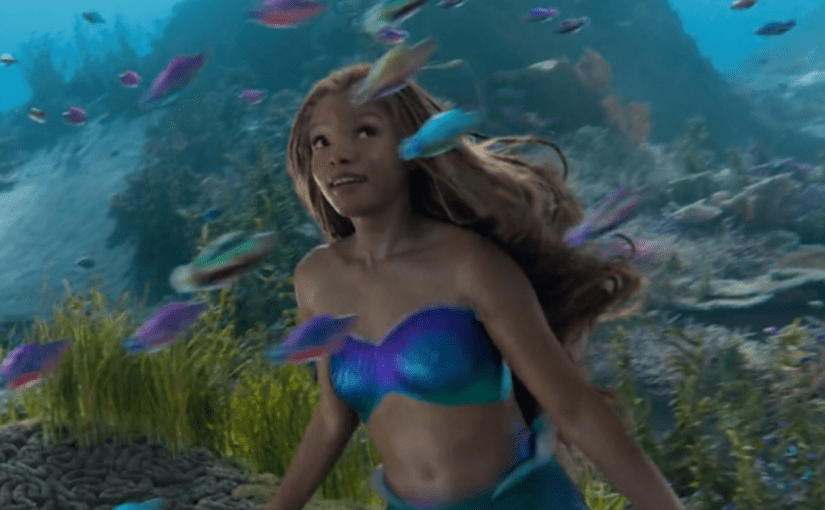
Still, it’s not all bad in this new The Little Mermaid.  Most of the cast is quite good.  Newcomer Halle Bailey (sure to be memorable in the upcoming musical version of The Color Purple) is sensational and she’s wonderful to look at as either the mermaid or the human version lacking a voice.  She has a wonderful singing voice and she’s a terrific actor against a CGI world of complicated water shots and imaginary creatures serving as her companions.  Melissa McCarthy is unrecognizable as Ursula, the sinister squid sea witch.  Her voice has a gruff intimidating edge to it and her torso and head donned in purple texture flow nicely with the CGI tentacles.  Javier Bardem is not doing his best work here because the script doesn’t demand it of him, but he fits in nicely as Triton, king of the undersea and father to Ariel.

Jacob Trembley lends a preteen personality to Flounder whose role is significantly diminished in this update.  That’s a mistake.  Instead, we get more of Scuttle who doesn’t look like a pelican any longer but is a bird who can somehow hold his breath under water for long periods of time to carry on panicked conversations with her pals.  Awkwafina voices Scuttle, and though I heard some laughter from the audience in response to her performance, it just didn’t win me over.  I found this Scuttle to be a nuisance that took me out of the film with each appearance.  The hip hop rap number (written by Lin Manuel Miranda) she performs was a very underwhelming substitute for comedy.  What was sacrificed was the hilariously silly, slapstick number from the original, where the French chef enthusiastically sang “Les Poisson,” as he torments poor Sebastian in a kitchen full of knives, boiling water and searing hot stoves.

Sebastian, the well-known sidekick, is just okay.  Daveed Diggs is a talented vocal performer, but I don’t think the final product served him well.  Often, I looked at this little guy and was not impressed, as remembrances of disappointment came back to me when I saw Jar Jar Binks for the first time.  Just like that Star Wars character, the googly eyes are detached from the head and Sebastian only evokes expression in that one area.  Nothing is done with the tiny mouth or cheekbones or ears.  Not even his claws or tiny legs offer much to do.  This crab lacked life.  As my colleague Miguel simply put it, the crab was not funny.  He just wasn’t funny in the slightest. 

A nice surprise comes from Jonah Hauer-King as the dashing Prince Eric, rescued from a shipwreck by a mysterious woman with a hypnotically, sensuous voice.  Eric’s role is thankfully expanded with the inclusion of his mother the island Queen (Noma Dumezweni).  Grimsby, the Prince’s aid, is also a welcome appearance (Art Malik) with more to do this time around.

I know for sure that I preferred the second half of the film over the first where new surprises are offered.  Rob Marshall’s film switches the influence of the story to a calypso/Caribbean vibe which is different from the slightly implied Greek environment of the 1989 piece.  This change allows a variety of different people of color and cultures to blend nicely together with believability.  After Ariel transforms into a human and Eric guides her across the island for a day of fun and escape, the story and settings come alive in color and calypso harmony.  In this area of the picture, much of the script is concentrated on Eric and his debates with his mother and her disapproval of the undersea colonies.  Confidant conversations also arise between Eric and Grimsby that I liked.  There’s more innocent flirtations between him and Ariel.  Hauer-King has good scenes with all of his co-stars from Halle Bailey to Noma Dumezweni and Art Malik.  The first half of the film is where much of the underwater life takes place, and it only convinced me so far, really taking me out of the film with the reinvention of the movie’s most famous songs.

Ultimately, like the live action interpretations of Aladdin and Beauty And The Beast this new version of The Little Mermaid is not a must watch and as much as I’m impressed with Melissa McCarthy, Halle Bailey and Jonah Hauer-King, I can’t recommend seeing it at $15 a ticket.  Why should you when the easily accessible and wholly original film is available?  This is just an unnecessary venture.

I’ve grown up as a Disney fan, but once again the Mouse House is demonstrating a lack of will to broaden its imagination.  They’d rather run in with another cash grab at the box office by issuing a substandard product repeat. 

THE HUNGER GAMES

By Marc S. Sanders

Some of the worst atrocities in history have often spawned some of the greatest stories.  I’d expect it would at least leave us feeling melancholy, but I hope it shapes a future that learns from humanity’s worst offenses.  That’s what came to mind as I watched the film adaptation of Suzanne Collins’ dystopian best-selling novel The Hunger Games.

In what was once a supposed North America, the continent is now called Panem and it is divided into twelve districts, with each specializing in some means of living.  Districts 1 and 2 are the upper-class wealthy.  Districts 11 and 12 are the starving destitute.  To maintain a semblance of order, President Snow (a chillingly older Donald Sutherland) oversees the nation’s Annual Hunger Games where a boy and a girl from each district is selected to compete in a dangerous competition of being the last one to outlive their competitors.  May The Odds Be Ever In Your Favor!  In the 74th edition, expert hunting archer Katniss Everdeen (Jennifer Lawrence in her most celebrated role) volunteers herself from District 12 to spare her younger sister from danger and selection.  She is paired up with the District 12 boy, Peeta Malark (Josh Hutcherson). 

Like any sporting competition, Collins’ story takes time to hype up the event.  The youths are fashioned up in the most glamourous adornments and interviewed for television by Caesar Flickerman portrayed by a delicious, yet unsung Stanley Tucci in bright blue hair and sparkly suits, doing his best Griffin, Carson, Letterman, Leno, and O’Brien.  With every white molar revealed in Tucci’s broad smile, he appears even more sinister in the purpose he serves for the Games, Panem, and President Snow.

Jennifer Lawrence gives a faithful portrayal to the Katniss character found in the pages of Collins’ series of young adult novels.  A new hero has been conceived – the rebel who stands along other well knowns like Luke Skywalker, Robin Hood and Harry Potter.  Katniss is not looking to be a savior but with influence from a prior Hunger Games champion (Woody Harrelson, doing his drunken best) and a calm, but humble fashion designer (Lenny Kravitz) she finds herself elevated towards a promising future.  Katniss Everdeen inherits the moniker known as “The Girl On Fire” with a three finger salute and a somber three note battle cry harmony.

I’ve likened the setting of The Hunger Games to the Holocaust and the early twentieth century European Nazi occupation.  (It seems more apparent in the next film, Catching Fire.)  If I had to compare the real-life period to this fictional one, then they are not anywhere close.  Yet, Suzanne Collins and director Gary Ross’ film depict hardship and oppression from a ruling upper class gleefully using their young for savage sport entertainment, while being forced to dwell in concentration camps with no permission to escape or run free, lest they suffer terrible punishments for themselves or those they care most about.

The Hunger Games values the themes of sacrifice while some characters inadvertently become heroes for a people against a domineering force.  It’s fantasy.  It’s adventurous.  It’s sprinkled with romanticism for Katniss and the triangle she’s pitted within for her care of Peeta but also her loving affections for another District 12 resident named Gale (Liam Hemsworth).   Frankly, the romance angle is a little weak in the films and books.  Ultimately though, it is harsh for the young characters in the story, which is why my wife refuses to invest her time.  I empathize with her position.  However, I find the story inspiring.  It’s also a hell of a thriller.

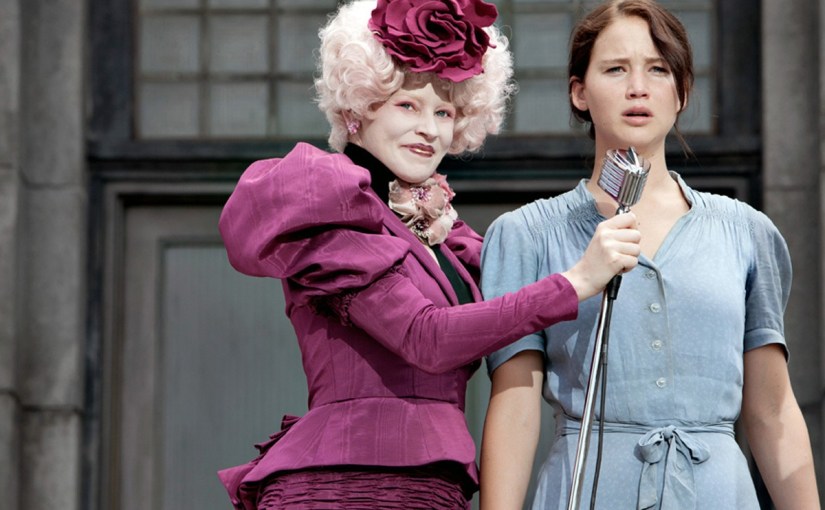
As a film, Gary Ross assembled a strong and alive production of gaudy, bright colors within the capital against morose grays found in District 12.  The clash of the two settings is no more apparent than when squeaky Effie Trinkett in her garishly loud facial makeup and wardrobes arrives in District 12 to host the Reaping, also known as the selection of the child contestants.  So many actors in this cast are memorable.  An unrecognizable Elizabeth Banks is no exception.  As Effie, her personality that publicly represents a hesitant Katniss and Peeta is deliberately inappropriate and further demonstrates how demonically twisted the mentality of The Hunger Games truly is. 

When it is time to finally arrive at the manufactured arena where the contestants will do battle to the death, Gary Ross effectively incorporates the inventive surprises offered by Collins’ source material.  Some competitors are brutal in their combative skills, but environmentally speaking the forest like jungle is dangerous as well.  Especially notable is a hive of stinging tracker jackers that’ll leave the viewers shaken. 

Suzanne Collins’ first installment of her series persists in leaving its ending completely questionable.  Will all these children, some of them who are noble and good, actually die?  Could a good soul like Katniss follow through with what the Games demand of her like killing Peeta for example?  I appreciate the imagination that went into the ending, leaving a subsequent tale to be told beyond this film.  

My one complaint is common in action films.  Gary Ross does really well with the edits and filming of his movie.  However, one of the last scenes develops into a hand-to-hand combat moment taking place in darkness with very shaky camera work and uneven grunts, punches, and kicks.  I abhor when filmmakers go this route.  It’s lazy work.  I can’t tell who is hitting who or where.  I’m just supposed to accept the final struggle that the hero is having with the bad guy and feel a sense of urgency and suspense as they supposedly cast a harsh blow to their enemy and fall over. I might as well close my eyes during moments like this because it’s all just blurry streaks in midnight blackness with sound editing filtered into the sequence.  This tiring approach happens so often in movies, and it becomes a let down for me time and again.   I love a well-made, thought-provoking thriller but the filmmaker hacks it all up near the end and it looks like he’s got to meet a deadline for the final print to get out to the theaters.

There’s much to discuss and think about in The Hunger Games.  Suzanne Collins’ idea stemmed from how television viewers soaked up the drama found in reality tv shows like Survivor and Big Brother.  It’s not so much the fate of the contestants that we care about, but how do they serve the producer’s crafted storylines.  Even American Idol steers the drama of the kids who get their shot at Hollywood fame.  The Super Bowl will position a star player like Tom Brady as a focus with questions of whether this is his final season, and how the championship games affect his marriage and family.  Does he get along with his coach?  None of this has anything to do with the points on the board.  Is all of this about the games, or is it about those tasked with playing the games, and for whose benefit of control, wealth, and power?  In this fantasy film, do the people of Panem cry at the drama spurned from the horrifying death of a child they got to know from Caesar’s colorful interviews, or are they in despair at the loss of another young life?  Whether it is real or fictional, is the drama of these gladiator games and competitions focused in the right direction?

The cast and production team under Gary Ross have put together an effective dystopian and bleak future reliant upon what the world focuses on more than anything beyond who they truly love or what they stand for.  The Hunger Games might seem inconceivable, but it is frighteningly relatable. 

ANT-MAN AND THE WASP: QUANTUMANIA

By Marc S. Sanders

Ant-Man And The Wasp: Quantumania is a fun frolic through the Quantum Realm, another dimension that was uncovered in previous chapters within the Ant-Man series of films.  I’m not watching a potential Best Picture nominee for 2023.  I’m watching a glorious kaleidoscope of colors and visual effects with likable characters, and the setup of a new big bad villain for upcoming installments for the Marvel Cinematic Universe.  It’s not a perfect movie.  It’s corny and hokey at times, but I was with the picture the whole way.

I do believe these sci fi superhero franchise films are getting way too diluted.  I think there are more Marvel films now, all working within a shared universe, then there are episodes of single seasons of television shows.  A lot of these films do not stand apart any longer and hinge on events or hanging threads that occur in prior installments.  It makes for a lot of homework and time spent on the consumer to keep track of everything, and where everyone was last left off.  With Disney + adding in multiple Marvel streaming series to watch as well, I’m sorry but my days feel like they need to be extended beyond the standard 24 hours.  The economic term known as “The Law Of Diminishing Marginal Utility” hearkens back to me at this point, all these years later after we first met Robert Downey Jr. as Iron Man in 2008.  Are viewers getting tired of the superhero phenomenon?  Superhero movies rule the box office these days.  Westerns did it four or five generations ago.  How many new westerns do you now see each year?

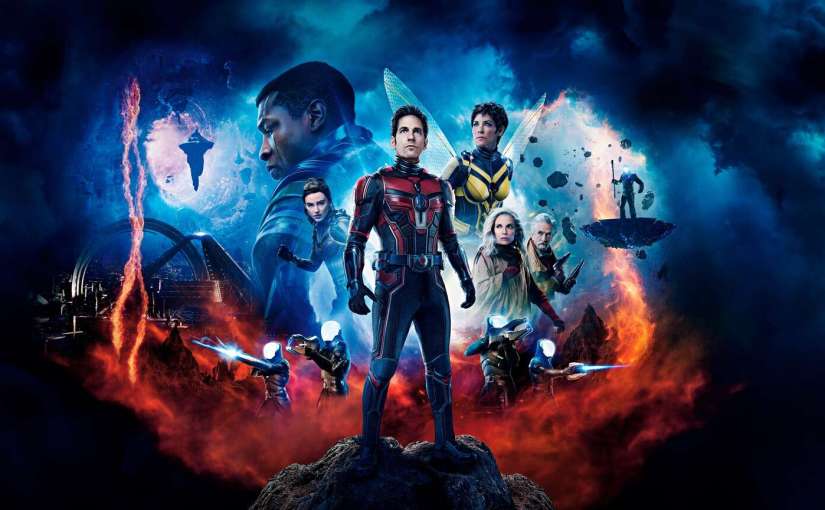
The blessing of Quantumania is that it does not rely abundantly on other material in the Marvel Cinematic Universe.  Scott Lang (Paul Rudd) reintroduces himself in a very adoring Paul Rudd-like way with a voiceover and thereafter, he is unexpectedly sucked into the Quantum Realm, along with his daughter Cassie (Kathryn Newton), his current partner Hope Van Dyne (Evangeline Lilly), aka The Wasp, and his mentors Hank Pym and Janet Van Dyne (Michael Douglas, Michelle Pfeiffer).  The gang must primarily depend on Janet to navigate them through this world of inconsistency and oddball inhabitants where no two characters seem to look alike.  Janet was marooned in the Quantum Realm for thirty years before finally being rescued.  What concerns her the most is one who is first referred to as “The Conqueror,” and later identified as the frightening superman known as Kang (Jonathan Majors), who was mysteriously exiled to this place.  As Janet describes, Kang has made the prison of the Quantum Realm his empire and now he wants to use the technology that our heroes possess to break free of this dimension and cause all kinds of chaos in the real world and other parallel universes.

The best assets to the film are the scenes between Jonathan Majors and Michelle Pfeiffer.  Granted, their dialogue could apply to any other kind of movie.  A lot of ping pong arguments between the villain and hero, which if I remember correctly go something like “You don’t understand.” and “I’ll never let that happen.”  This verbiage could also be suitable in a Meryl Streep tearjerker or a courtroom drama.  It’s pretty standard.  We’ve seen discussions like this a million times before.  Fortunately, my state of mind was not demanding of thought-provoking conversation.  The magnetism of their acting in front of the expansive CGI environment kept me hooked.   Jonathan Majors simply looks like a very frightening threat.  He’s calm at one point and later raging like a lunatic.  The man has levels.  If he were reciting the ingredients of chocolate chip cookies, I’d be on pins and needles. 

I do not think Quantumania is going to wow most audiences.  In fact, it’ll be a divisive film.  It’ll go half and half.  Though I really do not like to rank films any longer because it feels so pointless, I got into a debate with my wife and daughter about which one was better.  Quantumania or Wakanda Forever.  Both films have their merits, but I left the latest Black Panther film feeling a little depressed and exhausted.  That was a long time to feel morose for a superhero film.  The ladies, however, appreciated the story of that film over this one.  (I wanted to see the Black Panther suit a lot sooner.  I wanted a handful of people to be cut from the film, and I thought the Namor character was very boring.  Look for my review on this site.)

With Quantumania, audiences are either going to like the weirdness that is splashed all over the screen.  Splashed is not a strong enough word.  Try SPLATTERED!!!! Everywhere you look there is something abnormal to see from one corner to the next.  On the other hand, viewers will think the Quantum Realm and its inhabitants are just too bizarre, and the Marvel filmmakers are scraping the bottom of the barrel in imagination.  Sorry, but I got a kick out of the tall stilt guy with a spot light lamp for a head.  I thought the pink goo guy was cute.  I also giggled at the fat head henchman, with scrawny arms and legs, known as M.O.D.O.K. (with Corey Stall, making an MCU return).  The functionality of this character is deliberately lacking and comes off like Looney Tunes cutting room material, but that’s also why he is here.  If there was anything looking remotely normal in the Quantum Realm, well then it isn’t the Quantum Realm, I guess.  Bill Murray even shows up, but if you need a bathroom break, this is when you should go.  All of this looks way too stupid, yes!  Then again, stupid can be entertaining and stupid is often taken with subjectivity. So, I’m just one guy’s opinion. 

Quantumania is maybe the most unsophisticated of all the Marvel films.  More so than the Guardians movies, or the most recent Thor installment.  With a happy go lucky Paul Rudd, an army of ants and some of the most bizarre CGI extras found anywhere it proudly stands tall on that pedestal of ultra, ultra, ULTRA weird.  I think director Peyton Reed accomplished what he set out to do with this film.  The question is will the film win majority of approval within the nerd land of keyboard warriors like myself, who share their perspectives on the internet.  Well, the movie gets my vote at least.

IT’S A WONDERFUL LIFE

By Marc S. Sanders

I have finally righted a serious wrong and watched Frank Capra’s It’s A Wonderful Life, and what a pleasurable experience it has been.  Reader, if this movie lover who gets hopped up on science fiction gobbley gook with laser swords and spaceships can watch an old black and white movie feeling sorrow for its main characters, and elation when the film finishes, then it’s easy to understand how timeless and impressionable Capra’s classic film truly is.

I recall when I had finally seen It Happened One Night, originally released in 1934 and arguably the pioneer of the romantic comedy genre.  I could not help but connect certain moments and pieces of dialogue to the films released while I was growing up, like When Harry Met Sally… and Bull Durham.  Those films took inspiration from Capra’s comedy with Clark Gable and Claudette Colbert.  Capra pioneered storytelling once again with It’s A Wonderful Life.  As my wife and I watched the movie late last night until nearly two in the morning, I said to her this is like Back To The Future.  My wife said A Christmas Carol.  Both true statements.  So perhaps while Capra was revolutionary with his own storytelling, he might have been adopting some inspiration from what came before as well.  Regardless, I applaud his approach.  Frank Capra is a tremendous gift to the cinematic medium.  If there was a Mount Rushmore for filmmakers, Capra would most certainly be sculpted alongside the likes of Hitchcock, Chaplin and Disney.

George Bailey (James Stewart) has big dreams of leaving his sleepy little town of Bedford Falls and building grand designs of skyscrapers while also exploring the world, beginning with Europe and Alaska and whatever else needs discovering.  Like any of us, our yearning for adventure and the destinies we wish for get interrupted. Before you know it, we ask ourselves if life has passed us by.  It takes a guardian angel named Clarence (Henry Travers) to remind George that life has been with him all along; maybe not the life he envisaged, but certainly a life of purpose and significance beyond just himself.

George watches as his high school chums go on to grand accomplishments that pay off in enormous amounts of wealth.  His younger brother Harry (Todd Karns) goes to college, gets married and becomes a celebrated war hero.  However, George remains in Bedford Falls offering loans to his fellow townsfolk that he can’t afford to honor with a business he inherited from his father.  To lend and support comes involuntary to George.  He’s just a good man. 

On the other end of the spectrum is the mean, wealthy miser Mr. Potter (Lionel Barrymore).  Barrymore plays Potter like one of the worst villains in the history of cinema.  An unforgiving, jealous wretch of a man.  His cruelty is long and unmatched, even if he is relegated to a wheelchair.  He knows how destitute George is, despite his unending generosity, but Potter won’t tolerate the admiration George receives.  To squash George’s stature, he’ll buy out his business.  He’ll make every effort to silence George Bailey’s influence.  Potter will even try to take George under his wing where he can maintain complete authority as a big fish in the small pond of Bedford Falls.  Yet, Potter’s never-ending wealth cannot crush the love for George’s humbleness and giving nature.

A favorite device of mine in movies is when the filmmaker can turn the story’s setting into a character all its own.  Examples of this are shown in pieces like Spielberg’s Schindler’s List where the use of thousands of extras and piles of rubble bring testimony to the atrocities of the Holocaust.  In James Cameron’s Avatar (which I just watched as a refresher for the just released sequel), an imaginary neon glowing planet awakens our senses, and we learn that its inhabitants form a symbiont circle with the plant life and animals that dwell there.  In many films, the time and place speak to the viewer.  Bedford Falls is a main character to the story.  Capra makes wonderful use of the Main Street where each business building quickly becomes very familiar as if we have walked into these small town structures a hundred times.  It hearkened me back to my time in Fair Lawn, New Jersey where I would accompany my grandmother on her daily errands to the bank, the kosher deli and the Woolworth’s.  Wherever she went, everyone knew Helen.  In Bedford Falls, the pharmacy with the soda jerk doesn’t look new to me.  It appears like I’d seen it a hundred times before.  Martini’s, the bar, felt like I knew every hob knobber in the joint.  I could smell the ink and feel the creak of the wooden floors in Bailey Building and Loan. 

The townsfolk are also assembled wisely by Capra.  An old man sitting on his porch at night takes in the flirtations that George and soon to be wife Mary (Donna Reed) exchange with one another.  This man represents Bedford Falls taking stock in what’s to come next for our protagonist.  The people in this town have a rhythm to their gatherings.  Capra offers a magnificent shot where the camera is overhead behind George, wearing his overcoat and hat, and the townspeople are facing him at the other end of the sidewalk.  They expect of George, but does George have anything left to give?  I can only see the back of Jimmy Stewart, but I know all too well the expression he’s sending to the people opposite him.  Look at the scene where they march over to George Bailey’s business demanding their monies back.  How one delivers a line followed by another is perfectly timed to James Stewart’s despair.  The ending is beautifully cut as these same folks come into George’s home to offer their sense of giving during a desperate hour of need for George. 

I always knew the story of It’s A Wonderful Life.   Years ago, I saw a stage production where Miguel portrayed George opposite his girlfriend in the role of Mary.  Yet, I was not familiar enough with the surprises that Capra’s film offers.  I just didn’t realize how much fantasy is embedded in the movie as Clarence is meant to be a naïve angel who has yet to earn his wings.  Seems a little too childlike for me on the surface.  I’ll admit I didn’t take to the angels represented as blinking stars early in the picture.  That’s hokey!  However, when Clarence is personified in the latter half of the film, Henry Travers brings a sense of clarity to the purpose of life when he forces George and maybe anyone watching the movie to imagine what things would be like had they never been born.  Reader, I think I’ve seen story adaptations like this on episodes of Family Ties and The Golden Girls.  In this movie, it becomes frightening as we realize the actions we take carry impacts with them.  Had George not rescued his brother Harry from a skating accident, what would have happened to a squadron of soldiers during the war?  Had George not had the nerve to dance with Mary at his high school dance, what would have happened to her?  Had George not existed, then he wouldn’t be available to lend monies to people and what would have happened to a beautiful collection of new homes that would never be erected?  These questions are incorporated into roughly a thirty-minute last act that remind you to appreciate all that you saw earlier in the film.  I want to say its cheesy, but Travers and Stewart really don’t make it that way.  The sequence comes through with forthright honesty from Travers, never going big or outlandish, and genuine anguish from Stewart who convincingly appears like he’s lost everything when earlier he felt like he had nothing. 

I read that Jimmy Stewart did this film shortly after returning from serving in World War II.  He was suffering from PTSD and much of the torment and agony that George exhibits was coming through naturally on film.  This has to be one of the all-time greatest performances on screen.  Jimmy Stewart’s timing in practically every scene of the picture is perfection.  He’s a wide eyed optimist with big enthusiasm to get his life going.  Then he transcends into a teasing flirt with the girl he was not expected to hook up with.  When George tells Mary he wants to throw a lasso around the moon and give it to her, I really believe he could do it.  We have Jimmy Stewart to thank for that.  Later, he’s unexpectedly frightening as he is on the verge of being charged with fraud and penniless.  Stewart is uncompromising in front of Donna Reed and the young actors playing his children.  When he kicks over the table with the train set and gifts, on Christmas Eve, it’s terribly shocking.  Sadly, it’s relatable.  A film from 1946 presents personal problems and struggles that exist today.  That is why It’s A Wonderful Life is such an important piece.  We struggle to live with our struggles.

Frank Capra’s film is necessary to remind each of us to never give up, no matter how hard it gets.  We have value.  We have importance to ourselves and to others.  We are loved.  Yes, it’s only a movie and it conveniently solves itself in its made-up fantasy.  However, those that enrich and occupy space in our daily lives are real and they are folks who depend on us for their fulfillment and happiness.  We are necessary to making their lives better and sustainable.  Reciprocally speaking, they are just as important to mine and your satisfactions.  It might be drippy to claim that Frank Capra’s film is a “feel good movie,” but I prefer to believe that the writer/director, along with Stewart, Reed, Travers and the rest of the company served a higher purpose. They demonstrate that we have all been blessed with an enormous gift filled with the riches of love and friendship that life absorbs and treasures. 

Happy Holidays!!

THE LITTLE MERMAID (1989)

By Marc S. Sanders

What I hearken back to most when I watch The Little Mermaid is my junior year of high school in 1989.  If you were around at that time, then maybe you realized how much of an impact the characters of Ariel, Sebastian, Flounder, Scuttle and Ursula The Sea Witch had on kids, but teen pop culture as well.  Batman was big that year.  Disney’s underwater, romantic, musical adventure was at least as large.  Driving home from school, everyone I knew were singing along to celebrated numbers like Kiss The Girl, Les Poisson, Under The Sea and Part Of Your World.  My drama class couldn’t get enough of Poor Unfortunate Souls.  Oh, how overdramatic we would get in Mr. Locklair’s class while emulating Pat Carroll.  I still harmonize Ariel surrendering her voice.  Yes!  I can hold the tune!!!!  There is no denying The Little Mermaid cast a spell over the student body at Berkeley Preparatory School in Tampa, Florida.

The Little Mermaid is an important entry in the Disney lexicon.  Disney films were considered substandard, tired and stale before this release.  However, the adored fable based upon a story from Hans Christian Anderson awakened something that still carries on.  The music within the film from beloved writers Alan Menken and Howard Ashman were delivered like Broadway showstoppers.  The quality of the songs was elevated with gorgeous calypso and reggae harmonies, and vocal characterizations as colorful as the underwater life depicted on screen.

Ariel (Jodi Benson) is the title character who dreams of what life is like above the surface.  Her father, King Triton, strictly forbids her from going above the water.  In his eyes, humans are ghastly.  That’s a problem because his daughter is enamored with handsome Prince Eric (Christopher Daniel Barnes).  Like a sixteen-year-old who sneaks out of the house through a bedroom window, Ariel visits the nefarious and alluring sea witch, Ursula (a rapturous Pat Carroll in one of the best fantasy villain roles to ever appear in the movies).  The deal is Ursula will turn Ariel into a human for three days.  In exchange the little mermaid must surrender her gorgeous singing voice.  If Eric does not give Ariel a kiss of true love by the time the sun sets on the third day, then her soul belongs to Ursula for all eternity. Ariel gets some help from Sebastian the crab (also a sea-life orchestral conductor), innocent Flounder, and a zany seagull named Scuttle (Buddy Hackett).

The animators at Disney use everything at their disposal to burst wondrous color within the film.  There’s life brought to the sea life within the backgrounds from a blowfish who BLOWS, to the Octopus and the shrimp and swordfish.  Even the random bubbles that float around are marvelous to look at. Nothing is off limits and life under the sea seems so much more enticing compared to the ho hum activities that we humans endure each day with traffic jams and junk mail.

Other Disney productions like Alaadin and Beauty And The Beast that followed, offer some life lessons for the protagonists to consider.  The Little Mermaid doesn’t actually.  It rests upon wishes and dreams for Ariel.  I’m thankful for that.  It’s such a glorious picture that I coast through on the fantasy of it all.  Ariel takes me on adventures to explore shipwrecks and her grotto where her human collectibles are stashed.  I get to carefully approach the dark imagery of Ursula’s caverns where countless, slimy, pitiful souls suffer, while the tentacled monster delights in her vanity with Pat Carroll’s gleeful voiceover.  It’s just enough for me.  Disney doesn’t always have to preach, and I think it’s why The Little Mermaid is my favorite of all of their films. 

Every moment is beautifully drawn in shape and color.  Still for a film that came six years before the Pixar evolution, the expressions of the characters come off so naturally.  Look at Sebastian’s fear and frustration as he tries to keep up with an independent Ariel.  Pay attention to Ariel’s nervous reaction when she encounters Eric on the beach after she’s become human.  She’s animated to try and straighten her hair and grin her teeth because its as if the popular kid in school is walking across a disco lit gymnasium to ask her for a dance.  The animation is purely inspired by natural, human behavior that we are all too familiar with.  When drawn like this, we can’t help but be impressed.

The songs are the highlights though.  The compositions are so lively and easy to pick up and sing along to, like we all did in high school.  The lyrics are equally impressive like the most brilliant of dialogue.  When Ursula makes her campaign for why this trade would be advantageous for Ariel (Poor Unfortunate Souls), I can’t help but believe her.  She’ll have her looks and pretty face.  It’s only her voice!  You got a point there Ursula.  The best villains always have the most sound reasonings behind their motivations.

Sebastian (Samuel E Wright) makes a strong argument for why life Under The Sea is so much better than living on land.  His enthusiasm in song is completely convincing.  Life under the sea is nothing but a party.  Let’s go.

Jodi Benson gives a strong voiceover performance as Ariel.  I’m hearing a firm and independent young woman who stands her ground and will defy any orders to go after what she desires.  Her rendition of Part Of Your World is one of Disney’s most treasured and celebrated moments in film history when accompanied with the setting of Ariel’s towering grotto of props that we humans take for granted like fish hooks and dining utensils, especially a dinglehopper…you know…a fork!  This is what a kid dreams of becoming when alone in her room with no one there to judge her true feelings and desires.  It’s truly glorious.

The one scene that does give me pause is the dramatic discovery King Triton has of Ariel’s secret vault of collectibles.  By the end of the moment, his temper has grown so big, that he unleashes the power of his trident to destroy everything she’s treasured.  I’ve always said this looks brutally familiar to how a father might take a baseball bat to a kid and her room, teetering on domestic violence.  The scene is memorable but unnerving all the same.  Still, I have to remind myself that this is a fantasy, and this is only a movie. 

Nonetheless, The Little Mermaid is a timeless film filled with magic and whimsy and daring escapes and big laughs that are not just relegated for eight-year-olds.  As adults, we remember those butterfly feelings of our first crush and what held us back from pursuing it further.  We can relate to what the characters do for, and towards each other.  Again, everyone from the deliciously wicked villain down to the defiantly brave protagonist and her sidekicks have a point and very human understandings for why they exist and what they want out of life.  Being a mermaid or a crab or a sea monster doesn’t make any of these people any less human. 

FIGHT CLUB

By Marc S. Sanders

David Fincher’s Fight Club is a deliberately ugly and dreary film. It has to be to evoke the insomnia its narrator (Edward Norton) suffers from, as well as his lonely depression that offers no answers for his purpose to exist or to be loved by another person.

To alleviate his need for something fulfilling, the narrator resorts to attending support groups for men suffering from illnesses and debilitating diseases like testicular cancer. There he meets a former body builder named Bob (the singer Meat Loaf) who has developed floppy breasts after going through hormone therapy. Bob follows the processes of the self help group and embraces on to Norton’s character as a means of support; stuffing his face into Bob’s breasts. The narrator eventually becomes accustomed to this maternal practice and the ritual of attending these meetings as a regular process. However, he feels he is getting upstaged by Marla (Helena Bonham Carter), a punk looking girl with dark eyeliner and wild jet-black hair.

Even though Marla and the narrator negotiate who attends what meetings and on what night, Norton meets another punk like reckless character known as Tyler Durdin (memorably played by Brad Pitt) who manufactures and sells soap but also edits film reels, sneakily inserting penis images into family films. Tyler also works as a waiter at a high-end restaurant where he proudly adds a little of “himself” to all the courses that are served.

The narrator only works at a boring desk job where his boss uses any opportunity to look down upon him and chastise him on his performance or appearance, but never recognizing anything further within his nature. The boss could care less about him. Naturally, the narrator becomes in awe of Tyler’s behavior. Tyler is a rebel and offers much more beyond Bob’s comfort. Tyler serves a purpose for the narrator to pursue.

When Tyler challenges the narrator to hit him as hard as he can it eventually leads to a new kind of gathering for both of them, a support group known as Fight Club. Men from all over soon gather underground to partake of letting out their aggressions with bare knuckle fists and wrestling. Anyone attending gets a therapeutic vibe from bleeding and bruising themselves upon one another. The narrator certainly feels better.

Going a step further leads Tyler and the narrator to fight back against a system of order and capitalism. Their philosophy picks up traction and soon a form of revolution is taking place across the entire country. Somehow, the narrator is taken off guard by this new belief system.

There’s a lot to consider and question in Fight Club, though I’m not sure I care for the film as a whole to debate its message. Sometimes it feels like it’s not moving anywhere. Norton’s character learns things about his own consciousness and need to falsely subject himself as a cancer survivor or as an underground brawler because he has nothing else really going for him. I get that, but why should I care or like it?

Tyler Durdin resides in a broken down house on the other end of the city that is leaking from every pipe and it’s electricity could ignite another fire that maybe this decrepit dwelling survived once before. Tyler is happy with his home and happy to share it with the narrator as well as Marla whom he has endless sex with. Tyler doesn’t want the fancy trappings. It’s revolting to even possess such materialism and suck off the tit of a capitalist regime. With the narrator at his side, he encourages a fight against the power of commercialism and wealth. Find a way to destroy the structures of what the country has built itself into, perhaps.

That’s the message of Fight Club. I just can’t lay claim that I cared for the execution of the revolt. I’m supposed to laugh at Tyler’s antics at times like when he steals the gross liquid fat from liposuction patients to manufacture the soap he sells. Yes, we get a moment where the bags of fat leak and splatter all over the place. It was just never amusing for me. I found no symbolism in this passage. It’s just absolutely disgusting. When Tyler happily pisses in someone’s soup, I don’t think it’s funny either. I don’t like Tyler. I don’t envy him or want to be him. I don’t find anything to cheer for with him. I’ve got more admiration for John Bender in The Breakfast Club than I do for Tyler Durdin. I might respect what he stands for to a degree as we are a culture brainwashed by advertising and commercialism. I just don’t care for the actions taken by this so-called martyr on behalf of the self-described unfortunates like Norton’s narrator.

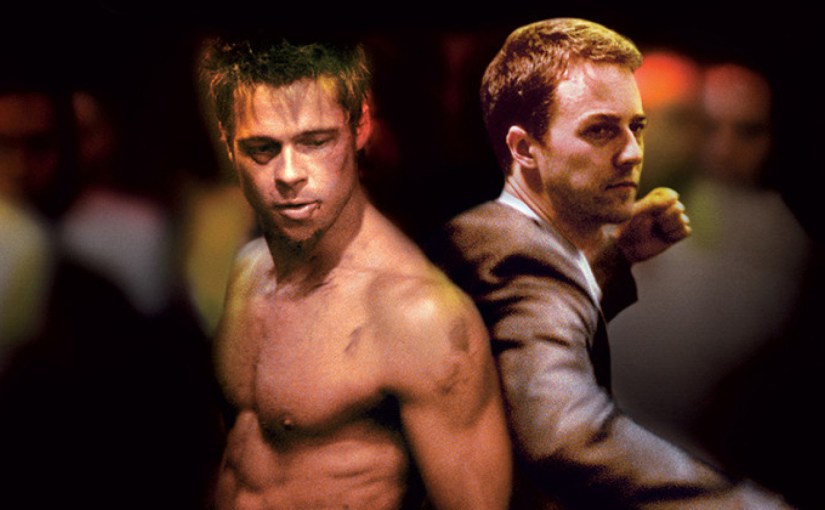
I also find it ironic and quite hypocritical that Fincher’s film is a call to stand up to materialism and commercialism and yet the cast is headlined by Brad Pitt, arguably one of the biggest box office stars of the last 30 years, complete with his name above the title and his image front and center ahead of Edward Norton’s on the film posters that promote the film. Pitt is also the guy you see first, last and all over the middle of any of the film’s trailers and advertisements.

Now tell me, is that not a contradiction in terms?

THOR: LOVE AND THUNDER

By Marc S. Sanders

Taika Waititi’s Thor: Love And Thunder doesn’t just operate as a standard Marvel Super Hero movie.  I think it encapsulates what moviegoers treasure when watching a film, and that consists of a gamut of emotions with the opportunity to absorb the best in sight and sound.  Even if we are watching a guy fly through the skies with a cape that’ll be marketed into a million toys and t-shirts, sight and sound are nothing without brains behind a script.  It’s fortunate that a director like Waititi always works with that in mind.  Marvel overseer Kevin Feige knows how to recruit talent behind the camera and you just can’t go wrong with the architect of a spoof on the surface, yet an all too horrifyingly real film underneath, like the widely acclaimed Jo Jo Rabbit.

I’ve always laid claim to the fact that movies largely recognized as “tear jerkers” like Steel Magnolias and Terms Of Endearment are actually comedies first, and then dramatic sob stories second.  I’m serious about that observation.  Why?  Because if a film is going to go to great lengths to risk the outcome of one of its main characters, then it must get its audience to embrace and deeply love that person first.  The best avenue to that approach is to outrageously laugh and cheer that character on ahead of what’s to come.  Taika Waititi’s second film to center on the God of Thunder does just that.  The best reward I got from Thor: Love And Thunder is that I laughed quite often (as the trailers imply), but I also teetered on tears as well.  Good fantasy storytelling will incorporate an all too real conflict with its protagonists and then introduce the strange and unusual as an escape.  The best example may be The Wizard Of Oz, and the simple set up of Dorothy and the risk of her perishing with her dog Toto in a threating tornado.  More recently, I also think about Guillermo Del Toro’s Pan’s Labyrinth centering on a young girl in early twentieth century war torn Europe.  Again, Waititi’s coming of age during Nazi occupation opus, Jo Jo Rabbit, follows this formula as well.  Without spoiling too much from Thor’s latest adventure, Waititi presents an all too real and unforgiving circumstance for one of the film’s characters and then segues into his delightfully and never too weird assortment of settings and characters.

It’d be easy to think that by what may be the sixth or seventh time we’ve seen Chris Hemsworth in the garb of this character that anything inventive would have been exhausted by now.  Not so.  A new dimension in storytelling arrives midway through the film that presents a different crisis for the proud God.  Hemsworth really approaches it beautifully.  It was reminiscent of Christopher Reeve in the original Superman, actually.

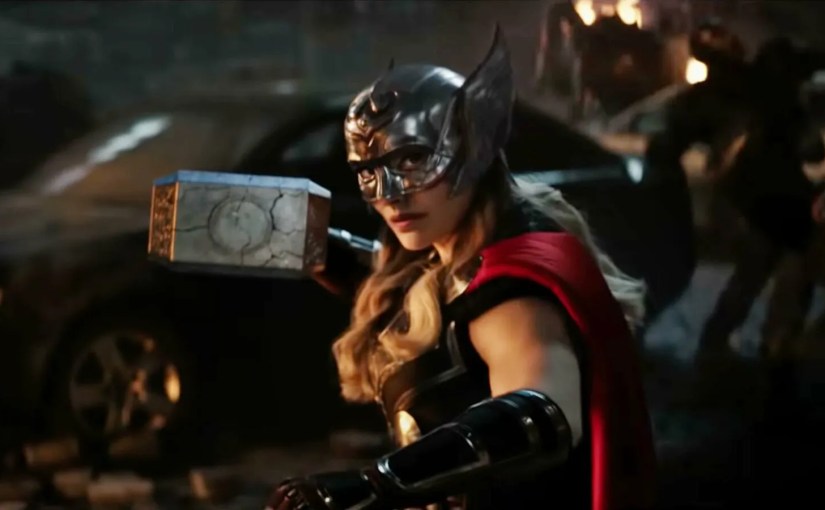
A supporting cast of return players work well together, particularly Natalie Portman, who is given a much more fleshed out and well considered character arc than her two previous Thor films. (Early on, Marvel Studios was notorious for not writing good female characters in any of their pictures.  They were just presented as glamorous damsels in distress. Thankfully, that’s well behind them by now.)  Portman returns as the on again/off again love interest, Dr. Jane Foster, for Thor.  Even better though, Jane actually becomes Thor!!!!! (No spoiler there.  Just look at the trailer or marketing poster.)  There’s great on-screen interaction with Portman and Hemsworth, even when it’s a montage of past dating episodes like in ridiculous Halloween costumes or having a domestic squabble as any typical married couple might have.  Hollywood should reunite these two for a romantic comedy in the vein of Rob Reiner/Nora Ephron material.  Chris Hemsworth is a much better partner than Ashton Kutcher ever was in a past Natalie Portman film.  Put Chris Hemsworth together with Natalie Portman again and they could become as adoring as Tom Hanks and Meg Ryan did.

By the time the fourth movie comes, does it really matter who the villain is played by?  Well, when you are writing a smart script amid ridiculous visuals like Taika Waititi is known for, the answer is yes.  This film surprisingly opens on a downer prologue that necessitates good dramatic acting amid silly CGI and garishly loud costumes.  It’s fortunate that Christian Bale, who regularly performs on a method level comparable to Daniel Day Lewis, was available to portray the scrawny, pale and scarred Gorr The God Butcher.  Bale puts all his talents into what could’ve been a throwaway role like, say a Ghostbusters bad guy.  (Can anyone tell me who actually played Gozar in the 1984 film????)  This is another notch in Bale’s repertoire of outstanding credits that should not be overlooked.  You can sympathize with Gorr, as well as be frightened of him.  There’s much range in this character on the same level as the Thanos villain from earlier Marvel films.

Russell Crowe has a fun appearance as the God known as Zeus.  He looks over the top ridiculous and he works in antics that seem like they came out of episodes of Who’s Line Is It Anyway?  Put it this way, I haven’t forgotten how Crowe walks down a staircase yet.  If Russell Crowe is anything of an educated performance artist, then when he was getting sized up in wardrobe, I’m sure the wheels were turning and he was considering what tics could work for that of a God drowning proudly in his own vanity.

Tessa Thompson and Taika Waititi are thankfully back, respectively as Valkyrie, King of the fishing/tourist destination New Asgard, and the simply innocent rock guy buddy, Korg.  The Guardians Of The Galaxy are here too.  It’s a fun bit of material they have to play with.

In another director/screenwriter’s hands, any Thor film would likely get boring with its standard formal Shakespearean like vocabulary and artificial CGI.  Isn’t that an ongoing problem with CGI anyway?  So often it looks to fake.  Because Taika Waititi opts for bright colors and odd shapes and sizes of setting and background characters, nothing could look artificial, because the fantasy is always acknowledged as over the top by the very characters occupying the space.  A glass castle of pinks and purples that resembles gigantic glass Mary Jane bongs or science lab beakers is accepted in a Thor film, just as much as munchkin size, owl like creatures with small beaks are a terrorizing army in flying jet skis with mounted laser guns.  Mix in a blaring rock soundtrack and Waititi hits the notes where it’s okay to laugh at the silliness of it all. In other moments, he’ll invite his audience back in from recess to take in what’s hard and difficult to live with and endure.  Again, Waititi pleasantly surprised me with the balancing act of outrageous comedy against crushing drama when he made Jo Jo Rabbit.  The blend works so well here in not so typical Marvel fashion.

Thor: Love And Thunder left me thinking that it is the best of the superhero’s four films.  It’s measure of laughs and choked up drama kept engaged and I appreciated the experience.  Remember, I recalled Steel Magnolias and Terms Of Endearment in this write up.  If you don’t take that comparison lightly, then hopefully you’ll have the same experience I did with this installment of the Marvel franchise.

PS: Hats off to the trailers for not incorporating everything the film has to offer.  Within the first fifteen minutes of the movie, I was actually taken aback by an element I never considered or expected.  It only enhanced my perspective of the film.

PSS: Anyone that knows me, knows that I love Guns N Roses.  Consider me a born-again fan.  Particularly Sweet Child O’ Mine will always be one of my most favorite songs.  This film reminded me that it was the first song my daughter heard the day after she was born, when I sang it to her in the hospital room. 

MALIFICENT

By Marc S. Sanders

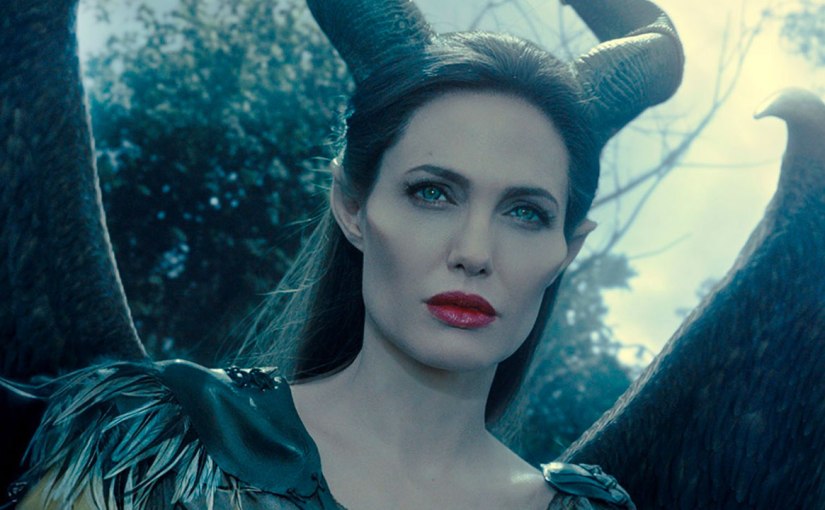
The wagon train of live action adaptations of Disney animated classics reached its pinnacle with 2014’s Maleficent. Much credit going towards Angelina Jolie’s portrayal of the title character. However, the visuals cannot be dismissed either. It’s a gorgeous film directed by Robert Stromberg.

Stromberg brings his wealth of experience in visual effects (Avatar and Master And Commander: The Far Side Of The World) to his directorial debut. The fantasy world of Maleficent’s forest, as well as the looming castle on its outskirts are dressed in gorgeous colors and vast dimension of pathways and caverns. The magical spells wafting in greens, golds, blues and reds, wielded by the characters, including the three protective fairies (led by a strong Imelda Staunton) is hypnotic and blends beautifully with the live actors’ performances. It’s as bold in the visual department as anything cropped up by Peter Jackson or James Cameron.

What makes this brisk 90 minute film special is a different point of view from the classic film Sleeping Beauty. Is there justification to a villain’s actions? Stromberg and Jolie certainly make a case for it. It’s a reminder that there are two sides to every story. Anyone ever consider that maybe Maleficent might have been betrayed at one point? I’ll be damned. At least that’s what I thought, after watching this film.

No one in life is born evil. I like to think people are made evil or perceived as evil. This film is a great example of that, much like the musical Wicked or the recent hit film Joker.

Jolie offers up the frightening aspects of the fairy dressed in black that we’ve been familiar with all these years. However, she’s fortunate that the capable script from Linda Woolverton offers up opportune moments to consider her soft, sensitive side. There are moments of no dialogue as Maleficent observes Princess Aurora (Sleeping Beauty) grow, and she develops a reluctant (it’s hard to resist calling her “Beasty”) affection for the child. Maleficent will even participate in a playful mud fight. There are more than just evil machinations going on here.

Unlike the other Disney live action iterations, Maleficent shows something new and unexpected. It harbors my appreciation for the film whereas Beauty And The Beast or Aladdin did not because they just churned out the same old thing.

If Stromberg’s film suffers from one weakness I’d say it could have used a stronger performance from Sharlto Copley (The A Team film adaptation) as the antagonist, Aurora’s father and Maleficent’s first love; the eventual king. There was not much threat from this guy. He was no match in character much less performance against Jolie.

Still, Maleficent is a great character film with lots of fun, whimsical visuals to explore.

THE WIZARD OF OZ

By Marc S. Sanders

The Wizard Of Oz will always be one of the greatest films ever made.

It’s a visually spectacular marvel of filmmaking and creativity. The accomplishments it achieves in performance, fantasy and musical tones work on any generation who has seen it since its debut on August 15, 1939.

Victor Fleming directed the adaptation from L Frank Baum’s successful series of books. Wisely, the picture opens in black and white where we meet Dorothy, one of the best cast roles in film history with the legendary Judy Garland. She lives on her Kansas farm with her dog Toto and her Auntie Em and Uncle Henry, along with some friendly farmhands called Huck, Hickory & Zeke. Following an unexpected twister, Dorothy and Toto are sent into the heavens while in their farmhouse. When the house finally lands, Fleming has Dorothy open the door to a kaleidoscope of wondrous color. Dorothy has arrived in Munchkin land located in the Land of Oz. The adventure begins.

Nearly any film of fantasy and adventure can be traced back to The Wizard Of Oz. It features the thoughtful mentor with Glinda The Good Witch, and the lovable sidekicks that Dorothy encounters known as the Scarecrow (Ray Bolger), the Tin Man (Jack Haley) and the Lion (Bert Lahr). It also has one of the greatest on screen villains of all time, The Wicked Witch of the West (Margaret Hamilton). The story pursues objects (ruby slippers, a brain, a heart, courage and a broomstick) for the heroes to acquire, years later to be identified by Alfred Hitchcock as “MacGuffins.”

Victor Fleming with Baum’s ingenuity inspired great storytellers of a future in movies yet to come. Authors like JK Rowling and JRR Tolkien or CS Lewis absorbed the will to compose never before conceived imagination thanks to The Wizard Of Oz. So many moments throughout the land far away from Kansas are so inventive. There’s endless the candy colored scenery of Munchkin land, along with a dark forest where trees come alive to argue and throw apples at you. The Witch’s foreboding castle with the crystal ball is ominous and frightening. The Emerald City where the great and powerful Oz resides is spectacular in life and cheerfulness. I still look in awe at the scenic design of the film questioning how it was all done. Matte paintings of endless depth for background give off the vastness of the land as the famous Yellow Brick Road stretches infinitely over rolling hills behind Dorothy and her friends as their journey continues.

The Wizard Of Oz is also an inspiration for the movie musical. Every song is unforgettable. Is there a greater song in film history than “Somewhere Over The Rainbow?” Dance sequences are totally engaging. Try not to love the ease of watching Dorothy skip along the road to “We’re Off To See The Wizard.” Ray Bolger’s rubber legged straw man clumsiness during his first scene with “If I Only Had A Brain,” seems to defy the limits of what a human body can do. Bert Lahr’s “If I Were King Of The Forest” is comedically inspired; the number that pauses the story for a moment as an escape among the characters’ adventure. As a kid I loved to roll my tongue on the word “forrrrrrrrrest.”

Margaret Hamilton’s green skinned wicked witch dressed in black with the pointed hat set a standard in villainy. It instilled some of the first fears many children ever experience to this day. Hamilton’s evil cackle with her determination to obtain Dorothy’s ruby slippers never leaves your mind once you see the performance. The Witch inspired any kind of horror film, and terrible villains we love to hate like Darth Vader, Maleficent, Hannibal Lector or Lord Voldemort. Evil queens and bad guys from the Disney vault only began from the seeds that Hamilton laid out.

So many of the greatest achievements in film history are contained in The Wizard Of Oz. It’s an outstanding musical, an incredible adventure and a brilliant fantasy. It’s beautifully cast and so creative on every technical level necessary for its flights of fancy.

More than any other film ever made, every person should see The Wizard Of Oz at least once in their lifetime.